
Chapter 10
In this chapter the conflicting timelines have been placed together. As we know, the dates and entries may not be accurate but we can compare them to the first column which we are from trusted sources. You will notice that the next three columns are somewhat similar. This is unsurprising as the Chronicles were influenced by Bede, who in turn was influenced by Gildas. The former two did use other sources. However Gildas’s chronology depends on a number of assumptions:
• His reference to Agitius does mean Aetius.
• The ‘thrice consul’ comment referred to the time of the appeal and not added as a title.
• The passage about forty-four years does mean between Badon and the present, and not two other events.
• Maglocunnus is Maelgwn.
• The timeline for Gildas of circa 500 to 570 is correct.
• The reference to the descendants of Ambrosius does mean grandchildren and this suggests a fifty (or forty-four) year period (an elderly grandchild could be alive 100 years later).
If this is not the case then it brings into dispute the whole narrative and the subsequent narratives from Bede and the Chronicles. If, however, it is true then one is left to explain the Gallic Chronicle entry of 440/1: ‘The Britons fell to the power of the Saxons.’ The Historia Brittonum and Annales Cambriae leave us with even bigger problems, aside from the dubious mythology and magical wonders. On one hand it pulls the narrative earlier, starting in 425 with Vortigern’s crowning, and dates the Saxon arrival a generation earlier in 428. This then pulls the whole story of the rebellion and Ambrosius into line with the Gallic Chronicle. Additionally it suggests St Germanus’s second visit occurred before 440, otherwise he would have been expected to mention this momentous political or military upheaval. It also means all our assumptions about Gildas are wrong and Badon was a generation earlier.
However, later entries from the Historia and the Annales Cambriae leave the opposite problem. They have Arthur fighting Octha after Hengist dies, and then the Battle of Badon even later in 516. This increased timespan then creates an Ambrosius fighting at Wallop in 437 and at Badon in 493 or even 516. Some have tried to get round this by suggesting two Ambrosius Aurelianus, or even two Vortigerns. For the latter, as it’s probably a title, this is possible. Also some texts refer to ‘Vortigern the thin’, suggesting a Vortigern the ‘not so thin’ elsewhere.
Whichever way one tries to adjust the timelines, one cannot get them to fit without ignoring whole parts, speculating on two characters with the same name or suggesting individuals were fighting battles fifty years or more apart. Then there is the archaeological evidence that suggests Saxons were already present during Roman times and there’s no solid evidence for widespread Anglo-Saxon invasion causing the devastation Gildas describes. Given some of his historical errors such as Hadrian’s wall and the purpose of his sermon, it’s quite possible, his account of the Saxon revolt was grossly exaggerated and later mistakenly copied by Bede.
One could build a perfectly reasonable narrative to create a ‘best fit’ timeline to accommodate much of the source material. First, Vortigern ruling between 425 and the 450s is not unreasonable even if we ignore the possibility of two Vortigerns. Bede had other sources so it is likely his version is more reliable. However, the sources refer to reinforcements and further Saxon arrivals. One possibility is the earlier date in Nennius is correct and there was some political situation that caused the Gallic Chronicle in 440 to view Britain as being under Saxon control. This could be Vortigern marrying Hengist’s daughter or handing control of Kent to them. Vortimer’s battles could be a response to that and the appeal to Aetius refers to Saxons rather than Picts. There is then the reference in Nennius to Hengist returning and making peace with Vortigern and perhaps the 449 date in Bede and the Chronicles refers to that. The subsequent rebellion is recorded as Hengist’s battles in the Anglo-Saxon Chronicles and this would put the rise of Ambrosius in the 460–70s. This may mean the victor at Wallop in 437 was his father or grandfather.
Table 17
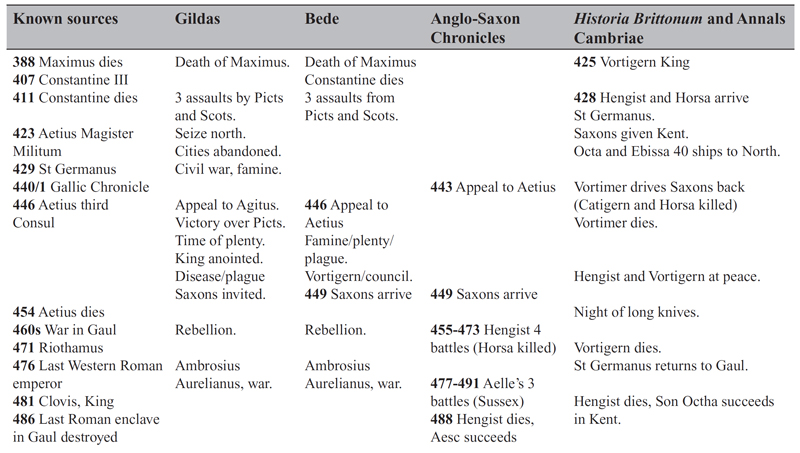
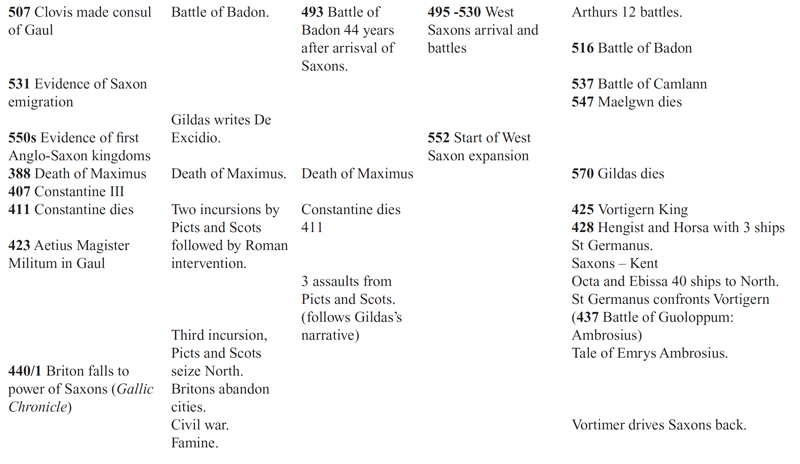
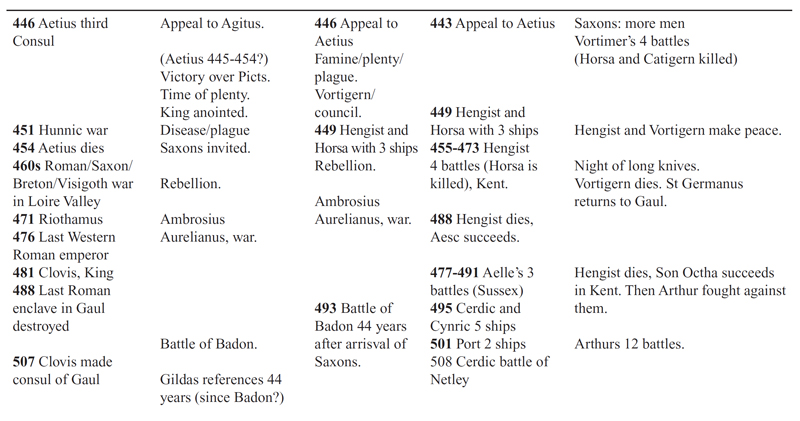
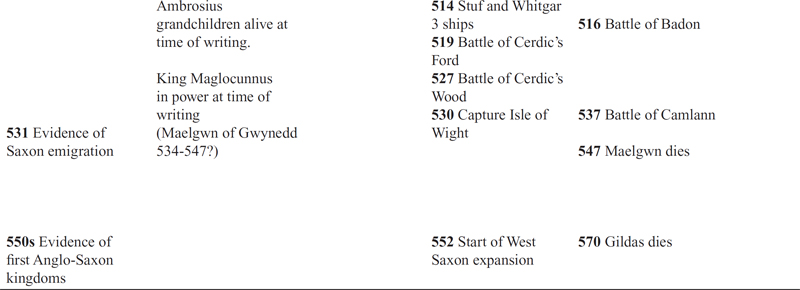
This would also make him a contemporary of Riothamus, if not the same person. Fighting in Kent, or even Gaul, in 460–70s would not necessarily negate the possibility of him fighting at Badon in 493. But that is not necessary because Nennius places Arthur fighting the Saxons after Hengist’s death and after Ambrosius. It also has the happy coincidence of falling into line with the fall of the last Roman enclave in Western Europe, which may tie in with the narrative in Geoffrey of Monmouth, and Arthur’s battles in Gaul and against the Romans. In this scenario one only has to correct the dates in Annales Cambriae by pushing the dates back a generation.
But there we run into the same problem others have before of over speculating: ‘We only have to correct some dates’. Let me go through just some of the points there. We now have Hengist arriving fighting-fit in 428 and engaging in battle in 473, presumably in his seventies. Second, the appeal to Aetius (or Agitius) is most definitely concerning Picts and Scots and not the Saxons. The Saxons are invited because of that threat. Now it is true, it is just as likely this occurred in 420s as in the 440s. This would indeed satisfy the Gallic Chronicle. But it pushes back all the other dates and expands the timeframe to make individuals unrealistically old. It’s not impossible that Ambrosius was in the 450s, Badon in the 470s, and Gildas wrote in 520. But then one has to explain all the other corrections necessary in the other sources.
Vortimer is associated with a battle in 455 when Horsa and Catigern die, not the 440s. If Arthur really is fighting battles in 516 and 537, why is Gildas not mentioning him? Why do the Anglo-Saxon Chronicles mention Vortigern but not Arthur? Why does Bede also not reference him? Why does the Historia Brittonum have most of the action occurring before St Germanus’s final visit ended, suggesting 440s followed by Arthur’s twelve battles? And yet the Annales Cambriae locate Arthur between approximately 500 and 537? I would invite the reader to attempt to adjust the different timelines to achieve a best fit.
There is a consensus from the experts that the narrative from Bede is roughly correct, or that Bede thought it was accurate and was attempting to be so. While there is archaeological evidence, however, it doesn’t fully support this; one remembers the existence of Saxons in parts of the south much earlier. Additionally, the Gallic Chronicle is respected as a source and the 440 entry remains to be explained. There is no evidence whatsoever for an Arthur figure from any contemporary or later respected source. The Historia Brittonum and Annales Cambriae do not have the same validity, but even if taken at face value they give widely contradictory statements and unlikely narratives. Additionally, the Historia Brittonum is the only reference to Arthur in the 300 years after he supposedly lived. Then over 100 years later we have two references in the Welsh Annals that may or may not have been added later to the text.
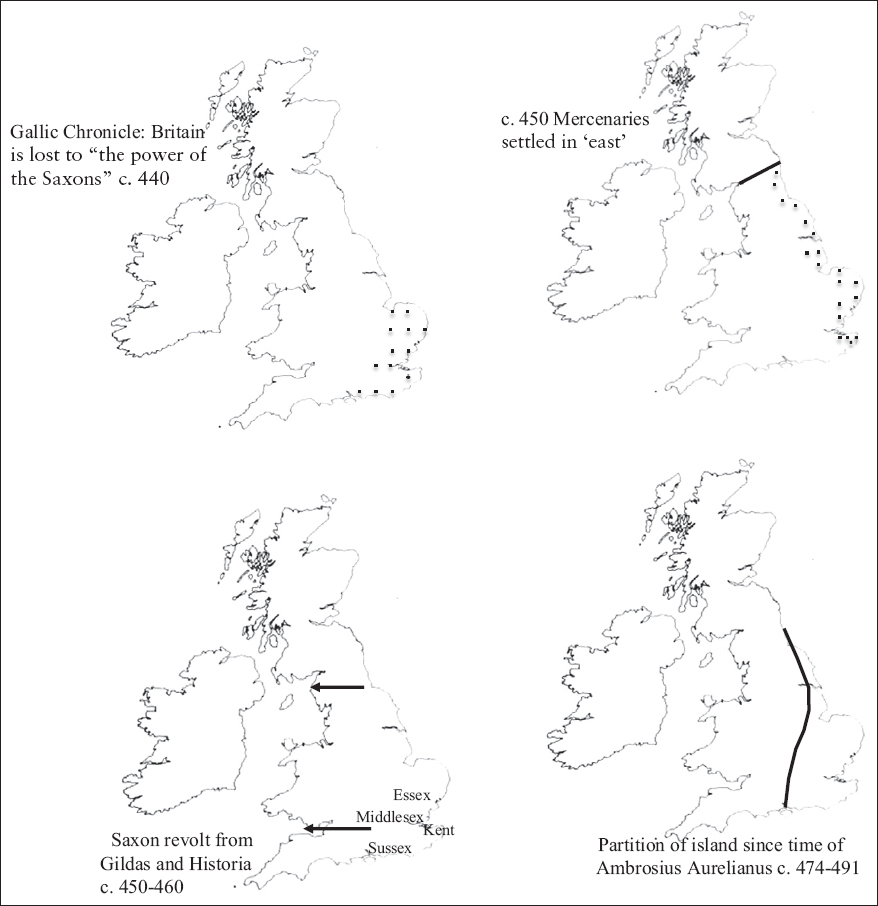
Possible sequence of events.
So to summarise, Arthur aside, we have sources that appear to contradict each other. For example the Gallic Chronicle against Bede. If you believe the material from the Historia Brittonum and Annales Cambriae, and that is the nub of the matter, this unfortunately still does not clarify any of the sources. Nevertheless, this is the first historical mention of Arthur. Also within these sources there is a rough consensus despite the contradictions. Something happened to cause an appeal, Germanic mercenaries arrived but later revolted. Ambrosius Aurelianus emerged to lead a fight-back culminating in the battle of Badon and a ‘partition of the island’ as Gildas puts it. Into this scenario, two late and disputed sources place our hero. How the legend changed and evolved over the centuries is impossible to know, but the next written sources to mention Arthur occur over 100 years after the Annales Cambriae.