
Chapter 9
The origins of settlers can be identified through pottery, metalwork and burials. Angles from Schleswig-Holstein settled in mid-, eastern and northern England in the fifth century, along with some Saxons. Shortly after, towards the end of the fifth century, there was some movement from Norway into Norfolk and Humberside. Saxons left their home in North Germany and evidence is found along the Thames valley as well as Wessex and Sussex. Jutes from Jutland appear in east Kent and parts of the New Forest and the Isle of Wight,1 and permanent settlements were established in the last quarter of the fifth century.2
This appears to corroborate Bede’s description of three main tribes. Procopius, writing a century after, names the three races inhabiting Britain as the Angiloi, Frissones and Britons. Linguistic analysis has found Frisian as the most closely related language.3 This Procopius passage is important as it also describes reverse migration of Angles and Frisians back to the Continent in the first half of the sixth century. Theuderich, king of the Franks, allowed Angles from Britain to settle after the Thuringian war in 531. This suggests there was pressure on Germanic peoples to move from Britain to the Continent from 500 onwards. Procopius states Theuderic’s son, Theudebert (king of the Franks 534–48), boasted to Justinian that he had overlordship of part of Britain, presumably because of his support of Anglo immigrants into his kingdom. It may be important to note that archaeological links to Frankish Gaul are most prominent in Kent, and Christianity was reintroduced via a Frankish-Christian princess marrying a Saxon king of Kent, Aethelberht, in the last quarter of the sixth century.
Additionally, Bede’s list of seven kings has Aelle of Sussex and Caewlin of Wessex separated by over fifty years between 500 and 560.4 This further points to a lull in Anglo-Saxon advance and corroborates the idea of a British resurgence. However, the picture is not consistent across the whole country. There is a strong correlation between Anglian areas and cremation, and Saxon regions and burial.5 So we have a South and Eastern divide. In addition there seems to be corroboration that the areas of Kent and Isle of Wight were Jutish. There is evidence that the New Forest area had once been Jutish land and Asser, King Alfred’s biographer, records that Stuf and Wihtgar were Cerdic’s nephews and of Jutish Origin.6
We can’t conclude there is total support for the literary sources that suggest Germanic tribes arrived in Britain after the 450s. Aside from evidence of Germanic mercenaries during Roman Britain, the archaeological evidence is at odds with Gildas and Bede in that it suggests Saxon presence in 430s and perhaps even a generation earlier,7 rather than after an appeal to Aetius before 449. Given the description of the southern coastal forts as the ‘Saxon Shore’ it really is impossible to say whether the forts were defended against Saxons or by Saxons, or whether the area was already settled by Saxons.
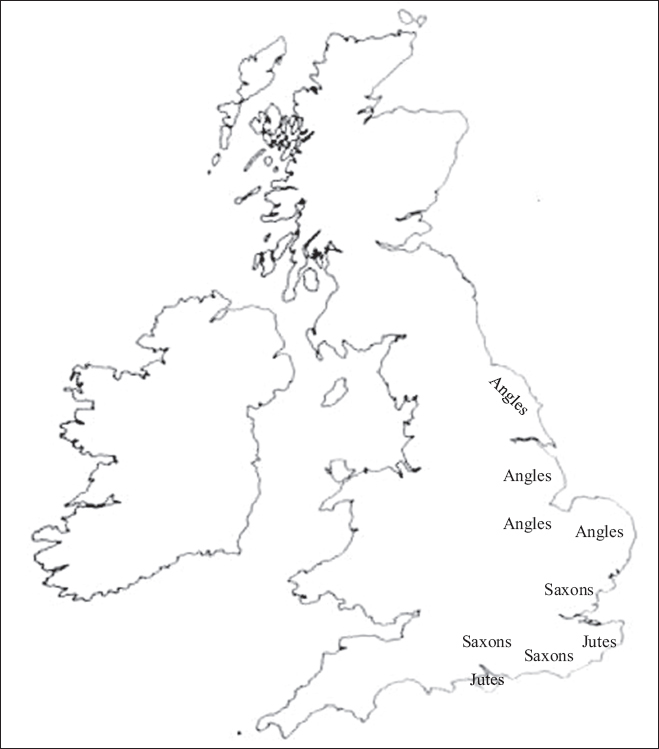
Fifth-century archaeological evidence.
The evidence supports the idea of a Saxon presence before 450 and a later Angle presence after. This could explain both the Gallic Chronicle entry regarding Saxons in 440 and the later Gildas and Bede references concerning the arrival of mercenaries around 450. They could be mislabelling Angles and Jutes as Saxons. The evidence for cultural, linguistic and genetic change is for population movements from even before the Roman invasion.8 The main evidence relates to eastern Britain from across the North Sea. Strabo, writing in the first century, contrasts Britons with Celts, and Tacitus describes Caledonians as having Germanic origin and the inhabitants of Britain ‘nearest the Gauls’ having similar language. The tribe nearest the Gauls were the Belgae and there is evidence from Caesar’s Gallic Wars that the Belgae were a Germanic people. Gallo-Belgic coins were found in Britain across the same area affected by the alleged later Saxon invasion.9 The Roman name for Winchester was ‘Venta Belgarum’, meaning the meeting place of the Belgae. There is also the interesting fact that after Roman Britain, inscribed stones were found everywhere except the southeast, suggesting further cultural difference. A similar difference occurs in the distribution of rune markings appearing in Angle and Jutish areas, but not supposed Saxon ones.10
As early as the late third century, Frankish and Saxon raiders began to attack the channel coasts.11 However, the forts of the so called Saxon Shore seem to have been built in the wrong time and place for defence12 and it is possible that Saxons were already present along the South Coast in the early fourth century. A Saxon site at Mucking in Essex shows late Roman bronzes in Saxon huts, and graves dated to 400. It is worth remembering Procopius writing in Byzantium in 550; he tells of a Frankish embassy accompanied by Angles, over whom the Franks claim to have dominion. The Angles tell of three populous nations: Britons, Angles and Friesians. They don’t mention Saxons. This could be ignorance, but the Saxon homeland was adjacent to Angeln and it’s unlikely Angles would have misidentified them. Far more likely this was a group who were linguistically and culturally different from both Angles and Saxons, or perhaps people who had settled many decades earlier and enough time lapsed for cultural and linguistic changes to take place.
There is genetic, linguistic, literary and archaeological evidence for Germanic presence in Britain before 400. The colonisation of later Anglian, Jutish and Saxon areas would have been inconsistent and irregular, with complex and different timescales,13 which makes for a very mixed and confusing picture. There is, therefore, evidence of Saxon presence much earlier than we previously thought. Then there’s evidence of further arrivals that could suggest Angles in the East, Jutes in Kent and Hampshire and more Saxons on the south coast. It is possible that it’s these later arrivals which are referred to in the sources, but it’s important to remember that they did not arrive into a political or cultural vacuum.
We do not know how they initially interacted with the indigenous population, the political administration and what the ethnic mix was at the time. Regarding provincial boundaries, there is some similarity with earlier Roman provinces and boundaries of later Anglo-Saxon and British kingdoms.14 Germanic settlement appears to take place in areas of Romano-British economic and political activity,15 which suggests some possible continuity. There’s even evidence that villa and estate boundaries stayed constant into the Middle Ages. I wouldn’t take that too far, but it does show that there was no ‘wiping clean of the slate’, so to speak. The Romano-British civitates and populations were not exterminated and replaced wholesale.
What there does seem to be is a return to tribalism16 with a patchwork of different tribal affiliations, some in line with civitates’ administrative boundaries, others overlapping. It would then be wrong to view the situation as one of simply Britons vs Saxons. There may well have been ethnic aspects at times, but at others a better analogy might be ‘rats in a sack’. In fact, if we look at the period from 550 to 700, we see the West Saxons fighting against Sussex and Kent as well as the Britons, Penda of Mercia in alliance with Cadwallon of Gwynedd fighting Northumbria, and a patchwork of shifting alliances involving Picts and the Irish Scotti in Dalriada, south-west Scotland.
There may have been a degree of continuity with civitates, or territories being taken over by warrior bands as going concerns. On the other hand we have Anglo-Saxon society developing after the breakdown of Roman territorial structures. Both these extremes may have occurred in different places. Examples of areas retaining Roman, and even pre-Roman, boundaries include Kent and Lyndsey. The Western Province Britannia Prima retained its identity, if not its integrity, as it shrunk into modern Wales. The Pre-Roman tribal area of the Dumnonii became Devon and Cornwall. Within Flavia Caesariensis, Lindsey appears to have retained some structure around Lincoln, while further west it later was home to the Mercians (literally boundary folk). In the southeast, Maxima Caesariensis retained at least one civitate, the Cantii, in modern Kent which may be connected with the legend of Hengist or Oisc founding or being given the county. In the northern province closely resembled the Northumbrian kingdom.
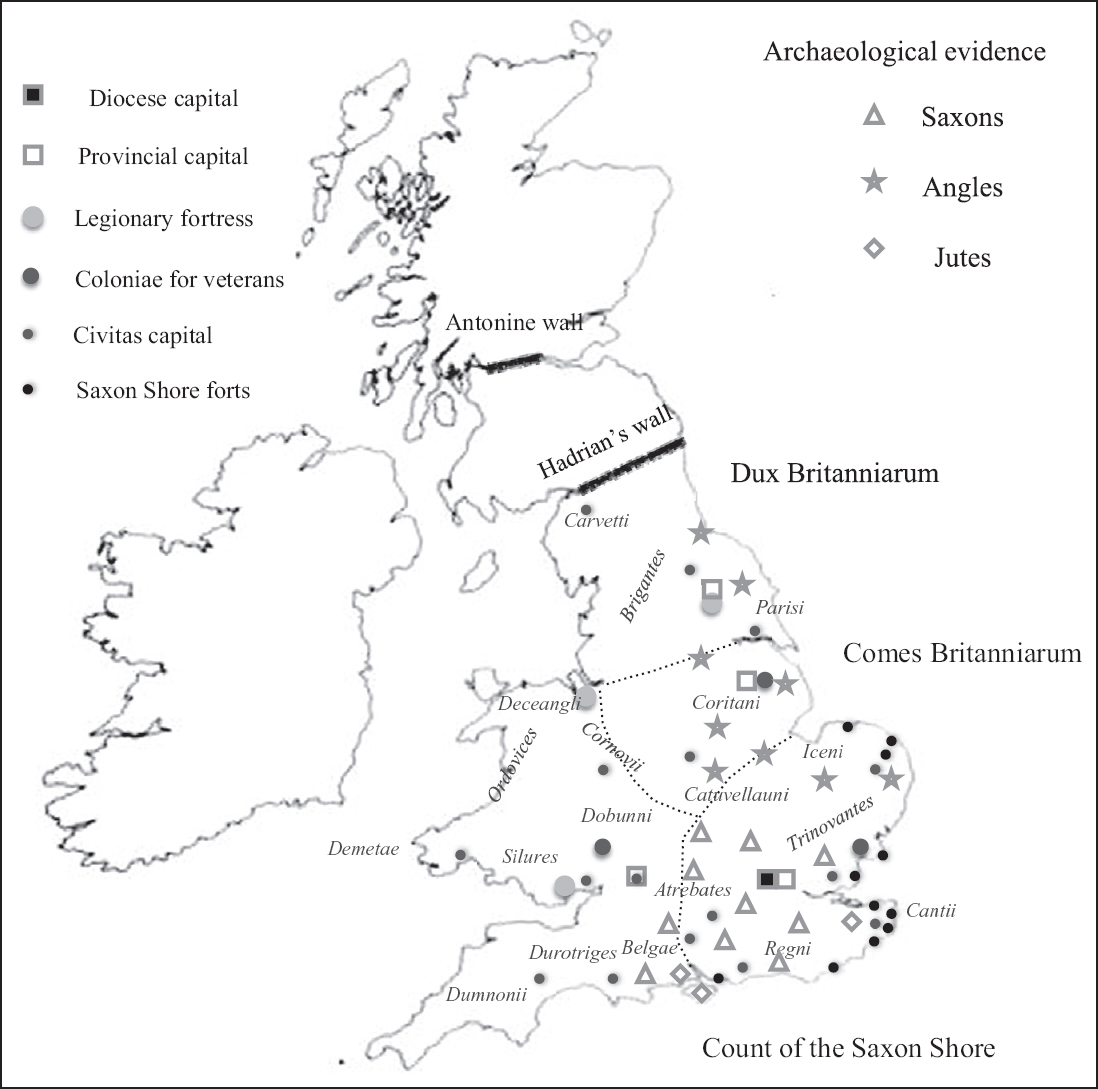
Post-Roman Britain.
After the last legions left in the early fifth century, there was a steep decline in the Romano-British economy. The end of the coin supply and Roman governance after 400 destroyed the economic cycle, and parts of Roman life failed suddenly and irrevocably,17 even if literary evidence suggests some aspects survived for several generations. However, the literary evidence implies a degree of governmental continuity rather than a rapid and wholesale collapse into petty kingships after 410, although it’s likely that power was decentralised to the provinces and then civitates. There is a sharp contrast with what happened in Gaul, where incomers gradually adopted Gallo-Romano language, culture and religion. The evidence favours large scale continuity alongside significant migration although it must be noted the evidence for continental migration is actually higher in the Roman period than after.18
In terms of numbers, Britain was far more densely populated than was once thought with estimates ranging from 1 million to as high as 4 million.19 There is evidence for climatic changes which, combined with increase in plague and famine, alongside military upheavals, put downward pressure on population in the fifth century.20 A figure of 2 million is not unreasonable to compare with estimates of Germanic immigrants or invaders. The debate about the Anglo-Saxon invasions can be summarised as follows: on one hand, a large scale movement of people, possibly tens of thousands, took over significant areas by force. On the other hand, small warrior groups infiltrated specific civitates or areas over a prolonged period, possibly as low as a few thousand.
The view that there was a sudden or rapid mass migration or wholesale replacement of the Romano-British population by Germanic tribes is inconsistent with the evidence. Bede, writing 200 years later, may well have believed it based on Gildas. However, there is no physical evidence such as the burnt layer left in the archaeological record of Londinium by Boudica’s destruction of the city. The change implied by the Gallic Chronicles or Gildas was political or military, rather than a mass migration. The archaeological evidence suggests cultural replacement rather than migration, there is simply no evidence for a military invasion.21 That doesn’t mean there weren’t large scale invasions and warfare, just that there is no physical ‘smoking gun’ like widespread burnt remains at various urban sites. The literary evidence also does not state explicitly a one-off large invasion; rather it implies small, unrelated bands at various locations over a long period, each with a different context arriving in a usually small number of boats or Keels as they were known. These Saxon boats would have been around 23 metres long and carried approximately thirty men;22 to transport 50,000 people would have required well over 1,500 such boats. That would equate to only thirty boats a week for a year, and we are talking about the last few decades of the fifth century and the whole eastern and southern coast. A boat a week over thirty years would have had the same effect in terms of moving a population. Therefore it is quite feasible for a large population of Germanic peoples to move into Britain, and there is evidence to suggest that did indeed happen. How much and in what circumstance is still open to question.
There is DNA evidence but it’s a little mixed, although advances are being made all the time. It is difficult, if not impossible, to distinguish between Anglo-Saxon and later Viking influence. Welsh DNA is significantly different, however, as is Devon, Cornwall, Cumbria and Scotland.23 There is a distinct difference in both maternal and paternal DNA between the East and the rest of the island, although overall the genetic structure across the British Isles is ‘stubbornly Celtic’.24 There has been some debate as to the interpretation of the evidence. One study found the most Continental influences amounting to 38 per cent in the expected areas of the North East, East Anglia and the Thames valley.25 This could be due to large-scale replacement, but a warrior elite making up as little as 10 per cent could contribute as much as 50 per cent towards the gene pool within five generations due to reproductive advantages.26 Thus the evidence does not favour dramatic population change; in fact, studies suggest principal traits within the British popularity were established 10,000 years ago after the last ice age.27
There is some DNA evidence to show a difference between what was to become the Anglo-Saxon kingdoms and the rest of the country, but there’s also evidence to show continuity in all areas. It does suggest the indigenous population remained in large numbers in what became England. Nor were there large scale desertions of areas, as archaeology suggests considerable continuity of use across the British/Anglo-Saxon divide.28 There is evidence of Romano-British presence from other sources too: The Law Code of King Ine of the West Saxons in 690 shows Britons were at a legal disadvantage similar to apartheid. The wergild (‘man-value’) of a British man was only half that of a Saxon. This would have encouraged some to adopt Saxon culture and language. The old English term for a Briton was Walh, which meant foreigner and came to mean ‘un-free person’ or slave. From this comes the modern ‘Welsh’, and can be seen in place names such as Walton or Wallasey. It is also worth noting there are British names in many of the Genealogies such as Cerdic, Cynic and later Caedwalla, all of whom were West Saxon kings.
Anglo-Saxon language appears to have been adopted by communities as part of a wider social and cultural change starting in the fifth century.29 The English language adopted fewer than twenty words from British Latin of Brittonic before 600, and place-name studies suggest that few names from pre-Saxon times exist due to a near-complete replacement in England with English names. So language and place-name studies could support the idea of a mass migration, but might also show a subgroup taking on the language and culture of an elite.30 This might be similar to how Norman French culture affected England after 1066.
The Tribal Hidage is thought to be compiled in the seventh century, although the earliest surviving copy is from the eleventh century. It contains a list of thirty-five tribes or territories and the number of hides assigned to each one. One hide is often equated with roughly thirty modern acres or 120,000 square meters. By contrast, modern Kent is over 31,000 hides compared to the 15,000 recorded in the Hidage. Alternatively, the measurement could refer to a unit for taxation purposes and thus not a geographical area. They are almost exclusively south of the Humber. The list is headed by Mercia, but Wessex is the largest at 100,000 hides. It includes all the major Anglo-Saxon kingdoms along with smaller tribal areas, some as little as 300 hides. Most historians agree it originated in Mercia. Although if it is a tribute list, the absence of Deira and Bernecia (or Northumbria) my indicate it originated there.
Table 16: The Tribal Hidage
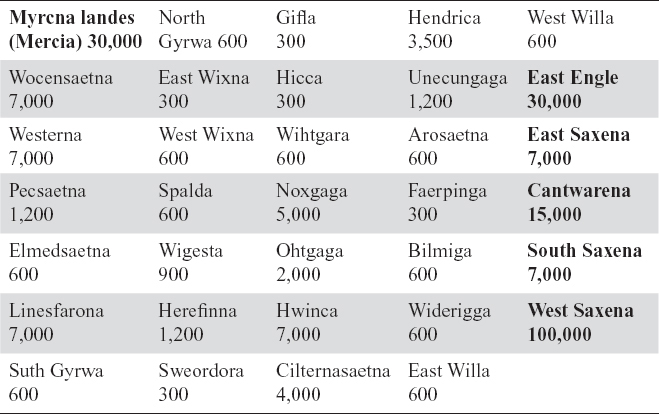
Not all the tribes can be identified. However it is worth noting the relative size of Hwince, or the Hwicce, who were located south of the Severn. It shows that by the seventh century there was an extensive Anglo-Saxon presence which confirms much of the information in Bede and other sources. The Hwinca has the same number of hides as both the East and South Saxons. The Hwicce do appear to have been located south of the Severn, but there’s no etymological link with Gewisse. Bede states the West Saxons were originally called the Gewisse but marks them distinct from the Hwicce, and as we can see they have the largest area of all at 100,000 hides.
One cemetery discovered in Wasperton in Warwickshire covers the period from the third to seventh centuries and apparently contains mostly local residents.31 What it shows is a change from Roman to Anglo-Saxon burials alongside the adoption of other material possessions and culture. This village is north of the area supposedly conquered by the West Saxons in the late sixth century. It’s precisely the area later covered by either Mercia or Hwince in the tribal hidage, but in the time of Ambrosius Aurelianus it is very likely to have been west of any ‘partition of the island’. This does suggest something interesting, if only about this one small area. Here is a location with an apparently consistent population who slowly change and adopt cultural practices from Roman Britain, a post-Roman British controlled area to later Mercia. This doesn’t mean other areas weren’t conquered by the sword or that other populations weren’t replaced. Towns and cities in general also show a marked change generally declining, yet some such as Canterbury, Wroxeter, St Albans and Carlisle show some perseverance.32
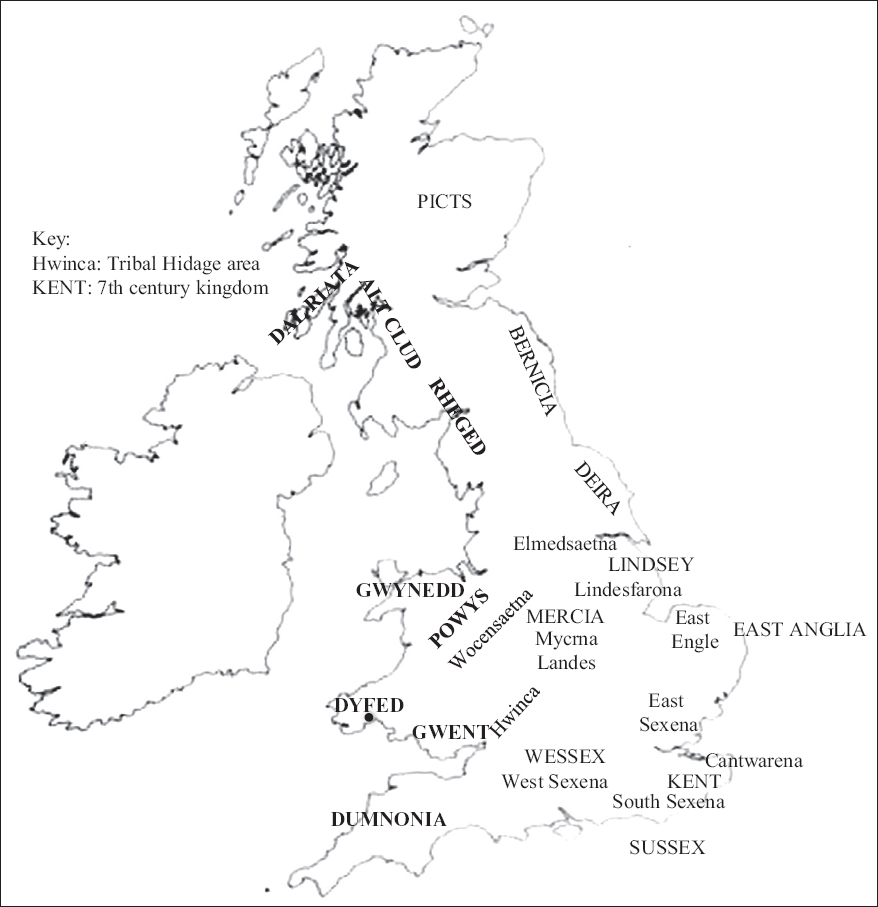
Tribal Hidage.
In summary, there has been much academic debate over whether there was a mass movement of tribes, small groups of warrior elites, or some combination of the two. The process may have been varied across time, geography and civitates, and involved many different Germanic groups coming at different times. Research generally has found both Bede and the Anglo-Saxon Chronicles inadequate as records of the arrival of the Saxons.33 However, inadequate doesn’t mean inaccurate or irrelevant. The spirit of what they are saying may be near the truth for a particular context in time or geography. There is still much debate about some of the figures referred to; stories about Vortigern and Hengist have had ‘vigorous historical criticism which has exposed them as myth’.34 However, while we cannot be sure of the process, we do know the outcome. The Anglo-Saxons slowly took control of Romano-British areas from east to west over a period of time, we can leave aside manner and exact circumstances. We have evidence of increased activity in Iron Age hill forts such as Cadbury, and refortification of sites like Viroconium near Wroxeter. What we don’t know is by whom or for what reason. What we do know is that 200 years after the time of Arthur, Anglo-Saxon kingdoms are well entrenched in large parts of what later became England.
The question is, what was the situation at the time Arthur is supposed to have lived? This is pure speculation but we have some clues to go on. The Anglo-Saxon Chronicle records in 457 that the Britons fled to London, and there is archaeological evidence to suggest activity up to 450. Yet by 500 the archaeological record suggests London was deserted, not to be reoccupied until the time of Alfred the Great in the ninth century. At least, no evidence of any Anglo-Saxon presence has been found within the walls.35 The decay was gradual rather than sudden. In fact, evidence to date appears to have disproved the theory of a surviving Romano-British enclave into the sixth century.36 There is evidence, however, for some continuity outside London’s walls from the fifth century and increased Anglo-Saxon presence around London from 450.37 Instead, a new settlement, Lundenwic, grew up slightly to the west of the walled city around modern day Westminster. It wasn’t until 886 that King Alfred established a settlement within the walls, a generation after Lundenwic had itself been abandoned due to Viking raids up the Thames.
Gildas, writing around 540, comments on the ‘partition of the island’ and being unable to access the shrines of the martyrs, including St Albans to the north east of London. The implication is that this had been the case since the time of Ambrosius Aurelianus. Taking the evidence from the Gallic Chronicle, Gildas and archaeology, this does seem to suggest that London and the southeast were already under Saxon control at the time Arthur is alleged to have lived. In 455, the Roman church changed the date of Easter, and evidence from later periods suggest the British church appeared to have adopted this change. Yet no later changes seem to have been made, suggesting that contact was lost sometime after this.38
If we trust the Chronicle and other literary sources, the south and east coast from the New Forest, round Kent and up to Hadrian’s wall was affected by the presence, immigration, or invasion of Germanic warriors. The Gallic chronicler appears to believe, as early as 441, that Britain was lost. In around 540 Gildas claims he can no longer visit the shrines of the martyrs in St Albans and other places, but seems to imply this has been the case since the partition of the island which occurred in the time of Ambrosius Aurelianus. One can imagine a strip of land along the south and east coast that also, at one point, spread inland as far as St Albans. How deep this strip extended into the interior, or even how continuous around the coast it was, is unknown.
In the south the Chronicle records later expansion after 550 and in the north around the same time Ida becomes first king of Bernicia. Elmet, in the Leeds, area was not conquered until 616. This suggests that these areas were under British control in Arthur’s time. Welsh sources also hint that eastern Powys, which spread deep into the midlands, was lost much later. We also have Urien of Rheged pushing the Bernicians almost into the sea in the last quarter of the sixth century. What this may indicate is that around 500, the British still controlled the bulk of what later became England. An arc from Dorset to Oxford, and perhaps even further to the Wash. Further north we can’t say how much of Lincolnshire or Yorkshire was under Angle influence. But enough of the country was for Aelle to be described as Bretwalda by Bede.