
Chapter 13
We will now cover the other sources for the legend. They can be split into two parts. The first are the French romances, all of which post-date Geoffrey of Monmouth. They were inspired by his work and we can see how the story evolved to include many of the elements we now consider part of the Arthurian tale. It does suggest there was a tradition in Normandy and France that was receptive to this. There may well have been a Breton influence. The second are the Welsh legends. Some of these are thought to pre-date Geoffrey’s work and thus are an invaluable source of clues as to what the legend may have appeared like to audiences pre-tenth century. Unfortunately, the only surviving copies are much later and so it is difficult to ascertain how much they have been corrupted. It is worth noting when specific concepts were introduced, such as the Round Table or sword in the stone.
It is a fruitless task to look at these stories in any great depth or detail as they are corrupted and contradictory. Theories built on such ‘evidence’ start by building on sand and relying on tenuous links and tautology. Written down over 500 years and as much as 1,000 years after the events, they can tell us little about how the stories developed prior to that. We will therefore only briefly list the most famous texts. On their own they prove very little, if anything, but as a body they do demonstrate a ‘market’ for Arthurian stories in the Middle Ages. So we have a list of works in the first table below, written mostly 600 years after Arthur is supposed to have lived and derived or influenced almost entirely by Geoffrey of Monmouth’s work.
Table 20: The French romances
|
Literary source |
Comments |
|
Roman de Brut by Wace 1155 Norman French poem. |
Literary history of Britain based on Geoffrey of Monmouth’s work. First introduction of the Round Table. |
|
Tristan and Iseult Twelfth century various: Thomas of Britain 1170s Beroul 1170s Folie Tristan d’Oxford 1175–1200 Prose Tristan 1230–40 Sir Tristram 1300 (first English version) |
Love affair between a Cornish knight and an Irish princess, fiancée of King Mark of Cornwall. Linked to Arthur for the first time in 1230s and through the later Welsh legends. |
|
Joseph of Arimathea and Merlin Robert de Boron Late twelfth-century French poem |
Joseph of Arimathea brings the Grail to Britain to the valley of Avaron, later translated to Avalon and identified with Glastonbury. Traditional tale of Merlin in connection with Arthur. Introduces sword in an anvil placed on a stone. First to connect the Grail with Jesus. Introduces ‘Rich Fisher’ version of the later Fisher King. |
|
romance poems Chretien de Troyes 1170–90 French |
Includes Arthur’s court and the knights of the Round Table. Eric and Enide 1170 Cliges 1176 Yvain, the Knight of the Lion 1180 Lancelot, the knight of the Cart 1180 Percival, le conte du Graal 1190 The first to feature Lancelot as a main character and the affair between him and Guinevere. Introduces the quest for the Holy Grail and The Fisher King. |
|
Vulgate Cylcle or Prose Lancelot Unknown 1210–30 French |
Five prose volumes introducing more Christian themes. Estoire del Saint Grail Estoire de Merlin Lancelot Propre Quest del Saint Graal Mort Artu Galahad’s quest for the Grail. |
|
Post Vulgate Cycle Unknown 1230–40 French |
Similar to Vulgate Cycle and one of the biggest influences of Mallory’s later work. Estoire del Saint Grail Estoire de Merlin Quest del Saint Graal Mort Artu Introduces Arthur’s incestuous affair which produces Mordred. Introduces the receiving of Excalibur from the Lady in the Lake. Links Tristan to the Grail quest. |
|
Le Morte d’Arthur Thomas Mallory 1485 Middle English |
Combines many of the themes from Geoffrey together with all the romance poems and stories. One of the best known works of Arthurian literature and the basis of many later and modern adaptations. |
The Welsh legends almost certainly pre-date both the French romances and Geoffrey of Monmouth’s book. However, they weren’t actually written down until much later and can be seen in the following manuscripts:
1.White Book of Rhydderch, c.1350 (Llyfr Gwyn Rhydderch, National Library of Wales, Peniarth MS 4- 5).
2.Black Book of Carmarthen, c. 1350 (Llyfr Du Caerfyrddin National Library of Wales, Peniarth MS 1).
3.Red Book of Hergest, after 1382 (Llyfr Coch Hergest, Jesus College Oxford MS 111).
4.The Book of Taliesin, dated to first half of fourteenth century but may include material from the tenth century, although not as far back as a sixth-century poet called Taliesin (Llyfr Du Caerfyrddin National Library of Wales, Peniarth MS 2).
5.Book of Aneirin, dated to around 1265 but thought to be a copy of a ninth-century original. It contains the poem, Y Gododdin concerning a battle in 600, and the sixth-century poet Aneirin that may be contemporary.
6.Triads of Britain, dated to thirteenth century, containing both mythic and historical figures and events (Trioedd Ynys Prydein, National Library of Wales, Peniarth MS 16).
7.Mabinogion is a collection of many of the works already mentioned, brought together in an eighteenth-century compilation. The stories contained are believed to have originated in the twelfth century and may have pre-dated Geoffrey of Monmouth.
Below is a brief outline of the relevant stories:
Table 21: Welsh legends
|
Literary source |
Comments |
|
Preiddeu Annfwn ‘The spoils of Annwfn’ Preserved in the Book of Taliesin dated to the early fourteenth century. Possibly originated tenth century. Estimates range for original version from 600 to 900. |
Arthur undertakes a dangerous journey to Annfwn, Welsh name for the Celtic Otherworld (realm of deities or the dead). Out of three boatloads of warriors only seven return. Arthur’s ship is named Prydwen. The poem is not clear but a cauldron of the Chief of Annwn guarded bynine maidens appears to be one of the spoils taken. Similar to the Cauldron of Diwrnach which Arthur takes from Ireland in Culhwch and Olwen. Also similar to story of Bran and Branwen in the Mabinogion. Possibly the basis of the Grail legends. |
|
Pa Gur ‘who is the gatekeeper’ Possibly originated tenth century. From the Black Book of Carmarthen in mid-thirteenth century. |
Dialogue between Arthur and a gatekeeper in which Arthur boasts of his prowess and that of his companions including Cat the Fair. Mentions son of Uthr Pendragon’s servant. Another fought at the Battle of Tryfrwyd, along with Bedwyr and Arthur, one the twelve battles in Historia Brittonum. Mentions Arthur fighting first a witch and then mythical ‘dog-heads’ at Edinburgh. Cai fights nine witches at the peak of Ystafngwn and a terrible cat of Palug. The former may be a reference to the nine maidens in ‘The Spoils of Annwfn’, the nine witches of Gloucester in Peredur or in the Life of St Samson. |
|
Stanzas of the Graves Ninth- or tenth-century origin. Preserved in the Black Book of Carmarthen mid-thirteenth century. |
A number of short verses of renowned persons. One verse ends with: ‘The grave of Arthur is a mystery’. |
|
Elegy of Geraint son of Erbin Ninth- or tenth-century origin. Preserved in the Black Book of Carmarthen mid-thirteenth century. |
Poem celebrating Geraint and his deeds at the Battle of Llongborth. ‘In Llongborth I saw Arthur, And brave men who hewed down with steel, emperor and conductor of the toil.’ Llongborth may be identified with Langport in Somerset or Portsmouth in Hampshire. Geraint may also be referred to in the early poem Y Gododdin as ‘Geraint of the South’. A later Welsh poem, Geraint and Enid, is linked to Erec and Enide by Chretien de Troyes. |
|
Triads of Britain Eleventh to fourteenth century Found in: Peniarth 16 manuscript, thirteenth century. Red book of Hergest 1400 Fragment in White Book of Rhydderch 1325. |
A rhetorical poem that groups things into threes. Multiple mentions of Arthur and related themes. For example: Three unfortunate counsels of the Island of Britain: To give place for their horses’ fore-feet … to Julius Carsar; to allow Horsa and Hengist and Rhonwen into this island; the three fold dividing by Arthur of his men with Medrawd at Camlan. Mentions various other characters: Urien, Uther, Owain, Gwenhwyfar, Medrawd, Emrys Weldig (Ambrosius), Gwrtheyrn the Thin (Vortigern), Gwerthefyr (Vortimer), Llachau son of Arthur, Cei, Geraint and Camlan. |
|
Culhwch and Olwen anonymous Original possibly eleventh century. Found in: Red book of Hergest 1400 Fragment in White Book of Rhydderch 1325. |
Culhwch wishes to marry Olwen, daughter of the giant Ysbadden. He travels to Arthur’s court in Celliwig, Cornwall to get Arthur’s help in a number of tasks the giant sets him. Only a small number are recorded including: The hunt for the boar Twrch Trwyth referenced in Historia Brittonum. The rescue of Mabon from a watery prison. The quest for the cauldron of Diwrnach in Ireland. Arthur kills The Black Witch. The tasks completed, the giant is killed and the lovers marry. Many of the tasks are similar to tales in other Irish legends. |
|
Geraint and Enid Found in: Red book of Hergest 1400 Fragment in White Book of Rhydderch 1325. |
Geraint, one of Arthur’s knights and son of Erbin of Dumnonia, and his romance with Enid. Likely derived from Chretien de Troyes’s Erec and Enide. |
|
Owain or Lady of the Fountain Original possibly eleventh century. Found in: Red book of Hergest 1400 and White Book of Rhydderch 1325. |
Owain, one of Arthur’s knights, based on historical Owain son of Urien, in a romance with the Lady of the Fountain. Likely derived from Chretien de Troyes’s Yvain, the knight of the lion. Similar also to tale in Life of St Mungo (aka St Kentigern) where the saint’s father, Owain, tries to woo Lot of Lothian’s daughter. |
|
Peredur son of Efrawg Found in: Red book of Hergest 1400 and White Book of Rhydderch 1325. |
Peredur travels to King Arthur’s court and proceeds on a number of adventures including a similarity with the Fisher King, although the Grail is replaced by a severed head in this version. Likely derived from Chretien de Troyes’s Perceval, the Story of the Grail. |
|
Brut by Layamon Late twelfth century |
First English version of Geoffrey of Monmouth’s History of the Kings of Britain |
|
Brut y Brenhinedd Thirteenth century. |
Middle Welsh version of Geoffrey of Monmouth’s History of the Kings of Britain |
|
Brut Tysilio Fifteenth century. |
Initially attributed to the seventh-century Welsh saint, Tysilio. Scholars now believe it derives from Geoffrey of Monmouth. |
|
Dream of Rhonabwy Written end of twelfth century, found in: Red Book of Hergest 1400. |
Set in twelfth century. Rhonabwy falls asleep and dreams he is back in Arthur’s time. He meets Iddawg, ‘the Churn of Britain’, called this because he caused the battle of Camlann by distorting messages between the king, or emperor as he is titled here, and his enemy Medrawd. He is led to Arthur’s camp before the Battle of Badon. Arthur is playing gwyddbwyll, a chess-like game, with Owain, son of Urien. The same Urien who is mentioned in Historia Brittonum and other sources as King of Rheged (Cumbria/Southern Scotland area) in the late sixth century. The Saxons, led by Osla Gyllellfawr (Osla big knife), ask for and receive a truce. Arthur’s army heads for Cornwall and Rhonabwy wakes up. Osla is recorded in Culhwch and Olwen as part of Arthur’s retinue. Alternatively, it could refer to Octa, son or grandson of Hengist and King of Kent in the early sixth century. |
|
Y Gododdin Book of Aneurin thirteenth century dated to seventh–eleventh century. |
Welsh poem about the men of the kingdom of Gododdin, around Din Eidyn (Edinburgh). 300 fought the Angles of Deira and Bernicia at Catraeth (possibly Catterick) around 600, and only one returned. Arthur is mentioned in passing in comparison to another warrior. ‘He charged before three hundred of the finest, He cut down both centre and wing, He excelled in the forefront of the noblest host, He gave gifts of horses from the herd in winter. He fed black ravens on the rampart of a fortress Though he was no Arthur Among the powerful ones in battle, In the front rank, Gwawrddur was a palisade.’ |
|
The Chair of the Prince Preserved in the Book of Taliesin dated to the early fourteenth century. Possibly originated tenth century. |
‘Has he not brought from Annwn The horses of the pale burden bearer The princely old man, The third deeply wise one, Is the blessed Arthur. Arthur the blessed, Renowned in song, In the front of battle, He was full of activity.’ |
|
The Elegy of Uther Pendragon Preserved in the Book of Taliesin dated to the early fourteenth century. Possibly originated tenth century. |
‘Do I not share my protection a ninth part to the battling Arthur’ |
|
Journey to Deganwy Preserved in the Book of Taliesin dated to the early fourteenth century. Possibly originated tenth century. |
‘Silent as fools, as at the battle of Badon With Arthur, chief giver of feasts, with his tall blades red, from the battle which all men remember.’ |
You will notice that the Welsh stories are more mythical in nature and don’t contain many of the themes of the French stories. Below I have shown when some of these themes were added to the story. You will note that many of those we associate with Arthur are actually very late additions to the legend.
Table 22: Arthurian themes
|
Concept and date |
Comments |
|
Round table 1155 |
First introduced by Wace’s Roman de Brut in 1155. Created to prevent quarrels among his barons. Brut by Layamon added that it was made by a Cornish carpenter after violence at a Christmas feast. There are no references in the Welsh sources. Charlemagne (742–814) is said to have possessed a round table decorated with a map of Rome. Celtic custom of warriors sitting in a circle round the king or lead warrior was often depicted in legends. |
|
Merlin Tenth century |
First reference is in the tenth century Annales Cambriae for 573 and the battle of Arfderydd after which ‘Myrddin went mad’ (which places him thirty-six years after Arthur’s death at Camlan according to same source). Legend of Myrddin Wylit (the Wild) is similar to Lailoken, who features in a twelfth-century Life of St Kentigern (or Mungo, who lived in the Strathclyde area circa 600). The Book of Taliesin also contains an early reference in the ‘Great Prophesy of Britain’, although it may be a different person, Merdin son of Madog. Another Taliesin poem appears to suggest the author is known as Taliesin and Merddin. The Black Book of Carmarthen contain a ‘dialogue between Myrddin and Taliesin’ and three other poems. The Red Book of Hengist contains ‘the conversation between Myrddin and his sister Gwenddydd’ and two other poems. Geoffrey of Monmouth combines Myrddin Wylit and Emrys Ambrosius from Nennius to create Merlin and place him before and during Arthur’s reign. Later French romances and Welsh literary sources come after this. |
|
Uther Pendragon or Uthyr Bendragon. 1136 by Geoffrey of Monmouth. Could be an epithet: ‘head dragon/chief leader’. |
Geoffrey of Monmouth records first detailed biography in 1136. He is also mentioned in various Welsh poems and Triads some of which name him as Arthur’s father. In Robert de Boron’s (twelfth-century) Merlin, Uther kills Hengist and Merlin creates the Round Table for him. In Prose Lancelot (thirteenth century), Uther takes an army to Brittany to fight near his home town of Bourges, similar to the historical character Riothamus in 471. |
|
Igraine or Eigyr 1136 by Geoffrey of Monmouth |
Welsh sources and genealogies name her as daughter of Amlawdd Wledig. Her sister Gwyar is the mother of Gwalchmai (Gawain). Geoffrey states she is the wife of Gorlois, Duke of Cornwall. Later romances derive from Geoffrey and also place her at Tintagel. |
|
Guinevere or Gwenhwyfar 1136 |
The earliest mention is in Culhwch and Olwen, eleventh century. Geoffrey of Monmouth 1136 named her as Guanhumara. Welsh sources name her Gwenhwyfar (Culhwch and Olwen; Life of St Gildas). Abducted by Melwas (Life of St Gildas) or Meleagant (Chretien de Troyes). Affair with Mordred (Geoffrey) or Lancelot (Chretien de Troyes). Welsh Triads name three Gwenhwyfars as wives of Arthur. A sister, Gwenhwyfach, is mentioned in Culhwch and Olwen. Additionally in two Triads a feud between the sisters is said to have caused the Battle of Camlan. |
|
Kingship |
The first description is ‘dux bellorum’, or leader of battles in the ninth-century Historia Brittonum. This doesn’t preclude a royal status, but is probably a biblical analogy as it is similar to the description of Joshua. The suggestion it is a late reflection of a Roman military title has also been made. The earliest Welsh sources that describe him as a king come in the eleventh century. One early poem, Geraint son of Erbin, possibly refers to him as ameraudur, which could be translated as emperor or general/commander. Geoffrey of Monmouth describes a vast Empire from Norway to the Alps. |
|
Sword in the stone Twelfth century |
First described by Robert de Boron in the poem Merlin. The sword was in an anvil on a stone in a churchyard in London. Later renditions changed it to in the stone itself. A number of suggestions have been put forward: A medieval sword of Saint Galgano (1148–81) is embedded in rock in the Abbey of San Galgano in Italy and may have influenced Robert who was writing soon after. The ‘London Stone’ is a block of limestone that was once a medieval landmark. Striking a stone with a sword was a popular medieval concept to signal authority. In John Cade’s rebellion in 1450 he is said to have struck the stone with his sword and declared himself Lord Mayor. The use of a stone mould to cast metal would result in the sword being drawn from the stone once cooled. Possible confusion between Latin word for stone, saxum similar to Saxonum for Saxon. |
|
Excalibur Twelfth century |
Derives from the Welsh Caledfwlch (e.g Culhwch and Olwen) meaning hard cleft, possibly borrowed from Irish mythology and the sword Caladblog. Geoffrey of Monmouth Latinised the name to Caliburnus. In French sources this became Caliburc, Escaliborc, Escalibor, Excalibor and finally Excalibur. Early legends have the sword being drawn from an anvil on a stone, then a stone itself. Later the Post Vulgate Cycle, 1230–40, has Arthur receive Excalibur from the Lady in the Lake. |
|
Other weapons Twelfth century |
In the Welsh Triads: Rhongomiant his spear, Carnwennan his dagger and Caledfwich his sword. Culhwch and Olwen refers to ‘Carnwennan’ (white hilt). Geoffrey of Monmouth refers to his lance Ron. In fifteenth-century Thirteen Treasures of the Island of Britain there is another ‘White-Hilt’, Drynwyn, belonging to Rhydderch Hael (580–614). It can only be drawn by a worthy man and the blade blazes with fire. Irish mythology also has a ‘sword of light’ (‘Claiomh Solais’). |
|
Lady in the lake Twelfth century |
Chretien de Troyes first mentions Lancelot’s upbringing by a fairy in a lake. Called Nimue or Vivienne in later romances. In some stories she captures Merlin in a tree or beneath a stone. Morgan is also later said to be either a sister or the Lady herself. Descriptions of her as a fairy queen are also similar to Geoffrey’s depiction of Morgan on the Isle of Avalon to whom Arthur is taken to be healed after Camlan. |
|
Lancelot Twelfth century |
Lancelot du Lac (of the lake) or Launcelot. First appeared in Chretien de Troyes in the twelfth century, the first to feature the love affair with Guinevere. Later works introduce his relationship with the Lady in the Lake and also the Grail quest. |
|
Morgan le Fay 1136 |
First mentioned by Geoffrey of Monmouth but has no relation to Arthur. In his later Vitae Merlini she is the leader of nine magical sisters of Avalon or The Fortunate Isle. This is similar to many other legends and myths in Britain, Ireland and Gaul, hence Le Fay or Faerie. Chretien de Troyes is the first to name her as a half-sister to Arthur and also names her as a healer. In later stories she developed into a sorceress or witchlike character and even a seducer of Arthur and mother to Mordred (early tales name her sister Morgause in this role). |
|
Modred Medrawt Medraut Tenth century |
First mentioned in Annales Cambriae written in the tenth century. The entry for 537 refers to ‘The strife of Camlann, in which Arthur and Medrawt fell.’ There is no mention of them being enemies. In fact some Welsh texts describe him in positive terms. His notorious reputation begins with Geoffrey of Monmouth. Early Welsh texts record him as nephew of Arthur and son of either Morgause or Arthur’s sister Anna, married to King Lot of Lothian. The references to him being Arthur’s son from an incestuous liaison came much later. |
|
Arthur’s sons from 830 |
Amr in Historia Brittonum c.830 (Amhar in Geraint and Enid). Llacheu is named in the Triads and Pa Gur. Loholt mentioned in the French romance Perlesvaus and Vulgate Cycle thirteenth century. Duran said to have died at Camlan in a fifteenth-century Welsh text. Cydfan Gwydre Modred is first described as a nephew but later texts change the relationship. |
|
Camelot Twelfth century |
The earliest written source, Culhwch and Olwen from the eleventh century places Arthur’s court at Celliwig (forest grove) in Cornwall. In the Welsh Triads (Peniarth MS 54, fifteenth century) Arthur’s courts are at Pen Rhionydd in the north, Celliwig in Cornwall and Mynyw in Wales (St David’s). The first two are unidentified although the former is likely to be within the later kingdom of Rheged. Geoffrey of Monmouth bases Arthur at Caerleon in South Wales. Camelot is mentioned for the first time, in passing, by Chretien de Troyes and he distinguishes it from Arthur’s chief court at Caerleon. In thirteenth-century Lancelot-Grail and Post-Vulgate Cycle, Camelot begins to supersede Caerleon but it is not until Malory in the fifteenth century that the Camelot of modern times emerges. Other sites are also mentioned as courts of Arthur: Quimper in Brittany in Lancelot romance. Carduel, Wales in Chretien’s The Knight and the Lion (unidentified). Cardigan in Chretien’s Eric and Enide. Stirling in Beroul’s twelfth-century Tristan. |
|
Avalon 1136 |
First mentioned by Geoffrey of Monmouth as the place where Arthur is taken after Camlan to be healed by Morgan Le Fay. Insula Avallonis means Isle of fruit (or apple) trees. In later Welsh texts it is Ynys Afallon or Afallach. May be linked to Irish legends concerning Emain Abhlach, a mythical island paradise also identified with Isle of Man or Arran. Geoffrey’s Vita Merlini indicates a sea voyage is necessary to get there and it is named the Isle of Apples. Later French romances identified it with Glastonbury. This was aided in 1190 by the ‘discovery’ of a burial on the site of the abbey with a cross inscribed with a reference to Arthur and Avalon. This discovery is believed to be a fake by the monks. There is an Avallon in Burgundy close to where Riothamus campaigned. Other suggested possible cities include Aballava or Avallana, a Roman fort at the western end of Hadrian’s Wall and Ile d’Aval of the coast of Brittany. As early as AD 45 Mela gives account of an island off Brittany, home to nine holy priestesses. Similar to nine maidens in ‘The spoils of Annwfn’ and later stories connected to Morgan Le Fay. |
|
The Grail 1190 |
First appears in Chretien’s 1190 Perceval. The German poet Wolfram von Eschenbach, based his work on Chretien, but perceived the Grail as a stone later linked to The Philosopher’s Stone. Around 1200, Robert de Boron linked the Grail to the last supper and the collection of Christ’s blood on the cross. Joseph of Arimathea then transports the Grail to England and founds a dynasty of Grail keepers. The Vulgate Cycle expands on this and includes other characters such as Lancelot and Galahad. The Grail has also been linked to earlier Welsh and Irish folk tales concerning cauldrons and vessels similar to Arthur and the cauldron in Spoils of Annwfn. |
|
The Fisher King 1190 |
First introduced by Chretien de Troyes. The Fisher King is the last of a long line of Grail Keepers, usually wounded in the groin or leg. All he is able to do is fish from a small boat near his castle in later legends called Corbenic (blessed horn/body). Initially linked to Percival later stories include Galahad and Bors. Could be derived from the Welsh legend ‘Bran the Blessed’ in the Mabinogion which is independent of Arthurian and Grail literature. |
|
Bedivere |
Bedwyr first mentioned in tenth century Pa Gur. Also in Culhwch and Olwen, Stanzas of the Graves, Welsh Triads and Life of St Cadoc. Becomes Bedivere after Geoffrey of Monmouth. |
|
Gawain |
First appears in Culhwch and Olwen eleventh century. Then in French romances from Chretien onwards. |
|
Kay or Cai |
First mentioned in tenth-century Pa Gur. Also in Life of St Cadoc, Culhwch and Olwen and later French sources. Maybe derivative of Latin Caius. |
|
Owain or Ywain |
Possibly based on Owain, son of Urien, King of Rheged at the end of the sixth century. Both Owain and Urien have multiple references in Welsh sources. Appears in Geoffrey of Monmouth and later romances as one of Arthur’s knights. |
|
Percival or Peredur |
Introduced by Chretien de Troyes. |
|
Lot, Loth or Leudonus |
Introduced by Geoffrey as Arthur’s brother-in-law and King of Lothian. Married to either Anna or Morgause depending on later legends. In the Life of St Kentigern (Mungo) written in 1185, he is said to be the saint’s grandfather after Teneu is raped by Owain mab Urien making him a contemporary of Urien of Rheged. Welsh sources make him king of the Gododdin. |
Thus many of our current concepts were not present in the early myths and stories. Merlin, the sword in the stone, the Round Table, Excalibur, the Grail, Camelot, and Avalon were all added in the twelfth century and we can see how the trend developed. Merlin, for example, is not mentioned by Nennius. In the Historia Brittonum the story of the two dragons attributed by Geoffrey to Merlin is actually given to Emrys Ambrosius, who is quite clearly the Ambrosius Aurelianus of Gildas. This is then a ‘Merlin’ a generation before any Arthur. However, the attached Annales Cambriae references a ‘Myrddin the wild’ in 573 which would be a generation or more after any Arthur. Geoffrey combines both characters many hundreds of years later and Latinises the name to Merlinus to avoid French or Latin speakers’ blushes from associating the word Myrddin with ‘merde’ or ‘merda’, despite the fact that in speech a Welsh -dd sounds like -th.
An early fourteenth-century tale, Sir Perceval of Galles, is another example of an entirely different story compared to Chretien de Troyes over a hundred years before. There is no Grail or Fisher King. Instead there is a magic ring. It is written in a style of parody and was used later by Geoffrey Chaucer. What this shows is how quickly stories develop and change. So when looking at Chretien’s stories in the twelfth century or the earliest Welsh legends, it is worth remembering the hundreds of years between the late fifth or early sixth century when these stories are supposedly set, and the earliest sources that have survived to the present.
Essentially, the Welsh tales leave us with an Arthur devoid of the trappings or stories we associate him with. In fact he’s a more mythical and magical figure fighting giants and giant boars. Yet the stories did appear. One wonders where the French writers got their inspiration if not from the stories of the day. And even if these are found to be false, we are still left with an Arthur figure and references to at least some of the characters connected to him, such as Uther and Guinevere. If one looks at the consistency in Arthur’s father and mother across all the different traditions:
Table 23: Arthur’s family
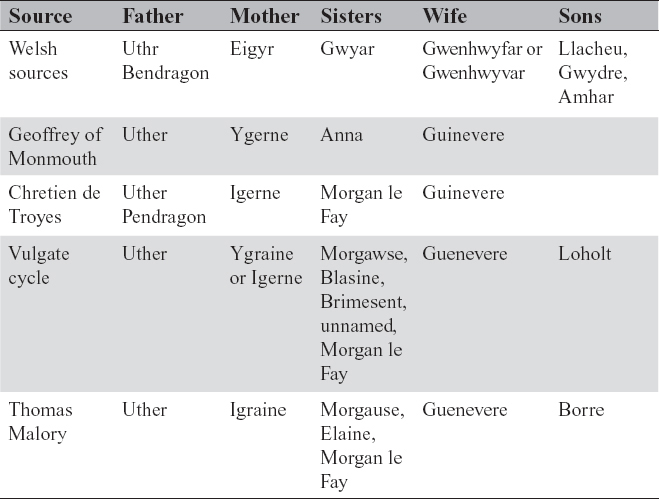
There is certainly some consistency regarding his parents. However, the proposed family trees differ significantly across the sources. In the traditional Welsh legends Igraine’s father is Amlawdd Wledig who marries a daughter of Cunedda. This places Arthur three generations after Cunedda and the same generation as Maelgwn and this contemporary with the five kings of Gildas. In Geoffrey of Monmouth’s version he is the grandson of Constantine, and Ambrosius is his uncle. The later romance versions build on this with various sisters and cousins. We have little information on Amlawdd Wledig, there’s more than one genealogy and none that are contemporary or credible historical sources. In short, we have a jumble of contradictory sources that lack any validity regarding a family tree. If we were to attempt a genealogy from the earliest sources it would look slightly different to Geoffrey of Monmouth and later French romances.
It is possible to see where some of the other concepts come from. The sword in the stone does have its equivalence in the medieval story of Saint Galgano (1148–81) where a sword is embedded in rock in the Abbey of San Galgano in Italy, and may have influenced Robert de Boron who was writing soon after.
In the Welsh Triads ‘Pen Rhionydd’ is listed as one of Arthur’s northern courts. It has been suggested this is Penrith in Cumbria and it may be worth noting a Neolithic stone ring called King Arthur’s Round Table is nearby. There are many such sites all over Britain: twenty-two Arthur’s stones, thirty Arthur’s Quoits (discus shaped stone); five tables and three round tables; eight seats; six Halls, camps or other types of residence; five graves and fifteen other sites referring to Arthur.1 They can’t all be connected to Arthur, and beyond local myth and legend there is absolutely no evidence linking any of them.
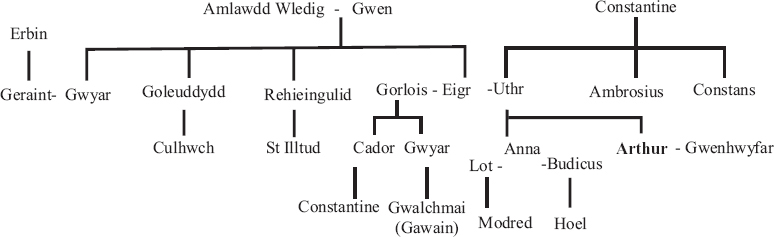
Genealogy of Arthur.
However, it is worth noting the absence of such sites in the south east. They are heavily concentrated around the Welsh coastline, with a smaller number in Cornwall, Somerset and the north. Similarly, the stories in the saints’ lives are mostly located in South Wales with the West Country also featuring alongside two references to Armorica. Additionally, while the alleged twelve battles can’t be located with any confidence, it is interesting that most of the credible theories do not involve the south east.
In summary, what we have is a single reference to Arthur in 830 by Nennius, 300 hundred years after he was supposed to have lived. There is one passing reference in the Y Gododdin which may originate between the seventh and eleventh centuries but wasn’t written down until the thirteenth. We have two lines referring to Badon and Camlann in the Annales Cambriae written in the tenth century, which, though it may reflect earlier composition, the lines themselves may have been added much later.
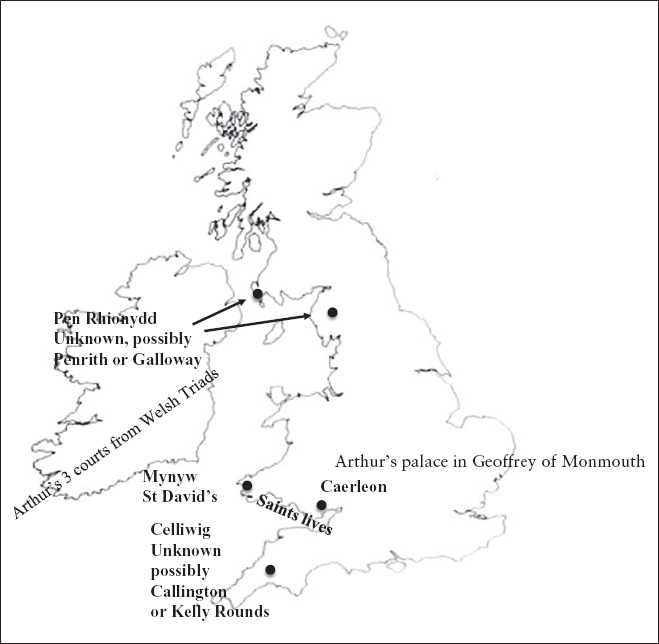
Arthurian locations in Welsh legends.
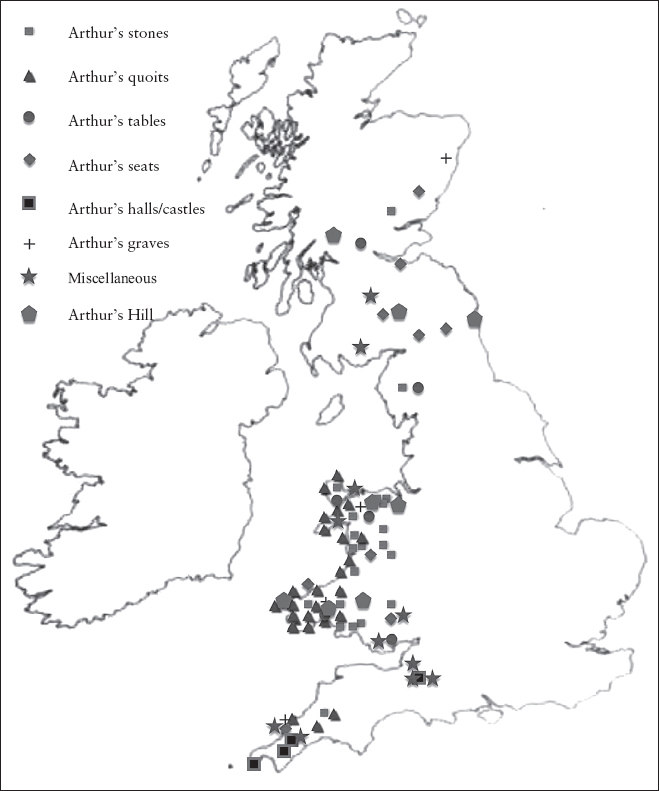
Arthurian landmarks.
Then we have Geoffrey of Monmouth’s work in the twelfth century which is highly suspect and in turn inspires an explosion of Arthurian stories. Many of the concepts we now associate with Arthur are added to the story then. Much later, Welsh stories and legends are written down and these reflect a more mythical and magical Arthur. It is debatable if they reflect an earlier tradition of stories, or if Geoffrey based some of his story on them. On that basis some might say the only evidence we have is the reference by Nennius in 830 and subsequent lines in the Annals Cambriae. All the other works are 500 years or more after any historical figure and could easily be based on a completely mythical character. Or indeed all based on the reference in Nennius, which itself is highly suspect and lacks credibility.
Let us look at the line in Y Gododdin:
In one sense rather weak evidence, however there is a consensus that this poem is contemporary and thus was written around 600. So we possibly have an authentic voice from the end of the sixth century mentioning Arthur in passing. In some ways this very casual reference does show that the author and his readers would recognise and accept the comparison with this famous person. However, first I would argue that one could equally say today: ‘though he was no superman or Hercules’. That would not prove the existence of either. Second, we know from the historical record that there were indeed persons called Arthur towards the end of the sixth century. This appearance and sudden popularity of the name has often been used as an argument that they were named after some famous warrior. We shall come across this later. While many have been put forward as the Arthur, I would say they can’t possibly all be Arthur.
For example, we have a prince of Dal Riata in the Strathclyde area. Arthur mac Aeden was the son of Aeden mac Gabrain, king of the Dal Riata. He lived and fought towards the end of the sixth century in precisely the area near the area of the Gododdin. At that time Dal Riata, Rheged, the Picts, Bernicia and Deira, Elmet and the Gododdin around Edinburgh were all vying for control. This reference in Y Gododdin could just as easily be about this Arthur rather than the Arthur referenced in Nennius. Equally, it could just as easily be proof that Arthur was a mythical figure with no basis in reality to whom warriors were routinely compared. People get very excited about this one line but there is only circumstantial evidence that it is contemporary and none that it is a reference to a historical figure, let alone the Arthur of legend.
Yet we have a body of myths and legends that did develop to produce a variety of stories in Welsh legend, which inspired the later French and Norman stories. These didn’t appear out of thin air. In any event we still have the reference in Nennius and entries in the Annales Cambriae, even if we were to do away with all the later stories. Unfortunately we simply don’t know the origins of the many stories or how they developed over time. The Welsh legends paint a very different picture from Geoffrey or the French romance stories. I’ve provided the table below to illustrate the many of the lesser known concepts form Welsh legend.2
Table 24: Welsh legends
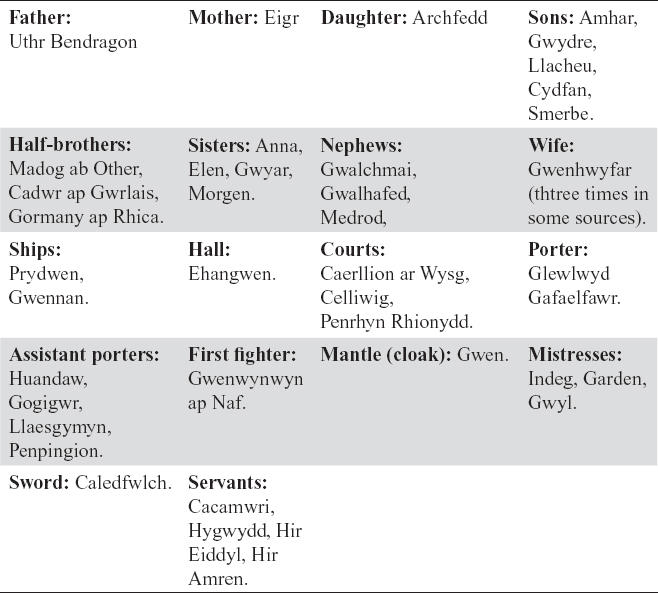
So how would we describe an Arthur devoid of all these transparent additions? We would be left with a battle leader, perhaps a king, but not necessarily. If a king, he might be a ruler of a tribal area, civitas or even one of the old Roman provinces. Perhaps the holder of some leftover Roman administrative or military authority. There would be no Excalibur, no sword in the stone, no Merlin, Round Table, knights, Camelot, Avalon and no Holy Grail. The earlier Welsh traditions do mention Guinevere, Uther, Igraine and Cai, Bedivere and Gawain, but the Welsh versions of these names would be unrecognisable to most and there would be no Lancelot or Percival. He would be far more localised and involved in civil strife. There would be no Arthurian empire or conquests on the Continent.
We have a large body of legends, myths and stories written 600 to 800 years after any supposed historical figure. These stories can be split into two broad groups. The first tend to be of French, Norman or Breton origin. They were inspired by Geoffrey of Monmouth’s work in the twelfth century and possibly by other myths circulating at the time; they were written down from the twelfth century. Many of the concepts we associate with Arthur appear to have been added to the story at that point. The second group are of Welsh origin and though written down after the French romances, may have originated much earlier. This second group present a more mythic and magical figure. They also portray a far darker and morally ambiguous figure. He is simply one of many warriors or kings who is often in conflict with his peers or the church.
Both these traditions would have interacted and helped evolve and change the story through the centuries. The nearest contemporary references are sparse and include the Historia Brittonum in 830, the Annales Cambriae compiled around 954 and the single reference in Y Gododdin which, though written down in the thirteenth century, may have been contemporary with the sixth. The reader will have to decide what weight he or she give to all the legends, stories, romances, saints’ lives written many hundreds of years later. Whether we can dismiss them all as unreliable and too late, or whether we can believe they may reflect a surviving element of fact. The reader will also have to decide the weight to give to the three earlier sources just mentioned.