
Chapter 17
There are a variety of things we don’t know. We don’t know what the political and social situation was in Britain before the Romans left. We don’t know for sure if there were four provinces or five, and we don’t know if the northern provinces were overrun in Gildas’s reports of marauding Irish and Picts. The fact the kingdoms of Rheged, Elmet, Gododdin and Strathclyde survived suggest the northern Britons remained a force. We don’t know if the whole island spoke a Brythonic language or if there were widespread pockets of Germanic. The fact the Julius Caesar noted the Belgae tribe was present on both sides of the Channel suggests it is possible that languages other than Brythonic were present. The meaning of the phrase ‘Saxon shore’ is open to interpretation. Archaeological finds suggest Saxons were present much earlier than previously suspected, although it’s always open to debate whether finds reflect changes in fashion or something more drastic. It does support the narrative that that Angles arrived in the middle of the fifth century and settled in the east of the island. Distinctive finds in Kent, Hampshire and Isle of Wight also support the idea that the Jutes were a distinctive group. It doesn’t help that there’s widespread misuse, even from Roman times, with labels such as Saxon.
Some sort of administrative structure may have continued after 410 and the visits by St Germanus in 429 and possibly in 437, or later, suggest some stability. The usually reliable Gallic Chronicle records a major power change in 440: ‘Britain falls to the power of the Saxons.’ Whether this relates to the revolt and subsequent partition recorded by Gildas is unclear. It could refer to an earlier political shift and the arrival of Hengist and subsequent revolt a separate incident. Alternatively, if they do concern the same circumstance, the dates are all slightly inaccurate, and the reference to Aetius, thrice consul, incorrect.
However, the archaeological record does not support widespread destruction. In fact, a considerable amount of continuation in land use and occupation is evident. On the other hand, later, more reliable sources, do record conflict from the seventh century onwards and a steady expansion of what did become known as the Anglo-Saxon kingdoms. Looking back two or three centuries later these people did see themselves as different from the indigenous Romano-British population. The Law codes of Ine demonstrate this.
Thus we can summarise as follows: Roman Britain continued after 410. Something happened in the middle of the fifth century that shifted power to people described as Saxons. Whether these were immigrants, soldiers stationed in Britain, or part of the indigenous population is uncertain. There is then evidence of further Germanic immigration in the east of the island.
Gildas and Bede describe a process of revolt followed by a fight back by Ambrosius which culminates in the battle of Badon. This is followed by a couple of generations of peace. The consensus is that Gildas is writing in 540s and thus Badon is around 500. This is in no way certain. It’s possible that the identification of Maglo with Maelgwn is wrong, the dates for Gildas’s life are wrong and the interpretation of the passage concerning the ‘44 years’ is also wrong.
So we are left with a Saxon revolt in 440 (Gallic Chronicle) and/or 450s (Bede, Anglo-Saxon Chronicles) followed by a period of warfare and an eventual fight-back by Ambrosius. It is not clear how long this period of warfare lasted but the victory of Mons Badonicus is certainly sometime between 450 and 550. In turn this is followed by a period of relative peace for two generations. The evidence from the Anglo-Saxon Chronicles, genealogies and literary sources begin to be more trustworthy towards the end of the sixth century. The beginnings of Anglo-Saxon kingdoms and further expansion appears to have began from 550 onwards.
Taking all the literary sources into account it is more likely that the battle was sometime between 470–520, and if we rely on Bede and the consensus about Gildas, some time between 490–500, although the Welsh Annals date it to 516. I suggest we keep the widest range and an open mind, because into this time period we must place Arthur. The first reference links him to two things: the battle of Badon and fighting the Saxons. Specifically after the death of Hengist in 488 (Anglo-Saxon Chronicles) when Octha came from the north to rule the Kentishmen, but before the reign of Ida of Bernicia in around 547.
We can dismiss much of the legend attached to him. The story of Merlin was first attributed to Ambrosius in the Historia Brittonum and later attached to Myrddin Wylit to form a composite figure by Geoffrey of Monmouth. It may shock and disappoint the lay person, but it is likely that the Merlin figure in connection with Arthur is pure invention. The Round Table, Avalon, Camelot, Excalibur can also be explained as literary inventions or based on contemporary stories such as Charlemagne’s round table and the sword of St Galgano. None of the later Welsh legends, Triads or saints’ lives are in any way reliable, although the persistence of characters such as Guinevere, Uther and Mordred may be more credible than wizards and magic swords. Nothing Geoffrey of Monmouth wrote in 1136, or any other later literary source, can be taken seriously.
We are, therefore, left with a very vague picture with little evidence. A warrior, living sometime between 450 and 550, fighting with the kings of Britain against the Saxons. Possibly connected with Badon and a later Camlann, where he falls. The evidence we have left falls into four main categories:
1.One reference in a possible seventh-century poem comparing a warrior to Arthur.
2.The list of twelve battles in the Historia Brittonum written in the early ninth century.
3.Two references in the Annales Cambriae written in the mid-tenth century.
4.The existence of four persons called Arthur in genealogies at the end of the sixth century, suggesting the name became popular.
Some may claim the existence and persistence of a body of legends and myths enduring several hundred years does carry some weight. The fact that these legends exist and were believed means something. I have sympathy with this view, but it’s difficult to value it as evidence when none of it can be verified and it’s hundreds of years out of date. So we are left with the very real possibility that Arthur was a mythical character or literary device. If a historical character, then we are left to attempt to place him in the correct period. The saints’ lives all point to the early sixth century in Wales and the South in particular, but none are contemporary or trustworthy.
Two main sources could be used to place a possible Arthur in a specific time. The first is the Historia Brittonum, stating Arthur fought after Hengist but before Ida. If we trust the other sources this means between 488 and 547, and yet these sources are no more reliable than the Historia. Given the contradictory statements within the document about the date of the coming of the Saxons, it is possible the entry for Arthur is misplaced as well and this might be important, given some of the possible identifications which are outside the time period. The second source is the Annales Cambriae, but the dates and entries are no more reliable either. In fact, the two entries concerning Arthur may have derived from the Historia Brittonum or have been added much later.
A common thread does emerge from the sources, however. The last legions leave Britain around 410, this is followed by a period of incursions and raids. Vortigern invites the Saxons who, a short time later, rebel. Ambrosius leads a fight-back that culminates in the battle of Badon, but some partition of the island has occurred. There then follows a period of stability and relative peace. Sometime between 550 and 600 the Anglo-Saxons start to expand once more. In the legends, when Arthur is placed into a timeframe, it is always after Ambrosius, in the context of fighting the Saxons and in being successful although later falling in a civil war. This timeline, Vortigern, Hengist, Ambrosius, Arthur, time of peace and fall, starts sometime after 410 and is certainly finished before 600. This puts Arthur sometime in between, but not too close to either of these two extremes.
This suggests three possible times in which to place him:
1.An early Arthur in the period 450–480. This would fall in line with Vortigern gaining power in 425 and the arrival of the Saxons in 428 as stated in one part of the Historia Brittonum. It would suggest a Saxon revolt in the late 430s and support the Gallic Chronicle entry for 440. This would place Ambrosius around 450 and presumably Badon sometime in the 460s or 470s. This would make Arthur a contemporary of Riothamus in 471. It would mean he was active at the same time as the Romano-Saxon wars of the 460s, the expansion of the Franks and Visigoths and the final fall of the Western Empire in 476. It would mean the dating and/or interpretation of Gildas is wrong and Bede’s dates are all inaccurate. It would also dismiss the dates in the Annales Cambriae for Badon and Camlann. Additionally, Hengist arriving in the prime of his fighting life in 428 is unlikely to be still fighting battles in the 450s–70s, and later dying in 488 as recorded in the Anglo-Saxon Chronicles. It also doesn’t explain the implied Saxon strength of Aelle in the Anglo-Saxon Chronicles from 477–91 and his description of Bretwalda by Bede.
2.A middle Arthur between 480–510. This is possibly the most popular and best fit based on the sources. This wouldn’t necessarily dismiss an early Vortigern or Saxon arrival. A Vortigern gaining power in 425, might have received several groups of mercenaries and might still have been in power in 449 to welcome Hengist. This would agree with Bede and the Anglo-Saxon Chronicles for a revolt and battles in the 450s. This would place Ambrosius either side of the 470s and would fall into line with Bede’s reference in the Chronica Majora regarding Ambrosius being active during the reign of Zeno (474–91). This would make Ambrosius a contemporary with Riothamus. A battle of Badon after 491 would explain the ending of references to Aelle in the Anglo-Saxon Chronicles and the gap of seventy years between the Bretwaldas, Aelle and Ceawlin, recorded by Bede. It would fall into line with archaeological evidence and the traditional dating for Bede, as well as the narrative of two generations of relative peace before the Anglo-Saxons start expanding again. It would make Arthur a contemporary of Clovis and the fall of the last Roman rump state, the kingdom of Soissons, in 486. Against this are the entries in the Anglo-Saxon Chronicles for the arrival of Cerdic in 495 (or 514 or even 532 depending on interpretation) and subsequent battles, which would contradict the narrative of two generations of peace. Also, it doesn’t conform with the dates in the Annales Cambriae for Badon or Camlann.
3.A later Arthur between 510–40. This is supported by the entries in the Annales Cambriae for Badon and Camlann and the date given for Arthur’s death in the History of the Kings of Britain by Geoffrey of Monmouth. It is more in line with later stories which place him a generation before Myrddin Wylit and Taliesin and connect him with various Welsh saints, mainly in the first-half of the sixth century. It is not inconsistent with the Historia Brittonum and could be supported by the reverse emigration of Angles around 531 from Britain to Frankia during the Thuringian War. On the other hand it goes against the narrative and dates found in Gildas, Bede and the Anglo-Saxon Chronicles, although if Gildas has been misinterpreted and misdated, subsequent sources would have been affected.
Bearing all that in mind, a list of various suspects have been put forward by a range of different authors. One or two might fall outside the suggested time periods above.
Table 31
|
Figure |
For |
Against |
|
Lucius Artorius Castus 140–197 |
Named Arthur. Fought battles in Britain and possibly Gaul. |
Too early to be credible. No supporting sources in the well-documented centuries after. No evidence he fought against Saxons. Can’t have fought at Badon. |
|
Vortimer mid-fifth century |
Correct time period. Fought against Saxons. Victorious in all his battles. |
Only mentioned in one source. Portrayed as separate figure in earliest source that mentions both. Not called Arthur. |
|
Ambrosius Aurelianus mid-fifth century |
Correct time period. Fought against Saxons. Connected to Badon by Gildas. |
Not called Arthur. Portrayed as separate figure by Historia Brittonum and later legends. |
|
Riothamus 460–70 |
Correct time period. Fought in Gaul. Name maybe a title – High King. |
Not called Arthur. No record of presence in Britain. |
|
Arthwys ap Mar mid-fifth century |
Correct time period. ‘Arth-’ type name. Linked to northern kingdoms through genealogies. |
Name not a derivative of Arthur. Genealogies not reliable. No evidence of battles or any other connection. |
|
Owain Danwyn (white-tooth) late fifth century |
Correct time period. King of Rhos. Father of Cynlas possibly referenced by Gildas with ‘bear’ imagery. |
Not called Arthur. No evidence of battles or any other connection. Genealogies not reliable. |
|
Cynlas early sixth century |
Correct time period. king of Rhos. Possibly referenced by Gildas with ‘bear’ imagery. |
Not called Arthur. No evidence of battles or any other connection. |
|
Artuir ap Pedr circa 550–620? |
Name a derivative of Arthur. Correct time period. King of Dyfed. |
More likely to have lived end of sixth century. No evidence of battles or any other connection. |
|
Artuir mac Aedan circa 560–96 |
Called Arthur. Historically attested figure. Fought many battles against Saxons. Many of the battles possibly linked to northern sites. Possibly fought at Dun Baetan in Ireland in 574. Son of a king. Plethora of landmarks with Arthur connection. |
End of sixth century and a little late for a historical Arthur. Localised battles ending in defeat. No record of contemporaries or later sources regarding him as the Arthur of legend. |
|
Athrwys ap Meurig circa 610–80 |
‘Arth-‘ type name. King of Gwent |
Outside likely time period. Most sources name him Atroys or similar. No evidence of battles or any other connection. |
Some of these theories are very plausible on face value, but they can’t all be Arthur. As we have seen, it doesn’t have to be any of these. It could well be, in fact is more likely to be, someone not in any genealogies. To put it bluntly: we need a body. Some suggest he is just as likely to be a mythical figure historicised by the ninth century than he is to be a historical character.1 One example would be Fionn in Gaelic literature.2 One of his deeds was building the Giant’s Causeway, yet he eventually was historicised in repelling Viking invaders. The processing of historicising legends was widespread in the Middle Ages hence the proliferation of foundation myths among the Romans, Franks, Anglo-Saxons and Britons. Other examples might be Robin Hood, William Tell and Sherlock Holmes. Supporting the theory of a mythical figure it is worth noting the following: much of the Welsh sources describe a legendary figure, often associated with magic. There’s very little association with fighting Saxons or Badon. In an age before modern communications, the printing press and widespread literacy narratives lose their accuracy and reliability beyond about five generations. We must bare in mind that your grandfather might be able to relate reasonably accurately what his grandfather told him, but beyond that facts get distorted. We know how unreliable even eye-witness statements can be, or how conspiracy theories can form even days after an event. Thus some have suggested that beyond about 200 years we can no longer trust an account as contemporary.3
We do have the twelve battles in Nennius, the entries in the Annales Cambriae and the Dream of Rhonabwy, although the latter is set in the twelfth century and the earliest copy is from the fourteenth, so its validity is called into question. The Annales Cambriae was written in the tenth century and doesn’t record against whom the Britons were fighting. In any event it is likely derived from the only early source that connects Arthur with Badon and the Saxons, which is the ninth-century Historia Brittonum. The vast bulk of the Welsh myths and saints’ lives portray a petty king or warrior often engaged in quests and supernatural events. It is possible that he was a mythical figure used in sagas and myths whose story evolved over 300 years. The figure and story then became historicised by the ninth century. All the subsequent Welsh legends stemmed from that before Geoffrey of Monmouth and the romance authors expanded it further.
There is an early Welsh poem, Armes Prydein, dated to the tenth century from the Book of Taliesin. It extols the Brythonic people to lead the Scots, Irish and Vikings to rise up and drive the Anglo-Saxons out. It mentions various Welsh heroes such as Cadwallon ap Cadfan and Cadwaladr ap Cadwallon, but not Arthur. There’s very little indication that Arthur was seen as a major heroic Welsh figure prior to the twelfth century. Most of the early Welsh legends portray a fantastical mythological character.
Referring back to the Historia Brittonum, if, for argument’s sake, we discount all the other evidence and just look at the sections between Vortigern and Ida, we can ask the following question: are there any figures in the text we know are fictional? Some, such as Vortimor, are not mentioned elsewhere, but I’m looking for definite falsehoods from the author. Although the foundation myth of Brutus and the later marvels of Britain lack credibility, there’s nothing in those sections after Maximus that is a provable lie.
Something started the stories, and those stories were of such interest they persisted for several hundred years. While the story evolved, several key points remained. A warrior, perhaps a king, fighting successfully for the Britons. While swords, tables, grails and family tree may have been added or changed, his father, mother and wife appear to be consistent, and it must be remembered that Geoffrey of Monmouth’s Arthur didn’t appear out of nowhere. There was a fertile ground full of Arthurian myths which must have been present 600 years after he lived. Regardless of the later stories, the fact is the original persisted strongly, possibly through many changes, for 600 years. Given that, is it not more likely to be based on historical fact rather than some mythical figure?
The case for Arthur’s existence might conclude as follows: we have a period of history between the Romans leaving at the start of the fifth century, and the emergence of Anglo-Saxon kingdoms towards the end of the sixth, for which we have little information. However, the sources seem to agree on a basic narrative. Roman Britain persisted for some time before a leader named Vortigern invited Germanic mercenaries to assist in repelling Irish and Pictish raids. There was a revolt and subsequent fight-back led by Ambrosius Aurelianus which culminated in the battle of Badon. There then followed a period of relative stability before the Anglo-Saxons expanded once more. Despite the lack of archaeological evidence for widespread warfare, the eventual emergence of those kingdoms appears to support this. In this mix we have Arthur. There is no reason to doubt his entry in that particular section of the Historia Brittonum any more than St Patrick or Ida, who are either side in the text. Likewise, there is no evidence that any of the entries in the Annales Cambriae are incorrect. The weight of other materials suggest there was a belief in the early Middle Ages, and beyond that Arthur was real.
There is a consistency in the narratives. His parents are always Uthr Pendragon and Eigr or Ygraine, his wife Gwenhwyfar. His sword Caledfwich, Latinised as Caliburn later, under French influence, changed to Calibur then Escalibur. We can see the evolution of the story across time. But the core remains and it is a story that has persisted down several centuries. The argument is not that the evidence is strong, nor does it rely on the ‘no smoke without fire’ argument. The position is, despite the evolution of the legend, there is a core, consistent, story. Arthur’s story is not at all incompatible with the narrative in Bede or other sources. Academics have been unduly cautious in dismissing the evidence in the Historia Brittonum and Annales Cambriae. I would remind readers of the historical consensus concerning Troy. It was generally thought that Homer’s Iliad was legend and Troy a myth, until the 1870s when Heinrich Schliemann uncovered the evidence.
The case to dismiss a historical Arthur as fictional might go like this: it is not for us to prove a negative. We are not required to prove for certain someone did not exist. The only requirement is to show there is not enough evidence, even on the balance of probabilities, and in doing so, the academic community has not been negligent or over-cautious in dismissing a historical Arthur. There are hundreds of fictional and unattested characters throughout historical sources. To ascertain if one has historical validity one must have evidence and that evidence must be of the appropriate standard. Lots of bad evidence is still bad evidence. Geoffrey of Monmouth is bad evidence. Worse than that, he is a thoroughly untrustworthy witness. All the so-called sources that come after him are tainted by his influence, but are poor in their own right as well as being far too distant in time to be considered. The Welsh legends also are too late to consider. The only evidence that could be considered has been found wanting.
To summarise the evidence we have:
The one line in Y Gododdin: Even if I grant it is a sixth-century entry, it doesn’t follow that it refers to our Arthur. It could just as easily refer to a local Arthur. Even if it does refer to the Arthur of legend as understood by the populace in the early Middle Ages, it doesn’t follow that he was not fictional. The apparent naming of three or four people as Arthur in the sixth century does not show that they were named after a historical character – it could easily be a coincidence. The numbers are so small it could be that records are just too poor for preceding years. It also doesn’t mean they were named after a historical figure. Names are popularised today from films, celebrities, royalty and books. The only reason we consider someone like Artorius Castus is because of his name. If we had hundreds of Arthurs to chose from, he would likely be bottom of the list of suspects. It is similarly poor evidence to latch onto any figure with an ‘Arth-’ type name who lived any time near the period at which we are looking.
The argument about the weight of legendary material is simply the ‘no smoke without fire’ argument. It has no merit. We have hundreds of religious and mythical stories with a huge ‘weight of material’. It doesn’t follow all those stories are true; for that we need evidence. Which leaves me with the last two pieces of evidence. The Annales Cambriae was written 400 years after the supposed events and are not considered reliable by the academic community. They are simply not contemporary enough. It is likely the entries for Arthur derive from our last bit of evidence. The Historia Brittonum was written around 830, 300 years after the events. It contains a mass of contradictory dates and stories alongside mythical and magical entries. It is not considered at all valid or credible as a historical document, other than for what it shows about the time it was written. There is no reason to dismiss the magical references, but respect the battle list attributed to Arthur. If we had proper evidence, we wouldn’t be looking at this at all. The only reason people spend so much time and effort on such poor evidence is because credible and valid sources do not exist. We have no credible evidence that is even within the 200-year period necessary for it to be considered – even at the far end of the definition of contemporary. Nothing within the memory of the oldest person living at the time, or even a grandparent of a grandparent, that could have been passed down.
We have rigorous historical methods and standards and it would be a great mistake to lower those standards. We have some contemporary evidence, both in Britain and on the Continent. It doesn’t include an Arthur. If evidence identifying a historical figure presents itself, then it can be examined and possibly accepted. Until then we have no need of an Arthur and we shouldn’t force historians to accept or invent one to satisfy our imagination.
Having covered those two arguments for and against in summary, we now have to ask ourselves the following: on the balance of probabilities, is there credible evidence for a historical Arthur? The evidence is sparse. One line in a possibly contemporary poem, together with an apparent popularisation of the name. A reference, albeit detailed, 300 years after the event and another 100 years later. Then a large body of legends and stories, what has been described as the ‘no smoke without fire’ argument. How much weight you give to each of these is for you to decide, I will lay out my theory in the discussion section next.
Discussion
Like many interested in the subject, I started hoping and wishing that such a figure existed, but perhaps willing to accept the evidence might not be there as yet. As I went through the sources I came to the disappointing conclusion that there is at least the possibility he did not exist and he was entirely a mythical figure. It’s difficult to put a percentage on this, but the likelihood of Arthur being mythical or a real figure now seems a lot closer than I had previously hoped. Because of this, I found myself reluctantly moving my position from Arthur being a historical figure on the balance of probabilities, to one of there simply not being enough evidence to support this.
That, however, seems to me the easy way out, so let me remove that option and force myself to choose between a mythical or historical figure. There is a reasonable chance that either option is correct. I have to concede, I am biased; I want there to be an Arthur. I’m sure most people would say the same. Who would want him to be mythical? Who would give up the possibility of solving the mystery? But hopefully I can detach myself from my prejudices and base it on the evidence.
Regarding the possibility of a mythical figure, it has to be accepted there are countless examples throughout history of a mythical figure becoming historicised. There is plenty of evidence that even eye-witness accounts can be faulty and the prevalence of modern conspiracy theories, many of them contradictory, demonstrates that even in our own time a false narrative can gain traction. Within a few generations it can become distorted further and the truth forgotten. But it’s a curious myth to develop, based as it is upon a very Roman-sounding name. In addition, one must consider the purpose of the Historia Brittonum, which was to inspire his contemporary ninth-century audience. It was written, I believe, with the expectation that the core story would be believed. We could say the same about the twelfth-century work of Geoffrey of Monmouth of course, which is riddled with falsehoods. There certainly was a great body of legends which had survived for the 600 years up to his time. Yet it may well be that ‘history keeps peeking through the gaps’. But Geoffrey cannot be trusted. As a witness he would be dismissed for his unreliability and lack of credibility. If we are to be consistent and rigorous with evidence, we must also dismiss all the later legends, stories and French romances.
This means no Avalon, it’s far too similar to other legends involving islands and nine maidens which existed separately to the Arthurian stories. It also means no Camelot, unless it’s some corruption of Caerleon, which is recorded as Arthur’s courts by Geoffrey of Monmouth. The Round Table is an obvious late addition and the simplest explanation is that it was stolen from Charlemagne’s story. Arthur’s sword was originally Caledfwlch and seems too similar to the Irish legendary sword Caladbolg. We can see the evolution from Caledfwlch to Caliburn, Calibur, Escalibur and so on. Its attributes are also similar to Charlemagne’s sword, Joyeuse. The fact many of the additions arrive via Breton or Norman sources may be no coincidence.
There is no Lancelot, no lady in the lake, and most certainly no Holy Grail. Likewise the sword in the stone seems far too similar to the legend of St Galgano. I have a soft spot for the legend of the London Stone, where someone in authority touches the stone with his sword, but my liking of a legend doesn’t make it true. Similarly, the idea of Arthur leading a cavalry unit is just guesswork. It may well be true, but there is no evidence. Perhaps he hated horses and was an infantryman throughout. Perhaps he hated swords and preferred a Frankish axe in battle. Nor can we speculate on Sarmatian cavalry or Eastern-European legends travelling thousands of miles and hundreds of years to appear in some veiled way with no clear evidence.
So what is left once we strip away the layers of the legend? We have a warrior; later legends call him a king or even emperor, although that goes too far. If king, it is a petty king, and he is one of many. He’s most certainly Christian as is the society in which he lives. His parents are consistently named Uthr and Eigr or Igraine. His wife is Gwenhwyfar, and Mordred is possibly his cousin or nephew. It is worth mentioning in general terms about all the various theories put forward, many of which rely on the interpretation of genealogies. What seems clear is that none of the earliest genealogies mention Arthur or his parents and are all written hundreds of years after he is supposed to have lived. Later sources, in their attempt to add his family to existing lines, cannot be trusted. Nor can we interpret any ‘Arth-’ type name any way we like. Too many of the theories ride roughshod over the genealogies, locations and battle names to arrive at self-serving and highly suspect translations and interpretations. What we can say for sure is they can’t all be right.
With that in mind I advise looking at two main sources for information. First, the original source material. This means good translations of Gildas, Bede, Nennius and the Anglo-Saxon Chronicles. Second, books, papers and research by respected academics. I looked at degree-level courses online to find out what text books were required and found academics like Dumville, Davies, Higham, Yorke and Bartrum invaluable. In addition, the references in these books and papers allow one to build up a library of credible sources. Prior to this I had read many of the theories and thought many were reasonable and plausible. After researching the sources and the experts, however, I reread them and found many to be lacking in credibility. In short, none of them are wholly convincing.
There are several geographical areas that appear to be of greater interest than others:
1.The South Wales region: Connected through the lives of the saints. St David’s is named as one of his courts in the Triads. Caerleon is named as his palace by Geoffrey of Monmouth and may be the ‘city of the legion’ listed as one of his battles.
2.The North: Linked to northern genealogies as a great-great-grandson of Coel Hen. Linked to next generation through other characters, Urien, Owain, Lot and Myrddin Wylit. At least one of the battles, Celidon Wood, is likely to have been in the north, but several others have been suggested. The northern military command led by the Dux Britanniarum was the strongest in the post-Roman provinces. Originally based at York and controlling Hadrian’s Wall, it would likely be involved with any northern battles.
3.Lincoln: The most likely site of the four battles in the ‘region of the Linnuis’. Could be defended from northern forces based at York.
4.Wroxeter area: The Roman city appears to be one of the few that shows signs of development into the sixth century. A major centre in the original kingdom of Powys, it is close to Baschurch, Caer Faddon, Buxton, Chester, the river Gamlan and many other sites suggested as possible battle identifications. It may have been the location of Cuneglasus, one of Gildas’s five kings.
5.West country: Contains Amesbury, which has been suggested derives from Ambrosius, and later legends claim Guinevere retired to a convent. Close to Cadbury hill fort, Glastonbury and Bath, all associated with the later legends. Some of the saints’ lives place him across the Severn or in Devon or Somerset.
6.Cornwall: Includes one of his courts at Kelliwig but also Tintagel and Camlann from Geoffrey of Monmouth.
From a military point of view and the likely identification of some of the battles, a northern commander based at York seems more logical. Yet many of the Welsh legends do seem to focus on South Wales and the West Country. The fact that the most likely battle sites appear to range fairly widely from the Caledonian Forest to Lincoln does not suggest a local petty ruler operating in one small area. What is clear is that there is no association with the south east. Outside of Geoffrey of Monmouth and later stories, cities such as London, Canterbury and Colchester do not feature at all.
If we decide that Arthur is historical, the next useful step is to decide if he falls in the time on which we are focused. If not, then we have to accept Nennius wildly misplaced him. Given the amount of historical knowledge it’s unlikely such a figure could have gone unnoticed or misidentified either before 400 or after 600. The only likely candidate is Artur Mac Aedan of Dalriada. It is true that one could interpret all the twelve battles as being in the north, but we have to wonder why he became so famous as a British and later Welsh hero, and not as an Irish or later Scottish one. We also have a Life of St Columba who was a contemporary of Artur, although it was written a century later by Adomnan. Yet there is no connection made, either in this or any other source, that Artur was the Arthur of legend. So we are left with the period in which Nennius places him; that is after St Patrick but before Ida of Northumbria.
This brings us back to the three options left to us in the last chapter: an early Arthur 450–80; a middle Arthur 480–510; or a late Arthur 510–40. Each choice requires us to depart from some sources. It requires us to address certain questions:
• What does the Gallic Chronicle for 440 signify?
• How to interpret Gildas, especially his reference to Badon and forty-four years?
• How does Bede’s date for the Saxon arrival square with the Gallic Chronicle?
• How to interpret the apparent double entry of Cerdic in the Anglo-Saxon Chronicles?
Let us first consider the political situation between Constantine III and circa 440 when the Gallic Chronicle records ‘Britain falls to the power of the Saxons.’ First, we can be fairly sure about what did not happen. We did not have a homogenous Romano-British society with no political, tribal, geographical or religious divides. Nor did we have one great mass of Anglo-Saxons, equally homogenous, who turned up en masse one day. We didn’t have some fluctuating border moving back and forth with the fortunes of war.
We know there were political divisions at the start. Constantine left behind an administration, but the Britons rebelled against them and appealed straight to the emperor. Honorius’s reply wasn’t to the Vicarius or Provincial Governors, but to the civitates. So there was some tension between central control of the island, the provinces and civitates. We don’t know if the provincial structure survived. Add to this tribal affinities; the fact that some tribal areas and civitates, such as Kent, survived even to this day, demonstrates there was continuity. However, it is unknown how much influence, if any, former tribal loyalties held. Then throw in religions tensions between the Pelagians and Orthodox Christians. There was also already a significant immigrant, and in particular, Saxon, population. Lastly, there was undoubtedly differing opinions regarding Rome and its influence. The letter-writers of 409 clearly felt connected to Rome, as did the appellants to Aetius a generation later. St Patrick referring to ‘citizens’, and Gildas referring to the ‘last of the Romans’, demonstrates the persistence of the link.
All these competing forces and agendas would not have lived in a vacuum of time and place, but would have shifted and changed across geography and time. For example, one can imagine trading ports and cities wishing to retain links with Rome and Gaul, while some tribal leaders flexed their muscles for independence. At the same time, some figures might have dreamed of following the footsteps of Constantine I, Maximus and Constantine III, uniting Britannia and declaring themselves emperor. Ethnic tensions may have risen, not just between Germanic immigrants and Romano-British, but between rival tribal areas. The religious divide on the Continent was often between Arian barbarians and Roman Orthodox Christians, although in Britain there are hints it also was between wealthy Pelagians and the more orthodox population. It’s tempting to think the appellants to Honorius in 409 had destroyed the Provincial structure, so perhaps there were no Governors to exert control, and yet as late as 540 Gildas claims, ‘Britain she has Governors, she has her watchmen’. From Gildas and Bede we hear there was a council of sorts, before approximately 450, to appeal to Aetius and hire mercenaries. Gildas certainly views the Romano-British as separate from the Saxons. He appeals to them as a whole, over the top of what he views as tyrant kings.
We have the makings of a complex and potentially dangerous political, racial, tribal and religious situation similar to many others throughout history, whether in the Balkans, Northern Ireland or Iraq. Yet the situation was calm enough to allow St Germanus to travel from Gaul in 429 and again years later. No kings are mentioned, but he meets a man of tribune rank. The people are Christian and on his second visit he’s able to remove the offending heretics. Clearly there is some sort of structure. There appears to be an army still, if one believes the story of the Alleluia Victory over the Pictish and Saxon raid. The archaeological evidence suggests towns and cities started to diminish in the fifth century, and yet there is still continuity. Hill forts start to be rebuilt and used; the economy starts to suffer and coinage begins to disappear. Yet Gildas reports that cities are not populated as before rather than completely deserted, and some sites, such as Wroxeter, show expansion at this time. Here is where my first deviation from mainstream theory occurs. I think the second visit of St Germanus was in 437 rather than 447. I’m convinced by the evidence presented earlier, but also it just doesn’t make sense if he visited after the incident that resulted in the Gallic Chronicle entry for 440. He would certainly have had something to say about that.
I think this is a very important date and it is another point on which I differ from past theories. Most people attempt to reconcile the 440 date with Bede’s Adventus Saxonum of 449. In the great scheme of things nine years doesn’t seem too great an obstacle to explain away. Yet when one looks at the sources of the Chronicle and Bede, the dates pull away from each other even more. It seems clear to me that this entry is accurate and the date, if anything, is before 440. What this means is a fundamental rethink of Gildas. Rather than the appeal being because of the Picts, it’s more likely due to this event. All those competing forces present between 410 and 440 come to a head. Perhaps the Saxon Shore forts break away under a Saxon leader. Perhaps the South East civitates or Province does likewise. So the entry in the Chronicle and the events reported by Bede are recording two separate events. I would like to put forward three possible alternatives:
1.There is a Saxon and Pictish rebellion/incursion, more successful than the one encountered by St Germanus ten years previously. This results in the Gallic Chronicle reporting that Britain falls to the power of the Saxons and Gildas reports the Picts take land ‘as far as the wall’. There is then an appeal to Aetius in 446. Subsequently, Angle and Jutish mercenaries are hired in 449 and it is this group who later rebel.
2.The narrative in Nennius is accurate in that mercenaries are invited around 428. He then goes on to describe further reinforcements, a marriage to a Saxon princess, being ceded Kent, the arrival of forty more ships, Vortimer’s four battles and poisoning, the Saxons returning and being ‘incorporated’, the night of the long knives and the Saxons being ceded several districts. So the Gallic Chronicle and Bede’s account could be describing two separate things within this. For example, the Gallic Chronicle could refer to a political change: Vortigern’s marriage, Kent being handed over or Vortimer’s death and subsequent return of Hengist. Bede on the other hand could be referring to the return of the Saxons after Vortigern retakes the throne and their being ‘incorporated’. The night of the long knives and taking over several districts in the South East could be the rebellion in Gildas.
3.The two dates do describe the same event, but the sources and timings are mistaken, meaning one, or both, sources are inaccurate.
I favour the first option, as we cannot completely trust Nennius. However, let us not forget that, other than the persistence of the legend over several hundred years, the Historia Brittonum is the only source that mentions Arthur within 300 years. So while I will conclude with an overall timeline, I will also attempt to create a timeline that best fits all the sources.
Once we accept that the Gallic Chronicle is a credible source, the next point in the sequence is the appeal to Aetius. There is no good reason to doubt it is Aetius, and the appeal is made when he is ‘thrice consul’. On the balance of probabilities, we will accept the appeal took place some time after 446. The next point is the appeal for mercenaries. Gildas labels them Saxons but Bede is quite clear that their leaders, Hengist and Horsa, are the eventual rulers of Kent and they are Jutes. He placed their arrival within ‘the time of Marcian and Valentinian’, 449–55. While Bede relies on Gildas he has access to other sources and clearly nothing has caused him to deviate from Gildas. Additionally, any Germanic immigrants in the ‘east of the island’, or to the north east, near the wall, are more likely to have been Angles.
The Anglo-Saxon Chronicle now comes into play. It records battles in 455 and 456, one of them apparently identical to one of Vortimer’s battles in Nennius. This could be the rebellion to which Gildas and Bede refer, thus the fight-back of Ambrosius occurs in the 460s. However, I would put forward an alternative, purely in an attempt to satisfy the Historia Brittonum. Vortimer is briefly successful but dies in the 450s. The Angles/Jutes return and are ‘incorporated’ (given official foedorati status). Then there is the ‘night of the long knives’, where 300 British nobles are slain and the ‘Saxons’ are ceded Essex, Sussex, Middlesex and other districts. Could this be the rebellion? If so, then following the chronology it is more likely to be in the 460s. Interestingly, one of the entries in the Anglo-Saxon Chronicle for 465 records twelve Welsh chieftains being killed near Wipped’s Creek. A flight of fancy I know, but perhaps the 300 nobles killed in Nennius is an exaggeration of the same event. Regardless, this puts the rebellion in the 460s, which makes Ambrosius more likely to start his fight-back in the 470–80s.
I am guilty of the same level of speculation of which I’ve accused others. However, if Bede is to be trusted, the Saxons arrived around 449 and Ambrosius was active ‘in the time of Zeno’, which means 474–91. When placing Arthur in the chronology it is rather academic what happened prior to Ambrosius if we can place him around 480, because Arthur is always after him in the narrative. The simplest answer to the riddle would be for Arturus Ambrosius Aurelianus to be the victor of Badon and the basis of the legend, in the same way Magnus Maximus became Macsen Wledig in Welsh legends. It wouldn’t be the greatest surprise if evidence of that was discovered. However, the narrative is fairly consistent. Ambrosius is a separate person and Arthur comes after him. So let us move on to another controversial interpretation.
What did Gildas mean in his passage about Badon and forty-four years? If the mercenaries arrived between 449–55 and Ambrosius is active between 474–91, the start of his forty-four-year period could refer to either of these dates or to Badon, which he doesn’t date. The end of this forty-four-year period could also mean either Badon or the time of Gildas writing. So when Gildas says forty-four years has passed, there are a number of interpretations:
1.The simplest is that he is writing forty-four years after Badon and at the time of Malicun (Maelgwn), 534–47. This means Badon was fought between 490–503.
2.Bede, writing 200 years later, with access to other sources plus perhaps a more recent copy of Gildas, interprets the text as forty-four years after the Adventus Saxonum, 449–55, placing Badon 493–99.
3.Badon occurred forty-four years after the first victory of Ambrosius, which Bede places in 474–91, leaving Badon 518–35.
4.Gildas is writing forty-four years after the first victory of Ambrosius, and Badon occurred at some point in between. However, given he states external wars have ended and a generation has passed since that victory, this suggests Badon is closer to the time of Ambrosius than that of Maelgwn. Thus Ambrosius could have began his fightback as late as 490, Gildas could be writing in 534, and Badon could have occurred a generation before in 516, satisfying the Annales Cambriae.
It is unlikely to mean, as some have suggested, that he is writing a month after Badon and forty-four years after either Ambrosius or the arrival of the Saxons. This is because he makes it very clear that external wars have ceased and there’s been a generation that has forgotten the horrors of that time. We are therefore left with two choices for the battle of Badon: a date in the 490s corresponding with Bede, or a date nearer to that in the Annales Cambriae entry for the year 516.
It is fair to say that most academics seem to favour the earlier date, but before we explore that further I want to focus on the genealogies; I want to reflect the fact that they simply don’t stand up as credible evidence. Written centuries later for dubious purposes, it is impossible to know if they were written to ‘fit’ the timespan in the Historia Brittonum. Anyone writing a saint’s life or a king’s list in the twelfth century would try to attach their subject to a well-known figure of the time.
Our information is confined to a limited and non-contemporary number of sources: Harleian genealogies British library MS 3859 dated to the twelfth century; Northern genealogies (Bonedd Gwyr y Gogledd) dated to late thirteenth century; Genealogies from Jesus College (MS 20) compiled in late fourteenth century and includes a number of Welsh lineages especially those of South Wales; various saints’ lives; various references in Welsh legends and Triads. If we put all this together we start to see an emerging picture, but are confronted with a problem straight away and it involves Cunedda.
Nennius refers to him as being 146 years before Maelgwn. Yet the genealogies have him as a great-grandfather. If Maelgwn reigns from 534–47 as suspected from the annals, we can estimate his birth to be around 500. If there’s twenty-five years per generation, his father would have been born 475, grandfather in 450 and Cunedda in 425. It’s very difficult to argue Cunedda moving to North Wales at fighting age in 388, and then three successive generations having children at the age of 40–50. The genealogy tables suggest Cunedda was born in the first quarter of the fifth century and moved to North Wales after the ‘Adventus Saxonum’ in 449. Or in other words, around the same time as Vortigern’s mercenaries were hired or in response to the revolt. There is no evidence for any of this and people writing genealogy tables or saints’ lives hundreds of years after the event would be trying to do exactly as we are doing here. However we can attempt to build a picture starting from before Cunedda.
The two main families are connected by marriage, with Cunedda marrying Coel Hen’s daughter, Gwawl. If we label Magnus Maximus generation one, Coel Hen and Cunedda become generation three in approximately 400–50. His sons are generation four, 425–75. This is where it becomes interesting because Arthur, if he existed, should be in generation five or six to be fighting fit at Badon in either the 490s or 510s. Cunedda also had a daughter, Gwen, who married Amlawd Wledig. They in turn have a daughter, Eigr or Igraine, who marries Uthr Bendragon in generation five, 450–500. Which would place Uthr’s supposed brother, Ambrosius, also in that time, allowing for him to be of fighting age ‘in the time of Zeno’, 474–91. What all this means is that Arthur is the same generation as Maelgwn and not the one before as many suppose. They are both great-grandsons of Cunedda. This doesn’t mean they are the same age, they could easily be twenty-five years, or a whole generation, apart. Given that Cunedda had nine sons and at least one daughter, it’s quite likely there is about twenty years from oldest to youngest.
Looking at Coel Hen’s descendants, it shows Urien fighting against Bernicians in the 570s and various cousins, along with Peredur and Myrddin, fighting at Arfderydd in 573. We can thus work backwards from those figures to estimate when others lived. Within these two families we have a variety of saints and characters later connected to the Arthur story. Other families are separate from these including the kings of Dyfed, including Vortipor and Vortigern’s family. The Brittany connection describes Ambrosius’s father as being Constantius, brother of King Aldroneus, a fourth generation from Conan Meriadoc. If Meriadoc was connected to Magnus Maximus, this could indeed place Ambrosius in ‘the time of Zeno’.
It does, however, mean Vortigern’s floruit must have been long to allow for his sons to be fighting Hengist and Horsa in the 450s and for him to be deposed by Ambrosius in the 470s–80s. The stumbling block to this is the pillar of Eliseg which shows Vortigern married to Severa, daughter of Magnus Maximus, who died in 388. It is not impossible for Vortigern to be born in 390, marry Severa, obtain the crown in 425, have children of fighting age in 450 and still be in power aged 70 in the 460s. Far more likely Nennius is simply mistaken, there are two Vortigerns (high kings) or the pillar of Eliseg is mistaken.
Table 32: Genealogies compared
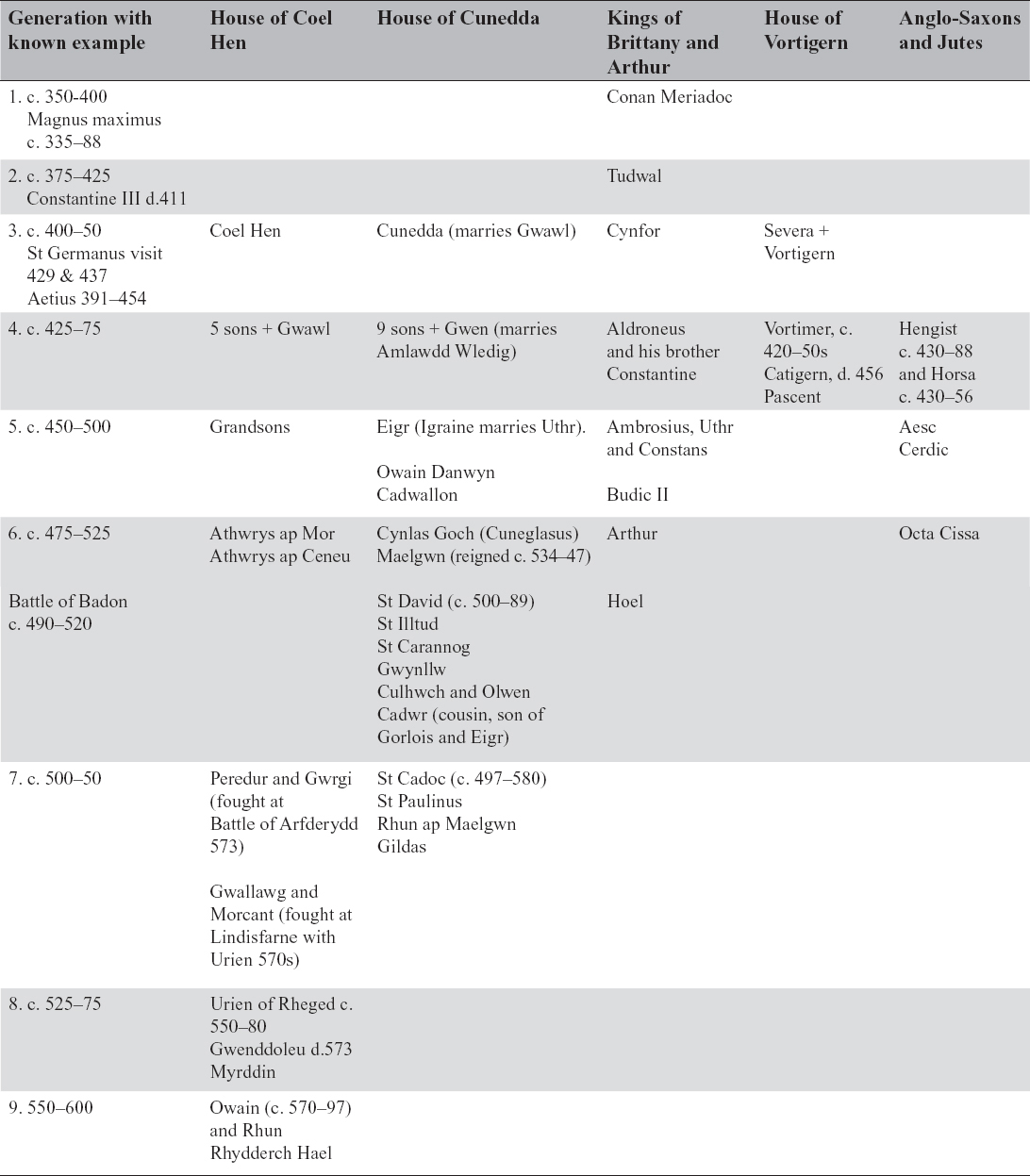
There is a problem with this method. A person with ten children such as Cunedda could have a generation between the oldest and youngest child. So in our speculative floruit Cunedda’s children could be born between 420 and 450. His grandchildren in turn could have been born between 440 and 490. In other words, it is quite possible to have grandchildren older than your youngest child. Thus different branches of the same family can cover a longer timespan. We can see this in Coel Hen’s family descendants, who we know were alive at the end of the sixth century such as Owain and Rhun the sons of Urien of Rheged. Likewise Arthur, being of the same generation as Maelgwn, would not necessarily mean they were the same age.
Nor can the fact of any consensus or consistency be used as proof. Writers many hundreds of years later would be trying to construct genealogies that would be believed. An author of a saint’s life in the Middle Ages would look at the genealogy tables and might wish to associate him with Arthur. He might well add that he was related in some way, and this in turn would be used in later stories and versions of family trees.
Having said all that, it does seem to fit together. From the saints’ lives we have a picture of St Dubricius and St Illtud being senior to St Samson, St Gildas, St David, St Cadoc, St Carannog and Paul Aurelian. That’s indeed what we find in the tables. Focusing on one branch of the Cunedda family, we have Glywys married to Gwawl, granddaughter of Cunedda. He has a number of sons: Gwynllyw, whom we met in the Life of St Cadoc receiving help from Arthur. Perphirius (literally ‘clad in purple’), father of Paul Aurelian, possibly linked to the Aurelianus family; and St Pedrog listed in some legends as being a survivor of Camlan.
We start to build up a picture of Ambrosius Aurelianus being born around 450, just after a similarly named figure is Western Consul in 446, Quintus Aurelius Symmachus. In the History of the Kings of Britain, Vortigern takes charge as Ambrosius and Uthr are still very young. This then allows them to be of fighting age ‘in the time of Zeno’ 474–91. Interestingly, a second Quintus Aurelius Symmachus, son of the first, is Western Consul in 485 suggesting he is of the same generation as our Ambrosius. While Ambrosius and Uthr are growing up in Brittany, according to Geooffrey of Monmouth, Vortimer is fighting his battles in Kent only to be poisoned, Vortigern retakes the throne, the Angles rebel again in the ‘night of the long knifes’ killing 300 British nobles. Perhaps this is the ‘storm’ in which Gildas reports that his parents died.
This means Ambrosius’s father cannot have been Constantine III, who died in 411. It means the Constantine cited by Geoffrey must have arrived in the 440s after the entry in the Gallic Chronicle and around the time of the appeal to Aetius. At that point Gildas states ‘kings were anointed’, and so one could reconcile these different narratives as follows: after the appeal to Aetius fails, a delegation to their Breton cousins in Armorica bears fruit and a Romano-Breton called Constantine comes across the channel and leads the British. The manner of his death differs with Gildas, claiming the parents of Ambrosius died in the Saxon revolt. Whatever the truth, an Ambrosius militarily active ‘in the time of Zeno’ 474–91 is likely to have been born to parents in the 440s. Which then allows time for a Vortigern figure to murder his successor and take control of a council before 450. None of this fits Geoffrey’s tale of Constantine reigning for ten years and his son for three before being murdered. Length of reign aside, however, there is a consistency.
The fly in the ointment is St Germanus of Auxerre. It doesn’t just mess with the timeline of Vortigern, but also with St Illtud who was supposed to be his disciple. If we pull the lines of Cunedda and Coel Hen back two generations, then we do indeed place Illtud a generation after St Germanus and Cunedda and Coel Hen in the same period as Magnus Maximus. But that pulls everyone else back, including those of whom we are fairly certain such as Urien and Maelgwn, as well as some saints. The only way to avoid this is by introducing the enigmatic St Garmon who was active in Wales in the 460s and died on the Isle of Man around 474. Then we go back to trying to have our cake and eat it by introducing two each of Vortigerns, Ambrosius Aurelianus and St Germanus like some Noah’s Ark of Arthurian characters. Nevertheless, St Germanus Bishop of Man, or St Garmon, is said to have lived in the time of Gwrtheyrn or Vortigern.4
The suggested identifications of Arthur previously mentioned are just some of the more popular theories among a veritable army of Arthurs. They all share a number of characteristics. First, they all rely on an inordinate amount of assumptions about the accuracy of the sources they use. We have already seen that academics reject genealogies written centuries later and often for contemporary political reasons. Second, they are highly selective in which sources they use and which are rejected. There is a fair amount of semantics and leaps of linguistic logic, Anyone with an ‘Arth-’ type name, connected to bears in any way, or called Arthur, is latched upon. Aspects of the legend not present are dismissed or explained away. Those that are present are highlighted and held up as proof and counter evidence ignored. The last point they all share is that they are mutually exclusive. They all seem very reasonable when you read them with no knowledge of counter evidence. But when read together and in conjunction with the source material and academic research on that material, one quickly realises none of the theories are in any way close to proving anything. In fact some of them are extremely poor. The more credible theories still rely on scribal errors and leaps of logic.
Another major problem is the arrival of the West Saxons. The later expansion began after 552. This period is completely consistent with the narrative of two generations of stability after Badon. The reverse emigrated of Saxons in 531 to Frankia along with archaeological evidence also supports this. But with a Badon in the 490s silencing Aelle and preventing Octa in Kent expanding, what does the arrival of Cerdic in 495 mean? It presents two problems. The first is the entry for 508 and describes a heavy defeat for the British that hardly fits with a victorious Arthur and time of stability. The second is the apparent double entry. So we have their arrival in 495 and Cerdic ‘conquering’ the kingdom six years later. Then we have an almost identical entry for the West Saxons arriving in 514 and Cerdic ‘succeeded to the kingdom’ in 519. Both these dates are followed by a successful battle seven or eight years later in 508 and 527. It may be that the later dates are accurate and it is worth noting in that version that Cerdic inherits the kingdom of the West Saxons a year after Arthur fights at Badon or Camlann depending which timeline one follows. But this is hardly in line with Gildas talking of two generations of peace.
There are a couple of things that might be important here. First, Cerdic is a British name deriving from Ceretic. His father’s name in the genealogy is Elesa, similar to Elasius met by St Germanus, described as ‘chief of the region’, although this is surely too early for a family connection. He is described as an ‘ealdorman’, which was the equivalent of dux in the Roman administration prevalent along the Saxon Shore both sides of the Channel. Second, most of the battles aren’t recorded as victories at all and seem defensive in nature: Cerdic’s Ford and Cerdic’s Wood before the entry for 530 where they take the Isle of Wight. It reads like they are bottled up in what is now the New Forest and resort to turning south rather than inland. I can only make sense of it by taking the later date for Cerdic, arriving in 514, taking over the West Saxons around the Solent in 519 and being bottled up until after 552. There is some academic consensus that these dates are too early and it is more likely that Cerdic arrived in the 530s to fit in with the later Bretwalda Caewlin. This is all speculation, however, and the entry in the Chronicles for 508 or 527 remains a thorn in the side.
A major defeat of a British king, Natanleod, after Badon, doesn’t fit with Gildas or Bede. However, Gildas does talk about civil wars, and there is the wording in the Chronicle to consider. In 494 they land at Cerdic’s Shore with five ships. Then ‘After six years [500] they conquered the West Saxons’ kingdom.’ This doesn’t mean they were West Saxons themselves, or even that the area was West Saxon at the time. It is true that Stuf and Wihtgar are later identified as Saxons and Cerdic’s nephews, but inter-marriage would not have been uncommon. Then later in 514, ‘the West Saxons, Stuf and Wihtgar, came to Britain with 3 ships’, also landing at Cerdic’s Shore this time fighting the Britons and putting them to flight. In 519 Cerdic succeeds to the kingdom of the West Saxons. The two battles in 508 and 527 are not necessary duplicates. The 508 entry records Cerdic defeating a British king, Natanleod, together with 5,000 men. It doesn’t say where this battle was, only the area controlled by Natanleod. The 527 entry mentions a battle at Cerdic’s Wood, but does not record who wins. It is quite possible these are separate battles.
The assumption has been that these landings are the same event duplicated with one, or both, misdated. There is, however, an alternative explanation: Cerdic arrives in 494 and in six years they are the first to ‘conquer the West Saxon land from the Britons’, which archaeology suggests had more Jutish connections. There is no way of knowing the political situation at the time and given their British-sounding names it is not at all certain whose side they were on. In any event there is a battle in 508. It may well be that this is one of the civil wars for which the British are castigated by Gildas. The entry for 514 names Stuf and Wihtgar as leading the West Saxons and arriving, with a different number of ships. Cerdic then succeeds to their leadership in 519. These entries are not necessarily mutually exclusive. The later battles in the early sixth century seem confined to the original landing site and the Isle of Wight. Later battles from 550 onwards and other sources, however, suggest that the West Saxons, or Gewisse, originated in the upper Thames valley, with the first West Saxon bishopric at Dorchester-on-Thames. The battles between 552 and 577 can be connected by a line north of the Chilterns and running south east between the south of Oxford and Salisbury, culminating in a battle in the west at Dyrham which captures Bath and Gloucester. The academic consensus is that the early landings of Cerdic and activity in Hampshire are highly suspect. Indeed Bede records these very same Jutish areas as being conquered by Caedwalla in 686.
If they are indeed misdated as many experts think, then why would Gildas not mention this new threat supposedly arriving in 532? If they came as stated in 495, how to explain battles between 508 and 530 also not discussed by Gildas. I think the answer to this lies in two places. First, the original name of the West Saxons were the Gewisse, meaning ‘sure’ or ‘certain’. Second, the fact Gildas reports no external wars ending, but that civil wars were continuing. This would suggest that the Gewisse were in fact closely linked to a British power. The faint whispers of a connection with Vortigern in Nennius and Geoffrey of Monmouth and the prevalence of British named kings in the line. It is quite possible that Gildas didn’t view them as anything other than Britons and it was only in Bede’s time that they identified as West Saxons. What follows from this is the battles around the Hampshire and Isle of Wight areas could be against existing Jutish elements or part of a complex civil war.
One further point concerns fighting in Gaul and the story in Geoffrey of Monmouth about a Roman delegation demanding tribute. An Arthur active from 480s to 510 would have been contemporary with the rise of Clovis. Any request for help from Syagrius or Clovis in their war would have occurred before 486. Pressure from Frankish expansion on the borders with Armorica may have occurred after that date as did the purported treaty around 497 between Clovis and Brittany. Clovis was offered the Consulship by the Eastern Roman emperor, Anastasius I, after his victory over the Visigoths in 507. One could imagine a delegation, similar to that described in Geoffrey of Monmouth, coming from Gaul on behalf of Syagrius, Clovis or Anastasius. It is also possible a British leader, with links to Brittany, would have taken an interest (or even sides) in any Romano-Frankish war in 486 or border disputes after. Any military activity after 500 in Gaul seems unlikely. It is certainly the case that warfare between Bretons and Franks was present after the 550s, but there are a number of issues that would preclude this time: it’s too late; there is well attested contemporary record from Gregory of Tours; it ends in defeat for the Bretons; it is during time of further expansion of Anglo-Saxon kingdoms in Britain that result in the loss of more land for the British. It has to be said, the only suggestion that Arthur fought outside Britain comes from Geoffrey of Monmouth and the Life of Saint Goeznovius. If, and it is a big if, there is some truth in this, then it’s difficult to see any chance outside the latter-half of the fifth century.
I will attempt a timeline that best fits the evidence, pushes out the least amount, creates the least contradictions and need for multiple characters of the same name, or persons of unrealistic lifespans. First, it might be useful to list some of the hints from the sources so far:
• Two main families are portrayed as dominating the genealogies of the North and North Wales: The Coelings and the Cuneddas.
• Arthur’s family stems from Brittany and this explains his absence from these genealogies. Uthr marries Cunedda’s granddaughter.
• Ambrosius and Uthr arrive in Britain after the time of Vortimer (450s) and are active in the time of Zeno 474–91, suggesting Arthur was born in or after the 480s.
• Many of the saints are connected to either the Cuneddas or Brittany, but are active in South Wales. Their timelines appear to correspond to each other and Arthur if he was active in the first quarter of the sixth century.
• Later characters such as Ida, Urien, Myddrin and Peredur are linked to the second-half of the sixth century and are viewed as being in the next generation. Taliesin the bard was said to have known Arthur, Maelgwn and Urien, suggesting he was a young man in the 530s while Arthur still lived.
• In terms of location, the battles suggest more northerly or eastern locations whereas the saints’ lives suggest South Wales and the West Country. The Triads, however, describe three courts in Cornwall, Wales and the North.
For the political situation one must look to a hundred years later for clues. There’s no clear cut Britons vs Anglo-Saxons. The West Saxons fight the South Saxons and Kent. The Northumbrians fight the Mercians. Christian princes escape to pagan Picts while Christian Britons ally with Pagan Saxons to attack Northumbria. Pagan Picts ally with Christian Britons to attack pagan Angles. It’s just a series of competing petty kingdoms with shifting alliances where ethnicity, culture and religion are only three variables. Having said that, Gildas does view the island as being partitioned. He at least sees a clear divide at the time of writing but also hints at many petty kingdoms emerging after Ambrosius and the battle of Badon. What this might mean is Ambrosius attempted to restore the earlier provincial structure of sorts. With Ambrosius leader of one part and Aelle as self-styled ‘Bretwalda’ of other areas. This wouldn’t necessarily mean a clear divide between Romano-British and Anglo-Saxons or Christians and Pagans. A likely scenario would be western/northern areas and eastern/southern areas, but with conflict within them and fluid political situation.
The fact that Bernecia and Deira both have British etymologies may be important. Berneich, as described in the Historia Brittonum, and Derw which may mean stem from people of the Derwent. It is impossible to know whether these were British or Angle controlled areas in 500. It is almost certain the south east was affected by Gildas’s ‘partition of the island’. By Arthur’s time London appears to have been abandoned and St Albans cut off. It is not at all certain who the Gewisse were and on whose side they fought. Elmet, around Leeds, is certainly still British, but York and Lincoln we can only guess. If we take Geoffrey at face value, then they were lost but retaken. We must remember it is very likely that a large Romano-British population remained in Saxon controlled areas. Likewise, significant numbers of Saxon and Angle settlers would have lived in British controlled areas. We can not assume a member of Cantii, for example, would have supported a British leader from the west. Likewise an Angle warband settled near Hadrian’s wall may have been quite willing to be hired by a British king to fight Saxon settlers elsewhere.
Nevertheless, while it was likely a complex and fluid situation there were clearly some, like Gildas, who saw the situation in ethnic or cultural terms. Thus a line of partition may well have designated some areas as clearly different politically and culturally. It is likely Arthur’s military activity occurred, at least at times, near this line of partition. We can only speculate where this boundary was, but it is likely within a broad corridor from the eastern end of Hadrian’s wall down to the Solent.
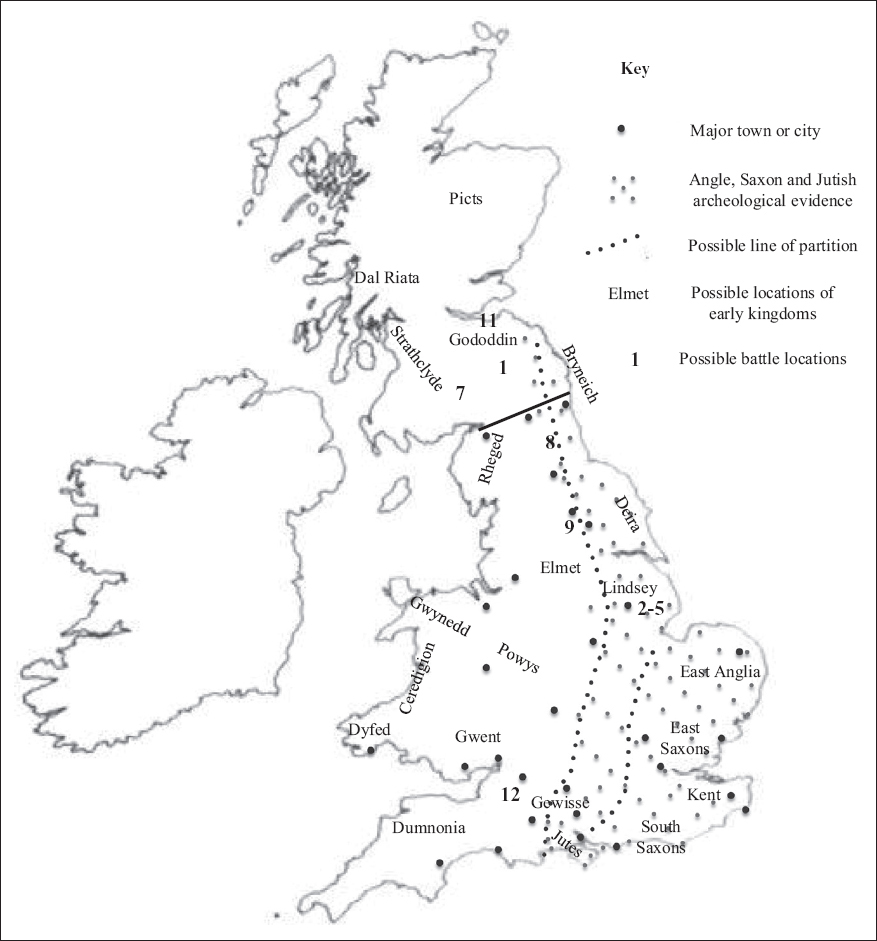
Britain circa AD 500.
It’s worth reminding ourselves what we know and what we can be reasonably confident about. Even some of these few facts are debatable as we can’t be sure about much between the time of Constantine in 411 and the arrival of Augustine to Kent, the kingdom of Aethelbert in 597:
Table 33: Likely timeline
|
407 |
Constantine III leaves Britain for Gaul. |
|
409 |
Britain rebels against Constantine’s administration and appeals to Honorius. |
|
410 |
Honorius advises civitates to look to themselves. |
|
411 |
Constantine III killed. |
|
429 |
St Germanus visits. |
|
437, 444 or 447 |
St Germanus second visit. |
|
440 or 441 |
Gallic Chronicle: Britain falls to the power of the Saxons. |
|
446–54 |
Groans of the Britons: Appeal to Aetius, ‘thrice consul’. |
|
449–56 |
Bede records the coming of the Saxons led by Hengist and Horsa. |
|
474–91 |
Bede places Ambrosius Aurelianus in the time of Zeno. |
|
490–500 |
Bede places the Battle of Badon forty-four years after the Saxon arrival. Gildas appears to place it forty-four years prior to his writing. |
|
534–47 |
Reign of Maelgwn and time of Gildas writing. |
|
550–600 |
Emergence of known historical figures and reliable sources. |
|
597 |
St Augustine’s mission to Aethelbert of Kent. |
The consensus of academics is that Badon is around 500, regardless of which interpretation of Gildas’s forty-four years one uses. This would place Arthur c. 480–520 and on balance it’s the time I prefer; the ‘middle Arthur’ option from our earlier evidence. It’s also quite possible to create a timeline favouring the ‘early Arthur’ if one views Bede as inaccurate, Gildas as misdated and all the Welsh legends and saints’ lives as invalid. Geoffrey of Monmouth’s Constantine, however, is clearly not Constantine III, given the alleged family tree and his place in the chronology. Thus it is at least possible, if not probable, to associate this with Gildas reporting ‘kings were appointed’ after the appeal to Aetius around 446. It follows from this that Ambrosius would be born in the 450s allowing for him being of military age ‘in the time of Zeno’. Interestingly, expert opinion does indeed place the Federate treaty, rebellion and subsequent fight-back much later, with the latter occurring as late as 490.5
The ‘best fit’, then, requires a ‘late Arthur’ that falls into line with genealogical and hagiographical sources, but also a less conventional interpretation of the ‘forty-four years’ and the battle of Badon. The table below therefore attempts to satisfy all the sources and address all the apparent contradictions while leaving the least out. Next to each year I have attempted to match the corresponding entry from the Gallic Chronicle, Gildas, Bede, Nennius, Annales Cambriae, Anglo-Saxon Chronicles and Geoffrey of Monmouth.
Table 34: All the sources side by side
|
388 |
Magnus Maximus killed. |
|
398 |
Roman response by General Stilicho. Gildas: first assault of Scots and Picts, legion sent and destroyed them. Bede: Assault of Irish and Picts, legion sent and destroyed them. Geoffrey of Monmouth: Picts and Huns attack while Maximus in Gaul, two legions sent. |
|
407 |
Constantine III takes troops to Gaul. |
|
408 |
Second assault of barbarians recorded in Gildas and Bede. Romans respond and leave for last time leaving plans for weapons and defence. Geoffrey of Monmouth: Scots, Norwegians and Danes attack. Romans defeat them. |
|
409 |
Britain rebels against Constantine’s administration and appeals to Honorius. |
|
410 |
Honorius advises civitates to look to themselves. |
|
411 |
Constantine III killed. |
|
425 |
Nennius: Vortigern takes power Pillar of Eliseg: ‘Brittu son of Vortigern who was married to Severa daughter of Maximus’. |
|
429 |
St Germanus of Auxerre first visit. |
|
437 |
St Germanus of Auxerre second visit. |
|
440 |
Gallic Chronicle: Britain falls to the power of the Saxons. Gildas and Bede: third assault, Scots and Picts seized whole of north up to wall. Towns and wall abandoned, British massacre. Enemy assaults, internal disorders over whole region. Geoffrey of Monmouth: Scots, Picts, Norwegian, Danes and others seize land up to wall. Cities and wall abandoned. |
|
446–54 |
Gildas and Bede: Groans of the Britons: Appeal to Aetius, ‘thrice consul’. Anglo-Saxon Chronicle: Dates appeal to 443. |
|
Gildas: British victory over enemies. Time of plenty. kings anointed. Disease and plague. Bede: Famine. Victory over Irish and Picts. Abundance. Plague. Geoffrey of Monmouth: Constantine arrives from Brittany, crowned king, achieves first victory. Has three sons: Constans, Aurelius Ambrosius, Utherpendragon. Genealogical sources: Cunedda sent to North Wales from Manau Gododdin with sons to expel Irish. |
|
|
449–56 |
Gwrtheyrn Gortheneu (Vortigern) leads council. Gildas: Rumour of attack, council led by ‘Proud Tyrant’ appeals for help from Saxons. Bede: Vortigern invites Angles and Saxons due to rumours of attack. Anglo-Saxon Chronicles: Angles invited by Vortigern Geoffrey of Monmouth: Vortigern invents rumour of attack to gain power over Constans, (Constantine now dead). Constans is murdered and Vortigern crowned. Ambrosius and Uthr still in their cradle escaped to King Budicius of Brittany. Genealogical sources: Grandchildren of Cunedda start being born including Eigr (Igraine) c. 460. |
|
449–56 |
Gildas: first Saxons arrive in three keels or warships Bede: Angles and Saxons in three warships led by Hengist and Horsa. Nennius: Hengist and Horsa in three keels. Anglo-Saxon Chronicles: three ships land at Ebba’s Creek in South East. Geoffrey of Monmouth: three keels land in Kent led by Hengist and Horsa. Gildas: Larger company arrive. Bede: after first victory against Picts, larger force arrive. Nennius: Asked for original supplies, further sixteen keels arrive, one with Hengist’s daughter. Anglo-Saxon Chronicles: More troops from Angeln sent for. Hengist and Horsa named. Geoffrey of Monmouth: After victory against Picts Hengist given land in Lindsey (Lincoln). Eighteen more ships arrive and Hengist’s daughter Renwein. Gildas: after a ‘long time’ Saxons asked for more supplies. Bede: Saxons asked for more supplies, threatened to break treaty. Nennius: Saxons asked for original supplies. Nennius: Vortigern marries Hengist’s daughter and Hengist is given Kent. Octha and Ebissa with forty ships given land in north near the wall. Geoffrey of Monmouth: Vortigern marries Hengist’s daughter and Hengist is given Kent. Octa and Ebissa with 300 ships given land in north near the wall. Archaeological evidence: increasing Angle and Jutish immigration into Eastern areas. |
|
455 |
Nennius: Vortimer fought four battles against them, Horsa and Catigern killed. Geoffrey of Monmouth: Vortimer made king and fights four battles, Horsa and Katigern killed. Anglo-Saxon Chronicle: 455 Battle at Agelesford (Aylesford?), Horsa killed. 456 Hengist and son Aesc defeat Britons at Crayford and they flee to London abandoning Kent. |
|
c. 460 |
Nennius: Vortimer dies. Vortigern regains crown. Hengist returns. Geoffrey of Monmouth: Vortimer poisoned. Vortigern restored, Hengist returns with 300,000 men. |
|
460s |
St Garmon or St Germanus of Man active in Wales later mistaken for St Germanus of Auxerre. |
|
c. 465 |
Gildas: Saxon rebellion over ‘whole island … all major towns laid low’. Bede: Saxon revolt from ‘east to western sea’. Nennius: Night of long knives. 300 nobles killed. Vortigern captured. Saxons take Essex, Sussex, Middlesex. Geoffrey of Monmouth: Night of long knives, 460 nobles killed, Saxons ceded London, York, Lincoln and Winchester. Anglo-Saxon Chronicle: 465 Hengist fought at Wipped’s Creek, twelve Welsh Chieftains killed. |
|
Gildas and Bede describe increased emigration from Britain. |
|
|
St Garmon active in Britain. Story of Vortigern and St Germanus confused with St Germanus of Auxerre. |
|
|
474–91 |
Gildas: Ambrosius Aurelianus fights back, wins first victory c. 480s. Parents had been killed in troubles (c. 450–60s) and grandchildren alive at time of writing (c. 540). Bede: Ambrosius Aurelianus fights back ‘in the time of Zeno’ 474–91 (Chronica Majora). Anglo-Saxon Chronicles: 473 Hengist and Aesc victory. Arrival of Aelle and South Saxons and victories recorded for 477, 485, 491. Geoffrey of Monmouth: Ambrosius defeats Vortigern first then Hengist. Gildas laments ‘partition of the island’ since that time. Bede describes Aelle as the first ‘Bretwalda’ or Britain Ruler perhaps of the Anglo-Saxon areas only. |
|
488 |
Anglo-Saxon Chronicles: Hengist dies Aesc succeeds. Nennius: On Hengist’s death his son Octha came from the north to the kingdom of Kentishmen. |
|
490s |
Geoffrey of Monmouth: Uthr succeeds Ambrosius, marries Eigr, who already has a son, Cadwr, from first marriage so likely now in 30s. A comet in 497 gives his epithet ‘Pendragon’. Genealogical sources: Great-grandchildren of Cunedda start being born: St Illtud, Gwynllw, Culwch, Olwen, St Caraannog, Cadwr, St David, Maelgwn, Arthur. |
|
493 |
Nennius: St Patrick dies aged 120. Irish annals: St Patrick dies. |
|
495–514 |
Anglo-Saxon Chronicles: 495 Cerdic and Cynric land five ships at Cerdic Shore fought battle. 501 Port and sons, Bieda and Maelga, land two ships at Portsmouth, kill nobleman. 508 Cerdic and Cynric defeat Natanleod and 5,000 at Battle near Charford, Netley. 514 West Saxons Stuf and Wihtgar (nephews of Cerdic) land three ships at Cerdic’s Shore. |
|
500–50 |
Genealogies: generation after Arthur – birth of grandchildren of Ambrosius, denounced by Gildas. St Cadoc and Paul Aurelian c. 500, Rhun ap Maelgwn c. 525 |
|
512 |
Anglo-Saxon Chronicles: Aesc dies. Octa succeeds him in Kent. |
|
Nennius: Then Arthur fought against them: twelve battles. (After St Patrick dies and Octha comes to Kent.) |
|
|
516 |
Battle of Badon: Annales Cambriae. Arthur and Britons the victors. Gildas and Bede: siege of Badon Hill, last but not least victory. Geoffrey of Monmouth: Saxons led by Colgrin and Balduff besiege Bath and are killed. Cheldric escapes (none of these are present in any genealogies or legends). Genealogies place Aesc or Octha in Kent, Aelle or Cissa with South Saxons. ASC: West Saxons Stuf and Wihtgar and Cerdic, Cynric or possibly Creoda. Nennius names Octha as Arthur’s opponent generally. Welsh legends name Osla. |
|
519 |
Anglo-Saxon Chronicles: Cerdic and Cynric succeed to kingdom of West Saxons. 527: Battle at Cerdic’s Ford. 530: Take Isle of Wight. 534: Cerdic dies, Cynric rules. Isle of Wight given to Stuf and Wihtgar. |
|
Badon to time of De Excidio |
Gildas and Bede: External wars stopped but not civil ones. Generation ‘kept to their stations’ and remembered, but they died. Age has succeeded ignorant of the storm. One generation of twenty-five years: 516 + 25 = 541. |
|
520–30s |
Genealogies: Urien, Taliesin, Myrddin Wylit born. Saints Dubricious, Illtud, Gildas, David, Cadog, Carannog, Padarn all active in South Wales. |
|
531 |
Saxon emigrants from Britain used by Franks in Thurungian war and given land. |
|
537 |
Annale Cambriae: Battle of Camlann. Arthur and Mordred fall Geoffrey of Monmouth: dates Camlann to 542 |
|
534–47 |
Reign of Maelgwn. |
|
c. 534 |
Gildas writes ‘De Excidio et Conquestu Britanniae’ forty-four years after the first victory of Ambrosius. A generation after Badon (twenty years) and in the time of the grandchildren of Ambrosius. |
|
547 |
Maelgwn dies |
|
550 |
West Saxons expand territory in South. Angle kings emerge in Bernicia, Deira and East Anglia. |
|
550–600 |
Emergence of known historical figures and reliable sources. |
|
570 |
Annales Cambriae: Gildas dies. |
|
573 |
Annales Cambriae: Battle of Arfderydd where ‘Myrddin Wylit went mad’. |
|
597 |
St Augustine’s mission to Aethelbert of Kent. |
|
c. 600 |
Possible original source of Y Gododdin with first reference: ‘he was no Arthur’. |
|
731 |
Bede writes An Ecclesiastical History of the English People using Gildas but also other sources. |
|
c. 830 |
Historia Brittonum written possibly by Nennius. First definite reference to Arthur and connection to Badon. |
|
c. 954 |
Annales Cambriae written at St David’s, Dyfed. First recorded date for Badon and first reference to Camlann. |
|
Tenth to fourteenth century |
Welsh legends and poems start to be recorded. A more mythical Arthur portrayed. Uthr, Eigr, Mordred and Guinevere connected to early legends. Genealogical records start to be written down but don’t refer to Arthur’s family until after Geoffrey of Monmouth in twelfth century. |
|
Eleventh century |
Lives of saints start to include Arthur. |
|
1136 |
Geoffrey of Monmouth writes History of the Kings of Britain. Introduces Merlin, lays out traditional family tree. |
|
Twelfth century |
Vulgate and post Vulgate romances. Introduction of concepts now connected to legend: Round table, sword in stone, Avalon, Camelot, Lady in Lake, Lancelot, Morgan Le Fey, Holy Grail. |
|
1485 |
Le Morte D’Arthur written by Thomas Mallory. Legend evolves into modern times. |
The table would not pass any test of historical evidence, but it does create a best-fit of all the sources.
So in conclusion: it is quite possible Arthur didn’t exist. There is certainly no current evidence to prove the case. Much of the evidence used to support his existence is just not credible. The line from Y Gododdin provides no more proof than a few people called Arthur lived in the fifth and sixth centuries. We are thus left with two main arguments. The entry in the Historia Brittonum over 300 years later; and the fact the legend persisted over hundreds of years. The last of these is the ‘no smoke without fire’ argument which, aside from being technically inaccurate, can easily be shown to be not the case in other legends. So we are left with the whole edifice possibly resting on Nennius, or whoever was the original author. Do you believe it is likely someone writing in the early ninth century would have placed a fictional character into the narrative? Or is it possible a fictional character could become historicised within the intervening 300 years?
My guess, and it is a guess, is that there was an original figure who lived between 450–550. It is possible he lived outside this time and was misdated by Nennius. However there are no likely candidates and no evidence to support this, therefore I would say it is very unlikely. We are thus left with our three possibilities: an early, middle, or late Arthur. An early Arthur would follow from the timeline suggested by the Gallic Chronicle, but would mean Gildas and Bede are mistaken. A middle Arthur would fall into line with Gildas and Bede and also a rough consensus of modern historians around a date for Badon of c. 500. A later Arthur would tie in with with the Annales Cambriae and saints’ lives.
In order to create a credible timeline that provides a ‘best fit’ of the sources, I’ve made some judgements about the evidence which I hope the reader doesn’t find unreasonable:
• The audience of the Historia Brittonum were aware of a historical Arthur.
• The Gallic Chronicle entry for 440 is to be trusted.
• The Adventus Saxonum described by Bede and Gildas is a separate event from 440 and occurred in 449–56.
• St Germanus of Man has been mistaken for St Germanus of Auxerre leading to the misdating of Vortigern by Nennius.
• Gwrtheyrn Gortheneu or Vortigern’s floruit is 440s–470
• The dating of Ambrosius militarily active in 474–91 by Bede is to be trusted.
• The chronology of Historia Brittonum places Arthur after Hengist and St Patrick around 490 but before Ida around 547.
• The dating of Gildas, De Excidio and Badon are roughly correct although open to interpretation but place Badon at least one generation before Maelgwn’s reign.
While I found this a useful exercise, on balance I would go for a middle Arthur; born before 480, coming of fighting age in the mid 490s. Fighting ‘at that time’ or just after the Historia Brittonum records the deaths of Hengist and St Patrick, which elsewhere are unreliably recorded for 488 and 493 respectively. Conveniently placing Badon 493–500, forty-four years both after Bede’s Adventus Saxonum and before Gildas writing his tract during the reign of Maelgwn 534–47. The ‘last but not the least’ victory. If his reign extended up to the 520s, this would have enabled him to interact with many of the saints associated with him.
Arthur has a Roman name because he likely comes from a Romano-British/Armorican/Gaulish father, although with a British mother. He is not to be found in Welsh genealogies because he doesn’t belong there, at least in none of the paternal lines or king’s lists. If he was, his presence would have been lauded and used for political reasons. It is very telling that Ambrosius Aurelianus, someone who we can be confident is real, is not in the genealogies either. A Romano-British fight-back would likely have involved the remnants of the remaining military forces. With the south east already fallen ‘to the power of the saxons’, the last command was the northern forces and it is reasonable to suggest a military or administrative command for Ambrosius, and later Arthur, rather than a royal one. I thus find it unlikely that any of the figures identified from the genealogies are our man. The original legend retains Uthr, Eigr and Medrawt and Gwenhwyfar, but doesn’t rely on any of this. Even if all these characters and legends were early embellishments it still wouldn’t necessarily throw out the Arthur in the Historia Brittonum. However, many of the concepts associated with the legend are certainly later additions and we must imagine our warrior without Excalibur, Camelot, Avalon, Lancelot or Merlin.
The battles have a distinctly northern flavour with Lincoln, Northumberland and southern Scotland likely locations. Badon seems an outlier but I would retain its association with Bath for two reasons. First, in the ‘Wonders of Britain’ section of the Historia Brittonum, Nennius refers to Baths of Badon. Second, I think it is telling that it’s later Anglo-Saxon name is Badanceaster. If, as is suspected, the Belgae used some form of proto-Friesian language, the Gewisse were Germanic mercenaries, or Saxon mercenaries were already prevalent in the south then it may well be the name Badon was in common usage long before it fell to the West Saxons after Gildas. A Romano-British military command based at York and covering up to Hadrian’s wall would be a likely scenario. Especially with London, the Saxon Shore command and the south east lost. Perhaps also active in South Wales through family ties and saints’ lives and a court at Caerleon. Thus with a court in the north and links to Cornwall, he wasn’t just a localised petty ruler.
I hope I have demonstrated the ‘when’, and at the very least, who he was not. One cannot simply pluck an ‘Arth-’ type name from the genealogies, or construct a theory by selectively picking sources we like and dismissing other more inconvenient ones. I hope I have also clarified the issues for the layperson and separated the wheat from the chaff. We can dismiss at least the fanciful theories and later embellishments. If Arthur did exist, he is the Arthur of the Historia Brittonum, which means he fought the Saxons in twelve battles in the time of Octha around 490–520.
It is possible, of course, that somewhere in Britain, buried in the earth, are coins bearing the inscription ‘Ambrosius Rex’ or perhaps ‘Uthr Bendragon’. Or a letter from Sidonius Appollinaris to Arcturus, or vice-versa, lying untouched in an old manuscript. A letter from the Pope hidden in some vault. An engraving on a tablet, ‘Artorius, Dux Brittoniarum’ thrown into a pit. Perhaps a tomb will be uncovered with an engraved cross that can be dated to the early sixth century. Maybe a stone, embedded in an old church or castle, its face hidden from view. The Latin or Ogham inscription will read ‘Arthur, dux bellorum, fought here and won in the year of Christ…’
References and Bibliography
Adoman of Iona, Life of St Columba. (Penguin, London, 1995).
Ammianus Marcellinus, (translated by Hamilton, Walter), The Later Roman Empire AD 354–378. (Penguin Books, London, 1986).
Ardrey, A., Finding Arthur, (Overlook Press, New York, 2013).
Arnold, C.J., An Archaeology of the Early Anglo-Saxon Kingdoms, (Routledge, London, 2000).
Ashe, Geoffrey, The Discovery of King Arthur, (The History Press, Stroud, 2010).
Ashe, Geoffrey, The Landscape of King Arthur, (Anchor Press Doubleday, London, 1985).
Ashley, Mike, The Mammoth Book of King Arthur, (Constable and Robinson Ltd, London 2005).
Baring-Gould, Sabine, The Lives of British Saints Volumes 1-4, (Forgotten Books, London, 2012).
Bartrum, Peter, A Welsh Classical Dictionary, (National Library of Wales, 1993).
Beard, D., Astronomical references in the Anglo-Saxon Chronicles, (Journal of the British Astronomical Association, Vol. 115, No. 5, p.261, 2005).
Bede, The Ecclesiastical History of the English People, (Oxford University Press, Oxford, 1994).
Breeze, Andrew, The Name of King Arthur, (Mediaevistic, Internationale Zeitschrift für interdisziplinäre Mittelalterforschung, Peter Laing. 2015).
Bromwich, Jarman and Roberts, The Arthur of the Welsh, (University of Wales Press, Cardiff 1995).
Bromwich, Rachel, The Triads of the Island of Britain (4th Edition), (University of Wales Press, Cardiff, 2014).
Bury, John, The Life of St Patrick and His Place in History, (Dover Publications, London, 1998).
Chadwick et al, Studies in Early British History, (Cambridge University Press, Cambridge 1959).
Charles-Edwards, T.M., Wales and the Britons 350-1064, (Oxford University Press, Oxford, 2014).
Clemoes, Peter, Anglo-Saxon England Volume 5, (Cambridge University Press, Cambridge 1976).
Cusack, Mary Francis, History of Ireland from AD 400 to 1800, (Senate, London 1995).
Cunliffe, Barry, Britain Begins, (Oxford University Press, Oxford, 2013).
Dark, K, R., Civitas to Kingdom; British Political Continuity 300-800, (Leicester University Press, London, 1994).
Dark, Ken, Britain and the End of the Roman Empire, (Tempus Publishing Ltd, Stroud, 2000).
Dumville, David, Saint Patrick, (Boydell Press, Woodbridge, 1999).
Gantz, Jeffrey, The Mabinogion, (Penguin Books, London, 1976).
Geoffrey of Monmouth, The Life of Merlin, Vita Merlini, (Read a classic, USA 2011)
Gilbert, Wilson and Brackett, The Holy Kingdom, (Bantam Press, London, 1998).
Goldsworthy, Adrian, The Fall of the West, (Phoenix, London, 2010).
Griffen, T., Names from the Dawn of British Legend, (Llanerch, Dyfed, 1994).
Halsall, Guy, Worlds of Arthur, (Oxford University Press, Oxford, 2014).
Higham, N.J., King Arthur Myth-Making and History, (Routledge, Abingdon, 2009).
Higham, N.J., Rome, Britain and the Anglo-Saxons, (Seaby, London, 1992).
Higham, N. and Ryan, R., The Anglo-Saxon World, (Yale University Press, New Haven, 2015).
Hobbs, R. & Jackson, R., Roman Britain, (The British Museum Press, London, 2015).
Jarman, A., Aneirin, Y Gododdin, (Gomer Press, Ceredigion, 1990).
Jordanes (translated by Charles Mierow), The Origin and Deeds of the Goths, (Dodo Press, Princetown 1908).
Keegan, Simon, Pennine Dragon, (Newhaven Publishing, 2016).
Lapidge, Michael and Dumville, David: Gildas, New Approaches, (Boydell Press, Woodbridge, 1984).
Laycock, Stuart, Britannia The Failed State, (The History Press, Stroud, 2011).
Low, D.M., Gibbon’s The Decline and Fall of the Roman Empire, (Chatto and Windus, London, 1981).
Matthews, John, Taliesin, The Last Celtic Shaman, (Inner Traditions, Vermont, 2002).
Moffat Alistair, The British: A Genetic Journey, (Birlinn, Edinburgh, 2013).
Morris, J., Arthurian Period Sources Volume 3 Persons: Ecclesiastics and Laypeople, (Phillimore, Chichester, 1995).
Morris, J., Arthurian Period Sources Volume 7 Gildas, (Phillimore, Chichester, 1978).
Morris, J., Arthurian Period Sources Volume 8 Nennius, (Phillimore, Chichester, 1980).
Naismith, Rory, Citadel of the Saxons, (I.B. Tauris and Co. London, 2019).
O Croinin, Daibhi, Early Medieval Ireland 400-1200 second Edition, (Routledge, London, 2017).
Oppenheimer, Stephen, The Origins of the British, (Robinson, London, 2007).
Padel, O.J., Arthur in Medieval Welsh literature, (University of Wales Press, Cardiff, 2013).
Pearson, Andrew, The Roman Shore Forts, (The History Press, Stroud, 2010).
Pennar, Merion, The Black Book of Carmarthen, (Llanerch Enterprises, 1989).
Phillips, Graham, The Lost Tomb of King Arthur, Bear and Company, (Rochester, Vermont, 2016).
Procopius (Williamson, G & Sarris, P., trans.), The Secret History, (Penguin Books, London, 2007).
Thomas, Charles, Christianity in Romand Britain to AD 500, (Batsford, London 1981).
Salway, Peter, A History of Roman Britain, (Oxford University Press, Oxford, 2001).
Sisam, Kenneth, Anglo-Saxon Royal Genealogies, The British Academy, london, 1953.
Stenton, Frank, Anglo-Saxon England, Oxford University Press, Oxford, 1989.
Swanton, Michael, The Anglo-Saxon Chronicles, (Phoenix Press, London, 2000).
Sykes, Brian, Blood of the Isles, (Corgi Books, London, 2006).
Thornton, D., Kings, Chronicles and Genealogies: Studies in the Political History of Early Medieval Ireland and Wales, (Linacre College, Oxford, 2003).
Thorpe Lewis (trans.), Gerald of Wales, (Penguin Books, London, 1988).
Thorpe Lewis (trans.), Gregory of Tours The History of the Franks, (Penguin Books, London 1977).
Thorpe Lewis (trans.), Geoffrey of Monmouth, The History of the Kings of Britain, (Penguin Books, London, 1966).
Wacher, John, The Towns of Roman Britain, (BCA, London, 1995).
Wallace-Hadrill, J.M., The Barbarian West 400–1000, (Blackwell, Oxford, 1999).
Wallace-Hadrill, J.M., The Long-Haired kings, (Methuen & Co, London, 1962).
Webster, L & Brown, M, The Transformation of the Roman World AD 400-900, (British Museum Press, London, 1997).
Webb, Simon, Life in Roman London, (The History Press, Stroud, 2011).
Wilson, Roger J.A., A Guide to the Roman Remains in Britain, (Constable & Company, London, 1980).
Yorke, Barbara, Kings and the Kingdoms of Early Anglo-Saxon England, (Routledge, London, 2013).
Zosimus (trans.), Zosimus Historicus, (Green and Chaplin, London, 1814)
www.vortigernstudies.org.uk