
Chapter 1
Julius Caesar made two brief invasions into Britain in 54 BC and 55 BC. It is worth mentioning Caesar’s description from his Gallic Wars. He describes the people of the interior as identifying themselves as ‘aboriginal’, but those of the coast being ‘Belgic immigrants’ come to plunder and later settle down. As we will see later, this could be quite important when it comes to language and ethnic identity. For the Belgae tribe, on the north coast of Gaul and south coast of Britain, were, according to Caesar, mostly Germanic in origin. It wasn’t until AD 43 when the Romans, under Claudius, were able to succeed in gaining a large part of the island. The Romans were confronted with a patchwork of tribes ranging from friendly to hostile. Whether these tribal affiliations lasted 400 years will be covered later, but it is quite important when considering the political and cultural landscape Arthur would have lived in. In Augustus’s reign two exiled British kings fled to Rome as supplicants, and later Caligula planned and cancelled an invasion in AD 40. The Catevellauni tribe in the home counties, north of what became London, were pressurising the Trinovantes centred on Camulodunum and the Atrebates (around Hampshire and Berkshire), ruled by descendants of Julius Caesar’s former allies. The trigger for Claudius’s invasion was supposedly to reinstate Verica as king of the Atrebates. After the invasion Caratacus continued a guerrilla war against the Romans before being captured by Queen Cartimandua of the Brigantes in Yorkshire around AD 51. This led to a Brigantian revolt from those unhappy with the Roman alliance. So we have a patchwork of relationships from friendly to openly hostile, not just between tribal areas but within regions as well.
What is known is that in AD 60 the Iceni rebellion led by Boudica succeeded in destroying Camulodunum, Londinium and Verulamium before being defeated by the governor and general, Gaius Suetonius Paulinus. The important thing about this is the rebellion wasn’t about the Roman presence as such, but about very specific incidents. Boudica’s husband Prasutagus had ruled as an ally of Rome and left his kingdom jointly to his daughters and the protection of Rome. On his death this was ignored; his kingdom was taken, Boudica flogged and her daughters raped. What is less well known is that previously, Rome had encouraged influential Britons to take out loans and given donations. These loans were now called in and the donations confiscated. Leading Iceni men had their estates confiscated and this was mirrored by the behaviour of Romans in Camulodunum, at that time a Colonia, which meant it was settled by veterans. Nor did it help that a temple dedicated to Claudius had been constructed there and the expense forced on the Britons. At the same time, Paulinus was on campaign to destroy the seat of Druid power on Anglesey in North Wales, an act that would further alienate the Britons.
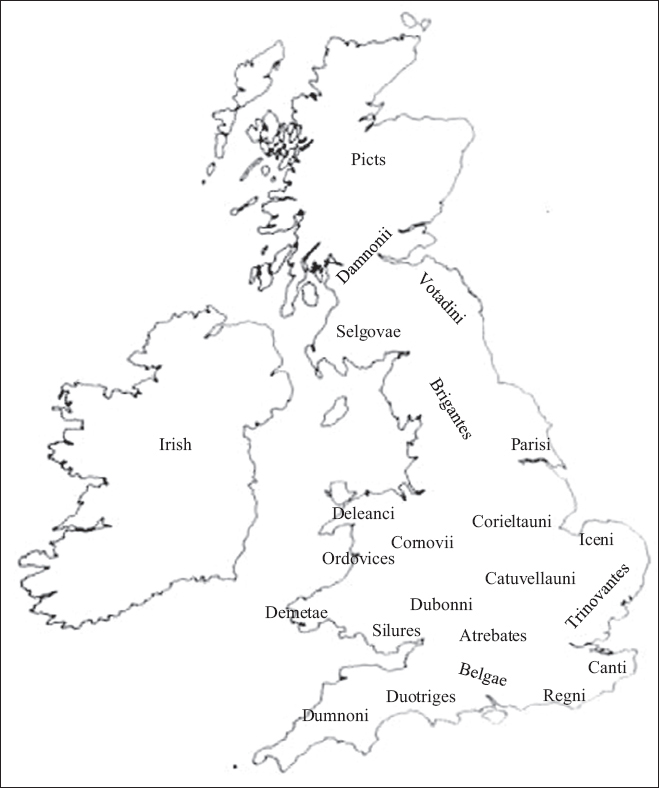
Tribal areas first century.
After the rebellion, much of blame was placed on the harsh behaviour of the former governor and procurator, who had fled to Gaul leaving London to its fate. The new procurator was Julius Classicianus and his policy of reconciliation eventually produced dividends. What is interesting about him is that he was Gaulish, the descendant of the very people Julius Caesar had subdued a century before. So here was a Gaul, with a Roman name, who had risen to high public office and would have considered himself part of the civilised Roman world. Given the Romanisation of Gaul, one wonders how the same process influenced Britain.
Indeed Tacitus, writing in AD 98, records a British client king, Tiberius Claudius Cogidubnus, as being loyal ‘down to our times’. He ruled several civitates, or tribal areas, and was possibly seated at the Roman Villa found at Fishbourne near Chichester. Additionally he describes Agricola’s governorship in AD 78–84. There seems to have been a policy of gradual Romanisation as temples, public squares and houses were built. They were introduced to Roman baths, arcades and towns. They started to mimic Roman dress and manners and encouraged their children to learn Latin. Tacitus goes on to describe their seduction by Roman civilisation as causing their ‘enslavement’.
Each civitas required a capital to administer government. One settlement, though, was completely new and grew to overshadow them all. Built near the ford at which Caesar had crossed the Thames in 54 BC and Claudius a century later (although Claudius’s troops failed to find the exact location). It started off as a fort on one of the three hills overlooking the surrounding marshland and the nearby ford near modern-day Westminster. Those hills are Cornhill, Ludgate Hill and Tower Hill. Opposite, on the South Bank, a further raised area allowed for occupation of modern day Southwark with the first bridge likely to be near to where London Bridge stands today. Being a new town in virgin territory, Londinium was home to Roman immigrants and quickly surpassed Camulodunum, becoming the centre of commerce and finance. We can see how much Roman Britain changed in a few decades by the expansion of London. The Basilica was the civic centre housing law courts and offices. First built in AD 70, it was replaced in the early first century by a building occupying 2 hectares, 300ft in length and three storeys high. It was the largest of its kind outside Rome, signifying the importance of London and Britain, and the extent to which the Roman way of life had embedded itself. The presence of two Roman bath houses and an amphitheatre further demonstrate this.
Two walls were built in the north of the province and are mentioned, inaccurately, in later evidence so I will include them here. Hadrian’s wall was built in AD 122 and took six years to complete.1 It was 73 miles long, 10ft wide and 12–15ft high. In front was a ditch. Behind was a rear earthwork, the Vallum, 20ft wide, 10ft deep and with a 20ft mound each side. There were ‘mile castles’ every Roman mile and a larger fort every 5 miles. There is evidence of decay and reconstruction until the end of Roman Britain. The Antonine wall between the Forth and Clyde in Scotland’s central belt extended the frontier some 100 miles north of Hadrian’s wall. It was a shorter construction of turf at 39 miles long, 10ft high and 16ft wide. Started in AD 142 it took twelve years to complete. There are nineteen forts every 2 miles. It is interesting to note that one of the forts north of the Antonine wall is called Camelon. Camboglanna, another possible derivation from Camelot, is on Hadrian’s wall. There is, however, no evidence for this connection.
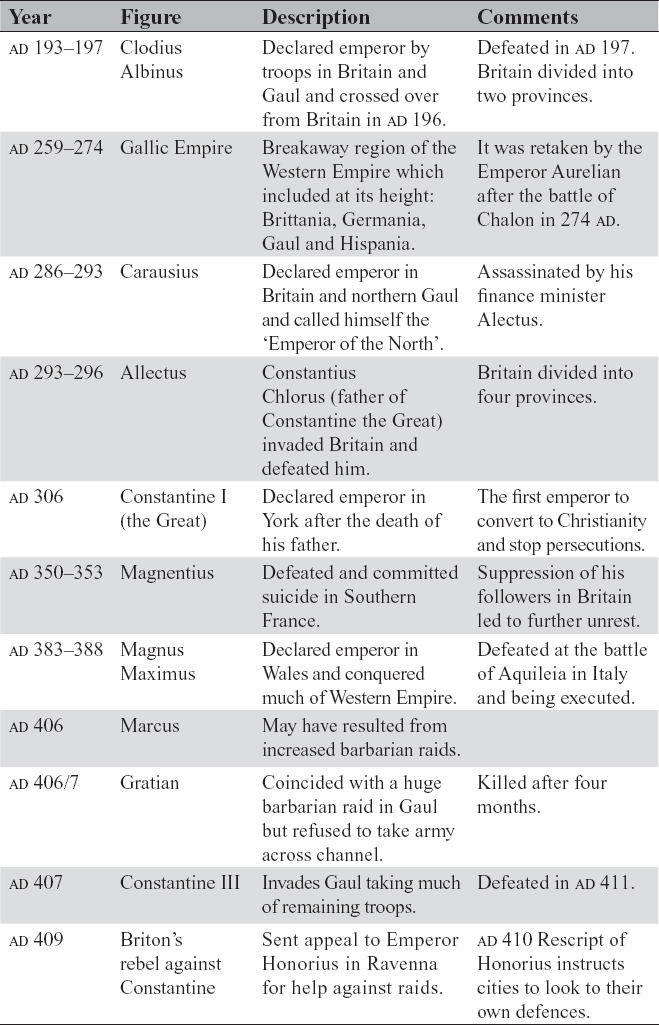
The provincial structure changed in AD 197 after a rebellion by Clodius Albinus. Albinus had been declared emperor by the legions in Britain and Gaul, but was defeated by Emperor Severus at the battle of Lugdunum in Gaul. Severus laid out the naked dead body of the unfortunate Albinus and reportedly rode his horse over it as a final act of humiliation. He then sent Albinus’s severed head to the senate in Rome, some of whom had professed loyalty to Albinus. Having promised to protect his wife and sons, Severus soon changed his mind and beheaded them too. Just to make sure some future upstart wouldn’t get similar ideas, he split Britain into two provinces: Britannia Superior in the south and Britannia Inferior in the north, as well as reorganising the military chain of command. Thus preventing one person from having a monopoly of power. This did not entirely work.
Around 260, a breakaway Gallic Empire including Britain survived for fourteen years before being recaptured by the Emperor Aurelian. Just thirteen years later in 286 another interesting figure, Carausius, appeared. Tasked with protecting the English Channel from pirates, he was found to be running a protection racket and sentenced to death. He responded by declaring himself emperor in Britain. He minted coins declaring himself Restitutor Britanniae (Restorer of Britain) and Genius Britanniae (Spirit of Britain), suggesting not just a flare for propaganda, but a possible disgruntled population willing to follow him. He was assassinated seven years later by his subordinate, Allectus, who was later killed in 296 when Constantius Chlorus invaded during the reign of Diocletian, after which the provinces were restructured again. Ten years later the son of Constantius, Constantine I, was declared emperor at York and went on to take the whole of the Empire under his control.
Fifty years later another breakaway emperor, Magnentius, proved to be popular in Britain, Gaul and Spain, mainly due to his tolerance of Christians and Pagans. His defeat in 353, three years after taking power, brought about two other interesting characters. The Emperor Constantius II sent an imperial notary to root out the usurper’s supporters. Known as Paulus Catena, or Paul the Chain, for his cruel ways, he set to work across the province. The historian Ammianus Marcellinus records that Paulus soon started arresting people on false charges and engaging in all sorts of corrupt and cruel practices. This caused an unsung hero of British history to step forward and try to stop the injustices. Flavius Martinus, the Vicarius of Britain, received a false accusation of treason for his pains which caused him to try and kill Paulus, personally drawing his sword on him. Having failed, he committed suicide. Paulus carried on his murderous and torturous career in Egypt before being burned alive during the reign Emperor Julian the Apostate in 462.
So we already had a long history of usurpers and rebellions involving Britain before we get to a figure who crops up at the start of many of the narratives that concern the Arthurian legend. Magnus Maximus was declared emperor in 383 while serving in Britain and took control of the Western Empire. This figure comes up repeatedly in both later Welsh legends and and sources at the start of our period of interest. About twenty years after Maximus’s death, Britain’s ‘last’ emperor was Constantine III, who took the last legions to Gaul around 407. This is another figure sometimes connected to Arthur’s story, although as we shall see later this may be someone with a similar name. What all this tells us is Britain had a rich history of rebellion, temporary periods of independence and usurping emperors. There was no particular reason for people living around 410 to think this was anything other than another upheaval in Rome’s long history. It also demonstrates that we actually have a lot of good sources for the period prior to 410, and yet there is no hint of an Arthurian type figure or anything connected to the story. There is no indication of any warrior called Arthur, bear-gods, Sarmatian sword legends or any other related concepts being present.
Table 1
The provincial structure in the late fourth century involved four or five provinces, each with its own governor answerable to a Vicarius (meaning deputy) based in London, heading the diocese of the Britons, who in turn reported to a Praetorian Prefect of Gaul, overseeing Gaul, Hispania and Britannia.2 There is some confusion as to whether Valentia was an additional province named for the Emperor Valentian after Theodosis recaptured the area between Hadrian’s wall and The Antonine wall after the Barbarian conspiracy in AD 367, or whether it simply renamed an existing province in the emperor’s honour. The provinces were as follows:3
• Britannia Prima covered the West Country and modern-day Wales with the provincial capital at Cirencester.
• Britannia Secunda covered the midlands and Lincolnshire.
• Flavia Caesariensis covered north of this line up to Hadrian’s wall with the capital at York.
• Maxima Caesariensis covered the South East and East Anglia, with London being both the capital of the Province and the Diocese.
• Valentia referred to the renaming of Flavia Caesariensis or a new province (regained from earlier centuries) north of Hadrian’s wall.
There is some debate about the exact position and boundaries of these provinces, but the important aspect is that the province was divided into administrative areas. Within each province were various civitates, so that over time more than thirty cities were created. Coloniae were created for veterans at Colchester, Lincoln and Gloucester, and there were three legionary fortresses at York, Chester and Caerleon.
The Magister Militum was created in the fourth century and took over the military functions of the Praetorian Prefect and, like him, was based in Gaul. Within Britain there were three commands:4
• Dux Britannarium controlled Limitanei (literally frontier troops) in the north including Hadrian’s wall. Consisting of eight cavalry and twenty-nine infantry units.
• Comes Litoris Saxonici per Britanniam (Count of the Saxon shore) also utilised Limitanei across the forts along the southern and eastern coast. Consisted of two cavalry and seven infantry units.
• Comes Britanniarum who controlled the main field army consisting of four infantry units and six cavalry units suggesting a mobile force to combat raiders.
The Dux Britannarium was a casualty of the barbarian invasions of AD 367. Interestingly, one of our earliest references to Arthur is not as a king but as a ‘Dux Bellorum’, which may be a reference to this military title. The title Comes Litoris Saxonici is only known from a fifth-century military list, the Notitia Dignitatum, which might be dated to 425. Whether this was just a copy of previous titles in unknown. There is certainly no evidence concerning the fifth century from Britain. What it does show is the majority of the units were in the north. The location of Coloniae, military fortresses and forces could indicate where rebellions might have taken place.
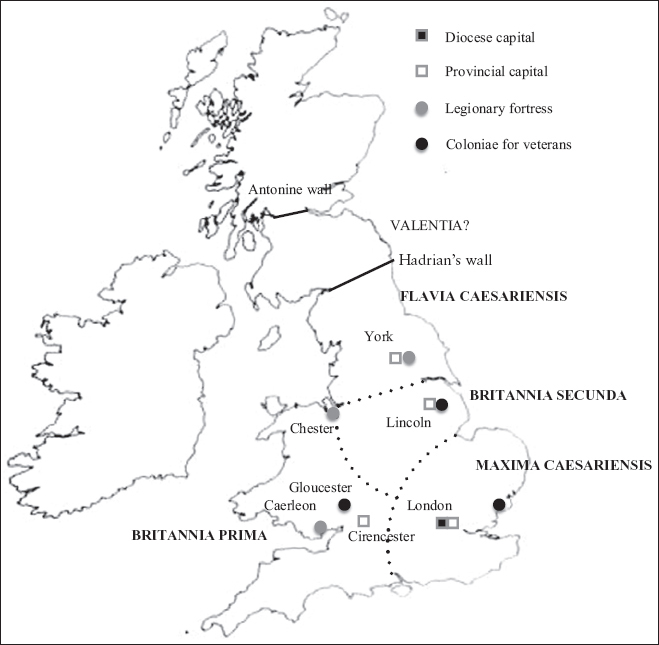
Provinces of Britain.
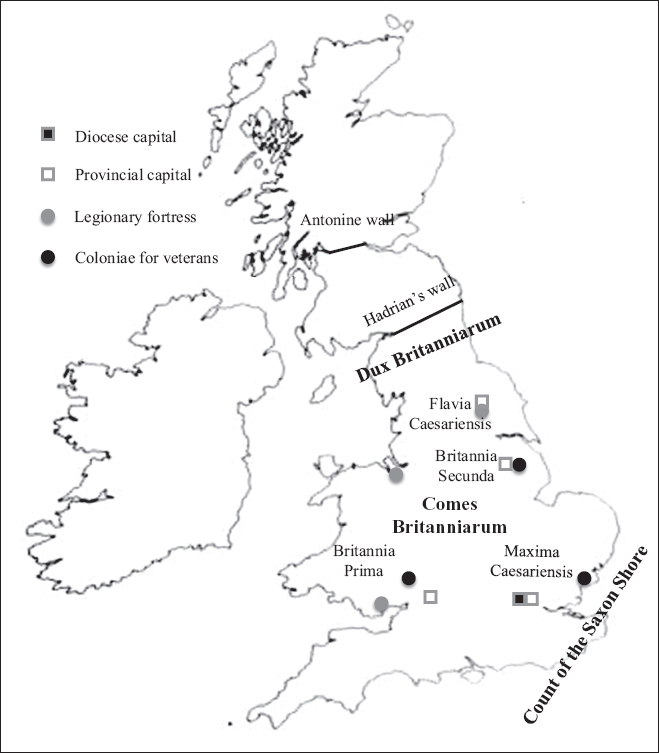
Military commands.
One might also assume that the Saxon Shore forts had something to do with Saxons. Yet nine out of the eleven forts were built two centuries earlier, and appear to be more related to trade than defence. They were part of a wider Gallic coastal system mirrored on the opposite side of the channel, likely built after the Gallic Empire. In fact there is no example of any Roman defensive system anywhere being named after an enemy, but also no evidence to suggest allied Saxon troops were stationed there.5 So I’m afraid we have no idea why the title ‘Count of the Saxon Shore’ came about. We could speculate about the presence of Saxons and what they were doing there, but it would be pure guesswork. However, later we will cover the Gallic Chronicle entry for 440, written in 452, which states Britain fell to the power of the Saxons. Given we know that Devon and Cornwall were not conquered for several centuries, it can only refer to the south east. It is likely this event affected the south-east province of Maxima Caesariensis, the diocese capital and major port, London, and the Saxon Shore.
At the end of Roman Britain the entire force is estimated at 20,000 troops, and possibly as low as 12,000 available at any one time, compared to a force of perhaps 50,000 in the second century.6 There is some evidence that coinage ran out in the decades after the Romans left; there is certainly no evidence of new coins being minted. What this means for the payment of troops is unknown. There were a number of times when Britain rebelled, broke away, or invaded the Western Empire. Table 1 shows examples of periods of unrest which did not result in a permanent break, demonstrating that some continuity of Roman life may have been assumed by many after AD 410.
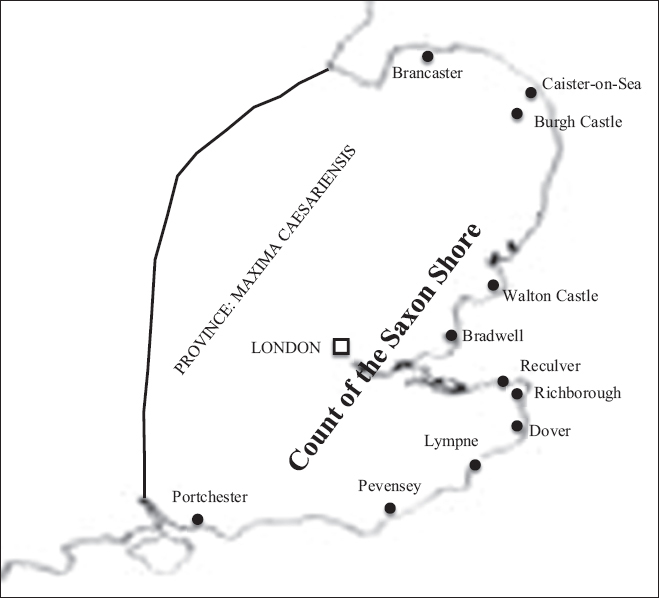
The Saxon Shore forts.
There were several occasions towards the end of the fourth century when barbarian raids were large enough to warrant a large-scale response. It may be worth remembering Table 2 below when we get to later evidence from Gildas and Bede:
Table 2
|
Year |
Incursions |
Comments |
|
AD 360 |
Picts and Scots |
Subdued by General Lupicinus |
|
AD 364 |
Picts, Scots, Saxons and Attacotti |
‘constant raids’ (Ammianus) |
|
AD 367 |
Irish, Pict, Scots. Attacotti and Germanic tribes |
The Great Barbarian Conspiracy. Widespread destruction including death of Dux Brittaniarum. |
|
AD 382 |
Picts |
Subdued by Magnus Maximus |
|
AD 398 |
Picts |
Defeated by General Stilicho |
|
AD 408 |
Saxon raids |
May have been reason for rebellion against Constantine and appeal to Honorius. |
Picts were a collection of various tribes living north of the wall. The Scotti were originally from Northern Ireland and settled in the Western Isles of what is now Scotland towards the end of the fourth century, and the Attacotti were likely north of Hadrian’s wall. ‘Saxons’ was a catch-all term for a number of Germanic tribes including Angles, Jutes, Friesians and Saxons.
We should also add that many of these tribes and others from across the Empire are listed as mercenary troops, although they were often posted far from their homeland. For example there are references to troops from the Attacotti presumably being co-opted into the army after their defeat by Theodosius in AD 368. There is evidence of extensive use of mercenaries from across the Empire stationed in Britain.7 I would also emphasise the Sarmatian cavalry introduced in AD 175. Approximately 5,500 were posted to the north near Hadrian’s wall after their defeat in the Sarmatian war of AD 170 in the Black Sea area. The Sarmatians, a nomadic steppe tribe, had perhaps relevant myths and legends, including standards with dragon heads (pen being the Welsh for head), swords being pulled from the ground and the hurling of swords into water. Plus they are connected to the only ‘Arthur’ recorded throughout Roman Britain, Lucius Artorius Castus.
Lucius Artorius Castus was a legion prefect in York and later a dux legionum (legion commander) leading troops to Amorica and Gaul towards the end of the second century. All we know about this Artorius comes from two inscriptions and there is nothing in the written historical record. This Artorius was a minor obscure figure, not even commanding a full legion. He ended his days as a Govenor of Liburnia in what is now Croatia. There are simply no records of him doing anything remotely connected to the Arthur legend in Britain or anywhere else. Most importantly, he is in completely the wrong time. In addition, it requires the legend to be carried forward several hundred years through a well documented time with no written record surviving.
By AD 350, Britain was a ‘prosperous diocese’.8 By the 360s, however, the towns were perhaps poorer and politically weaker, although by no means dead;9 Britain’s cities were ‘strongly walled’ in the fourth century and many of the most luxurious and largest villas were built in this time,10 so we have a mixed picture. There is some archaeological evidence of a ‘dark earth’ layer at some sites in the late Roman period that may suggest dereliction or destruction. We should treat this with caution as it is inconsistent across both time and location and may indicate change of use or occupation rather than destruction. New coinage appears to have stopped reaching Britain by 402, but this doesn’t mean money ceased to be used into the fifth century.
There is evidence to show a growing Christian community and the building of many churches in the fourth century. There is a record of three bishops from Britain in 359 attending the council of Arminium, modern-day Rimini in northern Italy, although their resources were such that they had to beg for funding. Having said that, evidence suggests that the number of bishoprics in late fourth-century Britain may have been in double figures and could number over twenty.11 All major cities in the fourth century had built large churches and a majority of the urban and rural population was at least nominally Christian.12
Concerning post-Roman Britain, ‘in the fifth and sixth centuries, neither the majority of Britons in the lowland half of Britannia, nor the Christian faith increasingly practised was expunged’.13 Indeed St Patrick, of whom we shall hear more later, was a Romano-British Christian. Even the later Anglo-Saxon kingdoms, though pagan, may not have eradicated the religion; for example Pope Gregory’s correspondence with Augustine who was sent to convert Anglo-Saxon Kent in AD 600 alludes to the ‘bishops of the British’. So the evidence suggests a widespread Christian community, if not majority.
Later legends do portray Arthur and his knights as Christian and refer to him carrying the image of the Virgin Mary on his shield into battle. Additionally, the various Lives of the Saints paints a somewhat more Celtic, if not pagan, Arthur than the later medieval romances. It is possible for him to have been both pagan and Christian. For example Clovis I, king of the Franks, was born a pagan but later converted to Christianity around the same time period Arthur is said to have lived. However it’s very likely a Romano-British leader would have been born Christian.
In a sixth-century version of the Liber Pontificalis by Bede, there is a record of a second-century British king, Lucius, for whom Pope Eleutherius received a request for baptism; it is further corroborated in Geoffrey of Monmouth’s History. However, there is an acceptance that this is more likely a scribal error concerning ‘Britium’ in what is now Turkey. There is certainly no contemporary record of any British king either writing to a Pope, or being named Lucius. Like Artorius Castus, this figure often appears in Arthurian theories despite there being not a shred of evidence. For our purposes, it is enough to determine that Christianity was a well-founded and growing religion at the end of Roman Britain.
In summary, Roman Britain was a well established and prosperous province. Despite many rebellions, civil wars and barbarian incursions, especially in the late fourth century, it was not at all certain after 410 that the links had been severed forever. It may be that some of the incursions mentioned concerning Picts, Scots and Saxons are alluded to in later evidence from Gildas and Bede, as well as the subsequent military responses and repairs to defences such as Hadrian’s wall. There was certainly a strong political and military structure. How long that structure lasted is open to speculation. What changes 350 years of Roman rule had on tribal affiliations is unknown. The effects of immigration and presence of federate troops is equally difficult to ascertain. As is the mix of ethnic, tribal, cultural, social and religious differences.
What we can be certain of is no contemporary record prior to the end of Roman Britain hints at any connection with the Arthurian legend. The only reason Lucius Artorius Castus is sometimes suggested as a theory is because he’s the only Artorius recorded in Britain. This is an extremely poor reason to nominate someone. It would be like getting a tip-off for a murder but only getting a first name then arresting the first person one found with that name. It’s worse than that, as it’s being told that someone did something hundreds of years ago and going through the records pinning it on the only person of that name we can find. Artorius was a common name and there were, no doubt, scores of them throughout Roman Britain. We must therefore look for our Arthur after the fall of Roman Britain.