
Chapter 2
Theodosius I was the last Roman Emperor to rule both west and east. On his death in AD 395 his sons Honorius and Arcadian split the Empire between them much of which was already home to a number of settled Germanic tribes including the Franks in Gaul and the Goths in the East. Around 400 there emerged the ‘bacaudae’, provincial rebels and slaves, who created significant civil unrest. Honorius, the western emperor, had sent General Stilicho to deal with barbarian incursions into Britain at the end of the fourth century. In around 402 Stilicho pulled troops, and much of the coinage, away from Britain and northern Gaul to deal with Visigoth rebellions.
In 406 there was a huge incursion of multiple tribes across a frozen Rhine into a relatively undefended northern Gaul which included Vandals, Burgundians, Alemanni, Alans, Saxons and Gepids. It was this incursion and Stilicho’s apparent abandonment that caused the Britons to rebel, appointing three different leaders in quick succession, the last being Constantine III who invaded Gaul in 407. Without Constantine’s army, and after Saxon attacks in 408, the Britons rebelled once more, this time against Constantine, and requested help direct from Honorius in 409, which we know was rejected in 410.
The Emperor Honorius, based at Ravenna, was still fighting against Constantine III and against Alaric, king of the Visigoths, who sacked Rome in that same year. He was unable to help and issued what is known as The Rescript of Honorius, where he urged the civitates to look to their own defences. Sent direct to the cities, the letter suggests that the Provincial apparatus had either broken down or could not be trusted by either the British civitates or Honorius. There is some contention that the reply from Honorius refers to Bruttium in Italy, but on balance it has been accepted to more likely refer to Britain. Much is made of this apparent ambiguity but for our purposes it is rather academic. The Romans never returned. What is important is what civil and military structures persisted in Britain after 410 and for how long?
General Stilicho was killed in 408 along with a large number of barbarian officers in the Roman army. In 410 Rome was sacked by the Visigoths who were eventually settled in south western Gaul. Constantine III was eventually defeated and killed along with his son Constans, a former monk, in 411. He did have another son, Julian, but there is no record of him being the father of Aurelianus Ambrosius or ‘Uthr’ Pendragon as claimed several hundred years later by Geoffrey of Monmouth, among others. Although it’s not completely clear that this is the same Constantine, despite the inclusion in Geoffrey’s twelfth-century book of Constans the monk as his other son.
The rest of the fifth century in Gaul can be seen in two halves. The first half is characterised by the attempts to control the Germanic tribes by giving them foederati status and using them to fight each other when one tribe rebelled. Franks in the north, Visigoths in south west, Burgundians in the south east and Alemanni in the east. The second half of the century sees a slow decline to eventual loss of control and then collapse of the Western Empire. Aetius was made Magister Militum in Gaul in 429, Consul for the third time in 446 and killed in 454. In the writing of Gildas, it is this Aetius to which the Britons appealed. What we do have at this point is one reference concerning Britain from a relatively contemporary source. The Gallic Chronicle written in 452 records that in 440, Britain fell to the power of the Saxons. What this means is open to conjecture. It is usually fairly accurate. Yet we know that parts of Britain did not come under Saxon control for several centuries. More of that will be discussed later.
As well as playing the different Germanic tribes off each other, Aetius had extensively used Hunnic and ‘barbarian’ mercenaries. The barbarians quickly adopted Roman behaviours and wished to be incorporated into the Empire rather than perhaps conquer it.1 Thus, in general there seems to be a willingness, or even desire, to take over Roman concepts rather than replace them. The survival of villas and towns, for example, appears to be far less likely in Britain compared to Gaul.2 While the barbarians were being Romanised, the Roman army and emperors were increasingly influenced by barbarians from Stilicho to Odoacer.3 During this period the greatest single blow to the Western Empire may have been the loss of Africa to the Vandals starting from 429. Despite this, the Western Empire still held, and the situation in Britain was stable enough to allow Saint Germanus of Auxerre to travel from Gaul to Britain, visiting St Albans.
In 451 Attila the Hun invaded Gaul, which led to his defeat by Aetius and allied tribes (Visigoths, Franks, Burgundians, Saxons, Armoricans) at the battle of the Catalaunian plains. Attila made an abortive attempt at sacking Rome in 452, before dying in 453. The Huns soon ceased to be a viable threat. It is perhaps the murder of Aetius in 454 by Emperor Valentinian II which signals the beginning of the end for the Western Empire. There then follows a succession of nine emperors in twenty years, increasingly controlled by Germanic officers, first Ricimer and then Odoacer. It is telling that in the following year the Vandals, who had passed through Gaul, Italy and Spain before settling in North Africa, invaded Italy and sacked Rome.
We now get to roughly the time that may concern us about events in Britain. There is some debate and contradictory evidence concerning when the Saxons started to seize control and we will come to this later. There are already Saxons in the Loire valley, and General Odoacer uses Saxon mercenaries in fighting against the Goths in the 460s. In northern Gaul, around Soissons, a Roman administrative area survives headed by Aegidus, the last Roman Magister Militum of Gaul. He is succeeded in 464 by his son Syagrius, who become known as the ‘Last king of the Romans’ in the Roman rump state of the kingdom of Soissons in northern Gaul. In 476, with the removal of the last western emperor, this kingdom became effectively independent.
Around the 460s there is evidence of Saxons in the Loire and Saxon pirates on the coast.4 In the sixth century, Gregory of Tours records that after Aegidius died in 464 the Bretons were expelled from Bourges, near the Loire river, by the Goths and many were killed in Bourg-de-Deol, central Gaul. At the same time a great war was occurring between Romans and Saxons, which the Saxons appear to have lost, being ‘cut down and pursued’ by the Romans and losing many of their islands, in the Loire, to the Franks.
In the middle of the sixth century, Jordanes, writing in The Origin and Deeds of the Goths, states the Emperor Anthemius (467–472) requests help from ‘King Riotimus of the Brittones’ to fight the Visigoth king Euric. He arrives with 12,000 men ‘by way of the ocean’; as he disembarks, he is met by the Goths and is routed. He fled with his men to the neighbouring Burgundians in the East. Some have argued that this phrase ‘by way of the ocean’ surely means from Britain, and that ‘Riotimus’ is a Latinised translation of ‘high king’. So we have a record of a British king able to muster 12,000 and travel to Gaul, presumably leaving his homeland defended. As Anthemius is soon recorded in the narrative as dead, one must conclude this battle was around 471. Additionally, the pressure on the Saxons in the Loire valley from 460 and the expansion of Frankish dominance of northern France does supply a reason, independent of British sources, for migration of Germanic peoples away from Gaul and towards Britain.5
However there are a number of problems with the theory Riothamus is the basis for Arthur. Firstly the phrase ‘by way of the ocean’ could easily mean from modern Brittany down the coast to the Loire river. The text says, ‘to the state of the Bituriges’, which is in exactly the area mentioned by both Gregory and Jordanes and accessible from the Loire. Plus we have the added difficulty in there is no record of this Riotimus either before or after, and no proof that this wasn’t a Latinised version of his name rather than a title. Even if it was a title, and the force of 12,000 did come from Britain, then we would still be left to prove that he was called Arthur. Then there is the fact that the only record of him is a defeat by the Goths. There is simply no evidence of any connection to the legend.
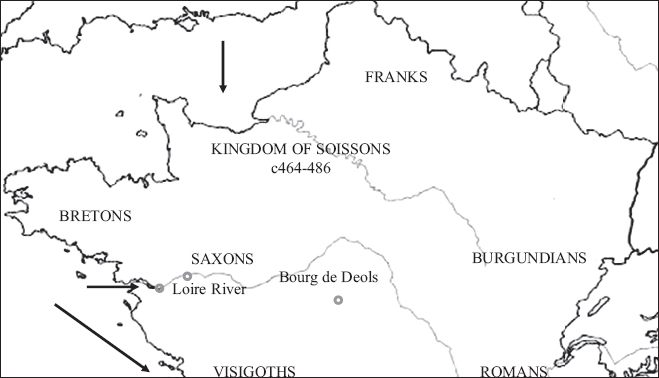
Possible routes for army of Riothamus.
A Romanised administration persisted in Gaul in the fifth century,6 and in 476 Odoacer deposed the last western emperor and sent the imperial regalia to Constantinople. Many date the fall of the Western Empire to this date. Clovis I became king of the Franks aged 15 in 481 and conquered Soissons, killing the ‘last king of the Romans’ in 487 before going on to defeat the Alemanni, Visigoths and Burgundians to control Gaul.
Clovis was then offered the consulship by the eastern emperor around 508. This means that Armorica, with it’s many links to Britain, initially bordered the last Roman rump state in Gaul up to 487, and then subsequently a dominant Frankia. Given Geoffrey of Monmouth’s narrative of Arthur being crowned at 15, invading Gaul and defeating the king of the Romans, this may be important. We will examine this in more detail later, but if there is any substance to it, then we have a few windows of opportunities for any significant military activity from Britain: The Romano-Saxon war of the 460s, Riothamus defeat by the Visigoths around 471, in the Frankish war with Soissons in 487 or in later border wars with the Franks from after that time.
In summary, a large influx of barbarian tribes together with civil war at the start of the fifth century caused major unrest in Gaul and the isolation of Britain from the Empire. The first half of the century involved Rome fighting against, and with, various tribes across Gaul and eventually resettling and making alliances. The second half of the century involved a rapid weakening of Roman power, and wars between Saxons, Bretons, Franks, Goths and Romans. The last Roman emperor was deposed in 476, but a rump Roman state survived until 488 as the Franks emerged as the dominant force in Gaul. During this time we have no evidence from Britain, except this tentative reference to a King Riotimus around 471. There is certainly no reference to anyone called Arthur. No letters from Popes, no Roman records, nothing from Gregory of Tours or Jordanes from the Franks or Goths.
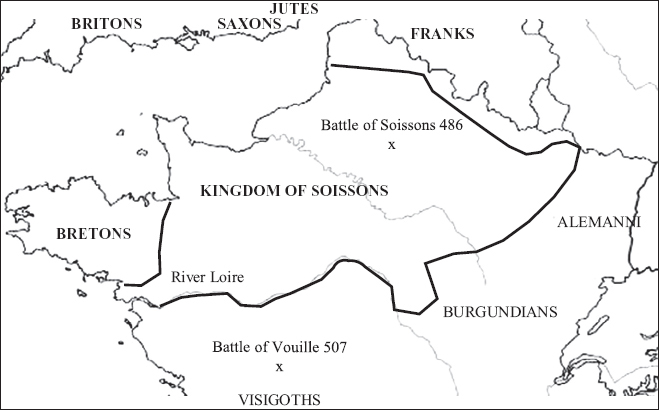
North western Gaul in the late fifth century.
We do have contemporary accounts referring to Britain, and also accounts from Britain. The first was written around 480 in Gaul concerning a visit by Germanus of Auxerre in 429, followed by a possible second visit a few years later. The second is the writings of St Patrick, whose floruit is debated with his death dated to either 462 or 493, although this tells us next to nothing about Britain. Lastly we have Gildas writing in approximately 540 who tells us quite a lot as we shall see. Frustratingly for the period we are interested in either side of 500, we have no contemporary sources about Britain. We do have a number of contemporary sources covering this period from other parts of the Roman world however, and it is on this we will focus next.