
Chapter 4
Gildas was a sixth-century British monk who is believed to have lived between approximately 500–570. He wrote a scathing indictment of Britain around 540, titled De Ecidio et Conquestu Britanniae (The Ruin of Britain). We also know of his life through a hagiography (saint’s life) written in Brittany in the ninth century and his death is recorded in the Irish annals. A further saint’s life was written in the twelfth century by Caradoc of Llancarfan, who was a friend of Geoffrey of Monmouth. There is a consensus that he wrote the tract in the first half of the sixth century, but outside that neither the genealogical evidence or the annals contain reliable data for his life.1 However, his denunciation of five kings, one of whom died around 547, leads scholars to believe the tract was written between 524 and 547.2 This would tie in with his reported death in Irish annals in 570.
Additionally he refers to the Battle of Badon, which he seems to say was the year of his birth and that forty-four years have since passed. This is important because it places this battle sometime between 480 and 503. It is this battle that is later attributed to Arthur and thus the date is of great relevance in our investigation. There are other interpretations of this passage: Bede, writing 200 years later, appears to translate the forty-four years as being after the landing of the Saxons, rather than before the birth of Gildas writing in De Ecidio. The key passage3 concerns the Saxon revolt and British recovery, which involves the emergence of a British leader, Ambrosius Aurelianus. It describes a period of victories and defeats which led,
up to the siege of Badon Hill, pretty well the last defeat of the villains and certainly not the least. That was the year of my birth; … one month of the forty-fourth year since then has already past.
There have been some scholars that have translated it as Bede did, but there is a general consensus that it is the year of Gildas’s birth. In addition Gildas also lambasts the grandchildren of Ambrosius, who is mentioned as leading the British, which would tie in with the writing being forty-four years after both the time of Ambrosius and Badon. However there are other interpretations. It really isn’t clear if the forty-four years start from the coming of the Saxons, the fight back by Ambrosius, or the battle of Badon. Nor is it clear if the end of the forty-four years is the Battle of Badon, or the time of writing. If we take a literal translation, without attempts by modern translators at punctuation, it would be even less clear:4
… now citizens now the enemies were victorious … up to the year of the siege of Mount Badon almost the last defeat of the rascals and by no means the least one month of the forty fourth year as I know having passed which was of my birth.
That reads to me, as a lay person, forty-four years from the ‘that time’ has passed. So, from the time of the fight back to the time of writing. Which means Badon was at some unspecified time between those two dates. Gildas also talks about a time of peace, at least from ‘foreign wars’, which suggests a generation or more has passed since Badon. Gildas only names Ambrosius in this part of the history, and even then the text is not clear about whether he led the Britons at Badon, only that he led the fight back after the initial revolt.
The whole document is, in layman’s terms, a sermon in three parts. The first part is a historical narrative covering the arrival of the Saxons and subsequent wars which culminated in the battle of Badon. The second part is a denunciation of five tyrants, and the third part concerns the church. He intimates he is now writing at a time of relative peace, but if they don’t mend their ways they will soon succumb to the same turmoil that occurred two generations previous.
So Gildas is saying: we’ve suffered all these past calamities due to our wickedness, and if we don’t change we are all going to hell in a handcart. He uses the examples of the wicked tyrants and priests to emphasise this. It’s important to note his purpose is not to relate accurate historical information. He has an agenda; it is a religious message, not an attempt at history. Although he makes some historical errors, as he gets nearer to describing his own time he naturally becomes more accurate and what he says in passing, so to speak, can help the historian.
He inaccurately portrays Hadrian’s wall as being built at the end of Roman Britain, but he is writing 150 years after the Romans left and 400 years after the wall was built. He obviously believes this to be the case but is wrong, which means he is likely to have lived a considerable time after the end of Roman rule. Not only that, he is likely to be living at a time when even the oldest person known to Gildas was born beyond living memory of the end of Roman Britain. This is another indication he is writing in the sixth rather than the fifth century. The last generation with experience of Roman Britain would have largely died out by around 470, the next generation may have had some fairly accurate information passed on. However, by the third or fourth generation their knowledge would have been as accurate as the average person today about the Crimean War 150 years ago. Remembering, of course, there was limited literacy and Gildas himself stated that all the records had been lost. Perhaps he has mistaken stories of repairs undertaken in that period handed down through a couple of generations. But the Battle of Badon would have been in living memory, so is likely to be accurate.
Perhaps the most revealing line is near the beginning where he refers to ‘the unhappy partition with the barbarians’, with the implication it affects the whole of Britain.5 He laments the fact ‘our citizens’ can no longer visit the graves of the holy martyrs and he names two locations: St Alban of Verulam, and the martyrs Aaron and Julius. Some translations record this as Caerleon, or Carlisle. However, the language is quite vague and a more accurate translation is simply ‘city of the legions’. This could be Chester, York or possibly even Lincoln. We know the original city of London was abandoned by around 500 and that significant Saxon settlement had already appeared outside the city and across the home counties. He seems to be saying that the barbarians are in St Albans and other areas, preventing the British from visiting various shrines. Or it could be that their presence in other areas prevents travel across Britain, and of course we don’t know where he is writing from, other than he is likely to be located in Britain, Ireland or Gaul.6 We can speculate about the precise nature of this partition, but it included at least parts of the South East.
The five kings he denounces all appear to be in the west of the island, but the tract as a whole makes clear in several places that he is referring to the whole island and not just one part. The most likely explanation is that the partition refers to the eastern side of Britain, involving the South East, East Anglia, Lincolnshire, Yorkshire and the North East up to Hadrian’s wall. This would then make access to Canterbury, London, Colchester, Lincoln and York difficult and would fit in with later archaeological evidence, later historical evidence, and literary sources, but it has to be admitted that we simply don’t know what Gildas meant.
There is an implication the Romano British still control a large part of the province. In fact, later sources record the British in the north pushing the Angles back to be besieged at Lindisfarne on the north-east coast as late as the 570s. The Anglo-Saxon Chronicles describe later expansion down the Thames valley, and Welsh sources record seventh-century expansion into the midlands reducing the kingdom of Powys. All this suggests that at the time Gildas was writing the British were still a force to be reckoned with. While he talks of many kings and a love for civil wars, he also states Britain has governors which suggests some sort of provincial structure survived. His audience does seem to be the whole of the Romano British, which suggests a single unitary political body in theory if not in practice.
Additionally he is writing in a style of Latin that suggests he has had training and is the product of a late Roman school.7 It shows that in 520–40 Latin is still a living language and there is an audience who would be expected to understand it. It is also felt that Gildas benefited from training in grammar and rhetoric, which suggests a form of Romano-British government or administration in early sixth-century Britain. It is possible that much more of the fabric of Roman civilisation was visible much later than has been imagined.8
The last contemporary account of Britain was Germanus in 429 where there is a sense of an ‘intact’ province. To quickly recap from the previous chapters: at the end of fourth century, Roman Britain has possibly five provinces each with a governor and a Vicarius in London; plus the three military commands. In 407 there is a succession of revolts that finally produces Constantine III, who moves his army to Gaul and eventually dies in the ensuing civil war. Meanwhile the British have again revolted and request help from Honorius. How much of this structure survived is unknown, but in 429 Germanus is able to travel to Britain, St Albans in particular, and then somewhere else to fight a battle. His biographer refers to a ‘tribune’ and ‘leading man of the province’, plus an established church.
St Patrick is little help because he refers only to Ireland, other than a letter to a presumed British king which tells us nothing about the wider political or military situation. The Continental sources are confined to the enigmatic Gallic Chronicle entry for 440 which tells us Britain fell to the power of the Saxons, which we know from history cannot be true for the whole country. Now, over 100 years later, Gildas is living in relative peace after a time of war. Some Romanised life has survived but the island has been ‘partitioned’, although by how much or where we know not. But now ‘Britain has kings, but they are tyrants; she has judges, but they are wicked’, and later ‘Britain has priests but they are fools; very many ministers but they are shameless’.
It is possible to suggest that at some point between 429 and 540 the provincial structure broke down and kingdoms emerged based on previous civitates, tribal areas or other power bases such as cities and towns. Also, this was either caused by, or allowed, the influx of Anglo-Saxon invaders which caused enough disruption from before 440s to cause a Gallic chronicler to view Britain as lost to the Saxons by that date.
I will skip over his general history and start from the point where Maximus ‘had his evil head cut off at Aquileia’, which refers to the battle where Magnus Maximus died in 388. Gildas himself doesn’t mention a date, but we know this from a variety of other sources. He then describes how the Britons ‘groaned aghast for many years’, due to ‘two exceedingly savage and over-seas nations’, meaning the Scots and the Picts (the ‘Scots’ at that time meant the Irish). Envoys are sent seeking help and a legion is despatched to deal with it. Having done so, a turf wall is built linking the seas. This is probably Gildas wrongly attributing the building of the Antonine wall to that time.
There is then a second incursion and a second request for help which again is answered and results in another wall, this time of stone. This appears to be Gildas again misunderstanding when and why Hadrian’s wall was built. This could be a reference to rebuilding either by Stilicho in 398 or sometime after. There is evidence of rebuilding and maintenance at the beginning of the fifth century. In any case, after this second incursion the Romans tell the British that they ‘should stand alone’; leaving them ‘manuals for weapons’ and placing towers overlooking the sea at intervals on the south coast, ‘they say goodbye, meaning never to return’.
The Picts and Scots then return, the wall and towns are abandoned and the barbarians seize the ‘whole of the extreme north of the island right up to the wall’. There is no mention of Constantine III and no way of knowing when these three incursions took place. They may be confused references to several barbarian invasions in 360, 367, 382, 398 or 407. Alternatively they could be unknown incursions in the 420–30s. The Romans saying goodbye could reference the Honorius rescript of AD 410, which puts the last incursion after the end of Roman Britain. But in truth we just don’t know what exactly Gildas meant.
But the next important event can possibly be dated. He describes how the survivors, the ‘miserable remnants’, sent a letter to the Romans begging for help, demonstrating that some at least in Briton still saw themselves as part of the Roman world. Gildas seems quite clear in saying this appeal is in response to Picts and Scots invading the north. He doesn’t at this point mention Saxons or any part of Britain ‘falling to their power’. Given his misunderstanding of history beyond his lifetime it is quite possible he is as mistaken about this as when or why Hadrian’s wall was built:
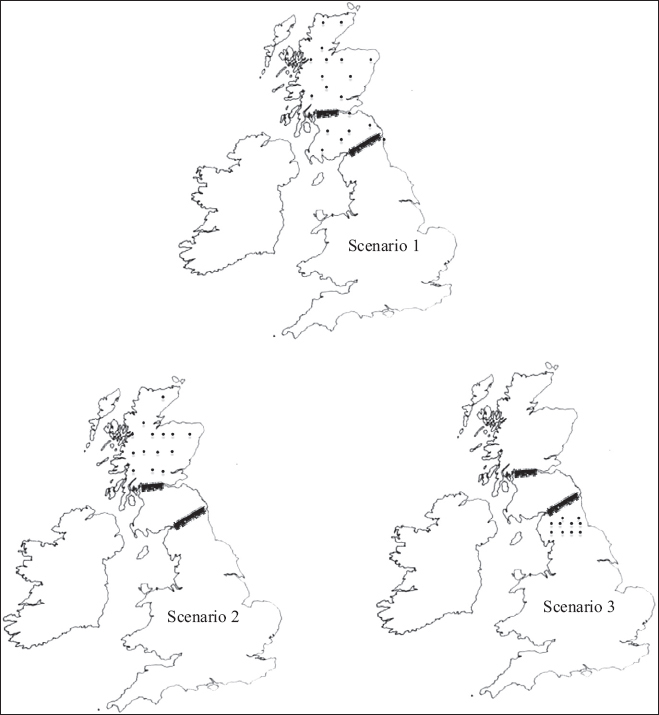
‘Barbarians seize … up to the wall.’
To Aetius, thrice consul: The groans of the British.
Further on came this complaint:
The barbarians push us back to the sea, the sea pushes us back to the barbarians; between these two kinds of death, we are either drowned or slaughtered.
Gildas then makes it clear that no help came. We know Aetius became Consul for the third time in 446 and died in 454, so we have a date there from which we can fix the narrative. There is an obvious discrepancy with the Gallic Chronicle entry for 441 in which Britain ‘fell to the power of the Saxons’. We know parts of Britain did not fall to the Saxons for hundreds of years. There’s evidence of continuing trade and other links between the West Country, Wales and Europe. Perhaps the chronicler is referring to the fall of one part, say the south east. Or an increase in piracy in the Channel cut Britain off, giving the impression it was lost. Or the wars involving Saxons, Britons, Romans, Visigoths and Franks in the fifth century did indeed cut Rome or Gaul off from Brittany and Britain.
Either the Chronicle or Gildas is wrong, or mistaken, or refers to something we don’t fully understand yet. It is assumed when Gildas wrote ‘To Aetius, thrice consul’, this dates the appeal to 446–54. However, Aetius became Magister Militum of Gaul in 423. Later evidence will attempt to bring what is known as the ‘Adventus Saxonum’ forward about twenty years to 428 and not 449. This would tie in exactly with a revolt, Bishop Germanus’s visit and subsequent battle, and the Gallic Chronicle entry for 441. How we explain these apparent contradictions will be crucial in forming a coherent timeline.
The name Gildas used is actually ‘Agitius’, and there are other possibilities for who he could be referring to, Aegidius is just one example. Even if this is to be translated as Aetius, then it is possible the letter was sent, but much earlier, say in 430s, and Gildas added ‘thrice consul’ as a qualifier or epithet. But there is a consensus that Gildas is quoting from a known source and does mean Aetius.9 So the most likely explanation is that it does refer to Aetius in the period 446–54.
Gildas’s overall framework is rather confused and scholars don’t rely on the accuracy of the chronology he puts forward.10 He states the appeal was in response to raids by Picts and Scots, not Saxons, although one must note Roman writers often mislabelled Germanic raiders as Saxons. We recall Germanus responds to a raid by Picts and Saxons. It must also be remembered Gildas is writing in the sixth century and his references to events from fifty years in the past get more disjointed the further back in time he goes. Additionally his main concern is to drive home a message rather than to be historically accurate.
The table below summarises the main events with an estimate of when the events occurred. Some have estimated the arrival of the Saxons to around 480, and then twenty years of war leading up to Badon. On the other hand Bede and the Anglo-Saxon Chronicles place the Adventus Saxonum much earlier around 450. Nennius places it in 428 and from the Gallic Chronicle we can imply a date prior to 440.
Table 5
|
Chapter from Gildas |
Year |
Contents of chapter |
|
13 |
383 |
Revolt of Magnus Maximus. |
|
13 |
388 |
Death of Maximus. |
|
14 |
Despoiled of army, military resources, governors and youth. Attacks by Picts and Scots for ‘many years’. |
|
|
15 |
Envoys sent. First appeal for help. Legion despatched. Turf wall built. (Antonine wall?) |
|
|
16 |
Legion leaves. Picts and Scots return. |
|
|
17 |
Envoys sent again. Second appeal. Romans send help again. |
|
|
18 |
Honorius Rescript of 410? |
Romans say they can no longer help. Build wall (Hadrians?), towers (Saxon Shore forts?) and left ‘training manuals’. |
|
19 |
Scots and Picts return. Seize part of far North. Towns and ‘high wall’ abandoned. |
|
|
20 |
446–54 |
Appeal to Aetius. Denied. Britons fight back and for the ‘first time … inflicted a massacre on them’ (Picts and Scots). |
|
21 |
Irish return home. Picts settle in northern part (Scotland?). Partial truce. Famine followed by ‘period of abundance’ and luxury. Kings anointed. |
|
|
22 |
Rumour of return of Picts and Scots. A council is convened. |
|
|
23 |
All the members of the council together with the ‘Proud tyrant’ invite the Saxons to fight for them. Three keels (warships) arrive and are settled in the ‘eastern side of the island’. Second, larger group of Saxons join the first. Supplies granted to them ‘for a long time’. Saxons revolt. |
|
|
24 |
‘Fire from sea to sea burned nearly the whole island’, all major towns laid low. |
|
|
25 |
Many killed, some enslaved, some emigrated over seas. Saxons return home ‘after a time’. Ambrosius Aurelianus leads fight back and initial victory His grandchildren, ‘greatly inferior’, are alive today. |
|
|
26 |
Approximately 500 |
From then on (see previous chapter) victory went back and forth up to the battle of Badon Hill neither the last or least defeat. This was ‘the year of my birth’ forty-four years ago. Cities still not populated as they once were. External wars have stopped but civil wars persist. New generation has only experienced calm and are turning away from ‘truth and justice’. |
The only correct, verifiable date in this chronology is the death of Maximus in 388, all the other suggested dates are tentative estimates. The appeal to Aetius around 450 can be regarded as a strong possibility based on the balance of probabilities. Given the mistakes concerning the building of the wall, no mention of Constantine III and confused chronology, it would be true to say the three invasions by Picts and Scots could refer to any of the raids before or after Maximus, or after 410.
If this date for Aetius is accepted then we can place the arrival of the Saxons just after, with the rest of the narrative leading up to Badon in the second half of the fifth century, with the battle being fought around 500 and Gildas writing forty-four years later. However, we shall see from later evidence that it is not that simple. There are some who have argued that Gildas didn’t mean Aetius at all. Others accept that he is referring to Aetius, but that the appeal may have been earlier and the title ‘thrice consul’ may have been added by Gildas, not the original letter writer. If these points are credible this could pull the whole narrative away from 450 as the date of the appeal, the Adventus Saxonum and subsequent war leading up to Badon.
The problem with this is some sources will try to drag these events twenty years back in time to fit in with Nennius and the Gallic Chronicles. Others will try to pull them forward to fit in with the Welsh Chronicles, which place Badon in 516 and Camlann in 537. They cannot all be true as we cannot have known figures such as Ambrosius, or indeed Arthur, fighting battles in both the 430s and in the 530s, leaving us to explain how this was possible in a time when people often didn’t reach 50 years of age.
To summarise so far, Gildas was a monk writing around 540 (although it could be between 520 and 550). His intention is a sermon rather than historical accuracy. For our purposes we can start his chronology from the death of Maximus in 388. The next important date is the appeal to Agitius which is likely to be Aetius after 446, but this is not certain. He describes the coming of the Saxons and subsequent rebellion after this appeal. Eventually there is resistance led by Ambrosius Aurelianus, whose grandchildren are alive when Gildas writes. This puts Ambrosius around 470–500 which ties in with the assumption about Aetius in 446. In addition he mentions the battle of Badon as the culmination of this fight-back and seems to date this at the time of his birth forty-four years previously in the 490s. At the time of writing there is a partition of the island between the Britons and Saxons, although they are now in a time of relative peace. This line of partition is likely to contain the south east at least but possibly further north.
There is further clues for dating Gildas as he goes on to describe five kings in less than complimentary language, one of which we can be fairly certain reigned from 534 to his death around 549. We can see these five kings below.
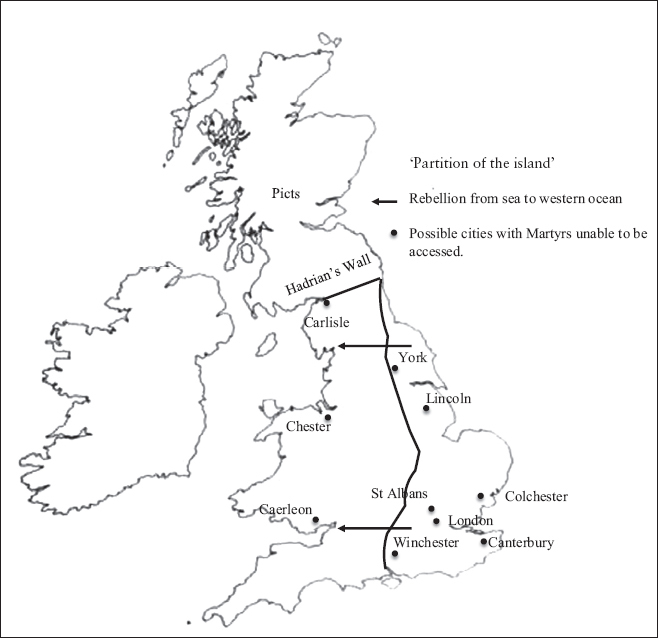
The partition of the island.
Table 6
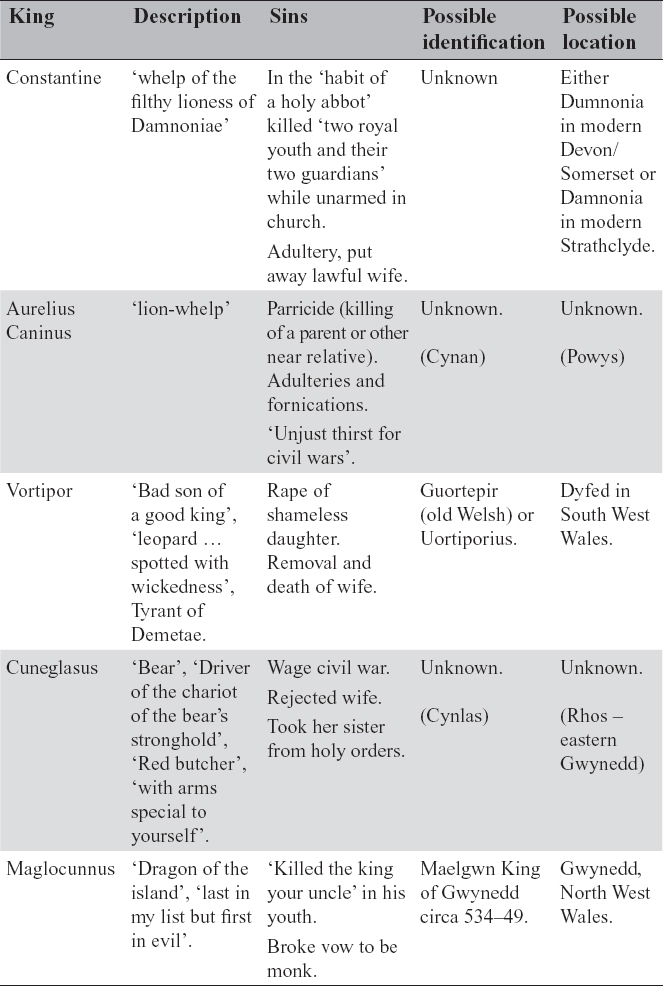
These are kings that were ruling at the time of Gildas, and a generation or two after Ambrosius and the Battle of Badon. There are some tentative suggestions that I have included in brackets, but these are highly speculative. Maglocunnus has been identified as Maelgwn, King of Gwynedd whose death is dated in annals as 547–9. One such annal, The Annales Cambriae, is a tenth-century adaption of Irish annals of uncertain date. The Welsh pedigrees are of equally uncertain validity.11 Thus in neither the annalistic, nor the genealogy evidence, have we sufficiently early or reliable data to identify, date or locate Gildas’s five kings.12
We should make a note of Cuneglasus, described as a bear and linked to the ‘bear’s stronghold’. The name Arthur, if Celtic in origin, derives from ‘Arth’ – the bear, so this might be significant. Additionally Aurelius Caninus may well be derived from Ambrosius Aurelianus. Gildas does mention his descendants not being as illustrious as the grandfather. Gildas states: ‘Certainly his parents, who had worn the purple, were slain in it.’ This could mean senatorial rank or even imperial family. Bede, in the eighth century, describes him as having a ‘royal or famous name’. In the ninth century, Nennius names him as the son of a consul. Geoffrey of Monmouth in the twelfth century has him being from Brittany and the brother of Uther Pendragon and son of Constantine. Whether this is Constantine III or some other Constantine is not clear. The most likely explanation is that his parents were of the ruling class in Britain at the time of the revolt and died in the warfare.
There are records of Roman Consuls with similar names from that time: Quintus Aurelius Symmachus was Western Consul in 446, the same year Aetius was awarded consul for the third time. There was a similar-sounding figure in 485 and either of these two historical figures could be contemporary with Ambrosius Aurelianus. There was also an Aurelius Ambrosius, or St Ambrose, who was a Bishop of Milan 340–97. A connection with the Aurelii Symmachi family is possible therefore, although it must be admitted this is purely speculative.
Other than Gildas identifying Vortipor as being king of the Dematae, even identifying Maglocunnus as Maelgwn isn’t certain. There is a stone in the church of Nevern, Pembrokeshire, with an inscription, both in Latin and Ogham. The Latin reads MAGLOCUNI FILI CLUTORI, while the Ogham reads ‘maglicunas maqi clutari’, translated as ‘[the stone] of Maglicu, son of Clutarias’. The stone is apparently dated to the fifth or sixth century. The translation of Gildas actually names this ‘dragon of the island’ Maglocuni. I am not suggesting this ‘Maglocuni’ has anything to do with it, but it does raise the possibility that the identification with Maelgwn is purely an educated guess. Deduced from the narrative and the likely time span of his life, plus the identification of Vortipor as king of the Dematae.
So, the only contemporary British source for this period outlines a historical narrative that is somewhat confused and inaccurate. It’s purpose is a sermon. It may well be exaggerated. It does, however, corroborate the coming of the Saxons, a civil war, a ‘partition’ of the island, the fight-back led by Ambrosius Aurelianus and the Battle of Badon. It doesn’t mention, or hint at, any person called Arthur. There is a much later explanation for this absence. Gerald of Wales, writing in the twelfth century, records that Gildas was angered at Arthur for killing his brother Hueil. This caused Gildas to throw into the sea a number of books he had written in praise of Arthur. Needless to say there is not a shred of evidence for this and, being 700 years after the events, can hold no weight. Some theories make much of this explanation, but it’s one thing to claim you’ve lost your evidence so to speak, quite another to claim someone threw it into the sea hundreds of years ago.
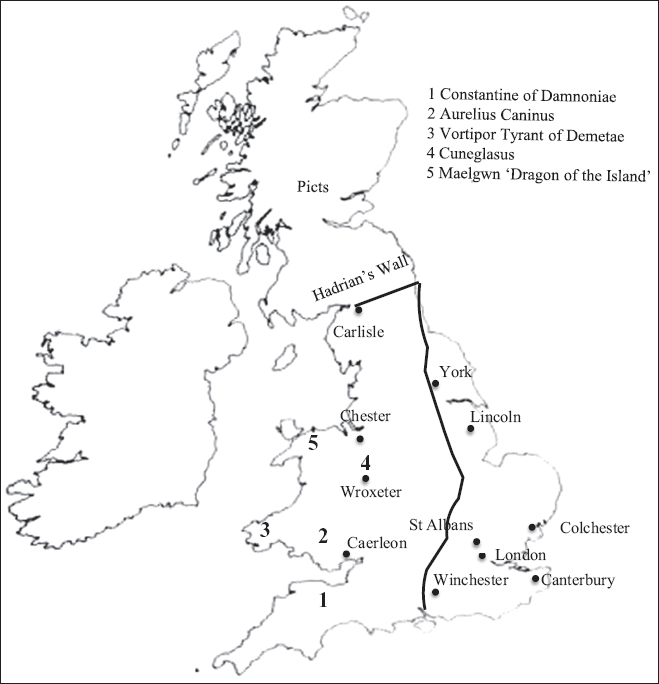
Possible locations for kings mentioned by Gildas.
We should also note that he does not mention Vortigern, and any attempts to claim ‘proud tyrant’ to justify this connection lack validity. Two hundred years later Bede borrows much from Gildas and names this leader as Vortigern, but we shall address that in the next chapter. The only person he names in the first section is Ambrosius Aurelianus who, in some translations, could be interpreted as being the victor at Badon. This could mean that Ambrosius Artorius Aurelianus is our man, but we have nothing on which to base that. Indeed, all the later stories seem to make clear he is not. In the later legends there seems to be a consensus that Arthur is the generation after Ambrosius. It would not be impossible for Badon to be the culmination of Ambrosius’s career and the start of Arthur’s. We must also bear in mind the five kings, like Gildas, are contemporaries, or the sons and grandsons of those who fought at Badon and so might be directly connected to Arthur in some way.
Concerning the location of Badon; later it is identified as Bath in other sources, but there are a number of problems with that. Firstly ‘Montis’ generally means mountain rather than hill. This would tend to favour a more northern or westerly location. Secondly ‘Badonici’ would tend to indicate Badon’s mountain, or a mountain connected with Badon, whether Badon is a place or person is unknown. The problem with Bath is the Romans knew it as Aqua Sulis and there’s no clue as to what it was called in the Brythonic tongue other than something similar to ‘Sulis’, which the Romans utilised. Later, the first written record in an Anglo-Saxon charter in 675 records ‘Hat Bathu’, or ‘Hot Baths’, for Bath. ‘Badum’, ‘Badon’ or ‘Badan’ are all derivatives of that with the ‘d’ sounding like a ‘th’. Badanceaster from the Anglo-Saxon Chronicles means literally ‘City of Badan’.
The problem is, Gildas was writing before 550 and the Anglo-Saxons didn’t conquer the area until a generation later, after the battle of Dyrham in 577. There’s no Roman Badon recorded anywhere, so one would assume Gildas has Latinised a Brythonic name of which we have no record. Also, it is the Brythonic ‘-dd- sound that creates a ‘-th’ as in Gwynedd. Nor is there any indication who is besieging whom. With the Belgae tribal area in the south and Germanic mercenaries stationed near the Saxon Shore forts and elsewhere in Britain, it is possible Bath was known as ‘Badan’ much earlier than is thought. We will revisit the possible location of Badon when we come to Arthur’s twelve battles listed in the Historia Brittonum. First we will cover the next contemporary Britain writing nearly 200 years after Gildas, the Venerable Bede.