
Chapter 5
So far we have had no hint of an Arthur figure in any of the historical sources. We will now cover someone known as the ‘Father of English History’, Bede, a monk writing in the eighth century in the north east. He is writing 200 years after Gildas and is writing in the Anglo-Saxon kingdom of Northumbria. He was born near Jarrow around 673, admitted into the monasteries of Wearmouth and Jarrow aged 7 and was ordained aged 29. His most famous work, The Ecclesiastical History of the English People, was written around 731, four years before his death in 735 – dates we can be fairly confident about. His methods are respected even today and he was the first person to date events from the birth of Christ, a method adopted by later writers which is of great help to modern historians.
He had access to an enormous library at the monastery which contained many of the sources we’ve already mentioned: Orosius, Eusebius, Gregory of Tours, Constantius’s Life of St Germanus and Gildas to mention just a few. He also lists those who helped him to compile the recent history of the Anglo-Saxon kingdoms: Abbott Albinus from the Kentish church; Nothhelm, a priest from London; Daniel the bishop of the West Saxons; the brethren of the monastery of Lastingham in Mercia; Bishop Cyneberht of Lindsey; and his own knowledge and connections in Northumbria. So he appears to have collected an extensive body of evidence.
By 731 the Anglo-Saxon kingdoms had expanded further westwards from Gildas’s day. Many of the British enclaves and small kingdoms had been swallowed up. We will cover briefly the expansion of Anglo-Saxon kingdoms a little later and will now concentrate on the actual text concerning the period in question. The first few chapters are a description of Britain and history leading up to the end of Roman Britain. A short summary of the relevant chapters can be seen below.
Table 7
|
Chapter 11 |
407 Gratian set up as dictator in Britain and killed. Two years before the Goths sacked Rome (actually sack of Rome was 410). Constantine elected in Britain and crossed to Gaul. Soon after he was killed with his son Constans. After this the Romans ceased to rule in Britain. |
|
Chapter 12 |
Bede seems to copy Gildas in relating three different invasions of Picts and Irish, the first two being crushed by Roman legions responding to cries for help. Bede copies Gildas’s mistake of attributing the building of the Hadrian’s and the Antonine wall to this period. The Romans vow never to return and leave plans for weapons and lookout towers. The Irish and Picts return capturing the whole northern part up to the wall, cities left deserted, people massacred and whole land left without food. |
|
Chapter 13 |
In 423 Theodosius becomes emperor. 431 Palladius sent to the Irish by Pope Celestinus. 446 Appeal to Aetius (no confusion from Bede about to whom the appeal is made). Aetius unable to help because of struggle with Blaedla (died around 446/7) and Attila of the Huns. At the same time there was famine in Constantinople (verified by other sources in 446). |
|
Chapter 14 |
Chapter 14 follows Gildas’s narrative aside from Bede naming Vortigern as the leader of the council. Famine in Britain. British fight back causing severe loses to the enemy. Irish return home. Picts settle in northern-most part. Time of abundance, affluence and luxury followed by vice and ‘every kind of foul crime’. Plague in Britain so there was ‘not enough people to bury the dead’. King Vortigern agreed to call for help of Saxons to fight Irish and Picts. |
|
Chapter 15 |
‘In the year of our Lord 449 Marcian, forty-sixth from Augustus became emperor with Valentinian and ruled for seven years. At that time the race of Angles or Saxons, invited by Vortigern, came to Britain in three warships’ and given ‘settlement in the eastern part of the island.’ Their numbers increase, the treaty is broken, there is rebellion and they ‘lay waste to every part of the island’. Bede is the first to detail the origins of kingdoms present in his day as coming from three powerful Germanic tribes: The Jutes settled in Kent and Isle of Wight. Saxons in Essex, Sussex and Wessex. Angulus in East Anglia, Northumbria and Mercia. He also named Hengist and Horsa as their leaders. |
|
Chapter 16 |
Saxons return ‘home’ (to eastern part of island?). Britons fight back and win victory under Ambrosius Aurelianus. From that time each side wins victories up to the siege of Mount Badon when the Britons slaughter ‘no small number’. This was forty-four years after the Saxons arrival (493 although this is a possible misunderstanding of Gildas). Bede finishes this part of the history with: ‘But more of this hereafter.’ But frustratingly he does not return to the subject. |
|
Chapter 17–21 |
A repetition of Constantius’s Life of St Germanus |
|
Chapter 22 |
He returns to the narrative in Britain and appears to repeat Gildas. ‘Britain had a rest for a time from foreign though not from civil wars’. Cities remained banned, enemy remained in Britain. A generation that kept to it’s bounds was replaced by one who forgot the ‘calamity’ and lesson. Quotes Gildas as describing many crimes but the worst being not preaching the faith to the Angles and Saxons. |
|
Chapter 23 |
Bede jumps to the year 582 and leads up to St Augustine’s mission to Kent in 597. |
It is quite similar to Gildas’s narrative in parts and it is clear that he has used that material. Yet it does add something to our understanding in terms of dates and names. Having said that, if Bede relied on Gildas too much then he may have assumed Agitius meant Aetius and filled in the blanks. As we don’t have all his sources we can’t know. One of the problems is many later sources quote, and rely upon, much earlier sources, but if they are all based on one source and that is incorrect then we are building our knowledge on sand.
Nevertheless, he used a number of sources and is well respected as a historian and his purpose for writing this work was as a historical piece, as apposed to Gildas’s sermon. He dedicates it to King Ceowulf of Northumbria and, for it’s time, it is a detailed and professional historical work. Not only does he corroborate Gildas, but he also has a body of other sources that do likewise. Despite the fact we don’t know all his sources we know his intention and reliability and the finished work is the result of those sources. There are things that Bede adds to the narrative. We now have a name for Gildas’s Superbus Tyrannus (Proud Tyrant), Vortigern. We also have a different interpretation or translation of the Mount Badon passage which puts the battle forty-four years after the arrival of the Saxons, rather than before Gildas is writing.
This could be a mistake on Bede’s part, or perhaps our modern translations are in error. I should add that in various parts he gives conflicting dates for the arrival of the Saxons. In two chapters (1.15 and 2.14) he gives 446 and in another two (1.15 and 5.24) he suggests within a range of 449–55. It is possible both Gildas and Bede are correct, although it would be a coincidence if Badon was forty-four years before Gildas was writing and forty-four years after the arrival of the Saxons. Given that Bede is obviously using Gildas, it seems more likely it is a misunderstanding. Whether Bede’s or ours is difficult to say. There is a consensus among historians today that Gildas meant forty-four years before the time of his writing, so this places the battle around 500.
This dating of Badon is crucial in placing Arthur so it’s worth looking at the options more closely. The starting point of this forty-four year period could be either the coming of the Saxons, the rebellion, the first victory of Ambrosius, or the battle of Badon. The end point of this 44 forty-four could be the battle of Badon or the time of writing. So the alternative interpretations are as follows:
1.Bede states the two dates are from the arrival of the Saxons to the battle, which would be in the early 490s by Bede’s dates but as early as 472 from later sources.
2.Many others translate it as between the battle up to the time of writing, which assume Gildas was written in the time of Maelgwn, 534–47 and thus put the battle between 490–503.
3.It could be from the time of Ambrosius to the battle. We will see elsewhere that Bede places Ambrosius in the time of Zeno 474–91. This could be from where the Annales Cambriae and later Welsh sources get a date of 516–20 for the battle.
4.Lastly, the forty-four years could be from the time of Ambrosius to the time of writing, which would tie in with the comment about degenerate grandchildren. Badon would be sometime between these dates, allowing for a period of peace.
It has to be accepted Bede has access to other sources which hasn’t prevented him from dating their arrival to 449. I would also add that Bede gives a clue in another of his works, the Chronica Majora, written in 725. He places Ambrosius in the reign of the eastern emperor Zeno, 474–91. Whether this is an assumption from an interpretation of Gildas or he had other sources is uncertain.
In summary, sometime between the Romans leaving in 410 and Gildas writing before 550, there was a British/Saxon war that culminated in a Battle at Mount Badon. On the balance of probability it’s possible to accept the appeal was to Aetius and that this appeal occurred around 446. We then have to decide what to make of the Gallic Chronicle entry on 441 and how this fits with Bede’s assertion that the Saxons arrived in 449. It would appear Bede understood that Ambrosius began his fight back in the 470s. Lastly, we will have to decide what, if anything, can help us determine a date for the Battle of Mount Badon as this will be central for any dating of a historical Arthur. We can be fairly confident of a date between 470–520, perhaps less so for Bede’s implied date in the 490s.
Concerning the Gallic Chronicle, there’s no way of interpreting Bede to arrive at a revolt in 440. However, it might be important that he describes three distinct groups and areas: Angles in the East, Jutes in Kent and Isle of Wight and Saxons in the South. The implication of his narrative is the Angles and Jutes are more likely to be involved in the arrival he describes and subsequent revolt. So the Gallic entry for 440 and Bede’s reference to 449 might be describing two separate events. Either that or one of the sources is inaccurate. We will come back to this conflict later.
If we can take Bede’s dating of Ambrosius as accurate, then the discrepancy in the sources concerning the Saxon arrival and revolts become academic because Arthur comes in the generation after Ambrosius, who in turn follows Vortigern and Hengist. Once more there is no reference, hint or mention of anyone in the text or any of Bede’s writings called Arthur, king or otherwise. Nor is there any reference of any aspect of the later legend. History at this point is silent. We must keep repeating absence of evidence is not evidence of absence – yet we still require some evidence. The next chapter gives us just that. It’s at least 300 years late and turns up to our witness box unshaven and slightly drunk, but he’s all we have up to this point.
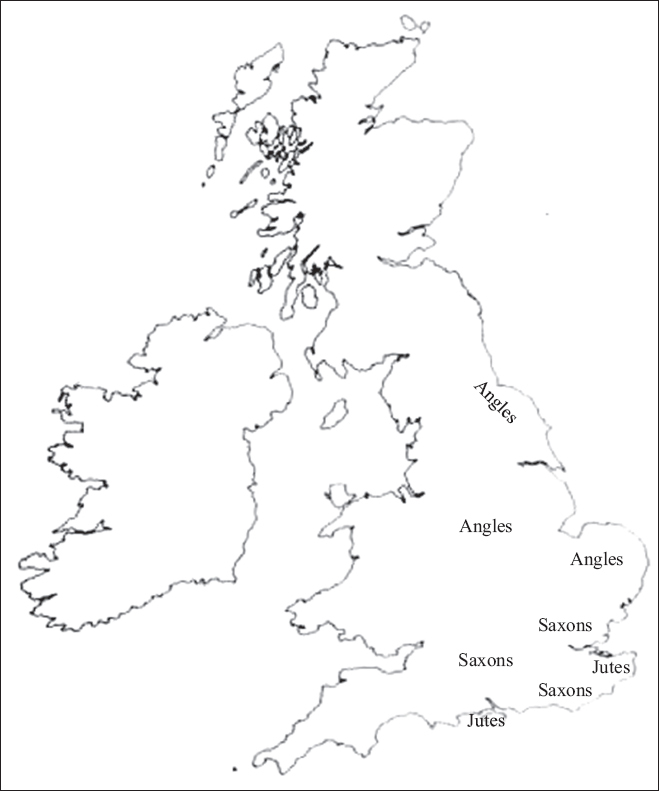
Bede’s locations for Angles, Saxons and Jutes.