
Chapter 6
We now come to the first historical record of Arthur. There are some who will claim the Welsh poem Y Gododdin has this title. However, the dating for that is not without controversy and the surviving copies are from the Middle Ages, so we will address that source later. The Historia Brittonum is a ninth-century text written possibly by Nennius, a monk in modern Wales. The earliest full text is dated to 828 but the date of the first edition is unlikely to be before 800. It was written in Gwynedd in north-west Wales in ‘the fourth year of King Merfyn circa 828’.1 Nennius is described as a disciple of ‘holy Elvodug’ who died in 809. He bemoans the lack of records claims:
I have therefore made a heap of all that I have found, both from the Annals of the Romans and from the Chronicles of the Holy Fathers, and from the writings of the Irish and the English, and out of the tradition of our elders.
Some scholars have concluded the preface was not part of the original text but added much later, and the preface is absent for all manuscripts earlier than 1164.2 Some copies name Mark the Anchorite as author, and one destroyed during the Second World War has Rhun, son of Urien, as the author. If true this would place it much earlier in the seventh century and also give it a northern provenance.
It has a list of contents which includes the following for chapter fifty-six:
King Arthur the warrior; the twelve battles that he fought against the English; the image of Saint Mary in which he triumphed; and how many of his enemies he laid low in a single attack.
There is a consensus that the preface is valid, despite being absent in the earliest manuscripts. The actual text is consistent across the surviving copies and is split into a number of sections with the fourth, the Kentish Chronicles being the most important concerning Arthur. The first section describes the ages of the world. The next section concerns British and Irish origins. He describes the Irish as coming from Spain, the Picts arrived first in the Orkneys, and he gives two alternative stories for the British. One is the tale repeated by Geoffrey of Monmouth 300 years later describing Aeneas escaping the fall of Troy and settling in Italy. His grandson Britto (Brutus in Geoffrey’s work), kills his father and is banished. After many adventures he lands in Britain giving the land his name.
The next section describes the coming of the Romans and makes a number of errors concerning Caesar’s campaign and the number of emperors. He does, however, mention Maximus and correctly describes three Roman ‘generals’ being killed by the British before the end of Roman rule and the subsequent appeal for help. The fourth section is termed the Kentish Chronicle and starts as follows:
It came to pass that after this war between the British and the Romans, when their generals were killed, and after the killing of the tyrant Maximus and the end of the Roman Empire in Britain, the British went in fear for 40 years. Vortigern ruled in Britain, and during his rule in Britain he was under pressure, from the fear of the Picts and Irish, and of Roman invasion, and, not least, from the dread of Ambrosius. Then came three keels, driven into exile from Germany. In them were the brothers Horsa and Hangest, sons of Wichtgils … Vortigern welcomed them, and handed over to them the island that in their language is called Tanet, in British Ruoihm.
Tanet may refer to Thanet in Kent. Although there is also a river Tanat near Ruthin in North Wales. Interestingly, there is a connection with Ruthin and Gildas. There is a monument in St Peter’s Square called Maen Huail. It is here that Arthur is recorded in a sixteenth-century chronicle (Elis Gruffydd) as executing Huail, the brother of Gildas. We will recall this being the cause of Gildas refusing to name Arthur. Yet the Life of St Gildas records this unlikely event as occurring on the Isle of Man. In any case, Gildas is quite clear that the first arrivals ‘fixed their dreadful claws on the east side of the island’, and this source is equally clear they are given an island to reside in. So Thanet in Kent is the most likely location.
As to the date, there are a number of contradictory statements within the text concerning the arrival of the Saxons:
Table 8
|
Chapter and page |
Text (known dates in brackets) |
Date of coming of Saxons |
|
Chapter 16 |
From the year when the Saxons first came, to the fourth year of King Mervyn, 429 years are reckoned. |
399 |
|
Chapter 31 |
From above: ‘the British went in fear for 40 years.’ Not clear if this is forty years from the death of Maximus (388), killing of the ‘generals’ (407), or end of Roman Britain (410). |
428 447 450 depending on interpretation. |
|
Chapter 31 |
When Gratian ruled for the second time with Equitius (375), the Saxons were received by Vortigern, 347 years after the Passion of Christ. |
375 380? Passion of Christ. |
|
Chapter 66 |
Vortigern, however, held empire in Britain in the consulship (emperors of East and West?) of Theodosius and Valentinian and in the fourth year of his reign (428) the English came to Britain, in the consulship of Felix and Taurus (428), in the 400th year from the the Passion of our Lord Jesus Christ. |
428 |
|
Chapter 66 |
From the year when the English came to Britain and were welcomed by Vortigern to Decius and Valerian are sxty-nine years. |
Unknown. No record. |
|
Chapter 66 |
From the reign of Vortigern to the quarrel between Vitalinus and Ambrosius are twelve years, that is Guoloppum, the battle of Guoloppum (possibly Wallop in Hampshire). |
N/A but places battle, and thus Ambrosius, in 437. |
There’s no real consensus from historians; however, many theories focus on the 425 date for Vortigern’s reign and the 428 dating of the Adventus Saxonum, which would tie in with the Gallic Chronicle entry for 440. The evidence for Bede and the Anglo-Saxon chronicles would all favour the later date of 449, which in turn ties in with a subsequent Ambrosius living two generations before Gildas. The other dates are all conveniently ignored, but there’s no logical reason to favour one above another.
The following chapters, 32 to 35, are a retelling of the visit by St Germanus which we know was in 429. Here, though, he introduces an unknown ‘miracle’. Germanus confronts a wicked king called Benlli ‘a great tyrant’. His fortress was burned with fire from heaven, with Benlli and all his men perishing. His servant, Cadell, was made king by Germanus, and his descendants ruled Powys from that time on. This is at odds with later Welsh genealogies which will be looked at later. Below is a brief outline of the chapter contents.
Table 9
|
Chapter 31 |
425 |
Vortigern ruled in Britain. |
|
Chapter 31 (and 66) |
428 |
Three keels arrive led by Hengist and Horsa (chapter 31). English came to Britain in consulship of Felix and Taurus (chapter 66). |
|
Chapter 32–35 |
429 |
Life of St Germanus part 1 concerning King Benlli and kings of Powys. |
|
Chapter 36 |
English encamped in Tanet. Numbers increase. British can no longer supply them and tell them to leave. Saxons take counsel to break peace. |
|
|
Chapter 37 |
Hengist negotiates with the ‘British King’ and envoys sent across the sea. Sixteen more keels arrive, along with Hengist’s daughter. Vortigern falls in love and gives Hengist Kent in return for her hand. |
|
|
Chapter 38 |
Hengist persuades Vortigern to invite his sons, Octha and Ebissa with forty keels to fight the Irish and settle them near the wall (Hadrian’s). They wasted the Orkneys and districts to the borders of the Picts. More keels arrive leaving their homeland empty and they came to the city of the Kentishmen. |
|
|
Chapter 39 |
A continuation of the life of St Germanus. Germanus confronts Vortigern for taking ‘his daughter to wife’. Vortigern is condemned by ‘the whole council’ and flees. |
|
|
Chapter 40–42 |
Tale of Emrys Ambrosius: A legend of two dragons, one white, one red, causing Vortigern’s new fortress near Mount Snowden to collapse. This is later attributed by Geoffrey of Monmouth to Merlin. Vortigern grants Ambrosius (identified as son of a Roman consul) the fortress and ‘all the kingdoms of the western part of Britain’. Vortigern ‘went to the northern part’ and came to the region called ‘Gwynessi’ and built a city called ‘Caer Gwrtheyrn’ (identified in South West Wales). |
|
|
Chapter 43 |
Vortigern’s son, Vortimer, fights against Hengist and Horsa and drives them back to Tanet. Attacking them three times. Hengist summons more men then fights against British, ‘sometimes victorious. … sometimes defeated and expelled’. |
|
|
Chapter 44 |
Vortimer fought four battles: Derguentid (Darenth in Kent?) Episford (Aylesford in Kent?) in which Horsa and Vortigern’s son Catigern fell. Third battle in open country by the inscribed stope on the shore of the Gallic Sea. Vortimer ‘soon after’ died. |
|
|
Chapter 45 |
Saxons return, Hengist asks for peace, Vortigern persuades council to accept. |
|
|
Chapter 46 |
At peace conference Saxons treacherously kill 300 British nobles and capture Vortigern who cedes Essex, Sussex and Middlesex to save his life. |
|
|
Chapter 47 |
Vortigern flees eventually to country of Demetians (Dyfed) to the fortress of Vortigern on the river Teifi (SW Wales), followed by St Germanus. Vortigern and his fortress is destroyed by fire from Heaven. |
|
|
Chapter 48 |
This includes an alternative ending for Vortigern. Vorttigern’s four sons described. Vortimer who fought the Saxons. Catigern (died in battle). Pascent, who ruled Builth and Gwerthrynion after his father by permission of Ambrosius who was the ‘Great King’ among all the kings of Britain. Faustus born of incest, cared for by St Germanus, became Bishop of Riez in France. |
|
|
Chapter 49 |
Genealogy of Vortigern. |
|
|
Chapters 50–55 |
After his (Vortigern’s) death St Germanus returns to his own country. Details of Life of St Patrick. |
So we have some similarities with Gildas and Bede except there are far more details. While many of the dates provided are wildly contradictory, there are indications that it happened much earlier than in Gildas’s account because the author places all these events before Germanus returning to Gaul. We begin to see two slightly different timelines emerging. One places the arrival of the Saxons around 428 and a rebellion in 440, the other a generation later with the arrival in 449 and the revolt in the 450s. This difference is important because Arthur always appears in the tale a generation after Ambrosius leads the fight back against the invaders. The earliest Arthur would have lived according to this narrative is in the 450s and the latest, before 550. We will attempt to narrow this ‘window’ as we proceed.
It is also worth noting Vortimer, Vortigern’s son. This is the first recorded source for this figure who, similarly to Arthur, has been regarded as fictitious by many academics. Vortimer’s battles, recorded in Nennius and Hengist’s battles in the Anglo-Saxon Chronicles are located in Kent. Both these sources record Hengist’s brother Horsa as dying at the battle of Aylesbury. The Historia Brittonum adds that Vortigern’s son Catigern also died. So there is a tradition that appears to cross cultural differences.
We then have the most important section and the very first reference to Arthur in any historical source. Nennius states the English increased their numbers and after Hengist died, his son Octha came from the north of Britain to the kingdom of Kent and all the kings of Kent came from him.
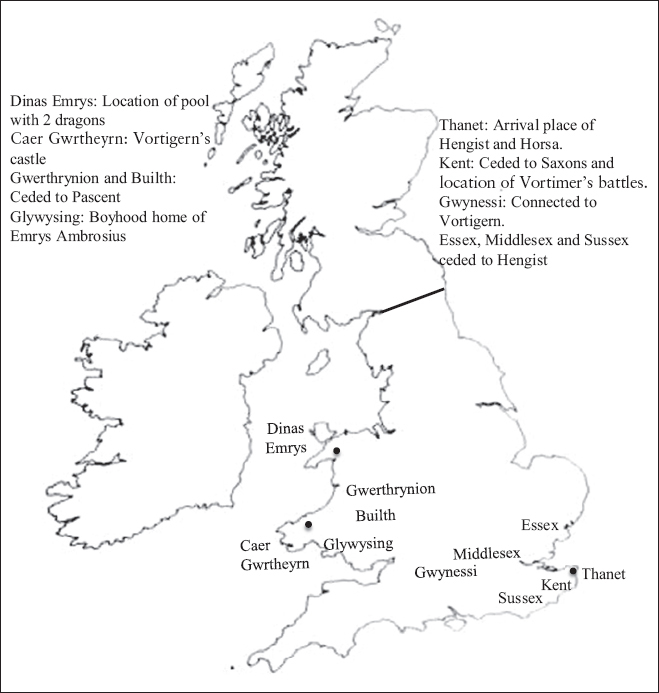
Locations in Historia Brittonum.
Chapter 56:
Then Arthur fought against them in those days, together with the kings of the British; but he was their dux bellorum [leader in battle].
The first thing one notices is that he is not titled king. Of course, nor does it state that he wasn’t. There is no alternative title given, although the epithet ‘dux bellorum’ has sometimes been used to justify an interpretation of a Roman title such as Dux Brittaniarum, there’s no evidence for that here however. Indeed, it is very similar to a biblical reference of Joshua. The suspicion is that he is using the references to St Patrick followed by the soldier, Arthur, as a nod to the book of Deuteronomy which has Joshua following Moses. The phrase ‘together with the kings of Britain’ has not only been used to suggest he wasn’t a king, but also that he wasn’t British at all. Again there is no way of knowing.
More interestingly is the preceding phrase, ‘At that time’, for the previous chapter refers to the time of St Patrick. He doesn’t date St Patrick and frustratingly there is a debate elsewhere whether his death was 462 or 493, although as we have seen the latter is more likely. Nor does he clarify whether ‘at that time’ refers to St Patrick’s life, or after his death; once again we are left with a large ‘window’. Another clue is in the text, ‘On Hengist’s death’, later evidence in the Anglo-Saxon Chronicles date Hengist’s death to 488, so we begin to see a theory emerging which places Arthur after the death of Hengist and St Patrick, which all ties in with the consensus for Badon in the 490s.
It isn’t that easy of course. First, the dates in the Anglo-Saxon Chronicle for that time cannot be trusted. Second, it’s not accepted that the figure of Hengist was anything more than fictional, as we shall discover in later chapters. One also has to wonder how likely it would be that a Hengist who arrived fighting-fit in 428 would have lived into the latter part of the century, which is what this source suggests. There are also contradictions from later sources concerning whether Octha is his son or grandson, even if their existence could be proven, which it can’t. But what does seem to be clear from this source is that Arthur is associated with at least one generation after Hengist.
Twelve battles are then attributed to him:
The first battle was at the mouth of the river Glein. The second, third, fourth and fifth were on another river, called the Douglas which is in the country of Lindsey. The sixth battle was on the river called Bassas. The seventh battle was in the Celyddon forest, that is the battle of Celyddon Coed. The eighth battle was in Guinnion fort, and in it Arthur carried the image of the holy Mary, the everlasting virgin, on his shoulders and the heathen were put to flight on that day, and there was a great slaughter upon them. The ninth battle was fought in the city of the legion. The tenth battle was fought on the bank of the river called Tryfrwyd. the eleventh battle was on the hill called Agned. The twelfth battle was on Badon hill and in it 960 men fell in one day, from a single charge of Arthur’s, and no-one laid them low save him alone; and he was victorious in all his campaigns.
It has proven difficult to locate any of these battles. The phrase ‘Then Arthur fought against them’ comes just after a reference to Kent, but none of the possibilities appear to point in that direction.
Table 10
|
Battle |
Translation |
Possible locations |
|
Glein |
Mouth of the river Glein. |
Glein derives from the Celtic ‘glan’ meaning pure or clean so could refer to any number of rivers. There are two river Glens in Britain, in Lincolnshire and Northumberland. |
|
Dubglas, Linnuis |
On the river Douglas in the country of Lindsey. |
Four battles at the same site. Dubglas may derive from ‘blackwater’ or ‘black green/blue water’, of which there are many. Linnuis is usually taken to mean Lincoln, but also referred to Lennox in Scotland. Additionally, the Lininius referred to Hampshire and Lindinis to Ilchester. |
|
Bassas |
On the river Bassas. |
Several Bas- suffixes usually referring to Anglo-Saxon names. There is also a Baschurch in Shropshire connected to Powys. |
|
Celidonis (or) Cat Coit Celidon |
Celyddon Forest. |
Usually assumed to mean the Caledonian forest, but could also refer to the forest of Celyddon located possibly in Gwent; Celyddon is a Welsh name and is referred to in later poems. There are also links to Kit Coit, the burial place of Catigern after the battle in Kent, mentioned in both Nennius and the Anglo-Saxon Chronicles where Horsa died. |
|
Castello Guinnion |
In Guinnion fort. |
Winchester was called Caer Guinn and Vinovium near Durham, Gwinnouion. There are several Gwynion-type names that could have been given to a fort. The image on his shoulders could be a mistranslation of the Welsh word for shield. |
|
Urbe Legionnis |
In the city of the legion. |
Caerleon, Chester or York most likely, but any town or city where the army was based at that time. |
|
Tribuit |
Bank of the river Tryfrwyd. |
Some people identify it’s location as the river Frew at Stirling; others, the river Ribble in Lancashire, the Severn at Gloucester or the Eden at Carlisle. It’s mentioned in the Welsh poem Pa Gur as Trywruid. |
|
Agned (or Breguoin in other copies.) |
Mount Agned. |
Geoffrey of Monmouth sites Monte Agned at Edinburgh. A tenth-century version of Nennius’s History gives this battle the alternative name of Breguoin. This could be Bravonium in Herefordshire or Bremenium, High Rochester in Northumberland. |
|
Monte Badonis |
Badon Hill. |
Nennius mentions the baths of Badon as one of the wonders of Britain and implies it is Bath. Badon or Baddon was the British for bath, but there were other ‘baths’ or hot springs in Britain. Plus Bath was known as Aquae Sulis in Gildas’s time. It wasn’t known as Badon, Badan or Badum until after the Saxon conquest in 577. Perhaps more importantly Monte, or mons in Gildas, usually means mountain or very large hill, which doesn’t describe the area in the South of the country. British Din Badon would be translated into Baddanbryg in Anglo-Saxon and there are a variety of Bad- suffixes across the country. Alternatively Caer Faddon is mentioned in the Dream of Rhonabwy and is located on the Severn near Welshpool. Mynydd Baidan is another possibility in South wales. Buxton also has a spring and Roman baths and a Roman Road called Bathamgate and is in a more mountainous area. |
There is a case for locating these battles in various areas of the country and these may give clues as to whom he was fighting and whether he travelled over the whole country or was more localised. There are a number of different theories which have been used to locate all twelve battles either in Wales, the South, the North or the East depending on your preference.3 There is evidence the list may contain the ‘resonance of Old Welsh poetic structure’,4 basically a battle song or poem. While some scholars think one or two locations can be identified,5 others, such as Higham, find the battle list is one ‘which our author largely compiled himself’,6 and Padel finds ‘safe identification is impossible’.7
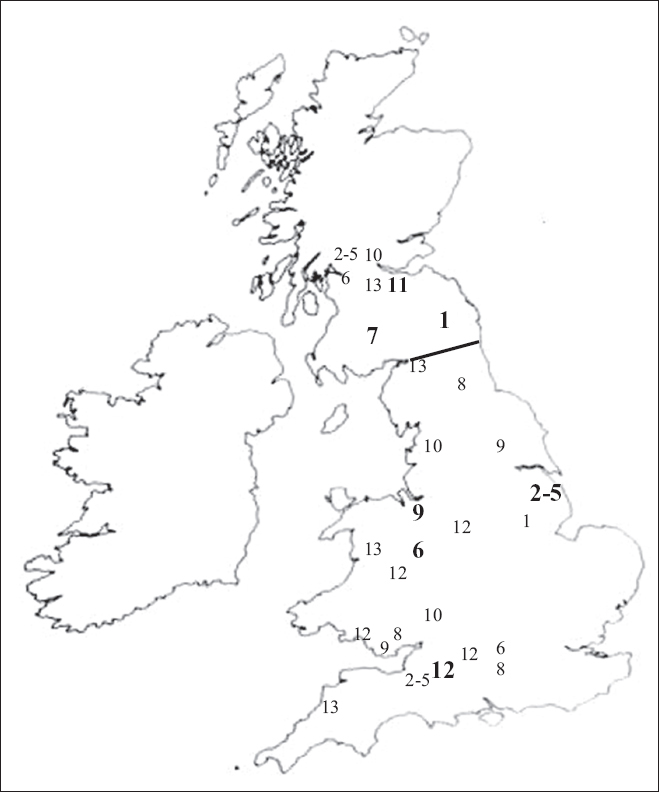
Some possible battle locations (13 = Camlan). Most likely locations in bold.
I might also add that some have identified other battles not connected to this time at all. The Battle of Celyddon Forest may refer to The Battle of Arfderydd in 573, fought in Strathcylde and traditionally has Myrddin turning mad and fleeing to the Caledonian Forest. The Battle in the City of the Legion may refer to the Battle of Chester in 616. It has even been suggested that the Battle of Badon was simply attributed to Arthur falsely to enhance his prestige. The text suggests he was fighting against ‘them’, by which it implies saxons. Specifically Hengist’s son, who moved from the north to Kent, but it’s difficult to come up with any locations from Kent that might be relevant.
If we could locate Badon, for example, this might help us understand the political and military situation. Battles confined to one area, or spread out across the whole island, would indicate if Arthur was a local ruler or operated across the whole country. Unfortunately no one has ever actually proved the location of any of these. Even those where there might have been a consensus, such as Celyddon or Badon, there is none.
The most we can say is that Celidonis is likely to be the Caledonian Forest and Linnuis is likely to mean Lincoln, given the location of Angle settlement and likely areas of contention. Aside from that I wouldn’t be confident about any of the locations. Bede mentions a river Glen near Yeavering Bell in Northumberland. He’s referring to King Edwin of Bernicia around 627, and of course is writing 100 years later. It may well be significant given that Nennius refers to a battle by a river of the same name. If Glein is likely to be Northumberland, Celidonis the Caledonian Forest, and the four battles of Linnuis, Lincoln, then we have a northern Arthur fighting the Angles on the east coast from above Hadrian’s Wall to the Wash. Given also that ‘Mons’ means mountain, there is a distinctly northern flavour to many of the battles.
One theory suggests Artur Mac Aedan of Dalriada from around 600 as the basis of the legend. Many of the locations in that area have been connected to these battles, but also many sites from the legend itself. Going against this is the fact we have reasonable sources covering that period and there’s no hint that this is the Arthur of legend, or anything in his life connected to the legend. We will discuss this theory among others much later, but it’s possible Nennius found a battle list of this Artur, Arthwys of the Pennines, or some other Arth-like name and assumed it was Arthur. Even that would still leave us with an Arthur located by Nennius as being sometime before or after the turn of the century.
The important point is that this is the first text to mention Arthur anywhere in history, albeit 300 years or more after the events. We must accept that we cannot identify the dates or locations – or even veracity of any of these battles save Badon, which Gildas mentions. The important question remains: can the text of the Historia Brittonum concerning Arthur fighting the Saxons be regarded as accurate? Even if the battles were appropriated from someone else or simply made up, we are still left with a claim that sometime after Hengist and St Partick but before Ida of Northumbria, Arthur ‘fought against them’. I would suggest there are five main options:
• He is a complete fabrication of the author.
• He is a mythical figure the author knowingly uses.
• The author erroneously believes him to be a historical figure.
• Arthur is a historical figure but the author misplaces him in the chronology.
• Arthur is a historical figure and the author correctly places him around 500.
We must look at the intention of the author. The text itself says far more about the ninth century than the fifth or sixth.8 Although some have argued it is no less historical than other major histories of the early Middle Ages.9 It is written for the political situation at the time, but also in some ways as a counter to Bede’s ‘English version’, which the author appears to know well.10 Some of the content suggests he is contrasting two dynastic foundations’ tales, Gwynedd and Powys.11 So it could be argued he is writing for King Merfyn and thus showing Gwynedd in a good light while Powys and other areas less so. The text contradicts and undermines many of the dynastic positions of contemporary British kings elsewhere in Wales.12 Additionally, he is placing much of the blame on Vortigern rather than the British as a race.
It thus has a political purpose, so when he introduces Ambrosius, this time it’s a very different character from the Romano-British warrior of Gildas and Bede. Here we meet him as a small orphan boy called Emrys Ambrosius, and there is a legend of two ‘worms’ fighting, often retold as a red and white dragon. Three times they fight until the white (representing the Saxons) is finally defeated by the red (the Britons). Nennius is the first person to mention Vortimer and Arthur in history. The purpose could be to demonstrate that Merfyn will be the third successful British ruler to drive the Saxons out.
This seems to contradict his comment in the preface of ‘made a heap of all I have found’. The evidence suggests this is not a committed historian collecting various bits of evidence, some contradictory, and attempting to write an accurate account.13 Rather it is a purposeful synchronising history and the text should be viewed as a whole, a narrative with a purpose. Many texts in the early Middle Ages combine the history of a people with a history of the church and the text is constructed to form a narrative. That doesn’t necessarily mean the contents aren’t true, but one must remember the content and style has a purpose.
The Saxons are portrayed, unsurprisingly, in a bad light; succeeding through treachery, murder and poisoning. The fault on the British side is laid squarely at Vortigern’s feet. Vortimer is there to show that the British were not the weak cowards portrayed by Gildas and Bede. Later he introduces St Patrick and Arthur, both British, one clerical and one martial. This is to demonstrate the spiritual and military prowess of the British. Arthur’s construction is similar to the Book of Deuteronomy, where Joshua follows Moses in the same way Arthur follows St Patrick.14 Joshua is also called a ‘leader of battle’. It positions the Britons as the new Israelites overcoming their enemies and re-occupying the promised land.
Straight after the battle list the text describes how the English continued to increase their numbers despite their defeats and brought their kings from Germany to rule over them until the time when Ida reigned. It records him as the son of Eobba and titles him the first King of Bernicia, also known as Berneich. The interesting thing about Berneich, or Bryneich, is it has a Brythonic etymology and so implies a former British area taken over by Angle settlers. Bernicia was the northern part of the later kingdom of Northumbria, although at that time it was likely confined to the eastern coastal area. Arthur’s time was before Ida, who we know from other sources was king in that part of Northumbria from around 547. Thus if we were to trust the accuracy and chronology of the text Arthur is militarily active from the time of St Patrick (died 461 or 493), after Hengist (died 488) to some time before the reign of Ida (547). In other words, we have a tentative timeframe of 450s–550 if we can trust the dates. Indeed, the text suggests some time passed between Arthur’s victories and the time of Ida. If we trust the more likely later date for St Patrick’s death, then we could tentatively suggest an orbit of 490–520 for Arthur being militarily active. Sadly it is not that simple as we can’t be certain, and definitive support is lacking.
It is true to say there are a number of known historical characters in the text. It’s difficult to be certain if any of the others are knowingly fictitious. The early part concerning Brutus appears completely unhistorical and is not supported by any evidence, archaeological or otherwise. The magical elements of the Wonders of Britain and the tale of Emrys Ambrosius also detract from it as a historical source. First, where it impinges on history the text is either demonstrably wrong, or evidence has been distorted. Second, the weaving together of different strands of stories such as St Germanus and Vortigern, then Vortigern and Hengist, and Ambrosius and the two dragons, suggests the author is manipulating sources and legends for a purpose; but still we cannot prove that for the key passages there are fictitious persons.
The author then goes on to list various genealogies, the cities of Britain and the wonders of Britain. In the latter he lists two wonders concerning Arthur.
The first is in the country of ‘Builth’, modern Wales, and describes a heap of stones with the footprint of Cafal, Arthur’s dog. When he hunted a great Boar (Twych Trwyth, also found in the later legend of Culhwch and Olwen) Cafal, the warrior-Arthur’s hound impressed his footprint on the stone, and Arthur later brought together the pile of stones called Carn Cafal. Men can come and take the stone for a day and a night, but on the next day it is miraculously found back on the stone pile.
The second is the tomb of Arthur’s son, Amr, in the country of Ergyng, South Wales. Arthur himself is said to have killed and buried him there though the circumstances are not recorded. It is claimed it’s length changes every time someone measures it and the writer himself has tested this.
So in this section we have a purely mythical Arthur, and some have suggested it negates the whole text. It certainly detracts from the validity of the source overall. What it does show is there were legends of Arthur circulating as early as 830. How much these legends changed over 300 years from Arthur’s time is lost to us, but we can say that by the ninth century there was already a mythical Arthur as well as a historical one in people’s minds. There are plenty of examples in history of mythical persons being made real in stories and legends. Historians require proof and one account 300 years later is not proof enough on it’s own.
In summary, we have a ninth-century text that could be drawing on earlier sources.
Concerning this document we have two opposing Arthurs. One is portrayed as a historical figure fighting the Saxons at a particular time in history, but that portrayal is slightly misleading because it is clear from Bede and later archaeological evidence that these aren’t Saxons at all. If he fought those who had came from the north as the text claims, then he fought Angles, not Saxons. And if he fought the Kentish men it is likely they were Jutes. In fact, as we will see from later DNA and archaeological evidence, it is debatable what percentage of the population was Germanic at all, and how much of the original Romano-British population stayed where they were. We will see later this could be anything from 50 to 90 per cent. The other Arthur is a mythical figure with magical stones and tombs embedded in a narrative which includes the story of Emrys and the magic pool containing two worms or dragons. There is no good reason to pick one and dismiss the other. The source is neither contemporary nor regarded as valid by historians in general. But we can’t dismiss it completely – and not just because it’s the first reference of Arthur in any known source. Despite it’s magical elements and possible propaganda purpose, it was written for an audience who understood who or what Arthur represented.