
Chapter 8
The Anglo-Saxon Chronicles had their origins towards the end of the ninth century, possibly commissioned by King Alfred of Wessex.1 They were most likely written in the south west as they appear more knowledgeable about that part of the country. The year, rather than the event, is the primary significance;2 it is the first continuous history of any western people in their own language. There are a number of surviving manuscripts, the oldest being the Winchester Manuscript written around 891. It begins with a genealogy of the Wessex kings from Cerdic to King Alfred. It proceeds from the time of Julius Caesar and goes up to just after the Norman conquest in 1066, although other manuscripts go a little further.
I will begin with the entries from the end of Roman Britain to the appeal to the Romans:
Table 12
|
Year |
Entry |
|
409 |
Here the Goths destroyed the stronghold of Rome, and afterwards the Romans never ruled in Britain; that was eleven hundred and ten years after it was built. In all they had ruled there four hundred and seventy years after Julius Caesar first sought out the country. |
|
418 |
Here the Romans assembled all the gold-hoards which were in Britain and hi class="tbodyc"d some in the earth so that no one afterwards could find them, and took some with them into Gaul. |
|
423 |
Here Theodosius the younger succeeded to the kingdom [Western Empire]. |
|
430 |
Here the Bishop Palladius was sent from Pope Celestine to the Scots [Irish class="tbodyc"] in order to strengthen their faith. |
|
443 |
Here the Britons sent to Rome and asked them for help against the Picts, but they had none there because they were campaigning against Attila, king of the Huns; and then they sent to the Angles and made the same request to the princes of the Angle race. |
So this deviates from some of the other evidence. There is Palladius’s mission, but nothing about St Germanus or St Patrick. The appeal is dated as 443, a little earlier than in Bede. There is no reference to explain the Gallic Chronicle entry of 441 which stated Britain fell to the ‘power of the Saxons’. The entry for 449 does however appear to have been influenced by Bede.
It notes Mauricius and Valentinian succeeded to the kingdom (i.e. the Roman Empire) and ruled for seven years. Then ‘in their days’, Hengist and Horsa arrive, invited by Vortigern, who is titled king of the Britons. They land at Ebba’s Creek (Ebbsfleet, East Kent). At first they assisted the Britons winning victories over the Picts in the north. They then ‘sent to Angeln’ requesting more help, implying they are Angles, although next it states: ‘these men came from three tribes of Germany: from the Old Saxons, from the Angles, from the Jutes.’ It then confirms much of what Bede says listing the the tribal areas:
• Jutes: Kent, Isle of Wight, parts of Wessex still called ‘the race of the Jutes’ (likely the New Forest area).
• Old Saxons: East Saxons (Essex), South Saxons (Sussex) and West Saxons (Wessex).
• Angles: East Angles (East Anglia), Middle Angles (Mercia) and Northumbrians.
It names Hengist and Horsa and lists their genealogy: Wihtgils, Witta, Wecta and Woden, thus claiming Woden originated the Wessex royal family and ‘that of the Southumbrians too’. It may be worth noting that Hengist and Horsa mean ‘stallion’ and ‘horse’ respectively, and some have thus suggested there is poetic licence or mythology at play here. There is also the reference to Woden in the genealogy tree which is similar to founding myths in other tribal societies. There is archaeological evidence concerning areas of north-west Europe being left uninhabited around this time, however, so that part of the narrative at least has some corroborative evidence.
We then have a list of four battles involving Hengist, one of which seems to replicate some of Vortimer’s battles in the Historia Brittonum. They all appear to be in Kent.
Table 13
|
Date |
Text |
|
455 |
Here Hengist and Horsa fought against Vortigern the king in the place which is called Aylesford, and his brother Horsa was killed. And after that Hengist and Aesc his son succeeded to the kingdom. |
|
457 |
Here Hengist and Aesc fought against the Britons in the place which is called Crayford, and there killed four thousand men; and the Britons then abandoned the land of Kent and in great terror fled to the stronghold of London |
|
465 |
Here Hengist and Aesc fought against the Welsh near Wipped’s Creek, and there killed 12 Welsh chieftains and one of their thanes, whose name was Wipped, was killed there. |
|
473 |
Here Hengist and Aesc fought against the Welsh and seized countless war-loot and the Britons fled from the English like fire. |
In 488 there is an entry recording Aesc as succeeding to the kingdom of Kent for twenty-four years, so presumably Hengist dies in that year. However other traditions name Oisc as the founder of the Kentish royal house.3 We recall the Historia Brittonum has Octha succeeding Hengist and then ‘Arthur fought against them’. Shortly after Hengist’s battles in Kent, there are several battles by Aelle recorded. These all appear to be in Sussex on the south coast. At that time the Weald separated Kent from Sussex and so it would have be difficult for armies to move from Kent to Sussex, or from Sussex north towards London. If these dates are in any way accurate, then it is interesting to compare them with the military activity of Ambrosius Aurelianus in ‘the time of Zeno’ (474–91) as described by Bede.
Table 14
|
Date |
Text |
|
477 |
Here Aelle and his 3 sons, Cymen and Wlencing and Cissa, came to the land of Britain with 3 ships at a place which is named Cymen’s shore [probably Selsy Bill, West Sussex], and there killed many Welsh and drove them into the wood which is named the Weald. |
|
485 |
Here Aelle fought against the Welsh near the margin of Mearcred’s Burn. |
|
491 |
Here Aelle and Cissa besieged Anderitum [Roman fort at Pevensey], and killed all who lived in there; there was not even one Briton left there. |
The last table concerns the foundation of the West Saxons:
Table 15
|
Year |
Entry |
|
495 |
Here two chieftains; Cerdic and Cynric his son, came to Britain with 5 ships at the place which is called Cardic’s Shore (probably Charford in Hampshire) and the same day fought against the Welsh. |
|
501 |
Here Port and his 2 sons, Bieda and Maegla, came with 2 ships to Britain at the place which is called Portsmouth, and killed a certain young British man – a very noble man. |
|
508 |
Here Cerdic and Cynric killed a certain British king whose name was Natanleod, and 5 thousand men with him – after whom the land as far as Charford was named Netley [probably Hampshire] |
|
514 |
Here the West Saxons, Stuf and Wihtgar, came to Britain with 3 ships in the place which is called Cerdic’s Shore [same location as Cerdic and Cynric] and fought against the Britons and put them to flight. |
|
519 |
Here Cerdic and Cynric succeeded to the kingdom of the West Saxons and the same year they fought against the Britons at the place they now name Cerdic’s Ford [probably Charford in Hampshire]. And the royal family of the West Saxons ruled from that day on [last line added by later annalist]. |
|
527 |
Here Cerdic and Cynric fought against the Britons at the place which is called Cerdic’s Wood. |
|
530 |
Here Cerdic and Cynric took the Isle of Wight and killed a few men at Wihtgar’s stronghold. |
|
534 |
Here Cerdic passed away, and his son Cynric continued to rule 26 years. And they gave all Wight to their two nephew’s Stuf and Wihtgar. |
|
544 |
Here Wihtgar passed away and they buried him at Wihtgar’s stronghold. |
You will note there are three separate tables as the entries, though continuous, appear to concern three distinct geographical areas and individuals. So, we have three sets of foundations stories and battle lists. Hengist in Kent between 455 and 473, Aelle in Sussex between 477 and 491 and then Cerdic, among others, in The New Forest area of Hampshire from 495 onwards.
The question of whether we can trust these dates arises. For example, there are two entries of eclipses for 1 March in 538 and 20 June 540. While it is recognised the dating is not exact, there were indeed eclipses on 15 February 538 and 20 June 540.4 There is then an entry for 547 in which Ida succeeds to the kingdom of the Northumbrians, which begs the question what was the political and military situation prior to that? The entry then lists Ida’s genealogy back to Woden, thus linking him to Hengist. A later entry for Cynric also links his Genealogy back to Woden. Hengist is mentioned as a character in the epic poem Beowulf, so the name would already be familiar.
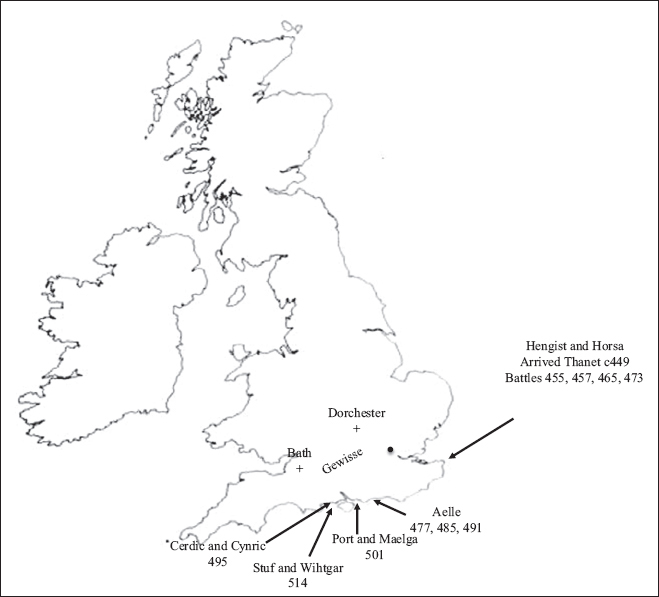
Foundation stories in the Anglo-Saxon Chronicles.
Victories for the West Saxons in 552 at Salisbury and in 556 at Bera’s stronghold (Barbury in Wiltshire) then follow. They are powerful enough to defeat Aethelbert of Kent in 568. There is then a further expansion:
571 Battle at Bedcanford and taking of settlements of Limbury, Aylesbury, Benson and Eynsham
577 Battle of Dyrham against three British kings and taking of three cities: Gloucester, Cirencester and Bath.
So we have activity in Kent involving Vortigern, Hengist and later Aesc between 455 and 473. We then have activity in Sussex by Aelle 477–91. Lastly, there are incursions by various people in the New Forest and Portsmouth areas from 495. The Chronicles list two as victories in 508 and 514, but are ambiguous about other battles. We then have a lull in military activity which ties in with Gildas referring to an end of ‘external wars’.
For Cerdic and Cynric the reference and likely location of the later battles do suggest a more defensive situation. There does seem to be a double entry for the arrival of Cerdic however: first they are said to arrive in 495 and take the kingdom six years later; then there’s an entry for the arrival of the West Saxons in 514 and Cerdic is said to succeed to the kingdom of the West Saxons in 519. It is possible there is an alternative explanation: Cerdic arrives in 495 and occupies the land the West Saxons later inhabit. Nineteen years later the West Saxons Stuf and Whitgar do arrive, and six years after that Cerdic succeeds to their kingdom.
But nineteen years is the same as an Easter cycle, so could easily be misdated by medieval writers. In addition, according to genealogy at the start, and the later entries in the Chronicle, it does appear that the first date is a mistake and Cerdic is actually dated to 514. He then succeeds to the kingdom of the West Saxons in 519. This could be significant if the date for Badon is 516 as per the Annales Cambriae. Plus, the timespan for Cerdic and Cynric arriving in 495 and being succeeded in 560 by Ceawlin seems rather long.
Asser’s ninth-century Life of King Alfred records a Creoda between Cerdic and Cynric which would make the time span more realistic, but it doesn’t take away the apparent double entry. The reference to the taking of the Isle of Wight in 530 could be seen as a retreat from the mainland. It could be that further expansion inland was impossible, but that would be highly speculative. Yet we have this gap of a generation or two from the early 500s to further expansion of the West Saxons from the 550s onwards. This does seem to tie in with Gildas talking about a generation of peace.
I would use caution with the literary sources as there is a heavy influence from Gildas, who influenced Bede, who in turn influenced the Anglo-Saxon Chronicles. It’s hard to speculate the extent of that influence, and what (and how valid) their other sources were. It may be important to note the differences: Gildas focuses on Saxons, while Bede is careful to name the Angles as those fighting at Badon.
There is another important point about the West Saxons which seems to contradict the narrative in the Chronicles. There is a suspicion that the whole line has been artificially extended, and a much more likely date would be 5325 for Cerdic’s arrival. In fact, Bede states that this area of South Hampshire and the Isle of Wight were Jutish until the West Saxon king Caedwalla conquered them in 686–8. Thus it would be impossible to place the origins in these Jutish territories.
The best claim for their origin is the upper Thames valley.6 The first site of a West Saxon episcopal see was Dorchester, and the battles of 552, 556 and 571 seem to suggest a swathe of territory twenty miles north and south of the river Thames, culminating in the battle of Dyrham in the west in 577 where Bath, Gloucester and Cirencester were captured. It is also important to note that Bede stated the West Saxons were formally known as the ‘Geuissae’ or ‘Gewisse’. They only started being called West Saxons after Caedwalla’s time in the seventh century. Gewisse means ‘certain’ or ‘sure’ and may be a reference to their reliability.
Another group, the Hwicce, are occasionally conflated with them but they have separate entries in a later source, The Tribal Hidage, which we will examine later, plus there is no etymological link. They may well have bordered each other at some point, with the Hwicce running alongside the east of the river Severn. Geoffrey of Monmouth labels Vortigern as ‘leader of the Gewissei. Additionally, in Nennius, after his confrontation with the boy Merlin, Emrys Ambrosius, Vortigern leaves the western part of Britain in his hands and goes to the northern part, to Caer Gwrtheyrn in the region called ‘Gwynessi’. Caer Gwrtheyrn is identified as being an Iron Age hill fort in West Wales, which isn’t north of any of the places in that part of the story. Vortigern takes Ambrosius from South Wales to sacrifice him before building a castle near mount Snowdon. There is no evidence for any speculation on this. The early entries in the Chronicles are highly suspect and we simply don’t know enough about the origins of the West Saxons or Gewisse.
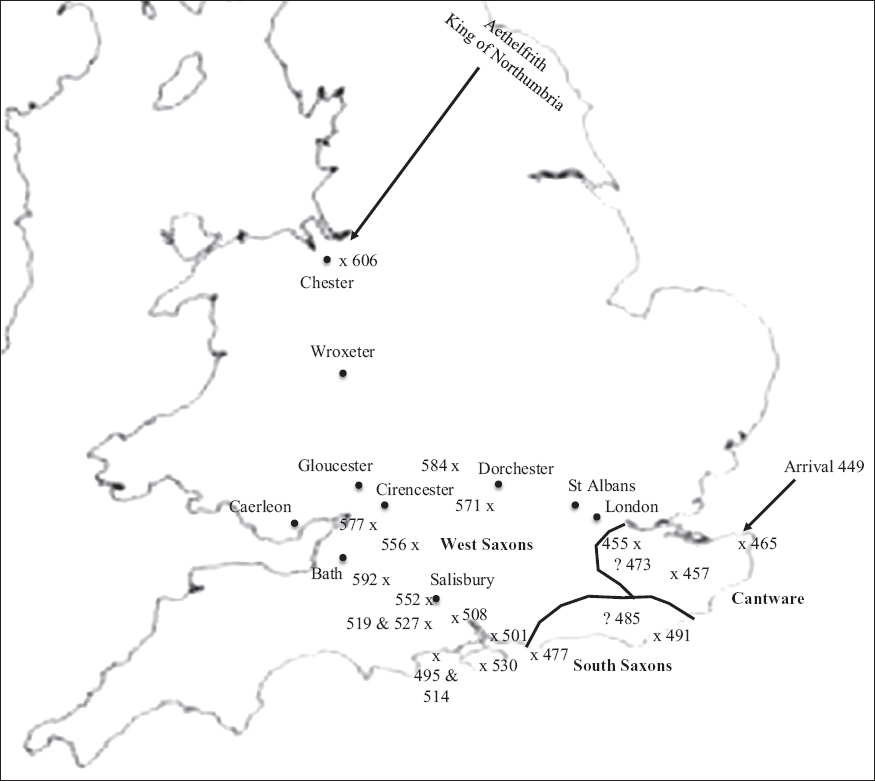
Location of battles in the Anglo-Saxon Chronicles.
In summary, the Anglo-Saxon Chronicles broadly follow Bede and describe a narrative of an appeal, arrival and subsequent revolt. There then follows three distinct areas and periods of conflict. The first involves Hengist and Horsa in Kent, and intriguingly confirms the battle mentioned in the Historia Brittonum, where Horsa fell. The second involves Aelle in Sussex, Bede’s first Bretwalda. The last involves the arrival of Cerdic and the West Saxons. There then follows an apparent break in victories until after 550, which on the face of it supports Gildas and a generation ‘free from external wars’. Unfortunately, no entries before the middle of the sixth century can be confirmed. What is clear is Arthur does not appear in any way.