
CHAPTER 2
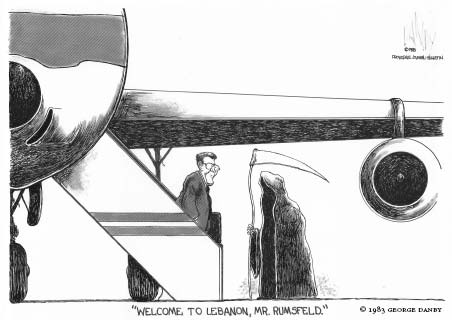
For years, Beirut had been known as the “Paris of the Middle East”—a favored destination of Western and Arab tourists. Its high-rise hotels along the Corniche and its magnificent port made it a symbol of a modern Middle East. That, of course, was before their civil war began in 1975. I thought I had been prepared for what I would see on my arrival in Beirut eight years later, but the physical devastation was much worse than I had expected. By the time of my visit in late 1983, large sections of downtown and portions of the port had been reduced to rubble. Once elegant hotels were pockmarked from rockets and bullets. Even the presidential palace was scarred by rocket attacks. That was where I first met Lebanon’s beleaguered leader, who was struggling to hold his shattered country together.
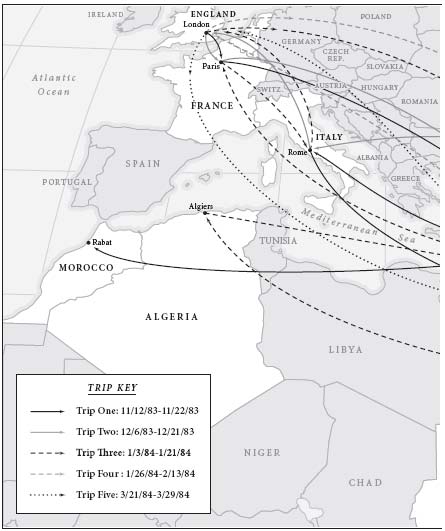
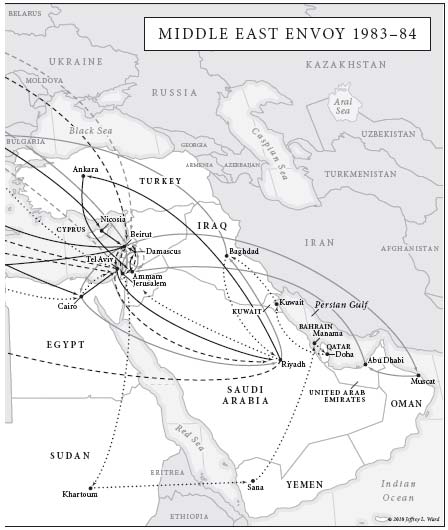
I traveled throughout the region five times during my brief tenure as President Reagan’s Middle East envoy.
Amine Gemayel was not supposed to have been president but assumed the position upon the death of his brother, Bashir. Bashir Gemayel had been a radical politician for the Middle East: a young dynamic leader who vowed to reform the Lebanese political system and even broached the prospect of peace with israel. That was the sort of thinking that didn’t win friends among the potentates of the Arab League. Bashir’s assassination—linked to a Syrian terror group—resulted in his reserved, serious-minded brother taking charge of the shaken nation.
President Gemayel had been in office for a little over a year when I first met him. He was impeccably dressed—a reminder that had he wished to, he and his family had the resources to join other wealthy émigrés on the French Riviera.
Gemayel spoke for long periods at a time. He knew his country’s prospects, as well as his own, were precarious. Everywhere he turned he was faced by adversaries and rivals, both within and outside his own government. I was struck by his raw emotion. Gemayel had come to believe that the only hope for his government’s survival, and for his country, lay with the United States. As long as American and other multinational forces were in Lebanon to hold Syria at bay, Gemayel felt he might have the breathing room needed to fashion a coalition government and expand the government’s authority outside of Beirut.
I believed that as well, at least initially. But I also sensed that as the security situation in Lebanon deteriorated, the Lebanese had become increasingly dependent on the United States. America, for instance, was playing a pivotal role in training the Lebanese military, which had degraded badly during their internal struggles. Yet I wasn’t sure our well-intentioned efforts were enough. On one trip I went to visit the Lebanese military headquarters, where I met with their leadership and our American trainers. Our people seemed to be training the Lebanese for conventional actions against professional combat units rather than for engagements with militias and small terrorist cells. As I wrote Secretary Shultz, I wondered if we were preparing the Lebanese military to fight the right battles.1
I also wondered whether the United States was playing too prominent a role in Lebanese politics. By the time I arrived on the scene, there seemed to be an expectation that we would help select the Lebanese cabinet, notwithstanding our country’s limited familiarity with the intricacies of Lebanese politics. To me, this was the diplomatic equivalent of amateur brain surgery. The likely result would be having a government seen as a puppet of the United States. As their dependence was increasing, a growing number of Americans back home weren’t sure how much they were willing to put on the line for that small country so far away.
Lebanon’s President sensed this. Although the Reagan administration spoke of its commitment to his country, Gemayel was unconvinced—and understandably so. He could not be certain that the United States would fulfill its promise to protect the Lebanese. As a result, Gemayel feared he could be forced to choose between making an arrangement with either Israel or Syria to try to keep his government intact. Neither of those choices was acceptable to large factions of the Lebanese people. An arrangement with israel would damage Lebanon’s relations with its neighboring Arab nations. Gemayel, like most of his countrymen, also was wary of the Israelis and their intentions, and expressed the fear that Israel could devour his country “like a mouthful of bread.” Being at Syria’s mercy was an even worse alternative; mercy was not a defining characteristic of the Syrian regime. I noted that if Israel could eat Lebanon like a mouthful of bread, the Syrians could gobble up Lebanon like a potato chip.2
During my first twelve days in my new post, I held twenty-six official meetings in nine countries, traveling over twenty-five thousand miles, to develop a better understanding of America’s options for our involvement in Lebanon. On the twelfth evening, weary and not feeling particularly enlightened, I put down some initial thoughts on the situation in a cable to Secretary Shultz I titled “The Swamp.”3 It was not a cheerful title; but it conveyed my sense of the region as a dangerous, shifting place inhospitable to American interests. My initial assessment was that we needed to lighten our hand somewhat in the Middle East, but to proceed carefully so as not to further upset the situation. specifically, I wrote Shultz that we should:
· close the gap between inflated perceptions of our abilities and reality;
· never use U.S. troops as a “peacekeeping force,” we were too big a target; and
· keep reminding ourselves that it is easier to get into something than it is to get out of it.
Contrary to what I expected when I first departed for Beirut, and despite my sympathy for the Lebanese people, I was left with the sense that there was little upside to our engagement. “My nose tells me that the odds are strongly stacked against us,” I advised Shultz. “I wish we hadn’t gone in. We need to be looking for a reasonably graceful way to get out.”4
The ensuing months saw more violence in Lebanon, as extremists linked to Syria and Iran hoped to accelerate a U.S. withdrawal. In early 1984, terrorists murdered one of the most prominent Americans in Lebanon—Dr. Malcolm Kerr, president of the American University of Beirut. Since we also had to be near the top of the terrorists’ wish list in the region, those charged with providing security for our team were particularly attentive.* Being assigned to stand inches away from high value American targets in the region was not exactly a formula for a long life.
I normally would have worked from the U.S. embassy in Beirut. But it had been closed after a bombing several months earlier that had killed sixty-three people. So instead my staff and I worked out of the American ambassador’s residence some distance from the capital. Unfortunately, the ambassador’s residence was hardly more secure than the embassy had been. It was shelled periodically, but there was no basement or shelter. As a result, during some of the attacks we spent time working under a staircase, which provided the best available cover.
One evening I left the ambassador’s residence to go to a small shack in the complex that contained the communications equipment needed to contact Washington, D.C. Our mission’s indispensable chief of staff, Tom Miller, and Ambassador Reg Bartholomew were with me. The shack contained two small rooms, a phone, and several radios. There was a small window with an air-conditioning unit in it. Just outside the shack, a SUV was parked near a tree.
When I made contact with the Secretary of State, he told me that he just had spoken with my wife, Joyce, who had been seeing reports on Chicago television and in the newspapers about the bombing and rocket attacks in Beirut, some of them in the areas where I was located.
“I talked with Joyce and reassured her,” Shultz said confidently. “I told her you had the best security possible and you were safe.”
At almost that exact moment, there was a loud explosion. A 122 millimeter Soviet-made Grad rocket hit the car just outside the shack. The impact of the explosion blew the air conditioner out of the window and across Tom Miller’s shoulder. A typewriter flew between Bartholomew’s and my heads, and I was thrown to the floor. As I scrambled back to continue the call with Shultz, I realized the phone line was dead. We, fortunately, were not.
In late December 1983, Secretary of Defense Weinberger received crucial support for a prompt and complete withdrawal of U.S. forces from Lebanon in a study commissioned by the Pentagon. It placed responsibility on the military commanders on the ground for failing to have adequate security safeguards and noted that the Marine force “was not trained, organized, staffed, or supported to deal effectively with the terrorist threat in Lebanon.”6 The report recommended that the Marines in Lebanon be withdrawn.
After the report was published, President Reagan acknowledged that the Marines’ mission in Lebanon was difficult. “We recognized the fact at the beginning,” Reagan said, “and we’re painfully mindful of it today. But the point is that our forces have already contributed to achievements that lay the foundation for a future peace, the restoration of a central government, and the establishment of an effective national Lebanese Army.”7 Asked if the United States planned to stay in Lebanon to see this work through, the President responded, “[W]hile there’s hope for peace we have to remain.”8
My own doubts about our ability to remain were growing. As I often do when dealing with a seemingly intractable problem, I developed an options paper. In the case of Lebanon, the exercise helped me think through whether we should persevere or, conversely, recognize that the potential for a positive outcome was limited and look for the best way to reduce American forces with as little damage to Lebanon and to our friends in the region as possible. In tough national security decisions, I’ve often found that there are seldom good options—only the least bad. This was the case in Lebanon. I estimated that we had a roughly 60 percent chance of accomplishing our goals in some form. These were not great odds, but I felt they were better than the alternative of a hasty withdrawal that would leave Lebanon to the control of the Syrians and further damage the reputation of our country. This was, after all, not quite a decade after our hasty withdrawal from Saigon at the end of the Vietnam War.
At the same time, a vigorous public debate was going on in Congress about whether to extend the mandate for U.S. troops in Lebanon—and if so, for how long. The Middle Eastern parties with whom we were negotiating learned all the details about the congressional debate by reading our newspapers. The Syrians were in effect being alerted that they probably had a winning hand.
Republican Senator Barry Goldwater was never one who had to be coaxed to offer his opinion. “We’re not helping one bit,” he said bluntly, “risking the lives of American Marines serving over there, trying to keep peace, when they’ve got a bunch of jackasses who want to kill each other. I’d get out of there and let them shoot.”9
Also troubling was the position of Illinois Senator Charles Percy, the chairman of the Senate Foreign Relations Committee. He was from the opposite end of the Republican spectrum from Goldwater and had previously been inclined to stick it out in Lebanon. But Percy was now saying withdrawal from Lebanon should take place “as soon as possible.”10 Indeed, there was a growing impression that a withdrawal might be ordered at any moment.
The way Syria operated during the Lebanon crisis provided an interesting insight into how smaller nations can manipulate a superpower. It also was a cautionary lesson for me in the future about how to deal with totalitarian regimes opposed to America’s national security interests.
The Syrian dictatorship possessed in the extreme two qualities particularly dangerous in a military adversary—ruthlessness and patience. Like all dictatorships, the regime had the advantage of not needing to cater to its domestic opinion. It could do whatever it deemed expedient to achieve its goals. The Syrians had been playing a diplomatic game with us for decades: doing just enough to look accommodating or coming up just shy of being too provocative. They played the international media like skilled poker players—offering public words of support for peace efforts so as to be seen as not unreasonable. The Syrians would float friendly diplomatic overtures to give the regime deniability when negotiations went off-track, as they had intended all along. This left them free to pursue their hostile interests behind the scenes: destabilizing the Lebanese government and supporting armed militias and terrorist groups. At other points, the Syrians dropped any pretense of cooperation and became immovable. Even during negotiations, Syrians and their then allies, the Druze, directed relentless artillery and rocket fire on the civilian population of Beirut.
The Syrians were savvy about the U.S. government. A Jordanian official told me the Syrians had analyzed America’s War Powers Resolution carefully. They knew that congressional support for our involvement in Beirut was fragile and vulnerable to the slightest shift of activity in the region.11 The Syrians believed correctly that they had the ability to force such a shift at their pleasure.
The obvious mixed signals the Syrians were receiving from Washington undoubtedly heightened that belief. Secretary Shultz and I observed that the Syrians were the most reasonable whenever the United States flew reconnaissance missions over their territories. They seemed sensitive to the proximity of American military power. When our flights were suspended, the Syrians became more intransigent. In mid-December 1983, the Department of Defense halted the reconnaissance flights without informing the State Department or our mission. It was done just at the moment we were trying to achieve concessions from the Syrian government. Even worse for American credibility, after assuring President Gemayel that the United States was going to continue to exert pressure on the Syrians, we heard through the grapevine that someone in the Department of State had tried to set up a separate, secret channel to make conciliatory overtures toward the Syrians. Here I was telling the Syrians there could be consequences for their actions while someone back in Washington was telling them just the opposite. Our delegation was blindsided.
None of these activities put me in a strong position when I arrived in Damascus on January 12, 1984, for my first meeting with one of the chief puppet masters behind the chaos in Lebanon, Syrian President Hafez al-Assad. In the best of worlds, Assad would be amenable to easing Syria’s interference in Lebanon’s political system and ending their support for terrorist groups. Neither prospect was likely, especially when America’s negotiating position was weak. The best we could hope for was to have Assad believe he might pay a price if he went too far against American interests.
Known as the Sphinx of Damascus, Assad was a man of studied discipline and ruthless calculation. He once ordered the leveling of the entire Syrian town of Hama, murdering an estimated ten thousand to forty thousand of his own people in the process.
Assad received me in his villa south of Damascus, where he had been recovering from a heart ailment. In our three-and-a-half-hour meeting (not long by Assad standards), he plied me with a steady stream of coffee. I tried to point out the strength of America’s position. I presented Assad with an overhead satellite photo of his capital city, including his presidential palace. In 1984, satellite photography was not as well known or accessible as it is today, with anyone able to use Google Earth. Back then overhead imagery was the exclusive purview of only a few technologically advanced governments, particularly ours. I gave Assad the photograph less to acknowledge his hospitality than to remind him that we were watching from above.
When our discussion turned to the business at hand, Assad was intractable. He was critical of our policy in Lebanon and in the Middle East generally. Assad expressed little sympathy for our concerns about terrorism in the region. He recited the trope that “one man’s terrorist was another man’s revolutionary.” The American revolutionaries I had grown up admiring hadn’t made a practice of killing civilians or paying suicide bombers.
In the case of Lebanon, the supposedly indecipherable Sphinx of Damascus was anything but. Time was on his side, and he knew it. What’s more, he knew we knew it. My meeting with Assad underscored the folly of democratic countries trying to face off with a dictator unless that country is resolved and unified, with the firm purpose to see the mission through to the end.
When I later met with our coalition partners to report on our efforts, none suggested that they had that kind of staying power. Only France, which had a longstanding relationship with Lebanon, had an interest in continuing to try to stabilize the country.
When I met with British Prime Minister Margaret Thatcher, she made it clear as only she could that when it came to U.S. policy on Lebanon, she was at best a reluctant team player. I had long been a fan of “the Iron Lady,” as the Soviets called her. I found that her stern reputation masked a dispassionate realism—which was certainly visible in her approach to the Middle East. In our meeting, she bore to the heart of the issue with crisp, unforgiving precision. She was skeptical of Lebanese President Gemayel’s ability to expand his coalition and, in a break from the American position, equally skeptical of Israel’s role in the standoff. She believed that our coalition lacked a clear mandate. She did not favor taking a tough stance with Syria because she believed that we needed them for a successful Middle East peace effort.12 She noted that even when the United States challenged Syria, some American officials behaved in a way that signaled to the Syrians that we lacked the will or cohesion to actually follow through. A mixed message was the worst kind to send to an authoritarian regime, she noted. In that, as in many things, she was absolutely correct. If anyone left our meeting with an impression other than that the Prime Minister would be happy to be done with the whole business at the soonest possible opportunity, they hadn’t been listening. In her public statements Thatcher was more diplomatic, offering words of solidarity with her political soul mate, President Reagan. But she also indicated what I knew well: Our time was running out.13
By the end of January 1984, as our Congress and most of our allies were ready to pull out, all hell was breaking loose in Lebanon. Emboldened by America’s mixed signals, the Syrians and the Druze stepped up their shelling of Beirut, causing increased civilian casualties. At the airport, our Marines were hunkered down behind new defensive barriers, under such restrictive rules of engagement that they were free to do little other than defend themselves. But rather than stiffening American resolve, the attacks seemed to be accelerating interest in withdrawal, at least among members of our government.
I got a taste of the mood in Congress when I went up to Capitol Hill to brief members. The Speaker of the House, the formidable Democrat Tip O’Neill, with whom I had served in Congress years before, had arranged for me to meet with the freshmen Democratic members. O’Neill understood how complex and challenging the situation was. His newly elected members were of a different sort. As I was going in to meet with this group, Tip pulled me aside. “Don’t look for much help from me on this, Don,” he warned. “I’m working with some crazies here.” By now America’s Lebanon policy had become simply a matter of arranging the details of an inevitable departure from the country.14
Retreat did not come easily for Ronald Reagan. “[T]he situation in Lebanon is difficult, frustrating, and dangerous,” Reagan said in a radio address to the nation in early February 1984. “But that is no reason to turn our backs on friends and to cut and run. If we do, we’ll be sending one signal to terrorists everywhere: They can gain by waging war against innocent people.”15
As the President was making his strong public statements, members of his national security team were working to move the United States in a sharply different direction. An internal National Security Council (NSC) review of the Lebanon policy called for the prompt withdrawal of most American peacekeepers. But in a show of support for Lebanon, it also called for increasing American military training and support to the Lebanese Armed Forces, which would leave about five hundred military personnel on the ground.16 Considering the alternatives, that sounded better than outright withdrawal. I believed that at least a residual presence could be helpful in sending a message that we were not going to simply depart hastily in defeat. I saw the situation in terms of flying a damaged plane: We could either crash land with a precipitous withdrawal or gradually reduce our presence in a controlled landing. I hoped that by the latter, we could salvage something, however modest, from our effort.
A couple of days after the issue appeared settled, George Shultz departed for meetings in South America and the President went to California. Meanwhile, fighting escalated in Lebanon, particularly around Beirut. On February 7, Reagan’s national security officials convened an emergency meeting to discuss the Lebanon situation anew. With Reagan away, the meeting was chaired by Vice President Bush who, as I was told, with the support of Secretary of Defense Weinberger and White House Chief of Staff Jim Baker, pressed for the immediate withdrawal of all of our forces, including the trainers and advisers just agreed to, from Lebanon.17 When informed of the recommendation, the President apparently acquiesced.
I was traveling in the region when Robert (Bud) McFarlane, Reagan’s new national security adviser and a former Middle East envoy, delivered the news. “[T]he situation on the Hill is becoming explosive,” he told me, in what might have been the understatement of the year. He insisted that the Congress would not agree to a residual presence of any U.S. forces at the Beirut airport, and that the administration needed “to act before the Congress confronts us with a very restrictive resolution or other problems.”18
I understood the dynamics in Washington pretty well, but I was disheartened that the American effort was ending so precipitously. It was similar to watching the American withdrawal from Saigon at the end of the Vietnam War, one of the low moments for America in recent history. At the time, I suspected that if Reagan and Shultz had been present at that NSC meeting, the decision might have come out differently.
Now it fell to me to deliver the disappointing news to President Gemayel. It was among the saddest tasks I have had to perform. After talking with McFarlane, I traveled to the presidential palace in Beirut. The palace had taken four direct hits that morning. Windows were broken and the long white drapes were blowing out in the wind. As I walked to the President’s office, I stepped around a pool of blood from a palace guard who had been hit in the shelling. I was reminded again of the personal courage Gemayel displayed by remaining in Beirut.
The Lebanese leader was amazed to learn that America had arrived at this decision. Though I knew he had cause to doubt the depth of the American commitment to his country, he appeared to have not imagined that we would desert him altogether. Being involved in diplomacy on behalf of the United States, I came to appreciate the perspectives many other countries have toward us. It sometimes seems to me we are looking at each other from opposite ends of a telescope. Smaller nations seem to look at us from the small end, through which we look enormous, even omnipotent. Americans have a tendency to look at other countries from the other end, and so their concerns seem smaller to us. This has colored the impression of our country in the Middle East, and indeed in the rest of the world: The view seems to be that if the United States can put a man on the moon we ought to be able to do almost anything if we really want to. Many believe that if we don’t achieve a goal they want, it is because we aren’t trying hard enough. That seemed to be Gemayel’s view.
Even though he was clearly down, the Lebanese leader was not ready to give up. He said he would remain in Beirut and do his best to try to pull together a workable coalition government. He explained his predicament and the serious problems he faced: trying to keep the ethnically and religiously diverse Lebanese army together; maneuvering to keep the Syrians off his back; and trying to persuade the Lebanese people to come together to save their country.
Trying to maintain his dignity, he urged that I ask President Reagan to reconsider his decision to withdraw.19 “I want to be very frank,” he said. “I am not trying to run away from my responsibility…. Now it is a matter of saving my country.”
I could provide Gemayel with no reassurance. I knew the decision would not be reconsidered. The United States had been one of Lebanon’s close allies. As I left him to his fate, I felt what he felt: America had not lived up to its promises.
To my surprise, the statement from the White House announcing the American withdrawal was couched in buoyant optimism. “[A]fter consultation with our MNF [multinational force] partners and President Gemayel, and at his request, we are prepared to do the following,” the statement began. It outlined a series of steps the administration was taking to further help the Lebanese. “We will stand firm to deter those who seek to influence Lebanon’s future by intimidation,” the statement added, pledging support for the Gemayel government. The steps, the statement said, “will strengthen our ability to do the job we set out to do and to sustain our efforts over the long term.”20 From the language, one could have been forgiven for thinking the new decision being announced was a victory for the Lebanese government. The reality was Gemayel would now be alone facing Syria and the centrifugal forces pulling apart his country.
The day after the White House statement, the Syrians and their allies stepped up their artillery and rocket attacks against the presidential palace, the American ambassador’s residence, and other targets in the hills overlooking Beirut. On February 8, more rounds of artillery landed near the ambassador’s residence. The United States did not mount any military response to these attempts to kill or injure our ambassador and his staff. I asked Washington about the new and tougher rules of engagement that had been approved by the President in the event American personnel continued to come under attack in Lebanon. I argued for a military response of some kind. The battleship USS New Jersey eventually began a shore bombardment using its sixteen-inch guns. But the retaliatory strike came late and was well off target. The shelling’s only effect was to signal American ineffectiveness, quite the opposite of what the President intended.*
At the end of March 1984, I stopped in Beirut for a final meeting in Lebanon with President Gemayel. Our encounter took place at midnight and lasted an hour and a half. Knowing now that the administration would not reconsider its decision to withdraw, Gemayel felt defeated. There was an air of despondency in his voice, followed by moments of resignation. After the dozens of hours we had spent together in the heat of battle, when our hopes had been higher, it was a sad parting. With the Syrians gaining an upper hand in his country, I thought it might be the last time I would see the courageous but disheartened Lebanese President.†
Despite Shultz’s and my hopes for an orderly evacuation, the departure of American forces from Lebanon ended up appearing frantic. Our withdrawal was met with despair by the Lebanese people and with ridicule from the French.21 The Italians left as soon as we did, and even the French, despite their disparagement of the American pullout, followed shortly thereafter. Lebanon and Israel never forged a satisfactory arrangement. Syria would remain in Lebanon for the next two decades, just as Hafez al-Assad had intended.
I returned to Washington on March 29, 1984, having worked hard on the complex and intractable issues in the region but disappointed in the outcome. While some would point a finger at Lebanon’s failings, it is also true that the withdrawal of American troops, our inability to match actions with our public statements and our hopes, and a lack of firmness by the administration in the face of congressional pressure had contributed to the outcome.
There were many decisions and judgments that had led our country to this point. For one, the administration may not have fully appreciated the staying power and determination of a regime like Syria’s. We approached a dictatorial regime from a position of weakness. Ruthless actors do not follow our modes of behavior. For example, one assumption in our negotiations with Syria was that their forces would withdraw from Lebanon if America could get Israeli forces to do so. That proved to be incorrect.
We experienced the risks of allowing our friends to become dependent on the United States. The Lebanese military could not fill the vacuum after America withdrew, at least in part because they had not been trained for the type of fighting they’d face. The other problem was the difficulty of having a national military force in a country with strong ethnic divisions. The government of Lebanon wasn’t able to achieve the cohesion necessary to provide effective leadership and, as it turned out, rested too much of its hopes on a continued American presence.
The experience with Lebanon confirmed my impressions of the Middle East as a tangle of hidden agendas, longstanding animosities, and differing perceptions operating above and beneath the surface. The hope that moderate Arab states, such as Saudi Arabia, Egypt, Jordan, and others, might play a constructive role in the crisis also proved to be misplaced.
I was troubled by the unrealistic expectations some in the region had of the United States, of the ways and how rapidly we could assist them if their neighbors took aggressive actions. In my travels, I was often warned by Gulf leaders about the looming dangers posed by Iran and Syria, and, potentially, by Iraq. I explained the need for our friends to undertake planning to deter aggression. I urged them to be prepared beforehand—and not found wanting after a new crisis arose. While I found the Saudis and Bahrainis somewhat receptive, the Kuwaitis, for one, were less so. Many leaders seemed to believe that American forces would be able to appear magically from over the horizon and deliver them from Iran’s or Iraq’s clutches; these beliefs encouraged them to do relatively little about their own defenses.
The difficulty in coordinating the military and political elements of the U.S. government and the Congress also became apparent during the Lebanon crisis. It pointed out just how important it is for there to be a tight linkage between our country’s diplomatic and military capabilities if America is to successfully meet its national security objectives.
While some believed that a decade after Vietnam, America had finally shed the baggage of our involvement in Southeast Asia, it seemed the American body politic was still a prisoner of the Vietnam experience. The country was able to deal with short operations such as the evacuation of American citizens from Grenada, which had occurred almost simultaneously with the Marine barracks bombing. But it was not well prepared to address the more complex challenge we faced in Lebanon. Our government—the Department of Defense as well as the Congress—and the media were still focused on yesterday’s war, reacting to the Vietnam experience but not confronting the growing problem of international terrorism.
Perhaps the most important lesson was that our government had not yet developed a full appreciation of the devastating effectiveness of terrorism as an instrument of policy against us and, indeed, against any free nation. We were on defense when we needed to be on offense. After the Marine barracks truck bombing, the immediate reaction was to do everything possible to defend against a similar attack. Cement barriers were put on the grounds around buildings, so that trucks with explosives couldn’t easily run into our buildings as they had before. The terrorists started using rocket-propelled grenades (RPGs), lobbing them over the cement barricades. So to defend against RPG attacks, embassy buildings along the Corniche in Beirut were next draped with a metal mesh to keep them from hitting the building. Because the mesh worked reasonably well, it wasn’t long before terrorists began hitting the soft targets, namely Americans and other Westerners going to and from their work.
It should have been clear: The way to successfully deal with terrorists is not only to try to defend against them, but also to take the battle to them; to go after them where they live, where they plan, where they hide; to go after their finances and their networks; and even to go after nations that harbor and assist them. The best defense would be a good offense.
Beirut demonstrated to me the profound truth that weakness is provocative. Our withdrawal from Lebanon contributed again to an impression among our friends and enemies of a vulnerable and irresolute America. This, of course, was President Reagan’s concern all along.
One observer of our pullout from Lebanon was a young Saudi. The American response to the Beirut terrorist attack, Osama bin Laden observed, demonstrated “the decline of American power and the weakness of the American soldier, who is ready to wage cold wars but unprepared to fight long wars. This was proven in Beirut in 1983, when the Marines fled.”22 Osama bin Laden said he first conceived his attack on the World Trade Center during that period.
Referring to the destruction of the Marine barracks and the bombing of the U.S. embassy in Beirut, bin Laden later noted, “When I saw those destroyed towers in Lebanon, it sparked in my mind that the oppressors should be punished in the same way and that we should destroy towers in America—so they can taste what we tasted and so they stop killing our women and children.”23
We were already entering a new age of terrorism, although many didn’t fully appreciate it. In September 1984, after U.S. forces had withdrawn from Lebanon, the U.S. embassy annex was nearly destroyed by a bomb, the third major attack on Americans in Lebanon in three years.
A month later, Prime Minister Thatcher barely escaped assassination by the Irish Republican Army. She was in her hotel room when a bomb exploded, destroying the bathroom she had been in only moments earlier. Her would-be assassins left Mrs. Thatcher a chilling note that I’ve reflected on many times since. “We have only to be lucky once,” they wrote to her. “You will have to be lucky always.”
Within weeks of Thatcher’s hairbreadth escape, George Shultz and I each delivered speeches on our recent experiences in the Middle East and the rising danger posed by terrorists. On October 17, 1984, I was awarded the George Catlett Marshall Medal presented by the Association of the U.S. Army. In my acceptance remarks, I summarized my conviction that the United States and free people everywhere needed to come to grips with terrorism as a preeminent threat of the future:
Increasingly, terrorism is not random nor the work of isolated madmen. Rather, it is state-sponsored, by nations using it as a central element of their foreign policy…. A single attack by a small weak nation, by influencing public opinion and morale, can alter the behavior of great nations or force tribute from wealthy nations. Unchecked, state-sponsored terrorism is adversely changing the balance of power in our world.24
Just a week after I gave my speech, George Shultz sounded a similar note of caution. He warned against America acting as a global Hamlet while terrorism was on the rise. “The magnitude of the threat posed by terrorism is so great that we cannot afford to confront it with halfhearted and poorly organized measures,” Shultz warned.25
In a preview of what President George W. Bush would call for less than two decades later, Shultz urged that America pursue a policy goal of preempting terrorist atrocities. He recommended strengthening U.S. intelligence capabilities, demonstrating a willingness to use force when and where needed to confront terrorism, and deploying the full range of measures available to our country.
“We will need the flexibility to respond to terrorist attacks in a variety of ways,” Shultz advised, using words that mirrored ones a future president would use, “at times and places of our own choosing.”
The Beirut bombing and its aftermath remain seared in my mind as the beginning of the modern war waged by Islamist radicals against the United States of America. It was one of those rare moments when our country was awakened, however briefly, to the dangers foreign elements could pose to our interests. Another of those moments would occur on a bright September morning in 2001. But the first, for me, took place much earlier—on a December afternoon when I was just a boy.