
PART II
“I am an American, Chicago born…and go at things as I have taught myself….”
—Saul Bellow, The Adventures of Augie March1
Cook County, Illinois
DECEMBER 7, 1941
In the carefree days of the early 1940s, when I was not yet ten years old, my life centered on school, chores, and, for entertainment, the family radio. Sometimes I’d tune in to Captain Midnight, which was about a U.S. Army pilot and his dangerous adventures. But it was another program that fully captured my imagination. Countless times I hurried into the living room so I wouldn’t miss its famous opening to the sounds of the “William Tell Overture”:
A fiery horse with the speed of light, a cloud of dust, and a hearty “Hi-yo, Silver!” The Lone Ranger! With his faithful Indian companion, Tonto, the daring and resourceful masked rider of the plains led the fight for law and order in the early West. Return with us now to those thrilling days of yesteryear. The Lone Ranger rides again.
For many young boys in the quiet villages on the outskirts of Chicago, where the biggest neighborhood news usually was the search for a missing dog, the American West offered mystery and excitement. My friends and I sent in for the Lone Ranger’s six-shooter ring and deputy badge. And we learned the Lone Ranger credo: “I believe that to have a friend, a man must be one. That all men are created equal and that everyone has within himself the power to make this a better world. That God put the firewood there, but that every man must gather and light it himself.” Seven decades later, it is still not a bad philosophy.
The radio also was our portal into the world of professional sports. In the fall, that meant football. My father and I cheered on our favorite team, the Chicago Bears. The Bears were fighting it out one Sunday at Comiskey Park when the announcer on Chicago’s WENR radio station interrupted the action with a bulletin. “Flash: Airplanes from the empire of Japan have launched a surprise attack on the territories of Hawaii.” A U.S. military base called Pearl Harbor was in flames.
NBC Radio broke from its regular programming to air a live report from Honolulu: “We have witnessed this morning…the severe bombing of Pearl Harbor by enemy planes, undoubtedly Japanese. The city of Honolulu has also been attacked and considerable damage done. This battle has been going on for nearly three hours…. It is no joke. It is a real war.”2 Hawaii was not yet an American state, but I had a vague idea of where it was. I didn’t know anything about Pearl Harbor or what it meant to the United States Navy. But I could feel that something terrible had happened. I saw it in my parents’ faces and heard it in the tense voices reporting the news of the attack. From that moment on, much of what was on the radio, in the newspapers, in talk on the streets, and in school centered on the attack.
For two years, Americans had followed the conflicts raging in Europe and Asia, but from the comfortable distance provided by two vast oceans. Many remembered the heavy American losses in World War I a little more than two decades earlier and wanted no part in another territorial dispute far away. That sentiment was especially strong in Chicago. The city was the national headquarters of the antiwar America First Committee. With more than eight hundred thousand members, it was one of the largest antiwar organizations in American history. The America Firsters appealed to many young Americans, including some whose paths I would cross in later life—a student at Yale Law School named Gerald Ford as well as a young John F. Kennedy, who sent the committee a check.* The America First Committee was one of the early casualties of the Pearl Harbor attack. Its membership dwindled almost overnight. And many of its supporters—Ford and Kennedy among them—soon went off to war.
Throughout the rest of that Sunday, our family huddled around the radio, listening to the latest news. New reports were coming in every hour:
President Roosevelt’s announcement of Japanese air attacks on United States Pacific bases staggered London, according to a dispatch just received, and London now awaits Prime Minister Churchill’s promise to declare war on Japan within the hour…. Political lines have been almost wiped out. Senator Wheeler of Montana, a leading isolationist says, “We must do the best we can to lick Japan.”…And the Chicago Tribune, one of the leading isolationist papers prints this headline for tomorrow morning: “OUR COUNTRY: RIGHT OR WRONG.”4
The next day, the American people heard from the President. Having first been elected four months after I was born, Franklin Delano Roosevelt was the only president I had known. There was something about Roosevelt’s voice that added to his authority. He had a formal, almost aristocratic tone. He certainly did not sound like any of our friends in the Midwest. Throughout the Great Depression, he had been a voice of reassurance, including to my parents. Outlining the indictment against the Japanese empire, he spoke slowly and deliberately. Every syllable was carefully enunciated, as if the words themselves were missiles of outrage and anger. That gave him a singular quality as America heard for the first time the words that have now become so familiar to history: “Yesterday, December 7, 1941—a date which will live in infamy…”5
The President asked Congress for a declaration of war. The fate of democracy now hung on America’s success. A war that millions at home had wanted to avoid was going to be fought, and many Americans would die in the cause. The conflict would change the lives of Americans across the country, including a boy in Illinois who wondered if we’d be able to return to the carefree world of The Lone Ranger again.
CHAPTER 3
In the desperate, hardscrabble years of the Great Depression, 1932 was, as the historian William Manchester described it, “the cruelest year” of them all.1
Even resilient, industrial Chicago had not been spared the Depression’s ravages. On the edge of the Loop, the city’s downtown business district, thousands of those left unemployed and homeless constructed a Hooverville of scrap metal shanties and cardboard tents, named as such to disparage the president who was blamed for the economic woes. Alleys and streets were given new names like Prosperity Road and Hard Times Avenue.2
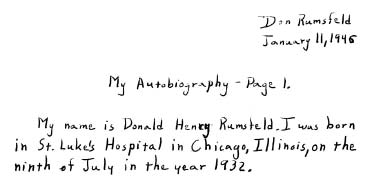
On July 9, 1932, the Chicago Tribune noted grimly that the Dow Jones Industrial Average had closed the day before at 41. 22—the lowest point recorded during the Great Depression. This was the day I was born—on what may well have been the bleakest day of the cruelest year of the worst economic catastrophe in American history. Born in St. Luke’s Hospital in downtown Chicago, I was the second child of George and Jeannette Rumsfeld. As I later recorded in my first and only other attempt at an autobiography (at age thirteen) I came home from the hospital to find I had a two-year-old sister, Joan.3 Since my family moved a great deal during our early years, Joan tended to be a frequent playmate and one of my closest friends.
Our mother, Jeannette, was a small woman, but her stature belied a feisty intensity. A teacher by training, she was a stickler for proper grammar. While she was kindhearted, she was also a formidable taskmaster. One vivid memory of my mother occurred when we lived briefly in North Carolina. In the South teachers taught by rote, as opposed to the progressive education I was used to in Illinois, in which students were encouraged to learn at their own pace. As a result I was far behind my Southern classmates. When told that I was in danger of being held back a grade, Mom bridled. She told my teacher that I would attend summer school and that she would tutor me personally to get me up to speed. Every day, Mom and I went through drills to make sure I learned my division tables. It wasn’t my favorite summer, but I learned enough to make it to the next grade.
My father, George Rumsfeld, was the kind of man any young boy would look to as a role model. I certainly did. He was the most honest and ethical person I knew, and I often sought his advice. One of the reasons he might have worked so hard to be a good father is that he knew what it was like not to have one. John von Johann Heinrich Rumsfeld left the family and divorced my father’s mother soon after his birth. From an early age, it was up to my father and his older brother, Henry, to help support the family. Dad started as an office boy at the age of twelve and worked hard for most of his life, always with an upbeat manner, often whistling, and without complaint. He seemed to have a sense of urgency about things and was never one to waste time. Sometimes he’d take me to the public golf course near twilight for his version of speed golf—playing nine holes in what I remember to be less than forty-five minutes, never stopping to take a practice swing.
My earliest years were spent in the city of Chicago, which by then had become known as a settling place for large numbers of European immigrants, industrious frontiersmen seeking a second chance at fortune, and for sizable numbers of African Americans, who emigrated from the South. Yet amid the city’s diversity, Chicagoans shared a common trait: a decidedly unfriendly attitude to the pretensions of aristocratic Europe. Many in Chicago were Irish at the time, and local politicians gloried in mocking the English, and the British seemed to reciprocate. “Having seen it,” the British writer Rudyard Kipling sniffed after visiting Chicago, “I urgently desire never to see it again. It is inhabited by savages.”4
There was some truth to the notion that the city was not for those with delicate sensibilities. The city gave America Al Capone, the St. Valentine’s Day Massacre, the Black Sox Scandal of 1919, and its legendary machine politics—denizens of its cemeteries were known for voting early and often. Chicago’s residents took a certain pride in their rough-and-tumble ways. It was a city where one’s value was measured not so much by pedigree but by sweat. “Chicago,” American writer Lincoln Steffens once wrote, quite correctly, “will give you a chance.”5
My father had spent most of his youth and first years of marriage in modest apartments in the city and was eager to move his family to a house in the suburbs. When I was six, we moved to nearby Evanston, home of Northwestern University, and then finally to a house in Winnetka, a small suburb to the north. These moves were not idle decisions but ones that my father, quite typically, had carefully thought through. Dad believed that the areas where the schools were considered the best tended to be areas where property values would increase. Winnetka, in the New Trier High School district, was such a place. We shared our house with Dad’s mother, Lizette, and her mother, Elizabeth. The older women, who had raised Dad, often spoke to each other in German.*
These days Winnetka is a well-to-do bedroom suburb of Chicago, but in the 1930s the town was economically diverse. Our neighborhood was a mix of businessmen with families and immigrant and working-class families: construction workers, a train conductor, an electrical power line worker, a gardener, and a cleaner among them.
I guess because my parents were energetic people, I must have inherited that characteristic at an early age. In addition to my studies, I played third base on Conney’s Cubs, our village hardball team, which was sponsored by the local pharmacy. I joined the Cub Scouts when I was seven, and enjoyed excursions to hike, fish, and canoe. As far back as I can remember I had odd jobs. I was not yet ten when I determined that I would earn enough money for my first Schwinn bicycle. I delivered newspapers, mowed lawns, and sold magazine subscriptions, including the Norman Rockwell–covered Saturday Evening Post. On Saturdays I earned a hefty twenty cents for delivering a neighbor’s homemade sandwiches to the employees at the Winnetka Trust & Savings Bank. When I finally earned enough money for my red Schwinn, it seemed the most perfect thing in the world. For kids in our neighborhood, our bikes were freedom. We could go anywhere we wanted. At least until it was time to come home.
All in all, mine was a fairly typical childhood in a small Midwestern town in the 1930s. Before Pearl Harbor.
Shortly after the Japanese attack, my father volunteered to join the Navy. Dad was not an ideal recruit. He was thirty-eight years old, well past the age draft boards were seeking. He had a slight frame that made him appear frailer than he was. The Navy recruiting office turned him away.
Instead of giving up, Dad embarked on an effort to gain weight. He ate banana splits, milk shakes, and anything else that would pack on pounds. After undertaking this regimen, Dad went back to the recruiting office and tried again.
It may have helped him that the war was not going well. The recruiting office finally said yes and told the determined man with the German name to prepare to deploy for officer training. His decision meant a big change in our lives.
After his ninety-day training assignment in Quonset Point, Rhode Island, Dad was commissioned, and our family moved to a blimp base near Elizabeth City, North Carolina. Navy blimps were used to spot German U-boats stalking Allied merchant ships in the Atlantic. My father didn’t want to spend the war in North Carolina though, and quickly requested a transfer to sea duty. Eventually his request was granted, and he was assigned to the USS Bismarck Sea (CVE-95), a baby flattop, or escort carrier, in the final phases of completion at a shipyard near Bremerton, Washington. Originally, my parents decided that the family would return to Illinois. But Mom didn’t want to be that far away from Dad, and at the last minute she decided we would travel with him until he went out to sea. So we moved next to East Port Orchard, Washington, then briefly to Seaside, Oregon, while the ship was being completed.
In 1944, after the Bismarck Sea’s shakedown cruise, the Navy transferred my father to the USS Hollandia (CVE-97), which was also preparing to deploy to the Pacific theater. The reassignment turned out to be fortuitous. After Dad went off to sea with the Hollandia, the Bismarck Sea was sunk by a kamikaze attack. More than three hundred people onboard were killed.
With our father at sea, my mother, like so many wives whose husbands were off at war, had to manage the family by herself. She learned to drive for the first time after Pearl Harbor, and wasn’t particularly comfortable with it. Heading south from Oregon, we drove through San Francisco. Mom was so nervous about driving up and down that city’s famous hills in our green 1937 Oldsmobile that she made Joan and me get out of the car and walk in case she lost control of the vehicle trying to work the clutch and floor stick shift.
Without having a chance to consult Dad, she bought a tiny house on C Avenue in Coronado, California, not too far from the naval air station. It was a big decision for her to make, with little money and less experience in such matters. Throughout the war, she was careful with purchases. Mom once wrote to my father that out of the $190 she had for the month, the family’s expenses totaled $186.37.*
We were fortunate to be in Coronado with so many other military families in roughly the same circumstances. Mom became good friends with the wives of others in the crew of the Hollandia. They shared their worries and their news with one another. Many of the kids I went to school with had fathers or older brothers deployed, so we shared a special bond.
We followed the news of the war by poring over maps in newspapers, listening to radio reports, and watching the short newsreels that played in movie theaters before the feature presentations. Everyone I knew in Coronado supported the war effort with a sense of common purpose. We planted Victory Gardens, where we grew our own vegetables. With earnings from odd jobs, I bought coupons or stamps for war bonds. I collected paper, rubber, and metal hangers to be recycled into war materials. My mother saved frying oil to be used for munitions. No one could buy new car tires, because rubber was being used for military vehicles, so old tires were retreaded. The government rationed such staples as gasoline, sugar, butter, and nylon. There were few complaints—there was a sense we were all in it together.
As the war went on, we would spot small flags in people’s windows with a star that signified someone in that house was in military service. When a serviceman was killed, those flags would be replaced with ones that had gold stars.
My parents were not accustomed to being apart, and it wore on both of them. Mom wrote letters almost every day. Dad would respond on the thin, onion-skin paper known as V-mail, the “V” standing for victory. Sometimes letters would fall apart as they came out of the envelope, because parts had been cut out by the censors aboard the ship to avoid giving the enemy intelligence if the mail was intercepted. As a result, we never knew where Dad was or what he was doing, but we were happy to receive his letters because that way we knew he was safe.
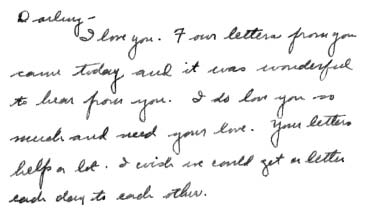
Letter from Jeannette Rumsfeld to George Rumsfeld, November 14, 1944.
“Well Darling, so long for now,” Dad wrote to my mother in August of 1944. “I love you and don’t think I’ll ever want to leave you or the kids again when this war business is over.”7
Around my father’s birthday, Mom wrote, “We didn’t have cake on your birthday—I didn’t want it without you. We just thought of you all day and talked about you and thought you many birthday wishes…. I want more time with you—all I can have—and as soon as possible.”8
Mom updated Dad on Joan and me. “[Don] is the type of person who needs to keep busy and he does keep busy,” she wrote in one letter. “Don said this evening at dinner that he has three ambitions. He would like to become a ‘band leader’ like Harry James [at the time I played the cornet in the junior high school band]—an ‘architect’ and a ‘flying Naval Officer.’”9 As it turned out, I would only fulfill one out of three.
In one of my letters to Dad, I updated him on what I was sure he needed to know. Softball was in season and I was going out for right or center field. Even though Dad was at sea in the Pacific Ocean, I did have my priorities. “Would you please try to get me a…fielder’s mitt if you can?” I asked. “I miss you a lot,” I added. “Take good care of yourself.”10 I couldn’t wait for him to come home.
A dramatic moment for me came quite unexpectedly when I was working on a school play in the courtyard of Coronado Junior High School. An urgent announcement came over the loudspeaker: President Franklin Roosevelt had died.
I had become accustomed to thinking of the President as indomitable. He was the person we listened to on the radio and saw on newsreels, the one who I believed would lead us to victory and keep my father safe. As shocked as I was by the news of his death, I was surprised by the reaction of a few of the kids in the school. When they heard about his death, some of them seemed cheered.
In my young mind, FDR was tied to my father, his ship, our country, and the war. Now that monumental figure was gone. I cried.
The conduct of the war now fell to someone the country knew almost nothing about, Vice President Harry S. Truman. Within a few months of taking office, Truman ordered the dropping of two atomic bombs on Japan. None of us knew what an atomic bomb was other than that it was a powerful explosive, and there was something called fallout from the massive detonation. For many Americans, including our family, the bombings meant that the long bloody war, a war that had cost sixty million lives, might soon be near its end.
After the second bomb was dropped on the Japanese city of Nagasaki, Dad wrote my mother a letter. “There is much conversation among the crew about the possibility of a Jap surrender, based on nothing concrete of course, as we have no information other than that from the radio,” Dad told her. “All of us think, however, that there is a good likelihood of it happening not far in the future. It is wonderful to contemplate.”11
His hope was fulfilled a few days later. On August 15, 1945, newspapers carried variations on the headline: “JAPAN SURRENDERS, END OF WAR!” I was selling the San Diego newspaper at the Coronado ferry dock with that message emblazoned on the front page. I sold out every copy of the paper that day, though in retrospect I wish I’d kept one. V-J Day meant my father would be coming home.
At first the USS Hollandia was scheduled to go to Japan as part of the occupation force. But the ship was assigned instead to bring back to the United States the survivors of the USS Indianapolis, which had been sunk in the Pacific by a Japanese submarine. It was a terrible disaster. Approximately three hundred U.S. naval personnel went down with the ship. Of the nine hundred or so men who had made it into the water, only about three hundred were rescued after nearly five days with no food or water, facing exposure and shark attacks. So the USS Hollandia returned to the United States on September 26, 1945—stopping first to drop off the wounded survivors of the Indianapolis, then coming into port the following day to disembark the Hollandia’s crew.
When we received word that the ship was coming in, my mother drove us up to meet Dad. Mom, Joan, and I watched the ship disembark the passengers and crew. Finally, my father came off the ship. For this thirteen-year-old boy, all was suddenly right with the world.
After my father died in 1974, I found a wrinkled letter among his papers that seemed to sum up as eloquently as anyone could what his service and the service of so many others had meant to the country. The letter was signed by Secretary of the Navy James Forrestal, who later became our country’s first secretary of defense. I assume it was sent to wartime personnel when they left the Navy for civilian life. Forrestal wrote that he had timed the letter to arrive after Dad was formally discharged from service “because, without formality but as clearly as I know how to say it, I want the Navy’s pride in you, which it is my privilege to express, to reach into your civil life and remain with you always.”12 Decades later, when I served as one of Forrestal’s successors as secretary of defense, I framed that letter, hung it in my office, and thought of it often when other young men and women were sent off to war in distant lands.
With my father officially discharged, we drove back to Illinois. Dad went right back to work at the same real estate firm he had started with at age twelve. He spent his days as a residential real estate salesman and then made extra money by buying houses in areas with good school districts, fixing them up, and then selling them for a profit. As a result, we lived in six or seven different houses over the next few years, including three houses on the same street in Winnetka. Because we were constantly refurbishing our homes, many nights when I came home from school I would help steam, soak, and scrape off the old wallpaper and put up new wallpaper in its place. After our work was done, Dad would put the house on the market to sell it, and he’d start over again in a new place.
I liked high school and studied hard. I played as many sports as I could. In my freshman year I entered the intramural wrestling tournament, and made it to the finals. By my senior year, I was co-captain of the varsity wrestling team with my friend Lenny Vyskocil, and our team won the Illinois state title for the first time in our school’s history.
Over the years people have asked me about my many years as a wrestler, and even tried to make it a metaphor for my approach to life. The fact is that wrestling happened to be a sport I was suited for. As with most activities, I found that the harder I worked at wrestling, the better I got, and I began to understand the direct link between effort and results.
In high school, I met Marion Joyce Pierson. Our friendship developed in a larger group of our friends, who would gather at the local diner. Hamburgers, fries, milk shakes, and the jukebox seemed a way of life on Friday and Saturday nights. Joyce and I were both elected class officers in our junior year. Through that year, I became increasingly aware of her spirited but unassuming style. Her eyes had a certain twinkle, as if they were concealing a wise insight or a humorous thought. We started dating when we were seniors, and it was an on-again, off-again relationship for most of the year.
As I considered college, I received proposals for wrestling scholarships from a number of the Big Ten universities, which I weighed carefully. But the dean at my high school, Fred Kahler, suggested that I go to Princeton. He had gone there, and Princeton, in his mind as a proud alumnus, was the best place for me. Until that moment, I had thought of the Ivy League as a place for the wealthy or connected, and I didn’t know which of those categories I fit into less.
When I learned that Princeton did not give athletic scholarships, I told the Dean I couldn’t afford to go there. Undeterred, he told me to fill out the application forms and take whatever tests were needed, and he promised to speak to the scholarship committee to get me aid based on need. I almost certainly would not have attended Princeton without his dogged encouragement.
The class of 1954 was not only all male, but all white. Well over half of our classmates in college had gone to prep school and had already taken a number of the required first-year courses. Those of us who came from public schools had a tougher road. Nearly every day I would go from classes straight to the library, then to football or wrestling practice, and then back to the library to study late into the evening.
My Princeton scholarship covered tuition and fees but not books, or the cost of the dorm, food, or transportation. I soon learned about a naval ROTC program that paid for almost all expenses and also provided fifty dollars a month in spending money. Along with it came a commitment to serve a minimum of three years upon being commissioned an ensign in the regular Navy at graduation.
As part of that NROTC program, I spent six weeks every summer on training duty. In 1952, after completing my Navy training aboard the USS Wisconsin, my roommate, Sid Wentz, and I caught a space available on a free military flight to Frankfurt, Germany, and traveled around Europe for two weeks. These were countries I had read about as a youngster during the war. Seven years after World War II had ended, I was struck by its lingering impact. Some bombed areas hadn’t been repaired. Even the stalwart British were still contending with rationing.
Meanwhile, the world had entered a new war—the Cold War. It featured clashes between surrogates and espionage rather than outright military confrontation between the two superpowers. Then war broke out on the Korean peninsula. In 1953, when I was again on a summer Navy training cruise, I received a letter from my folks telling me that my close friend and wrestling teammate from high school, Dick O’Keefe, had been killed in the conflict. Even more painful was the knowledge that Dick died when the war was all but over. Some seventeen thousand UN casualties, mostly American, occurred during the final twenty days of the conflict, as each side made every effort to advance their positions while a cease-fire was being negotiated.
One of the major fears during the Cold War’s early days was that Communists would infiltrate Western governments. Indeed, one of the reasons the Truman administration stepped up to assist Western Europe economically through the Marshall Plan was out of concern that desperate countries might be ripe for a communist takeover. There were reports of Communists in high-ranking posts in the U.S. government. By far the most engrossing, even transformative, episode during this period involved an admitted former Communist named Whittaker Chambers. Chambers had decided to defect to the American side and was cooperating with our government. It must not have been an easy choice for him, because he still believed that the Soviets would ultimately prevail in the Cold War.
As part of Chambers’ effort to supply information to the United States government, he volunteered the information that Alger Hiss, a high-ranking State Department official, was a Communist spy. Hiss angrily denied the charges, and nearly everyone in the correct circles supported him. Polished, well dressed, and articulate, Hiss had clerked for Supreme Court Justice Oliver Wendell Holmes and attended the Yalta Conference with President Roosevelt as part of the State Department delegation. Chambers did not compare well to Alger Hiss in newspaper photographs or newsreels: He was an overweight, unkempt figure with bad teeth who admitted to having aided the Soviet cause. Far fewer people seemed to believe him than Hiss.
In congressional hearings, Hiss contended he had never known Chambers. He was convincing. It seemed that if Chambers turned out to be telling the truth, Hiss would have to be the best liar in the world. Apparently he was. The connection between them seemed to be confirmed when Chambers testified in a secret session that Hiss had once mentioned to him about seeing a rare bird called a prothonotary warbler, which Hiss later independently acknowledged, completely unaware of the implication of his admission. To the surprise—and continued disbelief—of some, Hiss was eventually convicted of perjury.
I was fascinated by the case for many reasons, and its lessons stuck with me. When Hiss was convicted, I saw how completely wrong the conventional wisdom—as well as first impressions—could be. I also observed how determined many people, some thought to be the wisest among us, were to discount all evidence of Hiss’ guilt, even after he was shown to be deceptive. I also learned the name of a Californian serving on the congressional subcommittee who supported Chambers’ cause, and who helped break the case. He was a tenacious young member of Congress named Richard M. Nixon.
The Hiss case gave a new level of legitimacy to the concerns about Soviet espionage expressed by many conservatives. That cause was taken up by Senator Joseph McCarthy, a Republican from Wisconsin. The tension between McCarthy’s aggressive tactics and others in the government came to a head during the famous Army-McCarthy hearings, as a Senate committee looked at potential Communist infiltration into the armed forces. Once again I was riveted.
A lawyer for the Army named Joseph Welch called McCarthy to account after the Senator verbally attacked one of Welch’s young associates during a hearing. Welch then famously asked, “Have you no sense of decency, sir?” It was a good question—or, more accurately, a statement of fact. For the first time I observed the ugly sight of members of Congress unfairly browbeating a witness to advance their political interests.
The events had particular interest for me, because I was studying politics and government. In hindsight, I wish I had majored in history. A few members of the faculty in the political science department were far to the left. I was struck by the way one professor in particular seemed to disdain the private sector as rife with corruption and unethical behavior. The business world was an abstraction to him. He seemed to have little concept of what hardworking, ethical people like my father did every day.
Students at Princeton were required to write a senior thesis for graduation. I chose as my subject President Truman’s seizure of the steel industry two years earlier, during the Korean War. In Youngstown Sheet & Tube Co. v. Sawyer, Sawyer being Truman’s secretary of commerce, the Supreme Court ruled that Truman’s wartime seizure of the industry had been unconstitutional. I argued in my thesis that the Court’s decision was “timely and reassuring.”13 It hadn’t provoked much discussion outside legal circles at the time, but the 1952 case would become an important decision about the limits of executive power in wartime.
As we prepared for our graduation in March 1954, I attended our senior class banquet. The speaker was a Princeton alumnus and the former governor of Illinois, Adlai Stevenson. He was best known for being the unfortunate Democrat to run for the presidency against the popular Republican, Dwight D. Eisenhower, two years earlier. Stevenson was frequently considered an aloof intellectual—an “egghead” in the parlance of the 1950s. “Egg-heads of the world, unite,” Stevenson once replied in a play on Karl Marx’s famous quote, “You have nothing to lose but your yolks!” I couldn’t help but admire his good humor and perspective.
Stevenson’s speech that evening had more influence on me than any I had heard before. I knew I would next be serving in the Navy, but I was not certain whether I would stay in it and if not, what I wanted to do with the rest of my life. It might seem strange considering my later career that the one who so strongly sparked the idea of public service for me was a liberal Democrat and self-proclaimed egghead. But his comments came to me at a formative time in my life and a turning point for the country. With an armistice reached in Korea in 1953, America had just ended its involvement in a second war in a decade. Mounting concerns about communism, nuclear exchanges, and the possibility of more armed conflict were intensified by the first test of the hydrogen bomb, a weapon one thousand times more powerful than the atomic bombs of World War II.
Stevenson put the future into an important and new context for me. He talked about the responsibility of citizenship in whatever path we might choose, and the stark consequences awaiting us all if we failed in our responsibilities. “If those young Americans who have the advantage of education, perspective, and self-discipline do not participate to the fullest extent of their ability,” he warned, “America will stumble, and if America stumbles the world falls.”14
He reflected on the weighty responsibility of the American people in our democracy to be involved in helping to guide and direct their government. He said, “For the power, for good or evil, of this American political organization is virtually beyond measurement. The decisions which it makes, the uses to which it devotes its immense resources, the leadership which it provides on moral as well as material questions, all appear likely to determine the fate of the modern world.
“Your days are short here,” he added in closing, “this is the last of your springs. And now in the serenity and quiet of this lovely place, touch the depths of truth, feel the hem. You will go away with old, good friends. Don’t forget when you leave why you came.” Stevenson’s eloquent and inspiring words opened my mind to the need to look squarely and thoughtfully at each new experience, and to know I’d have to answer to myself at each leave-taking.