
CHAPTER 4
I tended at a still young age to be deliberative when it came to important decisions. I was one who tried to weigh the pros and cons, to look at things from different points of view, and then to make a careful choice. A woman can have a wonderful way of changing all that.
Upon graduating from college, I was ready for the Navy. Having been entranced with the idea of flying at an early age, I requested and was assigned to the naval flight school in Pensacola, Florida. Since there were no female students at Princeton in those days, and I studied or worked most of the time, and with little money, I had had practically no dates. So I thought it would be a fine thing to go off to the Navy unattached. But then there was Joyce.
We had kept in touch since high school, and I had seen her briefly on holidays when we both happened to be home. She was attending the University of Colorado and had an active social life there, with many friends and suitors. And my idea of going off to the Navy and hoping Joyce might wait around ran straight up against the news that she was having romances out West. So I invited her to come out to Princeton during her spring vacation and then again for my graduation.
The morning after I arrived back home in Illinois from graduation, while having breakfast with my parents, I thought about my immediate future. On the one hand was the prospect of being a happy bachelor in the Navy, young and unattached. But then a moment of total clarity presented itself. Without discussing it with anyone, I rose from the table. “I’ll be back in a bit,” I told my parents.
I went to find Joyce and asked her to marry me. There was little buildup, little suspense, and at ten o’clock in the morning, it wasn’t very romantic. But it felt right. I didn’t know who was more surprised when I proposed—Joyce, me, or her parents. When she told her folks the news, Joyce’s dad summed up the prevailing mood. “I’ll be damned,” he said, shaking his head.
Getting engaged the day after you got home from college may seem almost quaint now. Even in the 1950s things were starting to change. I Love Lucy hovered at the top of the Nielsen ratings for its six seasons, starting in 1951, but tensions burbled under the surface of Lucy and Ricky’s happy home life. Back then, their interracial relationship was unusual, as was Lucille Ball’s performing while pregnant. The word “pregnant” was not considered appropriate for use on television. The stars themselves divorced when the show ended. Rock and roll was viewed with suspicion by the establishment—Elvis Presley was threatened with arrest for obscenity by the San Diego police if he moved his body during his performances. Marilyn Monroe emerged as a new, modern movie star whose sex appeal and real-life dramas threatened to overshadow her acting. But it would take some years before these changes were brought home to Joyce and me. Our experiences were far removed from the glitter and glamour of popular music and films.
I did have one brush with the spotlight, however. While I waited for my flight-training class to begin in Pensacola, I was assigned to the Naval Air Station in Atlantic City, New Jersey—now as a newly engaged twenty-one-year-old. Soon after I arrived, Atlantic City was hosting the 1954 Miss America Pageant. These lovely young contestants were in need of escorts to the pageant ball. The pageant’s sponsors looked to the men of the United States Navy for help. When a call went out for forty-eight young officers to serve as escorts for the Miss America contestants, I felt it was my patriotic duty to volunteer. I was assigned to that year’s Miss Indiana.
As it happened, 1954 was the first year that they televised the Miss America Pageant, so it received a good deal of publicity across the country. The big news was that the actress Grace Kelly would appear. Joyce’s friends were among the viewers that night. Watching their television sets, more than one of them was heard to inquire, “Isn’t that Don Rumsfeld dancing with that beauty contestant?” As one might imagine, it was not long before that news made its way to Joyce. Thankfully she took it all in stride—as she has been able to take a great many things in stride over the many decades that followed.
Marion Joyce Pierson and I were married on December 27, 1954. As of this writing, I have spent more than 80 percent of my life with the pretty girl with twinkling eyes I first met at the age of fourteen. Newly married, Joyce and I would tackle Navy life together. Our first of many houses was a standard-issue cinder-block box at the end of the runway at NAS Whiting Field—a tiny place with a kitchen and bathroom on one side of a small sitting area and a bedroom on the other.
During flight training, I flew SNJs, the kind of single engine propeller aircraft now found only in air museums. My father was concerned about my flying, having seen a number of aircraft crash during the war. He had a point. Sadly, we lost several friends over those years. Still, I loved everything about flying—the freedom, the speed, the excitement. “More than anything else the sensation [of flying],” Wilbur Wright reportedly said, “is one of perfect peace mingled with an excitement that strains every nerve to the utmost, if you can conceive of such a combination.” I knew what he meant. I felt like I could have continued on as a naval aviator for the rest of my life.
My strong hope had been that I would be assigned to single-engine aircraft, preferably as part of an aircraft carrier–based fighter squadron. But the month I completed my carrier qualification and was headed to advanced training, the Navy had not met its quota of multiengine seaplane pilots, so that is where I was slotted. It was the bad luck of the draw. I tried to get my assignment changed, but the Navy needed multiengine patrol-plane pilots, and that was that. It was an early lesson in the reality of dealing with a large bureaucracy.
I then asked to be transferred back to Pensacola to serve as a flight instructor, since that was the only way I could get back into single-engine aircraft, even if it was the training command. My request was granted, but just as Joyce and I were preparing to leave, my orders were changed. I was sent to Norfolk, Virginia, where one of my assignments was to train for the 1956 Olympics in wrestling. After winning the All-Navy Wrestling title and qualifying for the final Olympic tryouts, however, my shoulder separated while wrestling at the Naval Academy. My Olympics hopes, such as they were, were over.
My disappointment was overtaken by a much more important event. On March 3, 1956, at Portsmouth Naval Hospital, our first child, Valerie Jeanne, was born, and our small family soon moved to Florida, where I began my assignment as a naval flight instructor. Later I was selected to be an instructor of flight instructors. At the age of twenty-four I was the youngest in the group and the most junior in rank. It was an excellent assignment and an honor, but it wasn’t the carrier duty I wanted.
Toward the end of my three-and-a-half-year commitment, I requested a transfer from the regular Navy to the Naval Reserve, where I would be able to keep flying as a “weekend warrior” but would also be able to pursue a career in the private sector. I loved flying, so much so that I probably would have been happy if I could have found a civilian job as a crop duster or a bush pilot in Alaska. But I also had responsibilities, and they were brought home to me almost immediately when Joyce came down with hepatitis from a flu shot with a dirty metal needle before the days of disposables. It took the better part of a year for her to get well. With a very sick wife, no job, no health insurance, and an infant child, we went back to Chicago and moved in with Joyce’s parents, and later with my parents, while I looked for work.
With the help of the Princeton alumni job placement office, I started interviewing. I was offered several starting jobs with corporations in Chicago. Then I heard that a first-term U.S. congressman from northeastern Ohio, David Dennison, was looking for an administrative assistant.
My earlier impression of Washington, D.C., had not been a good one. After my college graduation, Joyce and I had traveled there to attend a wedding. While there we went to a session of the U.S. Senate. Both of us, with our interest in politics and government, were expecting to witness great matters of state being debated. As it turned out, there was almost no one in the U.S. Senate chamber. The aged Senator Carl Hayden—who had been the last territorial sheriff of Arizona before it became a state—was presiding, and from time to time was dozing off. Only one other senator was on the floor: Wayne Morse of Oregon, who was talking about music. Henry Clay and Daniel Webster they were not that day.
I had never met a congressman before I met Dave Dennison, and he was exactly what I’d hoped a congressman would be. He was a thoroughly decent human being—honorable, intelligent, sincere, and hardworking. Though I had no legislative experience, I think he identified with me. We had both been wrestlers, and his brother also had served as an instructor of naval flight instructors. After my interview, I excitedly told Joyce, “I would pay to be able to work for this man.”
From the start, Dennison and I had a good working relationship. I was called on to organize and follow up on meetings with constituents, write legislative briefs, newsletters, press releases, and scripts for his radio program. Though he seemed content with my performance, I found the job difficult. I had not written anything since college, except for an occasional letter home. I had spent the previous three-and-a-half years flying airplanes and had literally never worked in an office in my life. The closest I had come was when I mopped the floors of a dress shop every week to make money while I was in high school. During those first challenging months I felt like I was scrambling every day. Almost every night I would go home with my stomach in knots.
In 1958, Dennison was up for his first reelection. He asked me to move my family to Ohio to help. It was a tough year for Republicans. A nasty recession was underway, and with President Eisenhower in the White House, Republicans were getting most of the blame. On top of that, Dennison’s opponent accused him of unethical practices. He criticized the Congressman for having had his wife temporarily on his congressional payroll (for a brief period, performing responsibilities for which she was fully qualified) and for leasing a portion of his law office as his congressional district office. Each was legal, but Dennison’s opponent made it sound like corruption. He fought against the allegations, but in a bad year those charges tipped the scale. All through election night we agonized, watching the down-to-the-wire contest. In the end, the congressman lost the election by 967 votes, about one switch vote per precinct. Seeing an able, honorable congressman lose his seat by such a narrow margin for what was unfair criticism was crushing.
After Dennison lost, I went to work for Congressman Robert Griffin, a Republican from Michigan. I also enrolled in Georgetown Law School. But Dave Dennison called me back to Ohio to help him try to win back his congressional seat. Joyce was pregnant again at the time, but she was also a tough battler for causes and people she believed in. When I asked her about going back to Ohio and getting involved in another tough political race, she quickly replied, “Let’s do it.” She gave birth to our second daughter, Marcy, while we were on the campaign trail in Warren, Ohio, in March 1960.
Once again, Dennison’s dedication wasn’t enough to turn the tide, and he lost by a narrow margin, while Massachusetts senator John F. Kennedy edged out Richard Nixon in the race for president. I was now 0 for 2 in political campaigns. I felt like I’d had enough of politics for the time being, so we returned home to Illinois, ready to start doing something else, or so I thought.
I had been settled at the Chicago-based investment banking house A. G. Becker for about a year when a rare opportunity presented itself. In late 1961, the incumbent Republican congresswoman in our district, Marguerite Stitt Church, announced that she was not going to seek reelection. Her husband, Ralph, was first elected to Congress in 1934, when I was two years old, and when he died in 1950, his wife was elected to the seat and held it subsequently.
Since the seat was open for the first time in almost three decades, it was seen as an opportunity for both parties that was not likely to be open again for the foreseeable future. The Republican candidate had an advantage because the district, while fairly diverse, had been Republican for a long time. Twelve or thirteen candidates announced they would run for the GOP nomination. Among them were several prominent local figures, each with a decent chance of winning.
I had toyed with the idea of running for Congress now and again. One of the people who encouraged the idea was New Jersey Congressman Peter Frelinghuysen, who represented the Princeton area. When I worked on Capitol Hill, he asked me to lunch. While we were talking, he asked when I was going back home. He did not think I should spend my career as a congressional staffer, but instead suggested that I might return to Washington one day as an elected official. It seemed unusual that a senior member of Congress would take such an active interest in a young staffer’s career. His suggestion stuck in my head.
If I wanted to run in my home district, this might be the only chance I’d have in several decades. I was twenty-nine years old. I had never held elected office. I had been away from my home district for ten years, since 1950, when I left for college. I did not seem to have anything that could even remotely be considered a political base.
My parents thought the idea of running for Congress was almost unbelievable. Having lived most of his life in Chicago, Dad had the impression that politicians were crooks. My mother didn’t see how someone my age could possibly succeed Mrs. Church, who was forty years older. I was the longest of long shots. The savvy political reporter for the Chicago Sun-Times predicted I would run seventh out of seven.
I did have a few things going for me, however, the most important of which was our many friends from school in the area. The campaign team we put together was like a reunion. But it was not, to be sure, in any sense a finely honed operation. In our initial meeting around a table in our kitchen, we had a long discussion about strategy and position papers. Then, just as the meeting broke up, someone asked, almost as an afterthought, “Won’t we be needing some money?” Laughing at how inexperienced we were, we each put in fifty dollars and managed to scrape together the formidable sum of four hundred dollars.
Ned Jannotta, a friend from New Trier High School and Princeton, became the campaign manager. He had also been away for many years in college, the Navy, and business school and was not even registered to vote. Brad Glass, another friend from high school and college, became our campaign treasurer. As a former All-American tackle on Princeton’s football team and a national intercollegiate heavyweight wrestling champion, he could be persuasive.
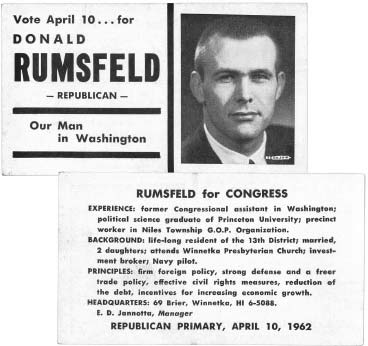
Another friend from high school, Hall “Cap” Adams, agreed to handle our advertising. He had printed up pocket-sized campaign cards designed for me to hand out to voters. I thought carefully about what my positions should be and managed to condense what I believed at age twenty-nine and what I believe today into twenty-three words onto the card. The policy portion read: “firm foreign policy, strong defense and a freer trade policy, effective civil rights measures, reduction of the debt, incentives for increasing economic growth.”
My parents, despite initial skepticism, quickly became enthusiastic supporters. Dad let us use a vacant house he was in the process of fixing up as our temporary campaign headquarters. My mother even spoke on my behalf. “I have heard many comments about your performance on behalf of your wayward son. I’m sure it was not a pleasant task, but the victory was well worth the many hours you spent working toward it. I am delighted with your stamina,” I wrote my mother after she gave a talk supporting me at the Women’s Republican Club of New Trier Township.1
Joyce and our friends went to work on making the candidate more presentable. For one thing, it was clear early on that I wasn’t a very good public speaker. Ned Jannotta and Joyce arranged to use an empty hall one evening so I could practice and they could critique me. I went up on the stage and gave my stump speech to the almost empty hall, over and over, while they would yell, “Stand up straight!” and “Get your hands out of your pockets!” and “Quit popping the microphone!” until I started doing a bit better. I found public speaking was like anything else: Unless you have some remarkable natural talent—which I didn’t—when you’re starting out, you don’t do it very well. But if you work on it and work on it, you can get better. I used to say it is like training an ape. If you do it right you get a banana and if you do it poorly you don’t. And pretty soon you start doing it right.
I had to deal with the impression that at twenty-nine I simply was too young to be a congressman. It was a particular problem since the incumbent, Mrs. Church, was so much older. So I traveled around the district as often as possible with Joyce so voters would see that I was married. As it happened, the election two years earlier of the young President Kennedy proved helpful to me. Kennedy had successfully overcome questions about his age and inexperience. The youthful image he and his family projected proved to be a winning asset.
To get my name out, Jannotta and I decided to meet with prominent local leaders and ask for their public endorsements. The idea was that their endorsement would create a ripple effect, so their friends and colleagues would learn they had endorsed me, which might encourage them at least to hear me out as well. We decided to think big and looked for one of the most prominent business leaders in the district. Donold Lourie, the chief executive officer of Quaker Oats, became an early target. My mother again was helpful; she had known Lourie’s mother years before. Another stroke of luck was that Lourie had been an All-American football star at Princeton. The meeting was of pivotal importance to my campaign, and I was going to use every possible advantage I could. So I gathered together my friends Ned Jannotta, Brad Glass, and Jim Otis—all of whom had been on Princeton’s varsity football team—and brought them with me.
Lourie was delighted to meet his fellow Princeton football alums—maybe too delighted. All he wanted to talk about was Princeton football. But I did manage to pry in a request for his help. Lourie graciously said he would give it some thought. I figured I had little to lose by indicating my sense of urgency. “Let me explain our situation,” I said. “The primary election is the second Tuesday in April. I need your support now, so I can use your support to get others to step up.”
I told him I wanted to publish his name in a local newspaper advertisement with the names of some other prominent citizens who were endorsing me. Then I said that when people asked him why he was for Rumsfeld, he had to be ready to make my case. It was a lot for me to ask a major businessman who had met me only a half hour earlier, but we needed his help and we needed it then, not later.
As I continued to press—maybe press my luck—Lourie again said he would get back to me. Not long after, he contacted us and said he’d sign on. It was, as expected, a major boost—one of the area’s most prominent citizens had put his backing behind a young unknown who was not the favored candidate of the Republican organizations in the district. It caused others to wonder why, and take a look. Soon community leaders in the district indicated they were backing me. Among them was Dan Searle, the CEO of the pharmaceutical company G. D. Searle & Co. He came on as our finance chairman and helped open the door to contributors and community leaders. Chuck Percy, the head of Bell + Howell, came onboard and led me to Arthur Nielsen, Jr., who signed on as chairman of the Rumsfeld for Congress Committee. By the election in early April, we had recruited some fifteen hundred volunteers and mounted a grassroots effort with everything from “Rumsfeld for Congress” earrings to cartops and bumper stickers to help to get the word out.
In those days newspaper endorsements were important. The biggest paper in the district, the Chicago Tribune, already had a candidate. They had endorsed the front-runner in the GOP primary, a prominent state legislator named Marion Burks. But the Tribune’s major rival, the Chicago Sun-Times, had not endorsed anyone yet. We knew that the Sun-Times was not likely to back the same candidate as the Tribune, so I took a gamble that I might be able to persuade that paper to throw its support behind me.
The paper was owned by the legendary Chicagoan Marshall Field. As it happened, the father of a close friend of Joyce’s and mine from high school, Carolyn Anderson, had a business connection to Field, and he arranged for me to meet him. Field made himself available for about three minutes. He was on his way out of town but said he would ask the editors of both of his papers, the Sun-Times and the Daily News, to meet with me, and then it was up to me to persuade them to support me. The editor of the Sun-Timeswas a well-known, crusty, old-time journalist named Milburn “Pete” Akers. He agreed to see me that morning and at least give me a hearing.
I found my way to Akers’ office and faced a large, somewhat disheveled man sitting behind a desk piled with papers. Akers started peppering me with questions right away: Who was I? What had I done? Who had I met in the congressional district? What places had I visited? Who was supporting me? Why was I running? And so on. It was all done in a courteous but penetrating way. I answered the questions as best I could. But I had never done anything like this before and was somewhat dazed by the encounter. I left our meeting without any idea what Akers might decide.
In fact, he got on the phone the moment I left and started checking out my answers. Not surprisingly, Akers wanted to talk to his numerous contacts to see what they thought of me. The political editor of the Sun-Times, who had predicted I would run seventh in a field of seven in the GOP primary, had to change his prediction when a month later, to his certain amazement, his paper, thanks to Akers, endorsed me for Congress. And the battle was on between Chicago’s two morning papers—the Sun-Times and the Tribune.
From there on out, whenever my name was mentioned in the Sun-Times’ editorials, it said that I was thirty years old, which was not yet the case.2
“Mr. Akers, I’m grateful for the mention,” I told him on the phone, “but there’s a problem. You keep writing that I’m thirty, but I’m only twenty-nine.”
“I know that,” Akers replied, matter-of-factly. “But you will be. And thirty sounds better.”
After the Sun-Times endorsement, a number of the original candidates in the Republican primary dropped out. By late March it came down to a four-man race between the two who were by then the front-runners with strong newspaper support—Burks and me—and two other candidates. Burks was the favored candidate, having garnered the endorsement of a number of the big Republican Party township organizations. He used what he saw as his strengths in the race against what he saw as my weaknesses, homing in particularly on the charge that I wasn’t a hard-right conservative. In one of his campaign ads he repeatedly labeled himself as a conservative and noted that he was “the only candidate qualified by experience, maturity, and political philosophy to represent the citizens of the 13th Congressional District.”3 Burks, however, also had to deal with unproven allegations involving financial management issues at an insurance company that he had chaired.
By the day of the primary election it was looking like I might actually win. We were mobilizing an army of volunteers, finally raising some campaign funds, and had important endorsements.* It was a surprising showing for a group of young people who started the campaign in a kitchen scraping together four hundred dollars. Because I’d managed two losing campaigns for Dave Dennison, failing by the thinnest of margins, however, we weren’t going to take anything for granted until all the votes came in. I won with 67 percent of the vote on April 10, 1962. “RECENT POLITICAL UNKNOWN IN SWEEPING WIN,” reported the Chicago Daily News.4 Joyce and I were still amazed at the thought that we had actually won. We knew we had little time for celebrating as we quickly turned our attention to the November general election.
Since the district was Republican leaning, I felt we had a good chance. Our campaign team was energized and enthusiastic, and I could feel traction as we went into the fall. But then historic events intruded. In late October, Adlai Stevenson, by then America’s ambassador to the United Nations, gave a dramatic presentation to the UN Security Council. Complete with fresh aerial photographs to prove the Kennedy administration’s case, he asserted that the Soviet Union had been secretly planning to install nuclear weapons on the island of Cuba, ninety miles from the United States. For many days, as American forces imposed a blockade against the Soviet ships en route to Cuba, the world stood closer to the brink of nuclear confrontation than at any time yet in the Cold War. Politics didn’t matter anymore. Americans stopped thinking about an election that was but a few weeks away and focused on the Cuban missile crisis.
When the confrontation ended and the Soviet ships turned around, President Kennedy received a sizable boost in popularity. I thought it might propel Democrats to victory in races around the country, even where they weren’t favored to win. I was also running against a man with a good name for a Democrat in 1962: John A. Kennedy. He was not related to the President, though it probably didn’t bother him all that much if some voters thought otherwise.
In the final days of my 1962 general election campaign I had no sense of what would happen. We kept working and worrying. On election night, when I prepared for a close vote, I was stunned again. We had won by a sizable margin. I was thirty years old and headed to the United States Congress. It was quite a night for our entire family. But most of all I remember the expression of amazement on the faces of my parents. Something had happened in the life of their son and in their lives that was beyond anything they had imagined.
I had been a newly elected member of the Republican freshman class for about fifteen minutes before I was asked to make waves. Shortly after my victory, Congressman Bob Griffin elephoned. I assumed my old boss was calling me to offer his congratulations. Instead, he told me he was in the early stages of an effort to unseat the third-highest-ranking Republican in the House, Charles Hoeven of Iowa, as the chairman of the Republican conference. Griffin had put together a small group that thought the party needed fresh blood and new ideas if they were to stake a claim on becoming the majority party sometime in the future. Of course, as a member of the leadership, Hoeven had strong backing for reelection. But Griffin and his team had a candidate they thought might be able to beat Hoeven. Their candidate was his colleague and friend from Michigan, Gerald R. Ford.
I had met Ford briefly while I was working as a staff member in Griffin’s office and had a positive impression of him. But as one might expect, opposing the entrenched party leadership was not something a newly elected, unknown freshman—not yet even sworn in—clamored to do. To make things even dicier, Griffin acknowledged that Ford hadn’t yet agreed to run. He was waiting to determine how much backing he could expect. My assignment, if I chose to accept it, would be to round up support from as many newly elected members for a man who wasn’t even sure he would make the race.
This was unusual business for someone who hadn’t yet set foot in his new office. But Griffin argued that the mission was worth the risk. The thought of having Republican leaders who seemed to accept, or at least not be uncomfortable with, a state of permanent minority status was discouraging. Republicans had made a lackluster showing in the 1962 midterm elections when historically the out-of-power party should have made reasonable gains. I knew from my experiences working for two Republican congressmen how frustrating it was to be in the minority, and particularly to feel that your leadership wasn’t mustering the energy and determination to fight back.
So I told Griffin I was onboard and went to work urging other incoming Republican members to support Gerald Ford for conference chairman. With the showing of support we assembled, Ford decided to run for the post, which he eventually won by a vote of 86–78.
As expected, our renegade effort left a lasting impression on the other members of the Republican leadership.
“I was picked as the lamb for the slaughter,” Congressman Hoeven said after his loss to Ford. “This should serve as notice to [other party leaders] that something is brewing.”5 As it turned out, Hoeven’s warning proved prophetic.