CHAPTER 43
“The way to keep weeds from overwhelming you is to deal with them constantly and in their early stages.”
—George Shultz, Turmoil and Triumph
While Afghanistan and Iraq commanded the focus of national security officials, there were 190 other countries that also needed monitoring and attention. Some of those nations, of course, were friendly to the United States, some less so, but all had daily interaction with our government at some level. Even officials from international pariahs such as Iran and North Korea were meeting with lower-level American diplomatic and intelligence officials and our intermediaries.
With our various economic and trade relationships and diplomatic and military reach, America does not have the luxury of pursuing policies of isolationism or neglect. We had to keep our attention on the world’s many significant activities, meeting constantly with foreign leaders, forging diplomatic and trade agreements, and standing firm and responding as necessary when unfriendly nations provoked our country. George Shultz referred to this kind of daily maintenance with foreign governments as “gardening.”1Throughout the Bush administration, while waging two wars and being on guard for another attack on our shores, many in the administration worked hard to be effective “gardeners”—with varying degrees of success.
When it came to personal diplomacy, George W. Bush was an active and productive, if publicly underestimated, asset. His decidedly informal brand of diplomacy was novel for some foreign leaders. What he chose to dispense with in polish, he made up for in persistence and reliability. In meeting After meeting, I saw the President put his foreign interlocutors at ease. This personal rapport paid dividends with leaders as diverse as Spain’s Prime Minister José María Aznar, Jordan’s King Abdullah, and Australia’s John Howard. His relationships translated into closer ties between our countries and tangible support for initiatives like the ninety-country Proliferation Security Initiative and on-the-ground assistance in Iraq and Afghanistan.
One of the administration’s important strategic successes was in our own hemisphere: helping to keep a democracy of forty-five million people from succumbing to the longest-running, best-financed, and most violent insurgency in Latin America. For more than a decade, the United States had been waging a war against drugs in Colombia. I thought that stopping the flow of drugs into our country, while important, was fated to be unsuccessful as long as the powerful demand for illegal drugs persisted. The Colombian government could spray coca fields and interdict drug runners, but as long as there were millions addicted to drugs around the world, people would find a way to produce and sell what the market demanded. Since the late 1990s, the Clinton administration’s $5 billion Plan Colombia had been a bipartisan antidrug initiative demonstrating that our government was doing something about the drug problem.
By 2001, Colombia was teetering on the edge of becoming a failed state, a refuge for drugs and terrorists. The instability was fueled by the narcotics trade and Marxist guerrillas known as the FARC. The guerrillas controlled an area of Colombia larger than Switzerland. It was a safe haven for coca cultivation, kidnapping, murder, extortion, and Communist-inspired terrorism. Many had written off the Colombian government’s war against the insurgency as a doomed effort. Some 60 percent of Colombians believed that the FARC would win. If that proved true, a stalwart democracy to our south would be replaced by a narco-terrorist dictatorship.
As part of the response to 9/11, I recommended to President Bush that, in addition to authorizing strikes in Afghanistan, he consider a plan to provide military assistance to Colombia’s efforts against the insurgents—not just the drug traffickers. Visibly assisting Colombia, I argued, would reflect the truth that the campaign against terrorists was global, and that we were not targeting only Islamist extremists.
There was, however, an Islamist terrorist element even in Latin America. Islamist extremists, many affiliated with Hezbollah and other terrorist groups, were taking advantage of ungoverned areas in several locations in the region to operate and raise money. If a government would not or could not govern its own territory, that was an invitation for adventurers of various types—terrorists, political revolutionaries, drug dealers, and other criminals—to enter and take advantage of the vacuum. Such weeds thrive where the atmosphere of authority is thin, and they can spread aggressively.
President Bush was eager to assist Colombia. Our efforts received an unexpected boost in 2002, when Alvaro Uribe was elected president. FARC rebels had killed his father and attempted to kill Uribe on no less than fifteen different occasions over his political career. As a presidential candidate he campaigned fearlessly against the FARC and vowed to reclaim Colombian territory from the drug lords. After his election he kept track of what he considered the key measures of his war’s success, including the numbers of monthly kidnappings, homicides, acres of land taken back from the FARC, and even the number of kilometers Colombians traveled on their holidays, since for many years traveling on some roads was a death sentence. When I met with Uribe, he would invariably have a yellow note card in his jacket pocket, listing his benchmarks.
In our first visit in June 2002, weeks After the Colombian elections, I told Uribe we might be willing to lend a hand by offering assistance in an integrated counterinsurgency campaign that strategically combined American and Colombian political, intelligence, economic, and military assets. If we were going to do more than just focus on trying to intercept drug shipments and spraying coca fields, there was one major hurdle: the U.S. Congress. Fearing direct American involvement in a guerrilla war in Latin America, Congress had imposed strict limits on intelligence sharing and military activities with the Colombians. The only authorized missions were those designed to reduce drug production, and there was even a congressionally imposed limit on the number of American military personnel to be allowed in Colombia at any given time.
Working with policy officials Doug Feith, Peter Rodman, and Roger Pardo-Maurer, we were able to reorient our assistance to Colombia toward counterterrorism and targeting the FARC guerrillas. The Congress agreed to change our authorities to allow for more than just the narrow focus on drugs. Our goal was to help the government of Colombia assert control—effective sovereignty, as we called it—over its entire territory.
In President Alvaro Uribe, we had the most skillful partner we could have hoped for. Unassuming and slight in build, Uribe was unafraid to take on the FARC and reclaim Colombian territory (he also commanded the overwhelming support of the Colombian people, reaching a 91 percent approval rating at one point).2 With expanded authorities and intelligence cooperation, we could take the fight to the enemy. An energetic Army Reserve Special Forces noncommissioned officer who had fought alongside the Nicaraguan Contras in the 1980s, Pardo-Maurer aggressively sought interagency and bipartisan support. Without adding a dollar to our budget, we made our aid far more effective than it had been before. Drug production decreased, and hundreds of thousands of acres of land were taken back from the FARC. The campaign to win back Colombia from the terrorists proved to be a major success.
Another significant success involved one of the most worrisome nations in the world—the Libya of Colonel Muammar Gaddafi. The State Department had long listed Libya as a leading sponsor of international terrorism. Libya was also notorious for its multiyear pursuit of weapons of mass destruction. The Gaddafiregime was responsible for the 1988 terrorist bombing of Pan Am Flight 103 over Scotland, which killed 270 people, including 189 Americans.
After 9/11, the Bush administration had a rare opportunity to persuade Libya—and perhaps some other terrorist-supporting or WMD-pursuing regimes—to choose a different path. I believed that if we put sufficient pressure on Afghanistan and Iraq, other countries might recognize that their interests in self-preservation meant that they too needed to end their support for terrorism and their WMD programs. This was the case with Gaddafi, who, After we invaded Iraq, reportedly told Italian Prime Minister Silvio Berlusconi that he did not want to become the next Saddam Hussein. It was not mere coincidence that only a few days After Hussein was plucked in such a degraded state from his subterranean spider hole and imprisoned in Iraq, Libya’s dictator acknowledged and agreed to dismantle his country’s long-running nuclear and chemical weapons programs.3
Though our activities elsewhere in the Middle East were gaining few headlines—we wanted it that way—the United States and its partners were also capturing and killing terrorists outside of Afghanistan and Iraq. Sensitive operations involving the CIA and U.S. special operations forces were ongoing in the Horn of Africa, Northern Africa, Pakistan, and Yemen, where terrorists had fled After we put pressure on them in their former sanctuaries in Afghanistan and Iraq. By developing relationships and establishing a presence in those countries beforehand, we made it harder for fleeing terrorists to find refuge there.4 Since 9/11 we had made manhunting and the skills needed to track (find), isolate (fix), and capture or kill (finish) individuals a priority for our military. By 2006, we had become quite successful using highly classified intelligence operations to track down our enemies in countries around the world. These counterterrorism efforts in ungoverned areas required not only careful military preparation and training, but skillful diplomatic support.
Our administration’s gardening record was not perfect, however. Certainly my “old Europe” comment was not a model of deft alliance management. And in other cases too, our stewardship in foreign affairs left something to be desired, especially in Bush’s second term.
Shortly After his reelection, President Bush rearranged his national security team. Colin Powell departed as secretary of state. National Security Adviser Condi Rice took over Powell’s post. Her longtime deputy, Steve Hadley, moved up to become national security adviser. CIA Director George Tenet had departed the administration several months earlier and had been replaced by Florida Congressman Porter Goss.
I hoped that these changes might improve the way interagency meetings were planned and run and the way decisions were summarized and implemented. I also hoped that State’s new leadership would make the department more supportive of the President’s policies. I thought the quiet competence of Steve Hadley might help the interagency process by providing Bush with clear options and ensuring his decisions were carried out. If so, Hadley would be less inclined to seek the forced consensus or bridging approach that I found ineffective in the first term. I hoped he would be more willing to move contentious issues up to the President for decision, where they belonged. I was particularly encouraged by his choice of a deputy, J. D. Crouch, who had served in the Defense Department before becoming the ambassador to Romania.
I thought Rice could be a good secretary of state in that she was close and loyal to the President. To get the benefit of the skills and resources of the State Department, a president needs someone to lead it who is intent on having that often independent-minded agency follow his strategic guidance. I was confident Rice would be inclined and might even be able to do just that; she had an opportunity to become a secretary of state in the mold of Henry Kissinger and George Shultz by bringing the President’s agenda to the State Department rather than the world’s agenda, as reflected through our diplomats, to the President. Yet despite the realignment inside the Bush administration, 2005 and 2006 witnessed some diplomatic failures.
On the steps of the U.S. Capitol at his second inauguration, President Bush proclaimed an ambitious goal for the nation: “ending tyranny in our world.” The State Department’s interpretation of the President’s conviction about the benefits of democracy led to complications with nations we needed as friends and partners. Promoting democracy and human rights in closed societies is laudable, and often serves U.S. interests. But sometimes the rhetoric came across as lecturing, and it could on occasion hurt our friends without actually improving human rights. I made a practice of asking whether the United States had any real leverage that might persuade foreign rulers to follow a different course to establish freer political and economic systems. Sometimes berating countries feels good to the beraters and wins domestic political points, but scolding them can often come at the expense of losing critical cooperation and alienating foreigners who see the United States as a bully.
Instead of labeling countries as good or bad—democratic or nondemocratic, pro–human rights or anti–human rights—I thought a better way of categorizing countries was to consider the direction in which they were heading. If a country that had been a longtime abuser of human rights and a foe of democracy was making steps toward freer political and economic systems, I believed we should calculate whether continued progress in the right direction was likelier to be achieved by encouraging rather than publicly chiding its leadership. I recognized the U.S. interest—practical as well as moral—in having other countries respect basic human rights and function democratically. But I saw that interest of ours as one of several that needed to be considered in the making of U.S. policy. It was not the sole interest, and it did not necessarily trump all others.
After Rice became secretary of state in 2005, she made it a priority to push Pakistani President Pervez Musharraf toward more democratic practices. Rice publicly called for Musharraf, the senior army officer, to seek democratic elections and relinquish his military uniform—a symbolic step designed to promote civilian rather than military leadership in Pakistan.5 Musharraf was trying to hold together a weak government, filled with elements that did not share his affinity for the United States. We were dependent on Pakistan’s logistic support for our efforts in Afghanistan; the country also had a formidable arsenal of nuclear weapons that could fall into the wrong hands if Musharraf’s government fell to a radical Islamist element. I questioned whether it was for U.S. officials to dictate what clothes Musharraf wore to work. I was disappointed but not surprised when only months After he complied with Rice’s request, he could no longer assert control over the military and was forced by various political forces to step down. The alternatives to Musharraf were, in my view, not likely to be better, and that has proven to be the case.
A similar situation presented itself in Uzbekistan. In the days After 9/11, Uzbekistan had provided important cooperation for our activities in Afghanistan. From 2001 to 2006, I traveled there several times and met with Uzbek officials elsewhere. By his own admission, President Islam Karimov was not an American-style democrat—there were few if any in the region—but he had shown no hostility toward U.S. interests. In fact, to Russia’s displeasure, he had allowed U.S. forces to use his Karshi-Khanabad (K2) airfield, a key link by which many tens of thousands of tons of supplies and aid, as well as our military forces poured into Afghanistan. We were working closely with the Uzbek military and their helpful minister of defense, Kodir Gulyamov. He was a physicist by training and the first civilian minister of defense in the former Soviet Union. In the spring of 2005, all of that changed, and it led to what I thought was one of the most unfortunate, if unnoticed, foreign policy mistakes of our administration, one that was aided and abetted by a bipartisan group in Congress.
The facts as best as can be determined are: In the early morning hours of May 13, 2005, in the eastern Uzbek city of Andijan, heavily armed men stormed the town prison. It appeared that the goal of the assault was to release members of an Islamic extremist group accused of seeking to establish an Islamic state, a caliphate, in eastern Uzbekistan.6 The rebels attacked the town’s government center and took officials hostage, killing some of them.7 Before long, Uzbek government forces massed to put an end to the situation. A firefight between the insurgents and government forces ensued, and innocent bystanders, including human shields used by the rebels, were caught in the crossfire.8 The U.S. Defense Intelligence Agency speculated that “[s]ecurity forces probably lost control of the situation and fired on noncombatants.”9 But information remained sketchy.
Self-proclaimed human rights advocates with longstanding records of opposition to the Uzbek government quickly got into the act. By 2001, “human rights” had become a sizable global industry. For some it was a cause, for some a profession. Many seemed interested in embarrassing the United States and Israel while ignoring human rights abuses by oppressive regimes such as Cuba and Zimbabwe. The facts were often mangled in the process. In spite of the fact that video filmed at the time showed the attackers in Uzbekistan to be heavily armed, the group Human Rights Watch declared them peaceful “protesters” who had come under attack by government forces for being “especially pious” Muslims.* In the Western press, estimates of the number killed by the government ranged from 175 to well over 1,000. Comparisons were made to the massacre of Chinese citizens in Tiananmen Square, and stories circulated of a deliberate massacre of civilians peacefully demonstrating in the street.11 The Uzbek government—which was not accustomed to the demands of a free press—didn’t exactly help its case by refusing to provide much information about its side of events.
Some members of Congress began a campaign of condemnation of the Uzbek government. Two weeks After the events in Andijan, Republican Senators John McCain and Lindsey Graham traveled to the capital of Tashkent to deliver a public rebuke. “[H]istory shows that continued repression of human rights leads to tragedies such as the one that just took place,” McCain lectured.12 Around the same time, I received a letter from McCain, cosigned by five other senators, insisting that America not pay the $23 million we owed the government from our military’s use of the Uzbek air base at K2. “[G]overnment security forces in the city of Andijan massacred hundreds of peaceful demonstrators,” they wrote. “We strongly object to making a payment to Uzbekistan at this time.”13
I replied to the senators, “The bills we have from the Uzbeks are for services rendered in the war on terrorism. Our national policy, as a general rule, is to pay legitimate bills presented for goods and services by other nations.”14 Paying our bills, though occasionally politically difficult, was the right thing to do.15 What’s more, failing to pay for the services we had requested and received and the goods we consumed would send a harmful message to all of the other nations helping us that the United States could not be relied on.16
After the facts were uncovered and eyewitness reporting was gathered, it was clear that Uzbek authorities had confronted an effort intended to overthrow the local government. The government’s security forces and public affairs officials functioned poorly, but this was not a simple case of soldiers slaughtering innocents, as had been widely alleged and misreported. At a principals meeting in the middle of the crisis, I argued for a more measured handling of Uzbekistan, to encourage Uzbek leaders to move in the right direction, toward freer political and economic policies. I did not favor berating them and shoving them back in the wrong direction—particularly when we lacked a clear understanding of what actually had taken place.17 Before calling for draconian sanctions and making public statements criticizing the government, I thought we needed to first find out the facts and then balance our clear interests in promoting freer political systems and human rights with national security interests. I argued further that if we handled the human rights issue incorrectly and damaged our relationship with Uzbekistan, we could make their human rights situation even worse, as the Uzbek regime would likely clamp down against those who had been closest to the United States and the West.* Any incentives Karimov once had to move toward a more open society would be undermined. Further, I knew that it would seriously damage our efforts in Afghanistan.
My arguments did not prevail. At an NSC meeting, Condi Rice responded to me by declaring, “Human rights trump security.” I wondered if she had really thought that through. She seemed to be saying that if a country didn’t behave as we did or as we expected, it would be shunned, even if turning it away from us took a toll on our nation’s security, and to make matters worse, it arrested their progress on human rights. If we took such a good and evil view of the world, we wouldn’t be able to count on support from any non-democratic country. “We made a clear choice, and that was to stand on the side of human rights,” senior State Department official Nick Burns echoed in the press.18
Karimov didn’t appreciate the recitation of complaints he heard in meetings with U.S. officials. Uzbek government officials also asserted that the State Department ignored their requests to renegotiate the base lease for the U.S. air base at K2, the critically important lifeline into Afghanistan. On July 29, 2005, two months After the riots at Andijan, the Uzbek Ministry of Foreign Affairs delivered a letter to the U.S. embassy in Tashkent, indicating that we were no longer going to be able to use the air base.19 The Karimov government gave us six months to pack up, which left those of us in the Defense Department scrambling to try to come up with alternatives, all of which were considerably more expensive. Our eviction from Uzbekistan came at a critical time, just when it appeared that the Taliban was mounting a renewed offensive After three years of relative calm. American-Uzbek military-to-military relations were cut off abruptly, ending a relationship that, beginning in 2001, had exposed Uzbeks to democratic values and principles, such as freedom of speech and civilian control of the military.
Uzbek leaders then began to strengthen ties with nations that would not berate them regarding democracy and human rights—such as Russia and China. Karimov signed a formal treaty of friendship with Russia in November 2005, a marked reversal in attitude from when I had met with him four years earlier.
“Russia was and remains for us the most reliable bulwark and ally,” Karimov noted at the signing ceremony.20 The treaty, he added, “demonstrates with whose interests our interests converge and with whom we intend to build our future.”21
In July 2006, I wrote Hadley, “We are getting run out of Central Asia by the Russians. They are doing a considerably better job at bullying those countries [than] the U.S. is doing to counter their bullying.”22 We were effectively taking ourselves out of the region, and in the process reversing their progress toward freer systems as well as damaging our national security interests. “We need an Administration policy for Central Asia, and we need the NSC to see that our agreed policy—once we have one—remains in balance,” my memo to Hadley continued.23 I saw our administration’s knee-jerk response as shortsighted and misguided. Human rights had not trumped security. The truth was that human rights and our country’s security had both suffered.
Ironically, while we were lecturing and chastising our friends and partners in the name of democracy, administration officials were reaching out to some of the most brutal and undemocratic regimes in the world, lending them the legitimacy they sought. In the weeks After major combat operations had ended in Iraq, intelligence had indicated that the regimes in Syria, Iran, and North Korea were nervous, since Saddam’s regime had toppled in just three weeks. But by 2006, their worries had been eased. Bush’s first-term initiatives to isolate regimes that pursued weapons of mass destruction and sponsored terrorists were dropped to pursue negotiations with them in the second term. Unambiguous records of deception, provocative behavior, and broken promises stretching back decades were set aside in the hope of obtaining reversals from countries such as Iran, Syria, and North Korea through diplomatic engagement. A risk, of course, was that our apparent eagerness could send the wrong signal and make the situation worse.
One of the finest qualities of Americans is our optimism. We tend to believe that people of goodwill anywhere can find solutions to most problems. But there are limits to diplomacy, just as there are limits to goodwill. Some problems cannot be solved through negotiations. Some despotic governments take advantage of international negotiations to achieve prestige, which is political capital for them. Some regimes use terrorism and WMD programs as bargaining chips to extract concessions from other countries. These regimes, and sometimes members of the world’s diplomatic corps, see negotiations and engagement as useful ends in themselves.
I remembered from my time as Middle East envoy for President Reagan how unproductive the many meetings with the Syrians had been. Because they had little incentive to make concessions, our diplomatic efforts appeared to them as signs of weakness that they could exploit. At the same time, there were occasions when I did see advantages to meeting with adversaries, such as Saddam Hussein, when there seemed to be reasons to believe that we might find some common interests. We had to be clear-eyed as to precisely what our goals were before sitting down at the negotiating table. We needed to understand what our interests were, what the other nation’s interests were, and in what ways they might coincide, if at all. We also needed to know what our leverage was and what the other side’s leverage might be.
Since 1979, Iran has considered itself at war with the United States, which it calls the Great Satan. Iran has taken the Soviet Union’s place in the Middle East, forming the core of a resistance bloc that is ready to ally with any state or organization at odds with the United States, the West, and our Sunni Arab friends in Jordan, Egypt, and the Gulf.
Since the radical Islamist regime came to power there, no other nation in the world has been responsible for as many deaths to U.S. troops as Iran. The 1983 attack against the U.S. Marine barracks in Lebanon was organized by Iran. Beginning in 2004, Iran began supplying Iraqi insurgents with explosively formed penetrators (EFPs), especially deadly improvised explosive devices. Iran was training Shia insurgent groups in Iraq to use them. “If we know so much about what Iran is doing in Iraq, why don’t we do something about it?” read one of my November memos to the Chairman of the Joint Chiefs.24 But a country strained by two wars and an administration battling criticism and declining public approval was not ready to be firm with Iran. The prospect of another confrontation left many searching for other options.
With nearly two hundred thousand U.S. troops in two countries bordering Iran, the regime could not discount the strength we had in the region. Since Iranian Revolutionary Guard members and its elite branch, the Quds Force, were training and arming Iraqi militants to kill Americans, I thought we could pursue them within Iraq with special operations raids. We also could seek stricter sanctions—especially on gasoline, which Iran lacked the capacity to refine—putting pressure on the regime and further isolating it from the international community. The possibilities of military pressure and diplomatic engagement were not mutually exclusive. Rather, the task was to closely link the two.
To change the Iranian regime’s behavior, I believed one of our best options was to aid the freedom movement inside Iran. Supporting those locked away in Iranian prisons might eventually lead to something like the Soviet Union’s downfall, which Ronald Reagan, Margaret Thatcher, and Pope John Paul II hastened by supporting Soviet dissidents. Millions of Iranians chafed at the rule of the ayatollahs. This became clear After protesters in the Green movement took to the streets in the wake of fraudulent elections in June 2009. DoD policy officials wrote a number of memos suggesting ways to reach out to the Iranian opposition movement: bringing their leaders to the White House, supporting them financially, providing them with technology to communicate with one another and to the outside world, and more forcefully speaking about the nature of the evil regime they were opposing.
Ultimately, the President decided that negotiations were the best way to try to deal with Iran. Every American administration since the Iranian revolution has participated in some form of diplomatic engagement with them; publicly, privately, or both. Beginning with Ambassador Zalmay Khalilzad in December 2001, the Bush administration also authorized American diplomats to hold discussions of one type or another with representatives from Iran, but nothing as substantial as the policy of engagement the State Department began to pursue in 2006. In an April 2006 memo I wrote of the proposed U.S.-Iran talks with the so-called EU Three (France, Germany, and Britain: “I think they are a disaster. We are stepping on a rake.”25 The negotiations yielded no significant concessions. To the contrary, Tehran seemed to have accelerated its illegal weapons programs, continued to fund Hezbollah in Lebanon, crushed its domestic dissidents, threatened to erase Israel from the map in another Holocaust, and escalated their attacks against American servicemen in Iraq.
For decades, Syria has been considered a prized quarry for optimistic American diplomats. After my efforts to engage the Syrians in the early 1980s, George H. W. Bush’s secretary of state, James Baker, traveled to Damascus no fewer than twelve times. Warren Christopher and Madeleine Albright made more than forty trips between them during the Clinton administration. American secretaries of state spent hours in the Syrian president’s waiting room cooling their heels as they awaited an audience. The Syrian state press played up these meetings with foreign officials, especially from the United States, as signs of Syria’s clout in the world. Although for some time After 9/11, President Bush had carefully denied Syria such injections of prestige, the State Department’s eagerness for engagement eventually resurfaced, with Powell and Armitage both making trips there, hoping for a diplomatic breakthrough that never came.
That hope was not solely the province of diplomats, however. CENTCOM military commander John Abizaid was a proponent of trying to peel off Syria from Iran, encouraging them to forge a historic peace with israel and thus help to end the Israeli-Palestinian conflict. Many in our military as well as in the State Department had long thought the stalemate over the Palestinian territories to be an underlying cause of violence in the region. I was skeptical, and even more skeptical of bringing in Syria from the cold. Nonetheless, I forwarded Abizaid’s arguments to the President, thinking it was important that he know his CENTCOM commander’s views on the matter.26
Peace with israel and an accommodation with the United States were not high on the priority list of the Syrian regime—not unless there was something major in it for them. Hafez al-Assad and his son Bashar (who took the reins After his father’s death in June 2000) hailed from a small Muslim sect, the Alawites. To maintain power in a nation with a Sunni majority, they burnished their pan-Arab credentials by working against Israel and making a not too hidden effort to oppose American forces in Iraq; they became the hub for gathering suicide bombers and jihadists to travel south across their border.
Throughout the 1990s, Syria built increasingly close ties with Iran and was heavily reliant on it for arms and funding. This alliance was more than just a marriage of convenience, as some have characterized it. The two nations had fashioned a de facto Hezbollah state in southern Lebanon. In exchange for funding and supplies, the terrorist organization Hezbollah worked to advance Syrian and Iranian policies in the region. With weekly flights from Tehran and Damascus shuttling in thousands of small arms and rockets, Hezbollah had amassed a military force to be reckoned with.
In February 2005, former Lebanese Prime Minister Rafik Hariri was assassinated by a massive car bomb in front of the St. George Hotel in Beirut. Hariri was a symbol of Lebanese independence, and as such a threat to the Syria-Hezbollah occupation of his country. Unsurprisingly, evidence that Syria and Hezbollah had their hands in the assassination was abundant, though both denied the claims.27
President Bush announced that America supported an international investigation of the murder and would advocate enforcement of UN resolutions calling for the withdrawal of Syria’s nearly fifteen thousand troops from Lebanon, as well as its many hundreds of intelligence officials. He recalled our ambassador to Syria.
Hariri’s death helped spark the so-called Cedar Revolution, a Lebanese popular movement against Syrian occupation and meddling, changing the dynamic in the region and at least temporarily stalling the U.S. efforts to win over Syria.* My old acquaintance, Walid Jumblatt, the wily leader of the Druze community in Lebanon, reversed his longstanding truce with Syria. I asked Jumblatt on one of his later visits to Washington how he had happened to switch sides. Recalling our strained relations during the Reagan administration, I said, “You were firing mortars and artillery at us back in 1984.”
“Yes,” Jumblatt replied, “but I’m with you now.” These encouraging signs proved fleeting.
I thought the administration’s early policy of pressure and isolation, despite occasionally mixed signals from State Department representatives, had worked reasonably well in making the Syrian regime uneasy and willing to make important concessions, such as withdrawing its military from Lebanon. In Bush’s second term, however, there was a change of course and the administration reengaged with Syria. The Department of State proposed relieving Syria’s diplomatic isolation and reverting to the practice of sending high-level U.S. officials to Damascus for meetings.
This policy of engagement, combined with our worsening difficulties in Iraq that were at least partly the result of Syria’s actions, sent a signal of weakness to Assad that he was quick to exploit. He reverted to his earlier policies of greater hostility toward America and our interests. Yet even in 2007, the State Department invited Syria back to the negotiating table in pursuit of Middle East peace between Israel and the Palestinians. Seeing that the United States was again the supplicant, and with the ill feelings about their assassination of a democratic Lebanese leader seemingly having been forgotten, if not forgiven, the Syrians reverted to their tried-and-true ways: obfuscation and delay at the negotiating table and active support for terrorism and covert pursuit of illegal weapons programs. Proof enough of their true intentions came with the discovery—and later destruction by Israeli aircraft—of a curious facility in eastern Syria: an illegal nuclear reactor nearly identical to one in North Korea. Regrettably, U.S. diplomatic efforts may have emboldened, rather than deterred, one of the world’s most dangerous regimes.
By July 2006, well over a decade of U.S. negotiations with North Korea and its erratic leadership had yielded little of benefit to the United States. North Korea continued to test and launch ballistic missiles, bluster about attacking South Korea, and develop nuclear weapons, detonating what intelligence professionals believed was a low-yield bomb in October 2006. We had confronted North Korean officials in 2002 with the fact that we knew about their clandestine uranium-enrichment effort, in violation of the Clinton administration’s “Agreed Framework.” As I wrote at the time in a memo to the NSC principals,
We should continue to deny Kim Jong Il the kind of attention he craves and has become accustomed to receiving in response to provocative behavior. . . . Getting us to the table is the trophy that Pyongyang seeks; for us to grant it in response to the latest nuclear provocations would only reinforce Pyongyang’s weak hand and prove that bad behavior pays.28
As long as Kim Jong Il was in power, I thought we had little prospect of inducing his regime to abandon its nuclear weapons program. Every day Kim and his officials focused on ways to consolidate and protect their dictatorship. Their disastrous policies spawned famine, torture, and oppression. The inhumane leadership of North Korea seemed to believe that the surest hold on power was the pursuit of weapons programs.
I thought it worthwhile to try to get China to work diplomatically to persuade North Korea to change its nuclear weapons policy, based on the view that our countries shared an interest in keeping the Korean peninsula free of nuclear weapons. Unfortunately, China seemed more interested in blocking U.S. efforts against North Korea than in keeping the Korean peninsula nuclear weapons–free.* The outcome the Chinese seemed to fear most was a collapse of their neighbor.29 Then they would be forced to deal with refugees and a failed Korean state on their border. As long as Kim Jong Il had China as a patron of sorts, I was not optimistic that the negotiations with North Korea involving the Chinese, known as the six-party talks, would succeed.
Instead of offering inducements of financial aid and heating oil, I thought there might be a remote possibility that if we put enough diplomatic and financial pressure on the country, some of its senior generals might overthrow Kim Jong Il. By 2006, Rice and the State Department envoy to North Korea, Christopher Hill, made clear that North Korea was the State Department’s issue alone, and that the views of the Defense Department would carry little weight. Rice and Hill seemed to believe they could obtain an agreement with North Korea to end its WMD programs. Deputy Undersecretary of Defense for Asian and Pacific Affairs Richard Lawless, a veteran expert on the region with years in the CIA, was no longer included in discussions.
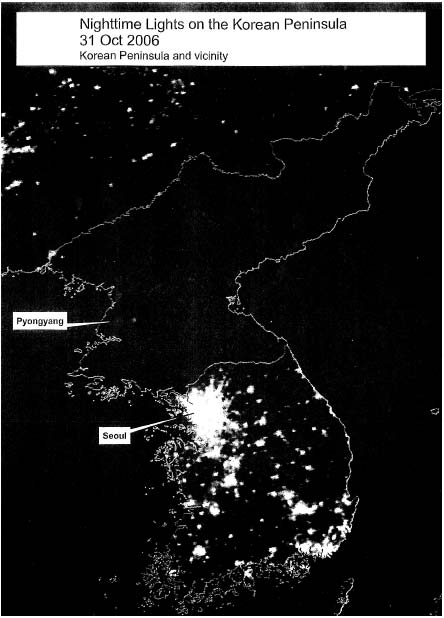
On my desk at the Pentagon I kept a satellite picture of the Korean Peninsula taken at night to remind me of all the Americans who were fighting for the freedom of Iraqis, Afghans, and, most important, for the safety and freedom of our own citizens. The photo shows that south of a distinct line—the demilitarized zone—is a free nation illuminated by the countless bright lights of a successful economy, the world’s thirteenth largest. To the norThis virtually total darkness, in which only one small pinprick of light shows, marking the North Korean capital of Pyongyang. The two countries have the same people and the same resources, and yet one country is full of light, and the other is dark, hungry, and poor.
The lesson can sometimes be lost on any who take their freedom for granted. I found that younger South Koreans, in particular, needed to be reminded that the reason they weren’t locked in the prison state of North Korea was because so many young Americans and allied forces had fought in the so-called forgotten war of the 1950s. Indeed, younger generations of South Koreans seemed to forget that the regime in the north still sought to unify all of the Korean Peninsula under its totalitarian rule.
In November 2003, I encountered this historical amnesia on a visit to Seoul. At an event on the top floor of a skyscraper downtown, a young Korean reporter approached me. The South Korean parliament was then debating whether or not to send troops to assist our coalition forces in Iraq, which had been liberated seven months earlier.
“Why should Koreans send their young men and women halfway around the globe to be killed or wounded in Iraq?” she asked me.
The question struck a deep chord. My close friend Dick O’Keefe had served in the Korean War fifty years earlier. He had been a wrestling teammate of mine at New Trier High School and had gone to Korea during the last year of the war. For the three weeks that cease-fire negotiations sought to bring the war to an end, both sides engaged in bloody battles as they tried to claim more land before an armistice was finally signed. In the twenty days the negotiations took place, U.S. and allied forces suffered 17,000 casualties, with 3,333 killed.30 On the last day of the war, O’Keefe was killed.
I had seen O’Keefe’s name earlier that day on a wall with the names of all Americans killed in the conflict. I placed a wreath at the war memorial. The legacy of his sacrifice, and the other 36,500 Americans who lost their lives on the battlefields of the Korean peninsula, is that some fifty million Koreans are free today—including that young reporter who asked me her question.
I thought of Dick O’Keefe as I answered her question. “Why,” I countered, “should Americans have sent their young men and women halfway around the world to Korea some fifty years ago?”
We stood overlooking Seoul’s skyline of bright and tall skyscrapers, a testament to the skills and industriousness of the free Korean people. This had come to the people of South Korea through the courage and sacrifice of others.
Pointing out the window at the lively, free, and prosperous city, I said, “There’s the answer.”