
CHAPTER 44
“You go to war with the Army you have—not the Army you might want or wish to have at a later time.”
—December 8, 2004
At Camp Buehring, a staging area in Kuwait for U.S. troops headed into Iraq, I held a meeting for some who would soon be deploying northward into a difficult fight against Iraqi insurgents. As I did dozens of times during my six years as secretary of defense, I gave the troops a chance to ask me any question they wished with the media there. After two questions from the audience, a soldier from the Tennessee National Guard raised his hand to ask the next one.
“Our soldiers have been fighting in Iraq for coming up on three years,” he began. “A lot of us are getting ready to move north relatively soon. Our vehicles are not armored. We’re digging pieces of rusted scrap metal and compromised ballistic glass that’s already been shot up, dropped, busted, picking the best out of this scrap to put on our vehicles to take into combat. We do not have proper armament vehicles to carry with us north.”1
He was raising a serious issue, one that was of concern to the troops and the Army—as evidenced when some of the members of the audience applauded.* I thought the question deserved a careful explanation, and I saw it as an opportunity to provide an overview of the steps the Army was taking to correct the problems they were experiencing. I responded at length:
I talked to the general [Steven Whitcomb] coming out here about the pace at which the vehicles are being armored. They have been brought from all over the world, wherever they’re not needed, to a place here where they are needed. I’m told that they are being—the Army is—I think it’s something like four hundred a month are being done. And it’s essentially a matter of physics; it isn’t a matter of money. It isn’t a matter on the part of the Army of desire. It’s a matter of production and capability of doing it.
As you know, you go to war with the Army you have—not the Army you might want or wish to have at a later time. Since the Iraq conflict began, the Army has been pressing ahead to produce the armor necessary at a rate that they believe—it’s a greatly expanded rate from what existed previously—but a rate that they believe is the rate that is all that can be accomplished at this moment.
I can assure you that General Schoomaker and the leadership in the Army, and certainly General Whitcomb, are sensitive to the fact that not every vehicle has the degree of armor that would be desirable for it to have, but that they’re working at it at a good clip. . . . [T]he goal we have is to have as many of those vehicles as is humanly possible with the appropriate level of armor available for the troops. And that is what the Army has been working on.2
Lieutenant General Steven Whitcomb, commander of Army forces in the Persian Gulf, came forward to follow my answer by explaining that any delays were “not a matter of money or desire.” He added, “It is a matter of the logistics, of being able to produce [the armor].”3
The exchange might have seemed straightforward to most of the people at the base. It seemed that way to me. But unfortunately only a few words of my extensive answer—“As you know, you go to war with the Army you have—not the Army you might want or wish to have at a later time”—ended up being isolated in print and as a seemingly endless loop on cable television. The comment was characterized by some critics, and particularly their contacts in the press, as an example of insensitivity.4 I did not see my remarks that way, and I still don’t. My statement carefully laid out the reality of the armed forces that existed when President Bush took office. Any president and any secretary of defense has available the military that their predecessors bequeath to them. The B-1 bomber I approved as secretary of defense in 1976 was being used in Afghanistan in 2001, just as the M-1 Abrams tank I had approved back then was the mainstay of the U.S. Army when I returned to the Pentagon a quarter of a century later. In turn, the number of up-armored vehicles available in 2004 were the consequences of decisions made years before President Bush or I took office in 2001.
My response also told a simple truth about warfare: As a conflict evolves, both sides adapt to the reality of the battlefield. The emergence of improvised explosive devices as the Iraq conflict wore on necessitated a shift to more armored vehicles that the Army had not acquired. It also necessitated a change by the commanders on the ground in their tactics, techniques, and procedures to make the troops less vulnerable. It took time to put up-armored vehicles in the field, and the Army, which has the responsibility to organize, train, and equip the troops, had not been arranged in an optimal way to accomplish that.
Commanders had been grappling with the problem of lethal improvised explosive devices since 2003, when they first began appearing. The favored IED was the roadside bomb. Made with garage door openers, egg timers, toy car radio controls, or washing machine parts, the bombs were inexpensive to assemble and crude in design. They were, however, remarkably effective in killing American and coalition troops.5 Among the most vulnerable to the roadside bombs were the thousands of humvees—lightly armored trucks—that were often used by our forces to move around in Iraq.
Once ground commanders experienced the first attacks by IEDs in the summer of 2003, they began to adjust. But so did the enemy. Our troops began using jammers to block the signal of remote-controlled bombs—until the enemy shifted to using wires, pressure plates, and heat sensors to activate the bombs. Once our troops became adept at deciphering the telltale signs of IEDs buried under roads, the enemy put explosives in piles of trash, the carcasses of animals, and, most savagely, in the corpses of murdered Iraqis. Our commanders changed their operating tactics as well, and began stopping three hundred yards before suspected roadside bombs. This led the enemy to plant second bombs at places where the convoys were likely to stop. Next, commanders began to position snipers on frequently bombed routes to kill those who planted IEDs, with the result that the enemy began planting IEDs elsewhere. The bombs themselves became increasingly sophisticated.6 Houses were rigged to explode when Iraqi or coalition troops entered to search them. In Fallujah and other cities, factories churned out massive car bombs that could take out a city block.
By 2004, IED attacks had risen to nearly one hundred per week, becoming the most deadly weapon our troops faced.7 General Abizaid and I regularly discussed the severity of the problem with General Casey. Abizaid urged that we mount a Manhattan Project–style effort to find a solution to IEDs, and in June 2004 we created the Joint IED Defeat Task Force with a budget of $1. 3 billion and a mandate to find ways to counter the threat.8 I urged that anything and everything be tried. I was told that the task force we assembled had even tried using honeybees to detect IEDs with their keen sense of smell. Hair dryers were mounted on the fronts of vehicles to trigger the bombs’ heat sensors.9
Coalition troops were increasingly coming under attack from explosively formed penetrators. EFPs use a copper disc that becomes a semimolten slug capable of piercing even the strongest armor. The first EFPs in Iraq were in Shia areas not far from the Iranian border. The chemical composition of their explosive charges had telltale signs of Iranian weapons manufacturers.10
We weren’t moving fast enough. In December 2004, I again expressed my continued frustration in a note to Myers and Pace. “I am very uncomfortable with the pace at which this is going. We know that vehicles are vulnerable and we know they are less vulnerable with armor. We have known it for some time.”11 And then, “My suggestion is this: until the Services can organize, [train] and equip the forces in a way that fits the tactics and strategies being used by the Combatant Commanders, the Combatant Commanders need to call a halt to what they are doing.”12If the U.S. Army could not provide enough armor for humvees, the commanders in theater would have to change the ways they fought. I ordered Abizaid and Casey to forbid all vehicles that had not been up-armored from leaving protected bases in Iraq.13 I told them we would fly in welders with armor and take as many airplanes as needed to get them and the required armor into Iraq. Within a matter of weeks, no unarmored vehicles were allowed outside of protected compounds.
By late 2005, the several billion dollars we had invested in the IED problem had resulted in progress. Casualties were down, even though the number of attacks had spiraled upward. Still, I wanted a more focused senior Army leadership, so I called another general out of retirement and back to duty: four-star General Montgomery C. Meigs. Meigs focused the Joint IED Defeat Organization on the people making the bombs and the enemy networks that sustained them. Armor continued to arrive in the theater, including the first prototypes of the Mine Resistant Ambush Protected (MRAP) V-hulled vehicles that afforded more protection to the troops. Increased local cooperation and better intelligence about the insurgent networks led to more coalition operations against those who were making the weapons. The IED challenge—and the amount of time it took to equip the force and adjust to the enemy’s tactics—highlighted again the need to accelerate the transformation of our military.
I steadily pushed each service to become more agile, more deployable, and better prepared to confront new, previously unanticipated threats.14 We redirected the Air Force’s energies and resources toward fielding more unmanned aerial vehicles, which by 2008 numbered over five thousand—a twenty-fivefold increase since 9/11.15 Under the leadership of Admiral Vern Clark, the Navy developed a new Fleet Response Plan to double its efficiency and the number of carrier strike groups available for global deployment at any given time. I encouraged the Marines to develop a special operations contingent.
The Army faced the biggest challenges. It has a proud and storied history dating back to the Continental Army of 1775. Under such legendary generals as Grant and Sherman, it preserved the Union in a tough-fought civil war. Under Pershing and Eisenhower it liberated Europe in two world wars. The Army manned the front lines of the Cold War flashpoints, its heavy tanks and artillery acting as a deterrent against a Soviet ground advance in Central Europe. For decades the Army had been organized for large land battles between sovereign states, symbolized by the service’s prized seventy-ton M-1 Abrams tank. The immediate challenges we confronted by 2001 though were not from massed enemy forces. By then our adversaries had learned that confronting the United States in a conventional war of massed force was a bad idea. As a result, America was unlikely to soon face the major land, sea, and air battles for which our military had organized, trained, and equipped over many decades. Instead, we needed a military that could quickly deploy in enough numbers to bring decisive lethality to bear, could leverage our country’s technological advantages, such as precision, communications, and stealth, and most important—could quickly adapt to changing circumstances in a given conflict and prevail.
Despite the unquestionable improvements made over the years—in many cases as the result of the lessons learned from the unconventional conflicts of the 1980s and 1990s—the Army was the most resistant to adapting to the new challenges and accelerating its transformation away from its Cold War posture of large, difficult to deploy, heavy divisions.
The small-scale unconventional conflicts of the Cold War, in Panama, El Salvador, Grenada, Lebanon, and elsewhere, were seen almost as distractions and diversions from what the Army was supposed to do and how it was supposed to do it. In fact, the painful experience in Lebanon had led Cap Weinberger, Reagan’s secretary of defense, to codify the aversion to smaller-scale conflicts as a matter of doctrine—what became known as the Weinberger Doctrine (his senior military assistant, General Colin Powell, would later adopt a version of it as the Powell Doctrine). The idea was that U.S. troops should only be committed as a “last resort” in support of clearly defined goals, with a clear “exit strategy” and “overwhelming force” to get in and get out.16
In the twenty-first century, however, the task was not to “overwhelm” nations and people who were not our enemies. The enemy was not the local population but the terrorists and insurgents living, training, and fighting among them. This came to be the case in the post-9/11 conflicts we were fighting, including the counterinsurgency campaigns that evolved in Iraq and Afghanistan. These required measured application of military power to minimize civilian casualties and encourage local cooperation.
It also struck me that the new realities of warfare meant that our military should be prepared to be used earlier in order to avoid full-scale conflicts altogether. Merely by their presence abroad or the ability to deploy rapidly, our troops could reassure allies and, in some instances, deter aggression from hostile nations or nonstate actors. They could train foreign forces, as they have in Colombia, Georgia, Jordan, and Kenya, so that the militaries of our friends and allies would be better able to take up the fight against mutual threats—instead of leaving it to our men and women in uniform, who carry more than their share of the burden. They could provide critical intelligence to stop terrorist attacks. They could lend a hand in natural disasters around the world, earning valuable goodwill for the United States by their actions, as we did in the aftermath of the Indian Ocean tsunami and the Pakistan earthquakes.
There were officers in the Army who understood the importance of deployability and speed, and who had taken aboard the lessons of previous unconventional conflicts. During the first Gulf War, there had been flashes of brilliance in the ground campaign that suggested that agility, mobility, and speed had their place in the Army. Throughout the 1990s the Army tried to resolve the tension between advocates for greater change and those who were reluctant to push too hard because of the momentum behind existing programs and weapons systems—momentum that would have to be shifted significantly if true transformation were to occur. During the late 1990s, Army chief of staff Eric Shinseki had wisely challenged the Army with the adage that “if you don’t like change, you’ll like irrelevance a lot less.”
Early on, it became apparent to those of us urging the Army to change that transforming it would be a contentious process. We would need to cancel some major Cold War–era weapon-development programs and encourage unconventional thinkers in the leadership who could help to move the institution.
After thorough reviews by the Army, the Pentagon’s program analysis and evaluation (PA&E) office, and Deputy Secretary Paul Wolfowitz, I announced in May 2002 that I was cancelling the $11 billion Crusader artillery system.17 Beyond its stunningly ill-conceived name, the program was an anachronism that typified the challenges we faced. A forty-ton, 155 millimeter howitzer, the Crusader could launch a shell from the Washington Mall and hit Camden Yards in Baltimore. But it was the antithesis of agility and deployability. The Crusader required two large cargo aircraft to deploy just one system with its ammunition and equipment, and it required considerable time and effort to assemble it on arrival. It wasn’t clear what role it could play in mountainous, land-locked Afghanistan, for example. I decided instead to use the $9 billion that had not yet been spent on it to invest in precision-guided weapon systems.
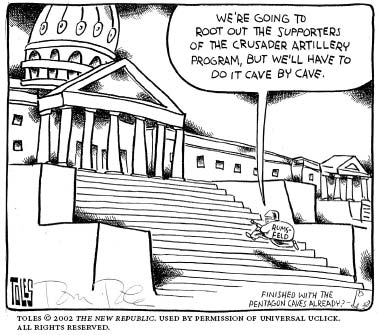
As with the M-1 Abrams tank issue in the Ford administration, my decision on the Crusader provoked near rebellion in the Army establishment, as well as hostility in the iron triangle: Congress, the defense contractors, and the DoD bureaucracy. The artillery community was angry. The defense contractors were apoplectic. Some in Congress were enraged. Some retired Army officers (including a few linked to contractors) were furious at what they characterized as institutional disrespect. Their thoughts were illustrated on the cover of the June 2002 Armed Forces Journal featuring my photo and the headline “does he really hate the army?”18
Some in the Army took actions that in my view bordered on insubordination. The Army’s Congressional Affairs office, for example, sent talking points to allies on Capitol Hill arguing that my “decision to kill Crusader puts soldiers at risk” and would cost lives.19 Ending the Crusader was “[r]eminiscent of unpreparedness in [the] late 1930s,” the talking points alleged. “OSD [Office of the Secretary of Defense] is looking for a quick kill to demonstrate their political prowess,” they continued. The talking points concluded that “[a] decision to kill Crusader puts the relevance of land power, hence the Army, in question.”20 A colonel on the Army staff called up my military assistant. “Now your boss is going to get what’s coming to him,” the colonel said. “We’ve got Congress on our side. We’re going to stick it up where the sun don’t shine and break it off.”
The Army’s top leaders, Tom White and Eric Shinseki, were visibly unhappy with my decision and also unhelpful. Before his appointment, Secretary White had been an Army one-star general who, after retiring, was a senior vice president at Enron.* In the months that followed my decision to cancel the artillery system, White had not been cooperative in moving the Army away from the Cold War weapons system toward the agile and more mobile force President Bush had campaigned for and which I sought. White’s narrow focus on and advocacy for the institutional interests of a single service was no longer acceptable in a world that demanded jointness and integration of the Army with Marines, sailors, and airmen. The Army needed better, more forward-leaning leadership. On April 25, 2003, I called White into my office for a chilly meeting. I told him I was prepared to accept his letter of resignation, though he had not drafted one. In retrospect I had made a mistake in putting a retired Army general in as the secretary—at least one who was so unwilling to upset the entrenched bureaucracy and help lead the Army into the new century.
Eventually Congress and the Army supported my decision on the Crusader, but it came at a high cost to me in frayed relationships with a few influential members of Congress and a number in the retired Army community. What I knew was that our nation needed the Army to be relevant for the twenty-first century, and that canceling the Crusader was the right decision for the U.S. Army, the Department of Defense, and, most important, for our country. Now, almost a decade later, no one is clamoring to reinstate the Crusader.
One year after the Crusader dustup, I added to the tensions with my recommendation of a retired four-star Special Forces general, Pete Schoomaker, to be the new Army chief of staff when General Shinseki completed his tour. Some took the decision to bring him out of retirement as a vote of no confidence in the senior Army leadership. In fact, I’d first proposed the job to Shinseki’s vice chief, General Jack Keane, seeing institutional benefit to continuing to promote from within the active-duty force. Keane declined for family reasons. While there were certainly other active-duty Army general officers at the three-and four-star level who had proven themselves, I recognized that the next chief would face significant internal resistance to the changes we needed to effect. I decided I wanted someone at the top of the Army who had the ability and desire to jar the institution and transform it into the expeditionary force our country needed. For many hardened Army traditionalists who came of age in a time of a fixed, defensive force designed to repel an assault from Soviet armored divisions in Central Europe, my recommendation to the President of a retired Special Forces officer was the last straw.
Many conventional Army officers considered the Special Forces to be undisciplined cowboys. It was not uncommon in military circles to hear them described as “hotdogs” who took too many risks, got into trouble, and needed to be rescued. General Shinseki, a combat infantry officer who had been wounded in Vietnam, made it clear to me he was not enthusiastic about the Special Forces and their capabilities. “No Special Forces soldier ever pulled me off the battlefield,” he once said to me.
The mistrust ran both ways, and the Special Forces folks were less than enthusiastic about Shinseki. For years Army Special Forces had been distinguished by their traditional green berets, which became their nickname. In a break from the past, Shinseki had insisted on requiring all Army personnel to wear berets. His decision was seen by many in the Special Forces and Army Rangers as devaluing their proud symbol.
Since 2001, I had made a priority of increasing the size, capabilities, equipment, and authorities of the special operations forces. By 2006, we had boosted their funding over 107 percent, doubled the number of recruits, and improved their equipment substantially.21 I authorized the Special Operations Command (SOCOM) as a lead command for war on terror planning and missions. We provided the CENTCOM combatant commander the authority to transfer special ops units anywhere he deemed necessary in his area of responsibility. We shifted some of the tasks that Special Forces had historically been responsible for, such as training foreign militaries, to allow regular forces to do them as well. This freed up special operators for more upper-tier tasks—reconnaissance and direct-action missions. I also urged the Marines to create a special operations contingent, and in 2005 we established the Marine Corps’ special Operations Command (MARSOC).22 Even though these were historic changes for the armed forces, they were resented by those wedded to the conventional, traditional Army.
Pete Schoomaker was bright, tough, and impatient. In addition to expanding special operations, he decided to implement an idea that had been kicking around for some time but, at least until he arrived on the scene, had met resistance. Schoomaker and I wanted to convert the Army from a force of ten active divisions (of fifteen thousand to twenty thousand troops each) into a force of forty highly capable brigade combat teams (of three thousand to five thousand troops each), with additional combat brigades in the National Guard.23 Divisions had been part of a centuries-long Army tradition—commemorated with proud banners and songs, each with its own culture, history, and ethos. Divisions also tended to be organized around a central purpose—light infantry or artillery, for example. Often our country’s need was for only a portion of the sizable capability of an entire division. It was for readily deployable, smaller, more agile units rather than the full division strength. But the way Army divisions were organized, a small cadre of troops deployed from a division left the rest of the division inoperable. Despite the respect that properly existed for the proud histories of the divisions, modern warfare often calls for relatively more deployable fighting units of a smaller scale.
The successful transition to the modular Army that exists today and that Schoomaker and a new generation of Army officers championed has made a truly historic difference in its capability. The changes created self-contained and interchangeable brigades with their own organic elements such as artillery and infantry. The brigades can be deployed rapidly and work effectively alongside the other services. Sustained deployment of ground forces in Afghanistan and Iraq has been made possible by this innovation. The successful conversion of the central Army maneuver unit from division to brigade has been described by defense analyst Robert Kaplan as “one of the most significant shifts in Army organization since the Napoleonic era.”24
Canceling the Crusader, dismissing the Army secretary, expanding special operations forces, bringing a four-star officer out of retirement to lead the Army, and a Special Forces officer to boot, encouraging war planning that takes into account speed, precision, agility, and deployability, and shifting from divisions to brigade combat teams—all were decisions that triggered fierce disagreement, and even resentment. I knew that change is hard. But I was always heartened when I met with the troops, because they seemed to appreciate that I was willing to do what it took to get the job done.