

1
With my sister Joan, c. 1938.

2
Lt. George Rumsfeld and Jeannette Rumsfeld, Coronado, California, c. 1944. Like so many others, our lives were changed by Pearl Harbor and World War II. We were not surprised by Dad’s decision to volunteer for the U.S. Navy. He lived by the simple rule, “Do the right thing.”

3
Becoming an Eagle Scout was an important activity for me as a young man (top center). As a guide at the Philmont Scout Ranch, I came to know New Mexico.

4
The Princeton University Varsity wrestling team in 1953 (fourth from left). Wrestling brought home to me the relationship between effort and results.

5
With Joyce, June 1954. Quite a month! I graduated from Princeton, was commissioned an ensign in the U.S. Navy, and asked Joyce to marry me. She said yes.
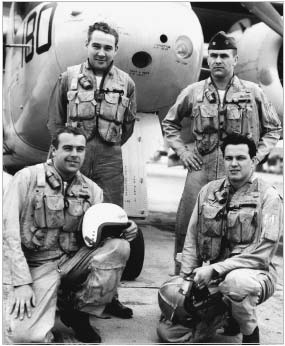
6
The airplanes I flew when serving in the Navy are now all in museums (author upper right).
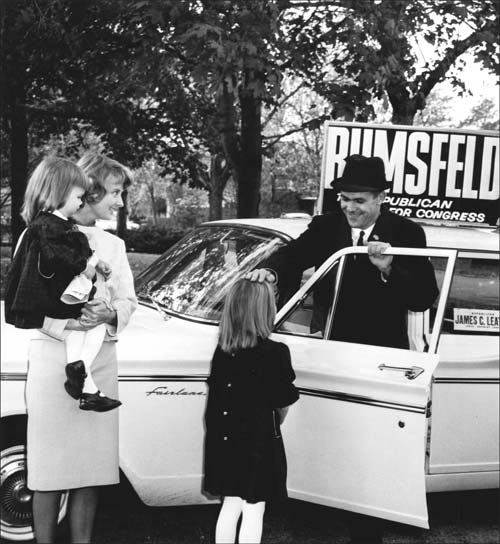
7
In my first campaign for Congress, Joyce and our two daughters, Marcy and Valerie, equently hit the trail with me in an effort make me seem more established than my wenty-nine years suggested.

8
With campaign manager Ned Jannotta after winning the 1962 Illinois 13th District primary election. When the results came in at our headquarters, the volunteers and I were amazed.

9
During the 1962 general election campaign for Congress, former President Dwight Eisenhower visited Illinois. I attended a lunch in his honor. During coffee whoever was sitting next to him got up so I could have a picture with Ike, who graciously put me at ease. It was the first time I had met a president.
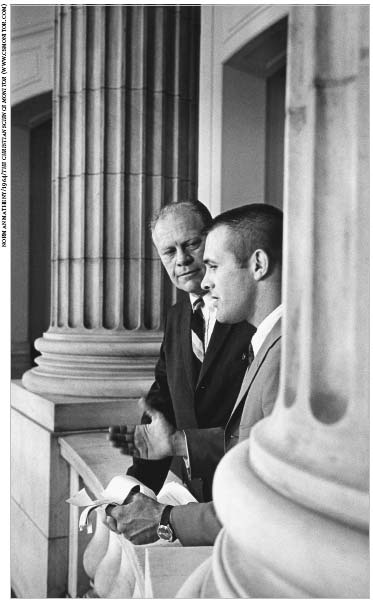
10
With House Minority Leader Gerald Ford outside the Speaker’s Lobby of the United States House of Representatives. If our paths hadn’t crossed in the years we served in Congress, both of our lives would have turned out quite differently.
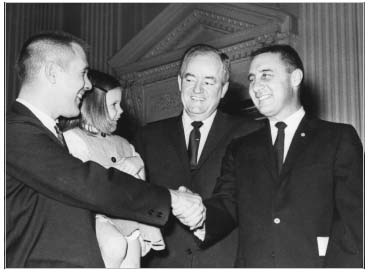
11
As a member of the Manned Space Flight Subcommittee in the U.S. House of Representatives in the 1960s, I met with many of our country’s pioneers in space. I introduced Marcy to Gus Grissom (right), the first man to fly twice beyond inner space. We were joined by the irrepressible Vice President Hubert Humphrey (center). Grissom died some months later in a test of Apollo I.
12
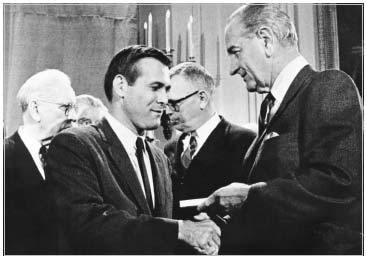
Just days after Martin Luther King, Jr., was assassinated in Memphis, Tennessee, Congress passed a bill to strengthen the 1964 Civil Rights Act. I was honored to receive one of the pens President Johnson used to sign the bill.

13
An official White House swearing-in for a member of the president’s cabinet is generally a formal occasion. Our three-year-old son, Nick, had other ideas. Joyce held the Bible but kept her eyes on him, wondering what he might do next as President Nixon tried not to laugh.

14
Director of the Office of Economic Opportunity, c. 1969. Finding myself at the helm of an organization whose founding I had opposed was a challenge. But I believed that properly managed and with more modest goals, OEO could be an effective experimental laboratory for innovative anti-poverty programs.

15
At a farewell dinner for Bryce Harlow (left) and Daniel Patrick Moynihan (center). Harlow and Moynihan were examples of the varied and outstanding talent President Nixon attracted to his administration. Moynihan stood out as an intellectual giant whose good humor and enthusiasm for life was infectious. Harlow was unquestionably the administration’s most seasoned expert on the presidency and the workings of the federal government.
16
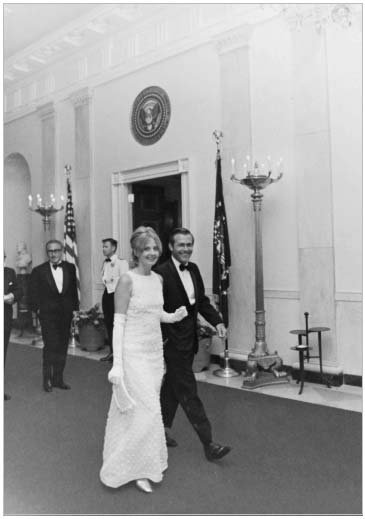
In the Nixon and Ford administrations, Kissinger seemed ever-present.
17
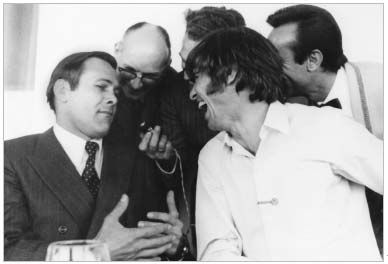
(Above): During a spring 1972 trip with Bob Finch, we managed a side visit to the legendary El Cordobés. He had come from a poor orphanage outside Córdoba to become the world’s greatest matador. We went to his ranch in the countryside, where he invited me into the ring for the testing of the bulls. One newspaper inaccurately characterized my bull as “a small bewildered cow.” El Cordobés howled with laughter when I tried to explain my technique—while wearing with good humor the Nixon tie clasp I had given him.

18
(With left to right) President Nixon, John Mitchell, John Erlichman, Charles Colson, Bryce Harlow, Bob Haldeman, and Bob Finch at Nixon’s Key Biscayne home. The President was constantly adjusting the members of his administration to assure he was getting a stream of fresh ideas.
19
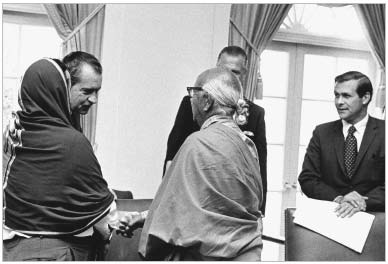
The Taos Indians had been working for years to reclaim the sacred Blue Lake in a forty-eight-thousand acre tract of land in the Sangre di Cristo Mountains near Taos, New Mexico. I was privileged to be present at the ceremony when President Nixon signed the legislation to return it to them.
20
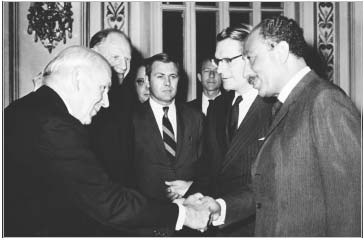
In Cairo for President Nasser’s 1972 funeral with (left to right) John McCloy, who had served as the High Commissioner of Germany after World War II; Robert Murphy, the renowned “diplomat among warriors” and Elliot Richardson. Then-acting President Anwar Sadat impressed us as thoughtful, serious, and ready to open avenues of communication with the West.
21
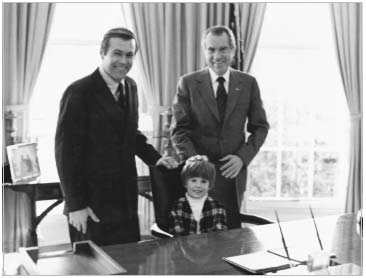
President Nixon could be both considerate and generous with his time. When I was preparing to leave for Brussels as the new U.S. ambassador to NATO, he asked me to stop by the Oval Office on my last day in Washington and to bring our son, Nick, with me. It was a glimpse of Nixon most people did not see.

22
With President Nixon and Henry Kissinger when Nixon attended his last NATO meeting in Brussels, just weeks before his resignation.
23

24
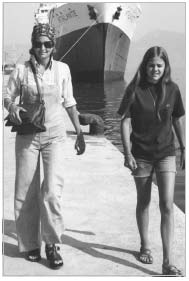
We had scheduled a family vacation for the beginning of August 1974. Joyce was determined to have some time together. We learned of President Nixon’s imminent resignation from the International Herald Tribune.

25
When I returned to Washington to serve as chief of staff in 1974, President Ford was determined to keep the White House involved in big issues. The warm and brilliant Dr. Herman Kahn moved seamlessly from discussing economics to nuclear strategy to future trends. Ford’s engagement in the discussion might have surprised his critics.

26
With Vice President Nelson Rockefeller, March 1975. The feeling was mutual.

27
On Air Force One with Larry Eagleburger (left), Henry Kissinger (center), and Dick Cheney (right). Serving as White House Chief of Staff was among my most challenging assignments, but it could also be enjoyable.

28
Ford’s fine sense of humor kept us all coming back day after day. It appears the President won this tennis match with photographer David Kennerly.

29
President Ford meeting with his advisers on the disastrous economic situation he had inherited (left to right: Bill Simon, Ron Nessen, Dick Cheney, and Alan Greenspan).

30
On his first trip abroad as President, Ford visited Vladivostok in the Soviet Union. His meetings, including this official luncheon with General Secretary Brezhnev and Foreign Minister Gromyko, were held in a former mental health sanitarium.

31
Two assassination attempts in September 1975 added to President Ford’s challenges. After the attempt by radical Squeaky Fromme, my longtime secretary, Lee Goodell, took down the President’s recollections on our return flight to Washington, D.C.

32
During the second assassination attempt, the bullet from Sarah Jane Moore’s pistol passed between the President’s head and mine, before hitting the wall of the St. Francis Hotel.

33
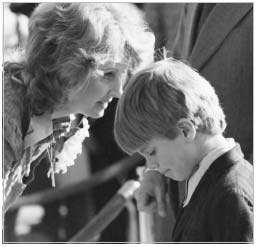
My mother, Jeannette, with Joyce, Nick, Marcy, and Valerie at my first swearing-in ceremony as secretary of defense. This is a favorite photograph of the special people in my life.
34
Nick, then eight years old, was taken aback by the nineteen-gun salute at the ceremony, but tried hard not to show it.

35
General-turned-statesman Yitzhak Rabin (left center) succeeded Prime Minister Golda Meir in 1974 to become the first Israeli-born leader of the Jewish state. He impressed me with his patriotism, which was tempered by a realistic understanding of the challenges of the Middle East. Tragically, he was assassinated in 1995.
36
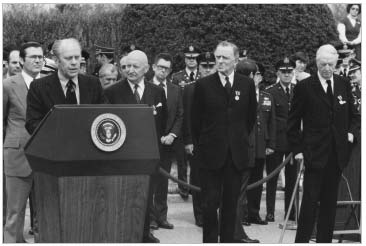
In March 1976, President Ford awarded the Department of Defense Distinguished Service Medal to my colleagues from NATO (left to right), Belgian Ambassador André de Staerke and French Ambassador François de Rose, as well as my successor as U.S. ambassador, the noted diplomat David Bruce.
37
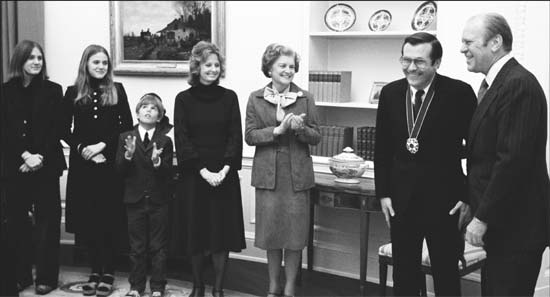
The President’s loss to Jimmy Carter in the 1976 election was tough, but the Fords continued to approach life with optimism, confidence, and good humor. It was a privilege to serve in his administration and to receive the Presidential Medal of Freedom in January 1977.

38
It seems that most of what I have done in life has resulted from working closely with bright, energetic, broadly experienced people. As I entered the business world with precious little background, I benefited from the talents of Jim Denny (left) and John Robson (right). I had known John in high school and Jim in college, but it had never occurred to me that we might wind up working together at G. D. Searle in the 1970s and 1980s. It was my great good fortune that we did.

39
Serving as President Reagan’s Special Envoy for the Law of the Sea Treaty, I met with two old friends in Tokyo: U.S. Ambassador to Japan and former Democratic leader of the Senate Mike Mansfield of Montana and Prime Minister Yasuhiro Nakasone, with whom I had worked when I served as a member of the Japanese-American Parliamentary Exchange fifteen years earlier.
40
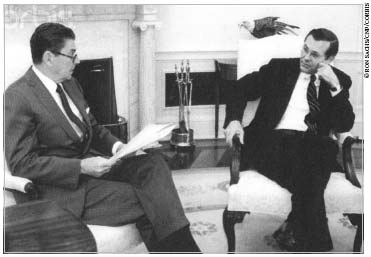
President Reagan asked me to serve as his Middle East envoy days after the terrorist attack on the Marine barracks outside Beirut, Lebanon, in October 1983. Reagan was deeply distressed over the loss of American lives. If in the end the problem of Syria, Lebanon, and Israel proved as intractable for his administration as for others, it was not for lack of will on the President’s part.

41
With Jack Kemp (left), Howard Baker, and Colin Powell discussing the 1996 presidential campaign. While our candidate, Bob Dole, had long experience in government and a compelling personal story of service, we were never able to challenge the personal charm and easy manner of his opponent, Bill Clinton.
42
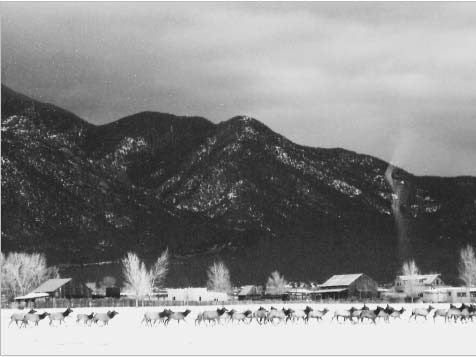
As the year 2000 approached, Joyce and I thought we were moving into our rural period, Taos, New Mexico.
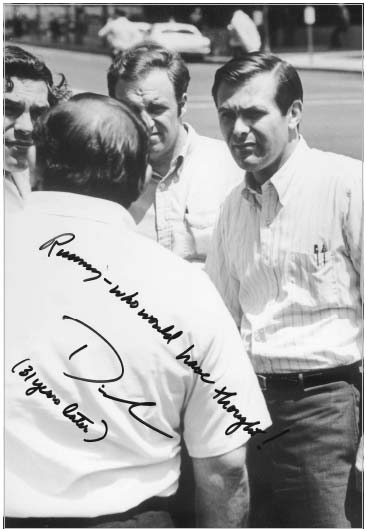
43
Dick Cheney and I were both amazed to find ourselves serving together in another administration some three decades after our time together at OEO. Cheney marked the occasion by signing this old photograph.
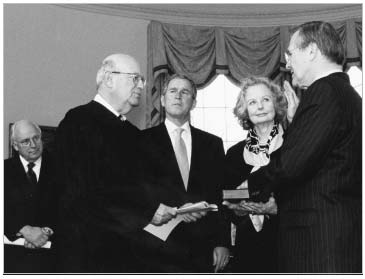
44
My second swearing-in as secretary of defense, this time with my old friend and colleague Judge Larry Silberman doing the honors.
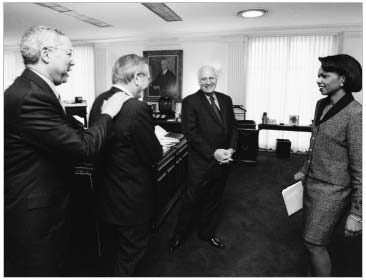
45
With Colin Powell, Dick Cheney, and Condi Rice at the Pentagon, March 2001. From the beginning of the Bush administration the four of us met weekly for lunch when we were in town, and Colin, Condi, and I had a regular telephone call each morning. I respected them all.

46
The Pentagon, September 11, 2001.

47
The Pentagon, September 12, 2001.

48
During my early-morning drives to the Pentagon through empty Washington streets in the days after 9/11 I saw how the terrorist attacks gripped the nation and filled the newspapers.

49
(Left to right) Doug Feith, Gen. Jim Jones, President George Bush, Condi Rice, Gordon England, Gen. Hugh Shelton, Gen. Jack Keane, Adm. Vern Clark conferring at the Pentagon the day after 9/11.

50
Meeting with the Pentagon press in the days after 9/11, Gen. Myers and I responded to hundreds of questions about this new and uncertain conflict—the first war of the twenty-first century.
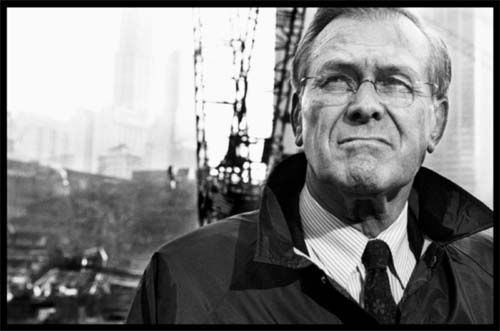
51
Ground Zero, New York City.

52
With Vice President Cheney while our miniature dachshund Reggie patrolled the area. After 9/11, we were never really off the clock.

53
At a meeting around my stand-up desk in the hours before military action started in Afghanistan with advisers Steve Cambone, Paul Wolfowitz, Larry Di Rita, and Torie Clarke.

54
Arriving at Bagram Air Base outside Kabul, Afghanistan, in December 2001, we were greeted by a band of haggard but courageous Northern Alliance fighters who had just toppled the Taliban—and by the abandoned wreckage of Soviet-made aircraft.
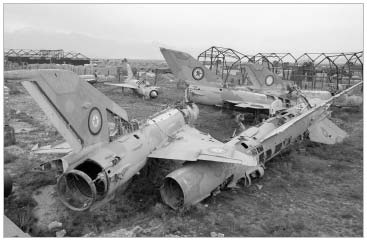
55
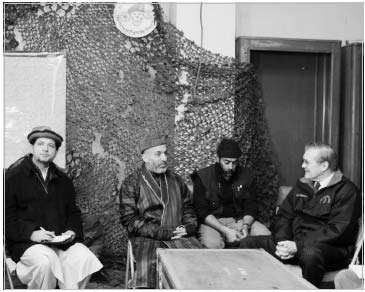
56
During my first visit to Afghanistan I met with the determined leader Hamid Karzai in an abandoned hangar at Bagram Air Base.
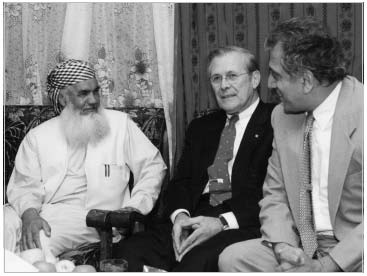
57
One of Karzai’s challenges was to integrate former Northern Alliance generals such as Ismail Khan into the new Afghanistan. With the assistance of our Afghan-born diplomat Zal Khalilzad he was able to do so, and Khan became an influential provincial governor.

58
During the Afghanistan and Iraq campaigns, those of us meeting in the situation room of the White House could communicate by secure video with commanders around the globe—here President Bush and I prepare for an update from Gen. Tommy Franks.

59
Arriving at Mazar-e-Sharif, Afghanistan, in 2003. Our country benefited from the close partnership between the then U.S. ambassador to Afghanistan, Zal Khalilzad, and our military commander Lt. Gen. David Barno. They understood the importance of linking American diplomatic and military efforts. Their effective model of cooperation was regrettably not always followed by their successors.

60
In the lead-up to the war in Iraq, President Bush made an effort to invite his combatant commanders along with members of the Joint Chiefs of Staff to the White House cabinet room for face-to-face meetings with their Commander in Chief.
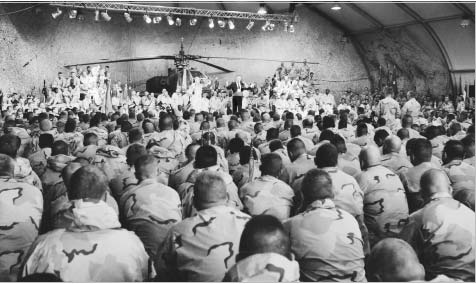
61
At a town hall meeting at Camp Buehring, Kuwait. I welcomed the opportunity to meet with our troops overseas. They were a constant source of inspiration.

62
At a December 6, 2003, meeting at Baghdad Airport, I advised Jerry Bremer that the Department of Defense’s oversight of his activities as CPA administrator was ending.

63
At a NATO meeting in Istanbul, Turkey, I passed a note to President Bush informing him that Iraq was sovereign on June 28, 2004—two days before the deadline.

64
With my senior military assistant, Vice Adm. Jim Stavridis; special assistant Larry Di Rita; Gen. George Casey; and Deputy Under Secretary of Defense Bill Luti in Baghdad. My staff and I traveled to Iraq fourteen times over three and a half years.

65
With Maj. Gen. Ray Odierno (left) in Kirkuk, Iraq, in December 2003, discussing the hunt for High Value Target Number One: Saddam Hussein.
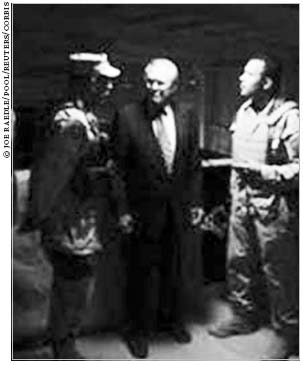
66
With Lt. Gen. David Petraeus (left) in Baghdad. Despite all the challenges we faced in Iraq, we were fortunate in the caliber of officers who led the effort on the ground, notably Gens. Chiarelli, Conway, Dempsey, Mattis, and McChrystal as well as Odierno and Petraeus, who would go on to play pivotal roles in the surge and beyond.
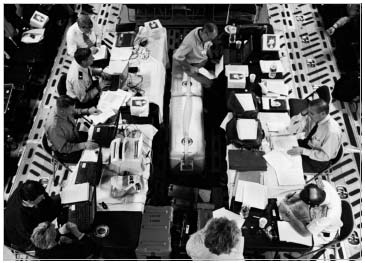
67
Travel to remote corners of the globe was sometimes tiring but always enlightening. Onboard a C-17 cargo plane headed into Uzbekistan with (clockwise from bottom left) Torie Clarke, Marc Thiessen, Doug Feith, Vice Adm. Ed Giambastiani, and my administrative assistant Delonnie Henry.

68
Sultan Qaboos of Oman was one of the most impressive observers of the Middle East. I benefited from his council after the Beirut barracks bombing in 1983 and again soon after the 9/11 attacks.

69
With Kazakh officials in Astana. What I had not admitted was that the ceremonial robe they had presented me was covering up a large hole in my old pair of suit pants that had virtually disintegrated as I got out of the car to join the meeting.

70
This handsome horse was a symbolic gift from the Mongolian Minister of Defense in 2005. I named him “Montana” because the surrounding steppe looked much like the big sky landscape of Joyce’s home state. When President Bush visited Mongolia the following year, he jokingly told his hosts that he had come to see how “Rumsfeld’s horse” was doing.

71
(Center to right) With Gen. Dick Myers and Deputy Assistant Secretary of Defense Richard Lawless, I showed my favorite satellite photograph to South Korea’s Minister of Defense. The image of the Korean peninsula at night illuminates more vividly than any words the power of freedom.
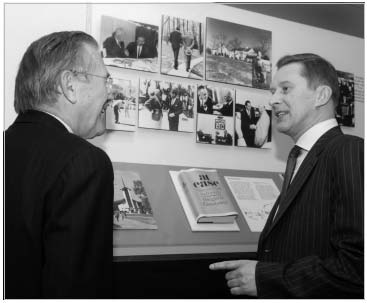
72
When my colleague Russian Minister of Defense Sergei Ivanov saw the photograph of a young Rumsfeld with former President Dwight Eisenhower in a Pentagon display, he mused, “That would be like me in a photo with Stalin.” I laughed and thought, “Not quite.”

73
(Top to right) With my senior assistant Robert Rangel, Assistant Secretary of Defense Peter Rodman, and Lt. Gen. Gene Renuart at a Pentagon meeting with Chinese Vice Foreign Minister Dai Bingguo in 2005. In the years after the 2001 EP-3 incident, relations between China and the United States went from strained to somewhat more cordial.

74
It was an honor to welcome Lady Margaret Thatcher to the Pentagon in 2006 and to show her one of the ballots from the first free Afghan elections.

75
With Joyce at the Air Force Academy’s 2006 commencement. Through all the challenges of my second tour as Secretary of Defense, Joyce was at my side. At my farewell ceremony in December 2006, Gen. Pete Pace presented Joyce with the DoD Distinguished Public Servant Award. He said the Reader’s Digest version of the tribute was “We love you, thank you.”

76
Joyce skied with the wounded troops in Vail, Colorado, and then enjoyed a barbecue hosted by local firemen. They cheered at what they had never seen before: a seventy-year-old woman sliding down a fire pole.

77
With Joyce at our surprise fiftieth wedding anniversary party in 2004.

78
Waiting to see the President with the chairman of the Joint Chiefs of Staff Gen. Pete Pace just outside the Oval Office, I paused to shine his shoes so he would look his best. It was an example of civil-military relations at their finest.

79
Thanking World War II veterans at the sixtieth anniversary commemoration of V-J Day in Coronado, California, August 30, 2005. On that day six decades before, I had been selling newspapers where the San Diego ferry docked nearby.

80
The world saw its share of natural disasters in 2005, requiring DoD relief, including Hurricane Katrina and the earthquake in Pakistan. Lt. Gen. Russel Honoré (left) led the Katrina effort with Maj. Gen. Bill Caldwell (center) and Adm. Tim Keating (far right).
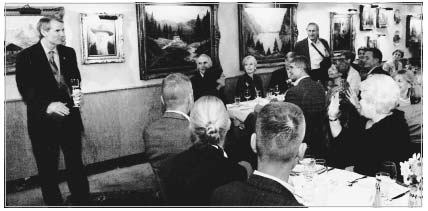
81
In the fall of 2006, Joyce suggested we go to the Washington restaurant Old Europe for what we expected to be our last dinner with the combatant commanders.

82
With President George Bush, Vice President Dick Cheney, and chairman of the Joint Chiefs of Staff Gen. Pete Pace at my farewell ceremony at the Pentagon on December 15, 2006. After my remarks, I sat down. As the applause continued, the President turned to me and, using an analogy from his favorite sport, said, “Don, they’re calling you out of the dugout.”

83
With Joyce and our children, Nick, Valerie, and Marcy, the day of my farewell ceremony. We were ready.

84
Our granddaughters Mia, Sophia, and Rachel with our daughter Valerie looking at my new Pentagon portrait in June 2010.
* I first gathered the sayings and thoughts that collectively would become known as “Rumsfeld’s Rules” while I served in the U.S. Congress in the 1960s. I continue to accumulate them to this day. Some rules are original. Many are quotes or variations of ideas from others. If known, the original source is credited. Readers will find examples of the rules scattered through this book.
* Most of the hostages were held until January 20, 1981, the day Reagan was inaugurated president.
* The casualties included 220 Marines, 18 Navy corpsmen, and 3 Army soldiers.
* The alleged mastermind of the attacks—Imad Mughniyeh—was indicted in absentia by a U.S. grand jury. Immediately after the Beirut bombing he took flight and could not be found. Mughniyeh became one of the world’s most wanted terrorists. Over the decades he was linked to a number of other high-profile attacks until he was killed, ironically, by a car bomb in Syria in 2008.
† Eventually, the Pentagon settled on an air strike against the Sheik Abdullah barracks in Baalbek, Lebanon, on December 4, 1983. The result was that the Syrians sustained little damage and the United States looked ineffective.5
* I had known Weinberger from our time in the Nixon administration. He had served as director of the Office of Management and Budget (OMB), where he was known as “Cap the Knife” for his cost-cutting efforts, and later as secretary of the Department of Health, Education, and Welfare (HEW). When he became Secretary of Defense, he had a different task. The Carter administration had systematically reversed the DoD budget increases James Schlesinger and I had initiated under President Ford, and when Reagan came in, the DoD budget needed to be increased. Cap and I were friends, and when he died in 2006, Colin Powell, who had been one of his senior military assistants, and I delivered eulogies.10
* Every presidential administration since Richard Nixon’s has held that the War Powers Resolution is unconstitutional.
* The military adviser in Lebanon was Brigadier General Carl Stiner, a pivotal figure in the development of U.S. special operations forces.5
* The shelling from the New Jersey kicked up dust but did no damage whatsoever. As I learned from my former senior military assistant, Vice Admiral Staser Holcomb, then serving as commander of U.S. naval forces in Europe, the President’s orders to respond to the shelling had come down the military chain of command “through multiple sets of clenched teeth.” In other words, no one had been insubordinate, but the reluctance at each level had the effect of substantially modifying the response Reagan intended.
† The dangers confronting the Gemayel family did not end with the murder of Bashir, and they did not disappear after the United States withdrew from Lebanon. Amine’s son, Pierre, was openly critical of Syria’s influence in his country. Twice elected to the country’s parliament, Pierre was serving as Lebanon’s industry minister when he was assassinated on November 21, 2006.
* The Kennedy who most aided the cause of the America Firsters was Joseph P. Kennedy, John’s father and a former U.S. ambassador to Great Britain. Returning to the United States in 1940, he announced that the British would have to seek an accord with Nazi Germany. “Democracy is finished in England,” he was quoted in a notorious front-page article. “It may be here.”3
* The Rumsfelds trace their roots to a small farm on the outskirts of Sudweye in Schleswig-Holstein. Members of our family can still be found there. In the late nineteenth century, my great-grandfather Johann Hermann Rumsfeld, a merchant seaman, immigrated to America. After settling initially on the East Coast, his son John von Johann Heinrich eventually made his way westward to Chicago.
* She itemized her expenses for Dad, including $70.00 for the house payment, $6.52 for gas and electricity, $2.60 for water; $8.37 for milk; $47.00 for six months’ taxes, and $7.00 for my new pair of shoes. Mom supplemented our income by working as a substitute schoolteacher. The tight finances were yet another challenge that she—like so many other military wives—was facing on her own.6
* Our entire primary campaign cost a whopping twelve thousand dollars. It was at the time the most money that had been spent in that district on a congressional race.
* There were some memorable characters. I was once on the House floor reading a bill that we were about to vote on later that day. Congressman John Byrnes of Wisconsin, well known as a serious legislator, came up to me. “Don’t start reading that stuff, Don,” he said jokingly, “or you’ll never make it around here.”
* Around the same time I found myself in similar circumstances regarding Japan. My father had volunteered to serve in the Navy in World War II and was assigned to the Pacific theater against the Japanese, then our bitter enemies. Less than two decades later Japan had embraced democracy and a Western economic system. I began involving myself in issues related to Japan, and began a long relationship with the people of that country. I helped establish the U.S.-Japan Parliamentary Exchange Program during the 1960s, which was designed to develop closer ties between legislators, businessmen, journalists, and scholars from both countries. I stayed engaged with Japan over the decades, serving on President Reagan’s Commission on the Conduct of United States/Japan Relations from 1983 to 1984 and as a member of the board of trustees of the Japan Center for International Exchange from 1990 to 2001.
* There was a story circulating at that time about a meeting the President had with a group of industrialists. After issuing an optimistic prognosis for the country, Kennedy said, “If I were not President, I would be buying stock right now.” “Sir, if you were not President,” a man at the end of the table retorted, “I would be buying stock too.”
* For a rich lesson in Texas politics and U.S. history, it is worth listening to the historian Michael Beschloss’s compilation of LBJ’s secretly recorded tapes in Taking Charge: The Johnson White House Tapes, 1963–1964 and Reaching for Glory: Lyndon Johnson’s Secret White House Tapes, 1964–1965.
* The supermajority needed to stop a filibuster was changed from 67 votes to 60 votes in 1973.
* In the House 80 percent of Republicans voted in favor, compared to 61 percent of Democrats. In the Senate, the numbers were similar—82 percent of Republicans in favor versus 69 percent of Democrats.
* My Democratic opponent was a businessman, lawyer, and former vice president of the University of Chicago. He called me “more negative than Goldwater” and concluded that the “Goldwater-Rumsfeld attitudes and voting records are negative, irrelevant, and unsuited to our times. They seem to me doctrinaire and extreme.”24
* The following Christmas, Ford graciously gave me a copy of his book about Lee Harvey Oswald, Portrait of the Assassin (Ford had served on the Warren Commission that had investigated the Kennedy assassination). Ford inscribed it: “To Don Rumsfeld in appreciation of your fine friendship and wonderful loyalty and to express my deep gratitude for your assistance, cooperation and leadership in the rugged days of 1965.”
† These efforts eventually took shape in the Legislative Reorganization Act of 1970.
‡ We were friends outside work as well. Bill Steiger, Pete Biester, and their wives became close friends of Joyce’s and mine. The Biesters lived a few blocks from us, and our children went to the same schools. Steiger had had solid experience in the Wisconsin state legislature as well as excellent political instincts. It was a real loss when he died shortly after his fortieth birthday in 1978, from complications of Type 1 diabetes.
* In his August 21, 1858 debate with Stephen A. Douglas, Abraham Lincoln pointed out, “And so I think my friend, the Judge, is equally at fault when he charges me at the time when I was in Congress of having opposed our soldiers who were fighting in the Mexican War…. You remember I was an old Whig, and whenever the Democratic party tried to get me to vote that the war had been righteously begun by the President, I would not do it. But whenever they asked for any money, or land warrants, or anything to pay the soldiers there, during all that time, I gave the same votes that Judge Douglas did.”20
† On June 2, 1965, I testified before the Joint Committee on the Organization of the Congress and raised a series of questions about the balance in responsibility between the executive and legislative branches of government.22
* Thurmond made a strong pitch for his favorite candidate, a rising star in the conservative wing of the party: California Governor Ronald Reagan. Since Reagan, like Nixon, hailed from California, the ticket would lack geographic balance. Congressman John Rhodes of Arizona also threw out a name no one else had mentioned: Congressman Gerald Ford. But Ford, like Reagan, had few backers among GOP elders.
* I was later named cochairman of the Republican truth squad, along with Senate Minority Leader Hugh Scott. Our small team of senators, governors, and congressmen followed Vice President Hubert Humphrey around the country and held press conferences after his appearances to get Nixon’s positions into local media at the same time Humphrey was getting coverage. True to form, the genial Humphrey would occasionally stop by to see us and say hello, even as we were preparing to counter his presentation.
* Moynihan later served as ambassador to India and to the United Nations before being elected to the United States Senate from New York, holding the seat until 2000, when he retired.
* The census had determined that my congressional district’s residents, while not the wealthiest in the country, did have the highest annual earned incomes.
* It was cold comfort some years later when Jack Anderson finally confessed that his column on me was among his biggest mistakes.8
* I asked Cheney to work on a dispute involving a community action program in eastern Kentucky. He found himself smack in the middle of an old-fashioned Southern political blood feud between an influential Democrat, Treva Howell, and Republican governor Louie Nunn. Both were leveling serious allegations of wrongdoing at each other. The charges were so serious that I told key Nixon aide John Ehrlichman that the FBI needed to become involved. Ehrlichman said he intended to send what he called his “own people from the White House” to investigate. I told him that getting the White House involved in investigations of that type was one of the dumbest proposals I could imagine and that I would ask the FBI to look into it myself, which I proceeded to do. FBI Director J. Edgar Hoover found that neither Howell nor Nunn had broken the law. Ehrlichman’s team of investigators gained greater fame—or infamy—in subsequent years as “the White House plumbers.”12
† When our family of two adults, three children, a dog, and a cat moved out a few years later, we were amused but not surprised to find that our house was advertised for sale as “suitable for a bachelor.”
* Even today, particularly on Sundays when we do not get to church, Joyce and I listen to a recording of Elvis singing gospel songs. He remains one of our favorite singers.
* The Cost of Living Council (CLC) did have one attraction: It was an education. It brought together the administration’s finest economic experts—including Shultz, Arthur Burns, Herb Stein, Paul McCracken, Ezra Solomon, and Marina Whitman. Larry Silberman, then the Undersecretary of the Department of Labor, and James Lynn, the Undersecretary at Commerce, worked closely with me as well to help figure out what we could do to implement the President’s directives without damaging the economy. Dick Cheney, who had asked for his own area of responsibility, came on board as Director of Operations.
* Most of the regular attendees were at the senior staff meeting on June 19, 1972: Shultz, Moynihan, Harlow, Haldeman, Colson, Ehrlichman, and press secretary Ron Ziegler.
* By the time he was done, Nixon had accepted fifty-seven resignations and made thirty new appointments.29
* At the time I was unaware that Henry Kissinger was also taping his phone conversations with others. Presidents Kennedy and Johnson had also done so.
† We were often reminded that most of the representatives at NATO had experienced the war firsthand. Joyce experienced this when she paid a social call on the wife of Marcel Fischbach, Luxembourg’s ambassador to NATO. To make conversation, Joyce asked Madame Fischbach how she had met her husband. Mrs. Fischbach replied matter-of-factly that when Luxembourg was occupied by Germany, the Nazis would round up young unmarried girls and send them to the Nazi officers’ clubs for entertainment. Since at that time they were leaving married women alone, her parents had taken the precaution of arranging for her to marry a man she barely knew—Marcel Fischbach.
* As the Watergate problems grew, and as the Yom Kippur crisis escalated, top aides like Secretary of State Henry Kissinger, Secretary of Defense Jim Schlesinger, and Al Haig (who had replaced Haldeman as White House chief of staff ) exchanged diplomatic notes under Nixon’s signature. At one point, senior officials decided to raise the Defense Condition level—a decision made at the height of the crisis when an embattled President Nixon was reported to be asleep.
* As a consequence of this serious dispute, Greece withdrew its forces from NATO’s military command structure. They were readmitted in 1980.
† Nixon noted in his memoir that “Don Rumsfeld called from Brussels, offering to resign as Ambassador to NATO and return to help work against the impeachment among his former colleagues in Congress.” My guess is that Haig may have told Nixon this to try to lift his spirits.10
* Ford turned down contract offers to play professional football for the Detroit Lions and the Green Bay Packers to attend Yale Law School.
* Senator Edward Kennedy was one of the harshest critics of the pardon, skirting close to accusing Ford of complicity in Watergate: “Do we operate under a system of equal justice where there is one system for the average citizen and another for the high and mighty? It is the wrong time and the wrong place and the wrong person to receive a pre-indictment pardon. And it has led many Americans to believe that it was a culmination of the Watergate coverup.” It was not the first or only time Kennedy was wrong. In 2001, Ford received the profile in Courage award from the John F. Kennedy Library, and Senator Kennedy praised him in quite different terms.24
* I was pleased to learn that I would be succeeded at NATO by the distinguished diplomat David K. E. Bruce. Bruce had been the head of the Office of Strategic Services (OSS) in Britain during World War II and had had the unique distinction of having served as ambassador to Germany, France, and the United Kingdom. Bruce’s appointment signaled Ford’s serious commitment to the alliance.
* Three weeks after I became chief of staff, I told the President he needed to meet alone with Schlesinger to get his “unvarnished” views on arms control negotiations with the Soviets before he issued guidance to Kissinger, who would be conducting the talks. I discovered a week later that Ford had decided to just call his secretary of defense and inform him of the guidance that he had given to Kissinger, who by then had already departed for Moscow.13
* There are conflicting reports on exactly when this event took place—Jude Wanniski states that it was in December 1974 and that Dick Cheney and I were both there. In 2004, Wanniski gave a different account on an internet blog. Memory can be a tricky thing. As it happens, my calendar indicates the dinner was on September 16, 1975, and I have a personal note about Art sketching the curve that night on a napkin.22
* Rockefeller considered himself the head of the Domestic Council, which Nixon had created in 1970. Theoretically, the Domestic Council would do for domestic policy what the National Security Council did for the President’s national security policy.
* The President was absolutely correct on this issue. At one meeting, Ford asked if anyone was in favor of giving New York City a bailout before it defaulted. I replied not just no—but hell no.36
* For example, one luncheon included Gertrude Himmelfarb, Edward Banfield, Herbert Storing, and Thomas Sowell.
* Ford once explained to me the reasons for his initial reluctance. When Nixon asked Ford to become vice president, Nixon told Ford that he wanted his favorite cabinet member, John Connally, to be the Republican standard-bearer in 1976, presumably after Nixon’s full eight years in office.
* Moore later said she was blinded by radical political views. Her concession would have been small consolation had she killed the President. She was released from prison in 2009.51
* Ford describes the scene in a similar fashion in his autobiography: “Kissinger and Rumsfeld were stunned by the sweeping nature of these changes. Both expressed doubts.”9
† President Ford had another reason for wanting me to take the post. He wrote: “Defense, I told Rumsfeld, was the place he ought to go. With his experience and ability, he could convince Congress to appropriate necessary funds for the military.”10
* In 1963, I had spoken out against President Kennedy’s appointment of Paul Nitze to be secretary of the Navy when I was in Congress. I had read of some of the recommendations of a panel he had chaired, which I considered too conciliatory toward the Soviets. After I learned that he had been asked to chair the committee specifically to try to improve the recommendations, I apologized to him. We became warm friends.13
* Bush obscured the situation somewhat in his own book by putting the allegation in the words of an unnamed “former House colleague,” who told him, “‘I think you ought to know what people up here are saying about your going to the CIA…. They feel you’ve been had, George. Rumsfeld set you up and you were a damned fool to say yes.’” By repeating the myth instead of setting the record straight, Bush in effect endorsed it.15
* Bush contended that it was President Ford’s decision to exclude him from consideration for vice president. Bush is quoted as saying, “I told Ford I’m not going to do that, but if you want me in this job enough you will make the caveat.”20
* In a 1977 interview Rockefeller said, “The third thing that I have no proof of but I have no way of explaining the event that ensued except by surmising what I will say to you and that is that Rumsfeld had something on the President that he could use and that the President for whatever reason did not want to come out. And therefore it was virtually if not in actual fact a blackmail situation.”26
* By the next day Kissinger had cooled down. After a meeting with the President, he said, “Don, I want you to know that I believe you handled the matter last night just right…. We would have ended up in a pissing match within the government, and we don’t need that.” He concluded saying, “I owed you that and wanted you to know it.” Kissinger could be a fierce bureaucratic battler, but he also was a man of integrity who would admit when he had erred.8
* As was tradition for nominees, I was introduced to the Senate Armed Services Committee by the two senators from my home state: Senator Charles Percy, a Republican from my old congressional district, and Senator Adlai Stevenson III, a Democrat. I had known Senator Percy for many years, and Senator Stevenson was the son of the man who had so sparked my interest in public service some two decades before.
† Ford was so angry that he uncharacteristically started questioning the personal fortitude of members of Congress. I cautioned Ford against that kind of rhetoric. I told him that was the kind of thing LBJ would say. “There is something about that chair,” I said, pointing to the one behind his desk, “that makes presidents begin to act and talk in a way to make them seem tough.” I urged Ford instead to approach his critics like Eisenhower did—in sorrow rather than in anger, and to rise above them rather than to sink to their level.3
* Around the time I was born, a New York Times reporter, Walter Duranty, won a Pulitzer Prize for his coverage of the Stalin era. Some of his articles were headlined: “industrial success emboldens soviet in new world policy,” “red army is held no menace to peace,” and “stalinism solving minorities problem.” Duranty’s reports from Moscow denied allegations that Stalin’s regime had starved its citizens—“There is no famine or actual starvation, nor is there likely to be”—and offered uncritical reporting on Stalin’s show trials of political dissidents (“You can’t make an omelette without breaking eggs”). Though much of the reporting proved to be false—and precisely in line with what Stalin wanted the world to believe—Duranty’s Pulitzer has never been revoked.8
* Helms later said he voted against my confirmation to register his protest against President Ford for firing Schlesinger instead of Kissinger.
* I called lawyers at the Pentagon and at the Department of Justice to ask for assistance. Contending that the demonstrators were protesting at a private residence, not on government property and that they had a permit to do so, both sets of lawyers unhelpfully said it was not a matter for the U.S. government—even though the only reason the protesters were at our house was because of my position as secretary of defense.
* In fact, when I was still serving as ambassador to NATO, Schlesinger had asked me if I would be willing to be considered for the post of secretary of the Navy, which I had declined, not wanting to leave NATO then.
† Clements’ wife was the Republican National Committeewoman from Texas.
* When I became secretary of defense I was a captain in the Navy reserve. Since I concluded I would not be able to activate myself in the event the President called up the reserves, I transferred from the active reserve to the standby reserve.
* William “Gus” Pagonis, then a major in the Army office of legislative affairs, was given the unpleasant assignment of going up to Capitol Hill that night to retrieve what turned out to be the Army’s incorrect press release. Pagonis went on to be a three-star general who served years later during the Gulf War and saw firsthand the M-1 tanks in action.
* Marshall’s assessment pointed out areas where the United States retained advantages over the Soviet Union: for example, in the quality of its missiles and in the potential for significant improvements in missile capability. The Soviets, however, were poised to move ahead in the areas of air defenses and civil defense preparedness. They had constructed elaborate underground systems beneath large housing projects, where a significant fraction of their urban industrial population could find shelter in the event of a nuclear conflict. Even if large numbers of their citizens were killed in a nuclear conflict, the Soviets were making the investments necessary to survive as a country. Communist leaders did not reach the top posts in the Soviet Union by worrying about the lives of a few hundred thousand of their people.8
* The Hughes briefing on Cuba, on February 6, 1963, had been carried on national television. Hughes’ use of aerial photographs taken from U-2 spy planes was considered revolutionary at the time. By the time Hughes was working with me, the technology had developed to the point that we had satellite images as well. With new high-resolution cameras, we had to be cautious. They made an overwhelming case, but making them public would have revealed sensitive information about our surveillance capabilities to the Soviets.
* I also had the briefing presented to our NATO allies. At my request, the NATO Secretary General appointed a Danish intelligence officer to develop a NATO-classified version of my briefing and then take it to all of the NATO capitals. My goal was to encourage our allies to increase their own defense budgets, which were declining. Our success in getting the Europeans to increase their defense expenditures was modest, but we did slow their decreases.
* The first SALT, signed in 1972, included a ban on antiballistic missile systems that could bring down an enemy’s nuclear ballistic missiles after they were launched. To begin development of a missile defense system, President George W. Bush and I led the effort to repeal the Anti-Ballistic Missile Treaty in 2001.
* Cruise missiles did not have a natural constituency even in the U.S. military, which made them susceptible to being bargained away in arms negotiations. One reason for this was that no one military service clearly benefited from expenditures for them, and the funds for them would have to come from one of the service’s budgets. As a result, no military service was ready to argue for the program at the expense of their other budget priorities. That left me as one of the few advocates for cruise missiles at the time within the Pentagon.
* As he had in August 1974, President Ford asked me and many others for a list of people to consider for vice president. I suggested George Shultz, Mel Laird, John Connally, Howard Baker, Bill Brock, Jim Buckley, George H. W. Bush, and Bill Scranton.1
* His most notable combat experience occurred during World War II when, in August 1943, as part of the 93rd Bombardment Group, Brown took part in a famous bombing raid against the Ploesti oil refineries in Romania, which were providing oil to Nazi Germany. Eleven planes in his bombardment group, including the lead plane, were shot down during that dangerous mission. Brown was credited with helping to bring back the surviving aircraft safely.
* Carter’s successor, Ronald Reagan, wisely decided to reinstate the B-1, and it has remained a valuable weapon system for our country into the twenty-first century.14
* Years later in a meeting with Chief of Naval Operations Admiral Elmo Zumwalt, I told him my story about the USSWisconsin. “I was on that ship. I was the navigator,” Zumwalt replied. Astonished, I asked him, “How the heck did you become an admiral with that foul-up in your record?” Zumwalt answered that he had warned against the mooring location but had been overruled by the Navy Department in Washington. I then asked if my account about the tugboats was what he remembered. “You are exactly right, but you left one part out: The tide came up.” It was a lesson about the importance of teamwork, to be sure, but it is also best to have a little help from the Lord.
† Both Robson and Denny went on to have distinguished careers after Searle. John served as dean of the Emory Business School before going on to be deputy treasury secretary for the George H. W. Bush administration. Jim became chief financial officer for Sears, Roebuck & Co. and later chairman of Gilead Sciences. Their private investment activities, however, have been less exalted. The three of us banded together in the 1980s as TBM. Once when we were considering a project requiring legal disclosure, we were forced to disclose that TBM stood for “Three Blind Mice.”
* Since Searle did business outside of the United States, especially in Europe, one of the people I turned to was a man whom I had always found a reservoir of good sense and unique perspectives, former ambassador to North Atlantic André de Staercke, the Belgian who had long served as the dean of the North Atlantic Council.
* I cannot, however, claim to have sold the centrifuge company. Because of the power of the unions and French law, we weren’t even able to give the company away. Our only solution was to pay the employees and the government so we would be permitted to transfer the business to the employees and be free of it.
* Searle sought new legislation to help every company affected by an FDA stay of approval. In January 1983, Congress passed an amendment to the Orphan Drug Act that provided any product that had been approved, and was subject to a stay of that approval which was later lifted, an extension of their patent to compensate for the time lost during the period of the stay.
* During the same period, the Standard & Poor’s 500 grew 12 percent.
* Carter said, “My opinion of the Russians has changed most drastically in the last week [more] than even in the previous 2 1/2 years before that.”2
* Others mentioned were former treasury secretary Bill Simon, former New York Congressman Jack Kemp, and Reagan’s close friend Senator Paul Laxalt of Nevada.12
* Dr. Robert Goldwin had written an article on the Law of the Sea in June 1981 that pointed out the potentially unfortunate consequences of the treaty. Goldwin wrote that John Locke did not define “common” resources as belonging to everyone; he defined them as belonging to no one, and that ownership derived from the labor expended to harvest the resources. Remove the reward for the labor and you remove the incentive to work. Goldwin’s article so impressed me that I sent it to George Shultz, who had succeeded Haig as secretary of state. 13
* Early in the administration, Bush came up to Joyce and asked, “What’s your son addicted to?” It was a blunt question, to be sure—it was one of the first conversations Joyce had ever had with the President—but that was not unusual for George W. Bush. Perhaps reflecting on his own, well-known challenges with alcohol, he asked thoughtful questions and showed a comforting lack of any embar rassment over the issue. It quickly put Joyce at ease with the new President.
* There was one issue raised in early January 2001 when the Chicago Tribune ran a story about an exchange President Nixon and I had in the Oval Office. Nixon made some disparaging and offensive remarks about African Americans. The irony of the minor controversy was that in contrast to the Chicago Tribune’s vigorous opposition to civil rights legislation, as a congressman I had supported the bills throughout the 1960s.
* The traditional model of a secretary of defense and deputy secretary of defense was Mel Laird and his deputy, David Packard, who had cofounded Hewlett Packard and benefited from a long career in business.
† Secretary Cohen offered to be helpful in any way to smooth the transition, which I appreciated greatly. His deputy, Rudy deLeon, and a number of Cohen’s senior staff graciously agreed to stay on during the many months it took to get President Bush’s nominees selected, cleared, confirmed, and on the job.
* From the time we recommended someone for a position, it took the White House personnel shop seventy days on average to approve them, and then another fifty-two days for Senate confirmation.6
* In the end, in October 2009, after labor unions representing federal workers spent many millions of dollars to help elect sympathetic lawmakers, Democratic majorities in both houses of Congress voted to kill the new pay-for-performance system we had put in place.
* In addition to our global posture, I also thought our bases and facilities in the United States should not be off-limits to review. In 2001, on my recommendation, the Bush administration proposed the largest U.S. military base realignment and closure (BRAC) effort in history. We reduced the number of bases across America to streamline DoD, improve its overall effectiveness, and cut costs. By closing bases we no longer needed, we projected that we could save the American taxpayer an estimated $5.5 billion every year. We also ended up earning criticism from a number of members of Congress who represented areas where bases might be closed.
* The only other signatory to the ABM Treaty, the Soviet Union, had ceased to exist.
* In our meeting, Deng was still trying to understand the American democratic system. He wondered how the U.S. Congress could enforce laws on China to reclaim American assets lost in Mao’s Communist takeover twenty-five years earlier. “I could explain it,” I told him, “but it would take a great deal of mao tai,” referring to the Chinese liquor.8
* In 1956, I learned that one of our close friends and a fellow Navy pilot, Jim Deane, had been shot down while flying a similar reconnaissance mission off the coast of China. Lieutenant Deane’s remains were never recovered. There were rumors he might have survived the crash and was being held captive, but we were unable to get any conclusive information. Deane’s wife asked her congressman, Gerald R. Ford, for his help in obtaining information. Later, on my 1974 trip to China with Kissinger, I was surprised when Kissinger handed me a memo about Jim Deane, whose fate he planned to raise with the Chinese. When I became secretary of defense in 2001, I tried to gather more information on missing American pilots, including Deane, when I met with Chinese officials. Despite our efforts, the Chinese never budged on the issue and Jim’s widow, Beverly Deane Shaver, continues to search for answers.
* Of the forty-four Chinese Air Force interceptions of U.S. reconnaissance flights prior to April 1, 2001, six involved Chinese planes coming within thirty feet of U.S. aircraft and two involved Chinese planes coming within ten feet.16
† The article went on to say that the U.S. reconnaissance plane had violated Chinese airspace, and in doing so was a “threat to the national security of China.” The article “modestly” closed with the demand that “the U.S. side…make a prompt explanation to the Chinese government and people about the U.S. plane’s ramming of the Chinese jet and its infringement upon China’s sovereignty and air space, apologize to the Chinese side and shoulder all the responsibility arising from the incident.”20
* Under the Goldwater-Nichols Act of 1986, the chairman of the Joint Chiefs is the principal military adviser to the president, the National Security Council, and the secretary of defense. Though the chairman is not in the chain of command or a member of the NSC, he generally serves as the communication link for military actions between the national command authorities—the president and the secretary of defense—and the combatant commanders.
* Powell had an engaging sense of humor and could poke fun at himself and some of the stereotypes of the State Department. On one occasion, Cheney, Rice, and I were at the State Department for one of our regular lunches, which we took turns hosting. The rest of us periodically kidded Powell about the State Department’s lavish meals. This time when we arrived, Powell had the table set elegantly with cloth napkins and matching silverware, and at each of our place settings silver platters with matching silver covers awaited. After we all took our seats, hovering waiters in tuxedos pulled off the silver covers simultaneously in a dramatic fashion. Underneath we found brown paper bags with sandwiches in them. Powell grinned, and we roared with laughter.2
* A particularly egregious example appeared in theWashington Post in 2003 entitled “POWELL AND JOINT CHIEFS NUDGED BUSH TOWARD U.N.” The article claimed that Powell and Joint Chiefs Chairman Dick Myers overruled a reluctant Bush, Rice, and me about seeking the international community’s help in postwar Iraq. It was so utterly untrue that both Myers and Powell took the rare step of publicly disputing it. This was the sort of storyline that continued throughout the administration. Other similar headlines included: “POWELL TRIED TO TALK BUSH OUT OF WAR” and “POWELL'S DOUBTS OVER CIA INTELLIGENCE ON IRAQ PROMPTED HIM TO SET UP SECRET REVIEW.” 12
* I find that committing a point of view to paper sharpens my thinking. It also permits other participants in the discussion on a given issue to understand my perspective more precisely. This approach, of course, has its drawbacks. Stating one’s position in a written document becomes part of history. It makes it hard to claim down the road that one was wiser than might have been the case, and it limits one’s ability to wait to see how events unfold before being publicly committed to a specific course of action.
* For example, over one three-month period in 2003, there were thirty-one meetings at the White House scheduled by the NSC staff. We did not receive any papers in advance for these meetings. Further, 48 percent of the meetings were canceled and we received summaries of the conclusions for only 17 percent of the meetings held.19
* Democrats were urging that any money from a projected budget surplus be directed to a so-called, nonexistent, Social Security “lockbox.” Unlike the internet, the lockbox idea was an Al Gore invention. During the 2000 campaign, Gore and congressional Democrats used the gambit in an attempt to turn any proposal they didn’t like—such as cutting taxes to leave more of the American people’s hard-earned money with them—into an effort to raid Social Security. The whole debate struck me as absurd. There was no budget surplus for a lockbox (it was only a theoretical projection), and the last people in Congress who tended to be worried about restraining spending were the proponents of the lockbox idea. Moreover, most everyoneknew that Social Security needed fundamental reforms that few were willing to confront.
* They included: Ed Giambastiani; Jim Haynes, the Department’s general counsel; Steve Cambone, the deputy undersecretary of policy; Larry Di Rita, my special assistant; and Torie Clarke, the assis tant secretary of defense for public affairs.
* The last time the Defcon had been raised to that level was in 1973, during the Yom Kippur War, when I was ambassador to NATO.
* Each of the other three hijacked aircraft had five al-Qaida terrorists onboard, and the difference between four and five terrorists may have meant the difference between failure and success. In 2002, the individual believed to be the twentieth hijacker—the missing hijacker from United Flight 93—came into U.S. custody in Afghanistan. The detention and interrogation at Guantánamo Bay of the suspected terrorist, Muhammed al-Qahtani, would later become a focal point of controversy.
* Pakistan, Iran, Turkmenistan, Uzbekistan, Tajikistan, and China all share borders with Afghanistan.
* He should not be confused with the terrorist who led the nineteen September 11 hijackers, an Egyptian also named Muhammed Atta.
* At my first meeting of NATO defense ministers in Brussels in June 2001, I made a point of meeting privately with the minister of defense of Uzbekistan, Kodir Gulyamov, which surprised some of our NATO allies.
* Until 2001, UAVs had been used mainly on an experimental basis. When they first had been ready for operations, Defense and CIA officials debated over who would control them and who would pay for their use. In both bureaucracies, some officials were eager to avoid responsibility and preferred not to be burdened with the cost. After 9/11, with coalition operations underway in Afghanistan, George Tenet and I began to sort out Defense-CIA joint Predator operations. We came to an agreement over who owned and paid for the assets, where they would operate, and who would “pull the trigger” on the very few UAVs that were armed at the time.
* Powell remarked, “All of the countries in the region—the United States, Russia and, as you heard, Pakistan, through Musharraf last evening—say, it’s better that they not enter Kabul. There’s too many uncertainties as to what might happen.” Secretary Powell went on to say, “Entering a city is a difficult thing. You put people in close quarters, they are of different tribal loyalties. We have seen what has happened previously when you had an uncontrolled situation and two forces arriving in Kabul at the same time not meaning each well.”10
* Early on, Karzai emerged as a possible candidate for a national leadership post. As such, we wanted him protected. At one point during the fighting against a much larger Taliban force, Karzai was evacuated briefly to Pakistan. In talking with Pentagon reporters, I mentioned Karzai’s evacuation. Though my remarks were accurate, I did not want to give a false impression that Karzai had sought to retreat, which he most certainly had not. Karzai, understandably, didn’t want it known that he had been taken out of Afghanistan, even for a short period. I later apologized to Karzai. He responded graciously.
* At one point I watched a Predator video feed of a tall, lanky man wearing a turban and white robes and surrounded by what looked like an entourage of bodyguards. Our military command center was abuzz with anticipation. There was not a doubt in anyone’s mind that the image on the screen in front of us was Osama bin Laden. As they made final preparations to take out the target, something spooked the man we were observing, perhaps an intelligence tip or someone catching sight of our Predator UAV above. He took off, running like a gazelle over rocky, rugged terrain. He couldn’t have been more than twenty years old. Bin Laden was in his midforties in 2001. Intelligence later corroborated that the man we all were absolutely convinced was bin Laden was not.
* One soldier confided that they had encountered a phenomenon largely unknown to them until that point: saddle sores. The problem had become so severe, in fact, that they found it difficult to ride. Some tried Vaseline to make it more comfortable, but the conditions were so windy and dusty that the sand turned the Vaseline into a scratchy paste. Then some clever mind came up with a different solution: pantyhose. It was another example of the often unexpected challenges our forces had had to meet and overcome.
* Leaflets dropped from U.S. aircraft encouraged Iraqi army units to rebel. CIA-sponsored radio broadcasts spread the same message.
* The French ended their participation in the no-fly zones in 1998.1
* In the days after the liberation of Iraq in 2003, I was given a video that U.S. Army soldiers had found. It was a twelve-minute film Saddam’s internal security services had put together. The video documented various methods of torture that his regime used, including beatings, limb and tongue amputations, and beheadings. Men were thrown off three-story buildings. Some were forced to hold out their arms to have them broken by lead pipes. Saddam’s men proudly videotaped their atrocities to terrorize others.
† Republicans voted 202 to 9 and Democrats voted 157 to 29 in favor of the bill.
* On the dangers posed by Iraq, General Jim Jones, then commandant of the Marine Corps, was among the most vocal. He was concerned that our operations over Iraq were, as he put it, “a high risk strategy without clear objectives or a discernible end state.” “I am working [on] the problem and certainly agree with your concern,” I wrote back on September 10, 2001.11
* When the strike took place, President Bush was on a state visit to Mexico. He and I had both approved the strikes, but neither of us was informed of their timing. So when reporters asked the President about them at the joint press conference he was having with Mexican President Vicente Fox, Bush was caught by surprise. Keeping the Commander in Chief in the dark about the timing of a strike was not the preferred course of action. But, one month into the new term, I was the only Senate-confirmed Bush-nominated official in the Department of Defense. We were still missing the entire layer of senior civilians who would coordinate communication with the White House and other members of the National Security Council.
* After his capture in Iraq by the American military in 2003, Saddam told an FBI interviewer he was interested in pursuing a “security agreement with the United States to protect [Iraq] from threats in the region” before the invasion occurred. For someone supposedly interested in cultivating a new relationship with the United States, Saddam had an odd way of showing it: firing on American pilots, praising and rewarding terrorists, and applauding the 9/11 attacks.13
* Since he admitted himself into treatment in September 2001, Nick has lived a drug-free life with the support of his wife, Anne.
† In Desert Storm, 10 percent of U.S. weapons were precision guided. By 2001, a decade later, some 70 percent of U.S. air-delivered weapons were guided by lasers or GPS with devastating accuracy.
* In 1990 and 1991, the military had shipped some four hundred thousand short tons of ammunition into the Iraq theater. More than 80 percent was returned to the United States untouched.2
* David Kay, the chief UN weapons inspector in 1991, believed it would have been only twelve to eighteen months until the regime reached “regular industrial-scale production of fissile material,” or enriched uranium, that could be used in an atomic bomb.4
* I considered it my responsibility to ask questions and seek needed information from briefers. In my experience, the good briefers and analysts did not show discomfort when I engaged them. In fact, they tended to enjoy the give-and-take and seemed appreciative of the interest of a senior official. Some commented that the interchanges helped them do their work better and provided useful input for their colleagues. After a few in the CIA alleged that some policy officials had “politicized intelligence,” in 2004 I asked not to receive my daily oral briefings from the CIA. If questions were going to be reported as efforts to distort rather than to better understand or clarify the information we were receiving, it not only wasn’t worth taking time to receive the briefings, it had risks. As a result, I began simply reading the CIA briefing materials and asking the undersecretary of defense for intelligence to pose any questions I might have.
* I have no knowledge of what Powell may have said to individuals when not in my presence—such as news reporters. But in the National Security Council meetings I attended, this was the only time I heard Secretary Powell discuss the issue. A few years later, when that issue started to surface in the press, I asked both Rice and the President if they had any memory of Powell ever suggesting a need for more troops. Bush said Powell might have said something to him, but was uncertain. Rice said she was at all the meetings between Powell and the President and had no memory of Powell raising the issue.21
* In the wake of the Vietnam War, the Army organization structure was changed so that the Army Reserves would have to be called up in the event of war. “They’re not taking us to war again without calling up the reserves,” General Creighton Abrams remarked. The TPFDD was a legacy of the military’s post-Vietnam mindset.24
† At a commander’s conference in February 2003, a midlevel officer stood up and, in his question, informed me for the first time that the Army was giving only five days’ notice for National Guard and Reserve call-ups. It was a strikingly and unacceptably short lead time, given that members of the Guard and Reserves had full-time jobs and lives outside of that in the uniform. I felt they needed and deserved at least thirty days’ notice of a possible call-up, if at all possible. And, in this case, it was possible, and in short order we managed to get the Army to fix its system.
* Other instances of military action without UN Security Council approval are: Vietnam War (1959–75); the liberation of Grenada (1983); the liberation of Haiti (1994–95); NATO’s bombing of Bosnia and Herzegovina (1995); the U.S.-UK bombing of Iraq (1998); and NATO’s bombing of Yugoslavia (1999).
* According to the Volcker report, “[D]ifferences among member states impeded decision-making, tolerated large-scale smuggling, and aided and abetted grievous weaknesses in administrative practices within the Secretariat…. As a result, serious questions have emerged about the United Nations’ ability to live up to its ideals.”28
* I was reminded of that fact during a meeting in Vilnius with Lithuanian President Valdas Adamkus. “Secretary Rumsfeld,” he said, “I remember you when you first ran for Congress in Illinois in 1962.” Adamkus had lived in the Chicago area for a number of years. He told me that he ran on the Republican ticket for sanitary district trustee in Cook County at the same time I was running for Congress. “You won your race and I lost mine,” he added. “But you’re now a president,” I replied. “I’d say you’ve made out all right for yourself.”
† “If Americans had listened to some European leaders during the past 50 years,” the President of Latvia told me, “we [Latvia] would still be in the Soviet Union.”3
* As the CIA noted at the time, “[I]t would be difficult for al-Qaida to maintain an active, long-term presence in Iraq without alerting the authorities or obtaining their acquiescence.”10
* A majority of the Turkish lawmakers voted in favor of the law allowing our forces to pass through Turkey on the way to Iraq, but the 264 to 251 vote failed to meet a parliamentary rule that required a majority of those present to vote in favor. Because there were 19 abstentions, three more votes in favor of the resolution were needed for it to pass.
* Both generals went on to serve in the Obama administration: Shinseki as secretary of veterans affairs and Jones as national security adviser.
* On September 30, 2002, for example, I dictated a note: “I want to talk to the Vice President about getting Tenet active in getting Arabs in states to help offer Saddam a way out.”36
* The reality was different from the media storyline. In the fog of war, Lynch’s unit had become lost after taking a wrong turn, and in a firefight she had been wounded and captured. Lynch’s captors took her to a local hospital, where a courageous Iraqi reported her whereabouts to U.S. forces. After her rescue, Lynch reportedly remembered little about the ordeal, but like most American troops who had volunteered to serve their country, she was brave and dedicated.
* One mile east of the airport, Army Sergeant First Class Paul Ray Smith and the soldiers of the 3rd Infantry Division were clearing a position to hold enemy prisoners of war. Without warning, Republican Guard troops began firing from a nearby watchtower, and nearly one hundred Iraqi troops threatened to overrun his position and an aid station where dozens of wounded American soldiers were receiving medical attention. Smith manned a machine gun and led a counterattack from an exposed position. Though he would not survive the battle, Smith prevented Saddam’s men from attacking the aid station, saving the lives of over a hundred American soldiers. For his courage, Paul Ray Smith became the first to receive the Congressional Medal of Honor in the wars that began after September 11, 2001.
* The list also included hospitals, mosques, and schools.
* At one point, I commented to General John Abizaid and General Myers: “The history books suggest that the way they stopped looting in earlier era[s] in Iraq was to get the tribes to provide security for things like electric power lines and oil wells.” I asked, “Have we considered talking to some of the tribes about providing that security and paying them for it, like we would police, and having them be responsible?” It would be precisely these tribes that would prove critical to achieving a level of security in the country three years later.10
* The intelligence community assessed that the Iraqi “police and justice personnel appear to have extensive professional training,” as one brief provided to the NSC principals asserted. This proved to be off the mark. To a great many Iraqis, the police force was equated with the abuses of Saddam’s regimes. The police lacked legitimacy and thus authority, posing a major problem for the coalition as an insurgency took root.12
* Today the Baghdad Museum is open and thousands of ancient Near Eastern artifacts have been moved back into their displays.
† The situation brought to mind a quote I had read: “The power of the media is willful and dangerous because it dramatically affects Western policy while bearing no responsibility for the outcome. Indeed, the media’s moral perfectionism is possible only because it is politically unaccountable.”19
* In the 2000 campaign, candidate George W. Bush had indicated that he was similarly ill disposed to sending American troops to take on “nation-building” missions. “I don’t think our troops ought to be used for what’s called nation-building,” Bush said.8
* Rodman had come of age as a protégé of Henry Kissinger during the Nixon and Ford administrations. Like Kissinger, he was a strategist who thought long term, the kind of adviser I favored. Rodman was a quiet presence in Department meetings. When he spoke, it was with unusual precision and insight.
† The deputies committee was the most senior interagency forum below the cabinet level. Departments were represented by the deputy secretaries or under secretaries in the meetings.
* In late 2003, when this deficiency became apparent, Doug Feith and I joined White House officials in urging the State Department to undertake the responsibility of creating an office of stabilization and reconstruction and a civilian reserve corps that could deploy as our military reserves did. Powell agreed eventually on the condition that it would be “small scale.” He was understandably concerned about State being assigned additional missions without increasing its budget, personnel, and resources. Such an office came into being only in 2004, but with less authority and a smaller mandate than it merits.
* The State Department and CIA had also not favored having the Northern Alliance advance on Kabul for fear the Afghans might not be able to settle disputes among Afghanistan’s ethnic divisions. Their view seemed to be that the United States needed to orchestrate the takeover of the Afghan capital and set up a balance of power for them.
* More than a year before the war began, in January 2002, Pentagon officials were pushing for a U.S. government-sponsored conference for all the external groups to show a united front against the Saddam regime. Deputy Secretary of State Armitage generated a series of bureaucratic impediments to stop or delay the meeting. Eventually, in December 2002, the administration organized a conference in London. By then, nearly a year had passed, to the detriment of our country’s planning efforts. Even then, State and CIA remained skeptical of the Iraqi externals, and voiced doubts about the Iraqis’ ability to come together to build a new country.
* I recommended to President Bush that Garner be appointed ambassador to Afghanistan soon after he returned to the United States, but without success. I believed he could inject a sense of urgency into the State Department mission in Kabul.18
* The failure to take responsibility for leaks that threatened to damage the administration ultimately belonged to the White House. In April 2003, a few weeks after my phone conversation with Powell, I assembled a package of news articles quoting officials from the State Department, including Armitage, that revealed damaging assertions against the administration, and sent the memo to Card. The articles, I noted, “reflect a hemorrhaging in the administration. It is clearly not disciplined.” Though it was seldom noted, Armitage also leaked CIA operative Valerie Plame’s name to the press, causing further damage.22
* After a brief talk with Bremer, I told Card that “I think he is the man” to head the CPA. Tenet said he had heard good things about Bremer, and Powell said he thought well of Bremer but wanted to “run a couple of traps” before he could say he was comfortable. I later learned a slightly different version of the story of the Bremer selection. Apparently when I mentioned Bremer, Powell was delighted, because Bremer had close links to the State Department.27
* Bremer quotes himself as saying, “I’d settle for MacArthur’s problems.”1
* When I met with the two of them on my visits to Iraq, their body language signaled a lack of rapport. By the end of their tours in mid-2004, I received reports that they were barely speaking.
* A subtle but important semantic misstep was that the administration allowed the United Nations to label the United States “an occupying power” in Security Council Resolution 1483. The unanimous May 2003 resolution signaled broad international approval for the coalition’s efforts in a liberated Iraq, but it gave credence to the propaganda of our enemies that we were “occupying” Iraq.
* It’s difficult to penetrate the fog of war even after the fact, but in the years that followed, some senior military officers who were on the ground now believe there were at least some Iraqi units that might have been called back to duty. Some believe that as many as three Iraqi divisions might have been available for use. “The idea,” Lieutenant General McKiernan later said, “was to bring in the Iraqi soldiers and their officers, put them on a roster, and sort out the bad guys as we went.” If McKiernan had been acting as the senior commander in Iraq on the ground, as I believed he was supposed to be, his view might have prevailed.31
* The CPA called the proposed new army the New Iraqi Corps. Though it had been done unwittingly, the acronym NIC was a particularly foul word in Arabic.
* In 2004, after the fact, the Senate Intelligence Committee’s report could highlight only one small section at the end of a thirty-eight-page National Intelligence Council document suggesting that the CIA cautioned of an insurgency: “[R]ogue ex-regime elements could forge an alliance with existing terrorist organizations or act independently to wage guerrilla warfare against the new government or Coalition forces.” This point was not included in the executive summary at the front of the document. Though press reports and opportunistic politicians seized on this line years later, CIA Director Tenet, to his considerable credit, came forward and put it into proper perspective in his memoirs: “It’s tempting to cite this information and say, ‘See, we predicted many of the difficulties that later ensued’—but doing so would be disingenuous…. Had we felt strongly that these were likely outcomes, we should have shouted our conclusions.”49
* According to the official Defense Department dictionary, guerrilla warfare was defined as “military and paramilitary operations conducted in enemy-held or hostile territory by irregular, predominantly indigenous forces.” An insurgency was defined as “an organized movement aimed at the overthrow of a constituted government through use of subversion and armed conflict.”53
* We learned that several Al-Jazeera correspondents were embedded with the terrorists. They knew when and where attacks against Iraqi and coalition forces would take place, and they videotaped the attacks showing our troops being killed.
* The often cited statistics about electricity generation did not give a full picture. After insurgent attacks on the power grid began taking a toll on production, Iraqis began to figure out the best solution for themselves. They bought generators for their homes and businesses that were far less susceptible to attacks than the large, vulnerable, and expensive power plants, lines, and transformers that made up the national grid.
* Two of the most promising leads were from two Sunni former army generals, Abdul Razaq Sultan al-Jibouri and Talalal-Gaood, who had reached out to the U.S. military in late 2003 and offered to help negotiate peace with Sunni tribes in Anbar province.
* DoD’s willingness to remove Ahmad Chalabi from a governance role in de-Baathification if he continued to be too stringent seemed not to register with those critics who argued that DoD officials were somehow fixated on making Chalabi the leader of Iraq.
* I wanted to make sure the details of a move to arrest Sadr had been properly considered before action was taken. With this in mind, at one point in 2003, I dictated a series of questions for Bremer and CPA security officials to consider before they moved against him. Bremer writes in his book that these “exasperating” questions were tantamount to my opposition to the plan. Asking questions about the operation and how it would be done was basic prudence. It was a mistake not to have asked similar “exasperating” questions about some of Bremer’s other decisions.35
* Not all of the photos were released to avoid inflaming the situation on the ground in Iraq and other places where American servicemen and-women were at risk.
* Another problem was that those at CENTCOM and the Army who had been in positions of responsibility and partly responsible for the circumstances that preceded the abuses at Abu Ghraib had already left their positions. By the spring of 2004, most of those still in the relevant posts had been in there for relatively short periods of time. On the operational side, General Abizaid had been on the job for only several months when the abuse occurred. Under him, General Sanchez was the officer directly overseeing operations in Iraq and, therefore, the officer most likely to be fired. But in my view the Army administrative chain had thrust Sanchez into a position he never should have been in, and proceeded to deny Sanchez the staff and support he required and requested and that I had authorized. The Army’s leadership had also been in flux. I had already fired Secretary of the Army Tom White in April 2003 for other reasons. Les Brownlee was an acting secretary when Abu Ghraib occurred. The Army chief of staff, General Shinseki, who had been in charge when the original deficiencies in training, selection of senior personnel, and establishing Sanchez’s headquarters occurred, had retired After his full four-year term in June 2003. The new Army chief of staff, Pete Schoomaker, had been in his position for only several months when the abuse occurred.
* Myers and I were accompanied by Les Brownlee, Acting Secretary of the Army; General Peter Schoomaker, Chief of Staff, United States Army; Lieutenant General Lance L. Smith, Deputy Commander, CENTCOM.
* The magnitude of the scandal naturally tempted charlatans to come forth to capitalize on the outrage. In March 2006, the New York Times profiled Ali Shalal Qaissi, the founder of the Association of Victims of American Occupation Prisons. Qaissi claimed to be the hooded prisoner made famous by Abu Ghraib guards who placed a prisoner on a box with wires attached to his hands. Qaissi handed out business cards with the silhouette of the image on it. The newspaper, among other media outlets, accepted the story without skepticism. It later was exposed as a lie.14
* The Church Report concluded: “[N]one of the pictured abuses…bear any resemblance to approved policies at any level, in any theater…. [N]o approved interrogation techniques at GTMO are even remotely related to the events depicted in the infamous photographs of Abu Ghraib abuses…. If an MP ever did receive an order to abuse a detainee in the manner depicted in any of the photographs, it should have been obvious to that MP that this was an illegal order that could not be followed…. We found, without exception, that the [Defense Department] officials and senior military commanders responsible for the formulation of interrogation policy evidenced the intent to treat detainees humanely.”15
† A report by Senator Carl Levin in 2008 disregarded all of these findings and claimed that “senior officials in the United States government solicited information on how to use aggressive techniques, redefined the law to create the appearance of their legality, and authorized their use against detainees.”
* In 1943 American troops executed fifty to seventy unarmed Italian and German prisoners of war in the Sicilian town of Biscari. At the liberated concentration camp at Dachau, U.S. troops shot and killed Nazi SS guards who had already surrendered. A lengthy investigation and military cover-up of the murders followed.1
† More than sixty thousand inmates are sexually abused every year in American prisons and jails. A September 2009 Justice Department report shows that out of ninety-three federal prisons, ninety-two reported instances of prison employees sexually abusing prisoners.2
* In early 2002 there were reports that some al-Qaida and Taliban prisoners in Dostum’s custody might have died in shipping containers near the northern Afghan town of Dasht-e-Leili. Dostum insisted that the deaths had been accidental, the result of suffocation, combat injuries, and sickness. The scope of what exactly occurred—whether negligence or malfeasance, as some later alleged—was never determined. What was clear was that U.S. Special Forces had not seen, taken part in, or condoned the action. Dostum, a leader respected by a large number of Afghans, particularly ethnic Uzbeks, was a valuable ally to the Northern Alliance and to our Special Forces in defeating the Taliban and al-Qaida; he also later was a member of the country’s freely elected government. Like many complex figures and phenomena in Afghanistan, he was a fact of life.
* In a 2002 interview, Clinton Justice Department official and future attorney general in the Obama administration Eric Holder said, “It seems to me that given the way in which they have conducted themselves, however, that they are not, in fact, people entitled to the protection of the Geneva Convention [sic]. They are not prisoners of war. If, for instance, Muhammed Atta had survived the attack on the World Trade Center, would we now be calling him a prisoner of war? I think not. Should Zacarias Moussaoui be called a prisoner of war? Again, I think not.”20
† Only nation-states—not groups or individual actors—may ratify treaties.
* “Every prisoner of war, when questioned on the subject, is bound to give only his surname, first names and rank, date of birth, and army, regimental, personal or serial number, or failing this, equivalent information.”21
† POWs must also be held “under conditions as favorable as those for the forces of the Detaining Power who are billeted in the same area.” Put a different way, housing POWs in individual cells—even with the luxuries of cable TV and individual bathrooms, as is done in many minimum security prisons across the United States—could be a violation of the Geneva Conventions. They must be housed as soldiers, in open barracks under the same conditions as U.S. forces and are entitled to wear their uniforms and badges of rank.22
* If we transferred detainees to governments that were tolerant of terrorists, they might well return to fight against us. Some nations were unable to give us the necessary human rights assurances and might turn the detainees over to security forces, from which they might receive treatment unacceptable by our standards. Other nations would not agree to allow U.S. officials to visit with transferred detainees to ensure their humane treatment or interview them to obtain additional intelligence. Still, I didn’t want to allow these issues to become excuses for not working the problem aggressively.
† Over the next three years we were able to reduce the number by a third, mostly by moving detainees to other nations. By the end of the Bush administration more than five hundred detainees had been moved out of detention at Guantánamo Bay.
* I approved interrogation techniques beyond the traditional Army Field Manual for one other detainee, Muhammed Ould Slahi, in August 2003, in accordance with an April 2003 working group proposal that had been approved by senior military and civilian DoD officials. Slahi had recruited some of the 9/11 al-Qaida pilots and been a key facilitator in the 2000 Millennium Plot. He tenaciously resisted questioning. After he was isolated from other detainees and interrogated, Slahi became one of the most valuable intelligence assets giving information on al-Qaida. Within weeks intelligence reports indicated that he began cooperating as a result of the interrogation plan and was providing large amounts of useful intelligence.
* Admiral Church has said, “I thought going in that I was going to find something different. I thought I was going to find the dots connecting…. You had pictures of Abu Ghraib. You had leaks beginning to show up about harsh interrogation techniques approved by fairly high levels in the office of the Secretary of Defense. And so…it occurred to me there’s probably some pretty close linkage there. But the facts didn’t bear that out. In fact, most of the abuse that we found had no relation to interrogation at all…. So I thought there would be a linkage, I didn’t see it in terms of the abuse.”24
* In April 2003 the service secretaries were: Thomas White, secretary of the Army; Hansford Johnson, acting secretary of the Navy; and James Roche, secretary of the Air Force. The members of the Joint Chiefs of Staff were: General Eric Shinseki (Army); General Michael Hagee (Marine Corps); Admiral Vern Clark (Navy); and General John Jumper (Air Force), plus the chairman, Dick Myers, and the vice chairman, Pete Pace.
* For a full discussion of the CIA’s interrogation program, see Marc Thiessen’s treatment of this issue in his book, Courting Disaster.
† According to an April 2009 Senate Select Committee on Intelligence report prepared by Democratic Senator Jay Rockefeller, and consistent with my recollection, Colin Powell and I were informed of the enhanced interrogation techniques on September 16, 2003—a year After members of Congress had received extensive briefings.32
* In a June 2004 Judiciary Committee hearing, Democratic New York Senator Chuck Schumer put it much more starkly: “There are times when we all get in high dudgeon. We ought to be reasonable about this. I think there are probably very few people in this room or in America who would say that torture should never, ever be used, particularly if thousands of lives are at stake. Take the hypothetical: If we knew that there was a nuclear bomb hidden in an American city, and we believed that some kind of torture, fairly severe maybe, would give us a chance of finding that bomb before it went off, my guess is most Americans and most senators, maybe all, would say, Do what you have to do. So it is easy to sit back in the armchair and say that torture can never be used. But when you are in the foxhole, it is a very different deal. And I respect—I think we all respect—the fact that the president is in the foxhole every day.”
* I was not told precisely about the intelligence gained through the CIA program, but I believe General Michael Hayden, a four-star Air Force general who had been director of the National Security Agency, and in 2006 led the CIA. Hayden was not a partisan or a bomb thrower. He did not have to defend boldly and publicly a program that he had inherited. After a careful review, Hayden concluded, “I was convinced enough that I believed that we needed to keep this tool available.” Hayden, along with former federal judge and U.S. Attorney General Michael Mukasey, wrote that: “[F]ully half of the government’s knowledge about the structure and activities of al Qaeda came from those interrogations.” 35
* The court proceedings against the so-called Blind Sheikh, Omar Abdel Rahman, who conspired to destroy the World Trade Center in 1993, revealed almost all the U.S. government knew about al-Qaida at the time. To comply with standard criminal procedures in U.S. courts, Andrew McCarthy, the chief prosecutor on that case, was required to turn over to defense attorneys a list of two hundred possible coconspirators. This told al-Qaida which of its members had been compromised and indicated where U.S. intelligence had gleaned its information. Bin Laden reportedly was reading the list several weeks later in Sudan. He must have been shaking his head in contemptuous wonder at how effectively the United States was assisting him in his deadly jihad.1
* In 1780, George Washington tried a spy linked to Benedict Arnold before a board of inquiry that was essentially a military commission. The use of military commissions by the United States government continued through the Indian Wars and the Mexican-American War. During the Civil War, military commissions tried more than two thousand cases. During World War II and the months After, thousands of prisoners were tried before commissions in Germany and Japan for “terrorism, subversive activity, and violation of the laws of war.”3
* One of the dubious privileges of serving in government in the information age is the increasing number of lawsuits in which public officials are named. Many are from folks looking to make a name or some money for themselves. One lawsuit alleged that the 9/11 attacks were a carefully orchestrated plot hatched at the highest levels of the U.S. government. It claimed that because I supposedly had foreknowledge that a plane was going to hit the Pentagon, I was legally liable for not ordering the evacuation of the building earlier. The many dozens of lawsuits are as ludicrous as they are time consuming and expensive.
† Future Chief Justice John Roberts was on the U.S. Court of Appeals for the District of Columbia Circuit when Hamdan’s case came to the appellate level in July 2005. He and the two other judges on a three-judge panel (one a Clinton appointee) unanimously had held that military commissions were legitimate forums to try enemy combatants, because they were authorized by Congress as part of the Articles of War, which are now part of the Uniform Code of Military Justice. Moreover, the court also noted that al-Qaida and its members were not covered under the terms of the Geneva Conventions, and that even if they were, Hamdan could not as an individual enforce the treaty in U.S. courts. Roberts had to recuse himself in the Supreme Court decision because of his earlier involvement in the case. Five—a bare majority—of the members of the Court he would lead voted to overturn Roberts’ earlier decision.
* That first case,Hamdi v. Rumsfeld, was brought on behalf of Yaser Esam Hamdi, a Saudi national born in Louisiana and, therefore, an American citizen. After his capture in Afghanistan he was transferred to the Navy brig in Norfolk, Virginia. His lawyers challenged the government’s right to hold him as an enemy combatant without a civilian criminal charge. The Supreme Court upheld that right, but ruled that he must be given an administrative process to enable him to contest his designation as an enemy combatant. On the same day the Supreme Court decided Hamdi’s case, it also issued a ruling in Rasul v. Bush. In Rasul, the Supreme Court overturned prior precedents and determined that the detainees in Guantánamo were in fact entitled access to American courts. Though we were not required to release any of the detainees because of these cases, the writing on the wall indicated that the Supreme Court would, for the first time, assert judicial authority over the Guantánamo base and the men held there, despite the facts that they were not U.S. citizens and that they were being held outside the United States.
* Despite Congress’s effort to limit the courts’ role in prosecuting the war on terror with the Military Commissions Act (MCA), the courts again would not agree, rejecting the Congress’s right even to set practical limits on the enemy’s access to courts in wartime. In the 2008 case of Boumediene v. Bush, the Supreme Court’s majority invalidated much of the MCA—After the Court had suggested the administration and the Congress pass such a bill two years earlier in Hamdan. Dissenting Chief Justice Roberts aptly called the perplexing Boumediene decision a “constitutional bait and switch.”18
* In 1998, a Spanish magistrate sought the extradition from Britain of Augusto Pinochet, Chile’s former dictator, on charges of committing torture. Pinochet was visiting London for medical treatment. The underlying rationale was that Chile, though a modern, advanced democracy, was incapable of holding its own former officials to account, so therefore a random foreign court (which happened to be in Spain) could do so. Appallingly, Britain’s House of Lords bowed to this notion of universal jurisdiction and approved Pinochet’s transfer to Spain to stand trial. But before the transfer to Spain occurred, British officials allowed Pinochet to return to Chile to attend to his frail health.
* For example, according to one UN investigator, unmanned air strikes “may well violate international humanitarian law and international human rights law”—including strikes that reportedly have been personally approved by President Obama.22
* After serving in the Department of Defense general counsel’s office, Jack Goldsmith moved to the Justice Department, where he became assistant attorney general of the Office of Legal Counsel (OLC)—the attorney who advises the U.S. government as to what is lawful and what is not. He went on to write The Terror Presidency: Law and Judgment Inside the Bush Administration, a valuable history of the unprecedented legal challenges that faced the Bush administration.
* Article 98 refers to part of the Rome Statute, which established the International Criminal Court. The article allows those nations that are members of the ICC to enter into separate bilateral agreements with other nations that do not want their citizens subject to the ICC.
* However, it should be noted that even the Patriot Act, which passed with bipartisan support in Congress in 2001, became controversial as time went on. An increasing number of legislators seemed to see it and other national security subjects as potent political issues. It is not unreasonable to imagine that the same could well have happened with detainee legislation.
* In response to 9/11, I had worked with Congress to create the U.S. military’s Northern Command as a headquarters in Colorado Springs to defend the American homeland. NORTHCOM’s first combatant commander, Air Force General Ralph “Ed” Eberhart, stood up the command hub to assist in responding to security threats in the northern hemisphere. At the time it was established, we were most concerned about defending against terrorist attacks, but we also had anticipated the need to respond to natural disasters. With Katrina, the new headquarters faced its first major test.
* With congressional approval, I had created the new position of Assistant Secretary of Defense for Homeland Defense shortly After 9/11 for the purpose of managing the DoD response in the event of a similar terrorist attack or a catastrophic natural disaster in the United States.
* I thought a better approach to strengthening the intelligence community was not to create a duplicative bureaucracy in the DNI, as the 9/11 Commission had recommended, but to give the CIA director more authorities and support as the coordinating head of the U.S. intelligence community. In October 2004, Congressman Duncan Hunter asked chairman of the Joint Chiefs Dick Myers his opinion on the DNI. As a military officer who had obligations to Congress to give his independent views when asked, even if they differed from the administration’s, Myers gave his opinion that the proposed DNI authorities over DoD-related intelligence agencies were problematic. When Andy Card found out about Myers’ response, he called me and said, “General Myers’ letter on the intel bill is going to cost the President the election.” His comment reflected a lack of understanding of senior military officers’ obligations. It also reflected a lack of understanding of the political landscape: President Bush won reelection by a comfortable margin just two weeks later.12
* The Defense Department made some well-intentioned but ill-fated attempts to compete in this arena. CENTCOM, for example, working closely with the Iraqi government and the U.S. embassy, sought to provide accurate information to the Iraqi people in the face of an aggressive campaign of disinformation by providing accurate news stories for local Iraqi papers. Yet when it was reported that the Pentagon had hired a contractor who in turn compensated our Iraqi allies for printing truthful stories, critics and the press portrayed this as inappropriate government propaganda. The program was immediately brought to a halt.
* Human Rights Watch reported that “Uzbek government forces killed hundreds of unarmed people who participated in a massive public protest in the eastern Uzbek city of Andijan. The scale of this killing was so extensive, and its nature was so indiscriminate and disproportionate, that it can best be described as a massacre…. One group of fleeing protesters was literally mowed down by government gunfire.” Amnesty International called the uprising a “mass killing of civilians” and denounced the Uzbek government’s “indiscriminate and disproportionate use of force.”10
* Indeed, this is exactly what happened. The Uzbek minister of defense, who had helped forge military-to-military ties with our country since 2001, was put on trial and kept under house arrest. Gulyamov had been a staunch representative of Uzbek interests, but he was also a cooperative partner in America’s efforts in Afghanistan.
* The Cedar Revolution occurred contemporaneously with other pro-democratic changes in the world. In the months After the felling of Saddam Hussein, so-called color revolutions brought reform-minded, pro-Western leaders to power in Ukraine, Georgia, and Kyrgyzstan. These democratic changes demonstrated the practical and moral value of President Bush’s efforts to spread freedom. Still, as I saw it, democracy and human rights promotion were among several important interests we had to consider in our foreign policy.
* China may one day regret its position if Japan, South Korea, or Taiwan decides to pursue nuclear weapons to counter the North Korean threat.
* I later was told that the soldier’s question had been planted by a Tennessee news reporter who had been embedded with the unit. The source of the question was of little importance—it was a critical issue regarding the safety of our troops, and I did my best to answer it fully.
* Shortly after White joined the Bush administration, Enron filed one of the biggest bankruptcies in American history and became a symbol of corruption in corporate America. White became a target by some who thought he had benefited at the expense of the shareholders and employees who were left penniless. Throughout the controversy I had fended off calls for White to be fired, since to my knowledge he had not done anything illegal.
* To my knowledge, Bremer had raised the question of U.S. troop levels only once before. In May 2003, before he even arrived in Baghdad, he sent me a copy of a study that reviewed the numbers of forces deployed in previous postwar conflicts. Bremer later backed offhis claim that his May 2003 memo was as emphatic on the need for higher troop levels as had been advertised. Bremer admitted, “What I said was I think this is an interesting report and you ought to take it into account. I didn’t ask for more troops. I hadn’t even been to Iraq.”4
† Bremer’s memory of the exchange is different than my records. “I did not hear back from him,” Bremer wrote in his memoir. I did in fact send Bremer a response, dated May 24, 2004. “I received your memo and I thank you,” I wrote. “Attached is a classified copy of the memo I sent to Dick Myers as a follow-up to your thoughts.”5
* Having Iraqis defend Iraqis was not only the right strategic course, it was a far more efficient option than using U.S. forces. I had the Defense Department’s comptroller, Tina Jonas, calculate the costs of recruiting, training, equipping, and deploying an American, an Iraqi, and an Afghan soldier. She reported that the cost of training and deploying one American soldier, approximately $107,000 per year, equaled the cost of training and deploying fifty-nine Afghan soldiers at $1,800 each or sixteen Iraqis at $6,500 each.5
* Petraeus was not the only general officer our team of four would recommend to the President for promotion who would go on to have successful careers. Generals Dave Barno, Stan McChrystal, Pete Chiarelli, Thomas Metz, Martin Dempsey, and Ray Odierno would all have a lasting imprint on the U.S. military.
* There were persuasive arguments in 2002 and 2003 that the total number of the Afghan National Army be kept below seventy thousand, in that estimates indicated that the Afghan government would not be able to pay the annual costs for an army of a larger size. There was also little violence across the country.9
* Though initially section 1206 was granted as a “special contingency authority” and a “pilot program,” the Obama administration and Defense Secretary Robert Gates have continued to support and defend the law, although some continue to fight a rearguard action against it.19
* By August 2006, after a major effort, the percentage of non-military personnel in the Afghan PRTs had increased from 2 percent to a disappointing 3 percent.21
* Some weeks later I recruited Vickers to come to the entagon as the assistant secretary of defense for special operations and low-intensity conflict; he remained in the post and became undersecretary of defense for intelligence during the Obama administration.
* I let General Casey know that “the late request to keep the Stryker Brigade in Iraq has been unfortunate…. We have to do a better job looking around corners to the extent it is humanly possible.” Casey responded that he agreed. “As I mentioned to you on the VTC, I tried very hard not to extend them,” Casey continued. “But as the security situation in Baghdad continued to deteriorate, it became apparent to us in our planning that the Iraqi Security Forces and Government did not have the ability to make a decisive impact on the Baghdad situation in the near term without more help from us. Extending the Strykers became an opportunity to make a decisive impact in Baghdad at a critical point for the new government and in our mission.”18
* Some analysts and pundits cited Lincoln’s decision to remove General McClellan as a template for President Bush. The analogy was flawed. Lincoln had given orders to McClellan that McClellan refused to obey. He was insubordinate to the commander in chief. That was certainly not the case in Iraq. Abizaid and Casey were not defying President Bush. They were carrying out a policy that the President, General Pace, the Joint Chiefs of Staff, and I had supported. The generals offered us their best advice and the President and I took it.
* Another loop was closed the day after my resignation, when I traveled to Manhattan, Kansas, to deliver the Landon Lecture at Kansas State University. Joyce and I were met by retired General and Kansas native Dick Myers and his wife, Mary Jo. Joyce and I felt good to be back in the Midwest and out of Washington, D.C.—we were at peace and knew the events of the past few days were for the best. Myers made some moving and gracious remarks about our service together. He recalled I used to joke that I spent more time with him than with Joyce.18
* It is worth noting, however, that before the surge’s success was known, Senate Majority Leader Harry Reid declared it a failure, and noted, “[T]his war is lost.” Senator Barack Obama also expressed concern that the surge would not succeed.13