
During an evening of reminiscences on 23 April 1924, Kamenev, Trotsky and Radek spoke with what now seems rare frankness, and at a time when there was as yet no cult of Lenin.
Radek, one of the most original and amusing characters among the leadership, and an alleged source of many jokes, said that Lenin was ‘the first man who believed in what we wrote, not as something that would happen in a hundred years, but as a concrete thing’. Lenin's greatness, he went on, lay in the fact that he was able ‘to overcome all wavering and carry the Party into the struggle for power’. As an example of this greatness, he cited a speech of 1921 in which the leader declared that War Communism had been a mistake.
I rang him and told him I disagreed with this judgment. He invited me over and said: ‘… who told you a historian has to establish the truth? The Party conducted its particular policy [War Communism] for three years, now it looks on the NEP as a sin. You can write a hundred theoretical articles, saving it is not a sin, but in your heart you're telling yourself it is a “sin”. You have to say “to hell with it”, and say it was a stupidity, and then a year later you'll write historical pamphlets proving that [NEP] was a policy of genius’.1
A more blatantly cynical attitude to politics would be hard to imagine, but there was nothing new about it: Lenin's cynicism was well known to his comrades before the October revolution. What is interesting is that they regarded his pragmatism as a sign of his ‘greatness’. It was probably this characteristic that Potresov had in mind when he spoke of ‘Lenin's diabolical genius’; and when Pavel Axelrod was asked, in 1910 at the Congress of the Socialist International, how one man could possibly cause all the splits and scandals in the Party, he replied that Lenin thought about nothing but revolution, day and night, and even dreamt about it: such a man was impossible to have dealings with.

Lev Kamenev and his wife, the sister of Trotsky, with American
relief officials at a soup kitchen in the famine-stricken Volga region in November
1921.

A starving family of Chuvash refugees outside
the town of Samara, 1921.
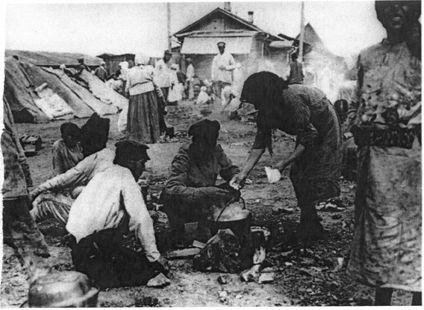
Famine refugees in a camp in the Volga region, 1921.

Above left: Lenin and army chief Kliment Voroshilov among Red Army soldiers who had just taken
part in crushing the Kronstadt revolt, 22 March 1921. The island fortress of Kronstadt, which had
been in the vanguard of Bolshevik support in 1917, had by 1921 become disillusioned and rose in
armed revolt, demanding a broad-based socialist government. Fifty thousand Red Army troops
crushed the rebellion, causing heavy casualties.
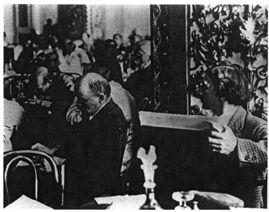
Above right: Lenin being sketched for a painting by I. Brodsky at the Third Comintern Congress,
June-July 1921.

Below: Lenin observing the testing of the first electric-driven plough, Moscow, 1921.

Above: The
‘triumvirate’ of Stalin,
Kamenev and Zinoviev
in Moscow in the early
1920s, with Rykov
(next to Stalin).

Left: Lenin and Stalin
at Gorki, Lenin's
country retreat. This
photograph has been
the subject of speculation
that Stalin had it
‘doctored’ to reflect his
intimacy with the
leader. The original
negative, held in the
archives, shows that
it was taken by Lenin's
sister Maria, and is
genuine.
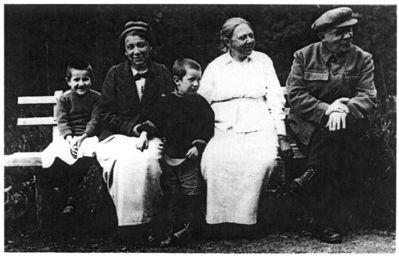
Lenin and Krupskaya with Lenin's sister Anna Yelizarova, her son Viktor, and the daughter of a
local worker, Gorki, August-September 1922.

Lenin in early August 1922.

Lenin and Krupskaya motoring around
Gorki with their chauffeur, P.S. Kosmachev,
and bodyguard, P.P. Pokaln,
August-September 1922.

Lenin and Krupskaya at Gorki with their
telescope, August-September 1922.

Lenin at Gorki in July-August 1923, showing
clear signs of a sharp deterioration in his
condition since the previous summer. His
sister Maria is with him. The male figure
is unidentified, possibly a physician.
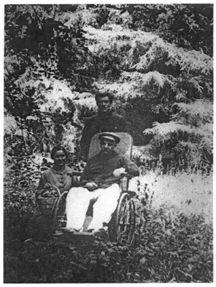
Lenin in the park at Gorki, accompanied by
P.P. and M.M. Pokaln, summer 1923.
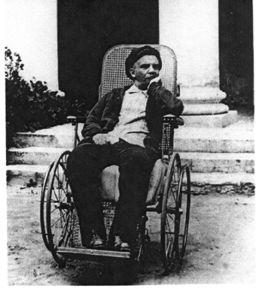
Lenin in the summer of 1923. Among the last pictures taken of him.


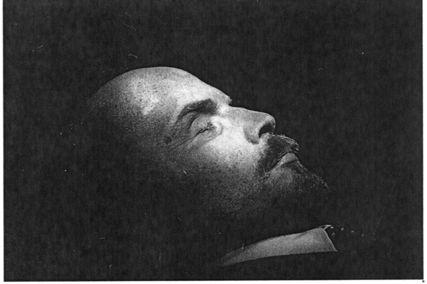
Lying in state, January 1924.

Lying in state. At the catafalque are secret police chief Felix Dzerzhinsky (third from left) and
Voroshilov (in army uniform).

A demonstration of Leninists in Moscow, 1992.

A protest against the handing-over of the Lenin Museum to the Moscow City Council, 1993.
Most significantly, Lenin was able to transmit his fanatical credo to a vast number of people. He succeeded, despite the delusionary nature of the idea. The delusion became reality, it materialized as the Soviet state, as a new way of life and new ideological institutions. Leninism, a term first used by Martov in 1904,2 displayed remarkable durability. As for the society he set out to build, he managed to lay only the foundations of the great new edifice before he was struck down by illness. To what extent did this illness affect his judgment and his functioning, especially in 1921 and 1922?
The Regime and the Illness
In December 1935 the head of the Kremlin medical administration, Khodorovsky, discovered in a secret archive the notes of the neurologist, the late Professor Kramer, who had treated Lenin. Khodorovsky naturally informed the authorities at once, but they had no intention of bringing the long-buried past to light, and consigned Kramer's notes to the secret archives of the Central Committee, where they remained untouched for more than fifty years.
Kramer had written that Lenin's terminal illness ‘lasted all in all about two and a half years, and its general characteristics harboured signs that all the neurologists, whether Russian or foreign, dwelt on as something that did not conform to conventional disease of the nervous system’.3 Lenin was seriously ill as early as the second half of 1921, yet he was working as hard as ever, and was under as great a strain as before. His schedule on one day, 21 June 1921, may serve as a good example. At 11 a.m. he arrived by car from Gorki and went straight to a meeting of the Politburo, where the agenda included a purge of the Party, the famine, the Third Congress of Comintern, taxes, the arrival of a US Senator, the forthcoming Moscow Party conference, a Chinese government proposal for the handing over of White Guards, the question of British representation in Petrograd, confirmation of Viktor Kopp as Russia's envoy in Berlin, and more. The Politburo usually dealt with between twenty and forty such items. Lenin listened more than he spoke, and also spent much of the time signing a pile of Sovnarkom and Party papers.
In the interval before the evening session, which began at six p.m., he had been engaged in his favourite occupation: writing or dictating notes. That day he wrote to at least a dozen government officials on matters ranging from food procurement in the North Caucasus to foreign trade, land use and educational policy; he read letters and cables, signed financial papers, mandates and permits, made numerous telephone calls, and so on. In the evening he chaired the Sovnarkom, which dealt with several dozen items. There he also wrote notes, signed documents, interrupted long-winded speakers, called for quiet, and showed signs of irritation if someone left the room or re-entered.
The stress, especially on someone who only in his forty-eighth year had discovered the meaning of state service, was enormous. Lenin's health suffered from the strain caused by having constantly to shift his attention from economic to political questions, from Party to diplomatic concerns and the endless receiving of visitors, as well as having to think about a mass of trivial daily affairs, dubbed ‘vermicelli’ by those inundated by them, or a tangle of incoherent problems. From having been an émigré spectator of Russian public life, and its sternest critic, he was now at the epicentre of the upheavals caused by his own policies.
His nervous system was seriously overloaded, and it had probably never been very strong. Lenin had always been excitable, losing his head and going pale when hearing of dramatic events or some new danger. Radek recalled that, when their train crossed the Swedish frontier in April 1917 and soldiers entered the compartment, ‘Ilyich began to talk to them about the war, and he went horribly white’.4 The sound of the violin put his nerves on edge, and he couldn't stand extraneous noise or bustle. Lydia Fotieva recalled that in July 1921, when his apartment in the Kremlin was being repaired, he ordered that the partition walls between the rooms be made ‘absolutely soundproof, and the floors absolutely free of squeaks’. People conversing during a meeting infuriated him.
Lenin complained about his nerves quite often. In February 1917 he wrote to his sister Maria: ‘I can hardly do any work at all because of my desperately bad nerves.’5 He had evidently known for a long time that he suffered from some sort of nervous condition, as there are among his papers the addresses of specialists in nervous disorders whom he seems to have consulted in Stuttgart in 1900.6 When he got excited he would work himself up into such a state of bellicosity that he would be ready to take extreme, even cruel measures. During the 1905 revolution, in a state of heightened excitement, he urged the revolutionaries to adopt tactics which most people would regard as abnormal and terrible: to fight against the Cossacks, he urged the use of knives, knuckledusters, sticks, paraffin-soaked rags, nails, slabs of gun-cotton, boiling water, stones and acid ‘to throw over the police’. He called for the Black Hundreds to be beaten up and killed, for Cossacks who had been accidentally separated from their troop to be attacked, and so on.7 The range of savage tactics is so broad and carefully thought out that it is hard to believe it emanated from an educated man, a writer and journalist. Such counsels of cruelty Lenin normally issued at moments of mental stress, nervous excitement or in extreme circumstances. At such times his powerful mind became simply possessed by revolutionary remorselessness.
A few years of Bolshevik power, with its attendant pressures, and Lenin's nervous vulnerability rose to the surface. It was especially noticeable after his first stroke, in May 1922, when Professor Kramer noted: ‘the basis of his illness is actually not only the overstrain of the brain, but also severe disorder of the blood vessels in the brain’.8 Disorder of the brain's blood supply is closely associated with mental dysfunction, which explains why most of the physicians who attended Lenin in 1922 and 1923 were psychiatrists and neurologists. According to the medical literature, mental illness, when caused by deterioration of the arteries of the brain, manifests itself as persistent headaches, irritability, anxiety, depression, fixed ideas. Lenin displayed all of these symptoms.
It is unlikely that we shall ever be able to establish the precise effect or importance of Lenin's illness on his actions when in power. He was perfectly capable of issuing cruel orders before the onset of his illness, notably in 1918. Nevertheless, those decisions, too, were taken at a time of heightened nervous tension: the greater the stress, the more radical and harsh the decisions. It seems clear that vast, unmonitored, unbounded power exacerbated the pathological tendencies in his mind.
We have seen that it was in August and September 1922 that Lenin initiated the expulsion of the Russian intelligentsia. The notion of deporting—in effect extinguishing—the flower of Russian culture could have occurred only to a sick or callous person. Yet only a month or two before those events, with Krupskaya's help, the sick Lenin was re-learning how to write, trying to solve elementary arithmetical problems and write the simplest dictations. He was covering pages with barely legible, crippled handwriting.9After his stroke in May he was having serious lapses of memory and reacting slowly to events. He was absent-minded: ‘He is unable,’ Professor Kramer noted, ‘to perform the simplest arithmetical functions, and he has lost the ability to recall even a few short phrases, while retaining his intellect in full.’10
There are certainly grounds for doubting the neurologist's assertion that Lenin had retained his intellect in full. His sister Maria recalled that when on 30 May ‘the doctors asked him to multiply 12 by 7 and he could not do it, he was very depressed. But then his old stubbornness reasserted itself. When the doctors had gone, he struggled for three hours over the problem and solved it by addition instead (12+12=24, 24+12=36 and so on)’.11 Yet within a month Lenin was taking such momentous decisions as the expulsion of the intelligentsia, approving ‘extra-judicial measures of the GPU, including executions’,12 and determining the tactics and strategy of Comintern.
Lenin was dangerously ill. The Politburo summoned physicians from abroad. Stalin sent instructions to the Soviet Ambassador in Berlin, Nikolai Krestinsky: ‘Take all necessary measures to persuade the German government to allow the physicians Foerster and Klemperer to leave for Moscow for the summer … Give Foerster 50,000 gold roubles (Klemperer will receive his in Moscow). They can bring their families, they'll be given the best conditions in Moscow.’13 Once there, these doctors plagued Lenin with their methodical ways. He wrote to Stalin: ‘I humbly request that you liberate me from Klemperer … I earnestly beg you to deliver me from Foerster. I'm more than happy with my own doctors, Kramer and Kozhevnikov.’14 His comrades, however, in their notes to each other on the matter, were not inclined to take any notice. Zinoviev suggested ‘leaving the Germans alone and reassuring Ilyich by telling him that a new examination is planned of all eighty comrades previously examined by the Germans’. The Politburo agreed to this proposal.15
Lenin was adamant that he be kept informed about political affairs. He wrote to Stalin:
The doctors have apparently created a legend which cannot be left unrefuted. They lost their heads when I had a serious attack on Friday and they have committed a particular stupidity: they tried to forbid ‘political’ meetings (having little idea of what that means). I was extremely annoyed and sent them packing. Kamenev came to see me on Thursday. We had a lively political conversation. I had a wonderful sleep and feel marvellous. On Friday came the paralysis. I ask you urgently, in case the illness gets worse and I don't have time to say it. Only idiots are capable of blaming political discussions. If I sometimes get agitated, it's because of the lack of timely and competent conversation. I hope you understand and you'll get rid of the idiotic German professor and company. You must come and tell me about the Central Committee plenum, or send one of the participants …16
For Lenin, life was politics and politics was life.
Lenin was ill, yet there was no serious call for him to lay down the burden of office and resign. In the course of conversation in the summer of 1922 he did mention on several occasions that if he could not continue in political life, he would try agriculture. His sister Maria recalled that he talked about cultivating mushrooms and breeding rabbits, but that he was obviously not serious.
As much as the physical effects of the illness itself, being cut off from current affairs caused Lenin profound bitterness and constant irritation. He was depressed by his inactivity, and he realised that the greater his comrades' concern for his well-being, the more they distanced him from government, and consequently the more exasperated he became. Power had always been the meaning of life for him, and, however ill he might be, he was not about to give it up.
He did not, however, conceive of power in personal terms, but as something much broader than an individual's participation in government. Ioffe once wrote to him, suggesting that he personified the Central Committee. Lenin replied in emphatic terms: ‘You're wrong when you say (more than once) that “the Central Committee—that's me,” [a variation of “I'état, c'est moi”]. That could only have been written in a state of great nervous agitation and exhaustion.’17 Ioffe's remark was intended to indicate Lenin's huge personal influence, and that, as Chairman of the Sovnarkom and the Council of Labour and Defence, and a member of the Politburo, his style of leadership made a marked impression on those around him. He was, in the words of V.S. Voitinsky, ‘surrounded by an atmosphere of unconditional submission’, and his comrades looked at the world ‘with the eyes of Ilyich’.18
Lenin was depressed by his constant headaches, and was pessimistic about his chances of recovery. On 14 June 1922, after a brief spasm of the blood vessels in his head, he told Kozhevnikov: ‘So, that's it. It'll be a stroke.’ At the beginning of the winter of 1923, again following a spasm lasting several minutes, he told Kramer and Kozhevnikov: ‘So, one day I'll have a stroke, just as a peasant once told me I would many years ago. “As for you, Ilyich,” he said, “you'll die of a stroke.” When I asked why he thought so, he replied: “It's that terribly short neck of yours.”’ Although Lenin tried to treat it as a joke, it seemed he feared the peasant might be right.19
He was oppressed by forebodings, and could not help noticing that he was losing the intellectual capacity to work as he once did. He summoned Professor Dorshkevich and told him he was suffering from insomnia and a lack of ‘mental quiet’. Dorshkevich observed: ‘first, a mass of extremely serious neurasthenic phenomena, depriving him totally of the possibility of working as he used to, and, secondly, a number of obsessions which cause the patient much anxiety.’ ‘Doesn't all that suggest madness?’ Lenin asked. Dorshkevich replied: ‘Obsessions are difficult for the patient to bear, but they never involve mental disorder.’20
The many doctors who attended Lenin after 1921 began to record a history of his illness from 29 May 1922. Kozhevnikov, a very perceptive physician, kept a record for a year; Professor Kramer maintained a diary from 6 May to 4 July 1923, while Professor Osipov, former head of psychiatry at the St Petersburg Army Medical Academy, and one of the leading specialists in the field, recorded the final and fatal phase of the illness.
As these records show, even when Lenin had been incapacitated by a second stroke, all his thoughts were of the Politburo, the Sovnarkom, the Kremlin. He could not believe that the power he had so unexpectedly and so recently acquired was now passing into other hands because of his illness. He fought back, and kept hoping to return to the summit. Notes relating to the period from 3 October 1922, a period of relative recovery, to the second stroke in December of that year, are illustrative. The dates indicate short periods of time, rather than a single day.
10 October: Kozhevnikov and Kramer chatted with Lenin after an evening session at the Sovnarkom. ‘The toothache had nearly gone, but his nerves have been shattered by the earlier illness and he kept wanting to weep, tears were welling up in his eyes, but Vladimir Ilyich just managed to suppress them; he did not cry once.’
29 October: The doctors were at Kamenev's, where Stalin and Zinoviev were also present. ‘Kamenev reported that at the last session of the Sovnarkom Vladimir Ilyich had criticized a point in a draft law, then did not notice that he had begun reading the same page again, though a different point, and was criticizing it again without realizing that this point had a completely different content.’
31 October: At 12 noon Lenin spoke at the VTsIK, his first appearance in public since the stroke in May. ‘He spoke firmly in a loud voice, he was calm and did not go wrong once … At home he listened to music, the piano, and was not upset, though he couldn't listen to the violin, as it has too great an effect on him.’
13 November: ‘Vladimir Ilyich spoke at the plenum of the Comintern Congress and gave a speech in German lasting one hour. He spoke fluently, without faltering, and did not lose his place … After his speech he told Doctor Kozhevnikov that at one place he forgot what he'd said and what he still had to say…’ He reported that the day before he had had ‘a very brief paralysis in the right leg’.
In his speech at the Comintern Congress, Lenin had made a frank confession: ‘We have committed and will still commit a vast number of stupidities. No one can see this better and more plainly than I.’ After a succession of international defeats, he had obviously cooled towards the world revolution. He described its prospects as ‘favourable’, but did not dwell on it. At the end of his speech he made some cautious remarks about Italian fascism, which might perform ‘great service’ by showing the people that ‘their country is not yet secure from the Black Hundreds’.21Nothing in the speech itself indicated that it had been written and delivered by a sick man. But it cost Lenin an enormous effort and the utmost strain, and at the end of it he was soaked in perspiration. The doctors continued their observations and treatment. The Journal of the Duty Physician continues:
25 November: Lenin was walking along the corridor when his legs went into spasm. He fell down. He got up with difficulty. After consultation with the doctors it was decided he should not take part in the general meetings of the Congress and should rest for an entire week.
12 December: He was back in his Kremlin office, where he saw Rykov, Kamenev, Tsyurupa, Dzerzhinsky and Stomonyanov. He gave his approval by telephone for the expulsion abroad of several ‘anti-Soviet elements’. A normal working day.
13 December: ‘Doctor Kozhevnikov and Professor Kramer visited Vladimir Ilyich … he is having paralytic attacks every day. This morning he had a small paralysis in bed, and another in the hip-bath … Vladimir Ilyich is upset and worried by the deterioration in his condition.’
16 December: 'His condition has worsened. He can write with difficulty, but what he writes is illegible, the letters overlapping each other. For thirty-five minutes neither the right hand nor right leg were capable of any movement. He could not touch the tip of his nose with the tip of his finger.22
Almost every day the doctors were recording: ‘he became agitated towards evening’, ‘his mood is worse’, ‘his mood is bad’, and so on. The isolation from political life was a torment, Lenin could no longer write as he used to, he was being shown practically no documents or papers to sign, even though he did attend a few more sessions of the Sovnarkom, the Politburo and some other meetings. Together, his doctors and his Party comrades protected him from the turmoil of life in Russia by wrapping him in cotton wool. The Politburo had already decided, on 20 July 1922, that ‘Comrade Lenin should have absolutely no meetings’ without its permission.23 Stalin was entrusted with the task of ensuring this rule was followed. After Lenin's improvement in October, however, there were lapses, and people started visiting him again. It seemed he was re-entering the fray. But his mood was uneasy. He was aware of how much he had deteriorated.
Lenin was in a hurry. There were still things he wanted to do, things he wanted to say. He was still capable of speaking, and he set about dictating his last notes and letters from 23 December 1922 to 2 March 1923. On 23 December he dictated to M.A. Volodicheva part of his famous ‘Letter to the Congress’. It opened with a drastic proposal that augured yet another sharp alteration of course: ‘I would strongly advise that this congress adopt a number of changes in our political system.’ In fact, Lenin was not capable of making such changes. It was this system after all that gave him power and the hope of achieving the goal of world revolution. He did not want to change anything in the Party's strategy, but only certain aspects of an operational and tactical nature, essentially to increase the number of Party members by bringing in more workers.
The next day, the doctors went to see Stalin, Kamenev and Bukharin. They reported on Lenin's condition, and on the fact that he had been dictating the day before. The trio decided, after the event, that the patient ‘should have the right’ to dictate every day for five to ten minutes, ‘but it should not be correspondence and Vladimir Ilyich should not expect to receive replies to these notes’.24 Lenin continued to dictate his ‘Letter to the Congress’ on 24, 25 and 26 December, returning to it again on 4 January 1923, when he dictated his famous postscript on the personal qualities of his comrades, especially Stalin and Trotsky.
What was it he wanted to say? He was concerned above all about unity in the Party, the danger of a split in the Central Committee, and the bureaucratic character of the administration, although he showed no awareness of the roots of this last danger. He was obsessed by one idea, namely that more workers and peasants be brought into the Central Committee and the Party organization, the apparat. He believed that ‘workers, by taking part in all Central Committee meetings, all sessions of the Politburo and reading all the Central Committee papers, can become a body of dedicated supporters of the Soviet system’.25 The naive idea at the heart of this proposal was that by changing personnel, one could change everything. Stalin, Khrushchev, Brezhnev, Andropov, Chernenko and Gorbachev were all of peasant or worker origin, as were nearly all the members of the Politburo and Central Committee, yet bureaucratism soon became the very essence of the Leninist system. Individuals and their social origins were not the problem.
Although Lenin's ‘Letter to the Congress’ does not nominate his successor, it does, however, name those who in his opinion did not fit the part. He wanted this document, which came to be known as ‘Lenin's Testament’, to be kept a strict secret. He ordered that five copies be kept in wax-sealed envelopes, which only Krupskaya was to open after his death, but Volodicheva did not write this instruction on the envelopes. Lenin was already being written off, not only by his comrades, but even by his administrative secretaries. Fotieva, the chief secretary of the Sovnarkom, informed Stalin, and shortly afterwards several other members of the Politburo, of the contents of Lenin's notes, thus giving Stalin the opportunity to neutralize their effect. Since Lenin was still alive during the Twelfth Congress, his notes had to remain ‘secret’. Stalin, forearmed, had time to secure the support of his comrades for the Thirteenth Congress.
Even before his ‘Letter to the Congress’, on 21 December Lenin had dictated a note to Trotsky on the foreign trade monopoly. Hearing of this, Stalin, who since 18 December had been responsible for maintaining Lenin's prescribed regime, roundly abused Krupskaya in the coarsest language, as we have seen. On 23 December she reported the incident to Kamenev, protesting that she knew better than anyone, including the doctors, what topics it was permissible to discuss with Lenin, ‘as I know what upsets him and what does not, at any rate I know better than Stalin … I'm human, too, and my nerves are strained to breaking point.’26 It was not until the beginning of March 1923 that she told Lenin about what had transpired.
Lenin's ‘Letter’ played a fatal part in intensifying the struggle for power. However one reads the text, it is plain that Trotsky, despite his excessive arrogance, was seen as ‘the most capable man in the present Central Committee’, while Stalin was ‘too rude’ and unlikely to exercise power with due caution.27 The result was that, while seeking to avoid a split, in fact Lenin increased the likelihood of just such an outcome.
The impact of the ‘Letter’ was dramatic. It was brought to the attention of the delegates at the Thirteenth Congress, but with the recommendation that Stalin be left in place as General Secretary, on condition he curb the defects Lenin had mentioned. It was then buried for decades in the deepest recesses of the Party archives. The system created by Lenin would have found its Stalin in any event. The country might have been spared the monstrous experiments of Stalinism, but the one-party ‘dictatorship of the proletariat’ would inevitably have led to an authoritarian regime. Therefore, the importance of Lenin's ‘Letter’ has probably been overstated: he was not proposing ‘changes in our political system’.
Up to the beginning of March 1923, Lenin dictated letters and articles on the legislative functions of the State Planning Agency, on the national question, on agricultural cooperatives, the peculiarities of the revolution and the Workers' and Peasants' Inspectorate, which Stalin controlled and which was responsible for recruitment for the Party. In 1929, on the fifth anniversary of Lenin's death, Bukharin gave a speech on ‘Lenin's political testament’, in which he described these last works of the leader as ‘a future plan for all our Communist work’ and ‘Lenin's plan for socialist construction’.28 For decades this definition was used, although its author's name was not mentioned—especially when the hapless Bukharin was awaiting execution.
While there were political and practical merits in some of Lenin's last thoughts, notably on the national question and cooperatives, and although he could even speak of ‘changing our entire view of socialism’,29 much of what he had to say was devalued by his entrenched political motivation: all this was necessary because ‘the whole world is now shifting towards a movement that must give rise to a world socialist revolution.’30
It is remarkable that Lenin was capable of dictating these lengthy works in such a short time, especially taking into account the sharp deterioration that took place in his condition during the nights of 16 and 22 December. Professor Kramer, moreover, recorded on those occasions that Lenin had shown symptoms of memory-loss. The ‘undulating’ form of the illness and its ‘unusual course’ were also noted by the other physicians, Strumpfell, Hentschell, Nonne, Bumke, Foerster, Kozhevnikov and Yelistratov.31 It was as if nature had given Lenin one last chance to have his say, and he seized it with all his strength. Plainly, he feared political extinction more than physical death, and although his comrades regarded his last notes as little more than his political death throes, Lenin was still fighting. He could not let go of the meaning of his life—political struggle, political leadership, political ambition.
The Politburo had given Lenin extended leave, lasting in effect from the middle of 1921. After May 1922, it seems, many Politburo members no longer expected him to recover, and they threw in their lot with the new arrangement of forces. The Central Committee's rules about ‘Lenin's medical regime’, which virtually isolated him from political and social life, were thus not entirely altruistic in their intent. While Lenin was learning to speak and write again at Gorki, the other leaders were preparing the ground for the decisive clash over personal power and influence. Stalin, Kamenev and Zinoviev did not conceal their fears about Trotsky, who appeared to have made up his mind some time ago that he was Lenin's natural successor, that the post had been reserved for him by the logic of history.
Lenin, although still hoping for recovery, was having more frequent thoughts about death. Several times in conversation with Krupskaya he mentioned the joint suicide of Marx's younger daughter Laura and her husband Paul Lafargue in 1911; he became interested in medical literature, and he asked Krupskaya to give him poison if his condition became hopeless. He often greeted the physicians with near-hostility. Naturally, all his fears were answered by assurances of a complete recovery.
Lenin began to be interested in what people were saying and writing about him. He reread Gorky's article ‘Vladimir Ilyich Lenin’, asked for a copy of Trotsky's ‘The National Element in Lenin’ and articles by Bukharin and other comrades which praised him, and wanted to hear the messages of goodwill that were coming in from all over the country, something that had never concerned him before. He wondered how he would be remembered, what he had given the people, what he had achieved.
Lenin now had the opportunity to look back over his life with a degree of detachment, and to assess it philosophically. There is no evidence in his last conversations, his notes or his articles, that he felt repentant about anything. He regarded mistakes, miscalculations and failures as a natural part of the process. He felt no remorse at having buried the social democrats in Russia, or at the destruction of the Romanov dynasty, the execution of Fanya Kaplan, the elimination of the SRs, the banning of the non-Bolshevik press, the expulsion of the Russian intelligentsia, the destruction of the provincial administration, the squandering of a vast part of the country's wealth on the world revolution. For Lenin, the end always justified the means.
The Long Agony
Lenin was no longer in control of his own fate. Professor Kramer recorded that hope for a recovery was sustained until March 1923, even though in February there were renewed signs ‘of breaks in his speech, at first negligible, but then more significant, though always fleeting … Vladimir Ilyich was finding it hard to recall either a word he wanted, or he was unable to read what he had dictated to the secretary, or he would begin to say something completely incoherent.’32 Krupskaya was his best ‘interpreter’, and she bore her heavy burden with remarkable stoicism.
After the unforgettable telephone conversation, Stalin bothered her no more; he simply ignored her. Evidently now certain that Lenin would not recover, he was finding his responsibilities onerous. On 1 February 1923 he read a statement to the Politburo, asking to be relieved of having ‘to observe that the regime established by the physicians for Comrade Lenin is carried out’. The response was a unanimous ‘no’.33
In early March 1923 Lenin was diverted by the so-called ‘Georgian affair’. A conflict had arisen the previous autumn over Stalin's plan, as Commissar for Nationalities, to integrate the three Caucasian republics, Azerbaidzhan, Armenia and Georgia, as autonomous bodies within the Russian Federation. (The plan also included other republics, but the conflict arose in the Caucasus.) The Georgian Bolsheviks, while accepting that economic integration of the region made sense, were adamantly opposed to relinquishing their political independence. The conflict had prompted Lenin to propose an arrangement which in effect led to the foundation of the USSR in December 1922. Instead of uniting the republics to the Russian Federation, he wanted to offer them apparently equal status as federal parts of a union; a union, moreover, which would govern Russia, not the other way round. Stalin stuck to his own agenda, however, and the conflict in Georgia now became a conflict between the ailing leader and his strutting lieutenant.
By March 1923 the situation in Georgia had deteriorated to the point where Ordzhonikidze,* frustrated by local resistance and procrastination, physically assaulted a local Bolshevik. For Lenin, when he heard of it, this represented nationalist oppression at its worst: assimilated non-Russians behaving worse than Russian bullies. Lenin did not approve of Georgian Bolshevik ‘nationalism’, but at this moment he thought it a lesser evil than ‘great state chauvinism’. He regarded the national question—i.e. the policy for holding the great multi-national country together—as a matter of primary importance, and dictated a note to Trotsky to ‘take it on yourself to defend the Georgian affair at the Central Committee. This affair is at present being “prosecuted”* by Stalin and Dzerzhinsky, and I cannot depend on their impartiality.’34 Trotsky, realizing no doubt that to accept would lead to open conflict with Stalin, declined the invitation, pleading ill health. He was content to wait.
The next day, having learned of Trotsky's refusal, Lenin dictated the last letter of his life. It was addressed to the Georgian Bolsheviks: ‘I am following your case with all my heart. I am appalled by Ordzhonikidze's crudeness and the tolerance of it shown by Stalin and Dzerzhinsky. I am preparing notes and a speech for you.’35 He would be unable to keep this promise.
The day before, however, a significant, if little noticed, event had taken place. Lenin, annoyed by Stalin's conduct of the Georgian affair, and feeling as if he was being held almost under house arrest by the high-handed General Secretary, was discussing these troubling thoughts with Krupskaya. As she listened to his disjointed complaints, she felt she could remain silent no longer, and told him about the way Stalin had abused her on the telephone two and a half months earlier. Lenin's sister Maria described that occasion in her notes: ‘Stalin called her on the phone and, apparently counting on it not getting to V.I., started telling her, in a pretty sharp way, that she shouldn't talk business with V.I., or he'd drag her before the Party's Control Commission. N.K. was terribly upset by the conversation; she was quite beside herself, sobbing and rolling on the floor and soon.’36
Lenin was up in arms when he heard about this incident. Ignoring Krupskaya's entreaties, apparently that day he dictated a letter which indicated exactly what he thought about Stalin. The letter, which opens with an uncomradely formal address, was marked ‘Top secret’ and ‘Personal’, but copies were sent to Kamenev and Zinoviev.
Respected Comrade Stalin,
You had the gall to call my wife to the telephone and abuse her. Although she agreed to forget what was said, she nevertheless told Zinoviev and Kamenev … I have no intention of forgetting what has been done against me, as it goes without saying that what was done against my wife was done against me. Therefore I must ask you to consider whether you are prepared to take back what you said and apologize, or whether you would rather break off relations between us.
With respect,
Lenin37
Lenin had strained relations with Stalin to the limit, and unthinkingly made his wife an object of his successor's ill will for the rest of her life. The weak condition of Lenin's nervous system could not bear such stress. As Kramer noted, the constant breaks in speech function and paralysis of the extremities ‘led on 6 March, for no obvious reason, to a two-hour attack, presenting as total loss of speech and complete paralysis of the right limbs’.38 The physicians were, of course, not privy to the drama that was being enacted between Lenin and Stalin. While they were busy with Lenin, Stalin transmitted his reply to Lenin via Volodicheva, but it could hardly have been read to him, in view of his sharply worsened condition.
The letter has lain in Stalin's secret archive for decades. Handwritten on three sheets of his own General Secretary's headed paper, it opens baldly, with no customary ‘Respected’ or other form of address than plain ‘Comrade Lenin’, and its general tone is openly disrespectful:
Five weeks ago I had a conversation with Comrade Nadezhda Konstantinovna, whom I regard not only as your wife but as my old Party comrade, and I said roughly the following to her (on the telephone): ‘the doctors have forbidden [us] to give Ilyich political information, as they regard this as the most important way of curing him. It turns out, N.K., that you are not observing this regimen. We must not play with Ilyich's life,’ and so on. I do not regard anything I said as crude or impermissible, or aimed against you, for I had no other purpose than your earliest recovery. Moreover, I regarded it as my duty to see that the regimen was observed. My conversation with N.K. confirmed that my suspicions were groundless, nor could they be otherwise. Still, if you think that to maintain our ‘relations’ I should take my words back, then I can take them back, though I refuse to understand what the problem was, where my fault lay and what it is people want of me.
I. Stalin.39
Krupskaya wrote in her memoirs of ‘The Last Six Months of the Life of Vladimir Ilyich’ (published only in 1989) that ‘his last illness falls into two periods. In the period lasting from July, there was further deterioration. This period was connected with much physical suffering and bad nervous upsets.’40 On 7 and 8 March it appeared that Lenin's attack on the sixth had been transitory, especially as on the tenth he gave Krupskaya to understand that he felt better.41 But Dr Kramer's notes show that on that evening he suffered another attack, leading to ‘stable changes both in speech function and the right limbs’.42
As soon as the leadership heard about the stroke, Zinoviev convened a meeting, consisting, according to the minutes, of ‘available members’. In addition to Zinoviev, those present were Trotsky, Molotov and Rykov. Telegrams were sent to Kalinin, Kamenev, Kuybyshev and all the members of the Central Committee, informing them of Lenin's worsening condition.43
A swarm of doctors was rushed to Lenin from Moscow, while telephone calls were made to Krestinsky in Berlin, urging him to send the best therapists, neurologists and psychiatrists. On 15 March the Politburo agreed to widen still further the range of physicians and ‘to bring in all the medical expertise that might be at all helpful in establishing a diagnosis and cure for Comrade Lenin’.44 Krestinsky reported from Berlin that Professors Minkovsky, Strumpfell, Bumke and Nonne were on their way, and that he was still ‘working on’ others. Questions were clarified as to whether they should be paid in pounds, dollars or marks.45 It seemed these experts were not enough, as Stalin cabled a Soviet emissary in Sweden, Simanovsky, to hire the famous specialist Hentschell. He promptly demanded a fee of 25,000 Swedish crowns, to which Moscow agreed without demur.46
After 11 March, when regular bulletins on Lenin's state of health began being published, suggestions started arriving for yet more doctors to be called in. For instance, Clara Zetkin drew the Kremlin's attention to Professor Oskar Vogt, ‘who in his time has treated Adolf Heck, Jules Guesde, Wurm and others’. He was, she said, ‘a Communist by conviction and he has a world reputation’.47 The Politburo supported Zetkin's proposal, but according to Zinoviev, when Professor Foerster was asked for a view, he was opposed.48 The Soviet consul in Mongolia reported that the local People's Party wanted to send a Tibetan doctor, and added that, ‘for political reasons it would be very desirable if he went to Moscow’.49
On 21 March Hentschell, Bumke, Nonne, Foerster, Kozhevnikov, Yelistratov and Kramer reported that Lenin's condition had deteriorated; he now manifested sensory aphasia, that is, he had difficulty understanding what was being said to him. By then, however, another incident had taken place, which revealed the extreme state of Lenin's mood.
Maria Ulyanova wrote in her memoir of Lenin's last six months that
in the winter of 1920-21 or 21-22 V.I. was very, very bad. Headaches and an inability to work troubled him deeply. I don't remember exactly when, but at some time during that period, V.I. told Stalin that he would very likely end up being paralysed, and he got Stalin's word that in that event he would help him get hold of some potassium cyanide. Stalin promised. Why did V.I. ask Stalin? Because he knew him to be a firm, steely man, devoid of sentimentality. There was no one else of whom he could ask such a thing.
She returns to this topic elsewhere:
V.I. made the same request to Stalin in May 1922, after his first stroke. V.I. had decided that he was finished and asked for Stalin to come to him for the shortest possible time. He was so insistent that it was decided he should be indulged. Stalin stayed for literally no more than five minutes. And when he came out, he told me and Bukharin that V.I. had asked him to get some poison, as the time to fulfil his earlier promise had arrived. Stalin had promised, they had embraced and Stalin had left. But then, after discussing it together, we decided we must give V.I. courage, so Stalin went back to V.I. again and told him that, having talked to the doctors, he was convinced that all was not yet lost … V.I. was visibly cheered and agreed. Though he did say to Stalin: ‘You aren't fooling me?’ To which Stalin replied, ‘When did you ever see me try to fool anyone?’50
Maria's memoirs, although they are not always accurate, are nevertheless clear that the thought of suicide was in Lenin's mind from the moment the illness struck him.
The archives, however, hold a more reliable document—a ‘strictly secret’ letter from Stalin to the Politburo, dated 21 March 1923:
On Saturday 17 March in the strictest secrecy Comrade Ulyanova (N.K.[Krupskaya]) told me of ‘Vladimir Ilyich's request to Stalin’, namely that I, Stalin, should take the responsibility for finding and administering to Vladimir Ilyich a dose of potassium cyanide. In our conversation N.K. said, among other things, that ‘Vladimir Ilyich is suffering unbelievably’, that ‘to go on living is unthinkable’, and she stubbornly insisted that I ‘not refuse Ilyich's request’. In view of N.K.'s insistence and also because V. Ilyich was demanding my agreement (V.I. twice called N.K. to go to him during my conversation with her in his study, where we were talking, and emotionally asked for ‘Stalin's agreement’, causing us to break off our conversation twice), I felt it impossible to refuse him, and declared: ‘I would like V. Ilyich to be reassured and to believe that when it is necessary I will fulfil his demand without hesitation.’ V. Ilyich was indeed reassured.
I must, however, state that I do not have the strength to carry out V. Ilyich's request and I have to decline this mission, however humane and necessary it might be, and I therefore report this to the members of the Politburo.
The reactions of the Politburo were summed up in an informal resolution: ‘I have read it. I propose that Stalin's “indecisiveness” is correct. There should be an exchange of opinion strictly among Politburo members. Without (administrative) secretaries. Signed Tomsky, G. Zinoviev, Molotov, N. Bukharin, Trotsky, L. Kamenev.’51
Stalin had already written to Zinoviev and Kamenev, evidently on 17 March, to report on his visit: ‘Nadezhda Konstantinovna just summoned me and told me in strict secrecy that Ilyich is in a “terrible” condition, he's having fits, “he doesn't want to live and can't live any longer and is asking for potassium cyanide, without fail. She told me she tried to give him cyanide but had “lost her nerve”, which is why she is asking for “Stalin's support”.’ Zinoviev and Kamenev wrote on Stalin's note: ‘This must not happen. Foerster is hopeful, how can we? And even if that wasn't the case! It mustn't, mustn't, mustn't happen!’52
There are certain aspects of these letters that require elucidation. It is unclear, for instance, quite how Lenin, who had lost the power of speech, could have requested ‘a dose of potassium cyanide’. Perhaps using sign-language? Stalin emphasizes several times that Nadezhda Konstantinovna ‘stubbornly insisted’ he be given cyanide, and even that she had tried to administer it to him herself. But where would she have obtained the poison? Had it been prepared at some earlier date? Had Stalin delivered it? These are questions to which no answers are available.
There is another no less important circumstance: on each occasion, Stalin promised to give the poison ‘without hesitation’. He considered it, moreover, a ‘humane and necessary mission’. To have carried out this mission would have accelerated the process of appointing Lenin's successor, for while the physicians were busy with their patient, the Politburo was the scene of a struggle for power. No expense or effort was spared to help Lenin, but perhaps this was rather in order to demonstrate loyalty to Leninism, the idea, the leader's cause, than in any real hope of a cure. Whoever called for the most effort would look the most loyal.53
From the published bulletins, it was impossible to guess Lenin's real condition. On 14 March 1923 it was reported that he was having difficulty speaking and moving his right arm and leg, but also that ‘his general health is improved, his temperature is 37.0, his pulse 90, steady and full’. On 17 March, ‘along with the continuing improvement in speech function and movement of the right arm, there is a noticeable improvement in the movement of the right leg. His general health continues to be good.’54
Many thought that Lenin's condition was simply due to exhaustion. Party organizations were sending telegrams to the Kremlin asking how he really was. From Tiflis (Tbilisi), Ordzhonikidze cabled Stalin: ‘Let me know Ilyich's true condition.’55 The Central Committee was by now, however, expert at manipulating information, and only what was regarded as necessary to maintain political calm was released. Speaking at the Seventh All-Ukrainian Party Conference on 5 April 1923, Trotsky declared: ‘When we discussed the first bulletin on Lenin's health in March, we were thinking not only of his health, we also thought about the impression this number of blows to his heart would make on the political pulse of the working class and our Party.’ Trotsky also set the tone for judging Lenin's role: ‘No one in the whole of history has had historical influence of sufficient scale to enable us to measure Lenin's historical importance.’56
Each leader took pains to demonstrate his own loyalty to Lenin, to his ideas and aspirations, although it was plain to all of them that his active political life was over, and that they must prepare themselves for the end.
The Journal of the Duty Physician following the stroke of 10 March 1923 gives a detailed account of Lenin's true condition:
11 March: Doctor Kozhevnikov went in to see Vladimir Ilyich at 11.15 a.m. His colour was pale and sallow, the expression on his face and in his eyes sad … He kept trying to say something, but only quiet, disjointed sounds emerged … Today, especially towards the evening, his comprehension of what was being said to him was worse, sometimes he replied ‘no’ when he should have said ‘yes’.
12 March: Professors Minkovsky and Foerster came today. Doctor Kozhevnikov went with them from the station to the Politburo and then to see Vladimir Ilyich … He appears to be fully conscious, but has total motor aphasia and today can say nothing … He cannot understand what he is asked to do. He was shown a pen, his spectacles and a paper-knife. When he was asked to give the spectacles, he gave them, when he was asked for the pen, he gave the spectacles again (they were lying closest to him) … After the visit, the doctors went again to the Politburo.*
17 March: After the doctors' visit, Lenin ate a good dinner. After a short time he wanted to express either an idea or a wish, but neither the nurse, nor Maria Ilyinichna, nor Nadezhda Konstantinovna could understand him. He became agitated and was given a bromide and Maria Ilyinichna called Doctor Kozhevnikov …
21 March: Another consultation took place with the addition of Hentschell who arrived today. After it they all went to the Kremlin. Vladimir Ilyich greeted them all [Strumpfell, Hentschell, Bumke and Nonne], but was evidently not happy about this invasion. Strumpfell made the examination, the others merely being present. When Nonne approached Vladimir Ilyich, he made a gesture with his hand as if asking him to move back …57
The patient was losing confidence in his doctors.
In May, however, Lenin seemed to be making a slow recovery. He would be taken out onto the veranda of the Kremlin apartment, and on the fifteenth he was transported, with a team of doctors and virtually at snail's pace, to Gorki. Kozhevnikov noted that ‘he has become stronger physically, has begun to show an interest in his own condition, as well as in his surroundings, he has recovered from the sensory aphasia and begun to learn to speak’.58 S.M. Dobrogaev, a physician specializing in speech therapy, worked with Krupskaya, who then herself undertook to help Lenin recover his power of speech.59
According to the medical notes and the research carried out by B. Ravdin,60 after 10 March Lenin's vocabulary was limited to a few monosyllabic words. ‘Vot-vot’ became a catch-all term that he used to express agreement, objection, a demand, annoyance, a request or just to keep a conversation going. As a rule, the use of individual words was accidental, and even when he repeated them, they were meaningless. Following Krupskaya's instruction, he learned to say ‘congress’, ‘cell’, ‘peasant’, ‘worker’, ‘people’ and ‘revolution’. She used alphabet cards and basic exercises, but without her help he was incapable of saying even a single word that he had already repeated after her. His brain was dying.
The artist Yuri Annenkov, who had painted Lenin's portrait in 1921, left an interesting account of his visit to Lenin in December 1923: ‘Kamenev took me to Gorki to do a portrait, or rather a sketch, of the sick Lenin. Krupskaya greeted us. She said there was no question of a portrait. And, indeed, reclining on a chaise-longue, wrapped in a blanket and looking past us with the helpless, twisted, babyish smile of a man in his second infancy, Lenin could serve only as an illustration of his illness, and not to model for a portrait.’61
It would appear that the numerous ‘reminiscences’ of meetings and ‘conversations’ with Lenin after March 1923 must either be mystification or politically motivated fabrications. Sometimes these were intended to show that Lenin would soon return to the helm of Party and state. As Ravdin has noted, Lunacharsky, speaking in Tomsk in May 1923, declared: ‘Vladimir Ilyich's arm and leg, that have been slightly paralysed, are recovering; his speech, which was at one time unclear, is also recovering. For a long time now, Vladimir Ilyich has been able to sit in an armchair, he can converse quite calmly, whereas before he was often very upset by his unclear speech.’62
There were many examples, after Lenin died, of official accounts which set out to show not the human tragedy of his end, but ‘the greatness of the sick leader’. For instance, one of his bodyguards, S.P. Sokolov, related that in the autumn of 1923 an armchair was delivered to Gorki as a gift from the Communist Party of Great Britain. Lenin thought for a while, and then mentioned a commissar who had lost both legs at the front: ‘Let's send the armchair to him. He's not going to be walking again. And for the moment I don't need it.’63 The production-line of myths was rolling.
After his stroke on 10 March Lenin completely lost the ability to indulge in one of his favourite pastimes, that of writing notes. Together with his loss of speech, this made communication impossible. With desperate endeavours, Krupskaya tried to revive some minimal capacity for elementary social intercourse. She gave Lenin almost daily exercises in the use of his left hand, which, like his vision, was not functioning properly (his right hand was completely paralysed). The Journal of the Duty Physician records that Lenin was ‘given biscuits, but for a long time he could not put his hand straight onto the plate and kept putting it around it’.64
The obstacles facing the patient and his long-suffering wife can easily be imagined. A teacher by profession, Krupskaya tried to revive from scratch Lenin's ability both to speak and to write. The first words he wrote, her hand on his, were ‘mama’ and ‘papa’. According to the official biography, ‘Thanks to his exceptional willpower, courage and persistence, in a relatively short time he accomplished improvements which would normally take months.’65 In fact, none of these ‘improvements’ led to the revival of either speech or writing ability.
Krupskaya's efforts, and those of the physicians, nevertheless produced some improvement in the second half of 1923; Lenin was now capable of shuffling across the room very slowly with the aid of a stick; with sign-language and gestures and his ‘vot-vot’, he was able to communicate in an elementary way. Professor Kramer noted: ‘In November and more so in December he was able to say a few words without prompting, he learned to write better with his left hand, he could read, or at least look through the newspaper, always pointing precisely at what interested him.’66
Lenin's basic abilities were returning slowly, but there was no sign that his mental strength was intact. The statements for the press and the Party organization, which had maintained an optimistic note, ceased after 16 May 1923 with Bulletin No. 35. The feeling arose among the population that Lenin must be improving, and that a complete recovery could not be far off. Behind the scenes, however, a greater frankness ruled. On 26 September Zinoviev reported at a Party meeting:
Roughly since 20 July V.L's health began to improve and continued to do so noticeably each day … For three days he has been able to walk, with someone next to him just in case … He has been out in a car … The worst thing has been his speech, but even here there is improvement … As for unprompted speech, that's bad … When the improvement began, he couldn't form one syllable out of two letters. Now that's improving, too …
The question was raised of his moving somewhere in the South. We all suggested the South, but the doctors were against it, and so was V.I., which was the main thing. [Professor] Osipov says, evidently he is conservative in his personal life and so is decisively against any [trip to the] South …
The newspapers are read to Vladimir Ilyich, at first with cuts, now without. They read him the headlines and he chooses what he wants to have read and what not … Nadezhda Konstantinovna told him about the [reoccupation by the Germans of the] Ruhr and then read about them to him. He expressed no great surprise. He expressed greater dissatisfaction with die news that in Ukraine rich peasants are having surpluses confiscated, and that was something he hadn't done before. He has an excellent idea of his own condition and is looking after himself very well … he is directing his own treatment and looking after himself …
He chases the doctors away and makes it hard for them to examine him … At the end of July they issued extremely pessimistic reports, giving less than one per cent chance of a good outcome. But since the middle of July things have been getting better and continue to do so.67
This was a more or less accurate account of Lenin's condition at the time, although he was probably indicating the pieces he wanted read to him from the newspapers entirely haphazardly. His condition had stabilized, with paralysis of the right side of the body and serious brain damage. The round-the-clock medical attendance was suspended.
Several times Lenin gave indications that he wanted to go to Moscow, and finally in the evening of 18 October 1923 such a trip took place. As Krupskaya wrote: ‘One day he set off to the garage, got into the car and insisted on going to Moscow.’ Apart from Krupskaya, he was accompanied by his sister Maria, Professors Osipov and Rozanov, and bodyguards. The Kremlin staff were waiting. With difficulty Lenin went up to his apartment, inspected objects and books with curiosity, and soon lay down to recover from the journey of an hour and a half.
Next day, for the last time, he visited his office, which was close by, looked into the deserted Sovnarkom meeting hall, and went outside. After choosing some books from his library, he indicated that he would like to be driven around Moscow. The group set off for the All-Russian Agricultural and Handicraft Exhibition, but heavy rain prevented a viewing, and, after calling in at the Kremlin for the books, they returned to Gorki.68
Whether or not Lenin had been mentally able to formulate and convey the idea of coming to Moscow to say farewell to the city, as has sometimes been suggested, the fact is that his brain, when it was examined after his death, showed such severe damage that many specialists expressed amazement that he had had even a rudimentary ability to communicate. Health Commissar Semashko confirmed on the basis of the autopsy that ‘the sclerosis of the blood vessels of Vladimir Ilyich's brain had gone so far that these blood vessels were calcified. When struck with a tweezer they sounded like stone. The walls of many blood vessels were so thickened and the blood vessels so overgrown that not even a hair could be inserted into the openings. Thus, whole sections of the brain were deprived of fresh blood.’69 He had been a seriously sick man, kept alive thanks only to the unceasing attentions of a team of physicians and a numerous entourage.
Yuri Annenkov, invited in 1924 to select photographs and drawings for books on Lenin, saw a glass jar at the Lenin Institute: ‘in it was Lenin's brain preserved in alcohol … one hemisphere was healthy and full-sized, with clearly denned convolutions; the other, which hung as it were by a ribbon, was wrinkled, crumpled, crushed and no larger than a walnut’.70
After the stroke in March, Lenin saw his comrades only rarely. As early as December 1922 the Politburo had accepted Stalin's proposal ‘to isolate Vladimir Ilyich both as far as personal relations are concerned, as well as correspondence’.71 Even the large household of chef, cook, gardener, cleaners, nurses and security men were not allowed to linger in the patient's view without cause. When Lenin was being pushed in his wheelchair around the grounds, by a nurse or by his chief of security, P.P. Pokaln, staff members would quickly move out of sight, in case unexpected contact upset him. Those who did meet him at that time experienced bewildering feelings. Instead of the man who only eighteen months or so before had been the brains and the heart of the revolution, they saw an almost immobile figure with sad eyes and a pitiful half-smile on his face.
In July his brother Dmitri visited, but apart from the physicians and domestic staff, only a handful of people came to see him. ‘Every visit disturbed him,’ Krupskaya recalled. ‘One could see it from the way he moved his chair after the meeting, the way he convulsively pulled the drawing-board towards him and got hold of the chalk. When he was asked if he wouldn't like to see Bukharin, who used to be our most frequent visitor, or one of the other comrades … he would shake his head, as he knew how incredibly hard it would be.’72
Some members of the Politburo and Sovnarkom visited, but only to observe Lenin from a distance, as he was being pushed around in his wheelchair or resting in the house. Like Stalin and Trotsky, they were reluctant to endure a meeting in which normal contact would be impossible. Trotsky expressed his concern by sending Krupskaya an American proposal for treatment, adding, however, ‘Personally, I don't have much faith in it.’73 Krupskaya was rightly perceived as ‘Lenin's manager’ now. She was the only one who could follow what he wanted to say, or guess the meaning of his ‘questions’. She recollected that ‘when you have spent your lives together, you know the associations that are evoked. I might say “Kalmykova”, and I would know from his questioning “What?” that he wanted to know about Potresov and his present political position. This was our own peculiar way of communicating.’74 This episode is recounted in the official biography as though it had been a normal conversational exchange: ‘Lenin listened with interest as N.K. Krupskaya told him about the life and work of the well known Russian social activist A.M. Kalmykova; he asked her about the present political position of A.N. Potresov.’75
Krupskaya's own mood fluctuated between hope and apathy, disappointment and total exhaustion. Her letters to Inessa Armand's daughters, notably the elder one, Inna, are more revealing about Lenin's last months than are her memoirs. On 6 May 1923 she wrote: ‘I'm kept alive only by the fact that Volodya* is glad to see me in the mornings, he takes my hand, and sometimes we talk without words about different things which anyway have no names.’ On 2 September: ‘I spend whole days now with Volodya who is improving rapidly, then in the evenings I go mad and am quite unable to write letters.’ 13 September: ‘The improvement continues, but it's all going devilishly slowly.’ 28 October: ‘Every day he makes a conquest, but they're all microscopic, and we are still hanging between life and death. The doctors say that all the facts indicate that he's recovering, but I now know for sure that they don't know a damn thing, they can't possibly.’76
It seemed possible that Lenin's ‘stabilized’ condition might last a long time. In the Politburo there was an unspoken understanding that while a recovery was unlikely, so was Lenin's death while the illness remained stabilized.
In mid-January 1924, the Thirteenth Party Conference opened. Krupskaya read Lenin the conference papers. He was elected a member of the presidium in absentia. During the conference, Skvortsov-Stepanov, who had been to Gorki on 29 November 1923, was asked by Kamenev to telephone Krupskaya, and on the closing day he gave Kamenev a note: ‘Lev Borisovich, I think the best thing would be for you to say a few words about V.I.'s health in your closing speech, but not to dwell on it,’ adding that the stenographers should not record it, and that the press should not be told anything about Lenin's condition. He proposed that Kamenev say that Krupskaya had been unable to attend the conference and had issued a statement. The text Skvortsov-Stepanov wrote for Kamenev read:
The recovery is progressing satisfactorily. He walks quite well with a stick, but he cannot stand up without help … He can pronounce individual words, he can repeat any word and clearly can understand its meaning … He has started reading about the Party discussion. He has read Rykov's speech and a letter from Trotsky. According to Nadezhda Konstantinovna, those around him can tell from various signs how he is reacting to the disputes, but she would rather not report her own deductions on this matter.77
Krupskaya was only repeating what the members of the Politburo already knew. As for ‘her own deductions’, they would have been pure guesswork. Yet, in Krupskaya's published reminiscences, recalling that she had told Skvortsov-Stepanov that the recovery was proceeding satisfactorily, she added: ‘Starting on Thursday [17 January], I began to feel something was coming; V.I. looked horribly tired and tormented. He was closing his eyes frequently and went pale, but the main thing was that somehow the expression on his face altered, his gaze became somehow blind.’78
On the evening of 20 January 1924 Professor M.I. Averbakh examined Lenin, who complained about his eyes, but nothing conclusive was discovered. Next day, after lunch, he was examined by Professors Foerster and Osipov. He had been extremely sluggish, had twice needed help in getting out of bed, and had then immediately lain down again. Fifteen minutes after Osipov had left him, Lenin suffered his last attack. He had been given bouillon and coffee. ‘He drank thirstily, and felt slightly better, but then he started having gurgling in the chest,’ Krupskaya recalled. ‘The gurgling in his chest was getting more and more. His eyes looked less and less conscious, [the male attendant and the head of security] were practically lifting him bodily, he occasionally moaned quietly, a tremor ran through his body, at first I held his hot, damp hand, but then just watched as the towel turned red with blood, and the stamp of death settled on his deathly pallid face. Professor Foerster and Doctor Yelistratov sprayed camphor and tried to give him artifical respiration, but in vain, it was not possible to save him.’79
At 6.50 p.m. on Monday 21 January 1924, Lenin died.
The Mummy and the Embalming of Ideas
According to an official anouncement of 23 January 1924, signed by six physicians and Health Commissar Semashko, the cause of Lenin's death was ‘an incurable disease of the blood vessels’.80 On the basis of the autopsy, the notion, sometimes suggested, that his disease was syphilitic in origin is unsustainable. Syphilis would have caused changes in the smaller vessels at the base of the brain, whereas the evidence is that it was the large blood vessels that were seriously affected, providing the physical evidence of the small strokes Lenin suffered. This interpretation is further strengthened by the atheroma, or narrowing of large vessels in the heart and aorta.81 It is reasonable to conclude that Lenin died from a number of causes, of which the most important was an inherited predisposition to atherosclerosis. The deaths of his father, his two sisters and his brother all suggest a genetic disease of the blood vessels.
Another contributory factor to Lenin's death was his physical unpreparedness for the huge strain to which he was subjected after the October revolution. Until the age of forty-seven, when he assumed vast and unfamiliar burdens, he had lived a life free of administrative responsibility. By 1920 it was already evident that he was beginning to crack under the stress. He took holiday after holiday, but it made no difference. Virtually the entire second half of 1921 and the whole of 1922 were taken as a ‘sabbatical’. Previously accustomed to literary activity, vacationing in the mountains, and to Party squabbles in exile, Lenin was completely unprepared for the new stresses. He was simply destroyed by the strains of power.
The Party leaders saw in the very act of Lenin's burial an enormous opportunity for strengthening the regime. At first, no one thought of a tomb or embalming: he was simply to be buried. The day after his death a Central Committee plenum agreed to hold a funeral meeting of the Congress of Soviets, arranged demonstrations of mourning, agreed that the funeral should take place on Saturday afternoon, that the body should be brought to Moscow accompanied by two hundred Congress delegates and Party leaders, and that steps be taken to prevent panic in the country. The lying in state would be in the House of Soviets, and the burial would take place in Red Square.82
The same day the Central Executive Committee formed a commission to organize the burial, consisting of Dzerzhinsky as chairman, Muralov, Lashevich, Bonch-Bruevich, Voroshilov, Molotov, Zelensky and Yenukidze.83 Stalin notified all regional and republican Party committees of Lenin's death, and called for immediate steps to maintain order and prevent panic.84 Among his numerous other chores, Stalin sent a coded cable to Tiflis: ‘Tell Comrade Trotsky that on 21 January at 6.50 Comrade Lenin died suddenly. Death was caused by paralysis of the respiratory centre. Funeral Saturday 26 January 1924.’85
Every day up to the funeral the Politburo, the Central Control Commission and the Funeral Commission met in almost constant session. Resolutions were taken to disseminate Lenin's speeches and to commission biographies: even before the decision was taken to turn his body into a Bolshevik relic, measures were quite far advanced to embalm his ideas. If the attempt on Lenin's life in 1918 was used to launch the mass terror, his death became the occasion to begin the Leninization of the spiritual and intellectual life of the country. The campaign would soon be launched, and would quickly snowball, to turn him into an ideological saint. Orders were issued for the mass casting of busts; on the initiative of the Petrograd Bolsheviks the Politburo agreed to rename the city Leningrad; the order of service was worked out for the Congress of Soviets; and the funeral was postponed to Sunday.86*
There was still no mention of mummifying the body. Digging had begun in Red Square when the Funeral Commission proposed extending the lying in state and delaying the burial, thus providing time for the absurd idea of mummification to emerge. Soon after Lenin's death, A.I. Abrikosov carried out a normal embalming, with the aim of preserving the body for six to seven days. On 24 January the Politburo discussed various ways of preserving Lenin ‘a little longer’ in a temporary vault at the Kremlin Wall. Neither Krupskaya nor Lenin's sisters and brother, however, would agree to even a temporary preservation of the body. The Politburo deputed Bukharin and Zinoviev to ‘persuade Nadezhda Konstantinovna: if she will agree not to insist on acceptance of her proposal, the question can be discussed again in a month’.87 Lenin's corpse had become an object of political and ideological manipulation.
Stalin at first gave no opinion as to whether the body should be mummified, but on reflection he came to see it as the creation of a secular Bolshevik relic with huge propaganda potential. On 24 January, on the orders of the Politburo, the following instructions were issued:
The coffin containing V.I. Lenin's corpse is to be kept in a vault which should be made accessible to visitors;
The vault is to be formed in the Kremlin wall on Red Square among the communal graves of the fighters of the October revolution. A commission is being created today for the construction of a mausoleum (temporary for now). Academician A.B. Shchusev is commissioned to prepare drawings of the mausoleum.88
The funeral session of the Second All-Union Congress of Soviets opened at 11 a.m. on 26 January. The official biography states that those who spoke included Stalin, Zetkin, Narimanov, Sergeev, Krayushkin, Voroshilov, Smorodin, Oldenburg and ‘others’.89 The ‘others’ were Zinoviev, Bukharin and Kamenev. Pravda published only twenty-eight lines of Stalin's speech on the following day, less than it had of any of the other speakers. Two days later, after Stalin had had a word with them, the editors returned to the topic and published all the speeches in full. They were later published as pamphlets, while Stalin's appeared in his collected works. He described Lenin as ‘a genius of geniuses among the leaders of the proletariat’, evidently having decided that he himself was going to be the chief disciple of Lenin's cause: to be the heir of the ‘genius of geniuses’ sounded fine to him. Knowing about the plan to construct a ‘temporary’ mausoleum, Stalin predicted: ‘In a short time you will see a pilgrimage by representatives of millions of toilers to the grave of Comrade Lenin.’ Zinoviev, in an hour-long speech, confirmed that on the following day ‘we shall lower Vladimir Ilyich into the grave’. He believed that the vault with access to Lenin was indeed only temporary.
What must Bukharin have thought, awaiting execution in his cell in 1938, if he recalled what he had said at the funeral session? ‘A revolutionary tactician of genius, Vladimir Ilyich steered our ship of state through all the dangerous reefs and shallows, and that means that nine-tenths of the fundamental work for our country has been accomplished.’ Kamenev said that Lenin had ‘conquered the world’ with the help of ideas. Some pans of his speech appear distinctly ambiguous when seen through the long perspective of time. He spoke at length, for instance, of the ‘trail of blood’ that led to Lenin's assumption of office. He meant the blood that Lenin himself had given for the cause. Today, however, we can interpret his words literally: after all, Lenin himself had said, speaking to the Communist Trade Union faction on 2 January 1920, ‘we shall not hesitate to shoot thousands of people’.90 Kamenev, like Zinoviev, thought the funeral was to be a customary one: ‘now we bow our heads before the grave of our leader’.91
The semi-aborted edition of Pravda merits quotation. In its address to the country, the Central Committee declared that, thanks to Lenin, ‘we stand firmly on the ground. Among the ruins of Europe we are the only country that can look boldly at its future under a workers' regime.’ And ECCI confirmed that the world revolution was marching forward ‘in giant strides’. In an article entitled ‘Comrade’, Bukharin wrote: ‘We shall never again see that great forehead, the wonderful head which radiated revolutionary energy in all directions.’ Lenin ‘was a dictator in the best sense of the word’, possessing ‘a powerful mental apparatus, an iron hand’ and ‘a furious temperament’. Kamenev called Lenin ‘a great rebel’, Zinoviev remembered him as ‘a rebel among rebels, a thinker among thinkers’, while Trotsky, who was in the Caucasus, called on the people to take up ‘Lenin's lantern’. Even the Metropolitan of Moscow, Yevdokim, was given space to say his piece. More prophetic than most, he predicted that ‘this grave will give birth to millions of new Lenins and will unite all of them into one brotherly invincible family … This grave will become a permanent rostrum from generation to generation.’ The historian M. Pokrovsky, ignoring the recent expulsion of so many of his former colleagues, declared that Lenin had ‘saved higher education from destruction … by demanding that whoever did not take the special Marxist examination, would be denied an education’. Similar tributes came from a large number of other prominent Bolsheviks. The newspaper also published the decree on the construction of the vault, and of monuments to Lenin in Moscow, Leningrad and elsewhere. The Congress of Soviets took the decision to publish Lenin's selected works ‘in millions of copies’, while the Lenin Institute undertook to produce an edition of ‘the complete works’.92
Articles by Zinoviev appeared in Pravda nearly every day. Of the ‘burial’ he wrote:
On a severe winter's day—on purpose, a hard frost of 26 degrees had struck—lion people arrived on Red Square … It is good that we had decided to bury Ilyich in a vault! It is good that we thought of it in time! It would have been beyond endurance to have put his body into the ground … Above the vault is the short, but entirely adequate inscription, ‘Lenin’. The people's pathway here will in truth never be overgrown. A Lenin Museum will arise nearby. Gradually the entire square will be a Lenin district … At 4 p.m. we lower the coffin into the vault with gun salutes …Lenin is dead, Leninism lives …When the proletarian revolution conquers the world, it will above all be the victory of Leninism.93
A rare film taken of the funeral reveals something uniquely Russian. Thousands, tens of thousands of people had come on that freezing January day to bury their Soviet tsar, some bearing banners with the unwittingly prophetic slogan ‘Lenin's grave is the cradle of the revolution’. Their faces show plainly that the people already believed in him, the more so as an attempt had been made on his life and as he had suffered at the end. The traditional Russian belief that their leader had wanted to do good turned the funeral into an important step towards creating the myth of a new, secular saint.
From the day of the funeral, the ‘embalming’ of Lenin's ideas also began, possibly one of the most unfortunate consequences of his death. The seemingly unstoppable process started of creating museums, erecting statues and publishing countless books and miscellanies, of renaming towns, streets, factories, palaces, ships and workshops. Krupskaya, who had a sensitive nose for the practical, knew that Lenin was being canonized into an earthly god. Only two days after the funeral, Pravda published a brief letter from her in response to the announcement of a Lenin Fund aimed at building monuments to him: ‘I wish to make a big request: don't let your grief for Ilyich run away into outward regard for his personality. Don't build monuments to him, palaces in his name, grand ceremonies in his memory and so on. When he was alive he had no time for such things, he found such things oppressive.’94
These words were generally quoted to show Lenin's modesty and simplicity, qualities that were perhaps undeniable. Lenin himself was not responsible for the embalming of his ideas, or the aggrandizement of his name. It should nevertheless be noted that during his lifetime the ancient Moscow district of Rogozhskaya was renamed Ilyich Gate, while Ulyanov Street made its appearance, as well as the propaganda train Vladimir Lenin, Lenin district in Petrograd province, and so on. Presumably the ‘Leninist Politburo’ of later years was not unaware of Krupskaya's words, as it approved the making of still more monuments and busts, year in, year out, month by month? In one decree after another, monuments to Lenin were erected throughout the Soviet period and throughout the Soviet Union, to say nothing of the effort that went into carrying on the practice outside the USSR. Whole studios and foundries were built and allocated hundreds of millions of roubles, supplied with thousands of cubic metres of granite, marble, stainless steel and bronze, all dedicated to this single purpose.95
The temporary mausoleum, as later the permanent one, soon became a place of pilgrimage not only for true Communists, but also, and perhaps primarily, for the simply curious. In time it formed an indispensable ritual stop for state visitors and other important delegations. It is not difficult to imagine the impression this made on Lenin's family, who could never reconcile themselves to it. Krupskaya was the first person to visit the temporary resting place, with Lenin's brother Dmitri, on 26 May 1924. In general she was to visit it infrequently, not even once a year, preferring to spare herself the emotional upset it caused her. The curator of the mummy, B.I. Zbarsky, recalled that the last time Krupskaya visited the tomb was in 1938, a few months before her death in February 1939. She is said to have stood by the catafalque for a while, muttering quietly: ‘He's just the same, but look how I've aged …’
Having created their relic, the Bolsheviks had taken the first decisive step towards turning Lenin's ideas into a secular religion; a religion, moreover, comparable in the unquestioning obedience of its adherents only to the faith of fanatical fundamentalists. As Winston Churchill wrote, the Russian people had been led by the Bolsheviks and Lenin into a quagmire. ‘Their worst misfortune was his birth: their next worst—his death.’96 Lenin's death did not free Russia of him; henceforth her citizens were forced to ‘carry out his commandments’.
The first decrees of the Central Committee after Lenin's death affirmed that the Party leadership ‘in its struggle to build the Communist society’ would make Lenin's mummy and everything associated with it one of the most important tools for accomplishing the task. A first step was the so-called ‘Lenin Enrolment’, or the induction into the Party of some quarter of a million factory workers. Henceforth a new element arose in people's lives: the ‘struggle for the purity of Leninism’ and for its ‘development’. The fierce inner-Party struggle of the 1920s was a battle over the monopoly of the Lenin inheritance.
The reason was Stalin. To secure his ascendancy, Stalin probably read Lenin's works more closely than anyone else, and to greater effect. In so many respects inferior to Trotsky, Zinoviev, Kamenev and Bukharin, he succeeded in clambering to the pinnacle of power precisely because he used as his chief weapon the ‘defence’ of Leninism, and presented himself as the chief interpreter of Lenin's ideas. On countless occasions he used this weapon as an argument that quickly became unanswerable in Soviet circumstances. On 1 August 1927, for instance, speaking at a joint session of the Central Committee and Central Control Commission, he disabled his opponents with his Leninist rapier: ‘I must first repudiate the utterly false statement of Zinoviev and Trotsky claiming that I belonged to the so-called “military opposition” at the Eighth Party Congress. It's completely untrue, comrades. It's gossip cooked up by Zinoviev and Trotsky who have nothing better to do. I have in my hands the minutes which show plainly that I then spoke together with Lenin against the so-called “military opposition”.’ Similar devices were used to great effect, as the Party increasingly saw Stalin as ‘defending Lenin’ while defending himself. As he said in the same three-hour speech: ‘We are carrying out …Lenin's commandments, while the leaders of the opposition have broken with Leninism and cast his commandments into oblivion.’97
The mummification of Lenin and the embalming of his ideas helped to consolidate the dogmatic mode of thought, and even the character of Party members. At first, attempts were made to explain the decision to preserve the body in rational terms. Thus, A.E. Yenukidze, Secretary of the TsIK, declared at the Commission for Perpetuating the Memory of V.I. Ulyanov-Lenin: ‘We did not want to make of Vladimir Ilyich's remains some sort of “relic”, as a means to popularize or preserve his memory …We …accorded and still accord the greatest importance to preserving the image of this remarkable leader for the rising generation and future generations, but also for those hundreds of thousands of people, perhaps even millions, who would be extremely happy to see the image of this man.’98 It is doubtful if the 150 million people who filed past Lenin's sarcophagus over the years thought that the sight of him was intended to make them ‘extremely happy’.
As the Politburo was organizing the carefully controlled publication of Lenin's writings, it was simultaneously committing great quantities of his materials to the most secret recesses of the archives. When, for instance, on 28 January 1924 the Funeral Commission applied to the Politburo for permission ‘to organize as soon as possible the correct and most complete information on Ilyich's life, up to his last moment, and the history of his illness and especially the last six months of it’,99 they met a stone wall, as all such matters had already become state secrets.
Lenin himself was extremely secretive, and the state he created followed his commandments in this sphere with devotion. For instance, the cost of hiring foreign specialists to treat him was a major state secret. In all twenty-six physicians took part in numerous consultations: Professors Dorshkevich, Foerster, Klemperer, Borchhardt, Kramer, Rossolino, Minkovsky, Strumpfell, Hentschell, Nonne, Bumke, Obukh, Veisbord, Averbakh, Osipov, Bekhterev, Krol, Feldberg, Doctors Kozhevnikov, Levin, Gautier, Yelistratov, Rozanov, Dobrogaev, Popov and Health Commissar Semashko. All the foreigners, of course, had to be paid. In June 1924 OGPU chief G.I. Boky enquired what these fees had amounted to, and from Brodovsky in the Soviet embassy in Berlin he received detailed information: Borchhardt, 220, 000 German marks; Foerster, £11, 900; Minkovsky, £4400; Bumke, $29,000; Strumpfell, $9500; Hentschell, 25, 000 Swedish crowns—the list continues in this vein.100
Moscow conducted an extensive correspondence with its representatives abroad over which physicians should be invited and what fees they should be paid, fees agreed to without a quibble. Soviet envoys gave advice on both scores. Krestinsky in Berlin, for instance, wrote in a letter to Stalin, Trotsky and Molotov, that ‘Foerster has already received a good fee from us twice; he doesn't doubt, of course, that all three trips will be well paid …I think Minkovsky will be satisfied with less than you're giving Foerster …’101 None of this was particularly unusual business practice, to be sure, and had the documents not been sealed in secret archives, they would have been of little interest.
After the strange funeral, the Politburo set out, with the aid of Dzerzhinsky, Krasin and the scientists, to find ways of preserving the dead leader, and even debated the technical aspects of the problem.102 On 13 March 1924, having heard reports by Molotov and Krasin, it decided: ‘In view of the absence of other methods for conserving the body of V.I. Lenin, the commission should be ordered to resort to measures for preserving it using low temperature.’103 Soon, however, the Politburo was able to approve a system devised by V.P. Vorobiev, a chemist from Kharkov, and on 24 July 1924 it recognized his achievement by conferring on him the title of Honorary Professor.104
The embalming process took four months. Meanwhile, A.V. Shchusev, the architect who had been commissioned to design the mausoleum, took his inspiration from Krasin's idea of a ‘tribune for the people’, and all his plans took account of this, whether for the temporary monument made of pine, the more permanent one of oak, or the eternal one of granite. The Politburo nevertheless decided to hold a competition, with prizes for the four best entries: first prize was to be 1 000 roubles, second 750, third 600 and fourth 500105—a very inexpensive initiative, compared to the fees paid to the foreign specialists called in to treat Lenin.
It was not, however, until 4 July 1929 that the Politburo, after innumerable reviews of the question, finally decided to proceed with the building of the permanent structure.106 For all practical purposes, the preservation of the mummy had up to now been handled by political security, the OGPU, and the least hint of criticism of the matter was subject to severe suppression. For instance, in July 1929, when Lazar Shatskin, writing in Komsomolskaya pravda on ‘Party philistinism’, cast doubt on the idea of the mausoleum, the Politburo at once denounced his position as ‘a crude political error’, and drew the corresponding administrative, i.e. punitive, conclusions:107 Shatskin was expelled from the Party soon after for ‘factional activity’, and was executed in 1937, his ‘error’ of 1929 no doubt figuring on the charge sheet.
Stalin was given regular reports by the NKVD on the condition of the mummy and the measures being taken to preserve it, such as its wartime evacuation to Tyumen in Western Siberia, from 1941 until the spring of 1945. Professor Boris Ilyich Zbarsky was responsible to the security services for maintaining Lenin's body in viewable condition, and in 1934 he and Vorobiev were decorated and each given the use of an automobile, an exceptional privilege at the time. In November 1939 Zbarsky was installed in a new laboratory on the personal initiative of Beria,108and in 1944 he was created an Academician—not that his work or his position saved him from arrest during the postwar terror.
By the early 19705 this laboratory employed twenty-seven scientists and thirty-three technicians, including three Academicians, one Corresponding Member of the Academy of Sciences, three Doctors of Science and twelve Ph.Ds. The embalming specialists watched carefully for any marks on the mummy's skin, ‘peeling of the nose’, ‘darkening’ or ‘deformation of the dermis’. In February 1940, for instance, Beria had reported to the Politburo that an inspection had revealed ‘deviations’ on the face, ‘a parting of the [autopsy] scar on the head, darkening on the nose’.109 In 1972, salaries at the laboratory were increased by twenty-five per cent.110 More care and attention was lavished on it than on the country's wretched public health service.
In March 1940 the Politburo approved Beria's plan for a new sarcophagus. Zbarsky was expected to submit plans and models ‘of an artistic kind’ by 15 April, for completion by 20 October. Special tasks were delegated to the Commissar for Power Stations and Electrical Industry, M.G. Pervukhin, and Commissar for Armaments B.L. Vannikov.111
An improved sarcophagus was made in the 19705. Ninety-six people received medals and dozens more high awards for its creation.
The mausoleum was frequently under repair. In 1974, for instance, refurbishment cost 5.5 million roubles, and four hundred people received medals and awards.
Gradually an entire mechanism was put in place to manage Lenin's embalmed body, which had become vitally necessary not so much for its propaganda value, as for its effect on the psychology of the masses. They indeed became accustomed to it, seeing it as a special feature of Soviet political culture. It is plain that the mummy could only exist in a society dominated by dogmatic thinking, and in effect it became the physical expression of the ‘eternal’ nature of Lenin's ideas. Rehoused in 1933 in its granite mausoleum and again on view, the ideological exploitation of the mummy had its effect for an extraordinarily extended period. For the Bolsheviks it was one means of personifying the ‘immortality’ of Lenin's precepts, although on the eve of the twenty-first century, rather than serving as testimony of the man's greatness, it is instead a reminder of the depth of the country's historic failure. For decades hundreds of millions of roubles were spent on preserving Lenin's relics. It was of no consequence to the Soviet leadership that the remains of thousands of soldiers had not been buried after the Second World War, nor that war invalids—the victors—lived under far worse conditions than those they had defeated. Thousands of wounded veterans of the war in Afghanistan could not obtain qualified medical help or accommodation or wheelchairs, yet funds for the mummy, for the mausoleum and its laboratory were never short.
To be sure, over the years there have been some futile attempts to expose the absurdity of the mausoleum. Several times small quantities of leaflets were distributed on Red Square protesting against ‘Russia's chief blasphemer’ being housed at the holy Kremlin. On 20 March 1959 a visitor threw a hammer at the sarcophagus and broke the glass. He was arrested, and most probably died in a lunatic asylum. On 1 September 1963 another visitor was blown up and killed by a device he had concealed under his coat.
As early as 1925 the Politburo established a special laboratory to study Lenin's brain. They wanted to show the world that the great ideas had been born in an extraordinary mind, and that this would confirm both their special quality and their absolute truth. In 1927 the laboratory became the Institute of the Brain under Professor Vogt, and later Professor Sarkisov. In May 1936 the chairman of the Committee for the Management of Research and Teaching Institutions reported to the Central Committee that the Institute of the Brain had in ten years ‘completed the fundamental and vitally important task for which it was established’. Its work consisted of 153 pages of typescript and fifteen albums containing 750 microphotographs, tables and diagrams.112
The Party leadership obviously hoped to be handed results which would confirm the special and superior nature of Lenin's brain compared to those of other people—despite the fact that it was manifestly diseased. In a secret report to Stalin in May 1936, Sarkisov wrote that from a series of indicators, such as the quality of the furrows and convolutions, it was possible to say that ‘V.I. Lenin's brain displayed an extraordinarily high degree of organization’. Lenin's brain, Sarkisov wrote, was being compared with ten hemispheres from the brains of ‘average people’, as well as with the brains of the Bolshevik Skvortsov-Stepanov, the poet Vladimir Mayakovsky, and the well-known philosopher and former Bolshevik Alexander Bogdanov. Lenin's brain, the report continued, ‘was preserved in formalin and alcohol, divided into blocks and set in paraffin wax. The blocks have been sliced into 30, 963 sections, all kept at the Institute.’ According to Sarkisov, Lenin's brain had a higher proportion of furrows of the frontal lobes than the brains of Kuybyshev, Lunacharsky, Menzhinsky, Bogdanov, Michurin (the father of Soviet genetics), Mayakovsky, Pavlov, Clara Zetkin, Academician Lulevich, the scientist Tsiolkovsky …the list goes on. This activity continued long after Sarkisov's day, with brain after brain being delivered into the hands of his successors, including that of Stalin.
If there was any scientific value in all this, it was surely vitiated by the blatant intent to establish the superiority of Lenin's brain over those of other people. Who knows - perhaps the furrows in Mayakovsky's brain were what made him a better poet than Lenin, and if so, then in that respect his brain was superior to Lenin's.
An average human brain weighs between 1300 and 1400 grammes, and Lenin's weighed 1340. Sarkisov's report said nothing about the anomalies caused by the long illness. On the contrary, he declared that ‘V.I.'s brain possessed such high organization that even during the illness, despite much damage, it remained on a very high level.’ The report reeks of political obedience and predetermination.113 In fact, in January 1994 Dr Oleg Adrianov, the most recent director of the institute, announced, ‘In the anatomical structure of Lenin's brain there is nothing sensational.’114
A hardly less disreputable fact about the institute is that it collected the brains of many people, as ‘rich anatomical material’ for its purposes. Apart from those already mentioned, it analysed the brains of the Japanese Comintern official Sen Katayama, the French writer Henri Barbusse, the writer Andrei Bely, the poet Eduard Bagritsky, the composer Mikhail Ippolitov-Ivanov, the opera singer Leonid Sobinov, among others. Whether their previous owners had given permission for such tests is unknown.
The idea of a party dictatorship had been Lenin's, but a dictatorship is unthinkable without a leader, and Lenin was of course the first leader of this dictatorship. Therefore, his posthumous deification should not be seen as a deviation from the norms of Party thinking. It was rather the natural result of the pre-eminent and well-established Party dictatorship. Lenin, however unwittingly, was the creator of his own grotesque immortality. Had the Congress of Soviets of 1924, by a fortunate twist of history, included Mensheviks, SRs and Kadets, it would never have authorized the rash of funeral ceremonies, to say nothing of the mausoleum and thousands of monuments and, least of all, the creation of a new form of holy relic.
Possibly the idea of the mummy was spontaneous, even accidental, but the transformation of the leader of the Party dictatorship into an ideological idol certainly was not. It was a natural expression of totalitarian thinking. The slogan ‘Lenin is more alive than all the living’ was taken almost literally. At the Politburo meeting of 16 February 1973 a discussion took place on ‘the question of renewing Party documents’. The ‘question’ was plainly raised in order to produce the following decree: ‘Party card No. 00000001 in the 1973 format is to be inscribed with the name of the founder of the Communist Party of the Soviet Union and Soviet State V.I. Lenin. The signing of the card is to be done by General Secretary of the Central Committee of the CSPU Comrade Brezhnev, L.I. Members of the Politburo, Candidate Members and Central Committee Secretaries are to be present for the signing.’115 Card No. 00000002 was issued to the other ‘Ilyich’, Leonid Ilyich Brezhnev.
The Inheritance and the Heirs
Thanks chiefly to Lenin's efforts, the Bolsheviks succeeded in convincing the Russian people that the path to happiness lay through lawlessness, arbitrary rule and violence. It had been a recurrent theme in his speeches for many years. In 1906, he stated the doctrinal position from which he never departed: ‘Dictatorship is nothing other than power which is totally unlimited by any laws, totally unrestrained by absolutely any rules, and based directly on force.’116 The totalitarian Soviet state was built on Leninist principles and, although after the Twentieth Party Congress in 1956 it was liberalized to a certain extent, it never became democratic. Described by Khrushchev as an all-people's state, all the components of the political system were elements of the same Leninist dictatorship exercised by one party, the CPSU. The last Soviet Constitution, promulgated in 1977, frequently mentions the full power of the people, but the delusion of democracy was easily punctured by a simple question: why were elections always unopposed? The central idea and chief content of the Soviet state was ‘the leading and guiding rôle of the Party’. Contrary to whatever he may have written in his State and Revolution, the essence of the Leninist state was the creation of the partocratic society, society ruled by a political party, with the dictatorship of the CPSU enshrined in the Constitution.
Thus, Lenin's chief heritage was a powerful partocratic system, based on a bureaucratic, military and political apparatus. Furthermore, it was official policy that the rôle of the Party would grow: ‘As the Soviet people handle more and more complex and responsible tasks in the building of Communism,’ Brezhnev said, ‘the rôle of the Communist Party will grow yet larger.’117 It is worth noting that Brezhnev not only renamed his own post General Secretary, but also made himself Chairman of the Supreme Soviet, i.e. President, in 1977, after removing Podgorny. All his successors followed this practice, with the interval between becoming Party leader and head of state rapidly growing shorter. In effect, the reality of the Party's control of the state was thus recognized in this personalized, non-institutional way. Party rule gradually produced an omnipotent clan of Party bosses in the centre and the provinces. State bodies, starting with the government itself, existed only to carry out the orders of the shadowy Politburo.
To become a member of this tiny inner circle meant undergoing the most stringent of checks. The General Secretary and the heads of the security service kept secret dossiers with compromising material on every member of the Politburo. Sealed in ‘Special files’, only the General Secretary himself was entitled to inspect these dossiers. Even the much-feared and hard-line orthodox M.A. Suslov had things to hide: as Party Secretary of the Stavropol region during the war, he had apparently escaped from the town as the Germans approached, commandeering several cars for his own use and abandoning wounded troops to their fate. In Moscow, he had abused his privileged access to restricted shops and bought large quantities of goods in short supply at nominal prices.118
Such compromising material was collected on every Politburo member. One had dubious clergy origins; another had uttered incautious remarks in the presence of his staff; a third disdained Communist morality and had affairs with the female members of his staff, and so on. In fact, each and every Politburo member had something which could be used to get rid of him if he displeased the chief in any way. Alexander Shelepin, who was Chairman of the KGB from 1958 to 1961, then head of Soviet Trade Unions, was sacked from the Politburo in 1975 for displaying, in the words of Brezhnev, ‘false democratism’: he had taken his holiday in an ordinary rest-home, rather than one of the special villas reserved for dignitaries, and—good God!—had even eaten in the communal dining-room. The real reason for his disgrace was the large demonstration by Ukrainians and Jews that had greeted him on a trip to London earlier that year.
The minutes of the Politburo are a chronicle of Lenin's heirs, and they embrace every imaginable—and unimaginable—aspect of the life of the great state. The agenda of a single meeting might include the results of a nuclear test, practical measures to prepare defence against nuclear and biological weapons, methods to speed up the construction of the Baikal-Amur railway, reinforcing atheist education, strengthening the security organs, the sale of oil and gas, and, most often, the celebration of Lenin anniversaries and jubilees. There was always time to discuss Leninist topics. As Brezhnev declared on 20 June 1968, ‘the main thing is that we must always, at all stages, defend Leninism from any attack, any assault…Leninism must be defended and we will defend it consistently and implacably …As you know, we have built our life and all our work according to Lenin. This is no empty phrase, it is our real life, it is our real work.’119
It would be hard to disagree: everything done in Soviet Russia after Lenin's death was done according to his blueprint, his precepts and his principles: the totalitarian state, the bureaucratic society, the dominance of a single ideology, militant atheism, the planned economy, the incredible exploitation of labour, the endless militarization of the country, the tireless search for new enemies. The ordinary Soviet citizen adapted to a life in which the state guaranteed him a barely adequate wage, a miserable apartment, some social benefits in the form of education, medicine and holidays—a beggarly minimum in a fabulously wealthy country. But the people were used to it, and knew nothing different. Their thinking was done for them, their decisions were taken for them. Even when the reins were somewhat loosened with the end of mass repression in the mid-1950s, there were those in the upper echelons of power who had to be dealt with by modified Stalinist methods, such as exile and isolation.
For instance, the Politburo discussed KGB Chairman Shelepin's report on Kaganovich, a member of the ‘anti-Party group’ who had been banished from Moscow to Kalinin at the time of the attempted coup against Khrushchev by the Stalinist die-hards in the Politburo led by Molotov in 1957. As the report indicated, Kaganovich had taken to visiting the capital illegally and looking up old friends, in the hope of getting help with the writing of his memoirs. His old friends, to a man, had reported these ‘unauthorized contacts’ to the KGB, mentioning the most trivial details: Kaganovich was complaining that ‘the pension he'd been given was a small one, only 1158 roubles’, and commenting ironically, ‘They couldn't even go to 1200 [the state maximum], I hadn't done enough time.’ He was also offended that the Central Committee had made it clear that he had permission only to reside in Kalinin.120 The Politburo responded to Kaganovich's complaints by stepping up surveillance on him and sending him to the Urals as a factory manager, bringing him back to Moscow in 1961 for expulsion from the Party. He nevertheless succeeded in beating the system by living for the rest of his life in the capital, whose underground railway once bore his name. He died in 1991 at the age of ninety-nine, dominoes champion of his locality.121
It became a tradition for the General Secretary to give the Politburo an end-of-year account of the amount of work it had gone through. In December 1973 Brezhnev told his colleagues that at fifty-three sessions they had dealt with 615 questions by discussion and a further 3256 by correspondence. Of these, 2062 involved foreign policy and foreign trade. Agriculture concerned 165 items, industry 163, welfare seventy. He added that as far as ideology was concerned, ‘things were not so good’, and only sixty-four ideological issues had been raised. He sympathized with his colleagues that ‘We are often tired, of course, we overload ourselves, but all of it, comrades, is for the sake of the good of our country, all of it is for the sake of serving our great Leninist Party.’ Even in this narrow inner sanctum, ideological cant was obligatory: ‘Comrades, we work in harmony, in the spirit of Lenin's commandments …In Lenin's times there were oppositional groupings in our Party that Lenin fought decisively against. Now we have total unity …For instance, sometimes I sign decrees which I don't agree with. True, there aren't many of them. I do it because the majority of the Politburo has voted for them.’122
What kind of men were Lenin's heirs? He himself had not been General Secretary of the Party, but his authority was so great that he was unanimously regarded as head of both the state and the Party. Subsequently, in the Stalinist interpretation, the Party leader was also in practice both the head of state and of government. We have already given much attention to Stalin, as Lenin's first successor. Let us now look at how the rest, from Khrushchev to Gorbachev, continued, defended or developed Lenin's ideas and his methodology. It should be noted that, unlike their ideological progenitor (and Stalin), most of their writings on Lenin and Leninism, whether articles, collections or even books, were not their own work, but that of anonymous speech-writers or ghost-writers, a practice that became deeply entrenched among the Party nomenklatura. Even a First District Party Secretary who wrote his own articles was a rare phenomenon.
In this respect Lenin was far superior to his successors. Even if his style was ponderous, impenetrable and repetitive, at least it was his own. With the exception of Gorbachev, it appears that Lenin's successors were not well versed in his works, however fond they were of quoting him. He was Marxist holy writ, which could be drawn on for any occasion. A quotation from Lenin had mystical significance, but it was above all the surest way to protect oneself from criticism for a lack of ideas. His successors merely skimmed the surface of his writings.
After Stalin's death in 1953, a joint session of the full Central Committee, the Council of Ministers of the USSR and the Presidium of the Supreme Soviet of the USSR decided that Nikita Khrushchev should concentrate on working in the Party Central Committee, and on 7 September 1953 he was appointed First Secretary, as the General Secretaryship was then called. Energetic, impulsive and inconsistent, Khrushchev was, however, a courageous politician, who would be remembered as the man who struck the first and most fatal blow against Stalinism. As a product of the Stalinist system himself, he condemned only the manifestations of Stalinism, not their origins and causes. On the contrary, the speech he gave at the Twentieth Party Congress in 1956—written for him by Central Committee Secretary P.N. Pospelov and his team—established Lenin as the ideal from which Stalin had departed.
Khrushchev declared that Stalin had introduced the idea of ‘enemy of the people’, whereas in fact it had been Lenin. ‘In January 1920,’ he went on, ‘Lenin ordered an end to mass terror and the abolition of the death penalty.’ He omitted to add that in March 1922 Lenin declared that ‘the more bourgeois and Black Hundreds clergy we shoot, the better’. Khrushchev very properly exposed Stalin, but he removed only the outer layer of his political and social defects, forgetting that he himself had been among those who had made their own contribution to Stalin's cult. Speaking at election meetings in Moscow in 1936, Khrushchev repeatedly praised Stalin: ‘Our Party has fulfilled Lenin's commandments under the leadership of our great Stalin … I am proud and think myself lucky to be able to work under the leadership of our great leader, Comrade Stalin …I swear an oath that I will not deviate one step from the line being carried out by our great Stalin.’123 All such speeches were greeted with stormy applause. The whole nation was blinded, like Khrushchev himself, who at the time genuinely believed that with Lenin's blueprint and his wise leader the Russian people were building a radiant future.
Although he called himself an orthodox Leninist, Khrushchev—who had not read him—used Lenin to debunk Stalin, as if Lenin had not been Stalin's spiritual father. It would not have occurred to Khrushchev for an instant that Lenin could have been wrong about anything. His listeners accepted that Lenin was an infallible saint, and that it had been Stalin who had broken his commandments. Thus, when Khrushchev stated that Stalin had shown disrespect for Lenin by shelving the building of the Palace of Soviets as a monument to Lenin, his audience was hushed. And when he declared that ‘we must correct this position and erect this monument to Vladimir Ilyich’, his words were drowned in a storm of applause.
Much is revealed of the kind of man Khrushchev was in his talks with Mao Tse-tung on 2 October 1959 in Peking. Their conversation lasted for four hours, and when the discussion turned to the territorial dispute between China and India, Khrushchev declared: ‘Whether they penetrated more than five kilometres or less than five kilometres is unimportant. I take as my example Lenin, who handed over Kars, Ardagan and Ararat to Turkey. And up to this day there are people in the Transcaucasus who are still disgruntled by these measures of Lenin's.’ He went on: ‘As for the Dalai Lama's leaving Tibet, had we been in your shoes we wouldn't have given him the chance to go. It'd be better if he was in his grave. But now he's in India and might go to the USA. Surely that wouldn't be good for the socialist countries?’
The talks were not going well, and Khrushchev, answering Chinese objections and ignoring diplomatic niceties, said much that was self-revealing: ‘As for Hungary [in 1956] …You must understand, we had an army in Hungary, we were supporting that idiot Rakosi, that was our mistake, not the mistake of the United States …If the windows of the American and [West] German embassies in Moscow were broken, it was we who organized it.’
In the course of the talks, a heated confrontation took place between Khrushchev and Marshal Chen Yi:
KHRUSHCHEV: If you think we're time-servers, Comrade Chen Yi, don't give me your hand, because I won't shake it.
CHEN YI: Me too. I'm telling you, your anger doesn't scare me.
KHRUSHCHEV. Don't you try to spit on us from up there, Marshal. You haven't got enough spit. You won't spit on us …We've shot down more than one American plane and always said they'd crashed by themselves. There's no way you're going to call us time-servers.124
Straightforward, harsh and tactless, Khrushchev's style had all the hallmarks of the Leninist. It was also the spirit of Lenin, however, that ejected Khrushchev from his position on 14 October 1964. The seventy-page report of the Central Committee plenum on this event is packed with quotations from Lenin, beginning with his ‘Letter to the Congress’ as the age-old argument against ‘the newly exposed claimant to a new cult of the personality’. Quotations were found on the harm and misfortune caused by ‘enthusiasts for restructuring in all or any kind of way’, on the ‘need for state wisdom’, on the importance of ‘the leader's personal qualities’, the ‘rôle of the Soviets’, and so on. Lenin was now being mobilized against Khrushchev, no less than he had been by Khrushchev himself when he was debunking Stalin.
One experienced participant recalled: ‘At a big reception, with about 2 000 people, many of them foreigners, Khrushchev had declared that it was not the working class and armed troops who had carried out the October revolution (which Lenin led), but old women. What is this but an attempt to diminish the rôle of Vladimir Ilyich and raise his own? How could his tongue twist itself into making such blasphemous remarks?’125
The Plenum, naturally, blamed Khrushchev for everything that was wrong in the country: slower output growth since Stalin's death, slower scientific and technological progress, problems in agriculture, but above all for his endless attempts to reorganize and restructure, his reforming itch. The ‘true Leninist’ was mocked with particular malice for his frequent trips abroad. It was pointed out that in 1963 alone he spent 170 days out of the country—and with his wife, to boot. Then there were all the gifts he had presented to foreign heads of state, and those he had received in return. It was all too much for the Party's hypocritical morality. As they scraped away at what dignity Khrushchev might have had, they overlooked the fact that it was they alone who had put him in his post.
He was condemned for the ‘colourful’ language to which he commonly resorted, often on inappropriate occasions: ‘Khrushchev's foul language was enough not only to wither your ears, as they say, but to make the cast-iron pillars blush: fool, idler, layabout, stench, a filthy fly, a wet hen, crap, shit, an arsehole—and these are only the printable ones. There isn't paper strong enough to bear the words he used most often, nor can the tongue bring itself to pronounce them.’ His attack on Stalin was also re-examined, and in the process Stalin, with some reservations, was defended. ‘Can Stalin really be depicted as having acted with the help of the axe and the scaffold? And how does it make the Party and the people look for tolerating him so long in power? One should not belittle Stalin's services, still less cancel them out.’126
Khrushchev was removed not because of his mistakes and omissions—of which there were not a few—but mainly out of revenge, revenge for what he had done at the Twentieth Congress in 1956, for the blow he had struck against Stalinism. Virtually all the ‘Leninists’ of those days longed for a Stalinist order without terror, and Khrushchev's departure meant that Stalinism was still alive and well. It was a form of Leninist Bolshevism with deep roots which Khrushchev had damaged badly, but not uprooted from their totalitarian soil.
A ‘true Leninist’, Khrushchev was a child of the regime. His long years of dedication to Leninism, of which he had only the vaguest understanding, were more highly regarded than his abilities, education or culture. Like Lenin, he was generous with his ephemeral, utopian prognoses, and, like his hero, he was prepared to fix the date (1981) at which the Soviet people would come into the promised land. While he was the instigator of the Cuban missile crisis of 1962, perhaps the closest the world has yet come to a nuclear catastrophe, he had the political courage to pull back. It is not for this, however, that he will be remembered by the Soviet people, but rather as their liberator from the gloomy oppression of Stalinism; incomplete, inconsistent, superficial it may have been, but still it was a liberation. Like his more fortunate successors, who remained in office until their deaths, after 1956 Khrushchev still kept his gaze zealously on Lenin, for it was clear that the system could not function without its ‘holy’ leader. This approach was well suited to the mediocrity who took over in 1964, Leonid Ilyich Brezhnev.
Brezhnev would take no step without consulting Lenin. He went further than any other of Lenin's successors in promoting the Comintern idea of spreading Communism throughout the world. On 16 April 1970, when opening a Lenin memorial complex in Ulyanovsk (not yet, in 1994, renamed Simbirsk), he declared that he firmly believed ‘in the universal triumph of the cause of socialism’, and that only a little effort was required to achieve complete victory. Thanks to Lenin, he went on, the time would come when ‘there will not remain even the tiniest island in the world where exploitation will exist’.127 Once again, the Soviet leadership was talking in terms of continents and epochs, hoping that as socialist influence spread across the political map it would be possible to constrict the capitalist world. Brezhnev's support for national and anti-imperialist movements was therefore enormous, costing the USSR fantastic resources. Egypt, Ethiopia, Yemen, Angola, Afghanistan, Nicaragua, Libya, Iraq, Syria and many other countries were all beneficiaries, as long as they adopted an anti-American stance.
Few historians of the decline of the Russian empire have been able to resist citing Nicholas II's published diary as evidence that the great country was ruled by a man of low intellectual calibre. On 10 April 1916, for instance, Nicholas wrote: ‘Slept till 10 a.m. The weather was warm. Received two reports. Birilev came for breakfast. Had long walk. At 6 received Fedorov. Read. Stana had dinner with us, rode with us and stayed the night.’128 The last tsar, it seems, did not lead a busy life. But at least he read, and was able to do so in several languages.
Brezhnev also kept a diary, and every day he wrote between ten and twenty lines in it, in a flowing, sweeping hand. Opening his diary at the same date as the above quotation from Nicholas, sixty-one years later, we find—and we reproduce Brezhnev's own punctuation and orthography: ‘Was at the dacha, had lunch. Borshch made with fresh cabbage Rested went outside read some papers. Watched hockey USR Sweden—USR won 4-2. Watched “programme vremya [Time]” Had dinner—sleep.’ The entry for 21 January is more informative: 'Rested at home for first half of the day lunched at home. Weight 85.200 Second half worked in Kremlin Signed PB [Politburo] minutes of 20 January. Bogolyubov reported …
16 February: Work at the house.
18 March: Exercise. Then talked to Chernenko. Then with C[omrades] Gromyko A.A., Andropov Ustinov—we read materials about Vance's visit—Rang Pavlov G.S. on cost [next word started and crossed out] Read all kinds of material with Galya Dorishina Went to the circus
13 April: Morning usual domestic chores. They took blood from a vein From 11 o'clock conversation with Daoud Question of one-to-one meeting dropped Had good rest—(lunch) Worked with Doroshina.
14 April: At home—Tolya washed my hair Weight 86.700 Talks with Podgorny about presenting me with Koms. card Presentation of Komsomol card No. 1 speech by Tyazhelnikov my speech Galya read serial from ‘pravda’ on limitation of strategic arms Who are the authors of this material Lunch and rest 2.30-4.10
15 April: Zavidovo 4 ducks—33rd wild boar—21—dragged
22 April: 86.400 Five o'clock meeting devoted to his [Lenin's] birthday Talked with Grishin Gromyko Chernenko Doroshina
23-24 April: Days off
3 May: Weight—85.300. Talk with Ryabenko. Talk on phone with Storozhev? I know what he wants. Talk with Chernenko K.U.—? About PB agenda Tailors—gave the grey suit, got the leather double-breasted casual jacket Rang Yu.V. Andropov—he came and we chatted Worked with Doroshina
3 June: Received Chernenko—signed minutes worked with Galya Doroshina Rest—flew to Zavidovo—5 boars.
And so it goes on: ‘Talked with Comrade Kopenkin A.N.—he said I've heard him with the voice of an officer, then the voice of a general, and now he's glad I hear his voice of a marshal’; ‘Went nowhere—no one rang all the same—had haircut and shave in the morning and hair wash Strolled a bit—the mail Watched [Central Army Sports Club] lose to Spartak good lads played well’; ‘Swam, 1 o'clock. 30 m. pool. Shave. Gossiped with Podgorny. After conversation with Ceausescu talked with Sharvanadze [sic]’; ‘Hunted in Astrakhan in the evening killed 34 geese …Had good shower’; ‘Talked with Podgorny about football and hockey and a bit about the constitution’; ‘Persuaded K.U. Chernenko to cut rise in tanks out of the film Communists’.129 The diary meanders in this way for hundreds of pages. Compared to Brezhnev's gibberish, even Nicholas II appears brilliant.
The important point is that the Leninist system of the monopoly of power facilitated and even favoured the promotion of colourless, mediocre and semi-literate people, whose intellectual potential was only half-developed. Everyone knew it, and it suited almost everyone.
Brezhnev's pathetic diary only arouses one's pity for the country. The last time I saw him was in November 1982, a week before he died. Marshal Ustinov brought him—he was practically carried by a hefty young man—into the Sverdlov Hall of the Kremlin, where all the military top brass were assembled. Unable to get up onto the platform where the chairmen were sitting, Brezhnev was led to a rostrum, papers were set before him and, clinging shakily to the edge of the speaker's lectern, he tried to read his speech. The generals in the audience lowered their heads; they were ashamed for their country and sorry for Brezhnev, a sick man who had reached the top by an organizational quirk. There followed twenty minutes of disjointed speech.
Yet this was the same man who quite recently had declared, in a speech entitled ‘Lenin's Cause Lives and Will be Victorious’: ‘However contradictory the picture of the world is today …the main decisive trend of development is precisely the one predicted by Lenin. However different the component parts of the world may seem, each one of them is leading—and in the last analysis can only lead—towards Communism!’ This was said not in 1919 at the Comintern Congress, but in April 1970. Lenin's successors had lost all sense of reality, living as they did in an illusory world created by the ideological myths of Leninism.
The whole country was mildly amused by Brezhnev's passion for decorations. He was a Hero in all the socialist countries that had created this order; in 1973 he was awarded the Lenin Prize ‘for strengthening peace between peoples’; he received the Frederic Joliot-Curie Peace Medal; and the Karl Marx Medal, which was the highest award the Soviet Academy of Science could bestow, for ‘outstanding work in the development of Marxist-Leninist theory’. He wanted very much to be a Marshal, and made himself one. He awarded himself every imaginable decoration, title and rank. His vanity became an absurdity and a public joke, while his entourage agonized over what new medal they could find to pin on him. It reached the point where more than once the Politburo awarded Brezhnev an order, and the Presidium of the Supreme Soviet only issued the decree after the fact.
Lenin had always wanted the Party leadership to include as many workers and peasants as possible. In practice it consisted of professional revolutionaries, a tradition the Party bosses jealously maintained, never letting state power slip from their grasp. Although they all came from workers' and peasants' families, in their early youth they joined the ranks of Komsomol and Party Secretaries, and worked their way steadily up the ladder to an office in the Kremlin.
In order to hang onto the East European satellites, all the General Secretaries not only relied on a common ideology and a vast army of tanks, but also had to be prepared to hand out interest-free credit, oil, gas, metals and weapons at less than world prices. When Brezhnev met Eduard Gierek, Gustav Husak, Todor Zhivkov, Jan Kadar and Erich Honecker—the leaders of the East European Communist states—in Budapest on 18 March 1975, the discussion quickly turned to oil and related topics:
HUSAK: Our planners say we need approximately another half million tonnes.
BREZHNEV: You're getting greedy. I can remember when your Slovnaft factory got three million tonnes of oil a year, now it wants six or seven.
HUSAK: We get sixteen million tonnes in all.
SHCHERBITSKY: That's the entire annual output of our Ukraine.
BREZHNEV: It's not such an easy matter to find new deposits. We're also making deliveries to Cuba. And we're clothing the Cuban army for nothing. And we're paying them for their sugar at favourable prices. We supply grain to several countries. Poland and the GDR are also not self-supporting in grain.130
The Comintern way of thinking was still functioning and, as before, it was costing the Soviet Union dear, at a time when the Soviet people were enduring a perpetually low standard of living.
Having reached the Party's Mount Olympus, each General Secretary had to immortalize himself by his acts, and once he was dead it was the Party's duty to continue to do so, according to the Leninist tradition. After Brezhnev's death on 10 November 1982, for instance, the Politburo strove long and hard to find a way to make the ‘great Leninist's’ imprint on history more visible. They wanted to rename the city of Zaporozhie ‘Brezhnev’, but Brezhnev's successor as General Secretary, Yuri Andropov, was wary: ‘The city is connected with the Zaporozhie Cossacks and Cossack unrest and so on. Wouldn't it be better for us to call it Naberezhnye Chelny?’ The meaning of this term was something like ‘River Canoes’, but the object of using it would be to incorporate the syllables ‘berezh’, and thus suggest the name of the recently departed leader. When the Politburo then suggested renaming a space centre after Brezhnev, Andropov again showed more wisdom than the others: ‘Should we really connect his name with rockets? It would be better to call Zvezdny Gorod [‘Star City’] in the Shchelkovsk district of Moscow oblast after him.’
Nikolai Tikhonov, Chairman of the Council of Ministers, then proposed giving the late leader's name to Nurek Power Station and to the Raspad Mine in Kemerovo ablast. Again Andropov was cautious about the associations: ‘There was a big accident at the Raspad Mine recently, a lot of people were killed.’ Tikhonov saw the point, withdrew his proposal and suggested instead that the ice-breaker Arktika be renamed the Leonid Ilyich Brezhnev. The Novolipetsk factory was also dropped as a candidate for renaming, but the Oskolsk metallurgical plant was so honoured. Many squares in various cities were renamed. For some unaccountable reason, Minister of Defence Ustinov thought that, while ‘the name of Brezhnev could be applied to a passenger ship, for the time being we should not use it for river shipping’. Andropov sensed that the Politburo was running out of ideas, and proposed that ‘Brezhnev's name be given to several more enterprises, but let's do it a bit later on’. This was agreed.131
Unlike his predecessor, Yuri Vladimirovich Andropov was a man of exceptional intelligence. He had given a substantial part of his life to the work of the KGB, he spent four years, from 1953 to 1957, in Budapest doing diplomatic work, and the rest of his career was devoted to the Leninist commandments of fighting political diversion and dissidents and undermining imperialism.152 For instance, at a session of 7 November 1974, the Politburo unanimously agreed the steps to be taken against Alexander Solzhenitsyn. As the minutes show, Andropov set the tone, which was followed by the rest of the Politburo:
BREZHNEV: We have to take account of the fact that Solzhenitsyn didn't even go abroad to collect the Nobel Prize.
ANDROPOV: When it was suggested he go abroad to collect the Nobel Prize, he asked for guarantees for returning to the Soviet Union. Comrades, I have been asking about Solzhenitsyn since 1965. Now he has risen to a new stage in his hostile activity. He is trying to create an organization inside the Soviet Union cobbled together from former prisoners. He speaks against Lenin, against the October revolution, against the socialist system … There are tens of thousands of Vlasovites [wartime army collaborators with the Germans] in the country, and Ukrainian Nationalists and similar hostile elements. Hundreds and thousands of people among whom Solzhenitsyn can find support ... I think we ought to put Solzhenitsyn on trial and apply Soviet law to him … Suppose there is a hostile underground and the KGB has not spotted it? But Solzhenitsyn acts openly and is quite brazen … Therefore the necessary measures, about which I have already written to the Central Committee, have to be taken, mat is, he must be put out of the country.133
Lenin's call to ‘cleanse Russia’ of the intelligentsia was clearly still being heard.
Andropov was fond of talking about democracy, as he did for instance on the occasion of the 106th anniversary of Lenin's birth, in 1976. Having made the customary obeisance to the dictatorship of the proletariat, from which the all-people's state had emerged, and stressed that ‘there is no democracy as such’, only ‘bourgeois democracy or socialist democracy’, Andropov declared that: ‘the huge advances made in socialist democracy … have for a long time put socialism way ahead of the bourgeois democratic states’.134
Of all of his successors, Andropov might be considered closest to Lenin in type. He had a powerful mind, was well read, and even wrote poetry in his spare time. The spirit of battle, the constant search for enemies, a narrow class focus, a love of secrecy, personal asceticism and inventive methods all made him a ‘true Leninist’.
Before Andropov became General Secretary, he frequently wrote confidential personal notes to his bosses, often of a highly idiosyncratic kind. In a note to Brezhnev during the Yom Kippur War of 1973, for instance, he wrote that the Americans were artificially fixing the world's attention on the Middle East, thereby trying to trick the USSR into neglecting its own interests. In this situation, he wrote: ‘You personally cannot do anything other than to drop everything you're doing and deal with this problem until morning … Personally, I think it is a diversion calculated to keep us fixed artificially only on the Arab-Israeli conflict, thus creating overstrain for everyone, especially for you personally. After all, in this situation you are forced to postpone many other no less important matters than the Middle East one, for example, preparing for your visit to India …’135
Such notes, of which there are many, indicate that Andropov, as Chairman of the KGB, was trying to control the more simple-minded Brezhnev. Seeing spies and provocations everywhere, in typical Leninist fashion he believed that the Americans were trying to undermine the General Secretary's precious health by setting up a smokescreen behind which they could do their dirty deeds. Perhaps he had seen Lenin's ‘arch-secret’ note telling Chicherin that they must support the 1922 Genoa Conference publicly, but work secretly to undermine it.136
Becoming General Secretary on 12 November 1982, in little more than a year Andropov made huge attempts to change things both in the Party and the country. More than anyone else in the leadership, he knew that the state and society were in a condition of deep stagnation. The main indicators were showing zero growth, and the economy was being kept afloat by billions of dollars earned from the export of oil, gas and other commodities. Having been the chief advocate of sending Soviet troops into Afghanistan in 1979, Andropov now saw that the episode had turned out to be a typical military-political trap. Party and state leadership, especially in the republics, was mired in corruption. A feeling of distrust reigned in the minds of the Russian people. Wanting to know the truth about what was happening in their own country and abroad, millions of citizens were secretly tuning in to foreign broadcasts.
Only the iron curtain, barbed wire and insurmountable obstacles prevented a vast number of people from leaving the country, the land of the GULAG, unfree Russia. When Andropov requested information about the number of Soviet citizens who had succeeded in escaping the country, even the incomplete statistics amazed him. Scientists, artists, sportsmen, intelligence officers, sailors, diplomats, writers, pilots and many others had legally crossed the frontiers, and then remained abroad. But there had also been illegal escapes—across the frontier, over the Berlin Wall, sailors abandoning naval vessels under cover of darkness, all drawn by the hope of liberty. Since 1946, the number of escaping soldiers alone was legion. Having read through the lists of names, Andropov slammed the file shut and set about taking measures to increase control of exits, legal or otherwise, to reduce the number of ‘inessential’ contacts to a minimum, and to intensify the work of prevention and to raise alertness.
A clever man, but an orthodox Marxist to the core, Andropov could see that drastic steps were required to arrest the collapse, break the stagnation and breathe new life into the old ideals. But as a Bolshevik of the Leninist type, he could think of no other way to stimulate the country than by ‘bringing in order’. Soon after his elevation to General Secretary, patrols started arresting people for loitering, thousands of homeless beggars were picked up by the militia, discipline at work was tightened up. In general, the people had some sympathy for such measures, although they did not realize that the sickness in the system was in its very foundations: the command economy, the monopoly of power, the lack of liberty. As might have been expected, Andropov's measures produced only very temporary results. The stagnation continued, and deepened.
During his brief period in office Andropov was extremely ill with kidney disease, and rarely appeared at the Politburo, still less in the republics or provinces. He attempted instead to rule by means of notes. On 4 August 1983 the Politburo discussed his note on the deployment of US missiles in Western Europe. Andropov did not mention the fact that it had been the deployment by the USSR of SS-20 mobile missiles that had provoked a response from the US and NATO. Instead, he proposed that all available means be used to bring pressure on governments and parliaments in the NATO countries in order to create maximum obstruction to the deployment of US missiles in Europe.137 Yet again, the country lost billions of roubles as the Party leadership strove for strategic supremacy in medium-range missiles, only to have to agree to withdraw them eventually for destruction, while yet again claiming this as a victory of ‘Leninist foreign policy’.
Even while he was bedridden, Andropov continued to send his notes for discussion in the Politburo. In October 1983 he sent a particularly important one, to be regarded as a programme paper, in which he raised the question of combating ‘departmentalism and bureaucratism’. He advised his colleagues to think about ‘a fundamental improvement in the organization of the management of the country’. This was to be placed at the top of the Central Committee's agenda and a commission was created to formulate the issues, headed by Mikhail Sergeevich Gorbachev.138 Andropov, like so many others before him, was deluded by the belief that it was possible to eradicate bureaucratism by administrative means. But more and more people were coming to see that this approach was hopeless, and that citing extracts from Lenin was not helping. A total crisis of the Leninist system was becoming plain to see.
The ‘true Leninist’ who succeeded Andropov when he died on 9 February 1984 was Konstantin Ustinovich Chernenko, whose star flickered in the political firmament almost unnoticed. The people had expected that, with the departure of Andropov, the parade of ailing gerontocrats would come to an end, but the Politburo had other ideas. Chernenko himself opened the Politburo meeting on 13 February 1984 from the chairman's seat, then demonstratively walked across to his usual place at the long table and asked: ‘Are there any proposals? I would ask the comrades to express themselves.’ Here he looked meaningfully at Tikhonov, who took his cue:
Comrades, we are all feeling these sorrowful moments. General Secretary of the Central Committee of the CPSU and Chairman of the Presidium of the Supreme Soviet, Yuri Vladimirovich Andropov, an outstanding figure in our Party and state, has left this life. Our Party, however, has at its disposal a large number of well trained cadres. I think the Politburo also has worthy comrades. Therefore I propose that the next Party Plenum appoint Comrade Chernenko, Konstantin Ustinovich, as General Secretary…139
The main hurdle had been cleared, and it remained only to proclaim support. Anyone who now proposed an alternative candidate would be labelled as threatening the unity of the leadership. Following Tikhonov, who was close to Chernenko, Gromyko, Ustinov and Grishin spoke in his support. Then it was Gorbachev's turn:
The situation demands that our Party, and above all its leading organs, the Politburo and Secretariat, remain united as never before. And unmistakably all of us in the Politburo, plus Candidate Members and Central Committee Secretaries, will be preserving the principle of succession if we accept the proposal to recommend Konstantin Ustinovich Chernenko for the post of General Secretary … The unanimity with which we have today spoken of Konstantin Ustinovich's candidature bears witness to the fact that we in the Politburo have complete unity in this respect.
Gorbachev was playing a part that had been prepared for him, as for the others, in this Party ritual. All those who spoke later had only to find different words with which to repeat the sentiments uttered by Tikhonov.
While Andropov had tried to change the fatal course of things, Chernenko, a typical example of the mediocrities to be found in the Party organization, was incapable of advancing a single new idea. Collection No. 83 in the Presidential Archives, containing 428 files, describes the career of a dedicated Party functionary. As chief of the Secretariat of the Presidium of the Supreme Soviet and director of the Central Committee General Department, Chernenko had daily access to the top level of Party and state. Endowed with little more than zeal, he became Brezhnev's favourite when no longer young and already a sick man, and towards the end of his career he had a sudden meteoric rise. In 1977 he became a Candidate Member of the Politburo, and a full member the following year. On 13 February 1984 he was made General Secretary. He was thrice a Hero of Socialist Labour, and was liberally sprinkled with decorations, including the Lenin Prize.140 For a Party functionary of Chernenko's calibre to become head of state and Party leader was a sure sign that the Leninist system was about to disintegrate.
Chernenko's sole accomplishment was to reallocate the functions of the Politburo members. Following Central Committee tradition, he made himself responsible for defence, state security and Party personnel, and also gave himself and his old friends in the apparatus responsibility for the General Department and Administration of Central Committee Affairs.141 A functionary to the end, he even sent a directive, which he ordered to be distributed to all executives in the localities, specifying the precise width of margin to be used in official papers, failing which such papers would not be admitted. Every member of the Politburo had an obligation to be a ‘theoretician’. The Party's publishing house, Politizdat, systematically inundated the bookshops with thick volumes written not, of course, by the ‘Leninists’ themselves, but by ghost-writers and speech-writers. Chernenko too made his contribution. Although his writers were well aware of their leader's own bureaucratic predilections, they dug deep into Lenin's manuscripts, hoping to find something that would show him in a ‘Leninist’, anti-bureaucratic light. They finally came up with a little-known letter from Lenin to Stomonyanov in September 1921 which they used to embellish an article by Chernenko on ‘the Party's growing rôle’. Lenin had written: ‘You are weighed down by work … That's not right. It's a mistake. And the mistake could become fatal. In important matters you should not work without the ability to load others with all the secondary jobs … Organize things so that you only direct and check. Otherwise you'll collapse.’142 It was paradoxical that Lenin, who for three years had attempted to decide everything on his own, should write that a leader should know how to delegate work.
The last time I saw Chernenko was in November 1984, four months before he died. He was due to read an official text at a large government reception in the Palace of Soviets to celebrate the anniversary of the revolution. His hands were trembling, he was wheezing and finding it hard to make out the words. He could barely hold the pages. He omitted whole lines; the hall was as silent as the grave, the audience feeling a mixture of embarrassment and pity. The General Secretary was practically dying from emphysema before our eyes, and with him was dying the period of stagnation.
Gorbachev's time had come, a time of hope, even euphoria. At long last a leader had emerged who seemed worthy of the great nation. First, he stunned the Soviet people by speaking without a written text, and doing it coherently, smoothly and intelligently. Nobody could remember such a thing happening before. To be sure, there were those who felt that although Gorbachev made different speeches to different audiences and on different topics, he seemed to be saying the same thing all the time. Against this, it could be argued that he was in the grip of a single reformist idea, and wanted the whole country to understand and support it.
It is still difficult for a Soviet citizen to write about Gorbachev, the last of the General Secretaries. In the West dozens of eulogies have appeared, and will no doubt continue to do so, while in his own country harsh criticism or outright slander is currently the order of the day. Speaking for myself, I was a strong supporter of Gorbachev, and still believe that Russians will only appreciate his true rôle in history at some future time. But I was also one of the first members of parliament to criticize him for his ‘contemplative’ attitude to reform, for his passivity over the conflict that arose in the Caucasus in early 1988 between Armenia and Azerbaidzhan over the Armenian enclave of Nagorno-Karabakh, and on other issues. Next day, as a serving Colonel-General, I was summoned to the Ministry of Defence and asked to submit my resignation as Director of the Institute of Military History.
The term of the last General Secretary began in time-honoured fashion. The full Politburo met on 11 March 1985, but this time even conservative army generals were terrified by the thought that yet another old man might be appointed, that the era of funerals would continue. There was a genuine fear that Chernenko would be succeeded either by the elderly Moscow Party boss Viktor Grishin or, worse still, by the acting Minister of Defence Grigory Romanov, who, although only sixty-two, was regarded as a rock-ribbed bureaucrat.
As Chairman of the Funeral Commisson—always an important job and a mark of approaching elevation—Gorbachev unexpectedly asked Minister of Health Chazov to go over the facts of Chernenko's death, which everyone already knew: at 3 a.m. on 10 March he had lost consciousness, and had died at 19.20 hours. Gorbachev then addressed the assembled leaders: ‘We must first of all decide the question of the General Secretaryship of the Central Committee of the CSPU. I would ask the comrades to express themselves on this item.’
Andrei Gromyko, then Foreign Minister and in June to become Head of State, was waiting, and raised his hand: ‘Whatever we may be feeling at this time, we must look into the future and we must not lose one iota of our historic optimism, our faith in the rightness of our theory and practice. I will say it straight out. When one thinks about the candidacy for the post of General Secretary … then of course one thinks of Mikhail Sergeevich Gorbachev. That in my view would be the absolutely proper choice … One more thought. When we gaze into the future, and I won't hide the fact that for many of us it is hard to do that, we must have a clear sense of the outlook. And the outlook is that we do not have the right to allow our unity to be damaged in any way.’
Everything went as usual. The first to speak on the issue carried the day, and Gromyko also resorted to the customary Leninist ploy of invoking unity in the ranks. The other members could only agree. Tikhonov, as if making amends for having so recently proposed Chernenko, now gave it as his ‘unqualified opinion’ that Gorbachev was the right man for the job. One after the other, they all followed suit. Demichev, the Minister of Culture, supported Gorbachev because ‘he has done a great deal to develop our agricultural-industrial complex’. The last to speak, Chebrikov, head of the KGB, declared: ‘The Chekists told me to nominate Comrade Gorbachev … You understand that the voice of the KGB, the voice of our team, is the voice of the people.’ In a police state, he was probably right.
Gorbachev was brief in his thanks for the nomination, which had only to go to the Central Committee plenum for rubber-stamping, but part of his five-minute speech is worth noting. He said: ‘The nine years I worked in Stavropol region and the seven years of my work here have made it obvious to me that our Party has huge creative potential … We do not need to change our policy. It is a true, correct, genuinely Leninist policy. We have to raise the tempo, move forward, expose shortcomings and overcome them, and see our radiant future clearly.’143
At the outset, then, Gorbachev followed the pattern of all previous General Secretaries by swearing loyalty to the Leninist course. It is unlikely that at that moment, before he had been formally elected, he could have done much else. He was a Party official who, however, felt acutely that the country was crying out for major change. He also understood that to initiate excessively sharp turns would be dangerous. It seems likely, though, that Gorbachev had no intention of smashing the old system, but wanted only to carry out some fundamental repairs to it. Even that was an unusual and bold course for such a hardened, dogmatic and bureaucratic society, and indeed the first small steps he took were in their effect revolutionary.
At the end of the Politburo meeting of 4 April 1985, suddenly and without notice, Gorbachev gave a speech on the struggle against ostentation, arrogance, the glorification of leaders, and toadyism. He made his task easier by reading from a long letter from one V.A. Zavyalov, an old Communist in Leningrad, which mocked Brezhnev for his gold stars and the adoration directed at General Secretaries. Gorbachev summed up: ‘Lenin talked of the authority of the leadership, the authority of the leaders, but that mustn't be confused with the authority of the Party … It's no secret after all that when Khrushchev took his criticism of Stalin to incredible lengths it caused only harm, and to some extent we are still picking up the pieces.’144 This perfectly encapsulated Gorbachev's standpoint: he was for a Leninist approach, against Stalinism, and in favour of cautious criticism of an already devalued past. It is difficult to see what position he could have taken at the time other than this rather timid and equivocal one.
Gorbachev often referred to Lenin in ritual fashion, but without excessive mawkishness. Even his programme statement at the Central Committee plenum of 23 April 1985 did not contain too many examples like: ‘The whole of life, the entire course of history convincingly confirms the great correctness of Lenin's teaching.’145 Calm and unexaggerated as Gorbachev's use of Lenin may have been, there is no sign that he ever subjected the leader's inaccurate predictions to the least criticism. He understood the vital need for change, for restructuring—perestroika—but most of his measures were half-hearted, indecisive and sometimes ambiguous.
At times, to be sure, Gorbachev acted with admirable statesmanship. Withdrawing the troops from Afghanistan, bringing Andrei Sakharov back from exile in January 1987, taking tough decisions after the young German Mathias Rust penetrated Soviet frontier controls and landed his plane in Red Square in May of the same year. There were also occasions when his decisiveness produced dubious results. Thus, when First Deputy Minister of Finance V.V. Dementsev tried during a Politburo meeting to object to the sweeping reduction of vodka sales, Gorbachev rounded on him: ‘There's nothing new in what you've said. We all know that we have nothing to cover the money in circulation. But all you can suggest is making the people into drunkards. So, present your ideas more succinctly: you're not in the Finance Ministry now, you're at a meeting of the Politburo.’146
Before becoming General Secretary, Gorbachev had behaved like a typical ‘ideological fighter’, careful to adapt to the opinion of his seniors. In September 1983, during the Politburo's discussion of the shooting down of the Korean Air Lines 747 which had strayed into Soviet airspace, with the loss of all 269 passengers and crew on board, he was vehemently indignant: ‘I am sure that our actions were justified. After all, the aircraft was over Soviet territory for some two hours, so it is hard to suggest that it was an unplanned action … we cannot keep silent now, we must take up an offensive position. We must develop the version which we are supporting at present.’147
Although Gorbachev remained burdened to some extent by the habits he had learned in the Party organization, he was in many ways a new kind of General Secretary who by the early 1990s was liberating himself from the more noticeable traits of provincialism. Gorbachev is commonly blamed for the break-up of the Soviet Union, but in fact he tried to save the Union to the very end.
By the summer of 1991, the hard-line Communists knew that the reformist Russian government under Boris Yeltsin was about to negotiate a new Union treaty with the republics that would guarantee the demise of the Soviet Union in its Leninist form, a treaty that would formally recognize the end of Communist rule and permit the nationalities to determine their own political futures. To prevent this, a group of conspirators, including the Soviet Prime Minister, the Defence Minister and other top officials, attempted to seize the government building by force and to declare a state of emergency. They had failed to take account of the Yeltsin government's popularity, and indeed also of the army's unwillingness to fire on Russian citizens. As the world watched the television pictures of the government building, the ‘White House’, surrounded by thousands of civilian defenders, the coup collapsed in confusion and demoralization. The attempt, far from halting the process of altering Russia's relations with the other republics, accelerated it to the point where, by the end of the year, the Soviet Union itself was declared defunct.
The demise of the Union was an enormous misfortune, especially as a confederation had been a viable possibility—and may yet come to pass. But it was neither Gorbachev nor Yeltsin who brought it about. Ultimately, the demolition of the Soviet Union was caused by the mine Lenin planted deep in its structure in 1920, when the Politburo began liquidating the provinces and creating national entities in their place. Under a dictatorship this was no threat to the unity of the country, but once the democratic process began, centrifugal forces came into play, and the long-repressed desire of every national republic for political independence mounted in a rising, irresistible tide. After seventy years of domination by Moscow, it was inevitable that this process should occur, but historical logic suggested that, instead of a break-up, a new arrangement ought to have been made possible between the republics—a Democratic Federation, perhaps.
Lenin as History
Lenin at the turn of the century was almost a typical Russian social democrat. He was the Lenin-Ulyanov who could observe Russia from abroad and create his abstract scenarios, abuse the Tsar and send advice on how to organize revolutionary action. But he separated himself from the liberal trend in social democracy and set off on the more radical course. From the time of the 1905 revolution his attacks on the liberal intelligentsia became savage, as he saw in liberal politicians the chief obstacle to his plans. His anti-liberalism was a mark of his general antipathy to liberty as a political and moral value.
The ‘bolshevization’ of his mind then took place. It seemed as if he could not envisage himself back in Russia unless a revolution took place, yet even in January 1917 he did not believe the revolution would happen. Had it not been for the First World War and the February revolution, Lenin night have lived out his days vegetating in Zurich or Geneva. Lenin was one of the few social democrats who saw in the war an ally for his cause. It had been the chief factor of the fall of the tsarist regime, but the Provisional Government that followed did not know how to get out of it with honour. Lenin knew how to get out of it, even if there was to be no honour. He came to the conclusion that the war must be buried, even at the cost of Russia's defeat. Indeed, he staked everything on Russia's defeat, and went still further, calling for the war between nations to be turned into a war within nations, a civil war. This is crucially important to an understanding of Lenin: to achieve his goal he was prepared to transcend patriotism, national honour and common humanity.
When he took control of the revolutionary government, Lenin was armed only with theoretical plans, and had never governed anyone, other than his wife. He was simply helpless when confronted with the mountain of Russia's problems. All he could think of was to confiscate, requisition and expropriate everything. To do this he needed only one device, merciless dictatorship. A mere two or three months before, he had been talking about the withering away of the state, and now he was feverishly creating an army, tribunals, people's commissars, an inspectorate, secret departments and a diplomatic service. The new state structure could only be made to work by recourse to the despised bourgeois ‘experts’.
Lenin's dispositions as founder and leader of the new state may have been superficial, haphazard and half-baked, but they were also harsh and cruel. He was not, in my view, the Janus he is often said to be: his character was of a piece. He was a total Bolshevik who combined in himself a number of traits which made him unique. He was committed to the revolution to the point of frenzy, and only what Viktor Chernov called Lenin's ‘irrational common sense’ saved himself and his party in hopeless situations.148
He was willing to commit appallingly cruel acts in the name of the revolution. Although he was not personally vindictive, like Stalin, he did believe that the revolution would fail if the millstones of the dictatorship ceased to grind for a moment. While this Jacobin outlook was little better than Stalin's brutality, it seemed to give a noble purpose, a certain revolutionary aura, to force and cruelty.
In a letter to Trotsky of 22 October 1919, Lenin wrote that the way to ‘finish off [White General] Yudenich is to mobilize another 20,000 [Petrograd] workers plus 10,000 of the bourgeoisie, put machine-guns at their backs, shoot a few hundred and put real, massive pressure on Yudenich’.149 Twenty-two years later, in the autumn of 1941, when Zhukov and Zhdanov reported to Stalin that the Germans were advancing on the defenders of Leningrad behind a living shield of Russian civilians (the old men, women and children were crying out, ‘Don't shoot, we're your people!’), Stalin at once signalled back: ‘My advice is don't give in to sentimentality, bash the enemy and his accomplices in the teeth … Give the Germans and their delegates everything you've got, whoever they are.’150
Believing that ‘everything is moral that facilitates the victory of Communism’, Lenin readily sacrificed long-term strategy to short-term tactics. Defending the excesses of War Communism in January 1920 against the arguments of Trotsky, who was by then convinced of the need to alter course, he said: ‘We sacrificed tens of thousands of the best Communists for 10,000 White officers and it saved the country. We have to apply the same methods now, or there'll be no grain.’151 Only when hundreds of thousands more had died from execution, hunger and above all rebellion, did Lenin yield and resort to the NEP, a solution forced on him to resuscitate the basic economy.
Lenin's ideas for creating the just and equal Communist society were delusions, yet they also possessed their own iron logic. The Russian revolution, as he saw it, was only the beginning. Russia was only the detonator of world upheaval. He was ready to sacrifice Russia in order to trigger the continental conflagration. The campaign against Poland, which was his initiative, ‘cost the country dear’, in Trotsky's words, and its outcome, in the Treaty of Riga, ‘cut us off from Germany and … gave a powerful impulse to the consolidation of the European bourgeoisie’. Trotsky, however, no less a Jacobin than Lenin, believed the goal was worth the risk.152 He did not mention that the senseless policy had also cost the lives of tens of thousands of Russian soldiers, and reparations to Poland of more than thirty million gold roubles.153 Another symptom of this senselessness was the transfer of ninety-three tonnes of tsarist gold to Berlin only two months before Germany capitulated in November 1918.
Lenin's dream of turning the planet red was based on false thinking bred by years of sitting in isolation and making up schemes for world Communist revolution, without taking account of ethnic, national, religious, geographical or cultural factors. He saw only class and economic motives, and the only value he was prepared to defend was power. There is no hint in any of the vast array of archival material to suggest that he was troubled by his conscience about any of the long list of destructive measures he took. Lenin was not personally vain, but he genuinely identified himself with the idea in which he believed. Because his delusions to some extent reflected universal values of social justice, he succeeded in converting them into a programme for millions of people, and imposing it by force.
* * *
As we have seen, the Party kept both the delusions and the image of Lenin alive as its most valuable asset. In April 1970, his centenary was marked with special pomp. For two years before the event the Politburo discussed and refined the details of the celebration. On 20 June 1968, for instance, Politburo member Gennady Voronov complained that ‘the question of Lenin's cooperative plan has been dropped, yet it was a most important stage in the life of the Party and in Lenin's commandments’; Prime Minister Kosygin thought it was a mistake to write that ‘the Party has become the leading force. I think that's wrong, because it has always been the leading force’; summing up the various statements that had been made in this vein, Brezhnev said: ‘We are building the whole of our life and all our work on Lenin.’154 The centenary itself opened a floodgate of every kind of commemorative act: statues and busts, books and films, festivals, readings, conferences, tours to the Lenin sites, new medals, new museums, postage stamps, gramophone records, and so on. Top Party officials were assembled in the Kremlin to receive special decorations. As Podgorny pinned yet another gold disc onto Brezhnev's lapel, he remarked: ‘I don't know for sure whether V.I. Lenin held meetings or worked in this hall, but let us think that he is among us now at this ceremonial moment’.'155 The regulation storm of applause greeted his words.
A two-day event in the Kremlin on 21 and 22 April 1970 brought sixty-six Communist and workers' delegations from the capitalist and developing countries, eighteen from the People's Democracies, a dozen from socialist parties, and many others from illegal and semilegal organizations whose presence in Moscow was facilitated by the special services. The Soviet leadership wanted to astonish world public opinion by the sheer scale, influence and quantity of Leninists inhabiting the planet. Nothing was said, of course, of the fact that most of these parties and groups had been supported materially by Moscow for years, or that many of the ‘general secretaries’ had come to Moscow in the hope of receiving fresh infusions of hard currency.
In the immediate aftermath of the Twentieth Congress in 1956, the Russian people heaved a sigh of relief and waited for their emancipation. The period of post-Stalinism, however, was to last another thirty years. During that time, the people somehow adapted themselves, formally carrying out their Leninist rituals, keeping a low profile, but mainly by working and hoping. The old bureaucratic shell remained the same, while below there were increasing signs of freethinking, internal dissidence, and attempts to point out what was wrong, often using Aesopian language. The new phenomenon of ‘kitchen frankness’ was born. The erosion of Leninism was under way, and the cracks in the monolith were well advanced. The leadership, at all levels, tried to halt the decay and preserve the ‘purity’ of Leninism.
As early as 1966, at the end of a meeting of the Central Committee Secretariat, Defence Minister Ustinov announced that he would like to discuss the nominations for the Lenin Prize for Literature and the Arts: ‘The list of candidates was published recently … and it was strange to see the name of the poet Yevtushenko there, as well as a few others who are not worthy of this high award.’ He was supported by Demichev: ‘Of course, the masses won't understand it if the Lenin Prize is given to Yevtushenko. There are some unhealthy tendencies among the writers, as the meetings at the Mayakovsky monument have shown. A lot of the things being published in Yunost' and Novyi mir are having a bad effect on readers, especially the young. I think Tvardovsky [the editor of Navyi mir] should no longer be a member of the Central Committee.’ Yevtushenko did not get his Lenin Prize, and Tvardovsky was dropped from the Central Committee.
In June 1981 the Central Committee decided it was time to start preparing a new edition of Lenin's collected works, the sixth. Since each previous edition had been between ten and fifteen volumes larger than its predecessor, the new one could have run to some seventy volumes. It is unlikely, however, that most of the 3725 documents secreted in the Party archives would have seen the light. For that to happen, Lenin would first have to be removed from his pedestal. Instead, the new edition would probably only have incorporated the material published in the ‘Lenin Miscellanies’ since the fifth edition of his works had appeared in the 1960s. Gorbachev, then a relative novice on Olympus, suggested ‘we leave the fifth edition and publish the new materials as a collection, or as a supplement to the fifth edition’. He was overruled, and the Institute of Marxism-Leninism was instructed to start on the sixth edition, with the additional task of preparing a ten-volume collection of memoirs to be completed by Lenin's 120th anniversary in 1990: five of these volumes have been published. In a mood which anticipated glasnost, the publishers were also permitted to include in the collected memoirs suitably edited extracts from the reminiscences of Trotsky, Martov, Valentinov, Kautsky and a few other heretics.156
By this time, however, the unanimity shown by the Politburo, and its dedication to Lenin's ideals, were no longer shared by a large part of the population. Leninism had been going through a long process of erosion. The authorities were of course aware of this. While Brezhnev was in the Kremlin reading his speech about Lenin's genius, or perhaps signing his new Party card, reports of a different kind were being written in the Lubyanka. The KGB had for many years been collecting material on its struggle against anti-Leninism. Andropov's report to the Central Committee for 1982 reads in part:
10,407 anonymous documents and 770 leaflets of an anti-Soviet, nationalistic and politically harmful character, and written by 1688 people, were distributed throughout the country in the past year. Most of the anti-Soviet documents were written anonymously and with the aid of various devices, such as spray-paint, home-made printing, stencil and photo-reproduction. Among perpetrators who have been apprehended were 118 Party members and candidate members, and 204 members of the Komsomol. 498 culprits had acted under the influence of the enemy's ideological sabotage, 228 were psychologically ill, 220 were hooligans, 37 were protesting against living conditions.'157
The leadership could not accept that Soviet society was not merely mired in stagnation, but also in a state of psychological disaffection and doubt about values that had previously been universally accepted. The gap between what people said in public and what they thought was widening to the extent that it had become an everyday fact of life. The public mood was like Lenin's physical condition after 10 March 1923. Leninism seemed on the surface to be alive, but it was incapable of a single fresh idea. By the beginning of Gorbachev's period of perestroika, Leninism was entering its death throes. The Russian people had not yet understood that Leninism was not amenable to reform, that either it must remain what it had been for decades, or be totally discarded.
* Ordzhonikidze, Stalin and Dzerzhinsky—two Georgians and a Pole—were Lenin's special emissaries in the Caucasus.
* A pun on ‘persecuted’.
* Although the members of the Politburo did not attend Lenin's deathbed, in assuming the rôle of controller of his medical management they set a precedent which nearly thirty years later would be repeated when Stalin was dying. For more than ten hours after suffering a stroke, Stalin lay without medical attention because no one was empowered to call a doctor without Beria's permission, and Beria was nowhere to be found. Virtually every decision of the consortium of terrified physicians attending him required Politburo approval.
* Diminutive of Vladimir.
* Trotsky, who had assumed he would not be able to get to Moscow in time for the funeral on Saturday, was thus prevented from taking part in this important political event.