

I jump’d aboard the tel-e-graph and trabbled down de ribber,
De lectrick fluid magnified, and kill’d five hundred Nigga.
—Stephen Foster, “Oh! Susanna” (1848)
[T]his volume of Moby Dick may be pronounced a most remarkable sea-dish—an intellectual chowder of romance, philosophy, natural history, fine writing, good feeling, bad sayings.
—Literary World, November 22, 1851
The great difference between Young America and Old Fogy, is the result of Discoveries, Inventions, and Improvements.
—Abraham Lincoln, “Lecture on Discoveries
and Inventions” (1859)

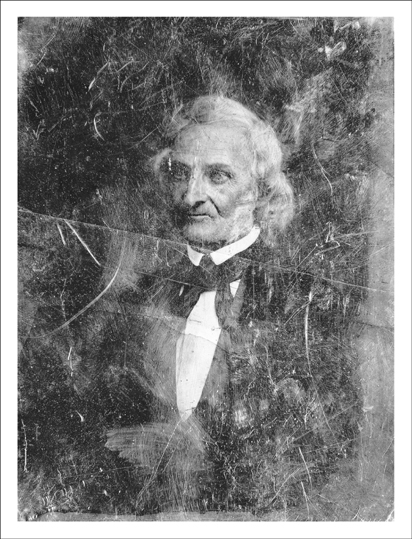
Samuel F. B. Morse, at about sixty (Princeton University Library)
ELEVEN
THE MUCH-APPLAUDED success of the Baltimore-Washington telegraph left Morse with a question: What next?
As one possible move, Morse considered giving the commercial development of his system to private investors. He had many bids from capitalists and speculators, some wanting to buy rights to the line, others seeking to build new lines themselves. Still others asked him to build lines for them—not only locally but to and from Buffalo, Richmond, Mobile, New Orleans. A Baltimore merchant wanted to buy out the entire patent. Morse offered to sell his nine-sixteenths share in it for $110,000—a sum not half the value of his invention, he reasoned, but it would free him to spend his time perfecting and superintending the system, “unembarrassed by the business arrangements.” The deal faded but Morse remained willing to sell his patent right for a relatively modest sum, the competence that had eluded him all his life.
Morse also weighed, and generally favored, selling his invention to the American government. The press took up the question of whether as a matter of public policy the new technological marvel should be nationalized. The Washington Union, for instance, argued that the government would distribute its benefits impartially, while in private hands it might become a “dangerous monopoly.” But the New York Evening Mirror and other papers condemned such thinking as patronizing and unrealistic; it regarded the people as “a set of knaves and swindlers, and the officials of the government as being alone worthy of holding any trust.” The Mirror foresaw congressmen misusing the wires for their private convenience, at public expense: “The Hon. Mr.
Hopkins will send word to his wife in Buffalo, that he had a comfortable night’s sleep.” To Morse the issue was neither economic nor political but essentially moral. Being “an engine of power, for good or for evil,” the telegraph would be safer under federal control. He hoped the government would buy his patent outright, expand and manage the system on its own, and keep him in place as superintendent.
With a half-dozen options before him, Morse was uncertain what to do. “Professor Morse is so constantly changing his plans,” Vail wrote, “that it is impossible to say what will be the next suggestion.” Morse’s attempts to confer with F. O. J. Smith, his partner, did nothing to relieve his indecision. As often in the past, Smith failed to answer letters and managed to be unavailable for consultation. Having come to despise Morse as narrowminded and sanctimonious, he cursed him as “the ‘puritan’ ” and ridiculed him for wanting to consult. Morse behaved, he said, as if he “could not start an inch until I came. It is provoking to witness such selfishness & effeminacy combined.”
Not that letters or meetings helped. In one exchange of views, Morse suggested that they sell the patent to the government, asking a quarter of a million dollars: “would you not be satisfied?” Smith was not satisfied. Nor could they agree on bargaining terms when discussing possible deals with private investors. Again and again Morse proposed divisions of profits, outlined responsibilities for bookkeeping, named prices for the sale of side lines. Again and again Smith rejected Morse’s terms and submitted counterproposals, all of which Morse found unsatisfactory and rejected in turn.
Their angriest clash arose over Morse’s hope of getting an additional appropriation from Congress. He wanted the money in order to extend the Washington-Baltimore line to New York City, with intermediate stations at Wilmington, Philadelphia, and Trenton—a distance of about two hundred miles. He planned to once more enlist Smith to write the contracts for the construction, while he once more superintended the work, which on completion would be offered to the government for purchase. But he seems to have understood that Smith had not forgiven his handling of the Bartlett contract—that Smith remained incensed over his refusal to ask full payment from the government for brother-in-law Bartlett’s never-completed trenching. Smith was “determined,” he suspected, “to defeat all application for an appropriation if I am to have the management of it.”
Since Smith at once dismissed any terms he proposed, Morse apparently invited him to name his own figure for the appropriation: $100,000, Smith said, to build a line of four wires. But Morse sensed and feared that Smith’s interest in the project was limited to using him as a respectable front for finagling a large grant. Then Smith would again subcontract work for less than the cost estimate to Congress and pocket the difference.
Morse may have been right. Smith became enraged when he visited the Committee on Commerce and learned that Henry Ellsworth, the Patent Commissioner, had proposed to its members a two-wire line, for only about $50,000. Smith protested violently to Morse that Ellsworth’s “mousing visits” to the committee had killed any chance of a congressional appropriation. “The intermeddling of your supposed friend … puts an end to all possibility of any further concert among the proprietors,” he said. “You will live to see these unpleasant truths verified to your sorrow.” Morse saw in Smith’s rant “the darkest designs upon us all,” menace that left him “sick at heart.” More than heartsick, Ezra Cornell now found Smith and Morse mutually envenomed, “entertaining the most perfect hatred towards each other.”
Smith had other ideas about how to cash in on Morse’s success. He offered to take over all telegraph negotiations for the next six years—“selling, leasing, constructing, & using”—putting his partners on salary and giving them a share of his profits. “It is unnecessary to say,” Morse remarked, “it was at once rejected as absurd.” Alternatively Smith proposed a geographical division. He would control the New England states, his partners New York, New Jersey, Pennsylvania, and Delaware. Morse greeted this with no less disdain. “I can hardly think you intended the proposition seriously,” he replied. “I cannot of course accede to a proposition so manifestly unequal.”
Some such division, however, appealed to Morse as possibly freeing him from Smith. He granted Smith the right to contract separately for a line from Boston to New York—not a promising venture since Smith understood little about telegraphy. Smith sent Cornell to Boston to exhibit Morse’s telegraph, hoping to raise money for his line from local “Merchant Princes.” As Smith’s one ally in the enterprise, Cornell helped him to aggravate Morse. Aside from longstanding gripes about salary and workload, Cornell believed, very improbably, that Morse had seen drawings he made of a new register and had stolen his design. Smith cheered on Cornell’s dislike of Morse, and they swapped abusive comments about him by mail.
Morse’s efforts to take advantage of his bright prospects antagonized not only Smith but also Alfred Vail, his other partner. Vail, too, nursed a list of grievances—that Morse was overbearing and erratic, broke promises, took him for granted. It distressed him that Morse had still not officially registered with the Patent Office his two-sixteenths interest in the patent. If Morse died, he might not be able to claim his share—and he had a wife and children to think about. He repeatedly asked Morse to register his name. But Morse nonchalantly said he would see, it wasn’t necessary, it could be done at any time, “putting off this matter of so much importance to me, and my dependent family.”
Morse’s handling of the new business opportunities deepened Vail’s resentment. He complained that Morse set terms for the sale of patent rights without consulting him, offering the rights cheaply even though people in Washington said the telegraph was “worth millions.” He also deplored Morse’s consent to Smith’s Boston–New York line. Smith was a “cunning deceitful man” bent on freezing him out: “I have no mind to give Mr. Smith any advantage in making money out of the Telegraph.” Besides, Morse’s decision to allow private individuals to own a major line would discourage Congress from purchasing the patent on behalf of the nation. All of Morse’s business dealings, Vail decided, betrayed his gullibility: “Professor Morse has confidence in … everybody till they cheat him.”
Vail probably kept his disgust to himself. Behind the scenes, his brother George kept reminding him that the family’s profit from their substantial investment in the telegraph depended on Morse’s goodwill: “upon every consideration,” George advised, “keep Morse your particular friend.” Meanwhile, through connections of his own, George quietly looked into the possibility of establishing a Vail telegraph line in Austria.
Despite Smith’s scheming and raving, Morse managed to get before Congress an appropriation bill for extending the Washington-Baltimore telegraph to New York City. The bill encountered both opposition and apathy, however. Congress ended its current session, in June, without taking final action. Recently glorified by public and press as the equal of immortal Franklin, the Lightning Man was ingloriously forced once again to anxiously wait out government indecision, this time for six months, until Congress reconvened in December.
Staying in Washington, Morse used the time for important new experiments. He and Vail worked at slimming the bulky Grove battery that powered the Washington-Baltimore line. They succeeded in reducing the necessary number of cups from eighty to twenty, promising great savings in the cost of material and maintenance. Morse looked into the possibility of dispensing with batteries altogether by using the “magneto-electrical machine,” a primitive generator designed by Charles Page, Chief Examiner of the Patent Office. Page’s device proved its enormous potential when it successfully operated the line in a test on Christmas Day, without the clutter of acid and plates and cups. Morse kept Page on as an adviser but did not alter the power supply in his system, probably because of the expense of manufacturing as many magnetos as he would need to replace his batteries.
Morse and Vail again addressed the problem of river crossings, a difficulty that at some time would have to be decisively faced and overcome. Morse had twice before attempted to conduct electricity underwater: by wire in New York harbor, inconclusively; and successfully across the eighty-foot-wide Susquehanna Canal, using the water alone as a conductor. At the canal he had been assisted by James Fisher, the New York University colleague he hired, then fired. Distrusting Fisher’s results, he decided to repeat the experiment, now aided by Vail and Cornell. On one bank of the canal they stretched a wire four hundred feet long, parallel to a wire of the same length on the opposite bank. To the four ends of the wires they attached copper plates, which they immersed in the canal. When a battery connected to the wire on the near shore was activated, it moved a galvanometer connected to the wire on the far shore, proving that current had been conducted through the water from one pair of plates to the other. In one of many further tests, Vail and Henry Rogers, Morse’s newly hired assistant, sent a current wirelessly across the Susquehanna River at Havre de Grace, a distance of nearly a mile.
Morse’s experiments made news, as did his fanciful suggestion that a telegraph line might be constructed along the Connecticut shore of Long Island Sound, electromagnetically linking all the neighboring towns “without the necessity of any other connection but the water of the Sound. It is even hoped,” the Journal of Commerce reported, “that a telegraphic communication may be made with Europe, and at no very great expense.” Despite the impressive trials and the fanfare, Morse wondered whether a more practical way of traversing rivers might be to stretch wire circuits across the water on lofty spars.
Morse and his assistants also tried to learn how telegraph lines might be affected by electrical storms. During one test, in a Washington office, a terrific lightning flash outside roiled the apparatus, spattering liquid mercury and shooting jets of snapping sparks. Onlookers were alarmed, and the dangerous accident found its way into the press. Morse and his crew said little, concerned that such reports might warn off insurance companies and scare landlords, whose permission was required before planting telegraph poles near their buildings. The indoor fireworks had a benefit, too. They led Morse and his helpers to devise a lightning arrester to protect the instruments and operators.
Hoping to improve the operators as well, Morse directed Vail to experiment with transmission speeds. Vail could telegraph 20 letters per minute; Morse, working as fast as possible, once managed to send 48 (or, in another trial, 122 s’s). But excitement over the invention was beginning to attract many young men who saw employment for themselves as telegraphers. Some took training from Vail, for $25. The learners included a whiz named Louis Zantziger, just fifteen or sixteen years old. Hired to work for Morse in Washington, he soon could transmit some 60 letters a minute, and within a year was tapping out 101.
As usual, Vail also experimented on his own. Among other things, he tried substituting a permanent magnet for the electromagnet, making a railroad track serve as a conductor, and using the earth itself to generate a galvanic current. He also devised a method of operating two independent circuits with one battery. “My mind has become so entirely engrossed in all that relates to the Telegraph,” he said, “that I almost feel unfit for anything else.” He also felt, however, that although his research had reduced the expense and difficulty of operating Morse’s system, it went unacknowledged and unappreciated. “With all these improvements, I got no credit from Professor Morse,” he told his brother. He intended to keep his current experiments to himself, and later make their results public: “Not even Professor Morse knows what I have in my possession.” But his family believed they knew—and they would long remember.
With Congress not in session, Morse left Washington for a few days in May to see his daughter, Susan. She came to New York from Puerto Rico, bringing his first grandchild, a boy named Charles. The reunion does not seem to have gone very well. Susan had developed chronic health problems. She spoke of her move to Puerto Rico as a “great sacrifice” and hoped to return permanently to the United States. Although her husband, a sugar merchant, had made a lot of money as sugar prices advanced, he lost much of it in speculations. And Morse seems to have treated his grandson with no more warmth or finesse than he had shown to his children. He left Susan feeling “sometimes sad,” she said, to think that he had been disappointed in the boy and found him unhandsome. Returned to Washington, Morse wrote to Sidney, asking his brother to reassure her—if the comment can be called reassuring—that while he considered his grandson handsome indeed, “I think more of disposition which is of most consequence and he appears to have a fine disposition.”
Whether or not his grandson Charles disappointed Morse, Charles his son certainly did. Now about twenty years old, the young man had done poorly at Yale—his father’s and grandfather’s alma mater—finding algebra and other subjects difficult and getting harder. He told his father he wanted to quit college and become a farmer. Morse consented, although “almost heart broken” by his son’s dropping out of school. Gradually, however, he came to think the move desirable for Charles’ health. And if Charles had a farm it might provide something like a home for Finley, who was showing an interest in gardening.
Sidney Morse vigorously publicized his brother’s telegraph system in the Observer. He himself had contrived a method of printing maps by engraving on wax—“cerography”—that Morse considered no less valuable than the telegraph. “It is rare,” he told Sidney, “that two of a family should be so favored, as to be the instruments of bringing before the world, such important revolutionizing inventions.” The two brothers also stood together in opposing the ever-noisier crusade against slavery. Sidney published a pamphlet, Letter on American Slavery, assailing the radical tactics of the Abolitionists. Morse said he agreed—“demons in human shape,” he called the Abolitionists; “a more wretched, disgusting, hypocritical crew, have not appeared on the face of the earth since the times of Robespierre.”
By contrast with the robust Sidney, Morse’s bookish brother Richard went on enumerating his plague of ailments—“indigestion, tendency of blood to the head, wakefulness, needless anxieties.” Married and the father of ten children, he had withdrawn from partnership in the Observer, doing no more for the paper than light writing and translating. Meanwhile he wandered in restless desolation from upstate New York to New Haven to Long Island—“not a well man,” he said, “and never expect to be.” Morse believed that, rather like himself, Richard was cursed by a “constitutional predisposition to low spirits.” He urged his brother to resist: “go round with your children to see amusing exhibitions.”
Although Morse surely would not have taken such advice himself, he did still long to have a family life. “I feel my loneliness more and more keenly every day,” he lamented. “Fame and money are, in themselves, a poor substitute for domestic happiness.” He quietly courted his “young friend” Annie Ellsworth, to whom he addressed some verse:
… when I review all the scenes that have past,
Between me and thee, be they dark be they light.
I forget what was dark, the light I hold fast.
Nothing is known of the “scenes” that passed between Morse and Annie Ellsworth. But they or Morse’s accounts of them were intimate enough to convince Susan that her father meant to marry the young woman: “you seemed so fondly attached to her.” Morse also kept up his cryptically flirtatious correspondence with Catherine Pattison. She sent congratulations on his success, hopes of seeing him, and the (beckoning?) news that she was not engaged.
Morse stayed in only distant touch with his former colleagues in art, and presided over the National Academy of Design as a figurehead. In July 1843 he had been obliged to call a special meeting of the N.A.D. to mark the sudden death, at the age of sixty-three, of Washington Allston. Allston had been unwell for a few years, struggling to climb his painting ladder, his face inflamed with erysipelas. Morse delivered an affectionate eulogy, honoring him as “our great American Painter,” a Christian gentleman of delicate sentiment who held to the highest standard of artistic excellence—“my long known, long tried, most valued friend and master.” At the family’s request he journeyed to Allston’s home near Boston to discuss arrangements for the uncompleted wall-size Belshazzar’s Feast that his mentor had made and unmade for twenty-five years. Looking through the paintbrushes Allston had last used, he chose one and accepted it from the family as a token.
In January 1845, Congress at last returned to deliberating on Morse’s request for an appropriation to extend the telegraph to New York City. Having already waited six months for a decision, he waited two months longer, in “unpleasant suspense,” as the bill made its way out of committee and into the House, then to the Senate. With his original grant about to expire he applied for a separate appropriation of $8000, for salaries and material to keep the Washington-Baltimore line in operation another year. He took pride in the fact that during its first year the line had been out of commission only one day, despite winter storms that had strewn the seashore with wrecks and halted railroad traffic. Many newspapers supported both his applications and even called on Congress to run the line to all large cities along the Atlantic coast.
Savvy and cynical about the workings of Congress, Smith doubted that the extension bill would pass. “A good feeling exists on all sides towards it,” he told Cornell, “yet it is like universal charity that fixes upon nothing in particular and helps nobody.” If the appropriation failed, as he believed, he intended to insist on a geographical division of the patent rights. As for the additional $8000 Morse asked, he considered the figure inflated, calculated only to provide another year’s salary for “the ‘puritan’ ” and Vail, with nothing for himself. Still well connected in official Washington, he let it be known that maintenance of the line required no more than $2500. The award of any larger grant would amount to a “sinecure.”
Morse’s eight-month wait ended mostly in defeat. The bill for running the Washington-Baltimore telegraph to New York failed. As Smith understood, Congress had little real interest in extending the line. Development policy in Washington had in general turned away from public financing of internal improvements, leaving them to be made by private enterprise. Morse did at least receive the requested $8000 to keep the line in service a year longer, with himself as the salaried superintendent. Congress assigned control of the line to the Post Office Department, making it a branch of the mail service. Ironically, this brought Morse under the authority of the Postmaster General, Cave Johnson, the former congressman from Tennessee who in the early House debates over funding the line had mockingly compared him to a mesmerist.
On Morse’s recommendation, Johnson boosted Vail’s salary and appointed him operator of the Washington station, now set up in the post office. “His time and talent,” Morse said, “are more essential to the success of the Telegraph than any two persons that could be named.” Transmissions were opened to the public, at the rate of one cent for every four characters. In securing salaries for himself and Vail, Morse inflamed Smith, who demanded part of the “sinecure” for himself, as one-quarter proprietor of the patent. Morse pointed out to Johnson that the original grant from Congress made no reference to paying the proprietors. Smith, he said, “has done nothing in the invention but throw obstacles in the way of its success ever since he had any connection with it.”
Morse’s defeat brought him back to the question raised the year before by his triumph: What next? With the government unwilling to develop his invention he might turn to private investors. But dealing with them meant asking help from Smith or trying to act as an entrepreneur himself. Both prospects repelled him. In his lifetime the American economic scene had changed dramatically. The earlier world of small farms and workshops supplying local needs had been taken over by competitive financiers, corporations, and wholesale commission houses geared to national and world markets. The distinctiveness of America was now to be measured by its New Men, as one commercial magazine declared: “it is the BUSINESS-MEN OF AMERICA that have made us what we are; and it is their enterprise that will still further advance our national power and greatness.”
Morse did not share the enthusiasm. “Money is the main thing to be got,” he complained, “character is of secondary & very trifling consideration.” He still lived for a personal glory unthinkable and unattainable without obedience to Christ, loyalty to artistic values, and pride in America’s Protestant Republicanism. His contempt for the scramble of moneymaking, his naiveté, his tendency to become easily vexed and discouraged—all disabled him for marketing his telegraph in the no-holds-barred world of buccaneer capitalism. He disdained the economic and social forces that might realize his hope of bringing his invention into universal use.
Morse’s deliverance from this bind was at hand. It appeared in the improbable shape of a short, emaciated-looking man of fifty-six—a “little whiffet of a man,” as a contemporary described Amos Kendall (1789–1869). Shoulders stooped, cheeks sunken, hair prematurely white, he had a cadaverous appearance that suggested disease. And indeed he coughed asthmatically and suffered chills, though sometimes bundled in an overcoat on even the warmest summer days.
Amos Kendall (The Library of Congress)
But Amos Kendall’s spindly fragility was deceptive. He was among the most influential politicians of the day, his name constantly before the public. At the time he and Morse met in Washington, around February 1845, Kendall had grown weary of government, but was deeply involved in Native American affairs, acting as a lawyer for one faction in a bitter dispute within the Cherokee nation. Betweentimes he worked on a biography of his political idol, Andrew Jackson. Jackson had brought Kendall to national prominence, appointing him Postmaster General—a cabinet position overseeing twenty thousand postmasters and a corrupt, mismanaged agency some half a million dollars in debt. By demanding efficiency and rectitude, Kendall quickly improved mail service, reduced expenses, and produced a $100,000 surplus.
Kendall became Jackson’s close friend and adviser, invited to dine with the family, entrusted with writing and revising state papers. He served Jackson brilliantly in the administration’s war on the Bank of the United States, the privately owned bank that managed the government’s funds. Sharing the President’s hatred of the bank as a manipulator of public credit for private enrichment, he outlined and publicized a phased removal of federal deposits to state banks. When Congress passed a bill to recharter the bank in 1832, it was Kendall who drafted Jackson’s impassioned veto message, concluding with an attack on the rich and powerful. Nicholas Biddle, the bank’s president, denounced the message as “a manifesto of anarchy—such as Marat or Robespierre might have issued to the mob.” But the veto helped Jackson win reelection, and gave Kendall the reputation of being the power behind the throne. “He is supposed to be the moving spring of the whole administration,” Harriet Martineau wrote, recounting Washington gossip; “the thinker, planner, and doer; but it is all in the dark.”
Contemporaries of this sickly, intelligent, complex man had sharply different opinions of him. Andrew Jackson praised his “stern and unflinching honesty.” Others called him “suspicious and Jesuitical,” Jackson’s “writing machine—aye, and his lying machine.” For Morse there was no question. Seeking to establish his telegraph system nationally but contemptuous of those he called “mere men of trade,” he saw Kendall as an invaluable ally. Kendall knew the top people in government. His tenure as Postmaster General had given him knowledge of the country’s routes of communication. He had legal training, managerial skill, understanding of finance, long experience with the press, and even a real interest in inventions, having himself devised something he called a cylinder steamboat. And Kendall was sensitive to Morse’s loathing of the marketplace. “It is my earnest desire,” Kendall told him, “to see you in a condition not to be annoyed and discomforted by the unpleasant incidents which must be encountered in a business so ramified.”
No less important to Morse, Kendall was someone of his own background, social views, and temperament. Just two years Morse’s senior, Kendall had been born into a Congregationalist family that went back five generations in Massachusetts. “No man is more ready than I am to say God’s will be done,” he remarked, “and to submit to that will without a murmur.” Dubbed “the Deacon” in boyhood because of his sobriety, he frowned on the efforts of Washington society to ape the manners of London and Paris. As Postmaster General—and the owner of three or more slaves—he had treated abolitionist pamphlets as incendiary printed matter, so local postmasters in the South were forbidden to deliver them. He had read Byron and written a tragedy, “The Fall of Switzerland.” The death of his first wife left him with four children; when he remarried three years later, at the age of thirty-seven, it was to a woman barely sixteen years old.
In a decision that would redirect his energy and change his life, Morse turned over the financial management of his telegraph system to Kendall. He had found, he believed, “perhaps the most competent man in the country to manage such a concern.” As it happened, he had also found his longest-lived and, except for Allston, deepest friendship. Kendall’s existence would be affected no less, for he pledged to Morse his wholehearted commitment: “My earthly all, my time, provision for my family, now and when I am gone, are embarked in this enterprize, for which I have resigned all other business.”
One month after meeting Kendall, Morse signed an agreement granting him full power to transact all telegraph business “in as full and complete a manner as I myself could do.” The agreement covered Vail and Leonard Gale as well, so Kendall represented in his person three-quarters of the patent right to Morse’s invention. He would get a commission of 10 percent on the first $100,000 he realized from the sale of rights, and a commission of 50 percent on further sales. “And I shall do my best,” he promised Morse, “to make my agency more profitable to you than it will be to myself.”
Morse’s agreement did not cover the one-quarter interest in the patent owned by F. O. J. Smith, whose permission Kendall would need in order to convey the rights to others. Kendall planned to interest private capital, organize the investors into companies, and issue stock to the members. At the same time he intended to hold open the option of selling the patent outright to the government. In his first encounters with Smith, Kendall found him adamantly opposed to such a sale unless Washington paid for the Bartlett contract. “In matters of trade with the Government,” Smith said, “I would feign no patriotism.” Unlike Morse, Kendall could speak Smith’s own language as a capital insider and match him cynicism for cynicism. “I have the same object in view,” he replied, “to make the most money in the shortest time that we honestly can.”
Kendall was also tenacious in forceful, intelligent argument. He gave Smith a dozen reasons to keep government purchase a possibility. For one, although a million dollars might ultimately be made through private investment, doing so would take years of perplexing toil. But an outright sale to Washington would at once reap “all of wealth the human heart ought to desire.” He stressed to Smith the importance of working together: “It is only by harmony in action that we can do any thing, and to preserve it we must make concessions where we cannot agree in opinion.” Kendall managed to pacify Smith, but by no means to convert him into a team player. Smith worked only for Smith: “I have no idea of going ahead of my necessities,” he said, “to serve the wishes of other folks.”
For the first six months after his agreement with Kendall, Morse became little more than a bystander to the development of his invention. Kendall rapidly set to work forming or licensing companies to build new telegraph lines, with most of the capital raised in small amounts from people located along the routes. Three companies were especially important as representing the foundation of a national network, with New York City the hub. In May, Kendall organized a joint stock association called the Magnetic Telegraph Company—the nation’s first telegraph company. The Magnetic took subscriptions for carrying on the Baltimore-Washington line through Philadelphia to New York. Kendall himself served as the salaried president. The same month he concluded an agreement with some upstate operators of stagecoaches to form the New York, Albany & Buffalo Telegraph Company. Capitalized at $200,000, the company intended to build a line from New York City through Albany, Syracuse, and Rochester to Buffalo, with a link at Springfield, Massachusetts, to Smith’s New York–Boston line.

Ad for the Magnetic Telegraph Company (Washington Republic, February 1, 1852)
Kendall drew up his most far-reaching agreement in mid-June, with a Rochester group later called the Atlantic, Lake & Mississippi Telegraph Company. It was led by Henry O’Reilly (or O’Rielly, 1806–1886), a rosy-cheeked, chin-whiskered immigrant from County Monaghan, Ireland. Now forty years old, he had come to America at the age of ten with his mother and sister; his father remained behind, in debtor’s prison. Weighing only 124 pounds, he was a bantam dynamo, the prototype of the Go-ahead American driven more by the promise of gain and advancement than by the fading ideal of self-sacrificing republican virtue. By the age of twenty he had made himself editor of the Rochester, New York, Daily Advertiser, the first newspaper between the Hudson and the Pacific. Identifying his own and the city’s future, he served as its postmaster and president of its Young Men’s Association, worked to improve its public schools, and wrote a history of the place.

Henry O’Reilly (Rochester Historical Society)
He saw in himself the frontier spirit of western New York, “where Yankee enterprise,” he liked to say, “is quickened by the energies of a newer country.”
In his agreement with Kendall, O’Reilly committed himself to raise money for the construction of two mammoth trunk lines extending thousands of miles. One would connect at or near Philadelphia with the in-progress Washington–New York line, running to Harrisburg, Pittsburgh, and on through Cincinnati to St. Louis, with branches into Kentucky and Tennessee. The other line would carry the in-progress New York-Buffalo line to Cleveland, Detroit, Chicago, and principal intermediate cities. Stretching westward from the Atlantic seaboard to the Mississippi River and the Great Lakes, O’Reilly’s system would open to the telegraph the sprawling continental interior, rapidly being settled. O’Reilly also undertook separately to build the Baltimore to Philadelphia segment of the Magnetic company’s Washington–New York line. “There is some field for ambition here!” he whooped; “some hope for position & profit!”
The high-risk, high-gain O’Reilly approached what he called the “Great Enterprise” with swashbuckling ebullience. He enlisted as a “soldier for life,” he said; his partners were “a band of brothers.” He so much admired Morse that he wanted the terms “telegraph” and “telegraphy” changed to “Morsograph” and “Morsography.” Full of pep and can-do, he hustled back and forth from Rochester to New York City to Harrisburg, shipping wire, setting timber, selling stock, printing circulars, talking up railroad officials, cultivating newspaper editors, getting his exertions boosted and avidly reported in the press.
Kendall worried that O’Reilly might be overreaching himself: “Doubts are entertained whether he will accomplish anything.” The doubt grew when O’Reilly proposed constructing a line north from New York through Quebec and then to Halifax. From Halifax it would communicate with the Magnetic company’s seaboard line by semaphores, to give intelligence of the progress of coastal shipping along hundreds of miles. O’Reilly assured Kendall that this northern line would not retard the building of his western system but quicken interest in it, forming “a magnificent outline of Telegraphic communication over a large section of North America.” Kendall restrained him: “my dear Sir, are you not suffering your mind to take too wide a range? Is not the field opened to you by your contract broad enough?” He advised O’Reilly to concentrate on realizing his already colossal plans.
Although Kendall spoke in a high-pitched voice and wrote in a trembly, spidery hand, his energy equaled O’Reilly’s—its mode, however, being not effervescent but focused and intense. He quietly took on a mountain of legal, political, and commercial problems that would have overwhelmed Morse. He negotiated rights-of-way with railroads and farmers, arranged for issuance of stock, saw to the sale of short-distance side lines off the main routes—a separate, further world of bargaining and aggravation—even looked into difficulties about purchasing augers and delivering chestnut posts. The work entailed writing hundreds of letters to the now-many members of the companies he had formed. Yet the ailing Kendall also took on the emotional burden of dealing with grumbling from Vail and shows of independence from Cornell. Polite but firm he took no nonsense. “To cut the matter short,” he said regarding Cornell, “he will have to follow my directions or seek employment elsewhere.”
Kendall patiently explained to Morse all his complex business arrangements and kept him closely informed on their progress. But for all his managerial skill and stamina, the multiplication of companies and lengthening of lines across the country meant an exponential increase in the number of persons involved in developing Morse’s system. Among many lesser promoters, for instance, Samuel Colt organized a New York and Offing Magnetic Telegraph Association, running a line from New York City to Coney Island that provided notification in Manhattan of ship arrivals off Sandy Hook. Each major or minor player had his own agreements, angles, and demands, complicating the overall situation well beyond the ability of Kendall or any other single person to keep in view, much less control—and beyond the scope of this biography to describe in any detail.*
Kendall admittedly found the work a great burden. “I do not know when I shall be with you again,” he wrote to his wife from New York. While in New York, unwell, he received appalling news. His twenty-two-year-old son, William, had been on a street in Washington joshing with a friend. The kidding deteriorated into a quarrel, during which William’s friend shot him dead. The calamity left Kendall uncertain whether he could continue his agency for Morse. But his piety and faith absorbed his agony: “thank Heaven,” he was able to say after a week, “I am resigned and have become calm.” The news came to him partly by telegraph, through the astounding electrical communication network now building across the United States.
Kendall’s agency gave Morse an unfamiliar sense of freedom. Surviving documents do not reveal his exact profits from the new telegraph companies, now or later. But after years of scrounging and borrowing, he stood in reach of financial security. For granting some group of businessmen rights to the patent, he and the other partners got a modest cash payment plus 50 percent of the stock issued. By taking patent fees in stock rather than cash, Kendall hoped to demonstrate confidence in the telegraph and encourage capitalists to invest. Looking further ahead, he believed that if the patentees retained half the voting stock in every company they would be able to promote unified policies and procedures that would bind the separate lines into a coherent and powerful national system.
At the moment Morse’s holdings represented future prospects, dependent on the success of telegraph entrepreneurs in making their stock pay dividends. But now or later he was the largest shareholder in the New York, Albany & Buffalo company, with 585 shares. He also held 256 shares in the Magnetic; most other shareholders had fewer than 20. He soon began to tithe his assets for “religious benevolent objects.” He donated stock certificates in Morse companies to Protestant churches of various denominations, and to such organizations as the American Tract Society, the Foreign Evangelical Society, the Cleveland Female Seminary, and the American Temperance Union. He also contributed $2000 in stocks to New York University and $1000 in cash to Yale.
With his budding telegraph empire under Kendall’s command, Morse returned to the idea of marketing his invention in Europe. His futile trip to England and France six years earlier had reinforced his sense that the Old World feared change, that he must confine his hopes to America. But his now-proven success had excited new interest abroad, bringing many feelers from European agents and governments. A “Dr. Bergman” offered to secure exclusive telegraph rights through the whole German confederacy. The French consul in Boston, named de Burgraff, advised him that the government was testing electric telegraphs and asked for the plans of his system. The Russian minister promised to write home in his favor and invited him to dine at the ministry in Washington. There Morse shared a twenty-five-foot-long table, all candelabra and flowers, with Daniel Webster and several Supreme Court justices.
Similar European enticements had once before come to nothing, but Morse anyway decided to take a short trip abroad. His departure gave Alfred Vail another reason to feel wronged. Vail was about to publish a monograph on the nature and history of Morse’s invention. “If the book comes out, I may as well stay at home,” Morse complained to him. He seems to have feared that Vail’s explanations and drawings might be used against him if he tried to secure foreign patents, as had happened years before in England. Vail had spent six months and more than $700 producing the work. He protested that chances of its being read in Europe were 100 to 1, and that everything in it was already well known, “explained to thousands, who have seen the instrument in operation;—and … published in the newspapers over and over again.”
Morse offered a trade. He would permit immediate publication of the work, in exchange for all of Vail’s contractual interest in overseas rights to the telegraph. Vail scoffed at the lopsided proposal—another case of his former teacher still seeing him as an undergraduate. “None of your nonsense Professor Morse,” he griped to his brother George; “I have some of my eye teeth cut now…. No you don’t.” While Morse was in Europe, the well-known Philadelphia house of Lea & Blanchard published Vail’s two-hundred-page monograph, entitled The American Electric Telegraph. Morse was not wrong in expecting it to cause trouble.
For demonstrations Morse took with him overseas two telegraphs. He planned to spend time in London and Paris, then go on to Stockholm and beyond. In preparation for a visit to St. Petersburg he gathered letters of introduction to American merchants in the city who could put him in touch with “Christian friends” there, and from Secretary of State James Buchanan. His prospects in Russia, however, once more proved phantasmal. During his three months abroad he got no farther north than Hamburg, Germany, and toured for a while in Holland as well.
In setting out, Morse centered his hopes on England. “If our Telegraph can be once successfully established on a line in England,” he told Vail, “we command the Continent also.” England mattered most because it had produced the only serious rival to his own system—the needle telegraph of the British inventor-scientist Charles Wheatstone, which several European countries had begun to adopt. The priority and comparative virtues of the two systems were at the moment subjects of cultural warfare in the British and American press. The rancor was intensified by competing national claims to the Oregon Territory, which for nearly forty years had been jointly occupied by both countries.
London journals such as the Globe and the Literary Gazette declared that everything accomplished by Morse in his Washington-Baltimore line had been done earlier and better by Wheatstone. “The English reader need scarcely be informed,” said the London Mechanics Magazine, “that Mr. Morse has … only re discovered what was previously well known in this country.” American newspapers fought back in articles typically entitled “The Magnetic Telegraph—American and British,” making the same claims for Morse: “the Electro-Magnetic Telegraph of Prof. Morse is the first realization of a practicable Telegraph on the Electric principle,” one wrote; “thefts of new inventions and bold plagiarisms of whole works, the offspring of American minds, have been so common in England, that we deem it almost a matter of course that no acknowledgement will ever be made in English works of indebtedness for any thing of the kind to America.”
Morse had inspected the British telegraph when he visited Wheatstone at King’s College, London, in 1838. Now he carefully observed it in public operation at railway stations and ticket offices in London and Hamburg, and along a ten-mile route in Holland between Haarlem and Amsterdam. What he saw confirmed his earlier sense of the superiority of his own system. Wheatstone had simplified his apparatus, reducing the number of needles from five to two. But transmission remained complicated. As part of a description in the London Pictorial Times suggests, it demanded a sort of bifocal gymnastics:
The left hand needle moving to the left twice gives a, three times b, once to the right and once to the left c…. The order is then taken up by the right hand needle, moving once to the left for h, twice for i, three times for k, once to the right and once to the left for l…. The remaining signs are made by the two needles working conjointly, so that the simultaneous movement of the two, once to the left, indicates r, twice for s, three times for t, once to the right and once to the left for u, once to the right for w, twice for x, and three times for y.

Cooke-Wheatstone double-needle telegraph (The Science Museum, London)
At the Paddington Station in London, Morse gave the operator a name of nineteen letters to send and have sent back. The result was several failures to spell the name correctly.
And as in Wheatstone’s earlier apparatus, the jerking needles had to be observed or their meaning lost. “The advantage of recording is incalculable,” Morse noted, “and in this I have the undisputed advantage.” In Hamburg he learned, for the first time, that Wheatstone’s system could not accommodate additional instruments along a route, as his own system could by using receiving magnets. “If anything is done in the way of Telegraphs,” he decided, “I think there is little doubt mine will be adopted.” He also learned that Wheatstone had become aware of his presence abroad and was putting down his telegraph as inferior—“as indeed impracticable!! and absurd!! Is not this truly laughable?”
Laughable or not, Morse made no headway for his system in England. While in London he managed to interest a start-up British association, the General Commercial Telegraph Company. He offered his invention to them for a thousand pounds sterling, plus a return on receipts. They required that he obtain an English patent, but he believed he could now secure one by treating his relay system—still undescribed in print—as an integral part of the apparatus. The group delayed making a decision, however, and the possible deal expired in brusque letters between lawyers for both sides.
Morse was anxious to get on to Paris, where a government commission was determining which one of several electrical telegraphs should be adopted in France. Besides, he wanted to get out of England. The tense dispute over title to Oregon had created more than the usual prejudice against America. In the outfitting of some naval expedition or fortifying of some dockyard he believed he saw signs of preparation for war. If so, the British would find it hard going: “we are better prepared than they have any idea of.” Whereas he always felt alien in England, the French made him feel welcome. “How deep this welcome may be I cannot say,” he added, “but if one must be cheated I like to have it done in a civil and polite way.”
Morse was well positioned to present his telegraph in France. In shifting from the old Chappe system of semaphores to electrical telegraphs, the government was using for its first trials Wheatstone’s needle apparatus. But the head of the government commission was Morse’s good friend Arago, Secretary of the Académie des Sciences. Morse wrote to Arago before coming to Paris, saying he had examined “the English system” and could confidently affirm that his own was much simpler, far more efficient, and less expensive. As used in the French trials, Wheatstone’s apparatus had been redesigned by a scientific-instrument maker named Louis Bréguet, whose grandfather had assisted Chappe. (Wheatstone, Morse noted with pleasure, “may crow on his own dunghill, but the French cock crows here.”) An experimental line of the Wheatstone-Bréguet telegraph had been installed on the Paris-Rouen railroad—the first electrical telegraph line in France.
On the last day of October Morse went to inspect the line, accompanied by Bréguet himself. He took careful notes and made drawings of the stubby ten-foot-high posts and the dial-plate receiver, whose needles registered incoming signals in a code adapted from the old Chappe semaphores. Like some other British and continental instruments, Bréguet’s seemed to him beautifully made. Where his own functional-looking equipment had the spare concentration on essentials of his neo-Calvinist portraits, Bréguet’s and the others had fancy dial faces and handsomely carved wooden cabinets. And like them, too, it seemed to him inefficient. In one minute it could display about twelve signals transiently; in the same time, his own telegraph could record permanently “at least 120!!!”Moreover, Bréguet’s Chappe-like code was no less hectically complex than Wheatstone’s. A day after inspecting the line, Morse penned a nineteen-page letter to Arago, recommending that the French government substitute his own system: “with simpler means, I can give a greater amount of intelligence in a given time.”
Arago arranged for Morse to demonstrate his telegraph for the Chamber of Deputies. However the showing may have impressed the parliamentarians, it displeased the Revue Scientifique: “The way the signs are produced, the writing carried out at a distance, the … composing of the alphabet, all these elements are essentially defective [essentiallement defecteuses], and it will be necessary to abandon them.” Morse’s inconclusive visit to Paris left at least some hope that the French might adopt his system. On that chance he left behind a telegraph with the American minister, Robert Walsh—“witnesses for me in France should attempts be made to encroach on my invention.”
Concerning the most fascinating adventure of his telegraph in Europe, Morse unfortunately left no record. While he was abroad, the Continent was also being toured by his friend Charles Fleischmann, an agent of the U.S. Patent Office gathering information about foreign agriculture and mechanic arts. Morse gave Fleischmann one of his instruments, to show to bigwigs he might encounter. Fleischmann happened to arrive in Vienna around October, just when the Austrian government was considering whether to put up electrical telegraphs along its railroad routes. He thus managed to secure an audience with Prince Klemens von Metternich.
Metternich, of course, was Morse’s Devil-of-all-devils, mastermind of the Leopold Foundation for supporting Catholic missionaries in America, the super-reactionary he once called “the arch contriver of the plans for stifling liberty in Europe and throughout the world.” Interested in telegraphy, Metternich invited Fleischmann to set up Morse’s apparatus in his palace. There Fleischmann demonstrated it to the corps of foreign diplomats in Vienna—including the ambassador of the Pope, who transmitted a brief message.
Metternich expressed astonishment at the simplicity of Morse’s “beautiful Telegraph,” as he called it, and opened the way for Fleischmann to demonstrate it in November before the imperial family. In the red-velvet royal reception room, Metternich himself, speaking in Italian, explained the workings of Morse’s invention to Empress Maria Theresa. One can only imagine how Morse received the news, early in the new year, that the first European country to adopt his system, for a 320-mile line from Vienna to Prague, was to be Austria, that serpent entwined with the King of Rome to Jesuitize America.
*The development of the companies is comprehensively and brilliantly described in a classic work, Robert Luther Thompson’s Wiring a Continent: The History of the Telegraph Industry in the United States, 1832–1866 (1947).