
TWELVE

RETURNING to America, Morse first gave his attention to completing the Magnetic company’s all-important line from New York to Washington. “The moment that is done,” Kendall told him, “the telegraph will be worth millions.” In Morse’s absence, Henry O’Reilly had nearly put up the Baltimore-Philadelphia section, and Vail and Cornell had nearly finished the leg from Philadelphia to New York. With Smith’s New York–Boston line almost completed too, the moment was exhilarating. Before spring, the Observer announced, it would be possible to speak by lightning directly from Boston to Washington.
A massive physical obstacle remained, however. The tail end of the line, the final link from Washington to New York, had to be stretched to upper Manhattan from a two-hundred-foot-high cliff in Fort Lee, New Jersey, and operate effectively across nearly two-thirds of a mile of the Hudson River. Cornell at first tried insulating the wire with india rubber and laying it across the river in pipes. He and Vail succeeded in communicating between the shores of New York and New Jersey. But a few weeks later, Morse tested the setup more rigorously by transmitting from Vail in Philadelphia, through Cornell in Fort Lee, to himself across the river in Manhattan. No current came through, as he frustratingly recorded:
At 11.25 reduced battery to 14. Still nothing from ft. Lee.
At 25 min to 12 I wrote “I get nothing from you” and also gave
(26.) but received no indication.
At 5 to 12 reduced battery to 10 cups. No indications.
At 12 h 5 increased battery again to 26 cups. No indications.
1. PM tried the instrument as before and with the same result.
The failure, Morse speculated, might be due to broken or twisted wires, perhaps to faulty insulation in the pipes. In any event, Cornell’s submarine line was problematic. The pipe and wires might be broken at any moment by the anchors of vessels getting underway in the Hudson River.
Morse considered or tried other methods of bridging the two shores. The wires could be run on high masts erected on either side of the river, but they might be struck by lightning or blown down by wind. Morse and his assistants tried changing the locations, extending an insulated wire across the river from Jersey City to lower Manhattan. A promising solution, but after four days a vandal severed the wire. An experiment to make the Hudson itself carry the electricity, as had been done successfully on the Susquehanna, produced a current too feeble to move the instruments. “You may judge of my anxieties,” Morse said. “The river I think will be a serious hindrance to us.”
A different problem hindered the western line of O’Reilly’s Atlantic, Lake & Mississippi company. Receiving magnets sold to him by Cornell—that is, devices that switched-in telegraph stations along the main line—were defective in themselves and incompatible with other equipment, causing long delays. A register he bought from Cornell was also “botch-work,” he said, screws working loose, cogs failing to mesh. Morse discovered that Cornell had designed the equipment himself and was going into business as his competitor. Cornell offered a defense—that his instruments embodied improvements that would benefit all the patentees. But the argument was fraudulent. Privately he believed that the public expected more from Morse’s system than it could deliver and would react against it, opening a market for his own inventions. Kendall warned him that he was exposing himself to prosecution.
Morse felt doublecrossed and angry. “Cornell has so bewitched, and befouled every thing he has touched … that I have hard work to restrain my indignation.” He regarded Cornell’s receiving magnets as no more than a “ clumsification” of his own, using four magnets instead of one—sold without his permission, too, and without compensating him. Installing Cornell’s instruments on Morse lines would also corrupt the desired uniformity of operation. Telegraph companies would be hard put to replace defective parts and shift operators from one part of the country to another. Cornell’s treachery left Morse reeling, “almost sick,” he told Vail. “Let us get along as quietly as we can with the plague till we can cut loose from him.” He had learned a lesson, too. After years of keeping his own receiving magnet under wraps, he now took out a patent for the device, at last describing and diagramming it in a public document.
With whatever difficulties, the country’s powerful new communication system kept expanding. Several new lines were completed by early summer. Morse enjoyed a triumph on May 12, when the Baltimore Sun printed an exclusive—three full columns of President Polk’s address to Congress the day before, requesting a formal declaration of war against Mexico and authority to call up troops. Taking more than two and a half hours to transmit, the important speech was by far the lengthiest document ever sent by telegraph. Morse sent a copy of the Sun to his friend Arago in Paris. The Chamber of Deputies was debating whether the worth of the electrical telegraph had been proved enough to justify government construction of a line from Paris to Belgium. “In the United States the matter is settled irresistibly,” Arago told the Chamber; “here is the President’s message printed from the telegraph in two or three hours … it could not have been copied by the most rapid penman in a shorter time than it was transmitted.” Impressed, the Deputies voted an appropriation of nearly half a million francs.
A month later, the crucial New York–to–Washington lightning line was functioning. The potential nucleus of a continental network, it was capable of leaving off dispatches at Baltimore, Wilmington, and Philadelphia. With the problem of crossing the Hudson still unsolved, messages arriving in New Jersey had to be steamboated across the river to Manhattan Island. Still, the press treated the event as extraordinary. The Washington Union reproduced at length the telegraphic interchange among Vail, Morse, and two unnamed operators—a nearly simultaneous four-way conversation across 260 miles:
Washington.—Baltimore, are you in contact with Philadelphia? Baltimore.—Ay, ay, sir; wait a minute. (After a pause.) Go ahead. You can now talk with Philadelphia. Wash.—How do you do, Philadelphia? Phila.—Pretty well. Is that you, Washington?
Wash.—Ay, ay; are you connected with New York?
Phila.—Yes.
Wash.—Put me in connection with New York.
Phila.—Ay, ay; wait a minute. (After a pause.) Go ahead. Now for it.
Wash.—New York, how are you? …
New York.—Ay, ay. Washington, write dots. (Washington begins to write dots.) That’s it; O.K. Now I have got you.
The newspaper assured its readers that the seemingly imaginary event it recorded had actually occurred—such a scene as “has never had its parallel on this earth.” News of the marvel reached England as well, for once impressing the British press, at least faintly: “The Americans appear to be going rather ahead of us in this branch of enterprise.”
On June 27, F. O. J. Smith opened his Boston–New York line, heralding instant communication between major American cities along some 450 miles of the Atlantic coast. Put up crudely and hastily, however, the line went out of commission more than half the time during its first months of operation. Sagging wires got in the way of passing trains, causing at least one death, and a single storm left 170 breaks. Alfred Vail had warned Smith that constructing the line would be more difficult than he supposed, advice Smith had laughed off as “quackery.” Morse recalled Smith’s arrogance with satisfaction: “A little less boasting a little less self complacency … would not have been of any harm.” On the other hand, given Smith’s full-time scheming, it occurred to him that Smith may have deliberately bungled the construction, hoping to buy up stock in the line at fallen prices: “A more perfect specimen of satanic possession, I do not believe exists.”
The first week in September, Morse officiated as New York became electrically linked to another major city. By turning a screw he opened the pioneer 507-mile line to Buffalo, constructed by the New York, Albany & Buffalo company. Operators at intermediate stations in Troy, Albany, Utica, Syracuse, Auburn, and Rochester all saluted him over the magic wires:
Buffalo sends compliments to Prof. Morse … and presents Lake Erie to Old Ocean.
Rochester Office sends compliments to Prof. Morse … and presents Erie Canal to Croton Aqueduct
Auburn presents State Prison to the Tombs.
Syracuse sends compliments to Prof. Morse and asks how are the Yorkers.
“Is not this the feature of the age?” asked one amazed newspaper; “The visitant to Lake Erie holding confidential converse with his friend in New York!”
The publicity and acclaim brought Morse a new round of ambitious proposals. Telegraph lines for Mexico, Cuba, and Chile … a system for the new state of Texas … intracity telegraphs for New York’s firehouses, police stations, and watchtowers. The enthusiasm did not move Congress, however. The legislators still showed no interest in nationalizing the telegraph, ending Morse’s hope that the government might purchase his patent. From now on, Kendall told him, “private enterprize must carry out what it has begun.” Leaping in, Kendall sold patent rights to a New York restaurant owner for organizing the Washington & New Orleans Telegraph Company. This group planned to carry the New York–Washington line south through Richmond, Charleston, and Mobile to the port of New Orleans. The commercial promise of the route was vast, as the company told potential investors: “If you want to be a Millionaire, take hold of this thing.”
Morse’s new revelations of the networked future also swelled his list of honors. “The nation’s idol,” as a friend described him, was elected to membership in the American Philosophical Society and awarded an LL.D. degree by Yale, its first honorary degree for work in science or invention. The twenty-six-year-old Sultan of Turkey, Abdul Mejid, conferred on him the country’s Nishan Iftichar, or Order of Glory. Morse had made two instruments especially to be taken to Turkey by the president of the American Scientific Association, Professor John Laurence Smith, headed there to advise on the country’s mining resources. Smith demonstrated the telegraph at the Sultan’s palace on the Bosporus, running a wire from its main entrance to the royal harem. Morse’s Order of Glory represented the first and only decoration the Sultan had bestowed on an American. As will appear, it took a year arriving.
Morse was further rewarded in seeing the many newspaper columns now headed “By Magnetic Telegraph.” In fact, his invention was beginning to transform news gathering and to reshape American journalism. With the completion of the New York-Washington line, New Yorkers who bought the morning edition of James Gordon Bennett’s popular Herald could read southern news telegraphed from Washington the evening before. Bennett planned to establish permanent bureaus of reporters and editors in Buffalo and Boston to promptly report the latest eastern and western news as well.
To the press and the public, Morse’s ever-lengthening lines gained a more urgent importance with the onset of the Mexican War, in May 1846. Americans eagerly waited to learn about troop movements in Texas and Mexico. News from the front arrived in Washington by pony express and steamboat, where it was tapped out over the wires. As Superintendent of the line Morse drew up regulations to ensure that all interested parties had equal access to the incoming dispatches, which could be copied at the rate of two words for one cent. Among eastern papers, competition to get out the war news first was intense and wasteful. Bennett agreed with the editors of five other New York papers to receive the news in common and share the expense of transmitting it—the beginnings of the Associated Press.
Morse stayed aloof from the business problems of his developing empire, living most of the time in Washington as Superintendent of the original line, “pleasantly situated,” he said. He boarded in a room across from one occupied by the social reformer Robert Dale Owen, whom he got to know. An amiable man, he thought, but in his efforts to improve society without reference to Christianity, a “subject of pity.” Morse invented a useful device for locating breaks in the lines, experimented with using not one but several electromagnets in his register so that several pens could record messages at the same time. Other inventors submitted ideas to him, many of them harebrained: plans for suspending telegraph wires across rivers by balloons, transmitting “Grammalogues” through a “Phono-Magnetic Alphabet,” rendering people weightless by means of the “anti-gravitating power.”
Despite Morse’s distaste for the marketplace, events forced him back into its push and shove. The trouble began, in the late fall of 1846, with a clash between F. O. J. Smith and Henry O’Reilly. O’Reilly, to recall, had contracted to build two mammoth lines from the eastern United States to the Mississippi River and the Great Lakes. He also built separately for the Magnetic company the Baltimore to Philadelphia segment of the Washington-New York line. The segment had cost $4000 more and taken longer than O’Reilly planned—results of using iron instead of copper wire, and of the many rivers and creeks to be crossed. The delays set back his work on the western lines for six months to a year. Always quick to scent an advantage, Smith claimed that by failing to meet several construction deadlines, O’Reilly had violated his contract with the patent owners.
Smith charged that O’Reilly had violated his contract in a more serious way as well. The language of the contract was in many places ambiguous. But in essence O’Reilly was required to turn over what funds he raised for the western lines to trustees, appointed to disburse the money and manage the business for the mutual benefit of the subscribers and the patentees. Instead, Smith charged, O’Reilly had formed his own stock association, the Atlantic and Ohio Company, and had issued stock in Baltimore—without the patentees’ knowledge. O’Reilly tried to explain that he meant his company to be “merely temporary,” a way of setting things in motion, “matter of form rather than substance.” He vigorously denied that he had issued any stock in Baltimore—“except one certificate was sent to the one subscriber in that City.” His several accounts of the stocks, however, are inconsistent and fuzzy, some conceding that he had also distributed certificates as gratuities to helpful newspaper editors.
Whatever the truth of these matters, Smith declared O’Reilly’s contract forfeit, putting him out of business. Kendall had been willing at first to negotiate the cost overrun with O’Reilly and to forgive the missed deadlines. But he could not ignore the charge that O’Reilly had formed a private stock association, in which the patentees themselves were not members. And when O’Reilly turned down an invitation to meet with him and Smith to discuss the situation, Kendall, too, had had enough. He joined Smith in declaring the contract a nullity. “I see storms ahead,” he said.
They came, for the cancellation incensed O’Reilly: “Never was a more dastardly attempt of things in the shape of men, to crawl out of a contract.” He had thrown himself into the telegraph business with visionary fervor, erecting posts, defying floods, overseeing operators, his eye fixed on Louisville, Kentucky, gateway for his western line to the Mississippi Valley. The thought of being compelled to abandon his quest seemed unreal. “It is like being out of the world,” he said, “to be away from telegraphs.” A proud man, he was also pained to disappoint the large public expectations he had aroused. A man of feeling as well, for all his braggadocio he had labored chiefly for his tenderly loved wife and sorely missed seven children. And creditors were pressing him to be paid for labor and material.
O’Reilly directed his rage at F. O. J. Smith. He believed that Smith’s aim in canceling the contract was to negotiate a more profitable deal for the western lines. Under the terms of O’Reilly’s contract, the patentees received a quarter interest; contracts that the patentees negotiated later with others gave them a half interest. O’Reilly believed that Smith was trying to get a half interest in the western lines as well. He also suspected that Smith wanted to cut in yet another brother-in-law, this time a Cincinnati newspaper editor named Eliphalet Case. “I for one will not tamely yield to one jot of any such scheme,” O’Reilly made it known; “I will hurl it back.” Attorneys having assured him that he had not violated the contract, he pressed on defiantly with the construction of telegraph lines to the West.
The “Napoleon of the Telegraph,” as the press tagged O’Reilly, soon won an impressive victory. Late in December, his line from Philadelphia reached Pittsburgh, making it possible to electrically transmit a message three hundred miles across the Allegheny Mountains. To mark the achievement, newspaper editors in Pittsburgh exchanged greetings with colleagues in Philadelphia, and a message went out to Washington informing President Polk that a regiment of Pittsburgh militia would soon be ready to leave for the Texas battlefront.
Morse got drawn into the quarrel at the end of the year, when Kendall and Smith filed an injunction to prevent O’Reilly from extending his line beyond Pittsburgh. O’Reilly laid no blame on Morse, with whom he had had no business contact, and even sympathized with him “for being in the hands of such men.” He credited a friend’s report that Morse was indignant over the situation, and had exclaimed “It is all the doings of that phantom, that spectre, F. O. J. Smith, who has haunted me like a phantom in this enterprize!” Morse may have said something to that effect, for he considered Smith’s attack on O’Reilly’s contract questionable, “not morally right if it was legally so.”
Morse went to Philadelphia for the trial, in February 1847. It was a bleak occasion for him. His appropriation from Congress to maintain the original Baltimore-Washington system had run out, leaving him not a Superintendent but a man with no salary. And he felt alien to the scene—a U.S. circuit court. Never before had he been party to a law-suit: “I confess to great ignorance even of the ordinary, commonplace details of a court.” Attending the proceedings throughout the day, he for the first time learned the details of his contract with O’Reilly. Vail had often accused him of being a “granny,” and indeed he sympathized with O’Reilly’s situation and wished to make “every possible allowance” for him. If the court granted an injunction, he told Kendall, it would be decent to show leniency: “O’Reilly may have acted hastily, under excitement, under bad advisement, and in that mood have taken wrong steps.” When his lawyers advised him that the case would undoubtedly go for the patentees, he arranged to have $20 sent to O’Reilly’s wife, keeping the source secret: “I could not bear to think that an innocent wife, and inoffensive children should suffer.”
Morse got no chance to show O’Reilly his fellow feeling and generosity. The judge, named Kane, dismissed the motion for an injunction. His ground was narrowly technical: at the end of the year, the patentees had conveyed to Smith’s brother-in-law the construction rights to O’Reilly’s Philadelphia-Pittsburgh line. Ignoring the charge that O’Reilly had formed his own stock company, the judge ruled that since the patentees had given up their interest in his line, they could not appear as complainants against him. “An injunction cannot be awarded at the instance of a stranger,” Kane observed, “and a patentee who has assigned away his interest is nothing more.”
The ruling jolted Morse. Although disposed to let O’Reilly off easily, he had also been led to believe that O’Reilly’s contract violations were so manifest that an injunction would be granted as a matter of course. “I never was more deceived in regard to a case,” he told Kendall. A committed believer in the law, he now questioned whether it could protect his rights. “I feel there is no security … the effect has been to make me doubt every thing, and whether in the eye of our laws I have any rights at all.” In the aftermath of the trial, he wrote to O’Reilly in a friendly spirit, hoping to arrange a peaceful settlement. But he also girded himself: “I am preparing for the worst.”
Morse much needed to be prepared. Emboldened by his victory at court, O’Reilly forged onward with his lines, using Morse’s system, contract or no. “We are nobly vindicated! … Now, indeed, for the Great West.” As his poles began marching west from Pittsburgh through Cincinnati to Louisville, the press disclosed that he was also building from Buffalo to Chicago. Morse was stunned. “Pray what does it all mean?” he asked Kendall. “Is the effect of the Philadelphia decision to give O’Reilly and his associates the construction of all the Telegraphs in the Union?” O’Reilly thought so, and believed that further efforts by Kendall and Smith to nullify his contract would backfire, destroying public confidence in Morse’s system: “they may find that, like Sampson [sic] of old, they have pulled down ruin around their own heads.”
To win public support, O’Reilly mounted an unrelenting advertising campaign. Dispatching agents into towns and cities where he planned to build, he blitzed the country with pamphlets, memorials, handbills, addresses to local legislatures, daily letters and notices in newspapers and magazines, broadsides and circulars with booming headlines: “TO THE PEOPLE OF THE UNITED STATES.” Each communiqué lambasted the patentees and assured existing and potential stockholders that he had the legal right to use Morse’s system. Kendall’s partisan writing as a political journalist during the Jackson era had trained him in riposte. He and Smith answered O’Reilly’s forces ad by ad, circular by circular—“TO THE PEOPLE OF THE WEST”—documenting O’Reilly’s violations of the contract, warning investors against subscribing to his lines, threatening to prosecute any of his operators who used Morse equipment.
Publicly and in private the two sides scourged each other as “Molochs,” “hyena-like personages,” “damned Skinflints,” “guerilla speculators.” Morse-ites routinely ridiculed O’Reilly as “the Great O’Reilly,” greatest humbugger of a humbugging age. O’Reilly-ites lampooned the wizened somber Kendall as “Old Amos,” “Amos the Pious,” or “Pope Amos.” F. O. J. Smith they impaled as “F. O. G. Smith” or simply “Fog”—names that stuck.
Morse abhorred the brawling and name-calling. But with the press sometimes identifying O’Reilly’s foes as “Morse & Co.,” he, too, came within the crossfire. “Notwithstanding my matters are all in the hands of agents and I have nothing to do with any of the arrangements,” he groaned, “I am held up by name to the odium of the public.” So recently a national hero, he saw himself become something like a national villain, “a target for every vile fellow to shoot at.” And he looked on as his invention, the so much praised wonder of the age, became derided and discarded.
O’Reilly had used Morse instruments on his west-moving lines. But he now began seeking out devices by other inventors to replace them. He favored the telegraph of a Vermonter named Royal House. It used a piano-like set of keys to transmit messages, one key per letter of the alphabet. The messages were reproduced at the receiving station by a type wheel that stamped the letters on a paper tape. Several newspapers highly praised House’s method. “Instead of an arbitrary character, like that which is used in Professor Morse’s machine, there is the letter of the alphabet,” reported the New York Herald; “It is … decidedly superior to any other telegraph ever used.” O’Reilly gave House money to develop his system, and secured rights to it for his western line. At the same time, he publicly belittled Morse’s telegraph, making known its supposed line breakdowns, errors in transmission, and other shortcomings. Morse and his associates had “diddled Uncle Sam out of $30,000,” he snickered; “There is more genius, twenty times, in House, than there is in Morse.”
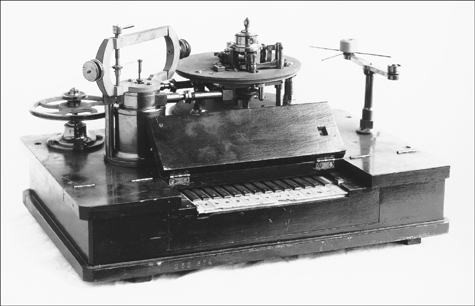
House printing telegraph (Smithsonian Institution)
Morse examined a model of House’s invention at the Patent Office. He was certain that it infringed his patent and could be stopped in the courts or, if not, would prove to be “all humbug.” The printing of common letters seemed to him not only no advantage but a serious disadvantage. It called for twenty-eight keys instead of his one, and depended on a dense machinery of springs, magnetic coils, and clock trains, plus a hydraulic pump. Untested over long distances and slower than his own telegraph, it represented an “improvement backwards.” He lumped House with Cornell and others who were trying to capitalize on the success of his system, “to avail themselves of its popularity to make something for themselves.” Just the same, an editor of the New York Evening Posttold him that after witnessing the device in operation he decided that its importance had been not exaggerated but underrated.
Though he thought House’s invention no more than a fussy gadget, Morse wished to protect himself against it. He filed a caveat with the Patent Office for a printing telegraph of his own. “I shall proceed to make it for curiosity’s sake, and to defeat these would-be infringers on their own ground.” But O’Reilly’s ground was always wide. He asked associates in Washington to speak with foreign diplomats and urge them to consider adopting some other telegraph than Morse’s for their countries. Morse believed that O’Reilly was also actively promoting House’s system in England. He prepared an article for the press that incorporated a letter “from a gentleman of distinguished mechanical science in London to his friend in America.” The scientific gentleman avowed that the English considered printing telegraphs “philosophical toys, of no practical value.” The gentleman was his brother Sidney, then visiting London. The friend was himself, but he preferred “not being known in the matter,” he explained, withdrawal from bare-knuckle capitalism seeming more desirable than ever.
O’Reilly understood that House’s invention might infringe Morse’s patent. To head off any attempt to attack the printing telegraph on that basis he turned the legal question into an ideological issue. He had always looked for investors not among bankers and financiers but among farmers, shopkeepers, and small traders who had only tens or a few hundred dollars to spare. He mustered their support for House’s telegraph by calling his line “The People’s Line” and depicting Morse and his associates as monopolists, enemies of the competitive economy that would stimulate the development of new and better systems. “We take the strongest Anti-monopoly ground,” he proclaimed; “Equal Rights to all modes of Telegraphing.” A broadside ditty set his message to the tune of “Dan Tucker”:
The “People’s Line” has just begun, When we get thro’ we’ll have some fun….
CHORUS
—Get out of the way with your monopoly, Get out of the way with your monopoly….
O’Reilly especially aimed his propaganda at westerners, picturing Morse’s supposed monopoly as part of the eastern stranglehold on the burgeoning frontier.
Behind O’Reilly’s efforts to turn him into an “odious monopolizer,” Morse saw a quite different object: “It is to destroy any feeling of sympathy in the public mind, from the gross robberies committed upon me.” To his grief, the efforts worked. After years of threadbare hanging on, he found letter writers to the daily papers perversely deriding him as a “nabob,” comparing him to Nicholas Biddle, estimating his wealth at half a million, a million, “far beyond what any other patentee has ever obtained in this country.”
As Morse feared might happen, the press itself turned against him, “giving currency to falsehoods, and magnifying troubles.” Editors had come to depend on the telegraph and hoped to get cheaper rates from O’Reilly than from him: “they join in the cry of ‘monopoly,’ ‘no monopolies,’ to profit by the competition.” New York papers stood to profit most from lower rates, especially Horace Greeley’s Tribune, a leading consumer of telegraph news: “Shall [the telegraph] be republican and free,” the Tribune asked, “or an agent of aristocratic despotism—shall it be American or shall it be Russian?” Among the few New York papers that defended Morse, the Day Book accused O’Reilly of bribing editors with gifts of stock: he “has made half the editors in the country his partners. Why shouldn’t they think him one of the greatest men of the age?”
O’Reilly found other powerful allies in shielding House’s telegraph from charges of infringement. He spoke with America’s leading scientist, Joseph Henry. Henry had grown angry at Morse after reading Alfred Vail’s Description of the American Electro Magnetic Telegraph, a popular pamphlet version of the book Vail had published while Morse was abroad. The pamphlet gave a flattering account of how Morse created his system, but did not mention the contribution to it of Henry’s work in increasing the distance through which electromagnets could be actuated, or of Henry’s advice, encouragement, and endorsements. Henry blamed Morse for the omission, supposing that he had reviewed and approved Vail’s work. He denounced the pamphlet to one of his classes at Princeton—“HENRY sticks it into MORSE,” a student reported. He also discussed his opinions with O’Reilly, as O’Reilly informed the public: “some of the most competent judges in the Union, (such as Professor Henry,) familiar with House’s as well as Morse’s Telegraphs, declare that House’s system does not infringe on Morse’s.”
Greatly though he had once admired Morse, O’Reilly now craved revenge against him—“that cypher Morse,” as he said, with his “crocodile tears & lamentations.” Trying to wipe out the public’s image of Morse as The Lightning Man, he announced a competition for the best essay on the “Progress of Electric Discovery, with reference to the Telegraphic system.” He promised a $300 prize to the writer who most clearly proved that neither Morse nor any other single person could be said to have invented the electromagnetic telegraph. He also revived the Sully squabble, enlisting Morse’s old nemesis, Dr. Charles Jackson: “you are said to have been present when Professor Morse claims to have invented the ‘first practicable Electric telegraph’ … I invoke your aid, in the name of truth and justice, to rebuke charlatanism grown rampant.”
At the moment Jackson was caught up in a violent dispute with the medical profession. In October 1846 a surgeon at Massachusetts General Hospital had performed the first-ever operation on a patient anesthetized by ether. The surgeon had been persuaded to try the procedure by a former pupil of Jackson’s, a Boston dentist named William T. G. Morton. Jackson stepped forward to claim that he himself had first conceived anesthesia, and to demand one-fourth of the profits from licensing the invention.
Embroiled as he was in what would be a lifelong battle, Jackson lent himself to O’Reilly’s vendetta. “Those who know Mr. Morse,” he said, “are aware of the fact, that he had no knowledge of electromagnetism previous to his voyage in company with me in the packet ship Sully.” Pseudonymous articles appeared in the press, recounting and supporting Jackson’s version of The Sully Story. In a Detroit newspaper, “Horicon” declared: “It was on this passage that he explained and illustrated to Mr. Morse the principles of the Magnetic Telegraph.” “Morion”—a.k.a. Henry O’Reilly—complained in Greeley’s Tribune that “our learned countrymen, Drs. Henry and Jackson, are deprived of the honor and credit justly their due.”
Morse had no appetite for renewing his war with Jackson: “The most charitable construction of the Dr.’s conduct is to attribute it to a monomania induced by excessive vanity.” Feeling he must protect his reputation, however, he investigated Jackson’s claims to the discovery of Letheon (as the anesthetic was called). He also wrote to several Bostonians asking whether, years before, Jackson had ever shown them a model or drawing of an electrical telegraph. He particularly wished to disprove Jackson’s charge that he had known nothing about electromagnetism before meeting his adversary aboard the Sully. In fact, six years earlier he had attended lectures on the subject at the New York Athenaeum. The lecturer, Professor James Freeman Dana, had died. But Morse located the very magnet Dana had used for his demonstrations. This magnet of 1826 had stayed in his mind, and in its shape and wiring was identical with the magnet he had drawn in his notebook on the Sully in 1832. The comparison proved that he had had a general knowledge of electromagnetism long before meeting Jackson: “The first application of the electro magnet to Telegraphic purposes was by one S.F.B. Morse and no mistake.”
O’Reilly launched his most intense attack where he thought Morse was most vulnerable and had most to lose—the legality of the patent. “We have now the ‘bull by the horns.’ Let him roar!” He and his associates challenged the patent on every conceivable ground, among them the refusal of the British Attorney General, Sir John Campbell, to grant Morse an English patent. “His failure to secure a Patent … was ascribed to national prejudice,” O’Reilly said, “but this falsehood is exploded by the fact that Great Britain readily granted to Professor House, who is a Yankee, a Patent for his American Letter-Printing Telegraph.” He also seized on a technicality in Morse’s patent application. Morse had signed the document on April 7, 1838. But O’Reilly found that the date when the Committee on Commerce recommended Morse’s appropriation for the Baltimore-Washington line was April 6. He publicized the discrepancy, implying that Morse had gulled Congress into supporting an invention that had no legal existence. “Here was a deliberate falsehood,” a Louisville newspaper pointed out, “a palpable and blushing fraud practiced on the Representatives of the people for the purpose of getting thirty thousand dollars voted to Professor Morse and his associates.”
Even worse, O’Reilly charged, Morse had conned the government into granting him ownership of a force in nature, a so-called general principle. Contemporary patent law was ambiguous on the question of whether an inventor could patent the general application of a natural force, or only a specific application of it embodied in some machine. Morse’s patent claimed “the use of the motive power” of electromagnetism “as a means of operating or giving motion to machinery, which may be used … in any desired manner for the purpose of telegraphic communication.” As O’Reilly interpreted this for the public, it meant that Morse had pilfered exclusive right to a “general principle.” “If this general principle could be patented,” he jeered, “please lose no time in applying for Patent Rights for your Schuyl-Kill water running down a man’s throat so glibly when aided by a little Coniac [sic].”
The press and public debated the “general principle” issue. A writer to the Troy, New York, Daily Post, for instance, took up and reinforced O’Reilly’s indictment:
Suppose a man who had obtained a patent for a water wheel to propel machinery, were to set up the claim that no one could use water to propel machinery by any kind of wheel subsequently invented, though it might differ from his in every particular, would not even Mr. Morse treat with contempt so absurd and preposterous a claim; and yet, is it more preposterous than his attempts to monopolize Electro Magnetism….
The editor of another paper compared Morse and his associates to hucksters, “venders of wooden nutmegs, proclaiming that everything else except their wares are humbug and frauds! As if the laws of Electro-Magnetism have not an infinite variety of application!”
Morse answered the attack on his patent point by point. He assured the public that he asserted no exclusive right to electromagnetism, but only to its use in transmitting and recording intelligence over long distances. As the fight over legal terms raged on, however, O’Reilly made new deals, built new lines, and enjoyed new triumphs. In August 1847 his poles reached Cincinnati. By late December, thrillingly, they stood opposite St. Louis, on the east branch of the great river: “Thank Heaven! The Mississippi is now reached,” he exulted; “Hurra for the ‘Atlantic, Lake & Mississippi’ Line—visionary as people once tho’t it!” He applied to the corporation of the city for permission to erect posts in town, determined to march on to Louisville.
O’Reilly paid a price for his victories. At one point he had not seen his wife and seven children in Albany for thirteen months: “there is no person on our whole lines who suffers, deeply suffers, as I do,” he told a friend. Even when one of his sons became seriously ill, “pining away to a skeleton,” he felt too swept up to return home: “I can hardly write to the family, much less be with them.” Each day’s progress, too, meant overcoming the same heap of problems that confronted Morse’s companies—how to interest investors, cross bodies of water, deal with shipping delays and snapped wires. A friend noticed that the struggle had worn on him, “changed your usually warm & generous disposition to a somewhat more bitter & less generous condition.”
To Morse it seemed that O’Reilly meant not only to defraud but also to torment him. “It cannot but be painful to witness the vindictiveness with which I have been personally assailed, and the reckless manner in which my patent has been denounced.” It depressed him to think that in leaving his painting career to become an inventor, he had simultaneously won applause and contempt, fame and disgrace. Depressingly too, he learned at the end of the year that a $1500 debt of his father’s, of which he had known nothing, remained unpaid after twenty years. At 7 percent interest, there was owing $8000, for which he remained responsible. His whole life seemed cursed by such a pattern of cancellation, a stasis of self-negation that got him nowhere—profit came with loss, success with failure, attraction with repulsion. “So the world goes,” he told his brother Richard. “It is as Sidney says, ‘Tantalus still.’ ”
A showdown in the conflict came late in 1847, when O’Reilly organized the People’s Telegraph Company to build a line from Louisville through Nashville to New Orleans. The route unmistakably violated his contract with the patentees, which placed the termination of his western line at St. Louis. Kendall challenged O’Reilly by forming a rival group, The New Orleans & Ohio Telegraph Company. Tauntingly, it planned to mirror the movement of the People’s company, building alongside it from Louisville to Nashville, thence to the Crescent City. Kendall formed companies to construct other lines in direct competition with O’Reilly’s from Buffalo to Detroit, Detroit to Milwaukee, and elsewhere. “We must be everywhere,” he said.
On the New Orleans route, O’Reilly intended to use what he advertised as “A NEW AND IMPROVED AMERICAN TELEGRAPH (and NOT Morse’s plan).” Not Morse’s, or House’s either. While publicly beating the drum for House’s telegraph, he had always privately thought it “not simple enough.” For his potentially lucrative line to New Orleans he chose an instrument called the Columbian telegraph, designed by two young telegraphers in his Cincinnati office, Samuel K. Zook and E. F. Barnes. Admirers of the Columbian alleged that it differed from Morse’s system in two ways. Its register used permanent magnets instead of electromagnets; and it had a novel galvanometer-like relay that supposedly protected transmission during thunderstorms. O’Reilly-friendly newspapers played up the device as “the greatest discovery of the present day.” The St. Louis Reveille congratulated its creators for teaching that “there are other minds in this country than Mr. Morse’s.”
Probably so, but it was less certain that the “other minds” included Zook and Barnes. Morse thought their apparatus unquestionably illegal, “a manifest and direct infringement of my Patent.” Here he did not differ greatly from O’Reilly. For all the hoopla in the press, several of O’Reilly’s associates and legal counsel told him frankly that the Columbian telegraph violated Morse’s patent rights—advice that did not deter him from using it.
By January 1848 a gang of twenty-five Irish workmen were erecting Morse wires and posts on the road from Louisville to Nashville, alongside a gang of fifteen erecting a Columbian line for O’Reilly. Morse’s contractor, a Louisville lawyer named Taliaferro P. Shaffner, expected fights and prepared for a “real ‘hug.’” “My men are well armed,” he told Morse, and “I think they can do their duty.” Morse implored him to avoid violence: “It would give me the deepest sorrow if I should learn that a single individual, friend or foe, has been injured in life or limb.” The harm, it turned out, went no further than some yelling. The rival crews worked side by side for fifteen miles, when Shaffner’s pulled ahead and in another four days left O’Reilly’s men twenty-five miles behind.
As the competing lines proceeded, pro-O’Reilly newspapers in Kentucky treated Morse and Kendall to withering scorn. The Massachusetts-born Kendall had spent ten years in Lexington and Frankfort as a lawyer, newspaper publisher, and politician. Old animosities against him had lived on. The Frankfort press mocked him as a “venomous reptile,” “poor driveller,” or “demented old man”—a hireling of “the blood-sucking calves that are hanging on the teats of Morse’s monopoly.” Kendall took it all with suave cynicism, as ravings sufficient, he said, “to excite the sympathy of every kind heart.” Morse, as he often did, met the abuse of himself on the Washingtonian high ground of disinterested patriotism: “Through these reckless attacks upon me,” he wrote to the editor of the Louisville Journal, “the merit of inventions, rightfully belonging to our own country (as in the present case) is given to other nations.”
Morse’s genteel replies made subscribers to his lines uneasy. The director of one company told him their concerns: “Many of our stockholders … begin to think you cannot protect our interest in your patent. They say you let O’Reily [sic] go on with impunity.” Although prodded by many others to take legal action, Morse considered O’Reilly’s course self-destructive. And he believed in bearing abuse with Christian meekness, leaving chastisement to God. Indeed his brother Richard suggested that God perhaps had made him eminent so that he might bear his cross before the public, affording “an illustrious exhibition of the christian character.”
By early spring, however, Morse had exhausted his humility. “It is high time these infringers should be brought up to the Bull ring,” he admitted, “and the sooner a case is decided in the courts the better.” Soon after O’Reilly opened the Louisville-Nashville section of his New Orleans line, Kendall sued him for infringing Morse’s patent. O’Reilly replied in a fiery pamphlet entitled “Letter of HENRY O’RIELLY [sic] to Professor MORSE.” Announcing that by early summer his lines would be in operation over four thousand miles from the Canada frontier to the Gulf of Mexico, he said he welcomed, indeed invited, indeed compelled Morse to sue him. He addressed Morse as a greedy hypocrite who bemoaned the “suffering poverty of genius” while teaming up with Smith and Kendall to extort money from him, “to blackmail me into the allowance of DOUBLE PRICE BEYOND WHAT YOUR CONTRACT REQUIRED FROM ME.” In defense this time of the Columbian telegraph, he charged that Morse had twice been denied a British patent “for want of originality” and challenged him to find a single rational American citizen “who believes that your Patent includes the lightning of Heaven.” He therefore welcomed a judicial inquiry. “The facts … will prove whether you or I most thoroughly deserve the ‘piratical’ reputation of plundering other men.”
For weeks Morse scarcely found time to sleep and eat as he prepared exhaustively for the trial, to be held in Frankfort, the state capital of Kentucky.“All my time has been occupied in defense,” he told Sidney, “in putting evidence into something like legal shape that I am the inventor of the Electro-Magnetic Telegraph!! Would you have believed it ten years ago that a question could be raised on that subject?” He tried to document as fully as possible all of his early work on the telegraph. He obtained affidavits from the Captain and some passengers on the Sully. Through an ad in the Observer he turned up the physician who had treated the finger he burned with molten lead when casting type for his primitive port-rule. He gathered decade-old newspaper items and notes for experiments, facts and dates about his demonstrations at the Speedwell Iron Works, accounts from painting students and daguerreotype customers who had seen his in-progress apparatus at the University. Kendall spurred him to “push the adversary to the wall” and tried to cheer him up: “The troubles you encounter are but the tax a man has to pay for wealth and fame.”
Morse attended all fifteen days of the trial, which opened in Frankfort on August 24. A district judge presided, the Honorable Thomas B. Monroe, who took several hours delivering his opening statement. Three lawyers represented each side, collectively an impressive group of three former circuit judges, two professors of law, and one U.S. district attorney. More than a week was consumed in reading depositions and examining various telegraphs. The depositions on Morse’s behalf included two by current chief examiners in the U.S. Patent Office: Charles Page, who had served him as a consultant; and Leonard Gale, his colleague and collaborator at New York University in 1836–37, and formerly a patentee, although Morse had recently bought out Gale’s one-sixteenth interest. The O’Reilly depositions included one from Charles Jackson, who swore that when he mentioned electromagnetism to Morse aboard the Sully, Morse exclaimed: “Electro-magnetism! What is it?”
The competing telegraphs were demonstrated in court, and explained to the judge by Morse and by E. F. Barnes. O’Reilly’s lawyers contended that the Barnes-Zook Columbian was an independent invention that did not violate Morse’s patent. They also assailed the patent. They argued, among other things, that Morse had obtained a French patent for the same invention; that his specifications claimed a monopoly on the “general principle” of electromagnetism; and that he had copied his apparatus from those of Edward Davy and Karl Steinheil. O’Reilly enjoyed and approved his lawyers’ presentation: “Plucked Jackdaw never looked nakeder than did the ‘learned Professor.’”
Judge Monroe rendered his opinion around September 13. It took several hours to read in court and when published ran sixty pages of small type, double columns. He ruled that the French patent had no bearing on the American patent; that the objection to Morse’s claim of a “general principle” was itself too general; and that in its structure and mode of operation the instrument demonstrated by Barnes infringed on Morse, who was the true and only inventor of the telegraph. He awarded Morse an absolute injunction against O’Reilly’s line—“so broad and comprehensive that nothing is left for evasion,” the Frankfort Yeoman commented; “O’Reilly will see he has no means of going on.”
O’Reilly did not blink. He promised to take his case to the Supreme Court, and meanwhile to keep his southern line in operation using some other instrument than the Columbian. In Louisville, the pro-O’Reilly Courier predicted that the judge’s unfair decision would inflame public opinion against Morse’s telegraph: “From one end of this Union to the other the people will speak out on this subject, and this monster can never now be smuggled through Congress. It is dead, dead, dead.” To bring on the outcry, O’Reilly floated stories of high-level conspiracy. He hinted or alleged in print that a “Morse clique” controlled the Patent Office; that Judge Monroe had been appointed by Kendall; that one of Morse’s lawyers, also named Monroe, was the judge’s brother. He howled for the judge to be impeached and demanded an investigation: “a more extraordinary case … has never characterized the history of any invention in art or science.”
Morse had learned from experience that O’Reilly responded to loss by raising the stakes. Still, the nature and ferocity of the attack stunned him. “Every effort of corruption is making, to rob and murder me, (murder I mean my reputation,) for if they can destroy that, they hope to be justified in robbing a thief.” He again felt at a loss what to do. Given the hostility toward him of many newspapers, he could not appeal through the press. Nor was he certain that he could rest on his reputation, preserving a dignified silence.
O’Reilly’s overreaching, however, only increased his losses. He tried to skirt the injunction by strictly applying its definition of Morse’s telegraph as a device for recording long-distance messages. He instructed operators of his Columbian telegraphs in Louisville to make themselves the recorders. They would receive incoming messages by ear and take them down by hand, listening to the click of the iron armature striking the electromagnet. The underlying idea had occurred to Morse at least a decade earlier, and at present many of his own operators could aurally “read” off the clicking magnet whole columns of incoming newsprint. Since the “Columbian” telegraphs no longer recorded long-distance messages, they no longer infringed Morse’s invention. Morse’s counsel fought O’Reilly’s dodge by moving for a writ of attachment, successfully. The court called O’Reilly’s attempt a palpable evasion of the injunction. He could not be located, but E. F. Barnes, his business manager in Louisville, was arrested for contempt and ordered to pay court costs.
O’Reilly tried again, and lost more. Since the injunction covered only Kentucky, he moved his Louisville office and apparatus across the Ohio River to Jeffersonville, Indiana. In this way he could use his wires in Kentucky to telegraph through to Nashville, while no longer sending messages to or from Kentucky or stationing an operator there. Once more Morse’s lawyers went to court against him. This time the judge ruled that O’Reilly’s sidestepping constituted an aggravated contempt of the injunction. Incensed, he ordered a U.S. marshal to seize enough of O’Reilly’s wires and posts to halt all Columbian transmission through Kentucky. O’Reilly was again away from the scene, but learned that if he came within reach of a writ the judge would imprison him for six months.
The end of 1848 brought Morse some additional healing for his wounds. In November, newspapers for the first time printed the results of a presidential election reported by telegraph. Readers of the morning Herald in New York could find out how voters in fourteen states, nearly half of the nation, had voted the day before. And the following month Morse at last received the Nishan Iftichar, or Order of Glory, awarded to him twelve months earlier by the Sultan of Turkey. The delay was in part due to the English legation in Turkey, which protested that Morse had not invented the telegraph, and in part to the American naval commander who brought the decoration overseas but for some reason failed to deliver it. It turned up in December at the Boston Custom House, with import duties to be paid.
Morse’s Order of Glory was worth waiting for—a gold brooch said to be studded with two hundred diamonds. The accompanying diploma stated that he now bore the Imperial Monogram, and praised him as a man of science, “a Model of the Chiefs of the Nation of the Messiah—may his grade be increased.” He asked the U.S. minister to Turkey to convey to the Sultan his profound appreciation: “no attention I have ever received, has excited such grateful emotions as this from the illustrious and truly noble head of the Turkish Empire.” Fifteen years earlier, in depicting the Catholic peril, he had warned that Americans were vulnerable because of their “anti-republican fondness for titles.” Just the same, in trying to achieve a sense of self-importance he had always sported such titles as Professor, President, Superintendent. He told the minister that he also wished to learn what distinguished persons had received the decoration, and what rank it conferred upon them.
Morse discovered once again that, as Sidney said, the world was Tantalus still. Several newspapers reported that his glittering Nishan Iftichar gave him the rank of Pasha. They pointed out that Article 13 of the Constitution required a U.S. citizen to obtain the consent of Congress before accepting a title of nobility or honor from any “emperor, king, prince or foreign power.” On an American who had not received consent, as Morse had not, the Constitution imposed a severe penalty: “such person shall cease to be a citizen of the United States.” A New York paper speculated that when “Pacha” Morse became “denationalized,” his telegraph would revert to the people for their benefit.
And O’Reilly’s go-ahead whirlwind was back. His circulars blared that he had sent a memorial to Congress proposing to establish a spectacular new line of telegraph—to the Far West, bringing the rest of the Union in touch with Oregon and California, “connecting the Atlantic and Pacific coast by lightning intercourse.”
Whatever Morse might count up as a satisfaction without a sting appeared in a brief newspaper notice: “Professor Morse, the lightning man, as he is called, was married on Thursday last, to Miss Sarah E. Griswold, of Louisiana.”