
FOURTEEN

THE DECADE since Morse opened the Baltimore-Washington line had been an economic boom time, stimulating enormous growth in the telegraph business. In 1855 an estimated 42,000 miles of telegraph wire thrummed across the United States. Most messages were sent by businessmen, who in the expansion of capitalist enterprise needed new communication services to stay in touch with far-off markets. Their “telegrams”—the word entered the language in 1852—contained orders to buy or sell goods, instructions to pay money, reports of freighting and shipping. Operating synergistically with railroads, the steam press, and other new technologies, the telegraph was part of an emerging infrastructure for distributing goods throughout the growing nation.
By 1855, the telegraph had also spun off collateral businesses and a new technical and professional community. The ever-lengthening lines gave rise to firms that produced wires and poles. Although Morse and Vail continued to manufacture instruments embodying their ongoing improvements, Morse met the greatly increased demand for apparatus by licensing its manufacture to instrument makers, who found a new market for their skills. Mechanics and engineers developed more sensitive relays, primitive versions of duplex transmission, and other refinements and innovations. Those involved in telegraphy were kept informed by a specialized technical press that issued such journals as the American Telegraph Magazine and the National Telegraph Review.
The occupation of telegrapher emerged as part of a new lower-middle class of white-collar workers. Each of the twelve New York City telegraph offices employed about four young men as telegraphers and clerks. On the Morse lines, devices to produce a clear loud click (“sounders”) had replaced many of the paper-marking registers, increasing transmission speeds. With as many as six machines going at once, the noise in telegraph offices struck one visitor as a polyphonic clatter, like “a watchmaker’s shop—a sort of Babel-like confusion.”
The fifty or so small American telegraph companies were consolidating into a few large regional companies. The mergers came in response to several pressures. Local, independent control had meant inefficient service, cutthroat competition, and reduced profits. The thriving Associated Press sought a smooth-working, national system for gathering news. And despite continued celebration of a free market, the nation was tending in many other branches of its economic life to interstate corporations with centralized managements. A particularly ambitious company was formed in 1851 by a group of Rochester businessmen. They aimed at acquiring and consolidating all telegraphic interests west of Buffalo, using House’s system. Organized as the New York & Mississippi Valley Printing Telegraph Company, they reorganized and reincorporated in 1857 as the Western Union Telegraph Company, and set out to dominate the industry.
At the same time, Morse’s user-friendly telegraphs were spreading outside the United States. Prussia installed them, sometimes with modifications, on important lines from Berlin to Aachen, Frankfurt am Main, and Hamburg; the Prussian government awarded him its gold medal for scientific merit, presented in a gold snuffbox. In 1853 a Morse line went up between Stockholm and Uppsala, the first telegraph in Sweden. Next year, a short line of Morse telegraph was strung between Melbourne and Williamstown, Australia, with plans for a thousand-mile line from Sydney to Melbourne to Adelaide. By 1855, a 5000-kilometer Morse network in India linked Calcutta, Bombay, and Madras. Morse telegraphs began clicking in the Russian empire. And there was discussion of the daunting problem of how to transmit Chinese ideograms.
The simultaneous movement of consolidation and expansion came together in the most complex technological feat ever attempted, and one of the great farsighted adventures in human history—the laying and operation of a submarine telegraph cable across the Atlantic Ocean, electrically connecting the Old World with the New and opening the present era of global communication.
Early in 1854, while in Washington enjoying his success in the Supreme Court case, Morse received a letter from a New Yorker named Cyrus W. Field (1819–1892). The son of a New England Congregationalist minister and a mother memorably named Submit, Field was slight, nervous, boyish. Yet he epitomized the go-ahead spirit of the American marketplace. Starting out as a teenaged dry-goods clerk he had worked his way into the business of merchandising paper, an important commodity with the growth of the American press. By the age of thirty-five he ranked among the wealthiest men in New York. Grossing a million dollars a year, he dwelt in a Gramercy Park town house crammed with Persian rugs and Greek statuary. At the time he wrote to Morse he had just returned from a six-month trip to the rubber forests of the Amazon jungle, partly for relaxation and partly to explore commercial possibilities. He arrived in New York with a flock of screeching parrots and a jaguar on a leash.
Field’s letter to Morse concerned the possibility of submarine telegraphy. A beginning had been made in 1852, when a British company successfully opened electrical communication between London and Paris, by a cable laid across the English Channel. Field wanted Morse’s opinion about whether a cable could be laid across the Atlantic Ocean. His idea was to span the two closest points between Europe and North America—Ireland and Newfoundland, a distance of about 1700 miles. From Newfoundland, the line could be run down through Maine to New York City.
Before replying, Morse visited the National Observatory in the capital to speak with its head, a short, stout naval lieutenant and oceanographer named Matthew Fontaine Maury. Maury had conducted a program of transatlantic soundings, and Morse inquired about the depth and contour of the ocean floor between Ireland and Newfoundland. He learned that the floor was deep enough to keep a cable beyond the reach of anchors or icebergs. And miraculously, perhaps providentially, the floor was shaped like a flat or gently sloping shelf, “which seems to have been placed there,” Maury added, “especially for the purpose of holding the wires of a submarine Telegraph.” Morse wrote back to Field from Washington expressing his “perfect faith” that the lightning could be made to traverse the Atlantic.
Field moved quickly. He interested several big investors, who in the spring of 1854 sent a delegation to Newfoundland. The group secured from the provincial government a grant of fifty square miles of land and a fifty-year monopoly on the construction and operation of telegraphs, plus £5000 for building a road across the province. The legislature granted a charter incorporating Field and his partners as the New York, Newfoundland, and London Telegraph Company.
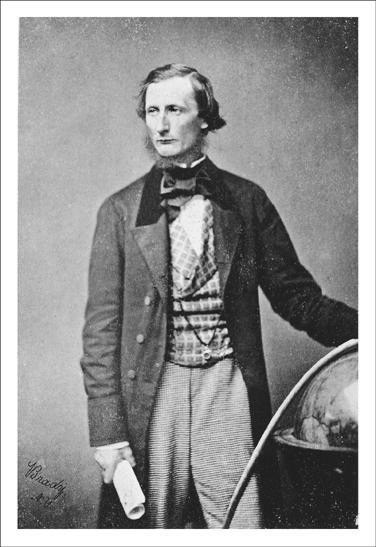
Cyrus W. Field (ca. 1860) (Carte-de-visite by Mathew Brady) (New-York Historical Society)
Field’s oracular venture became a major topic of the day. It drew some ridicule: “All idea of connecting Europe with America by lines extending directly across the Atlantic,” an American newspaper remarked, “is utterly impracticable and absurd.” Far more often, however, Field’s plan was hailed as a mindboggling fulfillment of modern commerce and technology: “it is impossible to contemplate the probability of such an achievement,” the New York Tribune said, “without a glow and a thrill at its sublime audacity and its magnificent uses.” The prospect of instant communication between continents stirred utopian fantasies of universal brotherhood, promising what another paper called “a more sympathetic connection of the nations of the world than has yet existed in history.”
Morse shared this ideology of redemption through communication and predicted an end to war “in a not distant future.” Together with his patent extension, an association with Field’s daring project meant a fresh start, a new beginning of his career. He invested $10,000 in the New York, Newfoundland, and London Telegraph Company, a one-tenth interest. Enthusiastically, he gave the company patent rights to his system for a line between Maine and New York City—free of charge. He also agreed to promote the company’s efforts to induce other American telegraph companies to transmit messages sent by the transatlantic cable at half price. The company placed him on its board of directors and advertised him as its “Electrician,” an honorary title.
Morse tried to make it generally known that he had been interested in suboceanic communication for more than a decade. He reminded many correspondents that in 1842 he had publicly attempted to telegraph across the East River. He often quoted the prophecy he had made a year later in a letter to the Secretary of the Treasury: “a Telegraphic communication on my plan may with certainty be established across the Atlantic! Startling as this may seem now, the time will come when this project will be realized.” But the many experimenters on both sides of the Atlantic now tackling problems of submarine telegraphy included several claimants to priority in the idea of a transoceanic line. Morse rebuffed them with smarmy graciousness, professing “the most respectful and kindly feeling” before laying out the crushing evidence against their delusions. “You will not feel offended if I give you facts,” he wrote to one rival, “though they may be fatal to your honest supposition … that you can claim priority in the suggestion of a Telegraph across the Atlantic.”
Morse took up eagerly the many practical questions raised by the cable-laying enterprise, some of great theoretical significance. He arranged to use part of the New York-Buffalo line for new experiments to determine the battery strength needed to communicate over very long distances. He examined various types of cable and insulating material, and offered Field detailed speculations on which would serve best. He suggested using one-eighth-inch wire of the purest copper, wound in shellac-saturated cotton or linen thread, then coated with gutta-percha—a latex that retains its plasticity under extreme pressure, previously used to insulate the cable across the English Channel. So prepared, one or more copper strands would be drawn into a lead tube loosely wound in iron wire.
Morse sent descriptions and drawings of his proposed cable to the experimental genius Sir Michael Faraday. Twenty-five years earlier, Faraday had generated electricity by rotating a copper disk in the field of some horseshoe magnets, a demonstration of electromagnetic induction that pointed the way to the creation of electric motors and dynamos. Morse hailed him as a fellow scientist. He said he had noticed that a prospectus from the British side of Field’s New York, Newfoundland, and London company identified Faraday as “Electrician.” “I have been elected to a similar office,” Morse explained. In his eleven-page letter he boasted of his pioneer cable-laying in New York harbor and his prophecy of transatlantic communication, but mostly sought Faraday’s views on what problems underseas operation might present.
Faraday did not reply. In seeking recognition as a fellow scientist from him, Morse miscalculated. The theoretical level of Faraday’s investigations was unapproachably beyond Morse’s expertise or even comprehension. And he learned from an acquaintance in England that Faraday took offense at being addressed as an “Electrician” to a company. From love of science and a sense of civic duty Faraday freely imparted his knowledge, but he stayed out of the marketplace: “no consideration would induce him to take part in any Company of a speculative or commercial character.” Morse’s acquaintance nevertheless relayed Faraday’s view that a current could no doubt be sent across the ocean. The chief problem, Faraday believed—correctly—would be the weight and strength of the cable, and the difficulty of laying it.
Morse quickly learned that he may also have misjudged his new business associates. Given the steep cost of lawsuits, many telegraph companies bought or leased rival lines rather than fight them in court.
For the same reason, Field wanted to acquire some small eastern companies that used Royal House’s printing telegraph. Morse liked Field personally, but the idea of Field’s group operating Morse lines together with House’s “rotten affair” insulted him. “I will on no account consent to put an inflated, bepuffed, lying abortion, on the same footing with my invention,” he told Field. He still intended to sue House for infringement, and believed that in the wake of the Supreme Court ruling he would be awarded heavy damages: “I do not feel like paying them money instead of receiving it.”
Kendall too was disturbed by Field’s willingness to consolidate with House companies. What troubled him even more, however, was the risky and one-sided agreement Field had extracted from Morse. Morse’s grant of patent rights at no charge to the New York, Newfoundland, and London company would be resented by Morse companies, which had paid for the rights. Also, Morse’s attempts to persuade other lines to transmit Field’s international messages at half price created a conflict of interest, since Morse himself owned stock in many of those lines. The other stockholders would suspect him of sacrificing them to serve his interest in Field’s line. Kendall warned Morse that the agreement would bring him distrust and ill will, and implored him to cancel it. “They ought never to have asked you to enter into it,” he said; “I have reason to doubt the sincerity but none to make me doubt the utter selfishness of these people.”
But Morse felt flattered to be treated by Field’s associates as the “great high priest” of telegraphy, and viewed the transatlantic cable as a noble philosophic-scientific-humanitarian endeavor. Field and his colleagues were “honorable men,” he told Kendall. They would not try to “entrap” him. Having made his agreement he would stand by it: “I shall feel myself bound in honor to bear this sacrifice myself and penalty of my folly, if folly it is.”
It took an entire year to ready the first stage of Field’s heroic undertaking—a land-and-water line connecting Newfoundland with the American continent. Telegraph wire had to be strung through a dense wilderness across Newfoundland, an area larger than Ireland. Eighty-five miles of submarine cable had to be manufactured to connect Newfoundland through the Gulf of St. Lawrence with Cape Breton Island, adjoining Nova Scotia, from where the line would pass into the United States. Field sailed to England to oversee manufacture of the cable, and to consult with the men who had telegraphically spanned the English Channel.
As he waited out the year, Morse took another of his occasional intermissions, in part to reorder his business affairs. His tormentors no longer included Henry O’Reilly. However colorfully bold, the “Napoleon of the Telegraph” was in his own way no less naive about business than was Morse. Wildly overextended, his People’s Telegraph to New Orleans a financial disaster, he went bankrupt, his furniture and other property seized and sold to pay his debts. The lines he had owned passed into other hands. Many of the lines had been poorly built and often broke down, so many of the companies that bought them also went bankrupt. His days as a power in the frantic telegraph business ended, O’Reilly took a clerical job in New York City, accepting daily wages to meet his family’s needs.
Not only O’Reilly was out of the way. Morse believed that the patent extension dissolved his contractual links to his partners in the original patent, leaving him free to act without consulting them. Alfred Vail could legally claim no interest in the extension, but on Kendall’s advice Morse gave him a continuing one-eighth share. Vail had decided anyway to quit telegraphy. He owned nearly $50,000 worth of stock in eight telegraph and railroad companies, but only about a fifth of it paid dividends. And he could find no more lucrative job than superintending a line from Washington to Columbia, South Carolina, at a demeaning annual salary of only $900. “I have made up my mind to leave the Telegraph to take care of itself,” he told Morse, “since it cannot take care of me.” Not an easy person to get along with—full of “morbid suspicions,” Morse said—Vail left gloomily: on bad terms with Kendall, feeling cheated by Smith, resentful toward Morse for failing to publicly acknowledge his contributions to the telegraph. His health had declined as well. The cares and worries of his service to Morse cost him what he described as “a termination of blood to the brain.” His physician advised him to “seek a rustic life.”
Vail returned to Morristown, New Jersey, site of his family’s Speedwell Iron Works. Semi-retired, he spent his time doing electrical experiments, compiling a mammoth Vail genealogy, annotating the many sermons he read, and arranging his scrapbooks and correspondence. He stayed in touch with Morse, occasionally meeting with him in New York. Rummaging around, he discovered some cast-off equipment from the early days of their partnership—a roll of the first telegraph paper they used, the model of the classic transmission key he had invented in Washington. He returned them to Morse, obviously still feeling some bond with his former teacher. Upon the death of his wife of thirteen years—a “crushing affliction,” he said, that left him weeping “bitter tears in loneliness”—he offered Morse $250 to design a monument to her.
Morse believed that the extension also voided Fog Smith’s share in his patent. “Consequently,” he said with vast relief, “the annoyances of Smith are at an end, so far as the necessity of consulting him is concerned.” Hoping to keep the peace, however, on Kendall’s advice he offered Smith an interest in his extended patent, as he had done with Vail. “The animal,” as Morse called him, brusquely rejected the offer and sued him for the same share in the extended patent as in the first.
And Smith won his case. A “legal swindle,” Morse moaned, but not exactly surprising, “for he is in his element, and I am not.” Having won his suit, “that incubus,” as Morse also called him, announced that he, too, would make a new start. Acting under what he conceived to be the terms of their 1838 contract, he intended to sell patent rights on his own, without consultation. “I do not perceive any safe course,” Kendall reported dolefully to Morse, “but an application … restraining him by injunction, getting a receiver appointed and going in for an annulment of the contract of 1838. The thought of another suit is revolting; but what can we do?”
Morse thought of disengaging from Amos Kendall as well. Since the extension dissolved their ten-year-old agreement, he told Kendall, it might be in their mutual interest to “close up our business relation.” As Morse’s agent Kendall had worked long and hard on his behalf. He not only fulfilled the terms of their agreement but also provided assistance and favors well beyond it—defending Morse at length in print, trying with Christian fellow-feeling to lift him from his blue periods. But Morse was irritated by Kendall’s attempts to steer him away from Cyrus Field. And Kendall’s never-robust health was worse than usual. Having suffered an attack of pleurisy and the death of another child, he could write for barely an hour without feeling exhausted; his hold on life, he said, was “very precarious.” Moreover, when business records were gathered to apply for the extension, they revealed that for a long time Kendall had kept the accounts on loose slips of paper. Among other results of his carelessness, money owed to Morse had apparently never been paid to him.
Morse sent Kendall an aloof letter, setting forth his terms for continuing their arrangement. “I have felt the want of a systematic keeping of our Telegraphic accounts,” he said. “This want has been felt most seriously when apprized of your often recurring illnesses, to which all indeed are more or less liable.” For years he had impressed on Kendall his indifference to mere trade. Now he required documentation of all the business Kendall had conducted as his agent over the past decade, with dates and amounts of every payment and receipt, and full details of the transaction. “Such a statement is, I conceive, a necessary prerequisite to any negotiation for setting up the business of your Agency, to which it seems the ‘extension’ has unexpectedly put an end.”
Morse’s tone sounds thankless, suggesting that he took Kendall’s devoted agency for granted, as if entitled to it. It turned out, however, that the extension did not alter Morse’s legal agreement with him, which remained in force. Kendall had experienced far worse in his life than thanklessness, and did not gloat. He continued selling patent rights and taking on the aggravation and legal mess that often followed. “Indeed,” he told Morse, “what is there connected with your patents and your telegraph property, that I have not to attend to? I do not complain, but do it all cheerfully.” A quick tally of debits and credits apparently revealed that a considerable amount of money was owing—not to Morse but to Kendall, who offered not to take it. A lawyer and clerk were hired to sort through heaps of correspondence and scraps of paper, assisting Kendall as he attempted to organize the business records, prodded now and then by Morse for a definitive statement.
In a final gesture of casting off the past, Morse tried to exorcise Joseph Henry. He had not replied publicly to Henry’s damning court testimony against him. But recently the testimony had been quoted at length in several new books on telegraphy, such as Alexander Jones’ Historical Sketch of the Electric Telegraph (1852), which cited Henry in attempting to show that Morse had contributed nothing essential to the invention. Morse answered in a ninety-page tract, The Electro-Magnetic Telegraph, A Defence against the Injurious Deductions Drawn from the Deposition of Prof. Joseph Henry, (in the Several Telegraph Suits).
In private, Morse accurately referred to his Defence as his “Attack!” Dropping his usual polite deference to Henry, he walloped him as a befogged academic whose testimony in court misrecollected and misrepresented their meetings. Henry’s supposed scientific discoveries were based on discoveries by others and/or were no help: “the impression that I derived any aid from him … is utterly fallacious.” With a barrage of damaging dates, names, and facts he assailed Henry’s reputation for impartiality, his credibility as an expert witness, his qualifications for heading the Smithsonian Institution. Then he sweepingly summed up the evidence: “the Magnetic Telegraph owes little if anything to Professor Henry’s labors or discoveries. The truth of History should no longer be allowed to suffer from so erroneous an impression.”
While at Locust Grove waiting out preparations for laying the Atlantic cable, Morse also reentered politics. He accepted an invitation from Democrats in the district to run for a seat in Congress. He did so without much enthusiasm, uncertain whether if elected he would be able to satisfy his constituency. As he put it, for forty years he had “cordially acquiesced” in Democratic policies—assented to the policies, he seems to mean, without espousing them. He disapproved the party’s “bargaining for Catholic votes,” and during the 1836 New York City mayoralty race he had run as a candidate of the Native American party.
In the congressional election, in November 1854, Morse received about 5000 votes, losing to the victor by just over 3000—a respectable showing: “I came near being in Congress,” he said. Defeated or not, he got a chance during the two-month campaign to make his views public. The paramount issue remained European designs on America. With the Revolutionary generation dying off—only about a thousand veterans of the war were left—he hoped to keep alive its ideal of an America purged of Old World corruption: “I am content to stand on the platform … occupied by Washington in his warnings against foreign influence.”
Morse had always thought the Abolitionists dangerous to the nation, comparable to the bloodsoaked Jacobins of the French Revolution. And European intriguants, in their latest attempt to divide the country, were insinuating into every public issue great and small the “rabid Abolition spirit.” The Kansas-Nebraska Act of 1854, for instance, permitted settlers in the newly created territories of Kansas and Nebraska to decide through their territorial legislatures whether to allow or prohibit slavery, repealing the thirty-year-old Missouri Compromise, which had excluded slavery from the same area. Morse believed that the act would pacify the now-tumultuous agitation over slavery and produce “lasting good to the slave as well to the country.” But Abolitionists had drummed up so much excitement over it as to shut out of public view vastly more important issues. And among the foreign inciters of Abolitionism, the most disruptive was the Catholic Church, now more than ever to be abhorred. “The reckless spirit of a wild and truly un-Christian abolitionism, is that which I believe Jesuits may, and do, use as one of the most efficient means to accomplish their great end, and the end for which they have been sent here, to wit, the dissolution of the Union.”
Despite efforts by Morse and others in the 1830s to warn Americans about subversion from abroad, Nativism had been quiescent for a decade. But it revived following waves of European immigration that from roughly 1845 to 1855 brought to America nearly three million foreigners, more than had come in all the time since the American Revolution. “It is a problem yet unsolved,” Morse said, “how far our moral strength can withstand the shock of such an avalanche.”
Morse felt the effects himself. He allowed an Irish railroad laborer named Brien to erect a “shantee” on his land at Locust Grove. Returning from a trip to Washington he found not only the Brien family but a whole shantytown on his property, “a complete Irish village” of railroad workers who had cut down his trees and burned his fences. “An incursion of savages could not have done so much injury in so short a time,” he howled. “I declare I almost cried when I looked at the scene.” He ordered the shanties removed and demanded “heavy damages.” With forecasts in the press of further large Irish immigrations soon to come, he theorized that England intended to drive the Irish out of Ireland, recolonize the country with Englishmen, and leave America to take care of the wretched refugee population it had created. In seeking a coachman, a laundress, and other domestic help he specified Protestants only: “I do not wish Irish,” he added.
Morse became a rallying point for the revived nativism. With new Catholic churches being built and new Catholic calls for an end to Bible reading in the public schools, he permitted nativist groups to reprint his Imminent Dangers to the Free Institutions of the United States Through Foreign Immigration (1835). He also agreed to sit on the Council of the Order of United Americans, an organization of self-described “ultra kind of Americans” opposed to immigrant-borne “jesuitism.”
Although running for Congress as a Democrat, Morse boosted the Know-Nothing party, the most visible and successful manifestation of resurgent anti-Catholicism. The party’s platform included a resolution to restrict political office to native-born Americans (“AMERICANS ONLY SHALL GOVERN AMERICA”)—a cause Morse had espoused for twenty years. Rapidly gaining support throughout the country, the Know-Nothings elected eight governors by the end of 1855, and the mayors of Boston, Philadelphia, and Chicago. “The American mind,” Morse wrote, “is at length awake.”
Morse drew most attention to the cause by dueling in the press with the American-born Catholic bishop of Louisville, M. J. Spalding. At issue was a statement supposedly made by the Marquis de Lafayette more than twenty years earlier: “American liberty can be destroyed only by the Popish clergy.” Lafayette’s warning had been often and widely quoted since first appearing in Morse’s Confessions of a French Catholic Priest (1837). Morse had included it on the authority of the ex-priest whose manuscript he edited for publication.
About ten days before the November 1854 election, an article made the rounds of American newspapers, denouncing the quotation as a “Disgraceful Forgery.” Reprinted from the Cincinnati Enquirer, the article maintained that Lafayette’s statement had been taken out of context from a letter he wrote, in a way that reversed its meaning. What Lafayette actually said, according to the Enquirer, was: “the fears … that if ever the liberty of the United States is destroyed it will be by Romish priests—are certainly without any shadow of foundation whatever.” Morse publicly called the Enquirer quotation spurious, a forgery itself, and demanded that the newspaper produce the supposed letter. He claimed that he had often personally heard Lafayette, who had been born a Catholic, warn against Catholic influence in America.
Soon Morse was trading insults in the press with Bishop Spalding, who attributed the reversal of Lafayette’s meaning to deceitful anti-Catholics. In their eight-month-long exchange of published letters and comments, the bishop sneered at Morse’s faulty memory and fondness for academic titles. Morse sneered back that it baffled “moral science” to account for so contradictory a thing as an American-born bishop:
that one who, with his first moral breath, inhaled the purified air of a Bible Christianity; that one whose infancy was nurtured amid the sound heads and honest hearts of a Kentucky community, should voluntarily shrink away from the day-light that surrounded him and deliberately prefer to grope for enlightenment in the foreign dens of a decaying and festering superstition….
Mostly Morse tried to out-argue the bishop, “Jesuit as I presume he is, and eel like as he may be.” With no less intensity than he brought to demonstrating the priority of his telegraph, he chased down evidence of the authenticity of Lafayette’s statement—writing to Paris booksellers, scanning old newspapers, contacting persons who had known Lafayette and historians who had written about the period, including Washington Irving and George Bancroft.
Morse’s months of research did not greatly help. Over the course of the controversy he shifted ground. Eventually he contended not for the genuineness of Lafayette’s statement but of the “sentiment” it contained: “The precise words,” he conceded, “are comparatively of little moment.” Just the same, sympathizers from all over enjoyed and approved his thrusts at the bishop. His letters, he learned, delighted readers in Georgia who believed that the Church was using Abolitionism to destroy the Union. An admirer in western Pennsylvania sent congratulations: “You have … layed the Bishop out as Cold as a waggon tire [sic].” The news reached the Protestant press abroad: “by the world-renowned Professor Morse,” the Edinburgh News of the Churches reported, “Bishop Spalding is pilloried in Kentucky.”
Despite his passion for the nativist cause, Morse felt no more at home in the movement than in the Democratic party. Unexpectedly he found himself leaving the Order of United Americans, and no longer endorsing the Know-Nothings. Like other political parties, the Know-Nothings were split by sectional loyalties. Many northern members aligned themselves with the Abolitionists, believing that the Catholic Church and nearly all Irish immigrants supported slavery. To Morse, the Know-Nothings were in this way “neutralizing” their influence, and he withdrew his support: “I cannot thus identify myself while there is any likelihood of my giving my influence to the ruinous anti-Slavery movement of the North against the South.”
To a lengthening list of disillusionments with the country that included the American press and American patent laws, Morse added the American party system. The Whig party having collapsed, the Democrats being sharply divided by the “dangerous ultraisms” of the day, and the new, anti-slavery Republican party being contemptible, he began to feel disenfranchised altogether: “my own views … are not in accord with the platforms of any present political organization, nor can I be identified entirely with any of them.”
During Morse’s year-long intermission, the first, North American stage of the transatlantic telegraph had been nearly completed. Six hundred workmen had built a road from one end of Newfoundland to the other. It wound around bays, and through rocky gorges and dense forests roamed by bears and herds of caribou—a giant causeway of telegraph poles eight feet wide and four hundred miles long. Simultaneously a 140-mile telegraph line had been strung through Cape Breton Island, about sixty miles away across the Gulf of St. Lawrence. What remained was to lay a cable in the gulf electrically linking Newfoundland with Cape Breton Island, where transmissions would pass through nearby Nova Scotia into the United States. A land-and-water line of telegraph would then be in operation some 1200 miles from Newfoundland to New York City, waiting to be attached to the undersea cable from Ireland.
On August 7, Morse and Sarah sailed from New York City to witness the laying of the gulf cable. For the critically important event Field chartered a sleek sidewheel steamboat, the James Adger. He invited fifty-eight guests as passengers—clergymen, doctors, lawyers, reporters, as well as the other directors of the New York, Newfoundland, and London company with their wives and children. The atmosphere was party-like. The flag-decked Adger left its Hudson River pier amid steam whistles, three-gun salutes, and displays of the Stars and Stripes. The first night out, Field’s guests heard a concert of airs from popular operas and selections of minstrelsy, such as “The Colored Fancy Ball.” Morse brought along and demonstrated a telegraph apparatus. When thunderstorms struck that evening, guests jokingly blamed them on the Lightning Man.
On August 20, Morse and the others aboard the Adger reached Port-aux-Basques, Newfoundland, from where the submarine cable would be laid to Cape Breton Island. They were scheduled to meet up with a vessel from England bearing the cable and paying-out equipment. But the vessel had been delayed. On Field’s order the Adger steamed around the southern end of Newfoundland to the capital city of St. John’s, for a four-day goodwill call on officials of the provincial government. Field distracted his guests with a shipboard banquet, whose several toasts included a flattering quatrain to Morse:
The steed called Lightning (say the Fates,) Was tamed in the United States; ’Twas Franklin’s hand that caught the horse, ’Twas harnessed by Professor Morse.
Morse replied by acknowledging his dependence on Field for his “favorite dream,” cherished for twenty-three years—“that universal humanity is to be bound in a true social fraternity by instantaneous intercommunication of thought.”
Humanity would have to wait, however. The Adger returned to Port-aux-Basques, where it at last met up with the sailing bark from England, the Sarah L. Bryant, loaded with copper cable. Morse left no account of the fatal mishaps over the next week, which are known only through reports in the press. On August 22 rafts bringing ashore lumber to build a telegraph shack were split by breakers. The lumber was rescued by spectators who rushed armpit-deep into the water, and some dogs that clenched planks in their teeth and swam with them back to the beach. Three days later the ships started out across the Gulf of St. Lawrence to lay the cable. But they collided; the Adger carried away the Bryant’s shrouds. On a second attempt, the Adger’s four-inch-thick towline jammed in its side wheel; in trying to disengage the line the Bryant lost its anchor.
The ships resumed their attempt to lay the cable on the twenty-seventh, a beautiful morning although with a strong northwest breeze. Late in the afternoon, after about forty miles of cable had been put down, a gale swept the Gulf of St. Lawrence. The Bryantpitched violently, in danger of being pulled under. It held on for hours, but near seven o’clock in the evening, a cry went up from the deck: “The cable is gone!” All forty miles of it sank, irretrievably. The expedition to complete the first stage of the transatlantic telegraph was over, a failure.
Morse and Field’s other guests returned to New York aboard the Adger the first week in September. Some at least stayed in a gala mood, holding a costume party and dancing the schottische. However battered, Field was determined to keep going. But he and his associates had lost about $350,000, a quarter of their capital. And manufacturing a new cable for the gulf would require several months, while the larger enterprise would be set back an entire year.
Morse had grown close to Field and his family. When writing to him, he sometimes sent a kiss for one of Field’s children; Field named a new son after him. What he found out a week or two after returning from Newfoundland therefore came as a nasty surprise. Field and his associates, he learned, had paid $100,000 for patent rights to a new telegraph, invented by a London-born Kentucky music teacher named David Hughes. Like the earlier House telegraph, it used a piano-like keyboard of twenty-eight keys, and printed letters of the alphabet. Its workings were complex, involving the synchronous movement of corresponding parts in the transmitter and receiver, kept in tandem by a spring that vibrated to produce a musical note of a certain pitch.
Field’s sudden interest in a rival telegraph upset Morse. But Field explained that he and his associates had bought the patent right preemptively. They simply wished, he said, to forestall the purchase of Hughes’ system by others who might use it in competition with the Morse system. Having been banqueted and toasted aboard the Adger, Morse accepted Field’s story. He assured Kendall that Field and his colleagues were acting openly and in good faith. “I am confident their designs towards me and also towards you, are of the most friendly and liberal character in their acquisition of the Hughes patent,” he said; “it was for the purpose of keeping it out of the hands of such men as … would not scruple to use it to my detriment, and to have it in the hands of friends.”
But two weeks later Morse’s restored confidence in Field turned to new concern. An article in the New York Herald entitled “Astounding Telegraphic Improvements” acclaimed Hughes’ apparatus as “the most wonderful instrument for telegraphic purposes ever invented … far ahead of any machine now in use.” The article had even worse news for Morse. It reported that Field had organized a new group, the American Telegraph Company, to build Hughes lines west and south—“a network of wires radiating in all directions from New York to every prominent business place in the Union.”
Morse knew about this company. He had given it his blessing, in the understanding that Field hoped to join the submarine cable to a national network, and therefore planned to lease or buy existing lines along the Atlantic seaboard and bring them under a unified management, including Morse lines. But his understanding of what Field hoped to do had not included the building of new lines worked by Hughes telegraphs. Such lines would put Field’s American Telegraph Company in direct competition with the Morse companies. He worried anew about Field’s intentions: “I hope collision may & will be avoided. Yet alas! my experience of men leads me to distrust the promises of the best of them.”
Morse calmed down again after a few days. He decided that the Herald article amounted to no more than another of those self-interested jeers at his system by the press, aimed at getting Morse lines to cut their rates for telegraphic dispatches. It strengthened his belief to learn that the article had been written by an agent of the Associated Press, Daniel Craig. Craig was the journalist whose transmission of international news from Halifax had been blockaded by F. O. J. Smith. A forty-year-old New Englander, Craig had a shady reputation. He sabotaged Smith’s Boston–New York line—Smith claimed—by sending a mistress to cut the wire. On several grounds Morse discounted the Herald article. To clinch the matter, he heard directly from Field that the article in the Herald wasuntrue. Field said that he and his associates in the American Telegraph Company had no intention of building new Hughes lines. “They were as much surprized as any one,” Morse told Kendall, “and as indignant of such misrepresentations.”
Kendall was less convinced. Suspicious of Field from the beginning, he again warned Morse that Field’s friendliness was a snare, designed to gain his confidence in order to exploit him. This time, he said, Field would use the fanfare about the Hughes telegraph to drive down the value of stock in companies that ran Morse equipment. Then Field’s American Telegraph would buy or lease the Morse companies at bargain prices. “It was not friendship to us which induced them to buy the Hughes instrument,” Kendall said; “it was in fact, say what they will, to hold it in terrorem over our heads and the heads of our companies to induce us to let them have our lines at a reduced rent.”
But Morse was by nature trusting—of an “unsuspicious disposition,” as Kendall put it. He also felt too deeply committed to the “great enterprize” of a transatlantic telegraph to risk alienating the men who made it possible. He conceded no more than that the motives of Field and his allies might be mixed. “They are kindly and I believe generously disposed towards me,” he replied to Kendall, “but they are business men too.”
Morse agreed to accompany Field over the summer on a trip abroad. Field wanted to enlist English capital and the English government in laying the cable across the Atlantic. He asked Morse to come along in order to experiment on submarine conductors, “of which,” Morse noted, “we have none of any great extent in this country.” A friend advised Morse to have the New York, Newfoundland, and London company pay for the trip: “the stockholders are a few wealthy men & you are to go to great expence for the benefit of the line & they bear none of the burden … is that liberal, or selfish?” Morse would hear nothing of Field’s supposed selfishness, however. Besides, he meant to take advantage of the trip by seeking payment for the ever-increasing adoption of his system abroad: “not a mile contributes to my support,” he complained, “or has paid me a farthing.”
But the spring months of 1856, as Morse prepared to depart, brought more disquieting signs. New articles glorifying the Hughes telegraph appeared, these too by Daniel Craig. Implying that he wrote with the sanction of Field’s American Telegraph Company, he reported the imminent construction of Hughes lines in New Jersey, Pennsylvania, and elsewhere along the Atlantic coast. Morse fulminated against Craig as a “low-bred profane wretch.” But he could not ignore the possibility that Craig was covertly writing on behalf of Field. Kendall pushed him to ask Field bluntly whether American Telegraph, owners of the Hughes patent, had authorized the use of Hughes instruments on the lines reported by Craig—in competition with the key New York–Washington line of Morse’s Magnetic company: “This much you have a right to claim as due to you.”
Morse made his uncomfortable relation to Field no easier by endorsing a new British organization, the Transatlantic Telegraph Company. Finding the group composed, he said, of “substantial and honorable men,” he swallowed their tale that they did not intend to interfere with Field’s great undertaking but to aid it. Field and his associates quickly disabused him. Becoming “quite warm on the subject,” Morse said, they made it clear that Transatlantic Telegraph was in fact a rival. The British group had widely publicized Morse’s sponsorship, obliging him to take out a notice in the New York Herald announcing his withdrawal from them, “undoing today what I did yesterday.”
Morse may have undone too soon, for only a week later he received depressing evidence of Craig’s secret involvement with Field’s company. How it arrived and its exact nature are unclear. But Kendall described the information as certain proof of “some degree of contact” between Craig and “some members” of Field’s American Telegraph. “They have … confessedly been dealing with Craig,” he said, “knowing that he entertained designs hostile to the interests of the Magnetic Line in which you are so deeply interested, and yet, with all their professions of friendship, concealed those designs from you and me.” He told Morse flatly that Field and Field’s associates had betrayed them.
Against his every wish and inclination to consider Field a friend, Morse was beginning to lose faith in him. “I confess,” he told Kendall, “there has been so much mysterious manoeuvering.” More than that, he had joined Field’s enterprise not for gain but for the good of humanity, to help realize “the great plan of uniting the two continents by Telegraph.” Flattered as he felt to be treated as the “high priest” of telegraphy, advertised as “Electrician” of the transcendent adventure, the evidence of schemes harmful to himself and to the Morse lines could not be wished away. He told Kendall that they would continue to negotiate with Field and his associates for the sale or lease of the lines. But he would “get away from all connection with them,” he said, “the moment I can do so without too great sacrifice.”
Morse and Sarah were scheduled to depart for Europe with Field in early June, now only about a month away. He still meant to make the trip, but before leaving he visited Boston and walked over to Charlestown, his place of birth. He had not seen the town for eighteen years, and then for only a few hours. The landmarks were so changed he scarcely recognized them. A pump in the square had vanished, a tavern stood in place of a mansion, the church where his father had preached was gone, together with the parsonage and garden.
But his first home, a two-story wooden house, still existed. Allowed in by the present owner, he viewed the room in which he supposed he was born, the walls unsubstantial, the ceiling low. At another house in town he discovered the watercolor portrait of his family he had painted in his teens.* He had wondered where the picture might be—his young self, his brothers, his mother and father gathered around a Chippendale table, on which stands a globe of the world.
Jedediah was much on Morse’s mind. About two weeks before leaving for Europe he wrote a biographical sketch of “my venerated Father.” He remembered not primarily Jedediah’s acts of benevolence—as when he gave the profits from his geographies to the needy—but more strikingly his Christian forgiveness of injuries. He recalled how his father addressed the flock who had driven him from his pulpit, quoting the words of Paul to the Ephesians: “Let all bitterness and wrath, and anger, and clamor, and evil speaking be put away from you with all malice.” His memory could summon up no more vivid image of his father than of Jedediah praying with choked tears for those who had injured him.
Morse and Sarah departed for Europe on June 7, taking with them their six-year-old son, Willie. They had to make the voyage without Cyrus Field, however. Field telegrammed to say he had moved his own passage up to July, owing to the illness of his eldest daughter. He said he could arrange for Morse to make the same change, so that they could still cross the Atlantic together. “My arrang. are now so fixed,” Morse telegrammed back, “I fear I can’t wait.”