
THIRTEEN

SARAH Elizabeth Griswold, Morse’s second wife, was the daughter of an army officer, born on Christmas Day at a military fort near Lake Superior. Not much more is known about her past, and very little about her married life with Morse. If they wrote to each other, the letters were not preserved or have been removed from surviving papers of the Morse family. In the few extant daguerreotypes of Sarah she looks plain but amiable—medium height, oval face, tightly coiffed chestnut hair parted in the middle, a pencil-line smile on her narrow lips. In two ways Morse’s choice of her seems unusual. She was thirty years younger than he. And she was deaf.
Morse first saw Sarah at a relative’s house a half-dozen years before their marriage. “I was exceedingly struck with her beauty, her artlessness, her amiable deportment…. I found myself in love with her then before I was aware.” His financial situation ruled out any thought of marrying, however, and she was then barely twenty. He stifled his feelings and thought no more of her until—“accidentally shall I say? no providentially”—he saw her in Utica at the wedding of his son Charles in June 1848.
Sarah had matured, and her character impressed him. The wedding party included his partly deaf son Finley, whose “defects” kept him apart, seated alone in a corner. “I saw Sarah go to him, and taking his hand drew him up and putting her arm in his, she walked the room for some time with him endeavoring to amuse him, and then seated herself by him and in every way she could devise amused him for a long while.” Sarah’s kind sympathy fixed itself in his mind. Two months later they married.
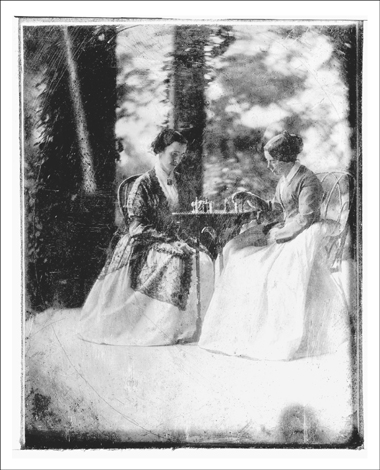
Sarah and Susan Morse at Locust Grove (Daguerreotype by Samuel F. B. Morse) (New-York Historical Society)
Sarah had been deaf since the age of one, owing to a fall or perhaps to scarlet fever. Early in adolescence she attended for three years the state-run New York Institution for the Deaf and Dumb, where she learned to communicate in sign language. Morse believed, or more likely only wanted to believe, that she had gradually been recovering her hearing. He said that he found no difficulty conversing with her, but this may have been due mostly to her proficiency in lipreading: “the simple movement of the lips seen across the room, without a sound being uttered she understands perfectly.” Although her speech, too, was impaired, he deliberately did not learn the sign alphabet, certain that if she conversed with him her articulation would improve: “I have little doubt that I can with God’s help teach her to speak as plain as anyone.” About two years after their marriage, he put her under the care of a physician named Turnbull, well known for his treatment of ear and eye problems. Turnbull tried to persuade him that as a result of the therapy Sarah could hear better than ever. But Morse’s own senses provided no evidence of improvement, and he wrote off Turn-bull as a fake.
Sarah’s impairment deepened Morse’s feeling for her: “her misfortune of not hearing, and defective speech only excited the more my love & pity.” He recalled Sidney remarking, before his own marriage, that he intended to choose a respectable poor girl, who would feel for him not only affection but also gratitude for befriending her. Sarah’s situation at the time of their marriage was similar—“portionless” and partly dependent on the beneficence of her sister’s husband. He increased Sarah’s debt to him by taking in her mother to live with them. Such bonds of need, he believed—“guarantees of affection aside from mere personal love”—augured well for the solidity of their marriage.
Morse felt no less indebted to Sarah. She had come to him in an up-and-down, “singularly checkered” existence. As a widower he had courted a succession of young women, each time ending up frazzled and dejected: “how many several trials I have passed through on this subject of another wife … how many times I have been thwarted and disappointed till almost in despair.” But having bowed in submission to God’s will, he now had everything in a wife he could have desired. “She is noble hearted, considerate, most anxious to please me in all things,” he beamed. “I say every thing when I say that my dear Lucretia could not be more so.” He relished the aura of content Sarah gave off—always busy with her needle or with a book, the very pattern of neatness in her person, sensitive to the beauties of nature. “I am almost overwhelmed with gratitude. His Gifts are worthy of himself. I have looked to him for this precious gift for twenty years.”
Sarah attended an Episcopal church, but in Morse’s view she lacked genuine piety. He instructed her in true religion, as he had done years earlier for Lucrece, praying that she might come to experientially know what it meant to have an interest in Christ’s death and salvation. “Love him, dear Sarah, pray for the Holy Spirit to take of the things of Christ and show them to you. By his aid you can be taught truly to love him.” She showed serious concern for her soul, and he drew improving lessons for her from events. In one instance he mentioned a man who had been killed by a train while attempting to save a horse that balked on the tracks. “Let it have its effect my precious Sarah, on your own heart,” he counseled. “How would the summons find you, supposing it should come as suddenly as to the poor man … Faith in Christ alone calms every fear.”
Morse brought Sarah into comfortable circumstances. His wealth can only be estimated, but in 1852 he held nearly $400,000 in stock in six telegraph companies, besides cash he earned from the lines as dividends and from income-yielding real estate in Utica. For $17,500 he had bought a 100-acre farm property about two miles from the village of Poughkeepsie. It included an unpretentious but substantial house fronting the Hudson River. The landscape pleased his painter’s eye: “every variety of surface, plain, hill, dale, glens, running streams and fine forest … the Fishkill Mountains towards the south and the Catskills towards the north; the Hudson with its varieties of river craft, steamboats of all kinds, sloops.” The farm gained in commercial and personal value from a soon-to-be-built railroad line that would bring him within two and a half hours of New York City.
To manage the large place, Morse hired several domestics, a cook, and a live-in farming family named Teller. When asked at a court trial to state his occupation, he replied: “I … am at present a farmer.” In time the place did become a working farm with a stable of horses, producing milk and butter, hogs for slaughter, and prizewinning wine, as well as potatoes, corn, and other vegetables, some of which he donated to a “Home of the Friendless.” He took a pew in the local Presbyterian church, a fifteen-minute ride away. Indulging his love of music, he had a pianoforte and stool shipped from New York City by barge.
Morse gave his estate the same name contrived for it by some former owners: Locust Grove. After years of nomadism he was happy to have a home—at least “as far as we are permitted to call any place this side heaven home.” He grew fonder of Locust Grove every day. Two years after settling in he decided to enlarge and transform his house. For the remodeling he hired the eminent New York architect Alexander Jackson Davis, designer of the influential Gothic building of New York University and author of Rural Residences (1837). He also hired Davis to shape the grounds according to the latest texts on landscape gardening, creating an ideal illustration of Nature. Among other things this meant landscaping the approach so that, from any one point, only portions of the house could be seen peeping through the verdure, teasing the imagination with suggestions of an infinite variety of “picturesque beauty.”
Morse himself made many sketches of the house he desired. Davis’ plans went through several stages of design and redesign before the remodeling was completed early in 1852. He encased the original Federal-style house in an octagonal Tuscan-style villa, featuring a dramatic four-story tower that afforded panoramic views of the lordly Hudson. The numerous rooms included a large library, into which Morse conducted a telegraph wire from a nearby line for his personal use.
Morse and Sarah quickly produced a family. Within four and a half years after their marriage, they had two sons and a daughter at Locust Grove, whom they named Samuel Arthur Breese Morse, Cornelia Livingston Morse, and William Goodrich Morse. As children of his old age, Morse looked on them as unmerited gifts from heaven: “My own unworthiness seemed more than ever great, so great that I was tempted to cry out, Why is all this to me a sinner?” Much as he enjoyed hearing their cheerful voices, however, he cautioned Sarah not to make them playthings: “Remember they have souls, and these are infinitely valuable, while the perishing body, though to be suitably cared for, is in comparison utterly worthless.” He attended personally to their religious training, as he had done with his first brood, and as Jedediah and Elizabeth had done with him. In language that by now had passed through several generations of Morses, he set out for them the doctrine of original sin, the quintessential importance of the Bible as God’s revealed Word, and the superiority of Christianity to other religions.
Morse’s children by Lucrece had become adults without ever having lived with their father. But now, for the first time in twenty years, he was able to have all of them around him, at least temporarily. Charles moved into Locust Grove for a while with his pretty wife, Manette. Morse had given them $5000 in Magnetic company stock as a wedding present, and Charles said that he counted himself blessed to have “such a kind and affectionate father.” The young man felt down, however. He had quit Yale to take up farming, but had given up that fancy and now was having trouble finding work. Lucrece’s deceased brother had left him some money, which he apparently misspent.
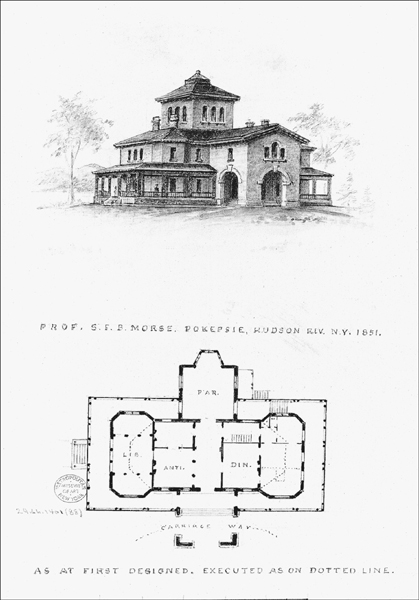
Alexander Jackson Davis, plan for Morse home at Locust Grove (Metropolitan Museum of Art)
Morse had little sympathy for his son’s floundering. He thought Charles talented, but disorganized and careless with money, a soft touch for “any plausibly spoken man.” Charles had thrown away hundreds of dollars—“and if he had millions it would be the same.” He therefore refused to help Charles out financially. At the same time he contributed $1000 to Yale, but that was a different matter, he told Charles, a “religious duty.” He intended, he added, to spend his money on “benevolent purposes” and Charles “should rejoice at such a prospect.” As for the future disposition of his estate, he planned to keep a close watch on his son: “it will depend on his acquirement of safe habits, whether I leave him anything.”
Finley, too, lived for a while at Locust Grove, working the farm, fishing, being helpful. Twenty-five years old, he missed his uncle Sidney, who for most of his life had served as a stand-in father. To Morse, Finley seemed a sort of sacred fool, handicapped by his condition but also elevated by it. “There is no improvement in the character of his mind, and I despair of ever seeing any,” Morse wrote, “but this affliction comes with so many alleviations of … docility, moral if not religious principle, health &c., that it is scarcely an affliction.” Lucrece’s brother had apparently left money for Finley, too. Morse planned to invest it in the Locust Grove farm, paying his son interest while making certain that he would always have a home.
Susan—“my ancient daughter,” Morse called her—remained in Arroyo, Puerto Rico, sending monkeys as gifts for his new children. But she visited Locust Grove annually, bringing his grandson, also named Charles, who to his delight showed an aptitude for drawing. At thirty, the daughter who had spent her childhood longing to be with him was now two years older than his wife. Her life in Puerto Rico seems to have been often unhappy. Contending with ants and lizards that chewed her plants, she referred to the island as “this horrid place.” Her husband, Edward, had established a distillery to make puncheons of rum. But he met with uneven success, rich one moment, poor the next. Probably to help out, Morse gave Susan $10,000 worth of telegraph stock. On one annual visit he took her to the Catskill Mountain House, a well-known resort. She was thin and in poor health, and he hoped the excursion might restore her flesh and color.
Morse had intently followed the progress of the politically divisive Mexican War. What many Americans condemned as a war of aggression aimed at extending slavery, he saw as a chance to prove the nation’s military valor and open a field to Protestant evangelism: “The Mexican race is a worn out race; and God in his Providence is taking this mode to regenerate them…. Our Bible & Tract Societies and Missionaries ought to be in the wake of our Armies.” He also gave credence to long-existing rumors of plans abroad to install a French or Spanish—that is, Catholic—monarch on the throne of Mexico: “how far these designs are connected with the Leopold operations in our own country, may be guessed at.” An American victory would halt the further spread of popery and teach European despots not to interfere in American affairs. He looked forward to an honorable peace with the Mexicans, he said—“after we have given them a thorough thrashing.”
Morse had also kept an eye on the revolutions overtaking Europe. In February 1848 a Paris mob clashed with a detachment of troops, who opened fire, killing or wounding some fifty people. The mayhem touched off massive civil disorder. More than a thousand barricades went up throughout the city; crowds overran the Tuileries Palace, tossing the throne into the courtyard. Leaders of the insurrection proclaimed that the people would not again allow the government to betray republican principles, as had happened under Louis-Philippe, who was forced to abdicate. The upheaval in Paris inspired popular uprisings in Italy and central Europe as well, driving the Pope from the Vatican and Metternich from Vienna.
Like many other Americans, Morse rejoiced in the revolutions, which President Polk called the most important event of modern times. Morse wrote to Arago congratulating the French on what they had achieved. “In a most important sense,” he said, “France now holds the destiny of the world in her own hands.” The question was whether she would succeed in finding a “moral basis” for maintaining republican government, or again relapse into anarchy and despotism. The first amendment to the American Constitution offered a model, he told Arago. An act similarly forbidding the French state to make laws concerning religion would “lay the Corner Stone of Liberty and happiness in France and throughout the world.” That, of course, did not happen. Napoleon’s conservative nephew, Louis Napoleon, staged a coup d’état, proclaimed himself Emperor, and suppressed the liberal constitution. One after another the other uprisings collapsed or were beaten down. “All is crushed,” the Observer lamented, “trampled under foot, rent at the point of the bayonet: justice, law, liberty, honor.”
As for his aesthetic life, Morse had taken scarcely any interest in painting for many years: “the very name of pictures produces a sadness of heart I cannot describe.” He visited the National Academy of Design with Sarah, but before leaving for Europe in 1845 he had declined reelection as president, and not once during his stay in Paris had he visited the Louvre. He blamed his withdrawal from art largely on John Quincy Adams. He still believed that it was Adams who had denied him a commission for one of the Capitol rotunda paintings out of ill will toward Jedediah Morse. And he still reflected bitterly on what the former president had done by thus blocking his development: “he killed me as a painter, and he intended to do it…. May God forgive him as I do.”
His eyesight deteriorated, Morse no longer wished to be remembered as a painter. By his own high standard, he felt, he had never been one. Of the more than three hundred canvases he had produced, some family portraits remained valuable to him for their likeness. But he retained only The Muse, the full-length portrait of teenaged Susan in a butterscotch-colored dress. Otherwise, nothing: “I could wish that every picture I ever painted was destroyed.”
Morse’s disgust did not take in his adventurous work in photography, which many still appreciated. “It was through him,” recalled the Brooklyn Daily Freeman, “that Daguerre communicated his invention to the people on our continent.” The Photographic Art Journal asked him to head a committee to award prizes for the best daguerreotypes. He was also remembered by a former Baptist clergyman named Levi L. Hill (1816–1865). Severe bronchitis had forced Hill to abandon his ministry. He became a professional photographer, supposing that the chemical fumes given off by Daguerre’s process would benefit his afflicted lungs.
They did not, but Hill made an improvement no less questionable. Some daguerreotypists had been hand-coloring their pictures. A few, notably in France, experimented with producing colored plates directly. Hill claimed that he had invented a method of photographing colors accurately, brilliantly, and permanently. Secretive, he vowed to let no one see specimens of his work until he had perfected the method and could, as he said, “dress the child of light for the public gaze.” Gossip about his hillotypes, as the pictures became known, gave rise to speculation about them in the photographic journals and the general press. Many daguerreotypists regarded him as an ignorant pretender.
Hill wrote to Morse about his invention, virtually begging him to visit his home in Westkill, New York, a hamlet about sixty miles from Poughkeepsie. Morse seldom left Locust Grove, and invited Hill there instead. But Hill declined, explaining he was too ill to make the trip, suffering what he oddly called “nondescript derangements of the billiary and nervous systems.” Morse finally did venture to Westkill, though it meant a seven-hour drive in a gig through a wild region of the Catskill Mountains. Hill had been physically threatened, so he said. He protected himself at home with a guard dog, revolver, and warning system. And he showed Morse no samples of his yet-imperfect invention: “Extreme Caution has been my motto … applying it to honest men as well as rouges [sic].”
Despite the bunker atmosphere, Hill impressed Morse as no crank but rather a retiring, sensitive “man of genius.” Either he had genuinely discovered a method of photographing colors or was under an “honest delusion” that he had. More than that, Morse saw him as a pious prayerful man, exclaiming in his own way What Hath God Wrought: “I am rejoiced to know that you specially recognize the hand of our heavenly Father in making you the honored instrument of its introduction to the world.” He gave Hill some stock certificates to help finance his further experiments.
Grateful for Morse’s trusting friendship, Hill wrote to him often as he tried to perfect his process. He made twenty-five to fifty pictures a day, “verily and truly,” he said, “heliotyping the actual natural colors.” His letters sound paranoid, full of suspicions about a photography establishment out to “crush” him and a world conniving to deprive him of title to his invention (“the French Savans … are preparing to pounce upon my prize”). Far from discounting Hill’s fears Morse identified with them. He assured Hill that piracy and calumny were to be expected: the new process after all would make Daguerre’s obsolete and put daguerreotypists out of business. Burned by his own rub with O’Reilly, he advised Hill not to take out a patent but to maintain his secrecy. “He shall not be plagued with lawsuits, have his life shortened and made miserable, and his just right in the property of his discovery snatched from him, if I can prevent it.”
Around September 1852, a year after Morse’s first visit, Hill again asked to see him. He said he feared he would not live much longer, having sustained a violent hemorrhage, seemingly from his lungs. Morse again made the trek to Westkill. This time Hill showed him some twenty specimens of his work. Most seemed dubious. But two were “exquisitely beautiful” color portraits, another a color full length of a child, a fourth a color landscape. Moreover, the French specimens Morse had heard about were evanescent and soon perished; the colors of Hill’s images were fixed and no exposure to light faded them. He concluded that Hill had indeed discovered a process for rendering and holding the colors of the camera image.
That may or may not have been so. Most standard histories of photography dismiss Hill’s claim to have produced colored images. On the other hand, although many hillotypes survive they have yet to be scientifically analyzed. Justifiably or not, Morse championed Hill in a published letter to the Washington National Intelligencer, proud that in the history of the new art, America could take a place beside France. “The magnificence of this discovery,” he wrote, “is as remarkable as the original discovery of photography by Daguerre.”
A second, more complex cycle of lawsuits disturbed Morse’s pleasure in his new marriage and the peace of Locust Grove, ending late in 1853 at the United States Supreme Court. Many important inventions of the time were repeatedly litigated: Cyrus McCormick’s harvester nine times, Eli Whitney’s cotton gin fourteen times—Morse’s telegraph, ultimately, fifteen times. As an associate of Ezra Cornell’s remarked, “When the Angel proclaimed ‘peace on earth & good will to men,’ there was no telegraph.” Standing to gain by the most efficient development of the telegraph at the cheapest rates, newspapers and magazines covered Morse’s intricate hearings and trials in detail, as a cause célèbre: “THE GREAT TELEGRAPH CASE.”
Morse’s new legal troubles commenced with O’Reilly. O’Reilly had run himself ragged getting up dozens of handbills and a vast correspondence—on one day nineteen letters, filling forty-eight pages. He was almost broke, too, behind in his rent and unable to pay his grocer’s bills. Heavy legal costs drove him to sell a house and forty-acre tract overlooking Long Island Sound, which he had purchased as the possible site of a “Great Hotel” for “the fashionable world.”
Burdened or not, the “Napoleon of the Telegraph” had no intention of allowing Morse’s mere patent to obstruct his conquest of North America: “Every wrong and outrage strengthens my resolution to accomplish all and more than I ever promised.” Much more. Along his announced line to Oregon and California he proposed erecting stockades twenty to thirty miles apart, manned by troops and connected by express riders. The stockades would serve not only as points of supervision for the continental line but also as a “people’s highway,” protecting settlers as they migrated westward and eventually flowering into towns. Still more: why not also, he wrote to the Russian ambassador, a system from St. Petersburg to the Pacific Ocean?
O’Reilly found a new telegraph to compete against Morse’s. With many promoters beginning to enter the telegraph market, many new instruments appeared for them to appraise: Henley’s “Magneto-Electric Telegraph,” needs no batteries; Hume’s “Electro-Phonetic Telegraph,” registering letters of the alphabet as different tones; Bakewell’s “Copying Electric Telegraph,” a proto-fax. Only months after his defeat in Kentucky, O’Reilly bought rights to a device invented by a British electrician-watchmaker named Alexander Bain. Bain’s electrochemical telegraph used the decomposing power of electricity to mark a revolving paper disk treated with potassium prussiate or other suitable compound. The message to be sent was punched beforehand on a perforated tape. The chemically treated disk recorded the message as blue dots and dashes. Once the tape was perforated, transmission flew—up to three times faster than by Morse’s instrument.
Morse saw in Bain’s telegraph “a new chapter of troubles.” Concerned, he made a rare excursion from Locust Grove to New York City, where Bain was exhibiting his system. What he saw reassured him. In the time it took a Bain operator to punch out the tape for transmission, his own telegraph could send three times as much text as the operator was preparing. And his patent, as he told Bain, covered the recording of signals by dots and dashes. Bain challenged this, alleging that a dotdash alphabetic code had been devised in 1827 by a Philadelphian named Swain, published in a book entitled Mural Diagraph.
Morse dug up a copy, and found that Swain had not at all been thinking of long-distance communication or of recording. Rather, as the title implies, Swain had designed his code for parley through a wall, by invalids and prisoners knocking and scratching upon it. Moreover, although he had represented the knocks by dots, he indicated the scratches as perpendicular lines, not dashes. Morse believed that the patent protecting his own code remained valid. Bain’s telegraph was an outright infringement, like the others—“mine made complicated.”
Morse tried to stop Bain from getting an American patent by beating him to it. He had conceived an electrochemical telegraph as long ago as the Sully. Over the years he had experimented off and on with methods of causing an electric current to mark paper treated with iron sulfate, potassium iodide, and other chemicals. He abandoned the idea as inferior to his electromagnetic instrument. But with Bain arrived on the scene he filed an application to patent a method of sending signs “by means of the decomposing, colouring or bleaching effects of electricity acting upon any known salts that leave a mark as a result.”
Bain filed for a patent about two months later. He had obtained an English patent for his electrochemical telegraph the year before. When he filed for an American patent also, Morse’s old colleague Leonard Gale, now an examiner in the Patent Office, turned him down. Gale refused to accept the date of Bain’s English patent as evidence of priority, and declared that his application “interfered” with Morse’s already submitted application, a ruling upheld by the Patent Commissioner. As American patent law allowed, Bain appealed the controversial decision to the federal courts.
Morse attended Bain v. Morse, heard in February 1849 before the chief justice of the District of Columbia Circuit Court. Bain’s counsel portrayed their client as “a poor Scotch clock-maker.” They portrayed Morse as John Jacob Astor plus Prince Klemens von Metternich, a potentate with “numerous and powerful supporters in all parts of the Union … a man residing in one of the most beautiful villas in the State of New York, and revelling in all the luxuries which wealth, united with taste, can bestow.” The lawyers’ characterization of him so much inflamed Morse that at one point he protested from his seat in the courtroom.
Kendall no longer practiced law, but he argued Morse’s case himself, making a three-hour speech before the judge. The ruling surprised him:
Samuel F. B. Morse is entitled to a patent for the combination which he has invented, claimed, and described in his specification, drawings, and model. And … Alexander Bain is entitled to a patent for the combination which he has invented, claimed, and described in his specification, drawings, and model.
The Patent Office, that is, did not err in accepting Morse’s application but did err in refusing Bain’s application as an “interference” with it. Both parties were entitled to a patent for an electrochemical telegraph. Kendall explained to Morse that the judge had not comprehended his arguments: “The old man is really incapacitated for his duties by deafness and I must suppose, did not understand me.” The decision left open, however, the far more significant question of whether Bain’s electrochemical telegraph infringed Morse’s patent for an electromagnetic telegraph, particularly in using the dotdash code.
The press reargued Bain v. Morse, partly as a now thrice-told tale involving the Sully, Morse’s burnt fingers, and the rest. The New York Sun located chemists in the city who could testify that many years ago they had sold Morse acids and salts to make his first attempts in electrochemical telegraphy. Bain being a Scotsman, the issue became embroiled in the techno-nationalist war. A Rochester paper bashed his telegraph as a “cast off British affair.” “We ‘go in strong’ for our own country,” the Sun added; “We are determined … that American inventors shall not be deprived of their just fame.”
In the patent granted to Bain, O’Reilly saw huge new opportunities for himself. It freed him to build competing electrochemical lines on Morse’s major routes between New York City and Boston, Albany, and Washington. He opened a Bain telegraph office at 29 Wall Street, elegantly fitted up with plate glass and mahogany furniture, virtually next door to the office of Morse’s New York, Albany & Buffalo company. Morse heard that at least one Bain line was using his relays. But Kendall advised him to do nothing, at least for the present. If O’Reilly’s Bain lines proved inefficient they would be no threat; meanwhile they would quiet outcries against the Morse patentees as monopolists. “But we should be ready to attack them if they are likely to be formidable,” Kendall added.
Using Bain’s system, O’Reilly also planned to resume work on his potentially lucrative line to New Orleans. He went to court seeking release from the 1848 injunction that had forbidden him to build in Kentucky. Morse wrote out a twenty-page deposition for the trial. But O’Reilly won. “The good time has come,” his latest circular proclaimed; “Mr. O’Rielly [sic] has triumphed, and completely at that, for he has cut loose from Morse.”
Morse and Kendall tried to convince the public that the triumph had no other existence than in O’Reilly’s say-so. The judge’s narrow decision, they pointed out, stated only that an earlier court’s injunction against O’Reilly’s use of the Columbian telegraph in part of Kentucky did not apply to his use of Bain’s telegraph. It might turn out that Bain’s dotdash code infringed Morse’s patent. For that reason the judge had ordered O’Reilly to provide bond with securities. Should an infringement be determined, O’Reilly would have to pay Morse costs and damages. So the Observer, too, issued a proclamation: “Professor Morse has been fully sustained.”
The rival cries of victory confused the public, but not O’Reilly. By mid-1850 he succeeded in opening his sure-to-be-moneymaking thousand-mile People’s Telegraph between Louisville and New Orleans.
In his handsome Tuscan villa with his young wife, Morse often felt deeply depressed. The piracy of his patent and unending legal tumult, he said, “leave me but little enjoyment of my life.” The thousands of dollars paid out to lawyers hurt too, leaving him without cash. Kendall wanted to engage full-time counsel. But with one topflight lawyer asking $2000 in cash and $2000 in stock, Morse estimated that legal fees would amount to $10,000 annually: “We may almost as well give up.”
Morse also faced attack from within. Jittery stockholders in Morse lines badgered him to guarantee the validity of his patents. He felt neither obliged nor inclined to do so. When their complaints came by mail he sent them on to Kendall, only to have the complainers appeal again over Kendall’s head to him. The board of directors of one Morse company voted to withhold dividends from him and the other patentees, retaining the money as security pending the validation of his patent. When he vehemently protested, the company president told him off: “Your want of knowledge of the method of doing business … is too apparent to need any thing further than a passing remark.”
And try as he might to keep out of the courts, Morse was engulfed by paperwork in readying himself over and over for trial. Again and again, with wearying sameness and vexation, he had to sift through growing piles of correspondence, affidavits, depositions, contracts, bills, and newspaper clippings destined for citation in shelves full of trial records, an “interminable labarinth [sic] of evidence, requiring the utmost minutiae of details & of hair splitting logic to defeat the cunning & knavery and persevering machinations of the pirates.” Hundreds of manuscript pages survive in which he repeatedly tried to narrate the history of his invention and define its essential originality in such a way as to make it invulnerable to attack or imitation.
The definition was crucial. All of Morse’s opponents in court argued that his patent protected only the particular instruments and alphabet he had fashioned from scientific discoveries made by others. Morse wished to argue the opposite: that his patent protected a vision of electrical communication. As he often put it, he had invented a genus as well as a species. In draft after draft, deleting, inserting, correcting, he strove to formulate the essence of what he alone had accomplished. At one time:
I do claim to be the first person known, who ever even conceived the possibility of marking or printing intelligible characters at any distance by means of any power whatever.
Another time he tried out:
Telegraphic Speech by Electricity, as the principle of my whole invention.
Or again:
… the first application of magnetism produced by electricity to the imprinting of characters at a distance by which intelligence is communicated.
Until the end of his life, Morse went on adding this and crossing out that, revising his definition to account for and annul new objections raised by his opponents.
It upset Morse that his legal foes counted Professor Joseph Henry as an ally. He had made several attempts to placate the famous scientist, who still resented the omission of his name from Alfred Vail’s history of the telegraph. Morse drafted a letter for Vail to sign and send to Henry, explaining that if the history gave offense none was intended.
Henry did not reply. Morse wrote to Henry in his own person, promising that he had no share in writing Vail’s book: “I am sure of entertaining only the most exalted opinion of your genius, and your labors.” Henry acknowledged the letter and promised a fuller response, but never sent one. When Henry was chosen to preside over the just-created Smithsonian Institution in Washington—the most distinguished scientific post in the country—Morse tried to make amends by publishing a letter in the Observer supporting the choice: “no man in the country,” he wrote, “has all the qualifications for this high trust in a greater degree.” But as president, Henry excluded Vail’s history from the Smithsonian library. (He also refused to provide a room at the Institution for a talk by Frederick Douglass, saying he “would not permit the lecture of the coloured man.”)
Morse’s opponents used Henry’s testimony against him at court, with damaging effect. In one deposition Henry swore that Morse based the telegraph “upon the facts discovered by myself and others.” To his knowledge, he added, Morse had never “made a single original discovery, in electricity, magnetism, or electro-magnetism.” Henry’s antagonism saddened Morse. He so much respected Henry as a scientist that he had considered giving him several thousand dollars to pursue his electrical experiments. The respect survived, and however injured by Henry he resisted striking back. “I would bear & forbear to the last endurable moment, for the sake of science, & lest his relatives and friends should be innocent sufferers with him in his exposure.”
And to deepen distress there was always F. O. J. Smith—“Professor Morse’s worst enemy,” Kendall called him. Morse had hoped to cut loose from Smith almost from the time they became partners. Four years earlier, the hope had seemed realized. At the time, Kendall and Smith had joined forces in fighting O’Reilly. But they began to disagree on how to carry on the war with him. Kendall then negotiated a territorial division with Smith that divorced their business interests. The agreement was complex, involving a series of contracts. Basically Smith gained control over Morse telegraph lines in New England, New York, and the Old Northwest (Michigan, Wisconsin, and most of Ohio, Indiana, and Illinois). Morse and Vail would receive stock in Smith’s western lines, and control the rest of the Union. At last Morse had freed himself of Smith, “this arch-fiend.”
But that was four years ago. Instead of cutting Morse loose from Smith, the agreement had generated heated quarrels about the meaning of its terms. At present, Morse found himself as much as ever the victim of Smith’s lust for the upper hand, his desire to gain advantage for the sake of advantage. Kendall charged that in violation of the separation agreement Smith was granting contracts for lines outside his assigned territory and failing to give Morse stock in the lines he built. After exchanging dozens of irate letters with Smith, Kendall informed Morse that they would have to sue him.
As he usually did, Morse tried to stay out of the dispute and urged Kendall to compromise: “the excitement of such perpetual litigation as we have to encounter,” he said, “sometimes distorts in our own minds the sense of right.” Kendall warned him that Smith would view their desire for a settlement as a sign of weakness, and exploit it to make them give up rights: “the effect on such a man can only be to confirm and strengthen him in his fraudulent course.” He pressed Morse to confront Smith in court. For Morse the situation came down to a choice between miseries. On balance he preferred Smith’s trouble-making to the worse exasperations of the law. “Let us bear it as agreeably as we can,” he told Kendall, “make up our minds to suffer a little for our want of caution.” Trying to bring the two men together, he wrote to Smith several times, addressing him with polite impartiality. “Much allowance should be made on both sides,” he typically began.
But Smith allowed Morse nothing. Instead, he made several new enemies for him by granting Ezra Cornell a patent right to build a 400-mile line from New York City to western New York State, in competition with the existing and profitable line of the New York, Albany & Buffalo company. Its directors angrily (and groundlessly) accused Morse of colluding with Smith, like a “double faced Judas.” Smith aroused further hostility toward Morse by enraging New York’s Associated Press. He had taken an intense dislike to its agent in Halifax, where transatlantic steamships first stopped when they reached the coast of North America, carrying news from abroad. Smith closed his Boston-New York line to the agent, refusing to allow him to telegraph the eagerly awaited international news to papers in New York City. The Herald warned that Smith’s blockade would “injure more seriously the prospects of Mr. Morse, than any ten men in the country, with all their original inventions at their back, could do.”
Kendall pleaded with Morse to take legal action: “The alternatives left are only submission or resistance.” Kendall’s threat of a lawsuit infuriated Smith: “Let him sue,” he told a friend; “I will blow Morse’s Patents Sky high, when I open my books. Nobody but myself, Professor Morse & the Almighty know what the facts are.” The supposedly explosive “facts” amounted to Morse’s delay in patenting his receiving magnet—an attempt, Smith called it, at “fraudulent & designed suppression and concealment.” Morse laughed off the trumped-up charge as “stuff of gossamer.” It proved that Smith should not be taken seriously. “F.O.G.—F.O.G. F.O.G. F.O.G. F.O.G F.O.G whew,” he told Kendall. “He threatens like a venomous serpent, but it is only the forked tongue not the fangs.”
But Smith’s threats were no bluff, as Morse learned in the hectic late summer and fall of 1850. At the time, Smith’s Boston-New York line itself faced competition from a man named Hugh Downing. Downing planned to build a line along the same route, installing Royal House’s piano-like printing telegraph. Smith decided to apply to the courts for an injunction to stop Downing, on the grounds that House’s apparatus infringed Morse’s patent. Downing meant to fight back by contesting the validity of the patent, using the well-worn testimony of Dr. Charles Jackson.
Smith wanted Morse to appear as a witness at the injunction trial to rebut Jackson. But Morse declined: “The idea of a monomaniac’s testimony weighing a feather … is ridiculous.” His disdain was not unreasonable. Jackson had recently added a new achievement to his invention of the telegraph and discovery of surgical ether. As principal U.S. geologist for the mineral lands in Michigan, he claimed that it was he, not a colleague, who had determined the age of the sandstone of Lake Superior. (The government soon discharged him, for neglect of duty and familiarity with alcohol.) Since Morse refused to appear in court, Smith decided to rebut Jackson by quoting self-incriminating passages in the many letters Jackson had written to Morse over the years. Morse had loaned him the letters to use as evidence in a recent suit in Ohio, and his lawyer still had them.
Through a farcical combination of circumstances that only the self-annihilating force of Smith’s vengefulness could have brought into being, Jackson’s letters became the object of a three-way struggle—Smith, his lawyer, and Morse against each other. The bizarrely tangled series of events, to merely outline them, began when Smith refused to pay his lawyer’s fees, calling them extortionate. In return, his lawyer refused to release Jackson’s letters for use in the injunction trial. With record-setting gall, Smith insisted that Morse pay the fees, since the suit against Hugh Downing was in defense of his patent. Morse replied that he could hardly be expected to compensate a lawyer he had not employed. But that was a moot point. In disgust, Smith’s lawyer insisted on having his money from Smith, not Morse. Only then, he told Morse, would he return Jackson’s letters: “I will not permit you to pay his bill.” Morse was left in a weird stranglehold: Smith demanding that he pay fees to a lawyer who would not accept them.
Smith threatened to break the impasse by unleashing what he called “war to the knife and the knife to the hilt.” He brutally informed Morse that during the upcoming trial he would not challenge Jackson. No, he would take Jackson’s side. He would expose Morse’s “hitherto supposed well founded patented rights.” He would show that Morse had stumbled on to his telegraph by guesswork, being otherwise limited—quite as Jackson had always said—by “a profound ignorance of the laws of Electro-Magnetism, by ignorance of the science of conducting agencies, by ignorance of what men of true learning had previously developed and established.” Morse really knew only one thing well: how to hoodwink his associates. “I think,” he told Morse, “we may all begin to see now the end of telegraph glory.”
Smith v. Downing was heard at a U.S. district court in Boston by a judge named Woodbury. With his patent being tested, Morse attended the trial. Jackson’s letters to him were submitted before the court, an arrangement having been made to take copies of the originals. Wood-bury spent more than three months reaching his decision, which he announced in October 1850. He noted that the case was difficult. Determining whether House’s printing telegraph infringed Morse’s patent, he said, involved scientific ideas not well understood except by the few who had devotedly studied them. Here Woodbury echoed a growing concern in the legal profession that few judges, much less juries, were qualified to hear such cases of intellectual property. Sensibly, he declared it unnecessary to resolve the byzantine conflict between Morse and Jackson in order to settle the main issue. That he did by denying Smith an injunction to prevent his competitor from using House’s system. In essence he ruled that Morse was entitled to his machinery and to his code but not to an exclusive application of electromagnetism to convey intelligence.
Whether the decision hurt or helped the self-destructive Smith is debatable. But it outraged Morse, who believed that Smith had sabotaged his own case for the sake of revenge. Since it seemed obvious to him that House’s telegraph infringed “the principle, and essence” of his own, he also suspected that in trying to do him in, Smith may have reached the judge. “I can come to no other conclusion than that [Woodbury] is either corrupt and has been bribed in some way, or that he has exhibited a profoundness of ignorance of the nature of the subject.” Smith being engaged in ongoing battle with the Associated Press, many newspapers applauded the outcome: “For the interest of Dr. Morse, we are sorry,” the Herald wrote, “and are glad that Fog Smith, a most troublesome personage, is effectually put down. Fog has been a thorn to the invention since the discovery was made.”
Having sided with Charles Jackson, Smith next formed an alliance that to Morse seemed unimaginable. He teamed up with their mutual enemy, Henry O’Reilly. The terms of the arrangement are unclear, partly owing to Smith’s always slippery language and nearly indecipherable handwriting—“foggy hieroglyphics,” Morse called them. Smith apparently conveyed to O’Reilly the right to use Morse’s telegraph on certain routes that had been granted to himself under the 1847 separation agreement. In exchange, O’Reilly would give Smith one-quarter of all the stock of these lines. O’Reilly would also have the advantage of the ex-congressman’s Washington contacts to advance his ballyhooed project of a lightning connection to California.
To Morse, Smith’s sadomasochistic partnership in Morse telegraphy with the despised O’Reilly proved him to be more viper than human being, “the double refined and concentrated essence of rascality.” Having long balked at Kendall’s insistence that they sue Smith, he at last gave in. He applied for an injunction to stop Smith from transacting any further business under their five-year-old separation agreement and from conveying any more rights to his patent. Smith said he welcomed the fray: “Very well—let litigation be the order of our lives.”
Morse v. Smith was heard in a superior court of New York City. Morse toiled twelve to fourteen hours a day for three days writing his affidavit. His lawyers argued that in the Boston trial against Hugh Downing, Smith had deliberately failed to make out a bona fide case, having on the contrary threatened to “blow Morse’s patents sky high.” Morse called the court’s attention to a “singular fact”: every prosecution instituted by himself in defense of his patent had succeeded, “whilst in every instance in which the said Smith has attempted to vindicate my patents by a judicial determination, he has in every instance been unsuccessful.” He brought other charges of fraud as well, among them that during their 1838 trip abroad, Smith did not fulfill and never intended to honor his contractual obligation to seek foreign patents.
Morse suffered a humiliating defeat. The judge refused to grant the injunction, ruling that Morse failed to show that Smith had any intention of defrauding him: “there is no such clear proof of any of the acts of omissions alleged with the motives imputed.” He also declined to rule on Smith’s behavior abroad, deeming it immaterial to the present case. Morse felt miserably deflated by the result, and by Smith’s glorying in it: “F. O. J. crows at the top of his voice.” He learned that Smith went on a spree with a crony, who was seen on Broadway drunk, “boisterously huzzaing for F. O. J. and cursing me and my telegraph.”
In reality, Smith had not much to crow over. Back home in Maine he was battling the boards of directors of a gas company and two railroads in which he was heavily invested. The local press portrayed him as money-mad, acting from “the lowest cupidity and lust for gain.” He had also gotten up a navigation company that launched an eighty-five-foot steamboat to ply the Androscoggin River, whose shoals proved so dangerous that the boat had to be taken out of service and left to decay. His domestic life was in no better shape. While married he had carried on a ten-year-long affair with a Boston divorcée; their two illegitimate sons closely resembled him. When his wife died he left his mistress and married someone else—“for my happiness,” he explained. Remarried, he soon began chasing still other women.
Looking into the future, Morse saw himself hideously coupled with Smith forever, “bound for life to a corrupted corpse.” With thousands of dollars spent to no purpose on litigation, and with his telegraph stock not paying dividends, he worried that he might have to sell Locust Grove and resettle in a humbler home, “suited to my change of circumstances. It will indeed be like cutting off a right hand.” And how would he make a living? Having been a painter, a university professor, and an inventor, having nearly entered the ministry and taken up political office, he might have to find altogether different employment, “and begin life again when on the downward side of the hill of life.” “If ever demoniac possession belonged to an invention,” he told his brother Richard, “not seven but seventy have crept into the Telegraph.”
Morse’s expensive but fruitless court trials also left him disillusioned with American institutions, though lifelong he had held them up to despotic Europe as examples of American liberty. The American press, “relentless unscrupulous,” had poisoned public opinion against him, wholly in self-interest—“because cheap despatches must be had by the press, and the press must be indulged.” He blamed the American government, too, for woefully defective patent laws that failed to protect the nation’s inventors. Invaded and robbed, the inventor sues, then waits in vain for redress until the entire fourteen-year term of his patent has gone by, “exhausted in endless suits, and ruinous expense.” “It is not the way to encourage the Arts,” he concluded, “to drive the Artists into exile or to the insane hospital or to the grave.”
Becoming one of the most controversial men of his time in America, Morse wished above all to get out of the spotlight, to retire “from public gaze, from public notice, from public mention.” He rejoiced that through the blessing of God his telegraph had blessed the world. But the best return the world could make him would be to forget his name. After his long quest for glory what he most sought, he said, was “Obscurity.”
Ultimately, inevitably, The Great Telegraph Case came before the United States Supreme Court. It was axiomatic at the Patent Office that no patent was of value until the Court sustained it. Morse’s chance arrived through Henry O’Reilly, who had long vowed to appeal the judgment of a Kentucky circuit court that his Zook-Barnes Columbian telegraph infringed Morse’s patent. The Supreme Court agreed to review O’Reilly’s case, its first scrutiny of the epoch-marking technology.
O’Reilly was in less than fighting condition. With several expensive suits pending against him, his financial situation had further deteriorated, not to mention, he said, “the losses & mortification (I might say, agony) which I have suffered.” Morse was content to remain at Locust Grove, but Kendall and several other friends and associates insisted that he attend: “the judges are men, and are influenced no little by your presence,” one wrote from Washington. “This point is the pivot of all your life’s affairs and you must be here.”
Morse spent two weeks in Washington at the end of December 1852, when O’Reilly v. Morse began. At the time, the Supreme Court’s chamber was located on the ground floor of the Capitol, north wing. Chief Justice Roger B. Taney presided, a scrawny man with a bulging forehead who would soon rule, in Dred Scott v. John Sanford, that slaves and their descendants had no rights as American citizens. Kendall had worked closely with him during the Jackson administration, when Taney served as Secretary of the Treasury. Morse was at least acquainted with the Chief Justice, on whom New York University had conferred an honorary LL.D. When Morse opened the Baltimore-Washington line in 1844, too, Taney had sent a ceremonial message over the astonishing wire to President Tyler.
Six hours were allowed each side to argue before the seven justices, including the demonstration of telegraph apparatus. The hundreds of pages of argument defy brief summary. The lawyers covered much familiar ground—the history of electric telegraphy since the eighteenth century, The Sully Story. They also presented depositions from prominent scientists (including Joseph Henry, on behalf of O’Reilly), and cited scores of American and English legal precedents. Then as now, legal debate about information technology proved to be of mind-numbing intricacy. In trying to clarify the confusing issues, the lawyers explicated in detail, and often in deadly legalese, the meaning of terms such as “principle” or “improvement”; phrases such as “motive power of the electric current”; dizzying distinctions between “art” and “mode,” “arm” and “lever,” “characters” and “letters.”
For Taney and the other justices, the case resolved itself into two basic questions. Most important, was Morse the “first and original inventor” of the electromagnetic telegraph described in his patents? If so, was O’Reilly’s Columbian telegraph “substantially different” from it?
Morse’s side tried to show that the Columbian infringed every claim in Morse’s patent, being identical with his telegraph “in object, beginning and ending.” O’Reilly’s distinguished counsel, Senator Salmon P. Chase of Ohio, addressed the Court’s basic questions by arguing that the “first” telegraphs had been invented abroad by Wheatstone, Steinheil, and Davy. He conceded that Morse had created the first practicable electromagnetic “marking” telegraph. But he emphasized how much Morse’s apparatus owed to earlier scientists and inventors:
[Morse] did not invent the art of telegraphing by electro-magnetism. He did not invent the battery; nor the circuit of wire, or wire and earth; nor the electro-magnet. He did not discover the transmissibility of the electric current through a long circuit. He did not invent the combination of the battery and its circuit with an electro-magnet, or electro-magnets placed in any part of it so as to move levers or soft iron bars suspended near their poles and thus produce mechanical results at a distance. He did not invent the process of marking paper….
Using the same available technology, Chase told the justices, other inventors had devised telegraphs no less useful and ingenious than Morse’s and as much entitled to patent protection. This included the Columbian telegraph, which he defended as an improvement upon Morse’s apparatus, not an infringement.
Morse considered the outcome in the Supreme Court critical to his future. “It involves wealth on the one side and comparative poverty on the other to me. If the decision is against me, I shall be compelled to sell my pleasant home.” After hearing both sides, however, the justices chose not to rule on the matter in their present session, but to ponder its complexities while in recess. As Morse waited, false reports and rumors about their opinions leaked out constantly. It was a long wait. The Court did not render judgment for a full year.
The decision would test Morse’s long-held view of himself as the sole creator of the electromagnetic recording telegraph. All achievements in the arts and sciences are in many respects connected and cumulative, of course. And his invention was constituted and forwarded by the work of pioneer electrical experimenters, contemporary scientists, academic colleagues, skilled mechanicians, continental inventors—by Volta, Henry, Gale, Vail, Bréguet, to name only some. Morse’s image of himself as the Lone Inventor took off from his earlier sense of being the “Son of the Geographer,” scion of a family whose intellectual independence he saluted in jotting down a brief scroll of honor:
First Geography of the United States. Jedd. Morse
First Religious Society in house of Jedd. Morse
First Religious Newspaper Sidney E. Morse
First Telegraph (in the literal sense of the term) S. F. B. Morse
First Course of Lectures on Fine Arts in U. States S. F. B. Morse
Much in Morse’s later experience and the thought of his era also disposed him to think himself the Lone Inventor—his Washingtonian ideal of national honor; his heroic conception of The Painter, independent of patrons; the antebellum ethic of the Self-Made Man; romantic notions of Genius.
Ironically, Morse’s claims for himself as an innovator rest most convincingly on the part of his work he valued least, his dogged entrepreneurship. With stubborn longing, he brought his invention into the marketplace despite congressional indifference, frustrating delays, mechanical failures, family troubles, bickering partners, attacks by the press, protracted lawsuits, periods of depression. Whatever the demands for recognition by Charles Jackson or Alfred Vail, neither of them produced a marketable telegraph. Joseph Henry set scientific investigation on an intellectual plane infinitely above its practical application, and thought himself superior to mere utilitarian inventors. Morse allowed his associates too little recognition, but they expected too much.
An editorial in the recently established New York Times put Morse’s case fairly:
Grant that MORSE was, as is claimed, indebted to the suggestions of others…. MORSE was the man who was publicly experimenting, in our midst, on this subject—inviting scientific gentlemen to witness his progress, who besieged the doors of Congress for an appropriation to enable him to demonstrate the practicability of his invention; who entered his caveat and obtained his patent; who, in 1844, laid down the first line of Electric telegraph in this country, from Washington to Baltimore, and sped the first aerial message on its electric path…. If others knew that electricity could be used for recording language at a distance, and kept the knowledge from the public, or were too indolent or careless to reduce it into practice, we think they are too late to claim the credit, after another, by labor and devotion, has accomplished the work.
With the help and collaboration of others, a normal situation for inventors, Morse created a telegraph system that against many competitors repeatedly proved itself to be the cheapest, the most rugged, the most reliable, and the simplest to operate. By perseverance that would not be denied he made it a commercial reality—the catalyst, to look ahead, of an entire industry and the beginning of a worldwide network.
The Supreme Court spoke in February 1854. Its thirty-seven-page decision gave Morse total victory—nearly. The justices ruled that, legally, Morse’s telegraph preceded the devices of English and Continental inventors. In using the scientific research and experiments of others, including Joseph Henry, Morse did no more than all inventors do in creating a machine with several elements: “the fact that Morse sought and obtained the necessary information and counsel from the best sources, and acted upon it, neither impairs his rights as an inventor, nor detracts from his merits.” On these grounds the Court unanimously declared Morse “the first and original inventor of the Telegraph described in his specification.” The Columbian telegraph, they said, had the same object as Morse’s and used substantially the same means, thereby infringing his patent. They imposed upon it a “perpetual injunction.”
But on the important matter of Morse’s right to a “general principle,” the justices split four to three. They had in mind the eighth claim of Morse’s reissued patent. It reserved to him the exclusive use, as he put it, of “the motive power of the electric or galvanic current, which I call electro-magnetism, however developed, for marking or printing intelligible characters, signs, or letters, at any distances.” Chief Justice Taney, in his majority opinion, ruled that the claim was too broad, inhibiting improvement and innovation. Some inventor might discover an even simpler or less expensive means of telegraphic recording by electricity, without using any part of Morse’s system. The Court declared this one item in Morse’s patent illegal and void. The close vote dramatized the conflict in contemporary patent law between concern for protecting an inventor against piracy, and concern for the public benefit and economic growth that might result from improvements on his invention—a conflict that would lead to extensive reform of the law.
Kendall, in Washington, telegraphed to Morse the substance of the Court’s decision. “Though not all we hoped for,” he said, “it is for you a signal triumph.” Morse thought so too. He believed that in validating his patent at the highest level, the justices not only killed the Columbian telegraph. They also “utterly annihilated” House’s printing telegraph and Bain’s electrochemical version, and protected him against “all other recording Telegraphs as yet given to the world.” Morse’s glee is understandable, coming after five years of legal warfare in Kentucky, Massachusetts, New York, and Pennsylvania. But the invulnerability of his patent remained to be proved, and meanwhile the denial of his eighth claim required him to withdraw or refine it. He revised its language, restricting his exclusive use of electromagnetism to the specific instruments described in his patent.
Having narrowed his claims, Morse applied for a seven-year extension of the patent. At the time, the Patent Office granted an extension only if the inventor could show that he had failed to receive a just remuneration during the usual fourteen-year term. For Morse this meant proving that he had made little or no money from his telegraph despite its steadily growing use and enormous public value. He spent six woeful months not only re-collecting correspondence, redrawing diagrams, and retaking depositions, but also figuring the economic value of his telegraph to stockholders and the public, and computing his experimental expenses and legal costs over the last fourteen years—at the same time fending off suits by O’Reilly and other competitors opposed to granting him the extension. “I never had any anxieties so tried as in this case of extension.”
But Morse succeeded here, too. The Patent Office calculated that over the years his patent had earned him a profit of $200,000. The Commissioner characterized this as “abundant compensation,” ordinarily. But some of the amount, he added, was doubtful because tied up in litigation, and “benefactors of their race” such as Morse were entitled to something beyond the “proper measure.” He therefore granted seven additional years of patent protection. To Morse the extra time seemed less a renewal than a beginning. It gave his invention a first life, a first real chance in the world: “it is, in fact, the moment to reap the harvest of so many years of labor, and expense, and toil.”