

We have listened too long to the courtly muses of Europe. The spirit of the American free-man is already suspected to be timid, imitative, tame.
—Ralph Waldo Emerson, “The American Scholar,” address delivered August 31, 1837
The invention all admired, and each, how he
To be the inventor missed; so easy it seemed
Once found, which yet unfound most would have thought Impossible.
—Copied out by Morse in 1839 from Paradise Lost, VI, 498–501
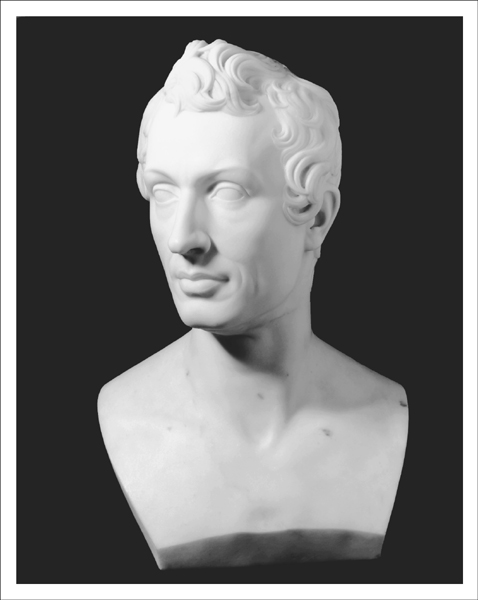
Horatio Greenough, Samuel F. B. Morse (1831) (National Museum of American Art)
FIVE
AFTER A twenty-six day voyage, Morse reached Liverpool on December 4, in cold that frosted his eyebrows and the fur on his cape. He stopped two weeks in London, then caught the small, dirty cross-Channel steamer to France, arriving in Paris at dawn on New Year’s Day. The icy weather had frozen the Seine. From Paris he headed for Rome by diligence, a clumsier vehicle than American stagecoaches, he thought, the cheap rear seats occupied by “low people.”
Even in his own well-cushioned compartment, Morse found the trip south jangling. Snow clogged the iron wheels of the diligence, forcing it to make sudden stops. No guardrail shielded the carriage from plummeting off the winding precipitous mountain roads, often blocked by rocks washed down from the heights. To cross the swollen streams he sometimes had to step out and be carried over on the shoulders of “brawny watermen.” Irksomely, as the diligence passed through the ten “dominions” of divided Italy he again and again had to present his papers and luggage for inspection. And there was talk of bandits, avalanches.
Journeying through France and Italy, Morse sometimes thought of Napoleon. In reading biblical prophecy while at college, he believed he saw Bonaparte foretold in Daniel and Revelation. He took time when in Paris to see the robes and golden cups used in the Emperor’s coronation. Drawing closer to Rome, he stopped at an inn near Antibes and breakfasted in a room Napoleon had occupied as he withdrew into exile on the island of Elba. Although he had exulted in Bonaparte’s defeat, he knew something himself of frustrated ambition, and felt if not kinship at least sympathy with the banished Emperor. He lay down on the bed and looked out on the room, which had been kept as Napoleon left it: “I … endeavored to conceive for the moment how he, who had in that very situation seen the same objects when he woke, then viewed the reverses of life, to which he had apparently hitherto believed himself superior.”
Then, Rome. Encircled by walls, without modern buildings, the city survived as a mausoleum of the classical world, Middle Ages, and Renaissance—to Morse a promised land, overpowering: “All the classic story of our school boy days, history and fable, truth and fiction … are now reality,” he wrote; “Rome, the very spot, Rome … once the seat of the Arts, the seat of the empire of the world.”
Morse settled into a shuttered four-story house at 17 Via dei Prefetti, a narrow cobblestoned street just off one of Rome’s main thoroughfares, the busy Via del Corso. Shelley had lived nearby in 1819, and a few streets away was the Piazza Colonna with its sculpted Egyptian column, taken as a trophy by Augustus after his victory over Cleopatra.
At first Morse established a daily routine of visiting the Vatican galleries, the Palazzi Borghese, or some other dizzyingly lavish collection. There the poorest Italian could experience aesthetic pleasure more refined than any available to even the wealthiest American. Despite his fifteen years’ experience and study, Morse felt unprepared for the scarcely imaginable magnificence he beheld, room upon spectacularly opulent room of marble walls and rare inlaid woods, packed floor to ceiling with stupendous frescoes, exhaustless stores of supremely gifted painting and sculpture by Caravaggio, Bernini, Botticelli, Michelangelo.
As he gazed and gaped, Morse took rapturous notes, listing the scores of paintings he saw and occasionally making small outline sketches of their composition. He made many discoveries, for instance finding painterly strengths in such “early masters” as Giotto and Ghirlandaio. To a modern eye their works seemed “rude, and stiff, and dry,” yet he saw much worth studying, especially “variety of attitude character and expression,” strong points of his own portraits as well. Other canvases leaped out to him as revelations, such as a portrait by Veronese: “proves that harmony may be produced in one color,” he noted, excitedly; “Curtain in the back ground hot green, middle tint sleeves of the arms cool, vest which is in the mass of light as well as the lights of the curtain warm, white collar which is the highest light cool!!!!”
Morse soon got down to business, copying paintings by Poussin, Rubens, and others to fill the commissions that made his life in Rome possible. In sending the completed pictures back to his patrons in the United States, he rolled up the canvases, coating them with a special varnish to prevent sticking. The commission that occupied most of his time involved a work by the artist considered in America to be the greatest painter of them all—Raphael’s School of Athens. The fifty or so figures in this summit of Western art include Plato, Aristotle, Pythagoras, Euclid, Ptolemy, and Raphael himself. Morse often worked at the copy all day, sitting in the famous Stanza della Segnatura of the Apostolic Palace and trying to shrink Raphael’s intricate wall-size fresco onto a canvas thirty by forty inches.
When he could, Morse visited the studios of some of the many European artists in Rome, not without envy. Students at the French Academy painted in a villa on the Pincian Hill overlooking the city, their ateliers provided rent-free by the French government, with a stipend for living expenses. Could he live that way, Morse felt, not forced to support himself by copying the works of others, “I too might paint the picture I have so long desired to paint.” He also saw the extensive studios in the Palazzo Barberini of the Danish sculptor Bertel Thorwaldsen, an old man with wild gray hair straggling over his ears, yet honored by the potentates of all Europe—“the greatest sculptor of the age,” Morse thought. The classical simplicity of Thorwaldsen’s work seemed to him no mere imitation of the antique but a reincarnation of its spirit. He got to walk with Thorwaldsen for recreation and to paint his portrait. In his diaries he noted but crossed out the information that the great man had taken an English noblewoman for one of his mistresses and fathered two children by another.
Thorwaldsen presented Morse with a cast of his Venus to send back to the National Academy of Design. From artists and patrons in the Rome art community Morse rounded up other benefactors for the N.A.D. as well. He shipped to New York such gifts as a ten-foot-high cast of the Farnese Hercules and scores of prints and books containing heads by Raphael, views of Pompeii, sulfur impressions of gems. The donations turned out to be costly, however. Freight charges from Rome to New York ate up funds set aside for operating expenses, and ran the N.A.D. into debt. Word came back to Rome to send “NO MORE PRESENTS.”
Morse found the Roman summer scorchingly hot, with a glaring sunlight that pained his eyes. He made several excursions into the surrounding countryside, including a month-long tour of Hadrian’s Villa and the Sabine Hills, a popular trail for plein-air sketching. He carried his painting gear slung over his shoulder, taking along a field chair and tall umbrella. The villa, with the decayed splendor of its amphitheater, temples, and fountains, was peerless, “the finest ruins I have ever seen.” Snacking on a basket of cherries, he sketched all day, the solitude broken only by the sounds of crumbling architecture and green lizards rustling through the leaves and ivy.
From Hadrian’s Villa, Morse traveled to Subiaco, about forty-five miles from Rome, bobbing along part of the way on a donkey over the steep twisting rocky paths. As many other artists had, he found the place uniquely picturesque—flocks of goats, twanging guitars, ruined convents, peasants in sugarloaf hats. He sketched in oil a rustic outdoor chapel, from which he made a larger landscape that shows a contadina kneeling before a shrine to the Virgin.
Morse got around Rome, too. He often attended concerts, and took in performances of The Barber of Seville and Bellini’s Romeo and Juliet. He visited the Protestant cemetery, where he copied down the odd inscription on a stone marking the burial of “a young English Poet … whose name was writ in water.” He was entertained one evening at the house of the painter Joseph Severn, but may never have realized that the peculiar grave was that of Severn’s dear friend, John Keats. In some fear of being mugged, he entered the Colosseum on a still night. Surrounded by broken moonlit piers and arcades, he seated himself in the center of the arena, where once stood a colossal statue of the sadistic Nero.
Apart from the superb art and antiquities, most of what Morse saw of Italian life disgusted him. He had arrived in Rome during the carnival season, in time to observe some of the festivities in the Via del Corso. The decorated thoroughfare was mobbed with revelers costumed as bears, harlequins, and even Satan, pelting each other with flowers and imitation sugar plums. Travel writers romanticized the scene, he thought. In reality it represented only degenerate chaos, “where man seems to delight in the opportunity to demonstrate to his fellowman how near he can approach in appearance and manners to the beasts he imitates.” During the previous year’s carnival a murderer had been publicly drawn and quartered; the merrymakers carried on in full view of his severed festering limbs.
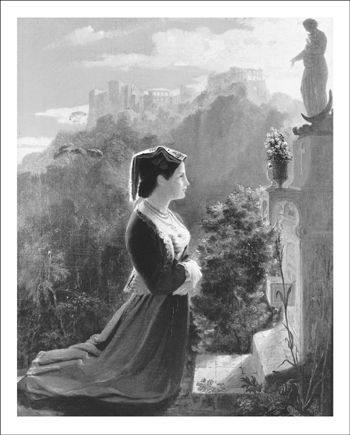
Samuel F. B. Morse, Contadina of Nattuno at the Shrine of the Madonna (Virginia Museum of Fine Arts)
Morse found evidence of the country’s “low state of moral feeling” not only in Roman decadence but also in the thievery at all levels of society. Customs inspectors extorted money by slapping on imaginary duties. Merchants asked for their goods three or four times what they were willing to take, trying to grab what they could. Morse learned how to handle price-gougers: “treat them like slaves, hold a haughty domineering manner towards them, you will then get civility.” Worst, at the bottom of the social ladder, were the beggars. Everywhere he had to fend off these “squalid and hideous objects,” including children beseeching him for treats. Once he found himself circled by a whole begging swarm—“such devouring eyes such pushing and bawling … so disgusting a sight.”
And farther south the moral climate was still more sordid. Visiting Naples in the fall, Morse enjoyed the gorgeous bay, and ascended the thundering cone of Vesuvius, the sea of hot lava inside sending up suffocating fumes and showers of hot cinders. He also visited the notorious private rooms of the museum, with their pornographic frescoes and statues, “evidence of the most depraved state of morals.” Far more offensive was the public burial place, which every day opened one of its 365 stone-covered pits to receive corpses of the poor. Holding a handkerchief to his nose and peering into the vault he beheld carcasses of men, women, and children of all ages. Thrown together in heaps, they had been stripped naked and left to corrupt in a mass like offal from a slaughterhouse. “So disgusting a spectacle I never witnessed,” he said. “Never I believe in any country Christian or pagan is there an instance of such total want of respect for the remains of the dead.”
What Morse experienced of Neapolitan filth and noise sickened him hardly less. Bored and mindless, people ate macaroni while delousing each other’s heads; children of both sexes went naked; vendors screamed cockles and figs; vagrants shat in public. The city had no libraries, no newspapers, no literary societies. And there was the loathsome local specialty, “a species of most nauseating looking cake … covered over with slices of pomodoro or tomatos, and sprinkled with little fish and black pepper and I know not what other ingredients, it altogether looks like a piece of bread that had been taken reeking out of the sewer.” Here Morse may well have written the first description in American literature of an anchovy pizza.
Nothing else in Italian life so much repelled Morse as the bizarre, menacing power of the Catholic Church. Hatred of Popery had been common in the New England of his youth, brought there from England nearly two centuries earlier by the first colonists. And now, despite a swelling population of twenty-one million, Italy was economically stagnant, dependent on an old-fashioned agricultural system, its work force largely illiterate. Like nearly every other American who visited Italy at the time, Morse blamed the country’s poverty and moral debasement on the “darkness and ignorance and superstition” of the Church.
Like his compatriots, too, who flocked to Catholic worship as to a circus, Morse made himself a connoisseur of ritual. Attending Catholic services became his chief entertainment in Rome. Mystified, he watched an attendant ceremonially open a prayer book: “bows, turns round, bows each side,” he recorded in his journal, “advances one side of the altar, and kneels; advances to the altar, bows, and kneels again; lays the book on the altar, bows, and kneels again.” He observed nuns taking the veil, the installation of several cardinals, the baptism of a converting “Jew man.” Upon the death of Pope Pius VIII he viewed the corpse lying in state at the Quirinal Palace, clad in an ermine cape and gold-embroidered crimson stole. Later he endured the motley crowd of beggars and nobles at St. Peter’s, to be present for the first appearance of the new Pope, Gregory XVI, trumpets blaring.
What Morse saw of monastic life appalled him as a macabre blend of deathly asceticism and leering sensuality. A group of brown-frocked Franciscans and Capuchins, heads shaven, seemed to him as haggard as disinterred corpses, yet libidinous-looking: “it needed no stretch of the imagination to find in most the expression of the worst passions of our nature.” Intrigued by ceremonial kissing, he recorded one faintly wanton instance after another: virgins kissing the hem of a cardinal’s garment; cardinals kissing the Pope’s toe; nuns kissing nuns; hundreds kneeling to kiss a crucifix; the foot on a bronze statue of St. Peter worn away not by kissing but by wiping preparatory to kissing, “sometimes with the coat sleeve by a beggar.”
Morse experienced the frocks and altars as a lineal descendant of New England Puritanism. Unlike the intellectual religion of his father and ancestors, he decided, Catholicism addressed the imagination but not the understanding: “No instruction was imparted, none seems ever to be intended.” Catholicism was not religion but theater. Like actors speaking their parts, worshippers at Mass mouthed the words of priests—priests he often caught yawning, and whose rushed, inarticulate recitation of Latin prayers struck him variously as “whining,” “drawling,” “brawling,” and “gurgling.” Indeed the playhouse was but the secular offspring of the Church, a “daughter of this prolific Mother of Abominations, and a child worthy of its dam.” Both pretended to teach morality by scenic effect and pantomime, “and the fruits are much the same.”
But much in Catholic culture pleased Morse’s ear and eye. He enjoyed the liturgical music, often going out of his way to hear the singing in some church. The architecture of the great cathedrals seemed “gorgeous beyond description.” And his color-sense delighted in the crimson-gold-and-ermine spectacle of Catholic worship, the shining mitres, flambeaux-lit processions, fans of peacock feather. Not to mention the unexcelled painting and sculpture, however its madonnas and eroticized cherubs offended his Calvinist sensibility.
In the landscape he painted at Subiaco, Morse managed to divorce such iconography from its meaning and to treat a shrine to the Virgin as little more than a picturesque rural object. Still, the strain between his religious and aesthetic responses to Catholicism sometimes left him benumbed. One night, for instance, he attended an illumination at the Vatican. Upon a signal, the thousands of spectators lighted candles, suddenly making visible in the darkness the vast piazza with its surrounding colonnade and the immense dome of St. Peter’s. Morse reached for language to describe the effect: “like enchantment … overpowering in brilliancy … truly sublime.” He reminded himself, however, that the magical event had been staged on a Sunday—the Sabbath treated as carnival, desecrated. “I never wish to spend such another,” he concluded glumly; “St. Peters is a world of magnificence … and to what purpose!”
Such uncomfortable reminders of the seductive power of the Church led Morse to question the power of his own art. His painting aimed, after all, at promoting moral refinement and respect for republican ideals. But might the sensuous appeal of color and form promote instead, as Catholicism did, a “religion of the Imagination”? He remained persuaded that when properly employed by the painter the medium would communicate truths to the Understanding. But there was clearly a danger. Without an “enlightened piety,” a love for art could sink into “heartlessness and frivolity.” And if it came to choosing, he preferred sermons on The Fall to Raphael: “I had rather sacrifice the interests of the arts, if there is any collision, than run the risk of endangering those compared with which all others are not for a moment to be considered.”
What Morse regarded as his deepest insight into Catholicism came during a walk on the Corso. Out to get some air, he paused to observe still another ceremony, a celebration of the Corpus Domini. A procession advanced toward him, several men upholding a canopy above the Host. As the canopy passed, spectators uncovered their heads and genuflected. Instead of doing either, Morse began writing some notes about the scene. Suddenly his hat flew off as he staggered under a bash to his head. The blow had come from the rifle of a soldier, one of the guards of honor for the officiating cardinal. The soldier pressed a bayonet against his chest and began cursing him, with “the expression of a demon,” Morse said, “pouring forth a torrent of Italian oaths.” He asked why the guard had struck him, but was answered only by more oaths, unintelligible to him except for the words il diavolo.
Morse often recalled the savage moment, and later wrote about it several times for publication. The soldier, he believed, must have been under orders to see that people knelt and took off their hats in respect to the display of the Host. That taught him something. Catholicism sustained its beguiling-horrifying dumb show by coercion. It was above all a “religion of force.”
Morse’s first trip abroad, eighteen years earlier, had landed him in a country at war with his own. Remarkably, he soon realized that his second trip had taken him to a country under revolutionary siege.
In the time between Morse’s two journeys—since, that is, Napoleon’s defeat at Waterloo—most of the rulers displaced by Bonaparte’s imperial armies had regained their thrones. The kings, emperors, and statesmen who gathered in 1814–15 for the Vienna Congress hoped to prevent any country from again dominating Europe, as had Napoleonic France. To establish a lasting balance of power they rearranged the Continent, making some domains larger, some smaller, combining or creating others. Yet the European political order remained volatile. Its aristocratic leaders governed uneasily, aware of massive unemployment, democratic aspirations, and a widespread sense of grievance.
Morse had been in Rome only about six months when the political system contrived at the Vienna Congress began to rupture. In July 1830, three days of revolutionary street fighting broke out in Paris, killing about two thousand people. Forced to abdicate, King Charles X fled the country. Parliament offered the throne to his cousin Louis-Philippe, a successful businessman. This blow to the ancien régime sparked uprisings in Belgium, Switzerland, Germany, Poland, and much of the rest of Europe.
Hopes for a new order soared in the Italian states, too. These hopes threatened not just the city of Rome but also the far larger region governed by the Pope, spread across the country from Venice to Naples. The zeal of the Italian insurrectionists was fed by the declared readiness of Lafayette and other French liberal politicians to block any attempted intervention by reactionary Austria, which governed the north of Italy. Austria at the time was a formidable power, a conglomerate of kingdoms, duchies, and earldoms personally possessed by the Hapsburg dynasty, which in addition presided over the union of German states.
Morse welcomed the historic moment as a contest between New World republicanism and an Old World alliance of kings, a “great contention … between liberty and despotism throughout Europe.” But the uprisings left him vulnerable in Rome, much as he had been years before in London. “Persons are frequently missing,” he observed, “no one knows what has become of them.” By mid-February, a year after his arrival, news reached Rome that rebels in Bologna had proclaimed the United Provinces of Italy, set up a provisional government, and declared the Pope’s temporal power at an end. Within a few days other cities revolted: Ravenna, Ferrara, Perugia, Urbino.
Morse recorded in his diary the growing alarm in Rome over a possible invasion by revolutionary forces, or insurrection from within. “The streets are filled with the people,” he wrote, “who gaze at each other inquisitively, and apprehension seems marked on every face.” As both an American and a painter, he feared for his safety. Some opponents of the uprisings blamed them on forestieri, foreigners such as himself. The galley slaves and lower-class Trasteverini were rumored to have been secretly armed by the government in order to massacre all foreigners in Rome. Artists were particularly suspected of being liberals. Near him in the Corso, soldiers took two French artists into custody; a Swiss artist had reportedly been roused from bed at midnight and imprisoned.
And the tension steadily increased. “A proclamation was issued last night requiring all persons to be at home in the evening,” Morse noted on February 15. “Arrests occur every night of suspected persons,” he wrote four days later; “I was told that not less than 8000 passports had been granted to leave Rome within a few days. Rome begins to look like a deserted city.” Those in flight included nearly all the Americans in Rome.
Morse closely followed events at the Vatican, to see how Gregory XVI dealt with the threat to his temporal power. High-ranking persons in the Church, he heard, had been arrested, among them the secretary of a cardinal; deserters from the Pope’s army had been captured and executed. Rumors circulated that to quiet the popular unrest, Gregory was disposed to grant a constitution—was even prepared to resign his mighty office. However much Morse despised the papacy, he admired Gregory’s willingness to sacrifice his dignity for the public good: “he is entitled to great respect for his personal character.”
On February 24 dependable reports arrived that a revolutionary army from the provinces was approaching Rome. Morse decided to flee north, and next day went to get his passport visaed. The consul advised him that the roads outside Rome were militarized and risky, infested with brigands: days before, a courier had been shot five times in the head. Just the same Morse packed up his trunk, painting case, and portfolio, and set off for Florence.
His escape from the Pope’s domain into Tuscany was nerve-wracking. He traveled by vettura, a slow-moving carriage capable of making only three or four miles an hour. Both he and his fellow passengers, two American men, carried pistols. Leaving Rome at four in the morning, they arrived around sunrise at Civita Castellana, where papal troops, on the alert and expecting a battle, took their passports and detained them for five hours.
Incident then succeeded incident so quickly that Morse had little time to think. Passing from town to town, through two hostile armies, he encountered soldiers asleep in the streets; crowds crying “Viva la libertà”; prisoners under escort, tied by the wrists; priests sporting the tricolor revolutionary cockade—dragoons, scouting parties, clusters of artillery, a singular air of alarm and sadness. Constitutional rebels or troops of the Pope often stopped the vettura to question him and his companions about the number and position of the enemy. The rebels liked Americans, he discovered. At a stop about fifty miles north of Rome, the commander of the Revolutionary Army, General Sercognani, even welcomed him and the others, “pleased to meet with citizens of a country which had taken so distinguished a part in promoting the liberties of the world.”
Morse slipped out of papal territory just in time. He later learned that he and his companions had no sooner left Civita Castellana, after their five-hour detention, than an order was issued for their arrest. And had he lingered in Rome he would have joined some English artists on their outing to the noted Grotto Ferrata. All the artists became gravely ill, he learned, some revolutionist having mistaken them for Germans and poisoned their wine with a solution of copper—“a most diabolical attempt.”
Reaching Florence was a relief. While living in Rome, Morse had longed for the amenities of bourgeois Protestantism, holding his nose for the sake of seeing the art. It cheered him to be in a culture that valued neatness and industry. “Everything in Northern Italy appears superior to the South, the cities, the people, the roads, the cultivation.”
During Morse’s two months in Florence, his relief turned to joy. His experience of Italy had meant a day-by-day readjustment of aesthetic standards, each discovery of some dazzling collection dimmed by the discovery of another still more dazzling. And in Florence he reached pure radiance, the city of Dante, Michelangelo, Leonardo, “the beautiful city.” While working on commissioned copies of self-portraits by Rubens and Titian, he studied paintings in the Pitti Palace and other collections that outshone anything he had seen in Rome, climaxed by the incomparable Tribune Room of the Uffizi Gallery—“the richest collection of art I have ever seen, every picture and statue is of the highest class.”
Morse took apartments in a house at 14488 Via Valfonda, where Thomas Cole and the Boston artist Horatio Greenough also roomed. Cole, an early member of the National Academy of Design, was developing a distinctive landscape style rich in historical reference, a hybrid landscape/history painting. Morse had met Greenough two years earlier in New York, through their mutual mentor and idol, Washington Allston. A bewhiskered six-footer, Greenough was on his way to becoming America’s first sculptor of international reputation. While in Florence he executed a perceptive marble bust of Morse. It records the furrows beginning to show at the corners of Morse’s mouth, lending his sensitive face a clenched determination that makes him seem at once gentle and severe.*
Morse admired Greenough as someone “wholly bent upon one object, excellence in his art.” But their friendship was uneasy. A Harvard graduate with an irreverent wit, Greenough disdained academies of art as pompous and joked about “my natural depravity of heart.” He teasingly called Morse “wicked Morse” and breezily advised him not to stay unmarried: “a man without a true love is a ship without ballast, a one-tined fork, half a pair of scissors.” He twitted Morse on religious issues too. His own “stubborn head,” he said, refused to “believe infants are born charged and primed with sin.” For Morse, art, sex, and original sin were solemn matters, as he evidently made clear to Greenough, who apologized: “Pardon, I pray you, anything of levity which you may have been offended at in me.”
Morse received a rebuke of sorts himself, from news that the uprisings in the Papal States had been squashed. He had welcomed Gregory XVI’s rumored disposition to end the tumult by granting a constitution. On the contrary, the Pope requested military aid from Austria, which sent some 15,000 troops to Rome. They quickly restored order, the rebels having no forces that could hold out against them. In foreseeing liberty triumphant over despotism, Morse had also put too much faith in declarations by France that it would block any Austrian intervention. The French failed to act, unwilling to be dragged into a war against the powerful Hapsburgs.
Headed ultimately for Paris, Morse left Florence in the middle of May for a two-month stay in Venice. Approaching from the sea and being poled through the Grand Canal, he thought the place a wonder: “we seemed to be rowing through an inundated city.” Yet another world of art opened up for him, the Venetian school of Titian, Tintoretto, and Veronese that in subordinating drawing to color had deeply influenced Allston. The city was friendly to artists. The Accademia and the gallery of the Palazzo Ducale stayed open from six in the morning until dark, “so that an artist can spend all his time to advantage, which is not the case in Rome or Florence.” He spent much of his time at the Accademia, copying on a small canvas Tintoretto’s monumental Miracle of the Slave.
Morse enjoyed the strangeness of Venice, not least the gondolas, “very like our Indian canoes.” Drinking his coffee each day in Piazza San Marco, he watched the Austrian officers promenading with their ladies, and the exotically costumed Greeks and Turks seated under awnings outside the cafes, smoking nonstop. His life was made the more agreeable by the British consul general and his family, devout Protestants with whom he often spent evenings singing hymns, praying, and reading Scripture.
But as Morse stayed on in Venice, he came to detest the place. The Venetians of the north began seeming no less indolent than Neapolitans of the south: “how many hours and days are wasted by this people in perfect sloth, in a dreaming, dosing reverie, or in actual sleep; the bustle, the restless activity, the enterprize so conspicuous with us is wholly unknown here.” The all-day lounging in San Marco was not merely an “empty heartless enjoyment,” either, but something darker, repressive. People socialized under surveillance, “surrounded by police agents and soldiers, to prevent excess.” In a bloody-walled dungeon of the ducal palace he saw and sketched a machine for strangling prisoners. He began to feel languid himself, a result of the sirocco-swept climate and, perhaps, the odoriferous canals—“excessively offensive,” scorpion-breeding.
It became evident to Morse that Venice was moribund, a place without a future: “No one can conceive without visiting Venice, the melancholy dullness of a decaying city, every thing going to ruin trade languishing, and the leaden hand visible everywhere; it is truly … a città morto.” In this it typified much of the rest of Italy, a stricken wasteland of reliquary bones, catacombs, and vats of stinking corpses. He passed July 4th with the only two other Americans he could find in Venice, talking about home, grateful to have been born in the United States—“the happiest of countries…. one bright spot on earth.”
Before heading for Paris, Morse crammed in the aesthetic and historic sights of other northern cities, taking notes on works by Carpaccio and Crivelli, quick sketch-copies of Velázquez and Brueghel (“small figures exquisitely finished”). In Ferrara he inspected the cell that had confined the mentally ill Tasso, noticing on an arch the large autograph of a previous sightseer, Lord Byron. He visited the geometric classical villas of Palladio in Vicenza, and Leonardo’s nearly ruined Last Supper in Milan—the disappointing “tameness” in the faces and “clumsiness” in many of the hands redeemed by strong composition and subtle narrative details, such as the overturned saltcellar in front of Judas.
Morse’s journey to Paris, in mid-September, turned out to be even more harrowing than his flight from Rome. Moving north through Switzerland and Germany, sketching mountains along the way, he learned that he would not be allowed to enter France. The French government had established a cordon sanitaire at the German border, hoping to protect the country from a cholera epidemic advancing from Asia through eastern Europe. A fellow passenger on Morse’s diligence, a young French-speaking German officer, offered to get him into France by sharing the expense of a well-placed tip (douceur) at the blockade.
Morse went along with the plan, which to his understanding involved little more than a routine bribe. One dark cloudy daybreak he found himself descending from the coach and following the officer and a guide through plowed fields wet with rain, while the diligence sped on with his luggage. He asked where they were going, but received in reply only the caution to go softly. “It then for the first time,” he wrote later, “flashed across my mind that we had undertaken an unlawful and very hazardous enterprize that of running by the cordon.”
Terrified of being arrested or shot, Morse managed to sneak across the frontier. He was rejoined by the diligence, which had gone through customs without him.
Two trials remained, however, the more difficult one a psychological trial. When the diligence stopped at a small village to change horses, some gendarmes asked Morse for his papers. He realized that his passport contained no signature verifying that he had officially been granted entry into France. He presented it, fearful that the omission would be discovered. But the much-traveled document contained the signatures of so many guards and customs officers that the puzzled policeman let it through.
Further on toward Paris, at Metz, Morse’s passport was demanded again. This time it was taken to the station-house for examination. Guiltily recalling the douceur, the guide, the slinking around at daybreak, he felt doomed. “The more I reflect the more I regret the step I have been ignorantly led to take,” he wrote, “and shall be much surprized if I am not yet a sufferer for it.” Instead, the police gave him a provisional passport to Paris. Just in time. His conscience had been telling him to confess that he had crossed the border illegally.
Paris at the time Morse returned was in some ways still a medieval city, a maze of narrow winding streets, wet and smelly from open sewers that ran in the gutters. Many of its three-quarters of a million inhabitants lived in crowded tenements, fetched their water from public fountains, endured the droppings of the city’s tens of thousands of horses. Yet the Napoleonic triumphal arches proclaimed the recent past and there were signs of the future as well—department stores, an elegant new Bourse, experiments in street lighting by gas.
During his year in Paris, Morse enjoyed the company of a politically engaged artistic and social circle. He took rooms at 29 rue de Turenne, a house owned by a comtesse, whose distinguished friends he met. Caustic Horatio Greenough lived there for two months, sculpting a bust of the Marquis de Lafayette although disdainful of the “frippery” of Paris and unimpressed by French taste: “They are in Art but the slaves of fashion.” Morse spent time with him, “now talking seriously,” as Greenough put it, “and now letting ding anyhow.” Ding as they would, Morse was miffed when Greenough sent home a statue for exhibition at Trumbull’s American Academy.
Settled only a few doors from Lafayette’s Paris mansion, Morse got to know the General more intimately than before. Now seventy-five, Lafayette greeted him warmly, the complexion of his massive face that of a vigorous young man. Morse had preserved with “religious care” letters to Jedediah from George Washington; he locked away letters from Lafayette to himself with similar reverence for their “high moral value,” intending to have his children read them as models of virtue. He relished visits to Lafayette and rides with him in his carriage—opportunities to hear firsthand anecdotes of the War for Independence and discuss the failed revolution in Italy.
Members of the American colony asked Morse to preside over an Independence Day celebration at Lointier’s restaurant, at which Lafayette was the guest of honor. Some eighty Americans attended, including the U.S. minister to France, William Rives. Morse rose after the first of thirteen toasts to salute the General as a countryman: “Yes, gentlemen, he belongs to America as well as to Europe. He is our fellow-citizen.” Oddly echoing his family’s frequent criticism of himself, he praised Lafayette for the consistency that set him apart from the “fickle class” of humanity: “He is a Tower amidst the waters; his foundation is upon a rock; he moves not with the ebb and flow of the stream.” According to newspaper accounts, applause interrupted nearly every sentence of his panegyric, topped at the end by nine cheers and a band playing the Parisienne. In the toasts that followed, Lafayette proposed “Republican Institutions: the prolific Daughters of American Independence.” Morse received a health as “The worthy representative of the artists of the country.”
Practically every evening Morse spent with James Fenimore Cooper (1789–1851) and his family. A close friend of Lafayette, the novelist was in his early forties, tall, with a rich voice and military bearing. His manner was brusque—“unconciliating,” people called it, “uncompromising,” “like a bluff sailor.” With his wife and daughters he occupied two floors of a house in the elite Faubourg St. Germain, in view of the Hôtel des Invalides. His much-translated Leatherstocking tales were widely read in France and throughout Europe, taken as realistic pictures of American life. He worked so intently at his writing that his hand sometimes shook. But his literary efforts brought him nearly $20,000 a year, probably more than any other American writer had ever earned.
Morse admired Cooper for proving to the world the value of American culture, refuting “the disgraceful taunt that is hurled at us by foreigners of being destitute of genius.” He also saw embodied in Cooper his own ideal of the American gentleman, someone of simple manner but superior mind and bearing, “equal to any title of rank in Europe, Kings and Emperors not excepted.” Cooper understood the hollowness of European political systems, and spoke on behalf of American principles with fearless dignity. Yet he was more courted abroad by the great than those who truckled and cringed to foreign opinion. Unknown to his friend, Morse wrote to Professor Benjamin Silliman in New Haven suggesting that Yale award Cooper an honorary M.A. degree: “Such a man ought to be cherished and supported by his countrymen.”
For his part, Cooper rated Morse “just as good a fellow as there is going.” Fancying himself a connoisseur of art, he accompanied Morse around Paris looking at old paintings for sale on the street. They argued whether some cheaply priced begrimed canvas was or was not a Teniers, Cooper interpreting along the way since Morse spoke little French. Morse also gave painting lessons to Cooper’s daughter Sue, in whom he was rumored to be interested. Cooper denied this: “Morse is an excellent man, but not just the one to captivate a fine young woman of twenty.”
Nevertheless, the rumor was probably true. Morse seems to have had no female company while in Italy, and did not consider looking for a wife abroad. Only America, he said, could produce “the beau ideal of woman in all that gives dignity and loveliness to the sex.” He apparently found such a prospect in young Sue, for he admitted taking a “deep interest” in Cooper’s family, “not merely on the father’s account.” Sue was half his age, but so was Catherine Pattison when he proposed marriage to her. On the other hand, that Sue was also the daughter of an esteemed friend may have aroused guilt. For whatever reason, he backed away. Horatio Greenough sent discreet congratulations on “your sound conscience with regard to the affair that you wot of.”
Through Cooper and Lafayette, and on his own, Morse gained a clearer understanding of the political situation in Europe. It seemed to him that between his two visits to Paris, the government of France had been transformed. When stopping in the city nearly two years earlier, en route to Italy, he had joined a crowd in the Tuileries to gaze at King Charles X dining off gold and silver plates. But the revolution of July 1830 had forced the ultraroyalist Charles to abdicate. “How changed are the circumstances of this city,” Morse found, “blood has flowed in its streets, the price of its liberty.” The values of the current monarch, Louis-Philippe, had been shaped by three years of exile in America, which he toured from Maine to Louisiana. This middle-class “Citizen King,” Morse believed, had brought France a new, progressive political order. During his earlier visit, too, Lafayette had little influence and was out of favor at court. Now he seemed a key figure, “second only to the king in honor and influence as the head of a powerful party.”
Cooper thought otherwise. To him, a royal reception that he attended typified the nature of Louis-Philippe’s government. A woman sat in a corner of the room throughout the evening, conspicuously sewing. She had been placed there, Cooper decided, as evidence of the king’s simplicity. But the plebeian touch was a “mummery,” like the rest of Louis-Philippe’s supposed republicanism. In reality, France was rapidly returning to aristocracy. Cooper also believed that his friend Lafayette had been outmaneuvered by the party around the king, manipulated to keep republican enthusiasm under control. Nevertheless Louis-Philippe was losing popularity every day. France had become a “Volcano.”
Morse learned that Cooper was right. Soon after he arrived in Paris, news came of the fall of Warsaw, ending Poland’s attempt to win independence from the rule of Czar Nicholas I of Russia—the state where the ancien régime had been most unbudgingly preserved. France failed to aid the Polish rebels, against whom the Czar sent an army of 80,000. To many it seemed that Louis-Philippe had once again first encouraged then betrayed hopes for political emancipation. Despite the four days he had spent at Mount Vernon with George Washington, he remained reactionary, no more willing to fight Russia for the independence of Poland than he had been to fight Austria over Italy.
Parisians protested the new regime’s cowardice and perfidy, giving Morse a second glimpse of revolutionary strife. One day in the early fall of 1831 he saw shops closing down, troops assembling, cavalry on the move. People quietly filled the streets as if expecting a parade, in defiance of police notices advising them to disband. That night the tense mood erupted. On the boulevard de la Madeleine near his house, Morse watched a crowd surge toward the gates of the hotel of General Sebastiani, Louis-Philippe’s minister of foreign affairs. Trampling horses and a corps of gendarmes approached to scatter the rioters, helmets glittering in the streetlights, swords drawn: “orders were given for the charge,” he recorded, “and in an instant they dashed down the street, the people dispersing like the mist before the wind.” His fear that blood would eventually flow was realized a few weeks later with the killing of about thirty people in an uprising near the Palais-Royal.
Morse became an active sympathizer with the cause of Polish independence. He joined the American Polish Committee that met Wednesday nights at Cooper’s apartments. Among other responses to the crisis the committee raised $6000 in the United States for the relief of the many Poles exiled in Paris. Morse did his part by investigating the financial prospects of a group of exiles who wished to emigrate to America, perhaps to found a colony in Ohio. He also went with Cooper to see Minister William Rives, hoping to obtain the release of the committee’s chairman, Dr. Samuel Gridley Howe of Boston. While on a mission to supply distressed Polish exiles in Germany with 20,000 francs, Howe had been seized by the Prussian government and jailed incommunicado in Berlin. Morse and Cooper gave Rives documents which they asked him to lay before the Prussian minister, showing that Howe’s mission had been charitable, not political. Howe was released, taken in a cart to the French border, and dumped across. His fate again demonstrated to Morse that the European powers took America for granted: the Prussians “would not have dared to treat a citizen of any other country in so cavalier a manner.”
Morse also wrote up for the American press an eyewitness account of the melancholy celebration held in Paris on November 29 to mark the first anniversary of the Polish revolution. The event brought the American Polish Committee together with a similar group from Poland itself and a French-Polish Committee organized by Lafayette, who attended in the uniform of the Polish National Guard. Pained by what he saw, Morse described for American readers the woe on the faces of the more than sixty exiles present—“the close pressed mouth, the frowning brow, and the downcast fixed eye.” The prominence of some of the exiles emphasized the pervasive sense of defeat. Among those in the flag-draped hall were the last president of the Polish government at Warsaw, the former principal of the University of Warsaw, “nobles, men of science, literature and art, and officers and soldiers,” Morse reported, “outcasts in a foreign country, housed by strangers, and living on their charity.”
Most of his time and energy in Paris, Morse devoted to painting at the Louvre. In easy walking distance of his house, the museum stretched more than a quarter of a mile along the Seine. Napoleon had swollen its holdings with the spoils of his military campaigns, masterpieces pillaged from churches and palaces throughout Europe. Much of the fabulous booty had been returned, but perhaps a fifth was left, in addition to the treasures of the French royal collections.
The museum’s mammoth Grand Gallery, lit by glass skylights, ran on for perhaps five city blocks. From one end to the other artists sat silently copying at their easels, soldiers motionlessly on guard. “It is a long walk simply to pass up and down the long hall,” Morse wrote, “the end of which, from the opposite end is scarcely visible, but is lost in the mist of distance. On the walls are 1250 of some of the chefs d’oeuvres of painting.” He saw works by Piero della Francesca and Murillo, staggering historical epics such as Veronese’s Wedding Feast at Cana, the dusky golden atmosphere of Caravaggio. Here was yet a further aesthetic standard, in one respect surpassing even that of Rome and Florence—gems not only from Italy but also from France, Germany, and Holland, “the most splendid, as well as the most numerous single collection of works of art, in the world.”
Morse painted at the Louvre throughout the winter cold, hindered by the short days but filling his many commissions. Cooper ordered a copy of Rembrandt’s Angel Leaving Tobias and often stopped by to banter: “Lay it on here, Samuel—more yellow—the nose is too short—the eye too small—damn it if I had been a painter what a picture I should have painted.” Others also paused at Morse’s easel, including Baron Alexander von Humboldt, author of Kosmos, a “physics of the world” fifty years in the making. Sometimes called the last universal genius, he had corresponded with Jedediah and praised his geographies, and now “took pains,” Morse said, “to find me out.” Morse toured the gallery with him at his request, awed by Humboldt’s ability to speak not only German, French, and English, but also Spanish, Turkish, Swedish, Danish, and Russian.
Sometime around the new year, Morse decided to refuse further commissions and apply himself to a single ambitious work. It would depict the Louvre’s Salon Carré, as if the room had on display many of the museum’s chief treasures. A tour de force, six feet by nine feet, it required him to copy in miniature thirty-seven masterpieces. Painting on a high stand from nine each morning until four, with “the closest application” and without interruption, he wore himself down and felt he had damaged his health. Yet he could hardly bear to be away from the canvas. “I have become so interested in it that I believe I should risk my life in finishing it.” He did not let up even when, in March, the cholera epidemic that had been raging through eastern Europe reached Paris, ultimately killing 18,000 people. Carts piled with corpses moved through the city; the deaths from cholera of two Liberal leaders touched off two days of renewed political street fighting. “I have remained at my post through the whole scene,” Morse wrote, “not without danger, not without great apprehension, but … with confidence that all was safe in the hands of Him to whom I have confided all for time and for eternity.”
Morse considered his Grand Gallery of the Louvre worth all the danger and effort, “a great labor but it will be a splendid and valuable work…. I am sure it is the most correct of its kind ever painted, for every one says I have caught the style of each of the masters.” His incessant toil over the complex canvas attracted crowds of onlookers. “He really has created a sensation in the Louvre,” Cooper wrote, “having a little school of his own, who endeavor to catch his manner.” One French nobleman was so impressed that he presented Morse an expensive folio of the monuments of France containing hundreds of engravings.
Morse planned to complete the miniature copies in Paris, adding the frames and the ten foreground figures when he returned to America in the fall. What to do after that was unclear. Despite the failure of his House of Representatives he thought he might send the Gallery on a traveling exhibition, beginning in New York City. Cooper advised him against this. Harshly criticized by some New York newspapers for meddling in European politics, he urged Morse to display the painting in Philadelphia, then in Baltimore and Washington: “Your intimacy with me has become known, and such is the virulence of my enemies in New-York, that I have no sort of doubt, of their attacking your picture in consequence.” As an alternative to either plan, Morse thought he might sell the painting to someone else for exhibition—or that Cooper himself might buy it.
Morse spent fully fourteen months on The Grand Gallery of the Louvre. The completed canvas reproduces in miniature the Mona Lisa, Raphael’s Belle Jardinière, Murillo’s Beggar Boy, and Veronese’s tremendous Wedding Feast at Cana, as well as pictures by Leonardo, Poussin, Rubens, and other masters, whose manner he convincingly rendered. To the left appears Cooper’s daughter Sue, copying a painting, with her parents behind her; beside her easel hangs Rembrandt’s Angel Leaving Tobias. Morse stands in the center, legs crossed, instructing a young female artist. Although this painting-about-painting belongs to an established genre of works that depict galleries, its inner subject is Morse’s experience of Europe and his hopes for the future—his productive encounter with the richness-beyond-measure of Western art, and preparation to paint a major historical work of his own.
As he got ready to return home, Morse assessed what he had learned during nearly three years abroad, and how it had changed him. His thinking about politics had been kept “at boiling heat,” he said, making more apparent than ever before the contrast between America and Europe. Europe was, above all else, sinister. Everywhere he had felt the oppression of Church and State, with their attendant ignorance and squalor. The Continent was but a larger version of the Roman soldier cursing him as il diavolo—one great garrison, preserving peace at the point of a gun. “The sword and bayonet are every where…. the habit of dread operates very powerfully to preserve order, but such order is purchased at the expense of the dearest rights of man.”
Morse also appreciated more keenly than ever how America’s precious political liberty depended on its foundation in Protestantism—“a religion of persuasion not of force.” In America, worshippers on the Sabbath were treated to a reasoned discourse that trained and encouraged them to think, immunizing them from the sophistical reasonings of demagogues. By contrast, the people of Catholic France had no means of acquiring habits of sober investigation, the Sabbath for them being distinguished from other days only by more billiard playing. Lacking a moral authority to sustain its political institutions, a “truly rational intellectual practical Christianity,” France was sinking back into despotism, making another, general European war inevitable.
Morse had also come to understand why European governments so often criticized the United States. They dreaded change. They feared that America’s example of people ruling themselves would threaten class privilege and possibly foment revolution. “Our simple existence keeps hope alive in the breasts of patriots.” He had often heard Europeans speculate that in fifty or a hundred years the United States would split into several different domains, some returning to monarchy. But Americans universally preferred republicanism, and sought political relief by changing administrations, not forms of government. The opposite was more likely to happen: over the next century all Europe would be revolutionized into constitutional governments, then republicanized, adopting “the principles of liberty promulged 60 years ago in America, and proved sound by 60 years experience.”
But three months before Morse’s departure, news from America tested his confidence in the country’s future. South Carolina cotton producers had blamed a serious decline in cotton prices on the high protective tariffs levied by the federal government. A South Carolina convention had declared the tariffs null, and warned that if President Jackson tried to enforce them, the state would secede from the Union. Morse deplored this “blindness and madness.” It encouraged European enemies of civil liberty, who claimed that republics were inherently unstable. He remained convinced that Americans were committed to enduring as a single people, the United States: “As to the Union,” he told Lafayette, “let the simple question ‘Shall this Union be dissolved?’ be so put that the nation must decide it, and but one voice will be heard from Maine to Mississippi, Never!”
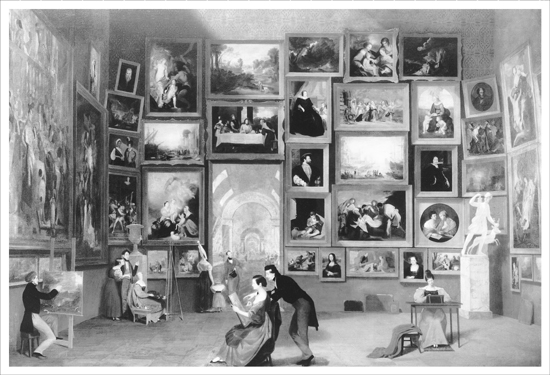
Samuel F. B. Morse, Grand Gallery of the Louvre (Terra Museum of American Art)
About his own future, Morse was less optimistic. He had learned much about brushwork and color harmony from Europe’s canvases aglow with centuries of ambition, skill, and genius. But what he had seen only recalled to him his still-frustrated longing for distinction as a history painter. Where was his School of Athens?
When he left America, Morse had been depressed, his career faltering. The thought that he was not improving as an artist but going backward, he said, “unremittingly tormented me.” He had hoped while abroad to rekindle his ardor and regain his proficiency, so that he might at last “execute some great subject.” He now felt better than ever prepared to do so, conscious “of the power to do more than I have ever been able to do.” But all told he had not accomplished much in Europe. Lack of money had forced him to spend his time copying. Not even The Grand Gallery of the Louvre had demanded the full range of his talents. As Greenough said, his gifts and most of his time had been wasted, “dribbled away in little things.”
Where was his School of Athens? The answer left Morse feeling no less futile than when he left America. His only hope lay in obtaining from Congress one of the still-uncommissioned history paintings to be hung under the dome of the Capitol. He had decided that the perfect subjects for him would be the departure and return of Columbus—“on these two I will stake my reputation as an artist.” Greenough implored him not to give up: “Hang on like Columbus himself…. These subjects are yours, you are theirs.”
But hanging on was not so easy. At times Morse felt that for too long he had spent too much energy dreaming of the commission from Congress: “I see year after year of the very vigor of my life wasted in this vain expectation.” And time was running out for him. He was forty-one; Raphael had painted all his wonders by the age of thirty-seven, “I ought to use the remaining few years of life in that department of art which will leave bread to my children.” When he returned to America it would be best to confine himself to portraits and copies. Europe had taught him much, not least by raising a question that could not be ignored. Why, after all, go on acquiring skills and knowledge he could never use?