
SIX

MORSE’S RETURN to New York began hopefully. A month after arriving, he accepted an appointment as Professor of Painting and Sculpture at the just-opened University of the City of New York. Founded by a small group of patricians, the school aimed at educating sons of the rising middle class. Morse was appointed without salary, expected to receive his pay in the form of fees from his art students for their instruction.
On reaching New York, Morse stayed several weeks with his brother Richard. But eventually he lodged, handsomely, at the university itself. Outgrowing its rented quarters in congested lower New York, the school joined a larger exodus of city residents northward to what would become Greenwich Village. In 1835 it erected a permanent building on parklike Washington Square, an impressive Gothic structure of white marble that inspired a fashion for “college Gothic” on other campuses. Morse rented five rooms in the northwest tower, and was given a sixth gratis—plenty of space to live, paint, and teach. Some of the rooms he rented to his five private students.
With the building still under construction, Morse’s quarters at first proved troublesome. The ceiling of the tower leaked and the walls dribbled, “perfect shower baths” that drove two students from their apartment. Forced to suspend his painting and teaching, Morse lost the fifty-three cents per day he charged each pupil for instruction. Three months after moving in he presented a bill for $50 in damages, including harm to his and his students’ health.
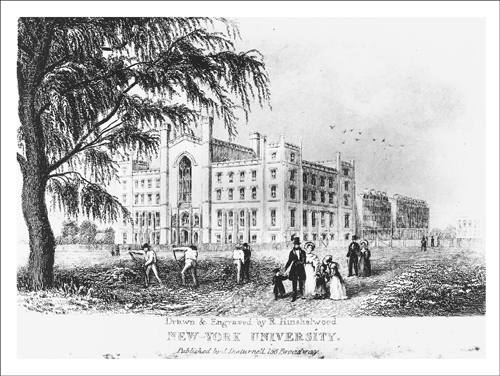
New York University (New York University Archives)
Despite the fuss Morse valued his professorship. He praised New York University—as the school quickly became known—for creating a separate department of the Arts of Design, the first in America. He recorded his high regard in an unusual architectural fantasy, Allegorical Landscape Showing New York University. It depicts the new Gothic edifice standing across a lagoon from Mount Helicon, the abode of the Muses. The key to the allegory is perhaps the powerfully rising morning sun that begins to illuminate the scene. The rising sun image had often been used during and after the American Revolution to symbolize the inevitable movement of the arts and sciences westward from the classical world to Europe and, inevitably, to America. Read in this way the painting presents the university as one locus of a cultural progress in America that is as certain as sunrise.
Morse also took charge again as president of the National Academy of Design, energetically. His absence had been felt: the number of lectures had dropped, instructors had missed classes. He threw himself into readying the annual exhibitions, advising Philadelphia artists on their conflict with the Pennsylvania Academy, delivering a reworked version of his talks on the affinity between painting and the other fine arts. He tried to raise money for the widow and daughter of Gilbert Stuart, living destitute in Newport. In touch again with Allston, he arranged a $500 loan to his mentor—by now considered the greatest living American artist, but debt-ridden and still struggling with his unpaintable Belshazzar’s Feast. All his efforts treated art as an exalted cause. They were noticed, too, bringing him election to such select groups as the Académie des Beaux Arts of Anvers, the Belgian Royal Academy of Fine Arts, and New York’s St. Nicholas Society, whose membership boasted families celebrated in the city’s history—Stuyvesants, Fishes, Roosevelts.
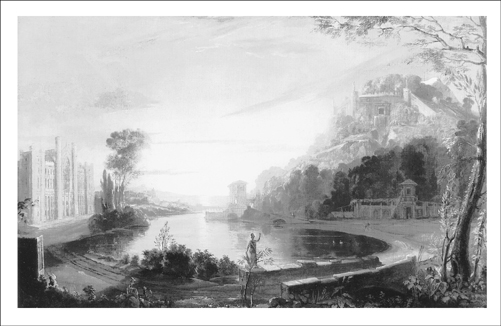
Samuel F. B. Morse, Allegorical Landscape Showing New York University (New-York Historical Society)
Shortly after resuming his presidency, Morse was approached by a director of John Trumbull’s American Academy, David Hosack, about the possibility of uniting the two associations. Unknown to Morse, Hosack came at the behest of Trumbull, who understood well enough that the breakaway N.A.D. had cost his Academy interest and support. Although Morse had feuded publicly with Trumbull at the time he founded the N.A.D., he approved the union if it could be made without compromise. Every academy he had seen in Europe was managed by artists, strengthening his conviction that any other plan of governance was “perfectly absurd.”
In January 1833, Morse, A. B. Durand, and William Dunlap met several times with a committee from Trumbull’s American Academy. On the crucial issue of governance, they agreed to unite by creating different classes of membership, one of academicians, another of lay members, with authority over separate matters. Morse and a representative of Trumbull’s committee drafted a description of the new, united academy. But when it reached Trumbull he rejected it. The plan, he said, denigrated and disempowered the propertied benefactors who had founded the Academy, and contributed its building and collections. Without the patronage of such men as John Jacob Astor, who recently donated two marble busts by Canova, the arts could not flourish in America: “never, while I live and have my reason,” Trum-bull said, “will I … consent to such a violation of their rights.”
Morse spent two weeks writing a reply, an exercise in cultural politics published as Examination of Col. Trumbull’s Address, in Opposition to the Projected Union. He denounced the American Academy as “anti-republican,” subjugating artists to a monied aristocracy: “The Artist, poor, helpless thing, must learn to boo and boo in the halls and antechambers of my lord, implore his lordship’s protection, advertise himself painter to his majesty.” Privately he wrote off Trumbull as the dead hand of the past—“an old man,” he told a friend, “in an institution formed for the promotion of the arts, but which has been an incubus on them.” Three years later the American Academy again tried to interest the N.A.D. in a union; its communication was read and filed.
Returning to his easel, Morse put finishing touches on some commissioned paintings he had brought back from Europe. Local awareness of his studies abroad created much curiosity about what his new work would be like. William Cullen Bryant promised readers of his Evening Post that their “talented countryman” would prove that America had artists the equal of any in Europe, and “earth and skies as fitted to inspire the poet or the painter as Italy can boast.” Morse’s many striking portraits in this period retain a precisely observed visual realism but reach beyond it for what he called “Intellectual Imitation”—not likeness but analysis, inner revelation. The sitters’ unconventional poses and unusual facial expressions seem emblematic of their being, as in his strongly composed portrait of the Reverend Thomas Harvey Skinner of Andover Theological Seminary. Not everyone agreed with Bryant, however. To New York’s former mayor Philip Hone, attending an N.A.D. exhibition, some of Morse’s new work looked frigid: “the warmth of the sunny skies of Italy does not appear to have had any effect upon the worthy president. He is … well acquainted with the principles of his art; but he has no imagination.”
However Morse’s European study affected his painting, it made the art scene in America dreary by comparison. Feeling for the arts in New York was low—or rather, he said, there was “no feeling.” In explaining to the public the failure of the N.A.D.’s proposed union with Trumbull’s Academy, he had had to rehash elementary matters he had made clear years before: “It is mortifying to find on my return home, that the very first principles of encouragement, the A. B. C. are to be taught.” The New York exhibition of his ambitious Grand Gallery of the Louvre was a commercial failure. Several city newspapers published laudatory reviews, the Mirror acclaiming the “magnificent design, the courage which could undertake such a herculean task…. We have never seen anything of the kind before in this country.” So few people attended the show, however, that Morse removed the Grand Gallery and displayed it in New Haven, where it failed to earn enough to pay for the exhibition room. William Dunlap explained that the painting charmed connoisseurs and artists but “was caviar to the multitude.”
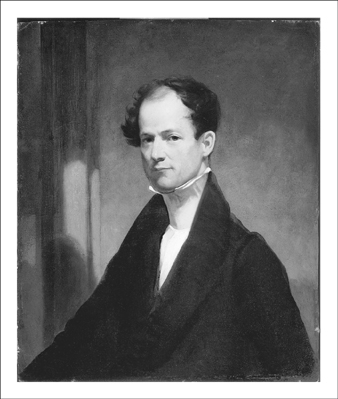
Samuel F. B. Morse, Rev. Thomas Harvey Skinner (Museum of Fine Arts, Boston)
Despite his professorship, his presidency, his vision of the rising glory of American culture, after a year back in New York, Morse again felt seriously depressed: “I have more mental suffering, more hopeless despondence in regard to the future, than I have ever before suffered.” He often fell ill, and once was confined for three weeks, under a physician’s care for boils on his legs. His brother Richard was also liable to such “fits” of “the blues”—and their father before them. Morse wondered whether something in his physical system might be awry, capable of producing in him “such settled conviction of hopelessness.”
He decided not. The real and the apparent causes were the same: his inability—for twenty years now—to survive as the sort of painter he wanted to be: “my profession is that of a beggar, it exists on charity.” His resettlement in America had only confirmed what he gloomily sensed in Paris: “My life of poetry and romance is gone. I must descend from the clouds and look more at the earth.”
Perhaps to begin his descent, Morse decided to sell the Grand Gallery of the Louvre. He gave it up reluctantly: “As a record of studies made in Paris, it was particularly calculated to be a treasure to me.” He considered asking $2500. But being again broke and in debt he offered the picture at half that amount to an upstate New Yorker, George Hyde Clarke, whose portrait he had painted five years earlier. He got more than he bargained for. When he told Clarke that after reducing the price to $1300 he had been offered $2000 by someone else, Clarke offered to release him from their deal. On the edge of losing a badly needed sale, Morse squirmed out: “I prefer your note for 1300 to his for 2000.” He even offered to paint Lafayette into an unfinished space in the foreground of the Gallery. This, too, was a mistake, for Clarke wrote back cursing the General as a Jacobin—“a Philosopher that only comprehended one half of Liberty merely personal freedom, & neglected the other more essential half the protection of Property.” Morse offered instead to fill the space—there beneath miniatures of Raphael and Murillo and Rubens—with hundred-dollar-apiece portraits of Clarke’s family, full-length.
Morse’s domestic situation offered little to lift his fits of the blues. On returning to America he seems to have placed his children under the guardianship of Sidney Morse, perhaps only as a legal convenience so that his brother could administer the bequests to them from Lucrece’s now-deceased father. But physically and emotionally he remained distant from the children, as his parents had been from him. His constant separation from them disturbed his brother Richard, who thought it “unnatural.”
Morse visited Susan at least once at her school in New England. At least once she also visited him in New York, when he likely painted The Muse, a monumental five-by-six-foot portrait of her at about the age of seventeen. She had been taking drawing lessons, and he depicted her holding a pencil poised over a large sketchbook on her lap, awaiting inspiration, clad in a lace cape and richly painted butterscotch-colored dress. Susan was also taking music lessons, learning to play “The Caliph of Bagdad”—an interest he encouraged by sending her sheet music for a waltz. Meeting his daughter now in her teens, after a three-year separation, he found her likable, “an affectionate, sweet dispositioned fine girl.” But he less often described her qualities as a credit to her than as a consolation to him, “a great comfort to me amidst my anxieties, cares, and disappointments.” She wrote to him of her desire to be with him: “I want to see you very much, dear father, and wish you would surprise me again.” But by contrast with his voluminous letters to Lafayette and Cooper, he replied with what barely amount to notes, one ending “I am in great haste.”
Morse’s son Charles was about thirteen, two years older than his youngest child, Finley—as James Edward Finley had become known. The boys stayed for a while with their grandmother’s family, the Breeses, in upstate New York. Mostly they seem to have been at school in New Haven, Morse paying off part of their school bills in copies of self-portraits by Rubens and Titian. Charles took Latin and French, achieving many grades of Excellent. Finley did less well, his mind and senses dulled. At some time in his early years he had contracted measles and scarlet fever. The diseases reportedly produced convulsions that damaged his brain and, among other impairments, left him partly deaf. The boy’s schoolmaster told Morse that with a little more strength Finley probably would make “respectable improvement” in his studies.
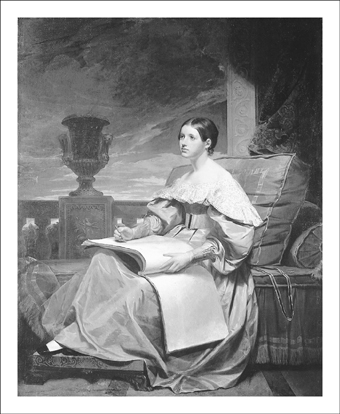
Samuel F. B. Morse, The Muse—Susan Walker Morse (Metropolitan Museum of Art)
Morse still felt the shock of Lucrece’s death ten years earlier, and still spoke of “the wounds which one such blow sends through all the affections of the heart.” But he wanted to remarry, and courted several women, without success. He still loved young Catherine Pattison—only as a daughter, he told himself, “not with that kind of love which were we nearer in age I could not help indulging. Such a love is now forbidden by every consideration.” Just the same he kept writing to her. And his avuncular warnings about the traps of this world came scented with gallantry:
I have seen but few such as you, except in the ideal creations of Romance, and I can only liken the concern with which you have inspired me when I see you entering into Society to that which one feels on seeing a beautiful young fawn fearlessly gambolling on the borders of a forest where its natural enemies of every kind lurk.
Catherine too knew how to play yes-and-no: “whatever you may say,” she replied, “will be looked upon as destiny.”
Morse found a more suitable prospect in New York City, but became put off by her character. He found another in Boston, whose “inexorable friends,” as James Fenimore Cooper described them, forbade her to marry him. Cooper and his family, returned from Europe with four Swiss servants, had rented a splendid town house on St. Mark’s Place, a half-dozen streets from Morse’s tower at New York University. A rumor went around that Morse had become engaged to Cooper’s daughter Sue—“which he laughed at, of course,” Cooper said.
Morse’s experience of Europe had intensified his already fierce nationalism. With his artistic career stalled, he gave much of his time to writing about the threat to America of foreign despotisms. While abroad he had kept extensive journals, full of political observation and commentary. He revised them for publication in the Observer, where they appeared as a series of “Sketches of France, Italy and Switzerland.” He also honored a request from Lafayette to publicize the reactionary nature of Louis-Philippe’s government. In an article for the New York Commercial Advertiser, he described how gendarmes “invaded” Lafayette’s country estate, seized a leading Polish exile Lafayette had been housing there, and drove him off as a prisoner to Tours. “Thus you will see what kind of liberty is enjoyed [in France],” he told American readers, “and you may well ask, whether the cause of freedom has gained any thing by the three days’ revolution.”
Morse tried to show that Louis-Philippe menaced freedom in the United States as well. Writing for the Journal of Commerce, he addressed the long-simmering issue of the payment by France of some $13 million in damages to American merchants for shipping that had been seized or destroyed during the Napoleonic Wars. American representatives in France had been trying to arbitrate the issue with the French government for years. A breakdown in the negotiations had recently produced a buzz of war talk in Paris and Washington. Morse proposed that the issue could be settled in ten minutes, except for Louis-Philippe’s effort—in concert with the sovereigns of Austria, Russia, and Prussia—to suppress aspirations for popular government. The king’s aim in leaving the indemnity unsettled was to push France into war with America: “The feelings of hostility towards the United States which a war will inevitably beget in the masses, will be a natural and effectual antidote to all that love of republicanism among them, which is engendered by admiration of American institutions.”
Morse’s encounter with Europe left him particularly concerned to warn about the spreading influence of Catholicism, sustained by increasing numbers of foreign immigrants. He clipped scores of newspaper articles marking the inroads of the Church in America—“Popery in Kentucky,” “Romanism,” “Real Principles of Modern Papists.” The anti-Catholic novels, pamphlets, and journalism that deluged the country included his brothers’ Observer. It published anti-Catholic news in every issue and ominously measured the Church’s rapid advance. By 1833, it calculated, the United States had become home to 11 bishops, 35 seminaries, 320 priests, and 500,000 worshippers, “a greater number of communicants than are attached to any other denomination in the country.”
To Morse, the danger was already evident in the growing number of violent confrontations between Catholics and Protestants. The most notorious erupted in his own birthplace, Charlestown. On August 10, 1834, a warm Sunday evening, forty or fifty Boston truckers, bricklayers, and volunteer firemen ransacked the Ursuline Convent School, an imposing red building occupied by twelve nuns and fifty-seven girls. Shouting “No Popery,” the men smashed furniture, burned the altar ornaments and cross, and at last set the building itself ablaze.
Morse deplored the violence, but sympathized with the indignation behind it. In his version of the widely reported events, the rioters believed that a young woman had been abducted, brought to the school, and subjected there to a “secret tyrannical punishment.” So the indignation, he said, was honorable to the Charlestownians: “had they viewed such an outrage with indifference, they would have shown themselves unworthy of American citizens.” What most worried him was the threat allegedly made by the Mother Superior. Confronting the crowd that first gathered at the convent, she promised that if they dared to damage the building the bishop would order “20,000 foreigners” to rise up in vengeance. For Morse, here in effect was Pope Gregory XVI summoning the myrmidons of Austria, but on American soil—a faithless betrayal of the nation “uttered in sight of Bunker’s Hill.”
Morse’s disgust was widely shared. Within a week after the burning of the convent, two new anti-Catholic newspapers appeared, the Philadelphia Downfall of Babylon and the New York American Protestant Vindicator. Attacks on Catholic churches in New England soon became so frequent that many posted armed guards to protect their property.
In this atmosphere of alarm, Morse carried forward the work of his father thirty-five years earlier, when Jedediah defended the Republic against imported Infidelity and Jacobinism. Under the pen name “Brutus,” he wrote for the Observer twelve articles on the Catholic peril, published serially in August and November 1834. Revised and expanded, the articles soon appeared as a nearly two-hundred-page tract, Foreign Conspiracy against the Liberties of the United States. In a tone of alternating sweet reasonableness and anxious fury, he revealed that European governments, in their long effort to forestall their own overthrow, were now plotting to bring down republican America by means of the Catholic Church: “Yes, the King of Rome, acting by the promptings of the Austrian Cabinet … has already extended his sceptre over our land.”
The Pope, Morse explained, is but a “creature of Austria,” whose Emperor recognizes the dangers to his country’s “principles of darkness.” Behind them both stands the archreactionary Austrian chancellor Prince Klemens von Metternich, guiding spirit of the Congress of Vienna—“the master of his Master, the arch contriver of the plans for stifling liberty in Europe and throughout the world.” To subvert America, Metternich and his Emperor, with the Pope’s blessing, have created the Leopold Foundation. Its funds support the work of Jesuit missionaries in America—“a secret society, a sort of Masonic order, with superadded features of most revolting odiousness, and a thousand times more dangerous.” Sent here to prey on ignorance and inflame passion, ready to spread riot upon a signal from Vienna or Rome, the Foundation’s terrorists were quietly putting in place the mechanisms of the country’s destruction. “The serpent has already commenced his coil about our limbs, and the lethargy of his poison is creeping over us.”
In its main elements, at least, the foreign conspiracy Morse described was not unfamiliar to Americans. Austria’s large holdings in Italy and intervention against Italian revolutionaries at the Pope’s behest had been kept in public view through newspaper articles headed “Austrian Horror of Republics,” books such as the Transcendentalist Elizabeth Peabody’s Crimes of Austria against Mankind. And a belief in secret societies as hidden managers of political upheaval had been constant in Western culture since at least the Middle Ages. It activated Jedediah Morse’s charge in the 1790s that clandestine Bavarian Illuminati were fomenting counterrevolution in America. It revived with the European political uprisings of the early 1830s, in which the Italian Carbonari, the French Societé des Droits de l’Homme, and similar underground organizations did in fact operate. The Leopold Foundation also existed, created in Vienna in 1828 with official approval of Pope Leo XII. Its members contributed money for missionary work in America, such as funds for the college that became Fordham University. In so doing, the Foundation helped to establish Catholicism in the country, especially in the West.
The detailed workings of the conspiracy that Morse depicted, however, were less familiar to his Protestant readers, and more chilling. Drawing on published and unpublished correspondence of the Leopold missionaries, he tried to demonstrate that Jesuit cells were even now infiltrating the American press, insinuating themselves into American political councils, inveigling American children into Catholic schools. Consider St. Joseph’s College in Kentucky with its priest-trustees, a college thus “under the exclusive control of the Pope, and consequently for an indefinite period under that of Austria!!” Consider the recent consecration of the Cathedral of St. Louis: artillery pieces thundering, a paramilitary “guard of honor” stationed around the church. The scene, Morse said, might have been not the western United States but Rome. He fully recounted his Corpus Domini confrontation—how once, as a canopy shielding the Host passed by him on the Via del Corso, a soldier knocked off his hat, pressed a bayonet to his chest, and cursed him as il diavolo.
At stake for America was what Morse called “Protestant republicanism.” Which is to say, as he understood the phrase, liberty of conscience, liberty of opinion, liberty of the press—the fruits of the country’s homogeneous white Protestant culture. “Our religion, the Protestant religion, and Liberty are identical.” (“The foundations which support Christianity,” his father had preached in 1799, “are also necessary to support a free and equal government like our own.”) He urged Americans to fight Catholicism not by its low methods of persecution and intrigue, but by their own distinctive means—the tract, the Sabbath school, the open discussion of the free press. But war is waging and fight they must: “THE WORLD EXPECTS AMERICA, REPUBLICAN AMERICA, TO DO HER DUTY.”
Morse’s Foreign Conspiracy became controversial. Widely circulated and often extracted in the anti-Catholic press, it spurred the formation of such anti-Catholic groups as the New York Protestant Association, dedicated to exposing the inconsistency of popery with civil liberties. Its narrative of the il diavolo episode made Morse’s defiled hat something of a symbol to anti-Catholic activists. Some newspapers dismissed his revelation of foreign conspiracy as a “chimera.” But he replied that during his years abroad he had observed the network firsthand, and that parts of the press itself might be even “unconsciously” a victim of Jesuit arts. “I have the fullest persuasion that this Conspiracy exists, that it is no chimera, and that all Americans of all parties religious and political should be aware of this new danger to our institutions.”
Living proof of the conspiracy, Morse believed, arrived in the fall of 1835 at his very doorstep. He was visited at New York University by a young German, about twenty-four years old, named Lewis Clausing. Formerly a medical student at Heidelberg, Clausing had just come from Pittsburgh—by way of Brussels, London, and Boston. He was in flight from Jesuit spies, he explained. They had been sent to pursue him because of his membership, while at Heidelberg, in a secret republican association. No longer knowing whom to trust, he sought out the author of Foreign Conspiracy.
By his account, Morse helped Clausing find a place to live, and to divert the young man from his troubles gave him tickets to lectures at the University and a pass to the N.A.D. exhibition. But Clausing’s troubles persisted—maps stolen from his room, he said, seductive women set in his path, a mysterious deaf man. Jesuits tracked him to his job at a New York printing office, plotting to make him seem a petty thief.
Morse soon began to suspect that Clausing was mentally unbalanced. He frankly told the young man that he saw no reason for the Jesuits to relentlessly pursue someone his age. But Clausing produced a copy of a German magazine entitled Der Geächtete (The Proscribed). It contained a list of political outlaws drawn up by the Austrian Central Committee and sent to all police officers in Germany. Clausing’s name appeared sixteenth on the list. “I saw by this document that his proscription was indeed not a dream of the imagination, but a truth,” Morse said. Nor could he discount as irrational the young man’s belief that he was under surveillance. Jesuits adept at espionage were being sent to America by the hundreds and “disposed all over the land, in the pay of the Austrian Leopold Foundation.”
Eventually Clausing also revealed to Morse the crime for which he was proscribed and pursued, which had nothing to do with membership in a secret society. Morse recounted without comment what Clausing told him. But as the author of Foreign Conspiracy it surely must have astonished him.
Clausing’s story was this: While a student at Heidelberg he went to see the revival of a long-discontinued ceremony—the “procession of the host”! Ignorant of the appropriate behavior, he did not remove his pipe from his mouth or his cap from his head. An ecclesiastic, in a passionate manner, left the procession—and struck off his cap! Unlike Morse in Rome, Clausing retaliated. Feeling humiliated before his fellow students and their code of honor, he went to the priest’s home and shot him through the face.
During Clausing’s final visits to him, Morse found the young man increasingly paranoid, construing the most ordinary events as evidence of a cabal. Clausing tried to see him at the University on July 2, 1836, but he was away. The same evening, in the Battery, the young man put a gun to his head and killed himself. Whatever else Morse felt about Clausing’s death, he considered his literary remains valuable in the crusade against foreign conspiracies. He printed from manuscript Clausing’s “Treatise on the Jesuits” and turned the unfortunate young man’s personal papers into a fifty-eight-page anti-Catholic biography of him, published in 1836 as The Proscribed German Student. He also wrote a biographical sketch of Clausing, published in several New York newspapers.
Some of Clausing’s fellow workers denounced Morse’s accounts of his life. In an article for the New Era, they denied his “atrocious calumny” that after a Corpus Domini procession their friend had attempted to murder a priest. One shopmate, born near Heidelberg, noted that the city is Protestant, and had witnessed no such ceremony since the Reformation. They all maintained that Clausing’s proscription had strictly to do with his membership in a republican organization that corresponded with Polish rebels. Morse investigated the matter and replied through the press. He quoted a letter to him from Charles Follen, professor of German at Harvard, affirming that Heidelberg celebrated the procession of the Host and was about half Catholic. Information he received from Heidelberg itself, however, forced him to acknowledge that Clausing’s tale of having shot a priest was untrue.
Morse completed his warnings about the Catholic menace by uncovering sexual corruption in the Church. He edited from manuscript a 250-page account of ecclesiastical lechery, published in 1837 as Confessions of a French Catholic Priest. The book appeared amid a burst of similar exposés inspired by Maria Monk’s Awful Disclosures of … Five Years as a Novice and Two Years as a Black Nun in the Hotel Dieu Nunnery at Montreal (1836). Her slim but sensational volume became the all-time American bestseller before Uncle Tom’s Cabin, its first buyers grabbing up 20,000 copies in a few weeks, later sales surpassing 300,000. A novice claiming to be a Protestant convert to Catholicism, Monk told a sado-Gothic tale of her sexual abuse in a conventual system designed, as she put it, to “comfort the priest”—illegitimate offspring being baptized then strangled. Morse credited Monk’s account, as many people did not, and may even have interviewed her.
A sort of male Maria Monk, Morse’s French priest presented himself as a refugee from popish tyranny and licentiousness, seeking shelter in America. He revealed how the Church’s vow of celibacy served only to inflame the passions of its priests beyond control. To quench his own lust he had worn vermin-infested clothing and drunk potions of water lilies, yet became attracted to one of his young female confessants. His fellow priests spoke as freely about their girlfriends as about theology. One killed his lover and cut her body into pieces; another made love to his mistress’s corpse. The French priest’s alarum summed up Morse’s own message to Americans about the militant fanatics among them: “Open your eyes and see: Popery overflows, invades you, and you are not aware of it; it strides with the steps of a giant to the conquest of your glorious land, and you do not resist, yea, you stretch out your hand to it.”
Morse’s anti-Catholic campaign led him for the first time into the rough-and-tumble of American party politics. Whatever the exact influence of Foreign Conspiracy and his similar works, they fed the closely related but broader fear of immigration. During the 1830s more than half a million immigrants from Great Britain, Ireland, and Germany arrived, in New York City alone.
The hope of controlling the tide gave rise, in the early summer of 1835, to the Native American Democratic Association—the country’s first explicitly nativist political party. It declared opposition not only to the Church, but also to the immigration of paupers and criminals and to office holding by foreigners. Based in New York, the Native Americans got the support of several city editors and sponsored their own penny journal, the Spirit of ’76. But they meant to do more than write. Claiming to stand apart from existing political parties, they organized ward committees and ran Native American candidates in the 1835 local elections. The party polled an impressive 9000 votes out of 23,000 cast. Similar nativist organizations sprang up outside New York—Paterson, Washington, Cincinnati, New Orleans.
Morse became one of the Native Americans’ chief spokesmen. Although a longtime Democrat, he considered independent opinion his privilege as an American. And at the moment he saw little more in the bickering between Democrats and Whigs than the defensiveness of officeholders and frustration of office seekers. The Native Americans had got hold of a momentous issue, vital to “all true patriots, whatever may be their party predilections.”
America, in Morse’s view, had fought itself free of Kings, Emperors, and Czars. But the new immigrants retained the mentality of subjects, bringing with them the same sinister anti-republican forces he had seen produce squalor and maintain oppression on the Continent. He believed that America properly welcomed “the intelligent and persecuted of all nations.” But on his moral-aesthetic scale the new arrivals stood beside the pizza-eating lazzeroni of Naples: “Filthy and ragged in body, ignorant in mind, and but too often most debased in morals … a loathsome picture of degradation, moral and physical.”
Morse’s visceral revulsion was felt by many others in New York’s older Protestant community, such as the diarist George Templeton Strong: “It was enough to turn a man’s stomach—to make a man abjure republicanism forever—to see the way they were naturalizing this morning. Wretched, filthy, bestial-looking Italians and Irish … the very scum and dregs of human nature.” And more were on their way. “All Europe is coming across the ocean,” Philip Hone grumbled, “all that part at least who cannot make a living at home; and what shall we do with them?”
In support of the Native American Democratic Association, Morse wrote a series of impassioned letters for the Journal of Commerce, published separately as Imminent Dangers to the Free Institutions of the United States Through Foreign Immigration. He took as his occasion a rise in public violence that “sadly degraded” the American character. He mentioned no specific events, but in recent memory a New York physician had been trampled to death during a clubs-and-brickbats clash between a Bowery gang and some Irishmen, the mayhem spreading in the city until put down by two hundred police. Some might view the lawlessness as a byproduct of democracy, Morse said. But the real cause was immigration, “foreign turbulence imported by shiploads.”
Morse scourged three immigrant groups in particular. First, predictably, the Hapsburg-Vatican Manchurian candidates, the “hundreds of thousands of human priest-controlled machines.” Next, the “outcast tenants of the poorhouses and prisons,” paupers and convicts whose immigration European governments in fact sometimes subsidized. He took special aim, however, at newcomers who weakened the coherence of the Union by resisting assimilation. He had in mind clannish Germans, Italians, and, especially, Irish who called the old country “home,” living in America as neither foreigners nor natives—“anomalous, nondescript, hermaphrodite.”
Among the national clubs they often formed, Morse singled out an Irish organization founded by a Bowery saloon keeper, the O’Connell Guard. He considered the name offensive and incendiary. It honored the Irish Catholic patriot Daniel O’Connell, who often publicly contrasted America’s reputed democracy with the reality of slavery in the South. At a crowded anti-slavery meeting in London’s Exeter Hall, he stood beside the Abolitionist leader William Lloyd Garrison and damned the United States as “the vilest of hypocrites—the greatest of liars.” To Morse, the new Abolitionist movement was “rife with danger to our country,” and in naming their paramilitary club the O’Connell Guard, Irish immigrants had “thrown a firebrand into the Slavery question.”
Morse acknowledged that not all immigrants were ignorant, vicious, or unpatriotic. But the present, “when the country is invaded by an army,” allowed for no nice discrimination. The innocent and the guilty come over together and live together: “We must of necessity suspect them all.” To protect the Republic he called for changes in laws concerning citizenship. He proposed extending the five-year probationary period for naturalization and denying suffrage to naturalized aliens. Since the immigrant came to America, and stayed, by permission of the people, the people could also withdraw permission and the privileges that accompanied it—“can take away his liberty, yes, and even his life.”
In addition to his influential tract, Morse wrote many signed and unsigned newspaper articles on immigration. Typical is a letter to the editor he composed for the Native American Citizen, asking Americans not to vote for naturalized office seekers: “depend upon it, the insolence of foreigners will no longer be endured.” The Observer published many like-minded articles, some of them probably by Morse himself. Readers of the paper learned that the Irish were “the most ignorant and turbulent people of Europe,” and were told what to expect from the onrushing boatloads: “We shall soon have more Papists in the North than they have slaves in the South. And who would not prefer two million slaves.”
In the spring of 1836, after a long search for a candidate, the Native American Democratic Association asked Morse to run for mayor of New York City. At first he for some reason declined. Mayors at the time served only a one-year term, but after all he still taught at the University; still presided over the National Academy; still painted, however much discouraged. And he had become engrossed in a possibly important new venture, as will appear. The Association asked him to reconsider, however, and in the end he accepted the nomination. The party’s demand for revised naturalization laws convinced him, he said, that it was his duty “to make the sacrifice to which I am called, and place myself at its disposal.”
Morse quickly got a taste of practical politics in New York. The conservative Whig party—descended from the now-defunct Federalists—fielded no candidate in the mayoralty race, expecting that Whig voters would support the Native American candidate. But only two days after Morse’s official nomination, the Whig Morning Courier disowned him. Its editor explained to the public that he had intended to vote for Morse, but he discovered that Morse backed the presidential nominee of the rival Democrats, Martin Van Buren. Morse had been “imposed” on the Native Americans, he charged, by “designing Van Buren men.” With the election only a day away, the startled Whigs hurriedly nominated a candidate of their own.
Morse admitted in print that he favored Van Buren for the presidency, someone he knew and had painted. “I have always avowed this preference,” he announced, “but it is subordinate to principles which are superior to any man.” He would not support Van Buren or anyone else, he said, who did not fearlessly espouse the principles of the Native American Democratic Association.
Morse’s explanation did him little if any good. The Courier’s revelation and the ticketing of a Whig candidate surely lost him votes, perhaps from among the Native Americans themselves. In the three-day balloting he ran last in a field of four, receiving 1496 votes, while the last-moment Whig candidate received 5989, and the victorious Democrat, C. W. Lawrence, received 16,101. “The fellow actually got 1500 votes,” as Cooper put it, “and would have been elected could he have got 15,000 more.”
The beating Morse took did not disenchant him with the Native American cause. The following year he attended the party conclave to again choose a mayoral candidate. He wrote an adjunct to the party platform, a call-to-arms addressed to all the citizens of America: “Shall the alternatives of riot and outrage, or order and tranquillity depend upon the yea or nay of a Foreigner? Shall they longer brow beat you at the polls, or dictate to you your rulers?—No! No! NATIVE AMERICANS OF LIBERTY, LOVERS OF LAW, LOVERS OF ORDER.” His shouting may have been heard. In the new city elections, a nativist ticket swept into office a mayor of New York and complete Common Council.
Morse’s shift to politics offered nothing to deny his parents’ criticism, years before, that he was fickle, unable to settle down: “one can never fix him,” Cooper said. Even his fond teacher Allston recognized something scattershot in Morse that limited his achievement. “I know what is in him,” he told William Dunlap; “If he will only bring out all that is there, he will show powers that many now do not dream of.” Greenough, too, urged him to focus: “give us at least one picture which should embody all your acquirements.”
But in addition to turning his career on and off, Morse was falling out of step with the direction of American art. Among the younger generation, his friend Thomas Cole was maturely developing the historiographic and ideological possibilities of landscape painting in his five-canvas Course of Empire series (1836). Oblivious to high culture, the genre painter William Sidney Mount was depicting scenes of ordinary Americans in everyday situations, designed for the many not the few. The theoretical superiority of history painting in the grand manner continued to be stressed. But under the influence of genre painting, many history painters began representing not major historical events but historical anecdotes such as the marriage of George Washington to Martha Custis. Morse had no wish to paint American scenery, American society, or kitsch Americana. Nor was he sympathetic to the Romantic call for a national art of raging originality, as propounded for instance by Emerson, who considered even Allston’s works genteel and complained that “all the American geniuses … lack nerve and dagger.”
But however behind the times or diverted by politics, Morse had hung on to one hope of succeeding as an artist on his own terms. The commissions for four paintings to adorn the Capitol rotunda remained open. The problem of assigning them had dragged on in Congress the whole time since his return to America, but was finally resolved early in 1837, just before the new city elections. In March 1834, Morse had presented his views on the matter in letters to a half-dozen influential members of Congress, including Daniel Webster, John C. Calhoun, and John Quincy Adams. He said he would be honored to be chosen for one of the commissions, and laid out his imposing credentials: “I have devoted twenty years of my life of which seven were passed in England, France, Italy and Switzerland studying with special reference to the execution of works of the kind proposed.”
But the signs were unfavorable. When the House debated the issue in December 1834, Congressman (and ex-president) John Quincy Adams questioned whether America could supply artistic talent worthy of decorating the seat of its government. He doubted, he said, “if four native artists could be found of eminence in the profession so transcendent as to ensure the performance of four masterpieces.” His colleagues took this to mean that the country might be better served if they hired at least some European painters. Adams later confided in his diary that he had spoken “somewhat inconsiderately,” but his snide remarks provoked an outcry. A representative from Virginia, Henry Alexander Wise, rose to object: “Sir, I am proud to say and believe, that this country—the great masters dead—is richer now in native talents in the fine arts than any country on the globe.” Cooper replied through Bryant’s Evening Post. He argued that the U.S. Capitol was destined to become a historic building and should display paintings by native artists, if only as moments in the record of the country’s cultural development, “links in the History of American Art.”
Further congressional action, in 1836, brought Morse months of painfully seesawing hope and disappointment. A select committee decided to ask seven artists to present sketches of possible subjects for the Capitol paintings. Morse was not included. His hope revived, however, when the committee abandoned this plan, and he heard that two of its members were favorably disposed to him. But nothing happened for another nine months. Then the committee at last chose four artists to paint the rotunda pictures: John Chapman, Robert Weir, John Van-derlyn, and Henry Inman.
For Morse, the decision to pass him by contained an added sting. Vanderlyn would paint a subject he had considered his own, the landing of Columbus. Something like hope flickered early in 1837, when Inman unexpectedly declined the commission. Several artists and newspaper editors advised Congress how to fill his place. “The rare qualifications of Mr. Morse for a work of the character contemplated,” the Journal of Commerce wrote, “are well known to all who are acquainted with the progress of the arts in this country.”
But Morse felt humiliated by the situation. Even if chosen to replace Inman, he could take no pleasure in being a leftover, “selected as a sort of fifth wheel.” He was tempted to save face, and spare himself further misery, by anticipating the committee’s decision and declining the commission in advance. He did not need to: Inman reversed himself and agreed to paint the one remaining picture. However indifferent Morse may have grown to the whole business, the turnaround came as a further humiliation: “even this back door way is closed to me.” He decided that Inman had been persuaded to change his mind by John Quincy Adams, whose seeming personal hostility he found unaccountable: “I never gave him the slightest cause of personal offence.” He came to believe that what turned Adams against him was a long-nurtured dislike of Jedediah, who had spent time with Adams in Washington fifteen years earlier.
Rejected beyond hope or appeal, Morse became more seriously depressed than ever. Having trained himself to do a grand historical work since at least his graduation from college, and having made himself one of the most conspicuous artists in America—probably too conspicuous for noisy politicking—he experienced his rejection as total defeat: “the object of my studies for 26 years, and the special mark at which I have aimed for 15 years, are forever removed before me.” He spoke of resigning his presidency of the N.A.D. and abandoning painting altogether. Friends tried to cheer him up. “To you our Academy owes its existence & present prosperity,” Cole wrote; “You are the Key Stone of the Arch.” Allston sent reassurance: “You have it still in your power to let the world know what you can do. Dismiss it from your mind, and determine to paint all the better.”
But Morse felt battered. “I staggered under the blow,” he said. He took to bed, “quite ill,” Cooper reported. The litterateur N. P. Willis, who had known Morse in Paris, later recalled him saying around this time that he was weary of his existence, and had he “divine authorization” would terminate it.
Morse’s near-collapse apparently lasted several weeks in the early spring of 1837. While abed in his sickroom, he was visited by a committee of artists, who brought an encouraging proposal. They represented artists in New York and Philadelphia, and some New York gentlemen, who formed a sort of stock company that would hire him to paint a historical picture of his own choice. Selling subscriptions at $50 each, and receiving $1000 from an anonymous New Yorker, they raised over $3000. The fee hardly compared with the $12,000 offered by Congress for the rotunda paintings, but Morse accepted the commission gratefully: “is not this noble? Is this not honorable to the character of our profession? Will it not tell to the credit of American artists?” In addition, the subscribers planned for him to keep the painting, for his own use and profit.
His depression lifting, Morse chose his subject. In Charlestown, while still in his late teens, he had painted the landing of the Pilgrims at Plymouth—probably his first ambitious history work. He would return to the subject now, but with a difference. The new painting would depict the Pilgrim fathers in Cape Cod harbor aboard the Mayflower, signing the Mayflower Compact—in his view “the first written constitution.” Entitled The Gem of the Republic, it would be massive—eighteen feet by twelve feet, the size of the rotunda paintings. It would take years to complete, but he planned to sacrifice everything else, and hoped to visit England and Holland for special study. Some of the figures, he decided, should be women. He thought he might paint in his young friend Catherine Pattison.
Morse’s plans and hopes had a way of dissolving, however, and The Gem of the Republic no sooner took shape than it became unreal….