
NINE

HAVING BEEN gone eleven months instead of the intended three, Morse found his affairs at home even more chaotic than he expected. In his absence the University had dismissed seven professors and reduced student enrollment from a hundred or so to forty. His own professorship had become “merely nominal.” Dr. Charles Jackson was still attacking him. Congress had done nothing toward financing a long-distance trial of his telegraph. And he had arrived broke—owing for rent, borrowing for meals, “not even a farthing in my pocket.”
Morse saw his one hope of relief in selling his telegraph to the Russian government. As he awaited the promised message from Baron Meyendorff, announcing the Czar’s decision, he tried to work out problems in his apparatus, to have it in top condition for presentation in St. Petersburg. Leonard Gale, his partner and consultant on scientific questions, was away in New Orleans. So he sought advice from Joseph Henry (1797?–1878), the formidable Professor of Natural Philosophy at Princeton. Son of an alcoholic day-laborer who died in a seizure of d.t.’s, Henry had made himself a world-class investigator of electricity, and the only American physicist with an international reputation.
Morse wrote Henry a deferential letter asking to meet with him at Princeton. He would come strictly as a learner, he said, but in advance he raised a general question: had Henry’s research and experiment uncovered anything that seemed to make the Morse system impracticable? Henry wrote back encouragingly. He said he knew of nothing that might prevent the success of Morse’s mode of telegraphy: “on the contrary I believe that science is now ripe for this application and that there are no difficulties in the way but such as ingenuity and enterprise may obviate.” One such issue, he said, was the length of wire between stations. If the length were great, something would have to be done to develop sufficient power at the far end. Meanwhile he invited Morse to Princeton.
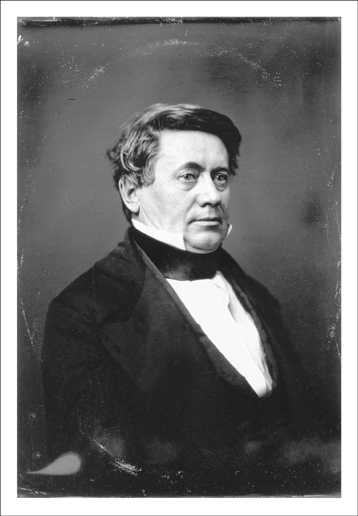
Joseph Henry (Chicago Historical Society)
Morse visited Henry for a few days in May. Blue-eyed and rosy-cheeked, Henry himself had recently returned from a year’s leave in Europe, where he met Wheatstone and Michael Faraday, and sat in on a meeting of the Académie des Sciences. (A reader of the Romantic poets, he also heard Wordsworth lecture on poetry.) Morse wrote out several key questions to ask Henry. For one, Would a succession of magnets introduced into the circuit diminish the magnetism in each? Here he obviously had in mind his relay, although he does not seem to have mentioned the invention during his visit.
Henry freely gave his opinions on Morse’s telegraph and Morse generally thought him amiable—an opinion he would drastically revise. They evidently discussed unrelated scientific topics as well, for Morse afterward sent him comments on the phenomenon of prismatic arches observed at morning and twilight. Morse was beginning to care about being, and seeming to the world, not simply a gimcrack inventor but a serious investigator of nature.
Morse expected to hear from Baron Meyendorff between May 10 and 15, but no answer came. For once he welcomed the delay. He wanted time to test his apparatus at home before embarking, “to have every thing in prime order, so as to surprise the czar.” He decided to build two new instruments, still further improved. Among other things, he overhauled the port-rule so that the metal blanks no longer had to be laboriously set by hand and cranked under the lever. Instead, he devised a small keyboard with a key for each letter, something like a miniature piano. Pressing the key closed the circuit and produced on the tape dots and dashes representing that letter. The new port-rule, he felt, overcame the one advantage of Wheatstone’s system to his own, that of showing a letter instantly, without having to set it up in type.
While streamlining his apparatus, Morse wrote again to Baron Meyendorff. But he received no news about the thinking in St. Petersburg. The Secretary of the Russian legation called on him in July to say that a message was expected by steamship. But none arrived: “the state of suspense,” he told Meyendorff, “is becoming exceedingly painful as well as disastrous to me in forming my plans for the future.”
The news finally arrived in August, and came from Amyot, the Baron’s assistant. No, the Czar had decided, no telegraph. It troubled him, Amyot explained, that electrical communication might easily be interrupted by acts of malevolence. Morse had discussed such concerns with Meyendorff while still in Paris, and refuted them to the Baron’s satisfaction. No matter. As Amyot dismally concluded, “The despotic countries and the free countries, my dear M. Morse, have therefore equally rejected your setting up a telegraph system.” Morse hoped to get from Meyendorff a fuller account of the Czar’s reasons, “ if Emperors give reasons.” He comforted himself by recalling that leading scientists at home and abroad believed that his invention would be established all over the world. But the defeat was hard to take: “I cannot believe that all my time and anxiety, and risk, and labors are to end in nothing.”
Prospects looked darker still when Morse learned, at around the same time, the fate of Mellen Chamberlain—the agent who had exhibited his telegraph to the Greek royal family and had been about to take it to Asia Minor and Egypt. During a pleasure-boat excursion on the Danube, Chamberlain and his party of nine drowned. No one knew what if anything he had managed to accomplish in Constantinople or in Alexandria.
Morse decided to take a break: “Perhaps it is the part of wisdom to let the matter rest and watch for an opportunity, when times look better.” Early in the fall, burdened by debt, he began making himself into a full-time photographer.
Morse had kept in touch with Louis Daguerre, whose process had been receiving excited coverage in the American press, headlined a “Remarkable Invention,” an “Extraordinary Chemical and Optical Discovery.” He invited Daguerre to exhibit in the United States and proposed him for honorary membership in the N.A.D.—to which Daguerre was unanimously elected, with “wild enthusiasm.” Morse also championed Daguerre against the Englishman William Henry Fox Talbot, a member of the Royal Society who had independently invented a rival method using photosensitive paper instead of metal plates. “Should any attempts be made here to give to any other than yourself the honor of this discovery,” he wrote to Daguerre, “my pen is ever ready in your defense.”
Morse set to work by acquiring a copy of Daguerre’s seventy-five-page manual, Historique et Description des Procédés du Daguerréotype, which described the new process step by step, with diagrams of the necessary equipment. Later in life he claimed to have bought the first copy of Daguerre’s manual to reach America, and to have been the first American to make a photograph—claims now either disputed or discarded. As with the telegraph, and most matters of technological priority, the early history of daguerreotyping in America is beclouded by mythology, competing claimants, and unresolvable controversy. Other Americans obtained copies of Daguerre’s pamphlet too, or knew what it contained, and several newspapers published Daguerre’s (and Talbot’s) procedures, including the Observer. As Morse undertook his work, so did others in Boston, Philadelphia, or Cincinnati, experimenting with different chemicals, finding ways to speed up exposure times, making and selling photographs. The French invention became internationally popular, although in America more than anywhere else. By one estimate, over the next twenty years as many as thirty million photographs would be made in the United States. “In Daguerreotypes,” Horace Greeley said, “we beat the world.”
Morse brought a copy of Daguerre’s manual to a maker of scientific instruments, George Prosch, who built him a camera according to Daguerre’s diagrams, for $40. Daguerre’s process, which Morse followed closely, consisted of four steps: sensitizing a silver-coated plate with iodine vapor; inserting the plate in a camera and exposing it to light; treating the exposed plate with hot mercury vapors to bring up the latent image; and fixing the image by bathing the plate in sodium thiosulfate. There were problems: the fragile surface of the image could easily be marred or tarnished, the highly toxic chemicals could cause blindness.
At first Morse used playing-card-size plates of silvered copper bought at a hardware store. Thinly coated with impure silver, they proved defective, and he began ordering plates from France. He reported his progress to Daguerre. One time he mentioned that he had discovered superior material for the important preliminary polishing of the plates, which he proposed calling Daguerreolite. Another time he said he had attained only “indifferent success” in picture-making, for want he believed of a proper lens.
But once he got going Morse delighted in the “photographic paintings,” as he called them. According to one of his several accounts of the subject, he made his first successful daguerreotype in September 1839: a view of a Unitarian church taken from a staircase on the third story of the New York University building, with an exposure of about fifteen minutes. (The earliest surviving American daguerreotype, however, is of Central High School in Philadelphia, taken on October 16, 1839.) He made many other pictures as well: interiors with busts, books, rugs; views of Brooklyn, of rooftops in Manhattan, of City Hall; experiments to capture an impression of motion. Like most other early daguerreotypes, Morse’s no longer exist. With two exceptions, one including his daughter, Susan,* they have all become lost or destroyed.
Hoping to learn the fine points of Daguerre’s process, Morse took some lessons from a pupil and business associate of Daguerre’s named François Gouraud. Gouraud was introducing the new art to America, beginning with demonstrations, lectures, and private instruction in New York late in 1839. He also showed a collection of photographs, some made by Daguerre himself, steeply priced for sale at from $40 to $300. Attracting much attention in the press, he planned to tour the other major American cities, working his way south to Charleston and New Orleans, and from there to Havana.
During January and February 1840, Morse took lessons from Gouraud in making proofs. He observed, asked questions, and took down for future reference Gouraud’s teachings on the acidizing process, the mercury bath, the calculations involved in figuring exposure time. He put the instruction to use in making many experiments on his own. He recorded in some detail their often disappointing results:
Jan 25. Friday, very cold, clear, cloudless sky. arranged for interior. plate a little streaked with acid, which became in those parts purple in the iodine box; placed plate in camera at 12:10 … time in the camera 30 minutes. result very imperfect. the acid mark showed streaked….
Feb 7. Thermo 66. 20 min to 12. Interior. bright sun. Camera 15 minutes. result bad scarcely any impression.
Another. 5 min. to 1 … Thermo. 63. Arranged objects on the roof in the open air, just without the window. bright sun. 15 minutes. result very fair shadows too dark and light solarized. Another. 1 h. 28’ Thermo. 63. small plate. 10 min. no result. Another. 2h. 4. Ther. 63 a little wind agitates the drapery and prints, after 5 minutes a gust of wind deranged all the prints. no result.
Another. 3. 26. Ther. 63. Exterior, view towards Brooklyn. same plate, used no acid on any plate this day. 24 minutes in Camera. Result. Nothing!
Morse was joined in his work by the recently appointed Professor of Chemistry at New York University, John William Draper (1811–1882). Twenty-eight years old, a chubby, broad-faced man with a dimpled chin, he had published several sophisticated scientific papers on the chemical effects of light. Broadening his interest in photochemistry, he now devoted himself fervently to the daguerreotype. He and Morse experimented together, Draper concentrating on the scientific problems, Morse the artistic, “as more in accordance with my profession.”
Morse and Draper especially hoped to make photographs of people. According to Morse, Daguerre had discouraged the idea when he proposed it to him in Paris. Pictures of still objects required an exposure of fifteen to twenty minutes, and Daguerre believed it impossible for anyone to remain immobile that long. But Morse and Draper both succeeded in making portraits by Daguerre’s process. Who produced one first became a matter of friendly disagreement between them. Morse later said that around September or October 1839, he took ten-to twenty-minute portraits of Susan and some of her friends. This seems unlikely, since the Observer did not announce his feat until April 1840, remarking that “Europeans have not succeeded in taking Daguerreotype likenesses of persons.” This too seems unlikely, since according to François Gouraud, Parisians were making portraits only two weeks after Daguerre published his process. Morse later settled, or at least smoothed over, the issue by granting both himself and Draper something. Draper, he said, succeeded first “in taking photographic portraits with the eyes open, I having succeeded in taking portraits previously with the eyes shut.”
Whoever did what first, in the spring of 1840 Morse and Draper opened a primitive portrait studio atop the New York University building, consisting of a workshop and a shed with a glass roof. By using two mirrors—one to reflect sunlight on the other, which threw the light on the sitter—they achieved fast exposure times of from forty seconds to two minutes. On sunshiny days they made pictures of prominent New Yorkers and on darker days gave lessons to student daguerreotypists. Morse of course had always scorned portrait painting. Ironically, his chief pride was now his notable ability to produce portraits photo-chemically He even went to New Haven for the thirtieth reunion of his Yale class and took two group pictures of the others who attended, eighteen men arranged side by side in the yard of the President’s house. In doing so he apparently inaugurated a popular and profitable line of commercial portrait photography. “How valuable,” the Observer commented, “would such a momento [sic] of early friendship be to every class, on leaving college for the busy scenes of life.”
The surviving evidence about Morse’s alliance with Draper is too skimpy to judge their individual contributions to its success. Both by himself and with Morse, Draper did pioneering work in photography. Among other achievements, he took daguerreotypes by artificial light, applied photography to microscopy, and made the first known photograph of the moon, launching astronomical photography. On the other hand, Morse’s personal acquaintance with Daguerre and his standing as head of the N.A.D. made him more conspicuous than Draper and many other daguerreotypists. Aspiring photographers wrote to him from all over the country, wanting to know how he managed to take likenesses in so few seconds, in diffuse light; inquiring where to get Tripoli powder for polishing plates. Many persons interested in the art looked to him as the head of photography in the United States—in effect Daguerre’s American representative.
How long Morse and Draper operated their University gallery is unclear. Draper withdrew to concentrate on scientific research, and in the fall of 1840 Morse moved into new quarters at the Observer. Despite the economic depression, Sidney was prospering, his newspaper now printing 16,000 copies—“beyond our most sanguine expectations,” he said. He had purchased the six-story building that housed the paper, on the corner of Beekman and Nassau Streets. At a cost of $500 he built his brother a rooftop studio, “entirely of glass,” Morse said, “so that I have nearly the effect of outdoor light.” The light especially pleased Morse, for he had been experimenting with reduced exposure times, and believed he could ultimately take a portrait in two seconds, if not in one. The rapidity also depended on the shortness of focus in the lenses, and he put together a series of lenses that provided a focus of four and a half inches.
Morse worked hard to make his photographs pay. “I am tied hand and foot through the day,” he said, “endeavoring to realize something from the Daguerreotype portrait.” The “something” amounted to enough to get him out of debt, but not enough to repay Sidney for the cost of the studio, as he promised to do. He increased his income by taking on pupils, charging $50 for one quarter’s instruction. They learned from him not only Daguerre’s process, but also ideas about lighting, posing, and facial expression he retained from years of training and practice as a painter. His pupils soon formed a corps of American photographers. It included the famous Mathew Brady, who later praised his teacher as “the first successful introducer of this rare art in America.”
Like all of Morse’s endeavors, the latest one drew him into debate and controversy. Exhibitions of daguerreotypes provoked much public discussion of how photography might redefine art. Most believed that its eerie exactitude would diminish the value of painting and painters. The New-Yorker, reviewing François Gouraud’s exhibition of French daguerreotypes, commented that by comparison the most beautifully painted miniature seemed “a miserable daub.” “You would be led to suppose that the poor craft of painting was knocked in the head,” Thomas Cole wrote, “and we [artists] nothing to do but give up the ghost.”
Morse disputed such beliefs in a speech to the National Academy of Design. The daguerreotype was bound “to produce a great revolution in art,” he said. But its influence would be “in the highest degree favorable.” The artist would no longer have to paint from imperfect sketches that had taken him days or weeks to execute. Now he could furnish his studio with exquisite models, facsimiles of scenes and figures—not copies of nature, “but portions of nature herself.” Such images would offer unsurpassed lessons in perspective, light and shade, and other problems of optics. For the public they would form a new school of taste, teaching how to discriminate between true artists and the merely chic: “Will not the artist, who has been educated in Nature’s school of truth, now stand forth pre-eminent, while he, who has sought his models of style among fleeting fashions and corrupted tastes, will be left to merited neglect?” He saluted Daguerre as a discoverer comparable to Columbus and Galileo: “Honor to Daguerre, who has first introduced Nature to us, in the character of Painter.”
No honor, however, to Daguerre’s pupil and associate François Gouraud. The lessons Morse took from him occasioned a bitter war of words between them. It began when the New York press praised some of Morse’s daguerreotypes. Gouraud wrote to the city’s Evening Star, implying that much of the success of the pictures was owing to himself, since he had “given Mr. Morse all the instruction in my power.” Morse already ached from slaps at his gifts as an inventor and painter, and was in no mood to suffer criticism of his talent for photography. He shot back in the same newspaper, saying that he had produced several photographs “of more or less perfectness” three weeks before Gouraud arrived in New York. Everything useful that Gouraud showed him in two months of so-called instruction was already available in Daguerre’s manual. Gouraud’s additions to it only hindered him: “all the instruction professed to be imparted by M. Gouraud I have felt it necessary to forget.”
Gouraud and Morse began attacking each other through lengthy letters to the editor, in what the press played up as the “Daguerreotype Controversy.” Gouraud evidently had taken a personal dislike to Morse, whose Christian-republican manner of dignified benevolence seemed to him (and to some others) an off putting combination of self-importance and obsequiousness. He portrayed Morse as an oily American Tartuffe, “a man of honied aspect, of such affectionate grasping of the hand, of such open and heavenlysmiles.” Having learned about Charles Jackson’s quarrel with Morse, he accused Morse of trying to “appropriate to himself the fruits of the genius of his fellow citizens.” And now Morse was falsely claiming to have improved Daguerre’s process—“one more in his long list of self-illusions…. after having invented the Electric Telegraph.”
Gouraud portrayed Morse as not only hypocritical and larcenous but also vicious. Morse was representing him to Daguerre as a shady financial schemer, “IN ORDER TO RUIN ME IN THE MIND AND ESTIMATION OF THAT GREAT MAN!” As evidence he published a letter to him from a devoted Paris Daguerrian, Abel Rendu. It confirmed that Daguerre had received defamatory statements about Gouraud from Morse. Rendu speculated that in making Daguerre an honorary member of the N.A.D., Morse hoped to give his slanders against Gouraud greater effect, “and secure for them a more certain triumph.” Gouraud followed up by leaving a petition at the office of a French-language newspaper in New York, the Courier des États Unis, which he invited his sympathizers to sign. With its hundreds of signatures the petition would be forwarded to Daguerre in Paris: “We shall then see whether M. Daguerre will conceive himself to have been so highly honored by the reception of a diploma which makes him the colleague of Mr. Morse.”
Morse denounced Gouraud as an “unblushing falsifier,” and denied that he had ever written Daguerre, or anyone else in Europe, a single word about him. The Morse-friendly Journal of Commerce turned Gouraud’s charges inside out. It alleged that he had invented his story of persecution by Morse in order to rob him of Daguerre’s friendship and confidence: “A storm is thus raised which threatens for a moment to bear down a worthy citizen, who has made himself poor by his devotion to the Fine Arts.”
In the end Morse was vindicated. Rendu, a minor government official, resented Gouraud’s publication of his private letter. He wrote to Morse apologizing for having unwittingly been used to injure him. He explained that Gouraud had duped him into becoming an accomplice, and gave Morse permission to publish his apology. Later he revealed to Morse that although Gouraud identified himself as a “Docteur de Science” and professor at the Sorbonne he was neither.
Morse happened to meet Gouraud about a year after their public free-for-all. The Frenchman seemed to feel “deep regret.” Others had deceived him, he said, and being excitable he got carried away by his feelings. Morse promised to forget the affair and extended his hand. Gouraud remarked, “you are indeed a christian.” For his brother Sidney, Morse drew the appropriate lesson: “How cautious it is necessary to be with these foreigners!”
Morse’s photographic work did not keep him from closely watching political affairs, ever alert to threats against America’s “Protestant republicanism.” Calls for public support of New York Catholic schools particularly disturbed him. The matter affected some 70,000 German and Irish Catholics in New York City alone, nearly a quarter of the population.
Governor William H. Seward, in his 1840 annual address, had expressed concern for the quality of education being offered the children of immigrants—an important consideration if they were to be assimilated into republican life. He invited foreign-born New Yorkers whose children attended parochial schools to petition for a share in state funds for public schools. A group of Catholic churches in the city immediately applied to the Common Council, which administered the funds. According to the Observer, they demanded a third of the school budget, about $45,000 out of $140,000. The Observer warned of what was afoot: “a wide spread, long concerted, deep laid and powerfully sustained conspiracy is just breaking out, to make this land what Italy and Ireland are, so far as popery is concerned.”
To Morse’s relief, the Council turned down the request for public funds. “Their vote,” he said, “deserves to be recorded by the side of the Declaration of Independence.” But the issue stayed alive, too dangerous to ignore. In October 1840—about when he opened his studio atop the Observer building—Morse chaired the founding meeting of a new national association, the Society for the Diffusion of Useful & Religious Knowledge into Italy. It planned to evangelize the country by sending Protestant missionaries and distributing Protestant books and tracts. Addressing the new group in the chapel of Union Theological Seminary, Morse reminded them that his warnings of foreign conspiracy, a few years ago, had often been dismissed: “many if not most of you deemed it a false alarm, the visionary fears of a morbid imagination.” But the warnings were being borne out, indeed the half had not been told: “How is it now? … Popery has reared its head boldly in our midst, and stalks with giant strides over the land … has even dared to dictate in the politics of the country.” To help the Italian people toward their spiritual regeneration would be at the same time to “attack the monster in his den” and protect the homeland.
Angry and divisive, the school funding issue gave new life to the Native American Democratic Association. Quiescent since 1836, when it had run Morse as a mayoral candidate, it regrouped to field candidates in the April 1841 city elections. As a prominent New Yorker and leading spokesman for the party, Morse was again nominated as its candidate for mayor. His surviving papers do not explain why he chose to drop photography and return to political life. Catholic influence was a grave issue to him, of course, and he had often before shifted directions. Most likely, however, he considered himself to be still biding his time while waiting for Congress to act on the telegraph. Whatever his reasons for accepting the nomination, he hardly knew what he was letting himself in for.
Running as a third-party candidate, Morse was regarded as a spoiler. Whigs had felt confident about winning the city election, riding on the recent victory of the first Whig president, William Henry Harrison. Fearing that Morse would draw off enough votes from their party to elect the Democrat nominee, Robert H. Morris, they set out to obliterate him.
The political dirty tricks began on April 8, one week before the election. The Express, a Whig paper, reported that the Native Americans had met at a city hotel and withdrawn Morse’s name from the mayoralty race. That was news to Morse indeed. Not until reading the paper did he learn that he had been scuttled. The Executive Committee of the Native American party published in the Sun a formal letter to him, explaining that the “meeting” was a sham, held without knowledge of the officers and attended by only a few members and strangers. To restore his candidacy, the Committee also took out two ads in the Sun. One included a letter from Morse asserting that he remained actively in the race. The other restated the party’s endorsement of him for mayor: “The friends of American principles—all opposed to foreign influence … will vote this ticket. Our fellow citizens are warned against all the arts of politicians to defeat this nomination.”
But the Whig tricksters had not finished with Morse. On April 12 three Whig papers in the city ganged up on him. The Commercial Advertiser revealed that his nomination as a third-party candidate was a Democrat scam—“a mere ruse of the enemy. The design is to create a diversion in the Whig ranks…. we say to the Whigs beware! Mr. Morse IS A VAN BUREN MAN.” The cry echoed accusations during the 1836 election that although running as a Native American, Morse supported the Democratic nominee for president, Martin Van Buren, as Morse admitted he did. The Whig Tribune joined the attack: “BEWARE OF TRICKS … The wire-workers in this business will doubtless vote themselves for Morris, after decoying all the Whigs into voting for Morse that they can humbug.” The same day, the Whig Express reported that the Native American party had met and once more withdrawn Morse’s name as a candidate.
In the space of one week, Morse read in the city press: first, that his party had disowned him; second, that Democrat conspirators had nominated him; third, that his party had disowned him a second time. Next he read an announcement by himself that he had backed out of the race. The day before the election, the Express and the Advertiser published a counterfeited letter to the editor, with Morse’s name attached as the author:
Dear Sir—Seeing the discord among the friends of the Native American Party, and that no good can result from their running a separate candidate at this election, I have come to the conclusion to withdraw as their candidate.
The Advertiser congratulated Morse for stepping down, the “tempestuous sea of politics” being no place for his high qualities of mind and artistic gifts: “He is a gentleman—every inch of him. He is more—being a man of genius and talent—both of which have been highly cultivated.” Next day, Election Day, many other city newspapers reprinted Morse’s “letter of resignation,” every word a fake.
The flimflam succeeded in confusing voters about whether Morse was or was not a candidate. In the close election, the Democrat and Whig nominees almost evenly divided the 37,000 votes cast, the Whig receiving just over 18,000 and the victorious Democrat, Morris, about 18,500. Morse polled a ridiculous 78. In about a third of the city’s seventeen wards he received no votes at all. Nastily bamboozled, he was left privately denouncing the “unprincipled tricks and forgeries.”
But the Catholic threat represented by parochial school funding continued, and became a key issue in the fall state elections. In May, Morse was chosen President of a new group called the American Protestant Union. It apparently consisted of no more than the old Native American Democratic Association reorganized and renamed to give it a fresh look following its dismal showing in the city elections. The Union styled itself a “national defensive society” and aimed at consolidating opposition to “the perversion of the Common School Fund to sectarian purposes.” As the election approached, school funding was argued caustically in the press and in public forums. Morse probably wrote some articles anonymously for the Observer, which printed a warning by him on its front page:
Americans, when you shall have become tired with your liberty, when you shall envy the fate of Ireland, Spain, and Italy; when you wish that your children and your descendants may become superstitious slaves, introduce Catholic schools …
The Observer described several meetings of Catholics in which abuse had been heaped upon Protestants, “our cherished institutions and sacred doctrines denounced.”
The most notorious such meeting occurred at Manhattan’s Carroll Hall on October 29, less than a week before the state election. The meeting was addressed by the fiery bishop of New York, John Hughes—a “cunning, flexible, serpent tongued priest,” the young reporter Walt Whitman called him, supported by “scullions from Austrian monasteries.” The bishop told the crowded assembly that their only hope lay in fielding their own ticket. To loud applause and cheers, he presented an independent Catholic slate, and urged its election.
For Morse and for the Observer, the spectacle of an ecclesiastic nominating candidates for the New York State Senate and Assembly gave unmistakable evidence of Catholic intentions to seize political control of America. It raised the supreme nightmare of “Protestant republicanism”: an American president holding his power from the Pope. “The mask was off,” the Observer jeered. “The foot of the Beast was trampling on the elective franchise, and his High Priest was standing before the ballot box, the citadel of American liberties.”
Two days after the Carroll Hall meeting, Morse, as president of the American Protestant Union, presented a rival nativist slate. Once again the Whig press opened fire on him. The Commercial Advertiser mocked him as a nativist version of Bishop Hughes. He had sent inquiries to Whig candidates asking their views on the school system, the paper said, then published only the replies that might be taken as support for the Protestant Union: “Why oppose Catholic juggling in one breath, and indulge in Protestant juggling in the next?” The Tribune denounced the Union ticket as a swindle, contrived to scare Irish citizens into voting for Democrats—who in the end won a sweeping victory. Morse’s Union ticket proved not much more popular than Morse the mayoral candidate. Of some 35,000 votes cast in New York City, the party received only 400, the all-Catholic Carroll Hall ticket got more than five times as many.
Morse continued to speak out against granting public school funds to Catholic schools, but his opponents soon won a partial victory. In the spring of 1842, the state legislature passed a bill giving over supervision of New York City’s schools to commissioners elected by each ward. This move toward community control brought mobs into the streets of Manhattan, who pursued Irishmen and stoned the house of Bishop Hughes. The militia was called out to protect Catholic churches. The Observer reviled the bill as “the most serious blow which has ever been struck at the citadel of religious liberty in this Western world.” The head of the Leopold Society, the paper reported, was on his way to the United States to help celebrate the advancing march of papal power in America.
Now fifty years old, Morse sometimes felt spent: “my prime is past; the snows are on my temples … my eyes begin to fail, and what can I now expect to do with declining powers.” Since returning from France he had been lonely, too: “trouble in various shapes … has shut me up within myself for two years past. I have made no visits, and scarcely have seen any one.” Fourteen years after Lucrece’s death he still marked the anniversary of her passing, recalling on every February 7 her faultless features, refined mind, devoted affection. The years, he said, “have scarcely healed the wounds which the loss of a most lovely wife on that day, first opened in my heart.”
The shock of his wife’s death, probably, and some later failed overtures to women made Morse wary of romantic attachments. “The burnt child dreads the fire,” he observed, “and I have been so scorched from my tinder box of a heart, that I have learned a little prudence.” So much ardor checked by a little prudence may explain why after more than a dozen years he still wrote to Catherine Pattison. When they first met, in 1828, she was in her teens, half his age. Now she was in her early thirties, unmarried, apparently available, and more desirable than ever for having undergone conversion: “Woman never appears in so lovely an attitude,” he wrote to her, “as when bending at the foot of the cross.” Yet he still presented himself ambivalently, expressing deep interest by emphasizing his desire to overcome it: “The more I have thought about you friend C. the more I felt disposed to keep my thoughts locked up, for I am not so ignorant of myself as not to know that my too sensitive feelings were not always under the control of a judgment which ought to be mature from years.” Sending mixed signals, he left it to Catherine to decipher his impassioned prudence.
Despite his fear of being burned again, Morse for a while pursued an eligible widow, identified in his correspondence only as “Mrs. Y.” They met at a dinner party in Sconondoa, an upstate village about twenty miles from Utica. Following his defeat in the New York mayoralty race, Morse had gone there to visit his mother’s family, the Breeses. He was enough interested in “Mrs. Y.” to give her his edition of the works of Lucretia Davidson, and write to her afterward to find out how she might be disposed toward him. He received no answer, however, and wrote to her again. Again she did not reply.
Uncertain how to interpret the “most perplexing silence,” Morse apparently returned to Sconondoa to see “Mrs. Y.”: “I do not give up until every effort has been made which I can make.” To younger members of the Breese family, their cousin’s “dismal courtship” seemed risible. “We tickle our sides well,” one of them wrote. They thought Morse pompous and hoped to see him fall on his face, “have his laurels a little bit ruffled, his plumes a little picked.” They got what they wanted. Returned to New York City he waited three months for a letter. None came, and he gave up. The rejection left him alone with “the blue gentlemen,” more solitary than ever, persuaded that he should stay single the rest of his life: “I feel in my despondency that no one cares for me.”
The Breese family had taken in Morse’s unfortunate son Finley, but Charles and Susan still had no home. Morse sent Charles longdistance bromides and instructions, identical with those he had once received from his own father: “You have a character to maintain…. Take care to deserve praise…. keep an accurate account of every cent you expend.” When his son entered Yale, Morse felt too preoccupied in New York to help the boy get settled in New Haven, “and must therefore,” he said, “leave him to be directed by the kindness of friends.” Charles was left scrounging for money to buy necessary books and winter coal, borrowing a quarter to pay postage, sending his father the same plaint as his sister Susan—“I wish you would come to see me some time.”
Susan shuffled among a pack of friends and relatives from one place to the other. Off and on she stayed with Lucrece’s sister in New Hampshire, with a family named Denison in New Haven, a Wickham family in New York City. The lifetime of vagabondage had its effect. Like her father, Susan had spells of deep depression. “I feel sometimes as if I had no desire whatever to live,” she wrote to him, “life seems without one cheering spot to me. I know, dear father, it is very wrong to indulge such feelings, and I pray that my Heavenly father will take such wicked thoughts of my heart, and make me a better Christian.”
Without meaning to, the prosperous Sidney became the medium for at last providing Susan with a home. When he married—for the first time, at the age of forty-seven—she fantasized that he and his bride might set up house in New York and take her in, so that “poor me will have some abiding place.” Instead, in the late fall of 1841, the couple took her along on a trip to Puerto Rico, where they planned to spend the winter. Now twenty-two years old, Susan had had a few suitors but rejected them, one because his religious faith was shallow, another because she thought him “countryfied.” While on the island, however, she gained a new beau, a young man named Edward Lind. She wrote about him to Morse, who approved what he read. Lind came from “one of the first families” in the West Indies, was partners in a flourishing firm in St. Thomas—and was not a Catholic. In the summer of 1842, Susan and Edward Lind were married in New Haven. “Why it was only yesterday I was married myself,” Morse reflected; “It must be a dream. I am growing old.”
Having not painted a picture for several years, Morse wondered whether he still could: “I presume that the mechanical skill I once possessed in the art has suffered by the unavoidable neglect.” A young artist who visited his studio at the University saw a few crayon drawings pinned around, but otherwise everything seemed neglected and unused. Dust covered the plaster models, canvases faced the wall, stumps of brushes littered the floor. Finished with his career or not, Morse still brooded over having been denied a commission for the Capitol paintings. The never-to-be-won prize had preoccupied the best part of his life, “animated me to sacrifice all that most men consider precious, prospects of wealth, domestic enjoyments, and not least the enjoyment of country.” The disregard of Congress, he said, had killed his enthusiasm for painting.
Morse apparently had done no work on The Gem of the Republic, the history painting commissioned by some well-wishers to console him for what Congress had done. To his horror, a subscriber to the painting placed an anonymous notice about it in the New York Mirror: “Not having heard any thing of this picture for upwards of a year, it has just occurred to us to inquire what has become of it? Is Mr. Morse engaged upon it? and when is the picture to be done?” Morse drafted a seven-page reply, rehearsing the long history of his connection with the rotunda project, including his studies in France and Italy, followed by a brief history of his misfortunes with the telegraph, including its rejection by the Czar.
Wisely, Morse did nothing with this anguished moan. Instead, he printed up a circular addressed to the subscribers, announcing that he now planned to return all the money they had given him—“not that I abandon my enterprise,” he insisted. On the contrary, he intended to free his imaginative powers from the sense of financial obligation that had inhibited it, “the first necessary step to the final accomplishment of my design.” This can have been nothing more than a hope-against-hope or attempt to save face, for privately he despaired of ever being able to paint again.
Fellow artists still treated Morse as a respected member of the guild. In 1841 the National Academy of Design ordered a bust to be sculpted of him and placed in the Council Chamber. While abroad he had sent back books on art for the N.A.D. library, and he took at least some part in its activities. John Trumbull’s long-failing American Academy had ceased to exist, its property sold off, including about twenty casts of antique statues and sixty-three busts bought by the National Academy.
A serious rival to the N.A.D., however, arose in 1839 with the formation in New York of the American Art-Union. Morse and a committee of the N.A.D. met with representatives of the new group to discuss the possibility of cooperating to advance the fine arts in America. But the committees clashed over the issue of exhibitions. The Art-Union maintained a free public exhibition of works by living American artists. Morse feared that this show would deprive the N.A.D. of some good pictures and reduce public interest in its annual exhibition—the Academy’s main source of support. “We have no stockholders,” he pointed out, “no subscribers to create a fund for our use; our sole Revenue is the Exhibition.” His committee therefore asked the Art-Union to confine its exhibitions to copies of famous paintings, works by deceased artists, and works previously shown at the National Academy. Here the negotiations broke off.
Morse remained proud of having founded the N.A.D. The Academy had a new room devoted to sculpture, and now owned the country’s largest collection of studio models, affording rich means of study. When asked to supply information on the history of the arts in New York, for an official state survey, Morse observed that when the Academy began, Philadelphia, Boston, and Baltimore led New York City in taste and enthusiasm. But currently about seventy professional artists connected with the N.A.D. lived in the city. The Academy was on its way to realizing part of the mission of its founders, “that of making New York the great centre of the Fine Arts as it has long been of the Commerce of the country.”
During his two-year engagement with daguerreotyping and politics, Morse had held himself ready to go to Washington if summoned by the government to discuss his telegraph. But as he often complained, he was not. And what news he received about the invention showed him not simply standing still but losing ground.
Morse learned that the Cooke-Wheatstone needle telegraph had been put in successful operation over thirteen miles on the Great Western Railway in England. More menacingly, the British partners were seeking an American patent for an improved version of their apparatus. Seemingly unaware of Morse’s lifelong distrust of English intentions toward America, they invited him to become their agent in the United States, obtaining the patent for them at his own expense in exchange for a half share in it. Oblivious also to Morse’s belief in the superiority of his own system, Wheatstone promised him more than financial profit: “you might have the merit of introducing into America the only invention of the kind of which the success has been put beyond all doubt.”
Stung and worried by the insensitive offer, Morse asked F. O. J. Smith for legal advice: “Does not our Patent secure us against foreign interference? Or are we to be defeated not only in England but in our own Country by the subsequent inventions of Wheatstone?” In fact, however, Morse had filed for but not yet received his patent. He wrote off inquiring about it to his friend Henry Ellsworth, Commissioner of Patents: “unless something is done to help me forward, the more wealthy Englishmen will have it in their power not merely to deprive me of the profit of my discovery in my own country, as they have already in their own, by a gross act of injustice, but … the Telegraph will be an English, not an American invention.” Ellsworth reminded him that the granting of the patent had been postponed at Morse’s own request, so that he could first secure European patents. Since the Patent Office had heard nothing further from him, it still had not issued the patent but would do so now.
There were vexing delays, however. The Office asked Morse to make several corrections in his drawings. It also belatedly discovered that he had neglected to fill in the date on his oath, requiring him to prepare a new affidavit, sworn before the mayor of New York. The certificate was finally issued on June 20, 1840, as U.S. patent No. 1647: “a new and useful Improvement in the mode of communicating information by signals, by the application of Electro Magnetism.” Since the first U.S. patent statute had been signed into law by President Washington in 1790, the provisions had been several times revised. Present law protected Morse’s invention for a term of fourteen years, with the possibility of a seven-year extension.
Not only the English, but French telegraphers, too, were looking for business in America. Early in 1841, Congress received a memorial from M. Gonon, one of the two so-called Professors of Graphy whose demonstrations in America four years earlier had prompted Morse to first unveil his own telegraph. Gonon now offered to establish a line of twenty-seven semaphore stations connecting Washington with New York, for a total cost of $15,000. He submitted endorsements from businessmen and politicians who had seen his system. He also laid out for Congress the disadvantages of supposedly superior electrical telegraphs: unsolved problems in crossing rivers and swamps, vulnerability to vandalism, enormous expense, “and, after years of gigantic work to establish a line of little distance.” The House Committee on Commerce reported a bill for $5000 to test Gonon’s plan, an attractive saving over Morse’s petition for $30,000.
It was in part Morse’s resentment of English and French trafficking in America that brought him back to telegraphy—“sick at heart to perceive how easily others, foreigners, can manage our Congress and can contrive to cheat our country.” A stronger inducement came in a long letter he received the first week of August 1841 from a Washington lobbyist named Isaac Coffin. Coffin knew that Morse’s petition for an appropriation to test the Electro-magnetic Telegraph had been before Congress many years without being acted upon. He explained to Morse that the main obstacle was the expense. Many members favored the cheaper plan of Gonon, who had just placed a working model of his semaphore atop the Capitol. There were other obstacles. The press of national business meant long delays in gathering quorums and getting bills reported out of committees to both houses of Congress, where they had to again await their place on a docket and then be debated. “A claim,” he told Morse, “therefore needs the most constant, unceasing and untiring and vigilant attention to see that it is not neglected.”
For a commission, Coffin offered to act as Morse’s agent in seeing the petition through. He said that he had the “warm friendship” of many congressmen, understood patent law, knew something about electromagnetism, and had much experience in forwarding bills. Sending along a testimonial from an influential House member, he promised to use “the most strenuous, untiring and energetic exertions to get Reports from the Committees in accordance with the prayer of the petition and to get the claim through both Houses of Congress.” If he failed, he asked no commission.
After two years of stagnation and hopelessness, Morse was enthusiastic about Coffin’s offer. “I at length have some nibbles at the Telegraph.” The other nibble arrived at about the same time. Some private individuals, “men of capital,” proposed financing a telegraph line of about 120 miles. Morse immediately consulted his partners, with whom he had fallen out of touch. Leonard Gale was in New Orleans, F. O. J. Smith back in Maine; Alfred Vail had married, become a father, and moved to Philadelphia. Morse asked Gale and Vail for a power of attorney so that he could act on their behalf. Recognizing Smith’s expertise in business, he asked him to come to New York: “I should prefer to have your business tact at hand to see that I did not defraud myself.”
Taking advantage of the nibbles proved not so easy. The capitalists’ proposal disappeared—“another of those ignes fatui,” Morse lamented, “that have just led me on to waste a little more time, money and patience and then vanished.” Coming to an agreement with his partners on Coffin’s offer meant three letters to write on each trivial point, then a week or ten days to receive an answer. Gale sent a power of attorney, but Vail wanted to consult his brother George. George had supplied most of the Vail money for Morse’s telegraph work so far, and like Alfred he resented Morse’s turn to photography. The Vails eventually granted a power of attorney, but negotiations about it hobbled on for four months.
Smith, an experienced Washington pol, was skeptical about Coffin’s assurance that he had enough influence to get the petition through Congress. Nevertheless he agreed to give Coffin a $2000 commission if he succeeded. But Coffin held out for $3000, “low enough,” he said, “especially as I have to take the risk after infinite labor of no remuneration.” He warned Morse that the Committee on Commerce had reported in favor of Gonon’s semaphore system: “Probably he and his friends will make great exertions to have it adopted, which once adopted, will be the death of yours.”
After months of this wearying back-and-forth, Morse felt futile, “almost ready to cast the whole matter to the winds, and turn my attention forever from the subject.” He thought of going to Washington himself to push his petition, but more than usually lacked funds. “I have scarcely (indeed I have not at all) the means to pay even the postage of letters on the subject.” The same want of money that kept him from acting, however, demanded that he act. Only his telegraph, he believed, could at last provide him a livelihood. And he had now become too deeply committed to its success to quit. “I have an invention which is to mark an era in human civilization, and is to contribute to the happiness of millions.”
Morse decided to start all over again. With the arrival of 1842 he launched a second, and more vigorous, campaign to get an appropriation from Congress for an experimental line. He began, in January, by seeking testimonials to send on to Washington. He wrote to Professor Joseph Henry, whom he had visited at Princeton, asking for “a letter expressive of your views.” Henry returned a solid recommendation. He commented that the time was ripe for the telegraph and that he preferred Morse’s to Wheatstone’s or Steinheil’s: “I have not the least doubt, if proper means be afforded, of the perfect success of the invention.”
Morse wrote the same month to several congressmen asking their help. A few expressed vague interest or doubt. But a member from Connecticut, William W. Boardman, agreed in effect to reintroduce Morse’s petition. In February he placed before the House a resolution calling on the Commerce Committee to “inquire into the expediency of establishing a system of electro-magnetic telegraph for the use of the Government of the United States.” The Committee would not address the issue for months, and meanwhile Boardman advised Morse to publicize the cause: “It may be worth while to keep the matter before the public eye, and excite an interest in it.”
To create a stir that might impress Congress, Morse prepared a new series of public demonstrations. He built several improved instruments, and experimented again to work out problems in transmitting over long lines. “I retire early and am up early and at work again so that days weeks and I find even months have slipped by almost unconsciously.” He devised a new battery, “the most powerful of its size ever invented,” he claimed, and succeeded in passing a usable current through thirty-three miles of wire.
Morse exhibited his system in New York City throughout the summer and early fall, reaping much new notice in the press. Journalists from the Tribune witnessed one trial. They wrote a rhapsodic account for the paper, calling the apparatus “among the most wonderful and, prospectively, the most useful applications of science to the great purposes of life which the present age has seen.” Most important, they asked Congress to immediately grant Morse the appropriation. Several weeks later Morse performed before a committee of scientists from the American Institute. The committee’s report, reprinted in the press, concluded that the instrument was admirably adapted to sending long-distance messages at high speed—“a most important practical application of high science, brought into successful operation by the exercise of much mechanical skill and ingenuity.”
The Institute awarded Morse a gold medal, and chose to include his apparatus in its annual fair at Niblo’s Garden. At this exposition of American progress in manufactures, agriculture, and invention, New Yorkers could see Morse’s system in operation all day. Reviewing the fair on its front page, the Herald predicted that his telegraph would prove “the great invention of the age,” and expressed pleasure in hearing that Congress might underwrite a large-scale test of it.
Morse gained sensational publicity, most of it unwelcome, in teaming up with twenty-eight-year-old Samuel Colt (1814–1862). Colt had received a patent for his famed revolver, the first multi-shot firearm. But he was struggling financially and personally, his gun company having gone bankrupt and his brother, convicted of murder, having committed suicide. He and Morse met at New York University, where Colt had a laboratory sponsored by the Navy Department. Colt experimented there with methods of detonating gunpowder underwater by electricity, in effect creating an arsenal of undersea mines to destroy enemy ships and defend American harbors. What interested Morse were Colt’s attempts to transmit electrical currents through water—a difficulty that had to be overcome if the telegraph was to work across the nation’s rivers. They shared wire and other equipment and commiserated on problems of getting financial support.
In October, Morse joined Colt for a two-day demonstration off Castle Garden, in New York harbor. From a galvanic battery on the U.S. brig Washington, Colt lay underwater cable to a ship aptly named the Volta—stripped but mined, one of its masts topped by the effigy of a man. Before a crowd estimated at 40,000—including the Secretary of War and Commodore Perry—he blasted the ship into the air, enveloping the sinking wreck in a thunderous cloud of mist: “Bang! bang! bang!” as the Herald described it, “combusti-blowup eruption! … 1,756,901 pieces.”
The same day, Morse gave a private demonstration of his telegraph for the Nautical Committee of the American Institute. He tried to send a message underwater from the tip of Manhattan to Governors Island, a distance of about a mile, using copper cabling insulated with tarred thread. His battery proved too weak, however, so that he had to exchange it for Colt’s large battery—“neither entire failure,” the Herald remarked, “nor entire success.”
Morse’s public demonstration the next day, however, left no doubt. The Herald promised a major event, bound to convince those who questioned the power of Morse’s telegraph: “All such may now have an opportunity of fairly testing it. It is destined to work a complete revolution in the mode of transmitting intelligence throughout the civilized world.” A crowd gathered at the Battery to watch Morse send a message electrically through a mile of water. He got off several characters, but without warning the transmission went dead. A merchantman had been getting underway, and its anchor fouled the submerged cable. As Morse looked on, the ship’s crew hauled in two hundred feet of his carefully insulated copper wire and severed it. The crowd at the Battery scattered—with jeers, by one account. Humiliated by his abrupt and complete failure in public, Morse was unable to sleep.
Morse’s new campaign to influence Congress brought other discouragements. He had hoped to personally exhibit his system in Washington, but learned that the House was in bad humor. By midsummer he stopped hearing from the lobbyist Isaac Coffin. He supposed that Coffin had rejected the partners’ offered terms, and had abandoned the idea of representing him: “Well so be it.” He felt deserted by his partners, too. During the year several entrepreneurs proposed plans to him for raising private capital to build a telegraph line. But his partners squandered the opportunities in slow, endless consultation by mail—Maine, New York, Philadelphia, New Orleans—and by their unwillingness to meet with him in New York. “I find myself without sympathy or help from any who are associated with me,” he complained to Smith. One time when Smith came to New York to advise on some legal matters, he promised to call on Morse but did not. Nor did he say where he was staying, leaving Morse to search at several hotels without finding him. Ahead, Morse saw only more delay, “another year of anxious suspense.”
The worst of it was that his partners contributed no money to the enterprise. While he spent his every last cent perfecting the system, often unable to pay everyday expenses, they claimed to be suffering from the long economic depression. Alfred Vail spoke of being “awfully poverty stricken”; his brother George pleaded that “my means are nothing at the present time.” Morse told Smith that without some financial assistance from someone, he would be compelled to return to painting, “and if I get once engaged in my proper profession again, the Telegraph and its proprietors will urge me from it in vain.”
A turning point for Morse came through the efforts of a New York City congressman, Charles Ferris, a member of the Committee on Commerce. To him had been referred the resolution introduced in the House by William Boardman of Connecticut, calling on the Committee to explore the possible usefulness to the country of communication by electromagnetic telegraphs. Ferris was excited about Morse’s invention and eager for the government to back it. When they spoke in New York, he asked Morse for an account of the system to use in winning over the Commerce Committee. He apparently also suggested that Morse support his efforts by demonstrating the telegraph in Washington.
Morse did both. He wrote a detailed history of his work on the invention from the time he first petitioned Congress, five years earlier. In eight printed pages he summarized his recent improvements of the telegraph, made clear its difference from Wheatstone’s and Steinheil’s needle versions, and carefully itemized the cost of erecting a line—about $400 per mile if strung on spars, $600 if enclosed underground in tubes. He also computed the revenue the government might expect from operating only a single circuit from New York to New Orleans: annual gross receipts of $300,000.
Morse journeyed to Washington early in December, putting up at a Missouri Avenue boarding house. How he financed the trip is unknown, perhaps by borrowing from Sidney. No help came from his partners. As a former congressman, F. O. J. Smith might have been especially useful; he promised to show up but did not. Vail did not come either; obtaining the necessary funds, he said, was “out of my power.” But Morse found Ferris, Boardman, and several other congressmen working energetically on his behalf, as well as his Yale chum, Commissioner Henry Ellsworth. However grown used to failure, he felt hopeful.
The enthusiastic response to Morse’s demonstrations justified his hope. With Alfred Vail unable to assist, he had brought along a colleague from the University, James Cogswell Fisher, Leonard Gale’s replacement as Professor of Chemistry. Over a few weeks they set up and performed three related tests. Stretching a wire circuit between the rooms of the House Committee on Commerce and the Senate Committee on Naval Affairs, they sent and received messages for any who cared to see and hear. They also showed that two or more currents could be made to pass at the same time on the same wire—a discovery they had made shortly before leaving New York, hinting at the possibility of multiplex telegraphy. And they successfully demonstrated submarine transmission. According to Morse, during a sleepless night following his mortifying failure in New York harbor, he devised a new method of crossing water. Fisher assisting, he tried it out on Washington’s Susquehanna River Canal. He immersed a pair of large copper plates on one bank, facing a similar pair immersed on the opposite bank, and successfully used the water itself to conduct the electrical current.
Morse believed that everyone who saw the tests admired them, a judgment confirmed by rave reviews in the Washington press. “This invention has truly been placed among the greatest of this or any other age,” the National Intelligencer commented. “The mind is scarcely prepared to pursue even in speculation the mighty results which are soon to follow its practical demonstration.”
On December 30, in the wake of Morse’s demonstrations, Charles Ferris submitted to Congress a five-page recommendation on behalf of the Committee on Commerce. It praised Morse’s telegraph as “decidedly superior to any other now in use.” Developing his system would lay no burden on the people, for the revenue to be derived from it would far outrun the building costs. Equally at stake were fairness to Morse and national pride:
Your committee are of opinion that it is but justice to Professor Morse, who is alike distinguished for his attainments in science and excellence in the arts of design, and who has patiently devoted many years of unremitting study, and freely spent his private fortune, in inventing and bringing to perfection a system of telegraphs which is calculated to advance the scientific reputation of the country, and to be eminently useful, both to the Government and the people, that he should be furnished with the means of competing with his European rivals.
Ferris bolstered the Committee’s case by including the impressive endorsements Morse had received from Joseph Henry, the American Institute, and Alphonse Foy, administrator of the French telegraph system. The report closed with the language of the appropriation bill itself, calling for a grant of $30,000 to Morse so that he might “test the Practicability of establishing a System of Electro-Magnetic Telegraphs by the United States.”
Morse took a deep breath. “I am told from all quarters that there is but one sentiment in Congress,” he said, “and that the appropriation will unquestionably pass.”