
EIGHT

SEEKING A BRITISH patent first, Morse settled with Richard and F. O. J. Smith in Bloomsbury. London seemed jammed with people of every rank, pickpockets to princes, wholly given over to the upcoming coronation of the new English monarch, Queen Victoria. Soon after arriving Morse witnessed the public ceremonies, from seats temporarily set up near Westminster Abbey. The bell ringing and twenty-one-gun salutes, the shouts and hand clapping, the gold-laced silver-buttoned coachmen, struck him as brilliant, “the most gorgeous pageant that our times have witnessed.” But in London as before in Rome, Morse the republican came back at Morse the artist, tempering aesthetic pleasure with scorn: “Is it possible, I thought, that the English are children, to be duped by these gew-gaws?” He kept his hat off during the proceedings—not out of respect, but so that people behind him could see.
Morse experienced many more emotional swings in trying to get foreign patents. In England the process was expensive and complicated, normally taking six to eight weeks and an outlay of a few hundred pounds. Over four days in June, Morse went about to the offices of a half-dozen or more clerks, paying the required fees. Smith drafted a petition to the Crown describing Morse’s invention, and Morse’s intent to obtain patents in Scotland and Ireland as well. A hearing was set before the Attorney General, Sir John Campbell, at which the petition would be compared with the descriptions in any previously filed caveats.
Morse took his apparatus to the hearing in order to explain to the Attorney General the difference between his system and those of his competitors. But Campbell refused to even consider granting a patent. Instead, he confronted Morse with the February issue of the London Mechanic’s Magazine, where Morse’s method, he declared, had already been published. Because of the prior publication he told Morse he could not proceed.
Having expected his application to be approved, Morse was “certainly surprised.” To his knowledge nothing of his invention had appeared in print beyond the results—accounts of what his telegraph did, but with no description of its operation that would enable a mechanic to reproduce the apparatus. Returned to his lodgings he drew up an essay-length letter to Campbell, probably with Smith’s advice and help, defending his right to a British patent. He trod daintily, suggesting that some key points in his case had perhaps been misapprehended by the Attorney General because of “the imperfect manner in which I presented them.” He exhaustively described what he considered the unique, and still unpatented, features of his telegraph, and submitted drawings of them.
On the basis of his patiently detailed letter, Morse was granted a second hearing before Campbell, which he attended with Smith. He discovered, however, that the Attorney General had not read the letter. Carelessly turning over its pages, Campbell asked whether he had not applied for a patent in the United States. Morse said he had. As he recalled the exchange, Campbell snapped at him: “America was a large country and I ought to be satisfied with a patent there.” He protested that the point at issue was whether legal obstacles existed to granting him letters patent in England. Campbell shrugged him off. “He observed that he considered my invention as having been published and that he must therefore forbid me to proceed.” The Attorney General’s “most gross injustice,” Morse believed, had nothing to do with the merits of his case, but sprang from “national or other motives.” Either way, it killed any hope of profiting from his telegraph in Great Britain.
During his first interview with the Attorney General, Morse came face-to-face with one of his foreign competitors. In Campbell’s anteroom he encountered Charles Wheatstone (1802–1875), whose telegraph had been written up in the Journal of the Franklin Institute in May 1837. At the time, Morse was laboring to send messages through a circuit of 1700 feet; Wheatstone was transmitting across nineteen miles. Now in his mid-thirties, Wheatstone looked “quite young,” Morse thought, an impression that Wheatstone’s small features and painful shyness also left on others. Shortsighted and fast-talking, too, he had been born into a family of musical-instrument makers. He himself later invented the concertina—as well as a solar clock for arctic expeditions, an effective typewriter, and the rheostat. Interested also in pure scientific research, he worked with Michael Faraday on thermoelectricity and was elected to the Royal Society. Currently he taught at King’s College, London, as Professor of Experimental Philosophy.
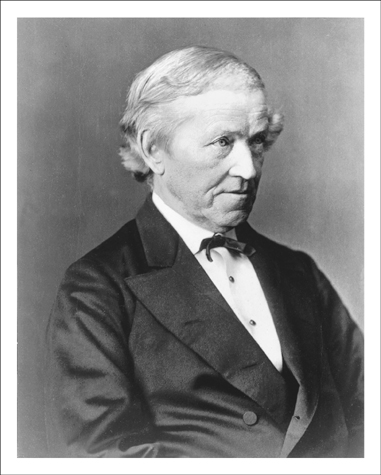
Sir Charles Wheatstone (The Science Museum, London)
Wheatstone invited Morse to visit him at the College and inspect his telegraph. Together with William Fothergill Cooke (1806–1879), a maker of anatomical wax models, he had developed a receiving apparatus that indicated letters by deflecting five needles in various ways on a diamond-shaped plate. For example, two counterclockwise deflections stood for A, one counterclockwise and three clockwise deflections stood for T. Wheatstone and Cooke had been granted a patent a year before—the first English patent for an electrical telegraph.
Morse found Wheatstone likable and intelligent, “a most liberal generous hearted man…. decidedly a man of uncommon genius.” He admired the clever and handsomely built telegraph, too, but thought it overly complex. It required five wire conductors between transmitter and receiver, and the signals were evanescent: the position of the needles on the dial had to be observed on the instant or be lost for ever. By comparison, his own telegraph used only one wire and imprinted its messages permanently. Except that both devices sent an electrical current over a circuit, Morse saw, the two systems had nothing in common. And a signaling telegraph such as Cooke-Wheatstone’s was intrinsically slower and less accurate than his recording telegraph.
During his seven weeks in London, Morse also learned something about two other rivals—the London surgeon Edward Davy and, especially, Karl Steinheil, a professor of mathematics and physics in Munich. He saw Davy’s six-wire telegraph in operation, and heard that the surgeon was attempting to add a recording device. It would produce a “bungling imitation” of his original zigzagging Vs, he thought, illustrations of which Davy must have seen in some newspaper. Steinheil’s telegraph represented a greater challenge. Morse did not see the instrument, but it was described to him as actuating two needles, which carried small reservoirs of ink and could mark a paper with lines resembling the dotdash code. It used a single circuit, like his own telegraph. Indeed he was told that Steinheil had copied this improvement from him. Later he learned that in reality Steinheil used two circuits.
Before coming to London, Morse had known about European telegraphs only through accounts in the press. His personal investigation of them enabled him for the first time to define the uniqueness of his own system, the ground on which his claim of originality could solidly stand. “My time has not been lost,” he wrote, “for I have ascertained with certainty that the Telegraph of a single circuit and a recording apparatus, is mine.”
Denied a British patent, Morse left for France, “not sanguine,” he said, “as to any favorable pecuniary result.” He took rooms on the rue de Rivoli, pleasantly overlooking the Tuileries gardens. The city had been turbulent during his visit six years before, following the July revolution. In the meantime his esteemed friend Lafayette had died, and with growing prosperity, new roads, the opening of the Arc de Triomphe, and at least a facade of parliamentary government, organized resistance and street rioting seemed things of the past.
Morse quickly obtained the French equivalent of a patent, a brevet d’invention. Since the semaphoric French system was state-controlled, however, the brevet meant nothing unless he sold his invention directly to the government. “The Telegraph is a government monopoly, and therefore I am dependent wholly on them.” He counted on being allowed to demonstrate his apparatus to Louis-Philippe—even though, five years earlier, he had accused him of conspiring with the despots of Austria and Russia to push France into war with the United States. “I am hourly in expectation of a message from the King to show the Telegraph before him,” he said.
It turned out to be a long hour. As the hoped-for invitation failed to arrive, Morse attributed it to the royal family’s preoccupation with the recent birth of the young prince, whom he saw (“he looked very much like any other baby”). But Louis-Philippe’s prestige and popularity had fallen, and he had been the target of several assassination attempts—one using a machine constructed of two dozen rifles that left fourteen people dead.
Morse’s prospects brightened when he was introduced to the celebrated astronomer-physicist Dominique François Jean Arago (1786–1853). Catalonian by birth, with dark curly hair and bushy sideburns, Arago was director of the Paris Observatory and permanent secretary of France’s elite national scientific society, the Académie des Sciences. Keenly interested in electromagnetic phenomena, he had been awarded the Royal Society’s Copley Medal for his discovery that nonferrous metals could display magnetic properties. He invited Morse to exhibit his telegraph at the observatory and, impressed by what he saw, asked him to exhibit it again before the savans of the Académie.
The Academy met at the Institut de France, on the Left Bank of the Seine. Seven years before Morse had spent his time just across the river—at the Louvre, perched on a high stand to paint his Grand Gallery. For the telegraph demonstration, on September 10, he sent messages some four hundred feet in the alphabetic code of dots and lines. He used a battery recently invented by the British chemist John Daniell, capable of delivering a constant and powerful current—a major, permanent improvement to his system.
Morse wrote out some notes for Arago to use in serving as his spokesman and translator. Arago would explain to the academicians that the exhibition instrument was imperfect, deliberately made about as large as a little desk (“petit bureau”) to endure the knockabout of travel, although the actual instrument could be made only one-third the size. Morse’s notes included a short version of The Sully Story and points for Arago to stress in explaining the uniqueness of the system: it requires only one circuit, uses no magnetic needles, writes in permanent characters, needs no attendance at the place of delivery, and is relatively inexpensive. He also had Arago mention his yet unused receiving magnet, by which intelligence could be “written at any number of intermediate places between any two distant points, and simultaneously with its reception at the most distant points.”
Morse felt that his demonstration went off no less effectively before the French Académie than it had before the American Congress. And Arago’s verbal presentation of it was lucid and convincing, as Morse judged from the Academicians’ faces and surprised cries. “A buzz of admiration and approbation filled the whole hall,” he wrote later, “and the exclamations, ‘Extraordinaire!’ ‘Très bien!’ ‘Très admirable!’ I heard on all sides.” These were no ordinary mortals, of course, but “the most celebrated scientific men of the world.” The spectators included Gay-Lussac, famous for his work on the volume of gases, and the brilliant Baron Humboldt, who arose after the demonstration, Morse said, and taking his hand congratulated him before the entire Academy.
Full accounts of the event appeared in the Courier Français, the Moniteur, and other Paris newspapers, as well as the Annales de Chimie et de Physique and the Academy’s weekly bulletin, the Comptes Rendus, which went out not only to members but also to foreign scientific societies and libraries. Several papers regretted that Morse’s ignorance of French made it impossible to interview him; a few misidentified him—as a Philadelphian, or as “Un savant étranger, M. Moss.” Nevertheless, they reported that even the most incredulous spectators became convinced that a dispatch could be sent over France end-to-end in half an hour. They envisioned Morse’s lines replacing the older semaphores, and within fifty years crisscrossing all of Europe.
Some of the journalists observed that questions of priority, Europe vs. America, were at the moment being debated fiercely (“avec acharnement”). They drew up genealogies of the telegraph, charting a history of active European experiment and invention over the last thirty years. The names and events were becoming familiar to Morse, although he had known nothing of them when he began. They included Samuel T. Sömmering, president of the Bavarian Academy of Sciences, who in 1809 demonstrated a thirty-five-wire telegraph driven by the electrolytic decomposition of water; the Danish scientist Hans Christian Oersted, who initiated the study of electromagnetism by discovering, in 1819, that a wire carrying a current deflects a compass needle; André Marie Ampère, a French physicist who saw the possibility of using Oersted’s deflected needles to transmit alphabetic signals (an idea he published but did not pursue); Baron Pavel L. Schilling, one of Sömmering’s assistants, a Russian who developed a prototype of the needle telegraph, perhaps as early as 1825; and the Germans Carl Friedrich Gauss and Wilhelm Eduard Weber, who in 1833 built the first telegraph to come into practical use, an electromagnetic needle device with a two-wire circuit. The Courier Français commented that “in reality there does not yet exist an inventor of the telegraph. The Inventor will be the first constructor who shall make it operate upon a very extended line.”
Morse enjoyed the publicity and enthusiasm. He noted that the Théâtre des Variétés was presenting a skit in which the characters conversed by telegraph over hundreds of miles. The Paris town talk not only established his name in France, but also put him ahead of his British and German rivals. Cooke and Wheatstone had obtained a French brevet, but Morse learned that his own telegraph was preferred, “pronounced far superior in simplicity and practicability.” Steinheil’s two-needle telegraph was shown in Paris, and Morse was also pleased to note that because of its complexity “mine is considered … having a decided advantage.” The news got back to America, where the Washington National Intelligencer, for one, reported that their countryman had the Englishmen and German beat: “It is said … to be very manifest that our Yankee Professor is ahead of them all in the essential requisites of such an invention.”
The acclaim brought Morse a new chance to realize his ultimate hope of demonstrating his telegraph to the King. Following the Academy exhibition, he was visited by Alphonse Foy, administrator of the current network of semaphores. Foy told him that the government now meant to test the practicability of a nationwide electric telegraph. He said he would recommend Morse’s apparatus: “I have examined carefully the system of Steinheil, of Wheatstone, and many others, French and German, and … yours is the best.”
Foy’s endorsement would go to the influential Minister of the Interior, Count Marthe de Montalivet, who was personally close to Louis-Philippe. Hoping to reinforce his case, Morse got a letter of introduction to Montalivet from General Lewis Cass, the American minister to France. Drafted by F. O. J. Smith, it explained that Morse wished to bring before the government a method of telegraphy that was simple, cheap, fast, and accurate, capable of being extended to every point in the country. If the government preferred, he could begin by building an experimental line connecting the royal palaces alone.
Having gained influential support, Morse awaited an interview with Count Montalivet, leading to a presentation before Louis-Philippe. But Montalivet’s secretary put him off from day to day by one excuse after another: Foy had not yet submitted his recommendation to the minister; the recommendation had been received but a synopsis had to be written; the synopsis had been written but Montalivet had not yet seen it. During one particularly aggravating period Morse called eight or ten times at the bureau and was unable to see even the secretary. At times he doubted that Louis-Philippe would ever get to see his telegraph: “some of the most essential improvements have lain for years in the portfolios of the Ministers.” But he kept hoping for a summons from the Palais-Royal, which would be decisive: “If I could but once get them to look at it, I should be sure of them, for I have never shown it to anyone who did not seem in raptures.”
The problem, Morse believed, was not one person or another but the French mentality. “I find delay in all things, at least, so it appears to me, who have too strong a development of the American organ of ‘go-ahead-ativeness’ to feel easy under its tantalizing effects.” The shipment from London of some new clockwork for his telegraph took more than two weeks, going through a dozen customs officers, commissionaires, and administrators demanding papers, receipts, drawings, sureties. The ponderous bureaucracy was only a sign of the larger, moral problem: “there is no such thing here as conscience.” Knowing themselves to be untrustworthy, the French had no confidence in others. They did not delegate authority to subagents, certain that it would be abused—“consequently the regular military muster-roll mode must supply the place of conscience, and all its circumlocutory, cumbrous powers…. Happy, thrice happy America!”
There were other frustrations as well. While waiting to hear from Montalivet, Morse also awaited word from home that Congress had passed the $30,000 appropriation bill. No news arrived. Hoping to goad the legislators into action, he wrote to the House Committee on Commerce describing his success abroad. Several European governments, he said, had in view adopting an electrical telegraph. And in France the “American Telegraph” was being recommended as the best: “I am at this moment awaiting the orders of the Minister of the Interior.” He implied that a similar interest in his apparatus existed among capitalists in America. He needed to know the government’s wishes because they would determine for him whether to go public, committing his telegraph to “the control of associations of private individuals.” The pressure on Congress, he hoped, might also work the other way, exciting action in the Paris bureaucrats: “I should be exceedingly glad to hurry these people by telling them that my services are wanted at home.”
A new possibility opened for Morse when he was called on by a director of the St. Germain railroad, a twelve-mile line outside Paris. This official inquired whether a telegraph could be contrived to report the location of the company’s trains along the road. Morse worked out a detailed plan featuring small electromagnetically operated bell towers that would register the arrival of the cars at a given point and notify every station over the whole route. He took a brevet for his new invention and made a working model.
The directors of the railroad, however, failed several times to show up for the demonstrations Morse arranged at his lodgings. “They are famous here for not keeping appointments,” he told Smith; “I have only to exercise patience and wait.” He needed more than patience. When the directors finally came they approved his plan—all but one of them, who objected to the enormous cost of building a trial line, an estimated 60,000 francs. Morse proposed an economy: instead of stretching the wire circuit underground, in protective tubes, it would be laid down above ground in grooved bricks. He waited for a reply, but heard nothing. Like the rest of France, the railroad officials proved to be “as dilatory as the Government.” In the end the company simply dropped the project.
Morse also tried to interest the French military, although his efforts are known only through his considerably later account of them. The Minister of War, he recalled, put him in touch with an elderly Marshal of France. Through an interpreter, he described for the Maréchal his strategy for using telegraphs on the battlefield. The instruments and a reel of fine insulated wire would be transported in a few light wagons: “when required, the wagons with the corps of operators, two or three persons, at a rapid rate should reel off the wire to the right, the centre and the left of the army … and thus instantaneous notice of the condition of the whole army, and of the enemy’s movements, would be given at headquarters.” Morse’s pitch got nowhere, the Marshal objecting that his plan would overburden the army with matériel.
Despite his many frustrations, Morse kept seeking new outlets for his invention. Smith drafted for him a letter to the famed international banker Baron Rothschild. It solicited the interest of “gentlemen of enterprise & intelligence,” promising that by Morse’s telegraph they could send messages in perfect secrecy. Morse also arranged with a wealthy Vermont capitalist then in Paris, Mellen Chamberlain, to market his system outside England and France. Smith drew up an agreement by which Chamberlain would bear the costs of travel and of procuring new instruments, and after deducting them from the proceeds return to Morse and his partners half the profits. Chamberlain meant to look for buyers or agents not only throughout Europe, but also in Asia and Africa.
Morse had intended to stay abroad only three months. But with some projects still alive and new ones developing he decided to linger. Meanwhile his brother Richard and F. O. J. Smith returned to the United States. Having taken the waters at Vichy and consulted physicians in Switzerland, Richard felt he had overcome his constant “sadness & dejection.” But the cures were short lived. Ever pessimistic—set on shutting out, as he realized, “every agreeable view of any object”—he began to think that whatever he had gained he would soon lose. He decided he must leave New York and withdraw from his partnership in the Observer.
Morse now saw Smith as a mixed blessing. He valued him for drafting letters that required legal expertise and for managing business deals. “I am not a business man,” he confessed, “and fear every movement which suggests itself.” But on other important matters he found Smith unreliable—especially in supplying the money the former congressman had promised to cover expenses in Paris. Jobless, his purse emptied by “a kind of perpetual diarrhoea,” he often complained to Smith that he had had to borrow: “I hope by an early answer you will relieve … the embarrassment I am in and have funds at my command sent me without delay.” To economize he built needed apparatus himself, spending hours in his room “like any mechanician.” In some degree he also blamed Smith for holding up the demonstration of his telegraph at court. “If I had the funds the King should have seen this long ago, and the government too have given me an answer.”
The stalled funds and bureaucratic delays often left Morse glum, his bright hopes in reach but never secured. He tried to “keep myself loose,” confining his expectations “at the lowest point, that is, at nothing.” But at times he slipped into one of his fits of “the blues,” certain that he was destined to be purse-poor forever, “never to realise even a competency.” He considered returning to America and moving permanently to the South, where he could resume his career in solitude as a portrait painter, “live secluded, without being burdensome to my friends.” But some encouraging chance for his telegraph always turned up to revive and strengthen his hopes. “My confidence increases every day in the certainty of the eventual adoption of this means of communication throughout the civilized world.” He reproved himself for mistrusting Providence, which in countless ways deserved his gratitude.
The black moods always returned, however. Or worse, when to the silence from the Palace and from Washington he added the state of his personal life. In his absence his affairs in America were becoming deranged beyond repair, his children parentless: “they are orphans, and orphans they are likely to be,” he admitted to Sidney. “I know they suffer in this forming period of their lives for the want of a home, of the care of a father and a mother, and that no care and attention from friends, be they ever so kind, can supply the place of parents.” Having soared on visions of fame and now sunk in hopelessness, he again felt unraveled, his “acute mental trials” all but unbearable—“so severe as almost to deprive me of reason, though few around me would suspect the state of my mind.”
Morse had cause to brood over his children’s well-being. Eighteen-year-old Susan lived with Sidney for a while in New York, but not happily. Full of business cares, Sidney sometimes forgot to dole out the money he was obligated to provide from her grandfather’s bequest. And despite Susan’s many economies he considered her extravagant. She reported to Morse that when she asked for money to buy Christmas presents, Sidney gave her a lot of his old books to bestow, “which I did not like much, as my friends gave me such handsome presents.” Mostly Susan was unhappy over living as the ward of friends and relatives. While in New York she also stayed part of the time with a family named Peters, and when they moved was left uncertain where to go next. She ended up with an aunt in New Haven, where, she said, “I do not feel exactly at home.” Her great wish, she wrote to Morse, was that someday “my dear father will have a sufficient competency to enable us to live in a home together.”
Morse usually offered Susan little consolation. “I look to God to take care of you,” he wrote. She lacked a home, true, but he reminded her that he himself was deeply bereft: “You cannot know the depth of the wound that was inflicted when I was deprived of your dear mother, nor in how many ways that wound has been kept open.” What hope of family life he held out for her seems, at least in one letter, no more than disguised self-pity, designed not to reassure Susan but to elicit her sympathy:
Tell Uncle Sidney to … have a little snug room in the upper corner of his new building, where a bed can be placed a chair and a table, and let me have it as my own that there may be one little particular spot, which I can call home. I will there make three wooden stools, one for you, one for Charles, and one for Finley, and invite you to your Father’s house.
Morse’s repeated depiction of himself as poor and helpless obviously made Susan feel guilty. She asked him to bring back a music box she might listen to while sewing—“that is, if you can afford it.” Like the rest of her letters to him since childhood, those she sent to Paris usually ended with a plea: “How I long for your return, my dearest father!”
However insensitive to Susan, Morse was even further cut off from his sons. “I feel quite unfit to advise with regard to them,” he told Sidney. “I know neither their dispositions nor their necessities.” For a time the boys were put up in Claverack, New York, with their uncle Richard and his wife, Sarah. Charles was nearing college age. Thirteen-year-old Finley, his mind stricken, seems to have had trouble dressing himself and may have developed a violent clumsiness. Richard described him as “mild, sweet-tempered, destructive.” He believed Finley should be put out to “some kind-hearted farmer in the country, where he could amuse himself with work or play.” In his emotionally ragged state, Richard cannot have been an adequate caretaker for Morse’s sons. And his wife seems to have been no better. Winter was coming on, and the boys lacked coats and had outgrown their pantaloons. Yet she told Richard, “Don’t bother about the children. Let them remain till their father comes home, or makes provision for them.”
Sidney planned to send Charles and Finley to school in Vermont. Susan was dismayed by the idea: “Poor boys! They are truly wanderers,” she protested to Morse. “I cannot bear the thought of their going so far away from us all,” she wrote to her father in Paris; “I long to see them have a home. And be with me again.”
With the New Year came a new hope of demonstrating the telegraph at court. Morse was visited by the Prefect of the Seine, Count Ram-buteau, whose power he considered next only to the King’s. He worked the apparatus for the Count, who sent the words “Louis-Philippe” and was so impressed that he promised to speak to the King the same evening. But as usual nothing happened. A promised visit from the Chief of the King’s household, Count Bondy, apparently never happened either. And early in the new year Morse lost his closest contact with the palace when the government formed a new cabinet, deposing Count Montalivet as Minister of the Interior. “I cannot bear this standing still,” Morse groaned. “I have been dealing too much in lightning lately to feel easy travelling on a snail’s back.”
Morse got some further discouraging news from Mellen Chamberlain, the Vermont capitalist who was trying to sell rights to the telegraph elsewhere on the Continent, and in Asia and Africa. Chamberlain reported from Athens that he had demonstrated the invention to important persons in the city, including the King and Queen of Greece. All were captivated, he said, none was willing to risk money: “Fame is all you will get … in these poor Countries.” Still, he was off to Alexandria to show the telegraph to Mehemet Ali, Sultan of Egypt, “and hope to get something worth having.”
But Morse was beginning to feel that he must confine his hopes to America. The Old World and its old systems made Europeans unwilling to try new things however promising: “There is more of the 'Go-ahead character with us, suited to the character of an electro-magnetic Telegraph.” Some doubt was cast on this too, however, when Morse learned that Bavaria had put in operation on part of its railroad system the apparatus of Steinheil—the first government to give its support to electrical telegraphs. Morse regretted that the American Congress had not taken the lead. But he managed to see in the event a sign of approaching vindication: “this first adoption gives the assurance of … universal adoption and if mine is best as all continue to affirm, mine must supplant all.”
This depended, however, on the meaning of “mine.” Morse learned that an article in the Boston Post had declared the electromagnetic telegraph “entirely due to our fellow citizen Dr. Charles T. Jackson.” Jackson himself had supplied the information in the article. His spokesman in the Post explained that aboard the Sully Morse “pretended to feel a great interest in the invention,” and later “undertook to monopolize the credit.” Morse replied from Paris, threatening Jackson with public disgrace unless he immediately published a retraction: “For your family’s sake, and for your friends sake, I would wish to spare you this mortification; an indulgence on my part, which you must be conscious you do not deserve.”
Far from retracting, Jackson took aim at Morse’s reputation among the savans. He wrote off a blast to the Académie des Sciences: “I am pained at the undeserved patronage which the French philosophers have accorded to Mr. Morse. The invention which he has shown them belongs entirely to me.” (“L’invention qu’il leur a montrée mi appartient en entier.”)
In reopening his war on Morse after five years, Jackson triggered a transatlantic cross fire of angry letters between them, as well as charges and countercharges in the Observer and other American newspapers. Morse found out that Jackson had recently been accused of plagiarism. Now a geological surveyor for the U.S. government, Jackson had allegedly pilfered from an unacknowledged source the substance of his published report on the mineralogy of Nova Scotia. Just the same, his tale of technological theft and deceit was much talked about in Paris. Morse countered it by publicizing the testimonials from fellow passengers on the Sully, which he had brought with him to Europe. They produced “a pretty strong tide of indignation raised against Jackson,” he said. He also assured his partner, F. O. J. Smith, that the battle in the American press would not hinder but promote their interests. Many people who would not bother to read dispassionate descriptions of the telegraph would devour controversy about it. So the fracas would serve as “one of the best advertisements.”
Toward the end of February Morse received an exciting proposal from a surprising direction. He had moved into new quarters, 5 rue Neuve des Mathurins. To save money he shared the space with a French-speaking Protestant minister from Boston, Edward Kirk. With Kirk acting as translator, he demonstrated his telegraph at home every Tuesday afternoon. He opened the levee to Paris scientific and government circles, but many other Europeans crowded in—Counts and Lords, as he carefully noted, Dukes and Duchesses, the Infante of Spain. All exclaimed over his system. He recorded the broken-English praise from one bigwig: “Are you not glorious, sair, to be the author of this wonderful discovery?”
The exciting proposal came from another of his enthusiastic distinguished guests—a Baron Meyendorff, agent of Czar Nicholas I of Russia. Meyendorff said he would immediately advise his government to establish a twenty-mile line of Morse telegraphs from St. Petersburg, laid underground. His right-hand man, an experienced scientist named Amyot, could experiment with Morse to ascertain the effects of temperature on the conductibility of long lengths of buried wire. The Czar had 80,000 men at his command, Meyendorff pointed out, so the trench for interring the circuit could be dug in only a week. Over several further meetings, he and Morse discussed the possibility of an eight-hundred-mile line to Warsaw.
Meyendorff’s Czar was of course the same autocratic Nicholas I who eight years earlier had crushed the Polish uprising and absorbed Poland into the Russian empire. Outraged, Morse had joined the American Polish Committee in Paris and written sympathetic newspaper articles describing the woeful situation of Polish exiles. But with the chance of Morse lines serving the great Russian capital, outrage made room for buttering up. Czar Nicholas, he told Meyendorff, was “well known to be both just and liberal.”
Morse, Meyendorff, and Amyot worked out detailed financial arrangements and a schedule. The Russian government would pay all expenses, including an advance of 4000 francs to Morse and a per diem allowance from the time he embarked for Russia. The contract was dispatched by courier to St. Petersburg for approval by Nicholas. Aware that Morse was planning to return home, Meyendorff promised to send him the Czar’s reply through the Russian Ambassador to the United States, between May 10 and 15. Morse could leave from New York around June 1, be in Paris a month later, and reach St. Petersburg by July 15.
Morse immediately booked return passage to America for March 23, a month hence. He quickly wrote to Smith, asking his partner to have six or eight new telegraphs made that he could take to Russia, embodying all the recent improvements: “our whole energies must be directed to having this first adoption of our System, a successful one; all hands must go to work.”
Morse’s last two weeks abroad were intense. Since the beginning of the year his telegraph had been competing for public notice with another invention, by the stage designer Louis Jacques Mandé Daguerre (1789–1851). Daguerre operated a celebrated diorama in Paris, huge transparent paintings brought alive with props and lighting effects, such as a view of Mont Blanc, changing from night to day, an Alp horn sounding.
After many years’ labor, Daguerre and his now-deceased partner, Joseph Nicéphore Niepce, had discovered a chemical process that could fix an image in the camera obscura (literally, “dark room”). The camera was a light-tight box commonly used as an aid to drawing. A convex lens at one end projected an image of the outside world onto a screen at the other end. An artist could peer into the box and draw from the image. When painting in New Haven around 1821, Morse had experimented with fixing camera obscura images on paper treated with silver nitrate. But he managed to produce only different degrees of shade, and gave up the idea as impracticable.
Daguerre’s invention competed with Morse’s telegraph not only for public attention but also for government support. His remarkable success had been described to the Académie des Sciences by Arago in January, although in general terms. Daguerre was keeping his process secret, offering to disclose it to the French government in exchange for a pension. The Chamber of Deputies was discussing whether to grant the pension, on the condition that Daguerre’s process would be made public for anyone to use, as a boon to humanity. Morse was well aware of the competition, but supposedly not fazed by it. A Deputy remarked to him, he said, that of the “two great wonders of Paris” the telegraph was of “vastly more importance than the Daguerreotype.”
Anxious to meet Daguerre before leaving France, Morse sent him a note asking to see his images, and inviting him in turn to inspect the telegraph. On March 7 he visited the French inventor for two hours at his rooms in the Diorama, a man with curly blondish hair and small dark mustache. Whatever superiority to Daguerre he may have felt before gave way to wonder when he saw the pictures, on metal plates about seven inches by five.
Morse was startled by the “exquisite minuteness of the delineation,” the inconceivable fidelity to physical reality: “No painting or engraving ever approached it.” The image of a boulevard contained a distant sign, on which the eye could discern letters but not read them. Examined with a powerful magnifying glass, however, every letter became distinct, “and so also were the minutest breaks and lines in the walls of the buildings and the pavements of the street.” Similar examination of Daguerre’s picture of a spider showed an intricate organization never before seen, opening a new field of research for the naturalist. And the images of interiors were Dutch paintings, “Rembrandt perfected.” As both a painter and an inventor Morse considered the new process “one of the most beautiful discoveries of the age.” He sent a lengthy narrative of his interview with Daguerre to his brothers in New York. Part of it was published in the May 18 issue of the Observer—the earliest firsthand account of photography to appear in America.
Daguerre’s return visit, the following day, ended badly. He spent more than an hour examining Morse’s telegraph. Meanwhile a fire broke out in his Diorama building, during a show. The audience escaped, barely, but his highly inflammable paintings were consumed. Sparks threatened to ignite his nearby house as well. Some neighbors saw the danger and carried off to safety his daguerreotype apparatus. A notebook containing his experiments, at first believed to be lost, turned up ten days later.
Probably a few days after Daguerre’s visit, Morse received a letter that prompted a last-minute change in his travel plans. It came from Lord Elgin, whose famed classical sculptures he had seen when studying in England twenty-five years ago. Elgin had attended Morse’s afternoon exhibitions twice, impressed both by the telegraph and by its inventor being president of the National Academy of Design. He brought along such splendid friends as the young Earl of Lincoln, later one of Queen Victoria’s Privy Council. Morse let his British guests know how coldly the Attorney General had dismissed his application for a patent. Elgin’s letter now informed him, however, that his telegraph had become well known in London, and influence might be used to obtain a patent for him. He urged Morse to return to London: “a short delay in your proceeding to America may secure you this desirable object immediately.”
Morse was reluctant to extend his stay abroad. He was scheduled to depart from Liverpool in only about ten days, and an expected summons from the Czar demanded his presence in New York. He decided to leave Paris immediately and spend as much time as remained in London. The day after arriving he sent his card to the Earl of Lincoln, who at once invited him to bring the telegraph to his house in Park Lane. On March 19 Morse exhibited its operation to an illustrious audience of Admiralty Lords, members of Parliament, and fellows of the Royal Society.
The heady appeals and flattery from on high produced no more action, however, than the rest of Morse’s dealings with the British and French, which had crept along or gone nowhere. Elgin promised him an introduction to the influential former Lord Chancellor of England, Lord Brougham. But when Morse applied to see Brougham the answer was a formal note of compliments and regrets. His Lordship was engaged at the House every day until dinner, and could allow him only a few minutes some morning before ten.
Morse sailed back to the United States on March 23 aboard the Great Western, one of the new screw-propelled iron steamships that were all but eliminating the centuries-old tedium and danger of ocean travel, capable of crossing the Atlantic in only two weeks. He made it to New York in three, despite stormy weather, anxious to hear from the Czar and move on to St. Petersburg.