
CHAPTER NINE
Five miles meandering with a mazy motion
Through wood and dale the sacred river ran
Then reached the caverns measureless to man….
MARCO POLO left Cambulac as Kublai Khan’s emissary. Still in his early twenties, he went without his father and uncle, whom he ceased to mention as companions for this phase of his travels. As always he enjoyed the protection and the blessing of the khan, which guaranteed his safety—at the price of unending loyalty. Despite the challenges that lay ahead, he bristled with newfound self-importance, understandable in light of his destination: Hangzhou, the largest, wealthiest, most celebrated city in China.
He carried a golden paiza just as his father and uncle had done on their journeys on behalf of the Mongol Empire. This object was a foot long and three inches across, and was inscribed: “By the strength of the eternal Heaven, holy be the Khan’s name. Let him that pays him not reverence be killed.” Possessing it meant that Marco was designated as a very important person in the Mongol realm, and was able to make full use of the khan’s extensive network of hostels, horses, and roads.
Draped along the shores of West Lake, Hangzhou presented the archetypal Chinese landscape of mountains soaring above a tranquil body of water that seemed to reflect Heaven itself. The metropolis was the traditional seat of the Song dynasty, and it had just been conquered by Kublai Khan’s leading general, Bayan, at the time Marco was dispatched to help administer the khan’s affairs. As a disinterested European, Marco was just the sort of official whom Kublai Khan preferred for overseeing the finances of a hostile or suspicious populace. Everything that Marco had seen since leaving Venice, even the wonders of Cambulac and the great Kublai Khan himself, served as a prologue to his voyage into the heart of China.
THE TWO CITIES were connected by one of the most massive public works in all of China, the Grand Canal, stretching over a thousand miles from Cambulac south to Hangzhou. The waterway served as a principal artery for Chinese (and Mongol) shipping and commerce. Its construction had been under way, in fits and starts, for centuries, but by the time of Marco’s trip it was nearing completion. Although Marco does not supply a precise itinerary, he probably followed the Grand Canal for much of his journey to Hangzhou.
Leaving Cambulac, Marco encountered “a very beautiful stone bridge” that crossed a wide, swiftly flowing river, which led to the Ocean Sea. He estimated the bridge to be “three hundred paces long and eight paces wide,” room enough for ten horsemen to ride abreast, clattering on the polished stone. “And it has twenty-four arches and twenty-four piers in the water supporting them,” he says, “and it is all of gray marble and very well worked and well-founded.” The bridge opened onto a vista as spacious as China itself. An impressionable young man could easily persuade himself that the world lay at his feet, and in a sense it did. The bridge, as much a spiritual symbol as an architectural wonder, evoked crossing over into a new realm, a new consciousness, even a new life. As he set foot on it, Marco may have sensed himself growing and changing with every step, as he passed beyond the Mongol stronghold into China itself.
Crossing the monumental bridge, he considered the care and ingenuity that had gone into its construction. “From one pillar to the other,” he observes, “it is closed in with a flag of gray marble all worked with different sculptures and mortised into the columns at the side, through the length of the bridge to the end, so that people who cross may not be able to fall into the water.” In all, he counted six hundred of these elegant pillars, each topped with a lion or similar animal, fashioned “of very fine marble.”
Known today as the Marco Polo Bridge, this structure is essentially the same as the day Marco traversed it. Completed in 1192, it is also called the Guangli Bridge, and its stone span reaches across the banks of the Lugou River. Historical records indicate that the Lugou was “violent and flowed extraordinarily rapidly,” but modern construction has diminished the current. The bridge witnessed one of the major engagements of the Second World War, when Japanese forces approached it during their campaign to conquer China.
THIRTY MILES from the bridge that would one day bear his name, Marco wandered through a charming landscape dotted with attractive, welcoming villages, seductive shade trees, “very fruitful cultivated fields,” refreshing springs, and Buddhist monasteries, where the monks busied themselves weaving silk and fashioning gold jewelry. In a change from his rugged, hazardous journey to Cambulac four years earlier, Marco seems to have felt secure, and he received a courteous reception wherever he went. “There are very many fine inns or hostels in our manner,” he notes with satisfaction, “where the wayfarers lodge, because of the multitude of merchants and strangers who come there.”
Thereafter, Marco’s account, likely drawn from the notes he brought back to Italy from China, becomes a fast-moving catalog of his “wayfaring” in the service of the khan. Marco traveled from one comfortable inn to another, always appreciative of the “beautiful” villages, cities, fields, and roads jammed with prosperous commercial travelers.
WHEREVER MARCO WENT, he encountered silk—and not just the fabric but the silkworms themselves, a great novelty to Europeans, and the mulberry trees on which they feasted. For centuries, Europe had known almost nothing about the art and science of sericulture; it was perhaps the most closely guarded secret in ancient history.
Even within China, the origin of silk was mysterious. Tradition credits Xi Ling-shi—a wife of the mythical Yellow Emperor, said to have ruled China in 3000 BC—with the introduction of silkworm cultivation and the invention of the loom. Although she was a phantom, silk was real; archeological digs have turned up silk threads, ribbons, and cocoons dating from 3000 BC, and a small ivory cup dating from 5000 BC contains images of spinning tools used for silk, as well as silk thread.
In China, a single cultivated species of moth became identified with silk, the blind and flightless Bombyx mori, whose ancestor Bombyx mandarina Moore fed on the leaves of the white mulberry tree. This silkworm’s thread is composed of a filament that is rounder and smoother than those produced by other moths, and across the millennia, thanks to persistent Chinese sericulture, it evolved into the more specialized Bombyx mori.
This moth lays as many as five hundred eggs, each weighing no more than a gram or so, within a few days’ time, and promptly dies. From that point, the story of silk can be told in a series of exploding numbers. An ounce of eggs eventually yields thirty thousand silkworms; the worms have one, and only one, source of food: the leaves of the mulberry tree. Those thirty thousand worms devour about a ton of mulberry leaves, and in turn produce twelve pounds of raw silk.
As the Chinese slowly perfected the cultivation of Bombyx mori, they learned to keep the eggs at 65 degrees Fahrenheit, and to raise the temperature 12 degrees to force them to hatch. Only then does the real work begin: feeding the worms fresh mulberry leaves, handpicked and carefully chopped, every half hour, around the clock, while maintaining a stable temperature. The worms quickly fatten in stacked trays stored in feeding huts; the sound of the munching creatures has been likened to heavy rain falling on a bamboo roof. At the same time, they must be protected from loud noises, drafts, and the odors of fish and meat and even perspiration; under ideal conditions, the coddled creatures can multiply their weight several thousand times, as they continually shed and change color.
To make their protective cocoons, the silkworms secrete a jellylike substance that hardens on contact with air. Over the course of three or four days, they spin a cocoon around themselves until they look like little puffy white balls about the size of a thumb. These are immersed in boiling water to loosen the silken filaments, which reach about half a mile in length, and the filaments, in turn, are gathered onto a spool.
There are two distinct types of silk cocoon. Cocoons of one type produce a filament about one-eighth the diameter of a human hair. The filament possesses tremendous tensile strength because of its molecular structure, known as a beta-pleated sheet, which looks like this:
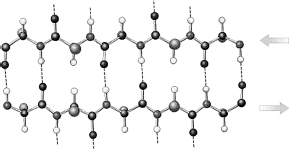
A single silk thread generally consists of five to eight of these filaments tightly wound together. After processing, the raw threads are ready for dyeing. Because dye fits neatly into the pleats, silk retains color far better than other natural fabrics can; colors look much richer and more vibrant on the sensuous surface of silk.
The other type of silk cocoon, much larger and fluffier, often goes by the name of Happy Family, because each cocoon contains two larvae. The filaments in this case are tangled together, and so are less valuable. Once it has been stretched over a form to dry, the silk is used for batting—warm, lightweight stuffing.
IN CHINA, the manufacture of silk was quintessentially women’s work; in the spring, the reigning empress inaugurated the silk season as part of her official duties, and her female subjects followed suit, spinning and weaving and embroidering silk at home and in workshops. In silk-rich regions, three generations of women in the same family would feed and supervise the maturing silkworms. The production of silk, labor-intensive as it was—with spinning, weaving, dyeing, and embroidering—occupied half of China’s provinces. Despite the ubiquity of silk manufacture, the key techniques of sericulture remained closely guarded by Chinese authorities; it was an offense punishable by death to reveal those secrets to foreigners, or to smuggle cocoons or even eggs beyond Chinese borders.
At first the wearing of silk was restricted to the emperor and his family. But over time, people from many classes of Chinese society took to wearing silk tunics, and silk eventually found a variety of industrial applications in fishing lines, strings for musical instruments, and silk-rag paper. By the time of the Han dynasty, 206 BC to AD 220, silk had become so widespread in China, and so deeply embedded in the Chinese economy, that it was a valuable commodity in itself, useful for paying debts. Farmers remitted taxes to the government in the form of silk they produced. The government in turn compensated civil servants in silk, and rewarded subjects for outstanding services in silk. Soon silk supplanted gold as a standard measure; rather than pounds of gold, value was calculated in lengths of silk. Eventually, silk became a form of currency, not only within China but also in settling debts with foreign nations. Silk became so much a part of the Chinese economy, way of life, and culture that 5 percent of Mandarin Chinese characters referred to some aspect of silk.
The Chinese monopoly on silk was eventually broken by competing countries. By 200 BC, the Koreans had mastered the rudiments of sericulture thanks to Chinese immigrants who brought the specialized knowledge with them. Five hundred years later, sericulture had spread along diverse “silk roads” to India, where it was embraced with the same vigor. Silk reached all the way to Rome, which became fascinated by the alluring textile. In about the fourth century BC, Roman accounts mention Seres, the semimythical Kingdom of Silk.
It is possible that the Roman legions first encountered actual silk at the Battle of Carrhae, near the Euphrates River, in 53 BC. It was said that the Parthians’ vivid silk banners unfurling in the wind startled the Roman troops, who promptly fled the battlefield. Within only a few decades, nobles in Rome wore Chinese silks as a sign of status, much as Chinese emperors had done for thousands of years. The Roman emperor Heliogabalus, who reigned briefly in the third century AD, insisted on wearing only silk. And near the end of the fourth century, one Roman report noted: “The use of silk which was once confined to the nobility has now spread to all classes without distinction, even to the lowest.”
Despite the inevitable dispersion of silk, the Chinese remained vigilant, and they succeeded in keeping the secrets of advanced sericulture to themselves until AD 550, when a pair of Nestorian monks appeared in the court of the emperor Justinian I with silkworm eggs concealed in their hollow bamboo walking sticks. In short order, the eggs hatched worms, the worms spun their cocoons, and Bombyx mori had come to the Byzantine Empire, bringing silk with it. Emulating China, the Byzantine Empire attempted to monopolize the production of its silk, and to retain control over the secrets of sericulture. While Byzantine silk soon eroded the market for the ordinary Chinese variety, most luxurious Chinese textiles continued to dominate markets in Central Asia, and were prized wherever they could be found. Soon Persia joined India and the Byzantine Empire in the war for sericultural supremacy. But even as Chinese silk lost ground to lower-grade foreign competitors, it continued to bring in extensive revenues and to impart a sense of economic and cultural unity to the empire.
At the time of Marco Polo’s stay, silk was just beginning to be produced in Italy, more than four thousand years after sericulture appeared in China. During the Second Crusade (1144–1149), two thousand silk weavers had migrated from Constantinople to Europe, and they disseminated trade secrets the Chinese had guarded for millennia. But for young Marco, silk remained an exotic novelty still identified with China.
THE JOURNEY continued to be idyllic until Marco came to a “province much wasted and destroyed,” as he bluntly states, “by the scourge of the Tartars”: Tibet. At this point in his travels, Marco had passed beyond the limits of European experience with Asia, and that is why it is occasionally difficult to determine the modern equivalents for the kingdoms and people he says he encountered. His trip to “Tibet” probably took him to the province of Yunnan in southern China, as well as to Burma, Vietnam, and vaguely defined regions to the north.
“Tibet” both fascinated and repelled Marco. As a merchant, he was intrigued with the spices—ginger and cinnamon, and still others he had never before seen, and failed to name—all growing in abundance. Amber appeared ubiquitous. Silk abounded. Coral, another medium of exchange, caught his attention, too. The locals, he says, “put it on the necks of all their wives and of their idols and hold it for a great jewel.”
The region’s anarchy and rampant superstition troubled Marco greatly, but he found himself succumbing to the spell cast by the powerful astrologer-magicians. He reports: “They do the most rare enchantments in the world, and the greatest marvels to hear and see, and all by devils’ art, which is not good to tell in our book, because the people would be too much surprised.” Once he has whetted his audience’s appetite, Marco proceeds to tell exactly what these demonic astrologers were capable of doing. “They bring on tempests and lightning and thunderbolts whenever they wish and compel them whenever [they wish them] to cease, and do infinite wonders.”
Returning to a subject that both fascinated and repelled him, Marco dramatizes in frightening detail the elaborate manner in which the conjurers attempted to exorcise the vulnerable sick: “When the magicians arrive, they ask about the manner of the sickness; then the sick persons tell them their ills, and the magicians begin to sound their instruments and to dance and leap until one of the magicians falls all on his back on the ground or on the pavement and foams at the mouth and seems dead. They say that the devil is inside his body, and he stays in such a manner that he seems dead. When the other magicians, of whom there were many, see that one of them is fallen in such a way as you have heard, they begin to speak to him and ask him what sickness this sick man has, and why he has it. One answers, ‘Such a spirit has smitten him because he did him some displeasure.’
“The other magicians say to him, ‘We pray thee that thou pardon him and that thou take from him for the restoration of his health those things that thou wishes to have.’”
Marco fearlessly probes the ecstatic spiritual life of these “Tibetans”: “When these magicians have said many words and have prayed, the spirit who is in the body of the magician who has fallen down answers. If it seems the sick man must die, he…says, ‘This sick man has done so much wrong to such a spirit and is so bad a man that the spirit will not be pacified by any sacrifice or pardon him for anything in the world.’ This is the answer for those who must die.
“If the sick man must be healed, then the spirit in the body of the magician says, ‘He has offended much, yet it shall be forgiven him. If the sick man wishes to be healed, let him take two or three sheep, and let him also make ten drinks or more, very dear and good.’…They have the sheep cooked in the house of the sick man, and, if the sick man is to live, so many of these magicians and so many of those ladies…come there. When they are come there and the sheep and drinks are made ready, then they begin to play and to dance and to sing.”
At this point in Marco’s account, one of the magicians collapses, “as if dead, and foams at the mouth.” Those left standing beseech the “idol” to forgive and heal the sick man. At times, the idol responds in the affirmative, at other moments, he replies that the sick man “is not yet fully forgiven.”
Having exacted still more tribute, “the spirit answers, after the sacrifice and all things commanded are done, that he [the sick man] is pardoned and he will soon be healed. When they have this answer, and have sprinkled broth and drink and have made a great light and great censing, believing that in this way they have given the spirit his share, they say that the spirit is on their side and is appeased, and they all joyfully send the sick man home, and he is made whole.”
On occasion, the sufferer died after the magicians pronounced him healed. Nor did everyone who fell sick receive attention. A rite of this complexity was reserved for the wealthy, and took place only once or twice a month, according to Marco, who was ever attentive to finances, even where magic was concerned.
The individuals practicing these black arts, Marco insists, were deeply suspect, “bad men of evil habits.” They looked the part, too, accompanied by the “very largest mastiff dogs in the world, which are as large as asses and are very good at catching all sorts of wild beasts.”
IN TIBET, Marco confronted the dark side of the Mongol conquest of Asia. To his credit, he describes in unflinching detail the havoc wrought by Kublai’s brother Möngke, who, Marco flatly states, “destroyed [Tibet] by war.” Following the path of Möngke’s devastation, Marco experienced stabs of anxiety and dread the likes of which had not appeared in his account since his poignant description of crossing the Gobi Desert. The experience challenged his assumptions about the nature of the Mongol Empire and his small place in it. Alone in the desolate world, Marco had nothing more than his talismanic paiza to clutch for reassurance, a reminder of the comfort, indulgence, and grandeur of Cambulac and especially Kublai Khan, several thousand miles to the east. Even though the gold paiza conferred a special status on Marco as the khan’s emissary, the object did nothing to dispel his sense of bewilderment at the chaos surrounding him, some of it caused by Möngke, some by the baffling and seemingly perverse nature of the Tibetans. All around him was evidence of the original Mongol culture—nomadic, predatory, its values utterly different from the charitable ethic that Kublai Khan championed.
Marco passed through a desiccated landscape drained of color and harmony, the somber aftermath of conquest. In disgust, he recounts what he saw in the “dilapidated and ruined” region: “One passes for twenty days’ journey through inhabited places, through which a vast multitude of wild beasts roam, such as lions, lynxes, and other kinds; for which reason the passage is dangerous.” But the dangers would only increase as he ventured ever deeper into Tibet.
POP! Pop! Pop!
The explosive reverberation tearing through the curtain of night frightened Marco, as it did everyone else new to the region, and there was no escaping it. Eventually he found the explanation: “There are found in that region, and specially near the rivers, very wonderfully thick and large canes”—three palms around, he estimated, and fifteen paces long. “The merchants and other wayfarers who go through such country, when they wish to rest by night, take some of those canes with them and put them on a cart, and make a fire of them, because when they are in the fire, they make so great crackling and so great report that the lions and the bears and the other fierce beasts have so great a fear of it that when they hear those terrible reports they fly as far as they can, and would not try to come near the fire for anything in the world. And the men make fires like this to protect themselves and their animals from the fierce wild beasts of which there are so many.”
Marco knew just how to perform this critical task: “One takes some of these canes all green and makes great bundles of them in the evening, and puts them on a fire of logs at some distance from the camp…. And when these canes have stayed awhile in this great fire, then feeling the heat they are twisted this way and that and split in half, popping terribly as they split, and then make so great a report that it is heard well ten miles off by night.”
Pop!
The noise was so loud, Marco claims, that anyone unaccustomed to hearing it “becomes all terrified, so horrible a thing is it to hear.” Indulging his taste for whimsy, he claims that the unsuspecting traveler might even “lose his senses and die” from the cacophony. Marco recommends an equally unlikely remedy against this possibility: stuff the ears with cotton, then bind the head, face, and even clothing until the newcomer becomes accustomed to the popping canes.
The horses’ reaction to the noise presented a serious problem. They became “so violently frightened” that they broke “halters and all other ropes” and fled from it. Neophyte merchants such as Marco learned to take precautions against losing their mounts this way; the proper method to prevent horses from bolting was to fetter their feet. Experienced merchants plying the route brought shackles with them for just this purpose. In time, the horses became conditioned to the racket, and no longer needed to be hobbled every time the canes were set ablaze.
TO MARCO’S EYES, marriageable young women of Tibet were as blighted as the region, sullied by “an absurd and most detestable abuse” contrary to the laws of nature. He observes: “No man [there] would take a maiden for wife for anything in the world, but every man requires in her whom he wishes to take to wife that she shall first have been known by many men, and they say that they are worth nothing if they are not used and accustomed to lie with many men.” As if obsessed, Marco repeats variations on the theme: virgin brides were displeasing to the gods worshipped by these people; having many lovers was proof that a bride-to-be was, in fact, desirable; and the value of a bride increased according to the number of men who have sampled her delights.
Merchants such as Marco who strayed into the region fell prey to the villagers’ schemes to secure bedmates for local young women. “When they perceive that some caravan of merchants or the people of other strange lands pass through that country and have stretched their tents for lodging,” Marco says, “then the old men of the villages and of the hamlets bring their daughters to these tents; and these are by twenty, and by forty, and by more and by less according to the number of foreigners so that each one has his own; and give them to the men who will take them, one vying with another in begging the merchants to take his daughter, that they may…lie with them.”
Marco’s dispassionate account of these bizarre proceedings suggests that the young women of the region failed to suit his fancy and that the commercial nature of the transaction dismayed him. However, that did not deter him from describing the practice in full: “Then the men take them and enjoy themselves with them and keep them as long as they wish there, but cannot take them with them to another place, nor to another district, forward or backward. And then when the men have done their will with them and they wish to go, it is the custom for him to give some jewel, or some other token to that woman with whom he has lain, so that she can show proof and sign when she comes to be married that she has had a paramour. In such a way it is the custom for each girl to have more than twenty tokens on her neck to show that many men have lain with her.” A girl adorned in this manner was “received by her parents with joy and honor,” Marco says. “Happy is she who can show that she has had more presents from more strangers.” Yes, he reluctantly admits, “young gentlemen from sixteen years to twenty-four”—his age group—“will do well to have as many of these girls at their will as they should ask for and should be begged to take without any cost.”
Marco often demonstrated that he was no prude, but sex Tibetan style offended his sensibilities. Seeking the moral high ground, he reminds his European audience, and himself, that these people were “idolaters and extremely treacherous and cruel and wicked, for they hold it no sin to rob and to do evil, and I believe they are the greatest scoundrels and the greatest thieves in the world.”
Nevertheless, their women were very eager in bed.
THE WOMEN of the adjacent province, Gaindu, appeared even more bizarre to Marco than did the daughters of Tibet. The men, Marco relates, did not “regard it as villainy if a foreigner or other man shames him at pleasure with his wife or with his daughter or with his sister or with any woman whom he may have in his house.” More astonishing, he “regards it as a great good when [a foreigner] lies with them.” Indeed, the man of the house “strictly commands” his wives and daughters to make themselves available to travelers such as Marco, and removes himself “to his field or to his vines and does not come back there so long as the stranger stays in his house. And I tell you that many times [the foreigner] stays there three days or four, eight and sometimes ten, and lies in bed enjoying himself with the wife of that wretch or his daughter or sister or whoever he shall wish.” All the while, he hangs his hat in the window or displays it in the courtyard as a sign that he is inside. “And the cuckold wretch, so long as he sees that token at his house, does not dare go back at all, knowing that the stranger is there, lest he should hinder him in his pleasures.” More surprising still, after the visitor departs, the master of the house returns to find “his family all joyful and happy, and rejoices with them, making them tell all the entertainment they made for the stranger, and all with joy give thanks to the gods.”
Although he enjoyed titillating his audience with this lurid description, Marco denounced the practice as a “vile custom” outlawed by Kublai Khan—not that anyone in this remote region paid much attention to the remote leader’s edicts.
Marco hints that the practice caused him keen embarrassment as he left Gaindu. Families inhabiting the “rugged places of the mountains near the roads” extended their peculiar form of hospitality to itinerant merchants, who repaid their kindness with a bit of fabric “or other thing of little cost.” Marco probably did just that, but ran afoul of his hosts. He relates that when such a merchant mounted his horse to depart, the man of the house and his wife mocked him and shouted curses: “See what you have left to us that you have forgotten!” they cried. “Show us what you have taken of ours!”
And with these words of derision ringing in his ears, the unsettled foreigner galloped away.
MARCO PAUSED just long enough to take note of an eye-catching bush that he took to be a clove. Not knowing quite what to make of it, he diligently reports that it “has twigs and leaves like a laurel in manner…. The flower it makes is white and small as in the clove, when it is ripe it is dusky black.” M. G. Pauthier, the nineteenth-century French scholar and editor, concluded that Marco meant Assam, or black tea—an especially interesting observation because it had long been assumed that the Venetian, despite all his years in China, never mentioned tea. Other commentators retorted that Marco was actually talking about the aromatic cassia tree, whose bark provides cinnamon. That is a less likely explanation because almost in the same breath Marco mentions cinnamon, implying that it was quite different from this particular flower.
Most likely, Marco was describing tea without realizing what it was. Unlike the Chinese, the Mongols drank koumiss and rarely sipped tea. No wonder Marco was unfamiliar with it.
JUDGING FROM HIS familiarity with Mongol commerce, Marco probably served as a tax collector for Kublai Khan, and most likely he collected revenues from salt, a vital commodity in the empire. Kublai frequently gave this task to foreigners who roamed the empire in his employ, and Marco was a good candidate for the assignment: throughout his account, he discusses the uses and economics of salt with ease and authority.
Earlier in the Travels, he had spoken of paper money, and silk money, about which Europeans would remain deeply skeptical. Now he would take up money in the form of salt, a concept still more baffling to Western sensibilities. Marco explains how this sort of currency was produced in the region: “They take salt water and have it boiled in a pan…for an hour [until] it becomes stiff like paste, and they cast it into a mold, and it is made into shapes…that are flat on the under-side and are round above, and it is of a size that can weigh about half a pound.” The salt cakes were placed on fire-heated stones until they dried. “On this sort of money they put the seal of the lord; nor can money of this kind be made by others than the officers of the lord.”
Once he became familiar with the intricacies of trading these homemade hard salt cakes for gold, Marco realized they presented an opportunity to acquire a substance whose intrinsic value he fully appreciated. Throughout “Tibet,” he saw merchants “go through mountains” to reach remote hamlets where they traded salt cakes for gold to “make vast gain and profit, because those people use that salt in food, and also buy things that they need. But in the cities they use almost nothing but the broken pieces of the coins in food, and spend the whole coins.” One can sense Marco’s wonder at this odd transaction, in which both sides came away with the item they believed they needed. The government salt monopoly, it seemed to him, was virtually a license to print, or in this case boil and bake, money.
MARCO next turned his attention to a place he called Karagian, his rendering of the Turkish name for the modern Chinese province of Yunnan.
Although ruled by Kublai Khan’s son Temür, Karagian offered scant reassurance for the unsuspecting merchant traveler. It was a land where quantities of “very great adders…very hideous things to see and to examine” lurked in the swampy muck. The creatures were ten paces long, and thick as a man. Barely containing his disgust, Marco endeavors to portray these brutes: “They have two short legs in front near the head, which have no feet, except that they have three claws, namely, two small and one larger claw made sharp like a falcon’s or a lion’s.” The creature’s massive head was the stuff of nightmares, with its two shining eyes, each the size of “four dinars.” As for the mouth, Marco would have his audience believe that it was “so large that it would well swallow a man [or] an ox at one time,” tearing its victim to shreds with “very large and sharp teeth.” In sum, says Marco, “it is so very exceedingly hideous and great and fierce that there is no man nor beast that does not fear them.”
The monsters were, of course, neither adders nor serpents, but crocodiles. Marco resolutely outlines how to catch one of them without getting eaten alive. Hunters, he explains, “put a trap in the road by which they see that the adders are usually gone toward the water, because they know they must pass there again. They fix a very thick and strong wooden stake so deeply in the ground—that is, in the road of those adders, on some sloping bank by which the path descends—that…none of the stake is seen; in which stake is fixed a sword made like a razor or like a lance, and it projects about a palm above the stake, very sharp and cutting and always sloping toward the approach of the serpents. And he covers it with earth or sand so that the adder does not see it at all. And the hunters put very many such stakes there in many places…. When the…serpent comes down the middle of the road where the irons are, it strikes them with such force that the iron enters it by the breast and rends it as far as the navel, so that it dies immediately. When they see them dead, the crows begin to clamor. One knows by the noise of birds that the serpent is dead, and then [the hunters] go there to find it.”
The hunters risk their lives, Marco explains, for the animals’ medicinal value: “When they have taken it, skinning it immediately, they draw the gall from the belly and sell it very dear. It is much prized because great medicine is made of it, for if a man is bitten by a mad dog, and one gives him a little…to drink in wine,…he is healed immediately. And again, when a lady cannot give birth and has pain and cries aloud, then they give her a little of that serpent’s gall in drink, and then the lady gives birth immediately…. The third virtue is that when one has any eruption like a boil or other worse thing that grows upon the body, then one puts a little of this gall on it, and it is healed in a few days.”
No matter how grotesque the crocodile’s appearance, its meat was prized as a delicacy. “They sell the flesh of this serpent because it is very good to eat and they eat it very gladly,” Marco reports. And the reptile even helped, in its awful way, to protect humans from other predators by devouring the newborn cubs of wolves, lions, and bears “while their parents cannot defend them.”
Through arduous study, Marco came to realize that the crocodile, for all its ferocity, could be an unexpected ally in the daily struggle for survival.
AS AN EMISSARY of Kublai Khan, Marco familiarized himself with the Mongols’ bloody attempts to subdue Karagian. The region was home to various tribes far removed from the refinements of Chinese civilization. Despite their very distinct and insular character, the tribes acknowledged arm’s-length Chinese rule during the Qin (221–206 BC) and Han dynasties, but ultimate power remained in local hands, with tribal chieftains, who lived by their own codes. Chinese inhabitants were few and far between, obvious outsiders in the province.
By the time of the Tang dynasty (AD 618–907), a kingdom known as Nanzhao had emerged as the dominant political and cultural power in the area, and it unified the disparate warlords, bringing a measure of sophistication to this otherwise primitive area. At its peak, just before Marco’s arrival, Nanzhao sheltered artisans who produced elegant fabrics woven from cotton and silk. The kingdom also provided salt—perhaps Marco’s reason for visiting in his capacity as a tax assessor—as well as gold. For a time, China’s policies encouraged Nanzhao to prosper, in part as a buffer against aggressive tribes in neighboring areas, but during the Song dynasty (960–1279), Chinese power declined. By the time Marco presented himself at the Mongol court, Kublai Khan was determined to bring this distant kingdom into line with a strenuously applied Pax Mongolica, but the tenacity of Nanzhao’s warlords promised to make doing so a very difficult task, with the prospect of only partial success.
Although Marco says the inevitable combat occurred in 1272, the date is incorrect, the result either of a faulty manuscript or of his own flawed attempt to convert it from the Mongol lunar calendar to the European Julian system. According to reliable Chinese sources, the events occurred in 1277, just before Marco arrived in the region. In any case, when he came on the scene, memories of the spectacular carnage were still fresh, and it seemed as if the neighing of horses and the thrumming of arrows had only just subsided.
As Marco learned, Kublai Khan’s pacification of the region came at the cost of a series of bloody and spectacular battles. In this varied, often mountainous terrain, the Mongols were out of their element, and they relied on local mercenaries for support. Their forces met with fierce resistance from a local warlord, whom Marco calls the king of Mien—that is, Myanmar, or Burma—and Bengal. This warlord, determined to repel Kublai Khan’s forces, vowed to “put them all to death in such a way that the Great Khan shall never wish to send another army against him.”
IN PREPARATION for battle, the king of Mien and Bengal assembled a force of two thousand “very large” elephants “well armed and prepared for war.” Each carried a “castle of wood, very strong and very well made and planned for combat.” And each castle, or howdah, contained “at least twelve men well armed to shoot arrows and fight.” In addition, the king’s army deployed “sixty thousand armed men on the ground, between those on horses, and [those] on foot.”
This tremendous army—its horses, elephants, men, and followers, all of them led by the king himself—pursued the forces of Kublai Khan until it was just three days’ journey away, and there the troops pitched their tents to gather strength for the battle to come. The Mongol general Nescradin led an army of just twelve thousand horsemen, whom he exhorted to do their utmost in battle. He tried to convince them that the soldiers serving the king of Mien and Bengal, though overwhelming in number, were “inexperienced in arms and not practiced in war.” Therefore, he said, the Mongol troops “must not fear the multitude of the enemy but trust in their own skill that had already been tried in many places [and] in so many enterprises that their name was feared and dreaded not only by the enemy but all the world.” If they lived up to their valorous reputation, they would win a “certain and undoubted victory.”
According to Marco, Nescradin could be as shrewd as he was eloquent. He took care to station his men on a great plain beside a dense jungle—too dense for the king’s elephants to enter. If by chance the beasts approached, Nescradin planned to send his Mongol troops into the jungle “and shoot arrows at them in safety.”

EUROPEANS habitually dismissed elephants as ineffective and dangerous in battle, even though they were the largest animal on land. But in Asia, tamed elephants had played a role in military conflicts for thousands of years. They carried heavy loads for armies on the march; in battle, they charged at fifteen miles per hour, although they had difficulty coming to a halt. A herd of stampeding elephants could crush enemy forces, who found themselves defenseless before the onslaught. Elephants terrified horses and camels, which turned and ran away. Their size afforded a great advantage to soldiers stationed on top of them; javelin throwers and archers could hurl their weapons from a great height into fleeing enemy forces on the ground. They did have drawbacks—a badly wounded elephant could thrash about wildly and menace its own army—but they were more than a match for the boldest Mongol horsemen.
THE TWO SIDES took each other’s measure for several days, while Mongol military intelligence went to work. Mongol spies learned the length of the arrows used by the enemy, and made sure that their own warriors’ arrows were shorter, so as to be incompatible with the enemy’s in battle. That way, the enemy would be unable to reuse them in bows designed for a longer weapon.
The Mongol arrow combined aerodynamic elegance with surgical precision. It was three feet long and perfectly balanced, with three rows of feathers at the butt for stability in flight. On occasion, the Mongols poisoned the tips, or dipped them in salt or another substance designed to inflict maximum pain. The deadly missile symbolized the Mongols’ mastery of military technology, and, coupled with their horsemanship, foretold success in combat.
With the battle about to begin, both sides approached within a mile on an open plain, where the enemy king “posted his battalions of elephants and all the castles and the men above well armed for the fight.” Behind them were thousands of soldiers on horseback, which he had arranged “very well wisely, like the wise king that he was,…leaving a great space between. And there he began to inspire his men, telling them that they should determine to fight bravely because they were sure of victory, being four to one, and had so many elephants and castles that the enemy would not be able to look at them, having never fought with such animals.”
The instruments signaling the commencement of battle sounded, and the king himself took off on horseback in the direction of the waiting enemy.
The Mongol forces observed the king and his troops approaching, but did not move until the two armies were face to face. When there was “nothing wanting but to begin the battle, then the horses of the Tartars, when they saw the elephants, were terrified in such a way that the Tartars could not bring them forward toward the enemy, but they always turned themselves back,” with the king’s forces in pursuit.
Nescradin ordered his men to dismount and to lead their horses into the surrounding jungle and tie them to trees; then he urged them to take up their bows and arrows “of which they knew well how to make use, better than any people in the world.” They advanced in unison on the elephants and began to shoot their arrows directly at the creatures’ heads. “They shot so many arrows at them with so great vigor and shouting that it seemed a wonderful thing,” Marco says. “Some of the elephants were severely wounded and killed in a short time, and many of the men, also.”
At the same time, the king’s soldiers perched in their castles “drew arrows also on the Tartars very liberally, and gave them a very vigorous attack. But their arrows did not wound so gravely as did those of the Tartars, which were drawn with greater strength.” And the Mongols, Marco informs his audience, “defended themselves very bravely.” Arrows flew so thick and fast that the elephants received wounds “on every side of the body.”
The pressure on the king’s elephant-borne forces mounted until the animals “felt the pain of the wounds…that came in such numbers like rain, and were frightened by the great noise of the shouting,” Marco says. “I tell you that they turned themselves in rout and in flight towards the people of the king with so great an uproar that it seemed like the whole world must be rent, putting the army of the king of Mien into the greatest confusion.” The panicked elephants charged this way and that “till at last in terror they hid in a part of the wood where no Tartars were, with such impetuosity that those who guided them could not hold them nor bring them in another direction.” The elephants blindly plunged deep into the jungle, smashing the castles high upon their backs into the trees, “with no small slaughter of those who were in the castles.” The Mongols watched the disoriented elephants wander off, beyond any hope of recovery.
THEN NESCRADIN turned his attention to the suddenly unprotected king of Mien and Bengal. The Mongol soldiers mounted their horses “with great order and discipline” and advanced on the king, “who was not a little frightened when he saw the line of elephants scattered.”
The king stood his ground, despite his weakening position, as the warring troops finally engaged in hand-to-hand combat “with such vigor, with such slaying of men, with such spilling of blood, that it was a wonderful thing.” Marco reports that the king’s troops “bravely” defended themselves with their arrows, “and when they had…drawn all the arrows, they laid hands on swords and on clubs of iron and ran upon one another very fiercely.”
The superbly equipped Mongol forces were destined to prevail in hand-to-hand combat. The warriors rode into battle wearing their version of chain mail: metal squares attached to flexible animal skin. The Mongol suit of armor featured a mirror over the heart, in the belief that mirrors could deflect and even destroy evil forces, such as enemy spears, simply by reflecting them. The warriors also wore a vest made of finely worked mesh, to prevent arrows from piercing the flesh, and carried hooks designed to grab on to an enemy’s chain mail so as to drag that warrior to the ground. Even their boots were adapted to the rigors of the Steppe, with upturned toes to create an air pocket as insulation against frostbite.
Marco describes the ensuing carnage in an eloquent crescendo: “Now one could see hard and bitter blows given and received with swords and with clubs; now one could see knights killed, and horses; now one could see feet and hands and arms cut off, shoulders and heads; for you may know that many fell to the ground dead and wounded to death. The cry and the noise there were so great that one did not hear God thundering. The fighting and the battle was very great and most evil on all sides; but yet you may know with no mistake that the Tartars had the better of it, for in an evil hour was it begun for the king and for his people, so many of them were killed that day in that battle.
“At last the king of Mien, seeing that it was impossible to make them stand or to resist the attack of the Tartars, the greater part of his army being either wounded or dead, and all the field full of blood and covered with slain horses and men, and that they were beginning to turn the back, he, too, set himself to fly with the remainder of his people.
“When the Tartars saw those that were turned in flight, they went beating and chasing and killing them so evilly that it was a pity to see, for they were for the most part dead. And the Tartars had the victory.”
MARCO FAULTS the ill-starred king of Mien and Bengal, who should have “waited for them in a wide plain where they would not have been able to bear the charge of the first armed elephants; and then with the two wings of horse and foot he should have surrounded them and destroyed them.” Such an outcome was not to be. The Mongol army came away from the battle with a great prize, more than two hundred elephants. Those elephants were far from the dumb beasts Marco had once taken them for; he now claimed that “the elephant has greater understanding than any other animal that is.”
In the end, Marco pays tribute to the victors, his Mongol masters: “This day’s work was the cause of the Great Khan winning all the lands of the king of Mien and Bengal, and making them subject to his rule.”
Unlike the regions around Cambulac, Karagian was Mongol in name only. Despite the Pax Mongolica imposed on it, the southwestern province remained treacherous, even for the most experienced traveler. Marco had painstakingly mastered his survival skills, but peril awaited him at every turn.