
CHAPTER TEN
Could I revive within me
Her symphony and song,
To such a deep delight ’twould win me….
WHEREVER HE ROAMED in these remote provinces, Marco Polo found examples of the natural order of things overturned: astrologers conjuring up tempests at will; salt employed as money; householders inviting strangers to lie with their wives, sisters, and daughters; deadly serpents yielding life-saving medicine—a dizzying succession of curiosities and paradoxes.
No group better exemplified the region’s topsy-turvy customs than certain inhabitants of “Uncian,” thought to be western Yunnan. The men were lazy, self-important, and mostly useless, or, as Marco puts it, “gentlemen, according to their notions. They have no occupation but warfare, the chase, and falconry. All work is done by women, and by other men whom they have taken captive and keep as slaves.” Yet something about this otherwise disreputable group caught Marco’s attention. Expectant parents practiced couvade (the word derives from the French for “to hatch”). As he describes it, “When the ladies have been confined and have given birth to a child, they wash him and wrap him up in clothes, and the lord of the lady gets into the bed and keeps the infant that is born with him and lies in the bed forty days without getting up except for necessary duties. All the friends and relations come to see him and stay with him and make him great joy and entertainment. They do this because they say that his wife has borne great fatigue in carrying the infant in her womb.”
The new mother, meanwhile, went straight back to work. “As soon as she has given birth to the child, she gets up from the bed and does all the duty of the house and waits on her lord, taking him food and drink at the time he is in bed, as if he himself had borne the child.”
No wonder Marco’s first audiences believed he had made up this custom for the sake of amusement. He described behavior so extreme, so fantastic, that he seemed to be satirizing imaginary heathens just to divert his listeners. But he was not inventing, and couvade as described by Marco Polo has been observed by anthropologists in such diverse places as Africa, Japan, India, and North and South America (among native populations), and among the Basques in Europe. The matter became the subject of medical inquiry in 2002, when two Canadian researchers, Dr. Katherine E. Wynne-Edwards and Dr. Anne Storey, studied saliva and blood drawn from expectant fathers, looking for hormonal changes during their partners’ pregnancies, and noticed changes in the men’s level of the hormone prolactin. This was highly unusual because prolactin is a female hormone involved in milk production. They also found that a form of estrogen, normally present at low levels in men, attained much higher levels in the men studied. The findings suggested that the men’s bodies were subtly imitating the adjustments taking place in their pregnant partners’ bodies—that is, the doctors concluded that “men are experiencing hormonal changes associated with parenthood and that those changes are similar to maternal changes.”
MARCO’S JOURNEY through what is now called Myanmar became more challenging and exotic with every step. In the Travels, he conveys the unnerving sense of passing through a dreamscape that remained solid so long as he was present, and then swiftly returned to the shadows from which he had momentarily rescued it. He writes of journeying for days on end through the jungle, “where there are elephants enough and unicorns enough and many lions and other strange wild beasts. There are no men nor dwellings.”
The unicorn, of course, was a mythical symbol of purity or virginity, resembling a horse with a horn protruding from its forehead. Powder derived from the horn was reputed to have magical curative properties, affording protection from epilepsy, poisoning, and other afflictions. Yet Marco mentions this wonderful creature only in passing, as if it were part of the scenery. And it probably was, for what he meant was the considerably less elegant, yet entirely real Asian rhinoceros, with a horn protruding from its forehead. The horn is made from keratin, the fibrous protein found in hair. The animal’s lack of magical properties, not to mention its ungainliness, may account for Marco’s lack of interest in the sighting.
Refusing to be distracted by myth, Marco preferred to pay strict attention to the practice of poisoning. Inflamed by stories he had heard, he imagined a “stranger” very much like himself, “a handsome man, and gentle,” who “came to lodge in the house of one of these of this province,” where the inhabitants “killed him by night either by poison or by other thing so that he died.” The murder took place “so that the soul of that noble stranger might not leave the house,” and so that the occupants might derive good fortune from it. It is easy to conceive of Marco afraid to sleep, or even to eat, for fear of succumbing to the evil designs of his hosts.
This hideous practice persisted until the coming of the Mongols, who inflicted “great punishment” on those who killed strangers for their souls. Marco attempted to reassure himself that the practice had been eliminated long before his arrival, but he worried that it might resume at any time. He notes that men and women alike, “specially those who purpose to do evil, always carry poison with them so that if by chance anyone is caught after something has been committed for which he ought to be put to torture, before he will bear the pains of the lash he puts poison into his mouth and swallows it, that he may die through it as soon as possible.” The local authorities had prepared a dreadful antidote. Marco says that “dog’s dung is always at the ready so that if anyone after being taken were to swallow poison, one may immediately make him swallow dung in order that he may vomit the poison.” And he assures his skeptical audience that “it is a thing very often tried.”
AFTER PAINTING a picture of the dread he experienced in the hinter-lands, Marco heaps praise on the ancient capital city of Pagan, although it is doubtful that he actually visited it. Nevertheless, he had heard of the opulent burial site of the kingdom’s deceased ruler.
In terms usually reserved for Kublai Khan, Marco describes the ruler as rich and powerful, and “loved by all,” and he repeats a story he had been told about him: “This king, when he approached death, commanded in his will that there should be…a monument like this, that on his tomb should be made two towers, one of gold and one of silver.” One of the towers, Marco explains, was made from “the most beautiful stone” covered with plates fashioned from gold “one finger thick.” Because of the gold exterior, “the tower did not seem to be of anything but gold alone.” The gleaming monument, says Marco, extended “ten paces high.” Atop the column sat a “round ball” containing “gilded bells that sounded every time the wind struck them.” Its mate, the silver tower, was equally impressive, and was topped with silver bells.
By implication, nothing in Europe equaled the towers’ grandeur.
MARCO CONSOLED himself with the thought that the formerly rebellious region had been conquered by Kublai Khan’s forces, and in a highly unusual fashion. It seems that the khan prepared for the incursion by summoning the “jesters and acrobats” of his realm and dispatching them to Mien along with the soldiers. He promised to provide them adequate leadership for the campaign, and they, in turn, would obey his commands.
The Mongol army, accompanied by jesters, quickly conquered the city of Pagan, where they were confronted by the two towers, one gold, the other silver, the mere sight of which diminished their arrogance. “They were all astonished at them,” Marco relates, and “told the Great Khan about the likeness of these towers and how they were beautiful and of very great value; and that if he wished they would take them down and send him the gold and the silver. The Great Khan, who knew that the king had built them for the welfare of his soul, that one might remember him after his death, said that he did not wish that they should be taken down at all, but said that he wished them to stay in such a manner as that king who had made them planned and appointed.”
This show of respect for a fallen enemy impressed Marco, who states that “to this day, the towers are adorned and well guarded,” and makes the questionable assertion that “no Tartar touches a thing of any dead man” because Mongol custom considers it “a very great sin to move anything belonging to the dead.” It was true, however, that Kublai’s deference was of a piece with his policy of encouraging local beliefs in lands conquered by his army. The Mongols realized that if they left intact the indigenous character of regions they overran, the inhabitants were far more likely to cede political control in order to preserve their spiritual identity.
As Marco resumed his travels through Asia, he experienced the once-static culture in a time of rapid transformation, making and unmaking itself as Kublai Khan incorporated one distant kingdom after another into his empire.
SOME LOCAL CUSTOMS proved too extreme for the Mongols to absorb, as Marco found in a province near Bengal. There, he says, “the people all in common, men and women, are painted or pricked with the needle all over their flesh…in a color of blood on their faces and all over their flesh of cranes and eagles, of lions and dragons and birds and of many other likenesses different and strange, so that nothing is seen not drawn upon and not scratched. They are made with the needles very cunningly and in such a way that they never come off by washing or nor by any other way. They also make them on the face and on the neck and on the belly and on the breast and on the arms and on the hands and on the feet, legs, and all over the body in this way.”
Marco must have cringed as he described the tattooing procedure in excruciating detail. It began with the tattoo artist, or “master,” drawing “patterns, so many and such as he shall please…with black over the whole body,” whereupon the subject “will be bound feet and hands, and two or more will hold him, and the master, who practices no other art, will take five needles, four of them tied together in a square, and the fifth placed in the middle, and with these needles he goes pricking him everywhere according to the drawing of the patterns; and when the pricks are made, ink is everywhere immediately drawn over, and then the figure that was drawn appears in those pricks. But the men suffer so much pain in this that it might be thought enough for purgatory.” Not surprisingly, “very many of them die while they are being so painted, for they lose much blood.”
Although Marco participated eagerly in many local customs, there is no indication that he submitted to this ordeal.
VENTURING DEEPER into the jungle, toward what is now Vietnam, Marco found himself among tribes whose “valiant men of arms” wore only skimpy loincloths made from the bark of trees. The region was so alien that the prevalence of paper currency bearing the seal of the Great Khan came as a reassuring reminder to Marco that he was still in the Mongol Empire, and still enjoying the protection of his paiza.
Nothing else offered Marco much comfort in a land where lions were, rarely seen but often heard. It was so dangerous, he says, that no man could dare to sleep at night outside the house “for fear of them, for the lions would eat him immediately.” The lions were so rapacious that merchants (like Marco) were forced to sleep in simple craft on the river, and even then their safety could not be guaranteed, for if they were not far enough from shore, “the lions go to them, jumping into the water and swimming up to the boat.” Once there, “they take a man from it by force and go their way and eat him.” To prevent this horror, the merchants made every effort to “anchor in the middle of the river, which is very broad.”
To defend themselves against lion attacks, Marco explains, the merchants formed a symbiotic partnership with fierce “dogs”—actually wolves—“with the courage and strength to go and attack the lions.” The “dogs” fought in pairs, and they offered serious protection against the king of the jungle. Marco says that a man alone on horseback, armed with a bow and arrow, and with two such “dogs,” could kill a lion: “When it happens that they find a great lion, the dogs, which are brave and strong, as soon as they see the lion, run upon him very bravely, encouraged by the man, one in front and the other behind. And the lion turns toward the dogs, but the dogs are trained so well to protect themselves and so agile that the lion does not touch them; and the lion looks at the men and not the dogs. And so the lion goes flying. But the dogs, as soon as they see that the lion is going off, run behind him barking and howling, and bite him in the legs or in the tail, and the lion turns very fiercely and would kill them, but cannot catch them, because the dogs know well how to protect themselves…. The lion is much frightened by the great noise that the dogs make, and then he sets himself on the road, escaping the noise of the dogs, to go into some thicket, or to find some thick tree against which he can lean his back, to show his face to the dogs so that they cannot worry him from behind…. He goes off step by step—not by any means would herun—because the lion is not held by fear, so great is his pride and the extent of his spirit. While the lion is going off in this way by degrees, the dogs go biting him all the time behind, and the man with the bow shoots at him. When he feels himself bitten, the lion turns this way and that towards the dogs, but the dogs being able to draw back, the lion returns to pass on his way. When one sees this, he lays hand to his boy (for they are very good archers) and gives him some arrows, both one and two and more and so many that the lion is wounded with arrows and weakened by loss of blood that he falls dead before finding a refuge…. [Lions] cannot defend themselves against a man on horseback who has two good dogs.”
IT CAME as a relief to the wayfaring Marco to turn from the strain of lion hunting to the mechanics of harvesting salt, his stock-in-trade as Kublai Khan’s tax assessor. In the city of Cianglu, yet another remote outpost of the Mongol Empire, he observed with a fine appraising eye local miners digging for veins of salt in the earth, and laboriously piling the salt into great mounds. “Over these mounds they throw water in plenty, so much that the water penetrating through them goes to the bottom of the mound of earth, and then they take and collect that and put it in great jars and in great cauldrons of iron, and make it boil. When it is well boiled and purified by the force of the fire, they leave it to cool, and then the water thickens and they take it and salt is made from it—very beautiful and white and fine.”
The locals produced enough salt to sell quantities to other provinces, deriving “great wealth” from the sale. At the same time, Kublai Khan received “much revenue and profit from it,” thanks to the diligent efforts of foreign tax collectors like Marco.
IN THE RECENTLY conquered province of Tundinfu—a place-name sometimes taken to refer to Yen Chau in Vietnam—Marco resumed his investigation of the intimate lives of young women. He found those in the area refreshingly “pure” and “able to keep the virtue of modesty,” in contrast to women of other places who opened their beds, if not their hearts, to travelers. In fact, the women of Tundinfu sound downright severe, for they neither danced nor skipped nor frolicked, nor did they “fly into a passion.” Unlike other girls he had encountered, these virtuous creatures did not lurk behind windows, staring at passersby, and they abjured “unseemly talk” and “merry-making.” On the rare occasions when they ventured beyond the sanctuary of their homes, they were accompanied by their mothers, and they avoided “staring improperly at people.” Their broad bonnets restricted their field of vision and focused their attention on the road ahead. It went without saying that they paid “no attention to suitors.” So modest were these young women that they refrained from bathing in pairs.
Photo Insert 2
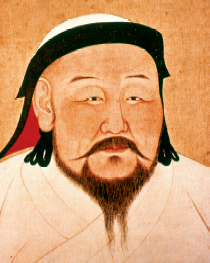
Kublai Khan, emperor of the world’s largest land-based empire
(Granger)
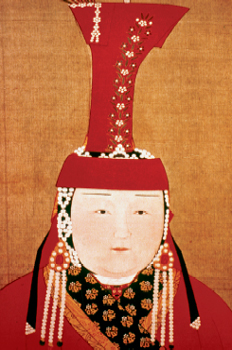
Kublai Khan’s wife Chabi, an influential partner during his reign
(Granger)
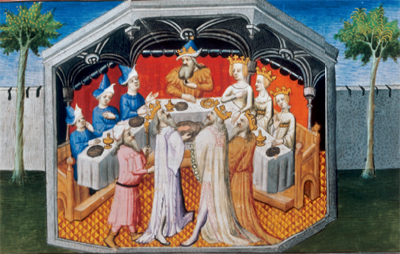
Kublai Khan dining, surrounded by wives and barons
(AKG)
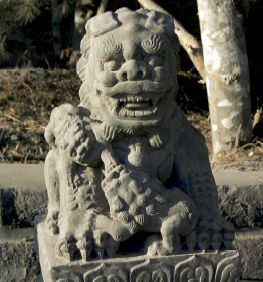
One of the many statues arrayed like supernatural sentries along the Marco Polo Bridge
(Courtesy of the author)
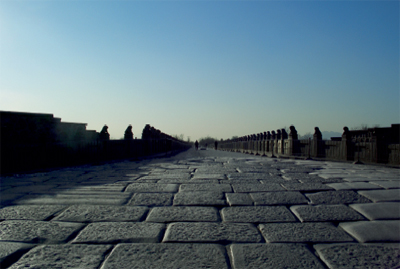
The Marco Polo Bridge, leading from Cambulac (Beijing). The Venetian crossed this impressive stone bridge to begin his journey across China in the service of the khan.
(Courtesy of the author)
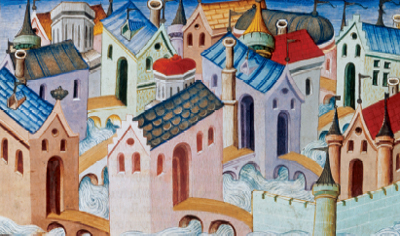
The city of Quinsai (Hangzhou) as depicted in the fifteenth-century Book of Marvels, based on Marco’s lavish description of what was then the largest city in the world
(AKG)
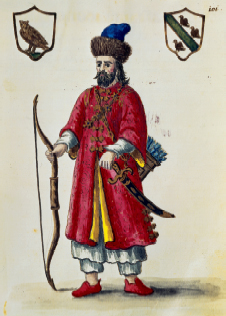
The Venetian traveler dressed in Mongol finery
(Art Resource)
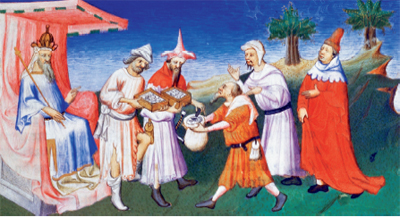
In this illustration from the Book of Marvels, Kublai Khan looks on as his emissaries conduct business using paper money, an innovation unknown in the West at the time of Marco Polo’s journey.
(Imageworks)
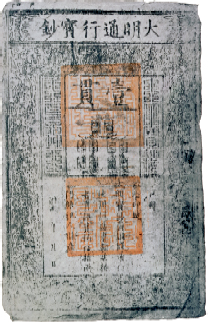
A Chinese banknote
(Bridgeman)
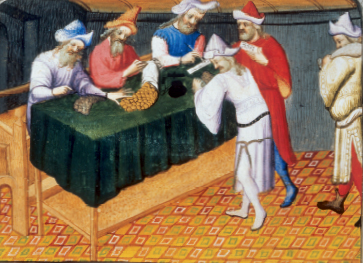
Kublai Khan employed Westerners as tax collectors to administer his empire, and Marco Polo likely found himself in this role.
(AKG)
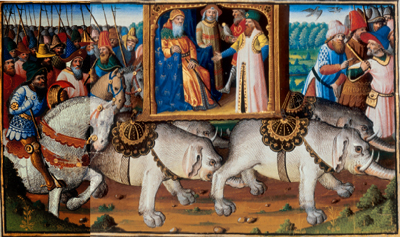
Kublai Khan hunting atop elephants
(AKG)
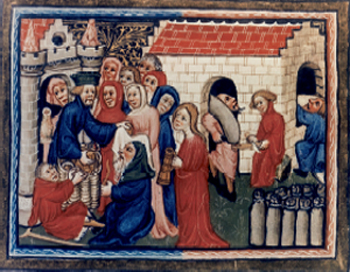
Kublai Khan’s generosity to the poor, as recounted by Marco Polo and portrayed in this illuminated manuscript, impressed Western minds.
(Art Archive)

Silkworms, one of the principal sources of Chinese wealth
(Imageworks)
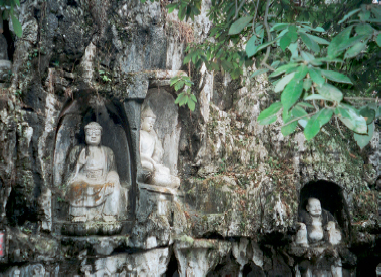
Haunting representations of the Buddha outside Quinsai (Hangzhou) deeply impressed Marco, who had initially dismissed them as idols.
(Courtesy of the author)
Their entire lives were arranged to protect them from any disturbance or violation; otherwise, the girl in question would not be able to marry, or, as Marco puts it, “if the opposite [of virginity] is found, the marriage would not hold.” Since this was a serious legal matter, the interested parties—the father of the bride and the bridegroom—took extreme measures to confirm the girl’s virginity.
“When the bonds and agreements have been duly made,” reports Marco, “the girl is taken for the test of her virtue to the baths, where there will be the mothers and relations of herself and of the spouse, and on behalf of either party certain matrons specially deputed for this duty who will first examine the girl’s virginity with a pigeon’s egg. And if the women on behalf of the bridegroom are not satisfied with such a test, since a woman’s natural parts can well be contracted by medicinal means, one matron will cunningly insert a finger wrapped in fine white linen into the natural parts and will break a little of the virginal vein so that the linen may be a little stained with virginal blood. That blood is of such a nature and strength that it can be removed by no washing from cloth where it is fixed. And if it be removed, it is a sign that she has been defiled, nor is that blood of her proper nature. When the test has been made, if she is found a virgin, the marriage is valid; but if not, not. And the father of the girl will be punished by the government according to the agreement that he has made.
“You ought to know that for the keeping of this virginity, maidens always step so gently as they walk that one foot never goes before the other by more than a finger, because the privy parts of a virgin are very often opened if she take herself along too wantonly.”
Marco notes parenthetically that Mongols “do not care about this sort of convention; for their daughters ride with them, and their wives, whence it may be believed that to some extent they suffer harm”—with none the worse for the disturbance. Clearly, this was a more realistic approach to the issue of virginity.
WHILE IN TUNDINFU, Marco lost a cherished ring, and his attempts to recover it opened his eyes wider than ever before to the possibilities of Buddhism. Here he found “eighty-four idols, each with its own name,” but this time he did not dismiss this form of worship. He faithfully reports that “the idolaters say that an appropriate power has been given to each idol by the supreme God, namely to one for the finding of things lost; to one for the provision of fertility of lands and seasonable weather; to one for the helping of flocks; and with regard to everything.”
Marco naturally felt drawn to the idols capable of locating lost items. Resembling twelve-year-old boys, they were decorated with “beautiful ornaments” and were tended around the clock by an old woman. Anyone seeking to retrieve a lost item, he notes, appealed to this woman, whereupon she advised burning incense. Only then would she speak on behalf of her inanimate charges, saying, “Look in such a place and you shall find it.” If the item was stolen, she would answer, “So-and-so has it. Tell him to give it to you. And if he shall deny, come back to me, for I will make him certainly restore it to you.” And this is what Marco did and heard in pursuit of the lost ring.
He reports that the old woman’s charms, in combination with the idols’ powers, worked wonders beyond the mere retrieval of lost or stolen goods. A woman who refused to return a stolen kitchen knife, for instance, might find that it “cuts off her hand, or [she] falls into the fire, or another misfortune happens to her.” A man might wind up accidentally cutting off his foot with a stolen knife while chopping wood, or breaking his arms and legs. “Because men know by experience that this happens to them because of denials of thefts, they give back what they have stolen immediately.”
To hear Marco tell it, the old woman frequently communicated with the mischievous spirits. They “produce whispering in a sort of thin and low voice like a hissing. Then the old woman [gives] them many thanks in this way: she raises her hands before them, she will gnash her teeth three times, saying something like, ‘Oh, how worthy a thing, how holy, and how virtuous.’ And she will say to him who has lost horses, ‘You may go to such a place and you will find them’ or, ‘Robbers found them in such a place and are leading them away with them in such a direction, run, and you shall find them.’ And it is found exactly as she has said.”
There was a catch: a bounty had to be paid. “When the lost things are found, then men reverently and devoutly offer to the idols perhaps an ell of some fine cloth,” such as silk. This was exactly Marco’s case, and proudly he reports, “I, Marco, found in this way a certain ring of mine that was lost,” and he hastens to add, “not that I made them any offering or homage.”
WHEN MARCO RESUMED his travels throughout southwestern China, adventures awaited him at every turn, more than he could stuff into his comprehensive account. “Do not believe we have treated the whole province of China in order,” he warns his audience at this point in his account, “not indeed a twentieth part; but only as I, Marco, used to cross the province, so the cities that are on the way across are described, passing by those that are at the sides and through the middle, to tell of which would be too long.”
“THIS PROVINCE OF MANZI,™ says Marco, picking up where he left off, “is a very exceedingly strong place. All the cities of the kingdom are surrounded with ditches full of water broad”—the length of a crossbow shot, he estimates—“and deep.” By Manzi, Marco meant the realm of the wealthy and sophisticated Song dynasty, which even Kublai Khan had long avoided, preferring to conquer other, more vulnerable regions of China. But the men of Manzi were not the courageous warriors that Marco, or the Mongols, supposed them to be. In 1268, they scattered before Kublai’s forces, or quietly surrendered “because they were not valiant nor used to arms.”
After the defeat, Marco made it his business to find out exactly how the khan’s men had come to defeat the local king, a supposed tyrant named Facfur, “who took delight in nothing but war and conquest and making himself a great lord.”
In reality, Facfur had little stomach for fighting, preferring peaceful commercial pursuits; he was precisely the kind of enlightened, semi-divine monarch Kublai Khan aspired to be. And for that reason, Facfur was vulnerable to the rapacious Mongol forces. By coincidence, King Facfur’s astrologers had informed him that under no circumstances would he lose his kingdom unless he were attacked by a man “with one hundred eyes.” This prediction had comforted the king, “because he could not think that any natural man could have a hundred eyes.” He was destined to be proven wrong. As it happened, Kublai Khan’s forces included an exceptional officer by the name of Bayan Hundred Eyes, who would prove to be Facfur’s nemesis.
Born in 1236, Bayan was a young man at the time of the campaign. He had joined Kublai Khan’s household as a retainer, and in this capacity he exhibited formidable administrative skills, impressive bearing, and dynamic communication. Bayan was married, but Kublai terminated his marriage and gave him a new, highly placed wife named Besüjin. Profiting from his elevated social status, Bayan quickly rose through the allied Mongol-Chinese ranks, forming alliances with the Confucian faction; in 1260, he joined the military, serving first as an administrator, and then as a commander whose leadership ability favorably impressed his superiors and disarmed potential rivals. A statesman and soldier, Bayan mastered Chinese literary forms, and he dutifully wrote military poetry in honor of the Mongol forces. Kublai Khan bestowed the highest praise on him, confiding to one of his sons, “Bayan combines in his person the talents of a general and of a minister. He is trustworthy in everything.” He concluded, “You must not treat him as an ordinary person.” Bayan had become the indispensable man of the Yüan dynasty.
When Kublai Khan determined that the time was right to attack the Song, he placed Bayan in charge of 200,000 cavalry supplemented by the Chinese infantry, as well as a navy of 5,000 vessels manned by 70,000 sailors. Leading his massive force, Bayan circled one city in southern China after another—five in all—demanding that the people lay down their arms and surrender to the Great Khan, but everywhere he went, he met with stubborn, silent resistance from the resolute Chinese. When he came to the sixth disobedient city, Bayan lost all patience and “took it by force and skill, causing all who were found in it to be killed.” Energized by victory, he led his troops on a campaign of burning and pillaging, taking twelve cities in quick succession. “Then the hearts of the men of Manzi trembled when they heard this news.”
With military control of the entire province, Bayan readied himself for the ultimate conquest, Hangzhou, the richest prize in all of China, or, for that matter, anywhere in the world, and the home of a million and a half people. No other city rivaled Hangzhou for opulence, beauty, or sophistication, or for progressive and generous government.
WITH HIS celebrated concern for the poor and dispossessed and his abundant charity, King Facfur embodied the wealthy city’s altruistic spirit. Exhibiting a newfound appreciation for Facfur, Marco insisted that the good king’s deeds merited a memorial, and that the king’s subjects loved him more than they had loved any previous king of the city, “because of the great mercy and justice of which he was master.”
Facfur championed the cause of children abandoned by their mothers, and he devised an efficient system of welfare and adoption on their behalf. “In that province,” says Marco, “they cast out the child as soon as he is born. The poor women who cannot feed them nor bring them up for poverty do this. The king had them all taken, and caused to be written for each one in what constellation and in what planet he was born. Then he had them brought up in many directions and in many places, for he had nurses in great abundance. When a rich man had no child, he went to the king and had himself given as many as he wished and those who pleased him most.” If an adopted child’s biological parents underwent a change of heart, and wished to have it back, they could, so long as they documented that the child was theirs. Otherwise, the infant remained under the king’s protection until marriage. When the adoptees reached marriageable age, the king performed mass marriages, and generously “gave them [the newlyweds] so much that they could live in comfort.”
Facfur was similarly generous with housing, ensuring that every dwelling, whether it sheltered rich or poor, “was both beautiful and great.” In this beneficent environment, petty crime was unknown, or so Marco claims: “The city was so safe that the doors of the houses and shops and stores full of all the very dear merchandise often stayed open at night as by day and nothing at all was found missing there.” And here, in contrast to so much of the Mongol Empire visited by Marco, “one could go freely through the whole kingdom safe and unmolested by night also by day.”
At the moment, the king and queen of Hangzhou were in residence amid their lavish court, “and there he [Bayan Hundred Eyes] drew up his army in order before it.” Overwhelmed by the might of the Mongol army, Facfur summoned his astrologers to inquire how he could have suffered this overwhelming defeat, and they explained that his adversary bore the name Bayan Hundred Eyes. The prediction had come true.
King Facfur “feared greatly, and he left that city with many people and entered into…a thousand ships loaded with all his goods and wealth and fled into the Ocean Sea, among the impregnable islands of India, leaving the city of Quinsai [Hangzhou] to the care of the queen, with orders to defend herself as well as she could, for, being a woman, she would have no fear of death if she fell into the hands of the enemy.” At that point, to the surprise of everyone, the queen, “who was left in the city with a great people,” displayed her mettle in the face of the Mongol onslaught. She “bestirred herself with her military leaders to defend it as well as she could like the valiant lady she was.”
The queen held her ground until she received a simple but unnerving piece of intelligence from her astrologers: a commander named Hundred Eyes was destined to prevail. When she learned that the general laying siege to the city was known by this name, “her strength failed altogether, for it immediately caused her to remember the aforesaid astrology that said that none but a man with a hundred eyes would take the kingdom from them.” With that revelation, “the queen gave herself up immediately to Bayan. And after the queen surrendered to the Great Khan, and the chief city of the kingdom, all the other cities and villages and all the remainder of the kingdom gave themselves up without mounting any defense.”
She and her husband met with sharply differing fates. “The queen who surrendered to Bayan was taken to the court of Kublai the Great Khan. And when the great lord saw her, he had her honored and waited upon in costly fashion like the great lady she was.” All the while, King Facfur languished in exile on an island off the coast of India until his death, far from the bountiful kingdom he had once ruled with such enlightened generosity.
UNTIL HE encountered Facfur’s example, Marco had embraced Kublai Khan as the ideal ruler. True, Kublai Khan displayed impressive generosity toward the poor late in his life, but Facfur’s passion for social and economic justice far exceeded the Mongol leader’s. A careful reading of Marco’s flattering description of Facfur suggests that Marco flirted with the idea that he, rather than Kublai, was the greater of the two—a judgment based on generosity of spirit rather than military might.
The change in Marco’s thinking reflected his shifting vantage point. When Marco was in Cambulac, Kublai Khan seemed a brilliant sun outshining all other sources of light, but the farther the Venetian ventured to the fringes of the Mongol Empire in performance of his duties as a tax collector, and the more instances of Mongol violence—including the slaughter of women and children—he witnessed or heard about, the more disillusioned he became. At one time, the Mongols had appeared more sympathetic to Marco than their enemies, but as he observed them brutally enforcing their empire’s rule, having himself sampled the refinement of China, a long, slow disillusionment with the Mongols quietly set in. That disillusionment informed his narrative, even as he struggled to maintain his allegiance to the warriors of the Steppe.
IF MARCO’S habitual tendency to gild his experiences appears suspect, he goes beyond the limits of plausibility when he describes how he played a heroic, pivotal role in the siege of the Siang-yang-fu, a “large and splendid city.” At least, that is the way he tells the story. Chinese annals contradict his version. The siege actually occurred in 1273, while Marco was languishing in Afghanistan, recovering from an unspecified illness, two years before he reached the court of Kublai Khan. In the case of the siege of Siang-yang-fu, Marco’s imprecision in converting dates from the Chinese to the European calendar does not account for the discrepancy, nor does the possibility of omitted text, because he emphatically places himself, his father, and his uncle at the center of the action.
According to Marco, Siang-yang-fu held out against the forces of Kublai Khan while much of China surrendered. Protected by a large, deep lake, the city was vulnerable to attack on only one side, the north. While resisting the Mongols, the inhabitants of Siang-yang-fu arranged to have ample provisions smuggled in over the lake; as a result, the Mongols were unable to starve them out. After three years of trying and failing to take the city, the Mongol army was “greatly enraged” and wished to leave.
Marco launches into a series of astonishing assertions, beginning with an offer that he, his father, and his uncle made to assist in the siege. Since describing his departure from Cambulac in the service of the khan, Marco had ceased to mention his father and uncle, creating the impression that he ventured forth alone while they remained close to Cambulac to pursue their trading business. More suspect, the offer to help with the siege violates the underlying premise of the narrative. Previously, Marco observed history in the making but scrupulously avoided portraying himself as affecting the course of events. Now, in contrast, he was presenting the Polos as heroes of the siege. “We will find you a way by which the town will surrender immediately,” they supposedly proclaimed.
Marco claims that the Mongol army accepted the offer and relayed it to Kublai Khan, who endorsed the plan. And he proceeds to show his family out of character, as combat-hardened warriors familiar with the latest Mongol military technology. He depicts the Polo company going to see Kublai Khan—highly unlikely, since the Great Khan was thousands of miles distant—and offering to “find a device and engine that the city would be taken and that it would surrender.” He explains parenthetically that the device was a mangonel, essentially a large and powerful catapult “that would throw into the town stones so great and heavy and from so far that they would confound all they would reach, killing the people and ruining the houses.” In the medieval fashion, Marco refers to the mangonel as an engine, meaning artillery that did not rely on gunpowder. Indeed, the mangonel derived its force from a torsion bundle—a length of rope wrapped around a rotating beam, or epizygis.
At first, Marco says, the Polos’ offer to employ a European-style mangonel baffled the Mongol leaders. “They all wondered greatly because…in all those parts they do not know what mangonels are, nor engines, nor trebuchets [a smaller device relying on a counter-weight rather than a torsion bundle], for they did not use them, nor were accustomed to use them in their armies.” Nevertheless, the Mongols were “very glad and astonished” by the audacious plan.
The technology of which Marco speaks was familiar in Europe; by AD 50, the forces of the Roman Empire deployed similar catapults, known as onagers, to lob rocks over fortress walls; Alexander the Great had also used them in his military campaigns. In medieval Europe, the mangonel served as a mainstay of armies laying siege to fortresses and castles because it could hurl huge stones or fireballs more than a thousand feet, causing considerable damage to otherwise impervious fortress walls. Marco portrays Kublai Khan as eager to use the mangonel in the siege, if only because it was “a new and strange thing.”
The Polo company made preparations with the help of two European assistants (mentioned nowhere else), one identified as a German, the other as a Nestorian, who were “good masters of this work.” Marco claims he ordered them to construct two or three engines capable of throwing large stones, and in only a “few days,” they fashioned three “very great and very fine mangonels according to the orders of the brothers, each of which threw the stones that weigh more than three hundred pounds each, and one saw it fly very far; of which stones there were more than sixty.”
There followed a demonstration of the siege engines for the benefit of Kublai Khan himself, “and others,” who came away mightily impressed. Immediately thereafter, the Great Khan ordered the mangonels “put on boats and carried to his armies, which were at the siege of the city of Siang-yang-fu.” Soon the mangonels were backed up by trebuchets, portable but equally destructive siege engines. Marco alleges, “they seemed to the Tartars the greatest wonder of the world.”
With gusto, he describes the European machinery’s devastating effect on the Chinese fortress. “When the trebuchets were set up before the city of Siang-yang-fu and drawn, each one threw a stone of three hundred pounds into the town. The stone that the mangonel first shot struck into the houses and broke and ruined everything, and made great noise and great tumult.”
Under attack from the strange engines, the inhabitants of Siang-yang-fu panicked. “Every day they threw a very great number of stones, by which many were killed. And when the men of the city saw this misfortune, which they had never seen nor heard [before], they were so dismayed by it and so alarmed that they did not know what they ought to say or do,” Marco gloats, “and they believed that this was done to them by enchantment, for it seemed that the bolts came from the sky.” Surrender became inevitable. “They wished to give themselves up in the way that the other cities…had done, and…were willing to be under the rule of the Great Khan. The lord of the army said he was quite willing for this. And then he received them, and those of the city gave themselves up like other cities.”
Marco boasts about the role that he and his family had supposedly played in the Mongol victory: “And that happened by the kindness of Master Niccolò and Master Maffeo and Master Marco Polo, son of Master Niccolò Polo, as you have heard. This solution…increased the fame and credit of these two Venetian brothers in the sight of the Great Khan and all the court.”
The Mongol victory at Siang-yang-fu remains one of the outstanding tales in Marco’s account, but with its departure from the facts as recorded in Chinese annals, its unusually bellicose tone, and its chronological impossibility, it also remains the episode most open to question. Nevertheless, the military contest did occur, and the annals indicate that the Mongols did, in fact, employ “foreign engineers” to lay siege to the city. Marco, however, could not have been among them. To give Marco his due, it is possible that his father and uncle participated in some phase of the siege on their previous trip. Yet at least three early manuscripts of the Travels fail to mention the siege at all. It seems more likely that this stirring episode was added by Rustichello, seeking to aggrandize the role played by the young tax collector and his elders in the making of the Mongol Empire. Even if the romance writer played false with history, he accomplished his literary aims.
AS MARCO veered back toward the east, heading for Hangzhou, he traveled the rivers of China. Although he was familiar with the sight of the canals of Venice teeming with watercraft, nothing had prepared him for the sight of the immense Qiantang River, as it is known today, “pursuing its course…more than a hundred and twenty days’ journey before it enters the sea, into which river enter infinite other rivers, all navigable, which run in different directions and swell and increase their turns to such a size.” The sheer size of the river—actually an estuary—inspired Marco to state, with accuracy, that it flowed through “so many regions, and there are so many cities upon it,” that watercraft traveling along contained cargo “of greater value” than on “all the rivers of Christendom,” and, on further thought, of greater value than on “all their seas.”
He cites a source for his claim: inspectors who “keep account for their lord” told him that more than five thousand watercraft traveled on the river each year, but he did not simply take their word for it. He asserts: “I tell you that I saw there at one time when I was in the city of Singiu fifteen thousand boats at once that all sail by this river, which is so broad that it does not seem to be a river but a sea.” The number referred to vessels in just one city, as difficult as Europeans would find that to believe.
Marco was particularly attentive to waterborne commerce because, it appeared, “the chief merchandise that is carried upon this river is salt, which the merchants load in this city and carry through whatever regions are upon this river, and also inland.” As a tax assessor, he was doing his job, following the salt, but he also noted that boats did a brisk trade in wood, charcoal, hemp, “and many other different wares with which the regions near the seashore are supplied.” The abundance was enough to overwhelm even the most jaded merchant of Venice.
These boats enthralled him—not just their number, but their variety, and their construction. Patrolling the docks, he took advantage of his position to study their construction and fittings at close range, as if plotting his eventual escape from the Mongol Empire aboard one of them. “They are covered with only one deck and have only one mast with one sail, but they are of great tonnage,” he reports. And he describes their rigging with great detail and expertise: “All the ships have not all the tackle of ropes of hemp, except indeed that they have the masts and the sails rigged with them. But I tell you that they have the hawsers, or, to speak plainly, the tow-lines of nothing else but of canes, with which the ships are towed upstream by this river…. Each of these ships has eight or ten or twelve horses which tow it through the river against the stream, and also with it.”
One day, perhaps, a similar ship might carry him from China to Venice and freedom.