
CHAPTER SIX
In Xanadu did Kubla Khan
A stately pleasure dome decree:
Where Alph, the sacred river, ran
Through caverns measureless to man….
WITH EVERY MILE that Marco Polo traveled along the Silk Road, he became ever more aware of the grandeur of the Mongol Empire, and the mystique surrounding the founder of the Mongol dynasty, Genghis Khan, reviled throughout Europe. Yet he has this to say concerning the ruthless warrior: “Genghis Khan was a man very upright: eloquent, and of great valor and of great wisdom and of great prowess.” Continuing in this boldly revisionist vein, Marco insists: “I tell you that when this man was chosen for king he ruled with such justice and moderation that he was loved by all and reverenced not as lord but almost as God, so that when his good fame spread through many lands, all the Tartars of the world who were scattered through those strange countries willingly held him with reverence and obedience for lord.”
Marco had seen for himself the havoc wreaked by the armies of Genghis Khan in Badakhshan and elsewhere—the cities lying in ruins, the houses burned to their foundations, the displaced populace living in exile while the Mongol invaders fed on their riches and infrastructure. But after three long years on the Silk Road, Marco had to express his hard-won admiration for the founder of the Mongol dynasty. To the young Venetian, only Alexander the Great approached Genghis in accomplishment.
Temüjin—Genghis’s original name—was born in about 1162 into one of Mongolia’s ruling clans, and came of age amid feuding tribes. Rivals poisoned his father, and Temüjin became an orphan at the age of nine. As he matured, he familiarized himself with Mongol military tactics, such as raiding camps and stealing horses. He learned to wield patronage, and recruited allies known as nökhör to join him in his quest for power. To become a nökhör was a serious matter, for it meant renouncing allegiance to all tribes and kin in favor of a chosen leader. In a culture rife with betrayal, Temüjin’s nökhör served him loyally.
By 1206, Temüjin’s success in building alliances and in tribal warfare led to his becoming Ruler of All the Mongols, holding the title Genghis Khan. “Genghis” is said to derive from the Turkic word tengiz, which meant “the ocean,” as if to suggest breadth and depth. And “Khan” simply means “emperor.” A near contemporary, the Persian historian Vassaf al-Hazrat, whose name meant “the court panegyrist,” ecstatically greeted the enthronement of Genghis as the Great Khan: “Ruby-lipped cupbearers poured wine in golden goblets and ravishing young ladies with glossy ringlets stood like statues by the throne of the Khan in tight and slinky dresses. Slaves with tulip cheeks knelt before the throne waiting on the dignitaries who performed the hand-kissing ceremony. A week of blissful feast and immense delight followed thus.”
Genghis came of age amid a stark landscape of grassy Steppe and soaring mountains, frigid lakes, and the arid reaches of the immense Gobi Desert. He was surrounded by herds of cattle, and by sheep, camels, goats, and horses. Twice a year, the nomadic Mongols packed up and moved, on rolling carts by day, resting in portable tents by night, following their herds in search of grass and developing their hunting prowess.
As he matured, Genghis drew strength from his belief that the Mongol sky god, Mönke Tenggeri, had given him the superhuman task of unifying these disparate Mongol tribes and conquering other nations. In conquest, the Mongols acquired the customs of those they had subdued until it became unclear who had the upper hand. Although they were fierce warriors and skilled horsemen, and were brilliantly adaptable, the Mongols were few in number; yet they controlled populations ten, twenty, or thirty times greater. Ultimately the overextended Mongols could not rule their empire for long, but during their brief ascendancy they spread their culture and beliefs far and wide.
Genghis established Tenggerrism—the worship of Heaven—as the official religion of the Mongol Empire and appointed himself its chief representative. For the Mongols, the sky took precedence over all. It was greater than the mountains, greater than the rivers, greater, even, than the Steppe itself. It was life, it was spirit, and it was the source of universal power. Tenggerism was, above all, a unifying credo, inspiring the Mongols to conquer everything under Heaven—which meant, in practice, every corner of the world. In the process of carrying out their mandate, the Mongols became early practitioners of globalization, seeking to connect the entire world. They were conquerors and marauders, but more than that, they were unifiers.
Fired by his elaborate sense of destiny, and emboldened by his genius for military strategy, Genghis pursued a longstanding Mongol aspiration, the conquest of China, the Mongols’ much larger and more powerful neighbor to the south and east. In his insatiable quest for more land to add to his empire, he subdued potential rivals—and there were many—among the Mongols, and built alliances with distant warlords. He then exploited the internal politics of China, playing one clique against another, using a mixture of diplomacy and war. The Chinese, who had seemed invulnerable, quickly fell before Genghis Khan’s cunning generalship. He mastered the art of siege warfare, learning to take cities by any means, no matter how savage. His troops burned or starved out inhabitants. They employed giant slingshots or catapults such as mangonels and trebuchets, capable of hurling stones or flaming naphtha or even diseased corpses over the walls into the midst of terrified city dwellers trapped by their own defenses. “Sometimes they even take the fat of the people they kill and, melting it, throw it onto the houses,” Carpini wrote, “and wherever the fire falls on this fat it is almost inextinguishable”—unless doused with wine, which few victims had the presence of mind to employ. “If it falls on flesh”—an even more horrifying possibility—Carpini calmly advised that “it can be put out by being rubbed with the hand”—a technique that escaped Marco Polo’s notice.
Ill-equipped to repulse the determined Mongol adversaries, China became resigned to the Mongols’ unifying influence and tried to make the best of the inevitable. In words that Genghis would have approved, Vassaf remarked, “As the rumors of his just rule spread to the horizons, the happy people of China and beyond, up to the Egyptian coasts and the far western territories, were honored to submit to his just rule.” The bitterest of ironies informed this assessment.
Genghis Khan knew when to hold his strength in check, and he took pains to respect Chinese customs and religion. Where he was received relatively peacefully, he ordered his generals to proclaim religious freedom and to forbid wholesale slaughter. In the process, the Mongol invaders took on as many traits from the conquered as they imposed. They adopted Chinese dietary practices, clothing, legal procedures, and religious observances.
IN 1227, as his vision of China unified under Mongol rule neared fulfillment, Genghis Khan died at the age of sixty-five, leaving his immense empire to his son Ögödei, along with a trove of lore unique in the world’s literature.
The year after Genghis’s death, a group of Mongol scribes produced The Secret History of the Mongols, an extraordinary compilation of Mongol history, ritual, folklore, and customs recorded in a mixture of Mongol and Uighur tongues. (The Uighurs are a Turkic people dwelling in Central Asia.) There were three to five major revisions of the work between 1228 and 1240, when a final compilation was produced. The original has been lost; an abridged Chinese transcript became the basis of subsequent versions of the Secret History.
Why secret? It contained stories about Genghis that the Mongols preferred to keep private, along with recommendations about governing best left to the powers that be. Even though the Mongols wanted to shield it from outsiders, they were all familiar with its laws and concepts, and among them it was known, simply, as their History.
Written in poetry and prose, the epic emerged from a shamanistic mind-set, connecting Heaven and earth, human and animal. The story begins: “Chinggis”—a more accurate transcription of the Mongol leader’s name, which probably meant “strong”—“Qahan was born with his destiny ordained by Heaven above. He was descended from Boerte Chino, whose name means ‘grayish white wolf,’ and Qo’ ai Maral, the wolf’s spouse, whose name means ‘beautiful doe,’ who crossed the lake and settled at the source of the Onon River.”
The narrative goes on to recount the elemental Mongol way of life, beginning twenty-two generations before Genghis. Of one hardy precursor, the Secret History records: “He saw a young female hawk catch and eat a black pheasant”—just the kind of spectacle Marco Polo later witnessed. “Using the tail hairs of his off-white, mangy-tailed, sore-ridden horse, with the blacked-striped back as a snare, he captured the hawk and reared it. When he was without food, he would lie in wait and kill wild beasts that wolves had cornered at the foot of the cliffs and shoot and kill them. Together with the hawk, he would pick up and eat what the wolves had left behind. So as the year passed, he nourished both his own gullet and the hawk’s.”
At times, the Secret History unfolds as if it were a saga of the American West, with its tales of horse rustling, sharp bargaining, and sudden displays of cunning and heroism, all set in the midst of a primeval landscape. But every incident and topic, from horses to hawking, struck a chord in the Mongol psyche, as the Secret History preserved the lifestyle embodied and codified by the warrior Genghis Khan.
As this collection of tales makes plain, ceaseless conflict shaped Mongol life—at first among siblings, and later among tribes—until Genghis Khan beat his rivals into submission and unified the realm. The Secret History tells of a symbolic battle among Temüjin, as the young Genghis Khan was known, and his half brothers over a “small fish,” a mere minnow. Their “noble mother” ordered, “Desist. Why do you, older and younger brothers, behave in such a way toward one another?…Why do you not work together? You must cease to behave in such a way.”
Temüjin and Qasar, his brother and ally, complained, “Only yesterday we shot down a lark with a horn-tipped arrow and they snatched it away from us. Now they have done the same again. How can we live together?” With that, the boys stomped out of the ger,mounted their horses, and went to avenge the theft, shooting arrows at the brothers who had tormented them. But when they returned, they confronted something far worse: their enraged mother. “You destroyers!” she cried, comparing them to wild animals:
Like the qasar [wild] dog gnawing on its own afterbirth,
like a panther attacking on a rocking mountain,
like a lion unable to control its anger,…
like a gerfalcon attacking its own shadow,…
like a male camel biting the heel of its young,…
thus you have destroyed!
Apart from our shadows, we have no friends.
Apart from our tails, we have no fat.
This last line referred both to the fat-tailed sheep on which they lived, and, by extension, to their kin. Thanks to the harsh discipline administered by his formidable mother, Temüjin eventually learned the lesson of cooperation and emerged as Genghis Khan, who transcended the internecine quarrels that marked Mongol history, and the Mongol psyche, to bring about a heavily guarded peace and stability.
THE MONGOLS believed that Genghis had come to them from the sky, and that after his death he returned to his home in the firmament. But his earthly dynasty continued after him. His grandson Kublai was born in relative obscurity, a circumstance that may have kept him out of harm’s way, and he advanced not because he was the chosen successor to Genghis but because he was cunning and resourceful enough to maneuver his way to the pinnacle of the Mongol hierarchy. No rival posed a greater threat to Kublai than a young khan called Kaidu. Although the two were cousins, Kaidu “never had peace with the Great Khan,” Marco says, and that is an understatement. The reason was simple enough: “Kaidu always demanded of the Great Khan that he wished his share of the conquest they have made.” Kublai replied that he would agree, if Kaidu promised to “go to his court and to his council every time that he should send to see him.” Kaidu refused “because he was afraid that he [Kublai] would have him killed.”
Matters came to a head in 1266, when Kaidu attacked two of Kublai’s barons, Kibai and Kaban, who had converted to Christianity. The opponents fought a tremendous contest involving 200,000 horsemen, with Kaidu emerging as the victor. “He grew in bombast and pride thereby,” Marco says.
Several years later, Kaidu mounted a direct challenge to Kublai, riding with tens of thousands of horsemen to the Mongol capital of Karakorum, where a battle took shape, according to Mongol custom: “When the two sides were on the field drawn up and ready, then they were only waiting till they should hear the drums begin to sound loudly, one on each side.” Once the drums sounded, “then they would sing and play their instruments of two strings very sweetly, and make great sport, waiting always for the battle.”
The opposing sides let loose a hail of arrows, and when they drew closer, pummeled each other with clubs. Marco heard reports from those who had been there that “it was one of the most cruel and evil battles that ever was between Tartars…. The noise of people was so great there and the clash of swords and of the clubs that one did not hear God for the thundering of it.” The battle amounted to a tragic waste of life, “for many men died thereby and many ladies were widows thereby and many children were orphans thereby and many other ladies were forever thereby in mourning and in tears—these were the mothers and the sweethearts of men who died there.”
By the first light of dawn, a weary Kaidu surveyed the bloodied battlefield. Spies brought him troubling news: Kublai Khan was already sending a fresh army “to take and assail him.” Kaidu gathered the exhausted remnants of his forces. “They mounted on horseback and set themselves on the way to return to their country,” recounts Marco. Learning of the retreat, Kublai Khan “let them go quietly.” Kaidu’s army did not stop retreating until it reached Central Asia.
Later, Kublai Khan raged and insisted he would have put the rebellious Kaidu “to an evil death”—wrapped in a carpet and trampled by horses—had they not been blood relatives.
MARCO CASTS the Mongol conquests not as the merciless slaughter of thousands but as a fairy tale about the spontaneous emergence of the Mongol presence from the windswept Steppe: “When Genghis Khan saw that he had so great a multitude of most valiant people, he, being of great heart, wished to come out from those deserts and wild places and arrayed his people with bows and with pikes and with their other arms…. I tell you that so great was the fame of his justice and kindness that wherever he went everyone came to submit himself, and happy was he who was able to be in his favor, so that in very little time they conquered eight provinces.”
In Marco’s telling, Genghis Khan’s conquests were marvels of peaceful subjugation: “When he had gained and taken the provinces and cities and villages by force, he let no one be killed or spoiled after the victory; and he put governors in them of such justice that he did them no harm nor took away from them their things.” Moreover, Marco claims, “These people who were conquered, when they saw that he saved and guarded them against all men and that they had taken no harm from him, and they saw the good rule and kindliness of this lord, they went too gladly with him and were loyal to him.” In this skewed version, their allegiance inspired Genghis to greater feats. “And when Genghis Khan had gathered so great a multitude of people that they covered the world, and saw that they all obeyed him faithfully and followed him, seeing that fortune so favored him, he proposed to himself to attempt greater things: he said to them that he wished to conquer a great part of the world. And the Tartars answered that it pleased them well, and they would follow him gladly wherever he should go.”
MARCO’S PORTRAYAL of Genghis Khan’s glorious rise omits disturbing details of the Mongol leader’s murderous thirst for power in favor of an epic, and unreal, battle between the Mongol warrior and the Christian leader of the East, Prester John. (“Prester” is an archaic word meaning “presbyter,” or priest.) But Genghis’s great rival Prester John did not exist, despite the European conviction that he dwelled in Asia, or perhaps Africa, ruling a magical and wealthy Christian outpost. In fact, the tenacious myth of Prester John originated in the fertile imagination of monks, who composed a letter purportedly written by him and directed toward the forces of Christianity in the West. It contained much to gladden the hearts of Europeans living in fear of the Mongols, including a vow to “take Genghis in person and put him to an evil death.”
Marco himself remained silent on the subject of Prester John’s existence. He did not claim, as he often did of others, to have personal knowledge of the Christian leader. But that gap in his knowledge did not stop him from narrating a mythic battle between the forces of the East and the West—led by Genghis Khan and Prester John. Prester John loses his life in this battle, a development that Marco seems to savor rather than lament—further evidence that the Venetian had come to identify with the Mongols. Which Marco was the real one: the devout Christian on a papal mission, who dismissed all non-Christians as idolaters and worse? The enthusiastic admirer of the Mongols? Each represented a facet of his sensibility. For Marco, Christianity represented the established order, reassuring but also confining; the Mongols, in contrast, signified boldness, magic, and grandeur. For the young traveler, they embodied an intoxicating way of life and belief.
On the subject of Genghis’s grandson Kublai, Marco became rhapsodic, and suddenly leapt ahead of his story. In his estimation, Kublai Khan was simply the greatest leader in history: “All the emperors of the world and all the kings both of Christians and Saracens also, if they were all together, would not have so much power, nor could they do so much as this Kublai Khan could do, who is lord of all the Tartars of this world.”
True, Marco was expressing himself in the medieval tradition of the panegyric, or formal compliment; hyperbole was expected—indeed, required. Yet he could be acid when he wished, even when discussing the high and mighty, from the relative security of a Genoese prison. Rhetoric aside, it is apparent that the prospect of meeting this grand personage could only have filled him with a sense of excitement and high purpose. Everything the Polo company left behind in the West dwindled in importance before the majesty and color of Kublai Khan and his nomadic subjects, who had conquered China against all odds.
“AND SINCE we have begun to speak about the Tartars for you,” says Marco, bursting with enthusiasm, “I will tell you many things of them.” He begins by describing—quite accurately—the basics of their nomadic existence, a way of life akin to that of the Indians of North America, with whom they may have shared ancestry: “The Tartars commonly feed many flocks of cows, mares, and sheep, for which reason they never stay in one place, but retire to live in the winter in plains and in hot places where they have grass in plenty and good pasture for their beasts; and in the summer they move themselves over to live in cold places in the mountains and in valleys where they find water and woods and good pasture for keeping their beasts; and also for this cause, where the place is cold flies are not found nor gnats and suchlike creatures that annoy them and their beasts.”
Marco takes his European readers inside the ger, the portable structure in which the Mongols dwelled: “They have their small houses like tents of rods of wood and cover them with felt; and they are round; and they always carry them on four-wheeled wagons wherever they go. For they have the wooden rods tied so well and orderly that they can fit them together like a pack and spread them, take them up, put them down, and carry them wherever they please. And every time they stretch and set up their house the door always opens toward midday.” These structures constituted, in effect, a portable village, and Marco marvels at the Mongols’ life on the fly: “They have beside this very beautiful carts with only two wheels covered with black felt that is so good and so well-prepared that if it rained all day water would soak nothing that was inside the cart. They have them brought and drawn by horses and by oxen and sometimes by good camels. On these carts they carry their wives and their children and all the things and food that they need. In this way, they go wherever they wish to go, and thus they carry everything that they need.”
Once he grew accustomed to life in a ger, Marco noticed an unusual domestic arrangement. “The ladies buy and sell and do all the work that is needed for their lords and family and for themselves,” he comments approvingly. “They are not burdensome for their husbands, and the reason is that they make much gain by their own work.” The more he observed Mongol women at work, the more he admired their diligence and contribution to family life. They are, he says, “very provident in managing the family and are very careful in preparing food, and do all the other duties of the house with great diligence, so the husbands leave the care of the house to their wives, for they trouble themselves with nothing at all but hunting and feats of battle and hawking and falcons, like gentlemen.”
Marco was instinctively drawn to the Mongols’ method of hunting, designed both to find food and to afford sport on the limitless Steppe. “They have the best falcons in the world”—another slap at Europe, where falconry was recognized as the sport of the aristocracy and falcons were a source of pride to the nobility able to afford them—“and likewise dogs”—all of which allowed the Mongols an abundant supply of food. Marco’s inventory of the Mongols’ foods seems calculated to inspire envy in his European readers, who often hovered on the brink of famine: “They feed on flesh and on milk and on game, and also they eat little animals like rabbits, which are called ‘Pharaoh’s rats’”—in reality, these were a species of rodent akin to the prairie dog. “They eat even the flesh of the horses and of dogs and of mares and oxen and camels, provided that they are fat, and gladly drink camel’s and mare’s milk.” Koumiss, the sour fermented beverage made from mare’s milk, was a staple of the Mongol diet, and a bond between all warriors. Drinking it practically defined the Mongol way of life.
Koumiss is of ancient origin. Writing in the fifth century BC, Herodotus states it was known to the ancient Scythians, nomadic precursors to the Mongols, and it may have derived from the name of another ancient Asian tribe, the Kumanes. The action of two organisms, a yeast and a fungus, converted the carbohydrates in mare’s milk into lactic acid and alcohol.
Marco came to enjoy this beverage, or at least tolerate it. At one point, he declares that the koumiss produced by one Mongol family tasted like white wine. He had no choice but to acquire a taste for it, because the Mongols drank little else; even in winter, when milk was scarce, they combined sour curd with hot water, beat the mixture, and imbibed it.
LIFE AMONG THE MONGOLS, for all its hardships, eventually won Marco’s qualified admiration. Unlike the bawdy wives of Kamul, the Mongol women remained faithful to their husbands. “For nothing in the world would one touch the wife of another,” he proclaims, “for if it happened, they would hold it for an evil thing and exceedingly vile.” He proceeds to extol Mongol marital harmony: “The loyalty of husbands towards the wives is a wonderful thing, and a very noble thing the virtue of those women who if they are ten, or twenty, a peace and inestimable unity is among them.” Instead of bickering, the women busied themselves with “selling and buying,…the life of the house and the care of the family and of the children”—all of which won young Marco’s ringing (and, to Christian ears, stinging) endorsement. “In my judgment they are the women who most in the world deserve to be commended by all for their very great virtue.”
Of course, the underpinning of this remarkable domestic concord was more complicated than Marco’s account initially suggests. The women, he eventually reveals, certainly deserved their “praise for virtue and chastity because the men are allowed to be able to take as many wives as they please, to the very great confusion of Christian women. For when one man has only one wife, in which marriages there ought to be a most singular faith and chastity, or [else] confusion of so great a sacrament of marriage, I am ashamed when I look at the unfaithfulness of the Christian women, [and call] those happy who being a hundred wives to one husband, keep [their virtue] to their own most worthy praise, to the very great shame of all the other women in the world.”
Having performed his investigation, he offers a careful description of the Mongol formula for marital success: “Each [man] can take as many wives as he likes, up to a hundred if he has the power to maintain them; and the men give dowries to the wives and to the mother of their wife to obtain them, nor does the wife give anything to the man for dowry. But you may know too that they always hold the first of their wives for more genuine and for better than the others, and likewise the children who are born of her. And they have more sons than all the other people in the world because they have so many wives, and it is a marvel how many children each man has.” The polygamy extended to relatives. As Marco explains, “They take their cousins for wife and, what is more, if the father dies, his eldest son takes to wife the wife of the father, if she is not his mother, and all the women who are left by the father except his mother and sisters. He takes also the wife of his own brother if he dies. And when they take a wife they make very great weddings and a great gathering of people.”
MONGOLIAN MARITAL and reproductive habits left a lasting mark. Juvaini, the Persian historian, noted: “Of the issue of the race and lineage of Genghis Khan, there are now living in the comfort of wealth and affluence more than 20,000. More than this I will not say…lest the readers of this history should accuse the writer of exaggeration and hyperbole and ask how from the loins of one man there could spring in so short a time so great a progeny.”
According to contemporary genetic researchers, Juvaini did not exaggerate. One in twelve Asian men—that is, one in every two hundred men worldwide—carries a Y chromosome originating in Mongolia at the time of Genghis Khan. Geneticists believe that Genghis Khan’s soldiers spread that chromosome as they raped and pillaged their way across Asia, replacing the DNA of the men they slaughtered with their own, by way of the children they sired. Some scientists have suggested that the Y chromosome persisting to this day came from Genghis Khan himself. (When a sperm’s DNA joins with that of an egg, the Y chromosome exchanges almost no genetic material with its partner, the X chromosome, and remains largely free of mutations.) A group of Oxford University researchers evaluated genetic markers in men across Asia; 8 percent of those studied were virtually identical, meaning that the individuals were closely related, even though they lived thousands of miles apart. The geneticists concluded that the 8 percent were direct descendants of Genghis Khan. When the results of the study were published, the popular press, echoing Juvaini, took to calling Genghis Khan the greatest—or, to be more accurate, most prolific—lover in history.

MARCO POLO became so enamored of the Mongols that he described their shamanistic beliefs with genuine appreciation rather than the disdain he reserved for most unfamiliar religious practices. He begins reassuringly: “They say that there is the high, sublime, and heavenly God of whom every day with censer and incense they ask nothing else but good understanding and health.” He concedes that they worshipped idols, but says they devoted special attention to one god in particular, whom they called Natigai, a “god of the land who protects and cares for their wives and their sons and their corn.”
Marco departed from his longstanding skepticism to study this worship of the idols. In his rendition, it bears an uncanny resemblance to Christian rites: “Each has in his house a statue hung on the wall of a room that represents the high and sublime god of heaven, or only a tablet set high on the wall of his room with the name of the god written there. Here every day with the thurible of incense they worship thus and lift up the hands on high, and at the same time gnashing thrice their teeth they ask him to give them long life, happy and cheerful, good understanding and health, and they ask him nothing more. Then also down on the ground they have another statue called Natigai, god of earthly matters…. With this god is his wife and children; and they worship him in the same way with the thurible and gnashing the teeth and lifting the hands, and of this one they ask temperate weather and fruits of the earth, children, and similar things.”
In one important way, Mongol belief differed sharply from Christianity: “They have no consciousness and care of the soul, but are only devoted to nourishing the body and getting pleasure for themselves.” Yet the Mongols did have their version of the soul. Marco writes that “they hold [it] to be immortal in this way. They think that when a man dies he enters immediately into another body, and, according as in life he had borne himself well or ill, going on from good to better or from bad to worse; that is to say, if he shall be a poor man and if he have borne himself well and modestly in life, he will be born again after death of the womb of a gentlewoman and will be a gentleman, and then of the womb of a lady and will be a lord; if he is the son of a knight and in life have borne himself well, at death he is born again of the womb of a countess…, and so always ascending until he is taken into God. On the contrary, if he shall have behaved ill, being the son of a gentleman he will be born again a son of a rustic, from a rustic he is made into a dog, always descending to lower life.” By the end of this careful, respectful, and intimate description of Mongol worship, it is easy to imagine Marco swept along in the spiritual tide.
Although alert to their religious practices, Marco remained oblivious to the larger spiritual world of the Mongols, in which the figure of Natigai intervened between hearth and home and immense cosmic forces. The Mongols viewed their deities arrayed in a floating hierarchy. Over all hovered the supreme divinity, the Eternal Blue Sky, and just below that a pantheon of ninety-nine divinities, one of which was Marco’s Natigai, the protector of women, of cattle, and of harvests.
With his description of Mongol religious beliefs, Marco set out to demolish the tenacious European image of the murderous Mongol savage. All wrong, according to Marco. Instead, he reports, “They speak prettily and ornately, they greet becomingly with cheerful and smiling face, they behave with dignity and cleanliness in eating”—if not in washing. “They bear great reverence to the father and mother. If it is found that any son does anything to displease them, or does not help them in their need, there is a public office that has no other office but to punish severely ungrateful sons whom they know have committed some act of ingratitude toward them.” With such measures, Mongol society enforced its stability. Although Marco stopped short of endorsing the concept of a designated official to discipline ungrateful offspring, he looked on approvingly.
SO MUCH for piety. In reality, nothing excited Marco’s admiration more than the Mongol warrior. Feared throughout the world, his kind specialized in horsemanship, rape, and destruction. The warriors seemed a glamorous and dangerous outlaw tribe, fiercely devoted to one another, consecrating their destiny to the pursuit of power. They lived strenuously and obeyed no one’s laws but their own defiant code. To the genteel Marco, it seemed that they were more in touch with the forces of nature than their refined Chinese subjects. No wonder he fell under their sway.
His adulation overwhelmed the formal literary veneer applied by Rustichello. “The rich men and nobles wear cloth of gold and cloth of silk and under the outer garments rich furs of sable and ermine and vair [that is, variegated fur] and of fox and of all other skins very richly; and all their trappings and fur-lined robes are very beautiful and of great value,” Marco tells his audience. “And their arms are bows and arrows and very good swords studded with iron, and some lances and axes, but they avail themselves of bows more than of any other thing, for they are exceedingly good archers, the best in the world, and depend much from childhood upon arrows. And on their backs they wear armor made of buffalo hide and of other animals very thick, and they are of boiled hides that are very hard and strong. They are good men and victorious in battle and mightily valiant and they are very furious and have little care for their life, which they put to every risk without any regard.” Europeans trembled at the thought of these warriors; Marco Polo came so close to them he could see the glint in their eyes and smell their breath reeking of koumiss, and he became intoxicated.
Vastly outnumbered by those whom they sought to conquer, lacking a common religion or common tongue, the Mongols subjugated the entire Asian continent. It seemed impossible that they had accomplished this task, yet they had, within only a few years. For Marco, the reasons were written in the Mongols’ wholehearted commitment to the warrior’s life. These men, motivated by the single-minded desire to serve their lord at all times, seemed tougher and more resilient than their European counterparts. Their philosophy of conquest was simple and stark: all war, all the time. Everyone participated in the effort. “There was no such thing as a civilian,” notes the historian David Morgan. Mongol forces drew from every stratum of society. In the words of Juvaini, the Mongol military was a “peasantry in the dress of an army, of which, in time of need, all, from small to great, from those of high to those of low estate, are swordsmen, archers or spearmen.”
This concentration of purpose deeply impressed Marco. “When the army goes out for war,” he observes, “more bravely than the rest of the world do they submit to hardships, and often when he has need he will go or will stay a whole month without carrying any common food except that he will live on the milk of a mare and the flesh of the chase, which they take with their bows.” When necessary, “they stay two days and two nights on horseback without dismounting.”
He concludes his description with unabashed hero worship: “They are those people who most in the world bear work and great hardship and are content with little food, and who are for this reason suited best to conquer cities, lands, and kingdoms.” This hard but vital way of life was power incarnate, it was freedom, it was everything the young traveler desired.
As Marco repeatedly states, the size of the Mongol armies was staggering. “When a lord of the Tartars goes to war he takes with him an army of a hundred thousand horsemen”—an unheard-of number in Europe. Despite its size, the Mongol equestrian army followed remarkably simple principles of organization. The lord, or general, “makes a chief to every ten, and to every hundred, and to every thousand, and to every ten thousand, so that the chief lord has to take counsel with only ten men.” So it went up and down the chain of command, each chief reporting on the actions of his ten underlings to the one chief above him. Under this system, the Mongols could launch an attack of an appropriate size on a plain, on a mountain, or in a valley; they even had a sophisticated network of spies who scouted remote roads and valleys before the army passed through, and in that way, “the army cannot be attacked from any side without knowing it.”
And there were still more Mongol survival techniques to which Marco became privy. “They live at most times on milk,” he reports, “and of horses and mares there are about eighteen for each man, and when any horse is tired by the road another is taken in exchange. They carry no food but one or two bags of leather in which they put the milk that they drink, and carry each a small pignate, that is, an earthen pot, in which they cook their meat.” If they cannot take meat with them, he says, they kill animals as they go, then “take out the belly and empty it and then fill it with water; and then take the flesh which they wish to cook and cut it into pieces and put it inside this belly so filled with water, and then put it over the fire and let it cook, and when it is cooked they eat the flesh, cauldron and all.”
Adhering to this strenuous, frugal lifestyle, Mongol warriors could go for days without eating cooked food or even lighting a fire. For sustenance, “they live on the blood of their horses; for each pricks the vein of his horse and puts his mouth to the vein and drinks of the blood till he is satisfied.” They found other extraordinary uses for the blood of their horses. “They carry the blood with them, and when they wish to eat they…put some of it in water and leave it to dissolve, and then they drink it. And in the same way they have their dried mare’s milk, too, which is solid like paste. It is dried in this way. They boil the milk, and then the cream which floats on top is put in another vessel, and of that, butter is made; because as long as it stays in the milk it could not be dried. Then the milk is put in the sun, and so it is dried. And when they go to war they carry about ten pounds of milk…in a little leather flask.” Mixed with a little water, “this is their breakfast.”
When circumstances permitted, Mongol cuisine featured more variety and subtlety than a warrior’s regime might suggest. Traditional recipes of this period included a medicinal concoction, Borbi Soup (“Reduce thirty or so sheep bones in one bucket of water until it is one-fourth the original amount of water, strain, skim oil from the surface, remove sediment, and eat as much as desired.”); Russian Olive Soup (“Trim and cut up one leg of mutton, add five cardamoms, and shelled chickpeas. Boil, strain, add Russian olives, sliced sheep thorax, and Chinese cabbage or nettle leaf.”); and Butter Skin Yuqba (“Finely cut mutton, sheep’s fat, sheep’s tail, Mandarin orange peel, and sprouting ginger. Add salt, sauce, and spices. Mix everything uniformly. To make skins, blend vegetable oil, rice flour, and white wheat flour.”). Revealing a Turkish influence, noodles had entered the Mongol diet, often in combination with mutton, egg, sprouting ginger, sheep intestines, and mushrooms, the whole served in a clear broth seasoned with pepper, salt, and vinegar. Marco would not have been surprised to encounter noodles in Mongolia; long before his journey, this type of food had spread from Turkey along the Silk Road in both directions. Contrary to myth, Marco Polo did not introduce noodles to Italy; his anonymous predecessors had.
MARCO ACKNOWLEDGED the Mongols as masters of military strategy—on land if not at sea—not because they were brutal, but because they were subtly strategic. It came as a surprise to many Chinese and Europeans to learn that when the Mongols “come to battle with their enemies, in the field they defeat them as much by flight as by pursuit.” The Mongols were not ashamed to be seen fleeing battle, but then they lured their adversaries into a culvert or onto a cliff where they closed in for the kill, felling them with the arrows they had saved for this moment. “When the enemy believe they have discomfited and conquered them [the Mongols] by putting them to flight,” Marco writes, the warriors of the Steppe regroup and let fly arrows tipped with lethal poison, killing the enemy’s horses. At this point the Mongols double back on their befuddled, exhausted adversaries to slaughter them.
Yet even as he wrote, Marco noted with regret that the purity of Mongol warrior life was passing—“now they are much debased”—undermined by the influence of “the customs of the idolaters,” presumably Buddhists, whose influence was spreading rapidly through the region, and by Islam, also spreading quickly.
No matter what the opponents’ faith, Mongol justice was swift, savage, and systematic. “If a man strikes with steel or with a sword, whether he hits or not, or threatens one, he loses his hand,” Marco observes. “He who wounds must receive a like wound from the wounded.” A petty thief received a beating for his transgression, “at least seven blows with a rod, or, if he has stolen two things, seventeen blows, or if three things, twenty-seven blows,” and so on by increments of ten blows. “And many of them die of this beating.” Anyone daring to steal a horse—the Mongols took care to brand them—or, for that matter, an ox, would inevitably die of all the blows he received in punishment, so to shorten the process, the malefactor was cut in two with a sword.
Clemency—what little of it there was—took a mercenary form. If a horse thief could afford to make ninefold restitution for his crime, he escaped with his life, if not his honor.
ONE MONGOL custom in particular astounded Marco: the marriage of dead children. He took pains to explain the elaborate rites to Europeans likely to dismiss them as grotesque fantasy. “When there are two men, the one who has a dead male child inquires for another man who may have had a female child suited to him, and she also may be dead before she is married; these two parents make a marriage of the two dead together. They give the dead girl to the dead boy for wife, and they have documents made about it in corroboration of the dowry and marriage.”
When such a ceremony was complete, a necromancer—a shaman or magician who communicated with the dead—burned the documents, with the smoke announcing to the spirits of the dead the marriage of these two deceased children. A marriage feast ensued. Later, the families fashioned images of the dead newlyweds, placed them on a horse-drawn cart adorned with flowers, and paraded them throughout the land, until, when they were done feasting, they consigned the images to the flames, “with great prayer and supplication to the gods that they make that marriage known in the other world with happiness.”
The two families bound by the marriage of their dead children exchanged gifts, even a dowry, as if bride and groom walked among them, erasing the boundary between life and death. Afterward, “the parents and kinsmen of the dead count themselves as kindred and keep up their relation…as if their dead children were alive.”
But Marco is only warming to his theme, and he has something “really marvelous to put into writing.” How could anything outdo the wonders he has already described? He has his answer ready: “We shall speak of the rule of the Great Khan and of his court, which in my judgment I hold, having searched out and seen many parts of the world, that no other dominion can be compared to.” Not only that, but “I shall bind myself for certain not to say of it more than is according to the truth.”
MARCO SPEAKS breathlessly of the “very wild” Mecrit people, nomads who domesticated and rode deer as large as horses; he enthuses over the kingdom of Ergiuul, with its “three races: there are some Turks and many Nestorian Christians, and idolaters [Buddhists] and some Saracens who worship by the law of Mahomet.” Discussing the province of Sinju, he waxes rhapsodic over the oxen and cows “as large as elephants” that were “very beautiful to see, for they were all hairy except the back, and are white and black.” Their wool, “more fine than silk” so impressed him that, he says, “I, Marco Polo, brought some of it here to Venice as a wonderful thing, and so it was counted such by all.” Not only that, but the region “produced the best musk…in the world.”
He was not alone in his fascination with musk; it was fabled throughout Europe as an ingredient in perfumes, aphrodisiacs, and potions of all kinds. Now Marco learned that the magical substance was actually obtained from an egg-sized abdominal gland of the male musk deer. He speaks of the musk he discovered in a “wild animal” resembling a gazelle. “The animal,” he advises, “has deer’s hair,” but much thicker, feet as large as a gazelle’s, and a tail like a gazelle’s, “but it has four teeth, two below and two above, which are three fingers long and are very thin, and white as ivory, and go two upward and two downward.” The Mongols, he notes, call the animals gudderi.
The secretion itself was reddish brown, with the consistency of honey, and a penetrating odor celebrated as a sexual lure. Marco precisely describes the Mongol method for obtaining musk: “The hunters sally forth at the full of the moon to catch the said animals; for when one has taken it he finds on it at the navel in the middle under the belly between the skin and the flesh a pustule of blood”—said to grow under the influence of the full moon—“which one cuts off with the whole skin and takes it out, and they dry in the sun. The blood is the musk from which comes so great an odor.”
The musk gazelle so intrigued Marco that years later he returned to Venice bearing “the head and feet of one of the animals, dried, and some musk in the musk sac, and pairs of little teeth.” The trophy served as a poignant reminder of the rich experiences in his past, but one that he could, with effort, re-create for his listeners from memory in his jail cell in Genoa.
About the region’s people, Marco had decidedly mixed feelings; he seems to change his mind even as he speaks of them. They had small noses and black hair, and the men sported no beards, only a few chin hairs. The women were very fair, “well-made in all respects,” with no hair anywhere, “except on the top of the head.” Although he considered himself a worldly fellow, he was both fascinated and repulsed to discover that the men “delight themselves much in the sensuality and take wives enough, because their religion…does not hinder them, but they take as many as they can.” Moreover, he says, “I tell you that the men seek beautiful wives rather than noble, for if there is a very comely and fair woman, and she is of low descent, yet a great baron or great man takes her to wife for her beauty and gives silver enough to her father and mother as they have agreed.” Marco may have been thinking how such payments resembled Venetian dowries, which also transformed matrimony into a commercial transaction and a political alliance between families.
MOVING EAST, Marco Polo came to “the province of Tenduc,” which he erroneously considered to be the former domain of the mythical Prester John. Relying on legends rather than facts, he explains that while the “greater part [of the inhabitants] are Christians,” there are also people of mixed race (by which he means the offspring of parents of different faiths, or cultures). These people, known as argon, are “idolaters,” presumably Buddhists and Muslims. Despite their mixed lineage, they, too, earn Marco’s admiration: “They are the whitest men of the country and fine men more than the others of the country who are infidels, and more clever and better traders than can be found elsewhere in any province.”
Marco stretches still further when he identifies the seat of Prester John as the “place which we call on this side in our country Gog and Magog”—a far-fetched but, to Marco, credible reference to the biblical despot Gog, who ruled the land of Magog.
At this point in his narrative, Marco became hopelessly entangled in legends and fragments of ancient history. The usually reliable narrator of personal experience relied all too heavily on half-remembered histories and legends.
WHEN HE TURNED from history to hawking, Marco resumed his characteristic vigor and accuracy as an enthusiastic witness to his times. Hawking served as the sport of choice for both European and Mongol nobility, and Marco grasped its grandeur and status. Kublai Khan, he wanted his audience to know, visited this region each year to hunt. “He hawks with gerfalcons, and with falcons,” Marco writes, “and takes birds enough with great joy and great festivity.”
The Great Khan established himself during hunting season in a settlement of “several little houses made of wood and stone, where they stay the night, in which he has a very great number of cators, which in our language we call partridges, and quail kept.” Moreover, “for their food, the Great Khan always has millet…and other seeds that such birds like sown over those hillsides in summer, commanding that none shall be reaped so that they may be able to feed themselves abundantly.”
Kublai Khan’s hunting camp, for all its rustic pleasures, served merely as a summer retreat. Three days’ journey over the Steppe brought the Mongol ruler to his celebrated summer palace, Shang-tu—or Xanadu, as it became known in Samuel Taylor Coleridge’s phantasmagoric poem “Kubla Khan.”
DESPITE THE fantastic attributes for which it is known in the West, Xanadu was a real place, as solid as the ground underfoot, and Marco Polo came to know it well. “In this city,” he tells his readers, “Kublai Khan made a vast palace of marble cunningly worked and of other fair stone.” Here Marco beheld the sights whose mere description would inflame Coleridge’s opium-besotted cortex.
Marco writes: “The halls and rooms and passages are all gilded and wonderfully painted within with pictures and images of beasts and birds and trees and flowers and many kinds of things, so well and so cunningly that it is a delight and wonder to see. From this palace is built a second wall which in the direction opposite to the palace, closing one end in the wall of the city on one side and the other on the other side, encloses sixteen miles of land. It is fortified like a castle in which are fountains and rivers of running water and very beautiful lawns and groves.”
These elysian fields contained the splendid royal zoo. “The Great Khan keeps all sorts of beasts there, that is, harts and bucks and roe-deer, and has them given to the falcons and gerfalcons, which he keeps in a mew. He does that often for his pleasure and amusement. In the middle of the park where there is a most beautiful grove, the Great Khan”—still envisioned only at a distance, not yet seen directly, but his presence becoming more deeply felt with every passing mile—“has made for his dwelling a great palace or loggia that is all of canes [that is, bamboo]…and on top of each pillar is a great dragon all gilded that winds the tail round the pillar and holds up the ceiling with the head, and stretches out the arms, one to the right for the support of the ceiling with the head, and the other in the same way to the left…. The roof of this palace is also all of canes gilded and varnished so well and so thickly that no water can hurt it, and the paintings can never be washed out; and it is the most wonderful thing in the world to be understood by one who has not seen it.”
His powers of observation sharpening, Marco describes this marvel of Mongol engineering, the edifice that Coleridge memorialized about five hundred years later as Kublai Khan’s “stately pleasure dome.” “The canes from which these dwellings are made are more than three or four palms thick and are from ten to fifteen paces long. One cuts them across in half at the knot, from one knot to the other, and splits them through the middle lengthwise, and then a tile is made. Of these canes that are so thick and large are made pillars, beams, and partitions, [so] that one can roof a whole house with them and do all from the beginning. This palace of the Great Khan, of which I have spoken, was made entirely from canes. Each tile of cane is fixed with nails for protection from the winds, and they make those canes so well set together and joined that they protect the house from rain and send the water downward.”
Still more amazing, the entire elaborate structure was collapsible and portable, just like the modest gers in which the nomadic Mongols dwelled. This was, after all, a nomadic culture, on all levels. Marco goes on: “The Great Khan has made it so arranged that he might have it easily taken away and easily set up, put together and taken to pieces, without any harm whenever he wished, for when it is raised and put together more than two hundred very strong ropes of silk held it up in the manner of tents all round about, because, owing to the lightness of the canes, it would be thrown to the ground by the wind.
“And I tell you the Great Khan stays there in that park three months of the year, this is June and July and August, sometimes in the marble palace, and sometimes in the one of cane. The reason he stays there is that he may escape the burning heat, for the air is very temperate and good, and it is not very hot, but very fresh.” Although Marco’s language sounds wonderfully imaginative, and European audiences read it as a beguiling fantasy, his description derived from observation.
KUBLAI KHAN seemed to be a law unto himself, feared and omnipotent, capable of dazzling everyone in his realm, but he depended on soothsayers for important decisions. Marco reports: “When the Great Khan was staying in this palace, and there was rain or fog or bad weather, he had wise astrologers with him and wise charmers who go up on the roof of the palace where the Great Khan dwells when any storm cloud or rain or mist rose in the air, and by their knowledge and incantation dispose of all the clouds and rain and all the bad weather, while everywhere else the bad weather went on.”
On second glance, Marco noticed there were actually two types of astrologers in the court, those from “Tebet” and others from “Chescemir” (presumably in present-day Pakistan), who were practitioners of black magic, and, it appeared, cunning manipulators of Kublai Khan. “They know devilish arts and enchantments more than all other men and control the devils,” Marco says, “so that I do not believe there are greater charmers in the world…. They do it all by devil’s art and make the others believe that they do it by their goodness and great holiness and by God’s work.” As if to announce their base character, “they go filthy and unclean, not caring for their own honor, nor for the persons who see them; they keep mud on their faces, nor ever wash nor comb themselves, but always go dirtily.”
The astrologers from Chescimir—“this most evil race of necromancers and charmers”—were, in short, repugnant.
To demonstrate their malevolence, Marco relates a story certain to horrify his listeners: “When they know that a man is condemned to death for ill that he has done and is killed by the government of the land, that condemned man is given to them and they take him and eat him; but if he were to die of his own natural death, they [would] never eat him for anything in the world.”
Photo Insert 1
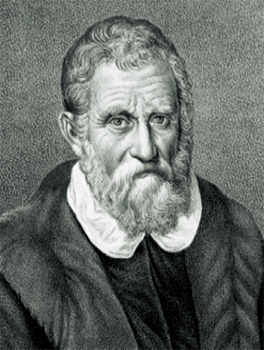
Marco Polo: a traditional portrait
(Corbis)
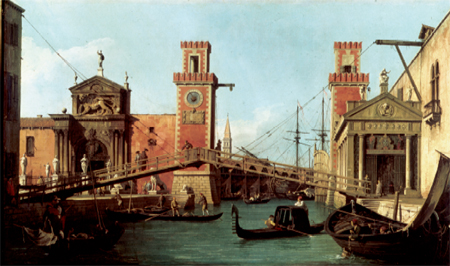
The entrance to the Venetian Arsenale, by Canaletto (1732). Here the Republic mass-produced warships.
(Art Resource)
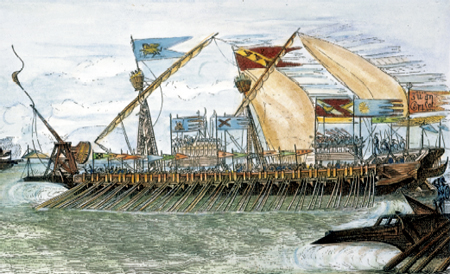
Marco Polo commanded a Venetian galley similar to this in the Battle of Curzola.
(Granger)
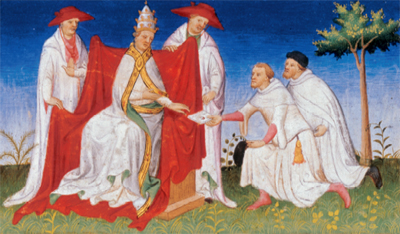
Pope Gregory X gives a diplomatic letter to Niccolò and Maffeo Polo.
(AKG)
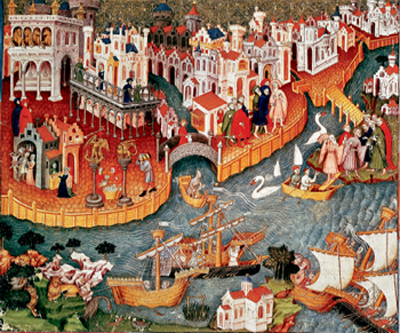
The departure of Marco Polo from Venice in 1271 depicted in a fifteenth-century illuminated manuscript.
(Imageworks)
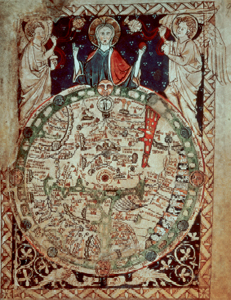
The Psalter map of the world from Marco Polo’s era
(Bridgeman)
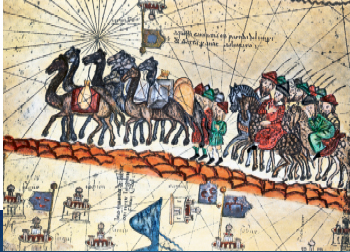
A detail from the influential Catalan Atlas (1375) depicts the Polo company on their travels.
(Corbis)
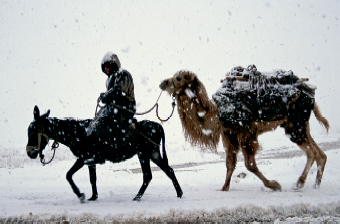
In our own time as well as in Marco Polo’s, travel on the Silk Road entailed months of hardship and grueling conditions.
(Yamashita)
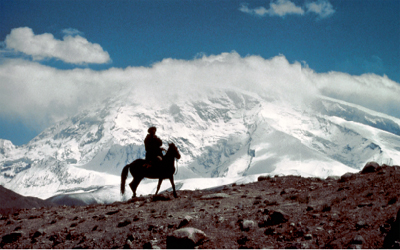
The Pamir, also known as the “Roof of the World.” Marco said the air was so thin that no birds flew.
(Corbis)
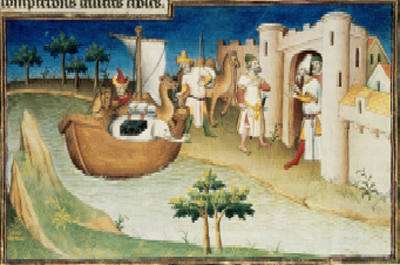
Marco Polo arrives in Hormuz, near the beginning of his journey.
(Art Resource)

The rugged Taklimakan Desert, which contained the most challenging routes of the Silk Road. The name is said to mean “Those who enter do not return.”
(Corbis)
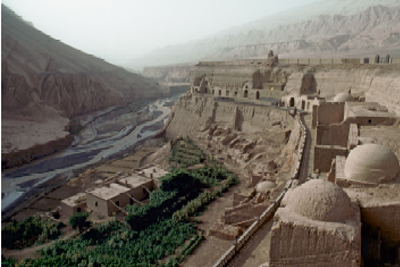
A Buddhist retreat along a remote stretch of the Silk Road in the Gobi Desert. After repeated exposure to Buddhism, Marco gradually came to appreciate its philosophy.
(National Geographic Society)
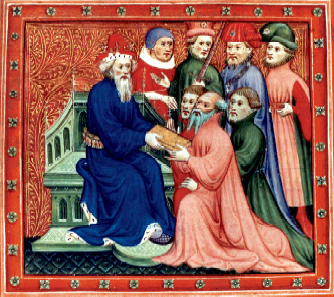
On bended knee, Niccolò and Maffeo Polo offer a papal letter to Kublai Khan.
(Imageworks)
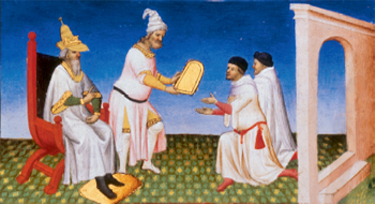
Kublai Khan bestows the paiza, a passport permitting travel throughout the Mongol empire, on the Polos.
(AKG)
To demonstrate the full extent of their devilish powers, Marco spins a yarn that has transfixed listeners over the centuries: “When the Great Khan sits at dinner or at supper in his chief hall, at his great table, which is more than eight cubits high, and the golden drinking cups are on a table in the middle of the pavement on the other side of the hall ten paces away from the table and are full of wine and milk and other good drinks, then these wise charmers…do so much by their enchantments and by their arts that those full cups are lifted of themselves from the pavement where they were and go away by themselves alone through the air to be presented before the Great Khan, without anyone touching them.
“And when he has drunk, the cups go back to the place they set out.” In case his listeners doubt this report, Marco insists that the exhibition took place in full view of the court: “They do this sometimes while ten thousand men look on, and in the presence of whomsoever the lord wishes to see it; and this is most true and trustworthy with no lie, for it is done at the table of the lord every day.”
Marco reported the occurrence as if he had observed it himself. Perhaps his enthusiasm overwhelmed his common sense in this instance, or perhaps the charmers had temporarily managed to bewitch his senses, along with everyone else’s.
AMONG ALL THE sights at the summer palace, nothing matched Kublai Khan’s huge albino herds. “This lord has a breed of white horses and of mares white as snow without any other color, and they are a vast number”—more than ten thousand in the herd, according to Marco—as well as an equally impressive number of “very white cows.” The milk supplied by these ethereal white mares and cows was considered so precious that “no one in the world dares drink of it except the Great Khan and his descendants,” with the exception of “another race of that people of that region that are called Horiat.” Long ago, says Marco, Genghis Khan accorded the Horiat that privilege “as a reward for a very great victory that they won with him to his honor.” As a result, “he wished that they and all their descendants should love and should be fed on the same food on which the Great Khan and those of his blood were fed. And so only those two families live on the aforementioned white animals, and on the milk obtained from them.”
Everyone else accorded special respect to the noble white beasts. Marco continues: “When these white animals go grazing through the meadows and forests and pass by some road where a man wishes to pass, one does them so great a reverence that if, I do not mean only the ordinary people but a great lord and baron were to see them passing there he would not dare for anything in the world to pass through the middle of these animals, but would wait till they were all passed, or would go so far forward in another direction, half a day’s journey, that he would have passed them.”
For the Mongols, the beasts had magical properties: “The astrologers have told the Great Khan that he must sprinkle some of this milk of these white mares through the air and on the land on the twenty-eighth day of the moon of August each year so that all the spirits that go by air and by land may have some of it to drink as they please.” Once they do, “all his [the khan’s] things may prosper, both men and women, and beasts and birds, and corn, and all other things that grow.”
The worship of the white mares and their milk was commemorated in an annual festival, which took place on the day of the khan’s departure from the summer palace, August 28. “On the day of the festival,” Marco reports, “milk is prepared in great quantity in honorable vessels, and the king with his own hands pours much of the milk here and there to honor the gods. The astrologers drink the milk thus poured out.” Having drunk deeply of the koumiss, king and court would fall into a drunken stupor.
FOLLOWING the feast came the sober departure from Xanadu and the disassembly of the summer palace. Marco says that Kublai Khan “has so planned it that he can make it and take it to pieces at his will very quickly; and it is all packed by pieces and is carried very easily where the lord commands.” With that, the nomads took their leave.
The notion of a collapsible, portable summer palace made of bamboo or any another light, durable material that could be quickly dismantled and packed up and moved like so much furniture struck Europeans as improbable, yet it was just as Marco described. He only seemed to be living among primitive heathen warriors; in reality, he had found his way into a confluence of civilizations several centuries advanced over Western Europe. How to explain them all to his skeptical audience? Making the future credible exceeded even Marco’s patience and powers of persuasion.
TRAVELING all this distance had proved extremely difficult, dangerous, and time-consuming for the Polos, and they felt secure in the khan’s all-encompassing embrace. In time, they would realize that they had wandered unintentionally into a trap as large as Asia, but a trap nonetheless. Kublai Khan presented himself as an invulnerable emperor, practically a deity, but he was, in fact, a vain and vulnerable despot, and the Polo company’s position within his empire was correspondingly precarious. Depending on his goodwill for their personal safety, they could neither renounce him nor flee him, not if they ever wanted to see Venice again. And if anything happened to him, they would be at the mercy of his enemies.
For the moment, Marco was too dazzled by his proximity to the most powerful ruler in the world to be concerned, for he had reached the heart of his story. “I will now tell you,” he promises, “the truly amazing facts about the greatest lord of the lords of all the Tartars, the right noble khan whose name is Kublai.”
FROM HIS privileged standpoint, Marco Polo urged his audience, Venetians especially, to study Kublai Khan’s example of empire-building. His lengthy account can be read as a consideration of the question of how best to rule an empire, and in this way, it is the medieval equivalent of another Italian analysis of statecraft, The Prince, by Machiavelli. Marco found in Kublai Khan a master practitioner of the art—part warrior, part despot, and part sage. To the Venetian, Kublai Khan was a flesh-and-blood person, but also a towering figure on the order of Alexander the Great, a ruler capable of transforming the world and history itself. Kublai Khan was power personified—military, sexual, and spiritual.
“The people remain humble, quiet, and calm for half a mile round the place where the Great Khan may be, out of respect for his Excellency, so that no sound or noise nor voice of anyone who shouts or talks loudly is heard,” Marco says of life in the Mongol palace. “Every baron or noble always carries a vase small and beautiful, into which he spits while he is in the hall, for none would have the courage to spit upon the floor of the hall.”
In keeping with the refined atmosphere of the palace, visitors wore special footwear, “beautiful slippers of white leather that they carry with them.” Marco explains that “when they are arrived at the court, if they wish to go into the hall, supposing that the lord asks for them, they put on these beautiful white slippers and give the others to the servants; and this, so as not to soil the beautiful and cunningly made carpets of silk, both of gold and of other colors.”
And now it was time for the Polo company, clad in this splendid attire, to encounter the embodiment of opulence and authority, the leader of the Mongols, Kublai Khan.
“WHEN THE noble brothers Master Niccolò and Master Maffeo and Marco were come into that great city [Cambulac] in which the khan was, they go off immediately to the chief palace, where they found the Great Khan with a very great company of all his barons. And they knelt before him with great reverence and humbled themselves [until] they were stretching themselves out on the earth.”
Prostrate before the omnipotent Mongol ruler, they waited in respectful but uneasy silence, until “the Great Khan made them rise and stand upright and received them with honor and made great rejoicing and great feasting for them.” Kublai Khan eagerly engaged Niccolò and Maffeo in conversation, questioning them “about their life and how they had conducted it” during the years of their absence from the Mongol court. “The two brothers told him that they had done very well since they had found him in health and strength.”
Having disposed of the preliminaries, Kublai Khan demanded to hear “what dealings” the brothers had had “with the chief Pontiff.” Marco says that Niccolò and Maffeo “explained to him well and skillfully with great eloquence and order all they had done, being heard with great and long silence by the lord and all the barons, who wondered much at their great and long fatigues and at their great perils.” When they concluded their account, they presented Kublai with the papal documents they had carried with them from Acre to Cambulac. The Mongol leader praised their “diligence” in accomplishing this superhuman task. But there was more.
With a Venetian flourish, “they handed him the holy oil that they had brought from the lamp of the Sepulcher of our Lord Jesus Christ from Jerusalem, which he had so much desired.” The gift, so difficult to obtain, had its intended effect. Kublai Khan received the magical substance with “great rejoicing and held it very dear and ordered it to be kept with great honor and reverence, and nothing was ever more dear or welcome than that.”
Next it was young Marco’s turn. His father and uncle formally presented the young man to the Mongol leader. “The Great Khan, when he saw Marco, who was a young bachelor of very great and noble aspect, asked who he was,” the reader is told. “‘Sir,’ said his father, Master Niccolò, ‘he is my son and your man, whom as the dearest thing I had in this world I have brought with great peril and ado from such distant lands to present him to thee for thy servant.’” One can imagine the youth’s cheeks tingling with apprehension at the formality and intimacy of the occasion, as well as its significance, for his father had just committed him to the service of Kublai Khan.
“May he be welcome,” said the Great Khan, “and it pleases me much.”