
BOOK TWO
CHAPTER SEVEN
I would build that dome in air,
That sunny dome! those caves of ice!
WINNING KUBLAI KHAN’S approval marked the decisive moment in young Marco’s life; henceforth he stepped out of his elders’ shadow and emerged in his own right. His exuberant, questing temperament proved the perfect match for the emperor and empire. So it was that the greatest ruler on earth saw promise in a keenly observant young traveler from the mysterious West. Together they freed Marco from his Venetian constraints, and under the khan’s influence Marco began to evolve into the traveler remembered by history. For seventeen years, Marco Polo and Kublai Khan participated in a most unusual partnership as master and servant, teacher and disciple, and even father and son.
Marco declares that Kublai Khan held him “in great favor,” and enlisted him “among the other honored members of his household, for which reason he was held of great account and value by all those at the court.” The young Venetian, in turn, studied his unusual hosts. “While he stayed at the court of the Great Khan, this youth…, being of very distinguished mind, learned the customs of the Tartars and their language and their letters and their archery so well that it seemed a wonder for all,” he says with characteristic lack of modesty. Before long, he had learned “several languages and four other letters and writings.” Thus armed, he came to know Kublai Khan perhaps better than the khan knew himself, and to etch him in the Western consciousness for all time.
To Europeans, Kublai Khan, like his ancestors before him, was more of a demonic force than a person, and although Marco plainly stood in awe of the leader of the Mongols, he was also determined to give him a human face—itself an iconoclastic act.
“The great lord of lords, who is called Kublai Khan, is like this,” Marco begins. “He is of good and fair size, neither too small nor too large, but is of middle size. He is covered with flesh in a beautiful manner; he is more than well formed in all parts. He has his face white and red like a rose; the eyes [are] black and beautiful; the nose well made and well set.” The description was somewhat idealized; portraits of the khan in his maturity depict him as conspicuously fat and jowly, magnanimous-looking yet imposing.
Overwhelmed by this august personage, Marco portrayed him in exalted terms. “The title Khan means ‘Great Lord of Lords,’ and certainly he has a right to this title; for everyone should know that this Great Khan is the mightiest man, whether in respect of subjects or of territory or of treasure, who is in the world today,” Marco said later, without exaggeration. “You should know that he is descended in the direct imperial line from Genghis Khan…. He is sixth in succession of the Great Khans of all the Tartars.” Although Kublai Khan was in his early sixties by the time he received the Polo company on its second visit to Cambulac, he had, until recent years, lived a life fraught with danger, and had become khan as much by his cunning and courage on the field of battle as by accident of birth.
KUBLAI KHAN was the child of Genghis Khan’s fourth son, Tolui, and a remarkable woman named Sorghaghtani Beki, who was largely responsible for forming the generous character of the future emperor. She raised the child in her husband’s absence and imbued him with the mystic, all-embracing spirit that would mark his adult life.
After Tolui drank himself to death, Sorghaghtani showed her spirit of independence. She spurned a marriage proposal from Tolui’s brother Ögödei, among others, and lobbied on behalf of her children’s future. Her flair for politics, combined with her quiet self-determination, won her wide admiration. One of the era’s wise men, the Syrian Gregorius Bar Hebraeus, the son of a Jewish physician who became a bishop and biblical commentator, said of Sorghaghtani, “If I were to see among the race of women another woman like this, I should say the race of women was far superior to men.”
Sorghaghtani was a Nestorian Christian, and as a result Kublai Khan was far more appreciative of Christianity than the Europeans who reviled him would have suspected. Everyone, including Marco, was aware of her Christian faith, and for this reason, he believed he had some common ground with her son, the most exotic of rulers. But Kublai Khan’s mother maintained a more elaborate spiritual life than her professed religion suggested. She actively encouraged religious toleration, partly out of conviction, and partly for political reasons. She embraced Buddhism and Taoism and Islam, all to gain the support of the populace ruled by her family. Even as she practiced Christianity, she donated generously to mosques and Muslim academies. And as she encouraged Kublai to learn to hunt like a Mongol, she insisted that he learn Uighur, one of several tongues adopted by the Mongols.
She was similarly enlightened in the administration of the affairs of the northern Chinese province that she ruled benevolently. Among the greatest challenges the Mongols faced in attempting to bring China under their control was the clash of two opposing ways of life: that of Chinese farmers versus that of Mongol nomads. Rather than force her Chinese subjects to adopt a nomadic way of life, based on the assumption of limitless but often useless land, Sorghaghtani permitted them to live according to their agrarian heritage; the result, for the Mongols, was a gratifying increase in tax revenues.
Kublai inherited the innovative aspects of his mother’s approach to governing their Chinese provinces. He embraced her polytheism, which ensured the cooperation of their subjects, and promised economic accommodation. But as a young man, he had strayed far from home, and Mongol governors administered the provinces with a much heavier hand. They forced Chinese farmers to resettle, destroying fragile family structures; they imposed punitive taxes; and they exploited Chinese labor wherever they could. By the time these Mongol excesses came to Kublai Khan’s attention, the Chinese had departed in droves.
Kublai tried to right the balance by replacing Mongol tax officials with Chinese equivalents, called “pacification commissioners.” Over time, he welcomed more Chinese into his administration, and by 1250, some of the defectors had returned, conveying their conditional acceptance of Mongol rule.

RELYING ON FOREIGNERS to administer his empire, Kublai Khan gradually became the least Mongol of Mongol rulers; the Mongols often criticized him for abandoning Mongol ways and embracing Chinese civilization in all its manifestations—language, clothing, religion (that is, Buddhism), and government. There was some truth to the charge, because he enlisted counselors from all backgrounds. A monk named Hai-yün tutored Kublai in Chinese Buddhism. He gave Kublai’s second son a Chinese name, Chinkim, “True Gold.” Other Chinese followed suit, and soon the young Mongol leader was receiving instruction in Confucianism. Turkish Uighurs, Muslims, and Nestorian Christians all began appearing in his court and winning posts for themselves. By one count, Kublai relied on a council of forty advisers from these disparate backgrounds. Years later, when Muslims and Europeans who braved the Silk Road arrived in his court, it was only natural that Kublai Khan invited them to serve the Mongols. In time, he divided his subjects into four major segments. First came the Mongolians, entitled to the highest positions. They were followed by the so-called Colored-Eye People, meaning those from Persia and the Middle East. Then there were Northern Chinese, and finally Southern Chinese—the two most numerous but least influential groups.
Even as Kublai Khan mastered the intricacies of Chinese court life, he retained the ingrained Mongol tastes for portable housing, for hunting, for horsemanship, and for conquest. At times he feared he had become too reliant on his elite Chinese advisers, and he was heard to wonder if Buddhists and Confucians had hastened the end of other dynasties. His lack of fluency in Chinese prevented him from holding extended conversations with the Confucians all around him; if they wished to instruct him in Confucian doctrine, he relied on a Mongol interpreter. He sought to incorporate the world, but on his terms.
As a rising young ruler, Kublai oversaw four large separate households, each administered by one of his wives. Chabi, his second wife, outshone the others, both in popularity with their subjects and in her influence over her remarkable husband. They married in 1240, or shortly before, when Kublai Khan was about twenty-five years old. Chabi was devoted to Tibetan Buddhism; she donated her jewelry to Buddhist monasteries and soon inspired Kublai to turn to Buddhism as well.
BELIEVING HE COULD overcome all differences—religious, linguistic, and more—through the force of his authority, Kublai Khan worked to strengthen his alliances within the Mongol Empire, and slowly proved his mettle as a leader. In 1252, he assisted his brother Möngke in conquering provinces in southwestern China. Within three years, records show, he charged a celebrated Chinese scholar with establishing schools to teach the Chinese language and sciences to Mongol children. In 1256, he assigned another respected Chinese scholar, Liu Ping-chung, to select a propitious site for the capital city of the Mongol Empire. His choice was Xanadu—a name that came to sound endlessly romantic and evocative to Westerners, but which simply meant “the Upper Capital,” because it lay north of the winter capital in Cambulac.
Möngke’s death in August 1259 cleared the way for Kublai’s ascent. In May 1260, the Mongol barons gathered in a khuriltai, a convocation to select their next leader. Their deliberations led to Kublai’s elevation to the position of “great khan.” He was forty-five years old.
A MONTH after Kublai’s election, his younger brother Arigh Böke rallied enough support among a coterie of disaffected Mongol barons to have himself declared “great khan” as well. From his stronghold at Karakorum, Arigh Böke vowed to undo Kublai Khan and his divided loyalties. Learning of his rival’s intentions, Kublai suspended the military campaign in central China and conferred with his generals to devise a way to repel this challenge to his authority. They recommended that Kublai preside over a new election, in the interest of Mongol unity. As the designated successor, he was obligated to submit to an election by all the members of the family and the principal barons. The results of the vote were mixed; each rival had his devoted supporters, setting the scene for years of conflict among the competing Mongol barons and their followers.
To solidify his position, Kublai made a pact with China’s dominant Song dynasty, whose prince pledged to serve Kublai Khan and to pay a generous annual tribute of 200,000 ounces of silver and 200,000 lengths of silk. On the advice of his Chinese advisers, he appealed to the Chinese populace, assuring them that his taxation rates would be lighter than those of his anti-Chinese rival, and he did whatever he could to identify himself with Chinese emperors in dress and custom. The appeals worked, but Arigh Böke continued to harass Kublai Khan in Central Asia, or wherever he detected weakness.
The endless skirmishing took its toll on Arigh Böke’s army. Disease and desertion and famine claimed many of his soldiers, and by 1264, Arigh Böke decided he had no choice but to surrender to Kublai Khan. Arriving in Xanadu, Arigh Böke appealed to his brother for mercy. The two brothers, until recently mortal enemies, embraced, and it is said that Kublai Khan tenderly wiped the tears from the eyes of his adversary.
Displaying the compassion for which he was known, Kublai Khan refrained from punishing Arigh Böke or his followers. Instead, Kublai banished his younger brother from his presence for a year, a measure that infuriated many barons, who were insisting on far more drastic measures. To appease his supporters, Kublai Khan conducted an inquiry designed to ferret out those who had inspired Arigh Böke to rebel. At last they settled on a hapless former adviser named Bolghai. Kublai Khan ordered Bolghai, along with nine other unlucky followers of Arigh Böke, to be executed.
In 1266, Arigh Böke himself died; he had been in robust health until his final illness, and suspicion arose that he had been poisoned to make way for Kublai Khan, but no conclusive evidence of wrongdoing surfaced. Kublai now ruled as the sole “great khan,” although the support he enjoyed from lesser khans was tepid, at best. To foreigners like Marco Polo, he appeared to rule a unified Mongol hierarchy, but in reality his power over the empire was more tentative than outsiders assumed, as much the result of chance and circumstance as of military might or presumed virtue.
AS EMPEROR, Kublai immediately brought sweeping changes to the realm. In 1260, the first year of his reign, he ordered the Chinese to give up their coins, made of copper, gold, and silver, in favor of paper currency. And he replaced Chinese paper currency, which had been in existence since the ninth century, if not earlier, with its Mongol counterpart. Soon, three kinds of Mongol currency flooded China, one backed by silk, and the two others by silver. Despite Chinese resistance, the experiment worked.
The Mongol fiscal policies and technology, based on Chinese models and far advanced over Western counterparts, both impressed and baffled Marco, who struggled to comprehend financial concepts so unlike those of Venice. In his Travels, he extols the wonders of Kublai Khan’s mint in Cambulac. “It is appointed in such a way,” he says, “that the great lord has [mastered] the art of alchemy perfectly,” by which Marco means that the mint enjoyed a license to manufacture wealth.
For the benefit of Europeans unfamiliar with paper currency, Marco clearly illustrates the procedure for printing money in Kublai’s mint: “He makes men take the bark of trees, that is, of the mulberries of which the worms that make silk eat their leaves, and the thin skin that is between the bark and the wood of the tree.” From that skin are made “sheets like those of paper. They are all black.” After being cut into squares worth varying amounts, “all these sheets are sealed with the mark and with the seal of the great lord, for otherwise they could by no means be spent.” In addition, each sheet is printed by hand with the mark of an official, and “if any were to counterfeit it, he would be punished.” The marvel of this form of currency is that “each year [Kublai] has so great a quantity of them made that he could pay for all the treasure in the world, though it costs him nothing.”
Marco tried to educate his skeptical European audience and persuade himself about the practicality and efficiency of Kublai Khan’s paper money. He writes: “All the people and regions of men who are under his rule gladly take these sheets in payment, because wherever they go they make all their payments with them both for goods and for pearls and for precious stones and for gold and for silver; they can buy everything with them, and they make payment with the sheets of which I have told you.” Equally impressive, the sheets of paper money “are so light that the sheet worth ten bezants of gold weighs not one.”
IN HIS PASSION to reform, Kublai Khan welcomed craftsmen, artisans, traders, and merchants to his court, in a sharp break with Chinese practice. Muslims from the Middle East brought spices, camels, and carpets with them. Merchants brought luxurious silk and lacquer, not to mention rhinoceros horns, and incense, much of it designed to appeal to Muslim tastes.
Kublai Khan’s treasury profited tremendously from this commercial activity. The Mongol government lent money at extremely low rates to the Mongol nobility while levying taxes on traders. No matter what type of transaction was involved, Kublai Khan’s administration required that merchants exchange their own currency, usually in the form of valuable coins, and occasionally gems, into Mongol paper currency, as Marco Polo observes: “Many times a year the merchants come together with pearls and with precious stones and with gold and with silver and with other things, cloth of gold and of silk; and these merchants give all of these things to the great lord. The great lord calls twelve wise men…to look at those things that the merchants have brought and to have them paid with what it seems to them they are worth…with those sheets of which I have told you.” If, perchance, “one has kept these sheets so long that they are torn and are spoilt, then he takes them to the mint and they are changed for new and clean ones.”
Although Marco found it difficult to believe that paper currency could have real value, he saw—with his own eyes, as he was fond of saying—that it served as the basis of a flexible and practical economic system, and extended the Mongol Empire’s economic influence over great distances. Paper money seemed to Marco a more potent invention than rockets or giant slingshots, and more persuasive than religion. It could even be considered Kublai Khan’s hidden weapon of conquest.
THROUGHOUT HIS REIGN, Kublai benefited from a unique asset: Chabi, his principal wife, who yearned to become the empress of a unified Mongol realm, and who devoted her energies to sustaining her husband when he became ensnared by infighting among the Mongols. It was Chabi who summoned Kublai Khan from his battles with the Song dynasty to defend his throne. And it was she who insisted that Liu Ping-chung persuade Kublai Khan to abandon a plan to turn the Chinese agricultural land surrounding the capital city into pastures for Mongol horses. “You Chinese are intelligent,” she told Liu Ping-chung. “When you speak, the emperor listens. Why have you not remonstrated with him?” Once the adviser interceded, Kublai Khan changed his mind, and left the Chinese farmland intact.
In court, where appearances mattered, Chabi set the fashion. Known for frugality, she collected discarded animal pelts and string, and other women soon followed her example. She took it upon herself to redesign the traditional Mongol headpiece, adding a visor to afford protection from the strong sun in China. She even devised a sleeveless tunic for combat.
Beyond her practical concerns, she shared with her husband a fascination with the Chinese emperor Taizong, who had reigned five centuries earlier, during the Tang dynasty. She encouraged Kublai to identify publicly with this revered figure as way of solidifying his identification with the Chinese people. Thanks in part to Chabi’s advice and example, he managed to retain his position and his popularity with the Chinese, largely by imitation.
Kublai’s manner of governing increasingly reflected Chinese approaches, especially those formulated by the Confucian scholar Jing Hao, who offered guidance concerning the principles of government. Yet Kublai clung to distinctive Mongol customs. Instead of relying on rigorous civil service examinations to select government officials, as the Confucians urged, he reserved the right to appoint his own choices, so that he would not run the risk of becoming overly dependent on the Chinese for the day-to-day operation of his administration. In this way, Kublai sought to blend his dynasty into the Chinese mainstream while maintaining a distinct Mongol heritage.
Kublai Khan became so adept at juggling these competing demands that he believed he could become all things to all people, the universal sovereign. He never quite achieved his aspiration; in Central Asia, various Mongol strongholds such as Persia and Russia claimed autonomy, although they paid lip service to the Great Khan in the east. Worse, as his reign continued, he presided over the disintegration of the Mongol Empire, even as he strengthened his base—and a very large and prosperous base it was—in China, where he continued his successful “pacification” of the Song, and its wealthy cities, especially the great prize of Hangzhou, located in the Lake District, the most sophisticated and scenic region in all of China.
SUCH WAS THE thriving empire in which Marco found himself. His facility with languages commended him to Kublai, who dispatched him “as a messenger on some important royal business.” Marco’s first stop: a city that he called Caragian, a journey of six months from Cambulac.
The young emissary took pains to prepare for the assignment, and to distinguish himself from other messengers. After their travels through the Mongol kingdom, those messengers returned to Kublai Khan “and were not able to tell him other news of the countries where they were gone.” Marco says that Kublai, in frustration, berated his couriers as “fools and ignorant, and said that he would like better to hear the new things and the customs and the usages of those strange countries than he did to hear those matters for which he had sent them; so Marco, who knew all this well, when he went on that mission, would fix his attention, noting and writing all the novelties and all the strange things that he had heard and seen according to the countries, going and coming, so that he might be able to recount them on his return to satisfy his wish.” With that, Marco Polo the traveler and storyteller was born, and so was the self-promoter and braggart whom other Italians would come to label, with admiration and derision in equal measure, Il Milione, “the Million.”
He saw himself, in contrast, as a conscientious emissary and chronicler: “All things that Master Marco saw and did and with whatever he met of good or bad he put in writing and so told all in order to his lord.” None of these field notes have survived, but it is believed that when he was imprisoned in Genoa he sent for them to assist in the composition of his Travels. Their particulars were etched in his memory.
Marco displayed an unexpected facility for conjuring distant, obscure worlds, making them seem both marvelous and comprehensible to his audience. Kublai was his first assignment editor, his first and most important audience, and ultimately his most compelling subject. Marco describes how the back-and-forth between the two of them worked, revealing, incidentally, how impressed Marco was with himself for pulling off this narrative feat: “When Marco returned from his mission he went before the Great Khan and reported to him all the affair for which he had gone. Then he told him all the novelties and all the things that he had seen on the road so well and cleverly beyond the wont of the other ambassadors who had been sent before that the Great Khan and all his barons were much pleased, and all those who heard him had great wonder at it and commended him for great sense and great goodness.”
Aware of his own uncanny powers of perception, Marco lavishes praise on himself: “This noble youth seemed to have divine rather than human understanding.” Throughout the Mongol court, “there was nothing more wonderful told than of the wisdom of the noble youth, and they said among themselves, ‘If this youth lives for long, he cannot fail to be a man of great sense and of great valor.’” He can only sigh with recognition. “From this mission onward, they honored him not as a youth but as a man of very great age, and thenceforward the youth was called Master Marco Polo at court and so will our book call him in the future, though his virtue and wisdom deserve a much more worthy name than Master Marco. And this is really very right, for he was wise and experienced.”
Kublai Khan’s barons often tired of Marco’s preening. To them, he seemed an obsequious stranger who had inexplicably charmed his way into their leader’s affections. Marco recognized the jealousy he engendered at court. The Great Khan, he claims, “kept him so near to himself that many of the other barons had great vexation at it.”
AS HEIR to the throne of Genghis Khan, Kublai pursued his goal of becoming the “universal emperor,” beginning in the spiritual realm. “He does the same thing at the chief feasts of the Saracens, Jews, and idolaters,” Marco explains. “Being asked about the reason, Kublai Khan said, ‘There are four prophets who are worshipped and to whom everybody does reverence. The Christians say their God was Jesus Christ; the Saracens Mohammed; the Jews Moses, and the idolaters Sagamoni Burcan [the Buddha], who was the first to be represented as God in an idol; and I do honor and reverence all four.’”
Of course, there were major differences among the four faiths cited by Kublai Khan, and in some ways their doctrines are not even compatible, let alone comparable. The Saracens’ Islamic faith was resolutely monotheistic, while the Mongols promoted a shamanistic cosmology overflowing with deities and relying on religious tolerance. Beyond those theological differences loomed an unbridgeable cultural gap. The Muslims sweeping across Asia were intensely urban, putting down roots in cities, where they succeeded in commerce. The nomadic Mongols detested cities and destroyed those in their path. Even in the capital, Karakorum, the Mongols lived outside the walls, on the open Steppe, while Chinese, European, and Muslim inhabitants huddled within.
Kublai Khan ruled first by acknowledging differences, and then by leveling them. Although the khan felt most at home with Buddhism, which flourished all around him and was spreading quickly, he deftly persuaded Marco that of all these religions, Christianity took precedence. “The Great Khan showed he holds that Christian faith for the truer and better,” Marco insists, “because he says that it commands nothing that is not full of goodness and holiness.”
In their roles as “ambassadors to the Pope,” Marco’s father and uncle often asked Kublai Khan the obvious question: If he preferred Christianity, why not renounce all other faiths and declare himself a Christian?
“How do you wish me to make myself a Christian?” asked the khan. From his point of view, Christianity was but one more credo, and far from powerful in his realm. Even the sorcerers in his court had more influence. “You see the Christians who are in these parts are ignorant so that they do nothing and have no power,” Kublai said, “and you see that these idolaters do whatever they wish, and when I sit at the table the cups that are in the middle of the hall come to me full of wine or drink…without anyone touching them, and I drink with them. They compel the storm to go in whatever direction they please, and do many wonderful things, and as you know their idols speak and foretell them all that they wish.” In contrast to these potent shamanistic practices, Christianity, with its emphasis on redemption and rewards in an afterlife rather than the here-and-now, offered only a slender thread of hope. “If I am converted to the faith of Christ,” Kublai Khan said, “then my barons and other people who are not attached to the faith of Christ would say to me, ‘What reason has moved you to baptism and to hold the faith of Christ? What virtues or miracles have you seen of Him?’” Should sorcerers or shamans decide to cast an evil spell over him, or poison him, he did not believe the faith of Christ would be sufficient to save him.
IF EMBRACING Christianity threatened to weaken his hold on the Mongol Empire, rewarding the warlords, or “barons,” who served him could only bolster it. Kublai Khan kept their loyalty with exceptionally generous rewards for their allegiance. Barons and lords who defended Kublai on the field of battle received “a great gift of gold and fair silver vessels and many fair jewels, and a superior tablet denoting authority.” According to Mongol custom, Kublai Khan conferred the tablets according to a firm hierarchy. Those who commanded a hundred warriors received a silver tablet, those who commanded a thousand received one made of gold, “and he who has command of ten thousand has a tablet of gold with a lion’s head.” These lucky few were also lavishly rewarded with pearls, precious stones, and horses. And those who commanded a hundred thousand received gold tablets engraved with lions, falcons, the sun, and the moon.
Each tablet of authority conferred by Kublai Khan on one of his loyal barons carried the following inscription: “By the power and strength of the great God and of the great grace that he has given to our emperor, blest be the name of the Great Khan, and may all those who shall not obey him be slain and destroyed.” Recipients also received “warrants on paper” explaining in writing their responsibilities and privileges.
The uppermost rank, those commanding 100,000 men, were highly conspicuous. By order of the khan, anyone of that rank who rode in public did so beneath a golden canopy “as a sign of great authority.” Not only that, but during convocations, he was to sit in a silver chair. As an even greater sign of respect, the khan permitted his barons to ride whatever horses they wished; they could take them from commanders serving under them, not to mention from ordinary soldiers, and they could even ride those belonging to Kublai Khan. The honor conferred by the tablet of authority was great, and obedience to its tenets was absolute: “If any dared not to obey in everything according to the will and command of those who have those tablets, he must die as a rebel against the Great Khan.”
DESPITE THEIR advanced warrior culture and astonishing record of conquests, the Mongols lagged behind the Chinese in technology, art, literature, architecture, philosophy, and dress. They even lacked a common language with which to administer their transcontinental empire. The Mongol court conducted business in a Babel of tongues; there were scribes for Mongolian, Arabic, Persian, Uighur, Tangut, Chinese, and Tibetan, among other languages. The scribes became adept at improvising multilingual written equivalents for the names and titles of Hindu deities, Chinese generals, Muslim holy men, and Persian dignitaries. To reach as many constituents as possible, court scribes translated Uighur—perhaps the most widely spoken tongue—into simplified Chinese characters, but this solution failed to resolve the complex communication quandary facing Kublai Khan and his ministers.
As a loyal servant of Kublai Khan, Marco relied on Mongolian, the tongue of the conqueror, or Persian, the lingua franca of foreigners in the Mongol court. For this reason, Marco frequently used Persian place-names in his account, not because he depended on Persian sources, as some skeptics have argued, but because he was following the accepted practice of the Mongol Empire.
In keeping with his aspiration to become the “universal emperor,” Kublai sought to encourage a common written language for all the peoples of his empire. To bring order to the chaos of Mongol communication, he commissioned an influential Tibetan monk named Matidhvaja Sribhadra to devise an entirely new language: an alphabet capable of transcribing all known tongues. Endowed with prodigious intellectual gifts, the monk was said to have taught himself to read and write soon after birth, and could recite a dense Buddhist text known as the Hevajra Tantra from memory by the age of three. As a result of these accomplishments, he was called ’Phags-pa, Tibetan for “Exceptional One.” Having arrived at the Mongol court in 1253 as an eighteen-year-old prodigy, ’Phags-pa later found special favor with Kublai Khan’s principal wife, Chabi, and came to exert a profound influence over the court.
Although Kublai Khan professed to respect four distinct faiths, ’Phags-pa ensured that his Buddhist sect, the Sa-skya-pa, ranked first among equals. To the Chinese purist, the Mongol version of Buddhism was debased, corrupt; it derived from the Tantric Buddhism of Tibet, whose lamas, “Superior Ones,” demonstrated a proficiency in sorcery that alternately delighted and intimidated the deeply superstitious Mongols and impressed the skeptical Marco Polo.
For a time, ’Phags-pa directed all spiritual matters at court, and even Kublai Khan deferred to him. In exchange for spiritual validation, he bestowed on the young monk a golden mandala said to contain pearls “the size of sheep droppings.” When the two met for their mystical séances, ’Phags-pa sat above his pupil, and when conducting secular business, they traded places. The see-saw relationship was intended to demonstrate a harmonious balance between spiritual and temporal matters.
In 1269, ’Phags-pa, in fulfillment of his commission, presented Kublai Khan with a syllabic alphabet—that is, one in which symbols represent consonants and vowels—consisting of forty-one letters, based on traditional Tibetan. The new written language became known as “square script,” owing to the letters’ form. It was written vertically, from top to bottom, and from left to right, using these symbols:
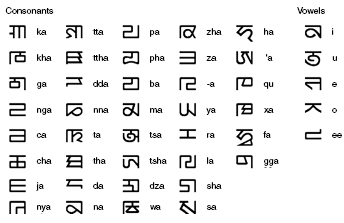
The system transcribed the spoken Mongolian tongue with more accuracy than its improvised predecessors, and even recorded the sounds of other languages, notably Chinese. Kublai Khan proudly designated this linguistic innovation as the language of Mongol officialdom, and he founded academies to promote its use. The Mongolian Language School opened the same year, and two years later, the National University. ’Phags-pa script appeared on paper money, on porcelain, and in official edicts of the Yüan empire, but scholars and scribes, devoted by sentiment and training to Chinese, Persian, or other established languages, resisted adopting it. Nor did Marco demonstrate familiarity with the new Mongol idiom.
In 1274, about the time the Polo company arrived in Mongolia, ’Phags-pa retired to the Sa-skya-pa monastery in Tibet, where he died in 1280. By that time, his version of Buddhism was falling into disfavor with the Mongols, and his clever script had failed to catch on, except among a small number of adherents who employed it on ceremonial occasions. It remained a worthy but failed experiment in artificial or constructed language.
KUBLAI KHAN’S intimate life was as structured, and as extravagant, as other aspects of his empire. Marco’s high position allowed him to become familiar with Kublai’s extended family, which was large enough to make Europeans gasp in disbelief. “He has four women whom he holds always as his true wives, and the eldest son which he has of these four women ought to be lord of the empire by right when the Great Khan should die,” Marco reports. “The [wives] are called empresses, and each is called also by her proper name. And each of those ladies holds a court by herself in her own palace; for there is none who has not three hundred”—in some versions of Marco’s account, the number swells to a thousand, or even ten thousand—“girls [who are] very fair and amiable.” In all, “they have very many valets and eunuchs, and many other men and women, so that each of these ladies has in her court ten thousand persons.”
Drawing on his familiarity with Kublai, Marco dared to follow this august personage into the bedroom to glimpse his extraordinary sexual behavior. “Whenever he wishes to lie with any one of these four women, he makes her come to his room, and sometimes he goes to the room of his wife.” As if they were not enough to keep him occupied, the khan had “many other concubines” at his disposal. Marco says that many came from the province of Kungurat, in Afghanistan, the home of a “very handsome and fair-skinned people; these women are very beautiful and adorned with excellent manners.” They moved with uncommon suppleness, altogether feline, seductive, and alluring, and they dressed in a strikingly attention-snaring fashion, wearing a head-piece from which dangled long, glimmering strands of pearls, framing the face, and making the eyebrows into a sharp dark horizontal streak. The pearl headpiece focused their gaze until their dark eyes haunted the dreams of an emperor—or an impressionable young Venetian.
Like so much else in the Mongol court, the process of selecting concubines fit to serve the khan was highly ritualized. Every other year, Marco explains, “The Great Khan sends his messengers to…find him the most beautiful girls according to the standard that he gives them, four hundred, five hundred, more or less, as they think right.”
Once assembled, the girls appeared before “judges deputed for this purpose, who, seeing and considering all the parts of each separately—that is, the hair, the face, and the eyebrows, the mouth, the lips, and the other limbs—that they may be harmonious and proportioned to the body, value some at sixteen carats, others at seventeen, eighteen, twenty.” Only those fortunate girls awarded twenty carats or more were selected and ushered into the presence of Kublai Khan himself, where they submitted to the scrutiny of still more judges. The procedure yielded forty maidens valued at the highest number of carats and, as Marco puts it, “chosen for his own room.”
Even these select girls had to undergo one final intimate inspection before they were deemed fit for Kublai Khan’s bed. Under his direction, the “elder ladies of the palace…make them [the girls] lie with them in one bed to know if she has good breath and sweet, and is clean, and sleeps quietly without snoring, and has no unpleasant scent anywhere, and to know if she is a virgin, and quite sound in all things.”
This description, as explicit as Marco dared to make it, is usually taken to mean that the barons’ wives engaged in sex with the female recruits to break them in and train them in the arts of love. Those who passed this most intimate test of all, who were “good and fair and sound in all their limbs,” were “sent to wait on their lord.”
Every three days, six winners of this Mongol beauty contest were dispatched to Kublai Khan’s quarters, “both in the room and in the bed and for all that he needs; and the Great Khan does with them what he pleases.” When he finished, the exhausted girls departed, only to be replaced by a second shift of six. “And so it goes all the year that every three days and three nights they are changed until the number of those hundred is completed, and they stay for another turn.”
During the orgies, Kublai Khan remained undisturbed by anyone except the young concubines. “If the lord has need of anything extraordinary, as drink or food or other things, the girls who are in the lord’s chamber order those in the other room what they must prepare, and they prepare it immediately. And so the lord is not waited on by other persons, but by the girls.” All the while, girls valued at fewer carats assisted other ladies in waiting, learning to sew and to make gloves, and “other genteel work.”
The khan shared his surplus of women with his barons, earning the goodwill and cementing the loyalty of all his petitioners. “When any gentleman is looking for wives, the Great Khan gives him one with a very great dowry, and in this way he finds them all husbands of good position.” As described by Marco, this intricate system of sharing sexual entitlements satisfied the needs of all the interested parties.
Marco realized that the arrangement required a remarkable degree of acquiescence on the part of Kublai Khan’s subjects, who found a justification for losing their daughters in the irresistible movements of the planets. “Are not the men…annoyed that the Great Khan takes their daughters from them?” Marco asks. “Certainly not.” It was no shame for a woman to be plucked from her town to serve the khan sexually, but a form of royal recognition. “They think it a great favor and honor, and are very glad that they have pretty daughters which he deigns to accept, because, they say, ‘If a daughter is born under a good planet and with good fortune, the lord will be able to satisfy her better and will marry her into a good position, which I should not have been able to do.’”
KUBLAI KHAN believed that he was fulfilling Heaven’s mandate to produce as many heirs as possible. According to Marco’s tally, Kublai Khan sired twenty-two sons by his four wives, and twenty-five additional sons by his concubines. (His many daughters did not merit comment.) To hear the diplomatic Venetian tell it, every one of Kublai Khan’s male heirs possessed the father’s courage and sagacity. And every one wanted to be the next “great khan.” Of them all, Kublai’s oldest surviving son, Chinkim, was expected to inherit the throne. He had distinguished himself on horseback and in scholarship, and he was popular with nearly everyone except for his direct rivals. Placed in charge of the sensitive task of collecting taxes, he firmly opposed corruption, yet he was generous in providing assistance to families afflicted by natural disasters such as drought and floods. In these respects, he proved himself a worthy successor to his father.
According to the Persian historian Vassaf, “When Kublai approached his seventieth year, he desired to raise…Chinkim to the position of representative and declared successor during his own lifetime; so he took counsel with the chiefs.” The other khans, not surprisingly, declared that Kublai’s proposal violated the precepts laid down by Genghis Khan himself—Chinkim was not eligible to become the “great khan” during his father’s lifetime—but they did pledge to support him after Kublai Khan’s death. To the young Marco, it seemed as if that day would never come.
But even Kublai Khan was mortal.