
8
‘The frontiers of states are either large rivers, or chains of mountains, or deserts. Of all these obstacles to the march of an army, the most difficult to overcome is the desert.’
Napoleon’s Military Maxim No. 1
‘The decision that Caesar took to have a hand cut off all the soldiers was completely atrocious. He was clement towards his own in civil war, but cruel and often ferocious towards the Gauls.’
Napoleon, Caesar’s Wars
Once Desaix had routed Murad Bey at the battle of Samhoud in January 1799, captured his flotilla on the Nile and ended the threat from Upper Egypt, Napoleon’s rule extended over almost the whole country. He could now unleash his attack on Jezzar. He told the Directory on the day he left Cairo that he hoped to deny the Royal Navy the use of Levantine ports such as Acre, Haifa and Jaffa, raise the Lebanese and Syrian Christians in revolt against the Turks, and decide later whether to march on Constantinople or India.1‘We have plenty of enemies to vanquish in this expedition,’ he wrote, ‘the desert, the local inhabitants, the Arabs, Mamluks, Russians, Turks, English.’2 The mention of Russians was no mere Napoleonic hyperbole; Tsar Paul I hated everything the French Revolution stood for and considered himself the protector of the Knights of Malta (indeed he had engineered his own election as Grand Master in succession to von Hompesch). On Christmas Eve 1798 he made common cause with Russia’s traditional enemy, Turkey, and also with Britain, and made plans to send a Russian army deep into western Europe. But for the moment Napoleon had no inkling of that.
Historians have long taken Napoleon at his word that he planned to go further than Acre, to Constantinople perhaps or even India, but since he took only 13,000 men with him, one-third of his entire force in Egypt, this seems very unlikely. Even if Acre had fallen, and the Druze, Christians and Jews had all joined him, the logistics and demographics would not have permitted an invasion of either Turkey or India, even by a general as ambitious and resourceful as Napoleon. He later claimed that with the help of the Indian Mahratta princes he would have expelled the British from India, marching to the Indus with a long halt on the Euphrates in daily 15-mile marches through deserts, with his sick, ammunition and food carried by dromedaries, his men fed by a pound each of rice, flour and coffee per day. Yet there are more than 2,500 miles between Acre and Delhi, and the march would have required crossing the whole width of modern-day Syria, Iraq, Iran and Pakistan as well as part of northern India, far further than his journey from Paris to Moscow. The logistics would have been impossible; these plans were only ever pipe-dreams prompted by the conquests of Alexander the Great.
In February 1799 Napoleon’s immediate objective was to pre-empt the Sultan’s proposed eastern land invasion of Egypt, supported by Jezzar, before returning to deal with the amphibious Ottoman invasion of northern Egypt he had long expected that summer – the two fortunately not co-ordinated. It was his old strategy of the central position writ very large. On January 25, 1799 he did write to Britain’s foremost enemy in India, Tipu Sahib, announcing his imminent ‘arrival on the shores of the Red Sea with a numerous and invincible army, animated with the desire of delivering you from the iron yoke of England’.3 A British cruiser intercepted the letter, and Tipu was killed in the capture of his capital, Seringapatam, by the young and highly impressive British Lieutenant-General Sir Arthur Wellesley that May. Napoleon’s intention was probably simply to spread disinformation, as he knew his letters were falling into enemy hands.
Leaving Desaix in Upper Egypt, Marmont in Alexandria and General Charles Dugua in Cairo, Napoleon invaded the Holy Land with Regnier in the vanguard, three infantry divisions under Kléber, Bon and Lannes, and Murat leading the cavalry. As the troops marched out of Cairo they sang the stirring 1794 revolutionary anthem ‘Le Chant du Départ’, which thereafter became a Bonapartist anthem. At a council of war the only general openly to oppose the invasion was General Joseph Lagrange, who pointed out that Acre was 300 miles away through hostile desert and past several well-defended cities which, if captured, would require garrisoning by detachments from the relatively small force that Napoleon proposed to take. He suggested that it would be better to await an attack inside Egypt, forcing the enemy to cross the Sinai instead of taking the battle onto their terrain.4 Yet with the amphibious assault expected in June, Napoleon felt he didn’t have the luxury of time; he needed to cross the desert, defeat Jezzar and then re-cross it before it became impassable in the summer.
Napoleon left Cairo on Sunday, February 10, 1799 and reached Katieh at 3 p.m. on the 13th. Just before leaving, he wrote a long letter to the Directory. One sentence was in code, which once deciphered read: ‘If, in the course of March . . . France is at war with the kings, I will return to France.’5 On March 12 the War of the Second Coalition began, with France eventually pitted against the monarchs of Russia, Britain, Austria, Turkey, Portugal and Naples, and the Pope.
To cross the then unmapped Sinai Napoleon would have to overcome problems of food, water, heat and hostile Bedouin tribesmen. His use of a dromedary camel corps, fast-firing drill by alternating ranks, and pieux (hooked stakes for swiftly erected palisades) were to be retained by French colonial armies up to the Great War.6 ‘We have crossed seventy leagues [over 170 miles] of desert which is exceedingly fatiguing,’ he wrote to Desaix on the journey; ‘we had brackish water and often none at all. We ate dogs, donkeys and camels.’7 Later they also ate monkeys.
In the past five millennia there have been an estimated five hundred military engagements fought in the area between the Jordan river and the Mediterranean. The western coastal route that Napoleon took – eschewing the mountain and Jordan valley routes – was the same that Alexander the Great had taken in the opposite direction. Of course Napoleon appreciated the historical aspects of his campaign, later reminiscing, ‘I constantly read Genesis when visiting the places it describes and was amazed beyond measure that they were still exactly as Moses had described them.’8
The fort of El-Arish, 170 miles from Cairo, was defended by about 2,000 men of the Turkish vanguard and their Arab allies. By February 17 Napoleon and the main body of his army had arrived there and constructed trenches and batteries. There were ‘violent murmurs among the soldiers’, who were exhausted and thirsty and who insulted the savants, unfairly blaming them for the entire expedition, but they quietened at the prospect of action.9 By the 19th a bombardment of the walls had created breaches large enough to send troops through. Napoleon demanded the surrender of the fort, which was accepted by Ibrahim Nizam, the co-commandant, as well as by El-Hadji Mohammed, commander of the Maghrebians, and El-Hadji Kadir, Aga of the Arnautes.* These men and their senior agas (officers) swore on the Koran ‘that neither they nor their troops will ever serve in Jezzar’s army and they will not return to Syria for a year, counting from this day’.10 Napoleon therefore agreed to allow them to keep their weapons and go back home, although he broke his agreement with the Mamluk contingent by disarming them. Before the second half of the twentieth century, and especially in the Middle East, the rules of war were simple, harsh and essentially unchanging; to give one’s word and then break it was generally recognized as a capital offence.
On February 25, Napoleon chased the Mamluks out of Gaza City, capturing large amounts of ammunition, six cannon and 200,000 rations of biscuit. ‘The lemon trees, the olive groves, the ruggedness of the terrain look exactly like the countryside of the Languedoc,’ he told Desaix, ‘it is like being near Béziers.’11 On March 1 he learned from the Capuchin monks at Ramleh that the El-Arish garrison had passed through on its way to Jaffa 10 miles away, ‘saying they did not intend to abide by the articles of capitulation, which we had been the first to break when we disarmed them’.12 The monks estimated the Jaffa force at 12,000 strong and ‘many cannons and much ammunition had arrived from Constantinople’. Napoleon therefore concentrated his force at Ramleh before moving on, laying siege to Jaffa from noon on March 3. ‘Bonaparte approached, with a few others, to within a hundred yards,’ recalled Doguereau of Jaffa’s city walls. ‘As we turned back, we were observed. One of the cannonballs fired at us by the enemy fell very close to the commanding general, who was showered with earth.’13 On March 6 the defenders made a sortie, which allowed Doguereau to notice how heterogeneous the Ottoman army was: ‘There were Maghrebians, Albanians, Kurds, Anatolians, Caramaneniens, Damascenes, Alepese and Negroes from Takrour [Senegal],’ he wrote. ‘They were hurled back.’14
At dawn on the next day, Napoleon wrote the governor of Jaffa a polite letter calling on him to surrender, saying that his ‘heart is moved by the evil that will fall upon the whole city if it subjects itself to this assault’. The governor stupidly replied by displaying the head of Napoleon’s messenger on the walls, so Napoleon ordered the walls to be breached and by 5 p.m. thousands of thirsty and angry Frenchmen were inside. ‘The sights were terrible,’ wrote one savant, ‘the sound of shots, shrieks of women and fathers, piles of bodies, a daughter being raped on the cadaver of her mother, the smell of blood, the groans of the wounded, the shouts of victors quarrelling about loot.’ The French finally rested, ‘sated by blood and gold, on top of a heap of dead’.15
Reporting to the Directory, Napoleon admitted that ‘twenty-four hours was handed over to pillage and all the horrors of war, which never appeared to me so hideous’.16 He added, wholly prematurely, that as a result of the victories of El-Arish, Gaza and Jaffa, ‘The Republican army is master of Palestine.’ Sixty Frenchmen had been killed and 150 wounded at Jaffa; the numbers of enemy soldiers and civilians killed are unknown.*
Napoleon’s treatment of the prisoners captured at Jaffa, of whom some, though not all, were men who had given their word at El-Arish and then broken it, was extremely harsh. On March 9 and 10, thousands of them were taken to the beach about a mile south of Jaffa by men of Bon’s division and massacred in cold blood.* ‘You . . . will order the adjutant to lead all the artillerymen who were taken in arms and other Turks to the water’s edge,’ Napoleon wrote unambiguously to Berthier, ‘and have them shot, taking precautions that none escape.’17 In his own account Berthier stated his belief that these men had forfeited their lives when Jaffa refused to surrender, regardless of what had happened at El-Arish, and he didn’t differentiate between the deaths taken in battle or in cold blood.18 Louis-André Peyrusse, a senior quartermaster, described to his mother what happened next:
About three thousand men deposited their arms and were led right away to the camp by order of the general-in-chief. They split up the Egyptians, Mahgrebians and the Turks. The Mahgrebians were all led the next day to the seaside and two battalions started to shoot them. They had no other recourse to save themselves but to throw themselves in the sea. They could shoot them there and in a moment the sea was dyed with blood and covered with corpses. A few had the chance to save themselves on rocks; they sent soldiers in boats to finish them off. We left a detachment on the seaside and our perfidy attracted a few of them who were mercilessly massacred . . . We were recommended not to use powder and we had the ferocity to kill them with bayonets . . . This example will teach our enemies not to trust the French, and sooner or later the blood of these three thousand victims will revisit us.19
He was right; when El-Aft on the banks of the Nile was abandoned by the French in May 1801, the Turks beheaded every Frenchman unable to flee, and when the British present remonstrated, they ‘answered by indignant exclamations of “Jaffa! Jaffa!”’20Captain Krettley, another eyewitness to the Jaffa massacre, saw how although ‘the first batch of prisoners were shot, the rest were charged by the cavalry . . . they were forced into the sea, where they attempted to swim, trying to reach the rocks a few hundred yards offshore . . . but they were not saved in the end, since these poor unfortunates were overwhelmed by the waves’.21
Contemporary French sources – there are no Turkish ones for obvious reasons – differ very greatly over the numbers killed, but generally give a number between 2,200 and 3,500; higher figures exist but tend to come from politically motivated anti-Bonapartist sources.22 As only 2,000 or so gave their word at El-Arish, Napoleon certainly executed some in the polyglot Turkish army who had not been present there, but who had been promised clemency by Eugène when they held out in an inn after Jaffa’s walls had been breached and the rest of the city captured. (This may be what Peyrusse had in mind when he said the massacre would teach them not to trust the French.) There was, of course, a racial element to this; Napoleon would not have executed European prisoners-of-war.
Napoleon himself gave the number killed at fewer than 2,000, saying: ‘They were devils too dangerous to be released a second time so that I had no choice but to kill them.’23 On another occasion he admitted to 3,000 and told a British MP: ‘Well, I had a right . . . They killed my messenger, cut off his head, and put it on a pike . . . there were not provisions enough for French and Turks – one of them must go to the wall. I did not hesitate.’24 The food argument is unconvincing; some 400,000 rations of biscuit and 200,000 pounds of rice were captured in Jaffa. He might well have thought himself too short of men to detach a battalion to escort so many prisoners across the Sinai back to Egypt, however.25 As his remarks on the September Massacres in Paris and his actions in Binasco, Verona and Cairo demonstrated, Napoleon approved of uncompromising – indeed lethal – measures if he felt the situation demanded them. He was particularly interested in ensuring that the eight hundred trained Turkish artillerymen weren’t able to fight against him again. (Had he taken up the Sultan’s job offer of 1795, many of these same men would have been his pupils.) Having accepted their word once, he couldn’t have been expected to do so again. And in a war against the seventy-nine-year-old Jezzar, fabled for his spectacular cruelty, who that year had had four hundred Christians sewn into sacks and thrown into the sea, he might have felt the need to be seen as equally ruthless.26
On March 9, during the massacres, Napoleon wrote to Jezzar, saying that he had been ‘harsh towards those who had violated the rules of war’, adding: ‘In a few days I shall march upon Acre. But why should I shorten the life of an old man I do not know?’27Luckily for that messenger, Jezzar chose to ignore this threat. The same day, Napoleon also made a proclamation to the sheikhs, ulama and commandant of Jerusalem, telling them of the terrible punishments awaiting his enemies, but further declaring: ‘God is clement and merciful! . . . It is not my intention to wage war against the people; I am a friend of the Muslim.’28*
In an all-too-rare example of poetic justice in history, the French caught the plague off Jaffa’s inhabitants whom they had raped and pillaged.* With a mortality rate of 92 per cent for sufferers, the appearance of its buboes on the body was akin to a death sentence.29 Captain Charles François, a veteran of Kléber’s division, noted in his journal that after the sack of Jaffa ‘soldiers who had the plague were right away covered with buboes in the groin, in the armpits and on the neck. In less than twenty-four hours the body became black as well as the teeth and a burning fever killed anyone who was affected by this terrible disease.’30 Of all the various types of plague infecting the Middle East at the time, this, la peste, was one of the worst, and Napoleon ordered the Armenian Monastery hospital on the seafront of Old Jaffa – where it still is today – to be turned into a quarantine station. On March 11 Napoleon visited it along with Desgenettes, and there according to Jean-Pierre Daure, an officer in the pay commissariat, he ‘picked up and carried a plague victim who was lying across a doorway. This action scared us a lot because the sick man’s clothes were covered with foam and disgusting evacuations of abscessed buboes.’31
Napoleon spoke to the sick, comforted them and raised their morale; the incident was immortalized in 1804 in Antoine-Jean Gros’ painting Bonaparte Visiting the Plague House at Jaffa. Napoleon said, ‘As general-in-chief he found it a necessary part of his duty to endeavour to give them confidence and reanimate them, by visiting frequently, himself, the plague hospital, and talking to, and cheering, the different patients in it. He said he caught the disorder himself, but recovered again quickly.’32 (There is no corroborating evidence for this claim.) Napoleon believed la peste to be susceptible to willpower, telling someone years later that ‘Those who kept up their spirits, and did not give way to the idea that they must die . . . generally recovered; but those who desponded almost invariably fell a sacrifice to the disorder.’33
• • •
Napoleon left Jaffa for Acre on March 14, the day before the British commodore Sir Sidney Smith and the French royalist military engineer and Brienne contemporary Antoine de Phélippeaux arrived off the port with two Royal Navy frigates, HMS Theseus and HMS Tigre. The Anglo-Russo-Turkish alliance had little common purpose except a desire to turn back French conquest, but that was enough for the Royal Navy to try to prevent Acre from falling to Napoleon. The city had been captured in 1104 by the crusading King Baldwin I of Jerusalem, who built walls 8 feet thick. The intervening centuries had left its defences much weakened, but the walls were still there, if not so high, and there was a deep moat. Defending the port were about 4,000 Afghans, Albanians and Moors, Jezzar’s efficient Jewish chief-of-staff, Haim Farhi – who had lost a nose, ear and eye to his master over the years – and now Commodore Smith with two hundred Royal Navy seamen and marines, and the talented Phélippeaux. They added sloping glacis defences, reinforcing the bases of the walls at an angle, and constructed ramps to get cannon up onto the walls (which had been impossible at Jaffa as the walls were too weak). Some of these defences can still be seen today, along with some naval cannon positioned by Smith.
On March 15 Napoleon, Lannes and Kléber easily thrust aside an attack by Arab cavalry from Nablus in a skirmish at Kakoun, suffering only forty casualties. Three days later, Napoleon was forced to watch in horror from the cliffs above Haifa as his flotilla of nine vessels under Commodore Pierre-Jean Standelet, carrying his entire siege artillery and equipment, rounded the Mount Carmel promontory straight into the clutches of Tigre and Theseus. Six ships were captured and only three escaped to Toulon. Most of Napoleon’s heaviest weaponry was then taken into Acre and turned against him. In an equally unmistakable signal that the course of events was turning, Jezzar reverted to form and beheaded the messenger sent with peace terms.34
Napoleon began his assault on Acre at noon on March 19, surrounding the town with fortifications and trenches at a distance of 300 yards. He hoped that the light artillery he had, and sheer French élan once a breach was made, might still capture the city. Although his headquarters were on the Turon hillside 1,500 yards from Acre – coincidentally the place Richard the Lionheart had chosen for the same job in 1191 – some of his siege lines had to go through a mosquito-infested swamp, which soon caused malaria outbreaks. The French set to work digging trenches and making the fascines, gabions and saucissons needed for fortifications.
‘At first the place looked indefensible,’ considered Doguereau, ‘and unlikely to hold out for eight days. It was thought that we only had to present ourselves before Acre, when the memory of the fate of Jaffa, which we had taken so easily, would terrify the Pasha.’35 With the benefit of hindsight, Doguereau concluded that Napoleon ought to have gone back to Egypt at that point, as Jezzar was in no position to threaten Egypt after the loss of El-Arish, Gaza, Jaffa and, on March 18, Haifa, which Napoleon could have garrisoned before withdrawing. But he had not yet defeated the Turkish army that was massing at Damascus, which had been the primary purpose of his invasion.
Napoleon launched no fewer than nine major and three minor attacks on Acre over the next nine weeks. At the same time, he had to send off forces to defend himself from Turks, Arabs and Mamluks, who fortunately came piecemeal rather than in co-ordinated assaults. At one point he ran so low on ammunition that he had to pay soldiers to pick up cannonballs fired from the city and from Royal Navy vessels; they received between a half-franc and a franc each, depending on the calibre. The French weren’t the only ones being incentivized; one of the explanations for the large number of Turkish sorties (twenty-six) was that Jezzar was paying a high bounty for French heads.36 (Of the four skeletons found on the battlefield in 1991, two had been decapitated.) On March 28 a cannonball buried itself three paces from Napoleon, between his two aides-de-camp, Eugène and Antoine Merlin, the son of the new Director, Philippe Merlin de Douai. Part of a tower fell down during a bombardment, but the subsequent attack failed because the ladders were too short, which understandably demoralized the men. One Turkish sortie was repelled only after several hours’ fighting. Sappers started to dig under a different tower, but they were foiled by counter-mining.
Meanwhile, Napoleon sent Murat off to capture Safed and Junot to take Nazareth to foil any relief attempts from Damascus. When on April 8 Junot defeated a raiding party of Turks in a skirmish near the village of Loubia with no losses, Napoleon described it as ‘a renowned combat that did credit to French sangfroid’.37 A far more serious engagement, indeed one that justified the entire Syrian campaign, was fought six days later.
• • •
The battle of Mount Tabor is a misnomer, since it was actually fought on nearby Mount Hamoreh, although Kléber had marched around Tabor, which was 8 miles away. Kléber’s intentions had been very bold, to attack the far larger Turkish and Mamluk army of some 25,000 that had been massing at Damascus with his 2,500 men at night at the springs where the Turks were watering their horses and camels (a long process, as a thirsty camel can drink about 40 litres). However, when the sun rose at 6 a.m. on April 16, Kléber’s force had not yet crossed the central Jezreel valley and was in full view of the Turks, who attacked across the plain. He had plenty of time to form two large squares, which despite being quickly surrounded stayed in formation as they trudged up the gently inclining slope of Mount Hamoreh, where the enemy could use their cavalry to less effect. By noon, at which point he had been fighting in the heat for six hours taking losses, and getting low on water and ammunition, Kléber successfully effected the dangerous and difficult manoeuvre of merging the two squares into one.
He had earlier warned Napoleon that he was in contact with a large body of the enemy, so Napoleon took over Bon’s division and marched to Nazareth in an effort to help him. By the time he got there on the 16th, Kléber was already engaged, so Napoleon drove his men in a circling manoeuvre from the west on to Mount Hamoreh. Ignoring one of the most basic rules of warfare, Pasha Abdullah of Damascus had failed to post scouts to watch for just such an attempt to relieve Kléber. Marching south-east from Nazareth, Napoleon could see from the smoke and dust where Kléber – outnumbered ten to one – was fighting. He appeared at about noon on the battlefield directly behind the Turks. His route climbed the watershed of the ridge, so there was no line of sight that even Turks on horseback could have used to spot him. Although the Vale of Jezreel looks flat from afar, there are undulations and natural curves in the ground of between 30 and 60 feet. Looking across the vale from the (untouched) battlefield today, it is easy to see how these contours hid Napoleon’s force as it rounded Mount Hamoreh and took the Turks completely by surprise in their rear, a dream combination for any general and one that Napoleon exploited to the full. Although they fled before really significant losses could be inflicted, the Ottoman army was completely scattered and their hopes of reconquering Egypt wrecked.
After the battle, Napoleon slept at the convent in nearby Nazareth, where he was shown the supposed bedchamber of the Virgin Mary. When the prior also pointed out a broken black marble pillar and told his staff, ‘in the gravest manner possible’, that it had been split by the Angel Gabriel when he ‘came to announce to the Virgin her glorious and holy destination’, some of the officers burst out laughing, but as one of them recorded, ‘General Bonaparte, looking severely at us, made us resume our gravity.’38 The next day Napoleon revisited the Tabor battlefield, a common practice of his, before returning to Acre for more attacks and counter-attacks throughout late April.
On April 27 the army lost one of its most popular commanders when gangrene set into a wound in Caffarelli’s right arm, which had been hit by a cannonball some days earlier. ‘Our universal regrets accompany General Caffarelli to the grave,’ Napoleon wrote in his Order of the Day. ‘The Army is losing one of its bravest leaders, Egypt one of its legislators, France one of its best citizens, and science an illustrious scholar.’ Those wounded at Acre included Duroc, Eugène, Lannes and four brigadiers, and on May 10 Bon was mortally wounded under its walls. The officer corps was thus at the forefront of the action, a key aspect of their service that won them their soldiers’ affection and respect. In one bombardment from Acre, Berthier’s aide-de-camp was killed standing near Napoleon, and Napoleon was himself knocked over by ‘the effect of the commotion of the air’ as a cannonball passed close by.39 With paper for cartridges no longer available, one Order of the Day required all unused paper to be handed in to the quartermasters.
On May 4 a surprise night attack was attempted, but failed. Three days later, with the sails of a Turkish naval relief force seen on the horizon, Napoleon sent Lannes to try to storm the city. The enterprising general managed to get a tricolour onto the north-east tower but no further, and was subsequently expelled. By now Napoleon was describing Acre to Berthier as a mere ‘grain of sand’, an indication that he was considering abandoning the siege. He was also convinced that Sir Sidney Smith was ‘a kind of lunatic’, because the British commodore had challenged Napoleon to single combat under the walls of the city. (Napoleon replied that he didn’t see Smith as his equal, and ‘would not come forth to a duel unless the English could fetch Marlborough from his grave’.)40Smith also devised the forging of an ‘intercepted’ letter from Napoleon to the Directory bemoaning his army’s perilous situation. Copies were distributed around the French army by deserters, and it was said that when one was handed to Napoleon he ‘tore it up in a great rage’ and forbade anyone to discuss it. This ruse de guerre certainly fooled the Turks, whose ambassador in London sent a copy to the Foreign Office under the impression that it was genuine.41
Easily Smith’s finest piece of psychological warfare, however, was neither disinformation nor misinformation, but simply supplying Napoleon with true information. Under a flag of truce, he sent over several editions of recent British and European newspapers, from which Napoleon was able to piece together the series of disasters that had recently overtaken French arms. Napoleon had been actively trying to obtain newspapers since January; now he could read of Jourdan’s defeats in Germany at the battles of Ostrach and Stockach in March and Schérer’s at the battle of Magnano in Italy in April – only Genoa was left to France in Italy. Napoleon’s brainchild, the Cisalpine Republic, had collapsed and there were renewed risings in the Vendée. The newspapers made him realize, as he explained later, that ‘it was impossible to expect reinforcements from France in its then state, without which nothing further could be done’.42
On May 10, a brigade attacked Acre at dawn – climbing over the decomposing remains of their comrades from earlier attacks, but not deliberately using them as scaling ladders as alleged by British propagandists. As an eyewitness recalled, ‘some got into the town, but, assailed by a hail of bullets and finding new entrenchments there, they were compelled to retire to the breach’. There they fought for two hours, cut down by the crossfire.43 It was to be the last assault; the next day Napoleon decided to raise the siege and return to Egypt. ‘The season is too far advanced,’ he told the Directory; ‘the end I had in view has been accomplished. My presence is required in Egypt . . . Having reduced Acre to a heap of stones, I shall re-cross the desert.’44
The proclamation he made to his troops was just as disingenuous as his claim to have reduced Acre to rubble: ‘A few days more, and you would have captured the Pasha in the very middle of his palace, but at this season the capture of Acre would not be worth the loss of some days.’45 (On re-reading his Acre proclamation years later, Napoleon ruefully admitted: ‘C’est un peu charlatan!’46) He also told the Directory that he had heard reports that sixty people were dying of the plague in Acre every day, implying that it might be better not to capture it anyhow. In fact Jezzar didn’t lose anyone to the plague throughout the siege.47 It was however true that he needed to re-cross the desert before the heat made it impassable.
Napoleon had indeed accomplished ‘the end I had in view’ at the battle of Mount Tabor; the only reason to take Acre had been to pursue his dream of attacking India via Aleppo and setting up a French Empire in Asia stretching to the Ganges, or possibly to capture Constantinople. Yet, as we have seen, these were romantic fantasies rather than achievable ends, especially once the Syrian Christians made it clear they were going to stay loyal to Jezzar (not least because Smith cleverly collected all Napoleon’s proclamations to the Muslims and gave them to the Syrian and Lebanese Christians). ‘But for Acre the whole population would have declared for me,’ Napoleon lamented years later.48 ‘My intention was to take the turban at Aleppo,’ which he believed would have won him 200,000 Muslim adherents.
On May 20, 1799 the French army quietly left their siege lines, moving off between 8 and 11 p.m. to avoid attacks from Theseus and Tigre as they marched some miles along the beach.49 They were forced to spike twenty-three cannon they couldn’t remove, burying some and throwing others into the sea.* ‘General Bonaparte remained on the hillock throughout the withdrawal,’ recalled Doguereau, only leaving with the rearguard.50 Napoleon had suffered the first significant reverse of his career (since Bassano and Caldiero could hardly count as such), and he had to abandon any dream of becoming another Alexander in Asia. He later summed up his glorious aspirations, claiming: ‘I would found a religion, I saw myself marching to Asia, mounted on an elephant, a turban on my head, and in my hand a new Koran that I would have composed to suit my needs.’51 There was undoubtedly an element of self-mockery as well as fantasy in his portrayal of his ambitions. It seems hardly likely that he would actually have converted, though he clearly thought about it. Later, he would tell Lucien, ‘I missed my destiny at Acre.’52
Whether because he was angry at this, or to deter Jezzar from following him closely, Napoleon employed scorched-earth tactics on the way back to Egypt, laying waste to the Holy Land. Similar tactics were later to be used against Masséna by Wellington in his retreat to Lisbon in 1810, and of course by the Russians in 1812. He had to leave fifteen badly wounded men behind in the hospital at Mount Carmel in the care of the monks; all of them were massacred when the Turks arrived, and the monks were driven from the monastery they had occupied for centuries.53 On the retreat to Jaffa, harried in the rear by Arab tribesmen from Lebanon and Nablus, Napoleon ordered some of his cavalry to dismount so that their horses could be used for the sick and wounded. An equerry asked him which one he wanted reserved for himself, upon which Napoleon hit him with his riding crop, shouting: ‘Didn’t you hear the order? Everyone on foot!’54 It made for good theatre (unless you were the equerry). Lavalette said it was the first time he had ever seen him strike a man.
Arriving at Jaffa at 2 p.m. on May 24, Napoleon was confronted with an agonizing dilemma. With a gruelling desert crossing ahead, he would have to decide what to do with those plague victims who could not make the journey back to Cairo, since the nature of their illness meant they couldn’t be put on ships. ‘Nothing could have been more horrible than the sights brought before our eyes in the port of Jaffa throughout our stay there,’ recalled Doguereau. ‘The dead and dying were everywhere, begging passers-by for treatment or, fearful of being abandoned, praying to be taken on board ship . . . There were plague victims in every corner, lying in tents and on the cobblestones, and the hospitals were filled with them. We left many of them behind when we left. I was assured that steps had been taken to prevent them falling alive into the hands of the Turks.’55 The ‘steps’ taken were laudanum (opium) overdoses, administered in food by a Turkish apothecary after Desgenettes protested that euthanasia contravened his Hippocratic Oath. From the French eyewitness accounts there seem to have been around fifty men who died in this way.56 Napoleon himself put the number killed at around fifteen, but he defended his actions passionately: ‘Nor would any man under similar circumstances, who had the free use of his senses, have hesitated to prefer dying easily a few hours sooner, than expire under the tortures of those barbarians.’57 To the Bourbon and British accusations that he was wantonly cruel to his men, which began as soon as the Syrian campaign was over, he replied:
Do you think that if I had been capable of secretly poisoning my soldiers, or of such barbarities as have been ascribed to me, of driving my carriage over the mutilated and bleeding bodies of the wounded, that my troops would have fought under me with the enthusiasm and affection they uniformly displayed? No, no; I should have been shot long ago; even my wounded would have tried to pull a trigger to despatch me.58
While the Jaffa mercy-killings were twisted by propagandists to blacken Napoleon’s reputation, there seems no reason not to accept his aide-de-camp Andréossy’s conclusion that ‘those few who were killed were past recovery, and that he did it out of humanity’.59
The march through the desert back to Cairo, featuring terrible thirst in the scorching heat – Napoleon reported 47ºC temperatures – was a desperately low point, with incidents of amputee officers being thrown off their stretchers though they had paid men to carry them. An eyewitness noted how such utter demoralization was ‘destroying all generous sentiments’.60 Although they didn’t know it, the water table is fairly close to the surface along the coastal route they marched, and if they had only dug a few yards down they would have found water along almost its entirety. ‘Bonaparte rode his dromedary, which forced our horses to adopt a tiring pace,’ recalled Doguereau.61 This was because, as Napoleon reported to the Directory, ‘eleven leagues [29 miles] had to be covered per day to get to the wells where there was a little hot, sulphurous salty water, which was drunk with more eagerness than a good bottle of champagne in a restaurant’.62 According to a letter intercepted and published by the British, another soldier recounted: ‘Discontent is general . . . Soldiers have been seen to kill themselves in presence of the general-in-chief, exclaiming “This is your work!”’63
Napoleon re-entered Cairo on June 14, having sent orders ahead that celebrations were to be organized for his victorious troops’ parade, featuring captured standards and prisoners-of-war. ‘Although we put on all that we had of finery,’ recalled Doguereau of the event, ‘yet we presented a miserable appearance; we lacked everything . . . most of us were without hats or boots.’64 The leading sheikhs came to Cairo to welcome Napoleon, and ‘expressed the utmost satisfaction on his return’, though with how much sincerity might be doubted.65 Napoleon lost around 4,000 men in the Syrian expedition, far more than the 500 killed and 1,000 wounded he reported to Paris.66 A week after returning to Cairo, he ordered Ganteaume to go to Alexandria to prepare the Venetian-built frigatesCarrère and Muiron (named after his former aide-de-camp) for a long, top-secret voyage.
‘We are masters of all the desert,’ Napoleon told the Directory on June 28, ‘and we have disconcerted enemy projects for this year.’67 The former wasn’t much of a boast and the latter wasn’t true, since an Ottoman fleet was on its way. On July 15, just as he was coming out of the Great Pyramid with Monge, Berthollet and Duroc, Napoleon was told of the arrival of the Turks off Aboukir.68 He wrote to the Grand Diwan saying that among the invasion force was a Russian contingent, ‘who abhor those who believe in the unity of God, because, according to their lies, they believe that there are three’, which was a clever way of trying to use the Russians’ Orthodox faith against them and to appeal to Muslim beliefs.69 He sent Marmont, whom he assumed would soon be besieged in Alexandria, a list of tips, such as ‘only sleep in the day’, ‘sound the reveille well before dawn’, ‘make sure no officer undresses at night’, and to keep a large number of dogs tied up outside the city walls to warn against stealth attacks.70
Napoleon gathered together every available man from Cairo to march to Alexandria, which he reached on the night of July 23. At night many of the soldiers slept under the stars, wrapped in their cloaks. On approaching Alexandria, they learned that the small French garrison in the fort at Aboukir had been overwhelmed and beheaded in front of the Turkish commander, Mustafa Pasha. ‘This news had a very bad effect,’ recorded Doguereau; ‘the French do not like this cruel way of making war.’71 Hypocritical as that may sound after Jaffa, it meant that few prisoners were taken two days later, when Napoleon’s 8,000 men inflicted a devastating defeat on the 7,000-strong Turkish, Mamluk and Bedouin forces under Mustafa Pasha at the battle of Aboukir. ‘We were obliged to kill them all to a man,’ wrote Lavalette, ‘but they sold their lives dearly.’72 Many of the Turks were simply driven into the sea by Lannes, Murat and Kléber. ‘If it had been a European army,’ said Doguereau, ‘we should have taken three thousand prisoners; here there were three thousand corpses.’73 In fact there were probably closer to five thousand. It was a stark confession of complete indifference to the fate of non-white, non-Christian enemies.74
• • •
With the second Turkish invasion force destroyed and Egypt safe, Napoleon decided to return as soon as possible to a vulnerable France facing a new Coalition led by Britain, Russia and Austria. Long accused afterwards of deserting his men, in fact he was marching to the sound of the guns, for it was absurd to have France’s best general stuck in a strategic sideshow in the Orient when France itself was under threat of invasion. He left Egypt without warning Kléber or Menou – indeed he even ordered Kléber to meet him at Rosetta as a diversion while he headed for the sea. Trying to sweeten the pill of being ordered to assume command, in a very long letter of instructions Napoleon promised Kléber that he would ‘take particular care’ to send him a company of actors, which he said was ‘very important for the army, and also to start changing the customs of this country’.75 When Kléber discovered that Napoleon – whom he took to calling ‘that Corsican runt’ – had left Egypt, the plain-speaking Alsatian told his staff: ‘That bugger has deserted us with his breeches full of shit. When we get back to Europe we’ll rub his face in it.’76 That pleasure was denied him, for in June 1800 a twenty-four-year-old student named Soliman stabbed him to death. (Soliman was executed with a pike driven into his rectum up to his breast.)77
Far from showing cowardice, it took a good deal of courage for Napoleon to cross the Mediterranean when it was virtually a British lake. He sailed on August 23 from Beydah, 9 miles from Alexandria, with most of his senior staff, including Berthier, Lannes, Murat, Andréossy, Marmont, Ganteaume and Merlin, as well as the savants Monge, Denon and Berthollet. Napoleon also took with him a young – between fifteen and nineteen, accounts differ – Georgian-born, Mamluk-dressed slave boy called Roustam Raza, who had been a present from Sheikh El-Bekri in Cairo. Roustam became Napoleon’s bodyguard, sleeping on a mattress outside his door every night for the next fifteen years, armed with a dagger.78 ‘Don’t fear anything,’ Napoleon told Roustam, who had been sold into slavery at eleven and was scared of sailing. ‘We’ll soon be in Paris, and we’ll find a lot of beautiful women and a lot of money. You’ll see, we’ll be very happy, happier than in Egypt!’79 He ordered Desaix, who was still chasing Murad Bey, and Junot, who was too far away from the embarkation point, to stay behind, writing to Junot of the ‘tender friendship that I devote to you’, using ‘tu’ throughout.80
Napoleon told the army he had been recalled to France by the government, which was untrue.81 ‘It’s painful to me to leave soldiers to whom I am so much attached,’ he said, ‘but it shall not be for long.’82 He boarded the Muiron on August 22 and, accompanied by the Carrère, set sail at eight o’clock the next morning with a north-easterly wind that blew for two days and, with his customary good fortune, took him away from the British cruisers in the area. The two slow-moving Venetian-built frigates followed a circuitous route to France down the African coast to the Gulf of Carthage, and then northwards towards Sardinia. ‘During the whole of this tedious coasting, we had not descried a single sail,’ recalled Denon. ‘Bonaparte, as an unconcerned passenger, buried himself with geometry and chemistry, or unbent his mind by sharing in our mirth.’83 On the journey, as well as learning from the savants, Napoleon ‘would tell us ghost stories, in which he was very clever . . . He never mentioned the Directory but with a severity that savoured of contempt.’84 Bourrienne read him history books late into the night, even when Napoleon was feeling seasick. ‘When he asked me for the life of Cromwell,’ Denon recalled, ‘I believed that I would not go to bed.’85 Oliver Cromwell, the conservative revolutionary general who effected a coup d’état against a government he despised, was about to become more of a role-model for Napoleon than Denon could have guessed.
Denon recorded that Corsica was ‘the first sight of a friendly shore’. Coming into Ajaccio on September 30 ‘the batteries saluted on both sides; the whole population rushed to the boats and surrounded our frigates’. Lavalette recalled that the sight of Ajaccio left Napoleon ‘deeply affected’, a phrase generally used at that period to denote tears.86 Napoleon’s time there was spent dining with old partisans and retainers, picking up some ready cash from Joseph Fesch and ‘reading in the public papers the melancholy story of our disasters’ in Italy and Germany.87 One can still see the room he occupied on that occasion in the Casa Bonaparte; it was the last time he set foot in his childhood home.
On October 6 Napoleon and his entourage left Ajaccio for Hyères. When, two days later, the sails of some English ships were spotted at 6 p.m., Ganteaume wanted to turn back to Corsica. Giving his first and last navigational order of the journey, Napoleon told him to head for the port of Fréjus on the Côte d’Azur, not far from Cannes. At noon on Wednesday, October 9, 1799 he stepped ashore in France at an inlet at nearby Saint-Raphaël. That same evening he was on his way to Paris. It had been a remarkable journey, and after 1803 Napoleon kept a scale-model of the Muiron on his desk; later he ordered that the ship herself ‘be kept as a monument and placed somewhere where she will be preserved for a few hundred years . . . I would feel very superstitious if anything bad happened to this frigate.’88 (She was scrapped in 1850.)
• • •
The Egyptian adventure was over for Napoleon after nearly a year and five months, though not for the French army he had left behind. They would remain until Menou was forced to capitulate to the British two years later. In 1802 he, his army and the remainingsavants were allowed to return to France. Napoleon admitted to the loss of 5,344 men in his expedition, which was a considerable underestimation since by the time of the surrender in August 1801, around 9,000 soldiers and 4,500 sailors had died, and relatively little fighting had taken place after he left, even in the final siege of Alexandria.89 Nonetheless, he had captured the country as ordered, fought off two Turkish invasions and returned to help France in her hour of peril. Kléber wrote a devastating report to the Directory denouncing Napoleon’s conduct of the campaign from its inception, describing the dysentery and ophthalmia and the army’s dearth of weapons, powder, ammunition and clothing. But although this document was captured by the Royal Navy it wasn’t published in time to damage Napoleon politically – yet another example of the luck that he was starting to mistake for Fate.
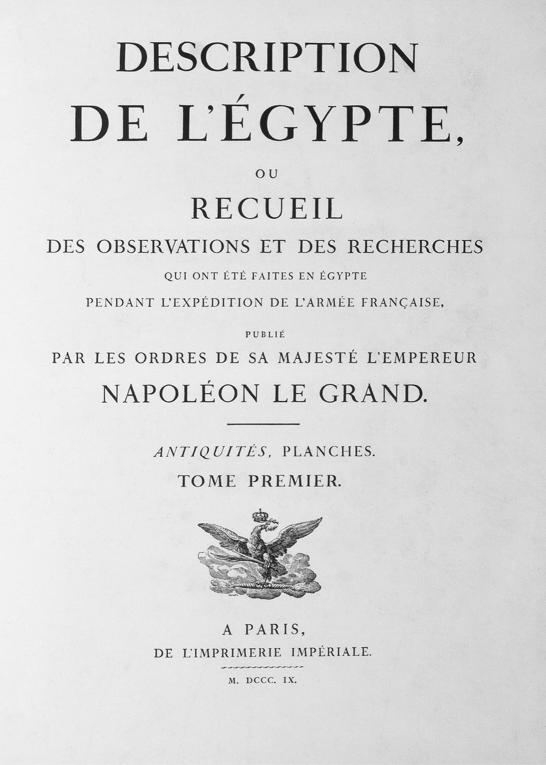
The greatest long-term achievements of Napoleon’s Egyptian campaign were not military or strategic, but intellectual, cultural and artistic. The first volume of Vivant Denon’s vast and magisterial Description de l’Égypte was published in 1809, its title page proclaiming that it was ‘published by the order of His Majesty Emperor Napoleon the Great’. Its preface recalled that Egypt had been invaded by Alexander and the Caesars, whose missions there had been the models for Napoleon’s. For the rest of Napoleon’s life, and indeed after it, further volumes of this truly extraordinary work appeared, finally numbering twenty-one and constituting a monument in the history of scholarship and publishing. The savants had missed nothing. From Cairo, Thebes, Luxor, Karnak, Aswan and all the other sites of Ancient Egyptian temples, there were immensely detailed scale drawings (20 inches by 27) in both colour and black and white of obelisks, sphinxes, hieroglyphics, cartouches, pyramids and sexually aroused pharaohs, as well as mummified birds, cats, snakes and dogs. (According to volume twelve, King Ozymandias didn’t have a ‘wrinkl’d lip and sneer of cold command’ as Shelley suggests, but a rather engaging smile.) Off-duty soldiers were occasionally shown lounging around in the foreground of prints, but for scale rather than propaganda.
As well as Ancient Egyptology, the volumes contained exceptionally detailed maps of the Nile, modern cities and towns, prints of minarets and landscapes, sketches of irrigation courses, and drawings of monasteries and temples, different types of columns, views of shipping, souks, tombs, mosques, canals, fortresses, palaces and citadels. There were encyclopaedic architectural blueprints with longitudinal and lateral plans of elevation, accurate down to the last centimetre. Although not politically triumphalist, the multiple volumes of the Description de l’Égypte represent an apogee of French, indeed Napoleonic, civilization, and had a profound effect on the artistic, architectural, aesthetic and design sensibilities of Europe.
Additionally, having narrowly escaped being bitten by a ‘horned serpent’ in a Theban grotto, Citizen Ripaud, the librarian of the Institut de l’Égypte, wrote a 104-page report for the Commission of Arts on the existing state of the antiquities from the Nile cataracts to Cairo.90 The savants’ greatest discovery was the Rosetta Stone, a stele in three languages found at El-Rashid in the Delta. They made copies and translated the Greek portion before starting to work on the hieroglyphics.91 Under the peace agreement covering the French withdrawal in 1801, the Stone was handed over to the British and sent to the British Museum, where it still safely resides. Tragically, the Institut near Tahrir Square in Cairo was burned down during the Arab Spring uprising on December 17, 2011, and almost all its 192,000 books, journals and other manuscripts – including the only handwritten manuscript of Denon’s Description de l’Égypte – were destroyed.