
7
‘This year the pilgrimage to Mecca was not observed.’
Anonymous Islamic historian on 1798
‘If I had stayed in the East, I would have founded an empire, like Alexander.’
Napoleon to General Gourgaud on St Helena
Although the idea of invading Egypt has been variously ascribed to Talleyrand, Barras, Monge (albeit only by himself), the encyclopaedist and traveller Constantin de Volney and several others, in fact French military planners had been considering it since the 1760s, and in 1782 Emperor Francis’s uncle, Joseph II of Austria, had suggested to his brother-in-law Louis XVI that France annex Egypt as part of a wider plan to partition the Ottoman Empire.1 The Ottoman Turks had conquered Egypt in 1517 and still officially ruled it, but de facto control had been long wrested from them by the Mamluks, a military caste originally from Georgia in the Caucasus. Their twenty-four beys (warlord princes) were unpopular among ordinary Egyptians for the high taxes they imposed, and were considered foreigners. After the Revolution, the idea of invading Egypt had appealed both to French radical idealists for its promise of extending liberty to a people oppressed by foreign tyrants, and to more calculating strategists such as Carnot and Talleyrand, who wanted to counter British influence in the eastern Mediterranean. Napoleon was of the latter group, telling the Directory in August 1797: ‘To destroy England thoroughly, the time is coming when we must seize Egypt.’2 Talleyrand suggested that he would go to Constantinople personally to persuade Sultan Selim III not actively to oppose the expedition. It was the first occasion, but by no means the last or most serious, when he was to mislead Napoleon.
Between his secret appointment to command the Army of Egypt on March 5, 1798 and the date set for the expedition to set sail, May 19, there were fewer than eleven weeks for Napoleon to organize and equip the entire enterprise, yet somehow he also managed to attend eight lectures on science at the Institut. As part of a misinformation campaign he spoke openly in the salons about the holiday he hoped to take in Germany with Josephine, Monge, Berthier and Marmont. To further the ruse, he was officially reconfirmed as commander of the Army of England, based at Brest.
Napoleon described Egypt as ‘the geographical key to the world’.3 His strategic aim was to damage British trade in the region and replace it with French; at very least he hoped to stretch the Royal Navy by forcing it to protect the mouths of the Mediterranean and Red Sea and trade routes to India and America simultaneously.4 The Royal Navy, which had lost Corsica as a base in 1796, would be further constrained if the French fleet could operate from the near-impregnable harbour of Malta. ‘Why should we not seize the island of Malta?’ he had written to Talleyrand in September 1797. ‘It would further threaten British naval superiority.’ He told the Directory that ‘This little island is worth any price to us.’5 The three reasons he gave the Directory for the expedition were to establish a permanent French colony in Egypt, to open up Asian markets to French produce and to establish a base for a force of 60,000 men which could then attack British possessions in the Orient. His ultimate ambition – or fantasy – may be gauged by his demand for English maps of Bengal and the Ganges from the war ministry, and his request to be accompanied by Citizen Piveron, the former envoy to Britain’s greatest enemy in India, Tipu Sahib, ‘the Tiger of Mysore’. Yet the Directory deflated these dreams; Napoleon was authorized only to invade Egypt and was told to raise the funds himself. He was expected to be back in France in six months.
As it transpired he had relatively little difficulty in raising the 8 million francs the expedition would cost, through ‘contributions’ extorted by Berthier in Rome, Joubert in Holland and Brune in Switzerland. Napoleon chose his senior officers carefully. On March 28 General Louis Desaix, a nobleman who had shown great promise fighting in Germany, brought another noble, General Louis-Nicolas Davout, to the rue de la Victoire to meet Napoleon for the first time. The twenty-eight-year-old Burgundian didn’t make a very good first impression, but Desaix’s assurances that Davout was a highly capable officer won him a place on the expedition. Although Napoleon was impressed with Davout’s performance in Egypt, they never became personally close, to Napoleon’s great disadvantage since Davout was later one of the few of his marshals to shine in independent command. Napoleon predictably took Berthier as his chief-of-staff, his brother Louis as an aide-de-camp after he had graduated from the Châlons artillery school, his handsome stepson Eugène (nicknamed ‘Cupid’) as another, the divisional generals Jean-Baptiste Kléber (a stentorian figure, a whole head taller than the rest of his soldiers and a veteran of the Army of the Rhine), Desaix, Bon, Jacques-François de Menou, Jean-Louis Reynier and fourteen other generals, including Bessières and Marmont, many of whom had fought under him in Italy.
The cavalry was to be under the command of the Haitian-born General Davy de la Pailleterie, known as Thomas-Alexandre Dumas, whose father was a French nobleman and whose mother was of Afro-Caribbean descent, hence the nickname ‘Schwarzer Teufel’ (black devil) which the Austrians had given him when he prevented them from re-crossing the Adige in January 1797.* Napoleon further chose General Elzéar de Dommartin to command the artillery, and the one-legged Louis Caffarelli du Falga the engineers. Lannes was to be quartermaster-general, a surprisingly desk-bound job for one of the most dashing cavalry commanders of the era. The chief doctor was René-Nicolas Desgenettes, who wrote a history of the campaign from a medical point of view four years later, which he dedicated to Napoleon. It was a formidable officer corps, abounding with talent and promise.
Napoleon also took 125 books of history, geography, philosophy and Greek mythology in a specially constructed library, including Captain Cook’s three-volume Voyages, Montesquieu’s The Spirit of the Laws, Goethe’s Sorrows of Young Werther and books by Livy, Thucydides, Plutarch, Tacitus and, of course, Julius Caesar. He also brought biographies of Turenne, Condé, Saxe, Marlborough, Eugène of Savoy, Charles XII of Sweden and Bertrand du Guesclin, the notable French commander in the Hundred Years War. Poetry and drama had their place too, in the works of Ossian, Tasso, Ariosto, Homer, Virgil, Racine and Molière.6 With the Bible guiding him about the faith of the Druze and Armenians, the Koran about Muslims, and the Vedas about the Hindus, he would be well supplied with suitable quotations for his proclamations to the local populations virtually wherever this campaign was finally to take him. He also included Herodotus for his – largely fantastical – description of Egypt. (Years later he would state that he believed ‘Man was formed by the heat of the sun acting upon mud. Herodotus tells us that the slime of the Nile changed into rats, and that they could be seen in the process of formation.’7)
Napoleon knew that Alexander the Great had taken learned men and philosophers along on his campaigns in Egypt, Persia and India. As befitted a member of the Institut, he intended his expedition to be a cultural and scientific event and not merely a war of conquest. To that end he took 167 geographers, botanists, chemists, antiquaries, engineers, historians, printers, astronomers, zoologists, painters, musicians, sculptors, architects, Orientalists, mathematicians, economists, journalists, civil engineers and balloonists – the so-called savants, most of whom were members of the Commission des Sciences et des Arts – whose work he hoped would give the enterprise a significance beyond the military.8 He failed in his hopes to persuade a professional poet to accompany him, but he did enlist the fifty-one-year-old novelist, artist and polymath Vivant Denon, who made more than two hundred sketches during his travels. Under their leaders Monge and Berthollet, the savants included some of the most distinguished men of the day: the mathematician and physicist Joseph Fourier (author of Fourier’s Law concerning heat conduction), the zoologist Étienne Saint-Hilaire and the mineralogist Déodat de Dolomieu (after whom dolomite was named). The savants were not told where they were going, merely that the Republic needed their talents and that their academic posts would be protected and stipends increased. ‘Savants and intellectuals are like coquettes,’ Napoleon was later to tell Joseph; ‘one may see them and talk with them, but don’t make one your wife or your minister.’9
• • •
‘Soldiers of the Army of the Mediterranean!’ Napoleon proclaimed from Toulon on May 10, 1798:
You are now a wing of the Army of England. You have campaigned in the mountains, in the plains and before fortresses, but you have yet to take part in a naval campaign. The Roman legions that you have sometimes rivalled, but have yet to equal, fought Carthage on this very sea . . . Victory never forsook them . . . Europe is watching you. You have a great destiny to fulfil, battles to fight, dangers and hardships to overcome. You hold in your hands the future prosperity of France, the good of mankind and your own glory. The ideal of Liberty that has made the Republic the arbiter of Europe will also make it the arbiter of distant oceans, of faraway countries.10
In the same speech, Napoleon promised his men 6 arpents (5 acres) of land each, although he didn’t stipulate precisely where they would be. Denon later recalled that when the soldiers saw the barren sand-dunes of Egypt from the boats before they landed, the men joked to each other: ‘There are the six arpents they promised you!’11
Napoleon prepared for the first French military action in the Middle East since the Crusades with his usual mastery of minutiae. In addition to all the military equipment necessary for his army, he collected astronomical telescopes, ballooning equipment, chemical apparatus, and a printing press with Latin, Arabic and Syriac type.12 ‘You know how much we will need good wine,’ he wrote to Monge, telling him to buy 4,800 bottles, most of it his favoured red burgundy, but also to find ‘a good Italian singer’.13 (In all, the expedition took 800,000 pints of wine to Egypt.) Napoleon’s prestige was by now sufficient to overcome most supply difficulties. François Bernoyer, whom he appointed to clothe the army, set about hiring tailors and saddlers and recorded that ‘When I told them that Bonaparte was leading the expedition, all obstacles disappeared.’14
Napoleon’s armada left Toulon for Alexandria in fine weather on Saturday, May 19, 1798 and was joined by fleets from Marseilles, Corsica, Genoa and Civitavecchia. It was the largest fleet ever to sail the Mediterranean. There were 280 ships in all, including 13 ships-of-the-line of between 74 and 118 guns (the latter, Vice-Admiral François Brueys’ flagship L’Orient, was the biggest warship afloat). Napoleon had assembled 38,000 soldiers, 13,000 sailors and marines and 3,000 merchant seamen. His army was somewhat top-heavy as it included 2,200 officers, a ratio of seventeen to one against the more usual twenty-five to one – an indication of how many ambitious young men wanted to see action under him. ‘Have a good bed prepared for me,’ Napoleon – a bad sailor – told Brueys before setting sail, ‘as if for a man who will be ill for the entire duration of the voyage.’15
This gigantic armada was fortunate to make it across the Mediterranean without being set upon by Nelson, who was looking for him with thirteen ships-of-the-line. Nelson’s fleet had been scattered towards Sardinia by a gale the evening before Napoleon set sail, and on the night of June 22 the two fleets crossed paths only 20 miles from each other in fog near Crete. Nelson made an educated guess that Napoleon was heading for Egypt but reached Alexandria on June 29 and left on the 30th, the day before the French arrived.16 To evade Nelson on three occasions was extraordinary; the fourth time they would not be so lucky.
Napoleon asked his savants to give lectures for his officers on deck during the voyage; in one Junot snored so loudly that Napoleon had him woken up and excused. He later discovered from his librarian that his senior officers were mostly reading novels. (They had started out gambling, until ‘everyone’s money soon found itself in a few pockets, never to come out again’.) He pronounced that novels were ‘for ladies’ maids’ and ordered the librarian, ‘Only give them history books. Men should read nothing else.’17 He was apparently overlooking the forty novels, including English ones in French translation, he himself had brought out.
On June 10 the fleet reached Malta, which commanded the entrance to the eastern Mediterranean. Napoleon sent Junot to order the Grand Master of the Knights of St John, Ferdinand von Hompesch zu Bolheim, to open Valletta harbour and surrender. When two days later he did, Caffarelli told Napoleon how fortunate they had been, because otherwise ‘the army would never have got in’.18 Malta had survived sieges before – notably in 1565, when the Turks had fired 130,000 cannonballs at Valletta over four months – and would do so again over the course of thirty months during the Second World War, but in 1798 the Knights were in schism – the pro-French knights refused to fight and their Maltese subjects were in revolt.
In his six days at Malta Napoleon expelled all but fourteen of the Knights and replaced the island’s medieval administration with a governing council; dissolved the monasteries; introduced street lighting and paving; freed all political prisoners; installed fountains and reformed the hospitals, postal service and university, which was now to teach science as well as the humanities.19 He sent Monge and Berthollet to plunder the treasury, mint, churches and artworks (though they missed the silver gates of the Church of St John, which had cleverly been painted black). On June 18 he wrote fourteen despatches covering the island’s future military, naval, administrative, judicial, taxation, rental and policing arrangements. In them he abolished slavery, liveries, feudalism, titles of nobility and the arms of the Order of the Knights. He allowed the Jews to build a hitherto banned synagogue and even denoted how much each professor in the university should be paid, ordering that the librarian there should also lecture on geography for his 1,000 francs per annum. ‘We now possess’, he boasted to the Directory, ‘the strongest place in Europe, and it will cost a good deal to dislodge us.’20 He left the island under the direction of his political ally Michel Regnaud de Saint-Jean d’Angély, who as well as being an editor of the Journal de Paris during the Revolution had been the maritime provost of the French harbour of Rochefort.
While sailing to Egypt from Malta, Napoleon wrote General Orders about how the army was to behave once ashore. Public treasures and the houses and offices of the revenue collectors were to be sealed up; Mamluks were to be arrested and their horses and camels requisitioned; all towns and villages would be disarmed. ‘Every soldier who shall enter into the houses of the inhabitants to steal horses or camels shall be punished,’21 he instructed. He was particularly careful to give no cause for a jihad. ‘Do not contradict them,’ he ordered his men with regard to Muslims. ‘Deal with them as we dealt with the Jews and with the Italians. Respect their muftis and imams as you respected rabbis and bishops . . . The Roman legions protected all religions . . . The people here treat their wives differently from us, but in all countries the man who commits rape is a monster.’22 He added that the first town they would enter had been founded by Alexander the Great, something that meant much more to him than to them.
On Sunday, July 1 the fleet arrived off Alexandria and Napoleon landed on the beach 8 miles away at Marabut at 11 p.m. He captured Alexandria the next morning by storm, Menou’s men going over the walls with ease. ‘We began by making an assault upon a place [Alexandria] without any defence,’ General Pierre Boyer, the army’s adjutant-general, wrote to his friend General Kilmaine back in France, ‘and garrisoned by about five hundred Janissaries [elite Mamluk soldiers], of whom scarcely a man knew how to level a musket . . . We lost, notwithstanding, 150 men, whom we might have preserved by only summoning the town [to surrender] but it was thought necessary to begin by striking terror into the enemy.’23 Napoleon had the dead buried beneath the granite Pompey’s Pillar, and inscribed their names on its sides.*
• • •
Napoleon stayed in Alexandria for a week, overseeing the disembarkation of his army, disarming the local population (except imams, muftis and sheikhs), making contact with the French merchants in Egypt, capturing nearby Rosetta, setting up a lazaretto(plague hospital) and writing an anti-Mamluk letter to the Turkish pasha in Cairo – ‘You know that France is the only ally the Sultan has in Europe’ – as well as producing proclamations on the printing press. One, dated ‘of the month of Muharrem, the Year of the Hegira 1213’, stated of the Mamluks:
The hour of their chastisement has come. For too long this rabble of slaves, purchased in Caucasus and in Georgia, has tyrannized over the fairest part of the world, but God, on whom everything depends, has decreed that their Empire shall be no more! . . . People of Egypt! I am come to restore your rights, to punish usurpers. I reverence . . . God, his prophet Muhammed, and the Koran! . . . Have we not destroyed the Pope, who made men wage war on the Muslims? Have we not destroyed the Knights of Malta, because those fools believed it to be God’s will to fight against Muslims?24
Napoleon was not afraid to invoke the deity – even to appear to take the side of the Muslims against the Pope – if it would serve his purpose and win over the population. Probably referring to the 1536 Franco-Ottoman alliance between François I and Sultan Suleiman the Magnificent, he then rhetorically asked: ‘Have we not for centuries been the friends of the Grand Signor (may God accomplish his desires!) and the enemy of his enemies?’ His reading had served him well and in his proclamation he echoed the rhythm and style of the Koran.
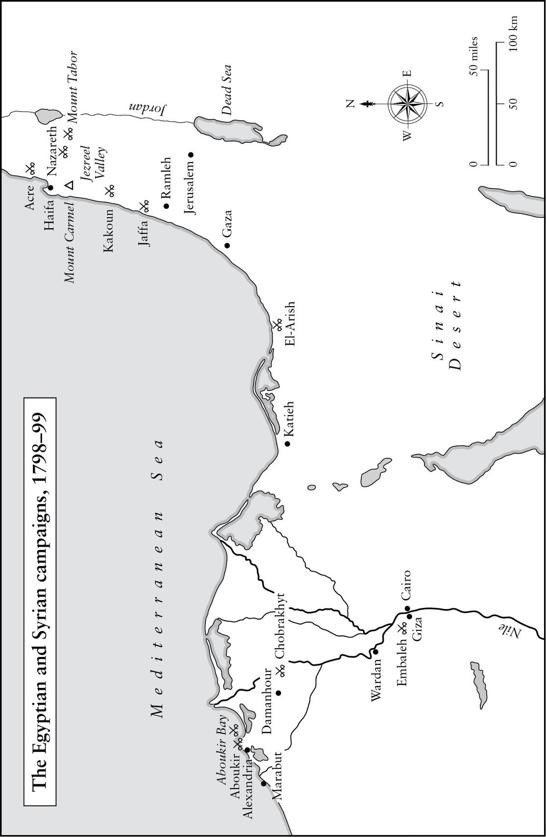
Leaving the fleet harboured in Aboukir Bay with orders that it be moored close enough to the land to be protected from attack, Napoleon set off for Cairo at 5 p.m. on July 7 and marched through the moonlit night. It was the first desert crossing by a modern Western army. They reached the first stop on the 150-mile road to Cairo, the town of Damanhour, at eight o’clock the next morning. Thereafter his men marched during the day, which they loathed to do because of the heat, the racking thirst, the flies, mosquitoes, snakes and scorpions, the swirling sandstorms and hostile Mamluks and Bedouin Arab tribesmen riding on their flanks ready to kill stragglers. Many of the wells and cisterns along the way had been poisoned or filled with stones. Berthier recalled that water sold for the same weight as gold on that march. One particular problem was trachoma (granular conjunctivitis or ‘Egyptian’ ophthalmia) whereby the scorching sunshine caused a roughening of the inside of the eyelids, which left at least two hundred men blinded.25The young artillery staff lieutenant Jean-Pierre Doguereau never forgot how hard it was to move cannon in the soft sand, where they could sink up to their axles. ‘Well, general, are you going to take us to India like this?’ shouted a soldier at Napoleon, only to receive the reply: ‘No, I wouldn’t undertake that with soldiers such as you!’26
Morale suffered badly in the desert. ‘It would be difficult to describe the disgust, the discontent, the melancholy, the despair of that army, on its first arrival in Egypt,’ wrote the contemporary historian Antoine-Vincent Arnault. Napoleon even saw two dragoons rush out of the ranks and drown themselves in the Nile.27 Captain Henri Bertrand, a talented engineer who became a colonel during this campaign, saw generals as distinguished as Murat and Lannes ‘throw their laced hats in the sand, and trample on them’.28The soldiers’ major gripe was that in the entire seventeen-day march from Alexandria to Cairo there was no bread and ‘nor a drop of wine’ and, as Boyer told Kilmaine, ‘We were reduced to living on melons, gourds, poultry, buffalo meat and Nile water.’29
At 8 a.m. on July 13, Mamluks attacked Napoleon’s camp at Chobrakhyt (also known as Chebreis) on the riverbank. Murad Bey, a tall, scarred Circassian who had co-ruled Egypt for years with Ibrahim Bey, attacked with around 4,000 men. Napoleon formed battalion squares, with cavalry and baggage inside, which the Mamluks merely circled on horseback. They looked magnificent in colourful costumes, medieval armour and riding fine horses, but Boyer was unimpressed with the way they ‘straggled round and round our army, like so many cattle; sometimes galloping, and sometimes pacing in groups of ten, fifty, one hundred etc. After some time, they made several attempts, in a style equally ridiculous and curious, to break in upon us.’30 Napoleon’s aide-de-camp Sulkowski used the same word, saying ‘against a disciplined army it was only ridiculous’.31 Armed with javelins, axes (which they sometimes threw), scimitars, bows and arrows and antiquated firearms, the Mamluks were no match for trained volleys of musketry. When he had lost around three hundred men, Murad rode off. It was a useful encounter for Napoleon, giving him a chance to practise tactics he later put to good use. He told the Directory about ‘a new kind of warfare, requiring much patience compared with the usual French impetuosity’, one that relied on steadiness in defence.32 The encounter did nothing to dent Mamluk hubris. ‘Let the Franks come,’ said one bey, possibly Murad himself, ‘we will crush them beneath our horses’ hooves.’33(Another version was: ‘I will ride through them and sever their heads from their bodies like watermelons.’34)
• • •
On July 19, while they were at Wardan on the way to Cairo, Junot confirmed what Napoleon might have already have suspected: that Josephine had been having an affair with Hippolyte Charles. (Although Joseph Bonaparte had long known it, he seems not to have told his brother at the time of their fraught interview with her.) Junot now showed Napoleon evidence in the form of a letter – we don’t know who it was from, and no post had been received since landing – and added that his cuckolding was the talk of Paris.35 It is a mystery why Junot chose that particular time and place to confront Napoleon. Charles had played a joke on him, gluing his sword into its scabbard, but that had been months earlier.
‘I have a great, great deal of domestic sorrow as now the veil has been completely lifted,’ Napoleon wrote to Joseph six days later. ‘Only you remain there for me on this earth. Your friendship is very precious to me: I have only to lose it and see you betray me for me to become a misanthrope . . . it is my sad condition to have all these feelings for the same person in one heart alone. You understand me!’36 This letter – which recalls parts of Clisson’s final letter to Eugénie – was intercepted by the Royal Navy on its way to France. Part of it was published, but not enough to make it clear to what Napoleon was alluding.37
Bourrienne states that Napoleon intended to divorce Josephine when he returned to France. Napoleon wrote again to Joseph to say, ‘Please try to arrange a country dwelling for me when I arrive, either near Paris or in Burgundy, I intend to confine myself there for the winter. I am so tired of human nature! I need solitude and isolation, grandeur has harmed me; my feelings have dried up.’38 No letters from Napoleon to Josephine survive from the Egyptian campaign, which some historians have taken to mean they were lost or destroyed, but a much more likely explanation is that he simply didn’t write any. The next surviving letter is dated May 11, 1800, by which point he called her, more sedately, ‘ma bonne amie’.39
To Napoleon’s understandable embarrassment, the British government published annual books of intercepted correspondence, covering 1798, 1799 and 1800. In order to underline what the editors gleefully called the ‘miseries and disappointments’ of his army, they reprinted letters from, among many others, Napoleon himself, Louis Bonaparte, Tallien, Bourrienne, Desgenettes, Menou, Boyer, Dumas, Brueys and Lasalle. (The last, perhaps the most dashing hussar in the army, wrote to his mother complaining that his hair was falling out due to ‘my total want of powder and pomatum’.40) Writing to their friends, families and mistresses, they were honest and, except for Napoleon, uniformly wanted to come home as soon as possible from a country that several described as ‘pestilential’. The collection included letters from Napoleon to Joseph complaining about Josephine’s profligacy – though that was hardly a state secret – and from Eugène to Josephine ‘expressing his hopes that his dear Mamma is not as wicked as she is represented!’ Rear-Admiral Jean-Baptiste Perrée, commander of the Nile flotilla, wrote to a friend: ‘The beys have left us some pretty Armenian and Georgian wenches, whom we have confiscated to the profit of the nation.’41
• • •
On July 21 Murad Bey appeared again, this time with 6,000 Mamluks and 54,000 Arab irregulars, many of them mounted, at the town of Embaleh on the left bank of the Nile.42 The Great Pyramid of Cheops at Giza, the tallest building in the world until the twentieth century, was clearly visible nearly 9 miles away, and Napoleon referred to it in his pre-battle Order of the Day: ‘Soldiers! You came to this country to save the inhabitants from barbarism, to bring civilization to the Orient and subtract this beautiful part of the world from the domination of England. From the top of those pyramids, forty centuries are contemplating you.’43* Napoleon often said thereafter that ‘of all the objects that had impressed him in his life, the pyramids of Egypt and the size of the giant Frion [the tallest man in France] were those that had most astonished him’.44 The reference to England, which had no plans whatever to interfere in Egypt’s affairs or in any way benefited from Egypt, was entirely hyperbolic, but it presumably went down well with the troops.
Napoleon formed his 20,000 men into five division-sized squares with artillery at each corner and the baggage, cavalry and savants inside. The men had quenched their thirst in watermelon fields, and were ready. They knew that if they pointed their bayonets at the Mamluk horses’ heads, in the words of one officer, ‘the horse rears up, unseating his rider’.45 The Mamluks attacked Desaix’s and Reynier’s divisions first, which, according to Boyer, ‘received them with steadiness, and at the distance of only ten paces opened a running fire upon them . . . Then they fell upon Bon’s division, which received them in the same manner. In short, after a number of unavailing efforts, they made off.’46 The battle of the Pyramids was over in two hours. Dommartin’s aide-de-camp Jean-Pierre Doguereau kept a journal of the campaign, in which he recalled that many of the Mamluks ‘threw themselves into the Nile; firing at the thousands of heads appearing above the water continued for a long while; all their cannon were captured by us. The enemy losses were considerable.’47
Many of the three hundred French casualties were due to friendly fire between the squares rather than to the Mamluks, who lost twenty guns, four hundred camels and all their equipment and baggage. Because the Mamluks traditionally went into battle carrying their life savings, a single corpse could make a soldier’s fortune. After the battle, the victorious French measured out gold coins by the hatful. ‘Our brave men were amply compensated for the trouble they had experienced,’ was how Berthier put it in his report to the war ministry, printed in Le Moniteur. Napoleon won the soubriquet ‘Sultan Kebir’ (Lord of Fire) from the Egyptians as Murad fled to Upper Egypt, where Desaix was despatched in pursuit. After one of Desaix’s victories there, the corpses of drowned Mamluks were fished out of the Nile to be picked over.
The day after the battle Napoleon entered Cairo, a city of 600,000 inhabitants, the same size as Paris and easily the largest in Africa. He set up headquarters in the house of Elfey Bey in Ezbekyeh Square and immediately started issuing orders for reforms. Each of Cairo’s sixteen districts was to receive its own diwan (council) made up of local dignitaries who would then send a representative to a Grand Diwan, under the presidency of the pro-French Sheikh al-Sharqawi. Napoleon accorded the diwans some powers over justice and administration, hoping they might eventually ‘accustom the Egyptian notables to the ideas of assembly and government’. His meetings with the Grand Diwan appear to have been jolly: one Muslim historian records that Napoleon was ‘cheerful and sociable with the gathered people and used to joke with them’.48 By direct decree Napoleon established a postal system, street lighting and cleaning, a coach service between Cairo and Alexandria, a mint and a rational tax system with lower impositions on the Egyptian fallaheen (peasantry) than the Mamluks’ extortionary demands. He also abolished feudalism, replacing it with rule by the diwans, set up a new French trading company, built modern plague hospitals and produced Egypt’s first printed books (in three languages). None of these reforms were undertaken on orders from the Directory, who were unable to get messages through; they were entirely on Napoleon’s initiative.
• • •
When he invaded Egypt, Alexander the Great visited the Temple of Amon at Siwah in 332 BC to consult the great oracle there. Napoleon considered it ‘a great stroke of policy’ and said, ‘It enabled him to conquer Egypt.’49 As Egypt had been Muslim since the seventh century, Napoleon felt it would be wise to embrace Islam as much as possible, although he never went so far as the general he called ‘that fool Menou’, who married an Egyptian, converted to Islam and took on the middle name Abdallah. (Marmont asked him whether he ‘intended, in the customs of the country’, to practise polygamy as well; Menou indicated not.50) Asked two decades later whether he had ever truly embraced Islam, Napoleon laughingly replied: ‘Fighting is a soldier’s religion; I never changed that. The other is the affair of women and priests. As for me, I always adopt the religion of the country I am in.’51
Napoleon respected Islam, regarding the Koran as ‘not just religious; it is civil and political. The Bible only preaches morals.’52 He was also impressed by the way that the Muslims ‘tore more souls away from false gods, toppled more idols, pulled down more pagan temples in fifteen years than the followers of Moses and Christ had in fifteen centuries’.53* He had no objection to polygamy, saying that Egyptian men were gourmands en amour, and, when permitted, ‘will prefer having wives of various colours’.54* His flattery of the ulama (clergy), his discussions of the Koran, and his holding out the possibility of his conversion to Islam – as well as his attempts to impress the sheikhs with French science – were all intended to establish a collaborationist body of Egyptians, with mixed results. As it turned out, no amount of complying with Islamic ceremonies, salutations and usages prevented Selim III from declaring jihad against the French in Egypt, meaning that any attacks upon them were thenceforth blessed.
Napoleon used to joke regularly about how close he had come to embracing Islam. On Elba he ‘described humorously’ to a British MP his theological discussions with the imams and how he procured, ‘after many meetings and grave discussions at Cairo, a dispensation from being circumcised and a permission to drink wine, under the condition of their doing a good deed after each draught’.55 He said that after being excused adult circumcision – or being ‘cut about’ as he put it – he agreed to pay for the building of a mosque (a cheap price under the circumstances).56 This story grew in the telling, and historians have subjected anecdotes like these to intense analysis and found them exaggerated, concluding that Napoleon was a compulsive liar. But who hasn’t embroidered the details of a good story to improve its effect?
Of course a good deal of real lying was going on too, in the propaganda sheets that Napoleon set up in Egypt, echoing those of the Italian campaign. Le Publiciste reported that the Copts sang hymns in honour of ‘the new Alexander’.57 The Courrier de l’Egypte, published for the troops, claimed that he ‘was close to being talked of as a successor to Mohammed’.58 One Order of the Day featured a verbatim report of a conversation between Napoleon and three imams, one called Mohammed, which took place after he had climbed the Great Pyramid and seen the Sphinx (whose nose was not shot off by French artillery, as one myth alleged). Even the briefest extract shows it to have been beyond satire:
BONAPARTE: Honour to Allah! Who was the calif who opened this pyramid and disturbed the ashes of the dead?
MOHAMMED: They think it was the Commander of the Faithful, Mahmoud . . . Others say it was the renowned [ninth-century ruler of Baghdad] Haroun al-Raschid in quest of treasure; but he found only mummies.
BONAPARTE: Bread stolen by the wicked fills the mouth with gravel.
MOHAMMED (inclining): That is the observation of wisdom.
BONAPARTE: Glory to Allah! There is no other God but God; Mohammed is his prophet, and I am one of his friends . . .
SULIMAN: Salutations also to you, invincible general, favourite of Mohammed!
BONAPARTE: Mufti, I thank you. The Koran delights my mind . . . I love the prophet, and intend to visit and honour his tomb in the Sacred City. But my mission is first to exterminate the Mamluks.
IBRAHIM: May the angels of victory sweep the dust from your path and cover you with their wings . . . O most valiant amongst the sons of Jesus, Allah has caused you to be followed by the exterminating angel, in order to deliver the land of Egypt.59
There was a good deal more in this vein, in the course of which Napoleon referred to ‘the Great Sultan our ally whom God surround with glory’. This might have surprised Selim, who was at that moment raising two armies to expel the French from Egypt. He then quoted the Prophet Mohammed – ‘who passed through all the heavens in a night’ – from memory, and came out with such lines as ‘Evil, thrice evil, to those who search for perishable riches, who covet gold and silver, which resemble dross.’60
Napoleon enjoyed all this mummery, and possibly the imams did too, but it was a serious attempt to elicit support from the Egyptians. When one of them, Suliman, said that he had treated the Pope ‘with clemency and kindness’, Napoleon retorted that His Holiness had been wrong to condemn Muslims to eternal hellfire. His reading of the Koran had led him to believe that ‘the will of Mohammed’ was for Egyptians to join the French in annihilating the Mamluks, and that the Prophet favoured ‘trade with the Franks’, supported their efforts to reach Bramah (that is, India), wanted the French to have depots in Egyptian ports, and apparently also wanted Egyptians to ‘drive out the islanders of Albion, accursed among the sons of Jesus’. For this, Napoleon promised, ‘the friendship of the Franks will be your reward until you ascend to the seventh heaven and sit beside black-eyed houris, always young and always maidens’.61
The three most important Arab witnesses of the French occupation were the historians Abd al-Rahman al-Jabarti, Hasan al-Attar and Niqula Turk. Al-Jabarti felt that the invasion was God’s punishment on Egypt for ignoring Islamic principles. He saw the French as the new Crusaders, but made no secret of his admiration for French weaponry, military tactics, medical advances, scientific achievements and interest in Egyptian history, geography and culture. He enjoyed his interaction with the savants and was impressed by Napoleon’s lack of ostentation and the way that on his journey to Suez he took engineers and Muslim merchants with him instead of cooks and a harem. Yet still he saw him as a rapacious, untrustworthy, atheistic beast, and was delighted when jihad was declared against the infidels.62
The Revolution’s principle of equality offended against much of the Koran, yet al-Jabarti appreciated how well the French treated local workers in their building projects, and he followed their chemical and electrical experiments with interest. He was unimpressed that French soldiers failed to haggle successfully in the souks, thinking it a way of ingratiating themselves with the populace, and was disgusted by the way the French dhimmis (infidel) allowed ‘the lowliest Copts, Syrian and Orthodox Christians, and Jews’ to ride horses and carry swords, in transgression of Islamic law.63
Al-Jabarti’s friend Hasan al-Attar, by contrast, was so fearful of being seen as a collaborator that he refused the savants’ invitations to visit their library and laboratories. Niqula Turk described Napoleon as ‘short, thin and pale; his right arm was longer than his left, a wise man and a fortunate person’.64 (There is no indication he was correct about the relative length of Napoleon’s arms.) Turk added that many Muslims assumed that Napoleon was the Mahdi (Guided One) who was expected to redeem Islam, and many more would have done so had he appeared in Middle Eastern rather than Western clothing. It was a surprising oversight. Napoleon wore a turban and baggy trousers only once, when it provoked laughter among his staff. Years later he told a courtier’s wife that since the hitherto Protestant Henri IV thought it was worth converting to Catholicism for the sake of ruling France, ‘Do you not think the Empire of the East, and perhaps the subjection of the whole of Asia, were not worth a turban and loose trousers?’, adding that the army ‘would undoubtedly have lent itself to this joke’.65
Napoleon was impressed with the healthy climate and fertile countryside in the regions adjoining the Nile, but contemptuous of its ‘stupid, miserable and dull-witted’ people. He described Cairenes to the Directory, only one day after arriving there, as ‘the most evil population in the world’, without explaining why. Ignorance reigned in the rural areas: ‘They would rather have a button off our soldiers than a six-franc écu. In the villages they don’t even have any idea what scissors are.’66 He was shocked that the country had no watermills and only one windmill, and that otherwise grain was milled between stones turned by cattle. The army hated Egypt because, as he later put it, unlike in Italy there was ‘no wine, no forks, and no countesses to make love to’.67 (He meant no local wine; in December he ordered Marmont to sell 64,000 pints of the wine he had brought from France, writing: ‘Take care to sell only the wine that looks as if it might be going off.’68)
• • •
When Napoleon reached Cairo he sent orders to Admiral Brueys to sail the fleet to Corfu, where it would be better protected and able to threaten Constantinople. But by the time his messenger reached Aboukir Bay, there was no fleet: it had been sunk on August 1 after an exceptionally daring attack by Admiral Nelson. Brueys himself had been killed when L’Orient exploded at 10 p.m. Two ships-of-the-line were destroyed, including L’Orient, and nine were captured; only four ships under Rear-Admiral Pierre de Villeneuve escaped. After spending two weeks at Aboukir convalescing from a wound to his forehead, Nelson sailed to Naples, leaving the Egyptian coast under close watch. ‘If, in this disastrous event, he made mistakes,’ Napoleon later wrote generously of Brueys, ‘he expiated them by a glorious death.’69
‘I feel your pain deeply,’ he wrote in a heartfelt letter to Brueys’ widow. ‘The moment that separates us from the object we love is terrible; it isolates us from the earth; the body feels convulsions of agony. The faculties of the soul are changed; it only communicates with the universe through a nightmare that distorts everything.’70 This was only a month after he had been informed of Josephine’s adultery, and one has to imagine that he had her in mind. To the Directory he wrote more clinically, characteristically distorting the figures, that there had been an ‘inconsiderable’ number killed and eight hundred wounded in the battle, whereas in fact the numbers were 2,000 and 1,100 respectively (against 218 British killed and 678 wounded).71
‘It seems you like this country,’ Napoleon told his staff at breakfast on August 15, the morning after he heard the news, ‘that’s very lucky, for now we have no fleet to carry us back to Europe.’72 In addition to cutting him off from France, with all the problems that implied, the Aboukir Bay catastrophe left Napoleon with a pressing cash-flow problem, since the Maltese ‘contribution’, estimated at 60 million francs, had gone down with L’Orient. But he refused to accept what he called ‘this reverse’ as evidence that Fortune had forsaken him. ‘She has not abandoned us yet, far from it,’ he told the Directory, ‘she has served us during this entire operation beyond anything she has ever done.’73 He even told Kléber the disaster might be beneficial, as the British were now forcing him to consider marching on to India: ‘They will perhaps oblige us to do greater things than we proposed to perform.’74
While Napoleon did what he could to woo the local populace, he made it clear that he would brook no disobedience. On August 1, in one of eight letters sent that day to Berthier, he insisted that exemplary punishments be meted out to the rebellious town of Damanhour, including beheading the five most influential inhabitants, at least one of whom must be a lawyer. But harshness was generally tempered with encouragement. When he discovered that the imams of Cairo, Rosetta and elsewhere were not intending to celebrate the Prophet’s birthday that year, pleading lack of funds and the unstable political situation – but really indicating to the faithful that, in Denon’s phrase, the French were ‘opposed to one of the most sacred acts of their religion’ – Napoleon insisted that France would pay for everything, despite his shortage of funds.75 The celebrations started on August 20 and lasted three days, with coloured lanterns on poles, processions to mosques, music, poetry-chanting, sideshows featuring bears and monkeys, magicians who made live snakes disappear, and illuminated representations of the Prophet’s tomb in Medina. Even the former erotic novelist Denon was shocked by the lewdness of the dances performed by some of the male dancers. On the Prophet’s birthday itself, French artillery fired salutes and a regimental band joined the throngs, as the French officers were presented to a cleric, Sayyid Khalil al-Bakri, whom Napoleon decided to declare the most senior of Mohammed’s descendants. At a feast of one hundred clerics at which the French were allowed to drink wine, Napoleon was declared a son-in-law of the Prophet with the name ‘Ali-Bonaparte’. The Egyptians were humouring him and he them; as one French officer recalled: ‘The soldiers were politic in their expressions; when they returned to their quarters they laughed at the comedy.’76
• • •
On the last day of the celebrations, Napoleon inaugurated the Institut d’Égypte, with Monge as its president, and himself vice-president. Its headquarters in Qassim Bey’s former palace on the outskirts of Cairo were large enough to house the Institut’s library, laboratories, nine workshops, an antiquarian collection and menagerie; the hall where the mathematics seminars were held was the former harem. Nicolas Conté, the chief balloonist, was put in charge of the workshops, which among much else produced spare parts for windmills, clocks and the printing press. After Desaix’s conquests in Upper Egypt, various stones and treasures were taken to Cairo, Rosetta and Alexandria intended for the Louvre, as soon as ships arrived that could transport them.
The Institut was divided into four sections – mathematics, physics, political economy and the arts – and met every five days. At its opening session Napoleon suggested very practical subjects as topics for its consideration, such as how the army’s baking could be improved; was there any substitute for hops in the brewing of beer; could Nile water be made drinkable; were watermills or windmills better for Cairo; could Egypt produce gunpowder; and what was the state of Egyptian law and education? He also wanted thesavants – who had their own newspaper, La Décade Égyptienne – to teach Egyptians the benefits of wheelbarrows and handsaws. Yet not all the savants’ activities and deliberations were connected to commerce and colonization: there were few practical applications for the studies they undertook of Egyptian flora and fauna, ancient sites, geology and mirages.
Napoleon tried to use Enlightenment science and reason to win over the Egyptians and even suggested the construction of an astronomical observatory.77 The French made full use of their printing press, medical instruments, telescopes, clocks, electricity, balloons and other modern wonders to try to awe them, which al-Jabarti readily admitted did ‘baffle the mind’, but none of it appears to have advanced their cause politically. (When Berthollet demonstrated a chemical experiment at the Institut, a sheikh asked whether it could enable him to be in Morocco and Egypt at the same time. Berthollet replied with a Gallic shrug, which led the sheikh to conclude: ‘Ah well, he isn’t such a sorcerer after all.’78)
On the day he opened the Institut, Napoleon wrote to Talleyrand – whom he believed to have honoured his commitment to go to Constantinople – to say that Egypt would soon be sending rice to Turkey and protecting the pilgrims’ route to Mecca.* That same day he sent a senior staff officer, Colonel Joseph Beauvoison, to the Holy Land to try to open negotiations with Ahmed Jezzar, the pasha of Acre (discouragingly nicknamed ‘The Butcher’), an enemy of the Mamluks and a rebel against the Turks. Jezzar specialized in maiming and disfiguring people, but also in devising horrific tortures such as having his victims’ feet shod with horseshoes, walling up Christians alive and stripping corrupt officials naked before having them hacked to death.79 He killed seven of his own wives, but his hobby was cutting flower shapes out of paper and giving them to visitors as presents. Now that Ibrahim Bey had been forced out of Egypt into Gaza, Napoleon hoped he and Jezzar might destroy him together. Jezzar refused to see Napoleon’s envoy Beauvoison and instead made peace with the Ottomans. (Beauvoison was fortunate; Jezzar sometimes beheaded unwelcome messengers.)
• • •
Napoleon had intended to return to France once the conquest of Egypt was secure, but on September 8 he wrote to the Directory (like all his correspondence, this letter had to run the gauntlet of the Royal Navy in the Mediterranean): ‘I can’t possibly return to Paris in October, as I promised, but the delay will last only a few months. All is going on well here; the country is subdued, and is becoming accustomed to us. The rest must be the work of time.’80 Yet again he was misleading the Directory: the country was certainly not ‘becoming accustomed’ to French rule. Much of his correspondence refers to the beheadings, hostage-taking and village-burning that the French had to employ to secure its presence.* Napoleon was content with the army’s clothing and payment, however, and in a letter to Barras all he could think of asking for was a troupe of actors to entertain his soldiers.81
On October 20 Napoleon learned that a Turkish army was gathering in Syria to attack him. He needed to move against it but that night minarets across Cairo rang out with a call for a general uprising against French rule, and by the next morning much of the city was in open revolt. General Dominique Dupuy, the city’s governor, was lanced to death in the street and Sulkowski was killed with fifteen of Napoleon’s personal bodyguard, whose bodies were subsequently fed to dogs.82 (Of Napoleon’s eight aides-de-camp who went to Egypt, four died and two were wounded, including Eugène at the siege of Acre.) Several boats were sunk on the Nile during the uprising, and overall about three hundred Frenchmen were killed, not the fifty-three that Napoleon later claimed to the Directory.83 The rebels took over the Gama-el-Azhar Grand Mosque, one of the largest in the city, as their headquarters. A rumour spread that it was Napoleon himself who had been killed rather than Dupuy, which inflamed the rebellion almost as much as theulama had, so (as Bourrienne recalled), ‘Bonaparte immediately mounted his horse and, accompanied by only thirty guides, advanced on all threatened points, restored confidence, and, with great presence of mind, adopted measures of defence.’84
Napoleon’s most important objective was to retain the Cairo citadel, which then as now commands the city with its high elevation and 10-foot-thick walls. Once secured, the height allowed Dommartin to use his 8-pounder guns to shell enemy positions over thirty-six hours; he did not hesitate to put fifteen cannonballs into the Grand Mosque, which was later stormed by infantry and desecrated. Over 2,500 rebels died and more were executed in the citadel afterwards. Years later, Pierre-Narcisse Guérin painted Napoleon forgiving the rebels, which he did not do until a long time afterwards.85 At the time he ordered that all rebels captured under arms should be beheaded and their corpses thrown into the Nile, where they would float past and terrorize the rest of the population; their heads were put in sacks, loaded on mules and dumped in piles in Ezbekyeh Square in central Cairo.86 ‘I cannot describe the horror,’ recalled an eyewitness, ‘but I must confess that it had the effect for a considerable time of securing tranquillity.’87 Napoleon wrote to Reynier on October 27: ‘Every night we cut off thirty heads’, and Lavalette described how the Egyptian police chief ‘never went out but accompanied by the hangman. The smallest infraction of the laws was punished by blows on the soles of the feet’, a technique known as the bastinado, which was especially painful because of the large number of nerve-endings, small bones and tendons there and was even meted out to women.88 These brutal measures ensured that, unlike the zealots, ordinary Cairenes did not rise up en masse against the French, who could not have resisted 600,000 people. Once the revolt was over, on November 11, Napoleon abolished the bastinado for interrogations. ‘The barbarous custom of having men beaten who are suspected of having important secrets to reveal must be abolished,’ he ordered Berthier. ‘Torture produces nothing worthwhile. The poor wretches say anything that comes into their mind that the interrogator wishes to hear.’89
• • •
By November 30 Cairo had sufficiently returned to normality to allow Napoleon to open the Tivoli pleasure gardens, where he noticed an ‘exceedingly pretty and lively young woman’ called Pauline Fourès, the twenty-year-old wife of a lieutenant in the 22nd Chasseurs, Jean-Noël Fourès.90 If the beautiful round face and long blonde hair described by her contemporaries are indeed accurate, Lieutenant Fourès was unwise to have brought his wife out on campaign. It was six months since Napoleon had discovered Josephine’s infidelity and within days of his first spotting Pauline they were having an affair. Their dalliance was to take on the aspect of a comic opera when Napoleon sent Lieutenant Fourès off with allegedly important despatches for Paris, generally a three-month round-trip, only for his ship to be intercepted by the frigate HMS Lion the very next day. Instead of being interned by the British, Fourès was sent back to Alexandria, as was sometimes the custom with military minnows. He therefore reappeared in Cairo ten weeks before he was expected, to find his wife installed in the grounds of Napoleon’s Elfey Bey palace and nicknamed ‘Cleopatra’.91
According to one version of the story, Fourès threw a carafe of water on her dress in the subsequent row, but another has him horsewhipping her, drawing blood.92 Whichever it was, they divorced and she thereafter became Napoleon’s maîtresse-en-titre in Cairo, acting as hostess at his dinners and sharing his carriage as they drove around the city and its environs. (The deeply chagrined Eugène was excused from duty on those occasions.) The affair deflected charges of cuckoldry from Napoleon, which for a French general then was a far more serious accusation than adultery. When Napoleon left Egypt he passed Pauline on to Junot, who, when injured in a duel and invalided back to France, passed her on to Kléber. She later made a fortune in the Brazilian timber business, wore men’s clothing and smoked a pipe, before coming back to Paris with her pet parrots and monkeys and living to be ninety.93
• • •
Napoleon’s decision to embark on what was called his Syrian campaign – though he never set foot in present-day Syria and stayed entirely within the bounds of modern Gaza, Israel and the West Bank – was presaged by his threat to Jezzar on November 19: ‘If you continue to offer refuge to Ibrahim Bey on the borders of Egypt, I will look on that as a mark of hostility and go to Acre.’94 Jezzar responded in early December by occupying the Ottoman provinces of Gaza, Ramleh and Jaffa and taking up position at El-Arish, only 22 miles from Napoleon’s Egyptian fort at Katieh on the edge of the Sinai desert, declaring that he was going to liberate Egypt from the French.
Napoleon visited Suez in late December, both to inspect fortifications and to trace the route of Ramses II’s canal connecting the Nile to the Red Sea, following it for 40 miles until it disappeared into the desert sands. (Little could he have guessed that his own nephew would be involved in building its successor in 1869.) He also announced his wish to visit Mount Sinai ‘through respect for Moses and the Jewish nation, whose cosmology retraces the earliest ages’.95 Berthier, Caffarelli, Dommartin, Rear-Admiral Honoré Ganteaume (whose survival of the battle of the Nile was, according to Napoleon, its sole commiseration), the chief ordonnateur Jean-Pierre Daure, Monge and four other savants came with him, as well as his guides.96 ‘We travelled fast,’ recalled Doguereau, ‘the commander-in-chief left Cairo at the gallop, and we urged our horses on at full speed so that they arrived out of breath.’97
It was on this sightseeing trip from Suez into Sinai (he never reached Mount Sinai itself) on December 28 that Napoleon appears to have come as close to death as he ever did in any of his battles, after taking advantage of the low tide to cross a section of the Red Sea.* ‘We reached the far shore without difficulty,’ stated Doguereau, and the party visited the so-called Spring of Moses and other antiquarian sites, but having lunched and watered the horses at the Nabah wells, they got lost as night fell and wandered through the low-lying marshy sea-shore as the tide rose:
Soon we were bogged down up to the bellies of our mounts, who were struggling and having great difficulty in pulling themselves free . . . After a thousand problems and having left many horses trapped in the bog, we reached another arm of the sea . . . It was nine at night and the tide had already risen three feet. We were in a terrible situation, when it was announced that a ford had been found. General Bonaparte was among the first to cross; guides were situated at various places to direct the rest . . . We were only too happy not to have shared the fate of Pharaoh’s soldiers.98