
6
‘Winning is not enough if one doesn’t take advantage of success.’
Napoleon to Joseph, November 1808
‘In my opinion the French do not care for liberty and equality, they have but one sentiment, that of honour . . . The soldier demands glory, distinction, rewards.’
Napoleon to the Conseil d’État, April 1802
‘Everything leads me to believe that the time for peace is now upon us and we must make it when we have the chance to dictate the conditions, provided they are reasonable,’ Napoleon wrote to Paris on April 8, 1797.1 The negotiations with what he called ‘this insolent and arrogant court’ began on April 15, with the Austrian plenipotentiary the Marquis de Gallo pedantically demanding that the pavilion where they were to take place be officially declared neutral ground. Napoleon happily conceded the point, explaining to the Directory that ‘this neutral ground is surrounded on all sides by the French army, and is in the middle of our tents’.2 When Gallo offered to recognize the existence of the French Republic, Napoleon told him that it ‘did not require or desire recognition. It is already as the sun on the horizon in Europe: too bad for those who do not wish to see it and derive the benefit of it.’ Gallo persevered, clearly thinking he was making a concession when he said that Austria would recognize it ‘on condition that the Republic preserved the same etiquette as did the King of France’. This allowed Napoleon to make the irreproachably republican remark that since the French ‘were completely indifferent to everything concerning etiquette, it wouldn’t matter to us to adopt the article’.3
Napoleon believed his hand would be considerably strengthened if only Generals Moreau and Hoche would cross the Rhine. ‘Ever since history has commenced to chronicle military operations,’ he told the Directory on April 16, ‘a river has never been considered a serious obstacle. If Moreau wishes to cross the Rhine, he will cross it . . . The armies of the Rhine can have no blood in their veins.’4 If French troops were on Austrian soil, he said forcefully, ‘we should now be in a position to dictate peace in an imperious manner’. In fact Hoche did cross on April 18, the very day the preliminaries were signed, followed by Moreau two days later. They then discovered to their great chagrin that they would have to halt their armies while their rival negotiated the peace.
Napoleon adopted an equally imperious manner in dealing with a threat that seemed to be arising from the ancient city-state of Venice, which was keen to guard its independence but hadn’t the armies to ensure it. On April 9 he wrote to Doge Ludovico Manin demanding that Venice choose between war and peace. ‘Do you suppose,’ he said, ‘that because I’m in the heart of Germany I’m powerless to cause the first nation in the universe to be respected?’5 Although the French did have some legitimate complaints against Venice – which leaned towards Austria, was arming rapidly and had opened fire on a French frigate in the Adriatic – Napoleon was undoubtedly bullying the state when a few days later he sent Junot to demand a reply within twenty-four hours to his letter. Matters got far worse on April 17 when Verona, part of the Venetian Republic that clearly hadn’t learned the lessons of Pavia, Binasco and Modena, staged an uprising in which between three and four hundred Frenchmen, many of them wounded soldiers in hospital in the city, were massacred.
‘I will take general measures for all the Venetian mainland,’ Napoleon promised the Directory, ‘and I will issue such extreme punishments that they won’t forget.’6 Bourrienne later recorded that, on hearing of the insurrection, Napoleon said, ‘Be tranquil, those rascals will pay for it; their republic has had its day.’7 At 2 a.m. on Wednesday, April 19, 1797 – although it carried the official date of the previous day – Napoleon signed the Preliminaries of Leoben. That it was he rather than a plenipotentiary from Paris who negotiated and signed the document was a significant indication of how the balance of power with the Directory had tipped in his favour. This was not the final comprehensive peace treaty between France and Austria, which wasn’t to be signed until October at Campo Formio, but Napoleon would negotiate that too. Under the terms of Leoben, Austria ceded the duchies of Milan and Modena as well as the Austrian Netherlands to France. Austria agreed to recognize ‘the constitutional limits’ of France – which the French considered to extend to the Rhine – while France recognized the integrity of the rest of Francis’s empire. Secret clauses forced Austria to renounce all her Italian possessions west of the Oglio river to the Cispadane Republic, but in compensation she would receive all the mainland territories of Venice east of the Oglio, as well as Dalmatia and Istria, while Venetian lands west of the Oglio would also go to France. Napoleon was simply assuming that he would be in a position to dispose of Venetian territory before the treaty was ratified.
Outwardly it looked as though Austria had done well, since the left bank of the Rhine was to be agreed at a future date and the territorial integrity of Austria itself was respected. Defending his negotiations, Napoleon told the Directory that Bologna, Ferrara and Romagna ‘will always remain in our power’, because they were ruled over by France’s sister-republic based in Milan. Less persuasive was his argument that ‘By ceding Venice to Austria the Emperor will be . . . obliged to be friendly towards us.’ In the same letter he told the Directory bluntly that they had got everything wrong from the very start of the Italian campaign: ‘If I had persisted in marching on Turin, I should never have crossed the Po; if I had persisted in marching on Rome, I should have lost Milan; if I had persisted in marching on Vienna, I should perhaps have lost the Republic. The real plan for destroying the Emperor was the one I adopted.’ Napoleon’s next remarks must have sounded implausibly disingenuous: ‘As for myself . . . I have always considered myself as nothing in the operations I have directed, and I pushed on to Vienna after having acquired more glory than is necessary to be happy.’8 Asking for permission to return home, he promised: ‘My civil career shall resemble my military career by its simplicity.’ He was surely imagining himself as the ancient hero Lucius Quinctius Cincinnatus, who returned to his farm and plough after saving the Roman Republic, and since these were semi-public reports, the non-secret paragraphs of which were published in the Moniteur, it is likely that he wrote these lines as much for public consumption as for the enlightenment of ‘those scamps of lawyers’ in the Directory, who nonetheless approved the terms of Leoben by four to one, with only Jean-François Reubell – who thought the terms too harsh on Austria – opposing.
In the course of the negotiations, the Duke of Modena tried to bribe Napoleon with 4 million francs not to depose him. According to the not altogether reliable Bourrienne the Austrian negotiators, Gallo and General Count von Merveldt, even offered him a German principality, to which Napoleon replied: ‘I thank the Emperor, but if greatness is to be mine, it shall come from France.’9 At the time, Austria seemed to be content with the Leoben terms. Gallo’s only complaint was trivial, that he ‘wished it to be transcribed onto parchment and that the seals should be bigger’, which Napoleon duly accommodated.10
On April 20 the Venetians played directly into Napoleon’s hands by opening fire on and killing a French sea captain called Laugier after he had illegally moored his vessel near the powder-magazine on the Venetian Lido. This gave Napoleon the justification he needed for what he was going to do anyway: demand that Venice expel the British ambassador and pro-Bourbon French émigrés, hand over all British goods, pay a 20-million franc ‘contribution’ and arrest Laugier’s ‘assassins’ (who included a noble-born Venetian admiral). Napoleon ignored the doge’s promise of reparations for the Verona massacre, saying his envoys were ‘dripping with French blood’. Instead, he demanded the evacuation of Venice’s mainland territories, which he needed to have under his control before the secret Leoben clauses could come into effect. Meanwhile he encouraged revolts in Brescia and Bergamo, and on May 3 he declared war. The Verona massacre was punished by the payment of 170,000 sequins (around 1.7 million francs) from the city, and the confiscation of everything in its municipal pawnshop valued at more than 50 francs. There were garrottings and transportations to French Guiana in South America, where the revolutionary government had taken to sending its undesirables. Church plate was expropriated, as were pictures, collections of plants and even ‘seashells belonging to the city and private individuals’.11
Only ten days into his war with Venice, Napoleon inspired a coup d’état in the city. Using the secretary of the French legation, Joseph Villetard, to undermine the oligarchy there with threats of French retribution, the doge and senate – whose forefathers had once held the mighty Ottoman Empire at bay – meekly abolished themselves after 1,200 years as an independent state. They too tried to bribe Napoleon, this time with 7 million francs. He replied ‘French blood has been treacherously shed; if you could offer me the treasures of Peru – if you could cover your whole dominion with gold – the atonement would be insufficient: the lion of St Mark must lick the dust.’12 On May 16, 5,000 French troops under General Louis Baraguey d’Hilliers entered Venice as ‘liberators’ and the four bronze horses that may once have graced Trajan’s Arch in Rome were removed from the portico of the Basilica di San Marco and taken to the Louvre, where they remained until they were returned in 1815.
The treaty with the new pro-French puppet Venetian government stated that it should furnish three battleships and two frigates to the French navy, pay a ‘contribution’ of 15 million francs, provide twenty paintings and five hundred manuscripts, and hand over the mainland territories that France wanted to divide between the Cispadane Republic and Austria. In return, France offered professions of ‘eternal friendship’. All of this was done without the Directory’s involvement. At the start of the 1796 campaign, Napoleon had not been allowed to sign the armistice with Piedmont without the permission of Saliceti, who (though sympathetic to Napoleon) was nominally a commissioner of the Directory. Since then he had signed four major peace agreements on his own authority – with Rome, Naples, Austria and now Venice.
He was about to sign a fifth. On May 23 street fighting had broken out in Genoa between pro-French giacobini democrats and the forces of the Genovese doge and senate. The authorities prevailed, and documents were discovered revealing Saliceti and Faipoult’s part in fomenting the botched uprising. Napoleon was furious with the Genoese democrats for rising too early, but he used the excuse of the deaths of some Frenchmen to send his aide-de-camp Lavalette to cajole the Genovese government. Like their Venetian counterparts, they soon capitulated and Napoleon personally drew up a constitution for a new Ligurian Republic – again without any input from the Directory.* This was based on the French constitution of 1795 and introduced a bicameral legislature of 150 and 300 members respectively, religious liberty, civic equality and measures of local self-government, principles which reflected neither the strict Jacobinism of his earlier days, nor (as some contemporaries suggested) a Corsican spirit of vendetta against Genoa. Indeed, after the democrats had destroyed the statue of Genoa’s great hero, Andrea Doria, Napoleon admonished them, writing that Doria had been ‘a great sailor and a great statesman. Aristocracy was liberty in his day. The whole of Europe envies your city the honour of having produced that celebrated man. You will, I doubt not, take pains to rear his statue again: I pray you to let me bear a part of the expense which that will entail.’13
• • •
Napoleon’s main residence in the spring of 1797 was the palazzo of Mombello outside Milan, where he summoned Miot de Melito for discussions. Miot noted the grandeur of Napoleon’s daily life there. Not only did Napoleon bring his family to live with him – Madame Mère, Joseph, Louis, Pauline and his uncle Joseph Fesch in the first wave, with more to come – but he also introduced a quasi-courtly etiquette. Italian nobility appeared at his table instead of his aides-de-camp, dining took place in public as it had at Versailles under the Bourbons, and Napoleon betrayed a very un-republican taste for flunkeys. These were paid for out of a fortune that he himself stated amounted at that time to 300,000 francs. Bourrienne claimed it was more than 3 million francs – equivalent to the entire monthly pay of the Army of Italy. In either case, it suggests that it was not just his generals who had mulcted Italy.14
Miot claimed in his memoirs (largely written by his son-in-law General Fleischmann) that on June 1, 1797 Napoleon took him for a walk in the garden of Mombello, and said: ‘Do you believe that I triumph in Italy in order to aggrandize the pack of lawyers who form the Directory, for the likes of Carnot and Barras? What an idea! . . . I wish to undermine the Republican party, but only for my own profit . . . As for me, my dear Miot, I have tasted authority and I will not give it up.’ He is further reported to have said of the French: ‘Give them baubles – that suffices them; they will be amused and let themselves be led, so long as the end to which they are going is skilfully hidden from them.’15 Yet this whole cynical speech – which many historians have taken at face value – fails to ring true. Would so subtle a statesman as Napoleon simply have blurted out the extent of his (at that time treacherous) ambitions to undermine French republicanism to a public functionary like Miot de Melito, whose loyalty could not be known and who supposedly recalled the conversation perfectly decades later?16
It was at this time, with many of them under his eye at Mombello, that Napoleon began his persistent interference in the love-lives of his siblings. On May 5, 1797 the twenty-year-old Elisa married the Corsican noble Captain Felice Baciocchi, who thereafter found swift promotion in the army and ultimately became a senator and Prince of Lucca, sensibly ignoring her several infidelities. The next month, on June 14, under Napoleon’s similar encouragement and prompting, the seventeen-year-old Pauline married the twenty-five-year-old General Charles Leclerc, whom Napoleon had served with at Toulon and who had also fought at Castiglione and Rivoli. Napoleon knew that Pauline was in love with someone else at the time, whom their mother Letizia thought unsuitable, but he supported the nuptials regardless. He also encouraged the cavalryman Murat to court his other sister, Caroline, and they married in January 1800.
• • •
In Paris, the Directory was in a precarious position. With inflation out of control – shoes cost forty times more by 1797 than they had in 1790 – and paper money, assignats, trading at 1 per cent of its face value, politics were in a febrile state.17 Discontent with the government was evident on May 26, when the Marquis de Barthélemy, a constitutional royalist, became a Director after royalist gains in elections. The Directory now consisted of Barras and Carnot, the lawyers Reubell and Louis de La Révellière-Lépeaux, and Barthélemy, the first four of whom were regicides, although Carnot was now tacking strongly towards the more liberal, non-royalist moderates. Napoleon had not taken such a prominent part in saving the Republic at Vendémiaire only to see it replaced by royalists, so he sent Lavalette to Paris to observe political developments there. Lavalette found plots for the return of the Bourbons, one of which involved General Charles Pichegru, a former military instructor at Brienne and the conqueror of Holland, but also conspiracies on the extreme left, the uncovering of one of which led to the guillotining in late May of the journalist and agitator François-Noël Babeuf, whose ideas were essentially communist (although neither the term nor the concept had yet been invented).
Napoleon was particularly sensitive to opposition to his own actions in the National Assembly. When a moderate ex-Girondin deputy called Joseph Dumolard made a speech complaining that Venice had been unfairly treated, that the Assembly had been kept in ignorance of Napoleon’s treaties and that ‘France’ (by which he meant Napoleon) had violated international law with her interference in the domestic affairs of sovereign states, Napoleon reacted explosively. ‘Ignorant and garrulous lawyers have asked why we occupied Venice,’ he told the Directory, ‘but I warn you, and I speak in the name of eighty thousand men, that the time when cowardly lawyers and wretched babblers guillotined soldiers is past; and if you oblige them, the troops of Italy will march on Clichy, and woe to you!’18 Clichy was the name both of the royalist club in the rue de Clichy and of the Parisian gate through which an army might march into the city.
Napoleon used his Bastille Day proclamation to the army to warn the domestic opposition that ‘The Royalists, as soon as they show themselves, will cease to exist.’ He promised ‘Implacable war to the enemies of the Republic and of the constitution!’19 Five days later he held big celebrations in Milan, which aimed to convey the message to France that the Army of Italy were more trustworthy as republicans than the messieurs (‘gentlemen’) of the Army of the Rhine. Such was the mutual dislike between the two forces that when Bernadotte’s division came from Germany to Italy in early 1797, fights broke out between the officers, and when Napoleon gave Bernadotte the honour of taking the standards captured at Rivoli back to Paris, some suggested it had been a ploy to remove him from Italy. Napoleon’s relations with the ambitious and independent Bernadotte had always been strained, and were to become far more so the following year when Bernadotte married Napoleon’s ex-fiancée, Désirée Clary.
• • •
On July 7, 1797, Napoleon published the constitution of the new Cisalpine (‘on this side of the Alps’) Republic. Comprising Milan (its capital), Como, Bergamo, Cremona, Lodi, Pavia, Varese, Lecco and Reggio, it represented a greater step towards the creation of an Italian national identity and consciousness than had the Cispadane Republic, as the large numbers of Italians who volunteered for its military units indicated.20 Napoleon appreciated that a large, unified, pro-French Italian state covering the Lombardy plain and beyond would provide protection against Austrian revanchism, and offer him the opportunity to strike once more against Styria, Carinthia and Vienna should the need arise. Its constitution, based on that of France, was drawn up by four committees under his direction, but because the first elections of the Cispadane Republic had seen many priests voted into office, this time Napoleon appointed its five Directors and all 180 of its legislators himself, with the Duke of Serbelloni as its first president.
By mid-July the situation in Paris had become dangerous. When the republican General Hoche was appointed war minister in the hope of cowing opposition to the government, he was accused by members of the Assembly of violating the constitution as he was not yet thirty, the minimum age for government office – except for Directors, who had to be forty – and he was forced to resign after only five days in the post. Napoleon, who was then twenty-seven, took note. ‘I see that the Clichy Club means to trample over my corpse to the destruction of the republic,’ he histrionically told the Directory on July 15 after Dumolard went so far as to table a motion critical of him in the Assembly.21 The separation of powers under the Constitution of the Year III of August 1795 had meant that while the Directory could not dissolve the Assembly, the Assembly could not force policy on the Directors. There being no court of higher appeal, politics in Paris had reached a deadlock.
On July 17, Charles-Maurice de Talleyrand became foreign minister for the first of his four terms in the post. Clever, lazy, subtle, well travelled, club footed, a voluptuary and bishop of Autun (a bishopric he never visited) before he was excommunicated in 1791, Talleyrand could trace his ancestry back (at least to his own satisfaction) to the ninth-century sovereign counts of Angoulême and Périgord. He had contributed to the Declaration of the Rights of Man and the Civil Constitution of the Clergy and had been forced into exile, which he spent in England and the United States between 1792 and 1796. Insofar as he had a guiding principle it was a soi-disant affection for the English constitution, though he would never have imperilled his own career or comforts for one moment in order to promote that or any other. For many years Napoleon held a seemingly unbounded admiration for him, writing to him often and confidentially and calling him ‘the King of European conversation’, although by the end of his life he had seen through him completely, saying, ‘He rarely gives advice, but can make others talk . . . I never knew anyone so entirely indifferent to right and wrong.’22 Talleyrand betrayed Napoleon in due course, as he did everyone else, and Napoleon took it very personally. The likelihood that he would die peacefully in his bed was proof for Napoleon later in life ‘that there can be no God who metes out punishment’.23
Yet this bitterness was all in the future. In July 1797 the first thing Talleyrand did on becoming foreign minister was to write to Napoleon asking oleaginously for his friendship – ‘The mere name of Bonaparte is an aid which ought to smooth away all my difficulties’ – eliciting a letter of equally embarrassing effusiveness in return.24 ‘Alexander triumphed perhaps only to enthuse the Athenians,’ replied Napoleon. ‘Other captains are the elite of society, you for example. I’ve studied the Revolution too much not to know what it owes you. The sacrifices that you made for it deserve recompense . . . You would not have to wait for it were I in power.’25 Amid the mutual flattery was the promise of what might come from a political alliance.
By late July, Napoleon had decided that he would support a Barras-led purge of the French government and legislature, ridding it of the royalists and moderates whom he thought were endangering the Republic. On the 27th he sent the strongly republican (indeed, neo-Jacobin) Augereau to Paris. He warned Lavalette of Augereau’s ambition – ‘Do not put yourself in his power: he has sown disorder in the Army; he is a factious man’ – but recognized that he was the right man to have in Paris at this time.26 He told the Directory that Augereau was ‘called by private affairs’ to Paris, but the truth was altogether more dramatic.27 With Pichegru taking the presidency of the lower house, the Five Hundred, and another crypto-royalist, the Marquis de Barbé-Marbois, becoming president of the upper house, the Elders, and with Moreau hardly bothering to celebrate Bastille Day in his Army of the Rhine, Barras now needed Napoleon’s political support, his military muscle and his money. Lavalette is believed to have taken up to 3 million francs – the equivalent of Napoleon’s entire net worth if Bourrienne is to be believed – to Paris to buy influence prior to the coup which was now intended.28
The Fructidor coup took place in the early hours of September 4, 1797 (18 Fructidor in the republican calendar) and was a complete success. Augereau occupied the important strategic points in Paris, despite a law against troops approaching the capital without the Assembly’s permission. He placed soldiers around the Tuileries where the legislature sat, and arrested eighty-six deputies and several editors, whom he sent to the Temple prison. Many of these, including Barthélemy, Pichegru and Barbé-Marbois, were subsequently deported 4,400 miles away to the penal colony of Guiana. Carnot escaped the net, and managed to make it to Germany. Unsurprisingly, Dumolard was imprisoned too, though on the Île d’Oléron off the Atlantic coast of France rather than in South America. The rump of the legislative chambers then annulled the forthcoming elections in forty-nine pro-royalist departments and passed laws against named priests and unpardoned émigrés who had returned to France. The reliable republicans Philippe Merlin de Douai and François de Neufchâteau joined the Directory in place of the purged Carnot and Barthélemy, and the re-radicalized body took extra powers to close newspapers and political clubs (such as the Clichy). It was now as powerful as the old Committee of Public Safety had been in the days of the Terror. The Army of Italy had saved the Directory, at least for the moment; in Miot’s view, Napoleon’s adherence to the Fructidor purge ‘secured its triumph’.29 The Directory purged the officer corps too, sacking thirty-eight suspected crypto-royalist generals, including Napoleon’s former rival General Kellermann, commander of the Army of the Alps.
Bourrienne recorded that Napoleon was ‘intoxicated with joy’ when he heard of the outcome.30 Although Carnot was one of the coup’s most prominent victims, he seems not to have held Fructidor against Napoleon personally. When he published his defence, from exile in 1799, he claimed that it had been he rather than Barras who had proposed Napoleon for the Italian command in 1796 and that by 1797 Barras had become an enemy of Napoleon, making ‘gross and calumnious sarcasms on a person who must be dear to Bonaparte’ (that is, Josephine).31 He claimed that for Barras, Reubell and La Révellière, ‘Bonaparte was ever odious to them, and they never lost sight of their determination to destroy him’ and said they had privately made ‘exclamations against the preliminaries of Leoben’.32 Napoleon clearly believed this, because when he seized power he recalled Carnot to the war ministry.
Napoleon himself had no wish to be seen intriguing and spent the day of the coup negotiating peace in Italy at Passeriano. But as soon as Lavalette – who had been with Barras on the night of 17 Fructidor – got back a few days later he was made to spend four hours recounting the events to Napoleon, describing in detail the ‘hesitations, fits of passion, and almost every gesture of the principal actors’.33 Carnot’s protégé Henri Clarke was recalled to Paris, leaving Napoleon the sole plenipotentiary for the Campo Formio peace negotiations.
Napoleon was regularly vexed by his discussions with the Austrian plenipotentiary, Count Ludwig von Cobenzl. ‘It would appear difficult to understand the stupidity and bad faith of the Court of Vienna,’ he told Talleyrand on September 12, calling the negotiations ‘just a joke’. After Fructidor he had no more interference from the Directory over issues such as Venice joining the Cisalpine Republic (which he opposed) and compensation for the Austrians in Germany for territorial losses in Italy (which he supported).34 The Austrians saw that there was no immediate hope of a Bourbon restoration, and so no further point in stalling negotiations. Demanding on September 26 that the Directory ratify his peace treaty with Piedmont, which stipulated that the kingdom send 10,000 men to serve alongside the French army, Napoleon predicted that in six months’ time King Charles Emmanuel IV of Piedmont would be dethroned. As he told Talleyrand, ‘When a giant embraces a pygmy and folding him in his arms, stifles him, he cannot be accused of having committed a crime.’35*
Napoleon’s letters from this period refer constantly to his supposed ill-health – ‘I can hardly get on horseback; I require two years’ repose’ – and are replete once again with threats of resignation for not being properly appreciated by the government, especially after the ‘factious’ Augereau was given command of the Army of the Rhine after Hoche’s death from consumption on September 17. He also continually complained about the difficulty of negotiating with Cobenzl.* In the course of a frank discussion over the future of the Ionian Isles, Napoleon smashed on the floor either a beautiful piece of antique china (the Austrian version) or a cheap tea set (the Bonapartist version), or possibly Cobenzl’s ‘prized porcelain teacups that had been given him by sovereigns such as Catherine the Great’ (Napoleon’s own version twenty years after the event).36 His negotiating technique often involved such histrionics, usually put on for show. Whatever was broken, Cobenzl remained calm, merely reporting back to Vienna: ‘He behaved like a fool.’37 One of Napoleon’s private secretaries recorded how Napoleon’s anger worked:
When excited by any violent passion his face assumed a . . . terrible expression . . . his eyes flashed fire; his nostrils dilated, swollen with the inner storm . . . He seemed to be able to control at will these explosions, which, by the way, as time went on, became less and less frequent. His head remained cool . . . When in good humour, or when anxious to please, his expression was sweet and caressing, and his face was lighted up by a most beautiful smile.38
In a long and exasperated letter to Talleyrand on October 7, recounting to him yet again Cobenzl’s obstinacy, Napoleon openly wondered whether fighting for Italy had ultimately been worth it, calling it ‘an enervated, superstitious, pantalon and cowardly nation’ that was incapable of greatness and certainly ‘not worthy of having forty thousand Frenchmen die for it’.39* He added that he had had no aid from the Italians from the start of his campaign, and that the Cisalpine Republic had only a couple of thousand men under arms. ‘This is history,’ he wrote; ‘the remainder, which is all very fine in proclamations, printed discourses, etc., is so much romance.’ Napoleon’s letters to Talleyrand resemble streams of consciousness, so close had their epistolary relationship become in only a matter of weeks. ‘I write to you as I think,’ he told his new ally and confidant, ‘which is the greatest mark of esteem I can give you.’40
On the morning of October 13, 1797, Bourrienne entered Napoleon’s bedroom at daybreak to tell him that the mountains were covered in snow, whereupon Napoleon – at least according to Bourrienne – leaped up from his bed, crying: ‘What! In the middle of October! What a country this is! Well, we must make peace.’ He had immediately calculated that the roads would soon be so impassable that the Army of the Rhine couldn’t reinforce him.41 At midnight on Tuesday, October 17, at the hamlet of Campo Formio halfway between Napoleon’s headquarters at Passariano and Cobenzl’s at Udine, he and Cobenzl signed the treaty. Under its terms, Austria ceded Belgium (the Austrian Netherlands) and the west bank of the Rhine to France; France took the Ionian Isles from Venice; Austria took Istria, Friuli, Dalmatia, Venice itself, the Adige river and the lower Po; Austria recognized the Ligurian and Cisalpine republics, the latter of which would now merge with the Cispadane Republic; France and Austria formed a ‘most favoured nation’ customs union; and the Duke of Modena lost his Italian lands but was compensated by Austria with the Duchy of Breisgau, east of the Rhine. A conference was summoned at Rastatt in November to decide the future of the Holy Roman Empire and to work out compensation for the expropriation of the Rhineland princes; and to establish a pro-French independent Lemanic Republic around Geneva (which sits on Lake Léman) as well as a Helvetian Republic in Switzerland.
‘I have no doubt there will be lively criticism of the treaty I’ve just signed,’ Napoleon wrote to Talleyrand the next day, but he argued that the only way to get a better deal was by going to war again and conquering ‘two or three more provinces from Austria. Was that possible? Yes. Probable? No.’42 He sent Berthier and Monge to Paris with the treaty to expound its merits. They did such a good job, and so enthusiastic was the public enthusiasm for peace, that the Directory ratified it swiftly despite several of its members privately regretting the lack of republican solidarity shown to Venice. (It is said that when asked about the Venetian clauses, Napoleon explained: ‘I was playing vingt-et-un, and stopped at twenty.’43) On the same day that he signed the Campo Formio treaty, bringing five years of war with Austria to an end, he also wrote to the interior minister of the Cisalpine Republic setting up a competition for a composition honouring the late General Hoche, open to all Italian musicians.44
• • •
While commending Campo Formio to Talleyrand, Napoleon mused on the next set of priorities for France. ‘Our Government must destroy the Anglican monarchy, or expect itself to be destroyed by the corruption of these intriguing and enterprising islanders. The present moment offers us a fine opportunity. Let’s concentrate all our activity upon the naval side and destroy England. That done, Europe is at our feet.’45 Talleyrand was active on Napoleon’s behalf, and only nine days later the Directory appointed him to command a new force, the Army of England. Napoleon immediately set to work. He suggested getting Hoche’s maps of England off his heirs, had new surveys made of all the ports between Dunkirk and Le Havre, and ordered the construction of a large number of troop-carrying gunboats.46 On November 13 he sent an artillery expert, Colonel Antoine Andréossy, to Paris ‘in order to cast guns in the same calibre as the English cannon so that, once in the country, we may be able to use their cannonballs’.47
Napoleon also made sure that the heroes of the Army of Italy were recognized, sending a list of the bravest one hundred soldiers of the campaign, who were to be awarded the coveted golden sabres of honour. They included Lieutenant Joubert of the 85th Line, who had captured 1,500 Austrians with thirty men at Rivoli, Drum-Major Sicaud of the 39th Line, who single-handedly took forty prisoners at Calliano, Colonel Dupas of the 27th Légère for being ‘one of the first on the bridge at Lodi’, and Grenadier Cabrol of the 32nd Line, who had scaled Lodi’s walls under enemy fire and opened the town gates.48 He also sent a flag to Paris enumerating what he claimed to be the number of prisoners taken during the campaign (150,000), standards captured (170), guns (600), ships-of-the-line (9), peace treaties signed, cities ‘liberated’ and artists whose masterpieces he had sent to Paris, including Michelangelo, Titian, Veronese, Correggio, Raphael and Leonardo da Vinci.49
Leaving the Army of Italy in the hands of his brother-in-law Charles Leclerc, Napoleon went to the Congress of Rastatt in November, passing through Turin, Chambéry, Geneva, Berne and Basle, where he was lauded by the crowds. One night in Berne, recalled Bourrienne, they passed through a double line of carriages which were ‘well lit up, and filled with beautiful women, all of whom raised the cry: “Vive Bonaparte! Vive the Pacificator!”’50 He entered Rastatt in a carriage drawn by eight horses and escorted by thirty hussars, a protocol usually adopted by reigning monarchs. Napoleon understood the power that spectacle held over the public imagination, and wanted the new French Republic to make the same visual impact that the old European monarchies enjoyed.
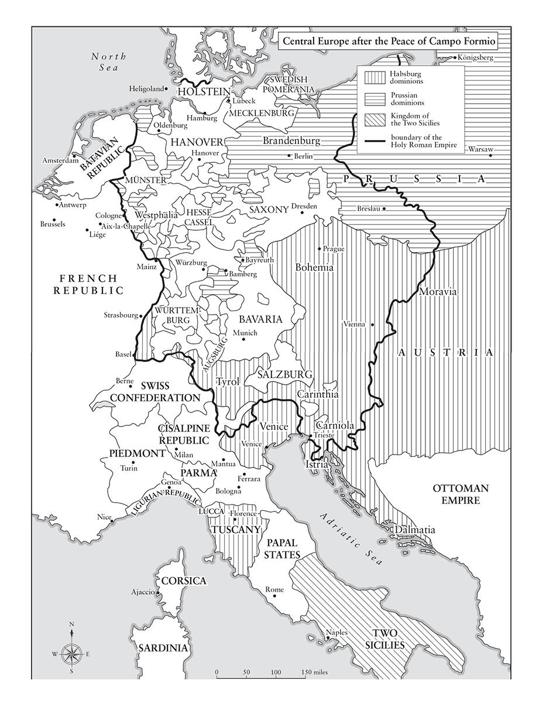
The Treaty of Campo Formio was officially ratified at Rastatt on November 30. It compelled Austria to give up her chief Rhenish strongholds – Mainz, Philippsburg and Kehl – evacuate Ulm and Ingolstadt, and withdraw her forces beyond the River Lech. At that time there were 16 million Germans who didn’t live in either Austria or Prussia, and Napoleon wanted France to make a vigorous bid for their support since the glory days of the Holy Roman Empire that had once united them were now long gone. (In one of his coarser turns of phrase, he described the Holy Roman Empire as ‘an old whore who has been violated by everyone for a long time’.51) Napoleon wanted to compensate the German princes who were going to lose lands to France under the treaty, posing as the protector of the medium-sized German states against the designs of Austria and Prussia. As he had presciently put it in a letter to the Directory on May 27: ‘If the concept of Germany didn’t exist, we would need to invent it for our own purposes.’52
The negotiations, which Napoleon opened but which continued until April 1799, gave him the perfect opportunity for a calculated act of diplomatic rudeness, when the King of Sweden – who had territory in Germany – had the gall to send Baron Axel von Fersen, Marie Antoinette’s former lover, as his delegate. ‘He came to see me with all the complacency of a courtesan of the Oeil-de-Boeuf,’ Napoleon quipped to Talleyrand, referring to a room in Louis XIV’s private apartments at Versailles.53 He told von Fersen that he was ‘essentially disagreeable to every French citizen’, and that he was ‘only known by your affection for a government justly proscribed in France, and for your useless exertions for its re-establishment’.54 Napoleon recalled that Fersen ‘replied that his Majesty would consider what I had said, and then he left. I naturally conducted him to the door with the usual ceremonies.’55 Fersen was recalled.
Napoleon left Rastatt for Paris on December 2, 1797, pausing only to be the guest of honour at a dinner given by the masonic lodge in the town of Nancy on the way. (Freemasons tended to be supporters of his modernization programme, especially in Italy.) Dressed in civilian clothes, in an undistinguished carriage and accompanied only by Berthier and General Jean-Étienne Championnet, he reached Paris at 5 p.m. on the 5th. ‘It was in the general’s plans to pass unnoticed,’ recorded a contemporary, ‘at this moment at least, and he quietly played his game.’56 Too young to become a Director, Napoleon deliberately decided to adopt a low profile in Paris so as not to antagonize the Directory, despite the sensation that his presence in the capital caused as soon as it became known. Josephine’s daughter Hortense recalled ‘keeping back a crowd made up of all classes of people, impatient and eager to catch sight of the conqueror of Italy’.57 The rue Chantereine on which Napoleon and Josephine had rented a house at number 6 (the name meant ‘singing frogs’, because there was once a marsh nearby) was changed in his honour to the rue de la Victoire.* Napoleon bought the house soon afterwards for 52,400 francs.* The extent of Josephine’s almost psychotic extravagance may be discerned in the fact that she had spent 300,000 francs decorating it with Pompeian frescoes, mirrors, cupids, pink roses, white swans and so on, when it was still only rented.58
Years later, Napoleon recalled that this Parisian period of his life was fraught with peril, not least because soldiers would shout ‘He ought to be king! We must make him king!’ in the street. He feared this might get him poisoned, as many people thought (wrongly) had happened to Hoche.59 For this reason, as a supporter recorded, ‘he avoided taking part in politics, appeared rarely in public, and admitted to his intimacy only a small number of generals, scientists and diplomats’.60 He thought the people would not remember his victories for long, saying: ‘The Parisians retain no impression.’61
At 11 a.m. on December 6 Napoleon met Talleyrand at the foreign ministry at the Hôtel Galifet on the rue du Bac. They sized each other up over a long conversation, and liked what they saw. That evening Napoleon dined privately with the Directory; he was received warmly (if disingenuously) by Barras and La Révellière, amicably enough by Reubell but coldly by the others.62 The whole government threw a huge official welcoming ceremony for him at the Luxembourg Palace at midnight on Sunday, December 10, where the great court was roofed over with flags and a specially constructed amphitheatre featured statues representing Liberty, Equality and Peace. Napoleon adopted a diffident demeanour throughout. A Briton living in Paris at the time noted that ‘As he passed through the crowded streets, he leaned back in his carriage . . . I saw him decline placing himself in the chair of State which had been prepared, and seemed as if he wished to escape from the general bursts of applause.’63 Another contemporary observed: ‘The cheers of the crowd contrasted with the cold praises of the Directory.’
Placing oneself in the limelight while seeming modestly to edge away from it is one of the most skilful of all political moves, and Napoleon had mastered it perfectly. ‘All the most elegant and distinguished people then in Paris were there,’ recalled another observer, including the Directory and both chambers of the legislature and their wives. When Napoleon entered, another witness observed, ‘everyone stood up, uncovered [that is, took off their hats]; the windows were full of young and beautiful women. But, notwithstanding this splendour, an icy coldness characterized the ceremony. Everyone seemed to be present only for the purpose of beholding a sight, and curiosity rather than joy seemed to influence the assembly.’64
Talleyrand introduced Napoleon with a very flattering speech, to which Napoleon replied by commending the Campo Formio treaty and praising his soldiers’ zeal in fighting ‘for the glorious Constitution of the Year Three’. Then he proclaimed his belief that ‘When the happiness of the French shall be secured on the best practical laws then Europe shall be free.’65 Barras, who like the other Directors wore a toga on official occasions, then made an adulatory speech. ‘Nature had exhausted all her powers in the creation of a Bonaparte,’ he said, comparing him to Socrates, Pompey and Caesar. He then said of Britain, which had by now completely swept the French navy from the world’s oceans: ‘Go and capture that gigantic corsair who infests the seas. Go and chain up that gigantic freebooter who oppresses the oceans. Go and chastise in London outrages left too long unpunished.’66 After his speech, Barras and all the other Directors embraced Napoleon. Bourrienne concluded, with pardonable cynicism, ‘Each acted to the best of his ability his part in this sentimental comedy.’67
Napoleon was much happier on Christmas Day, when he was elected a member of the Institut de France, then (as now) the foremost intellectual society in France, in place of the exiled Carnot. With the help of Laplace, Berthollet and Monge he won the support of 305 members out of 312, with the next two candidates gaining only 166 and 123 votes respectively. Thereafter he often wore the dark-blue uniform of the Institut with its embroidered olive green and golden branches, attended science lectures there, and signed himself as ‘Member of the Institut, General-in-Chief of the Army of England’ in that order. Writing to thank Armand-Gaston Camus, the Institut’s president, the next day, Napoleon said: ‘The true conquests, the only ones that cause no regret, are those made over ignorance.’68 It was not only the French people he was hoping to impress when he displayed these intellectual credentials: ‘I well knew that there was not a drummer in the army but would respect me the more for believing me to be not a mere soldier,’ he said.69
His proposers and supporters at the Institut undoubtedly thought it a boon to have the foremost general of the day as a member, but Napoleon was a bona fide intellectual, and not just an intellectual among generals. He had read and annotated many of the most profound books of the Western canon; was a connoisseur, critic and even amateur theorist of dramatic tragedy and music; championed science and socialized with astronomers; enjoyed conducting long theological discussions with bishops and cardinals; and he went nowhere without his large, well-thumbed travelling library. He was to impress Goethe with his views on the motives of Werther’s suicide and Berlioz with his knowledge of music. Later he would inaugurate the Institut d’Égypte and staff it with the greatest Frenchsavants of the day. Napoleon was admired by many of the leading European intellectuals and creative figures of the nineteenth century, including Goethe, Byron, Beethoven (at least initially), Carlyle and Hegel; he established the University of France on the soundest footing of its history.70 He deserved his embroidered coat.
Napoleon showed considerable tact when, having been offered a major role by the Directory in the no-longer-popular anniversary celebrations of Louis XVI’s execution on January 21, he modestly attended in his Institut rather than his military uniform, sitting in the third row rather than next to the Directors.
• • •
Napoleon’s gaucheness with women was on display at a reception thrown by Talleyrand in his honour on January 3, 1798, at which the celebrated intellectual Madame Germaine de Staël, as Josephine’s daughter Hortense later remembered, ‘kept following the General about all the time, boring him to a point where he could not, and perhaps did not, sufficiently attempt to hide his annoyance’.71 The daughter of the stupendously rich banker and Louis XVI’s finance minister Jacques Necker, and a leading Parisiansalonnière in her own right, Madame de Staël hero-worshipped Napoleon at the time, refusing to leave a dinner before Lavalette after the Fructidor purge, simply because he was Napoleon’s aide-de-camp. At Talleyrand’s fête she asked Napoleon: ‘Whom do you consider the best kind of woman?’ clearly expecting a compliment of some kind to her own famed intelligence and writing ability, whereupon Napoleon answered: ‘She who has had the most children.’72 As a throwaway remark to a near-stalker it did the trick (and since France’s low birth-rate was to become a problem over the next century it might even be considered prescient), but it reveals much about his fundamental attitude to women.
Turning his thoughts to the invasion of Britain, Napoleon had arranged to meet Wolfe Tone, the leader of the rebel United Irishmen in December to elicit help. When Tone had told him he wasn’t a military man and couldn’t be of much use, Napoleon had interrupted him: ‘But you’re brave.’ Tone modestly agreed that he was indeed. ‘Eh bien,’ said Napoleon, according to Tone’s later account, ‘that will suffice.’73 Napoleon visited Boulogne, Dunkirk, Calais, Ostend, Brussels and Douai over two weeks in February to evaluate the chances of a successful invasion, interviewing sailors, pilots, smugglers and fishermen, sometimes until midnight. ‘It’s too hazardous,’ he concluded. ‘I will not attempt it.’74 His report to the Directory on February 23, 1798 was unequivocal:
Whatever efforts we make, we shall not for some years gain naval supremacy. To invade England without that supremacy is the most daring and difficult task ever undertaken . . . If, having regard to the present organization of our navy, it seems impossible to gain the necessary promptness of execution, then we must really give up the expedition against England – be satisfied with keeping up the pretence of it – and concentrate all our attention and resources on the Rhine, in order to try to deprive England of Hanover . . . or else undertake an eastern expedition which would menace her trade with the Indies. And if none of these three operations is practicable, I see nothing else for it but to conclude peace.75
The Directory were by no means ready to conclude peace, and chose the last of Napoleon’s three alternatives; on March 5 they gave him carte blanche to prepare for and command a full-scale invasion of Egypt in the hope of dealing a blow to British influence in and trading routes through the eastern Mediterranean. It was in the Directors’ interests for Napoleon to go to Egypt. He might conquer it for France or – just as welcome – return after a defeat with his reputation satisfyingly tarnished. As the pro-Bonapartist British peer Lord Holland put it, they sent him there ‘partly to get rid of him, partly to gratify him, and partly to dazzle and delight that portion of Parisian society who . . . had considerable influence on public opinion’.76 For Napoleon it represented an opportunity to follow in the footsteps of both his greatest heroes, Alexander the Great and Julius Caesar, and he did not rule out the possibility of using Egypt as a stepping-stone to India. ‘Europe is but a molehill,’ a delighted Napoleon told his private secretary, ‘all the great reputations have come from Asia.’77
• • •
Later that month a mini scandal emerged that threatened to drag Napoleon into a vortex of financial corruption and political embarrassment which could have prevented him from ever having a chance to make his reputation on the banks of the Nile. Alongside large-scale army contractors such as the Compagnie Flachat and Compagnie Dijon that accepted deferred, long-term payments from the Treasury for supplying the army’s immediate needs were smaller firms that were regularly accused of short-changing the taxpayer through invoice-manipulation, substandard equipment, rotting provisions and even direct horse-thieving from peasants. One such group of war-profiteers was the Compagnie Bodin, run by the notorious Louis Bodin, among whose investors, Napoleon discovered to his horror from his brother Joseph, were Barras, Hippolyte Charles (who had by then left the army to become a full-time contractor) and Josephine.78 Although Charles had left Italy in August 1796, his relationship with Josephine had remained close.
It was one thing for Barras, Talleyrand and others to make their fortunes through loans, currency speculation and insider-trading, since their murky dealings were virtually taken for granted by the public, but if it emerged that Napoleon’s own wife was also profiting from corrupt army provisioning, one of his strongest appeals to the populace – his integrity – would vanish overnight. Furthermore, his own private war against the Compagnie Flachat in Milan, in the course of which he had chased one of its directors into exile, would now seem like the grossest hypocrisy rather than what it genuinely had been, a burning desire to get the best deal for the Army of Italy.
Napoleon and Joseph subjected Josephine to a tough interrogation on March 17 that left her shaken, angry and vengeful, but as untruthful as ever. They demanded to know exactly what she knew about Bodin, whether she had got him supply contracts, whether Hippolyte Charles lived at the same address as Bodin at 100 Faubourg Saint-Honoré and whether the rumour that she went there almost daily was true.79 Josephine’s panicked letter to Charles immediately afterwards suggests not only that she had denied everything, but that she still loved Charles, hated the Bonaparte brothers, had possibly seen the Bodin speculations as a way out of her marriage as well as of her debts, and that she now desperately wanted to cover her tracks. ‘I replied that I knew nothing about what he was saying to me,’ she told her lover. ‘If he wished a divorce he had only to say; he had no need to use such means, and I was the most unfortunate of women and the most unhappy. Yes, my Hippolyte, they have my complete hatred; you alone have my tenderness and my love . . . Hippolyte, I shall kill myself – yes, I wish to end a life that henceforth would be only a burden if it could not be devoted to you.’80
She then told him to get Bodin to deny all knowledge of her involvement and say that he hadn’t used her to get Army of Italy contracts; to instruct the doorman at the Faubourg Saint-Honoré to deny all knowledge of Bodin, and to tell Bodin not to use the letters of introduction which she had given him for his business trip to Italy. She signed off with ‘a thousand kisses, as burning as is my heart, and as amorous’.81 A subsequent letter to Charles concludes: ‘You alone can make me happy. Tell me that you love me, and only me. I shall be the happiest of women. Send me, by means of Blondin [a servant], 50,000 livres [1.25 million francs] from the notes in your possession . . . Toute à toi.’82
As he contemplated a new campaign in Egypt, Napoleon thus had every reason to wish to escape Paris, a place he had come to equate with corruption, disloyalty, heartache, secret malice and the potential for deep embarrassment. He always had a certain idea of himself as a noble knight, like Clisson from his own short story, and the behaviour of both the Directory and Josephine threatened the ideal. It was time to double the stakes once again.