
CHAPTER THIRTY-EIGHT

While the Virginia yeomanry suffered under Pope’s harsh new regime, which turned once-prosperous farmers into paupers overnight, Jackson’s own soldiers also found themselves in a much harder and less forgiving world.1 The most obvious signs of this were the new Confederate conscription laws, passed in April of that year, that extended terms of service for currently enrolled soldiers and made all males from eighteen to thirty-five subject to the new draft. The early war had been fought entirely with volunteers, many of whom believed that military regulations infringed on their basic rights to liberty and the pursuit of happiness. These were people, after all, who had revolted against a centralizing government, natural antistatists who did not want anyone in authority telling them what to do. During Jackson’s valley campaign, he had lost thousands of men who simply went home. In June, Longstreet complained that soldiers were moving between the army and their homes “without the slightest regard for official policy.” Many never came back. The ones who did were punished lightly or quietly forgiven. None was shot for desertion, though hundreds easily could have been.2 In the first phase of the war, the army and the public at large would not tolerate mass shootings of deserters. Jackson, like other generals, had understood this.3
But by the summer of 1862 the national mood had changed. Southerners were tired of seeing stragglers and deserters—“dirty villains,” as the Richmond Examiner called them—lounging about grogshops, boardinghouses, and hotels while brave men fought and died on the fields of war. As a result, those early days of tolerance and understanding were coming to an end.4 Stragglers, once considered an inevitable if unfortunate part of war, were increasingly treated as what they often were: men who would not fight. On the march from Richmond to Gordonsville, Jackson’s division commander Charles S. Winder had ordered thirty stragglers “bucked and gagged”—a painful form of punishment that consisted of tying the offender’s hands together at the wrists and slipping them down over the knees, while running a stick under the knees and over the arms. The “gag” was a bayonet placed in the mouth and tied from behind with string. Men would be left in this trussed position from sunrise to sunset. Winder hated stragglers. Though Jackson ordered him to stop the practice, Winder persisted in his other favorite punishment, hanging stragglers and other disciplinary cases from trees by their thumbs so their toes barely touched the ground, and leaving them that way all day.5
The new severity brought far worse punishments. Before the Battle of Cedar Mountain, a court-martial established by Jackson had convicted three soldiers of desertion and sentenced them to death. Two of them were conscripts who were guilty of nothing more than missing their families and going home to see them, something many members of the Stonewall Brigade had done, often repeatedly, in the valley campaign. Jackson entertained two pleas for leniency. To the first, from a colonel in the 10th Virginia, from whose regiment two of the men came, he replied with icy fury, “Sir! Men who desert their comrades in war deserve to be shot! And officers who intercede for them deserve to be hung!” For Jackson, straggling and desertion were the ultimate violations of duty. Next came a chaplain with his own gentle plea. “General, consider your responsibilities to the Lord,” he implored Jackson. “You are sending these men’s souls to Hell!” Jackson replied, “That, sir, is my business. Do you do yours!” Jackson “then handled the chaplain rather roughly,” according to Jed Hotchkiss, “taking him by the shoulders, whirling him around, and pushing him out of the tent.”6 Jackson hated deserters with a special passion. He had only restrained himself from shooting them before because public opinion wouldn’t have tolerated it.
On August 19, the day of the executions, Brigadier General William Taliaferro’s full division marched out in columns to a field beside the Mount Pisgah Baptist Church in Orange County, Virginia, while a regimental band played a funeral march. The prisoners were blindfolded and forced to kneel in front of their caskets. The firing squad formed at six paces and fired a volley into the prisoners. Two were killed instantly. The third, who was still alive and tried to stand, was shot again.7
The next day two Confederate soldiers who had deserted to the enemy were captured by Jeb Stuart’s cavalry. Jackson ordered them hanged from the limb of a tree by the roadside and left there while the rest of the army passed by, just in case anyone hadn’t gotten the message.8
• • •
The Battle of Cedar Mountain might have seemed at first like a version of Malvern Hill—a pointless slaughter brought on by a foolish attack that accomplished nothing in particular for either side. Jackson had withdrawn two days later to his previous position below the Rapidan River. The Union was no closer to its objective of taking the Virginia Central Railroad in Gordonsville. But a major change had taken place, and it had happened in the minds of Union war boss Henry Halleck and John Pope. Jackson’s lunge at Culpeper, as it turned out, had scared them.9 On July 31, Pope had vowed to Halleck that he would be “in possession of Gordonsville . . . within ten days.” But at five forty-five in the morning after his defeat at Cedar Mountain—exactly ten days later—he sounded like a different man. Now he warned Halleck that he expected “a very severe engagement” to follow and that “I will do the best I can, and if forced to retire will so do by way of Rappahannock Crossing.”10 Though he continued to rattle his saber, advising Halleck on August 12 that “The enemy has retreated under cover of night. . . . Our cavalry and artillery are in pursuit,” in fact he had little or no interest in advancing against Jackson. The wind had gone out of his sails.
Halleck, meanwhile, was even more worried than Pope about the danger that lurked south of the Rapidan: “Your main object should be to keep the enemy in check until we can get reinforcements to your army,” he wired Pope on August 11. On August 13 he said flatly, “Do not advance across the Rapidan,” and repeated that order on the sixteenth.11 Pope’s orders were to wait for McClellan’s army to join him. Halleck, meanwhile, was badgering Little Mac into speeding up his massive troop transfer. McClellan, for personal and political reasons—not least because he thought that helping his detested colleague John Pope was contrary to his self-interest—was slow-walking the entire enterprise.
Lee’s objective, conversely, was to strike Pope before McClellan got there. Lee had thus ordered Longstreet’s corps to join Jackson near Gordonsville, leaving a mere three divisions to guard all of Richmond. By August 16 Lee had an army of 54,000 men—30,000 under Longstreet and 24,000 under Jackson—facing Pope’s 50,000. Lee did not know how much of McClellan’s army was on its way to reinforce the Army of Virginia. But he knew he was running out of time. Once McClellan joined Pope it would be impossible to force the Federals from central Virginia, or to head north, as Lee was planning. Lee would be forced to withdraw.
Lee, Jackson, and Longstreet spread maps in front of them and pondered their next move. Lee quickly saw that Pope had made a potentially fatal mistake. In his new, post–Cedar Mountain defensive posture, he had backed himself and his entire army into the delta formed by the junction of the Rapidan and Rappahannock Rivers. Though there were several fords across the Rappahannock, there was only one main bridge across which his army could escape. Burn it, Lee theorized, and he could cripple the Union retreat. Thus cornered, with his back to a great river, Pope’s army might be destroyed. It was one of those moments of crystal-clear vision that rarely happen in war. Pope was exquisitely vulnerable. Lee ordered an immediate advance. Unfortunately, he once again could not make the cumbersome machinery of his army move fast enough. By the time he got it in motion, Pope, aided by an intercepted message, had discovered his error and had promptly moved his army behind the Rappahannock. A disappointed Robert E. Lee ordered the two wings of his army—Longstreet on the right and Jackson on the left—forward to the south bank of the Rappahannock. On August 20 the two armies were staring at each other across one of the most formidable natural obstacles in the region.
Now the game began in earnest, but with more pressure on Lee than ever. He knew that the Union armies might be only days from rendezvous, and he had left Richmond virtually undefended.12 To engage Pope before that happened, Lee would have to cross the Rappahannock at one of its three bridges or half dozen fords. Pope, understanding this, vigorously defended the crossings. For three days, from August 21 to 23, in a series of artillery fights and skirmishes that included an ineffectual Jeb Stuart raid into the Union rear at Catlett’s Station, Lee’s army probed for weak points in the Union line. When he was repulsed, Lee simply slid his army crabwise upstream, north and west, Jackson’s corps in the lead, looking for better opportunities and stretching Pope’s already thin lines. Pope and his generals showed considerable defensive skill. They mimicked Lee’s moves and parried his thrusts.13 On August 22 one of Jackson’s brigade commanders, Jubal Early, finally got beyond the Union right flank and managed to cross the river at Sulphur Springs. But he was isolated there by rains and a rising river, and suddenly found himself and his brigade trapped on the enemy’s side of the river. He was rescued from fast-closing Union forces only after Jackson’s engineers managed to build a makeshift bridge.
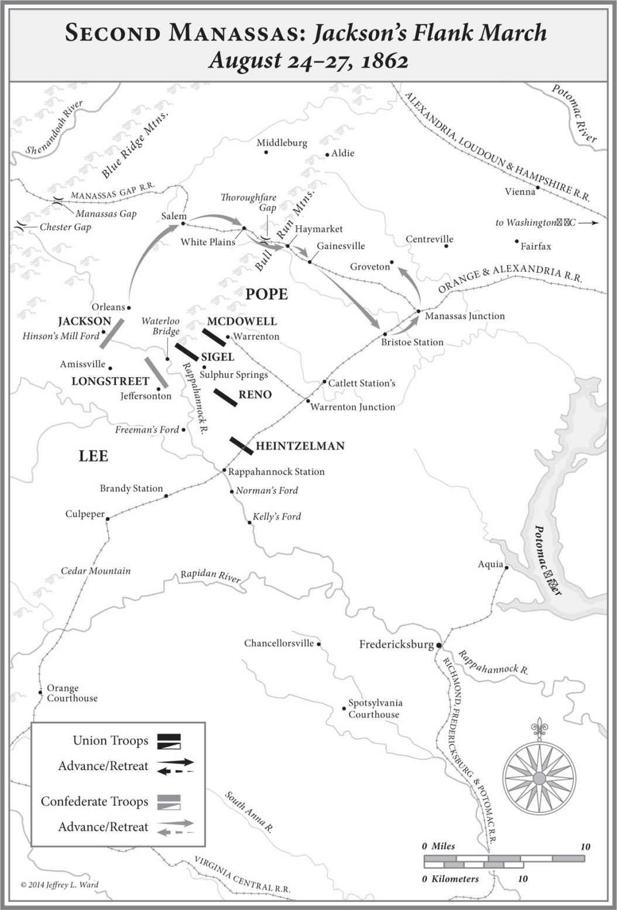
By August 24, Lee’s army was once again in stalemate, facing Pope across the Rappahannock. This time they were farther upstream, but with no better chance of crossing than they had had four days before. Artillery continued to boom but was increasingly meaningless. Pope’s defensive maneuvers had gotten him what he most needed: time. That day the first of his reinforcements began arriving. Many more were on their way, marching west from Fredericksburg or south from Alexandria. The Army of Virginia and the Army of the Potomac, it seemed, were on the verge of unification.
That Sunday afternoon, August 24, Lee summoned Jackson to his headquarters near the town of Jeffersonton, behind the Confederate left. Jackson was in a bad mood. His army’s maneuvers had produced nothing. He had been forced to save Early from almost certain destruction. Nothing had been gained. Jackson arrived to find that “headquarters” was really a table that had been set up in an open field, away from any structures, human or natural. “There was not even a tree within hearing,” recalled one officer. This was to be an extremely confidential meeting. Lee was seated at the table with a map laid out in front of him. James Longstreet was seated on his right, Jeb Stuart on his left. Jackson approached the table and stood, facing them.14 While artillery grumbled in the distance, the four generals talked. Though staff officers loitering nearby listened as hard as they could, they could make out nothing. Hunter McGuire recalled many years later that at some point in the meeting “Jackson . . . was very much excited, drawing with the toe of his boot a map in the sand, and gesticulating in a much more earnest way than he was in the habit of doing. General Lee was simply listening, and after Jackson had got through, he nodded his head, as if acceding to some proposal.”15 The only record of what was said came from Douglas, who heard Jackson say, at the meeting’s end, “I will be moving within an hour.”16
Though we do not know what words were spoken, we know with great certainty what the meeting was all about. What had gotten Jackson’s attention was one of the most profoundly daring plans of the war, one that violated both military theory and common sense in equal measure. To pry Pope out of his secure position behind the Rappahannock, Lee proposed that Jackson and his entire corps march in a sweeping arc around the Union right, climbing north across the foothills of the Blue Ridge, then turning east through the Bull Run Mountains, and landing on the plains deep behind Union lines. His mission was to cut the Orange and Alexandria Railroad, Pope’s main supply line. In that sense, the plan was similar to what Lee had proposed in front of Richmond: to force a Union army to withdraw to protect its supplies. Except that now, any rebel force in Pope’s rear would also be on Washington’s doorstep. Once Pope discovered what had happened, he would have no choice but to leave his Rappahannock camps and move toward Washington. James Longstreet, meanwhile, would try to keep Pope’s attention engaged as long as he could. When Pope fell back, Longstreet would follow Jackson’s route north. Twenty-five mounted couriers from the vaunted Black Horse Troop would keep Lee and Jackson in touch.17 If there was one lesson Lee had learned at the Seven Days, it was the importance of communication.
The risks inherent in Lee’s plan were breathtaking. By dividing his army he left each half vulnerable to attack. If Pope learned that there were now two small rebel armies separated by fifty miles, he could attack and destroy Lee, then turn on Jackson. Then, too, there was the problem of McClellan’s army, some of which might be landing at Washington (two entire army corps, in fact, under Franklin and Sumner). That would leave Jackson trapped between McClellan and Pope, with Lee unable to help. Whatever happened, Jackson would be alone in the Union rear with no supply line and no reinforcements within a two-day march. From the moment he left the Rappahannock, he would be in constant peril. The closer he got to Washington, the more hazardous his position would become. Jackson, who had proven his ability to operate alone and without support while engaging multiple Union armies in the valley, was the obvious choice for the job. As in the valley campaign, Lee left the details of Jackson’s operation to him. Jackson was ecstatic: he was being ordered by Lee to strike deep in the heart of enemy territory, surrounded by unprecedented peril, with almost unimaginably high stakes.
He lost no time getting started. At 6:00 p.m. on the night of August 24, Longstreet’s brigades quietly replaced Jackson’s troops along the river. At 3:00 a.m. on the twenty-fifth, Jackson’s bugles blew reveille, the men were rousted, and the army trooped off, tack creaking, wagon wheels rattling, shanks of bayonets clanking rhythmically against canteens. None of the men had the slightest idea where they were going. But that was nothing new. They joked that Jackson’s piety expressed itself in the directive “Let not thy left hand know what thy right hand doeth.”18 But by now they knew Jackson well enough to know that they were headed for a fight.
• • •
The march was textbook Jackson: The corps he brought across the river at Hinson’s Ford was light, lean, and stripped for action. The men carried only their muskets, cartridge belts with sixty rounds of ammunition, and haversacks with three days’ cooked rations. All baggage, knapsacks, and bedrolls were left behind. Other than his eighty guns, with caissons and limbers, the only other rolling stock were ambulances. A herd of cattle trailed the column. By deliberate design, a twenty-four-thousand-man corps, with its immense human needs, was marching deep into enemy territory and into a country that had already been heavily foraged, with no supply train and no supply line.19 It was the sort of enterprise that a general such as George McClellan, with his obsessive worry about supplies, could never have imagined.
There were new marching rules, too. This time there would be constant movement, no breaks, no more fifty minutes on and ten minutes off. There was to be no straggling, no removing of clothing or shoes when crossing streams. There was to be a minimum amount of noise, too. And there was even more than the usual secrecy. Those who knew the country knew they were marching north, but no more. Even Jackson’s division chiefs were kept in the dark. According to William Taliaferro, their only instructions were to “march to a cross-road; a staff officer there will inform you which fork to take; and so to the next fork, where you will find a courier with a sealed direction pointing out the road.”20
Though the terrain was broken and uneven—nothing like the often dead-flat, macadamized valley pike, where Jackson’s foot cavalry had won its reputation for marching—the men moved with extraordinary speed, leaving the column only to grab ears of green corn or half-ripe apples from roadside fields.21 Even by Jackson’s standards, his soldiers performed brilliantly. “They outmarched and broke down the artillery horses,” wrote one soldier. “So enthused were both officers and men that I never heard a word of complaint.”22 Another soldier wrote, “The fine weather, magnificent country, the mysterious march through fields and byways . . . the possible collision at any moment with the enemy . . . all served to keep us intensely interested.”23
They conducted of one the war’s most remarkable marches: twenty-six miles in a single day, with full ordnance and artillery. The column moved with the same sort of sustained speed that had produced those odd, warping effects on enemy perception in Jackson’s valley campaign. As events unfolded, it would not seem possible to anyone along the Rappahannock or in Washington that an army of that size could possibly have covered that much ground, secretly, in one day. Even the normally hard-to-impress Jackson admitted that it was “a severe day’s march.”24 Near sunset, as Jackson’s column approached the town of Salem, twelve miles north of Pope’s right, he dismounted and climbed a large rock by the side of the road to review his troops. He presented a strange spectacle, standing hatless, high above the road, illuminated by the rays of the setting sun. When the men saw him they forgot their exhaustion and burst into cheers. But as the hurrahs rolled through the regiments Jackson, worried that the noise might alert the enemy, signaled gently to the men to stop. They did, and immediately passed the word through the ranks: “No cheering.” Instead, as they passed the lone man on the rock they raised their caps in mute tribute to their strange, transcendent leader. Jackson, softened by this remarkable display, said to a member of his staff, “Who could not conquer with such troops as these?”25 When Jackson’s column finally halted, in darkness, the weary men “dropped beside their stacked muskets,” recalled one of them, “and without so much as spreading a blanket were instantly asleep.”26
Back on the Rappahannock, Longstreet’s batteries were trying to keep Pope’s mind on his front and not on his flank and rear. At 8:45 a.m., a Union colonel in Banks’s command on Pope’s far right saw an arresting sight: a column of rebel infantry and artillery marching in a northwesterly direction away from the village of Jeffersonton. At nine thirty he had an even more interesting report: four batteries and six to eight regiments had passed within the hour, “well closed up and with colors flying.”27 At eleven twenty-five Nathaniel Banks sent Pope a note with his own analysis. “It seems apparent,” he wrote, “that the enemy is threatening or moving upon the Valley of the Shenandoah via Front Royal with designs upon the Potomac, possibly beyond.”28 Pope immediately wired Halleck with the perplexing news, telling him that he believed the rebel column contained twenty thousand men, and saying that he was ready to dispatch Irvin McDowell to pursue them.
But instead of actually doing anything about this mysterious rebel column, Pope spent the better part of the day shuffling the various parts of his army, and extending his line, for some unknown reason, to the left. While doing all that, he failed to order his cavalry to scout the enemy outside his own lines. Somehow, by the end of a day that saw Jackson’s men in bivouac far to the north, Pope had come to agree with Banks that the mysterious Confederate column was headed toward the valley. Pope would always have trouble perceiving the obvious. That was lucky for Lee, whose plan was working perfectly.
• • •
On the second day Jackson was moving again in the pitch darkness of “early dawn.” Soon his divisions under Ewell, Hill, and Taliaferro turned east, pushing ahead with the same resolve they had shown the previous day. The pace once again was an unforgiving three miles an hour. At midday the column crossed the narrow defile through the pretty, modest elevations of the Bull Run Mountains. By four o’clock on August 26, while James Longstreet’s guns continued to fire across the Rappahannock, Jackson’s men found themselves very far indeed behind Pope’s lines—roughly twenty miles—in the small town of Gainesville. They had marched fifty miles in thirty-two hours. At about this time Jeb Stuart and two brigades of cavalry had caught up with Jackson.29 They had been ordered there by Lee, who thought Jackson needed Stuart’s scouting and screening abilities more than Longstreet did. From now on, Stuart would be Jackson’s eyes, shadowing his every move. While Stuart’s horsemen were fanning out, Longstreet was starting to pull away from his position on the Rappahannock. He and Lee had agreed that the best way to reunite the two armies would be for Longstreet to follow in Jackson’s path, through Thoroughfare Gap in the Bull Run Mountains. Where they might meet was unknown: it would depend on how Pope responded to Jackson’s incursion.
Jackson now moved to cut the railroad line. He knew there was a large Union supply depot at Manassas Junction, but he believed it might be heavily defended. So he decided to strike the smaller Bristoe Station. At 6:00 p.m. his cavalry swept aside the few surprised Federals who were there. Soon they heard the whistle of a train returning from delivering supplies to Pope’s army at Warrenton. Though the Confederates tried frantically to derail it, they were too late: the train roared through, carrying word of the rebel presence eastward to Manassas and beyond. A few minutes later another train arrived. This time Jackson’s men were ready, having placed obstacles along a quarter mile of track. He and his staff watched from a small rise by the tracks as the train came on. When shots were fired, the engineer throttled up, the train boomed through the station, and hit the obstructions. “Down the embankment rushed the engine,” recalled an observer, “screaming and hissing, and down upon it rushed the cars, piling up on one another until the pile reached higher than the embankment.”30 Soon another train arrived, smashing into the wreckage of the first. A third train approached, but the engineer spotted trouble and turned back toward Warrenton, now carrying the news directly to Pope.
Having wrought considerable destruction on the rail line—the principal goal of his expedition—Jackson now turned his attention to the Union supply depot at Manassas Junction, five miles farther toward Washington on the Orange and Alexandria line. He sent Isaac Trimble, the stalwart Marylander who had performed well at Cross Keys, along with 500 infantry and some of Stuart’s cavalry, to attack the Federal force there. Trimble made quick work of it. His regiments swarmed into the lightly defended depot, setting upon his adversaries before they had time to unlimber most of their cannons. Trimble’s men took 300 prisoners, including the post commander, 175 horses, and 8 pieces of artillery, plus an enormous trove of Union supplies while sustaining only 4 casualties. It was sometime after midnight. Jackson, after marching more than 50 miles, had completely severed Pope’s supply line.
At about the time Trimble was taking Manassas Junction, John Pope was sitting in his headquarters near Warrenton concluding that something was seriously wrong. He had been receiving ever more alarming reports all day and into the night: rebels under Jackson, Longstreet, Hill, and Stuart were seen approaching Thoroughfare Gap. At 8:00 p.m. he received a telegraph from Manassas telling of a Confederate attack on the railroad. By midnight, with his communications cut, Pope had decided that ten thousand to fifteen thousand Confederates were already east of Thoroughfare Gap and that Lee’s army was somewhere behind them.31 He now also understood that the daunting rebel force on the south side of the Rappahannock was no longer there.
Pope, however, was anything but disconsolate. Once he accepted that he had somehow been duped by fifty thousand Confederates, it occurred to him that his misfortune might actually be a brilliant opportunity. He knew now that Lee had either split his army or at the very least had strung it out along a fifty-mile arc. He also knew that only part of it had crossed through Thoroughfare Gap and that this advance guard was vulnerable. In the early morning of August 27, Pope gave orders for his full command to march back toward Washington and “crush the enemy.” With the addition of Samuel Heintzelman’s and Fitz John Porter’s corps from McClellan’s army, he now had sixty-six thousand men. The army would march along parallel tracks spread out over eight miles, with its left on the Warrenton Turnpike and its right tracking the Orange and Alexandria Railroad. Their goals were the towns of Gainesville and Manassas Junction. Whatever piece of Lee’s army they found, they would overwhelm and destroy.32
Those weren’t the only troops moving in Jackson’s direction. Alarmed by the Confederate raid—though not certain that it was any more than small-scale cavalry mischief—Henry Halleck had dispatched four thousand men by train to the front to clear the area of rebel raiders. Halleck had also ordered General William B. Franklin’s ten-thousand-man corps—which had traveled by boat from the James River to Alexandria—to march on Gainesville from the east. As of the morning of August 27, something approaching eighty thousand Union soldiers were moving against Stonewall Jackson.
• • •
Jackson, who was fully aware that he was going to be attacked, potentially from several directions and almost certainly by numerically superior forces, had no intention of sitting still. Leaving Ewell with three brigades at Bristoe Station to watch for the Union advance, early in the morning of August 27 he took divisions under Hill and Taliaferro to Manassas Junction to join Isaac Trimble. Their mission: to deal with and dispose of an almost unimaginably large cache of Union supplies housed in warehouses, boxcars, and wagons.
They would not be able to enjoy this Yankee largesse right away. They were attacked twice, in sequence, by small Union forces convinced they were flushing out a gang of rebel guerrillas instead of Stonewall Jackson himself with some of the toughest fighting men in the Confederate army. The first attack came from the 2nd New York heavy artillery, arriving for duty at Manassas Junction. They opened fire on some cavalry, and actually had some fun making the rebels jump and flushing them from a barn until the New Yorkers saw, to their horror, nine thousand infantry and twenty-eight artillery pieces arrayed in a semicircular arc against them. They beat a hasty retreat.
The second attack was a more serious affair. The force Halleck had urgently dispatched by train to deal with the railroad raiders consisted of a New Jersey brigade under Brigadier General George Taylor plus two Ohio regiments. At about 10:00 a.m. Jackson’s men became aware of Taylor’s men advancing in precise battle lines from the east. There were only 1,200 of them. Taylor, who had no idea what he was up against, had decided to move forward with the smaller force. Onward they came, into the waiting half-mile-long defensive arc that had been set up earlier to deal with the New Yorkers. Onward came the bluecoats, bayonets and rifle barrels luminous in the sun, into Jackson’s waiting death trap. He let them come, ordering his men to hold their fire until Taylor’s force was inside the arc of the Confederate line. Then rebel guns opened with murderous rounds of canister from the Union flank, tearing enormous holes in Taylor’s line, while thousands of Confederate muskets exploded from the center. The Union soldiers attempted a bayonet charge, but the line was shredded before it traveled fifty yards. When it became fully apparent that the Union troops would be slaughtered where they stood, Jackson did something out of character. He had admired the toughness of Taylor’s men. After Union lines broke for a third time, Jackson ordered the cannon fire to stop, took out a white handkerchief, rode out in front of the Rockbridge artillery, and shouted, “Surrender! Throw down your arms, and surrender!”33 The response was a bullet fired at Jackson’s head. That soldier quite possibly regretted his arrogance, if he lived that long.
Taylor’s men stood Jackson’s fire courageously for ten minutes. Then, seeing that his retreat was about to be cut off by Stuart’s horsemen, Taylor managed what started out to be a reasonably orderly retreat, though he himself fell with a mortal wound. But as the Confederates pursued, and continued firing canister, the retreat soon turned to panic and rout. The Federals lost 339 of 1,200 men, 201 of whom were taken prisoner. Many more would have died if the Ohio regiments, arriving late, had not been there to help cover their comrades’ retreat. Jackson paid General Taylor a high compliment in his battle report, saying, “The advance was made with great spirit and determination and under a leader worthy of a better cause.”34
Having driven the enemy away from Manassas Junction, Jackson’s men turned to the prize at hand. The sheer tonnage of what they now possessed was beyond anything seen in the war. There was, moreover, no way they could possibly carry it all off with them, and they all immediately grasped that fact. The only question mark was their sobersided, regulation-bound general. Would he turn the men loose? He would. He did. What happened next was one of the great, extended revels of the Civil War. Before them, in a hundred boxcars and in many sheds and warehouses, was a cornucopia of Union industrial and agricultural production: pyramids of artillery ordnance, crates of new boots, shoes, underwear, and other clothing, Springfield muskets. There were also pickled oysters, canned fish, and whole hams, oranges, lemons, potted lobster, mustard, wheels of cheese, still-warm field ovens surrounded by baked goods, canned fruit, cigars, and candy. The men, lately deprived of rations and often wearing tattered shreds of rotting butternut homespun and sometimes without shoes, ran wild from boxcars to warehouses, stuffing their pockets and haversacks, taking whatever they could find. Some of their antics were comical. In addition to being a railway depot, Manassas Junction was a place of refuge for runaway slaves. Some of the men broke into their shanties and emerged “wearing colored women’s wardrobes,” according to one observer, especially hats. “When these half-starved men sang songs of merriment and danced around their campfires, eating lobster salad and drinking Rhine wine, the scene was ludicrous in the extreme.”35
Jackson did take care to limit access to two precious commodities: he placed all medicines and medical supplies under guard, and he ordered a large cache of whiskey dumped on the ground. “Don’t spare a drop, nor let any man taste it under any circumstances,” Jackson ordered one of his captains. “I fear that liquor more than General Pope’s army.”36 He didn’t get all of it, of course, and many a canteen—particularly in Stuart’s outfit—was happily filled with liquor.
While the bacchanalia proceeded—along with the gathering and loading of supplies Jackson’s troops would actually be able to carry away with them, and preparing the rest for destruction—“Old Baldy” Ewell was conducting far more serious business. He had been left at Bristoe Station with three brigades to confront whatever force Pope sent to deal with the railroad raiders. At about 3:00 p.m. that force arrived in the form of five thousand soldiers under Major General Joseph Hooker, a handsome, intelligent West Point graduate who had fought aggressively in the peninsula campaign. True to form, Hooker deployed and attacked Ewell immediately, provoking a sharp fight that raged for an hour until the rest of Hooker’s division began to arrive and Ewell realized he was facing a much larger force. Jackson’s orders to Ewell were to fall back in the presence of a superior force and join the rest of Jackson’s troops at Manassas Junction. At about 4:00 p.m. Ewell proceeded to do just that, conducting a textbook retreat, falling back while fighting, inflicting three hundred casualties on the enemy, and slowing the Union advance to a crawl. It was exactly what Jackson had wanted: Ewell had stung Hooker and temporarily stopped the movement of Pope’s army toward Manassas Junction. He had bought the army a few hours.
Jackson was determined to use them well. That night his men packed up everything they could carry, which included 50,000 pounds of bacon, 1,000 barrels of corned beef, 2,000 barrels of salt pork, and 2,000 barrels of flour, plus tons of ammunition, weapons, and other quartermaster and commissary stores. Then they set fire to the rest, a magnificent, raging conflagration that reddened the sky for miles around.
But what to do now, in the fire-tinged darkness of the Manassas plain with eighty thousand Federals closing on him? The logical thing for Jackson to do was to head north and west to Thoroughfare Gap, toward safety, avoiding a fight with his three divisions against Pope’s five corps or roughly fifteen divisions, for twenty-four hours. Lee and Longstreet were on their way, following in his footsteps. They would be there in twenty-four hours. He could unite with them, then turn and face Pope. He and his corps already had done extraordinary things. They had marched fifty-five miles, destroyed a Union railroad and telegraph, blunted a Union offensive at Bristoe Station, and captured or destroyed considerable tonnage of Federal supplies. More important, they had forced Pope from his secure defensive line on the Rappahannock. The stasis of August 24 had given way to the fluid chaos of August 27.
But Jackson was not, as virtually any other general would have been, thinking of escape. It was characteristic of the man that at such a moment of impending danger he was thinking only of how he could smash John Pope. He would be outnumbered, of course, possibly two or three to one. Thus he knew his only chance was to make sure the battle was fought on his terms and on his chosen ground.
But how to do that?
Before he left Manassas Junction Jackson had made up his mind. He knew the terrain well from the Battle of Manassas and he knew there was an unfinished railroad line several hundred yards north of the Warrenton Turnpike, west of the Sudley Road that had seen so much fighting in the First Manassas. The line, which ran for more than two miles, offered a superb defensive position, most of it in moderately thick woods. Jackson could bide his time there, near the tiny hamlet of Groveton, and wait for his opportunity to strike. Groveton, moreover, was less than ten miles east of Thoroughfare Gap, which meant that Jackson would be in a position to link with Longstreet’s army when it arrived. In the event of total disaster he could retreat to the north. At midnight, Jackson and his three divisions marched out of Manassas Junction for their new bivouac. Though his divisions under A. P. Hill and Richard Ewell got lost in the dark, by the following morning Jackson had his entire twenty-four-thousand-man force “packed like herring in a barrel” in the woods in front of the railroad excavation. By Jackson’s orders, the army was very quiet. Cooking was forbidden, along with music and shouting. Except for the periodic crash of Jeb Stuart’s horse artillery as he routed Federal scouting parties, according to one soldier, “the woods sounded like the hum of a beehive on a warm summer day.”37