
CHAPTER THIRTY-NINE

For Major General John Pope, the world was a bright, promising place on the morning of Thursday, August 28, 1862, full of hope and possibility. He was certain that he had corralled the elusive Stonewall Jackson at Manassas Junction. All of his scouting reports told him that this was true. Jackson had finally gone too far. And now Pope would throw his full force against the trapped rebel commander. The night before, he had ordered a massive convergence on the junction, fifty thousand men advancing in a carefully spaced seven-mile-wide arc to prevent Jackson’s escape. That movement was under way. Pope was so convinced of his impending victory that he told Irvin McDowell, commander of his 3rd Corps, “If you will march promptly and rapidly, we shall bag the whole crowd.” Jackson had surprised the Union high command with his daring march. Now he would pay for it.
Or perhaps not. At noon a Union division under one-armed general Phil Kearny, whom Winfield Scott once called “the bravest man I ever saw,” arrived at Manassas Junction to find nothing but smoldering desolation, charred skeletons of boxcars, and debris scattered everywhere. Beyond the wild destruction it had left behind, there was no sign of Jackson’s column. Confederate stragglers insisted that the men had all marched off to Centreville, seven miles to the northeast. This turned out to be a wonderfully effective and entirely unintentional piece of misdirection. Though Jackson had ordered Ewell and Hill to march north to Groveton with the rest of the column, a series of misunderstandings and bad directions had led them to march eastward—toward Centreville—in the process losing themselves in the darkness. Though the stragglers were telling the truth—authentically selling their comrades out—they did not know that the rebel generals had soon corrected their mistakes and marched on to Groveton. Their divisions were now neatly tucked into the woods with the rest of Jackson’s force.
Still, Pope chose to believe these honest shirkers. At 2:00 p.m. he issued orders for a new massive convergence, this time on the town of Centreville. Now, as the afternoon waned, the fatal weakness in Pope’s character—his indecision under pressure—began to show itself. Soon after issuing those orders he received word that Longstreet’s army had reached Thoroughfare Gap, where it had clashed with a small Union force. In his zeal to catch and destroy Jackson, Pope had somehow neglected the rest of the Confederate army. Consumed by an impulsive desire to correct that mistake, he abruptly changed his orders again, directing his army to turn and march west. He soon rescinded those orders, too.1 Pope’s waffling only grew worse.2 At 5:00 p.m., swayed by persistent reports of Jackson’s march eastward, and believing he could defeat Jackson, then wheel and fight Longstreet, Pope ordered his troops to turn yet again and resume their march to Centreville, much to the dismay of his generals—especially McDowell, who had been raising alarms about Longstreet’s approach from the west. The fact remained: after a full day of probing with scouts and cavalry and entire divisions, and frenzied countermarching over an area familiar to many of them from the Battle of Manassas thirteen months before, Pope still had no idea where Jackson and his twenty-four thousand men were.
While Union soldiers, whipsawed by their commander’s shifting orders, marched hither and yon over the rolling fields and timbered groves searching for him, Jackson was looking for an opportunity to strike. His concealment had only been a temporary ruse. He had been waiting all day for a large Union force to pass by on the Warrenton Pike, as a spider waits for a fly, though in this case the spider was less than half as big as the fly. He was impatient and running out of daylight. And he had not heard from Lee. Throughout the day he had been restlessly riding his lines, mostly alone. “When he was uneasy he was cross as a bear,” wrote cavalryman W. W. Blackford, “and neither his generals nor his staff liked to come near if they could help it.”3 His demeanor changed temporarily when a courier arrived in late afternoon with the news that Lee and Longstreet were only twelve miles away and would likely arrive in the morning. Jackson’s normally stern face, according to one observer, “beamed with pleasure” and relief. “Where is the man who brought this dispatch?” he asked. “I must shake hands with him.” The news gave him all the more reason to draw Pope into battle. But he needed the mechanism by which to do that.
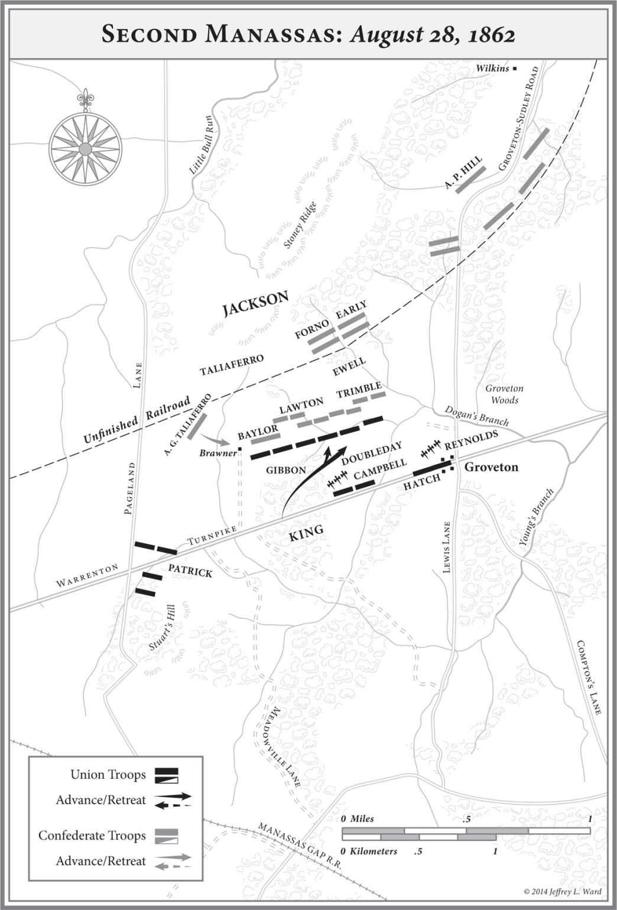
At about 5:30 p.m., that mechanism came tramping eastward down the Warrenton Turnpike. When corps commander Irvin McDowell received Pope’s 5:00 p.m. order to march on Centreville, he had put his army on the road. Its advance units were four brigades under the command of Brigadier General Rufus King, an epileptic who was still woozy from his last, quite recent seizure. Among them was an unusual group of Indiana and Wisconsin regiments under their commander, John Gibbon, who had taught artillery tactics at West Point and authored a popular textbook on the subject. They were distinguished both by their origin—they were one of a few western brigades fighting east of the Mississippi—and by their attire: dark blue frock coats, light blue pants, white leggings, and outsized black hats with plumes. Known as the “Black Hat Brigade,” they looked somewhat pointlessly ornate, more like bandbox soldiers than a group of fighting men. Though this was their first fight, they would quickly distinguish themselves. They would go on to fame and legend as the “Iron Brigade,” one of the hardest-fighting units of the war and the Northern equivalent of the Stonewall Brigade.4
King’s men had just had a leisurely dinner and were proceeding at route step down the Warrenton Turnpike, strung out for a mile on the road. The men were relaxed, even a bit drowsy, “chatting, joking, and laughing in their usual manner,” according to one of them, perhaps about the ridiculous cascade of ever-changing orders issuing from headquarters.5 As they shuffled forward, a lone rider appeared in front of the woods on the north side of the road, maybe 150 yards off. He was obviously a rebel. He was within easy musket range, but no one seemed to be in the mood to shoot him. He didn’t look like much. He wore a dusty, rumpled uniform and weather-beaten cap. He rode a substandard horse. He ranged back and forth over the broom sedge in full view of the Union column, surveying it as though attempting to understand its meaning. Then he turned abruptly and galloped away.
As he thundered back into the woods, where half of the Army of Northern Virginia lay concealed, one officer, watching him approach, said, “Here he comes, by God.”
The inquisitive horseman was Jackson. And this was the opportunity he had been waiting for. After such an anxious morning and afternoon, he was pleased with the prospect of battle. According to one observer, he was suddenly “as calm as a May morning.” He turned to his officers and said, in a soft voice, “Bring out your men, gentlemen.” The soldiers had been waiting for this moment all day; now the looming action sent a wave of anticipation through their lines, like electricity. They understood that large numbers of men had been looking for them. “The hunt is up,” one of them wrote later. “Jackson is at bay on his baptismal soil, with Pope in front and the whole North behind him.”6 Moments later, Jackson’s artillery sounded, shells screamed into the Union lines, and several thousand men in blue coats dived for any cover they could find by the roadside. They quickly retreated to the woods south of the turnpike, unlimbered, and returned fire, and soon salvos from both sides were shattering the evening air.
But what sort of force were the Federals facing? Gibbon huddled with fellow brigade commander Abner Doubleday, another artillerist who had the great distinction of firing the first Federal shot from Fort Sumter.7 Pope’s communications throughout the day had assured them that Jackson’s main force was at Centreville. There was no question about that. And all Gibbon had seen were a few enemy guns banging away in the distance—very likely some of Jeb Stuart’s horse artillery, making its usual mischief. Gibbon and Doubleday decided that the best way to shoo this nuisance away would be to storm the battery. They sent skirmishers out, and the 2nd Wisconsin and 19th Indiana Regiments fell in behind them, and they all moved smartly toward the wooded area north of the turnpike.
But as they were nearing musket range of the rebel artillery, the guns suddenly stopped firing. There was an odd, momentary silence, as though in response to a change of orders; then a line of Confederate skirmishers rose from the grass in front of the guns, and the advancing bluecoats could see white smoke from their musket barrels and hear the abrupt, rattling staccato of their volleys. The presence of infantry was odd. And then suddenly the woods themselves seemed to come alive. A wave of gray-clad soldiers rose, en masse, and swept down the gentle slope in perfect battle lines, a quarter of a mile away and closing, red battle flags with starred blue crosses fluttering over the ranks. Soon they were within range and then terrible, long, rolling volleys swept the field. The air buzzed with .58-caliber pieces of lead, and men started falling in great numbers. This was not a regiment of Jeb Stuart’s troopers with some light artillery. Gibbon and Doubleday had stumbled on old Stonewall himself.
What followed was an old-fashioned slugfest, a powder-scorched prizefight in which the fighters—initially the Iron Brigade against the Stonewall Brigade—stood toe to toe, neither side seeking shelter or retreat. The two lines blasted away at each other, eighty yards apart along a half-mile front. They maneuvered for each other’s flank. Though Jackson had the advantage of numbers, it took him an excruciatingly long time to bring his regiments up, and he never fully succeeded. Frustrated, he himself took command on the field, ignoring the chain of command and feeding men into the fight as fast as he could. “I met Gen’l Jackson near a gate trying to rally some stragglers,” recalled one soldier, “more excited and indignant than I ever saw him, riding rapidly among them and threatening with his arm raised.”8
Whether it was the ferocity of the Union fighters, or Jackson’s inability to bring more of his force into the fight, an hour and a half after it started the battle between his right wing and the advance units of McDowell’s corps was deadlocked. Neither side had given an inch. “It was a stand-up combat, clogged and unflinching, in a field almost bare,” wrote General William B. Taliaferro, who was seriously wounded in the fight, as was General Ewell. “In the dying daylight they stood, and although they could not advance, they would not retire. There was some discipline in this, but there was much more of true valor.”9
At such close range, the firing was accurate and murderous. One of every 3 men in the fight was hit by a bullet. The 2nd Wisconsin suffered 276 casualties out of 430 soldiers, while the Stonewall Brigade lost 340 out of 800.10 Two Georgia regiments suffered 70 percent casualties, a percentage almost unheard of in the Civil War. More than a third of the Federal officers were left dead or wounded on the field.11 Darkness ended the fight. Spectral lanterns soon bobbed and floated across the field as roving details brought the wounded in. “Here, under the trees, lay the sufferers, awaiting each his turn to receive the attention of the two or three surgeons in this part of the field,” wrote one of Doubleday’s staffers. “Lighted by torches or bits of candle, these surgeons were busily engaged in their melancholy labors.”12
To Jackson, the meaning of the bloody shoot-out at Groveton was clear. He had deliberately picked a fight with a piece of Pope’s army, thus revealing his hiding place, and he fully expected to be attacked by Pope’s entire force the next day. That was what he wanted. Lee understood this, but no one in the Union army did, and the improbable idea that Jackson was not in retreat was a source of great confusion to his enemies over the next two days. His choice did not seem rational. A rational man would not choose to maintain his position in the woods, awaiting certain destruction by a much larger army. As Jackson saw it, he had a perfectly good chance to strike a blow at Pope before more of McClellan’s reinforcements arrived. And he knew, moreover, that Lee was on his way.
To Gibbon, Doubleday, and their division commander, Rufus King, the meaning of the fight was far less clear. King at first insisted on following his orders, which meant continuing down the turnpike to Centreville to engage Stonewall Jackson. Gibbon argued that such a move was pointless, since all evidence, including testimony from captured Confederate prisoners, suggested they were in the presence of the legendary Stonewall himself. They would be better off beating a sensible retreat south toward Manassas Junction, with the hope of finding reinforcements.13 Gibbon pushed the point, won the argument, and King’s brigades fell back. They knew they could not possibly fight Jackson alone.
Pope had his own, inevitably personal interpretation of the evening’s events. He and his staff had watched the battle’s brilliant illuminations from a patch of high ground near Bull Run, eight miles to the east. By 9:30 p.m. he was convinced that King’s brigades had struck Jackson’s corps. Once again, Pope saw nothing but opportunity. He was an optimistic man. Jackson, he theorized, had been camped at Centreville and was now retreating westward to escape destruction, staggering beneath the weight of his stolen supplies. King’s brigades had intercepted him in midflight. Pope’s vision thus conformed to all of his own hopes and preconceived notions. Thrilled at this development, he wrenched his entire army once again from its appointed courses by ordering a dawn attack. “I stated to several of my staff officers that were present,” he testified later, “that the game was in our hands, and that I did not see how it was possible for Jackson to escape without very heavy loss, if at all.”14 For all of his swagger, Pope, having been deceived three times by Jackson, this time took precautions. His army would spread out and march on Jackson’s position from both the east and the west, placing Jackson in a box and leaving no room for error. Pope was unaware that, in his unshakable conviction that Jackson was fleeing and did not want to fight, he had actually been deceived a fourth time.
Even more impressive than these deceptions, Jackson had accomplished what he had really wanted all along: to goad Pope into attacking him, entirely on Jackson’s own terms, before the Army of Virginia had been fully reinforced by McClellan. Adrift in visions of glory, Pope had been drawn into a battle he did not have to fight.15 Jackson posed no offensive threat to an army three times his size, after all. He was certainly no threat to Washington. Time, moreover, was on Pope’s side. The wiser, more conservative course would have been to fall back toward the capital, wait to unite the two armies, then move forward against Lee, Jackson, or anyone else who tried to stand in their way. The Union numerical superiority would be crushing. Instead, Pope was putting his army into needless combat against one Confederate corps while a second one, with none other than Robert E. Lee in tow, loomed up from the west. Instead of laying an elaborate trap for Jackson, Pope was actually walking into one, and both Lee and Jackson knew it. Jackson had no intention of using his three divisions as bait or sacrifice; he had come to understand the profound advantages that men firing from defensive cover had in this war. And he had carefully chosen a superb defensive position.
• • •
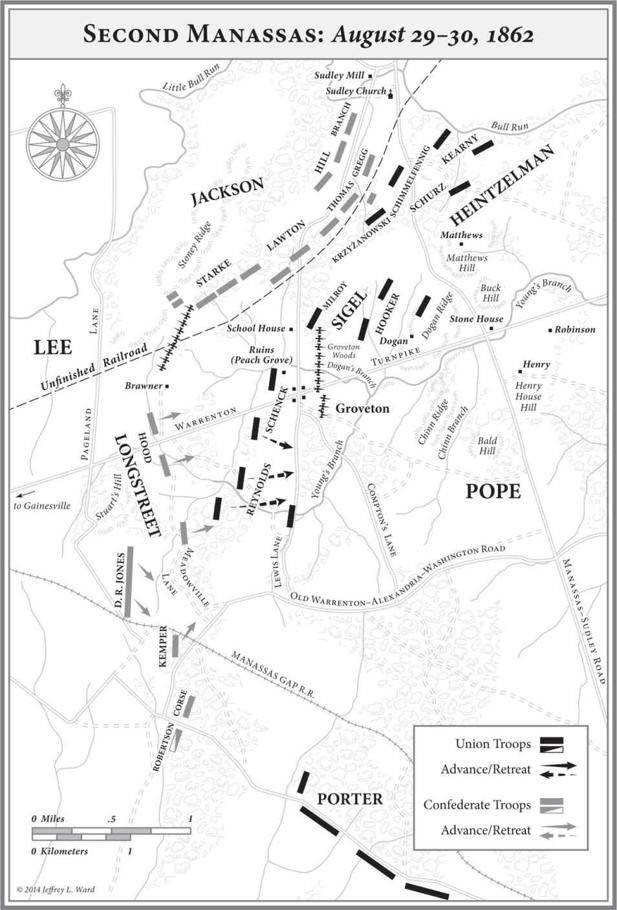
On the morning of August 29, expecting the full fury of the Union army to fall upon him—an expectation that would not be disappointed—Jackson shuffled his force east and north, placing his twenty-four thousand men in a gentle two-mile arc behind the unfinished railroad spur. To level the land for railroad tracks, engineers had dug trenches in some places (“cuts”) and piled dirt in others (“fills”). The effect was that of a linear fort, dead-level in a few isolated places and occasionally a bit too deep, but largely continuous along a wooded ridge. Any infantry that hoped to carry it would pay dearly in blood.
That would be the story of the battle. At daylight artillery on both sides began their barrages, and soon Franz Sigel’s Union skirmishers advanced into the woods north of the Warrenton Turnpike. They were probing, looking for the exact location of Jackson’s men. Behind them came the lines of battle, broken into clusters and odd groupings by the thickets. A Union general described “the weird clatter of rebel bullets against leaves and tree-trunks and branches.” And suddenly “the rattling fire of skirmishers changed into the crash of musketry, regular volleys, rapidly following each other. We [had] evidently struck Jackson’s main position.”16
What followed was the first of many savage fights that day that raged along Jackson’s two-mile line, the opening of the battle that would come to be known as Second Manassas or, as Northerners called it, Second Bull Run. With nine thousand men in place, Franz Sigel fought the battle’s first phase, mounting steady assaults on the center of Jackson’s position. For four hours Sigel’s troops came on, advancing in successive waves through the woods against the Confederates, who mostly fired from behind the cuts and fills of the railroad embankment. The Union attacks were repulsed, and many Union boys fell, but they were starting to take a fearful toll. The battle was just beginning.
Pope, who arrived on the field at noon and conducted a reconnaissance of the front, had a very clear idea about how to fight this battle. His plan was to keep Jackson occupied in his center and left, while Fitz John Porter’s 5th Corps fell on the Confederate right. Porter would strike the crippling, turning blow; he would flank Jackson, cut off his retreat, while the rest of the army would drive straight ahead. Pope had given those orders to Porter in the morning—or so Pope thought—but as the day progressed there was still no sign of Porter’s corps. In keeping with his scheme Pope unleashed another series of devastating attacks on Jackson’s increasingly weary, depleted lines. At about 2:00 p.m. he sent Joe Hooker’s division forward, and again the woods exploded in sheets of flame and smoke, minié balls thudded into trees and human flesh and bone, and again the Federals advanced through what one of them called “a hurricane of death.”17
Now the hours of constant defensive battle against superior numbers began to tell on the beleaguered rebels. Men from Massachusetts and New Hampshire regiments finally broke Jackson’s line and came pouring over the edge of the embankment. Suddenly they found themselves down in the cut with their enemies, exchanging fire at such close range that the muzzles of their weapons touched, and swinging their muskets by their barrel ends. It was brutal, destructive, highly personal warfare. In spite of their fierce, almost unbelievably brave charge, the Union soldiers, under their commander, Cuvier Grover, could not sustain their drive. The enemy position was too strong, and their assault had cost them a third of their force. Like all the other Union attackers that day, they faltered, broke, and fell back. As they did so, two Confederate brigades under Taliaferro’s replacement, William E. Starke, counterattacked, routing Grover’s and three other brigades in the process. Since Jackson was under strict orders from Lee to fight only a defensive battle, there was no question of further pursuit. That attack was followed by yet another thrust at Jackson’s center, also repulsed.
The fight wasn’t over yet. With Porter’s ten thousand fresh troops still nowhere to be seen, shortly after 5:00 p.m. Pope ordered Kearny to move against A. P. Hill’s division on Jackson’s left. This assault was the most brutal yet, the brunt of it falling on Brigadier General Maxcy Gregg’s five regiments of South Carolinians, who were dug in on a rocky knoll behind the embankment. Gregg, a brainy South Carolina lawyer whose side interests included botany, astronomy, and ornithology, rallied his men by shouting, “Let us die here, my men!” That they did, by the score. They had been fighting almost continuously for eight hours. They had lost a third of their brigade and were running out of ammunition.18 Alarmed, A. P. Hill sent a message to Gregg asking if he could hold his position. Gregg replied that, even though he was almost out of bullets, he could “hold the position with the bayonet.”19 Hill relayed the news to Jackson, and Jackson sent his unadorned reply through his aide Henry Kyd Douglas: “Tell him if they attack again he must beat them.” Jackson then thought better of it, and accompanied Douglas on horseback. They were met by a worried A. P. Hill, who was on his way to see Jackson. Jackson was sympathetic. But there was no question of retreat. “General, your men have done nobly,” he told his West Point classmate. “If you are attacked again, you will beat the enemy back.” History does not record Hill’s reaction. But a moment later, as a new, rising sound of musket fire came from Gregg’s front, Hill said, “Here it comes!” then turned and galloped away. Jackson called after him, “I’ll expect you to beat them!”20
What happened next was as close as Jackson came to disaster that day. Kearny’s ten regiments drove forward into the Confederate lines. They charged, broke, fell back, then charged again and again, line after line of bluecoats driving closer and closer to the embankment. There seemed no end to it. Kearny’s men were on the verge of a shattering breakthrough—one that might also have closed off Jackson’s only path of retreat—when 2,500 Confederates under General Jubal Early arrived on the field. In the battle’s most brilliant counterattack, Early’s fresh troops collided with the exhausted Federals, raking their depleted lines with fire, and almost immediately pushing them back. Soon they were in full retreat. Within ten minutes of Early’s attack, Kearny’s force was reeling out of the woods toward the turnpike as the rebel yell rose behind them and the Confederate lines rolled forward, stopping only when Hill reminded Early that his orders were not to advance beyond the embankment. That was the end of the fighting that day on Jackson’s front.
When it was over Hill sent a staff officer with a message for Jackson: “General Hill presents his compliments and says the attack of the enemy was repulsed.” Jackson smiled. “Tell him I knew he would do it,” he said.21 Jackson’s army had withstood the best the Union could throw at it and had paid for it in unimaginable amounts of human blood. Jackson and his commanders had furiously plugged holes in their lines all day and had fought off the repeated assaults by an army that was just as determined as his own to win. Pope had helped them by attacking sectors of the line instead of making multiple simultaneous advances. Jackson had been able to shift reinforcements to meet each Union threat.22 He ended the day in possession of virtually the same ground he had started with—ground that was now littered with dead and wounded men.
But that was by no means the full story of one of the most tactically complex and politically charged days of fighting in the war.
• • •
Jackson’s first concern, on the clear, warm morning of August 29, before the successive waves of Union assaults began to crash and break against his lines, was the whereabouts of Longstreet’s corps. He knew it had passed through Thoroughfare Gap and the village of Gainesville. He knew it was close. Now, above the line of trees to his west, he could see an enormous cloud of dust rising in the still summer air, heralding the imminent arrival of thirty thousand men and more than eighty pieces of field artillery. They had been sent to him from God and they had arrived in time and the question was where to put them. He had carefully selected a position on his right, almost perpendicular to his own line. Together the two Confederate wings would form a three-mile-long, slightly warped L—or, as some would describe it later, an open jaw with Jackson as the mandible—that put Longstreet immediately on the Union flank.
At 8:00 a.m. Jackson sent Jeb Stuart and his cavalry to Lee and Longstreet. Stuart’s job would be to guide Longstreet’s column in and install it in its new position. At 10:00 a.m., under Stuart’s guidance, Robert E. Lee led John Bell Hood’s Texas brigade east on the Warrenton Turnpike to the place designated by Stuart. As Lee did so he noticed that there were skirmishers everywhere, hundreds of them, fanned out and darting through the light and shadow in the woods. But he could not tell whose side they were on. He dispatched scouts to find out. After a couple of tense minutes, he got his answer: they were Jackson’s men. This meant that the two armies, which had traveled a combined one hundred miles or more at an interval of two and a half days, had somehow managed to fit their fifty-four thousand soldiers and trains perfectly together deep in enemy territory and in the presence of a large Union army. And they had done it, for all practical purposes, in secret. Lee’s plan had been more than daring. That it was working bordered on implausible. The three generals soon met and made plans, though there is no record of what was said. By noon, Longstreet’s men were fully deployed, positioned invisibly in woods just as Jackson’s men had been on August 28. East of them were open fields all the way to Bull Run.
Lee’s most obvious move at this point—as Jackson was being hammered by Union assaults—would have been to throw Longstreet forward against the Union left, using the full power of his L formation to turn Pope’s flank. But in one of the battle’s odd twists, that did not happen. Longstreet stayed in the woods. Jackson was left on his own to absorb the terrible fury of the pounding, dawn-to-dusk Union attacks. As would become apparent during the day, Lee and Longstreet had good reasons for holding back.
The first of these had to do with the wayward column of Union general Fitz John Porter. That morning he and his 5th Corps found themselves about two miles due south of Jackson’s right wing, listening to gunfire from the front, and waiting for orders. What he got from Pope was a masterpiece of self-contradiction and military nonsense. The rambling “Joint Order,” written at 10:00 a.m. from Pope’s headquarters near Henry Hill, seemed to direct him to simultaneously advance, stay put, and fall back. It was, in any case, not a clear order to advance against the enemy. Part of the order revealed Pope’s own shocking ignorance of Longstreet’s location: “The indications are that the whole force of the enemy is moving in this direction at a pace that will bring him here to-morrow night or the next day.” Porter knew better. Every soldier on the Union left knew better. Irvin McDowell had been informed of Longstreet’s arrival by his calvary chief at 9:30 but he inexplicably failed to tell Pope, a shocking lapse that would eventually severely damage McDowell’s reputation. In the spirit of Pope’s simultaneous and contradictory demands, Porter elected to stay where he was, assuming he would receive clarifying orders.
Pope, meanwhile, assumed that Porter would move against Jackson’s right and spent the entire day waiting for it to happen. Porter’s attack was to be the pivot of the entire battle. Porter, of course, did not have a clue that his superiors two miles to the east were waiting for him to do anything. (This issue—Porter’s orders from Pope and how he carried them out—was the subject of the war’s most famous court-martial. Porter was initially found guilty and removed from command. Not until long after the war were the charges overturned and Porter reinstated.23) At four thirty Pope, now furious and convinced that Porter’s failure to move was related to his political alliances, finally sent an order for Porter to advance, but Porter did not receive it until 6:00—too late, he believed, to move such a distance and attack before dark. Pope later lashed out at Porter, writing, “During these long hours General Porter still remained idle with his corps in column, and many of them lying on the ground, for ease of position probably, as they were not under fire. . . . It is not unreasonable to say that, if General Porter had attacked Longstreet . . . with ten or twelve thousand men . . . the effect would have been conclusive.”24
Porter, frozen in place as he was, was to be the great strategic pawn of the battle. He was more than just the key to the failure of Pope’s grand plan of attack. He was also the main reason why Longstreet’s corps stayed out of the fight. During several scouting expeditions that day, Lee, Longstreet, and Stuart had discovered two truths, both of which were disappointing to Lee, who wanted very much to attack. First, there were several Union divisions right in front of them that covered more than half of their mile-plus-long front. It was not clear to Lee how numerous his enemies were or what the terrain would be like. His main worry, sitting just south of them on the Manassas-to-Gainesville Road—directly on their right flank—was Porter, whose intentions were unknown. For the Confederates to attack now, Longstreet reasoned—he was the voice of caution—meant shifting a large part of his own force to guard against a flank attack, thus weakening the whole operation. And he reminded Lee that they still did not know what sort of terrain lay in front of them. Three times that day Lee proposed to attack; each time Longstreet talked him out of it.
The day’s fighting might thus have ended with Early’s repulse of Kearny except for one final, strange twist. Lee decided, at the last minute, and with only a little daylight left, to send John Hood forward with his Texans, Georgians, and Carolinians along the Warrenton Turnpike in a reconnaissance in force. The idea was to discover what was in front of them, in preparation for Lee’s planned advance the next day. Hood moved forward at about six thirty. By coincidence John Pope had also sent a force forward along the Warrenton Turnpike, but for such a bizarrely different reason that it requires explanation. Pope had seen Confederate wagons moving west down the Warrenton Turnpike and had come to the conclusion that the rebels, reeling from Kearny’s brutal though ultimately unsuccessful assault, were retreating. Though Pope’s chief of staff pointed out that the wagons were probably ambulances conveying wounded to the rear, Pope would not believe it. Instead, as a blazing sun streaked the sky over the Bull Run Mountains, he ordered an immediate pursuit. Soon Brigadier General John Hatch with three brigades was marching westward down the turnpike to strike a blow at the fleeing rebel army. As he left, his superior, Irvin McDowell, who agreed with Pope, barked, “General Hatch, the enemy is in full retreat! Pursue him rapidly!” The Union command could not shake the idea that Jackson was scared and running away, though all of Jackson’s behavior since August 26 argued against that idea. For some reason Pope was not thinking about the whereabouts of Longstreet.
Imagine, then, the surprise of General Hatch when, as his brigades crested a ridge overlooking Groveton, they suddenly faced a headlong frontal assault from several thousand of General Hood’s eager, battle-tested fighters. As Hatch immediately understood, the Confederates were not retreating. They were not fighting a rearguard action. The rebels were in force, and looking for a fight. He sent a message to Irvin McDowell saying as much. When McDowell received it, he exploded, “What! Does General Hatch hesitate?! Tell him the enemy is in full retreat and to pursue them!” No amount of pleading was going to save Hatch from a fight. So he fought bravely on, into and beyond darkness, and his men were beaten and driven back and many ended up wandering lost in the dark. There had not been much point in the battle—Lee was able to gather very little battlefield intelligence from it—and there were only a few hundred casualties on both sides, testimony to the difficulty of trying to hit a moving target in the darkness. Soldiers who watched from miles around as the fight illuminated the night described its strange beauty. They were unused to seeing so many muskets fired after dark.
Thus the day’s battle—one of the war’s greatest and bloodiest combats—finally ended. Pope, who still did not understand that he had struck Longstreet, closed the day out with an early-morning dispatch to Halleck that suggested he had won a decisive victory. He wrote, “We fought a terrific battle here yesterday with the combined forces of the enemy. . . . The enemy was driven from the field which we now occupy. . . . The news just reaches me from the front that the enemy is retreating toward the mountains. I go forward at once to see.”
Jackson, at his headquarters several miles away, would have been astonished to read that message. He was ending his day by patching up his lines and preparing for renewed attacks in the morning. Now that Robert E. Lee was present, he had assumed command of the battlefield. Jackson was following Lee’s orders, which meant holding fast, defending his position. According to Hunter McGuire, Jackson ended his day around a campfire, where his black servant Jim made coffee for him and his staff. McGuire told Jackson that Maggie Junkin Preston’s nineteen-year-old stepson, “Willy” Preston, had been mortally wounded that day. The blue-eyed, beardless Preston, a former VMI cadet, had recently joined the Stonewall Brigade and had quickly become one of Jackson’s favorites. When McGuire said this, Jim “rolled on the ground, groaning in his agony of grief.” Then McGuire noticed Jackson’s face.
The muscles were twitching convulsively and his eyes were all aglow. He gripped me by the shoulder till it hurt me, and in a savage, threatening manner asked me why I had left the boy. In a few seconds he recovered himself, and turned and walked off into the woods alone. He soon came back, however, and I continued by the fire, drinking the coffee out of our tin cups, when I said: “We have won this battle by the hardest kind of fighting.” And he answered me very gently and softly: “No, no; we have won it by the blessing of Almighty God.”25
We will never know what passed through Jackson’s mind when he heard about Willy. Perhaps it was a vision of that vanished old world of Lexington, a world inhabited by his dead wife, Ellie, and her spirited sister Maggie, Jackson’s beloved surrogate father George Junkin and his great friend John Lyle, and by apple-cheeked young men in immaculate uniforms marching peacefully across the VMI parade ground. All of that was gone, vanished—more completely than he would ever know. It had lived in some way in Willy. Now Willy, too, was gone.
• • •
One of the most important players in the Battle of Second Manassas was a man who was never there: George B. McClellan. After moving his army north, he had assumed command of those parts of it that had not joined Pope’s army, most significantly the corps of Edwin V. Sumner and William B. Franklin, containing fourteen thousand and eleven thousand men, respectively. Together they were larger than Jackson’s entire force. As Lincoln and Stanton saw it, the logical thing was to move this impressive force to the battlefield as quickly as possible. But it never happened. From August 27 to August 30, in an effort that required considerable energy, McClellan kept these troops in or near Washington. In the peninsula campaign his endless dithering, pettifoggery, inflated enemy troop estimates, and stubborn refusal to advance suggested to many observers that McClellan was incompetent. At Second Manassas, his behavior started to look to his critics—including the Secretary of War—more like malfeasance or even treason.
There was no doubt that McClellan detested Pope and would have been happy to see him fail. His correspondence is full of the wish that his rival might be defeated and the hope that his own fortunes would thus be bolstered. His letters drip with contempt, jealousy, and naked ambition. On July 22 he wrote his wife, Ellen, “I see that the Pope bubble is likely to be suddenly collapsed—Stonewall Jackson is after him, & the paltry young man who wanted to teach me the art of war will in less than a week either be in full retreat or badly whipped. He will begin to learn the value of ‘entrenchments, lines of communication & retreat.’ ” On August 10: “I have a very strong idea that Pope will be thrashed during the coming week—& very badly whipped he will be and ought to be—such a villain as he is ought to bring defeat upon any cause that employs him. . . . I am inclined to believe that Pope will catch his Tartar [Jackson] within a couple of days and be disposed of.26 On August 23: “I take it for granted that my orders will be as disagreeable as it is possible to make them—unless Pope is beaten, in which case they may want me to save Washn again.”27
The question—argued over in detail by memoir writers and historians for the last one hundred fifty years—was whether he withheld reinforcements out of pure malice and self-interest or because he was simply being his old cautious, conservative self. Here the picture becomes murkier, mainly because of the cynical and cowardly machinations of his superior, General in Chief Henry W. Halleck. In the wake of Jackson’s rout of the small force under Brigadier General George Taylor, McClellan’s natural conservatism had asserted itself. In a long meeting with Halleck on the night of August 27 he insisted that, because there was obviously a large Confederate force between Pope and Washington, the capital itself was in danger, and thus General Edwin V. Sumner’s 2nd Corps was needed to defend it. He also argued that the eleven thousand men in William B. Franklin’s command should not move to Pope’s aid until they had their full artillery with them. They might otherwise be beaten in detail. (Bringing up artillery would take at least several days.) Pope, moreover, already had sixty-seven thousand men, including elements of McClellan’s army, to face fifty-five thousand Confederates. Such assertions were perfectly McClellan-like in their caution and aversion to risk, and he wrote to his wife to say that he was pleased that he and Halleck were in agreement. Halleck, moreover, had already seemingly abdicated his proper role as arbiter between the two rival generals, telling Little Mac in a letter earlier that day that he (Halleck) “had no time for details” and “you will therefore, as ranking general in the field, direct as you deem best.” Halleck had not only agreed with McClellan’s strategy; he was also trusting him to make his own decisions.
But Halleck was buffeted by stronger winds. Secretary of War Edwin Stanton—looking for information with which to discredit McClellan—had demanded pointedly of Halleck whether McClellan had promptly obeyed his orders to quit the James River, and, more tellingly, if Franklin had been ordered to Pope’s relief and whether those orders had been obeyed. Halleck, afraid that his own neck was on the block, now wrote a long, untruthful reply saying that he had done everything possible to prod McClellan into action. Then, to McClellan’s astonishment, at 12:40 p.m. on August 28—the day of Jackson’s Groveton fight—Halleck bypassed Little Mac and personally ordered Franklin to march to Manassas Junction. He got back a plaintive note from McClellan saying, “The moment Franklin can get started with a reasonable amount of artillery he shall go.” Halleck, now going all out to cover himself, wrote, “Not a moment must be lost in pushing as large a force as possible toward Manassas.” McClellan, perhaps now realizing that there was considerable subtext to his correspondence with Halleck, replied flatly: “Your dispatch received. Neither Franklin nor Sumner’s corps is now in condition to fight a battle. It would be a sacrifice to send them now.”28 This of course looked like McClellan was simply refusing, out of spite, to obey orders.
At 2:30 p.m. on August 29, while the battle raged in front of Jackson’s railroad embankment and successive Union assaults were being repulsed and no reinforcements from McClellan’s army were in sight, Lincoln sent McClellan an innocently hopeful wire: “What news from direction of Mannassas [sic] Junction?” McClellan replied that he believed the enemy to be in retreat and that “I am clear that one of two courses should be adopted: first, to concentrate all of our available forces to open communication with Pope; second, to leave Pope to get out of his own scrape, and at once use all our means to make the capital perfectly safe. No middle course will now answer. Tell me what you wish me to do, and I will do all in my power to accomplish it.” Lincoln answered that he preferred the former, but in any case left the ultimate decision to Halleck. Halleck, in turn, sent his own deeply hedged reply to McClellan, saying that Sumner’s column should remain to defend Washington and that Franklin should advance, but that he really need to go only far enough to reconnoiter the enemy’s location and strength. “Perhaps he may get such information at Anandale as to prevent his going farther,” Halleck wrote. He was most concerned about a strike on Washington, so Franklin should probably stay close to home. This hardly amounted to “prodding” McClellan to order an advance. Halleck was clearly trying to have it both ways.
Thus were large numbers of reinforcements kept from the Army of the Potomac. Though when taken out of context the phrase “leave Pope to get out of his own scrape” sounded faintly treasonous—and would haunt McClellan for a long time, especially in the 1864 presidential election—in fact McClellan was guilty only of infelicitous language. He was right: those were the two options. And Henry Halleck had been perfectly complicit in retaining Sumner’s and Franklin’s forces near Washington. In McClellan’s mind, his orders were now clear. He ordered Franklin to move forward but to stop at Annandale, well short of the battlefield. Halleck, meanwhile, shifting once more to cover himself, wrote a note to McClellan at 7:50 p.m., saying, indignantly, “I have just been told that Franklin’s corps stopped at Annandale . . . this is contrary to my orders; investigate and report the facts of this disobedience.” But Halleck’s dizzying duplicity had another consequence. Now Lincoln and Stanton became enraged at McClellan, believing that he was deliberately refusing to help Pope. “He has acted badly toward Pope,” Lincoln told his secretary John Hay. “He really wanted him to fail.” While the latter was almost certainly true, there is little hard evidence that McClellan, acting from pure enmity, actually wanted his country to fail, too.29
• • •
Pope had made several telling mistakes in the campaign, but the most harmful was to misinterpret—almost willfully, it seemed to his subordinates—the stream of intelligence he received about the presence of James Longstreet. Hatch had encountered a piece of his corps, as had Porter and Reynolds, and there was no shortage of reports of a large Confederate force crossing Thoroughfare Gap. Porter had even told Pope personally on the night of August 29 that there was a body of men sitting precariously on the Union left. Pope, who had become convinced that Porter, a McClellan protégé, was the head plotter in a McClellan-led cabal to thwart him, refused to believe it. Pope decided that Longstreet, instead of extending Jackson’s existing line, had moved in behind Jackson in a position of support. No one knows quite why he thought this. Just as it is difficult to understand why, on the hot, still morning of August 30, Pope continued to believe that his enemy was retreating.
That conviction had put him in an expansive mood. He had once again persuaded himself that he was on the brink of victory. That morning he stood on a treeless knoll at his headquarters, smoking a cigar and exchanging jokes and pleasantries and congratulations with his generals. Just before noon he ordered another massive pursuit of the supposedly retreating rebel army. Porter would lead it, Hatch and Reynolds would follow; Hooker and Kearny would follow a parallel path to the north. The men were assembled, the artillery rolled up, and the chase after the retreating rebels began in earnest. Predictably, it lasted less than an hour, the time it took for skirmishers to discover that something big and massed and threatening was still sitting back in those woods by the railroad embankment. Jackson’s men had not gone anywhere. That was the end of Pope’s delusion.
Lee had decided against a morning offensive. He would wait for Pope to attack, then look for a weakness to exploit. If Pope did not attack, Lee had a backup plan: late that afternoon Longstreet would advance eastward across the open fields toward Chinn Ridge and engage Union forces, while Jackson pulled out from behind the embankment and marched around the Union right, striking deep in the Union rear, a miniature version of his march to Manassas Junction.
But Pope did attack. At 3:00 p.m. Porter’s ten-thousand-man corps, which Pope had made sure was going to do the fighting this day, was sent forward, en masse, against Jackson’s right. Men who saw it remembered it as one of those picture-book assaults: the Federal lines advancing in perfect order, bayonets and musket barrels flashing like heliographs in the slanting afternoon sun, battle flags streaming above the regiments. There was a strangeness to the movement, too, for those who could see it. They were hitting Jackson’s right, literally under the noses of Longstreet’s watchful thirty thousand. “Evidently Pope supposed I was gone,” wrote Longstreet later, “as he was ignoring me entirely. His whole army seemed to surge up against Jackson as if to crush him with an overwhelming mass. I could plainly see the Federals as they rushed in heavy masses against the obstinate ranks of the Confederate[s].”30
What followed was desperate, furious combat, much of it conducted as before at close range. Rebels fired from cover behind the cuts and fills of the excavation; Federals used anything they could find—rocks, trees, dead horses, even dead comrades. Along one part of the line Confederates quickly ran out of ammunition and began to throw stones at the enemy. Some they threw hard and straight, others they lobbed over the edge of the embankment onto the Federals huddled below, severely injuring some of them. Some of the Union boys threw them back. The fighting became so intense at the “Deep Cut” that Jackson was worried his lines might break. He later wrote, “As one line was repulsed, another took its place, and pressed forward, as if determined, by force of numbers and fury of assault, to drive us from our positions. So impetuous and well-sustained were these onsets as to induce me to send to the Commanding General for reinforcements.”31 Unlike the previous day, Jackson had no uncommitted reserves to bring forward.
Longstreet, upon receiving Jackson’s request, realized two things at once: first, that his reinforcements would never reach Jackson in time, and second, that the battlefield presented his batteries with a clear opportunity for enfilading fire. He ordered more guns forward to supplement the batteries that were already blasting away. Their combined fire now tore into the second and third waves of the Union assault and pinned many attacking Federals against the unfinished railroad. The effect was immediate and devastating.32Three times Porter’s forces rallied. Three waves of assault crashed and disintegrated against the insurmountable Confederate wall. They finally broke altogether. Some withdrew gracefully, others did not, as the Confederates piled out of their trenches in pursuit. In Jackson’s words:
Soon a general advance of my whole line was ordered. Eagerly and fiercely did each brigade press forward, exhibiting in parts of the field scenes of close encounter and murderous strife not witnessed often in the turmoil of battle. The Federals gave way before our troops, fell back in disorder, and fled precipitately, leaving their dead and wounded on the field. During their retreat the artillery opened with destructive power upon the fugitive masses.33
Many just ran rearward in a confused, chaotic mass, a retreat that bordered on panic and took Porter and other commanders time to quell—some of it at the points of bayonets. Eventually order was restored.34 But not before Irvin McDowell managed to overreact to the danger. Sensing an impending First Manassas–style rout, he ordered Brigadier General John F. Reynolds forward with his 7,000 men from his position behind the Union lines, moving it north of the turnpike. This might have seemed sensible enough if there had been no danger on the Union left. But there was enormous, catastrophic danger on the Union left. Reynolds’s advance meant that the Federal left was now virtually wide open and vulnerable. There were only 2,200 Union troops in place south of the turnpike, essentially an open field for Longstreet’s advance.
Lee and Longstreet were not immediately aware of McDowell’s mistake, but they understood that Porter’s frontal assault had failed, that his ranks were shattered, and that the large force that had been on their right—Porter again—was no longer there. They decided, simultaneously and while the smoke was still rising from the last of Jackson’s volleys, that the moment had come for Longstreet’s corps to finally rise from the woods and move against Pope’s left. It was not completely clear what was ahead of them, but Lee knew he was burning daylight, and he knew he had an opportunity, straight from classical military textbooks, to envelop and possibly destroy Pope’s army. Longstreet, who had argued persuasively for a full day against an advance, was now ready. He was fully aware that he was in the pivot of one of the battle’s—and the war’s—great climactic moments. In his own words, “As [Porter’s line] broke the third time, the charge was ordered,” and then “twenty-five thousand braves moved in line as by a single impulse.”35
And now the rebel wave rolled forward, to the astonishment of the Union command, especially John Pope. With Hood’s Texans in the lead, it crushed everything in front of it, including a full brigade and battery. For thirty minutes Hood bulled straight ahead, unstoppable. The rebel goal was Henry Hill, the center of the fight at First Manassas. If the Confederates possessed it they could cut off a Union retreat down the Warrenton Turnpike. But first they had to cross Chinn Ridge, where hastily assembled Union forces put up a surprisingly tenacious defense, allowing time for Pope to place some seven thousand troops on Henry Hill, which lay only three hundred yards behind it. At about 6:00 p.m. Chinn Ridge finally fell. The Confederate victory there meant that Longstreet had finally demolished the Union left.
It was at about this time, too, that Pope as much as conceded defeat. Some Union regiments and brigades were already streaming eastward down the Warrenton Pike. At five fifty he gave orders to the rest of his army to retreat to the line of Henry Hill. He also ordered Nathaniel Banks to destroy all public property at Bristoe Station—completing Jackson’s work—and retreat with his corps to Centreville. A brisk defense on Henry Hill—where Federals held off an advance of three thousand Georgians—spared the Union army the sort of headlong, panicked flight of the First Manassas. Jackson’s troops might have made a difference there. But for some reason Lee never ordered Jackson’s eight fresh brigades forward. Jackson had been told only to “look out for and protect [Longstreet’s] flank,” most likely because his brigades and divisions had been so badly wounded, scattered, shuffled, and commingled with each other while absorbing the repeated assaults over three days, that Lee believed he was in no shape to attack.36
Pope’s army, in any case, was quite soundly beaten. (The casualties—10,000 Union and 8,300 Confederate—gave no indication of the thoroughness of the beating Pope took.) At 8:00 p.m. Pope ordered a full retreat of all his units to Centreville. By 11:00 p.m. most of his army had retreated across Bull Run. There was no panic this time, just heartbreak and humiliation. At Centreville, they encountered soldiers of General William B. Franklin’s corps, who instead of cheering or sympathizing with their bloodied comrades, mocked them. Some said plainly they were happy that Pope had been beaten, echoing the sentiments of their leader. In doing so they were acting out the larger drama of the Union army, with, as one soldier put it, all of “the arrogance, jealousy, and hatred which then was the curse of Union armies in Virginia.”37 Soon Pope and his generals decided that staying at Centreville was a bad idea, too, since the rebels would simply march around them. For once he was not wrong. This was exactly what Jackson tried to do. On September 1 he slipped away and marched north and east around Pope’s flank, hoping to cut off the Federal retreat. Anticipating this, two divisions under Pope clashed with Jackson in the Battle of Chantilly, a quick, violent, rain-drowned affair fought in a riotous thunderstorm that ended in stalemate and cost the life of the remarkable Major General Phil Kearny. He had mistakenly galloped into rebel lines, then, realizing his error, had turned and ridden away. One observer recalled that “as he galloped off lying prone on his horse’s neck, [he] was killed. No trace of a wound was to be found, the bullet having entered the anus.”38
There would be no more Confederate pursuit of the Union army. By this point it hardly mattered. Lee could not destroy the Union army, and he could hardly demoralize it any more than he already had. After the battle Pope’s men resumed their retreat, slogging through the mud and rain to Alexandria. Those who participated in it remembered great disorder and confusion, vast snarls of wagons, ambulances, caissons, and wounded men—in the words of historian Bruce Catton, “the disorder inseparable from retreat.”39The men walked with heads down, disheartened as much by the knowledge of how badly they had been mishandled by their own generals as from their shameful retreat from the field.
Though Chantilly had been largely a pointless afterthought—Jackson had not wanted to fight it—the idea of a victorious rebel army loose on the outskirts of Washington put yet another major scare into the capital. Stanton ordered the weapons and ammunition in the national arsenal transported to New York. He also ordered a steamer held in readiness to help the president escape, if necessary. Henry Halleck, the leader of the Union war effort, seemed on the verge of a breakdown, battered from his fight with McClellan, suffering from a painful case of hemorrhoids, and horrified by his army’s precipitous retreat that he had been powerless to stop.40
Pope himself was deeply depressed. On September 2 he wrote a letter to Halleck that was alarming in its tone of meekness, gloom, and resignation. “As soon as the enemy brings up his forces again,” he wrote, “I will give battle when I can, but you should come out and see the troops. They were badly demoralized when they joined me, both officers and men, and there is an intense idea among them that they must get behind the intrenchments. . . . You had best decide what should be done. The enemy is in very heavy force and must be stopped in some way.”
Lee’s message to Richmond, meanwhile, which was played and replayed in newspapers throughout the South, was a measure of the true size and sweep of this Confederate victory:
The army achieved today on the plains of Manassas a signal victory over the combined forces of Genls McClellan and Pope. On the 28th and 29th each wing under Genls Longstreet and Jackson repulsed with valour attacks made on them separately. We mourn the loss of our gallant dead in every conflict yet our gratitude to almighty God for his mercies rises higher and higher each day, to him and the valour of our troops a nation’s gratitude is due.
Perhaps the most astonishing thing of all to happen at the Battle of Second Manassas took place at the very end of the campaign. On the afternoon of September 2, the sun had finally come out and Generals Pope and McDowell were riding at the head of their retreating column, followed by their shuffling, silent, disconsolate men. In the road ahead they saw a small group of horsemen led by a small man riding a great black horse and wearing a jaunty yellow sash. It was George McClellan. As he approached he saluted crisply and proceeded to inform them—to their numb amazement—that by order of President Lincoln he was now back in full command of the armies of Virginia. A few moments later General John Hatch, who hated Pope and felt mistreated by him, addressed his infantry in a parade-ground voice that was heard by all, “Boys, McClellan is in charge of the army again! Three cheers!”41 His men erupted, shouting and screaming “with wild delight.”