
Chapter Nine
‘In seizing a state the usurper should carefully examine what injuries he must do, and then do them all at one blow so that he does not have to repeat them day after day; and by taking care not to unsettle men he can reassure them and win them over with gifts. Anyone who fails to do this, either from cowardice or bad advice, has to keep a knife in his hand all the time.’
Machiavelli, Il Principe
‘Where he went abroad, his eyes whirled about, his body secretly armoured, his hand ever on his dagger.’
Sir Thomas More, The History
of King Richard the Third
The reign which now opened was to be the unhappiest in English history. The black legend had begun before the King even ascended the throne. For the rest of his short life he was to be a byword, inspiring more dread and terror than any monarch before or since, not excepting Henry VIII. More is not exaggerating when he says that Richard III ruled in an atmosphere of nightmarish insecurity.
[He] never had quiet in his mind, he never thought himself sure. Where he went abroad, his eyes whirled about, his body secretly armoured, his hand ever on his dagger, his countenance and manner like one always ready to strike back. He took ill rest a-nights; lay long waking and musing, sore wearied with care and watch; rather slumbered than slept, troubled with fearful dreams – suddenly sometimes start up, leapt out of his bed and ran about his chamber.
Sir Thomas tells us he heard this ‘by credible report of such as were secret with his chambermen’.
Even before Richard’s subjects had reason to suspect that the Princes had been killed, it is likely that the majority disliked and mistrusted their new King. He was a scandal, by the lights of his own violent age. Dr Hanham emphasizes that his nephews were dispossessed ‘on grounds which were evidently not thought adequate by the country at large’; in More’s words, ‘upon how slippery a ground the Protector builded his pretext, by which he pretended King Edward’s children to be bastards’. There had not been the slightest pretence at legality in taking away the younger Prince’s peerages – the Petition contains no mention of depriving him of these. Above all, neither could be bastardized, even by Act of Parliament, unless a full canonical investigation by the Church had proved beyond doubt that their parents’ marriage had been invalid.1 Few crimes were considered more heinous than swindling heirs out of their birthright; as that venerable lawyer, Bracton, had written 200 years before, ‘God alone can make an heir.’
Moreover, as Mancini attests, many Londoners believed that usurpation would be followed by murder. And, although they lived in a brutal age, fifteenth-century Englishmen could be sentimental enough about children. The feast of the Holy Innocents – commemorating King Herod’s massacre of all the children in Bethlehem – was an enormously popular devotion in the late Middle Ages. Richard would be commemorated as the Wicked Uncle in the ballad of the Babes in the Wood, which may have an origin earlier than the sixteenth century – it was undoubtedly inspired by the fate of the little King and his brother. The capital was stunned by shock and horror.
It may be asked why was there no resistance. The answer is that, as with all successful coups d’état, Richard had taken everyone completely by surprise and with overwhelming military superiority. It was common knowledge that thousands of his much feared Northerners were on the way south. No great magnate was available to drum up opposition to the coup, and lesser folk were not ready to risk their necks. But, as will be seen, this did not stop bitter and mounting resentment.
The Princes seem to have been attractive boys. The Croyland writer says that they were ‘sweet and beauteous children’, and he must have seen them with his own eyes. Mancini heard glowing reports of Edward V. ‘He had such dignity in his whole person, and in his face such charm, that however much they might gaze, he never wearied the eyes of beholders.’ Obviously he had inherited the good looks of his magnificent father. ‘I have seen many men burst forth into tears and lamentations when mention was made of him after his removal from men’s sight.’ The Italian scholar adds that Edward showed signs of intellectual ability unusual in one of his age. We know hardly anything about his younger brother, Shakespeare’s ‘little prating York’. The chronicler Jean Molinet – not the most reliable of sources – informs us that he was ‘joyous and witty, nimble and ever ready for dances and games’.2
For all Richard III’s Plantagenet blood, military prowess and proven ability, many Englishmen simply could not think of him as the true King of England.3 They still acknowledged young Edward. But Richard was cursed with a weakness for self-delusion, which weakened his political judgement. Being ‘blind with covetousness of reigning’, he could not believe that he was unacceptable. A Latin poem in the Croyland Chronicle, which plainly refers to him, warns that those who usurp power ‘confound themselves and their cause by confusing private desires with public good’. No doubt the new King deluded himself for some time into believing that he was popular; after all, he really was the man best fitted to govern the country. He retained a certain amount of good will in the North, though in the end many Northerners abandoned him – the two key magnates who were to betray him at Bosworth both came from the North. He was unable to identify a whole host of secret enemies until they declared themselves and it was therefore impossible for him to remove all opposition at one blow. In consequence he failed to implement what was to be one of Machiavelli’s cardinal tenets for a successful usurpation.
The mental climate of his age may well have conspired to prevent Richard from seeing himself as a hypocrite. There was an all too seldom resolved conflict between emotion and action in fifteenth-century minds. The King’s slightly older contemporary, Sir Thomas Malory, the author of the exquisitely noble Morte d’Arthur, was little better than a gangster and gaolbird who stood accused of armed robbery, sacrilege and rape on not just one but several occasions.
The reign began with a forced gaiety. On Friday 4 July Richard and his wife travelled by state barge along the Thames to the Tower of London, the royal residence from which by tradition Kings and Queens of England rode to their Coronation. Anne had come down from the North early in June, apparently bringing with her the Earl of Warwick, Clarence’s nine-year-old son. (Probably Richard regarded the boy as a potential rival, even though he was excluded from the succession by his father’s attainder.)
‘Edward Bastard, late called King Edward V’ – as he was now described officially – was still at the Tower, together with his brother. The Great Chronicle of London refers to the two children being ‘seen shooting and playing in the garden of the Tower by sundry times’, but gives no precise date. Probably they had been moved out of the palatial apartments by the river long before the arrival of their uncle and aunt and taken into the fortress itself – Mancini says this happened as soon as Hastings was liquidated. It has been plausibly suggested that they were moved twice, first to the Garden Tower (now the Bloody Tower) from where they had access to the garden, and then into the White Tower in which State prisoners were held and where they could be kept out of sight – they had disappeared for good from the public gaze by the time of their uncle’s Coronation. It is unlikely that he visited them, though they cannot have been entirely absent from his thoughts.
Yet perhaps Richard was too busy exulting over the kingdom he had seized. His capital was world famous for its riches and size, dwarfing even his cherished York. Thanks to Mancini, who left it the same week and recorded his impressions only a few months later, we know what it looked like at this very moment. He notes how the Thames is navigable by large vessels up to London itself, how, had the South Bank been walled, it could be described as a city in its own right. He mentions the ‘very famous bridge, built partly of wood, partly of stone. On it there are houses and several gates with portcullises; the houses are built over workshops belonging to various types of tradesman.’ He is impressed by the ‘very strong citadel next to the river, which they call the Tower of London’, and by ‘enormous warehouses for imported goods’ on the banks of the Thames, and – a curiously modern note – by ‘many cranes of extraordinary size to unload merchandise off the ships’. He describes the three main streets. The one nearest the river (Thames Street) is full of ‘all types of metal, wine, honey, pitch, wax, flax, rope, thread, grain and fish, and other rough goods’. In the central street (comprising Tower Street, East Cheap and Candlewick Street) ‘you find nothing for sale but cloth’. The third street, running through the town centre (from Aldgate on the east side to Newgate on the west, and including Cornhill and West Cheap) deals in ‘more precious goods, such as gold and silver plate, cloths of rich hue and all sorts of silks, carpets, tapestry and other rich wares from abroad’. He says he simply does not have room to describe ‘the citizens’ refined ways, the magnificence of their banquets, the lavish decoration and opulence of the churches’. Other foreigners were equally dazzled. Twelve years later a Venetian wrote that he had seen fifty-two goldsmiths’ shops in Cheapside alone, that in Milan, Rome, Venice and Florence together he had never seen so much silver plate as in London. This was indeed the ‘Flower of Cities all’ (even if as many as a third of the population may have been destitute or near destitute). Its proud inhabitants had enough confidence in their private judgement to be deeply disturbed by the usurpation. But it made no difference.
On 5 July the new King and Queen rode from the Tower of London to their Palace of Westminster. He was dressed with breathtaking splendour, in a doublet of blue cloth of gold over which he wore a purple velvet gown trimmed with ermine. He far outshone his wife, who followed him in a litter escorted by five mounted ladies-in-waiting. The royal pair were accompanied by the vast and gorgeously clad procession of the Lords Spiritual and Temporal, which included almost the entire English peerage – three dukes, nine earls and twenty-three barons. The Duke of Buckingham outshone even Richard, in a robe of blue velvet embroidered with blazing golden cartwheels. (According to Rous, the Duke was already boasting that he now had as many men wearing his livery as Warwick the King-maker.) In addition there were nearly eighty knights and countless gentlemen – a surprising number of whom would rise in rebellion within a very few weeks. As he rode through the London streets, the bare-headed King bowed to right and to left.
Richard III and Anne Nevill were crowned in Westminster Abbey by Cardinal Bourchier (despite the old man’s unwillingness – he stayed away from the Coronation banquet)4 on Sunday 6 July 1483. Contemporaries claimed it was the most magnificent Coronation that had ever been seen. The boar badge was much in evidence – 13,000 white boars on fustian hangings decorated Westminster – and a new officer-of-arms had been specially created for the occasion, Blanc Sanglier. The King and Queen walked barefoot to the Abbey. Here they submitted to the ancient (but nowadays long since discontinued) anointing with the holy oils on the breast, standing naked from the waist up. After being crowned they heard High Mass and took Communion, the King drinking from the Chalice – a privilege then enjoyed by no other English layman. (No doubt he had made a confession of his sins, in preparation.) The Te Deum after the crowning and the anthems during the Mass must have been heard only too easily by the miserable Elizabeth Woodville and her daughters in sanctuary at the Abbot’s Lodging. Wearing their crowns, the anointed King and Queen retired briefly. In their absence the Duke of Norfolk and Earl Marshal, mounted on a charger whose cloth-of-gold trappings swept down to the ground, rode up and down to drive out the crowds. At four o’clock the monarchs entered Westminster Hall, still wearing their crowns, to preside over the Coronation banquet attended by several thousand people. On bended knee the Mayor of London served them with hypocras (hot spiced wine), wafers and wine. During the banquet the King’s Champion, Sir Robert Dymmock, wearing a white armour and mounted on a charger caparisoned in white and scarlet, rode into the hall and flung down his white steel gauntlet – as a challenge to anyone who disputed Richard III’s right to the throne. There were cries of ‘King Richard! God save King Richard!’ and he rode off with his silver-gilt bowl of wine, after drinking the monarch’s health. The banquet continued until nine, when it was growing dark and great wax torches were brought in. As soon as these were lit, the lords and ladies went up to the royal dais to renew their homage and say goodnight, and then at last the King and Queen left the hall too.
Coins were at once struck to proclaim that Richard was now a consecrated King. As was customary, the silver groats and half-groats showed him crowned with a bare, anointed breast; they had the boar’s head for their mint mark. Perhaps symbolically, the sole gold denominations issued were the beautiful angel and angelet – these were touch pieces for the ‘King’s Evil’ (scrofula) which only the hand of a consecrated monarch could heal. No act of ostentatious piety was left undone. On 12 July Richard and Anne processed barefoot around Edward the Confessor’s shrine at Westminster.
Foreign rulers were informed with due ceremony of Richard III’s accession. The Pursuivant Blanc Sanglier was sent to Plessis-les-Tours to announce it to Louis XI and to ask for his friendship. If Commynes is to be believed, Louis had no wish to answer the usurper. However, he sent a curt note of acknowledgement. Even Kendall admits (in his study Louis XI, the Universal Spider) that ‘so shaky a government could never trouble France’. Richard appears to have been piqued by the Valois’s coldness.
While Dymmock’s white gauntlet had been left lying on the floor of Westminster Hall, there had nevertheless been a hint of discord during the Coronation. At the moment of crowning it was noticed by some that the Duke of Buckingham – who was enjoying the privilege of carrying his new sovereign’s train – ‘could not abide the sight thereof’, but turned the other way to avoid seeing the crown being placed on Richard’s head.
Nevertheless, Harry Buckingham had been richly rewarded, as indeed had everyone else who had helped with the usurpation. Already he possessed half the Bohun inheritance and now the King gave him the remainder – estates worth over £700 a year – with the promise that the gift would be ratified by Parliament as soon as it met. He also received Richard’s former office of Lord Great Chamberlain, besides being appointed Constable of England – in modern terms, Commander-in-Chief. He was supreme in Wales and the West Country.
John Howard received another of the King’s former posts, that of Lord High Admiral. Moreover, on 28 June, only two days after his master’s seizure of the throne, he had received his real reward and had been made Duke of Norfolk, Earl Marshal and Earl of Surrey – the latter title being borne by his son, Sir Thomas. The new Duke had carried the crown itself at the Coronation. He was also presented with nearly as many manors as Buckingham, besides other revenues. His domain was East Anglia.
The Earl of Northumberland, who had marched into London with some 5,000 northern troops on 3 July – Richard reviewed and thanked them in Moorfields – received the King’s old offices and privileges in the North West, becoming the new Warden of the entire Scots Marches. He was also appointed to many other great northern offices and likewise received a vast grant of manors. However, most unwisely, he had only been given many of his posts for a limited tenure and his determination to restore Percy dominance in the North remained a dream. Even so, he was none the less the most powerful magnate in the North.
Lord Stanley, who had been forgiven, seems to have been allowed to retain his office of Steward of the Household. Presumably this was thought sufficient to secure his friendship – a gross miscalculation. He too controlled large blocks of territory, in the north Midlands.
Buckingham, Norfolk, Northumberland and Stanley, these were the four props of the new regime. They formed an alarmingly narrow power base. All were ‘over mighty’, with large private armies. The desertion of any one of them could place Richard in grave peril.
Yet very few people were happy about the new regime. It is likely that, with most Englishmen, the majority of peers regarded the King as an usurper for all his crowning and anointing. Robert Fabyan’s New Chronicles of England and France makes this very clear. (The author was fully adult in 1483 and living in London.) Because Richard had stolen the throne, he
fell in great hatred of the more part of the nobles of his realm, in so much that such as before loved and praised him still as Protector, now murmured and grudged against him, in such wise that few or none favoured his party, except it were for dread or for the great gifts that they received of him; by means whereof he won divers to follow his mind, the which after deceived him.
Plainly he sensed an undercurrent of disloyalty; there are indications that he suffered from the paranoia which afflicted his brother Clarence. This might well explain why he was always clutching his dagger and wore a mail shirt.
However, Richard had henchmen, household men, upon whom he could rely. They appear to have worked as a team and included, to name only a few, Francis, Viscount Lovell (Lord Chamberlain), Lord Scrope of Bolton, Sir Richard Ratcliff and William Catesby (Chancellor of the Exchequer), together with Sir Robert Brackenbury (Constable of the Tower), Sir Robert Percy (Comptroller of the Household), Sir Ralph Assheton (Vice-Constable), Sir James Tyrell (Master of the Henchmen and Master of the Horse), John Harrington (Clerk of the Council), John Kendall (the King’s Secretary), Walter Hopton (Treasurer of the Household), Sir Thomas Burgh, Sir Marmaduke Constable, Sir Humphrey Stafford, Sir Thomas Pilkington, Sir Gervase Clifton and John Nesfield. Nearly all were Knights or Esquires of the Body. Edward IV had run a similar team – household men and estate managers used in central government or for security purposes – but was never sufficiently isolated to rely on it in the way that his brother did. Richard’s team was a general staff, a bodyguard and an administrative élite. It was a general staff, a bodyguard (from whom today’s Gentlemen-at-Arms are descended) and an administrative élite. Its military functions were especially important: Dynham was at Calais, while Brackenbury, as Constable of the Tower, was in control of the chief arsenal and arms depot; Brackenbury was also keeper of castles in Kent, as Tyrell was in Cornwall; Assheton would take over most of Buckingham’s military duties; and many other members served as castellans or commissioners of array. The ‘mafia’ contained some very tough men indeed, as became increasingly evident during their master’s short reign.
It is possible that Lord Lovell had been a boyhood companion of Richard at Middleham but there is no proof that he was, as Kendall maintains, the King’s ‘oldest and dearest friend’. Nor was he a Northerner, even if he possessed estates in the North. His real home was a beautiful Oxfordshire mansion, Minster Lovell, which his master visited on at least one occasion and whose ruins are still elegant. Even so he was plainly close to Richard, who made him Lord Chamberlain (Hastings’s old place) and therefore the man responsible for organizing and administering his household. At the Coronation he had the honour of carrying one of the Swords of Justice. He was also appointed Chief Butler of England – a position formerly occupied by Rivers – and was later created a Knight of the Garter. Undoubtedly he was deeply committed to the King, which may well be why two years after Bosworth he was one of the leaders of a revolt against Henry VII.
Richard Ratcliff was the team’s hit man. A Northerner and one of the King’s three principal lieutenants, Ratcliff belonged to a well-established family of minor gentry of Lancashire and Westmorland squires; in London he had lodgings in the suburb of Stepney. He was a younger son and a typical career ‘household man’; his maternal grandfather, Sir William Parr, had been Comptroller to Edward IV, while his Parr uncles may have fought by Richard’s side at both Barnet and Tewkesbury, one of them being killed. Ratcliff himself had been knighted after Tewkesbury, and then created a Knight Banneret during the siege of Berwick – no doubt for his services against the Scots at sea, off the Cumberland and Galloway coast. He could even claim distant kinship with the King, through being Lord Scrope of Bolton’s son-in-law. Richard had the utmost respect for his opinion, consulting him on matters of special importance. More says specifically that Ratcliff was employed by the King in carrying out ‘lawless enterprises’, being ‘a man that had long been secret with him, having experience of the world and a shrewd wit, short and rude in speech, rough and boisterous of behaviour, bold in mischief, as far from pity as from all fear of God’. Richard heaped honours on him and made him a Knight of the Garter together with Lord Lovell in 1484.5
With a certain exaggeration, Catesby may be described as the intellectual of the team. The Croyland chronicler places him among the King’s leading advisers, and states that Richard hardly ever dared oppose his views. The same writer comments, with uncharacteristic savagery, that he was executed after Bosworth ‘as a final reward for such excellent services’. We know little of his background save that he was a Northamptonshire squire, born about 1450, the son of Sir William Catesby of Ashby St Ledgers (of the same family as the Gunpowder Plot conspirator). His London residence was an apartment in The Harbour, Warwick’s former mansion in the City. He also appears to have had country retreats, rooms at Woburn Abbey as well as at Ashby. As for his personality, the betrayal of Hastings indicates ruthless ambition and a total lack of scruples; he was probably no more loyal to his new master – it is likely that before Bosworth he tried to arrange a secret bargain with the Stanleys to save his skin. He may also have had an odd streak of vanity; judging from an inventory of his belongings, he possessed a peacock – and most unlawyerlike – taste in clothes, wearing garments which included white or green satin doublets, scarlet hose and purple satin gowns. The Croyland chronicler plainly disapproved of him intensely. Yet his will, dictated just after Bosworth, shows that Catesby was deeply religious; it makes obviously sincere requests for prayers from family and friends, besides telling his wife that he has ‘ever been true of my body’ to her. This curious contrast between unprincipled self-seeking and compulsive piety reflects the dichotomy of Richard’s own nature. A lawyer and administrator by profession, he was almost certainly the King’s principal legal and financial as well as political adviser. He worked very closely with Ratcliff; together, they are known to have overruled Richard on at least one occasion. Both were identified with their master in the public eye – and were detested with him. Although he served the King so industriously, Catesby never received honours like Ratcliff; he was not knighted, but merely made an Esquire of the Body; perhaps he was too much of a lawyer and too little of a soldier to be thought altogether a gentleman, even if his father-in-law was Lord Zouche. In many ways he was a forerunner of the powerful bureaucrats to whom the Tudor monarchy would owe so much. Beyond question, he, Ratcliff and Lovell were the three most influential men in the realm.6
What was remarkable about Richard’s chosen servants is that so many came from the North, to a quite extraordinary extent. Of the fifteen barons known to have been members of the Council eight were Northerners as were a large proportion of the other members. Only one among seven Garter Knights created by the King was not a Northerner. Of the thirty-two Knights of the Body who have been identified at least fifteen came from Yorkshire, Cumberland, Westmorland or Lancashire, as did at least thirteen of thirty-four Esquires of the Body. This bias in favour of men from the North was no less apparent in his ecclesiastical appointments. It is important to realize that, as Professor Ross reminds us, ‘In southern England men from the North were still regarded with fear and mistrust, as wild, warlike, fearless and licentious … At best they were aliens, men largely unfamiliar with court and capital.’ This northern predominance is something unique in English history. At the time it caused much bitter feeling in the South.
While Richard ruled largely through his household and professional henchmen, most of whom owed their careers to him, he had, of course, a Council. Nothing could have been more decorous, even though some of the henchmen belonged to it. Besides Lord Chancellor Russell there were several other churchmen. Among them were Archbishop Rotherham, restored to favour; the invaluable Stillington of Bath and Wells; and Alcock of Worcester, who had been Edward V’s tutor. Another was an old friend from the North, Richard Redman, Abbot of the White Canons at Shap in Cumberland and now in addition Bishop of St Asaphs; if a noted pluralist, he was devout enough and rebuilt his ruinous Welsh cathedral in the form in which we know it today. Undoubtedly the King consulted these prelates frequently, especially in the drafting of statutes. It helped him, so he hoped, give the impression of being a diligent, conscientious and, in particular, pious ruler.
One may be sure, however, that Richard did not ask their advice about the matter which was most in his mind at the beginning of his reign – the future of his nephews. He must have realized that popular feeling still recognized Edward V as the true King and York as his heir, that it had not swallowed all the chicanery about Eleanor Butler. While the boys lived, he was at risk. During the following reign Henry VII was to dispose of Warwick, the last surviving Plantagenet male, for much the same reasons, but would use legal murder (after trapping the youth into a technically treasonable plot). It is a measure of Richard’s neurotic insecurity that he could not wait for the Princes to reach a more acceptable age and use the same method.
For the deposition of Edward V by the Petition was obviously invalid to those who knew anything about legal matters. If Edward IV’s marriage really had been null and void, then it was up to the Church to prove it, an investigation which could easily have beenconducted discreetly and thoroughly under the Protectorate. Problems of troth-plight, annulment and bastardy were familiar to Englishmen of that time, since they frequently provided an excuse for a tacit divorce (a loophole only tidied up by the Council of Trent). It is quite possible that Richard and his secret advisers were certain that the canon lawyers would discover that Edward IV’s children were legitimate after all. The prelates might have protested, but the Archbishop of Canterbury was nearly senile, while, though Russell must have been only too well aware that it was a matter for the Church, the usurpation was a fait accompli; his embarrassment may perhaps be reflected in the Croyland chronicler’s scant treatment of events during these months.
The decision to kill the Princes may even have been taken before Richard seized the throne. Mancini informs us that immediately after Hastings had been eliminated on 20 June, all the little King’s servants were forbidden to go to him. ‘He and his brother were taken into the innermost rooms of the Tower and as the days went by began to be seen more and more rarely behind the bars and windows, until at length they ceased to appear altogether.’ More heard of more sinister rumours. As soon as Edward was told that his uncle had seized the throne he was ‘sore abashed, began to sigh and said: “Alas, I would my uncle would let me have my life yet, though I lose my Kingdom.” ’ According to Mancini, his friend Dr Argentine (the royal physician and future physician to Prince Arthur, who would end his own life as Provost of King’s College, Cambridge), who was brought in to attend Edward – probably for toothache, to judge from his skull – seems to have been the last member of his household to visit him.7 Argentine reported that the boy was going to confession daily and doing penance ‘because he believed that death was facing him’. The French chronicler Molinet apparently heard a similar story. This confirms what More has to say. ‘But forthwith were the Prince and his brother both shut up and all others removed from them only one, called Black Will or William Slaughter, was set to serve them and see them sure.’ More adds that Edward stopped washing and dressing properly and, with his brother, was sunk in listless gloom. Mancini, who left England just after Richard’s Coronation on 6 July, says that even then there were already suspicions that the little King had been murdered. ‘Whether in fact he has been done away with, and how he was killed, I have so far been unable to discover.’
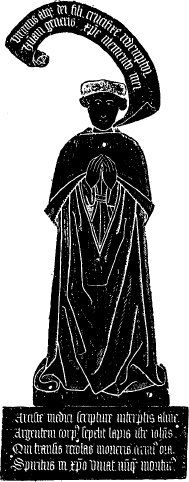
8. The last person known to have seen the Princes in the Tower alive, Dr John Argentine. An astrologer as well as a medical practitioner, he was Edward V’s physician. Later he became physician to Henry VII’s son Prince Arthur and Provost of King’s College, Cambridge. From a brass at King’s.
The Croyland chronicler tells us that by autumn 1483 a rumour was circulating that Edward IV’s sons had died a violent death, but it was not known how. It is clear that by early September at latest their mother, with Buckingham, Morton and others, was certain the boys were dead, since by then they were putting forward Henry Tudor as Pretender and hoping to strengthen his cause by marrying him to the sister of the late Edward V.
Commynes may give the earliest dated reference to the Princes’ death. While he says confusingly in one passage that Buckingham ‘caused the death of the two children’,8 in others he states that Richard killed them.9 He also makes it clear that Louis XI thought Richard had had them murdered and that he considered him ‘extremely cruel and evil’. Louis died on 30 August 1483 after an illness which had struck him speechless for a week. Gairdner does not think that the news could have reached the French King in time, but this is arguable – communications were quicker than he supposed, especially with a spy master like Louis.10
The first definitely dated reference is also from a French source. In January 1484, when the Chancellor of France, Guillaume de Rochefort, was warning the Estates General at Tours of the dangers of a minority – Charles VIII was only fourteen – he asked them to remember what had happened in England after Edward IV’s death. ‘Think of his children, already well grown and promising, being murdered with impunity and of the Crown’s passing to their assassin being countenanced by the people.’11 It is known that in December 1483 Mancini was in the Chancellor’s neighbourhood and it has been suggested that the Italian had told Rochefort of his fears for the boys’ lives. Yet it none the less remains logical to assume that the Chancellor was not announcing the news of Richard III’s usurpation and murder of the Princes to the Estates, but simply reminding them of something already known to most reasonably well-informed Frenchmen.
The earliest documented English reference is the Act Titulus Regius passed after Bosworth by Henry VII’s Parliament in January 1486. It charges Richard with ‘unnatural, mischievous and great perjuries, treasons, homicides, and murders, in shedding of infants’ blood [italics mine]’. The next date is April 1486, when the ‘Second Continuation’ of the Croyland Chronicle was written and specifically accused Richard of killing ‘his brother’s progeny’. Henry’s son, Prince Arthur, was born in September the same year and the court poet, Pietro Carmeliano (who had been Richard’s poet too), wrote some verses in celebration – in them he reviles the late King for having murdered both Henry VI and his own nephews.
It is curious that Commynes should think even for a moment that Buckingham might have killed the Princes, though admittedly Molinet says that the Duke was mistakenly suspected.12 Both Buckingham and Norfolk may, just conceivably, have been consulted by Richard about the murders. The two noblemen had a lot to lose if Edward V ever regained the throne – in particular Norfolk, who would have forfeited his new Dukedom at the very least. However, it is going too far to suggest that either of them rather than the King was responsible for killing the boys. Kendall investigates, and rejects, the theory that Buckingham contrived their murder in order to increase his own chances of succeeding to the throne. There is absolutely no evidence to support this theory – the Duke may perhaps have urged the need to get rid of the children, yet no contemporary English source accuses him of killing them. Nor does any contemporary source, either English or French, even mention Norfolk in connection with the crime. The theory that it was Norfolk who murdered the Princes was first heard in the nineteenth century and is based on a misinterpretation of his household accounts, together with a totally erroneous impression that he, and not Brackenbury, was Constable of the Tower.13 Indeed, it is hard to believe that anything could have happened to the boys without Richard’s personal command.
It was to be many years before anyone learnt what had actually been done with the Princes. This was certainly by deliberate design; Rous emphasizes that because they had been in prison ‘it was afterwards known to very few by what manner of death they had suffered’. Richard Arnold, a London merchant, wrote vaguely in his commonplace book for the year 1482–3, ‘The two sons of King Edward were put to silence.’ Polydore Vergil believed that Richard had deliberately put about a rumour of their death within a few days of the murder, to make people resigned to his government. The ballad ‘Ladye Bessiye’ preserves another contemporary rumour in stating that, like their uncle Clarence, they were both drowned in a pipe of wine.
Nothing really substantial was heard until 1502, when Sir James Tyrell was awaiting execution for conspiring with the then Yorkist Pretender, the Earl of Suffolk. In fear of death and presumably concerned for their salvation, he and his servant John Dighton made confessions in which they described how the Princes had died. The confessions were not made public, possibly because of the sacramental seal (if they were made to a priest who then broke it), though also perhaps for another reason. Nevertheless, various versions seem to have circulated. More therefore attempted to make an approximate reconstruction of the events of 1483 and, it has to be admitted, may well have indulged his sense of the dramatic. Yet the account which he gives, although rejected by many historians, carries considerable conviction.
We know from other sources the details of the new King’s progress, which began on 20 July. He set out from Windsor accompanied by a train of magnates and courtiers, though without the Queen or the Duke of Buckingham. He spent a night at Reading Abbey, reaching Oxford on 24 July, where he lodged at Magdalen; next day he listened to two learned dissertations on theology and moral philosophy in the great hall of the college – one of the orators was the humanist Grocyn. Richard then stayed a night at the nearby royal palace of Woodstock, returning briefly to the university before going on to Gloucester. Here he presented to the town whose name he had borne for twenty years a charter which gave it a Mayor and Corporation and created it an independent county with special privileges. He gracefully declined a large donation proffered by its townsmen, as he did everywhere else, saying that he wanted their hearts rather than their money. At Gloucester Buckingham caught up with him, en route for his Brecon stronghold. It was the last time that the King and the Duke would ever meet, after a friendship of little more than three months; they parted on seemingly amiable terms. Richard went on to Tewkesbury, where Edward of Lancaster and George of Clarence lay buried, giving the Abbot an enormous sum of money – £300 – after which he proceeded by way of Worcester to Warwick, which he reached on 8 August. Here he passed a week in his late father-in-law’s mighty palace-fortress on its bluff overlooking the River Avon, and here he was joined by Anne. Perhaps it was now that he began his programme of building at Warwick, on his usual grandiose scale; it is known that he planned a great bastion which would be able to withstand the surprisingly effective gunfire of the period – he is also reputed to have built the Bear and Clarence Towers and the Spy Tower and Lodgings, still to be seen today.
More tells us that it was during the stay at Warwick that the King gave orders to dispose of his nephews. Arguably this seems to be confirmed by what very scant evidence there is. A comparison of the few contemporary sources – the Croyland chronicler, Vergil, Rous, Molinet and Commynes – indicates that they were murdered at the end of July or in early August.
It is likely that Richard ordered their killing because he feared attempts would be made to rescue them. The catalyst was probably an abortive plot during July, organised by four men who included Edward’s former groom of the stirrup. Their plan was to light fires all over London and smuggle the boys out of the Tower during the confusion, but it failed and the leaders were caught and executed. There was also a scheme to help the ex-king’s sisters escape from sanctuary at Westminster and take them overseas. As soon as Richard heard of it, he ringed the Abbey with ‘men of the toughest sort’ under John Nesfield, so that no one could get in or out. This, too, may have decided him to liquidate his nephews.
The trusted household man whom he chose for the task was a Suffolk knight, James Tyrell of Gipping, who had been with him for at least a dozen years. Tyrell had received the accolade after Tewkesbury and with Ratcliff had been promoted to Knight Banneret in 1482 for services during the Scots war. As has been seen, he had already performed at least one secret and dangerous commission for the King; in 1473 he had lured the dowager Countess of Warwick out of her sanctuary in Hampshire and, eluding Clarence’s watchful spies, brought her north to life-long imprisonment at Middleham. He was an able administrator, well used to dealing with high officials. More thought him ‘a man of right goodly personage … and worthy to have served a much better Prince’. He explains that Tyrell ‘had a high heart and sore longed upward, not rising yet so fast as he had hoped, being hindered and kept under by means of Sir Richard Ratcliff and William Catesby’ – who clearly did not care for competition. However, he was recommended to the King as the right man for the unpleasant job in hand by ‘a secret page of his’.14
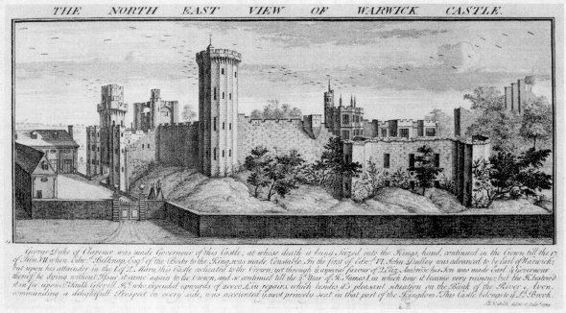
9. Warwick Castle, where the Spy Tower and the Lodgings – both glimpsed over the broken wall at the right – are believed to have been built by Richard during 1483–5. From S. and N. Buck, A Collection of Engravings of Castles, Abbeys, etc.
According to More, Richard had already sent a messenger from Gloucester, one John Green ‘whom he specially trusted’, to Brackenbury, Constable of the Tower of London, with a letter ordering him to put the children to death. Robert Brackenbury of Selaby in Co. Durham, near Barnard Castle, was one of the King’s northern protégés and had only just been appointed Constable on 17 July.15 But he was either too cautious or too squeamish to carry out such terrifying orders and refused, saying that he would ‘never put them to death therefore’ – he was not going to risk his neck. Richard was very angry indeed when he received his answer, sighing, ‘Ah, whom shall a man trust?’ It was then that he asked the ‘secret page’s’ advice. When approached, Tyrell was ready and willing. The King thereupon gave him a letter for Brackenbury, which ordered the Constable to hand over the keys of the Tower to Tyrell for one night.16 It is best to give More’s actual words as to what happened:
Sir James Tyrell devised that they should be murdered in their beds. To the execution whereof he appointed Miles Forest … a fellow flushed in murder beforetime. To him he joined one John Dighton, his own horsekeeper, a big broad strong square knave. Then all the others being removed from them, this Miles Forest and John Dighton about midnight (the innocent children lying in their beds) came into the chamber and suddenly lapped them up among the clothes – so bewrapped them and entangled them, keeping down by force the featherbed and pillows hard unto their mouths, that within a while, smothered and stifled, their breath failing, they gave up to God their innocent souls into the joys of heaven, leaving to the tormentors their bodies dead in the bed. [The Great Chronicle of London records, long before More, how ‘some said they were murdered atween two feather mattresses’ – though it also mentions rumours of other methods.]
After the wretches perceived them – first by the struggling with the pains of death and after, long lying still – to be thoroughly dead, they laid their bodies naked out upon the bed and fetched Sir James to see them. Who, upon the sight of them, caused those murderers to bury them at the stairfoot, meetly deep in the ground under a great heap of stones.
More adds that a priest of Brackenbury’s later disinterred them and reburied the bodies, since the King did not like to leave them ‘in so vile a corner’. However, the priest died, and with him the secret of the Princes’ burial place.
Sir Thomas’s account has been dismissed as a tale of melodramatic invention, full of errors and incongruities. Certainly it contains many mistakes, though this becomes understandable when one realizes that it was at most a very approximate reconstruction of what had happened, much of it based on guesswork. In his History of the Reign of King Henry VII Francis Bacon explains why. More gives as his source the reports ‘of them that much knew and little cause had to lie’, rather than the actual confessions of Tyrell and Dighton. Bacon tells us that though Henry was informed of the confessions, he ‘made no use of them in any of his declarations; whereby, as it seems, these examinations left the business somewhat perplexed’. But while Tyrell went to the block, Dighton – who does not even seem to have been arraigned – was set free, after which, according to Bacon, he told the story of the Princes’ death to anyone who would listen. More had not met Dighton, though he says that he is still alive at the time of writing – he ‘yet walketh on alive in good possibility to be hanged ere he die’. (Modern scholarship has traced a number of Dightons and Forests, who may or may not have been the men in question.) He must therefore have had to glean details of the confessions indirectly, perhaps from tavern gossip, and to balance them against other rumours which were circulating.
Many historians are puzzled as to why Henry VII did not publish the confessions to discredit Richard III and discourage further spurious pretenders like Lambert Simnel and Perkin Warbeck. But the Tudor King had an excellent reason for not reminding the English people of royal murders; only three years before, he himself had legally murdered the last male Plantagenet – the mentally subnormal Earl of Warwick, whom he had kept in the Tower since Bosworth – by deliberately involving him in a pathetic little plot with Warbeck and then beheading him for treason. In any case Henry was secretive by nature and disliked reopening unprofitable debates; in Bacon’s words, he preferred ‘showing things by pieces and by dark lights’. Above all, he cannot have wanted publicity for the House of York, since there was still a Yorkist Pretender in the person of Edmund de la Pole.
Polydore Vergil definitely accepts Tyrell’s guilt, but merely says that he killed the boys. He ignores the confessions – ‘with what kind of death these sely [poor] children were executed is not certainly known’. He also tells us that Tyrell was dispatched not from Warwick, but from York. Much has been made of this by Richard’s defenders in order to discredit Sir Thomas’s version. However, Vergil was an excessively self-conscious stylist, who believed in the elegance of brevity, and who in any case had no experience of criminal investigation. More, on the other hand, as cannot be too much emphasized, was a professional lawyer with very considerable experience of investigating crimes, of assessing evidence and weighing probabilities, and of trying to establish what had really happened. He makes it perfectly clear that several conflicting versions of the confessions by Tyrell and Dighton were circulating. ‘I shall rehearse you the dolorous end of those babes, not after every way that I have heard, but after that way that I have so heard by such men and such means as methinketh it were hard but it should be true.’ What he does not say, but which is obvious from his treatment of other incidents in the History is that the version which he had accepted was in part his own reconstruction. Vergil may not make use of Sir Thomas’s reconstruction, but that does not mean he rejected it – if, indeed, he even knew of it.
The author of the Great Chronicle of London is another contemporary who supports More. He believed that the murderer was either Sir James Tyrell or an unnamed ‘old servant’ of the King. He wrote before the publication of More’s History. It is surely significant that both he and Vergil as well as Sir Thomas identify Tyrell as the prime murderer.
Kendall tries to demolish More on the most specious grounds. He claims it is inconceivable that King Richard would have sent letters to Brackenbury ordering him to kill the Princes. But the letters were carried by well-trusted men and even in the fifteenth century ‘sealed dispatches’ were far from unknown. He makes great play (as do all Richard’s partisans) of Sir Thomas’s ignorance of Tyrell’s previous employment by the King, yet this is surely irrelevant; a curriculum vitae or an obituary cannot have been exactly easy to come by in the sixteenth century. Tyrell’s recommendation by the ‘secret page’ in particular carries conviction rather than otherwise; for ‘secret page’ one should read modern ‘secret agent’, a man employed by Richard to spy on and report on his household – it would obviously make sense to consult him about which of the henchmen was most suitable for such a tricky job.
Beyond question, More’s account of the murders is full of errors – one serious – and partly based on sheer surmise, and cannot be accepted in every detail, but as a reconstruction it is a tour de force. It is also probably very near the truth. Instead of being criticized for mistakes or too much imagination, Sir Thomas deserves to be congratulated for an inspired piece of detective work.
What gives More’s account such conviction are the two skeletons discovered in 1674. A staircase to the White Tower was being demolished when, at a depth of ten feet, the workmen found a wooden chest. (It may have been an arrow chest of the sort in which Anne Boleyn was coffined so hurriedly.) Inside were the bones of two children, the taller on its back, the smaller lying face down on top of it. Some of the bones were stolen by souvenir hunters – and replaced by animal bones – until in 1678 King Charles II ordered the remainder to be interred in a fittingly regal urn in the Henry VII Chapel at Westminster Abbey – near the tomb of their sister, Elizabeth of York. Furious attempts have been made to show that these are not the remains of the Princes. However, when the urn was opened in 1933 and the skeletons were examined, both were found to be male, the larger four feet ten inches tall and the smaller four feet six and a half inches, and each slenderly built; a dental surgeon estimated their ages at about twelve and ten (roughly those of the Princes in 1483) and also deduced that the elder suffered from a painfully diseased jaw which might well have caused melancholy. Twenty years later these findings were submitted by Kendall to a group of anthropologists and dentists, who differed in their opinions; some believed that the conclusions of 1933 were probably more or less correct, others disagreed about the larger skeleton’s age and even sex. Richard’s partisans have argued that it would have been impossible to dig ten feet down into solid stone in a single night; in fact, the murderers need not have dug downward but could have dug from the side, into the rubble which composed the foundations of the staircase, since it is known to have been an external stair. This would certainly tally with Sir Thomas’s description of the boys being buried ‘at the stair-foot, meetly deep in the ground under a great heap of stones’. If these are not the Princes, it is an almost miraculous coincidence that the bones of two medieval adolescents should have been buried in this particular place.
More’s most serious mistake is his tale of a priest having later reburied them. But perhaps this was the impression of Tyrell and Dighton themselves since ‘whither the bodies were removed they could nothing tell’. It might have been the King’s original intention, but it was never carried out. It could also be accounted for by Brackenbury having a priest say the prayers De Exequis or even a Mass over the spot where they lay, although it was unconsecrated ground – this would undoubtedly be in keeping with Richard’s always obsessive anxiety that the souls of the dead should rest in peace.
In the meantime their uncle was basking in the seeming adulation of his new subjects. When he was still at Warwick, he received an ambassador bearing letters from Ferdinand and Isabella the Catholic, King and Queen of the Spains. The envoy, Sasiola, made ‘by mouth’ the barely credible though unquestionably tactful assertion that his sovereign had been ‘turned in her heart’ against Edward IV because he had refused her hand for that of Elizabeth Woodville; she and Ferdinand wanted Richard to join them in a war against Louis XI of France. The English King was in no position to wage a long and expensive campaign against the French, but he sincerely welcomed the idea of a treaty of amity with the Spaniards. Also at Warwick on this occasion he saw once more his old comrade-in-arms, the egregious Alexander Albany, who had quarrelled yet again with his brother. Technically England was still at war with the Scots, but a letter was sent by James III on 16 August in which he asked for an eight-month truce with a view to negotiating lasting peace. Nevertheless, the Duke of Albany might well prove useful to Richard III.
The day before King James sent his letter Richard had left Warwick to continue his progress, going by way of Coventry, Leicester and Nottingham. From the last town his secretary, John Kendall, wrote to the Corporation of York asking them to give the King a particularly splendid welcome, ‘to receive His Highness and the Queen as laudably as their wisdom can imagine’. Kendall assisted their wisdom’s imagination by suggesting that the streets of York should be adorned by hangings and tapestries. He confided to the Corporation that this was to impress the ‘many Southern lords and men of worship’ who were accompanying Richard. We know from Rous, who had been an eyewitness at Warwick, that the royal retinue included the Bishops of Worcester, Coventry, Lichfield, Durham and St Asaph, the Earls of Warwick, Lincoln, Huntingdon and Surrey (Thomas Howard), the Lords Stanley, Dudley, Morley, Lovell and many others, together with a multitude of knights and gentlemen. ‘And ladies of similar rank with the Queen.’ No doubt Kendall’s letter to York emanated from the King. Clearly Richard wanted his magnates and his courtiers to appreciate his popularity in the North and the fact that he still had a strong power base there.
At Pontefract the King and Queen were joined by their nine-year-old son, Edward of Middleham, Earl of Salisbury, probably on 24 August. This was the day on which the boy was given the heir apparent’s traditional titles of Prince of Wales and Earl of Chester. Clearly he had been too sickly to come south for his parents’ Coronation, and he had had to travel from Middleham to Pontefract by ‘chariot’ – a conveyance used only by delicate women or invalids. Yet he seems to have been a normal enough child. He kept a fool called ‘Martyn’ and a pack of hounds, besides two running footmen to accompany him during the hunt. And his health was at least good enough for him to visit fairly frequently the local religious houses of Coverham, Fountains and Jervaulx – the latter still famous for its horses. As soon as his father had ‘ascended’ the throne, the Corporation of York had ridden out to Middleham to pay their respects to the small boy who might one day be their King. As presents the burgesses brought such delicacies as six herons, six cygnets, twenty-four rabbits, a barrel of red wine and a barrel of white wine.17
During the family’s stay at Pontefract, Richard took the opportunity of making yet another ostentatious display of piety, which at the same time conveniently blackened his late brother’s name. Edward IV had appropriated twenty-four acres of land belonging to a local priory. The new King gave it back
calling to remembrance the dreadful sentence of the Church of God given against all those persons which wilfully attempt to usurp into themselves, against good conscience, possessions or other things of right belonging to God and his said Church, and the great peril of soul which may ensue by the same.
In all probability it was only a few days since he had ordered the liquidation of his nephews.
York gave the Royal Family the magnificent reception for which Kendall had asked, and much more besides. On Friday 29 August Richard and his cortège were met at Brekles Mills, just outside the city, by its Mayor and Corporation in their furred gowns of scarlet velvet and by an attendant host of leading citizens expensively dressed in red. They escorted their guests through the chief gateway, Mickle-gate, to be cheered to the echo by a mass of more ordinary citizens, though everyone was in their best clothes. The people of York vied with one another in staging special displays in welcome. As the King and Queen and the Prince passed through the densely thronged and richly bedecked streets, they were greeted by three splendid and elaborate pageants in token of the city’s rejoicing. Richard was presented with two great silver-gilt basins filled with gold coins, while Anne received a gold plate piled high with more gold coins, to the value of a hundred pounds.
The southern lords and men of worship with the King must have been gratifyingly impressed by such solid testimony to his northern popularity. Richard himself was plainly delighted. He decided, obviously on impulse, to invest his son as Prince of Wales in this rich and friendly city, sending to London in haste for suitable robes and hangings – in particular for 13,000 tapestries bearing the badge of the white boar. (No doubt these were the hangings used at his Coronation; some would have been cloth badges to be worn by royal retainers.) The messenger was none other than Sir James Tyrell, who presumably had speedily rejoined his master with the news that he had successfully accomplished his delicate mission. The three weeks at York which followed were one long celebration, during which the Corporation entertained the King and his court to two memorably extravagant dinners and many other entertainments. These were ‘stage plays, tournaments and other triumphal sports’. On 7 September, a Sunday, the Corpus Christi Guild – which Richard and Anne had joined in 1477 – put on a special performance of the Creed mystery play for their benefit, in the superb Perpendicular Guildhall with its brilliantly coloured glass windows. He reciprocated by giving ‘most gorgeous and sumptuous feasts and banquets, for the purpose of gaining the affection of the people’.
However, the visit’s highlight was the investiture of the Prince of Wales in York Minster. The King placed a golden circlet on his son’s head and put a sceptre into his hand. To enhance the solemnity of the occasion he also knighted the Spanish ambassador, Sasiola. Finally, preceded by forty trumpeters, Richard, Anne and the Prince, still wearing their diadems, walked in procession through the city streets – the Queen holding Edward’s hand. (The streets they walked must have been narrow, winding, tall gabled lanes very like today’s Shambles.) The King wore a crown of notable richness and magnificence and ‘the common people of the North so rejoiced that they extolled him above the stars’. It should of course be borne in mind that as yet probably no whisper of his nephews’ murder could have reached Yorkshire. The day’s ceremonies were so majestic, Richard’s crown so imposing and the crowds so large that some spectators thought a second Coronation had taken place.
The King was intoxicated by such an enthusiastic reception. He remitted more than half a year of York’s taxes, a characteristic display of prodigality which probably he later regretted. Then he took the opportunity to revisit his favourite houses of Sheriff Hutton and Middleham. Anne and Prince Edward remained at Middleham – no doubt the sickly child had been exhausted by the celebrations.
Certainly Dr Thomas Langton – a Westmorland man – Bishop of St David’s, who accompanied Richard’s progress, had no reservations at all about his new sovereign’s popularity, as he wrote the same September to the Prior of Canterbury. It would be too cynical to attribute his exuberant approval entirely to the fact that the King had made him a Bishop and appears to have told him to expect further preferment. In a much-quoted letter, Langton says,
He contents the people where he goes best that ever did Prince for many a poor man that hath suffered wrong many days have been relieved and helped by him and his commands now in his progress. And in many great cities and towns were great sums of money give to him, which all he hath refused. On my troth, I never liked the conditions of any prince so well as his. God hath sent him to us for the weal of us all.
However, the Bishop then breaks into Latin in a sentence which is smudged and faint but appears to read: ‘I do not take exception to the fact that his sensuality [voluptas] seems to be increasing.’ This last comment goes quite contrary to the modern theory that Richard was something of a puritan.
One man definitely not delighted by all the junketings at York – celebrations unparalleled in the city’s recent history – was Henry Percy, Earl of Northumberland. From his later behaviour one can see that secretly the Earl was angered by Richard’s return to the North. He must have resented his presence there during Edward IV’s reign and it is very likely that he had helped with the usurpation in the hope of being rewarded by the restoration of Percy dominance. But if the King was to keep visiting the North regularly and continue to use it as a power base, then Northumberland would still be overshadowed – the monarch himself on one’s doorstep was even worse than a Royal Duke. The enthusiasm for Richard shown by York – over which the Earl wished to regain the control exercised by his forefathers – must have irritated him intensely. He would have been further incensed on learning that the King was establishing a permanent Royal Household in the North at Sheriff Hutton. Northumberland may gloomily have suspected, and with justice, that this was going to develop into something more.
Leaving his Queen and his son behind him at Middleham, Richard resumed what appeared to be a triumphant progress. He spent several nights at Pontefract, a favourite residence, and then travelled by way of Gainsborough to Lincoln. Here astounding news reached him on 11 October. A widespread and well-planned rebellion had broken out against him – it was led by his dear friend and mightiest subject, the Duke of Buckingham.