
Chapter Ten
‘From hostile nobles he has not only to fear desertion, but that they will rise against him; since they are far seeing and astute in matters of state, they always move in time to save themselves and to extract favours from the man they think is going to win.’
Machiavelli, Il Principe
‘The malice of him that had best cause to be true, the Duke of Buckingham, the most untrue creature living.’
Richard III, letter of 12 October 1483
Paradoxically the Duke of Buckingham’s revolt inaugurated the seven prosperous months of Richard III’s reign – October 1483 to April 1484. He put down with ease what at first sight looked like a very formidable rebellion indeed, and then ruled with a splendour which staggered even Commynes. Parliament met, and proved gratifyingly tractable. Even Elizabeth Woodville would eventually agree to leave sanctuary with her daughters. Yet although the Duke was to be crushed, his revolt spelt Richard’s eventual doom. It united all the many strands of opposition.
No one knows what made Buckingham turn against the King. One might have thought he would have been satisfied by such enormous rewards. More says, ‘A man would marvel why the Duke plotted against the King; and surely the occasion of their variance is by divers men diversely reported.’ Sir Thomas may well be right in identifying jealousy as Buckingham’s motivation. Some observers detect a long-term plan to bring down the House of York and replace it with himself. This seems to have been the opinion of many contemporaries; Polydore Vergil tells us, even if he reflects their opinion, that
the multitude said that the Duke did the less dissuade King Richard from usurping the Kingdom, by means of so many mischievous deeds, upon that intent that he afterward, being hated both of God and man, might be expelled from the same, and so himself [Buckingham] called by the commons to that dignity, whereunto he aspired by all means possible …
Certainly the Duke was very much aware of his own descent from Edward III.
However, there is another simpler, more convincing possibility – that Buckingham had very quickly reached the conclusion that a regime so unpopular as that of the new King could not endure. One of Edward IV’s greatest strengths had been an ability to win genuinely popular support – it was one of the principal props of his monarchy. It was precisely this quality which Richard III lacked. And without it he could not hope to overcome the widespread indignation at his usurpation. Indignation was turning into hatred as rumours circulated that the boys had been liquidated. An unknown, but undoubtedly contemporary, chronicler writes simply that he had ‘put to death the children of King Edward, for which cause he lost the hearts of the people. And thereupon many gentlemen intended his destruction.’ The Duke was probably the first man to identify a political loser, and certainly the last to back one. He must have been badly shaken by the rising fury against the new regime. He knew that a serious rebellion was being planned; its leaders must have approached him very early on and, as will be seen, they were men of substance and position, not just adventurers. More tells us that what finally decided Buckingham on his course of action was the long discussions which he held with Dr John Morton, Bishop of Ely, whom the King had most unwisely placed in his custody – ‘whose wisdom deceived the Duke’s pride, to his own deliverance and the Duke’s destruction’.1
According to Sir Thomas, Buckingham may have been considering putting forward his own claim to the throne. He shows Morton flattering the Duke about his ability, and how he possessed ‘excellent virtues meet for the rule of a realm’. Unfortunately More’sHistory ends at this precise point, and we know that, even if it had continued, the author would have been unable to explain the real reasons for Buckingham’s astonishing volte-face in the autumn of 1483. But, had the Duke really intended to aim at the crown, it is more than likely that it was the Bishop who – after first convincing him that Richard could not survive – persuaded Buckingham to step down in favour of the senior Beaufort-Lancastrian candidate, an obscure exile called Henry Tudor. His basic motive was self-preservation – he knew now that the King was doomed and he was determined not to go down with him.
Like the Duke of Buckingham, Dr Morton had a Lancastrian background. Indeed, he was now in his sixties, having been born in 1420, when the Lancastrian dynasty was at its zenith under Henry V. A typical prelate politician of the age, he had served Henry VI well and faithfully – in More’s words, ‘He had been steadfast upon the party of King Henry while that party was in prosperity, and nevertheless left it not nor forsook it in woe.’ Taken prisoner at Towton in 1461, instead of changing sides like most of his fellow Bishops, who recognized the new Yorkish monarch, he had escaped from the Tower of London and gone to France to Margaret of Anjou and her son. This was at a point when their cause seemed quite hopeless and he knew that he would have to live as a penniless exile. He accompanied Queen Margaret on the disastrous road to Tewkesbury in 1471. Only when her son was dead and her cause finally lost, and only then, did he transfer his allegiance to Edward IV, whom he served with equal steadfastness. Sir Thomas makes him tell Buckingham,
If the world would have gone as I would have wished, King Henry’s son had had the crown and not King Edward. But after God had ordered him to lose it and King Edward to reign, I was never so mad that I would with a dead man strive against the quick. So was I to King Edward faithful chaplain and glad would have been that his child had succeeded him.
Thomas More, whose good opinion is not to be dismissed lightly, had a ‘pleasant remembrance’ of Morton and quite clearly admired and respected him. As a youth he was attached to his household, by which time the former Bishop of Ely – now in his eighties, but still sharp and vigorous – was Cardinal Archbishop of Canterbury and Lord Chancellor of England. In Utopia More puts a fascinating and attractive portrait of the old man into Ralph Hythloday’s mouth: ‘He was not more honourable for his authority than for his prudence. He was of a mean stature, and though stricken in age, yet bare he his body upright. In his face did shine such an amiable reverence as was pleasant to behold, gentle in communication, yet earnest and sage.’ In his youth, Utopia continues, John Morton was ‘taken from school into the court, and there passed his time in much trouble and business, being continually tumbled and tossed in the waves of diverse misfortunes and adversities. And so by any and great dangers he learned the experience of the world.’ This estimate of his qualities is confirmed by Mancini, writing over thirty years before – ‘of great resource and daring,’ he says of the Bishop of Ely, ‘trained in politics since King Henry [VI]’s time’. The Italian also stresses his unshakeable loyalty. There is no need to emphasize that Henry VII, who was nobody’s fool, quickly arrived at a very similar estimate.2
However, Morton has had a bad press in popular history, most unfairly. This is largely because of the merciless taxation he is supposed to have levied when Henry VII’s Lord Chancellor. In fact, ‘Morton’s Fork’ – a device for crushing any unwilling tax-payers into the ground – should really be called ‘Fox’s Fork’ since, according to More, it was Bishop Richard Fox who invented it. Furthermore, in spite of worldliness and a reputation for pluralism, Morton was a devout and responsible churchman, even according to Sir Thomas’s demanding standards. Far from being the time-serving politician of tradition, he was something of a hero – which is plainly how More saw him. He has also been accused of being the real author of Sir Thomas’s History (a theory long since disproved) and of telling a pack of lies about Richard – regardless of More’s opportunities of checking his facts. Certainly he does not appear to have given More the impression that he was a liar.
The King may well have entrusted him to Buckingham because of his reputation as a brilliant administrator, with instructions to win him over. If an experienced politician, Morton was obviously by no means a compulsive intriguer, as he had firmly demonstrated by his steady loyalty to both the Houses of Lancaster and York. Despite his fidelity – and perhaps even readiness to fight for – Edward V during the usurpation, he was being treated with what looks like calculated leniency on Richard’s part. Had he shown willingness to co-operate with the new regime, like Rotherham, he could no doubt have expected speedy forgiveness and preferment. Either, as with so many contemporary Englishmen, he simply could not stomach the dispossession and murder of the Princes – he may have learnt of the latter from Buckingham – or else his unusually acute political instinct told him that the country would never be at peace under its new King. Some distinguished modern historians have argued that, given time, Richard III’s undoubted abilities and the excellent government he would have provided might have made his subjects accept him. Probably most of them were not prepared to give him the time. It was surely the Bishop of Ely’s fertile brain which found a solution to unite the entire opposition to the usurper, whether it was Lancastrian, dissident Yorkist or even Woodville. Dr John Morton was going to be the architect of Richard’s ruin.
For all the Petition and the Coronation, in strict law the rightful Yorkist claimant – now that Edward V and his brother were dead – was Edward IV’s eldest daughter, Elizabeth of York. But she was still in sanctuary at Westminster and in any case at that date a woman, let alone an eighteen-year-old girl, was not acceptable as a candidate for the throne of England. A grown man was needed, who, besides possessing a claim to the throne, could lead a political party and – in name at least – command armies in battle. There was such a man.
Despite Richard’s alleged boast when he murdered Henry VI, there were still heirs of Edward III through the female line, and not primarily Buckingham. The children of John of Gaunt (Edward’s fifth son) by Catherine Swynford – the Beauforts, so called from the French castle in which they had been born – had entered the world as bastards, but Richard II had legitimated them with a Patent, which was confirmed by Act of Parliament. Their half-brother Henry IV, himself born in legitimate wedlock, had formally acknowledged this Patent though adding the words excepta dignitate regali (save for the throne), which debarred them from succeeding to the throne; he omitted to make the disqualification law by a further Act of Parliament. Much later, lawyers were to argue with justice that a royal Patent could not alter one confirmed by Parliament, and that in consequence the Beauforts were in no way debarred from the succession. Beyond question, during Henry VI’s reign they had acted as full Princes of the Blood and had been tacitly accepted as such. The last legitimate Beaufort males had perished at Tewkesbury, but the family survived in the female line. Buckingham’s mother had of course been a Beaufort. However, her first cousin, Margaret Beaufort, Countess of Richmond (now wife to Lord Stanley), was the senior representative. By the first of her marriages – to Edmund Tudor, Earl of Richmond, Henry VI’s half-brother who had died in 1456 – Margaret had given birth to a single child, Henry.
By origin the Tudors were mere North Welsh hedge squires from Anglesey.3 They claimed the legendary King Cadwallader as their ancestor, but in real life had been the smallest sort of Cymric gentry until the scandalous marriage of Henry’s grandfather to the widow of Henry V, when he was still her Clerk of the Wardrobe; his father, Maredudd ap Tudur, had been a bastard and butler to the Bishop of Bangor. Yet for all the obscurity of his male forebears, Henry Tudor was a Beaufort and therefore the Lancastrian claimant to the throne of England. Edward IV had been very well aware of the existence of ‘the only imp now left of Henry VI’s brood’ and had once or twice tried to get possession of him, presumably with a view to liquidation. ‘He [Henry] told me on one occasion,’ Commynes remembers, ‘that since the age of five he had been guarded like a fugitive or kept in prison.’ Henry had seen almost nothing of his mother – only fourteen when she bore him – and spent his early childhood in the household of the Yorkist Lord Herbert, who intended to make him his son-in-law. He was not rescued by his own family until the Readeption of Henry VI when his uncle, Jasper Tudor, Earl of Pembroke, found him and then after Tewkesbury fled with him to the semi-independent Duchy of Brittany. Here, Commynes informs us, from the age of fifteen ‘he had lived the life of a prisoner’, although Duke Francis II treated him ‘reasonably well’. Probably about 1475 to 1476 King Edward very nearly laid hands on Henry by pretending that he wanted to marry him to one of his daughters; the youth only escaped by falling ill and delaying his departure for England. During his illness a friendly Breton explained the true situation – that he was being sent to his death – to Francis II, who relented and kept him in Brittany.
Yet Henry Tudor had been considered for the hand of Edward’s eldest daughter, Elizabeth, before her brothers’ disappearance. We know from the Calendar of Papal Registers that Margaret Beaufort discussed with King Edward the possibility of such a marriage, while a draft pardon for Henry survives. This explains why Dr Morton, the Queen Dowager and Buckingham recognized him as the obvious bridegroom for Elizabeth, acknowledging his claim to the throne.4
Contemplating the horrific visage of the miserly old Welshman painted by Michael Sittow in 1505, with which we are so familiar, one may wonder how such a creature could attract any adherents at all. But in 1483 he was only twenty-seven and an early sketch (admittedly known only from a sixteenth-century copy) shows a surprisingly amiable, even debonair young man. Polydore Vergil, who often met him in later life and who wrote after he was safely dead, tells us that ‘His appearance was remarkably attractive and his face was cheerful, particularly when speaking.’ Professor Chrimes, the author of his definitive biography, says,
We have to think of a man impressive and outstanding – tall, rather slender, dignified, of sallow complexion, and rather aquiline features, whose most striking characteristic was the vivacity of his expression and the brilliance of his small blue eyes, especially animated in conversation.
His ruthlessness only showed itself after he had won the throne, his excessive avarice and the mad Valois streak only towards the end of his life. Unquestionably he was almost as unscrupulous as Richard, but he was far more intelligent, much subtler. However, in the mid-1480s optimists no doubt discerned a romantic young royal fugitive who was the last representative of a tragically lost cause. Exiles and opponents of the King must have been delighted to find a leader who was more Beaufort and Valois prince than Welsh adventurer. Thanks to Buckingham and Dr Morton – and, above all, to his mother – he was soon to become an infinitely preferred alternative to Richard III.
As soon as the Duke had been won over by the Bishop, the latter sent a message to Margaret Beaufort’s chief steward, Reginald Bray, asking him to visit Brecon discreetly in order to discuss a matter of some delicacy. Clearly Bray was impressed by Morton’s plan and the Duke’s support, returning to his mistress with a glowing report. But Margaret Beaufort had already concocted her own scheme, which was very similar to the plot being hatched at Brecon.
Although the real Lancastrian and Beaufort claimant to the throne, like Elizabeth of York Margaret was ruled out as a pretender simply because she was a woman. Still only forty, she had had three husbands: Henry’s father, Edmund Tudor, Earl of Richmond; Lord Humphrey Stafford, Buckingham’s uncle; and, since 1473, Lord Stanley. A remarkable survivor, she had seen the court of Henry VI and Margaret of Anjou and would live to be aware of that of Henry VIII and Catherine of Aragon. Too little is known about her, yet though convention forced her to keep the most discreet of profiles, she was the first great Tudor and the first successful female politician in English history. The bronze tomb effigy by Pietro Torrigiano in Westminster Abbey – that greatest of monuments to Richard’s overthrow – shows a strikingly handsome face of austere refinement with strong, if superbly delicate, features; when young she must have been a considerable beauty. Devout, perhaps saintly, she heard six Masses every day and was an ascetic with a taste for mysticism; she personally translated The Mirror of the Souls from the French, besides initiating the translation and printing of many other devotional works, including the Imitation of Christ. Her future confessor was Bishop John Fisher, a canonized Catholic saint. Nevertheless, Margaret was masterful and plainly attracted by power – during her son’s reign she would be described by an informed observer as one of the half dozen most influential people in England, and was allowed to sign herself ‘Margaret R.’ King Richard had no more dangerous opponent than this quiet, pious lady.
To judge from her behaviour in 1483, and from what we may guess about it in 1485, Margaret was an unregenerate Lancastrian and a natural politician, as shrewd as she was courageous and determined. (Sir George Buck describes her, quaintly but accurately, as ‘a lady of a politic and contriving bosom’.) Her ambition, both for herself and her son, was surely fuelled by a sense of moral outrage. No doubt she venerated the memory of poor Henry VI and abhorred Richard for having butchered him, let alone for being a usurper. It is clear that by early September at latest, probably very much sooner, she was aware that the Princes in the Tower had been murdered. Someone with no less keen a political instinct than the Bishop of Ely, she must have realized at once how powerful a candidate for the throne her only child – whom she had not seen for a quarter of a century, when he was still a baby – would become if he married Edward IV’s eldest daughter.
By coincidence Margaret shared the same physician as Elizabeth Woodville, a Welshman from Caerleon called Dr Lewis. She was therefore able to contact the former Queen, who was still immured at Westminster, and propose that the Woodvilles should support Henry’s claims; in return he would marry Elizabeth of York. ‘Dame Elizabeth Grey’ accepted the terms with alacrity. (She too must have known that by now her royal sons were dead.) Margaret then told Reginald Bray to enlist supporters among the gentry. When he brought news, probably totally unexpected, from Dr Morton that – of all people – her nephew Buckingham had decided to come out for Henry, she saw a real chance of a successful rising. Immediately she dispatched a messenger to her son in Brittany to explain the situation and to tell him to join Buckingham in Wales. It was probably Henry Tudor’s first intimation that one day he might be King of England. The messenger also delivered ‘a good, great sum of money’.
Elizabeth of York was almost certainly told of the plan and the projected marriage. ‘The Most Pleasant Song of the Lady Bessy’ is a late version of the contemporary ballad in her honour, ‘Ladye Bessiye’, composed in her lifetime, though written down only afterwards. (The author seems to have been a household man of Lord Stanley, Humphrey Brereton.) It is often pure fantasy and is full of anachronisms. However, it may be correct in saying that Elizabeth sent a ring and a letter to Henry – by the hand of the poet himself – together with a large consignment of gold, presumably from the treasure her mother had brought into Westminster.
The conspiracy gathered momentum. Everywhere there were people who welcomed the hitherto almost undreamt of idea of the Earl of Richmond as Pretender. (Which surely indicates that, like Buckingham, Morton, Margaret and Elizabeth Woodville and herdaughters, they were already fairly certain that Edward V and his brother had by now been murdered.) From Kent Sir Richard Guildford sent a messenger, Thomas Romney, to Henry, pledging his support. By late September the Duke of Buckingham himself was in direct communication with the Earl.
It shows a quite extraordinary lack of political acumen on Richard’s part that when the news of a revolt arrived he had not yet recognized that Henry Tudor was the most dangerous of his enemies. Apart from a sense of outrage at the Duke’s betrayal, the King’s chief reaction was probably alarm at the strategic implications. Not only was Buckingham the Constable of England – Commander-in-Chief – but he had been made supreme in Wales, on the Welsh Border and in the West Country, and given control of all fortresses and arsenals throughout these areas largely because they were hotbeds of die-hard Lancastrianism. If in 1471 Margaret of Anjou’s Westcountrymen had succeeded in outmarching Edward IV and linked up with their Welsh comrades, Henry VI might still have been on the throne in 1483. The Severn had foiled them. Now the Duke of Buckingham controlled both banks of that vital river. Moreover, he also possessed a base in the Home Counties, in Kent; from his father he had inherited Penshurst Place – a tower there is still called ‘Buckingham’s Tower’ – near Tonbridge.5 The local Kentish landowners would have known his household men and had very likely met the Duke himself.
Probably Richard’s government at first found some difficulty in identifying just who was involved with Buckingham. There had been rumours of angry discontent since the usurpation. It seems that as soon as the new King’s progress reached the Midlands, ‘meetings and confederacies’ began among the gentry all over the South and West Country, ‘who had begun to murmur greatly’, to discuss how to rescue Edward V and York; none of them realized that they were dead. The Croyland Chronicle – if it really was Richard’s Lord Chancellor who supplied the basic text – gives us an invaluable summary of the situation as it must have appeared to the King and his Council in the last half of October.
The people round about London, and throughout Kent, Essex, Sussex, Hampshire, Dorset, Devon, Somerset, Wiltshire and Berkshire, as well as some other Southern counties, decided to set matters right [i.e. restore Edward V]; upon which it was publicly announced that Henry, Duke of Buckingham, who was then at Brecon in Wales, regretted his former conduct and would be a leader of the movement, but then a rumour spread that King Edward [IV]’s sons had died a violent death, though how it was not known.
(Dr Hanham thinks that the writer means that Richard actually encouraged the rumour, in order to scotch the rebellion.) Accordingly the men who had started the revolt, realizing that without a Pretender they were doomed, suddenly thought of Henry, Earl of Richmond. The chronicler continues, ‘The Duke of Buckingham, acting on the advice of the Lord Bishop of Ely, who was his prisoner at Brecon, sent a message to him which asked him to come to England to marry Elizabeth, the late King’s daughter, and take possession of the throne.’ As the days went by, Richard was to be made aware that a very large number of his subjects indeed regarded him as ‘the wretched, bloody and usurping boar’.
The regions ready to rise against the King are interesting. As has been seen, the West Country was still fiercely anti-Yorkist, while much of Wales was involved – though not very willingly – under Buckingham. Both were traditionally Lancastrian areas, as was Kent. But the districts round London and the central southern counties had hitherto been Yorkist.
To a certain degree the rising in the southern counties was the long expected Woodville counter-coup. Lord Dorset and his uncle, Bishop Lionel, suddenly appeared in the latter’s see of Salisbury, where they busily recruited supporters. In Berkshire Sir Richard Woodville found an ally in Sir William Stonor, an old friend of Dorset. In Devon there was Sir Thomas St Leger, who wanted Dorset’s son as a husband for his daughter. Sir George Browne, of Betchworth Castle near Reigate in Surrey, was the stepson of old Sir Thomas Vaughan, who had been beheaded at Pontefract. In Kent Sir John Fogge was married to a Haute, a cousin of the man who had perished with Vaughan.
But it is quite wrong to see the Southerners as being restricted to Woodvilles and their kindred. As has been seen, Buckingham possessed a base in Kent which was only a few hours’ ride from the houses of Browne and Fogge. Moreover, there were plenty of Lancastrians, especially in the West. In Devonshire there was Sir Edward Courtenay of Boconnoc (rightful Earl of Devon) with his kinsman Peter Courtenay, Bishop of Exeter, and in Cornwall the Arundells. And some of the plotters even belonged to Richard’s household, while he had made Sir Thomas Lewkenor a Knight of the Bath at his Coronation. Primarily, however, the rebels of 1483 were men who remained loyal to the memory of Edward IV. A considerable number had been members of the late King’s household. They rose out of furious resentment at Richard’s treachery towards the children, his stealing of their inheritance.
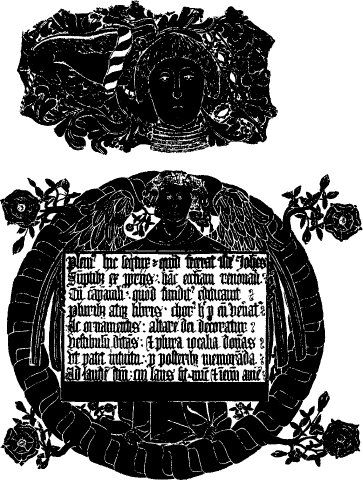
10. Sir John Fogge, once Treasurer of the Household to Edward IV and a kinsman of the Woodvilles. Richard pardoned him after the coup of 1483, publicly shaking his hand when he came out of sanctuary at Westminster. He took part in Buckingham’s rising but received a second pardon. From fragments of a brass of 1499 at Ashford, Kent.
What is also striking is that so many of the conspirators – over a dozen at least – had been Members of Parliament, where they may have first become acquainted. Stonor had represented Oxfordshire, Browne Surrey and Canterbury, and Fogge Kent – Stonor’s rising in Berkshire was joined by another former MP, John Norris; Browne in Surrey by yet another, Sir Thomas Bourchier of Horsley, who had fought at Barnet. (He was a kinsman of the Cardinal Archbishop and thus of the King himself.) In Sussex Sir Thomas Lewkenor of Bodiam Castle had likewise represented his county. In East Anglia there was Sir William Knyvet, once MP for Norfolk. In Wiltshire both Sir John Cheyney and Sir Walter Hungerford of Farley Hungerford had been members for their county, as in Somerset had Sir Giles Daubeny (one of Reginald Bray’s recruits). In Devonshire St Leger too had been an MP – for Surrey – and Sir Richard Edgecombe had represented Tavistock. These were persons of standing, with wide lands and valuable offices, rich, middle-aged men, leaders of local society and not hot-headed, penniless adventurers with nothing to lose. They were able to rally many lesser gentry and substantial yeomen to their cause.
Their eventual plan of campaign was not ill-conceived. Separate but concerted risings were timed for 18 October, St Luke’s Day. The Kentishmen and the men of Surrey, Sussex and Essex would make a feigned attack on London to divert Richard from the real onslaught from Wales and the West Country. The south-eastern musters were to be at Maidstone, Guildford and Gravesend under Fogge, Browne and Knyvet with the valuable assistance of Sir Richard Guildford and his son (from Rolvenden on the edge of Romney Marsh). More serious would be gatherings in Berkshire and Wiltshire under Stonor and Cheyney, since they hoped to be speedily reinforced from the West Country; Sir Richard Woodville was with Stonor at Newbury, Bishop Lionel with Cheyney at Salisbury. The South West would be led by Dorset, St Leger and the Courtenays. But the most important blow was to be struck by Buckingham, who intended to cross the Severn with his Welsh levies and link up with the Westcountrymen. (It was Somerset’s campaign of 1471 in reverse.) Finally Henry Tudor, with 5,000 Breton mercenaries – hired with money lent by Duke Francis – would land on the south-western coast.
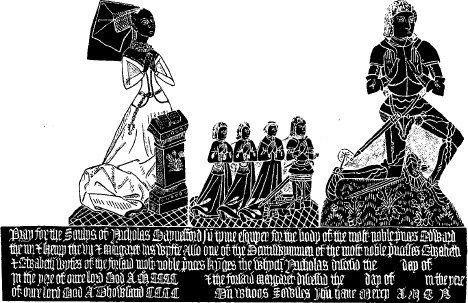
11. Nicholas Gaynesford (1427–98) of Carshalton, Surrey and his wife Margaret. He was an Esquire of the Body to Edward IV and Henry VII, she one of the ‘Gentilwommen’ to their Queens He was also Usher to Elizabeth Woodville. Formerly Sheriff for Surrey and Sussex, he tried to raise the South East against Richard in autumn 1483. From a brass at Carshalton.
The King received news of the impending rebellion and of Buckingham’s involvement on 11 October. His spies had discovered the plot just in time. It took him so completely by surprise that he was without the Great Seal. On 12 October he wrote from Lincoln to the Lord Chancellor, ordering him to send it with all speed possible. Richard added a postscript, which rings with almost hysterical rage. It contains these words:
Here, loved be God, is all well and truly determined, and for to resist the malice of him that had best cause to be true, the Duke of Buckingham, the most untrue creature living; whom with God’s grace we shall not be long till that we will be in those parts and subdue his malice. We assure you there was never false traitor better purveyed for …
(The phrase ‘loved be God’ has a personal sound about it, and may often have been on the King’s lips with perhaps a Yorkshire accent.) The Great Seal arrived soon enough, being delivered to Richard on 18 October at the Angel and Royal Inn at Grantham. His army – including 300 men from York – assembled at Leicester, in sufficient strength for him to be justified in his savage optimism and to march south on 24 October.
As Lord High Constable of England, Buckingham had been the King’s senior military officer. Among his duties was that of presiding over courts martial. To replace him Richard therefore appointed a Vice-Constable. He chose Sir Ralph Assheton of Fritton-in-Redesdale. Born in 1420 and consequently well over sixty, Assheton was by origin a Lancashire man, although he lived in Yorkshire and had been a Sheriff of that county. Not only had he served with distinction in the Scottish War, but he came from a family noted for soldiers, his father having been one of Henry V’s most trusted senior commanders in France. A long-standing member of the Household, Sir Ralph had ridden in his master’s Coronation procession. He appears to have had an extremely unpleasant name, perhaps partly from the fact that his half-brother was a famous alchemist and partly from his affectation of always wearing black armour, though chiefly because of his ferocity. His conduct during the subsequent campaign in 1483 earned him much hatred. The King gave him power to try treason cases ‘without formalities or appeal’. A grim jingle ran:
Sweet Jesu for thy mercy’s sake
And for thy bitter Passion,
Save us from the axe of the Tower
And from Sir Ralph of Assheton.
The ‘Black Knight’, as he was popularly known on account of his armour, is credited – in legend – with rolling prisoners downhill in barrels filled with spikes. Unquestionably he was the best man for stamping out rebellion of any sort, but Richard did not endear himself to his subjects by employing someone with quite so sinister a reputation as the Black Knight.
Luckily for the King the Duke of Norfolk happened to be in London, where the news of the rising broke on 10 October. Apparently the rebels in the Home Counties would not wait and rose prematurely. He at once began to assemble troops; he wrote to John Paston, among others, asking him to bring ‘six tall fellows in harness’ (armour) and explaining that ‘the Kentishmen be up in the Weald and say that they will come and rob the City’. One may guess that Norfolk had the fervent support of the Londoners, who remembered other visitations from Kent, such as those by Jack Cade and the Bastard of Fauconberg, only too well. The Duke quickly dispatched a small force to occupy Gravesend, and this effectively stopped the Kentishmen from crossing the Thames to join their friends from Essex. He also occupied Reigate, which frightened off the Surrey men at Betchworth Castle, and sent out raiding parties. Shaken, the rebels withdrew to Guildford to await the arrival of their main army from the West country.6
However, the Duke of Buckingham raised his standard at Brecon on 18 October, as originally planned. This was the same day that Norfolk was occupying Reigate. Accompanied by the Bishop of Ely and various others – including a certain Thomas Nandike, ‘necromancer of Cambridge’, as he was to be described in the subsequent Bill of Attainder – Buckingham began his fateful march. The Westcountrymen also rose as planned, and seem to have proclaimed the Earl of Richmond ‘King Henry VII’ at Bodmin.
Richard, acting ‘in no drowsy manner’, according to the Croyland chronicler, had already used his agents to stir up the Welsh Yorkists. These raided the Duke’s lands as soon as he marched off. The local Welsh had been bullied and oppressed by Buckingham, ‘a sore and hard dealing man’, and must have caused considerable damage – no doubt news of it was brought to the Duke’s levies, who began to desert. In any case few of his ‘tenants’ felt any obligation to join him. Still more important, one of the henchmen, Sir Humphrey Stafford of Grafton – presumably with the campaign of 1471 in mind – speedily organized breaking down bridges and blockading roads into England. However, it was all unnecessary. The heavens opened and a deluge like Noah’s Flood descended. Soon the Severn and the Avon broke their banks and every little stream became a raging torrent; fords vanished and roads turned into quagmires – the Vale of Evesham transformed itself into an inland sea. The ‘Duke of Buckingham’s Water’ was long remembered, with horror. The chronicler Grafton is almost certainly reporting accurate folk memory when he says that ‘Men were drowned in their beds, children were carried about the fields, swimming in cradles, beasts were drowned on hills; the rage of water lasted continually for ten days.’
Buckingham never succeeded in even crossing the Severn, and only got as far as the Forest of Dean. Sodden, famished, hopelessly demoralized, his unexpectedly small army simply disintegrated and ran for cover. He himself retreated north, perhaps making for Brecon, though by now his stronghold there had been stormed by the King’s men. The Duke had already entrusted his son Lord Stafford to the wife of a faithful follower, Lady Delabeare, who shaved the little boy’s head, dressed him like a girl and concealed him in a safe place. Buckingham disguised himself as a labourer and took refuge near Wem in Shropshire in the house of a supposedly trustworthy retainer, his servant Humphrey Bannister. Dr Morton, whose instinct for survival was much more strongly developed, made discreetly for East Anglia and, after hiding for a while in the Fens of his diocese, crossed unnoticed to Flanders. (Ludicrously Richard’s latterday partisans have accused the fugitive prelate of finding time, while on the run, to visit Croyland Abbey and falsify its monks’ chronicle.)
Meanwhile, the furious King, with his undoubted flair for strategy, was marching southwards – first towards Coventry, and then towards the West Country, which he had correctly identified as the most dangerous region. He had issued an extraordinary proclamation, phrased in his most self-righteous style, against the ‘traitors, adulterers and bawds’. Headed ‘Proclamation for the Reform of Morals’, it alleges that Dorset was a dishonourer of ‘sundry maids, widows and wives’ and that the rebels were guilty of ‘the damnable maintenance of vices and sin as they had in times past, to the great displeasure of God and evil example of all Christian people’. (Ross comments that it ‘reads more like a tract against sexual licence than a condemnation of armed treason’.)7 More practically, besides these clumsy attempts of character assassination, he offered huge rewards for their capture; whoever apprehended Buckingham would receive either £1,000 or lands worth £100 a year (the fortune of a substantial squire or even knight), though some rebels rated only £12 a year. Richard soon learnt how Norfolk had ended any threat to London, then of the disaster which had overtaken Buckingham.
So did the rebels in the West Country and the Home Counties, themselves demoralized by the wretched weather. They dispersed in panic, those who could fleeing abroad, some going into sanctuary, others taking to the woods. When Richard reached Salisbury at the very end of October, he met no opposition whatever. Shortly afterwards the Duke of Buckingham was brought in by the Sheriff of Shropshire, to whom he had been betrayed by Bannister. (The latter was set up as a gentleman in reward, as Lord of the Manor of Yalding in Kent.) Buckingham was immediately tried by a court presided over by Assheton and sentenced to death. He begged frantically for an audience of the King, who refused, perhaps wisely, since years later the Duke’s son claimed that his father had meant to kill Richard with a hunting knife. The over-mighty, over-subtle Harry Buckingham was beheaded in Salisbury market place on Sunday 2 November, although it was All Souls’ as well as the Lord’s Day. His vast estates were forfeited to the Crown. The King marched on into the far West Country, right down to Exeter, where he had arrived by 8 November; he installed himself in the Bishops’ Palace from where Peter Courtenay had fled only a few hours before. He was watching the situation throughout the entire South and sent orders to besiege Bodiam in Sussex – though that mighty fortress put up little resistance, quickly surrendering to the Earl of Surrey.8
In the meantime Henry Tudor had sailed from Paimpol in Brittany, apparently in late October. The same storm which ruined the rising inland struck his little fleet at sea and left him with only two ships – he must have had to run before the wind. When he sailed into a West Country port, either Poole or Plymouth, he saw that the harbour was ringed with troops and sent a boat to investigate. The armed men on shore – who were Richard’s – shouted that they were a detachment of Buckingham’s army. Henry was too wary to be caught, and realized that there had been a disaster. Wisely he set sail for Brittany. He was forced to land in Normandy, but after three days received French permission to march back to Brittany. Here he was told of Buckingham’s death, though also that Dorset and others were at Vannes. He summoned them to meet him at Rennes, the ducal capital.
At Exeter, the King executed Sir Thomas St Leger, among others, on 12 November. He was Richard’s brother-in-law, having been the second husband of his sister Anne, and offered a large sum of money in return for his life – to no avail. (There was a familiar moralizing note in the subsequent Act of Attainder; St Leger had ‘by seditious means married Anne, Duchess of Exeter, late wife of the said Duke, he being then living’.) We do not know how many conspirators perished. Vergil names several besides St Leger whom the King executed together with ‘divers others, even of his own household’. Some were taken to London to suffer. They included four former Yeomen of the Crown to Edward IV, who were hanged, drawn and quartered at Tyburn. Sir George Browne and another leading rebel were beheaded on Tower Hill in December.
Half a century afterwards Sir Thomas Wyatt – the poet and lover of Anne Boleyn – boasted of the fidelity of his father, Henry Wyatt, to the Earl of Richmond. Richard had imprisoned the elder Wyatt in the Tower for nearly two years, presumably for involvement in the rising of 1483. According to his son, Richard had him racked in his presence. ‘Wyatt, why art thou such a fool?’ asked the King. ‘Henry of Richmond is a beggarly pretender; forsake him and become mine. Thou servest him for moonshine in water.’ The tale is supposedly supported by a fanciful Wyatt family legend of later date:
King Richard, in a rage, had him confined in a low and narrow cell, where he had not clothes sufficient to warm him and was a hungered. A cat came into the cell, he caressed her for company, laid her in his bosom and won her love. And so she came to him every day and brought him a pigeon when she could catch one.
Wyatt, one is told, persuaded the gaoler to cook the birds for him, surviving to be released by Henry VII and given high office. The legend adds that for the rest of his life Henry Wyatt, ‘would ever make much of cats’. After allowing for poetic exaggeration, there may be a basis of truth in the story of Henry Wyatt’s imprisonment. Wyatt had land in Surrey near Camberwell and could have been recruited for Buckingham by the neighbouring Gaisfords of Carshalton. He was extremely able (to judge from his future career under Henry VII) and the King may indeed have thought that he would make a useful servant.9
Richard spent mid-November marching from Devon to London. He went by way of Salisbury, Winchester, Farnham and Guildford. He returned to his capital in the last week of November, receiving the customary welcome from the leading citizens who rode out to meet him at Kennington.
He had put down an extremely dangerous rebellion without meeting a sword drawn in anger. Yet he was sowing dragon’s teeth. First by confiscating southern estates on a scale which had not been seen for centuries; as Machiavelli might have told him, ‘Men forget the death of their fathers sooner than the loss of their patrimony.’ Moreover, he did not wait for such formalities as Acts of Attainder and confiscated them illegally. Second by giving the estates to northern henchmen like Scrope, Assheton and Ratcliff – the last picked up manors worth nearly £700 a year, the income of a minor peer – or to the greatest in the land, whose loyalty would always be dubious. At least a hundred other Northerners profited. He should have brought in support from other regions as well instead of alienating them by his obvious preference for the North. He simply did not know how to use the vast patronage which had fallen into his hands.
The King’s ineptitude was especially apparent in his treatment of the Stanleys. Although the head of that wily family had first to suffer interrogation by the Council to make quite sure, he had given a show of loyalty which delighted Richard. Lord Stanley received Buckingham’s office of Constable of England together with large grants of land, while his brother Sir William – one of fifteenth-century England’s shiftiest personalities – obtained key posts in Wales and valuable estates. Lord Stanley’s wife Margaret Beaufort, a principal architect of the conspiracy, had the penalties of attainder ‘which she deserves’ remitted; her lands were merely taken from her and transferred to her husband ‘for the good love and trust that the King has in him’.
Yet Richard took away with one hand what he gave with the other, appointing their enemies to positions of influence in the North West, in areas adjoining Stanley country. These were the Harringtons from whom the Stanleys had stolen Hornby Castle in Lancashire during an inheritance dispute, and their kindred. Richard Ratcliff, related to the Harringtons by marriage, was made Sheriff of Westmorland. another relative Sheriff of Cumberland and a third a royal chamberlain. There was every likelihood the King might restore Hornby to James Harrington, who had become a particularly useful henchman. (James may have carried the royal standard at Bosworth.) That people like this were key members of the royal household added to the Stanleys’ sense of injury.
The Earl of Northumberland, quite as treacherous as any Stanley, was given Buckingham’s great office, that of Lord Great Chamberlain of England – which had been held by Richard himself when he was Duke of Gloucester and even when he was Protector. Many of Buckingham’s manors also went to the Percy. The regime’s four main props had become three and two of them were far from sound – only Norfolk was genuinely loyal.
However much the Duke of Buckingham’s rebellion might have failed, it had secured the long-term objective of Dr Morton and Margaret Beaufort. The hitherto almost unknown Henry Tudor was transformed into the acknowledged Lancastrian Pretender – aPretender too for those Yorkists who were horrified by the realization that Edward V had been murdered. As Dr Rowse observes, the Earl of Richmond ‘would never have been brought forward if Richard had been content to remain Protector and done his duty by his nephews’. Moreover, Henry now had something very like a court in exile, which included several extremely experienced and talented soldiers and prelates – besides an incomparable party manager in the Bishop of Ely, even if the latter preferred to remain in Flanders. Astonishingly the King’s proclamation of 23 October against Buckingham, Dorset and all the other ‘traitors, adulterers and bawds’ had not even bothered to mention Henry Tudor.
Yet at this time Richard must have seemed unassailable. He had demonstrated triumphantly that he could survive a very widespread, very well-supported and very well-organized revolt. He kept Christmas 1483 with notable magnificence at Westminster. Large quantities of silver plate were purchased for the festivities, even though various royal treasures had to be pawned to pay for them. (These treasures included a gold-plated helmet which had belonged to Edward IV.) He bought exceptionally rich robes for himself and his Queen – spending the staggering sum of £1,200 – as well as buying costly gems from a Genoese dealer. There is a hint of overdressing here, like that by some insecure nouveau riche. Nevertheless, Commynes was sufficiently impressed by what he heard to note that Richard was reigning with greater splendour than any King of England ‘these last hundred years’.
Such exuberant magnificence befitted a monarch who is sometimes described as a Renaissance Prince. To apply the word Renaissance to a North-western European at this date may perhaps seem anachronistic; Gothic art and architecture were still flourishing in England. Yet the humanist revolution was crossing the Alps, even if the English Renaissance was a very slow process, which developed at a different pace and in a different way to the Renaissance in Italy. Undoubtedly there was cultural contact – the very presence in London of an Italian man of letters like Mancini indicates an exchange of ideas. In fact, Richard’s court poet, Pietro Carmeliano, was a humanist from Brescia while the court clerics included men who had studied Greek in Italy and collected manuscripts. Moreover, the decline of Christianity into the popular ritual observances and mechanistic superstitions favoured by the King himself produced the same moral vacuum in England as in Italy which was so opportune for the self-conscious rise of RenaissanceRealpolitik. It is surely significant that a humanist like Sir Thomas More could believe that he understood Richard – who was his near-contemporary – so well. In more ways than one the King anticipated his great-nephew, Henry VIII. For the new Yorkist monarchy was no less a manifestation of the Renaissance than the Tudor monarchy which grew out of it. Richard III may have known nothing of Italian statecraft, and was born too early to be acquainted with the works of Machiavelli (his junior by seventeen years), yet in his lack of scruple and ferocity he was very much a Renaissance tyrant.
When speaking of Richard, Commynes uses the word ‘proud’ more than once. Plainly he employs it in the sense of vainglory or self-delusion. Had he known the word ‘hubris’ he would have used that too. For the King was defying fate. Despite his ostentatious splendour, his regime was under constant threat, with growing opposition everywhere – at home and abroad.
In Rennes Cathedral at dawn on Christmas morning 1483 Henry Tudor, Earl of Richmond, took a solemn oath that he would marry Elizabeth of York. At the same time his fellow exiles, Lancastrian and Yorkist alike, swore loyalty to each other. Then they knelt before the Earl and did him homage, as though he had already been crowned and anointed King Henry VII. They also swore to return to England and overthrow the tyrant.
King Richard nevertheless remained England’s all-powerful sovereign. But although, that Christmas, he had much to celebrate, he also had many immediate worries.
Understandably relations between the English government and the Duchy of Brittany had become strained. They were made worse by the increasing activities of West Country pirates. Although it was winter, a fleet of Breton privateers harried English shipping in turn, very nearly capturing the precious Calais wool fleet, which only escaped by fleeing back to England. In December a squadron of King’s Ships commanded by Thomas Wentworth was sent out to destroy the Breton fleet; Wentworth was unsuccessful, though several enemy vessels were captured. Meanwhile, the authorities in London and the West Country confiscated all Breton ships and goods they could lay their hands on. Richard saw the futility of such a conflict, which would only infuriate English merchants, and soon tried diplomacy. Yet he did not make a really serious effort to persuade the Bretons to hand over Henry Tudor until summer 1484 – he still did not take him seriously enough.
Despite the dreadful winter roads of the period, in January 1484 the King went on progress through that notoriously turbulent and disaffected county, Kent. Medieval Kentishmen had a name for pugnacity and lawlessness, besides a lingering loyalty to the House of Lancaster. When Richard visited Canterbury during the progress, the Mayor and Corporation offered him a somewhat meagre purse of gold (£33. 6s. 8d.), which he declined. Bishop Langton took it instead. No doubt the King prayed edifyingly at the shrine of St Thomas.
Kent had not been exactly idle during the recent rebellion and Richard clearly expected more trouble. He had already set up a command centre at Buckingham’s princely house of Penshurst Place, installing a northern gauleiter – Sir Marmaduke Constable from Flam-borough in Yorkshire. A Knight of the Body, Constable was plainly a key man in the ‘mafia’, even if he had begun his career as a Percy retainer; probably he transferred his service before Richard became King – he is known to have distinguished himself at the siege of Berwick.10 On 16 December 1483 Sir Marmaduke had been appointed Steward of the Manors of Penshurst, Tonbridge and Brasted, his job being principally to stop ‘livery and retaining’ – to put an end in Kent to private armies – and also to see that every Kentishman of substance took a comprehensive oath of allegiance. Since he spent only a few months in the county, it is likely that he had some success; the Kentishmen remained untypically quiet for the rest of the reign. He was soon moved up to the Midlands, to perform the same task there from Tutbury Castle in Staffordshire. Constable received very substantial rewards, in the form of offices, annuities and estates (among the latter was a certain manor in Leicestershire, Market Bosworth). About the same age as Richard, he was popularly known as ‘little Sir Marmaduke’, and perhaps his small size helped recommend him to the King; little men tend to like other little men.
Shortly afterwards the King issued a proclamation which states that ‘His Grace is utterly determined that all his subjects shall live in rest and quiet, and peaceably enjoy their lands, livelihoods and goods, according to the laws of this his land.’ He was determined to win popularity by an ostentatious display of benevolence and by showing himself to be an efficient ruler concerned with justice before all else. Indeed, in December he had already deputed some of his Council to sit at Westminster in the White Hall to hear ‘the bills, requests and supplications of poor persons’ – an innovation which later grew into the Court of Requests.
Richard’s obsession with what would nowadays be termed his image was obviously only too apparent to his court poet. As a needy sycophant with all his countrymen’s talent for insinuating flattery, Pietro Carmeliano knew just what was required. In the introduction to a manuscript copy of hisLife of St Catherine of Egypt, produced between 1483 and 1485 and dedicated to Sir Robert Brackenbury, he inserted some Latin lines which refer to Richard:
If we look for devout religion first and foremost, can any Prince show more piety? If we wish for justice, whom in the entire world may be placed before him? If we contemplate his prudent conduct both in peace and war, whom shall be considered his equal? If we seek for a soul of truth, for highmindedness joined with wisdom, who is there to take precedence of our King?
Brackenbury would certainly have recognized this as his master’s ideal picture of himself. (In 1486 Carmeliano, essentially a professional, was to write of Richard as having been an evil and ferocious monster.)
A desperate anxiety to demonstrate that he was a worthy, a devoted King, is evident in Richard’s conciliatory attitude during his one and only Parliament. It met on 23 January 1484.11 Summoned for the previous November, it had had to be postponed because of Buckingham’s rebellion. Among Members of the House of Commons were William Catesby, Humphrey Stafford, Walter Hopton, Thomas Pilkington and John Harrington, together with at least a dozen others from the Household – probably including Ralph Assheton the Vice-Constable and James Tyrell, by now promoted to Master of the Horse. The King made a conscious attempt to use the Parliament to enlist national support, which may be why its proceedings were recorded in English instead of Law French for the first time. The Lord Chancellor preached an eloquent and learned opening address, skilfully adapted from the one he had prepared for the abortive Parliament of the murdered Edward V. He took as his text the words from Scripture: ‘We have many members in one body, and all members have not the same office.’ Bishop Russell then launched into an appeal for unity, with frequent references to the ‘commonweal’, claiming that the recent revolt against Richard had violated God’s Commandments – he gracefully labelled the late Duke of Buckingham as ‘a rotten member’. After this Catesby was elected Speaker of the House of Commons, and spokesman for its knights and burgesses.
The first Bill passed confirms the new King’s title to the throne, in an attempt to use Parliament to persuade a sceptical England that his claim was valid. It declares Richard III to be the true King of the realm by inheritance, election, consecration and coronation, and acknowledges his son as heir apparent by settling the succession on the heirs of Richard’s body. What in fact was being enacted was the Petition presented to the Protector in the previous June, though now slightly amended. The avowed purpose of the Act (later to be referred to as Titulus Regius) is that by ‘quieting men’s minds’ it ‘removeth the occasion of all doubts and seditious language’. As Alison Hanham observes, ‘When a legal parliament finally gave its authority to this remarkable document, disquiet and sedition had indeed shaken the country.’12
The Lords and Commons – the two Houses were meeting together in the Painted Chamber at Westminster – then passed the various Bills of Attainder. A hundred persons are named – among them thirty-three from Wiltshire, twenty-eight from Kent and Surrey, eighteen from Exeter and fourteen from Berkshire. (This was a quarter of all people attainted between 1459 and 1509.) The attainders confirm that their lives are forfeit, save for the Bishops’, and that their estates have been confiscated. Richard, behaving with calculated magnanimity, later pardoned over a third of those concerned – this was standard practice during the Wars of the Roses, while many of the others were in any case safe in Brittany. The King even gave a pardon to Sir John Fogge, whom he had pardoned once already; here his motive must surely have been showmanship – a display of unheard of generosity. One again recalls what More says of Richard – ‘with large gifts he got him unsteadfast friendship’. Gairdner emphasizes that these ‘concessions granted in the hour of danger to those who had given him the most annoyance, could have done little either to win or strengthen the attachment of the people to his throne’. Indeed, although pardoned, Sir Richard Edgecombe refused to leave Brittany and abandon Henry Tudor.
Certainly the Parliament did nothing to redress the anger caused by the confiscation of so many estates in southern England, an anger which was not merely confined to their former owners. Most of the henchmen who took them over were Northerners with little time for southern susceptibilities and, so the Croyland chronicler informs us, their heavy-handed occupation of their new manors aroused bitter resentment. All ‘the people of the South … daily longed more and more for the … return of their ancient rulers rather than the present tyranny of these people’. Professor Ross calls it ‘a virtual colonization of northern barons, knights and esquires’. It continued for the rest of the reign, with a methodical takeover of local administration throughout the southern counties, Northerners becoming Sheriffs and Justices of the Peace from Kent to Cornwall. Thus, Edward Redmayne from Yorkshire became Sheriff of Dorset and Somerset; Halnath Mauleverer, another Yorkshireman, became Sheriff of Devon; and Thomas Huddleston from Cumberland became Sheriff of Gloucestershire. Sir John Savile, from Thornhill in the West Riding, was appointed Governor of the Isle of Wight.13
The Parliament passed some undeniably useful measures. Henceforth it was illegal when selling land to conceal rights, or secret feoffments, held over it by others; this was intended to stop the endless, unjust lawsuits over property, like that which nearly ruined the Pastons. It was made easier to obtain bail and to avoid imprisonment because of unsubstantiated accusations dictated by malice. Plundering the property of persons awaiting trial (as the Earl of Surrey had done so recently with Mistress Shore) was declared illegal. There was some mildly xenophobic legislation against Italian merchants trading in England, though many customs duties were lowered – those on books being abolished altogether. There were statutes on hallmarking silver and against using inferior dyes in the manufacture of wool. Bondsmen, or serfs, on Crown lands were freed (which probably affected their lives very little). The Parliament’s pièce de résistance, however, was the abolition of ‘benevolences’; these were the contributions to the royal coffers, forced loans in all but name, so common under Edward IV, which had caused ‘divers and many worshipful men of this realm … by necessity to break up their households and to live in great penury and wretchedness’. The Parliament came to an end on 20 February, after voting the King tonnage and poundage (customs revenues) for life.
In his history of Henry VII Sir Francis Bacon, no admirer of Richard, says that the King was ‘a good lawmaker for the ease and solace of the common people’. Needless to say, Kendall claims that the excellent statutes of the Parliament of 1484 were directly sponsored by Richard, while Anthony Cheetham has made much of the King’s employment of ‘the most able and learned men’. Even Gairdner admits that the statutes were beneficial. Yet, as Dr Hanham stresses, it is highly debatable how far this legislation was initiated by the King. ‘So much has been made of Richard’s good government that it ought to be said that he was in no position to enact oppressive measures, even if he had wished to do so; that the abolition of benevolences was probably a concession to popular feeling.’ Moreover, even Kendall has to concede that the legislation of January and February 1484 did not gain Richard any notable good will from his subjects.
During this time the King had also been busy with foreign affairs. Breton privateers were still giving trouble. Early in 1484 Thomas Wentworth had again to take out another squadron to patrol the English coast, reinforced by a second squadron under Lord Scrope of Bolton. Probably their real purpose was as much to guard against another invasion as to fight privateers, even if a few of the latter were captured. Plainly it was expected that Henry Tudor would try again and soon. The much-vaunted innovation of a primitive postal service by Richard, a kind of pony express – a single horseman was posted every twenty miles on the main roads so that a letter could be carried 200 miles in two days – was intended solely to give early warning of that dreaded event. Commissions of Muster and Array were constantly issued to keep troops in readiness.
Meanwhile, the Scots continued raiding over the Border. In practice the war had never ceased and Dunbar, handed over by Albany the year before, remained in English hands. In February 1484 the King decided to prepare another invasion of Scotland the following May. His motive may have been a desire for prestige; perhaps he hoped to recapture some of the popularity which had followed his triumphs of 1482.
In every single one of Richard III’s actions one can detect a frantic need to establish his insecure regime as solidly as possible. At some date in February he made the Lords Spiritual and Temporal attending Parliament, together with the Knights and Esquires of his Household, take an oath of allegiance to the Prince of Wales. They swore ‘adherence’ to him as their supreme lord should anything happen to his father. Although it was ‘a new kind of oath’, hitherto unknown to the Croyland chronicler, who gives us this information, it cannot have been so very different from the one in which Richard himself had sworn allegiance to his brother’s son.
In his desperate desire for stability the King was even ready for a rapprochement with the Woodvilles. It was a grave embarrassment that Edward IV’s Queen and her daughters were still in sanctuary at Westminster. Moreover, the girls were not dangerous in themselves – England was not yet ready for a female sovereign. The Croyland writer tells us how ‘after much pleading, and also threats, had been employed Queen Elizabeth, being very strongly entreated, sent her daughters to King Richard’. But she would only do so after he had sworn a solemn and detailed oath on 1 March 1484 before an august assembly composed of the Peers and Bishops who had come up to London for the Parliament, together with the Mayor and Aldermen. In his oath Richard promised that he would see they came to no harm – no ‘ravishing or defiling contrary to their wills’ – and that he would not ‘imprison [them] in the Tower of London’. He also pledged himself to give them dowries and to ‘marry such of them as be of marriageable age to gentlemen born … And such gentlemen as shall hap to marry with them, I shall straitly charge lovingly to love and entreat them as wives and my kinswomen …’ (By ‘gentlemen born’ the King almost certainly meant Peers.) The clause about the Tower is significant, and so is the absence of any reference to the girls’ brothers.14
There is no documentary evidence that ‘Dame Elizabeth Grey’, as the former Queen of England was now officially styled, came out from sanctuary with her daughters. However, it is probable that at about the same time she retired to some obscure refuge in the country, since in his oath of 1 March Richard endowed her with a generous sum for her maintenance. (Her estates had been confiscated and were being administered by a receiver, John Fitzherbert.) The King also appointed that ruffian John Nesfield, ‘one of the Esquires of my Body’, to act as her gentleman-in-waiting. He was not taking any chances.
Richard’s defenders have cited Elizabeth Woodville’s behaviour in March 1484 as ‘proof’ that the Princes were still alive or else that it was Buckingham who had killed them. No mother, they argue, would have handed over her daughters to the murderer of her sons. They forget that the King had had another of Elizabeth’s sons, Richard Grey, killed openly at Pontefract.
Presumably to demonstrate his respectability, on 10 March 1484 Richard sent an extraordinary homily to the clergy in Convocation. He told them, ‘Our principal intent and fervent desire is to see virtue and cleanness of living to be advanced, increased and multiplied, and vices and all other things repugnant to virtue, provoking the high indignation and fearful displeasure of God, to be repressed and annulled.’ No doubt the King wished to be the guardian of public morals, yet the members of Convocation cannot have been over-impressed by his official and enthusiastic recognition of two bastards whom he had sired; there are hints – by Bishop Langton and the Croyland writer – that his own private life was still far from impeccable. Thomas More thought him a hypocrite; discussing Richard’s futile attempt to discredit Jane Shore, he speaks of him with heavy irony as ‘a goodly continent Prince, clean and faultless of himself, sent out of heaven into this vicious world for the amendment of men’s manners’. The fangs of malice were all too evident in his moralizing.15
The King always had a number of priests and prelates in his train. One was the admiring Bishop Langton of St David’s, whom Richard employed on diplomatic missions abroad and whom he promoted to Salisbury early in 1485. Bishop Redman was equally in evidence. Another from the North was John Shirwood, a former Archdeacon of Richmond, whom he made Bishop of Durham when that key see fell vacant at the end of 1483. The King had a high regard for Shirwood, who was closely identified with his regime, and tried hard to obtain a Cardinal’s hat for him. He was a humanist who had studied at Rome under Byzantine tutors and who could speak Greek as well as read it. Other humanist clerics at court were the Keeper of the Privy Seal, John Gunthorpe, Dean of Wells, who had studied at Ferrara; and the Royal Chaplain John Dogget, Cardinal Bourchier’s nephew, who had studied at both Padua and Bologna – as indeed had Langton. Conceivably they may have made their master aware that something very important was taking place in Italy; rather touchingly Richard’s letter to the Pope about Shirwood’s red hat mentions his good Greek – he himself could barely read Latin.
Another cosmopolitan English religious whom the King employed was Fra’ John Kendall, a Knight of Rhodes. The Knights played a considerable role in public life. The Grand Prior of England – ‘My Lord of St John’s’ – ranked as premier baron of the realm, and in London the great hall of the vast priory at Clerkenwell was frequently borrowed for important assemblies. As ‘monks of war’, they could scarcely be expected to be humanist scholars, but they knew Rome and how to handle curia officials – since they usually travelled through Italy before taking ship to their island stronghold. Kendall, who was the Order’s Turcopolier (general of light horse), had been active all over Europe raising funds for the defence of Rhodes against the Turks during the famous siege of 1480. On 16 December 1484 the King commissioned Fra’ John, together with Bishops Langton and Shirwood, to go to the Eternal City and offer the royal obedience to the new Pope, Innocent VIII. Kendall, who incidentally was a cousin of the Pastons, may have been related to the King’s Secretary. What makes him unique among Richard’s courtiers is that we have a very good idea of what he looked like, from a contemporary Italian portrait medal.
There is, however, a contemporary representation, if not a likeness, of a member of the ‘mafia’. The King’s predilection for Northerners was not restricted to men from Yorkshire or the Border counties. It extended to anyone originating from north of the River Trent. One example is Sir Gervase Clifton of Clifton in Nottinghamshire. Born in 1438 and a nephew of Archbishop Booth of York, he belonged to an old established family of the upper gentry. A former Esquire of the Body to Edward IV, he was created a Knight of the Bath at Richard’s Coronation. Perhaps significantly his wife was a Constable of Flam-borough, so he was a close kinsman of ‘little Sir Marmaduke’ – that key member of the Household. Clifton seems to have done good service during Buckingham’s rebellion, since on 24 April 1484 he was given extensive lands in Derbyshire, Leicestershire and Huntingdon, which had once belonged to the Duke. He was to fight for his master the following year. The ballad ‘Bosworth Feilde’ tells us how among those that ‘came that day to serve their King’ was ‘Sir Gervase Clifton in rich array’. He was badly wounded and very nearly killed. Nevertheless, he survived, dying in 1491. What is particularly interesting is his funeral brass at Clifton, which may portray the sort of armour he had worn at Bosworth.16
At the beginning of March 1484 the King and Queen set out on a further progress, through the Midlands. On the way they visited Cambridge, where they stayed for some days. Many of Richard’s favourite clerics were Cambridge men, for whom he had an agreeable if unexplained preference. He was a great benefactor of the university even by royal standards. On this occasion he founded a number of scholarships, bestowed many privileges, and gave £300 towards the completion of King’s College Chapel – begun by Henry VI – while Anne presented Queen’s College, once so favoured by Elizabeth Woodville, with valuable endowments. After pausing at Buckden Manor, near Huntingdon, a stone and red-brick country house of Lord Chancellor Russell, and also at Stamford, they proceeded to Nottingham, which they reached by 20 March.
Richard’s decision to spend several weeks at Nottingham was dictated by strategic reasons. Here news of trouble on the Scots Border could reach him in half the time it would take to get to London; the Moss troopers were out and if they began to do real damage he would have to go north even before the spring. Above all, the news which he considered most serious of any, that of a landing by Henry Tudor, could arrive almost at once, enabling him to muster his army as quickly as possible.
However, it is unlikely that the King expected to hear anything unpleasant just yet, and he could find time for interests other than affairs of state. Some of his modern defenders suggest that he was a patron of the arts, but while we know that he enjoyed magnificent residences and liked impressive music in church, there is nothing to indicate any marked taste for literature or painting. Yet Richard was undoubtedly interested in one, somewhat exotic, art form – heraldry. Even before taking the Crown he had appointed his own pursuivants, displaying his armorial insignia and badges on every possible occasion. The day after he arrived at Nottingham he issued a charter which incorporated the heralds of the Royal Household into a College of Arms under the Earl Marshal (another emolument for Norfolk). The heralds were given Pulteney’s Inn in Coldharbour in London for their headquarters. Their business was not entirely confined to blazonry, since they also performed diplomatic functions, carrying messages – in particular declarations of war – from one sovereign to another.
The King’s interest in heraldry may explain why in 1484 William Caxton dedicated The Book of the Order of Chivalry to his ‘redoubted, natural and most dread Sovereign Lord, King Richard’. In the book, of which he was the author as well as the printer, Caxton laments the decay of knighthood. ‘What do ye now but go to the baths and play at dice?’ he rebukes contemporary English knights. He appeals to the King to order Justices of the Peace to ensure that every knight in the realm should possess horse and armour ‘so as to be always ready to serve their Prince’. It is perhaps not without irony that Caxton promises his sovereign, ‘I shall pray almighty God for his long life, and prosperous welfare, that he may have victory of all his enemies and after this short and transitory life to have everlasting life in Heaven.’ We do not know whether Richard received a copy.
Important news did indeed come to Nottingham, though not from the Scots Border or from the coast. It was far worse than Moss trooper raids, far worse than any landing by the Tudor. On 9 April Edward, Prince of Wales, had died at Middleham.

12. William Caxton prays that Richard will have ‘victory of all his enemies’. From Caxton’s colophon on the last page of The Book of the Order of Chivalry (1484?).