
CHAPTER 19
*
ALLAN NICHOLLS: Whether you like it or not, Bob was always Bob, and Bob was always the Bob he wanted to be. He was never anybody else. He was never anybody’s version of him, either. He was just him.
STEPHEN ALTMAN: There’d be times at Lion’s Gate where all of a sudden the smart people realized, “Oh, he’s got that look in his eye. All right, stay out of his way because he’s going to nail somebody and just lambaste them and rip them to shreds and let’s not be that person.” But once he stopped drinking he pretty much didn’t do that anymore. He didn’t suffer fools, but he didn’t go looking for a fight.
Some people took it personally but hung around anyway. There’s a lot of hanger-on-ers around him and a lot of leeches, and a lot of “What can you do for me?” types. And a lot of times he was right. It’s just, do you have to do it like that? Go up to the crafts-service guy and say, “You’re just a crafts-service guy, that’s all you are.” It’s like, “What did I do? I’m just making coffee.” I think he had a fear of being found out that he was just a normal person and wasn’t a genius.
To me, he was like the typical con man. Like how he would get his movies together and get the people involved. He was like Tom Sawyer painting the picket fence. If the movie was made, and everybody made money, he wasn’t a con man anymore, he was just a great director and leader and salesman, you know? If it all falls apart and everybody loses their money, then he’s a con man. Most of the time he made it work, so that’s why everybody kept hanging around. I mean, if he wasn’t successful, most people wouldn’t be hanging out with him. No, no, no, we wouldn’t be here at all. So that’s the way it goes.

Seeing the world through a lens
JOAN TEWKESBURY: You know how a diamond cutter knows exactly where to cut the rock so that it doesn’t fall apart? He will see a glimmer of something where no one else does. That would be Bob in a crowded room. He could tell you who would fall in love with who, whose marriage was over. He had this uncanny ability to foresee human behavior. That was why it was really difficult when he would have too much to drink and call you a fake. It cut to the core because you had seen him be so spot-on about calling behaviors. So you’d say, “Oh gee, I must be a fake.”
It was a favorite word of his. I came to understand it was part of a projection of himself. He was afraid of not being completely real. Bob was a big guy and he had gone through the war and he had done all this stuff. But deep down inside, as there is in many of us, there’s this voice saying, “I wonder if they’re going to find me out?”
He had dark stuff in there and who knows why. But men of that age didn’t talk about their interior life or their stuff, but his interior stuff would come through.
MICHAEL MURPHY: He could cut you. He could do that look and say one sentence. I saw him reduce an obnoxious but famous publicist to tears that fast in the lobby of a theater one night. She said something or did something he didn’t like, and he turned on her and he said one sentence and she just came unglued. He was a very powerful guy. But I think he had much more of a reputation than anything else. Anybody with half a brain could get along with this guy. He was not a hostile person. He didn’t look for trouble, really. He was certainly ready for it, and as I said before, alcohol was not his best friend in that department. But he had a lot of good times when he was drinking, too. I can’t think of too many people that were the subjects of his wrath that didn’t deserve it. It was always some stupid Hollywood kind of thing that would start it.
JOHN SCHUCK: There’s a real dark side to him. I only saw it personally because it was directed against me at a Christmas party when we were making McCabe & Mrs. Miller. It was a wonderful party, and there’s eighty people there up in Vancouver, and I’d gone to the bathroom. It was fairly late, so the party had been going on five or six hours. I was coming back through this room and Bob was there getting something out of his desk, and he looked up at me and kind of walked up to me very close and said, “I don’t like you very much.” And I said, “Well, that’s your loss.” End of exchange. Never mentioned it again. Never felt any dislike from him again.
He continued to hire me for a couple more films. I don’t think it was directed at me at all, but for a minute there I was hurt by it, of course. But then I never saw any indication of it. Don’t know what prompted it. I just happened to be in the room at the right time. It could have been the combination of alcohol and whether he was smoking that night, I don’t know. But there was that personality change that often happens with people that are heavy drinkers.
ALAN RUDOLPH: The key to Bob is he and his movies, everything about his movies and everything about him, were completely inseparable.
Another key to Bob is that you were always a guest in his world. He never entered yours. He entered yours but only on his terms, whether it was personal, public, professional, intimate I’m sure, or intentional. Bob would never surrender to anyone else’s world, ever. I don’t think he was capable of that. I think Bob heard his voice and his calling and never varied. He was different, and it’ll take your book to try and define it, and it will be elusive and you’ll never get to the center of it because you shouldn’t be able to.
I don’t care what their title was, who they were, I’ve never been in any room with anybody where Bob wasn’t at least tied for the most powerful force in the room. I’ve been with him with governors and senators. His X-ray vision not only encompassed his ability to react, digest, react, and control a situation, but he also knew where to go inside of any person and what he could tweak. Because he didn’t have any decorum rules, he could challenge people on an emotional, personal, political, creative level. And then be in control of them. The restrictions and restraints that a lot of people put on themselves when they’re in public prohibits them from being so free. But there were never any rules for Bob on any level.
In the Bob world, the biggest mistake—I think it’s the biggest crime maybe committed in humanity—is betrayal. So if you were working on Bob’s behalf and did not bring your own priorities there to overwhelm his priorities, and you were working for the common good and you made a mistake, he may be annoyed by it, it may have to be corrected, but there was no anger. No true anger. If you betrayed the trust of the gift of this human interaction and creative process, then, basically, Bob couldn’t abide that.
He didn’t have to work at being who he was. One of the first things I remember was him quoting Abraham Lincoln, where he says, “You just have to tell the truth and you don’t have to remember anything else.” And that was how he lived. That’s why there was no effort. That’s why Bob could create things lying on the couch and not getting up. And there was no tension. There wasn’t that stress that killed people. What killed him was bad chemistry, you know, bad pharmaceutical chemistry and a life of just diving off the deep end every time. I mean, it’s going to catch up with you if you live to the max.
PETER NEWMAN (producer): The way he ran his life and his business was sheer anarchy. It was a circus with this artistically gifted presence in the center of it. He could be incredibly generous and outrageously cruel. It seemed to me at the heart of it was Bob was very, very, very sensitive. My appraisal was that even though he would make jokes about things, he was very sensitive to the fact that he didn’t get to direct a feature film until his forties, and his first was such a hit and he barely got paid for it. He was also incredibly sensitive that he had been mistreated by the studios. He had a real dislike for business.
I think anyone who worked with Bob went through a period of having great love or great anger toward him. It depends on what point in time you talk to someone about Bob.
I was quoted once saying Bob called me “the Jew with the money.” Bob was totally irreverent. First of all, I didn’t have any money. More important, some people saw an implication that it was anti-Semitic. Nothing could be further from the truth. God knows he wasn’t anti-Semitic. He was just outrageous.
PETER GALLAGHER (actor): He would say, “Every morning I wake up and I’m at the bottom of a very deep hole. And I scratch and claw all day long, and by the end of the day if I’m lucky I get my eyes above the edge and I get a glimpse around before I end up at the bottom of the hole again.” So as gruff and as sort of outsized as Bob can be, there is a tremendous compassion that informs what he does.
MATTHEW MODINE (actor): On the outside he had this confidence and strength and wry sense of humor, but all of that stuff was like the shell of a crab. Inside it’s really soft, sweet meat. To protect that he had to create this strong, I-don’t-give-a-shit attitude. For an artist to succeed as long as he did, he needed a strong shell. Life, let alone the industry, will crush that and make you cynical and make you think about dollars and cents. A filmmaker whose films don’t make money in this business is discarded faster than a used piece of toilet paper. But Bob always found a way to finance his need to tell a story.

Robert Altman, scowling on the set of McCabe & Mrs. Miller
BUCK HENRY (writer and actor): In the back of my head I was always aware that he could turn on a dime if someone said something that really irritated him or had an opinion that didn’t make him laugh. I think he had very strict rules of behavior—I would imagine having something to do with his childhood.
His rage against the establishment was one or two parts bullshit. Everybody kissed Bob’s ass. They realized that he was an important filmmaker—regarded as that around the world. He liked the feeling of being really angry.
* * *
LILY TOMLIN: I had optioned a book in 1971, Maiden, by Cynthia Buchanan. I was crazy about the book, and Jane Wagner, my partner, wrote a screenplay. And as it happened, Bob was looking for something for Joan Tewkesbury to direct, and we had the same agent, Sam Cohn. Bob read that screenplay of Maiden and wanted to produce it and have Joan direct it. So Bob said to me, “You’ll come to Nashville this summer and we’ll do Maiden in the fall.”
He had just finished California Split and that was a Columbia picture. Columbia optioned the book and the screenplay for Maiden and then Jane and Joan had begun working on the shooting script for Maiden. I went to Nashville, and the guys from Columbia, the suits, came to town and wanted Bob to cut six minutes out of California Split. He punched one of them in the nose, and he fell in the pool. Maiden never got made. It’s still sitting on the shelf at Columbia.
JOSEPH WALSH: It was something the way he’d go after studio executives.
I’d say, “Why do you go out of your way to knock them in print? Why are you building up the animosity?”
He said, “The suits know nothing. If you had to deal with those kinds of people you’d understand.”
I really never knew what the psychology was. Maybe he liked the friction, to keep him on edge with his talent. I felt he did a disservice to himself. I’m saying, “Don’t fuck it up, Bob. Don’t do it when you don’t need to. I’m certainly not asking you to kiss anybody’s ass, but do you have to always kick it?”
ROBERT DORNHELM (director): Maybe you have to be playful, dangerously playful, to beat the Hollywood system. He enjoyed making enemies. Offending people was something he had great appetite for. It’s quite American, quite individualistic. I grew up in a totalitarian regime, in Austria, and we are all kind of beaten down by authority. He was kind of the opposing way. He was needling, provoking, questioning. He was what a true artist should be.
He shouldn’t be put in for sainthood. He had a monstrous side to him and he was also a sweetheart. A man of contradictions. Like any creative person, you have to be monstrous in your beauty and in your ego to accomplish it. Yet at the same time I have seen him be very gentle and sweet.
KEITH CARRADINE: Bob could be very tough, you know. I know there are people who had run-ins with him over the years and he could be very, very harsh and tough. He could cut you off. I never had anything like that with Bob, never. Maybe because I never crossed the line? And I know there was a line you could cross with Bob.
I think probably the people that had problems with him at any point were on some level either fools or just assholes. Not that Bob was a saint and not that he was always right. We all know that. And he also gloried in defying authority. But that’s what made his work so brilliant. Even the failures were brilliant.
WREN ARTHUR (producer): On some levels he was the easiest guy on the planet, on others he was absolutely the most difficult, complicated guy on the planet. He was the girl with the curl in the middle of her forehead. He was so great and so much fun and could be the most entertaining, intriguing individual when he was good, and when he was bad he was just the most terrifying, really bad, scary person to be around. On some level, he was the midwestern everyguy. And he could also be Bob Altman the big, fancy director. He was so many different things inside of one person, as we all are. And what made him special is he really saw that. Everybody had the potential or was interesting on some level, or they were absolutely boring and he would sort of torture them or ignore them. But if you showed an interest and you weren’t scared of him, he wanted to know what you could bring.
He definitely had a mean streak. I only got it a couple times. I think a lot of other people got it repeatedly, and that was their relationship. I can give you a million psychological reasons for it, but I think it was never black or white. A lot of times it was out of frustration. He was a man, absolutely, but he was also a boy. He had a real boyish streak. And it was sometimes just out of literal frustration, and so it was whatever was in the way. Or whoever was in the way would get it. And sometimes it was all chemicals. A lot of different chemicals in his body, you know, I mean literally, between the booze and the pot, it was just like whatever was happening chemically. I understand moody. But sometimes it could just be the chemicals. And that’s almost scarier because that means maybe he really doesn’t have control. That would be the frustrating part because you love him and you look up to him and he does play the role of big papa. And for big papa to all of a sudden turn around, it could be very sad. Or hurtful.
He sought out conflict. I think it challenged him, it made him think harder, made him have to. I don’t think this is original to Bob, by the way. I think it is universal for artists of any kind. Painters, writers, actors, directors, production designers. Anyone who is thinking in a creative mind. It’s like your fingers get electric. Everything shoots and fires and it’s like when you wake from a dream because you’ve fallen or you stub your toe and everything goes “Aargh!” That kind of conflict makes that feeling. It’s an endorphin, it’s an adrenaline rush. So sometimes the conflict is very productive and sometimes it’s incredibly counterproductive, and I think Bob had his share of both across the board.
That said, he was one of the most endlessly positive people in the most negative uniform, you know what I mean? He could just keep going.
PAUL THOMAS ANDERSON: I was asking him advice about something, talking about something that was going on with me in my life. He said, “I will tell you this, whatever you do, you have to do what’s right for yourself. You can’t think about anything else.” It wasn’t as vague or general as it sounds, ‘cause I’m not telling you what we were talking about. But he was very specific in what he was saying. It wasn’t just a broad-stroke comment. I felt like he was relaying to me something that he learned through the course of his life. And perhaps suggesting that you have to be selfish from time to time. Perhaps he had been selfish from time to time. But it would be okay and ultimately it would make me happy.
JOHN WILLIAMS: He was very much a man of his time. Shaped by the Depression, sculpted by the war. He didn’t look back to earlier times or ahead to other times, but he was showing us how we are right now. He spoke the current vernacular, literally as well as artistically. If he could have been a writer, and I think he could have, he was almost a Sandburg or a Steinbeck kind of character who really knew the people in the middle of this country in the 1930s and ‘40s. He really had an understanding of the people of the Midwest, the blacks, the farmers, the workers. The farmland bowels of this country were in his blood in some ways. He felt like the quintessential midwesterner to me in all these respects.
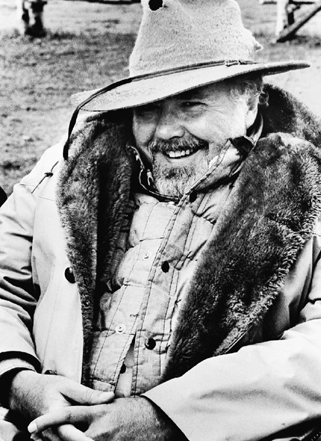
Robert Altman, smiling on the set of McCabe & Mrs. Miller
JULIANNE MOORE (actress): Often I think you find with auteurs or people who are supposedly artists, there’s this idea that they carry around and that the world carries around that they’re somehow different, therefore more special, therefore are supposed to have special treatment. There was none of that. None of that was present in Bob’s personality or his life. Not a moment of it. Not a moment of egomania. I’ve never known anybody who was more aware of what was going on in a set, like everywhere, with the camera operator and the actors and the makeup person, and he was always exceedingly aware of the psychological temperature of the set. And of everybody on it. And was careful of how he talked to people, how he interacted.
There was a script that somebody had approached him about for me, and he wanted to talk to me alone. He was like, “What do you think, honey?” I remember he was lying down. He was in the last year of his life and he was lying down on the couch and I had come in for a meeting and sat next to him on the couch and he was like, “Tell me what you really think. Do you want to do this or do you not want to do this?” He was really trying to assess exactly what my feelings were about the project, privately. He wasn’t somebody who was going to disregard what I felt, ever. And not because it was me, but because that’s how he was with every individual, which is really unusual in a person with that kind of breadth of artistic vision.
WOLF KROEGER (art director): He said he never gave a shit. Of course he did. Of course he cared. He was always marked as being anti-Hollywood. But if anyone was Hollywood it was him. The real Hollywood. He wanted to be a famous film director. He was a rebel. But he would never admit that. He had the same weaknesses we all do. We all want to be appreciated. You know, “This whole system sucks and this whole system is unprofessional, and I’m the one who is really working very hard on it. They don’t appreciate me, but I’m going to do a good job.” And by being difficult he got a lot of fame out of it, too.
He was a human being, a guy you could talk to, relate to. He showed all his faults, he showed all his tempers, he was a person you could relate to.
JOHNNIE PLANCO (agent): One night in Cannes, Bob and Kathryn were having words. Kathryn said, “Oh Bob, get over yourself.” And he stood there sputtering and finally said, “Why don’t you take a flying fuck off the ceiling?” I burst out laughing because it was such a stupid thing to say. Then we all started laughing.
SUE BARTON (publicist): I had known Bob and Kathryn for years, and I had seen Bob through all kinds of awful things. I was the publicist on Nashville, and we used to have these arrangements: if it was somebody’s birthday or anniversary a party would be given following dailies. Everybody would stay and have some drinks.
Early that afternoon Bob’s secretary said to me, “It’s Bob and Kathryn’s fifteenth wedding anniversary. Should we do something?”
We got a cake. We did this and it was very unpleasant. We didn’t realize how far gone he was, drinking and smoking at dailies. Kathryn was ever cool—”They’re playing our song.” I was walking toward the office and he was walking away.
He said, “Who arranged this?”
I said, “Well, I did.”
He said, “Well, you’re fired.”
I said, “You can’t just say that and walk away.”
So he turned around and walked back to the back room. I said something and then he said, “There’s nothing to celebrate about marriage. Your mother just died, right?” And she had, a couple months before. He said, “Why aren’t we celebrating that?”
At which point Kathryn picked up this great big fruit basket and threw it at him. He walked out.
She said, “He doesn’t mean anything by it. Be there in the morning and it’ll all be fine.”
I thought he was never going to do that to me. I thought, “Fuck, I don’t want to do that.” I promptly left and went to Nova Scotia. I didn’t see him for a long time after that.
Then one night at Elaine’s, Kathryn was giving a kind of surprise birthday party for Bob. As the evening progressed Bob came over to me and said, “You’ve been a wonderful friend.”
“That’s because I love you and I love Kathryn.”
And from that moment on we were fine.
GARRY TRUDEAU: I’ve done some soul-searching on this because of the whole issue of exceptionalism. Do you excuse bad behavior in some people and not in others? Do you write it off as the price that you pay for doing the work with somebody who is exceptionally talented? And I wasn’t entirely satisfied with the answers I gave myself because there were times when I thought, “This man is not very good to a lot of people a lot of the time.” Although he was always capable of enormous generosity and warmth, is there some sort of complicity in just overlooking it?
For some reason, I had immunity. He only exploded at me once. I can’t recall what it was over, which is telling. Because it didn’t really matter what it was over. He just needed to explode. Generally he’d be tough on others and not on me. That made it more confusing in a way. A tougher call. You can say, “Well, do you put up with this because it’s not directed at me?” [Laughs] I can imagine myself walking away had I been treated with the kind of cruelty which he was capable of. Just out of self-protection. But I wasn’t.
MALCOLM MCDOWELL (actor): He was such a maverick and a “fuck you” kind of person and such a complete individual who very much marched to his own beat. It was very refreshing. He didn’t seem to be scared of anybody. He wasn’t intimidated by the suits and all that, which was great.
I found myself in Rome while he was there talking about some project. And I was there doing a film, a very strange film about a Roman emperor. And it was a strange set. And I was telling Bob about it at dinner.

At the start of each new film, Altman would ask his wardrobe department for a new hat, which he would wear throughout the shoot. This straw hat with a flower was the choice for The Long Goodbye
And he said, “You’re all naked, huh?”
I said, “Yeah, yeah.”
And he said, “I may come and visit you.”
Well, actually there was a big party, so he did get to meet the producer, this man called Bob Guccione. And I was telling Bob all about him. And he was going, “Penthouse magazine.”
And I said, “They told me to treat him like one of the Warner brothers.”
He said, “I see.”
And he goes in. He comes in. And there’s this big party—there’s Pets and the actors, on one of the sets, or whatever. And Bob goes over to Bob Guccione and says, “Mr. Gucci, I like your shoes.”
Beautifully put away. Beautifully.
HARRY BELAFONTE: Early in our relationship, I told a joke and it became the metaphor for everything in our lives. These two musicians decided they were going to the jazz festival in Montreux, but they always flew. One says, “We should take one of these cruises, man, and just get out there and have four days and just lay out and see what that side of life is like.” So they were out in the middle of the Atlantic. And the water was calm and glassy. The moon hung high in the sky. The musicians broke out a spliff, a reefer, and they lit up and took a hit, gazing quietly out at the magic of the moon and the water.
The first musician said, “Man, look at all that water.”
And the second musician said, “Yeah, and that’s only the top.”
Bob went crazy. He went out. So anytime we were someplace and somebody said something, Bob would look at me and say, “That’s only the top.” And when somebody would come and aggravate him, and she ran her mouth or something, as she took a breath, Bob goes, “That’s only the top.”
LEONARD COHEN (singer and songwriter): He came to a concert that I gave at the Troubadour in Los Angeles, which I think still exists. It was a very popular club at the time. I remember an extremely generous gesture of his. I was onstage and I left the stage with a considerable amount of anxiety about the performance I had just given. I was walking offstage, down the hall to this little dressing room, not feeling very good about things. Bob was standing there—he was a big man and I’m a small chap—he just opened his arms and gave me a big bear hug.
He was a very, very good example because he just kept doing it regardless of how it was received. And did it with a tremendous grace and tremendous originality. To see him doing that was always impressive and always inspiring. He was only about seven or eight years older than I am but he seemed to be very much more accomplished and very much more in the world, so he was someone who was a shining example of the combination of integrity, originality, and indifference to the winds of change.
MATTHEW SEIG (producer): The guy had a bad temper and he could explode. And you know it was a long time before he ever yelled at me, a real long time. But I never took it personally. I don’t know, it was just Bob screaming. By that time I was so used to seeing him do it that it just was, you know, not a big deal. I wouldn’t have wanted to put up with that on a regular basis.
MICHAEL MURPHY: I would have hung out with this guy night and day. He could have been a plumber. That would have been fine with me. He just was that kind of guy. How could you not want to be there? I really did, I wanted to be there regardless of whether I was in the movies or not in the movies or any of it, you know? I loved hanging around with him and ergo I was involved in a lot of things. I was there for a lot of the down stuff and the hard times and I saw a lot of it. I try to be careful with that stuff because you see people at their most vulnerable. That’s why I never have liked those kiss-and-tell books. But this guy was just so remarkable.
You know, my parents influenced me, obviously, but I don’t know, I was too young to get it, or maybe it was jammed down my throat. But it was something about the way he just let you tag along. You learned by standing there watching it all. I think about this guy, I swear to God, every day. Every day he goes through my mind somehow.
ALLAN NICHOLLS (actor/music director/screenwriter/associate producer/assistant director): We went on a fishing trip once. Bob, Bob Eggenweiler, myself, Tommy Thompson, and Frank Barhydt. One night, we’re floating around—we were going to go fishing the next day—off the coast of Escondido. It was about an eighty-foot boat, a luxury boat. I had never been fishing on a boat before in my life, and we were sitting around having drinks at the end of the day, and all sunburned and having a cocktail and Eggenweiler was cooking some great fucking meal. And Bob goes, “This is true homosexuality” [laughs].
RENÉ AUBERJONOIS: He had these offices on Westwood Avenue, Lion’s Gate Films. If you were in town and drove by, you could just drop in and Bob would be in his office. He would be there and you could walk in and just hang out and eat popcorn and smoke a joint. I can’t imagine doing that in any other producer or director’s office on the face of the Earth, but that’s the way it was.
One time, Henry Gibson was there having a meeting for the film Nashville. I felt very uncomfortable. I felt like Bob was showing me what I was going to be missing. The minute I realized I was in a meeting for a film—I never actually told Henry that, how uncomfortable I felt—I made excuses and left. I remember feeling very hurt. Bob was manipulative. He was devilish. He was tricky. He was slippery. He was McCabe. You could sense that you could get on the wrong side of Bob and that could not be good.
HENRY GIBSON: René found that as a source of rejection? Did he say I did anything? Because I don’t remember too many meetings there prior to shooting. Oh, what a heartbreak. It could be that he imagined that I was in the room, which is all right.
JOSH ASTRACHAN (producer): I don’t know, this may be a little easy, but I feel like Bob never saw somebody who was satisfied with himself that he wouldn’t like to pull the rug out from under. But part of it is just this combative guy who couldn’t resist taking a swipe sometimes, even if he ended up being the one who got swiped.
RICHARD BASKIN (composer): I had a dream where I’m at a cocktail party and we’re at an apartment on the twentieth floor. Everybody’s having a good time and Bob is pretty lit. Scotch in one hand and a joint in the other. We end up out on the balcony arguing. He loses his balance and falls off the balcony. Jesus, I’ve killed Bob. I see Kathryn in the room and say, “How am I going to tell Kathryn?” The door opens and in walks Bob, like a cartoon character. His hair is rumpled and he has a Band-Aid across his nose. That was always the perfect metaphor for who he was. He was indomitable, a force of nature.
BILL ROBINSON (agent): I met him during The Long Goodbye. I was an agent trying to sell him a client. He didn’t act like he was one of the great filmmakers of our time. Pretty soon we started playing backgammon, and eventually we probably played a few hundred thousand games of backgammon. How was he? Not great. On a ten scale, a ten being a top tournament player, I was probably an eight and he was probably a six. But he had great guts. He was not afraid to make a bet or give you the cube and double you. That was the fun with him. You’d be sitting here, it’s his turn and you’d be in a much better position to him. He’d say, “I’m going to turn the cube to sixteen.” When you’re playing with an opponent not as good as you, you don’t want to have the doubling cube go too high. He wasn’t afraid or intimidated by anybody, just exactly like he was in the business. And he never cared if he lost. He always paid right then. You didn’t wait a day or a week. He got up, got his money, and paid you. Every single time.
Most of us, when we’re spending or gambling money, we understand how much we can afford to lose. And I’d rather not lose that much. I guess I can, but I’d rather not. He never worried about that. Let’s say he had five hundred dollars in his pocket and he was bringing it home to give to Kathryn to buy something. If on the way home he got in a backgammon game he would just not worry about losing that. He would get in the car and find a way to get what he wanted with that five hundred dollars. And if he didn’t, he had the confidence that he’d get it tomorrow. It was confidence, mainly, but it was more than that. He didn’t have the fears and the insecurities that the rest of us have. If you don’t worry about that, you’re free. Your behavior is free. If you’re a businessperson, your idea of failing would be, “Did the movie make money or not?” His sense of failure would be if people he knew and liked didn’t like his movie. Unless, of course, he really liked it.
HARRY BELAFONTE: Backgammon? He beat me all the time. I mean, that son of a bitch has beaten me when I had just one off left, and he had all his chips still on. He was amazing. In the face of a clear loss he would turn the cube over, a double. I’d say, “Why are you giving it away, Bob? I got you, man.” He said, “Let’s play.”
ALLAN NICHOLLS: There is a sheet of paper somewhere, and I can’t remember if I’m up fifteen points or seven points. But he does owe me. And I can’t remember if it was five dollars a point or twenty dollars a point. If he was winning, he’d make it twenty dollars a point. And if I was winning, five dollars a point.
STEPHEN ALTMAN: He was a horrible backgammon player. I used to kick his ass regularly. On my nineteenth birthday he bought me this beautiful backgammon board that I still have. And he took two weeks of per diem pay from me that night, gambling. It was like, “If you’re going to play with me you’re playing for five dollars a point.” It was every penny I had, like five hundred dollars or something. At the time that was everything. He really enjoyed that and then enjoyed beating the hell out of me at that game for a long time. But I persevered and at the end I believe I took a lot more from him than he ever took from me. I certainly played by his rules and stuck it to him whenever I could and it was a lot of fun. We had a good time.
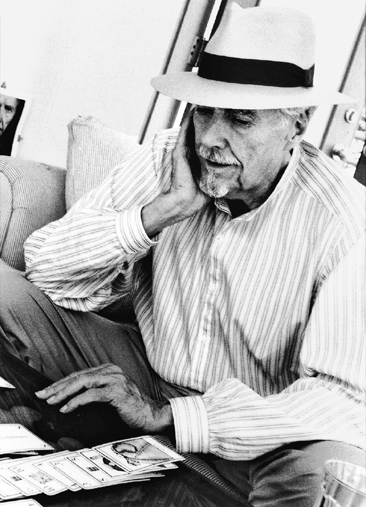
Playing his signature tarot solitaire game
JOSH ASTRACHAN: One of the great things was the Bob solitaire game, with tarot cards. It’s such a vivid part of who he was on a day-in, day-out basis. It always seemed to me it was kind of the perfect distraction and meditation, because it allowed him to remember whatever he needed to remember. What’d it look like? Oh, the desk was covered. I mean they were oversized cards. He looked like some kind of wizard, you know, with these things. And I didn’t even know what those characters were, let alone what the rules were of how you could assemble one on top of the other. And of course he had those long beautiful hands and he would look so great playing solitaire. So it all seemed inscrutable and kind of magical, as if he were summoning, you know, telling his future. And then he’d know what to do and he’d call out in the middle of it—”Get this thing done.”
* * *
JULIAN FELLOWES (actor and screenwriter): Bob was a very explosive personality. Bob was hot. He was a kind of charismatic exploding lion, and that is something that has to be handled with care.
GERALDINE CHAPLIN: He was such a focus of your attention that when he didn’t call you worried you had done something. He was the best person in the world to be loved by. You’d always love him, but you never knew if he loved you or not. I fell out of favor for some reason, I don’t know why. I probably got old and I wasn’t useful anymore.
BOB BALABAN (actor/producer/director): Well, he had a ferocious temper. I don’t think it was an age thing necessarily, but I think for a lot of men anyway, he’s their father. Because he’s the thing you fear in your father, you need his approval desperately, because people around Bob really, really want his approval, which he gives so lavishly when he’s giving it. So the times when he didn’t give it, it’s like your father has taken away your worth, you know?
PAUL NEWMAN (actor and philanthropist): He was an original. Being an original means that you’re standing out there on thin ice sometimes. But at least he was out there skating while everybody else was waiting for cold weather.
HENRY GIBSON: I’m always surprised that people are surprised that an artist has tantrums, has fits, has prejudices, becomes easily exasperated, is impatient, is overly exuberant, loves to entertain, is theatrical, is a gambler. This is human nature. Artists from the beginning of time have been this way. What, are we really surprised? Are they surprised because perhaps in the twenties and thirties and forties the press was not exposed to this? Yes, that’s what I think. But did great artists, great conductors, great writers of the last three centuries not have similar characteristics and traits? Yes. This is all part of the fabric of greatness. He was very, very human. He never presented himself as a saint.
Now, his work demonstrates his generosity, the expansiveness of his spirit, his encouragement of others, his taking chances on others, his recognizing talent, his fanning it. He held people up. Yes, there were some actors who gave brilliant performances only for him. And could not sustain it, because perhaps they did not have the technique to follow through, the training, the exposure. What they didn’t have was Bob. No, if you talk about the man, I see both sides and I hug both. It would be unbearable if he was treacly. He’s not a greeting card. He’s not haiku.
He had this gift—which was also an affliction—of people finding in him the father they never had. Because he was by nature in accommodating cast, crew, the people he worked with, paternal. Did this come from his father? I don’t know. Normally we do one of two things. We either imitate our fathers or we couldn’t stand them and we go in the complete opposite direction. As we mature as kids, we realize that this man that we idolized makes mistakes. He does have clay feet. He does some outrageous things. He’s our father. We love him. And then we get a little older, and we say, “You know, we’re all made of many strands.” So some people might go into shock. Some people didn’t mature. Some people were daddy-hung. It sounds like an Indian word, doesn’t it? Or something on an Indian menu.
Your capacity for hurt is sometimes stronger than your capacity for love. You’re talking about people being so hurt that they remember it for thirty years. Because they refuse to accept the fact that he was human. He never could be a saint. I know some of those people you’re talking about. You know, “I can never forgive him.” Hold on for a minute. From that one incident, and yet you worked for him here, you’ve worked for him there? Someone spilled wine on your new burgundy dress? A disproportionate reaction to a larger-than-life soul, I think.