
CHAPTER 20
*
Buffalo Bill and the Indians, or Sitting Bull’s
History Lesson (1976)
Charles Champlin, review in the Los Angeles Times, June 30, 1976: When Robert Altman’s movies are good, they are very, very good, and when they are bad, they are infuriating because there is something arrogantly self-destructive about them. … The Altman successes and the Altman nonsuccesses are linked by his unchallenged ability to make strong images and arresting scenes. His films are sometimes pretentious and sometimes exasperating but they are not often boring, although the latest, “Buffalo Bill and the Indians, or Sitting Bull’s History Lesson,” is all three…. Buffalo Bill is played as one long Homeric hangover by Paul Newman in a shoulder-length curly wig (which he is caught without, self-scalped so to speak, in one farcical early morning confrontation with Sitting Bull).
* * *
KENNETH BRANAGH (actor): Buffalo Bill is an example of Altman putting an American icon, Paul Newman, into the role of an American icon. He had the ability to attract actors with surprising roles in controversial pieces that were about something—in that case a look at show business, a look at history, a look at how America looks at itself, a look at the West. It was a real potpourri of really fascinating, controversial insight. He was unafraid in that picture of presenting disillusion in a very prominent way, and yet it wasn’t gloomy. He looked difficult things in the eye.

With Paul Newman, as Buffalo Bill, during location shooting universally described as a joyful experience, followed by a ho-hum audience response and a bitter dispute with producer Dino De Laurentiis
MIKE KAPLAN (publicist and producer): It was an Altman movie—what you expect is not what you get. Looking back on it I don’t know what they were expecting. I just see the film in my eyes. They were expecting much more of a traditional movie that would have more action, maybe—it had Paul Newman and Burt Lancaster. And Bob was making a statement about celebrity and the treatment of the Indians and the nature of America.
MATTHEW SEIG (producer): He was fascinated by the whole role of putting on a show, the whole tradition of showmanship, whether it’s a con or not and how very American that tradition is. He’s very much in touch with American culture. Whether or not his films are accepted by it is not really the point. It’s his interest in America and its institutions, including show business.
* * *
PAUL NEWMAN: The way he chooses his language and his descriptive phrases is amazingly perceptive and helpful. And if you don’t listen very carefully, you might miss it. Bob directs using active verbs. You can play an active verb. You can’t play an inactive one.
I don’t remember what the specifics of the scene were, but Altman beckoned me over. He thought for a minute—I was playing a scene with another actor—and he said, “Crowd him.” It was so clear and so defined and so unmistakable what he wanted from that scene and from that character that he made it easy to play. When he tells you to crowd the guy you’re talking to, you know exactly what he’s talking about. You put out physical presence to bear on the scene. “Back off” you can play in more ways than one. You can play it intellectually, you can play it physically. If he tells you to amuse the other character—almost any active verb you can think of you can find a way to play.
When you needed it, that was the kind of direction he would give. Most of the time he was happy to let you find your own way and to be comfortable. But if you got into trouble he sure as hell could get you out of it.
He knew how to make people comfortable. Even when he disagreed with them he knew how to make them comfortable. It’s a great gift, particularly a great gift for someone who has authority.
JOHN CONSIDINE (actor and screenwriter): Newman has a great sense of humor. I think when Newman arrived Bob had his dressing room filled with popcorn. That started this back-and-forth of practical jokes on each other. Bob had this beautiful pair of beaded gloves that an Indian tribe had made for him. He wore them all the time. Somehow Newman got ahold of these gloves.

At his desk in the production office of Buffalo Bill and the Indians, or Sitting Bull’s History Lesson
PAUL NEWMAN: The popcorn, I thought, was a minor insult. But to get into his bedroom at the hotel and steal his gloves and then have them French-fried and served garni in a fast-food box I thought was rather stylish. I’ve forgotten what he retaliated with. He always had his very fancy camper. I think I got ten thousand chickens and put them in his camper, which needless to say was both difficult to clean and to drive.
I had someone tell him that I had an announcement broadcast on the local radio station—there was an emergency, and the production department needed four thousand extras the next morning at six o’clock. He was crazy. Of course he didn’t know how to stop it. There was a flurry of excitement in the production department. I think I let him off the hook, told him it was a gag.
We had a bad scene, which we finally, obviously cured, but he said, “The reason I got so pissed off—underneath every practical joke, there is an element of malice. You’re trying to make someone look silly. You’re trying to humiliate them or make them feel bad.” And he said, “Why would anybody want to do that?” And so that was the end of my reign as the king of practical jokes. Altman was very relieved when he found out about that, I might add.
ALAN RUDOLPH (director): Bob once suggested to Paul Newman that they form a company together using the first half of Bob’s last name and the second half of Paul’s. They’d call it the Altman company.
JOHN CONSIDINE: Dino De Laurentiis was the producer, and he expected a shoot-’em-up kind of thing. He came to the set one day. Bob had rented this big place for the whole cast and crew to watch this big Muhammad Ali fight. At one o’clock in the afternoon Bob says, “That’s a wrap. We’re all going to watch this fight.” He and Dino had this huge argument. “Bob, you can’t stop shooting at one o’clock!” The last thing I heard was, “Dino, Dino, it’s just a goddamn movie.” So we all watched the fight.
During the last third of the shooting, Bob was in extraordinary pain from a bad back. He could barely walk, and you could tell he just wanted it to be over. He probably rushed through the cutting process, too, because I always thought if he ever went back and recut it, it could have been a more successful film. It was a colossal flop. It was so wild to have this amazing, wonderful time and then the reception was so bad.
GERALDINE CHAPLIN: He was always at his best when he had his back against the wall with a knife at his throat. He was too excited to get on to the next project always. He had so much talent and he was such a genius, his mind was going much faster than the project. And a lot of times he would be on to the next project before he finished cutting the one he was on. His best projects were when he was out of favor and had to prove himself. That’s when he paid most attention.
LAUREN HUTTON: I went to the premiere straight from the airport. I had this giant elephant bone—huge—it was about four feet long, a bull-male tibia. So I went to the premiere with this thing over my shoulder. And then it was a disaster. Then I see Bob and Dino having this huge fight in the lobby. And then I went and got my suitcase, my little duffel, and my bone, and we went to Bob and Kathryn’s apartment for the after party. Everyone was so stricken that when I walked in the door, I immediately took my bone off my shoulder and said, “This is for you.” And I gave it to Bob, this giant bone. So Bob spent that whole night with that bone on his shoulder.
KATHRYN REED ALTMAN: I love that bone. It’s been here in my home for more than twenty years.
BILL ROBINSON (agent): Dino wanted it to be more commercial. He flew over here and almost threatened Bob, “That movie has got to be shorter!” The longer it was, in his mind, the less people would like it. Bob didn’t care. “That’s my movie. You can’t cut it.”
JOAN TEWKESBURY: Dino is a guy who tells a story, and there’s a beginning, a middle, and an end. They may have been sitting down at the same table to have dinner, but they weren’t having the same meal.
Unbylined story headlined “De Laurentiis Dismisses Altman from Ragtime,” The New York Times, June 22, 1976: Robert Altman, one of Hollywood’s top-flight directors, whose credits include “M*A*S*H,” “Nashville” and “Buffalo Bill and the Indians,” which is scheduled to open in New York on Thursday, has been dismissed as the director of “Ragtime,” the movie to be based on E. L. Doctorow’s novel.
The award-winning director said last night that he was dismissed by Dino De Laurentiis, producer of “Ragtime,” three weeks ago, because of a difference of opinion, not about “Ragtime,” but about how much should be cut out of “Buffalo Bill and the Indians.”
“He [Mr. De Laurentiis] was disappointed in ‘Buffalo Bill’ and requested that I cut the film rather drastically,” Mr. Altman said. “I did my best to accommodate him, but in the end it’s my movie and I had to put it out the way my conscience dictated.” … “I’m naturally disappointed. I feel like Adlai Stevenson—It hurts too much to laugh and I’m too old to cry. It’s not the artists who are disagreeing, it’s money.”
MARTIN SCORSESE: The big tragedy, I think—well, “tragedy” may be too strong a word and “disappointment” is too light a word. I’m talking about when he was going to do Ragtime and he didn’t get it. As interesting a film as it turned out to be, with Milos Forman, there’s something uniquely American about it, and it had to do with a kind of gigantic fresco of America at that time. The rebelliousness and the nature of the material, and a gallery of characters. Who could handle that better? Who could juggle it better? Who could weave them in and out like a beautiful tapestry? Who else but Altman could do that kind of thing?
I saw him right after that happened. I said, “What do you do now?”
He said, “Punt” [laughs]. And even though the only football game I ever understood was in M*A*S*H, I got it.
* * *
Story headlined “Buffalo Bill Wins Top Berlin Prize,” Reuters, July 8, 1976: The United States film “Buffalo Bill and the Indians, or Sitting Bull’s History Lesson” won the Golden Bear award at the Berlin Festival, despite an earlier protest by the director, Robert Altman, that he did not want the picture considered for a prize. In a letter to the festival, Mr. Altman said the film had been edited so drastically that it perpetrated “a fraud” on audiences. The version at the festival was authorized by him.
JEFF GOLDBLUM (actor): After Nashville, I saw Buffalo Bill. I loved it. The guy who played Sitting Bull hardly talked. Altman said, “I learned something from him—he had the courage to be empty.”
* * *
Robert Altman as Producer
Welcome to L.A. (1977, directed by Alan Rudolph); The Late Show (1977, directed by Robert Benton); Remember My Name (1988, directed by Alan Rudolph); Rich Kids (1988, directed by Robert M. Young); Mrs. Parker and the Vicious Circle (1994, directed by Alan Rudolph); Afterglow (1997, directed by Alan Rudolph); Trixie (2000, directed by Alan Rudolph).
ROBERT BENTON (writer and director): He produced for me the way he would want someone to produce for him—to be supportive and never lie. Altman taught me how to be a director. It’s that simple. I was a writer working as a director. I illustrated a screenplay. He taught me a way of listening to the actors, a way of respecting the actors, a way of letting the picture become a more fluid process. It was great process for me.
On Late Show, he was there every day at the end of the day saying, “Great work, you’ve done a great job.” When there were notes they would be extremely good notes. Essentially he said, “The actors are the only real heroes in movies. It’s easy for guys like you and me to stand behind the camera and make up a story. If he or she has a question with our logic, we really should listen to them.”
There was a tiny scene and Lily Tomlin was in her apartment and these guys came in to threaten her. It was a tiny moment and she said, “No, no, I’d do this.” I suddenly realized, only because Altman had made me see that, she wasn’t speaking as Lily, she was speaking as Martha, the character. She knew exactly what she was doing, and my job was to let the actors have a safety net so they could risk anything and they could feel secure. I think that’s really what Altman did with all his actors, made them feel safe and that he would protect them. And he did.
He was out preparing 3 Women, and he said, “Show the picture to Warner Brothers.” In the back of Lion’s Gate there was a garage he converted into a screening room. All the people from Warner Brothers came. They sat down and it was very pleasant. We started running the picture—it was the worst screening. Three minutes in, I felt like I was on the Titanic.
I got a call from David Geffen, who was then head of production at Warner’s. He said, “If it were up to me I’d bury this. But there is a young executive named Paula Weinstein, and she wants to work with it.” Altman’s favorite mode is to put on your helmet and get into the trenches and tell them to go fuck themselves. But he listened to me and he listened to Paula and he said, “We have to change the editor.” He brought in Lou Lombardo and he was great. From September until Christmas of ‘76, we significantly changed the picture. It was really Lou Lombardo and Paula who did it.
Altman kept getting madder at me and madder at me. He thought I was listening to just anybody. He didn’t understand how desperate I was. And we got into big fights. He would get so mad he would fire me. I’d be hysterical. I’d call Sam Cohn, who was my agent and also Bob’s agent, and he would say, “Don’t worry.” I’d be back at work the next morning and everything would be fine. He loves a good confrontation, and I was the opposite. It worked in the end. Oh God, I drove him crazy. But I still have enormous affection for him. I owe him more of a debt than any other filmmaker I can think of. If that movie is good it’s because of him.
* * *
The Fox Five
3 Women (1977)
A Wedding (1978)
Quintet (1979)
A Perfect Couple (1979)
HealtH (1980)
ALAN LADD, JR. (producer): At Fox, we did 3 Women, Perfect Couple, Quintet, and A Wedding together. I started HealtH with him, but then I left the studio. I was the only studio head that would hire him at the time. The hypocrisy of this town—so many people took out ads about him when he died, but they wouldn’t hire him. The creative community admired him greatly but studios were afraid of him—because of his outspokenness. On some level they recognized that he was a master. To know Bob was to love Bob—but if you didn’t know him you swallowed all the bullshit about him in town.
I knew Bob as an agent when he was a TV director. Bigger than life—even then he was a man who did what he wanted, wouldn’t compromise with anyone. But he was always on budget—that was all the studio cared about. When I was head of Fox he gave me a call one day with an idea—and he came in and told me the idea of 3 Women, which I found intriguing.
* * *
Jack Kroll, review of 3 Women, headlined “Desert Song,” Newsweek, April 18, 1977: Like any true artist, Robert Altman couldn’t play it safe if he wanted to—which he doesn’t. His movies take chances, and none of them has risked more than 3 Women. In this, his tenth film in seven years and in many ways his most personal work, Altman dares to make something beautiful out of the deepest and most all-encompassing sorrow. Bleak visions of life are a dime a dozen these days, and the only excuse for an artist to have such a vision is to turn that bleakness into something blazing with paradoxical light and heat, something to stir and shock us into the exhilaration of discovery. This is what Altman does in 3 Women. … What makes a wasteland is the absence of love, which Altman embodies in a “rehabilitation” clinic for old people in the Palm Springs desert area of California. … Here in this hygienic limbo of youth and age, Altman’s dream-girls, Millie Lammoreaux (Shelley Duvall) and Pinky Rose (Sissy Spacek), meet. They are ultimate American waifs, crossing paths in these gypsy jobs that are parodies of caring…. The third is Willie (Janice Rule), who owns the apartments and a decayed Disneyland called Dodge City where the local studs come to shoot targets, ride dirt-track motorcycles and drink. Willie is a silent, sibylline figure who paints every surface—even the bottom of the pool—with grotesque humanoid figures in which a fierce, priapic male terrorizes three females, one of whom is pregnant. … Altman’s dream of three women expresses his sense that human beings have become more vulnerable than ever to pain, loss, betrayal, cruelty and shame. He’s right, but his film has an originality and beauty of form that moves you beyond the force of its insight.
ROBERT ALTMAN: I had done a painting years before. There were about two years that I did paintings. And I did a painting of three women, just three faces, and then I had this dream that I was making this picture in the desert, and it was called 3 Women and it was about personality theft. We were living on the beach in Malibu, and Kathryn had gotten very sick—I had just visited her in the hospital.

Sissy Spacek, as Pinky, and Shelley Duvall, as Millie, in 3 Women
KATHRYN REED ALTMAN: It happened fast. Sunday night we were walking on the beach and I felt like I couldn’t get anything down. I went upstairs and I was just sick all night. I ended up in the emergency room. They finally just had to go in—surgery. … They got in there and found a duodenal ulcer. You know it’s all the psychological thing—ulcers and problems and stress. But this one was buried so deep it took forever to finally find it. That was when he was at home with Matthew. And he had this dream.
ROBERT ALTMAN: During that time when Kathryn was in the hospital, our son Matthew was spending time on the beach and he had been sleeping in my bed. So there was sand in my bed, which might be why I was dreaming about the desert. I would dream a little, I would think about this, and I’d wake up and I’d go to the pad by my bed and I’d make notes. And then I’d wake up and I’d have Bob Eggenweiler and Tommy Thompson in my bedroom. And I’d say, “Now go down to the desert and find a location that’s like this and this and this.” And, of course, none of that happened. Neither of them was there, and I never wrote a dream note in my life, and I had no pad next to my bed, even. So I dreamed about making the picture, and the tenor of what the film was. I called Alan Ladd at Fox and said, “Listen, I read a short story and I want to make a film of it.” I didn’t want to tell him it was a dream. And I kind of made up the story. And he said, “Great. Go ahead and make it.”
ALAN LADD, JR.: He didn’t mention that it was a dream until later, in Cannes.
SISSY SPACEK (actress): I got to know Bob while we were shooting Welcome to L.A. We’d go to Lion’s Gate to watch dailies, and it was really like going to the movies. It was a real festive and relaxed atmosphere at that office. There didn’t seem to be a real hierarchy, like if you were low on the totem pole you never felt like you couldn’t talk to Bob. He made himself accessible to everybody. Granted, he surrounded himself with people he really liked and respected.
I remember he told us about his dream. I did little drawings, little sketches about his dream. Bob would get the seed of an idea and he would let the people he was working with become a part of that. I remember we were doing one scene and I was really upset about how it had gone. It wasn’t real, it wasn’t authentic. He just laughed. He said, “Once you have done it, it becomes real.” Part of his genius was making you feel as though you can do no wrong. He was really an artist. He didn’t run after what was happening at any time. He was not a formula man. He did his own thing and he trusted that everybody he was working with would pull his weight.
He told me everything he knew about my character, Pinky, and then it was like he would give actors a track, a blueprint. “Now work within these parameters and put yourself into it.” He didn’t need to have all the answers. He didn’t have that disease where as a director you have to know everything.
There was a lot of improvisational stuff. He would give us a scene in the morning and then it would grow. It was so freeing working with him after having worked with other directors. The way he works is all very naturalistic. Everything is natural and the sets are happy and relaxed and he seemed to always be the happiest and the most relaxed.
I don’t think I ever knew what the film was about. I remember Bob would say, “Well, if you confuse people enough in the first twenty minutes they’ll give up trying to figure out what it’s about and they’ll just go with it and enjoy it.”
Shelley always said the three women were the id, the ego, and the superego. At that time I had never heard of the id or the superego. She was way ahead of me. I just tried to portray the dream that Bob had. I didn’t think of it in those kinds of terms. To me it was about this girl who was a bit of a blank page. So young she didn’t know who she was yet and she met someone who she was completely enamored with and wanted to be like her. So as young people often do, she emulated her and was playing that part. I wasn’t thinking of the bigger picture of what it’s about.
When I was sixteen or seventeen I was on a bus in New York. It was pouring rain, and all the people ran under this awning. There was a girl a year or two older than me who had gotten off the bus. I looked over at her and was so taken by her and the way she dressed and the way she wore her hair. I remember thinking distinctly, “I want to be her. I want to be just like her.” Already in my life I had experienced something like that. I did become as much like the way she looked as I could.
Shelley was incredible. I remember her always getting her skirt closed in the car door. I think the first time it was an accident, but that was the thing about Bob. He loved accidents. He loved the things that happened that you didn’t plan. Bob would do things over and over hoping that something would happen that was unexpected.

With Shelley Duvall and Sissy Spacek during the 1977 Cannes Film Festival, at which Duvall shared the Best Actress award for 3 Women
ROBERT ALTMAN: The first time Shelley caught her dress in the door, Tommy Thompson, who was my assistant director, yelled, “Cut!” I loved it. I wanted her to do it again.
SISSY SPACEK: The little boy was very much alive in Bob. Bob was the mischievous kid who would put a plastic turd on the middle of the cake at the wrap party and then would stay nearby. He would get a few of us over to watch as people came. He was just tickled when no one stopped eating the cake, they just ate around it. He took such great delight in playing those kinds of pranks on people.
ROBERT ALTMAN: The reviews were mixed. Pauline Kael said she liked the first half of 3 Women but she didn’t like that last half. I said, “That’s like saying, ‘I like your baby. It has a cute head. But I don’t like her arms and legs.’” I mean, just say you don’t like it. Don’t say how it should have been done.
* * *
Mary Murphy, story headlined “Crisis of a Cult Figure,” New West, May 23, 1977: As Altman awakes in his New York City apartment, the phone rings…. “Don’t you realize you are letting history go down the drain?” Altman is shouting into the phone. He is talking to an executive at Fox about the distribution plan for 3 Women. “I told you this film had to be released slowly. At this rate it will be gone in three months and no one will make a penny.” His mouth moves continuously, his head bobs, his feet pace, perspiration dampens his shirt. He grabs a gold toothpick he wears on a chain around his neck and in rapid strokes picks at his front teeth. “I’m so mad,” he tells Shelley [Duvall], hanging up, “I could punch somebody.”
Within the next two hours a Fox executive calls to inform Altman that 3 Women is a box office failure in the South and the Midwest, new reviews are read to Altman in which he is attacked as a “middle-class artist,” “a megalomaniac,” an imposter who is ripping off Bergman and Fellini, and Shelley Duvall, after a four-minute conversation in the bedroom, has broken her contract and walked out on A Wedding.
Altman twists the cap off the Cutty Sark and rolls a joint.
* * *
JULIANNE MOORE (actress): I was in the theater department at Boston University, and we used to go to the movies in Harvard Square, where they always had revivals. I’d somehow managed to go through high school in the seventies not seeing Nashville. But I didn’t—I lived on Army bases. You just saw whatever movies were around, and for some reason I hadn’t seen that. So I saw 3 Women and up to that point I wanted to be a theater actor. I never had seen anything like it before. And it was the first time in my life that I actually noticed the presence of the director in a movie. I felt it really strongly. And I thought, “I don’t know who this guy is, but that’s what I want to do. I want to do that kind of work.” From then on I’d see his films whenever I could, and he was always my absolute favorite director, for what he said the-matically and emotionally and how he felt about people. Who people are, what they’re capable of—good or bad.
* * *
Betty Jeffries Demby, story headlined “Robert Altman Talks About His Life and Art,” The New York Times, June 19, 1977: Movie buffs may take advantage of this rare opportunity to trace not only Altman’s artistic progress, but to chart his development as a philosopher and commentator on social mores as well. And in these times of raised consciousness, special attention will perhaps be paid to the director’s treatment of women, from the humiliated Hot Lips Houlihan in “M*A*S*H” to the exotically intertwined heroines of “3 Women.”
“Women have been subjugated in our society,” he says. “Consequently, they’ve had to become manipulative. They have more disguises and facets than men. Those are the kinds of things that interest me, where we’re dealing with disguises, where we make assumptions and we’re almost always wrong.”…
“I cannot do ‘Rocky’ or ‘One Flew Over the Cuckoo’s Nest’ and all those films where there’s no question about the way the audience is going to feel at the end. I think sad people laugh, happy people cry, and brave people are frightened. Cowards are brave. There’s total contradiction. The minute you take the surprise away, there’s no art. The minute you plot something and say this is going to be this way because of this, you’re wrong.”
* * *
HENRY GIBSON: As with Fellini, people always wanted to explore the symbolism in his films. And people were constantly after him to interpret this or explain that. I loved what he would say in response. Someone would ask him, “In this particular picture, when we see the color red over here, what does it mean?”
And he very cleverly evolved this response. He said, “Well, what do you think it means?”
The person would say, “Well, I think it means it’s the sunset of that character’s life.”
And he’d say, “You’re right. That’s what it means.”
What he tried to tell people again and again is you get from the feast what you bring to it. There isn’t a rightness and a wrongness of interpretation.
ROBERT ALTMAN: Most of the people who have looked at my work and don’t know me, even the ones who do know me, they analyze it from a certain point of view, which is right and it’s wrong.
Asking me what something’s about will only lead them into misunderstanding. I mean, then you’re talking about some kind of logic that doesn’t really exist. Take Vincent [van Gogh]. His whole life was the epitome of the failed artist. And then suddenly, after his death, actually, for some reason somebody says, “Oh, look at this.”
I don’t think I know the truth. Or if I do, I’ve been disguising it for a long time. I don’t know that I want to give that up, this late in the game. But I don’t think it makes any difference. My answer is going to be no less valid, or no more valid, than the woman in England who wrote a book about five of my films, writing about what this or that film was in my life, and applying it to my life.
What difference does it make? How close do you want to get? By you, I mean your audience. What is it that they want to know? And what value is it for you to tell them?
The minute I say what a movie I’ve made is about, I’ve narrowed everyone else’s view of it. If I say what it means to me, its range to some extent is limited to the viewer from that point on.
* * *
JOHN CONSIDINE (actor and screenwriter): A Wedding had a funny genesis. He was finishing 3 Women in Palm Springs. I had come down there to do some voice-over work. After this one day he was told he had this big interview. He sat down in this living room and these people interviewed him and one of the questions was, “What are you going to do next, Mr. Altman?” He looked down at this coffee table and it had this whole display of wedding magazines. He said, “I think I’m going to do a film on the American wedding industry.” When they left I said, “Really?”
He said, “I just thought of it, but do you want to write it with me?”
So I stayed in a little room in Lion’s Gate and started writing. He said, “First thing, I want there to be a lot of characters.”
Nashville had twenty-four main characters, so I doubled it to forty-eight.
He came in one day and said, “We need to start the screenplay.” He sat down at the typewriter and wrote, “Exterior—Cathedral, day. Church music playing. Limousines and cars parked. A wedding is in progress.” Then he got up and said, “Okay, you take it from here.” I wish I had saved that piece of paper.
He didn’t write much, but some of the biggest turns in A Wedding were Bob’s ideas. Like the day he came in and said that there was going to be this terrible car crash, and everybody thinks the bride and groom are dead. I thought, “My god, where is our comedy going?”
I started a little card for each character and started putting them up on the wall. He came in and said, “I’d like our characters to have secrets, every character to have a secret. It doesn’t necessarily have to come out in the screenplay. But let’s give all of them a secret.”
It’s great for an actor to know something that nobody else knows. I just started expanding these.
He brought in Allan Nicholls and Pat Resnick to help with the script. I didn’t love that. We had a little thing about that. That’s just the way it was. I had a lot of anger and I wasn’t able to really express it to him.
He said, “Are you mad at me?” I said, “No, not really.”
I was at a stage of my life where at least with someone like Bob, I couldn’t tell him what I really felt.
One day Bob came in and said, “We have to have a story tomorrow because we’re going over to Fox to get the money.”
I stayed there all night and came up with twelve pages. The car is ready and we’re going and I handed it to him and he said, “I don’t have time to read this.”
I said, “Bob!”
We meet with Alan Ladd, Jr., and the other execs at Fox, and Bob says, “So, tell them the story, John.”
I started telling them; then Bob would get an idea and he would interrupt me. He would finish this and then say, “Tell them what happens next, John.” And we kept going. It was this incredible improv. We get outside and he looked at me with a big smile, and said, “Can you believe those guys gave us the money for that?”

Carol Burnett, Paul Dooley, Mia Farrow, Dennis Christopher, and Amy Stryker as the Brenner family in A Wedding
When we started shooting, Tommy Thompson came in one morning and said, “Fox is really pressuring us. They want to know the schedule. They have to see it, Bob.”
Bob said, “Tommy, look, if they don’t see a schedule, they have no idea how we’re doing. So let’s tell them we’re doing fine.”
CAROL BURNETT (actress): I remember Lily telling me how wonderful he was to work with on Nashville—”Carol, if he ever asks you to work with him, say you’d carry a spear.” That told me how much he was admired.
He had the ability to put a key in everyone’s back and open us up to be brave. He created an atmosphere on the set. I’ve never really enjoyed the process that much because I’m kind of a creature of theater and live television, where you learn it, you rehearse it, you do it, and you go home. Movies take forever. Three hours just to light the scene? For me it’s boring at times because you just sit and wait. That wasn’t the way with Bob. He created this atmosphere that was like recess. You just went in and you knew what the plot was, and you had some lines you were going to do, and the rest was up for grabs.
On A Wedding he got all of us in a room. He explained the plot to us and then he said, “Please, if you have an idea for a scene, come to me with it. I want to hear it. Some of the best scenes in my movies have come from the actors’ ideas.” You never hear a director say that. That was truly an astonishing thing.
The food was fabulous. He brought a wonderful chef. Everybody got the same salary and nobody got a lot. He made it up to everybody with these fabulous lunches. Everybody got along because everybody was happy.
Pat McCormick and I had this story line that he was married to the character Dina Merrill played, and I’m called Tulip and I’m married to Paul Dooley, who’s called Snooks, and we’re rich Southern trash. They’re to the manor born, but they don’t have any cash. Our daughter is marrying into that family, to the son played by Desi Arnaz, Jr. So there was a plot point where Pat’s character is smitten by Tulip, and she doesn’t know this and they’re dancing at the reception. He comes over and asks her to dance. He’s supposed to reveal his love for her on the dance floor. There were some lines, but neither Pat nor I felt that it was right. We went to Bob and said, “Can we play with this?” He said, “Sure.” We went back and found a room and came up with the idea that during the dance he’s in a reverie and never opens his mouth and she makes small talk and the more she talks the more uncomfortable she is. He finally presses her into a corner and professes his love.
Bob said, “Great, let’s shoot it.”
I’ve improvised a lot with television but this is the first time I’ve ever done a film where you can do that.
KATHRYN REED ALTMAN: Paul Dooley, in A Wedding, was the only casting I ever did for Bob.
PAUL DOOLEY (actor): Sam Cohn is his agent, and Sam’s wife and Bob’s wife became friends. Sam’s wife ran the American Place Theater and I was doing Hold Me! there. So Kathryn sees me and she likes me and she knew Bob was looking for someone, a character man for A Wedding. So she said, “You’ve got to come see this guy, I think he’ll be right for that movie.”… He came downstairs and there were four of us and we were more or less in the same dressing room. Anyway, endearing me to all my fellow cast members, he showed tremendous interest in me. “Would you come and see me tomorrow at my office?” The rest of them are looking at me like, “Who the fuck are you?”
On the third visit he says, “Well, I found your daughter.” And he says to me, “Who’s your agent?” I said, “I don’t have an agent. I’m between agents.” He says it doesn’t matter anyway, it’s going to be the same amount of money. And nobody ever does this. He says, “Vittorio Gassman is getting fifty grand, Carol Burnett is getting fifty grand, everybody else is getting twenty-five grand. Then there’s a group of people that get ten grand, and that’s you.” They never do that in the business. He didn’t like bullshit. He didn’t like games, he didn’t like playing around.
Bob likes to do what some artists call working with found objects. An actor does something that’s unexpected, and Bob, in some cases, you may not like it, but if he likes it, you know, he puts it right in the movie. But he loves these happy accidents. And I was one of his found objects. He just found me somewhere and put me in these movies.
CAROL BURNETT: Occasionally he would show us one of his movies if we wanted to stay after the dailies. I had not seen 3 Women. I was fascinated by it. I went to sleep and I dreamed about 3 Women. It was a funny dream. I went back the next day and I said, “I dreamed that Janice Rule was in the pool painting these murals. I dreamed she was there and there was a tarp and we couldn’t see what she was doing. Then she pulled a string and the tarp was raised and it was all Disney characters—Mickey and Donald and the whole gang.” He roared.
He said, “Well, if that’s what it did for you, that’s what it was supposed to do.”
ALLAN NICHOLLS (actor/music director/screenwriter/associate producer/assistant director): If anything, A Wedding was about gossip and how gossip spreads and how gossip hurts, and how gossip helps and how gossip kills and how gossip kills the right guy sometimes.
ALAN LADD, JR.: I was concerned about the kids dying at the end of A Wedding. He got his way. I guess he wanted the end to make a statement, his way of saying, “These things happen.”
BARBARA ALTMAN HODES: That wreck in A Wedding, and the bride in braces? Well, you know, Bob just took that from his own life, from what happened before he married LaVonne. And the groom’s family’s name? Corelli, right? Well, his second wife was Lotus Corelli.
Margaret Ladd, actress, from a diary she kept during A Wedding: Today they’re shooting the car crash. The car, in which the bride and groom are supposedly driving away, crashes into a gasoline truck and burns up. … Yesterday they had to show the car careening dangerously, at a very high speed, away from the house. It had to almost hit the stone pillar in front of the house. It was a very scary shot. Well, guess who was driving the car for the stunt shot? You guessed it: Altman. He scared the shit out of everyone. He really almost hit the post, missed it by about two inches at a very high speed. The cameramen almost stopped shooting they got so scared. … He got out, very cool, and said calmly to the cameramen: “Did you get that OK?” But there was a little smile on his face that he couldn’t quite hide, just creeping up in one corner.
* * *
Aljean Harmetz, story headlined “Altman Pledges Profits to Rights Plan,” The New York Times, June 12, 1978: The latest in a series of Hollywood parties for the proposed Equal Rights Amendment raised $57,000 yesterday—and a promise of as much as $2 million from Robert Altman, the producer and director of “Nashville.”
Mr. Altman impulsively offered all his profits, up to $2 million, of his new movie, “A Wedding,” which is scheduled to open in New York in September. Later, he said he had “felt moved” by the speech of Carol Burnett, one of the stars of “A Wedding.”
CAROL BURNETT: I think I did my speech in character as Eunice talking to Momma, trying to explain what the ERA was. She said she had been learning what it was, and it was nonthreatening, it was just a cry for equality in the workplace. I thought it might be fun to do it as a character who just learned about it, trying to get through to her dense mother what it was all about.
KATHRYN REED ALTMAN: Yeah, he pledged all his profits from A Wedding to the ERA. There were no profits from A Wedding.
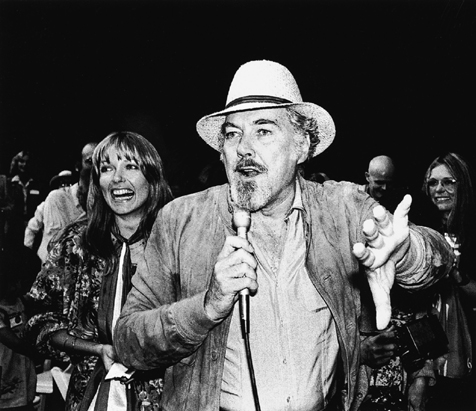
Robert Altman addresses the Equal Rights Amendment countdown party in Beverly Hills, June 11, 1978. Actress Susan Blakely is at left, and Gloria Steinem is at right.
* * *
FRANK W. BARHYDT (screenwriter): When he first told me about Quintet he didn’t say it’s this apocalyptic thing. It really had to do with adrenaline and people’s middle-class lives. They go to college, they get out of college, they get married, they have children, they buy a home, they have these very comfortable and very boring lives. And gambling was an adrenaline that people need, that risk. He equated that with the feeling after a storm, a violent storm, people feel invigorated because they escaped death, they cheated death. So that was the premise. These people really had nothing other than death looking at them, and in order to experience life they had to gamble their lives.
WOLF KROEGER (art director): Quintet was an absolute bore, really.
PAUL NEWMAN: I think Quintet was a valid supposition, but I think the details just got away from us. There weren’t enough details piled on top of each other to support that as a dramatic supposition. It’s a complicated supposition, you understand. It’s the end of the world, and if you’re going to go out you might as well go out with some excitement. So the excitement is that you have to track down the guy in front of you and kill him. But you also know that there’s a guy in back of you who’s trying to kill you. You might have gotten that on the second viewing, but most people only get a first. You have to be looking straight ahead but you have to be looking in back of you, too.
I don’t think you have to go out to kill for excitement to keep feeling alive, though Bob may have felt that way about the critics.
Vincent Canby story headlined “Robert Altman’s Talent Falters,” The Looking exhausted on the set of Quintet New York Times, February 18, 1979: The other day while watching Robert Altman’s new film, the end-of-the-world fantasy called “Quintet,” I could feel the blood rushing to my feet and my heart wanting to follow. The movie was both leaving me cold and giving me the sweats.

Looking exhausted on the set of Quintet
“Quintet” may be the most aggressively self-indulgent motion picture made in the last 20 years by a major American director.
As “Quintet” droned on in settings of surreal, frozen beauty, and as the characters, the last survivors on earth, play a mysterious kind of backgammon called quintet, or slink around the ruins cutting each other’s throats, or talk about life, death, hope (“an obsolete word”) and the mystical meaning of the numeral five, I was reminded of all the terrible little-theater plays I’d seen in my youth.
Robert Altman to David Thompson, from Altman on Altman: My father died from cancer just before we left for Montreal. My mother had died two years before. I’m sure that influenced the tone of Quintet.
* * *
ALLAN NICHOLLS: For A Perfect Couple, we came up with the story idea first about two people meeting from very different walks of life. And yet two people firmly involved in family. One of them, the family was a band. For the other, the family was their heritage.
PAUL DOOLEY: I had already made A Wedding. Bob’s not saying anything to me, like he likes my work, because he had a gruff side, too. So about three months later a friend of mine says, “Buy Variety.”
“Why?
“Just get the new Variety. Page sixty.”
So I just went to a newsstand and looked at it and here’s an ad with me and Marta Heflin, “Robert Altman announces his next film. A romance. Paul Dooley and Marta Heflin, coming to theaters next year.” But he never said a word to me about this.
I called him up. I said, “Who’s this Paul Dooley that’s going to do
that film?”
He says, “I knew I could get you.” Then he said, “I wanted Shelley Duvall to do it, but she’s got some other stupid job.”
He didn’t like it that much when his “family,” if you will, started going out and working in the other side of the business, because he really invented Shelley. Shelley wasn’t available or something, so he was naturally pissed off about that. But he saw Marta Heflin as another girl. He wanted to do a film about people who weren’t conventionally pretty people or the right age or just the way Hollywood would do it. He does most of what he did to say “Fuck you” to Hollywood. He didn’t like conventional, formulaic movies, and none of us do, really. Sometimes you put the right hero and heroine together and it’s a formula movie, but you know it’s George Clooney and someone else and it’s still a good movie. But they still spend the last five minutes going back to the girl and embracing her and kissing her. Even if Arnold Schwarzenegger is an alien, he’ll do something nice for a girl at the end, especially if she’s in a very short skirt. It hasn’t changed all that much. Anyway, he didn’t use the phrase, but it’s almost as if he wanted to show that an ugly duckling has the right to fall in love and be happy.
He was cynical about the idea he was supposed to do things a certain way. It might be antiauthoritarianism or something. “Don’t tell me how to make my movies.” Well, I got news for you. In fifty years, when people have forgotten many of the current directors who made a lot of money, they might still remember Bob Altman, ‘cause there’s a body of work you can look at. And there’s no one like him, first of all. If a guy makes hit movie after hit movie after hit movie, he’s probably doing a formula. Anybody who’s an artist wants to do something slightly different next time, whether you’re a writer, or artist, or whatever it is. Bob was an individual, an adventurer, and a gambler. And he was willing to gamble other people’s money and even his reputation on a hunch, on an idea he had. But I thank God for it because he saw me in certain situations that other people didn’t.
ALLAN NICHOLLS: We screened Perfect Couple at Lion’s Gate for Mick Jagger. It was a fun night. And after that screening Bob and I looked at each other and thought, “We’re going to make some money on this one.” We didn’t. The marketing and distribution failed us. I want to get back at them one day. And the way I want to get back at them, I’ve been talking to Kathryn and Bob’s legal people about doing A Perfect Couple as a musical. It is a musical and it should be a Broadway musical. But it takes some time to get that going. Everything else is a musical on Broadway. So why not Bob, who loved Broadway so much, why not his legacy there? It would be cleverly ironic too, if one of his most unsuccessful films becomes a Broadway hit.
* * *
FRANK W. BARHYDT: He had just gotten back from shooting A Wedding, and I had written this script, for HealtH. It was about an election for the president of a health-food convention, and I didn’t really know the form. I knew description and dialogue. I didn’t know how it really should look. So I just sort of did my own version of it and my parents were out visiting and I asked my father to read this and he found it funny. So I asked Bob if he would read it. He said yeah. Bob has always had a fascination with politics and power. So all political things are interesting to him, and I just happened to tap into that. Four days later he said he was going to make it.
CAROL BURNETT: He was liberal, definitely a liberal. You saw that in HealtH. The idea was a convention of health nuts, but HealtH was of course really about Eisenhower and Stevenson—Betty Bacall was Eisenhower and Glenda Jackson was Stevenson, down to the part where she crossed her leg and you see the hole in her shoe.
LAUREN BACALL (actress): I didn’t really get to know him until he called me one day to have lunch with him and tell me about this movie that he wanted to make, called HealtH. Of course he was filled with ideas, and it all sounded very funny to me, which indeed it was. I loved my character, Esther Brill. She was this eighty-something-year-old virgin who says every orgasm takes twenty-eight days off a woman’s life! It was a wonderful movie. I loved the movie. Everyone who saw that movie adored it. He used to carry it from festival to festival.

With Lauren Bacall on the set of HealtH
He made movies in his very own original way. If you wanted to try something, go ahead and try it. If you weren’t precise about every word, fine. He lived up to his reputation of being this incredibly gifted, original man who was wonderful with actors and who just had a knack for making unusual movies.
WOLF KROEGER: HealtH? Absolutely a piece of garbage. There was nothing there. He just made it up. But he must have had something nobody else had, because he always attracted great actors.
DAVID LEVY (producer): With the late-seventies stuff and the Fox deal, there was a certain fly-by-the-seat-of-the-pants quality. He really liked both on-set and off when the unplanned happened; he always celebrated that. And he trusted that. Another person would say that’s hubris. A lot of people aren’t comfortable in what might be called that unplanned state. He was very much okay with operating in that space. I remember on HealtH, Laddie, Alan Ladd, Jr., would be asking, “Could we get a real script on this? Could we get a whole script?” And it was never really forthcoming. It was always a work in progress. That was a thirty-five-day shoot, but after twenty-nine days he basically felt, “I got what I got and I’m okay with it and I don’t need to kick this around anymore.”
So it was a very free-flowing, controlled chaos. But that was by design, his design, you know? And here again, this was another film that didn’t perform. I want to say that the theatrical release for the most part lasted all of a week, maybe two. It played in such a limited way and the studio felt that no matter what they did to get behind it, it wasn’t going to reach an audience. So it died a painful but very quick death.