
CHAPTER 25
*
The Player (1992)
Terrence Rafferty, review in The New Yorker, April 20, 1992: The title character of Robert Altman’s new movie is a young Hollywood studio executive named Griffin Mill (Tim Robbins), who, for no very good reason, murders an aspiring screenwriter. The picture is a brilliant dark comedy about the death of American filmmaking. It’s like a documentary about a mirage: the world it shows us is sunlit and shimmering, and the people have the thin presence of holograms. Altman is doing one of his specialties here—exploring an odd American subculture—and when his idiosyncratic realism is applied to the insular, constantly self-regarding community of Hollywood “players” it has an almost hallucinatory effect. The movie has the exhilarating nonchalance of the director’s seventies classics, and its tone is volatile, elusive: with breathtaking assurance, it veers from psychological-thriller suspense to goof-ball comedy to icy satire. Altman turns the self-reflective world of Hollywood into a fun house in which every grotesque distortion somehow appears to us as a newly discovered, paradoxical truth. Robbins gives a layered, richly suggestive performance—the sort of performance that Altman’s style, at its best, produces without obvious effort. At sixty-seven, Altman still seems like the youngest filmmaker in America.
* * *
DAVID BROWN (producer): I had read a piece in a defunct magazine, called Manhattan Inc., which was an excerpt from the book The Player. I thought, “How wonderful, this author knows Hollywood.” There was a true authenticity. But I didn’t see how it could become a film. Most of it is an internal monologue, which makes it impossible as a movie. I set it aside, but a little time passed and I had lunch at the Century Club with the man who published the book The Player. The lunch was a social lunch but he mentioned the book. I said I read an excerpt in a magazine and I thought it was quite authentic. I thought about it some more and said, “Why don’t I acquire the rights for twenty-five hundred?” The author, Michael Tolkin, was fired by his agent for taking so little.

Tim Robbins as the homicidal studio executive Griffin Mill in The Player
MICHAEL TOLKIN (author and screenwriter): It took me six or eight weeks to write the script. I was surprised how quickly it turned around. I thought a book that is so internal would be difficult to translate, but what I found was the structure of the plot was sound enough that what Griffin is going through is enough. There was enough suspense and enough pressure on the character so it wasn’t internal.
After my agent had fired me, I went to William Morris. And Altman had just recently switched to William Morris after he came back from Europe. Somebody there gave him the script.
JOHNNIE PLANCO (agent): I ran into Bob at the Russian Tea Room after he’d been away for five years. I said, “Are we going to work again?”
He said, “Oh, I just went back to Stan [Kamen].”
I was hurt because he’d said we’d work together when he came back from Europe. But the next morning he called Stan and said he’d made a mistake. Then he called me and said, “Okay, I’m yours. That’s the good news. The bad news is that I’m unemployable. They’ll hang up on you if you suggest me.”
He viewed studios as the enemy. Like somebody scared, he shot first.
I talked to David Brown for The Player. I suggested Bob. David said, “I hear he drinks too much and is abusive.”
I said, “David, it’s not true—meet with him.”
DAVID BROWN: We had a number of directors in mind. Sidney Lumet wanted to make the film in France. That sounded good to us, but little by little we exhausted all the possibilities. At some point Bob Altman called me and said, “You own a property I was born to direct, The Player.”
I said, “Bob, I agree you were born to direct this, but you have to be a good boy and play ball.” He said, “I will.”
JOHNNIE PLANCO: They met at seven a.m. By ten, eleven, I hadn’t heard from anyone.
MICHAEL TOLKIN: We had a meeting with Altman and Scotty Bushnell. He had recently had some kind of surgery. He had a boil on the back of his neck and one of his eyes was rheumy. Scotty was slumped in the couch, sitting behind Bob, who was sitting in the chair. And Altman said he wanted to do it. He had some ideas. Any time a director wants to do something, he says the right things. I think he talked about wanting to use stars as extras in the way the book had thrown in a couple of movie stars very casually. He wanted to amplify that.
He left the room and David Brown said, “He’s a brilliant filmmaker. He hasn’t made a successful movie in a while. There are cycles, and he is due for a success.”
Frankly, since we hadn’t had luck with anybody else, this was the best chance that we had.
JOHNNIE PLANCO: Just before noon, David called and said, “Who are you going to get for the lead?” He told me, “You know, I’ve got Bob for the movie.”
Robert Altman, from DVD commentary: I’d written Short Cuts, based on Raymond Carver short stories, and I’d been trying to get that picture financed. That’s what I was really working on. I couldn’t get the money to finance that film. The Player was offered to me as a picture they were going to make. I was a director for hire. I needed the job—I saw it was an easy shoot. I kinda liked the idea of it, so I did it.
DAVID LEVY: It wasn’t a huge budget—it was six million and change: but for the first time in years he had people who had the power on a project say “We want you.”
Stephen Cole, story headlined “Going the Distance for Short Cuts Director,” the Globe and Mail, October 16, 1993: Sidney Lumet priced himself out of the impending production of The Player, author Michael Tolkin’s anti-Hollywood screed. Hungry for work, Robert Altman begged for a chance to direct a film he felt born to make, offering his services at one-quarter of Lumet’s $2 million asking price.
JERRY WALSH: One night in New York, Bob said he wanted to go to the movies after dinner. I said, “That’s just amazing. I’ve never gone to the movies with you before. I thought you never went to the movies.”
He said, “Oh, yeah, I hardly ever go. It makes me too jealous. But I want to see an actor.”
I’m pretty sure he said that Scotty wanted him to see this actor who was in a movie called Bull Durham about baseball. I’m pretty sure that Tim Robbins is one actor that he was introduced to by Scotty.
TIM ROBBINS: It was kind of a critical time for me when I met Bob. Jacob’s Ladder had just come out and had tanked. No one saw it. It was as if the universe conspired to create the worst possible environment for a movie about a Vietnam veteran who was having hallucinations. It was two or three weeks before we went into the Gulf the first time, the Gulf War. So the country was not in the mood for a movie that was in any way critical of the military or in any way questioning the military. I was counting on this movie. So it comes out and I was close to broke. I was broke. And I had a new son. And I had a mortgage and all. So all of a sudden I was running out of money.
He was putting together Short Cuts. I got a call from my agent saying, “Do you want to meet Robert Altman?”
I go up there, I park my car, I get out and it was very friendly, it was a very warm environment immediately. The people that worked for him, you could tell there was a decency there. You can tell that kind of stuff. He told me about the movie and it sounded great. And he said, “So are you in?”
I said, “What? Oh. Yeah.”
And it was as simple as that. I mean I was kind of shocked. Some directors just put you through so much to get a part. I mean, after a certain point, either you have it or you don’t. And some directors need to see audition, audition, don’t trust something. So already you’re starting this idea that something’s not quite right. But with Bob it was immediately, “You’re the guy.” This is the vibe you got from him—”There’s no one like you and you’re going to be great in this movie.” You immediately respond to that positivity, that belief that he had in you and confidence he had in you.
Well, Short Cuts doesn’t happen. At least not yet. I’m starting to panic now ‘cause I got nothing. There’s a really terrible comedy that’s presented to me for a ton of money. And it’s an offer. I’m not sure when The Player became real, but I know I was terrified facing that decision of turning down this thing and worried that I would not get anything else for a while. I went out to L.A. and actually said yes to the job. Went to see a movie that night, I think it was The Doors. Went home that night and said, “Get me out, I made a bad choice.” I think the possibility existed at that point that The Player was going to happen. But it wasn’t real yet and Short Cuts had already not gotten put together. So it was a choice between the possibility that The Player might happen and this million-dollar offer for a comedy that was not so funny.
So I find out later, not from Bob but from other people, that around the time that I was having this dilemma, Bob was having a similar choice. They were telling him, “We’ll give you the money for The Player if you use this actor, or that actor, a choice of two.”
He said, “No, Tim Robbins is my guy.”
He could have walked away from me and had his film financed, which nine out of ten directors in Hollywood would do. “Sorry, kid, I can’t get it made with your name, you’re not worth enough.” But Bob had given me his word and he had a belief in me that I was this character. And he turned down the money to do it with these two actors that he didn’t feel were right. Or maybe he just felt that he had already told me that it was me.
Robert Altman, from DVD commentary: I think that eighty percent of my creative function or work is finished the moment I get the film cast. And from that time on, I’m passing this idea that came to me from someone else over to someone else or another group of people. So I can’t claim any real authorship for it. All I was for it was the fascist that kept everything in line and going while this thing was made. When you really get down to what made the difference, what made this thing better rather than just ordinary, I don’t think we’ll ever find out, because I think it’s a compilation of people.
TIM ROBBINS: I go out to L.A. and I start going to rehearsals. It’s not really rehearsals, it’s just me and Bob. And it’s just me and Bob in his office smoking pot. I think I first smoked with him the first time I met him, right after that lunch. I’m not sure about that, though, which is the problem with smoking pot.
We start talking about the movie and about this scene; we started going through the script. And from the start he said, “You know, I don’t really like this script. I think we can do some really interesting things with it, but I’ve asked Michael to change some stuff.”
And Michael was reluctant. He felt the script was good enough. It was sold to the financiers and I don’t think he saw the need to change it. And I guess I was of the mind that I’m working with Robert Altman, dude. That is all I need to know. I’ll change anything, you know? If he says we’re going to change it, we’re going to change it.
It’s a live organism making a film, and in Bob’s world it couldn’t remain static, it couldn’t remain the same, it had to keep evolving daily. The basic situations were there, the basic scene structure was there, but I think he thought a lot of it just sounded like written dialogue and it wasn’t organic enough and so we had to figure out how to get there.
DAVID LEVY: Bob was really loving the picture, but right near the beginning there he felt hamstrung by certain things script-wise, and I remember that he called up Michael Tolkin and said something along the lines of, “You did a great job, it’s really terrific, but now I’ve come to the point where I’ve got to do what I’ve got to do.” And when he hung up that phone it was like a tremendous burden lifted from him. He was not going to be a slave to the written word. I hope that doesn’t seem like any kind of diminution of Michael’s contribution at all. I’m just saying Bob really struggled with trying to respect him and what was there and at the same time needing to make a certain departure from what was on the page. That was a pretty glorious experience.

With Tim Robbins, as Griffin Mill, on the set of The Player
DAVID BROWN (producer): During the production, Robert Altman was an improviser beyond belief. The writer, Michael Tolkin, complained that he went to the dailies and he didn’t recognize any of the dialogue. For a while, Michael and I bonded against Altman. We slunk away and said, “Why can’t we see the script?” And all that stuff. We were anti-Altman at the same time we recognized his genius.
Finally I said to Bob, “Why don’t you show Tolkin the working script?”
He said, “Yes, I can do that, but that’s not what I plan to shoot.”
He reminded me that Ring Lardner complained all during the picture they made together, M*A*S*H, but didn’t complain when he won the Academy Award for best screenplay.
PETER GALLAGHER: There’s this scene with Cynthia Stevenson and Tim Robbins in a hallway at the studio, and I was sort of hanging out. I wasn’t in it. I had just finished and I was up in a couple of scenes and I’m just messing around, hanging out.
“Gallagher!” It’s Bob.
“What?”
“I want you to go in there and do something.”
“What?”
“I don’t know.”
“When?”
“Next take.”
And I’m like, “Fuck, okay, all right, where am I? Where has the character been, where’s he going, where are we in the story? What’s happening between them, why would I possibly be there, what would I say to them? My office is over there and the lot is over there, what would I be …”
“Ready?”
“Yeah, okay, I got something.” And I go by them and it’s like, “Habeas Corpus, Griffin. Habeas Corpus.” Because that was a movie he was pitching, but Tim’s character was also beating the murder rap, because they didn’t have the body. In that minute it’s like you pull every molecule of every instinct and training and awareness you have to try to contribute something. And it’s not like Bob’s sitting back not watching. He’s breathing in every single moment.
TIM ROBBINS: At one point Bob said, “There’s going to be people around that are going to be trying to tell us what to do. I just want you to know that if it becomes a pain in the ass and it’s not fun, I just want your word that you’ll walk off the set with me.”
And I said, “You got it.”
In other words, I was a coconspirator. And I knew he was up to great mischief and he warned me that there could be ramifications from producer kind of people, or money people. But he said, “As long as we’re united, we’ll be fine.” So that’s pretty cool, to have one of your heroes invite you into his mischievous master plan and smoke a joint at the same time.
PETER GALLAGHER: It must have been a mindblower to write a great book and write a script thinking the script would be developed in that way. Then all of a sudden this eight-hundred-pound gorilla says, “Yeah, I love your script. Hang onto it and tell me what you think of the movie” [laughs].
MICHAEL TOLKIN: The story of every movie is the same—script changes, writer grumbles. I was one of the producers of the movie. If I hadn’t been I would have been banished from the set, I’m sure.
His disdain for plot is something that I think hurt the basic entertainment and commercial potential of some of his films. In the book and the script there is the postcard writer and the police. He lost the perspective of the postcard writer. He trimmed that part of the story in the second and third act, which in the book and the script was keeping suspense while the love story and the business story were playing out. There were three forces—Larry Levy, the cop, and the postcard writer. He cut the postcard writer out of the suspense. I think it would have been five minutes more, if that, of film.
A director cannot improve the structure that holds attention. It’s just not possible. Only a script can create or hold attention. But writers get into trouble egotistically when they want to think that if a script wasn’t changed everything would be better. It’s a balancing act.
Robert Altman, from DVD commentary: Making a film is like painting a mural. You’ve got this big wall to fill and you’ve got a subject, and the only difference is, as you go up there and you’re painting it, you’ve got living pigment. So you’ve let me paint a horse over here in the upper-right-hand corner and you turn around and look back and the horse is moving across the stage and you have to quickly paint a fence. You have to kind of control it, but you’re dealing with a living thing that’s really forming itself. So you’re sitting up there doing damage control all the time. But the style in which one paints these films is… their personality, it’s what they do, it’s their artistry.
* * *
Dialogue from The Player:
(Studio executive Larry Levy, played by Peter Gallagher, introduces himself to Burt Reynolds, playing himself.)
LARRY LEVY: Burt. Larry Levy. I hope you don’t remember me, and if you do, I hope there are no hard feelings. I was only working for Kastner at the time.
ELLIOTT KASTNER: The line about me in The Player? That’s Altman getting back at me, but I enjoyed it very much. I found it amusing.
* * *
DAVID BROWN: People came out of the woodwork to work for him. He was extremely popular with actors. We had Bruce Willis, Julia Roberts—any number of actors who simply wanted to be in a Bob Altman film.
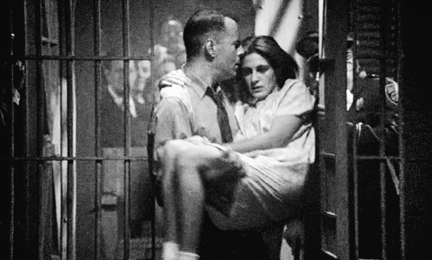
Julia Roberts playing a condemned convict and Bruce Willis as her rescuer, in cameo appearances in The Player
DAVID LEVY: The Player was one of those pictures where every day you felt the magic. I know that word is off-putting and overused, but it was true. Just that kind of energy on set and then at dailies. I mean, you were aware of everything coming together just as it should. Once we started screening it, the buzz in town was just incredible. And even before that we started getting people to do cameos and play themselves, and then people started calling us saying, “Oh, can I be in it, can I be in it?” It was nice because they worked it for day-player scale, and we donated their salaries to the Motion Picture Home, and so it became a thing to do.
PETER GALLAGHER: I made a point to meet a few studio heads. Not heads, but close—presidents—because we were just trying to learn about the system. About Hollywood. One of these guys asks me, “How did Altman do it? He’s got all these people making this movie now for nothing.”
I remember thinking, “Well, he just picks up the phone and calls.” I said, “If you give an actor the slightest chance that they might be able to do good work, that counts for a lot. If, on top of that, they’ll be valued as well [laughs], who’s going to say no?”
MICHAEL TOLKIN: Harry Belafonte was the first person Bob called. He wanted to be able to say to all the others, “I’ve got Harry Belafonte.” He said, “We’re leading a protest march.”
HARRY BELAFONTE: I was in the Caribbean and a person in the house where I’m staying says Bob Altman wants to talk to me. So I was surprised. Thought there might be a little prank at the end of the line. But it was him. And he said, “Mr. Belafonte, I’m Robert Altman. I’m calling to get you into a picture I’m doing.”
I kind of paused and waited for the other shoe to fall. And I said, “Really? What movie are you doing?”
And then he said, “The Player.”
And I said, “Is there a script or something?”
He said, “No. I mean, you could read it if you like. But your part is not in it.”
So, okay [laughs].
He said, “I only need you for a very, very short time. But I must tell you I cannot have anyone else but you in this scene and doing this.”
As he talked, everything became more and more diminished [laughs]. No script, I have no lines, and I’m only needed for an hour. So I said, “Well, Mr. Altman, if it weren’t for the glory of the honor of talking to you, this would be the silliest conversation I’ve ever had with a filmmaker.”
He said, “Well, I’ve had my moments.”
I said, “Let me hurry up and tell you that I’m very far away. I don’t live in L.A., where you’re shooting, and I’m not in the United States. That’s a lot of work, expense.”
So he said, “Well, in this instance, no expense will be too great.”
It all comes to about eighty bucks [laughs]. So we chatted for a little bit longer. I put aside all the alarms of what I expect to come out of such a thing. I began to pursue the curiosity of it. I said, “Okay, well, I’m down here in the Caribbean. It’s going to be a day to get there, a day to rest, and then a day to shoot and a day to get back.”
He said, “What’s the day to rest for?” [laughs].
LILY TOMLIN: During The Player, he called me one night and said, “Can you shoot a little thing?”
I asked what the setting was and he said it was an old hotel. Scott Glenn and I were supposed to be in the dailies the suits were watching. I just pulled out an old vintage forties robe from my costume room and went onto the set. I would have done that anytime, and with complete trust. I don’t think actors always do that. You have to really have a feeling for who you are going to run yourself over to.
CHER: One day he called me. “I need you in a red dress for a movie.”
“All right. Give me a moment and I’ll call you back.”
It was late. I could have said I don’t wear red. But you would do things you didn’t like because of him. I was crazy about him.
MICHAEL TOLKIN: Schwarzenegger was the only one who refused, and Bob was really pissed at that. He was really pissed that Arnold had slighted him. He couldn’t even get through to him. It was all managers and agents and lawyers.
ALLAN NICHOLLS (actor/music director/screenwriter/associate producer/assistant director): In shooting the most important scene in The Player, the execution scene with Bruce Willis, Bob challenged the whole Hollywood system. He shot it in an empty warehouse in Culver City. By shooting it off a studio, he didn’t have to pay Teamsters, which would have been an incredible amount of money. He didn’t have to pay studio charges. He shoots it on Sunday, on a day off. So everyone—all the stars he got to come—would be available. He encourages them to come already dressed for their parts, and they do. He got everybody to donate their salaries. And he was organized enough to shoot it in one day. The whole day was probably six hours long. We didn’t break for lunch; there was no reason to. So nobody went into any kind of overtime.
Nobody but Bob could’ve pulled that off.
* * *
STEPHEN ALTMAN: You know, his improvisation isn’t always pure improvisation each time. It’s hard to tell what was the accident and what was planned. For the beginning of The Player, he wanted to shoot a ten-minute scene and that was it. He was like, “Stevie, build me a model of the set, the exterior, then build me a model of the crane. And I want all the interiors, of where everybody’s going to be.”
And he just smoked pot and played with this little thing like a kid playing with a Tonka toy. He worked that out in his mind well before we ever built the set or got out there. So that opening scene was practiced. The actors could say whatever they want, basically, but there was very much already in his mind.
TIM ROBBINS: It wasn’t like he couldn’t deal with writers. He needed to be in the moment. And the filmmaking process had to be a living organism that is constantly evolving. And so that whole first shot—that long tracking shot that opens the picture—that’s completely improvised. I mean, everyone knew where we were going to be, but all the pitch meetings were improvised, all my responses were improvised. All the scenes you see, I don’t think were ever written down. We had a day of rehearsal where we just played around.
And then there’s the scene where we’re sitting around in a conference room talking about the writers and eliminating the writers. That line came to me at the last minute. It was just like, “Well, if we could just eliminate the actors or the writers, we’d have something there.” It was all in the moment. And this stuff doesn’t happen unless you are free to do it. If you’re in a constrained or restricted environment that is telling you, “You must do the script as it is written,” none of that stuff would have happened.
BUCK HENRY (writer and actor): For my scene in the famous opening panning shot of The Player he called and said, “Come and pitch a project. You’ll sit with the studio head—Tim Robbins—and pitch something. You’ll be one of three or four.”
I said, “Pitch what?”
He said, “Anything you want—it will all be one shot.”
I was just improvising. I was pitching The Graduate, Part II—as a parody of pitches. In each take I got a little further out. I didn’t want Tim to know what I was going to say. I was looking for the hot laugh, looking for the band to laugh, as we used to do in the old days of television.
Dialogue from The Player:
BUCK HENRY (as himself, pitching The Graduate II): Ben and Elaine are married, still. They live in a big, spooky house up in northern California somewhere. And Mrs. Robinson lives with them … her aging mother, who’s had a stroke …so she can’t talk. … It’ll be funny. Dark, weird, and funny. And with a stroke.
BUCK HENRY: Typical of Bob to begin a film with an impossible shot. Everyone was in on it—the crew coming together for the first time. It gave a sense of camaraderie for everybody, that we were all in on this one big gag. There must have been sixty actors in the take—and everyone had to hide behind a tree or in a car or a house or something. It was not like Rope—a continuous shot for no good reason except Hitchcock’s amusement. This one parodied the long shot, introduced forty or fifty characters, and expressed what the movie was about—the mechanics of filmmaking.
At the premiere of The Player at the Ziegfeld, a guy comes up to me and says—apropos of my proposal for The Graduate sequel—”I know you were making a joke, but I think we should take it seriously.”
Robert Altman, from DVD commentary: It’s a very conceited thing, this shot with no cuts in it. … It’s showing off. And it sets the picture up to be the kind of picture it’s going to be and it tells the audience what they’re in for. And I knew it would be commented on.
* * *
STEPHEN ALTMAN: Again, when you talk about improvisation, sometimes it’s just Bob taking what’s presented to him. Think about the Greta Scacchi-Tim Robbins love scene. Where it’s focused completely on their faces. Everyone’s like, “It’s oh so marvelous,” and “How did you think of that?”
How? She wouldn’t show her tits. She was pregnant at the time and so they were forced into that. He had to figure some way out to get this love scene out and then it’s like a work of genius. Actually, it was because we couldn’t do it any other way.
TIM ROBBINS: We talked about it and Bob was a real gentleman. And you know, I don’t recall him getting pissed off about it. He had envisioned it in a certain way, but he is the kind of filmmaker that as things evolve, they evolve. So he shot that scene in close-up with just the faces. But as he’s telling me about it, he’s totally excited about it. He says, “It’s going to be great. We’re going to make this the sexiest sex scene ever and it’s going to be just on your faces.”
ROBERT ALTMAN: I put Cynthia Stevenson in the hot tub with Tim because she’s not the girl Hollywood usually asks to take her shirt off. When he saw the movie, Paul Newman told me, “I get it. You don’t get to see the tits you want to see. You see the ones you don’t want to see.”

Greta Scacchi, as the amoral artist June Gudmundsdottir, with Tim Robbins, as Griffin Mill, in The Player
PAUL NEWMAN: Yes, that’s accurate. I don’t have to clarify it. It speaks for itself.
SUSAN SMITH (spokeswoman for Greta Scacchi): Thank you very much for your interest in interviewing Ms. Scacchi, but unfortunately she is unavailable at the time being. I wish you the best of luck with your book and thank you again.
PAUL NEWMAN: There was a more important point in that movie about nudity, I thought. Tim Robbins’ character was talking to this young woman on a cell phone and he was watching her while he was talking to her and moving in closer. It was just the most frightening scene in the world, to realize that you could be observed in your most private place. And of course it raises the specter of all those questions of privacy which are now becoming paramount and the technology that we have today. Just a little hint. Yeah, it certainly wasn’t about nudity, it was about how accessible everybody is. It’s spooky.
* * *
DAVID LEVY: Tim can corroborate this, but I think that Bob and Tim were, shall we say, relaxing. And they cooked up the ending together.
TIM ROBBINS: It must have been one of the last days of preproduction. We went all around the block about the ending. I think it was late in the day, the office was still open, there were still people there, but I seem to remember it was late in the afternoon. And he said, “Come on, we’ve got to talk about this ending.”
And so we smoked a joint. It was like, “Let’s figure this out—only one way to do it: Smoke a joint.”
So I say to Bob, “I forget, how did M*A*S*H end?”
And he goes, “Well, Radar comes on the loudspeaker and says, “This is a movie directed by Robert Altman and blah, blah, blah.”
And that’s what tipped it for me. I said, “Whoa, whoa, whoa. What if the writer pitches to Griffin the story you just saw of the movie?” And that is a totally stoned thought.
But Bob was like this [stands up, starts pacing around excitedly, waving his arms]. He walked out and he comes back and he goes, “I’m never giving you credit for that!” [Laughs]
And he comes out and tells everyone, “We’ve got the ending, we’ve got the ending!” But it really was his idea because it was M*A*S*H reinvented.
I hold those to be some of the best creative moments I’ve had. He didn’t suffer bad ideas. It was like you’d be in the room and someone would say something and he’d say, “No, that’s terrible.” He was honest with you. Something that’s too clever, too thought out, too derivative, he would piss on it in contempt. Not in a mean way but just, “Come on, we’re creative people. Creative people create new things, they don’t try to do what people have done before and repackage it.” That’s what’s wrong with Hollywood. It keeps telling the same stories over and over again with different actors. And very few people are trying to tell the story in a unique way. And that’s the only thing that Bob was able to do. No one told a story like Bob Altman.
DAVID BROWN: Tolkin had to begrudgingly agree that his book was well served by the film. It’s a remarkable film and Altman deserves a great deal of credit, but so does Tolkin, whose book it was.
MICHAEL TOLKIN: I can look back and say he changed my life. The Player as it is, as a cultural object, exists because of Altman and what he brought to it. Altman was unquestionably a genius and an important artist. He has a few really great movies and a lot of films that are of great interest and are worth watching and watching again, but don’t fully work on the terms on which they could have worked because of his disdain for story. Which I think is competition with writers, or anxiety that if he didn’t take full credit for the films he was somehow admitting defeat or not being the artist he wanted to be. But the movies are completely collaborative, and that’s the great message of human cooperation that comes out of the movies.
* * *
TIM ROBBINS: You know, The Player was a huge hit in Cannes. He won Best Director and I won Best Actor. And you’re sitting there having champagne at your hotel after this fantastic screening. The whole town is abuzz. It’s “Altman’s Return.”
JOHNNIE PLANCO: At Cannes, he was back on top. During that festival everyone wanted to meet him. We sold Short Cuts, Kansas City, a movie about Mata Hari that didn’t happen.
There was a French company who really wanted to meet Bob. He’d sold everything, but they really wanted to meet Bob. He said, “I have nothing to give them.”
I told him just to meet them and be polite. They came in, three guys with weird haircuts. Bob said, “Unfortunately, I have nothing to give you, but thanks for coming.” As he was ushering them to the door, he said, “You know, you guys look like Mo, Larry, and Curly—you should be in The Three Stooges.“
He closed the door and said, “That went well, didn’t it?”
KATHRYN REED ALTMAN: You talk about how the eighties were hard, and then when The Player hit it was a whole other thing. It used to irk him to death when they’d all say, “Yeah, Altman’s making a comeback.” He’d say, “A comeback? I haven’t been anywhere. I’ve been working.”
Robert Altman to Gavin Smith and Richard T. Jameson, story headlined “The Movie You Saw Is the Movie You’re Going to Make,” Film Comment, May—June 1992: Every goddamn magazine that you could pick up has it as my “comeback.” This is my third comeback; whaddya gonna do on my next one?! … It’s nice, but you know what’s gonna happen next? I’m gonna pay for it. But I know that. I know that these are the rules of the game and I’m okay with that. I’m not “angry with Hollywood.” I’m not a “maverick.” I’m not a person who “ran away in exile.” I fiddle on the corner where they throw the most coins. Where I can get my work done.
KATHRYN REED ALTMAN: At the Academy Awards in 1993, Bob was nominated as director for The Player. Our chances were absolutely nil, and Bob didn’t want to go, but he was convinced that it was important that he show up. We had no anxiety. We just knew that we had to do this. So I decided I would bake pot brownies or grass cookies—whatever I was doing at that time in my baking career. We crumbled it up to the size of nuts and had it in a little bag.
The Academy Awards can be the most miserable experience ever because of the anxiety and the fears, and because it takes forever. We left our house at three in the afternoon—Konni was with us—completely made up and dressed up, and it didn’t start until seven. Then they break for commercials, and if anyone gets up they slip a stand-in into their seat. It just goes on and on.
So there we were in the very front row. I thought we’d get into our brownie bag later. Bob wanted to get into it right away. Well, every award was for Clint Eastwood, for Unforgiven. We’d clap and appreciate, and every time we’d tuck in our legs so he could get by to get his Oscar. The whole time we were munching away on our grass brownies. By the time he got up there to get Best Picture—after he’d gotten all the others, including Best Director—we were all for him [laughs]. We were saying, “Hey Clint! Go for it! Way to go! Hot dog!” [Laughs]
We went to every party that night—the Governor’s Ball and the Elton John party and Clint Eastwood’s party. He had taken over Nicky Blair’s on the Sunset Strip, and we talked with him and had a drink. We ended up at Swifty Lazar’s party at La Scala—that was the famous party in those days. We got home at three in the morning.
It’s a great way to lose.