
CHAPTER 24
*
The Laundromat (1984; TV)
Anne Tremblay, story headlined “Altman Makes a Cable Film Abroad,” The New York Times, January 20, 1985: What is Robert Altman doing in Paris directing a film set in a quintessentially American locale? “I find there’s nothing for me to do in America because of the kind of films they make there and the way they make them,” Mr. Altman said during a recent interview on the set of “The Laundromat,” an hour-long drama he is directing for Home Box Office. …
The American director, whose feature films “M*A*S*H” and “Nashville” have attained cult stature, moved here last August and at least for the time being has no intention of working in the United States. …
“Artistically, it’s just miserable. Everything’s based on commerce. A guy can be a rapist or a crook, yet if he has a lot of money he’s admired. But that system will fail.”
DAVID LEVY (producer): His move to France? Most artists want two things. They want to do their work and they want to have an audience for that work. In saying “audience,” you’re also talking about a kind of acceptance, aren’t you? You’re talking about acceptance or appreciation of the work. The things that were being offered here and the things being done here just weren’t getting that acceptance and appreciation, and he was very much an icon over there. That audience is different from the audience here and they were very indulgent of and accepting of anything he would do. I think it was largely a case of, “Why not be where I’m wanted? Why not be where I’m appreciated?”
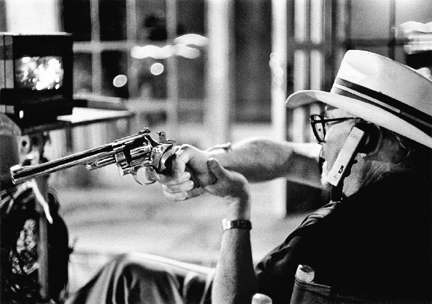
Holding the .357 Magnum used to shoot up the motel and a pickup truck in Fool for Love
He had a bit of the gypsy in his soul. He loved being on location and just going into a place and feeding off it, doing his thing and moving on. I think that was a part of it as well.
KATHRYN REED ALTMAN: What drew Bob to Paris? He could get a deal. I only liked it because I knew it was temporary. I loved the city and all the monuments. Bob didn’t even notice; he didn’t care. He was just making a movie, you know? He was as comfortable there as he would have been anywhere. And his French was the worst. He would garble it out and they’d get it. It helped being Robert Altman.
GARRY TRUDEAU: His moving to Paris, scaling down the size of the films, doing more modest undertakings, didn’t make them less serious as films. I think that there are a great many directors who went through periods where their pride prevented them from making certain kinds of films and they now deeply regret that.
STEPHEN ALTMAN: After Secret Honor we went right to Paris and he did The Laundromat there. Then he left for Fool for Love, to shoot it in New Mexico, but he edited it in Paris and stayed there until after Beyond Therapy, when he got sick of it, which eventually everybody does, including the French.
* * *
Robert Altman Operas
The Rake’s Progress (Stravinsky; 1983, University of Michigan; 1987, Opéra de Lille, France); McTeague (director and coauthor of libretto with composer William Bolcom; 1992, Lyric Opera of Chicago); A Wedding, The Opera (director and coauthor of libretto with Arnold Weinstein, composer William Bolcom; 2004, Lyric Opera of Chicago).
* * *
Fool for Love (1985)
Roger Ebert, review in the Chicago Sun-Times, December 18, 1985: At the center of Sam Shepard’s “Fool for Love” are two people whose hurts are so deep, whose angers are so real, that they can barely talk about what they really feel. … Robert Altman’s movie version of Shepard’s play stars Shepard himself, in a strong performance as Eddie. But he doesn’t dominate the story as much as you might think. The central performance in the movie is Kim Basinger’s as May. Although she has played sexpots before—indeed has specialized in them—nothing prepared me for the dimensions she was able to find in this one…. Part of her impact probably is because the director is Altman. Few other major directors are more interested in women. In his films such as “Thieves Like Us,” “Three Women” and “Come Back to the Five and Dime, Jimmy Dean, Jimmy Dean,” he has shown women in setting very similar to this one: unfulfilled women, conscious of the waste of their lives, living in backwaters where their primary pastime is to await the decisions of men.
* * *
SAM SHEPARD (writer/actor/director): I didn’t know Bob before this. He was originally interested in my play, and at that time he was doing a lot of adaptations. At the time I wasn’t that turned on about making Fool for Love into a movie. And if I was, I thought Ed Harris should do it because he was so great in the play. Bob kept insisting that I do it, and then he wanted Jessica [Lange] to do it, too. Then Jessica backed out at the last minute and I went ahead and did it.
I still think it was a mistake on my part. I thought Ed was better. He had more of a clean attack on the character than I did. I think I was too attached to the material. I didn’t have enough distance from it.
I directed the play. A play isn’t designed to be a movie, it’s designed to be a play. I don’t think the movie works nearly as well as it did onstage. But many people liked it. I think Bob did a commendable job. But in retrospect I don’t think it works. I think a lot of people who really enjoyed the film never saw the play.
What didn’t work? The physicality of it. Onstage it was huge. It had a frightening physical reality to it, because of the actors, because of the intensity and the presence of the actors. On film it comes across as kind of a quaint little Western tale of two people lost in a motel room. Know what I mean? It doesn’t have the power. In the theater it was right in front of your face, it was so intense it was kind of scary.
I don’t regret making the movie but I’ve certainly learned from it [laughs]. I personally don’t want to try to transform a play into a movie. If somebody else wants to take it and mess with it and do the screenplay and all that, I wouldn’t object to it. But I don’t have any ambitions to turn these plays into movies. And I’ve never had any success with it. There’s never been any of my plays that was turned into a movie that was worth a shit. A lot of people have tried it and one after another they don’t work.
It was weird because he had told me I was going to be involved in the editing process and this and that, and he kind of took the film and went to Paris and cut the whole thing there and that was it. I was disappointed in that. I didn’t have anything to say about that. I don’t blame him really. Why should an actor be involved in the editing? But he did abscond with it and made his own thing. I can understand he probably got it done quicker, which was probably his objective. It was quite a while before I saw him again.
I did an interview—it’s one of those things that smartens you up. I finished the interview. I finished it! As we were walking out of the building, the reporter for Esquire said offhandedly, “What do you think of Woody Allen and Bob Altman as directors of actors?” And I said, “Neither one of them knows anything about acting.” Which is true! I still stand by that! It’s true. They’re great filmmakers. Each of them in their own way is a fantastic, unique, extraordinary filmmaker. But they don’t know anything about actors. About acting. About how to talk to actors, about how to discuss the premise of the character, the situation of the character, how to find the character. I was spoiled to a large extent by working in the theater, by working with great directors who do know actors. People who know actors inside and out. Who have dialogue with them, who spend weeks in rehearsal. You don’t have that luxury in film.
These guys want to make a movie. And they’re great casting guys. They find the absolute right actors for the job. Those actors know how to do it and they know that they know how to do it. But there’s no dialogue, there no discussion. It’s, “Let’s shoot it.” They’re making a movie! Their focus is the camera, the lights, the set, what’s going to be on film. They’re not interested in how the actor is approaching the character and what he’s trying to investigate or anything like that. Neither one of them would sit down with an actor for six to eight weeks working on a role. There’s no way. Altman would pull his hair out [laughs]. And I love Bob. It certainly wasn’t meant as an insult. It was meant as a perception, mainly having to do with the difference between film and theater. Simple as that.
* * *
O.C. and Stiggs (Released in 1987; filmed in 1983)
Janet Maslin, review in The New York Times, March 18, 1988: “O. C. and Stiggs” rambles a lot and doesn’t have a full supply of the Altman alchemy, but it’s certainly a lively, colorful satire; its notion of American artificiality runs so deep that the film begins and ends at a man-made surfing beach in the middle of the desert.
* * *
PETER NEWMAN (producer): When we made O.C. and Stiggs, basically, no studios would work with Bob at that point. I was made aware that Freddie Fields used to be his agent, and Freddie had just been appointed the head of MGM. I called Freddie Fields. He said, “Yes, we’ll approve Altman if he can do it for eight million or under, and [if] he promises to shoot the script.” Within a month or two we were in Phoenix in the middle of the summer at a hundred and twenty degrees, shooting a film I don’t think he really wanted to make. But there were financial considerations.
I felt a lot of anger from Bob. I think he was unhappy making the movie, and I think he was angry that I would even be talking to the studio. He said, “We really shouldn’t be talking to those people—not even giving them a shooting schedule.” I got the wrath of Bob for trying to figure out what a producer does.
I still can’t even describe what that movie is. I don’t know if he was trying to do a parody of teen movies that were popular at the time, or what.
When we showed it to MGM, MGM said, “We’ve got a huge problem here.” That’s one of the few instances where Bob didn’t want to hang around and fight the fight. He didn’t finish that movie. The studio finished that movie.
I think this guy had given out his share of abuse, but he certainly had been abused by a lot of big corporations, and he was always certain that it was coming. I wish I had understood that when I saw him going through making this movie.
KATHRYN REED ALTMAN: I remember one summer, he was really depressed at the time, and I’d try to think of things to do with two boys and one granddaughter, Signe. This was right after O.C. and Stiggs. We were all stuck in a one-bedroom apartment in the Delmonico. Something had fallen through, and there were no jobs in sight. I got everybody roller skates and then I got remote-control cars for Matthew so that he could run them up and down the hall. I just tried to think of all the different things that we could do. Finally Bob got pissed off with the whole thing. We got a friend of ours, Gillian Freeman in London, to look in the paper and see if she could find an inexpensive place—we had no money—so that we could go to London for a month. She found this place in Earls Court, which is not your greatest neighborhood. And it was a funny little place. And the boys went to Amsterdam on their own. And Signe and Bob and I went to Paris on the hovercraft.
He had been put on the wagon and he wasn’t smoking dope then. But anyway, so then he decided that we would take the Queen Elizabeth back. With what money? Who knows? I stopped asking. I didn’t want to know. And so we did, but he had a horrible time because he wasn’t drinking. They had a casino but it was about as big as this table. The kids ended up having a good time, a lot of disco stuff and all that. And I was reading Hollywood Wives by Jackie Collins, so that got me through it. It was sort of fun. As soon as we got in the range of telephones he was okay—this was a five-day crossing and you don’t get to the phones till like the end of the third day. And then he came to life.
* * *
Keeping Busy
Basements—1987 (TV); Beyond Therapy—1987; Aria, segment called “Les Boréades”—1987 (film); The Dumb Waiter—1987 (TV); The Room—1987 (TV); The Caine Mutiny Court-Martial—1988 (TV).
Robert Altman, to Sally Ogle Davis, story headlined “Robert Altman Reluctantly Tackles a Classic,” the Globe and Mail, May 7, 1988: I can’t get anything made at all in this community [Hollywood]. I don’t even have an agent. I don’t bother to go to talk to them. I won’t even send a piece of material out to them because I just know it’s pointless.
PETER GALLAGHER: Caine Mutiny Court-Martial was my first experience working with Bob, but the very first time I saw Bob was at Tufts University, where I was an undergraduate and he came to speak. It was around Buffalo Bill time. He was wearing a fringe jacket and I remember he looked like Buffalo Bill. He was all balls-to-the-wall and I thought, “Well, that guy seems like he’s awful stuck up. Who does he think he is up there in his big tassels?” That was sort of the scornful, outsider’s view of a sophomore or junior in college who was just assuming he wouldn’t be able to do what he wanted with his life, and it was all going to be miserable. Of course, what I would have seen had I been a little wiser was somebody who was having a great time and loved what he did and made no bones about it. Little did I know that years later, in terms of my approach to film, he’d be about one of the most important people in my life.
Caine Mutiny was extraordinary for me for a lot of reasons. Bob was looking for this part of Jack Challee and nobody wanted to play it, thank God, which is how I’ve gotten most of my parts, I think. Nobody wanted to play it because he had all the lines and no laughs. No payoffs. It was all just grunt work. And so I got a call to come in—it was from Scotty Bushnell, who was working with Bob then—and we sat down.
So I sat down, it was at the old office just above the Regency, at the Delmonico, and I went in there and it was winterish, kind of late in the day. He said, “I could really see you doing this part. I’d like you to think about that. Would you like a beer?”
What? Huh? Would you like a beer? “Sure.”
He left the room and I said to Scotty, “Did he just offer me a job?” I was so moved that he respected me enough to not just arbitrarily make me jump through hoops just for the sake of it. I thought, “I don’t care what kind of part this guy wants me to play, I’ll walk on broken glass for this guy.” He treated me with respect for the first time in I couldn’t remember how long, as opposed to the rounds and rounds and rounds of, “I don’t know, try it on one foot.”
The greatest thing about working with Bob is you suddenly realize there’s a tribe of people out there, and when you’re amongst them, you realize you’re not crazy. Caine Mutiny was really the first time that I experienced the kind of freedom and delight and camaraderie on camera that I had up to that point only experienced onstage. I felt valued, which was a shocking thing.
You can say it was during a lull in his career. But when you’re that age and impressed by someone, you don’t think of him having a hard time. In your eyes, he’s kind of a giant. Did he become less arrogant since I saw him at Tufts? Yeah—well, maybe I just got less stupid.
KEITH CARRADINE: After Nashville, Bob never invited me again until he was doing The Caine Mutiny Court-Martial for television. He called me to play Queeg and I was absolutely terrified. I was terrified by the ghost of Humphrey Bogart. Frankly, I didn’t have the balls to confront that. At the same time, I was married, I had two kids, and I was offered another project, also for television, with Glenn Close. I could either do this movie with Glenn Close for two hundred fifty thousand dollars or I could do this with Bob for sixty thousand. I called him, and I was absolutely straight with him. I said, “Bob, I can’t afford it. I got kids to feed, I got to make some money, and I’ve got this thing and they’re going to pay me a lot of money.”
And he said, “Oh, I understand, I understand.”
He didn’t understand. Nobody turns Bob down. And that was the last time he asked. And in retrospect, I should have done Caine Mutiny. I regret to this day that I didn’t do that. He got Brad Davis, who was terrific. But hey, man, you makes your choices and you lives with them. And that was a choice that I made at that moment in time. If I had it to do over again, I wouldn’t make the same choice.
* * *
Tanner ‘88 (1988; TV miniseries)
MATTHEW SEIG (producer): So yeah, the eighties were a period with O.C. and Stiggs, which was a disaster and a disappointment, and Fool for Love and The Laundromat and The Room and The Dumb Waiter, which are crazy. And The Caine Mutiny Court-Martial. You know, all just out there. Oh, Beyond Therapy, too. Odd. A lot of odd stuff done in odd ways. And whatever way to get them done. And then he was sort of sucked into working in Europe quite a bit. And he came back and forth. He came back to do Tanner ‘88.
John Corry, review in The New York Times, February 15, 1988: Call it imaginative; call it satire; call it a mixed result. “Tanner ‘88: the Dark Horse” is too real to be funny, but it’s also not real enough. How can a film make fun of politics when politics makes fun of itself? The Home Box Office presentation does not find the answer, although it may make the year’s most interesting try. … “Tanner ‘88” is written by Garry Trudeau and directed by Robert Altman; already that sounds rewarding.
* * *
GARRY TRUDEAU: I have a very dear friend from college named Richard Cox, an actor, and he had been in Paris for some reason when he was invited to a party where Robert Altman may have been the host, because Altman was living in Paris at the time. And Bob said something completely random to my friend. He said, “I feel like crap.”
Richard said, “Why?”
He said, “I just couldn’t sleep last night and I was playing this dream over in my head. I was working on this project with Garry Trudeau.”
And Richard said, “Well, he’s my closest friend. You know, you’re a hero of his.”
So yeah, he dreamed me before he met me.
The Tanner ‘88 idea came by way of HBO. There was a vice president there named Bridget Potter—remarkable woman—who was in charge of original programming, of which there was very little at that time. I think we may have been their first series. She called me up and said, “We’re thinking of a bogus presidential campaign. Would that be something you’d be interested in writing?”

With writer and cartoonist Garry Trudeau and actor Michael Murphy, as the candidate Jack Tanner, on the set of Tanner ’88
I had my plate full, as I always do, and I said, “The only way I would really be interested in doing that is if I could work with Robert Altman.” After the dream thing with Richard, Bob and I had gotten together and we’d been kicking an idea around for a series called Americaville or something like that. I think it was sort of a precursor to Short Cuts and it was supposed to be this vast cast of people whose lives all intersected. Not unlike Nashville and some of the other ensemble pieces he worked on. But he thought it could be a TV series, so I knew he was open to working with me on a TV series. So they called back and said, “Yeah, he’s willing to do it.”
Okay, now that’s December of ‘87, so we’re about six weeks away from the New Hampshire primary. We don’t have a story. We don’t have characters. We have nothing. And so Bob said, “I’m going to put this into production with the scraps of ideas that we have.” And he called me up day by day and he’d say, “I’ve got this great actor, could she be in it? Named Pam Reed. She’s this Broadway actress and I think she’d be great. I’ll introduce you to her and maybe you’ll think of a character for her.” And Michael Murphy came in as Tanner.
MICHAEL MURPHY: We were doing The Caine Mutiny Court-Martial and I get through a bunch of stuff and we break for lunch one day. I’m sitting there and Bob comes up and sits down. He looked at me with that look and says, “I’ve decided I’m going to run you for president.”
I said, “President of what?”
He said, “President of the country.”
I said, “You’re kidding.”
So, twenty minutes later we’re in New Hampshire and I’m standing out there with Bush and Dole shaking hands.
GARRY TRUDEAU: We were really winging it in those first few weeks. When he finally got eight or ten people together, he brought them over to his apartment for costume fittings. We had to decide while they were there who they were going to be so that we put the right costumes on them. Danny Jenkins, who played Stringer, he’s this sort of rail-thin, tall guy with a very innocent look. He said, “Well, who am I?”
And I said, “Well, you’re Stringer.”
“Good. Tell me something about my character.”
And I said, “You’re tall.”
He said, “That’s it?”
I said, “That’s as far as we’ve gotten” [laughs].
If it hadn’t been for Altman’s reputation for creating safety nets for actors, for protecting his actors, for keeping them secure and making them safe while they worked, I don’t think any of them would have signed on, because they didn’t know what they were signing on to. So we started.
Bob moved the operation up to New Hampshire, and then as I generated pages I was sending them up to him. The degree of difficulty was very high. It was very complicated because you’re shooting stuff, then seeing what you have, then writing to that. Somehow we pulled that together, we delivered it one hour before airtime. The executives never saw it before it aired [laughs].
We never did get ahead enough to send them a script. So they put eleven shows on the air that they had not read or lawyered or anything else. I was faxing pages to Bob on the set, so the actors were often seeing them the day they were shooting them. And you’ve never seen such stressed-out producers because they didn’t know what the set was supposed to look like.
I’d join them on the set for things that I thought might need a writer in place. But of course Bob loves to have the actors find what they need. That was an interesting experience. Imagine my surprise when I found out that certain things that I had written would be shot verbatim and other things would be dropped entirely, and then everything in between. And you could see there was some degree of frustration from the actors because they liked the lines, by and large. Or at least they seemed to. It’s not that they minded living by their wits, because most good actors kind of enjoy that. But I could see they were a bit conflicted because there were certain scenes that I’d written that they really did want to play the way it was on the page.
But, you know, mostly they didn’t say that. It would be foolish for them to say it. A director is God on the stage. So I just made the adjustment. I have this other life and I may have a little less at stake, perhaps, in my theatrical work because of it. For me it was such a kick working with one of my early heroes that I just made the adjustment to the process.
We had a long scene in Tanner on Tanner, which was the follow-up to the series. It was at Elaine’s, and I had made a big mistake. I wrote that as an eight-to ten-character scene with a lot of cross action. In my head that was a Bob Altman scene. The problem was that Bob Altman had to direct it in a day because that’s all we had. So the complexity of it was just out of reach to us in the amount of time that we had to do it. So Bob, depending on what he was seeing, was just being his genius maestro self and he was grabbing what he saw and also was trying to get through the day.
At the end of the day he kind of looked at me, and I was looking a little depressed, because I had the headset on all day and I was hearing very little of what I had written. And he said, “Do you know why you write that dialogue?”
And I said, “No, Bob, why?”
And he says, “You write that dialogue so the actors know who they are.”
I thought about that. That’s not why I thought I was writing the dialogue. I mean, that would be a by-product certainly, and would orient them, but I don’t recall anguishing over every comma with the idea that it’s just to kind of let them know who they are. But obviously that’s the way he viewed it, and that’s the way he viewed all writing. Including his own.
JOAN TEWKESBURY (screenwriter and director): When Alex Tanner tells her film students at the New School to forget all the rest of the stuff and just be brave, I hear Bob’s voice talking directly to me.
Robert Altman, from DVD commentary: In my mind, Tanner ‘88 was the most creative work I’ve ever done—in all films and theater.
GARRY TRUDEAU: Bob described it as the most creative work he ever did. He says so again and again. He’s also wrong [laughs]. I would place M*A*S*H and Nashville way ahead, and if I thought about it probably some other films, too.
* * *
Vincent & Theo (1990)
Derek Malcolm, review in The Guardian (London), June 21, 1990: The film is one of Robert Altman’s sanest and least eccentric. It simply looks at [Vincent van Gogh’s] life and work from another angle. It is, as a matter of fact, not so much about van Gogh as his emotional and dependent relationship with Theo, his art dealer brother. … But though there is no way you would call it easy entertainment … it does explain, with some historical accuracy (for instance, van Gogh did not cut his ear off but did slice a lobe) that behind great art lie human beings considerably more flawed than their creations. What the film also attempts to show us is that masterpieces do not appear out of thin air but as a result of constant and usually enervating struggle, involving both refinement of technique and the capacity of the rest of us to mock them. Just once or twice, Altman seems to be making the point that innovatory work in all fields, even his own, is rarely given the succor it deserves.

Robert Altman in a field of sunflowers in France during the filming of Vincent & Theo
* * *
JERRY WALSH (friend/lawyer/executor): In the fall of 1988, a young Dutch TV producer named Ludi Boeken approached Bob about directing a multi-hour TV biography of Vincent van Gogh to mark the hundredth anniversary of van Gogh’s death in 1889. Almost from the beginning Bob was unhappy with Ludi, while Scotty and I argued that he was a good guy doing the best he could with limited funds. The film was not a financial success, and Bob believed that under the contracts he was entitled to more money than he had received from Ludi.
At the Cannes Film Festival a year or two later, Bob told a London newspaper that Ludi Boeken was a liar and a thief and Bob hoped he would get cancer and die.
Judy Brennan, story headlined “Dutch Producer Boeken Sues Altman for Slander,” Variety, June 29, 1992: Dutch producer Ludi Boeken and his Paris-based Belbo Films have sued Robert Altman for slander after the director allegedly called him a “thief, liar and pimp” in numerous articles published worldwide. Boeken is seeking more than $800 million in general and special damages.
JERRY WALSH: Ludi sued Bob and the newspaper for libel in London, and the newspaper paid a settlement to Ludi. Ludi then made the mistake of having his firm, Belbo Films, bring a second lawsuit, also for libel, in Los Angeles against Bob’s company, Sandcastle 5 Productions. By doing this, Belbo Films subjected itself to the jurisdiction of the Los Angeles court to hear Sandcastle 5’s counterclaim for contract damages.
I got Bob a first-rate First Amendment lawyer in Los Angeles, who promptly got Belbo’s libel claim dismissed, and we then had a trial of our counterclaim, which resulted in a two-million-dollar judgment against Belbo Films. Ludi had by that time sold Belbo Films, which had no assets in the United States, and we ultimately settled with Belbo for a few hundred thousand dollars.
* * *
ROBERT ALTMAN: It’s hard to talk about the audience because I don’t really think of the audience that much. I really don’t. I think they have a responsibility to pay attention and appreciate what I do. It’s like all the Campbell soup cans—that’s the multitude. They’re all the same and they’re stamped and turned out. On inspection, one is defined by the one next to it.
I remember when we were up in Calgary and Nashville opened. There was a theater near my hotel, and there were people going around the fucking block. I rushed down there but nobody was going to see it. They were going to The Pink Panther or something. And to me that was the audience. No individuals. I don’t think I would know how to cater to them if I wanted to. If I tried I’m sure I would be wrong. I mean, I’ve had people stop me on the street and say, “Oh, didn’t that scene mean so-and-so?” And I said, “That sounds good to me, but I never thought of that before.”
Remember the Abner Dean cartoon? There was a young man and there’s a dead tree, and hanging from that tree is a tin can and a spring. And coming around the bend is an endless procession of these naked beings pulling boulders with head straps. The line of them goes on to infinity, it curves around a little hill and goes on and on to another infinity. And next to this tree is this young man trying to enlist the attention of this crowd of people pulling the stones. He’s saying, “Look, I made this!” Well, these people didn’t look up. Their heads were down pulling their boulders and they were just trudging along. To me that says it all. I’ve never seen the whole art thing shown more precisely.
Vincent van Gogh never sold a painting. Well, his brother bought one. Had he succeeded as an artist he would have failed. I mean, he would have had to change what he did. Do I identify with him? No. I sold a lot of paintings.
Robert Altman to F. Anthony Macklin, Film Heritage, Winter 1976–77: There are natural enemies, in which case neither can be blamed. You can’t blame the minnow for being the natural enemy of the bass. The fish are always going to eat him. The artist and the multitude are natural enemies.
Robert Altman, from The Player DVD commentary: If I had all the movies I’d ever made on a desert island, and a nice theater and projector and everything, I’d never run any of them. But if I had one person who hadn’t seen one, I’d stop and spend the two hours and run any film I’ve made for anybody. If there’s a new set of eyes to look at it. And I’ll see a different film just because I know it’s being perceived by somebody else. … And I mean an audience of one person, if I’ve got one person hooked. But if I was sitting here alone, I’d look at about two minutes and leave. I like to feel their reaction, to know there is somebody that this is bouncing off of, this is reaching a new, another perception.
* * *
PETER GALLAGHER: I’ll never forget, we were both in Paris. We weren’t working together. He had just shot or was about to shoot Vincent & Theo. I was getting screwed by my producers and he was getting screwed by his producers. It was weird, we were both just getting beat up by these separate European producers. We found out the other was in town and we hung out one night and started writing country song titles. And we had a blast. Mine were lame contributions—”Just ‘Cause I Don’t Know Doesn’t Mean I Won’t Find Out.” Stuff like that—inspired by these producers who were trying to pull a fast one. His was the best: “I’m Swimming Through the Ashes of All the Bridges I’ve Burned.”
Hal Hinson, story headlined “Robert Altman, His Way; on Art, Money and Vincent & Theo,” The Washington Post, November 18, 1990: As the ‘90s commence, Altman is the movies’ forgotten master. He’s on nobody’s “A” list of bankable directors. Or “B” list. Or “C” list…. It’s fair to say that a great painter of oils, unable to afford paints, has been forced to work in charcoal. … There is a widely held assumption that somewhere along the line, Altman lost it—that for whatever reason his best years are behind him.