
9
A subtle but perceptible change occurred in the nature of Robert I’s war against the English from the year 1318. That year witnessed the collapse of Scottish grand strategy with defeat in the Irish Sea and defeat in Ireland. However, it also witnessed the complete destruction of the Vale of York in the spectacular long-distance raid of 1318, the surrender of key Northumberland castles and the advent of an improved security for Scotland with the recapture of Berwick. The euphoria and unrealistic ambition that possessed the Bruces in the wake of Bannockburn was now curbed, yet there was no mistaking the reality of the Scottish military hegemony or the extent of English defeat. Robert only required to wrest admission of defeat from Edward II to enable a realistic settlement to terminate the incessant and destructive warfare. But the north of England, the part of England which was within Robert’s range and which he could strike at regularly, did not rate highly in Edward II’s priorities. Consequently, in this new phase of the struggle, Robert manifested a marked anxiety to capture a vital pawn, a strategic prize or hostage, which he could trade for recognition of his kingship and peace.
On 13 April 1318 Edward II received the news that Berwick had fallen. One might imagine that the loss of Berwick would wonderfully have concentrated the minds of the English king and his magnates. The largest town in Scotland was recognised as the key to the security of estates on the Eastern March, a vital harbour in the battle against North Sea predators, and, indeed, a potent symbol of the English claim to Scotland. The folly of bickering in the face of such a powerful threat as Robert posed had been long apparent; now it was blindingly obvious that, if the English magnates did not combine to recapture Berwick, the war was lost. Already it was too late to organise a campaign for the 1318 season: terms for a peace between the king and his obstreperous cousin Lancaster were not hammered out until August 1318.
Optimistically the chronicler of the Vita Edwardi Secundi begins at this point to list improvements in England’s fortunes: the pope had now placed Scotland under an interdict; Edward Bruce had been defeated in Ireland; the food shortages of the last three years had been relieved by an abundant harvest in 1318; and now at last king and magnates were co-operating. He voices the pious hope that ‘treachery, perjury and homicide, which brought Robert Bruce to the throne, will lead him at last to a desolate end’.
At the Easter 1319 parliament in York Edward II sought and was granted a subsidy to make war on the Scots, and the amassing of foodstuffs and the arraying of foot soldiers commenced. Envoys were sent to Robert claiming the kingdom of Scotland, but offering him personal safety in life and limb if he would desist. Robert replied that ‘he did not not much care for the king of England’s peace; the kingdom of Scotland was his and pertained to him both by hereditary right and by right of battle. He said that he was justified by these titles, and protested that he neither ought to nor would acknowledge any superior or earthly lord.’ Early in September there assembled an army of perhaps 5,000 infantry. As to cavalry, the English king paid a formidable 1,300 horse to campaign, including the earl of Pembroke and contingents sent by Richmond and Arundel; in addition to this the great magnate Lancaster contributed his own contingent. The accounts also feature 500 light horse or hobelars, the majority of which were led by Andrew Harclay, thedefender of Carlisle. The English advanced on Scotland. At first they brought no siege engines, and perhaps their original intention was to seek battle, but when they reached Berwick they settled in front of the town and began to invest it. Siege engines were summoned from York, Northampton and Bamburgh. Robert was not in the town but at Arbroath. The English, however, believed him to have sworn an oath to relieve Berwick before a certain time, and thus looked forward to bringing him to battle.
The brief but fierce siege of Berwick from 8 to 18 September 1319 is another of the great set pieces of the war, and Barbour clearly relishes the telling of it. He says that the tents and pavilions of the English magnates made a town bigger than Berwick itself, and then the English ships also arrived, filling the harbour to the utter amazement of the defenders. Each English lord was assigned a section of the wall to attack, and after six days of preparation, during which the attackers isolated the town by digging a ditch on its landward side as Edward I had done in 1296, the English unleashed their assault. They rushed the walls bearing ladders, which the Scots strove to topple backwards. The Scots had not had the opportunity to improve on Berwick’s defences, and the town walls were in some places perilously low.
In great peril they defended their town,
For, to be perfectly frank,
The walls of the town were then
So low that a man with a spear
[on the ground] could hit another above in the face.’
Inside the town the commander, Walter the Steward, and his followers rode around the circuit of the walls, helping wherever the defenders were hardest pressed. The English made full use of their naval support, and tried to position a tall ship against the wall on the seaward side so that it could drop a drawbridge onto the wall. Using barges rowed by oarsmen to tow the ship, they endeavoured to keep her against the wall, while the defenders fended off the ship with spears and long poles, attacking crew and oarsmen with missiles. The tide began to ebb, however, and the ship soon ran aground. When she was high and dry, the defenders sallied out, attacking the ship and setting fire to it, killing or putting to flight the crew, before bolting back into the town on the approach of another ship.
The attackers resumed their efforts by building scaffolds to tower over the walls. They also constructed a ‘sow’, a large and very robust wheeled shelter, designed to shield sappers from missiles and rocks thrown from above while they undermined the town walls. It probably incorporated a great battering ram. The defenders had captured an experienced engineer, whom they forced to work for them, and they deferred to his advice on how to deal with the sow. This engineer, whom Barbour identifies as John Crabbe, constructed a wheeled crane to lower flaming bales of pitch, tar, flax and timber onto the roof of the sow.37 On 13 September the English launched a general assault. Again they tried to scale the walls with ladders; again the Scots shoved back the ladders and sent them crashing to the ground. Then the English began to manoeuvre their sow into position under the walls. The engineer attacked it, not with the crane, but with a ‘mangonel’ or catapult, launching huge boulders. With an eye to keeping his audience hooked, Barbour describes how the first attempt overshot the sow by a long distance, and the second fell short, but the third struck the sow directly and broke its main beam, causing the sappers within to scramble out and flee for their lives, and the Scots to laugh gleefully:
The men ran out pretty fast
And those on the wall shouted
That their sow had farrowed there!
The English then renewed the attack on the seaward side, sending high-castled ships against the wall in an effort to gain a height advantage over the defenders. Boats full of armed men were hoisted high up the masts to bring them level with the parapets, but one boat suffered a direct hit from the catapult, smashing the boat, and tumbling the men into the water.
While Edward II and Lancaster were making to attack Berwick, Robert, to distract them, had dispatched Moray and Douglas into England at the head of a large raiding party. They crossed the border on the Western March and rode down Tynedale. From there they ravaged Northumberland and the bishopric of Durham. They had been in Yorkshire from as early as 3 September, but the English army had refused to fall for such an obvious ploy and had continued its approach to Berwick, beginning to invest and besiege it. However, the daring of the Scots at this time knew no bounds, and Moray and Douglas appear to have hatched a plot to win for Robert that vital edge, the pawn that he could trade for recognition of his kingship. A story is recounted in independent narratives that the raid of 1319 included a plot to kidnap the queen of England from her household quarters in York. As one chronicler remarks, ‘if the Queen at that time had been captured, I believe that Scotland would have bought peace for herself’. It appears that the Scots approached York stealthily, assisted by an English spy, Edmund Darel – one of Lancaster’s men – and established a secret lair not far from the city, near Myton-on-Swale. In the city, however, another of their accomplices revealed the plot to Archbishop Melton and the citizens, and offered to lead them to where the Scottish raiders lay in wait.
Edward II had ordered the whole of the Yorkshire militia to Berwick for the siege, and the city of York lay defenceless. Queen Isabella was sent to safety in Nottingham, and Melton assembled a makeshift army of citizens, peasants from nearby villages, clergy and chancery clerks – including the chancellor himself, John de Hothum. This rabble he led out on 12 September to confront the veterans of Moray and Douglas, and it met with disaster. The Scots set fire to haystacks to create a smokescreen, and, emerging out of this, they set upon the inexperienced English clerics, citizens and peasantry. Great slaughter ensued; many were drowned trying to flee across the River Swale, and many royal servants were taken prisoner. Because of the large numbers of English clergy involved, the whole episode was dubbed the Chapter of Myton. Thereafter the Scots caused widespread destruction in Airedale, Wharfedale and in Lancashire too, before escaping homewards by the West March.
Tension ran high in the English camp at Berwick as news from Yorkshire was awaited. On 10 September most of the large contingent of almost a thousand archers and 350 hobelars led by the Cumberland knight Andrew Harclay ceased to be at the king’s wages; clearly they had departed, either to try to cut off Moray’s retreat by the Western March or to defend estates. News of the Chapter of Myton reached the English camp at Berwick on 14 September, and instantly the English fell out among themselves over how to react. Northern lords led by Lancaster wanted to leave and defend their estates. Edward II and the southerners were for pressing on with the siege regardless. Accusations of treachery began to fly, ‘For it was commonly said that the earl had received £40,000 from Robert Bruce to lend secret aid to him and his men, and that at the siege while everyone was attacking the wall, none of the earl’s retinue assaulted it, and that the town of Berwick would have surrendered if the earl’s caution had not fought against this, and that James Douglas on his way back to Scotland passed through the earl’s lines, and that the earl went through the midst of the Scots.’
Amid bitter recriminations Edward’s army began to disintegrate and he was forced to call off the siege. Thus the raid of 1319 had precisely the effect that Robert intended: the English had been diverted from the capture of Berwick and returned home on 17 September 1319 more divided than ever before. Edward II blamed Lancaster, of course; he also blamed John Crabbe, the privateer chief and engineer, and the Count of Flanders for his refusal to prohibit trade with Scotland. He complained bitterly to the count that Crabbe had been prominent in the town’s defence and that ships which had sailed from Zwyn had borne arms to Scotland, enabling the Scots to defeat his siege of Berwick. To this, the count replied on 14 November 1319 that John Crabbe was wanted for murder and would be punished on the wheel if caught. He protested that he had already prohibited the shipping of military aid to the Scots. Of the convoy to Scotland the count said he knew nothing; he believed that ships had gone to Scotland and Ireland only to trade.
There followed an interesting sequel to the siege of Berwick. On 1 November 1319 ‘when the crop had been stored in barns’ Moray and Douglas crossed the West March into Gilsland and laid all waste, as far south as Brough on Stainmore. There are indications that the Western March had been recovering from earlier devastations, and this recovery had been reflected in the size of the force Andrew Harclay had brought to Berwick. To judge from the chronicle account, this destruction was of particularly intensive nature, more concentrated even than the burnings visited upon the Vale of York, and designed to inflict famine and dislocation upon the West March for years to come. Moray and Douglas returned to Gilsland by way of Westmorland after ten or twelve days and devastated ‘Cumberland’, before retiring to Scotland with a great spoil of cattle and prisoners. Clearly the threat posed by Andrew Harclay had been recognised and acted upon.
Before Douglas and Moray had returned home from this demonstration of Scottish power, the trusted clerk and court favourite Robert Baldock was on his way to Berwick with an invitation for King Robert to negotiate. The talks took place at Newcastle in December, and the English team comprised three magnates who enjoyed the full confidence of the English king: Pembroke, Bartholomew Badlesmere and Hugh le Despenser the younger – Baldock’s patron and a powerful court favourite, and soon to monopolise all access to Edward II. Also present, as chancellor of England and bishop of Ely, was the able John de Hothum, he who had contributed so much to saving Ireland from conquest. The Scottish team was undistinguished, but Robert and his court moved to Berwick, within proximity of the negotiations. Terms for a truce were agreed. Remarkably for one who held the upper hand, Robert made most concessions, the chief of which involved castles. He handed back the castle of Harbottle, the gateway to Redesdale, to Edward II’s envoys – as private persons – on condition that if no final peace were agreed by Michaelmas 1321 it would be destroyed or handed back to him. He undertook to build no new castles in border sheriffdoms. In addition, English ships, men or property wrecked on Scottish coasts would be returned, and disputes between England and Scotland would be settled by representatives from both sides. These concessions, and indeed the two-year truce itself, were incentives that Robert had to provide to persuade the English even to talk about the substantive issues of sovereignty and kingship. At Christmas it was settled that there should be a two-year truce to run from 29 December 1319, during which it was hoped that a final peace could be agreed.
To increase his leverage at the coming peace conference, and also because Robert and four bishops were cited to appear before the papal curia at Avignon, the decision was taken to send a carefully chosen delegation, armed with a comprehensive statement of the Scottish case, to John XXII in 1320. This document was the Declaration of Arbroath, an impassioned statement of Scottish rights and of Robert’s title to the throne.38 In the spring of 1320 Robert sent Edward II a letter inviting negotiations. Its formality and the lofty terms of its introduction suggest that it was probably intended to be presented to the pope as evidence of English intransigence. It is unconditional in its desire to achieve a peace:
Since while agreeable peace prevails, the minds of the faithful are at rest, the Christian way of life is furthered, and all the affairs of holy mother church and of all kingdoms are everywhere carried on more prosperously, we in our humility have judged it right to entreat of your highness most earnestly that, having before your eyes the righteousness you owe to God and to the people, you desist from persecuting us and disturbing the people of our realm, so that there may be an end of slaughter and shedding of Christian blood. Everything that we ourselves and our people, by their bodily service and their contributions of wealth can do we are now, and shall be prepared to do sincerely and honourably for the sake of good peace.
In the event nothing much was done in the first year of truce: both kings were preoccupied, Robert with the Soules conspiracy and the Black Parliament – discussed in the next chapter – Edward with journeying to France to do homage to Philip V of France, and magnate politics. Early in 1321 Robert granted safe conducts for fifty English envoys to come to Berwick. Still, the English envoys were in no hurry to reach a settlement; while they were anxious for the respite of truce to continue, their royal master refused to countenance any concession on his claim to the sovereignty of Scotland. During March and April 1321 earnest negotiations took place at last in the castles of Bamburgh and Berwick. Present were representatives of Philip V and of Pope John, who had now received and replied to the Declaration of Arbroath. But since neither Edward II nor Robert would compromise on the vital issue of sovereignty, these talks were still doomed to fail. Peace would not be achieved until the English admitted defeat. Unable to extract such an admission from Edward’s representatives, the Scots changed their tactics and proposed a long truce. Twenty-six years was the term they suggested. Such a proposal would have sensibly shelved the intractable problem, allowing time for the Bruce dynasty to establish itself. But Edward II would not compromise, nor could he be seen to do so.
Both parties were to blame when the conference, predictably, broke up without settlement, and the expiry of the two-year truce now loomed on the horizon. Confident that the failure of the conference had proven his point, Robert sent his account of the Scottish case to the curia. Edward had bought time to recover from a succession of humiliating defeats, confront the barons of the Welsh March, and he now planned to invade Scotland. At once Robert and his lieutenants began to stir up domestic trouble for him, by entering into secret talks with his hated cousin, the earl of Lancaster. The political temperature in England had risen sharply when the king’s favourites, the two Hugh Despensers, father and son, provoked to violence the lords of the Welsh March, including Lancaster’s main ally, the earl of Hereford. Moray and Douglas began to correspond with Lancaster, who in these letters is referred to by the code-name King Arthur. Robert can scarcely have seen Lancaster as one who might be able to deliver a settlement, but the Scots may have secured a promise of inaction on the part of the earl should war between the kingdoms be resumed.
The truce expired on 1 January 1322 and the Scots wasted no time in once again visiting death and destruction upon the north of England. In the last fortnight of January, Moray, Douglas and the Steward launched a particularly severe raid against the bishopric of Durham, intended to coincide with a revolt staged by Lancaster, Hereford and other disaffected English magnates. An anonymous letter now known to be written by Lancaster to an unnamed addressee – clearly a Scottish lord – describes the assembly of his forces and asks him to name a meeting place, and to grant permission for thirty horsemen ‘to come safely to your parts’. King Robert sealed the required safe conduct, though whether it was issued or used is unknown. On his way to Durham, Moray issued a further letter of protection to an emissary of Lancaster, who was on his way to Scotland to beg for help. According to a document later found on the corpse of the earl of Hereford, the three leaders of this Scottish invasion were to join Lancaster and Hereford in making war on their enemies in England, Wales and Ireland. The Scots, however, continued to work to their own agenda. The accommodating prior of Durham, Geoffrey de Burdon, had just been deposed by the warlike bishop, Louis de Beaumont. Possibly as a result of this the community of Durham ceased to pay tribute due to the Scots, and Robert decided upon a severe punishment. Moray took up position on the Tees, poised to intervene in the uncertain situation to the south. Walter the Steward led a raiding party to Richmondshire, which could be relied upon to pay up if menaced, and he exacted a heavy fine from the inhabitants in return for sparing them from destruction. Douglas ravaged Cleveland and the area around Hartlepool, a favourite target of the Scots. They spent a whole fortnight in Durham, pillaging and robbing thoroughly:
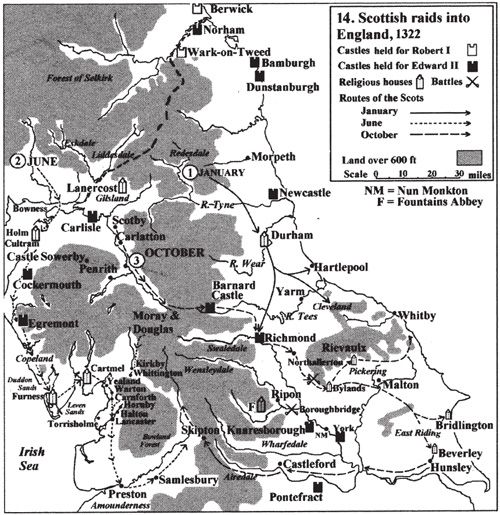
That same year [1322] around the Purification of the Blessed Virgin [2 February] the Scots entered the bishopric; and the whole of the eastern plain was destroyed. They burnt barns full of grain and then they made as though to cross the Tees into Richmondshire; but at night they returned secretly to the east. Men and women who had returned by boat from Cleveland suspected nothing, and reckoned that the Scots had crossed the Tees. They took them in their beds. And having perpetrated many evil deeds, they returned to their own country. So great a famine followed that devastation in the bishopric that a quarter of wheat might often fetch 40s. that summer, if it could be had at all.
So comprehensive was the devastation of 1322 that in a contemporary document the episode is referred to simply as ‘the burning of the bishopric’. Financial records survive for the estates of Durham Priory, revealing that a ‘sudden and catastrophic’ loss occurred at this time. The flock of the priory was successfully evacuated to Cleveland for the duration of the raid; nevertheless the stockman reported that he had lost forty sheep as a result of the ‘abominable depredations of the Scots and other robbers’. At the end of the month this punitive raid came to an end.
Robert, however, kept up the pressure on the border districts throughout the spring, threatening invasions on east and west marches. Andrew Harclay pleaded with the king of England for assistance. A chronicler well informed about events at court characterised Edward II’s response to him as follows: ‘You may know for certain, Andrew, that if Robert Bruce threatens me from behind, and my own men who have committed such enormities against me should appear in front, I would attack the traitors and leave Robert Bruce alone. Small wonder if the Scots, who are in no way bound to me, invade my kingdom, while those who are bound to me by fealty and homage rise against me, plunder my men and set fire to my towns.’ But the smouldering resentment in England against royal misrule erupted into civil war when the allies of Lancaster and Hereford besieged the royal castle of Tickhill. Edward II and the Despensers marched north and confronted them at Burton on Trent on 10 March, causing the earls to retire to Pontefract. There the decision was taken to retire to Lancaster’s Northumberland castle of Dunstanburgh and there await the support of the Scots. But Andrew Harclay, having received orders to raise a force on the West March, moved swiftly south and across the Pennines to intercept them. He met the earls in battle at Boroughbridge on 16 March, drawing up pikemen as a schiltrom ‘in the Scottish fashion’. In the battle that followed Hereford was killed and Lancaster surrendered, to be executed a few days later.
For his service to Edward II Andrew Harclay was created earl of Carlisle, and there is no doubt that, for his part, the King of Scots recognised in Harclay a formidable opponent. English preparations for an invasion of Scotland, to commence on 1 August, went on regardless. Robert decided to pre-empt the attack by repeating his efforts in 1319 to impoverish and weaken the Western March, and hopefully neutralise the threat posed by Harclay. Robert himself took the field. At the age of forty-eight he was already an old man by medieval standards, yet he saddled up and led an army into England, proving himself to be a strenuous knight yet:
The king [Edward II] mustered an army in order to approach Scotland about the feast of St Peter in Chains [1 August]; hearing of which Robert de Brus invaded England with an army by way of Carlisle in the week before the nativity of St John the Baptist [that is, around 17 June], and burnt the bishop’s manor at Rose, and Allerdale, and plundered the monastery at Holm Cultram, notwithstanding that his father’s body was buried there; and thence proceeded to lay waste and plunder Copeland, and so on, beyond the sands of Duddon to Furness.
The path of destruction described by the chronicler is borne out by administrative records; we know, for example, that two watermills pertaining to Egremont castle were burnt around Midsummer’s day. The abbot of Furness went to meet Robert and paid a ransom to save that district from destruction. Robert stayed at the abbey, but the chronicler relates that, despite this, the Scots set fire to various places and robbed them. He pressed on further into England, beyond the Sands of Leven to Cartmel, and burnt the lands of Cartmel Priory, robbing them and driving off their cattle. He crossed the sands at the mouth of the River Kent, visiting destruction upon Yealand, Warton and Carnforth to arrive at Lancaster. There the Scots burnt the town, sparing only the Benedictine and Dominican religious houses, no doubt at a price. At Lancaster Robert’s force was joined by another, led by Moray and Douglas. They had arrived by way of Kendal, Whittington, Hornby Castle and Quernmore Forest. Perhaps this second party had met with some resistance, for two Scots had been taken prisoner at Hornby Moor on 2 July. Tenements at Torrisholme, now a part of Morcambe, were destroyed. The combined force stayed at Lancaster for four days and nights and there was extensive damage, robbery and trampling of crops. The castle was burnt, and the townsfolk subsequently petitioned the English king for the right to take timber to rebuild the town. Still the raiders rode on, driving before them large numbers of refugees. They entered Amounderness; at Preston a rent roll of 1324 bears evidence of their visitation. Only the house of the Friars Minor was spared, and again the townsfolk had subsequently to petition Edward II for timber to rebuild. The whole village of Skerton was destroyed and corn trampled down. Some of the Scots raided fifteen miles to the south of Preston; the manor of Samlesbury was pillaged.
No details are available of Robert’s return journey, except in the register of the bishop of Carlisle, where it is recorded that the Scots stayed about Carlisle doing destruction for eight days, doubtless to tempt Harclay and the garrison into battle. The main chronicle source however adds that the Scots ‘re-entered Scotland on the vigil of St James the Apostle [24 July] so that they spent three weeks and three days in England on that occasion.’ It goes on to say that the Scots who rode beyond Preston were some eighty miles within England; in fact it describes a ride of about a hundred and forty miles into England. For the Scots the western raid of 1322 was a considerable achievement, which not only diminished the menance which Harclay represented, but accumulated funds for the expected defensive campaign in Scotland and raised to new heights the morale of the Scots and their confidence and pride in their king. It is possible too that the Scots were searching for a very specific target in the upland forests of Lancashire, namely the enormous herds of cattle pertaining to the earldom of Lancaster which are known to have grazed there in summer months. If the earl of Lancaster’s collusion with the Scots had safeguarded them from raiding in 1319, his recent execution meant that they might now be driven off. It is impossible to say, however, whether the Scots gained this enormous booty.
The raid on Lancashire would not prevent the English invasion of Scotland, preparations for which were now far advanced. Edward II had now wiped out virtually all domestic opposition, and was free to demand military service of unprecedented severity from his subjects. The royalist Parliament of York in May 1322 nullified the Ordinances of 1311 and went on to grant extravagant taxation to Edward to facilitate his attack on Scotland, including a grant of one foot-soldier from every village to serve for 40 days. This was on top of writs of array for 37,800 men, coming from almost every county in England, 10,000 from Wales and 7,000 from Ireland. Furthermore, 11,000 men were to be stationed at the Western March. Only a percentage of this service materialised; nevertheless Edward II entered Scotland with the largest English army yet deployed: almost 20,000 infantry and 1,200 hobelars were paid by the royal wardrobe. He insisted upon increased requirements for armour, and favoured heavily armoured foot spearmen. His army was, however, deficient in cavalry, the result of his having recently eliminated so many English magnates upon whom the royal host depended for unpaid service. There were about 300 knights – including earls, bannerets and barons – and about 950 men-at-arms. A massive purveyancing operation swung into action to feed such a force. An Italian merchant, Manentius Francisci, supplied 2,614 quarters of wheat to the Newcastle depot. Edward was dependent upon ships, however, to transport supplies to the army in Scotland, and this was to prove a fatal weakness.
About 10 August 1322 Edward II’s huge army left Newcastle upon Tyne and marched up the Tweed, bypassing Berwick. They entered Scotland by way of Melrose Abbey and Lauderdale, making for Edinburgh. Barbour recounts that Robert withdrew across the Forth. He had prepared for invasion by evacuating all the livestock from Lothian; we may assume that he also removed or destroyed supplies of grain and other sustenance. It was in effect a ‘scorched earth’ reaction to invasion.
He lay quietly with his army
At Culross, for he meant to try
To cause his foes to lose strength
By starvation and by long marches,
Then when he had weakened their strength
He would engage in a fight with them.
On 18 August Edward II was at Crichton, and next day he moved to Musselburgh, on the coast. He was at Leith, where there was a good harbour, on 20 August, and some provisions from his fleet must have arrived the next day, for he was able to issue stores to his troops. The army meanwhile amused itself by sacking Holyrood Abbey. But the fleet bearing the bulk of the provisions did not arrive, and two explanations are advanced to account for this. A draft letter of the king to his bishops indicates that fear of Flemish privateers prevented the fleet from reaching Leith: ‘The Flemings had come to the aid of our enemies, the Scots, and they put to sea in ships just as our fleet was nearing Scotland. They took ships with goods on them so that none dared to come to us.’ Not only had the fleet been menaced by privateers, but storms had destroyed fourteen of the supply ships. With the vast army already starving, Edward had no choice but to retreat to Musselburgh on 22 August and from there across Ancrum Moor on 30 August, returning to England on 2 September. On their retreat the English sacked the monasteries of Melrose and Dryburgh. A Scottish chronicler describes with horror how monks were killed, and various impieties committed by the English troops.
Robert himself led the retaliation, accompanying Moray and Douglas for a second long-range raid into England. He mustered troops from the Western Isles, Argyll and north and south of the Forth, and on 30 September 1322 he crossed the Solway Firth at Bowness, and ‘ravaged the district around Carlisle for five days’. Andrew Harclay, who might have proved a very able opponent, had just dismissed the force of 500 hobelars he had maintained at Carlisle during Edward’s invasion. While Robert wasted the vicinity of Carlisle, his raiders, led no doubt by Moray and Douglas, swept on purposefully down the valley of the Eden, raiding the villages of Castle Sowerby, Scotby and Carlatton on the way. Shortly afterwards Robert followed them. A well-informed chronicle claims that from the first Robert was seeking to encounter and capture Edward II himself. The seizure of a crucial hostage would have been a very apposite reaction to the English invasion, for only such a prize would prevent future English invasions and force the English to concede Robert’s kingship.
English perceptions of Scottish movements are interesting. Edward II became aware that Robert had entered the West March on 2 October, and he summoned ten magnates, including Harclay, to attend him at ‘Blakehoumoor’, an unidentified location on the North Yorkshire Moors. Harclay, however, had just retired into Lancashire to raise an army. By 5 October Archbishop Melton at Nun Monkton had heard already that the Scots were in Yorkshire and near Richmond. The next we hear is that Edward II, on 13 October at Rievaulx Abbey, understood them to be at Northallerton, and began to panic. He was extremely angry that Harclay had not yet shown up. Writs were hastily issued to sheriffs, keepers and castellans on 2 and 5 October in a frantic effort to raise troops from local militias. We know from another source that Moray was on that day only 15 miles away, at Malton, and already almost in a position to cut off the English king’s retreat. The English magnates assembled on a hilltop position near Rievaulx and Old Byland that has been identified by Barrow as Roulston Scar, to bar the progress of the Scots and to give their king time to escape. Battle was joined, and for a time the English magnates succeeded in holding off the Scots, but Robert used the Isles-men to scale the rocky cliff to the rear, and the English position was turned. Meanwhile, Edward II ‘chicken-hearted and luckless in war’, fled to Bridlington and to York, leaving loot worth a fortune. The haul from the Battle of Bylands was vast. Byland and Rievaulx Abbeys were sacked. Among the prisoners was the haughty earl of Richmond, John of Brittany, who had been guardian in Scotland in 1305 and again in 1307. Robert and he clearly had unfinished business, and an angry row developed:
When he saw John Brittany
He showed him great indignation
For John was accustomed to speak haughtily
And too maliciously at home
The king ordered that John be taken quickly away
And see that he was closely imprisoned,
Saying that if he had not been such a wretch
He would have bought his disgraceful words dearly
And John miserably begged him for mercy.
The unfinished business might well have been the earl’s possession of the Bruce family possessions of Hart and Hartlepool, which Edward II had granted to Richmond in 1322. Richmond was held in captivity for two years, after which his ransom was set at a crippling 14,000 marks (that is, £9,333), perhaps twice the annual income of a rich magnate. Henry de Sully, butler of France, was captured by Robert, and three French knights were taken prisoner by Douglas. The knights were redeemed and released by Robert, with an eye to the French king’s favour, to return to France without ransom.
Robert did not resist the urge to flaunt his mastery of northern England and his humiliation of the English king. Moray was sent to occupy the Vale of Pickering, where a ransom was extracted from the men of the vale. Subsequent reductions in parish tax assessments suggest that the damage inflicted by the raiders was widespread, extending even to coastal parishes. Robert took temporary possession of the East Riding, an area that had hitherto escaped raiding, and set up his standard at Hunsley. The religious houses of Bridlington and Beverley sent emissaries to Robert at that place to offer co-operation and money, hoping in return to be spared destruction. On the approach of the Scots, the canons of Bridlington evacuated their valuables, relics and muniments to their church of Goxhill across the Humber. Nine Scots and eighteen horses arrived at Bridlington to take up billet at the monastery. The nearby villages of Rudston and Kilham were burnt and despoiled, their cattle being driven off. Finally, about 22 October, Robert led his raiders back towards Scotland. Destruction in Airedale, at Skipton in Craven and at Barnard Castle, detailed in administrative accounts, reveals the routes home taken by the raiders.
Though Robert failed to capture Edward II on this great raid of 1322, it was an awe-inspiring demonstration of Scottish power. The personal prestige of the English monarch was at an all-time low. He had now twice been humiliated in battle. He had shown himself incapable of providing protection even for vassals living far beyond the border regions of his kingdom. Yet even this was insufficient to persuade Edward II to make peace, and in February 1323 he was issuing orders for a fresh campaign against Scotland.
While Edward II’s insistence upon fighting a war he could not win was making genuine peace negotiation impossible, there were magnates of northern England so utterly exasperated with their king that they were prepared to take matters into their own hands. At Lochmaben on 3 January 1323 Robert met with Andrew Harclay, the victor of Boroughbridge and recently elevated earl of Carlisle, and they hammered out proposals for a peace treaty. Harclay’s motives were mixed. He is known to have been grasping and acquisitive, and his star – so recently in the ascendant – had plummeted from royal favour on his failure to save Edward II from humiliation at Bylands; clearly Edward II suspected him of awaiting the outcome of the battle, in expectation of an English defeat. Nevertheless, Harclay was surely representative of those northerners whose lands had been devastated and lives blighted by the ruinous continuation of the war against Scotland. The details of the proposed settlement were as follows: Robert was to have his kingdom ‘free and quit, for himself and his heirs’; each kingdom was to be distinct and separate, each governed by its own laws and customs; twelve arbiters, six from each country, were to form a committee to settle differences that might arise between the kingdoms. If Edward II could be persuaded to accept these terms within a year, Robert undertook to pay England at a rate of 4,000 marks per year for ten years, to found and generously endow a monastery in Scotland to pray for the souls of those killed in the war, and to assent to a marriage between his heir and the English royal family. Finally, neither king would be forced to accept back into his kingdom or restore forfeited lands to anyone who had fought against him.
The most striking aspect of the Bruce–Harclay treaty is the generous terms for peace offered by the victorious side. This is proof positive that Robert longed for an equitable and lasting cessation of violence and that – saving his royal dignity and Scotland’s independence – he was prepared to make enormous sacrifices to achieve it. There is further evidence from Barbour that the loss of life engendered in pursuit of his right troubled the king on his deathbed. Yet Robert also had a less altruistic reason to pursue peace at this time. Robert, Count of Flanders, had died in September 1322, leaving a child as his successor. The regents who governed Flanders thereafter were less inclined to turn a blind eye to co-operation between Scottish and Flemish privateers on the North Sea, and Scotland had, in effect, lost an important ally that had bought her wool and brought her vital imports of foodstuffs and weaponry.
As might be expected, news of a possible settlement was hugely popular in the north of England, and Lanercost reports that ‘the poor folk, the middling sorts and the farmers in the northern parts were not a little delighted that the King of Scotland should freely possess his own kingdom on such terms that they themselves might live in peace.’ Harclay was quite incapable of delivering Edward II’s assent to any such agreement, and before he had even broached the subject with his royal master, local rivals, jealous of his success, lost no time in relaying accounts of his secret negotiations with Robert to the government. Harclay had received a commission to treat with the Scots for a final peace in the failed negotiations of February 1322, but he had no sanction whatever for committing his king to such terms, and consequently he had violated his allegiance and his homage. On 25 February 1323 Harclay was arrested in Carlisle Castle by his local rivals, and he was tried and hanged, drawn and quartered shortly afterwards.
Yet, even as he prepared for a campaign in 1323, it dawned on Edward II that he could no longer persevere in yet another costly, futile expedition. He had just executed the one magnate competent to defend the north. Robert sought the assistance of Henry de Sully, whom he had recently captured at Byland, to convey a message to Edward II while he was in England en route for France. In person, he asked the French magnate to transmit an offer of a truce until 22 May. Returning to France by way of the English court in March 1323, Sully bore Robert’s letters and his oral comments to Edward II. Sully sent Robert a draft version of the letter which would shortly be forthcoming from Edward II and which was addressed not to Robert as king, but to ‘the people of Scotland who are at war with him’. Barrow sees in the text of Robert’s reply to Sully a sense of humour, but it can also be read as an explosion of outraged dignity:
We desired and desire always to negotiate with the king of England afroresaid in the form of a final peace between him and ourselves, saving always to us and to our heirs our kingdom free and quit and also the condition of our allies …
Sir on this matter we have received letters of yours and transcripts of [Edward II]’s saying that he has granted to the people of Scotland who are at war with him a truce; and this manner of speaking is very strange to us, for in other truces which have been made between him and us, we have been named as the principal as he has been on the other, though he would not style us king …
… there is no more reference made to us than to the meanest of our realm. And do not wonder therefore that we have not agreed to this truce, but if it had appeared in the proper manner we should willingly have accepted it …
In fact the finished version of Edward II’s letter does address Robert as principal. This simple case of ‘crossed wires’ demonstrates that Robert was in deadly earnest about his claim to the throne and his insistence on royal dignity.
Nevertheless, by the beginning of May teams of negotiators met once again, this time at Newcastle. The English were represented by Pembroke and the current royal favourite Hugh Despenser the younger among others; the Scottish envoys were led by Moray. By a pragmatic compromise each side acknowledged that a final peace could not be reached in current circumstances, but undertook to shelve the conflict for the time being, and to hope that a solution would somehow emerge in the future. Fundamental issues were left unsolved: neither Robert’s royal title nor Scottish sovereignty had been acknowledged by the English. Instead, it was agreed that there should be a truce from 12 June, and that it should last for thirteen years. No new castles were to be built in the English or Scottish marches. The goods of Scottish ships driven aground on the English coast would be restored. Edward would not stand in the way of Robert’s approaches to the papacy to have sentence of excommunication lifted. On 30 May 1323 the agreement was reached, and it was subsequently sealed at Bishopsthorpe near York on 12 June 1323.
As it was, the English nobles could barely stomach the compromise. At the Bishopsthorpe council, ominous rumblings of discontent were heard from those who had lost titles and estates. Henry Beaumont, who, having fought for many years in Scotland and married Alice Comyn, considered that he held a title to the earldom of Buchan, refused to give the king counsel when asked, had to be ordered out, and on his way out remarked contemptuously to Edward II that he preferred to be absent. Magnates who harboured such grievances became known as ‘the Disinherited’, and over time they were to become a force powerful enough to destabilise the temporary truce.
It stands to the enormous credit of Robert Bruce that he did not insist on full recognition of his rights but agreed to such a ‘fudge’. Now, since the execution of Harclay, he would have found it easier than ever to inflict further misery and starvation upon the population of northern England, devastate more territory, extract more silver, enrich his followers and enhance his reputation still further. It is unlikely that Robert realised fully the growing unpopularity of Edward II’s regime at this stage, or foresaw any danger of its collapse and replacement by a more belligerent regime. But he would have been deeply troubled by the loss of support from Flemish privateers who had acted as his navy in the North Sea; his worst fears were realised when, on 18 April 1323, all Scots were ordered to leave Flanders. He was certainly looking over his shoulder at Balliol opposition within Scotland. Crucially, Robert was still without an heir, and expectation of one must have been diminishing with time. Consequently he keenly felt the need for stability and peace to assist in establishment of a dynasty. Finally, to judge from his offer in the Bruce–Harclay agreement of a monastery to pray for the souls of those killed in the war, he was moved by Christian humanitarian considerations to postpone extraction of the recognition that he craved in order to spare the present generation the evils of another war. Thus he allowed Edward II this face-saving formula, trusting that the future would bring about conditions for a final settlement. Forty-nine years old, war-weary and plainly most anxious for a peace, Robert would have expected the truce to last at least for the remainder of his own lifetime. He would have been surprised to learn that his fighting days were not yet over.