
8
Famine, war and Ireland
The Battle of Bannockburn initiated a unique period in the history of the British Isles as Scotland enjoyed a brief military hegemony from that event until the end of Robert’s reign. In this period the Scots came close to conquering Ireland and to dominating the Irish Sea. They challenged English control of the North Sea and there are signs too that the Bruces were fomenting rebellion in Wales. Yet Scotland was stronger than England only in the sense that she was better led. England on the other hand had been weakened on two counts. Firstly, she was preoccupied by the hostility that smouldered between Edward II, still grieving and resentful over the murder of Gaveston, his lover, and his barons, led by Thomas of Lancaster. Secondly, and more fundamentally, England was profoundly weakened by the onset of the Great European Famine of 1315–18, caused by torrential rains which ruined successive harvests, and thereafter by widespread animal pestilence. As the more populous, and more tillage-dependent of the two warring kingdoms, the famine affected England more severely. In these conditions it was virtually impossible for the English to assemble the provisions necessary to sustain the large concentrations of men and beasts needed for a military campaign. Much less is known about how the Scottish economy fared during the famine at this time, but Scotland was a less densely populated country than England; was less dependent upon sensitive wheat and more so upon rain-tolerant oats; and, in any case, was much more pastoral than arable. The Scots deployed relatively small forces in their raids, preying upon the enemy and living off his lands. While conditions varied enormously between regions, Scotland therefore will not have seen the widespread agricultural distress that the rains caused in England. Ironically, while famine in Britain was the ally of the Scots, famine in Ireland was their Achilles’ heel. The Irish campaigns of 1316 and 1317 ended with the Scottish army retreating and suffering from starvation. Nevertheless, it is undeniable that these historical accidents – the famine and the bitter divisions among the English nobles – account for much of Robert’s success in these years.
War rolled grimly on, and no time was wasted in following up the victory at Bannockburn. The Northumbrians were horrified at the news of defeat in Scotland and knew exactly what to expect; witness the reaction of two royal officials trying to levy taxes at Morpeth when they encountered remnants of the defeated English army returning from the battle:
Richard and Robert began to tax the goods of the said men [of Northumberland] in the seventh year [of Edward II], and they sat at Morpeth in the said county; and suddenly there arrived Stephen Seagrave and many others with him and they told them that the lord king was retreating from Stirling with his army and was coming towards England, and at this they were terrified. They fled and, like others of the county, stayed in enclosed towns and castles and forts. And immediately afterwards before 1 August, there came Edward Bruce and Thomas Randolph leading the Scottish army.
Although Robert did not participate in this raid, it is worth outlining its course because it set the pattern for many others to follow. It is particularly well attested by the English chronicles, which add that James Douglas and John Soules also led contingents. The Scottish infantry seems to have marched the length of Northumberland, where they stayed three days at Newburn on the banks of the Tyne, burning, wasting and perhaps trying to tempt out the Newcastle garrison. But the cavalry rode on, through Durham, which bought them off, over the Tees and into Yorkshire where, at Richmond, they turned westwards into Swaledale. At the Reycross on Stainmore they met with an ambush perpetrated by the Carlisle garrison, but the Scots fought off their assailants and entered the valley of the Eden. The Carlisle men were energetically led by Sir Andrew Harclay, who begins to feature prominently in the narrative from this point. The Scots burnt the towns of Brough, Appleby – where they disrupted the proceedings of the county court – and the castle of Kirkoswald. We can tell from the accounts of the estates of the Honour of Penrith that they visited destruction upon its five manors: Penrith, Carlatton, Castle Soweby, Langwathby and Scotby. At Salkeld they destroyed the watermill. They used their stolen herds to trample the crops and then rode off into Liddesdale. The people of Copeland, terrified at what they saw happening to northern Cumberland, paid the Scots 600 marks (that is, £400) for a guarantee of safety from Christmas to Midsummer, then 24 June.
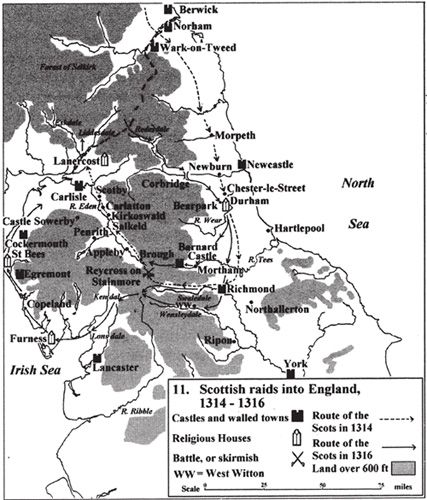
This, then, was the nature of the warfare that Robert unleashed upon the north of England. Infantry were involved only in border districts and places where the Scottish presence came close to permanent occupation. The long-distance raids were carried out by horsemen mounted on hackneys or ponies. These rode swiftly into England and swept down the East March, devastating villages and driving off cattle, taking hostages where payment could be expected, trampling standing crops and burning barns, mills, and homesteads. They were quite prepared to be bought off, and deals were struck with terrified inhabitants crowded into towers or churches, or onto castle parapets. Religious houses held a special attraction for the raiders: there they could find sacred vessels of precious metals, costly vestments, and other objects of high value besides the proceeds of estates, tithes and other collections from the laity. Sweeping westwards into Pennine dales, the raiders drove the stolen cattle before them, pausing only to wreak destruction upon the upland farmsteads as they crossed the Pennines. Finally, and having reached the West March, they turned northwards, bypassing the heavily fortified city of Carlisle, into Liddesdale, or crossing by the fords of the Solway Firth. Moray and Douglas regularly led these long-distance, U-shaped mounted raids through northern England. Raiding developed over time, with the Scots penetrating deeper and deeper into England and spending longer on each raid. This may have been due not only to their increasing audacity: they may have been forced to go ever deeper into England because there was practically nothing left where they had been previously. During Edward Bruce’s invasion of Ireland, the raids became less frequent, for the Scots are known to have transferred lords and their troops from one theatre of war to another.
The raids were partly a natural consequence of victory over a hostile neighbour and partly an opportunity to reward and enrich loyal and successful lieutenants, but partly too they were an instrument of royal policy. Robert clearly hoped that such raids would force Edward II to negotiate with him and concede his right to the kingship of Scotland, but his hope was ill founded. Edward showed some concern over the devastation of his six northern counties, but his prime and overwhelming objective was the undermining and defeat of his cousin, Thomas of Lancaster, whom he hated with a passion. One fifth of Edward’s kingdom was under tribute to Robert, yet his preoccupation with Lancaster was unrelenting. Once – and only once – Edward and Thomas managed to co-operate for long enough to launch an attack against Robert, but that effort, the siege of Berwick in 1319, collapsed amid a storm of recriminations and accusations of treachery on both sides, and their mutual antagonism redoubled. The failure of the raids to force the English to the conference table was one reason why Robert felt compelled to underwrite Edward Bruce’s grand and ultimately disastrous strategy for the conquest of Ireland.
Following the battle and the raid of Edward Bruce and Moray, the first cessation of hostilities occurred in October 1314. On this occasion the English administration ‘granted’ a truce to the Scots on the intervention of King Philip of France. Negotiations with the English were able to commence at Durham on 20 October. They were to encompass both exchanges of prisoners taken in battle and discussions aimed at ‘a perpetual peace’. But it is quite incredible that either side was genuinely interested in compromising on the central issues of kingship and sovereignty at this stage. Both still had high hopes of victory, and the futility of continuing the war had yet to be demonstrated. Moray was at Durham on 17 October 1314, presumably as Robert’s chief negotiator. The details of the prisoner exchange were finalised, but the talks broke down soon afterwards, presumably as soon as they proceeded to the issues of kingship and sovereignty.
Robert had to apply further military pressure, not that it will have galled him to do so. The amnesty offered to irredentist Anglo-Scots was due to expire, and at a parliament at Cambuskenneth Abbey near Stirling on 6 November 1314 proclamation was made that all who had died in opposition to King Robert or who had not yet come into his faith were duly disinherited for evermore. On the conclusion of this parliament Robert led another invasion of Northumberland. Chronicles contain no details of this expedition; indeed, with respect to the devastated and anarchic state of Northumberland, the chronicles at this point lapse into general lamentations and yield little detail. It seems likely, however, that this was the occasion of Robert’s taking homage from the people of North Tynedale, and his grant of that region to Sir Philip de Mowbray, who had come into his peace on delivering to him Stirling Castle. Robert was in effect threatening to dismember the kingdom of England. This posturing appears to have had a salutary effect upon the English, for further negotiations took place, this time at Dumfries. By Christmas, they too had collapsed, neither side being prepared to give way on the substantive issue. Again Robert resorted to the threat of force, and early in 1315 Yorkshire was braced for imminent attack by the Scots.
In February and March intermittent violence on the Marches alternated with parleys. We know only that proposals concerning the kingship of Scotland were being discussed, but simultaneously both sides were preparing for a serious escalation of the conflict in Ireland and the west. Robert appears to have advertised his intention to intervene in Ireland. Early in 1315 the English chancery learned that the Scots were expecting ‘thirteen great cogs’ loaded with arms and supplies from Flanders, probably intended to equip the expedition. A messenger of the Scottish king was arrested in Dublin that month. Pre-emptive action was organised and before 15 February 1315 John of Argyll’s forces recaptured the Isle of Man for Edward II in anticipation of the Scottish invasion of Ireland.35 On 18 February John received orders to raise 10,000 men and 60 ships, manned at double strength, to be ready by 6 April for an attack on the west of Scotland. These developments in the west undermined any progress made in negotiations. Neither side was sufficiently interested in a settlement at this stage: in Scotland Edward Bruce was urging extension of the war to Ireland, while in England Lancaster’s administration was simply playing for time until the summer, when it hoped to organise a fresh invasion of Scotland.
The invasion of Ireland was enormous gamble, and the reasons why Robert sanctioned it are many and complex. One source suggests that Edward had received an invitation from an Irish chief ‘with whom he had been educated in his youth’; however it is much more likely that the impetus for the invasion came from Scotland, rather than Ireland. Edward Bruce had dynastic ambitions of his own, as Barbour relates:
Sir Edward, earl of Carrick,
Who was stronger than a leopard,
And had no desire to live in peace,
Felt that Scotland was too small
For him and his brother
Therefore he formed a purpose
That he would become king of Ireland.
Here Barbour is borne out by another chronicler, who describes Edward thus: ‘very mettlesome and high-spirited, [he] would not dwell together with his brother in peace, unless he had half the kingdom for himself; and for this reason this war was stirred up in Ireland.’ Duncan points out that the prisoner exchange lately agreed with the English allowed for the reunion of Robert and his queen, and if children were forthcoming Edward Bruce would lose his position as Scotland’s heir presumptive and any hope of gaining a kingdom of his own.
Another factor, unrelated to Edward Bruce’s ambition, was the threat from Scottish émigrés, led by John of Argyll and Dungal MacDowall. John’s fleet was destined no doubt for the west of Scotland. He had orders to receive to the peace of Edward II, magnates and communities of the Western Isles. His recent capture of Man provided a central base from which he could dominate the Irish Sea and threaten western Scotland. Man was surely captured in order to forestall the expected Scottish invasion of Ireland, for most of the twenty-two Scots and others captured were distributed to Irish garrisons to serve as hostages. John and the émigrés posed a threat that could not be ignored, and Edward Bruce’s invasion was at least partly intended to take the war to them, and deprive them of their last refuge.
Other, lesser benefits would flow from a successful invasion of Ireland. One of these would be the capture of Carrickfergus Castle. This massive strength was owned by the earl of Ulster and was ideally positioned to serve as a base for those attacking Argyll or western Scotland. Devastating Ireland would also deprive the city of Carlisle of the source of half its provisions, and similarly starve John of Argyll’s fleet at Man. Finally, Robert hoped that by capturing some prize of enormous strategic value he might force Edward II to concede his right to the kingship. He certainly appreciated the diplomatic leverage that the capture of Carlisle and Berwick would bring; and he may have seen Ireland in terms of such a prize.
Thus Robert was pushed into approving the western adventure by the ambitions of his brother, and simultaneously drawn into Ireland by the troublemaking activities of the MacDougall affinity and the prospect of a ragbag of lesser benefits. And so in spring 1315 he vastly extended the scope of his war by assenting to Edward’s invasion of Ireland. At Ayr on 26 April 1315, a council met to settle the evidently related questions of the royal succession, and the co-ordinated campaigns in Ireland and on the western seaboard of Scotland. A royal tailzie – a formal deed, which set aside the normal course of the law – settled the royal succession on Robert’s heirs male, or, failing that, on Edward Bruce and his heirs male, or, failing that, on Marjorie, Robert’s daughter and her heirs male.
Directly after the council, in the month of May, Edward’s formidable army embarked for Ireland. With him went Moray and several prominent knights, including Philip Mowbray, John Soules and John Stewart of Menteith. On arrival, Edward’s force appears to have been welcomed by the Gaelic Irish of those parts of Ulster which are closest to Scotland, but, as our knowledge of Edward’s Irish campaigns is heavily dependent upon non-Gaelic sources, this dimension of the Irish adventure is largely hidden from us. Edward, however, lost no time in investing Carrickfergus Castle – just as his brother began to besiege Carlisle on the opposite shore. He may have staged an inauguration of himself as king of Ireland shortly afterwards, or this may have taken place in May of the following year.36 After a brief expedition into Leinster, where he burnt the Irish seaport of Dundalk, he defeated an army led by the earl of Ulster on 1 September 1315 at Connor. This forced the Red Earl to vacate Ulster and move to his other lordship, that of Connaught. Edward co-operated closely with a squadron of four ships led by the privateer Thomas Dun, using this naval support to ferry his men across the River Bann and to convey Moray back to Scotland. Dun carried out a spectacular raid on the harbour of Holyhead in Anglesey on 12 September, when he captured a ship laden with provisions. In England, Dun’s reputation as ‘a cruel pirate’ and a ‘perpetrator of depredations on the sea’ was growing.
Much of the value of these Irish campaigns for Robert was that they were one part of a two-pronged strategy against the MacDougall émigrés in Ulster and the MacDougall homeland in Argyll. In view of the MacSween expedition of 1311, the capture by the Scots of Northburgh Castle in County Donegal is surely significant as it may have threatened or blocked the passage of similar expeditions to Argyll. It is important to recognise the co-ordination inthe campaigns of the two brothers. The same fleet that carried Edward’s force to Ireland then proceeded against Argyll, where Robert was taking the homage of the western lords. At East Tarbert Robert established a new royal burgh, intended to augment his influence in the area. Interestingly, while Walter the Steward accompanied Robert on the Argyll campaign, no less than three members of his extended family were with Edward Bruce across the North Channel: John Stewart of Jedburgh and an Alan Stewart were there during the course of the Irish campaigns, and the magnate John Stewart of Menteith was also present in Ireland. The Stewart connection was then heavily involved in both aspects of this strategy. It was on this campaign that Robert had his men drag his ships with sails unfurled across the isthmus between the two Tarberts, while he himself remained in the ship. The king was doing rather more than just taking a shortcut, as Barbour underlines:
For they knew, by an old prophecy,
That whoever should have ships go
Between those seas with sails
Would so win the Isles for himself
That no-one could withstand him by force.
In the year 1098, two hundred years beforehand, the king of Norway, Magnus Barelegs, had performed the very same symbolic action when he too had needed the men, galley-fleets and money of the western seaboard for an invasion of Ireland. Robert was demonstrating, as Magnus before him had done, that he claimed mastery of the Western Isles and that he would exercise the fullness of that lordship. His campaign dealt another terrible blow to MacDougall influence in Argyll, and it was a MacDonald, Alexander Óg, who died bearing the title King of Argyll in 1318. By contrast, Edward Bruce had no such spectacular success; he was forced to invest Carrickfergus Castle and it did not fall until September 1316.
Before proceeding to the attack on Carlisle – the counterpart of Edward’s siege of Carrickfergus – Robert had further unfinished business of a personal nature to settle, this time with the people of Hartlepool in the bishopric of Durham. The anomalous position of the bishopric of Durham during these years has long intrigued scholars. Since 1312 it had been well within range of the Scottish raiders, but from that date it had consistently bought off the threat. Governed by its prince-bishop as a state-within-a-state, it possessed a unity and cohesion that the English county communities of Northumberland and, more especially, Cumberland lacked. Unsurprisingly, Robert treated the bishopric as his milch cow. It continued to pay extortionately for truces long after Northumberland and Cumberland had sunk into chaos, and in one agreement with the community of Durham the Scots reserved to themselves the right to ride through the bishopric on their way to raid Yorkshire. But in June 1315 payments seem to have lapsed, and opportunity was taken to settle a grudge against tenants of a former Bruce estate: ‘Sir Robert Bruce came into the bishopric of Durham with a great army and so secretly had he come that he found people sleeping soundly in their beds. He sent Sir James Douglas to the district of Hartlepool with many armed men while he himself remained at the vill of Chester le Street. Sir James despoiled the said town, and he led back as captives many burgesses and many women. Having collected much booty from the whole countryside they all returned to their own country.’ Another source adds that the townspeople took to sea in ships to escape the Scots, and this gives another clue as to reasons for this action: Hartlepool had become a naval base for the enforcement of Edward II’s maritime blockade of Scotland, and from its harbour the English would intercept Scottish, German and Flemish ships trading and preying on English shipping in the North Sea. Scotland’s continental trade, which brought in cash income and weaponry, was vital to the prosecution of the war. But, in addition to this, Hartness – and Hartlepool – had formed a part of the Bruce ancestral lands, and Robert took personally the active involvement of former tenants of his family undermining his war. Hartlepool remained a target for subsequent Scottish raids in 1318 and 1322, and was specifically excluded from the purchased truces with the bishopric. As a result of this raid a new truce with Durham was organised, beginning on 1 July 1315 and to last for two years. For this the bishopric coughed up the huge sum of 1,600 marks (that is, £1,066).
Now, more than ever before, Robert needed money: not only was Edward Bruce’s siege of Carrickfergus draining his treasury, but in the very month after the Hartlepool raid he himself commenced the siege of Carlisle. That two such daunting challenges were undertaken simultaneously is testimony to the Bruces’ confidence at this time; all the more so when one considers that they were attempted in concert with increased pressure on Berwick. With hindsight we can see that victory at Bannockburn had tempted Robert to overstretch his resources; had the combined resources of these three sieges been applied separately to these projects, all might have succeeded. As it was, in three years Robert gained two of his three targets.
A vivid narrative of the siege of Carlisle, clearly written by an eyewitness, is contained in the English Lanercòst chronicle. The account reveals that Robert strove to apply the sophisticated techniques he had witnessed at Edward I’s siege of Stirling Castle, but with fewer resources, inadequate materials and in adverse weather conditions:
On every day of the siege [the Scots] assaulted one of the three gates of the city, sometimes all three at once; but never without loss, because there were discharged upon them from the walls such dense volleys of darts and arrows, likewise stones, that they asked one another whether stones bred and multiplied within the walls. Now on the fifth day of the siege they set up a machine for casting stones next to the church of the Holy Trinity … but there were seven or eight similar machines within the city, besides other engines of war.
Defence of the city was energetically organised by Sir Andrew Harclay, a remarkably able Cumberland knight. The Scots resorted to many ingenious stratagems. They built a siege tower – called a ‘belfry’ – to push up against the walls and gain the advantage of height on the defenders, but some distance from the walls it stuck in earth saturated by the torrential rains of the worst summer in living memory. The Scots attempted to fill up the moat by pouring into it huge bundles of corn and hay, but the material was simply swallowed up and borne away by the swollen waters. They built drawbridges, but these proved too heavy and sank completely into the moat. One can almost hear the howls of derision from the defenders on the city walls as these successive expedients failed. Then, on 25 July, an all-out assault on the eastern walls was launched as a diversion while Douglas’s commandos tried to scale the western wall. Douglas himself may have been wounded in this attempt. The next day Robert gave up. Perhaps he was simply exasperated, but he may also have heard two pieces of bad news: ‘A false report meanwhile spread throughout England that our army in Ireland had scattered the Scots, that Edward Bruce was dead and that hardly one of the Scots remained alive. Hence Robert Bruce, both on account of these wild rumours and because he had heard that the Earl of Pembroke had recently arrived with many men-at-arms, gave up the siege and set out towards Scotland.’ Abandoning their war machines the Scots marched off, in such disarray that the defenders were able to capture two Scottish knights.
Edward Bruce was alive and kicking. Not only had he kept Carrickfergus under constant siege, but he had also decided to risk a winter campaign too. Towards the end of 1315, with winter coming on, he marched south from Ulster for a second time – quite remarkably given the weather conditions – ranging far into Leinster, the very heartland of the Anglo–Irish colony. But the English managed to retain the loyalty both of the Anglo–Irish and of many Gaelic lords. A high-ranking royal clerk named John de Hothum, who had long experience of Irish affairs, had arrived in Ireland in September 1315 to put backbone into Edward II’s Irish government. By taking oaths and hostages, and by judicious distribution of pardons, grants and privileges, Hothum made an invaluable contribution to keeping Irish magnates onside. Edward put to flight Roger Mortimer at Kells in December 1315, and at Ardscull near Skerries in January 1316 he worsted in battle an assembly of Anglo–Irish magnates led by the justiciar Edmund Butler. Dublin made ready for desperate defence, and in the city Brother Walter de Aqua was paid to direct operations from 9 December to 5 May, but Edward did not attack. It is a feature of the Bruces’ armies that they were ill-prepared to take cities by storm. Some of the Gaelic Irish clans of Leinster and Munster were inspired by his success to rise in revolt against the English. By February, however, lack of supplies forced Edward to retreat to Ulster, his men ‘so weakened, both from hunger and exhaustion that many of them began to die’. Some time before September 1316 Robert himself seems to have crossed to Ulster, causing the Carrickfergus garrison at last to throw in the towel. One of the main objectives of the Irish expedition had therefore been accomplished. The three warlords, Robert, Edward and Moray, returned to Scotland to hammer out a basis for continuing the conquest of Ireland, and part of the agreement reached was that Moray should be granted the Isle of Man, which was still in English hands.
There followed a lull in the raiding of England. Scottish energies and resources may have been drained by Edward Bruce’s campaign in Ireland. Negotiations with the English government were resumed, and it appears that a truce until Midsummer 1316 was agreed. For his part, Edward II committed the keeping of northern England to a succession of commanders with widespread powers, and – on parchment at any rate – significant forces at their disposal. None of the English commanders made any significant attack on Scotland, and for a particularly powerful reason already referred to above. In the years 1315–18 summer after summer was ruined by incessant rain. Sword and fire having been visited on northern England by the Scots, it was the turn of famine to immiserate the lives of the northern English peasantry. The rain destroyed crops and food prices began to soar. In northern England the famine was partly the result of the devastation wrought by the Scots. It became impossible for commanders to muster troops where the tenantry were deserting estates and where there was no food to sustain armies. In 1316 the Lancaster administration struggled and failed to mount a campaign against Robert, their efforts rendered hopeless by shortage of supplies, dissension, desertion of tenantry and incessant rain, which made roads and river crossings impassable.
On the North Sea there was no truce. The advantage which the English had gained through the establishment of the St Omer staple in 1313 was lost in the early summer of 1315, when Robert, Count of Flanders, rose in revolt against Louis X, his French overlord. The French called upon Edward II to honour his commitments under the alliance, by expelling Flemish traders and sending ships to support the French against the Flemish. It was in Edward’s interest to do neither. He needed all his ships to supply Berwick in the North Sea, and to defeat Edward Bruce and Thomas Dun in the Irish Sea. The English were still trying to enforce a blockade on Scotland, maintaining a fleet of twenty ships to keep the privateers at bay; this they now had to divide. The added distraction allowed King Robert to blockade Berwick by sea, as well as on land, and by the autumn of 1315 the garrison was desperately short of food. By October men were reportedly starving and the desertion of the garrison was said to be imminent. In November relief vessels were forced to jettison most of their cargo to escape the privateers. Then, around 6 January 1316, Robert and Douglas launched an amphibious attack on the town:
In the week of the Epiphany, the King of Scotland came stealthily to Berwick one bright moonlit night with a strong force, and delivered an assault by land and by sea in boats, intending to enter the town by stealth on the waterside between Brighouse and the castle, where the wall was not yet built, but they were manfully repulsed by the guards and by those who had answered to the alarm, and a certain Scottish knight, Sir J de Landels was killed and Sir James Douglas escaped with difficulty in a small boat. Then, in March 1316, the warden wrote in bitter terms to Edward II: ‘Assuredly, sire, your people are dying of hunger and I have nothing but fine words for them … And now lately many are leaving the town and those who stay die in anguish from starvation on the walls.’
By May it was impossible for the English to supply the town by sea; on 10 May the mayor of Berwick reported that two vessels had recently been captured trying to supply the town. Attacks on English shipping increased: John Crabbe now had the wholehearted support of Count Robert. Flemish crews had been expelled from England and deprived of legitimate employment, and had no option now but to join the privateers and prey on English vessels. Crabbe captured two ships from Great Yarmouth in March 1316, and off the Isle of Thanet he seized an English wine ship returning from Gascony. What saved the situation for the English on the North Sea, and for Berwick, was the cessation of hostilities between France and Flanders late in 1316, which meant that Edward II could once more deploy the whole of his North Sea fleet to supply Berwick and suppress the Scots and Eastlanders, while Flemish crews could abandon privateering and turn once more to legitimate trade.
As soon as his truce with the English ended, Robert mercilessly unleashed his raiders once more on northern England. The first major raid on Yorkshire took place at Mid-summer, 24 June 1316. Moray and Douglas probably led this raid; Robert remained in Scotland. They rode through Durham and crossed the Tees at Mortham. That settlement was subsequently abandoned as result of destruction by the Scots. Then they split into three groups: some continued up Teesdale, devastating the estates at Barnard Castle, and into the valley of the Eden where they burnt Penrith and Carlatton. Another approached Richmond and was bought off by the nobles, bargaining from the safety of the castle ramparts. They turned up Swaledale to Stainmore. The third group rode into Wensleydale, destroying the village of West Witton and, meeting up with their comrades on Stainmore, rode on into Kendal and Lonsdale, and across the sands to Furness. Their route home along the Cumberland coast is borne out by taxation records, which reveal a string of impoverished parishes as far as Cockermouth.
In January 1317 Robert crossed to Ireland. By this time his old nemesis, John of Argyll, had retired to London ‘impotent in body and his lands in Scotland totally destroyed’. John lived only a year and a half afterwards, and died around the beginning of 1318 on a pilgrimage to Canterbury. Other Scottish émigrés remained in Ireland or around the Irish Sea – Duncan MacGoffrey, Dungall MacDowell and others – keeping alive the flame of resistance to the Bruces. Robert joined forces with Edward and Moray, setting off southwards to lay waste the heartlands of Leinster. They approached Dublin just as Edward had done the previous winter with every appearance of assaulting the city, but, as before, they veered away from it when the citizens prepared for a stout defence. From hindsight and on the evidence we have, this looks like a wasted opportunity to destroy the English colony in Ireland and gain that vital bargaining-counter that could have brought an end to the war. One possible explanation for the Scots’ failure to attack Dublin is that the city was well supplied with hostages. Besides men captured off the Isle of Man, Sir Alan Stewart was being held in Dublin Castle and, as we have seen, relatives, the Stewarts, contributed significantly to most Irish campaigns.
The Scots continued southwards, destroying the countryside, while the army of Edmund Butler, the justiciar of Ireland, followed them at a distance, not daring to attack. Then Robert received an appeal for assistance from a faction of the O’Briens – Clann Briain Ruaid – and hared off to the west towards Limerick. When the Scots arrived in Thomond, they discovered that the faction they had come to help had been defeated by their rivals – Clann Taidc – and they found waiting for them these hostile O’Briens. The decision was taken to retreat; Robert might have received wind of the arrival of a fresh English army under Roger Mortimer, at Youghal on 7 April. At this point in the narrative Barbour alludes to a curious incident. Robert halted the retreat of the army ‘from Limerick’ – we should say, rather, the banks of the Shannon, since the Scots did not enter that city – in order that a poor laundress suffering labour pains might give birth. Barbour includes the story to illustrate Robert’s humanity; some commentators however have suggested that the story might imply that the laundress was bearing the king’s child. The only action of the campaign occurred on 17 April, when a skirmish took place at Eliogarty in County Tipperary with Irish hobelars, and this was followed by a long hard march back to Ulster, during which the Scottish army a second time ‘nearly perished with hunger and fatigue, and many were left there dead’. This costly and ultimately fruitless expedition is tantamount to a defeat. Just as the Scots avoided giving battle in England, the Anglo-Irish lords had avoided confrontation with the Scots and in this way saw off the King of Scots.
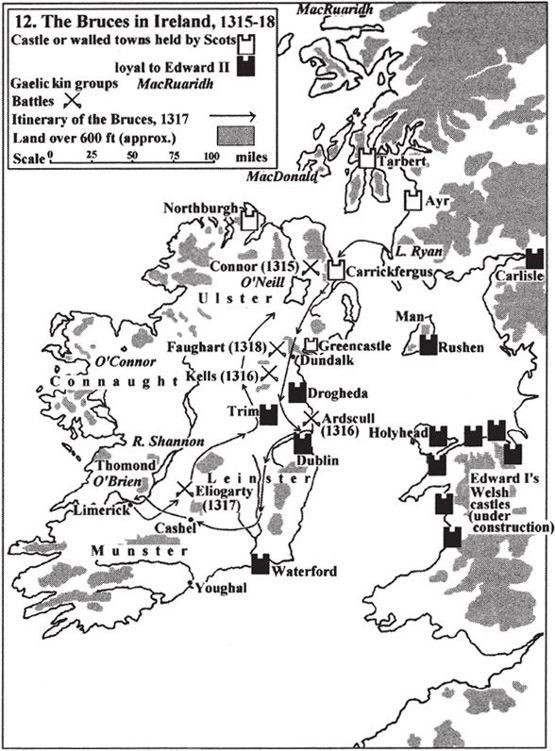
Following a good harvest and in a clement winter, campaigning would have been tough; in early 1317 it is incredible that the Bruces even attempted it. Wasting the colony, though it deprived the English West March of provisions, can hardly have been justification in itself, and had Robert been serious about the capture of Dublin he would surely have brought or made a siege train, and used it. It is quite clear, however, that Robert had expected much more support from Anglo-Irish and Gaelic lords than was forthcoming. The O’Brien faction had clearly diverted the expedition for their own ends, and their manipulation of Robert recalls a similar attempt by an O’Connor faction to use Edward’s expedition in 1315 against their local adversaries. By these two instances we are reminded that Gaelic was only a secondary cultural influence on the Bruces: they could ‘talk the talk’ of Gaelic lords, but might occasionally be shown up as naive Anglo-Normans, hopelessly bogged down in and sidetracked by the micro-politics of the Gaidhealtachd. That said, the brothers went to some lengths to promote their stance as leaders of a pan-Celtic alliance against England. Edward’s propaganda was circulating in Wales at this time, and the Scottish royal chancery may have had a hand in composing the Remonstrance of the Irish Princes. In this letter to the pope, written in 1317 by Domnal O’Neill ‘king of Ulster and by hereditary right true heir to the whole of Ireland’, a list of oppressions and grievances committed by English kings and their ministers, and English settlers in Ireland is rehearsed, and O’Neill’s hereditary right is transferred to Edward Bruce, ‘illustrious earl of Carrick’.
Robert was back in Scotland at least by 14 June 1317, and probably well before that. On his return he commended William Sinclair, Bishop of Dunkeld, who had seen off a seaborne invasion of Fife, calling him ‘my own bishop’. Robert was in good time for an expected resumption of hostilities. The English chancery had issued orders for levies of troops and accumulation of foodstuffs in preparation for a campaign that summer. On 13 July Edward II wrote to his commanders in the north that from a fortnight after Midsummer – 8 July – the Scots had been mustering for an invasion and that he feared it was already in progress. But there was no chance of serious campaigning by either side in what passed for a summer in 1317. The harvest was disastrous and grain prices rocketed; the roads had become mires; and the peasantry, impoverished and displaced, were preyed upon by Scottish raiders and English garrisons alike. Such weather is likely to have been experienced in Scotland too, though, as explained earlier, the consequent agrarian crisis is unlikely to have been quite as harsh.
Unwelcome news had meanwhile been received from the Irish Sea in the summer of 1317. Thomas Dun, the privateer chief who had been the scourge of English shipping, had provoked the English government into taking resolute action. In May Edward II ordered two ships; one was a 140-man galley, and therefore much faster than other vessels on the Irish Sea, where ships were normally of 18, 22 and 26 oars, to hunt down the ‘cruel pirate’. Already on the Irish Sea ‘for the defence of Ireland and the king’s land of Scotland’ was a squadron led by John Athy. On 2 July Athy encountered Dun’s squadron and, after a fierce sea-battle in which 40 Scots are said to have been slain, the pirate chief was taken alive. A squire called Geoffrey Coigners was rewarded with a payment of £10 for this achievement. Before he was executed, Dun revealed, or was made to reveal, that Moray was preparing an attack on Man and also intended through treachery to capture Anglesey. This did not, however, prevent Moray’s capture of the Isle of Man, which occurred around October 1317.
Unable to campaign in 1317, Robert turned to intrigue. A new pope had ascended the Throne of St Peter, John XXII, and he renewed the papacy’s attempts to reconcile Edward II with Robert, whom he considered to be Edward’s vassal. Two papal legates, both cardinals, had arrived in England to settle a variety of ecclesiastical disputes in the English Church, and also to impose a two-year truce on the Anglo-Scottish conflict at the behest of Edward II. Robert ignored the truce, because in their letters the cardinals failed to acknowledge his kingship, and because he felt himself to be on the brink of capturing Berwick. He forbade publication in Scotland of the papal bull announcing the truce, and he had the cardinal’s messengers assaulted and their letters torn up. The cardinals decided to visit him in person. In September 1317 they were on their way into Scotland to threaten Robert with renewed excommunication and to impose terms for a truce wholly unacceptable to him. Travelling with them was the bishop-elect of Durham, Louis de Beaumont, and protecting the whole party was his brother Sir Henry de Beaumont, a magnate and veteran commander of the Scottish wars.
As long as the papacy denied his royal title, Robert preferred to ignore its peace-making initiatives, and he could not afford to have these senior churchmen entering Scotland and undermining his royal dignity by denouncing him in front of his magnates. He avoided the unwelcome visit – it seems – by hiring a host of Northumbrian robber-knights, led by Gilbert de Middleton, to waylay the cardinals before they reached Durham. Consequently these princes of the Church were ambushed at Rushyford on 1 September 1317, their belongings – including the papal bulls so offensive to Robert – stolen, and, humiliated and seething with indignation, they were forced to continue to Durham on foot. At this sacrilege the outrage of English ecclesiastical and secular authorities was apoplectic. However, it was Middleton and his adherents who were roundly cursed, condemned and excommunicated; for Robert the whole affair had the great advantage of ‘deniability’, and enabled him to persist in his violation of the papal truce without an embarrassing showdown with the cardinals in Scotland. Several interests benefited from the robbery. The monks of Durham Priory had no love for their bishop-elect, Louis de Beaumont, whom they resented as he had been foisted upon them against their will. Similarly Gilbert de Middleton and other local knights, who habitually profited as middlemen organising the collection of Robert’s tribute, resented the ascendancy of the warlike Beaumonts in the defence of the border, worrying that they would upset their applecart. In the aftermath of the robbery Middleton and his associates, as content to be hung for a sheep as for a lamb, led the English Eastern March in a widespread revolt against royal misrule, lack of pay, lack of provisions, rapacious castle garrisons and against the prospect of domination by the Beaumonts. In the Middleton Rebellion, as it is known, retainers of Thomas, Earl of Lancaster, were prominent. Mysteriously, the earl himself had been on hand directly after the robbery to lead the unfortunate prelates to safety, almost as though Lancaster knew in advance of what was to happen. The robbery of the cardinals and the Middleton Rebellion is a murky episode, the full truth of which will never be known, but there is no mistaking the hand of the King of Scots, upon whose permission life in the English border counties outside castles and walled towns depended. The revolt, which even spread into Yorkshire, was crushed by castle garrisons and those anxious to do down their local rivals or curry favour with Edward II.
Capitalising on the confusion he had sown, towards the end of September Robert renewed his assault on Berwick. Edward II hastily dispatched reinforcements from York and a ship from Whitby with twenty-eight armed sailors on board. The siege lasted into the winter, and in December Robert was supervising siege engines between onslaughts, determined that ‘he would have Berwick’. In the spring Robert resorted to guile, and on the night of 1/2 April 1318 a party of Scots led by Douglas scaled the walls of Berwick, at a place where the guard had been bribed. The town was taken at last. The garrison retreated to the castle and held out until 18 June, but the fall of the town of Berwick heralded a general collapse of English strongholds on the Eastern March. Wark on Tweed surrendered on 21 May, and Harbottle around that time ‘because relief did not reach them on the appointed day’ and Mitford was taken by guile soon afterwards.’ At the end of April or early in May Robert had dispatched Moray and Douglas on a devastating raid on Yorkshire. The raid was a pointed defiance of the two-year truce which the pope had announced and sought to impose, and, although there is no other evidence of collusion between Lancaster and the Scots at this date, it may have been intended to support a general Lancastrian revolt in England. Two groups of raiders left Scotland. On the Eastern March a first group passed through the bishopric of Durham, but stopped to devastate the area around Hartlepool in reprisal for the capture of a Scottish ship. Then they crossed into Yorkshire at Yarm. A second group appears to have entered England by the West March and rode up the Eden Valley and down Teesdale to Barnard Castle, devastating villages along the south bank of the river, until the two groups met and joined forces in laying waste the Vale of York. Taxation records enable us to trace the trail of devastation, and these are supplemented by chronicle accounts and chance survivals among administrative records. Richmond seems to have bought off the raiders a second time. Ripon was spared, in return for 1,000 marks, a sum negotiated with townsfolk crowded into the minster for safety. Fountains Abbey bought off the raiders, but a large part of the Scottish force stayed at the abbey, and many of the granges and outlying farms were destroyed. Northallertonshire was devastated by all accounts, and on Sunday 28 May the raiders destroyed the king’s granary at Boroughbridge. The two groups converged on Knaresborough. They burnt 140 houses in the town, leaving only 20 standing, and they searched the Forest of Knaresborough for refugees who might be hiding there with their cattle. The arrival of Moray in Knaresborough may not have been by chance. The earl of Lancaster’s rivalry with Edward II had developed into open war in some parts of England, and from October 1317 to the end of January Lancastrian rebels associated with the Middleton Rebellion had held Knaresborough Castle against the king. In January 1318 Moray was believed to have been approaching to aid the rebels, and it may be that when he actually set out in May he expected to find the Lancastrians still holding out. Whether or not this was the case, Robert had nothing to lose by stirring the antagonism between Lancaster and his royal cousin. Following their usual U-shaped itinerary, the raiders crossed the Pennines by several routes, including Airedale and Wharfedale, where tax assessments and the records of Bolton Priory reveal their wake of devastation. Entering Lancashire they destroyed it for six days; Warton, Cockerham and Garstang were said to be ‘totally burnt’; Preston and Kirkham were ‘burnt and destroyed’. Of their return journey nothing is known: since it was made through countryside already devastated, it does not figure in the records.
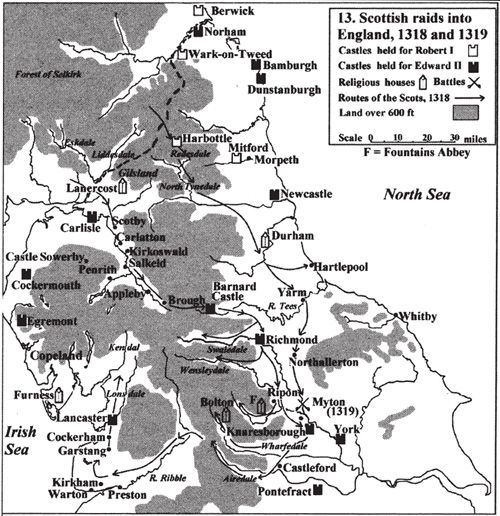
While these events were taking place in Britain we hear virtually nothing of what was happening in Ireland. After Robert left Ireland, Edward Bruce remained in Ulster for over a year, but in the autumn of 1318 he advanced to the borders of that province. An intriguing four-month gap in the sequence of Robert’s dated acts leaves it just possible that the king took an army to Ireland at that time to assist Edward once again in his conquest of Ireland. There is no firm evidence in Irish sources of Robert’s presence in that country, but that Robert was expected seems to be implied in the Annals of Clonmacnoise, where it states that ‘fearing his brother Robert Bruce king of Scotland (that came to this kingdom for his assistance) would acquire and get the glory of that victory which he made himself believe he would get of the English which he was sure he was able to overthrow without the assistance of his said brother, he rashly gave them the assault.’ At Faughart near Dundalk on 14 October 1318 Edward encountered three Anglo-Irish magnates: Edmund Butler, John de Birmingham and the Archbishop of Armagh, Roland Joyce. The best source for the battle, however, makes no mention of Robert, yet it claims that Edward had already been reinforced, and that he approached the town of Dundalk with ‘a great army of Scots which had newly arrived’. Certainly Edward was accompanied by MacRuaridh and MacDonald chiefs; nevertheless his force was greatly outnumbered by the Anglo-Irish and his Gaelic Irish allies refused to commit themselves to a fight. The Lanercost chronicle provides the clearest description of the battle: ‘They [Edward Bruce’s army] were in three columns at such a distance from each other that the first was done before the second came up, and then the second before the third, with which Edward was marching, could render any aid. Thus the third column was routed, just as the two preceding ones had been. Edward fell at the same time and was beheaded after death; his body being divided into four quarters, which quarters were sent to the four chief towns of Ireland.’ Barbour contends that the corpse of Gib Harper, who was wearing Edward’s coat of arms – and who might have been Edward’s herald – was mistaken for that of Edward himself, and that Gib’s head was severed, placed in a box of salt, and sent to Edward II.
Robert, we may assume, was distraught at the loss of his last remaining brother. All of his four brothers had now been killed in vindication of his right; he will have grieved sorely. Had Edward’s remains escaped the final indignities, it can have been of cold comfort to Robert, and he may have begun to wonder whether his regalian right was worth such slaughter. A nightmare of a war without end between Scotland and England now loomed, for the English might never concede defeat. From this stage in the struggle Robert abandoned any dreams of pan-Celtic leadership and the conquest of Ireland that he might still have entertained. Instead he redoubled his efforts to extract submission from the English and, if they would concede his title and Scottish sovereignty, began to offer remarkable concessions in hope of a lasting peace. Through a tiny window on Robert’s personal grief it appears that he ascribed this disaster to the wrath of a long-dead Irish holy man: within a month of Edward’s death he had provided for a lamp and a candle to burn perpetually at the altar of Blessed Malachy in the Cistercian abbey of Coupar Angus.