
1
Scotland in the late thirteenth century
Robert Bruce was born on 11 July 1274. His aristocratic family had extensive holdings in south-west Scotland, where they had been lords of Annandale for generations. Turnberry castle, the head of his mother’s earldom, is the most likely place his of birth. He was probably not born on the family’s estates in England, but was rather ‘Scottish by birth’ as we would understand it, since he subsequently claimed the Scots as ‘his own people’. The Bruces were of more than just lordly rank: they were great magnates, the social equals of earls. Indeed, by marrying his mother, his father had acquired the title of earl of Carrick in right of his wife. The development of the Bruce dynasty will be discussed in the next chapter; for the present Robert’s early life will be discussed, together with the contexts into which Robert was born.
Life in the Middle Ages was dominated by ideas and assumptions that no longer exist in quite the same way, and common misunderstandings of Robert Bruce are often rooted in failures to understand how a man of Bruce’s time and social class comprehended life, relationships and the world. ‘The past is another country’ and one should not go there without a guide, however brief, however sketchy. To do otherwise is to risk infecting the past with the assumptions of the present age, creating anachronisms and investing historical personalities with attitudes and assumptions that they could never have embraced. The period we are dealing with is the late thirteenth and early fourteenth century, and the backdrop to Robert’s early life is known as the High Middle Ages. This was before gunpowder was commonly used in Western Europe (though great lords were beginning to explore the potential of primitive explosives). It was before the Black Death wiped out a third of Europe’s population. It was a time when economic growth and agrarian expansion was levelling off, or perhaps just beginning to recede in many parts of the British Isles. Economic trends were not of course clearly evident to Robert or his contemporaries. Perhaps because technology had not changed significantly in a thousand years, people in the Middle Ages did not usually conceive of society as dynamic or evolving. It has been said, with justification, that medieval people had no concept of evolution. It would be incorrect however to say that they did not introduce new ideas and inventions; rather they showed a tendency to represent innovation as a return to an earlier state of affairs. Medieval people were much more respectful of the past than we are, and looked to tradition, custom and lineage to provide justification for decisions or actions. To them, society and economy were as they always had been, time out of mind.
The marriage of Robert’s father, Robert Bruce, the sixth lord of Annandale, around 1272, is the subject of an engaging vignette in Fordun’s chronicle, in which, during a chance encounter while she was out hunting, the lady, Marjorie, Countess of Carrick, vamps her man:
When greetings and kisses had been given on each side, as is the wont of courtiers, she besought him to stay and hunt and walk about; and seeing that he was rather unwilling to do so, she by force, so to speak, with her own hand, made him pull up and brought the knight, although very loathe, with her to her castle of Turnberry. After dallying there with his followers for the space of fifteen days or more, he secretly took the countess as his wife. Friends and well-wishers of both knew nothing about it, nor had the king’s consent in the matter been at all obtained. Whatever the chronicle says, Robert’s father is unlikely to have been browbeaten or forced into marriage with a rich widow and a countess in her own right. Rather, Fordun is protecting the father of his hero from accusation of abducting Marjorie. Enraged, King Alexander III, whose right it was to approve marriages between his tenants-in-chief, took Turnberry and all the countess’s possessions into his own hand; but a gift of money soon placated him. The marriage was a very fruitful union and may have been a love match, quite unusual for the Middle Ages when marriage was predominantly viewed as a property contract, to be negotiated between two families, often while the principals were still very young.
With respect to Robert’s early family life we have no firm evidence, but we can hazard some generalisations.2 Robert Bruce VI, has been characterised as ‘spineless’ and ‘colourless’ by Professor Barrow, but this is by comparison with Robert’s colourful crusader grandfather, Robert Bruce V, known to contemporaries as Robert the Noble, and to history as ‘Bruce the Competitor’, because he competed with others for the throne of Scotland at the hearings known as the Great Cause in 1290–91. This grandfather seems to have been an immense influence on Robert. That is evident not only from his conviction of the justice of his claim to the throne, a claim pioneered by Robert Bruce V, but also from his death-bed crusading aspirations, derived from the example of his grandfather. Marjorie, the mother of Robert, the future king, being the daughter of Neil, the last Gaelic earl of Carrick, was a Gaelic noblewoman. Her marriage to Robert Bruce of Annandale brought that lord the earldom of Carrick as we have seen, and so it was that Robert the king-to-be inherited the title earl of Carrick. Recently Seán Duffy has suggested that Robert’s maternal grandmother, the wife of Neil, Earl of Carrick, may have been a daughter of an O’Neill king of Tyrone. It may therefore be no accident that the Christian name Neil recurs in the Bruce family. The O’Neills of Tyrone harboured pretensions towards the kingship of Ireland, and if it were the case that the Bruces were connected by blood with the O’Neills it would have profound implications for the Bruce claim to be of royal blood. It is possible too that from Neil of Carrick the Bruces inherited a claim to lands in County Antrim in Ireland, granted in the twelfth century to Neil’s father, Duncan of Carrick. Be that as it may, ties with the Gaidhealtachd, the Gaelic-speaking crescent that extended along the west and north of the British Isles, were close, and Gaelic was quite literally Robert Bruce’s mother tongue. We may be certain that all the children spoke French and Gaelic; possibly some Latin, the language of prayer; and Scots, the English dialect used by the Lowland peasantry. The family will have moved between the castles of the lordship: Lochmaben, the main castle of the lordship of Annandale; Turnberry and Loch Doon of the earldom of Carrick.
Robert had eight or nine siblings, but since his father married a second wife (presumably on the death of Marjorie) some of the younger children may have been half brothers and sisters. The boys, at least Robert and Edward, were fostered according to Gaelic tradition, spending a substantial part of their youth at the courts of other noblemen. The foster-brother of Robert is referred to by Barbour as sharing Robert’s precarious existence as an outlaw in Carrick during the years 1307 and 1308, while Edward was, according to one source, invited to Ireland by ‘a certain Irish magnate with whom he had been educated in his youth’. It is possible then that they were fostered to Gaelic Irish magnates. Tales of Finn MacCool are referred to in The Bruce and perhaps the children absorbed the traditional Gaelic stories at their mother’s knee. Elsewhere in the poem Robert is said to have recited the tale of ‘Ferambrace’ (‘Iron Arm’), the Charlemagnian hero, to raise the spirits of his men; this illustrates the family’s dominant francophone, chivalric background. The children could well have been taught to read in some of their languages, though those destined for knighthood (Robert, Neil, Edward and Thomas) may have considered that writing was best left to clerks. One of the younger brothers, Alexander, was groomed for a career in holy orders. As heir, Robert will have been schooled by specialist tutors in all the refinements of courtly etiquette – manners, elocution, music perhaps, and dancing – and he will have waited as a page at his father’s and grandfather’s tables. He will have received some schooling in law. Special attention will have been paid to the martial arts of horsemanship, swordsmanship and jousting. Leisure activities included a prodigious amount of hunting and falconry. A love of ships and sea travel that emerges in Robert’s later life may have been instilled in his youth.
The importance of piety will have received great stress. Medieval Christianity is said to have been akin to polytheism in that every day, every locality and every situation had its own particular saint. Saints could be jealous of their due devotions and wrathful. St Malachy, as we shall see, may have been perceived by the family as malevolent. The children will have been taught to revere certain saints above others: Columcille, and also Andrew, whose cult had grown over the past hundred years at the expense of the Celtic saints. Relics and pilgrimages featured prominently. St Ninian may have been the principal local saint, and it was to St Ninan’s cave that Robert made his final pilgrimage. His charters also suggest devotion to St Fillan, whose shrine was maintained in the Abbey of Inchaffray, and to St Kentigern, the patron of the bishopric of Glasgow. Also, in later life, Robert showed some partiality towards St Kessog, who founded the community of Inchtavannach, on the Isle of the Monks in Loch Lomond.
It is easier to generalise about Robert’s early life than to describe the world he was born into. In Scotland there was a consciousness of being a small and relatively poor kingdom on the very edge of Christendom; the Declaration of Arbroath refers to ‘Poor little Scotland, beyond which there is no dwelling place at all’. The vast majority of her half a million inhabitants were peasant farmers living off cattle and the land. Outside the core areas of medieval farming – such as Lothian, the eastern coastal plain and the Lowlands generally – medieval population was either at its height or, perhaps, just beginning to decline. In regions such as south-west Scotland, where the Bruce lordship was centred, grain farmers were beginning to abandon unprofitable soils and pastures as the demand for food, and hence the price the farmer could expect, was not quite as high as it had been. Farmers in south-west Scotland were fortunate in that they had extensive areas of high moorland which provided seasonal pasture on which cattle might graze. Cattle were more important than tillage in such parts of Scotland, and this was reflected in the social organisation of Gaelic Scotland, where the population moved with the cattle between seasonal pastures. Over a large part of the British Isles, Robert Bruce’s wars helped to accelerate the downturn in grain farming and, viewed in the long term, to terminate many features that typified the High Middle Ages.
If tillage was beginning perhaps to falter, trade was flourishing, though it was all on a fairly small scale. There were not many towns or ‘burghs’ in the Scotland of Robert’s day and those that existed were small and often situated on the coast. But kings and lords had realised that towns generated income through concentrating the population and creating markets, and so the development of burghs had been encouraged by the great lords through grants of privileges: rights to take tolls, and hold fairs and markets. Scottish kings had created thirty-six royal burghs, many of which developed urban characteristics. The main towns were Berwick, Edinburgh, Roxburgh and Stirling. Most of the larger towns were on the east coast where there was a growing export trade in wool, leather, hides, fish and timber. Wool in particular was sold to Flemish and Italian merchants who supplied the great cloth-manufacturing centres. The other goods were exported to England and also farther afield to Flanders, the Netherlands and the German-speaking towns of the Baltic. There was considerable Flemish interest and settlement in the leading ports of Aberdeen, Perth and Berwick – where the Flemings had a headquarters (probably something of a community centre and plant for processing exports) at the Red Hall, while the merchants of Cologne maintained a similar presence at the White Hall.
The sort of society that Robert grew up in can perhaps be most briefly explained by looking at some of the cleavages that existed. Social divisions at the time of Robert Bruce were fine, many and complex; but it will help if we look first at that between the nobles and the churlish, and secondly that between the Gaelic and the Anglo-Norman. Gentillesse or nobility could only be conferred by breeding; one had to be born a gentleman, noble or aristocrat to possess the appropriate manner, speech and air. Gentillesse also implied landed wealth, an estate sufficient to maintain a noble household. It was not enough just to have money; at this period very few rich townsfolk – if any – made it into the charmed circle of gentillesse. It was nevertheless a broad social category, and stretched from the king and the highest aristocrats in the land (such as the Bruces of Annandale) to poor knights and squires with only a manor or two to their names, such the family of William Wallace.
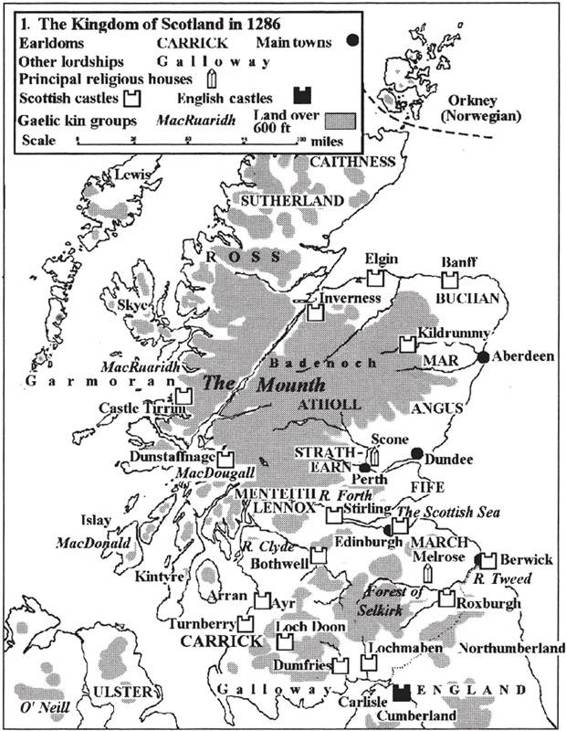
The relationship between nobles is sometimes described as hierarchical, and certainly there were different degrees of rank, the principal ranks being king (at the apex of the social pyramid), earls, barons, knights and gentlemen. Everyone had to have a lord, a patron, a protector, of whom he held his fief of land, and to whom he performed the act of homage and fealty. This was a solemn occasion. The vassal knelt with hands joined before the lord in the presence of witnesses; the lord, standing up, clasped the vassal’s joined hands, and the vassal recited a formula of words promising undying loyalty. The act was sealed by the gift of a fief of land, for which the vassal completed some noble service: knight service, ship service, or even a nominal service such as gifting a rose at midsummer or a pair of sparrowhawks. The bond of homage was not lightly broken. In The Bruce Barbour waxes lyrical on the virtue of loyalty, the bond that ties a man to his lord, and the social cement that keeps society together:
Loyalty is to love wholeheartedly
By loyalty men live righteously.
With loyalty and but one other virtue
A man can still be adequate,
But without loyalty he is worthless
Even if he is valiant or wise.
For where loyalty is lacking
No virtue is of sufficient price
To make a man good
So that he can be called simply a ‘good man’.
When the time came for Robert to assert in arms his claim to the kingship of Scotland he had of course to persuade others to break oaths of homage and fealty they had taken to the kings of England. Malise, Earl of Strathearn, is said to have scorned to come over to Bruce’s side, declaring that his oath of loyalty was not ‘fragile like glass’. Besides the interplay of lords and vassals, there were other dimensions to noble society. The market in land allowed an earl to hold land of a knight where it was desirable, knights to rent royal demensne from the king, and monasteries to let out their lands to nobles of all ranks for profit. Noble relations then resembled a network, rather than the familiar feudal pyramid of the school history books. Rival networks of magnate interest sprang up and vied with one another for influence in localities or at court: for most of the thirteenth century the influence of the Bruces had been eclipsed at court by the dominance of their great rivals the Comyns, who had controlled most of the high offices in the land for the best part of the thirteenth century, and had built up a powerful network of castles, estates and interests across the kingdom.
The francophone, chivalric society of northern Europe provided the main cultural input to the Bruce family. As aristocrats they considered themselves natural leaders and displayed that arrogant disdain of the lower ‘churlish’ social orders and pride in their own ancestry common to all aristocracies. From their position near the top of the social hierarchy, as magnates or tenants-in-chief of the king, they controlled lesser baronial or knightly families through grants of land and other bestowals of patronage. As the king demanded taxation and knight service from the Bruces, so they in turn demanded food or money rents and (in time of war) knight service, ship service, castle-guard and other assistance from their noble dependents. Ecclesiastical livings such as parishes andvicarages, were also used as patronage, to be dispensed to social inferiors in return for their loyalty and their services. Perhaps unusually for a magnate family of such high standing, the Bruces had not founded a monastery in Scotland; rather, they continued to patronise the monastery of Guisborough in Yorkshire, which held the tombs of their ancestors. When Robert became king he patronised many Scottish religious houses and several English ones, but he was especially generous to the Cistercian foundation at Melrose, where his heart now lies buried.
It was expected of all magnate families to display their wealth and privileged status in a variety of ways. The Bruces lived ostentatiously; diet, dress and manners were distinct from and superior to those of social inferiors. Their main seat was at Lochmaben, but they will have maintained several grand houses and moved between them periodically, accompanied by a large group of noble retainers, known as a retinue or meinie. In common with aristocracies right across northern Europe at this time, they displayed armorial devices illustrating their pedigree. The Bruces flaunted their martial valour in tournaments, listened to troubadour ballads on the themes of courtly love, and enjoyed Arthurian literature, all of which were in vogue during this, the golden age of chivalry.
The churls on the other hand, were the vast majority of the people, excluded from gentil society and each bound to a lord by economic and social obligations of a baser kind: chiefly the payment of rents and dues, and the performance of labour services (including military service in time of war). This social category included men of greatly varying legal status, from prosperous freeholders, through bondmen to natives, bound to the soil and burdened with all sorts of services, payments and obligations. The corollary of the churl’s submission was that the lord would provide protection in times of danger, settlement of disputes, justice for the aggrieved and the distribution of largesse: rewards, grants, gifts and charity. The lord’s officials, the stewards, baillies or reeves, dispensed justice in the lord’s court, enforced social bonds, punished evil-doers and those who defied society’s taboos, and provided protection. Robert Bruce, William Wallace and their peers in the lordly class, took virtually no account of the opinions or needs of the common people. There are examples, as we shall see, of Robert acting charitably and humanely towards churls, as he was obliged to by Christianity, but beyond that he will have had little interest in the welfare or opinions of common people. A number of his acts as king show Robert to have been socially conservative, keen that bondmen should remain on their lords’ estates and not desert them for the towns, and keen generally that individuals should know their place and not aspire to rise above their rank.
The second principal division in society was linguistic and cultural. Scotland at the end of the thirteenth century was far from culturally homogeneous. Until about 1200, the principal culture and language of Scotland had been Gaelic, and, though slowly on retreat before English, Gaelic was still spoken widely in the west and north, in the Highlands and Islands. In the north and in the recently acquired territories of Man and the Western Isles, there had for centuries been extensive Norwegian influence and Norse language and customs will have persisted in places. In Lothian, on the coastal plains, and around the larger east-coast towns the Scots dialect of English predominated, and it was slowly gaining ground at the expense of other languages. Flemings and some Germans had settled in the large towns of the east, attracted by the prosperity of Scottish trade. Finally, everywhere, the lordly class spoke Anglo-Norman French and this was the language of the Scottish court; it was also common to most of the courts of western Christendom. Only in the west did Gaelic lords continue to use their traditional tongue.
Gaelic culture absorbed Anglo–Norman elements, such as knight service and homage and fealty, but it retained distinctive features such as living in kinship groups or clans, fosterage, and the maintenance of strong social ties with the Gaelic kingdoms of northern and western Ireland. The Gaelic lords of the Western Isles and Argyll were often referred to as ‘kings’ in their own language, but as ‘barons of the Scottish realm’ in French. The MacDougalls, MacDonalds and MacRuaridhs were the three most powerful kin groups of the west and, though all claimed descent from a single ancestor, warfare and rivalry between them was constant. Their mercenaries from the Western Isles, known as ‘galloglasses’, traversed the northern sea lanes, seeking seasonal employment in the endless wars of the Irish kings.
Robert Bruce, however, was primarily an Anglo-Norman magnate, and his family had been installed in the twelfth century on the borders of the kingdom of Scotland to protect it from raids by the Gaelic people of Galloway, who were resisting absorption into Scotland. Situated on an interface between two cultures, the Bruces did not remain unaffected by social interchange with their peers of the other culture, and consequently by 1274 the family had long been exposed to Gaelic manners and customs. Through living cheek by jowl with Gaelic forms and traditions for hundreds of years, with occasional inter-marriage and development of social and economic interchange, acculturation set in, and the Bruces of Annandale absorbed aspects of Gaelic life and manners, just as crusaders living a long time in the Holy Land showed a tendency to pick up Arabic and even Islamic traits. Similarities between Gaelic and Anglo-Norman culture were much more marked than the differences: both societies tolerated considerable violence, and both put enormous stock on loyalty to one’s lord as the most fundamental of social bonds.
With such a polyglot, multicultural population, one may be excused for asking how far Scotland was a single entity. But the question has to be answered in the affirmative: Scotland was very definitely a single kingdom in 1274. There were many Scottish cultures and tongues – a point that makes nonsense of the allegation that Robert Bruce was somehow less Scottish because he spoke French – yet Scotland was a political entity, a kingdom. The image of the nation of Scotland being welded together by war with England, forged under the blows of Edward I, the Hammer of the Scots, is quite false. Rather, by the late thirteenth century Scottish kings had already forged for their territories an identity sufficiently strong for it to be able to exist without a king, as it did during the interregnum of 1286–92. The succession crises that occurred in 1286 and 1292, when first King Alexander III and then his only heir both died in quick succession, demonstrated that the combined efforts of previous monarchs had been successful in forging a political identity or nationhood, ‘the community of the realm’, which was capable of authoritative decision-making during interregnum, and commanded the loyalty of the great majority of Scots. Constantly augmented by war and diplomacy, the kingdom of Scotland by this period had virtually attained its modern frontiers; Orkney and Shetland alone remained Norwegian territory in 1274.
Scotland was as much a unity as any medieval kingdom, yet all such kingdoms were assemblages of diverse regions linked to a monarchy by personal bond of lordship. The territories ruled over by the Scottish king were inhabited by peoples of English, Gaelic, Norse, Manx, Flemish, and Norman descent. It was to unite these disparate peoples that the monarchy began carefully to cultivate ideas of ‘Scottishness’ that fully embraced all its loyal adherents. During the course of the thirteenth century the royal genealogy, solemnly recited in Gaelic at the enthroning of each successive monarch, was revised to embrace Pictish as well as Scottish ancestors. Though regional differences persisted, it is fair to say that by the close of the thirteenth century the monarchy had achieved its goal of political unity. Scottish kings had previously addressed charters to the different peoples by name, as French, Scots, English and (rarely) as Gallovidians, but this had ceased by 1190. Nevertheless, the men of Galloway had their own unique relationship to the Scottish throne, completely different to that of the men of Lothian or Fife. This was bound to be the case, since the formation of the kingdom had been a far from inexorable or even process. Galloway, for example, had never quite been absorbed into the kingdom as fully as other provinces. Galloway’s subjugation began around 1164; it was long, bloody and not entirely completed even by the time of Robert’s birth. Galloway retained separatist tendencies. Scottish claims to Cumbria and territories in Northumbria proved unsustainable, and these territories were ceded to England. The Western Isles and Man were obtained from Norway by the Treaty of Perth as late as 1266. Magnus, the last king of Man, submitted to Alexander III only in 1264. Even then the islanders revolted against Scottish rule in 1275, and Scots and Gallovidians together ruthlessly suppressed the rebellion. The separatisms of Man and Galloway were subsequently encouraged by England when it suited her to do so. Many Scottish nobles held lands in England and in other kingdoms, illustrating that the bonds of lordship cut across the frontiers of kingdoms. Furthermore, while customs, laws, privileges and traditions were jealously preserved, such customs were often highly localised. Law was not a single point of reference; there existed a wide diversity of laws, which included: the Law of the Marches that prevailed on the borders, the Laws of Galloway, peculiar to that region, the Forest Law that applied in the extensive royal hunting preserves; the Law of ‘the Four Burghs’ of Berwick, Roxburgh, Edinburgh and Stirling; and Brehon Law that prevailed in Gaelic-speaking regions.
It was the monarchy, then, and the network of loyalties and obligations that flowed from monarchy, that defined Scotland. The throne descended by male primogeniture, that is, to the eldest son of each successive king. So long as the king had capable male children the arrangement worked; but if, as occurred in 1286, the king died without children, the precise rules of descent were open to some dispute. Professor Duncan has recently examined the Scottish tradition of king-making. The ceremony of king-making was very solemn, and we are fortunate to have a depiction of it on the seal of Scone Abbey. Central to the inauguration ceremony (as with all Gaelic king-making) was the setting of the king-to-be on a special stone throne, at a special location. Scottish kings were neither ceremonially crowned nor anointed at this date, but they did aspire to both and tried unsuccessfully to obtain from the papacy the right to incorporate them into the ceremony. The absence of these rituals gave credence to the English claim that the Scottish monarchy was subordinate. The ceremony began with the candidate being acclaimed as king in the church of Scone Abbey. He took oaths on the gospels to defend the church, maintain right and justice and keep good laws, and he was girded with a sword. For the open-air ceremony of enthronement, the candidate was then led to a cross in the churchyard, where stood a wooden bench-throne containing the Stone of Scone. The earl of Fife or his representative led the candidate to the throne. Once enthroned, the king would receive a symbol of authority, an elaborate sceptre. He was also ceremonially cloaked with a mantle and stole by the abbot of Scone and another cleric, symbolising endorsement by the church. He may have worn a crown all along, but it was certainly not a central part of the ceremony. Robert Bruce had to do without the Stone of Destiny when he was enthroned; perhaps for that reason, when in 1328 he was offered it back, he did not make strenuous efforts to recover it. Finally, the new king’s genealogy was read out by a Gaelic historian, demonstrating that the new king was descended from the Pictish and Gaelic kings of old, right back to Iber Scot, the first Scotsman. A feast followed, and fealties were taken.
The king was lord of the royal estates (or royal demesne), but he had to factor into all his decisions the opinions and interests of the aristocracy. This was led by great landowners, the magnates. Primogeniture was the inheritance custom commonly followed by all the nobility: the first-born son would inherit the whole of the estate. If there were no son, the property would be equally divided among his daughters. Chief among the magnates were the thirteen earldoms: Fife (which was the most prestigious of the earldoms, and whose earl assisted at the enthronement of the monarch), Mar, Angus, Buchan (held by the Comyns), Strathearn, Atholl, Ross, Sutherland, Caithness (which was held jointly with the Norwegian earldom of Orkney), Menteith, Lennox, Carrick (which Bruce himself inherited), and March. Besides earldoms, there were other great lordships comparable to earldoms, including the lordship of Annandale (held by the Bruces), Garmoran (by the MacRuaridhs) and the lordship of Galloway (by the Balliols). As we have seen, there were, in addition, three great Gaelic kin groups which existed in the west, besides a myriad of lesser Gaelic kin groups.
On special occasions, when a king wanted to focus the attention of the whole realm on business of particular importance – a royal marriage, a demand for special taxation, or an important set of decrees – a parliament would be summoned. Parliament was a specially enlarged council which all the leading nobles and prelates were obliged to attend. There was no question at this date of mere knights attending, as already occurred at some English parliaments, but parliaments did formally concede grants of taxation (in the form of levies on assessed moveable property) to the monarch. The powers of medieval monarchy could depend very much upon the personality and character of the king. In general however it was agreed that, on the death of a tenant-in-chief, a king would take custody of the estate until the heir was of age to inherit. Usually an under-age heir would become a royal ward, and on inheriting his property the heir would pay a large sum to the king, known as a relief. Should a tenant-in-chief betray his oaths of homage and fealty, he forfeited his inheritance. The king had a say in the marriages of the children of his tenants-in-chief and of their widows, as we have seen with respect to the marriage of Robert Bruce VI and Marjorie, Countess of Carrick. Custom decreed however that no king should disparage a widow, that is, marry her off to someone of lower rank.
By the late thirteenth century the Scottish monarchy had developed a specialised officialdom to help it run the kingdom. Royal justice was dispensed through three justiciars: of Scotia (in the north); Lothian (in the prosperous south-east); and Galloway (in the west). Sheriffs were the principal agents of royal authority in the localities. Twenty-eight sheriffs, some of them hereditary, many controlled by the great magnates, supervised royal demesne and served as chief accounting officers for royal income and expenditure. They held courts where in they insisted on royal rights and collected the profits of justice: fines, and forfeitures. Sheriffs paid royal income to the king’s chamberlain, a single officer who centrally managed the king’s finances, and whose first duty was to provide for the royal household, the most lavish of all the lordly establishments. The royal household was organised along the classic Carolingian model. It was divided into three main departments: the ‘chapel’ or chancery, staffed by clerks, functioned as the king’s bureaucracy; the ‘chamber’ functioned as the treasury; and the ‘hall’ looked after provisioning and daily necessities of the large, itinerant household. From the chancery the king issued writs, orders and grants bearing his great seal, the stamp of royal authority. It was presided over by the royal chancellor, chief of the king’s council. The chancellor and the chamberlain probably both also sat on the exchequer (an addition to the original household), which was essentially a court of audit. Royal officials were called before the exchequer annually to answer for debts owing to the king, and there they claimed what allowances they could to set against that debt.
A word about the currency and monetary values in general will be helpful at this point. The main unit of currency in use throughout the British Isles was the silver penny, which was counted in pounds, shillings and pence (£ s d). The mark however was also used as a unit of account. This was two-thirds of a pound, or 13s 4d. There is no point in suggesting a factor or multiplier which would allow one to express medieval values in terms of today’s prices. Relative values of commodities have changed beyond recognition. In the Middle Ages food prices especially fluctuated greatly according to harvest, and such fluctuations affected other prices too. However the following examples might serve as a rough guide to monetary values: an earl’s income could amount to £5,000 per annum; a warhorse would cost £30 to £40; in wartime a knight earned 2s per day from royal service; and a footsoldier collected a daily wage of 2d.
No medieval kingdom could conduct its affairs in isolation from its neighbours, and, although it had diplomatic relations with all the kingdoms touching the North Sea, the neighbour with which Scotland shared a land border was of pre-eminent importance. When we ask how independent of England Scotland had been up to this point, we must bear in mind that ‘independence’, like ‘nationality’, is another modern concept that sits uneasily when imposed upon the medieval world. The kingdoms of western Christendom were not independent of one another, but rather interdependent. All paid lip service to the theory that a supra-national papacy was supreme in matters relating to religion (a large slice of life in the Middle Ages), and all the royal families of Europe intermarried, causing kingdoms to interfere often in one another’s affairs.
Since the two kingdoms already had a history of five hundred years of sharing ‘one poor island’, it is barely surprising that the relationship between Scotland and England was complex. There had been peace between the kingdoms for seventy years, and many Scottish aristocrats, including the King of Scots himself, held estates in England as well as Scotland. The Bruces held substantial estates in Essex, Middlesex and in the Bishopric of Durham. John Balliol held manors in seventeen English shires. Besides being much larger than Scotland, England was much more populous and wealthy. England might have sustained two and a half million people at this date; Scotland would scarcely have had a population of half a million. Wool exports (the only economic data available for comparison) suggests the same sort of proportion: Scotland exported 5,000 sacks in 1327, and England roughly five times that. Given this order of dominance, it is barely surprising that, as soon as one could reasonably speak of an English kingdom, that kingdom claimed a ‘superior lordship’ over the whole of Britain. In the twelfth century certain Scottish kings had accepted the lordship of Henry I and later of Henry II, both particularly powerful kings of England, but resisted attempts by less powerful English monarchs to impose upon Scotland. By the thirteenth century the custom had developed whereby, shortly after the coronation of each king of England, the King of Scots would visit him to perform a ceremony of homage and fealty, where the vassal knelt before the lord and acknowledged his lordship. Was this done in return for the kingdom of Scotland itself, or merely for the lands which the Scottish king held in England: the lordships of Tynedale and Penrith? The interpretation placed upon this ceremony by the participants appears to have depended largely upon the personalities involved and upon the ebb and flow of the power relationships between the kingdoms and between the kings themselves. Alexander III is said to have insisted categorically that he held his kingdom from God alone; other Scottish monarchs might not have been in a position to be so unequivocal. The sources on this ceremony are either vague, or were intended as propaganda for one side or the other. The vagueness surrounding the ceremony allowed each king to interpret the act of homage as he pleased, and it facilitated the peaceful co-existence of the kingdoms for most of the thirteenth century. Edward I’s insistence upon clarity and definition, which spoiled this comfortable fudge, is one of the factors that led to war in 1296.
Medieval people did not conceive of society as divided into religious and secular realms; rather the Scottish Church and religious belief generally informed every aspect of life. The clergy represented a high percentage of the population: perhaps a tenth of all the men and women in Scotland were in clerical orders of some kind. There were regular clergy (orders of monks and nuns who lived by the Rule of St Benedict) and secular, or diocesan clergy. The most powerful regular order was the Cistercians, whose abbeys (Melrose, Arbroath, Paisley, Kelso and Holyrood) maintained vast herds of sheep in the uplands and sold the wool to Italian and Flemish merchants. In addition there were friars, regular clergy who lived not in monasteries but in the community; the Dominican and Franciscan friars were well represented in the larger towns.
The kingdom of Scotland had also to maintain relations with the papacy. However the Church was firmly under the control of the king, who could almost always have his servants appointed to key bishoprics, abbacies and other ecclesiastical offices, and he could call upon the church for subsidies and financial aids. The papacy could only tax the Scottish Church with the king’s agreement, and it almost always had to share the proceeds with the monarch. Whereas the co-operation and good offices of the papacy were much to be desired, the power of the papacy was not such that a pope could impose his will on an unwilling monarch or an unco-operative kingdom. Robert Bruce himself ruled for many years as king while ignoring successive excommunications. For their loyalty to Bruce, the Scots themselves cheerfully suffered the full force of papal displeasure, including a variety of harsh ecclesiastical penalties: excommunication, a general interdict imposed upon all of Scotland, prohibition from holding ecclesiastical office for themselves and their relatives. They were all ignored by the Scottish hierarchy. As in most of the kingdoms of Christendom, the papacy had influence but not power.
Nevertheless the Church of Bruce’s day aspired to and usually enjoyed an especially close relationship with the papacy. With the help of the papacy the pretensions of the archiepiscopal see of York to control the Scottish Church had been resisted. The process had left Scottish churchmen with a sense of group solidarity, and from time to time the national Church assembled in Provincial Council to approve Rome’s demands for greater centralisation and ecclesiastical taxation. Although Scotland lacked an archbishop, leadership was provided by the two premier bishoprics of Glasgow and St Andrews. The absence of an archbishop was considered an advantage: a papal bull of 1192 had established the Scottish Church as the ‘special daughter of Rome’, there being no intermediary between the pope and the Scottish bishops. This fostered effective channels of communication between the Church and the papacy, for Scottish churchmen became skilled in lobbying at the Roman curia. Both its sense of solidarity as a ‘national’ church, and its close ties with the papal curia, made the Scottish Church a formidable opponent of Edward I’s attempts to integrate Scotland into his kingdom and a valuable expression of Scottish identity which Robert Bruce utilised to the full.
Such was the Scotland of the late thirteenth century: a polyglot and highly diverse territory and people, yet conscious of itself as a unity, even if only begrudgingly so in the cases of Man and Galloway. Society was deeply conservative, tradition-bound and resistant to change. Scarcely peaceful in any quarter, since violence was endemic in a society dominated by quarrelsome lords and rivals, Scotland had nevertheless been at peace with its neighbouring kingdom for seventy years. Such was the country and society in which Robert Bruce VII reached adolescence, mercifully oblivious to the catastrophe that waited around the corner.