
2
Robert Bruce first surfaces in the contemporary record as his father’s son, a witness to an undated charter of Alexander MacDonald of Islay, a long-time ally of the Bruces. The MacDonald were a powerful kinship group in south-west Scotland which looked to the Bruces for leadership; other allies included the MacRuaridhs, the Stewarts and the earls of Atholl, Mar and March. As a young man (and probably before his investiture as earl) Robert was knighted. Knighthood could be bestowed by king or earl, but we do not know who knighted Robert Bruce. The knighting of the heir involved the family in huge expense, with the new knight kitted out with armour, horses, servants with specialised abilities (from noble squires to grooms and stableboys) and more prosaic equipment for an independent household. A ‘feudal aid’ or seigneurial tax could be levied from the tenants to assist with the expense. Knighthood was an honourable and exclusive status to which all noblemen, whether kings or mere gentry, aspired: on the death of Robert Bruce as King Robert I of Scotland in 1329 one Scottish chronicler could think of nothing finer to say of the dead hero than that ‘he was, beyond all living men of his day, a valiant knight’.
As a young knight Robert would be well aware that his family had rivals and enemies as well as allies. Chief among these rivals were the powerful Comyns, who had dominated life at the Scottish royal court for two generations.3 There were three principal lineages bearing the surname Comyn, for, early in the thirteenth century, Walter Comyn had married twice, producing two sets of offspring. The offspring of his first marriage became known as the Comyns of Badenoch (or the Red Comyns), that of his second marriage, to Marjorie, Countess of Buchan, became the Comyn earls of Buchan (the Black Comyns). The third lineage of Comyns, a cadet branch of the Comyns of Badenoch, was known as the Comyns of Kilbride. All three branches operated politically as a unit, and together they had built up a powerful alliance with extensive lands, widespread patronage and a formidable network of castles. In alliance with the Comyns were the Balliol lords of Galloway and the MacDougall lords of Argyll, traditional enemies of the MacDonalds.
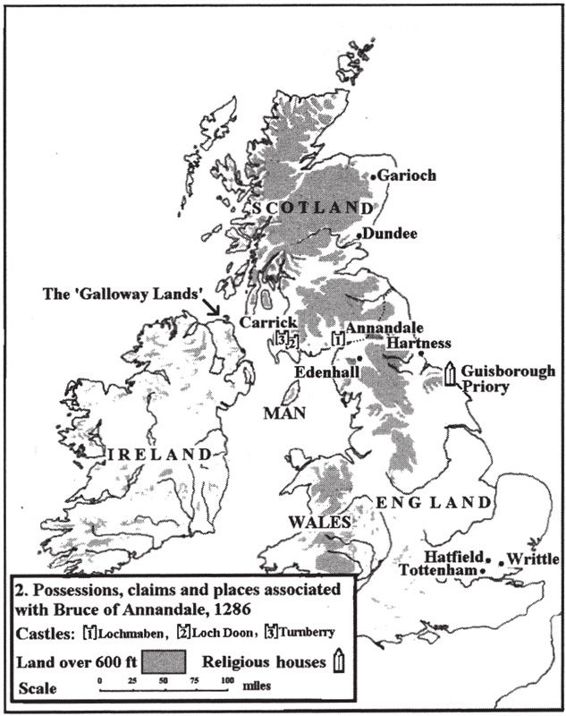
However, before we examine young Robert’s active role in the affairs of the kingdom, it is necessary to consider the legacy of aspirations, property, lands and traditions bequeathed to him by his ancestors. His inheritance included not only sprawling estates, considerable monetary wealth, and legal privileges and rights but also, from his mother an interest in the Gaelic world, and from his grandfather, a burning ambition that embraced aspirations to kingship. The scion of a proud aristocratic lineage, ‘our’ Robert Bruce was only the latest in a succession of nobles bearing that name.4 The family name, rendered in Norman-French as de Brus or de Bruys, derives from Brix near Cherbourg in Normandy. Robert Bruce I was a protégé of Henry I of England (1100–35) who had rewarded him for his services with the lordship of Cleveland in north Yorkshire. There the first Robert Bruce founded the Augustinian Priory of Guisborough and endowed it with vast estates so that the monks would exert spiritual influence on behalf of him and his family. From early in his career Robert associated with another of Henry I’s protégés, David, the son of Malcolm III, King of Scots, who held the English earldom of Huntingdon. On several of David’s charters Robert’s name is listed among those witnessing the deed. This is a strong indication that Robert served David as his vassal, or at any rate was closely associated with him. In 1124 David became king of Scotland, and it was probably on the occasion of his enthronement in that year that he granted Robert the lordship of Annandale with its castle. David was actively pursuing a policy of bestowing upon dependable warlike Norman families estates situated on marcher territories of his kingdom. Such grants were made to Norman families because Normans could provide ‘knight service’, which meant supplying mounted, armoured knights for the royal host. Annandale bordered both England, a potentially hostile but usually friendly neighbour, and Galloway, a Celtic region at that time unsubdued by the kings of Scotland. The Bruces were then honour-bound to defend the borders (or ‘marches’ as they are usually termed) of the Scottish kingdom on the monarch’s behalf.
The first Robert’s friendship with King David did not survive the Scottish invasion of England in 1138, and Robert made a solemn renunciation of his homage to David, a very rare and drastic step in medieval society. He fought with distinction against the Scots at the Battle of the Standard. However, before this breach occurred, the first Robert seems to have passed the lordship of Annandale on to his second son, a supporter of David. Thus Robert, a ‘cross-border baron’ with lands on each side of the Anglo-Scottish border, skilfully minimized the effects of war between the kingdoms on the fortunes of his family. Annandale was saved from forfeiture by the King of Scots on this occasion. Robert died in 1142, and was buried at Guisborough Priory. His first son, Adam, inherited the great estates in Yorkshire; his second, Robert, retained the lesser fief of Annandale.
From a charter of this period we learn that Robert Bruce II held Annandale by service of ten knights; that is, he had to contribute ten knights to the royal host in time of war. During his time however there occurred an incident that cast a shadow over the fortunes of the Bruces. In 1148 the great Irish saint, archbishop and ecclesiastical reformer St Malachy O’More, passing through Scotland on his way to Rome, favoured the second lord of Annandale by staying at his castle. During the visit Malachy interceded on behalf of a thief whom Robert had sentenced to hang. Magnanimously the lord gave way to the pleading of the holy man and declared that the thief’s life would be spared. In return Malachy blessed the lord and his family. But the following morning, as he set out, Malachy saw the body of the thief swaying on the gallows and realised that Robert had hanged the man regardless. He revoked his blessing and laid instead a terrible curse upon the lord and his offspring, and on the town. The curse of a holy man of St Malachy’s stature was a serious impediment to fortunes of any medieval dynasty. The Lanercost chronicle relates that ‘three of his heirs perished in succession’ and indeed Robert Bruce II granted a house in Lochmaben to St Peter’s Hospital in York for the souls of (among others) ‘his infants’. Furthermore, a misfortune appears to have occurred around the year 1200 at Annan forcing the family to move to Lochmaben. It has been suggested that the River Annan washed away a part of Annan Castle, forcing the family to move the head of the lordship from Annan to Lochmaben. That misfortune may also have been attributed to the curse of St Malachy. Whatever the historical truth of these troubles, the Bruces themselves, including King Robert, appear to have believed in the curse. Robert II faced misfortune of another sort: war between the kingdoms flared up again in 1173–74, forcing him to choose between allegiances. Robert had considerable property in England: Hartness in the bishopric of Durham, and the manor of Edenhall in Cumberland. He chose to support Henry II of England against King William the Lion, bringing immediate confiscation of Annandale. The Bruce patrimony was, however, restored after the conflict, and relations with the Scottish court improved to the extent that William the Lion married his illegitimate daughter to Robert Bruce II’s son and heir, Robert. Unfortunately this Robert predeceased his father, who died in 1194.
The third lord of Annandale was therefore a younger son, William, but of William there is little to tell. He died in 1211 or 1212. His son and heir, Robert Bruce, the fourth lord (though the third of the name), made a very successful match by marrying into the Scottish royal family.5 His bride was Isabel, second daughter of David, Earl of Huntingdon. This was definitely an advance on marriage to a king’s illegitimate daughter, and represented a considerable increase in the family’s fortunes. Imbued both with a keen sense of service to the monarchy and, naturally, to its own long-term interest, the family carried on collecting estates through the bestowal of royal patronage and astute marriages. Within Scotland they acquired one third of the lordship of Garioch and the burgh of Dundee; they also enlarged their holdings in England through marriage. By the time of our Robert’s birth their English estates included the manors of Writtle and Hatfield Broadoak in Essex, one third of the manor of Tottenham in Middlesex, and Hartness in the bishopric of Durham. They seem also to have claimed territories in Ulster: the ‘Galloway lands’ in County Antrim granted to Duncan of Carrick. Claims to land and titles were guarded jealously and pursued wherever possible in appropriate courts, for it was a most litigious age and no claim, however distant or far-fetched, could be allowed to lapse.
The family was acutely aware of its position vis-à-vis the monarchies upon which its fortunes depended. It was Robert Bruce V, the grandfather of the future king, who first aspired to royal dignity in Scotland. This Robert, whom contemporaries called Robert the Noble, was a most colourful and energetic magnate. The Lanercost chronicle records in a brief obituary that ‘He was of handsome appearance, a gifted speaker, remarkable for his influence … as noble a baron in England as in Scotland.’
No doubt he had charisma, but he was also a schemer, a chancer and a very devious character. Born around the year 1225, he married into the family of the English earls of Gloucester; and south of the border he participated in the bitter struggles between Henry III of England and his magnates. He fought on Henry III’s side at the Battle of Lewes in 1264. King Henry lost that battle to his over-mighty subject Simon de Montfort and, as a consequence, Robert was captured and had to appeal to his son to arrange a ransom for his release. Capture in battle was a catastrophe often greater than death, for ransoms could economically cripple even a magnate dynasty. Robert, however, was well resourced: besides Annandale and Hartness, he had inherited on the death of his mother in 1251 or 1252 her estates in Essex and the Garioch. With this accession of wealth he built a large stone castle at Lochmaben, and the dynasty survived the payment of his ransom.
The Bruces’ aspiration to the Scottish throne originated in an incident which, Robert the Noble alleged, occurred during the reign of Alexander II. Robert claimed that, at a time when King Alexander was still childless and was preparing to lead an expedition to the Western Isles, the king had recognised him as his heir presumptive. The incident, if it occurred at all, appears to belong to the year 1238. Robert’s contemporaries may have known of it, but there is no historical evidence beyond Robert’s word that this recognition was ever made. Professor Duncan is deeply sceptical about the claim.
The historicity of these events however only became of critical importance when the throne of Scotland depended upon it. For the present Robert the Noble pursued other means of self-promotion. Even in the small, distant and impoverished kingdom of Scotland, noble families felt part of the francophone, chivalric society of Europe; testimony to this is the participation of Robert the Noble in that ambitious but inglorious enterprise of medieval Europe, the crusade to preserve the Holy Land from Islamic control. Along with Bretons and men of the Low Countries, he joined the expedition led by Edmund ‘Crouchback’ of Lancaster, younger son of Henry III of England. Robert was already fifty years old. They sailed in the autumn of 1271, to reinforce a previous expedition led by Edmund’s elder brother, Prince Edward of England.
This Edward was to become a figure of towering importance in the lives of the Bruces. He was to become Edward I ‘the Hammer of the Scots’, and he bore the nickname ‘Longshanks’ because his lanky stature (he stood an impressive six foot two inches in height) enabled him to stay in the saddle when other men would have been toppled. The character of this king has been variously interpreted, and Scottish historians have, not surprisingly, tended to be rather harsher in their assessment of him than others. But there is agreement on many aspects of the man. Edward was brilliant in many ways: a skilled reformer of law, a courageous general and a leader of men. He demanded clarity and definition in law; and he strikes one as having been crisp and decisive in manner. It was this quest for definition that led him to disturb the convenient vagueness over Anglo–Scottish relations that had preserved peace between the kingdoms for seventy years. Edward had a short fuse, and displays of his violent ill temper are well documented. He would mercilessly browbeat those who opposed his will; the combination of his overbearing rage and his height could reduce a man to a nervous wreck. Much of his grievance against the Scots who opposed his will was founded on his perception of them as disloyal, or having broken oaths of fealty. Conventional in most respects, and much admired as a king, there was undoubtedly a streak of cruelty in Edward’s character.
The crusaders sailed first to Tunis, then wintered in Sicily before setting off again, via Cyprus, to Acre, the capital of the crusader state in Palestine, known as Outremer. They enjoyed little military success, but Edward managed to shore up the beleaguered Christian state by negotiating a truce for it. Significantly, on the return journey Robert visited the monastery at Clairvaux, where St Malachy is buried, presumably to seek the saint’s forgiveness for his family; furthermore, on his return, he granted land to the Abbey of Clairvaux to provide three candles at St Malachy’s shrine to placate the angry saint.
Edward of England returned to a throne, since his father had died in his absence, and Robert Bruce the Noble continued to serve him, holding office in England as sheriff of Cumberland from 1283 to 1285. Robert made a second marriage. His new bride, though not as high-born as his first, was already twice a widow and therefore brought into the family two dower portions from previous alliances, all lands in Cumberland.
The fateful year 1286 probably marked the birth of serious Bruce pretensions to the throne of Scotland; indeed the events of that year generated similar aspirations and ambitions in many aristocratic hearts in Scotland and further afield. For on 18 March 1286 King Alexander III died as the result of a fall from his horse, leaving as his only descendant a sickly three-year-old girl, resident in Norway, Margaret ‘the Maid of Norway’.6 Any medieval kingdom would have been shaken by such a calamity, for it threw into doubt the future of the royal succession and jeopardised the security and tranquillity of the realm. Although the throne was not actually vacant, the event must have inspired clerks and lawyers all over Scotland, and further afield, to research old deeds, genealogies and chronicles on behalf of noble families to discover, resurrect, or if necessary manufacture a claim to the throne of Scotland. Any claim, however unlikely or far-fetched, might have a value, if it were considered worth buying off by more serious contenders.
For the two leading magnate dynasties in Scotland the event opened up the real possibility of absolute power. These were the Bruces themselves, who, as we have seen, led a wide alliance of magnate families in the south-west of Scotland, and the Comyns, who for most of the thirteenth century had controlled the government of Scotland. John Balliol, Lord of Galloway and of Barnard Castle, was the candidate for kingship backed by the Comyns and their allies. At the king’s funeral on 29 March the magnates attending decided to send an embassy to Edward I of England. The magnates recognised in Edward, the monarch of a friendly neighbouring kingdom, a potential ally whose enormous military and financial resources might be useful in preserving order in Scotland and warding off the distant but troubling prospect of a civil war. He was perhaps the only power capable of controlling the simmering ambitions of the rival magnate alliances. It is not known whether this embassy reached Edward (who was in France from 13 May 1286) or whether it was subsequently recalled.
The kingdom of Scotland was sufficiently robust to function for a time without a king, and the institutions of state continued to operate in the name of ‘the community of the realm’. In official documents this kingdom-without-a-king referred to itself as ‘the community of the realm’, and the phrase may be variously interpreted as ‘the governing elite’, ‘the nobles’ or ‘those who had a stake in the kingdom’. A parliament was summoned to Scone for 2 April 1286, where the magnates of the realm swore fealty to Margaret of Norway and undertook to keep the peace. At this council Robert the Noble flung down the gauntlet to his adversaries and boldly stated his claim to the Scottish throne, based upon a theory (or perhaps it was merely an opinion) that a female could not succeed in Scotland. At once the tension increased. Though the claim would not have been unexpected, the community of the realm must have realised that civil war had come a step closer. The parliament seems to have adjourned to consider the impact of this claim. It reassembled around 28 April and at this point it is likely that John Balliol lodged a counter-claim that, by the accepted rules of inheritance, he and not Bruce was the true heir. He was, after all, a descendant of the elder daughter of David, Earl of Huntingdon, and Bruce of the younger. However, Queen Yolande claimed to be expecting a child, a declaration which took the heat out of the debate for the present, and nervously the magnates settled down to await the outcome of the pregnancy.
In the meantime the parliament set about establishing the necessary structures for the government of the kingdom during the interregnum. Firstly, to manage affairs of state, it set up a council of ‘keepers of the peace’ or ‘guardians’. We might call it a regency council. This council of guardians was composed of two earls, two bishops and two barons. Analysis of the individuals selected reveals that in its personnel a delicate balance was observed between the two magnate factions that dominated the kingdom. Bishop Robert Wishart of Glasgow and James, the hereditary steward of Scotland, were supporters of the Bruces; Bishop William Fraser of St Andrews, Alexander Comyn, Earl of Buchan and John Comyn of Badenoch were supporters of Balliol. Earl Duncan of Fife may have had equal attachment to both sides. Secondly, the parliament decided that all the nobles should swear an oath of loyalty to whosoever should obtain the kingdom of Scotland by reason of nearness in blood to King Alexander III. This committed the magnates to accepting the rightful heir whoever that should turn out to be: Alexander’s posthumous child, or, failing that, Margaret, the Maid of Norway, or, failing that, whoever was adjudged to be nearest in blood to the king. It was a formula everyone could sign up to. Thus no decision was taken, but the contending parties were bound to accept an ultimate decision, and civil war was warded off – for the time being.
During the summer of 1286 however, the government began to panic. On 7 August a second embassy was dispatched to Edward with all haste to seek his counsel and protection. Evidently the queen had lost the child, but understandably news of the miscarriage was kept secret as along as possible for fear that the rival magnate camps would resort to arms. It is not surprising that the Bruces, who must have known that their legal claim was the weaker, reacted violently as rumour of the miscarriage spread. Robert the Noble and his son Robert Bruce VI assembled their principal allies in September 1286 at Turnberry Castle – Patrick, Earl of March, and his sons; Walter Stewart, Earl of Menteith, and his sons; James the Steward and his brother John; and Angus Mór MacDonald, Lord of Islay, and his son Alexander – and bound them, together with two Irish magnates, Richard de Burgh, the Red Earl of Ulster, and Thomas de Clare, in a pact of mutual assistance.7 This arrangement, known as the Turnberry Band, might have involved some commitment to an expedition to the west of Ireland, where both the earl of Ulster and de Clare had interests. Much more significant however was the implication that these Irish magnates were committed to helping the Bruce faction in the event of civil war in Scotland. The Bruce faction was preparing to bring in Irish allies to support Robert the Noble in his bid for the throne.
In the winter of 1286–87 the Bruces seized control of three castles in the south-west of Scotland – the royal castles of Dumfries, Wigtown and the Balliol castle of Buittle – securing the Solway Firth for the reception of their Irish allies. This violence was clearly intended to menace or intimidate John Balliol. But the coup failed. No Irish allies arrived, and James, the hereditary steward of Scotland, chose not to stand by his commitments to the Bruces, but instead, acting as guardian, assisted in regaining the castles and putting down the Bruces’ aggression. By May 1287 it was all over. The action had amounted to little more than an aggressive gesture. Besides those involved in the Turnberry Band there were other magnates who might have joined the Bruces but did not: the earls of Fife, March, Atholl, Lennox and Mar, Bishop Wishart of Glasgow, not to mention lords of the second rank, such as Soules, Lindsey and Biggar. Robert the Noble, having resorted to arms prematurely and without the support of his coalition, seems to have withdrawn temporarily from Scotland. It was now clear that Margaret of Norway would inherit the kingdom. It was desirable for the guardians of the kingdom firstly to have her reside in Scotland, and secondly to arrange a marriage for her, in order that Scotland’s future be settled. Eric of Norway was keen that his daughter inherit the kingdom, and was probably delighted to learn that marriage to Edward of Caernarfon, the son of Edward of England, was also a possibility. He sent ambassadors to England to discuss the possibilities. Such a match also seemed an attractive prospect to the Scottish guardians, who were anxious to involve the powerful English monarch in Scotland to prevent any recurrence of violence. However there were two dangers: the English king might use the opportunity to exercise the feudal overlordship, which he claimed to be his right; and there was also a danger that Scotland’s separate laws, customs and institutions might be swallowed up altogether if the kingdoms were united by a such a marriage of heirs. We do not know how Edward I had responded to the guardians’ request for counsel and protection. To judge from his later actions, he probably offered to do all he was asked on condition that his overlordship of Scotland was acknowledged. Rather than assent to such a condition, the guardians decided to manage without his help. They initiated delicate tripartite negotiations with the Norwegians and English about the marriage of the absent Margaret, the acknowledged Lady of Scotland whom all parties agreed should inherit the kingdom. Eric was reluctant to send his daughter to Scotland while it was unstable. The brief rebellion and its suppression had been a blow to the Bruces and for a period of about two years they lost influence. Unrest continued however. Late in the summer of 1289 Duncan, Earl of Fife, was ambushed and slain by his own relatives, the Abernethys, an event which is not satisfactorily explained. The earl of Buchan also died, but, probably to avoid exacerbating the situation, these guardians were not replaced.
The remaining guardians developed a plan to have the six-year-old Margaret marry five-year-old Edward of Caernarfon, Edward I’s heir, who later became Edward II; by such a royal marriage Scotland might enter into union with England yet safeguard the independence of her customs and institutions. Robert the Noble may have retired to his English lands around this time, but he managed to secure appointment as one of four envoys to treat with the Norwegian ambassadors. In November 1289 the ambassadors agreed that Margaret the Maid should come to Scotland or England within a year, into the custody of her great-uncle, Edward I, who would send her to Scotland as soon as the country was settled. This arrangement is known as the Treaty of Salisbury, and, as has been pointed out by Professor Nicholson, it was the first recognition by the Scots that Edward I could intervene in Scottish affairs. The Scots had to promise not to arrange any marriage for the Maid without the advice and consent of both Norwegian and English governments; but eventually they succeeded in negotiating a marriage agreement called the Treaty of Birgham, on 18 July 1290. The settlement heralded a union of the crowns, and it was a diplomatic coup to the extent that it avoided having to acknowledge the overlordship claimed by Edward I. By this, the Maid was to marry young Edward and would be given dower lands in England, but the Scottish kingdom was to remain ‘separate, apart and free in itself without subjection to the English kingdom’. Although the thrones of Scotland and England would be united in the person of one monarch, each realm would remain separate, and ‘the rights, laws, liberties and customs of the same realm of Scotland to be preserved in every respect and in all time coming throughout the said realm and its borders, completely and without being impaired’. Under the union Edward I could be involved in maintaining peace in Scotland but denied a controlling interest; and when, in time, the marriage produced an heir, the crowns of Scotland and England would be joined in a union in which Scotland would be an equal partner. Among the stipulations of the treaty were provisions guaranteeing that there would be no taxation of the Scots except for Scottish needs; tenants-in-chief of the Scottish crown need do homage only in Scotland; elections of the clergy were to be free from interference; and appointments to the customary offices of the Scottish government would continue. The only qualification to the Scottish achievement is that these provisions were agreed subject to ‘the right of our said lord [Edward I]’, so all along Edward was safeguarding his claim to be overlord of Scotland.8
Against considerable odds, the guardians had then succeeded in landing a future for Scotland that involved neither civil war nor subjection to the English crown. Without doubt Scots saw Edward I as a benevolent and potentially stabilising influence, whom they were anxious to involve in Scotland to stave off unrest. But already Edward was beginning to encroach upon Scottish rights and capitalise upon the weakness of his northern neighbour. Some time between 1286 and 1290, the earl of Ulster took possession of the Isle of Man, and in 1290 an assembly of islanders made over the land of Man to the king of England, taking no account of the Scottish claim. The Scots appear to have lodged no formal protest. Edward also appointed the powerful bishop of Durham, Antony Bek, to supervise the government of Scotland on behalf of the infant monarchs-to-be, requiring the guardians to obey Bek.
In October 1290 the situation of Scotland, and the attitude of Edward I of England, were transformed by a calamitous event. Margaret, the Maid of Norway and Lady of Scotland, died in Orkney on her way to Scotland. The risk of civil war between the principal claimants to Scotland now escalated; patently there was an urgent need for authority of some kind to prevent the situation degenerating. The obvious, and indeed perhaps the only source of such authority, was Edward I, who began to set his own terms for acting as protector of the Scottish realm. No one in Scotland raised any objection to his involvement as adjudicator in the question of who was to succeed to the Scottish throne. Intriguingly, there existed a precedent for appeal to an outside monarch to judge in a case of disputed succession. Frederick Barbarossa, the German Emperor, had sat in judgement in the case of the Danish throne in the eleventh century, but it is thought that Edward was probably unaware of this.
Edward was still being drawn into the Scottish arena as opposed to forcing intervention, for the Scottish factions were making approaches to him. Bishop Fraser wrote in October, warning Edward that the Bruce faction had already taken up arms, that Robert the Noble had come to Perth, near Scone, with a powerful retinue; Fraser asked Edward to come to the border to prevent bloodshed, and to place the rightful heir on the throne. He implied strongly that Balliol was that rightful heir. The document received from the Bruce faction is known as the Appeal of the Seven Earls. The Appeal is a blend of invention, tradition and antiquarian myth, and it represents Bruce propaganda of an unsubtle variety. It sought Edward’s help against Bishop Fraser and John Comyn, and it reveals that the committee of the guardians was now dominated by the Balliol interest. It alleged that the guardians’ officers were ravaging Moray. The kernel of the document however is a hitherto unheard of constitutional theory that the seven earls of Scotland had the right to choose the king. Balliol’s supporters advanced no such theories and put their faith in the accepted laws of primogeniture. That said, Balliol was not above slipping a timely bribe to Edward I’s right-hand man: as ‘heir to the kingdom of Scotland’. He sealed a charter granting Edward I’s overseer, Antony Bek, lands held by the Scottish king in England, or, should Edward I refuse to allow that, 500 marks-worth of land in Scotland.
Although both letters to Edward I probably exaggerate the extent of disorder, the danger of civil war was looming. Probably to everyone’s relief Edward decided that the dispute over the throne of Scotland should be decided by himself, but he would act only in the capacity of Scotland’s overlord. In March 1291 he ordered English monasteries to search their chronicles for information on the historic relationship between the two kingdoms. To some Scots it may have seemed – as it now seems to us – that Edward was taking advantage of the vacancy of the Scottish monarchy to clarify to his own advantage the relationship between the kingdoms. Edward travelled to Norham, on the English bank of the River Tweed, arriving in May 1291, where magnates, notaries and lawyers assembled for the court case to settle who should inherit the kingship of Scotland. It is known to history as the Great Cause. The English army was to muster at Norham on 2 June, and the fleet made ready to blockade Scotland so that Edward’s judgement might be enforced should this become necessary.
Edward began by establishing rights of jurisdiction over Scotland. He pointed out that Scottish kings were neither crowned nor anointed and represented this as proof that they were subordinate. He asked ‘the high men of the Scots’ – probably the guardians – to acknowledge him as overlord. The Scots refused, on the ground that they had no knowledge of his claim, and that only a king of Scotland could respond. Edward then sought such an acknowledgement from the claimants (or ‘competitors’) to the throne. This was forthcoming, and neither Robert the Noble nor John Balliol, nor any of the other claimants, made difficulty about acknowledging Edward’s suzerainty over Scotland. Furthermore they agreed that Edward might take the realm into his own hands, so long as he then granted it to the successful candidate. Edward accepted, and, not without some caginess on the part of the commanders, the royal castles of Scotland were handed over to his keeping. It is unlikely that Edward then installed English garrisons in Scottish castles generally, though he may have done so in the case of Berwick. Edward then took the homage and fealty of the guardians, bishops and all the magnates of the realm, and arranged that oaths of fealty from as many nobles as possible be collected on his behalf. In June 1291 the guardians accepted that their provisional government derived its authority from Edward as superior overlord, a fateful concession that carried the implications that Scotland was a sub-kingdom rather than fully independent, and that the next king of Scots would be a vassal of the king of England. Edward then made a short tour of the main towns of his sub-kingdom, taking in Edinburgh, St Andrews and Perth. His taking control of castles and his tour of inspection cannot have been well received by Scots of any class. This victory, won without a sword being drawn, Edward would shortly squander, transforming it into a running sore that would plague the last decade of his life.
Robert Bruce VII, the king to be, was sixteen years of age when Margaret of Norway died and he surely followed these events with breathless interest, perfectly aware that his own fate would be profoundly affected by the success or failure of his grandfather’s claim. As we have seen, it is around this time that he was knighted, and began to appear on the political stage in the Bruce dynastic interest.
On Edward’s return to Berwick, hearings began there in August 1291, and a court of 104 auditors was set up, 40 chosen by Robert the Noble, 40 by Balliol and 24 by Edward. The Great Cause was to last a year and a half, though this included a nine-month adjournment to allow for research. A total of 14 claimants had now stepped into the ring, most of whom were dismissed at an early stage. One of these was John Comyn II of Badenoch, one of the guardians and leader of the mighty Comyn faction. The rebuttal of Comyn’s own fairly weak claim came neither as a surprise nor as much of a setback since he was married to a sister of John Balliol, the odds-on favourite.
Four serious competitors emerged: Bruce, Balliol, Florent Count of Holland and John Hastings, an English baron. Florent V, Count of Holland, lodged a very strong claim, based on his descent from a daughter of Earl Henry, the son of David I, but he lacked sufficient documentary evidence to substantiate it. In fact Florent had been encouraged to enter a claim by Bruce. Aware that his own claim was weaker than that of Balliol, but also that Florent did not have the necessary documentation to prove his still stronger claim, Bruce cut a deal with the count. We have the text of the agreement, sealed on 14 June 1292. If either Bruce or Florent gained the throne, the successful party would grant one third of the Scottish royal demesne to the other, to be held as a fief for service of a mere five knights; and if Bruce were awarded the throne, he would grant to Florent lands in England equivalent to one third of the Scottish royal demesne. Florent had clearly little independent motivation. Bruce appeared to be offering him a chance to gain great wealth at no risk, and so he had agreed to assist Bruce in his scheme. For his part, the devious Robert was clearly anxious to create obstacles in the way of Balliol success. Another of the lesser competitors, also encouraged by Bruce, was King Eric of Norway. His far-fetched claim, made late in the day, was soon dismissed. However, by encouraging Eric’s involvement Robert the Noble managed to gain something for his son, and in November 1292 Robert Bruce VI journeyed to Norway to arrange the marriage of his daughter Isabel to King Eric. The guile of Robert the Noble is to be marvelled at: he had prepared two stalking horses, Florent and Eric, and later, in response to events, he had developed a fallback position – that the kingdom might be partitioned. He was utterly determined to get something out of the Great Cause.
The hearings of the Great Cause ground on. The three main claimants were all descendants of daughters of David, Earl of Huntingdon (d. 1219), the grandson of David I of Scotland. John Hastings claimed descent from the youngest daughter, Ada, and argued that Scotland was not a true kingdom, but simply a lordship subject to the kings of England, and, as such, the territory should be partitioned among the descendants of female co-heiresses, the three daughters, as any landed estate would be divided when male line failed. At this point Robert the Noble argued vehemently that the kingdom could not be partitioned, though later he was to change that position. The court rejected the Hastings argument on the ground that the unity of the kingdom of Scotland should be preserved.
Only Bruce and Balliol remained. Most authorities concur that John Balliol’s case was stronger, and that Balliol enjoyed wider support among the nobility and the clergy than the Bruce. Balliol’s case was based on the simple law of primogeniture: the kingdom could not be divided, and therefore had to be awarded to the descendant of David of Huntingdon’s eldest daughter, Margaret, namely himself, her grandson. Balliol therefore had a better case to the throne than either Robert Bruce, the son of the second of daughter, Isabel, or John Hastings, the grandson of Ada, the third and youngest daughter. Seniority of line, not nearness of degree, was what mattered, in the Balliol view.
Robert the Noble was not daunted by the simplicity of the Balliol claim. His lawyers too accepted (initially) that the kingdom could not be divided. But they maintained that, according to the established laws and customs of Scotland, a living younger son had a stronger claim to succeed than the son of a deceased elder son, and that Bruce, as the son of the second daughter, should succeed instead of John Balliol, the grandson of the eldest daughter. On this basis he claimed to be ‘nearer in blood’. Furthermore, and as we have seen, Robert the Noble claimed that, at a time before Alexander II had children to succeed him, that king had appointed him as his heir, should he come to grief in war. As far as historical precedent went, there is little evidence to support Bruce’s assertions. The most recent work suggests that it was ‘a hope entertained by the family which may have been built upon hints’ made by King Alexander II around 1238, that Bruce had a possible right to the throne. There is nothing that suggests that Bruce had anything but complete conviction in the justice of his own case.
It was universally accepted however that the Scottish throne descended by male primogeniture, and most rules and precedents favoured the Balliol claim. As they saw the case slipping away from them, Bruce’s lawyers in desperation conceded after all that the kingdom might be divided and that the descendants of each of the three daughters of Earl David should obtain his third of the land and income. This late change of plea has contributed to the charge that the Bruces were unpatriotic and self-seeking. Not only were they prepared to acknowledge the overlordship of Edward I, they also were prepared to acquiesce in partition of the kingdom. We must bear in mind however that every competitor had acknowledged Edward’s overlordship, and that no medieval magnate would turn down the chance of one third of a kingdom.
With defeat staring him in the face, Robert the Noble may have begun seeking assurances from his allies. In October 1292 William, Earl of Sutherland attested that he had sworn an oath to Sir Robert Bruce of Annandale to assist him with all advice and power to prosecute his claim to the throne of Scotland. When in November 1292 it became clear that the writing was on the wall for Robert the Noble’s claim, this was the occasion of a reshuffle of responsibilities within the Bruce dynasty. Possibly to avoid the personal indignity of rebuff by the court at Norham, the Competitor resigned his claim to his son and to his heirs: ‘We inform all of you that we have granted, and totally surrendered, to our well-beloved son Robert Bruce, Earl of Carrick, and his heirs, the whole right and claim that we had, or could have had, to sue for the realm of Scotland … we give and grant of our free will, to our son and his heirs, full and free power to sue for the realm …’
Days later that son, Robert Bruce VI, the Earl of Carrick in right of his wife, resigned the earldom to his son, Robert Bruce VII, the future king. In fact such a deed could not be legally binding: an earldom was not in the earl’s gift and was something that only a king could bestow. But it shows one generation of the Bruce dynasty passing on the torch to the next. Much thought now will have gone into finding a suitable match for the young earl of Bruce dynasty Carrick. Every marriage among the nobility represented an alliance and every bride brought dower land into the family. In the year 1296 or thereabouts Robert married Isabel, daughter of the earl of Mar; shortly afterwards a daughter was born to them, whom they named Marjorie, probably in honour of Robert’s mother.
Edward I pronounced in favour of John Balliol on 17 November 1292, bringing the Great Cause to a close, and bringing bitter defeat to the Bruces. On St Andrew’s Day 1292 (30 November), John Balliol was enthroned on the Stone of Destiny at Scone in the time-honoured fashion as King of Scots, being solemnly led to the throne, not in traditional form by the earl of Fife, who was an infant, but by Sir John de St John as the earl’s representative. King John did homage to Edward as his overlord. The Comyn family resumed the control of government that it had enjoyed for half a century, and the spoils of high office and royal patronage went to them and their allies. At King John’s first parliament, in February 1293, Alexander MacDougall of Argyll became sheriff of Lorn, the royal agent controlling the south-west coastline, confirmation of a dominance that had existed in the previous reign. By contrast, his rival, Angus Mór MacDonald, a supporter of the Bruces, absented himself from the gathering. At the subsequent Stirling parliament of August 1293, the nineteen-year-old Robert Bruce VII was established in his mother’s earldom of Carrick. He was sponsored by James the Steward and the earl of Mar. He cannot have avoided paying a relief and performing homage and fealty to King John Balliol, but his grandfather and his father were conspicuous by their absence on the occasion and neither ever did homage to Balliol.
To the delight of the Bruces however, relations between John and Edward soon began to deteriorate. Naturally, the Bruces would side with the English against King John and his Comyn allies. But the great patriarch of the Bruce family, Robert Bruce the Noble, died aged about seventy-five at Lochmaben on 31 March 1295, just a year before war between England and Scotland broke out. He was buried with his ancestors in Guisborough Priory on 17 April.
The genesis of this war between the kingdoms lay in Edward I’s deliberate provocation of the Scots, and also to an extent in his need for military service. Edward had defined the relationship between Scotland and England to his own liking: he had defined the status of the kingdom of Scotland and he had chosen its king. That king enjoyed widespread support and the loyal adherence of the long-established dominant magnate interest, the Comyns. Yet though he had put Balliol in the saddle, Edward now refused to let him ride by himself. Instead he allowed, and even encouraged, individual Scots to appeal over the head of their new king to himself as overlord. Predictably, one of those who appealed over the head of King John to the superior lord was Alexander MacDonald of the Isles, the son of Angus Mór and an inveterate enemy of the MacDougalls who were now in the ascendant in the west of Scotland. The two families had recently been linked by the marriage of Alexander MacDonald to Juliana MacDougall.9 King John had arbitrated between Alexander and his wife’s family in a bitter dispute over Juliana’s dower land at Lismore, had given judgement against him, and was now enforcing that judgement by taking temporary possession of that land. Accordingly, Alexander and his wife, Juliana, took their complaint to Edward I, alleging that King John had occupied a part of Lismore and was refusing to hand it over to them. Not surprisingly, Edward found in favour of MacDonald and called the new King of Scots to account. Another such appellant was Malcolm le fitz Engleys, elsewhere known as MacCulian or MacQuillan, a lord of Kintyre who similarly claimed that King John had denied him justice. These were two of a dozen similar appeals made by Scots to Edward I, most of them politically inspired to embarrass the new King of Scots. There was no tradition of appeals from Scottish courts to courts outside the kingdom (except, rarely, to the papal court). Edward no doubt considered that he was merely exercising his rights, but by entertaining such appeals Edward was insulting the dignity of the Scottish king and needlessly rubbing the noses of Scots in the diminished status of their monarchy. Scots were well aware of Edward’s subjugation of Wales in 1282–84, and drew the inevitable comparison that their homeland was also being reduced to a mere appendage of England.
King John, as might be expected, refused to acknowledge the legitimacy of such appeals and ignored both them and the inevitable summons before the English court of King’s Bench in May 1293. Eventually however he was pressurised into appearing before the parliament of England in the autumn of that year. Facing the wrathful Edward before a hostile audience must have been a terrifying ordeal. John declared that he had no power to answer the charges or anything touching his kingdom without the advice of his people. Then he began to vacillate, renewing his homage and fealty and promising obedience. Edward merely raised the stakes and increased the provocation by demanding the personal military service of King John in the war which now loomed between England and France, as well as the service of ten earls and sixteen barons. King John prepared to submit. No king of Scotland had performed overseas military service at the behest of the English king for a hundred and thirty years, and the Scottish aristocracy were scandalised, as well as outraged that they had been summonsed as vassals to fight Edward’s battles for him.
King John’s Comyn-dominated council however, inspired perhaps by a Welsh revolt in 1295, resolved upon a stance of firm resistance to Edward’s demands. John’s objections were overcome by drastic action on the part of his councillors. At a parliament held in Stirling on 5 July 1295 they took management of relations with the French out of King John’s hands. In an unprecedented move, a council of twelve, bent on resistance to Edward’s demands, was appointed to rule the country and they sent a deputation to King Philip the Fair of France which negotiated an alliance between the government of King John and King Philip. Scots and French drafted a treaty in Paris in October 1295, providing for the marriage of Philip’s daughter Jeanne with John’s son Edward Balliol. The treaty thus provided for the French to have a permanent interest in alliance with Scotland, something that no monarch of England could tolerate.
Edward I, well aware that matters were coming to a head, demanded in October 1295 the surrender of Berwick, Roxburgh and Jedburgh castles until the end of his war with France, and he insisted that neither Frenchmen nor Flemmings should be permitted to enter Scotland. He met with robust refusal and gave orders in January 1296 for troops from English counties to assemble at Newcastle on 1 March. The council acting in the name of King John meanwhile summoned the Scottish host to meet at Caddonlee on the Tweed on 11 March. Along with the Bruces, two other Scottish earls supported Edward I: Gilbert de Umfraville, Earl of Angus, an Englishman, and Patrick, Earl of March. The Bruce family withdrew temporarily from Scotland. Robert Bruce VI, having succeeded to Annandale on his father’s death, was obliged to abandon his family estate. The Lanercost chronicle records that the Scottish magnates ‘pronounced forfeiture of his paternal heritage upon Robert de Brus the younger, who had fled to England, because he would not do homage to them. Also they forfeited his son in the earldom of Carrick, wherein he had been infeft, because he adhered to his father.’
John Comyn, who had succeeded his father Alexander in 1289, both as earl of Buchan and as constable of Scotland, took control of the Bruce patrimony; he had probably been granted it as a forfeiture by the council. Edward I had, however, provided a safe refuge for the Bruces by appointing Robert Bruce VI to the command of Carlisle Castle in October 1295. Almost the first blow in the war between England and Scotland was a direct attack on the Bruces. On 26 March seven Scottish earls – Buchan, Menteith, Strathearn, Lennox, Ross, Atholl and Mar – made a surprise attack on the walled city of Carlisle from across the fords of the Solway Firth. But for the presence of the earl of Mar, it is clear that this was not so much a war between England and Scotland as the Comyn faction attacking its traditional enemies.10 The Scots burnt the suburbs and tried to burn down one of the gates, and a spy within the city created a fire which panicked the citizens for a short while. The citizens, however, broke down the bridge over the Eden, and from the city walls women dropped stones and poured boiling water on the Scots below. Next day the Scots gave up the attack and retired to Annandale. Young Robert Bruce will have helped defend Carlisle on this occasion, and will have gained first-hand knowledge of the city’s defences. The next time Carlisle was besieged he would be leading the attack.
On the eastern route into England – the ‘East March’ – the English host crossed the Tweed to confront Berwick, the largest town in Scotland. One of the English chronicles, the rhyming chronicle of Peter Langtoft, contains snatches of popular song that capture the bitterly chauvinistic, rabidly xenophobic mood in which this war was fought.11 He records the taunts and jeers of the Scots at Berwick. ‘Let him Pike and Let him Dyke’, sang the Scots as Edward methodically built fortifications – a ditch and a palisade – prior to his attack. Then Edward unleashed a devastating attack on the poorly defended town. Bower’s Scotichronicon describes great slaughter: ‘the aforesaid King of England spared no one, whatever the age or sex, and for two days streams of blood flowed from the bodies of the slain, for in his tyrannous rage he ordered 7,500 souls of both sexes to be massacred.’ Chronicles, written to entertain and edify as well as to inform, are prone to exaggeration and statistics cited in them are not to be taken seriously. Nevertheless, we gather that the storming of the town was accompanied by great bloodshed. Langtoft records the song of the English foot about the massacre:
Scattered are the Scots,
Huddled in their huts,
Never do they thrive.
Right if I read,
They are tumbled into Tweed,
Who dwelt by the sea.
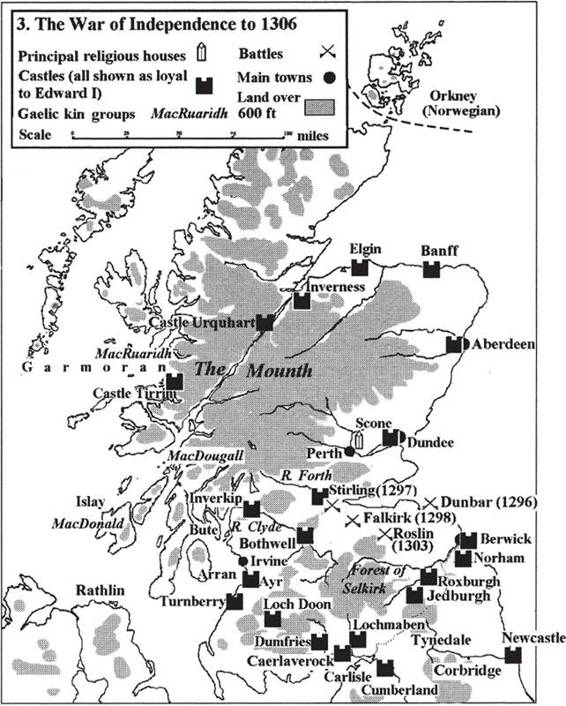
The Scottish cavalry, led by Ross, Menteith and Atholl, meanwhile raided Northumberland, but when the two main hosts engaged at Dunbar on 2 April there could be no doubt as to which would prevail. Edward I’s cavalry, commanded by John, Earl Warenne, and seasoned in recent Welsh and Gascon campaigns, overwhelmed the flower of Scottish chivalry and slaughtered the infantry. The English foot sang rowdily of their victory, and jeered at the Scots for robbing the corpses of nobles on the battlefield:
The foot folk
Put the Scots in the poke,
And bared their buttocks.
By the way
Never heard I say
Of readier boys
To rob
The robes of the rich
That fell in the field.
They took of each man;
May the rough ragged fiend
Tear them in hell!
After this shattering defeat there was very little resistance except in the west. There Highlanders, under Alexander MacDougall, Lord of Lorn, had to be quelled by an expedition from Ireland. Otherwise, Scotland was too shocked to resist. That summer Edward spent in making a stately progress through the towns and castles of the east coast, taking control of Edinburgh after a week’s siege, then Stirling, Perth, Aberdeen, Banff, and even reaching Elgin late in July. Edward insisted upon an abject surrender from King John, and obtained it. Ceremonially King John was stripped of regality, and became known as ‘Toom Tabard’. The nickname – ‘the empty surcoat’ – conveyed that John had become a nullity, or perhaps in modern English a ‘stuffed shirt’. The kingdom was handed over to Edward I as overlord, and John, the unmade king, was sent south as a prisoner to the Tower of London. The earls of Atholl, Ross and Menteith were also sent into captivity, along with John Comyn the younger of Badenoch. Lesser prisoners were sent to other castles in England. Almost one hundred Scots of the gentil classes were made prisoner; many to be released on payment of a ransom or sureties, others of higher rank imprisoned partly to impress upon them the force of Edward’s lordship, partly to guarantee good behaviour from their tenants or kinsmen, and partly as trophies to impress and gratify the English.
The treasury, jewels, plate and regalia of the kings of Scotland were loaded onto baggage trains for England, but trophies of another sort were also captured. These were the sacred relics of the kingdom: the Black Rood of St Margaret, a jewelled relic case containing a piece of the cross of Christ; and the Stone of Destiny, on which Scottish kings had been enthroned time out of mind. In English towns and cities the mobs were jubilantly reciting anti-Scottish lampoons and scurrilous jeering songs, recorded in the chronicle of Peter Langtoft:
The sorcery
Of Albany
Cannot prevail.
[St] Andrew is dead,
Or he sleeps at the minster.
Their king’s seat of Scone
Is driven over downs
Carried to London.
Edward was interested in acquiring the magical properties of these objects for himself and his dynasty. In the past he had acquired the most sacred of Welsh relics, a fragment of the true cross called Y Groes Naid or the ‘Cross of Neath’ and the crown of Arthur, and had paraded them through the streets before adding them to the shrine of St Edward the Confessor, the saint whom Edward regarded as his spiritual mentor. He had brought the ‘Cross of Neath’ with him on his triumphal journey through Scotland in 1296, and he obliged Bishop Wishart to swear fealty to him on that very relic. To Wishart, Scotland’s leading churchman and patriot, the message was clear: Edward had appropriated to himself all the power of Scotland, temporal and spiritual, as he had already appropriated that of Wales.
It was just as important to send out an unmistakable signal to the Scots that there would be no subsequent Scottish king unless Edward consented. He decided to rule Scotland as ‘superior lord’, without intermediary, and through mere officials. With the war won and Scotland’s humiliation complete, Edward was delighted to pass over responsibility for Scotland to a lieutenant. Warenne was appointed, and as he tossed Warenne the great seal of Scotland Edward cheerfully remarked, ‘When you get rid of a turd, you do a good job.’ At the August 1296 parliament in Berwick an ordinance for the government of Scotland was drawn up, detailing how Edward would henceforth rule the kingdom.
What then of the Bruces? Bower records, and we have no reason to doubt it, that Robert Bruce VI chose an opportune moment, approached Edward I and delicately reminded him that, now the Balliol claim to the throne had been overthrown, as runner-up in the Great Cause he was in line for employment as vassal-king of Scotland. This demeaning request elicited the richly deserved and crushingly scornful response, ‘Do you think I have nothing better to do than win kingdoms for you?’