
The Third Restoration
_____________
‘Henri V will never abandon the flag of Henri IV’
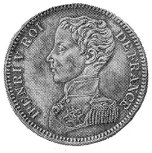
There are some kings who never reigned, whom history none the less calls King. James III of England and Louis XVII are familiar enough. Henri V is less well known.
Many contemporaries saw the Revolution of 1830 as a French version of the English Revolution of 1688, equating the Bourbons with the Stuarts, and in many ways Legitimism, the creed of those loyal to the Bourbon dynasty, was a kind of French Jacobitism. Its supporters included every Frenchman who loved the old kings and the old religion, while it had all the poignant romance common to great lost causes of the Right. But for many years Legitimism was very far from being a lost cause. For France did not finally make up her mind what sort of government she really wanted until the very end of the nineteenth century. In 1830, even Liberals like Stendhal thought a republic ‘a horrible condition anywhere else than in America—’tis the real cholera morbus’; and without Louis Philippe and the division among Royalists, France would almost certainly have remained a monarchy into the present century. Fervent Legitimists believed that Heaven would not allow the Orleanists—‘the regicide dynasty’—to keep the throne they had stolen, and all good Catholics prayed hopefully for a Third Restoration.
Furthermore, besides the simple creed of the Dukes and country squires, there was also an intellectual Legitimism. Balzac, Vigny, Gustave Doré and later Taine, Renan and even Pasteur, were all Legitimists. Taine and Renan, who were ‘scientific’ historians, launched a powerfully argued attack on the entire philosophy of the Revolution and on the whole cult of reason and democracy (which had been accepted by Orléanism).
Henri - Charles - Ferdinand - Marie - Dieudonné d’Artois de Bourbon, Duc de Bordeaux, styled Comte de Chambord and known to his followers as King Henri V, had been born in 1820, the son of the murdered Berry. Fatherless, forbidden to see his mother after her disgrace in 1832, deprived of his adored grandfather in 1836, Henri spent his youth in Austria in the midst of fanatical Ultra exiles. His aunt d’Angoulême filled him with tales of her martyred parents, while Jesuit tutors—arch-reactionaries in the nineteenth century—instilled an uncompromising piety into the boy, as well as some rather slanted history. He grew up unused to being contradicted, for his courtiers still followed the old etiquette, and it is hardly surprising that he acquired too much faith in his own judgement. The old King had been a father rather than a grandfather to him, and fundamentally Henri’s political convictions were those of Charles X: later he derided ‘sterile parliamentary confrontations from which the sovereign usually emerges so weakened as to be all but powerless’. Above all, he grew up to be a Catholic of the penitential sort, expecting affliction rather than mercy from his God; his natural haughtiness was tempered by genuine humility. He was devout to the point of mysticism, a faithful husband and a loyal friend. Of all his dynasty, he resembled most his great-grandfather—the Dauphin Louis, son of Louis XV.
In appearance, Henri V was the short, stout sort of Bourbon, his face that of a man of sorrows, mournful and austere. Apart from brilliant, piercing eyes, a heavy beard and a curious hairiness, his chief characteristic was a pronounced limp due to a riding accident when he was twenty-one. In manner he was unmistakably regal, though reserved and silent. He undoubtedly possessed what is nowadays known as ‘charisma’.
In 1843 the King set out on a long European tour, arriving in England later that year, much to Queen Victoria’s emotion. He stayed in Belgrave Square, from where he issued a manifesto: Legitimists sang Vive Henri Quatre under his window while he received their leaders. In 1846—after a sad little romance with a Russian Grand Duchess, broken off by order of the Tsar—he married a Habsburg, Archduchess Marie Theresa, daughter of the Duke of Modena. She was a tall, angular old maid, three years older than he, soured by premature deafness, arrogant and blindly reactionary in her political and religious views, and with a deep distrust of the pagan French (whose language she spoke with a peculiarly ugly accent). They were to be childless.
Henri’s sister, Mademoiselle, had left him the year before to marry their cousin, the future Charles III of Parma. The young Duke was assassinated in 1854, whereupon Mademoiselle became Regent for her six-year-old son, Robert I. But in 1860 even Parma was lost to the Bourbons, when theRisorgimento swept Robert off his throne and incorporated the Duchy into the new Kingdom of Italy. Poor battered Mademoiselle died four years later.
After the ‘Revolution of Contempt’ had ejected Louis Philippe and his Bourgeois Monarchy in 1848, and during the subsequent reaction, the majority in the French Assembly was divided between Legitimist and Orleanist deputies. A group of the former went to meet Henri at Wiesbaden to discuss the situation with him, but no positive policy emerged. Legitimist officers planned a coup d’état for 1849, but it never took place. In the event, Louis Napoleon took advantage of the Royalists’ disunity to give the French the strong monarchy which they sought and set himself up as Napoleon III. But the tawdry Opèra Bouffe world of the Second Empire, with its crowned adventurer, its flash court and its foreign business barons, thoroughly disgusted the Legitimists, and indeed many other Frenchmen as well.
The Legitimist party was both well supported and well organized. There were three sorts of Legitimist. First, men of action like the Duc des Cars and General de Saint-Priest, who would have liked a coup d’état. Then the parliamentarians, such as Pierre-Antoine Berryer, a golden-voiced lawyer from Lorraine who was called ‘the tribune of the monarchy’. Although of bourgeois origin, he was the idol of the French nobility on account of his wonderful speeches: Emile Olivier (Napoleon III’s ‘liberal’ prime minister) said, ‘He who has never heard Berryer speaking on one of his good days, does not know what oratory is.’ Berryer hoped for a decentralized constitutional monarchy. Decentralization—and hatred of Paris—was one of the inspirations of the third group, the populist Legitimists, who tried to forge a kind of radical Tory alliance with the Republicans; they were led by the Marquis de Rochejacquelein, who advocated universal suffrage. Some of these democratic noblemen even went so far as to argue that true virtue was to be found only in peasants.
These three Legitimist groupings were co-ordinated by a high command in Paris which was appointed by the King. The Bureau du Roi consisted of twelve devoted noblemen who met once a week under the chairmanship of the Duc de Levis or the Duc des Cars—or later, the Marquis de Dreux-Brézé (one meets again all the old names so familiar under the Ancien Régime and during the Restoration). Besides laying down guidelines for policy, the Bureau also organized fund-raising, with gratifying results: despite their lamentations, the upper ranks of the French nobility had remained surprisingly wealthy. At local level there was a network of clubs and secret societies: in some instances, Freemasons’ Lodges were actually taken over. There was even a Legitimist news agency, founded in 1848 by a M de Saint-Chéron; the Correspondance Saint-Chéron sent out well-composed press releases to newspapers all over France.
From the 1840s to the 1870s, the Legitimist party was probably the best organized and best disciplined political opposition in French history. Another Louis XVIII would have regained his throne easily in 1849 or after 1870. Alas, Henri V was incapable of being a politician. In a sense he was not even a Legitimist—to himself and to his more deluded followers he was simply the re-incarnation of la vieille France, a formula which was hardly an election winner. Legitimist leaders complained respectfully but bitterly of their King’s lack of leadership.
Henri lived happily enough in his castle at Frohsdorf (in Upper Austria, near Salzburg) with a little court of devoted friends headed by Blacas’s son, where he was treated with simple yet impressive etiquette. He hunted and shot and played his whist and attended Mass, just as his grandfather had done, his chief pleasure being his beautiful grey horses. He was fond of his charmless, sterile wife, who loved him deeply. A romantic whose favourite authors were Dumas and Chateaubriand, his fantasies of Old France were far preferable to the reality. Only if the country which had beheaded his great-uncle, rejected his grandfather, murdered his father and disgraced his mother, begged him humbly to return, would he contemplate ascending the throne of his ancestors. He wanted no coups d’état, no Vendées, no counter-revolutions; everything must be left to Divine Providence. With his Wagnerian isolation, dreaming medieval dreams in his lonely turrets, he has been compared to the Bavarian Ludwig II at Neuschwanstein.
The extraordinarily unreal atmosphere of his court was typified by the elder Blacas. When the old Duke died in 1839, he left instructions for his body to be buried at the feet of Charles X, in the best traditions of thirteenth-century French chivalry. This mock-medievalism was to be the ruin of the Legitimist cause.
However, Henri made a political move in 1859, when the Risorgimento threatened the Papal States. He announced that he was ready to ‘pay with his blood for a cause which was that of France, the Church and God’. There was an enthusiastic response to his appeal. Legitimist volunteers flocked to the Pope’s army to become the redoubtable Zouaves Pontificales, who fought beneath the Bourbon Lilies; a detachment from the Vendée was only dissuaded with difficulty from wearing the Crusaders’ cross.
Then, unexpectedly, Napoleon III was utterly defeated by the Prussians at Sédan on 2 September 1870, and a provisional republic was proclaimed two days later. In the general election of February the following year, the Right triumphed—180 Legitimists were returned, together with over 200 Orleanists and 30 Bonapartists, to be faced by only 200 Republicans who were split into moderates and extremists. The Left were thrown into even more disorder in the spring by the Communards’ Revolution in Paris, and by its savage repression. All that stood in the way of a restoration was the President, Adolphe Thiers, who had been prominent in bringing down Henri’s grandfather and who believed that a republic ‘would divide Frenchmen least’; and the disunity of the monarchists.
One should not forget how alarming the idea of a republic must have seemed to many Frenchmen in 1871. The only European republic which then existed was Switzerland, while memories of the Revolution and of 1848 and its riots, and the recent and bloody experience of the Commune, did not inspire confidence among moderates. Furthermore, conservatism was strengthened by the current Catholic revival, a kind of moral rearmament which expressed itself in huge pilgrimages and in building a great basilica at Montmartre to atone for the sins of France.
The law which exiled the Bourbons was repealed. Henri returned briefly to France in 1871, spending three days at his château of Chambord. Here he issued a proclamation declaring that, while he would never abandon the Lilies—‘I will not let the standard of Henri IV, of François I, of Jeanne d’Arc, be torn from my hands’—he was ready to accept parliamentary government. He then left France. The Orleanists tried desperately to persuade him to make way for the Comte de Paris, but in January 1872 Henri issued a second proclamation, refusing to abdicate; in February he held a monster rally at Antwerp. The impasse between Legitimists and Orleanists lasted for another year.
On 24 May 1873 Thiers fell, manœuvred into resigning by the Right. His successor was the Franco-Irish Marshal, Patrice de MacMahon, Duc de Magente; a convinced Legitimist, he only accepted the Presidency to pave the way for a Restoration. The real power behind this honourable but simple old soldier were three Orleanist Dukes: the Duc de Broglie, Prime Minister; the Duc d’Audiffret-Pasquier, President of the Assembly; and the Duc Decazes, Foreign Minister (and the son of Louis XVIII’s darling Elie). Then the Whigs turned Jacobite: the government, ‘the Republic of Dukes’, determined to forge an alliance with the Legitimists. The latter were nearly all noblemen, a wonderfully picturesque collection from the Faubourg Saint-Germain and the depths of the countryside; some were quite ready for another White Terror, like the fanatical Chevaux-Légers or ‘Light Horse’, but there were also those like the Comte de Falloux who believed in constitutional monarchy and accepted the Tricolore. Moderate Legitimists were prepared to bargain with the Orleanists—the fact that that mainly bourgeois party was now led by Dukes facilitated negotiations—on the basis that the childless Henri should reign so long as he lived and then be succeeded by the Orleanist Pretender, who in any case was his heir presumptive. (Louis-Philippe-Albert’s descendant is the present French Pretender, Henri, Comte de Paris.)
The army was willing to support the Restoration; an officer who protested publicly was summarily retired, and there were plenty of Legitimist generals like the Marquis de Gallifet (familiar to readers of Proust) who had slaughtered the Communards with such cruel zest. Opposition was expected in many parts of France from peasants who believed that not only would tithes and feudal dues return, but that Henri V was going to bring back the legendary droit de seigneur—the nobleman’s right to every peasant girl on her wedding night. None the less, even that great Republican Gambetta thought that as a whole France was too tired of bloodshed to resist; if the peasants did rise, the troops would crush them and the government would then be congratulated for crushing anarchy.
On 5 August 1873, two distinguished visitors arrived unexpectedly at Frohsdorf. They were Louis-Philippe-Albert, Comte de Paris and Head of the House of Orleans (he was the usurper’s grandson), and his uncle the Prince de Joinville. It was a difficult moment—Henri’s consort was known to bear a hatred for the Orleans amounting to mania. The Count, who looked more like a German professor than a French nobleman, hesitated when Henri V entered the room, then bowed and greeted his cousin as his King. Henri embraced him. ‘You were quite right to come here privately like this without waiting,’ he said. ‘The Bon Dieu will reward you.’ The Count, whom he now acknowledged as Dauphin, was in his mid-thirties and had as much practical ability as the King possessed idealism and honour—he had even studied English trade unionism. Shortly after his visit to Frohsdorf, the Comte de Paris publicly recognized Henri as ‘the sole representative of the monarchic principle in France’.
On the evening of 14 October a delegation headed by the Legitimist M Pierre Chesnelong—not a nobleman oddly enough, but a successful draper—met their King in a little pavilion in the garden of a hotel at Salzburg. During a pleasant dinner party, full agreement was reached on universal suffrage and ministerial responsibility. But then Henri announced grimly, ‘I will never abandon the White Flag,’ M Chesnelong, a glib Gascon, made his famous reply, ‘Your Majesty must allow me not to have heard those words.’ After an hour’s argument, the King reluctantly agreed that theTricolore could remain the flag of France until after the Restoration, when he would refer the matter to the Assembly. Chesnelong returned in triumph with the wonderful news that an agreement had been reached, not only on the constitution but on the flag.
Everyone was now convinced that the King would have his own again. The President of the Assembly, the Duc d’Audiffret-Pasquier, declared triumphantly on 18 October, ‘In three weeks the national, hereditary and constitutional monarchy will be established.’ The Faubourg Saint-Germain ordered court dress, while coaches prepared for the Most Christian King’s joyeuse entrée into ‘his good city of Paris’ may still be seen at Chambord. Daniel Halévy writes of ‘an amazing rally of la vieille France, of the old nobles, of Dukes and country squires, of priests and heralds’. It was the French nobility’s final fling.
On 31 October 1873, on Henri’s orders, the Legitimist newspaper L’Union published a letter which he had written to M Chesnelong. The King could not abandon the White Flag. ‘I cannot agree to open a strong and healing reign by an act of weakness,’ he explained. ‘It is the fashion to contrast the stubbornness of Henri V with the flexibility of Henry IV … but I wish to remain just what I am.’
As a boy, Henri had seen the French army march off under the White Flag to conquer Algiers. With his contempt for Bonapartism, he was incapable of understanding that a new military tradition had grown up since he had left France, based on glorious victories in Italy and the Crimea, in Africa, China and Mexico, and on heroism in defeat during the martyrdom of 1870. All these campaigns had been fought under the Tricolore.
Marshal MacMahon, who had served beneath the Lilies as a young man, was thunderstruck by Henri’s decision. He said that if the army was forced to fly the White Flag, ‘the chassepots [rifles] would go off by themselves!’ Broglie decided that the only thing left was to introduce a bill extending the Marshal-President’s powers for seven years, the Septennat, in the hope of at least saving conservative government. The Third Restoration was over. As the Pope, Pio Nono, wryly observed, ‘Whoever heard of a man giving up a throne for a napkin?’
Then followed an incident as romantic as anything in those novels by Alexandre Dumas which the King enjoyed so much. The Assembly sat at Versailles, and there Henri arrived secretly on 10 November, accompanied only by his valet, to stay at a small house in the rue Saint-Louis. (He had to bring his valet, as he had never learnt how to tie his own tie.) His faithful gentlemen, the Duc de Blacas and the Marquis de Dreux-Brézé, joined him and were informed of an amazing scheme. He would appeal to MacMahon as a French nobleman, tell him to bring a cavalry brigade, then together, arm-in-arm à la Française, they would go into the Assembly, who would proclaim Henri King. Poor Blacas went to the Marshal with the preposterous plan, asking him to call on his master, by night if necessary, and leaving the key of the house in the rue Saint-Louis; obviously a King could not call on a subject. But MacMahon had taken an oath to the Assembly, and his honour would not let him break it. Henri waited in vain, before saying sadly, ‘I expected a Constable of France but I find only a Chief of Police.’ On 19 November, the Assembly voted for the Septennat—a tacit rejection of the monarchy. There is a legend that, disguised in a voluminous cloak, the King waited during a grey and misty afternoon in front of the palace, by the pedestal of Louis XIV’s statue, to hear the result.
Later a Legitimist general said, ‘If only we had known!’ But the King had left France for ever on that night of 19 November 1873, to return to his dreaming in Upper Austria. In June 1874 the Duc de La Rochefoucauld, as a last desperate step, proposed to the Assembly that the monarchy be restored; his motion was defeated by 272 notes to 79. On 30 January 1875, France became a Republic—by one vote.
King Henri, fortified by the rites of Holy Church, died at Frohsdorf on 24 August 1883 after a long and painful illness borne with much courage. He was never a bitter man, and one may guess that his last years were happier than they would have been had the Third Restoration succeeded. It is easy to blame him for throwing away the crown of France. Yet, as the late Sir Denis Brogan (hardly an admirer) writes, Henri V ‘had made, not by cowardice but by pride and dignity, the great refusal’. Professor Cobban even goes so far as to say of Henri that ‘trained as he said himself to expect nothing from God and nothing from man, free from worldly ambition or knowledge, lame, isolated, living in and for the past’, he was ‘perhaps the noblest of his line’.
It was fitting that Henri V should die childless. However magnificent in their days of glory, the Bourbons, like the dinosaurs, could not adapt to a new and alien environment. Theirs was the first great monarchy to fall before democracy, never to be restored. The failure of the Third Restoration announced the doom of all hereditary monarchies of the crowned and anointed sort, not only in Europe but throughout the entire world.