
‘That Man from Béarn’
_____________
‘I rule with my arse in the saddle and my gun in my fist’

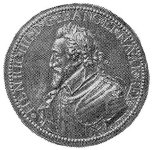
Henri IV is certainly the most colourful of French Kings. The Vert Galant killed mountain bears with a knife, fought on foot with a pike at the head of his men, ate and drank enough for ten, had sixty-four mistresses, and wished every peasant to have a chicken in the pot on Sundays. At first sight this laughing, swaggering little hero seems quite different from the Bourbons who followed him. In fact he bequeathed a surprising number of his qualities to his descendants.
Henri of Navarre was born at Pau in Béarn, on 13 December 1553. At his christening the Navarrese King, Henri d’Albret, rubbed his grandson’s lips with garlic and made him sip some wine. He enjoyed it and the old King, laughing, said, ‘You’re going to be a real Béarnais!’ Philip II always referred to Henri as ‘That Man from Béarn’. The baby was taken to a remote castle in the Pyrenees where he grew up with the local peasant children on a diet of bread, cheese and garlic, running barefoot in the mountains. He kept his southern accent—and his common touch—throughout his life. Of all the Kings of France he was the only Southerner.
His mother brought him up in the faith of Geneva. When, in 1561, Henri was taken to Paris on his father’s orders and given a Catholic tutor, he refused to go to Mass. After his father’s death, Jeanne reinstated the Protestant tutor; by the time he was ten Henri had changed his religion twice. He remained in Paris, attending classes at the Collège de Navarre. Eventually he was able to speak as well as write Latin and Greek with some fluency; he also acquired a knowledge of Spanish and Italian. In addition he learnt to write very beautiful French (Proust credits the Duchesse de Guermantes with writing ‘le français exquis de Henri IV’.) In 1567 he rejoined his mother and his sister Catherine at Pau. His education continued, including no doubt instruction in fencing and the military arts. Relaxations were tennis—there was a magnificent court at Pau—swimming, hawking and, above all, hunting, which was one of the great passions of his life. He also learnt to dance, though, so his earliest biographer informs us, ‘with more spirit than grace’.
The First War of Religion had come to an end in 1563 but the Second broke out in 1567, to be followed by the Third in 1568. There were between half a million and a million Huguenots in France, including a large number of experienced soldiers. But the vast majority of Frenchmen were Papists and when the Counter-Reformation began, a new, fanatical Catholicism came into fashion. Apart from a few rare eccentrics who were known as the Politiques, most people thought that the only solution was conversion or extermination.
The situation was made worse by the lack of any proper royal authority. From 1559 until 1589 France had inadequate Kings—François II (the husband of Mary, Queen of Scots), Charles IX and Henri III. These three decadent sons of Henri II left the government of the realm to their mother, Catherine de Medici, whose intrigues earned her a sinister name. Years later, when she and her brood were dead, Henri had some kind words: ‘I ask you, what could she have done, poor woman, left at her husband’s death with five small children and two families in France—ours and the Guises—who hoped to get the Crown for themselves? Wasn’t it necessary for her to play some strange games, to deceive everybody, in order to protect her sons who reigned only because of her cunning? You may say she did harm to France—the marvel is she didn’t do worse!’
When the Third War of Religion broke out, King Charles threatened to invade Béarn, and Queen Jeanne and her two children had to take refuge at La Rochelle. Jeanne’s brother-in-law, Louis, Prince de Condé, commanded the Huguenot army; in March 1569 he was taken prisoner at Jarnac and shot. Although Condé’s real successor was the Admiral de Coligny, the Huguenots hailed Henri as their champion; the fifteen-year-old boy and his mother were presented to the Protestant host who cheered them heartily. However, in 1570, when both sides had fought each other to a standstill, the Huguenots’ right of public worship was restored, in a settlement guaranteed by four places de sûreté—towns with Huguenot garrisons.
Later, as a further guarantee, a marriage was arranged between Henri and the King’s sister, Marguerite de Valois. Queen Jeanne died in June 1572, before it could take place (probably of tuberculosis, though it was rumoured that she had been poisoned by Catherine de Medici’s perfumer, with gloves whose scent entered the brain).
Everyone believed that the marriage would bring peace and the great nobles of the realm, Protestant and Catholic, assembled in the capital. Henri’s bride, Marguerite de Valois, was nineteen. Brantôme wrote, ‘If in all the world there has ever been anyone perfect in beauty, it is the Queen of Navarre … and I think that all women who were, who are and who shall be are ugly next to her.’ Portraits are less flattering. None the less, ‘Margot’ danced exquisitely, spoke Greek with astonishing fluency and was an excellent theologian. She was also a byword for promiscuity. The couple did not take to each other. On 18 August they were married at Nôtre-Dame, Marguerite wearing a royal crown and an ermine cape, with a long train of royal blue borne by three princesses. The marriage was the prelude to one of the most ghastly crimes in European history.
During the wedding, Catherine de Medici was deeply distracted by matters of state. Admiral de Coligny had persuaded Charles IX to attack Spain, a war which could only be disastrous. Catherine was in despair; Catholic nobles urged the Queen to agree to Coligny’s assassination; reluctantly she yielded. The Guises, who had a father’s murder to avenge, arranged the details. On 22 August one of their henchmen shot at the Admiral from a window, but only wounded him. The Huguenots were enraged. Catherine, terrified, accepted that a general massacre was the only solution. After much browbeating, King Charles, unbalanced at the best of times, agreed, screaming, ‘Kill them all’. It was the eve of the feast of St Bartholomew.
Before dawn on Sunday 24 August 1572, the Duc de Guise’s swordsmen broke into Coligny’s bedroom. He was skewered with a pike, then his corpse was thrown out of the window to be hanged by its heels from the public gibbet. The tocsin sounded and the Paris mob was unleashed. Neither children nor pregnant women were spared—whole families had their throats cut. The Louvre was turned into a slaughterhouse, its floors and staircases strewn with dead or dying Protestants. Henri and his cousin Condé were spared only because of their royal blood; they passed a terrifying night listening to the screams of their friends. The butchery continued for several days, at least 4,000 dying in Paris. Similar massacres took place in the provinces, 10,000 more Huguenots being killed by the end of September. But their strongholds held out and the Catholic ‘final solution’ merely precipitated the Fourth War of Religion.
Henri was forced to change his faith for a third time. He remained a prisoner at court for nearly four years. During this time he played the part of a simple, self-indulgent squire, hunting and whoring. Among those of other mistresses, he enjoyed the favours of Charlotte de Sauve, a beautiful blonde whom the Queen Mother had ordered to spy on him.
In 1575 a Venetian diplomat wrote a detailed description of the young King of Navarre. Henri was ‘of medium height but very well built, with no beard as yet, brown skinned, and zestful and lively as his mother was; he is pleasant, affable and friendly in manner, and generous too, so people say. He is obsessed by hunting in which he spends all his time.’
In May 1574 Charles IX died in agony, of pulmonary tuberculosis—blood vessels burst all over his body. He was succeeded by his brother, Henri III, who for a few months had been a reluctant King of Poland. The last Valois monarch was an extraordinary figure; intelligent, cultivated and brave, he was also a homosexual and a religious maniac—transvestist orgies alternated with flagellant processions. This epicene psychopath surrounded himself with catamite ‘mignons’ whose shrill quarrels often ended in lethal duels. On the whole he left government to his adored mother.
Two attempts at escape by the King of Navarre failed. A third scheme, in February 1576, was more carefully planned, but at the end of a day’s hunting near Saint-Germain, news came to Henri that he had again been betrayed. Changing his plans, he galloped into the forest with only a few friends, though it was a freezing winter’s night. They hardly drew rein for three weeks, until they reached Protestant Saumur and safety.
In May 1576 Henri III made peace with the Huguenots of the ‘Calvinist Union’. They were given freedom of worship everywhere save Paris. A popular reaction saw the foundation of the ‘Catholic League’; La Ligue mobilized the Faithful by parishes just as the Huguenots were by presbyteries. Between these two armed camps France sank into bloody anarchy.
Henri of Navarre, now the acknowledged leader of the Huguenots, ruled almost all south-western France. However, he seldom ruled it in peace, for there were five more ‘wars of religion’. His armies were the Protestant lords and squirearchy on horseback. Until the fall of La Rochelle in 1628 these ‘razats’ rode out to do battle for the soul of France, their cropped heads and Biblical speech (the ‘patois of Canaan’) anticipating the Roundheads of the English Civil War.
Henri held his court mainly at Nérac in Armagnac—the setting of Love’s Labour’s Lost, ‘a park with a palace in it’. According to that dour Puritan, Agrippa d’Aubigné, the entire Huguenot court gave itself up to the pleasures of love. Henri could hardly be expected to remain content with one mistress. Mlle d’Ayelle, a Cypriot refugee, was succeeded by Mlle de Rebours and then by Xainte, one of Margot’s women of the bedchamber. There were also tales of a girl who starved herself and her baby to death because of Henri’s desertion, of another unreasonable lady who threw herself out of a window, and of a baker’s daughter who drowned herself. In addition there was a charcoal burner’s wife, and his groom’s doxy whom he surprised in the stable (and who gave him a mild dose of gonorrhoea). Undoubtedly there was a pathological element in his insatiable sexuality. His chief passion at Nérac, Françoise de Montmorency-Fosseuse, was only fourteen when she became his mistress in 1579, and the honour went to her head when she found herself with child. But her baby died. In 1583 Marguerite left Henri for good.
By now Henri was fully mature, a stocky, jaunty little man with a fan-shaped black beard, upturned moustaches, hair en brosse and a tanned face with a great hooked nose and an invariable grin. His clothes were stained and shabby, he spoke broad Gascon and swore horribly, and he looked altogether more like a common soldier than a King. Ebullient, mercurial, laughing or weeping as the mood took him, he joked unceasingly, relying on charm rather than majesty. During the unending cavalry raids and sieges which occupied this period of his life, he developed remarkable powers of leadership. Yet in some ways he had inherited the lack of balance of his father, King Antoine. His moods of melancholy were so extreme as to be pathological; he may well have been a manic depressive.
In January 1583 Henri at last met a woman worthy of him—Diane de Gramont, Comtesse de Guiche, known to history as ‘la grande Corisande’. A widow, she was twenty-six years old, a brunette with black eyes and a high forehead. Her friend, Montaigne, said there were few ladies in France who were a better judge of poetry. Corisande gave Henri intellectual as well as physical companionship. To her he wrote his most delightful letters, written as André Maurois says ‘with a mixture of country warmth and Gascon poetry’. Sometimes he describes the landscape and the birds, sometimes he descends to the price of fish. He sent her passionate messages, ‘loving nothing in the world so much as you … my soul, I kiss a million times those beautiful eyes which all my life I shall hold dearer than anything else in the world … I will live as your faithful slave. Good-night my soul.’ He also wrote revealingly of his savage melancholia: ‘all the Gehennas where a spirit can go are busy with mine’, or ‘until the tomb which is nearer than perhaps I realize’. He was incapable of being faithful, despite assurances that ‘believe me, my fidelity is pure and stainless—there was never its like’. Corisande can hardly have relished his sorrow at losing little Gédéon, his son by Esther Imbert (daughter of a Protestant pastor)—‘Think what it would have been like had he been legitimate.’ With his letters he sent gifts—bird’s feathers, fawns and wild boar piglets. The sheer number of his letters to Corisande shows how often he was away on campaign.
On 27 October 1587, at Coutras, Henri was forced to give battle to a greatly superior Catholic army. Henri III’s favourite, Anne, Duc de Joyeuse, had 2,500 horse and 5,000 foot—the Huguenots numbered 2,000 horse and 4,000 foot. Navarre with a river at his back could not retreat. The two armies made a strange contrast; the Catholics in gilded armour and nodding plumes; the crop-headed Huguenots in leather jerkins and plain steel. Joyeuse launched a headlong frontal attack, his glittering cavalry only two deep. Henri had mixed musketeers with his cavalry and sited his three cannon where they could do most damage. The enemy were mown down, then three Huguenot squadrons, each six deep, rolled them back. Henri, with his white plume and white scarf, led one squadron—his sword was red with blood. His followers were not so merciful; 5,000 Catholics were slain, including Joyeuse himself. The victory cost Henri only forty casualties.
He at once galloped off to present Corisande with the captured standards, disappearing for three weeks. He then informed his horrified followers that he had promised to marry her. Fortunately his gentleman-in-waiting, Agrippa d’Aubigné, made him realize that such a match would destroy any chance of inheriting the throne. Henri agreed not to see Corisande for two years. In the event he never saw her again. It was one of the very few occasions when Henri brought himself to resist a mistress.
After losing his army at Coutras, Henri III was at the mercy of the Catholic League. The Seize, a junta of fanatic Catholic bourgeois, controlled Paris. Against the King’s express orders, Henri, Duc de Guise, made a triumphant entry into Paris in May 1588. The Duke was the hero of the Catholic mob—among the League it was openly argued that he would make a better King than the Valois, that he had a better right to the throne by virtue of his descent from Charlemagne. Henri III fled to Blois. He saw only one solution: at dawn on 23 December 1583, Henri de Guise was stabbed to death in the royal bedchamber, by the King’s personal bodyguard, the Forty-five; the following day his brother, the Cardinal de Guise, was hacked to death by halberdiers. The League reacted with fury, mobs howling for revenge. King Henri discovered that he had alienated the greater part of his subjects and now ruled only a few towns in the Loire valley.
Inevitably he turned to his cousin of Navarre. They joined forces, after a public reconciliation and soon controlled the entire area between the Loire and the Seine. On 30 July they besieged Paris, with an army of 40,000 men. But on 1 August a Dominican friar, Jacques Clément, obtained an audience of the King and then stabbed him in the stomach, with a knife which he had concealed in his sleeve. The wound did not at first seem mortal. However, the King died during the night, after ordering his followers to take an oath of allegiance to Henri of Navarre.
Henri was King of France, but only in name. Most of the country was ruled by warlords, and everywhere the nobles robbed the bourgeois and harried the peasants, while the countryside swarmed with bandits. The League proclaimed as king Henri’s uncle, the aged Cardinal de Bourbon, and struck coins in the name of ‘Charles X’; but their real champion was the Duc de Mayenne (Guise’s brother) who secretly hoped for the throne. A mere sixth of France supported Henri. His army dwindled every day—not many Catholics would fight for a heretic King who had been excommunicated. His only chance was to be a Politique, to appeal to those who preferred peace to religious war. Some years before, he had written to a friend, ‘those who follow their conscience belong to my religion—my religion is that of everyone who is brave and true.’ But while the Baron de Givry might fling himself at Henri’s feet, crying, ‘You are the King for real men—only cowards will desert you’, there were not many men like Givry.
Meanwhile, Henri withdrew to Normandy with 7,000 troops, from where he could control the districts on which Paris depended for food, setting up his headquarters at Dieppe. Here he could obtain supplies and munitions from England. Mayenne pursued him, with 33,000 men. The odds were nearly five to one, and Henri’s staff advised him to sail for England. Instead the King prepared an impregnable position. The road from Paris approached Dieppe through a marshy gap between two hills—on one side was the castle of Arques, on the other earthworks and trenches. Henri placed his arquebusiers and Swiss pikemen in the trenches and drew up his cavalry behind them; heavy cuirassiers armed with pistols but accustomed to charging home with the sword.
The Catholic cavalry were old-fashioned lancers who charged in widely spaced lines. Their commander, the Duc de Mayenne, was a strange figure, enormously fat, too fond of food and wine, gouty and tortured by venereal disease, who passed his days in a sluggish torpor, frequently retiring to bed. His staff were as idle and unbusinesslike as their commander. None the less, he lacked neither ambition nor courage.
The morning of 21 September 1589 was misty. When Mayenne attacked the trenches in the Arques defile, the mist prevented the castle’s guns from firing. The Catholic pikemen overran Henri’s first line of trenches and the Catholic cavalry attacked on both flanks. When his front was on the point of disintegrating, Henri galloped up, shouting ‘Are there not fifty noblemen of France who will come and die with their King?’ His cavalry held the enemy—the Royalist foot rallied. Then the mist lifted and the castle batteries opened fire. The Leaguers withdrew hastily and Henri retook all the lost ground. Mayenne realized that he was facing a most formidable general. Some days later, news came that reinforcements were on their way to Henri—more Huguenot troops and an English expeditionary force. After another halfhearted engagement, the Duke withdrew.
Having taken the measure of his opponent, Henri was anxious to bring him to battle again. As bait he laid siege to Dreux. Mayenne advanced to its relief with 15,000 foot and 4,000 horse, and on 14 March 1590 engaged the King at Ivry. Henri had 8,000 infantry and 3,000 cuirassiers. A white plume in his helmet and a white scarf round his armour, he prayed before his troops—then he told them that, whatever happened, they must follow his white scarf. In the centre, he led his cuirassiers to crash into Mayenne’s lancers, through whom they hacked and pistolled their way. All along the line the Royalists hurled back the enemy cavalry until they disintegrated, fleeing, abandoning their infantry to be shot down by Henri’s arquebusiers. In his flight, Mayenne ordered the bridge at Ivry to be broken down behind him, cutting off many of his men from any hope of escape. The King ordered his exultant followers to spare Frenchmen but to give foreigners no quarter. Three thousand Leaguer foot and 800 cavalry died—nearly a hundred standards were taken.
In May he besieged Paris with 15,000 men, but the capital remained fanatically Catholic—even monks and friars took up arms. Rather than shed Parisian blood, Henri decided to starve the city into submission. (He is said to have passed his time debauching two young nuns, whom he afterwards made abbesses.) By July Paris was starving, horribly. There were cases of cannibalism—children were chased through the streets. People ate dead dogs, even the skins of dogs, together with rats and garbage. Some made flour from bones; those who ate it died. Thirteen thousand perished of hunger. At midnight on 27 July the King launched a general assault on the suburbs, but it was beaten back; despite its sufferings, Leaguer Paris was not prepared to surrender to a heretic King. Early in September it was relieved by the Duke of Parma, who ferried food across the Seine to the stricken city. Disconsolately the King withdrew, to winter in northern France. Many Royalist squires rode home.
It was in these gloomy days that Henri met Gabrielle d’Estrées. She was seventeen (Henri was thirty-seven), the daughter of a Picard nobleman, a plump, round-faced pink and white blonde who liked to dress in green. Gabrielle already had a lover, the sallow-faced Duc de Bellegarde (known asfeuille morte—dead leaf). Rivalry drove the King into a frenzy. He showered letters on his ‘belle ange’—‘My beautiful love, you are indeed to be admired, yet why should I praise you? Triumph at knowing how much I love you makes you unfaithful. Those fine words—spoken so sweetly by the side of your bed, on Tuesday when night was falling—have shattered all my illusions! Yet sorrow at leaving you so tore my heart that all night long I thought I would die—I am still in pain.’ He wrote a poem, Charmante Gabrielle, and had it set to music. Eventually the affair went more smoothly. In the autumn of 1593 Gabrielle found herself enceinte with the King’s child, the future Duc de Vendôme.
Meanwhile, after the setback at Paris, Henri’s star had begun to rise again. In the summer of 1591 he was reinforced by English troops. For a time these were commanded by Queen Elizabeth’s young favourite, the Earl of Essex, to whom Henri showed himself especially amiable. Sometimes relations were strained: Sir Roger Williams, being rebuked for his men’s slow marching pace, snapped back that their ancestors had conquered France at that same pace. Even so, many Englishmen took a strong liking to Henri IV. In 1591 Sir Henry Unton, the English ambassador, wrote of him: ‘He is a most noble, brave King, of great patience and magnanimity; not ceremonious, affable, familiar, and only followed for his true valour.’
Sully tells us that Henri’s life on campaign was so exhausting that sometimes the King slept in his boots. Unton grumbled, ‘we never rest, but are on horseback almost night and day.’ None the less, Henri continued to hunt whenever possible.
The League was splitting into many factions. The Cardinal King, ‘Charles X’ had died in 1590, since when they had been unable to agree upon even a nominal candidate for the throne. The most formidable Catholic contender was the Infanta Isabella, daughter of Philip II of Spain—Guise, son of the murdered Duke, was to be her consort.
In November 1591 the Royalists beseiged Rouen. Henri, hearing that Parma was on his way to its rescue, galloped off with 7,000 cavalry to stop him. On 3 February 1592, at Aumâle, he unexpectedly made contact with the Spaniards and had to beat a hasty retreat after being wounded by a bullet in the loins; he was carried in a litter for several days. Unton commented gloomily, ‘We all wish he were less valiant.’ Parma relieved Rouen in April. However, he and Mayenne were trapped by Henri at Yvetot. When all seemed lost for them, Parma—who had been wounded—rose from his bed and evacuated his troops over the Seine by night. This great general then returned to the Low Countries where he died at the end of the year, his wound proving mortal.
One must admit that Henri IV lacked calibre as a soldier, compared with Parma. Though capable of fighting a defensive battle, as at Arques, the King was primarily a cavalry man—all his victories were won by the charge. His instincts as a captain of horse always came before his duty as a commander.
During 1592 Henri, the League and Philip II accepted a stalemate. The Tiers Parti, a combination of Politiques and moderate Leaguers, now asserted itself. Their solution was that Henri should turn Catholic. More and more Huguenots were willing to settle for aPolitique monarchy—many urged the King to let himself be converted. After carefully counting his followers’ reactions, Henri, in white satin from head to foot, was received into the Roman fold at Saint-Denis, on 23 July 1593. This conversion has too often been seen as an act of cynical statesmanship, summed up in the phrase ‘Paris vaut bien une messe’ (there is no proof that he ever said it). In fact Henri wept over the gravity of the step. Since childhood his personal beliefs had been fought over by the kingdom’s most persuasive theologians, and he must have become hopelessly confused. Within a fortnight, towns all over France were declaring for Henri, and on 25 February 1594 he was crowned King in Chartres Cathedral. The impact upon France was extraordinary—Henri’s putting on the Crown was accepted as both sacramental confirmation and seal of legality.
On 18 March Henri entered Paris, sold to him by its governor, the Comte de Cossé-Brissac. The same afternoon the Spanish troops marched out of Paris. Henri watched them, saying, ‘My compliments to your King—go away and don’t come back.’
The warlords still controlled most of France—Mayenne Burgundy, Joyeuse the upper Languedoc, Nemours the Lyonnais, Epernon Provence, and Mercoeur Brittany. But the bourgeoisie rallied to Henri. Town after town rebelled against the magnates; at Dijon, led by their mayor, armed citizens overcame Mayenne’s troops and handed the town over to the Royalists.
Paris was still dangerous. Early in 1595, a young scholar, Jean Chastel, attacked Henri with a knife. Always agile, Henri recoiled so quickly that he escaped with only a cleft lip and a broken tooth.
At the beginning of 1595 Henri formally declared war on Spain. He had not done so before, to avoid the onslaught of Philip II’s full military might, which was still directed against the Dutch. Soon the Spaniards were invading France on five fronts. In June Henri, operating in Burgundy, nearly lost his life in a cavalry skirmish at Fontenay-le-Français. With a small force of cavalry he found himself surrounded by the entire Spanish army. An enemy trooper slashed at him and was shot down only just in time by one of Henri’s gentlemen. Luckily, reinforcements came up and the Spaniards withdrew. Henri wrote to his sister Catherine, ‘You were very near becoming my heiress.’
In September 1595 Clement VIII at last agreed to give Henri absolution (officially he was still excommunicated). Six days later Mayenne negotiated a truce with Henri; in return for his submission he received three million livres and the governship of the Ile de France. Soon, of the warlords, the Duc de Mercoeur in Brittany alone remained. Elsewhere every important French city had recognized Henry IV by the summer of 1596.
But Philip II continued the war implacably. Henri was desperate for money: in April 1596 he wrote to Rosny (the future Duc de Sully) that he had not a horse on which to fight nor a suit of armour. ‘My shirts are all torn, my doublets out at elbow, my saucepan often empty. For two days I have been eating where I can—my quartermasters say they have nothing to serve at my table.’ The King summoned the old feudal Assemblée de Notables to meet at Rouen in October 1596—nineteen from the nobility, nine from the clergy and fifty-two from the bourgeoisie. He invited them to share the task of saving France, in a tactful and flattering speech, and the necessary supplies were voted. Even so the war was far from won. In 1597 Amiens, capital of Picardy, was captured by the Spaniards. It was a severe loss, as not only was the town the centre of Franco-Flemish trade, but also a supply depot filled with munitions. Henri in person led an army to recapture it. ‘I will have that town back or die,’ he promised. ‘I have been King of France long enough—I must become King of Navarre again.’
During his siege of Amiens, Henri reorganized the army. He placed the three veteran corps of Picardy, Champagne and Navarre (also known as Gascony) on a permanent basis, together with that of Piedmont and new regiments from the northern provinces, each of 1,200 picked musketeers and pikemen. There were also the Royal Guards and the various regiments of mercenaries, Swiss and German. His 4,000 Gendarmes d’Ordonnance provided the heavy cavalry.
Amiens surrendered on 25 September. Elsewhere the Spaniards were failing. The Dutch, still fighting the Spanish, were increasingly successful. Another Spanish Armada, destined for Ireland, was destroyed by storms. In March even Mercoeur surrendered. King Philip, in failing health, despaired and, on 2 May 1598 a treaty was signed at Vervins, by which France retained the frontiers of 1559 and regained any towns occupied by the Spaniards. (Queen Elizabeth of England was so furious that she called Henri the Anti-Christ of ingratitude.)
Henri had also taken steps to ensure peace at home. The Edict of Nantes, promulgated in April 1598, gave the Huguenots liberty of conscience and guaranteed their safety with 200 fortified towns maintained at the Crown’s expense, though defended by their own Protestant garrisons. The Edict was not quite the triumph of common sense over bigotry that it seems to modern eyes. In reality it was little more than an armed truce. Protestant France could muster 25,000 troops led by 3,500 noblemen who constituted an experienced and highly professional officer corps. An English observer, Sir Robert Dallington, noted: ‘But as for warring any longer for religion, the Frenchman utterly disclaims it; he is at last grown wise—marry, he hath bought it somewhat dear!’ France could simply not afford another civil war. Even so Henri had to bully the Parlements into registering the Edict.
Henri IV was now undisputed King of a France which was at peace for the first time for nearly half a century. At last he was able to enjoy Paris. He acquired new friends, like the fabulously rich tax farmer, Sebastien Zamet, an Italian from Lucca, who had begun his career as Catherine de Medici’s shoemaker and then made his fortune as court money-lender. The King often dined and gambled or gave little supper parties for his mistresses in Zamet’s hôtel in the Marais. Gabrielle became a familiar figure in the capital. She accompanied the King everywhere; they rode together hand in hand, she riding astride like a man, resplendent in her favourite green, her golden hair studded with diamonds; she presided over the court like a Queen. As tactful and kindly in manners as she was warm-hearted and generous by nature, Gabrielle had the miraculous gift of making no enemies. She had born Henri several children, notably César whom the King made Duc de Vendôme. Gabrielle was given increasingly greater rank, eventually becoming a Peeress of France. Henri’s love deepened every day. Eventually he decided to marry her. In token of betrothal he gave her his coronation ring, a great square-cut diamond.
Henri left her briefly in April 1598, when she was again big with child. Her labour began on Maundy Thursday, accompanied by convulsions. On Good Friday, her stillborn child was cut out of her; she suffered such agony that her face turned black. She died the following day, of puerperal fever. Henri buried her with the obsequies of a Queen of France—for a week he wore black, and then the violet of half-mourning. He wrote to his sister, ‘The roots of love are dead within me and will never revive.’
Perhaps fortunately for his sanity, he was soon busy with Savoy. Its Duke, Charles Emmanuel, who dreamt of restoring the ancient Kingdom of Arles, delayed the surrender of Saluzzo and intrigued with Henri’s courtiers; there was even a plot to poison the King. In late 1600 Henri invaded the Duchy. Snow made it a difficult campaign and Henri complained of the hardship—‘France owes a lot to me, for what I suffer on her behalf.’ By the peace of Lyons, signed in January 1601, Henri gained Savoyard territories on the Rhône which all but blocked communications between the Spanish Netherlands and Spain’s possessions in northern Italy. It was the end of Henri’s career as a soldier. Few monarchs have handled a pike or pistolled their way through a cavalry mêlée with such gusto.
He now had the task of rebuilding his ruined kingdom, a land of deserted villages and overgrown fields, of roads infested by highwaymen. Henri has been criticized for not giving France a new system of government and for restoring the traditional structure, theAncien Régime which went down in 1789. But this is to ask that he should have been a man before his time. His education and outlook were those of the later Renaissance, not of the Enlightenment, and the Renaissance always looked to the past.
His chief minister was Maximilien de Béthune, Baron de Rosny, whom he made Duc de Sully and a Peer of France. Born in 1560, Sully belonged to the lesser nobility of Picardy and was a Huguenot. Bald, with a long beard like a patriarch, eccentric, avaricious and ill-mannered, he was also tireless in his master’s service. He and he alone was able to work the archaic taxation system.
Henri’s first concern was to tame the nobility, and he waged merciless war on the robber barons who plagued France. It took a full scale cavalry battle to defeat ‘Captain Guillery’s’ band of outlaw noblemen in 1604. In 1607 the King lent cannon to a gentleman whose daughter had been abducted by a neighbour, so that he could batter down the walls of her kidnapper’s château. He forbade nobles to ride over ripening crops. Formerly, provincial governorships had been tantamount to semi-independent fiefs, but Henri insisted on appointing every town governor and garrison commander. To the Duc d’Epernon who objected he wrote, ‘Your letter is that of an angry man—I am not so yet and I pray you don’t make me.’ Fear of the over-mighty subject also dictated his harsh treatment of his sister, Catherine, now an eccentric old maid who had clung stubbornly to her Protestant faith, and still hoped to marry her cousin, the Comte de Soissons. Henri forced her to marry the Duke of Lorraine, who refused to allow her to practise her religion. Poor Catherine died three years later, ‘of sadness and melancholy’.
In 1599, he met the last of his three great concubines, Henriette d’Entragues, daughter of the Governor of Orléans. A slim brunette, with a disturbing bosom and flashing black eyes, she at once infatuated Henri with her provoking airs and savage wit. She was a girl who knew just how to exploit the King’s wild jealousies. He had been ready to marry Gabrielle d’Estrées, so she saw no reason why he should not make her his Queen instead. She blew hot and cold until at last Henri, frantic with lust, literally bought her from her father with the title of Marshal (although the man had never seen a battle), a large down payment in cash and a written promise that, should Henriette have a son by him, he would marry her as soon as he was divorced. A furious Sully sent the money in silver—it took many cartloads to deliver it.
However, Henri was just as capable of playing a double game in love as in war. When Rome obligingly annulled his marriage to Marguerite, he sought the hand of Marie de Medici, the twenty-seven-year-old daughter of the late Grand Duke Francesco I of Tuscany. In June 1600, Henriette, far gone with child, was resting in her bedchamber at Fontainebleau when the room was struck by lightning which actually passed under her bed. Terror made her miscarry. The King now regarded his promise as invalid, even if Mme de Verneuil (he had made Henriette a Marquise) did not. In October 1600 he married Marie by proxy.
From a political point of view Marie de Medici was thoroughly desirable—her uncle Grand Duke Ferdinand, was anti-Spanish and fabulously rich. Personally she was less desirable, a large, fat, stupid blonde with a vile temper. However, during the consummation of the marriage at Lyons she performed so well that afterwards the King boasted of her prowess. After a month’s marital bliss he lovingly rejoined Henriette in Paris. When his wife arrived at the capital, the King insisted on presenting Henriette to her, saying, ‘She has been my mistress—now she is going to be your most biddable and obedient servant.’ Henriette refused to curtsey and the King had to push her on to her knees before the infuriated Queen. He continued to sleep with both. On 27 September 1601 the Queen gave birth to a Dauphin.
Meanwhile Sully laboured tirelessly. When he became Superintendent of Finances he found the Crown in debt to the sum of £3 million. By 1608 he had paid off nearly half the debt, by redeeming mortgaged Crown revenues and increasing the yield from taxation. The principal direct tax was the taille, an arbitrarily assessed percentage of farm income or a specified percentage of a man’s actual property. The chief indirect tax was the gabelle, an exorbitant duty on salt which caused much resentment. There were also duties on wine, besides customs levied at internal as well as external frontiers. Much of Sully’s success was due to his reduction of profiteering by the tax farmers and of corruption in general.
As the nobility and clergy were exempt from taxation and many bourgeois purchased exemption, the taxes fell mainly on the peasantry, causing much hardship. Yet Henri cared for his peasants. In 1600 he told the Duke of Savoy, ‘Should God let me live longer I will see that no peasant in my realm is without the means to have a chicken in his pot.’ This wish for a chicken in every pot every Sunday is one of the most enduring of the legends about him. In the eighteenth century Henri IV was described as the only French King whose memory was kept green by the poor.
Another source of revenue was the paulette (named after a lawyer called Paulet). This was the sale of offices and titles in return for an annual payment of one-sixtieth of the purchase price. An office conferred nobility, including tax exemption, and in consequence a new aristocracy was created to balance the old feudal nobility. Before the Revolution almost every rich self-made man bought a title.
Henri knew that if France was to prosper, something more was needed than efficient methods of taxation. The country’s chief source of wealth was crops and livestock, so he encouraged new methods of agriculture. Companies were founded to improve arable land, and Dutch experts were brought in to drain fen land. But peaceful conditions were quite sufficient for the French peasant and by 1608 France was exporting grain. Waterways and canals were dug and roads repaired. In 1601 a Chamber of Commerce was founded, which investigated and encouraged horse breeding, linen manufacture, ship building, glass blowing and many other industries. The silk industry was revived, mulberry trees and skilled weavers being imported from Italy. Other luxury industries were founded, notably the Gobelin tapestry looms, and the Savonnerie carpet factory. Mineral resources were scientifically investigated, Henri creating the office of Grand Master of the Mines. Abroad, a spectacularly profitable treaty with Turkey obtained valuable facilities in the Levant for French merchants, while there were commercial treaties with England and the German Hansa. In Canada Samuel de Champlain established a tiny but enduring settlement of fur traders at Quebec. New edicts directed at increasing the country’s prosperity were promulgated every month, edicts which the King not only read but helped to draft. Despite his hunting and whoring, Henri IV was his own first minister.
Sully, who combined the functions of Minister of Finance, Minister of the Interior, Minister of Transport and Minister of Works, was responsible for implementing all these reforms. But one must not underestimate Henri’s contribution. He did far more than merely encourage his Minister, who lacked his enthusiastic response to new ideas. It was Henri who preached agricultural revolution, whose interest was largely responsible for the re-establishment of the silk industry, who supported the Canadian enterprise.
Henri’s employment of Sully enabled him to avoid much of the odium incurred by unpopular policies. Sully’s committees of privilege examined the nobles’ rights to pensions and exemptions, to Crown lands and revenues, demanding full restitution where these had been usurped. These, together with his harshness and gauche arrogance, made him the most hated man in France. Soissons tried to dispose of him by a duel but backed down when Henri announced that he would act as Sully’s second.
By 1602 the French nobility was thoroughly disenchanted. The hub of the opposition was the Maréchal de Biron, an old comrade-in-arms of Henri. During the Savoy campaign he intrigued with the enemy, plotting the King’s murder. An atheist and a student of witchcraft, there was something Satanic about Biron. He plotted a general uprising; Spain and Savoy were to invade while the Marshal and his friends would raise disaffected areas of the kingdom. Henri discovered the plot, but was reluctant to destroy such an old friend; three times he offered Biron a pardon if he would confess his treason, but was rebuffed. During his trial Biron raved and ranted, shrieking that Henri owed his throne to him. At his execution he had to be dragged to the block. The King commented, ‘I would have given 200,000 crowns for him to have made it possible to pardon him; he did me good service though I saved his life three times.’
Then there was the conspiracy between Biron’s friend, the Comte d’Auvergne, and Henriette’s family, the d’Entragues, in 1604. Henriette had resolved to avenge herself when in the summer of 1604 her father had been ordered to surrender the Promise of Marriage (which he had concealed in a bottle). Henriette and her children were to flee to Spain, whereupon Philip III would recognize her son as King of France as soon as Henri had been assassinated. Two attempts were made on Henri’s life but failed, then her sister informed the authorities. Henriette was confined to a convent. However, the King soon forgave her, though she never quite recovered her former influence.
Potentially the most dangerous conspirator of all was the Protestant Duc de Bouillon, who tried to stir up the Huguenots. However, Henri outmanœuvred him, sending Sully to the General Assembly of the Reformed Church in 1605, where he persuaded them to accept the status quo. The King then marched into Bouillon’s lands in the Limousin, blowing up his château. In 1606 he arrived before the Duke’s stronghold of Sedan with an army and cannon, and forced him to submit.
The court of Henri IV has been described as a cross between a barracks and a bawdy house. It was certainly informal. When the court wine taster drained Henri’s glass to the last drop, instead of merely sipping it, the King complained, ‘You might have left some for me.’ He was on good terms with the Parisians, roaming the streets of his capital with little or no escort. He preferred to dress plainly, in grey satin without lace or embroidery, and was careless about washing: Henriette once told him, ‘You smell like carrion.’ (However, the legend of Henri’s chewing garlic like fruit, so that his breath felled an ox at twenty paces, is apocryphal.) His teeth were bad, stopped with lead and gold, and in later years he had to wear spectacles. He was so small that he always used a mounting block. Yet, for all these inelegancies, the English ambassador noted that the great lords of France trembled in King Henri’s presence. He could be stately enough, receiving embassies seated on his throne, surrounded by Princes of the Blood; on such occasions he dressed magnificently, wearing diamonds in his hat. Indeed, during his reign the Louvre and the Tuileries lacked neither grace nor splendour.
Henri was a great builder, notably at Paris, Saint-Germain-en-Laye, Fontainebleau and Monceaux. His most notable enterprise was the gallery connecting the Louvre with the Tuileries, which an English visitor described as ‘unspeakably fair’. At the Tuileries he created, in the opinion of the same visitor, ‘the fairest garden for length of delectable walks that ever I saw’. At Saint-Germain-en-Laye he built a series of terraces which overlooked the Seine. (Here he installed hidden water jets which drenched the unwary courtiers who trod on them, to the King’s joy.) There was a project to build an enormous new palace at Blois, but this came to nothing. Henri was also interested in public building. Work on the Pont Neuf commenced in 1604, and the next year the Place Royale (now Place des Vosges) was begun, with its pavillons and arcades. There was also the Place Dauphine and the uncompleted ‘Porte et Place de France’ which was intended to rehouse the Parisian poor.
Henri has never received his due as a patron of the arts. He was responsible for the second ‘School of Fontainebleau’. (The first school, a product of the inspired patronage of François I, had lost its momentum under the last Valois.) At Henri’s request, Toussaint Dubreuil executed a large number of frescoes at Fontainebleau and at the King’s new château of Saint-Germain. Dubreuil also worked on the petite galerie of the Louvre, together with Jacob Bunel. Amboise Dubois probably painted the portraits in the great gallery, which so impressed an English tourist; Thomas Coryate refers to ‘many goodly pictures of some of the Kings and Queens of France, made most exactly in wainscot, and drawn out very lively in oil works upon the same’. Dubois also painted a portrait of Marie de Medici as Minerva. Both Henri and Marie were painted by Frans Pourbus in 1608; Henri, in formal black and wearing the Saint Esprit, looks every inch the soldier King, grizzled but still vigorous. Another artist who worked for him at Fontainebleau was Martin Fréminet, who decorated the Chapelle Royale.
One can hardly claim that Henri IV was an intellectual. The news that James I of England had written a book horrified him. (It was he who called James ‘the wisest fool in Christendom’.) None the less, Henri was well aware that writers could play a useful political role in the presentation of the restored monarchy. The historian Jacques Auguste de Thou, who wrote a Latin History of My Own Time, was made Grand Master of the King’s library, while a Historiographer Royal was appointed, Pierre Matthieu. There was an acknowledged Poet Laureate, François de Malherbe, who was made a Gentleman of the Bedchamber. Even a Huguenot scholar, the great Isaac Casaubon, received a court appointment.
The King sought to weaken the Huguenots, not by persecution but by encouraging a Catholic revival. The Jesuits were allowed to set up schools. He encouraged public disputations between theologians of the two persuasions. He even tried, unsuccessfully, to persuade Saint François de Sales to leave Savoy and accept a French diocese; he commented, ‘A saint. And furthermore a gentleman too.’ Throughout his reign, Catholic reform gathered momentum.
Despite these edifying preoccupations, the King continued to keep his ménage à trois. Henriette insisted she ought to be Queen and that the Dauphin Louis was a bastard, referring to Marie as ‘your fat Florentine banker’. At the same time the Queen nagged Henri so viciously that often he had to flee from the marital bed, where he ‘found thorns’. (Yet Sully tells engagingly how, when he brought the King and Queen presents at daybreak on New Year’s Day 1606, the King told Marie, ‘Awake, you dormouse, give me a kiss, and groan no more, for I have forgotten all our little quarrels; I am anxious to keep your mind easy, lest your health should suffer during your pregnancy.’) To make life even more difficult, Marie acquired two deplorable favourites, Concino and Leonora Concini. The latter, half maid, half lady-in-waiting, was the Queen’s foster sister, who had married a foppish Florentine homosexual. Sully wrote that they deliberately worked on the Queen to make her dissatisfied with the King.
Henri had his bastards brought up at Saint-Germain-en-Laye with his children by Marie. The Queen had two more sons, a Duc d’Orléans who died in infancy, and Gaston, Duc d’Anjou; and two daughters—Elisabeth who married Philip IV of Spain, and Henriette Marie who married Charles I of England. Henriette’s children were Gaston Henri, who was made Bishop of Metz and Abbot of Saint Germain when he was seven, and Gabrielle—both legitimized. Henri was devoted to them all. The Spanish ambassador entered an official audience to find him crawling on all fours round the throne room with children on his back.
The King’s diversions continued to be hunting and gambling. At the latter he was a bad loser, paying his card debts grudgingly. His cronies now included François de Bassompierre, a high-spirited young soldier, while a somewhat surprising new friend was his confessor, a suave, saintly Jesuit. Henri liked Père Cotton so much that courtiers joked that the King had ‘cotton in his ears’.
In 1605 Queen Marguerite—Henri had allowed her to retain the title—returned to Paris. She was enormously fat and wore a golden wig, employing blond English footmen for their hair. With her vast skirts she could block an entire doorway. She built an hôtel near the Louvre, filling it with gigolos and savants for she retained her conflicting tastes for vice and piety. (St Vincent de Paul was one of her chaplains.) She made fast friends with Henri’s children whom she loaded with presents—they called her Aunt.
In 1609 Sir George Carew reported of Henri: ‘His health and strength he hath in a great proportion, his body being not only able for all exercises, but even for excesses and distempers, both in intemperance and incontinency. And though he be sometimes bitten by the gout yet ever he findeth means suddenly to shake it off. And in the four years, that I served in that court, I found him little decayed in his countenance, or other disposition of his body, but he rather grew to look younger every day than other.’ Henri’s good health may have owed something to good wine. Although he is celebrated for drinking enough for four, in fact he seems to have indulged in quality rather than quantity. A rousing traditional song is attributed to him in praise of ‘my old Arbois’, that rare and almost legendary wine from the Jura. Above all he enjoyed the still grey wine of Champagne, sometimes boasting that he was ‘King of Ay’, a noted Champenois vineyard.
Yet Henri was increasingly plagued by melancholy. Sometimes he blurted it out—‘I wish I were dead’—at others he was known to dance and whistle by himself. He regretted his vices but had a pathological need of sex. To some extent his melancholy was soothed by religion. His skilled confessor, Père Cotton, realized that he was not altogether responsible for his sins.
As late as the end of 1609, true to the tradition of British diplomacy, Carew believed that Henri was anxious to avoid war. In fact Henri had been preparing for it for many years. When Sir George wrote, Henri had an army of 37,000 men under arms, all (save 1,000 mounted noblemen) being regular troops receiving pay. The arsenal in Paris was well stocked, and money had been set aside for a war chest. The artillery had been reorganized by Sully, as Grand Master of the Ordnance, and a corps of engineers had been formed. Although the army continued to be officered by noblemen, they now served on a professional instead of a feudal basis. Two military academies were instituted as well as a hospital for veterans. If necessary the King could muster 100,000 troops.
Henri was determined to break the encirclement of the Habsburgs, who among them ruled most of Europe. In Spain he intrigued with the persecuted Muslims and Philip III was so alarmed that in 1609 he ordered the expulsion of two million Moriscos. But it was in Germany that Henri saw most opportunity: he intended to enlist the Protestant Princes against the Emperor. His opportunity came with the death of the Duke of Cleves-Julich-Berg in March 1609; the succession was disputed and the Emperor occupied the duchies, to the alarm of the Princes. By August Henri was preparing for war.
The King seems to have referred to his ultimate objectives as ‘a Grand Design’, and in the past many historians credited him with an inspired plan for European peace. The earliest account occurs in Sully’s memoirs, the alleged project taking a more definite shape in the revised eighteenth-century version of Sully’s memoirs. The supposed scheme aimed at guaranteeing nations and creeds by the collective agreement of a great European League led by France. Modern historians agree that the Grand Design was in large part invented by Sully, though possibly a few ideas may be ascribed to Henri. D’Aubigné limited it to confining Spain between the Pyrenees and the sea. Henri’s real foreign policy was identical with that of Cardinal Richelieu—to make France the greatest power in Europe by breaking the Habsburg hegemony.
There now occurred Henri’s last love affair, with the fifteen-year-old Charlotte de Montmorency. He first saw her at a ballet rehearsal at the Louvre, dressed as a nymph. She raised her spear as if to stab him, whereupon the King, in his own words, ‘almost swooned away’. The King made himself a laughing-stock, dressed in scented ruffs and sleeves of Chinese satin. Sighing, he told Bassompierre, to whom she was engaged, ‘I want to talk to you as a friend. I have just fallen in love, I am bewitched and worse by Mlle de Montmorency. If you marry her and she loves you I will hate you; if she loves me, you will hate me.’ He explained that he was going to marry her to his nephew Condé, ‘as a comfort for my old age’. When the worldly-wise Bassompierre said he would break off his engagement because it gave him an opportunity of showing how fond he was of the King, Henri burst into tears and said he would make his fortune as though he were one of his own bastards.
Condé, first Prince of the Blood, was a reserved, awkward youth of twenty, dissolute and reputed to have caught the pox. His favourite pastime was drinking in low taverns. He and Charlotte were married in May 1609. By now Henri had sunk to spying on Mme la Princesse, wearing a false beard and even hiding behind a tapestry to watch her through a hole. He persuaded her parents to petition for the annulment of her marriage. Unexpectedly Condé refused to bring his wife to court; at the end of 1609 the young couple fled to Brussels, where there was a last abortive attempt to procure Charlotte by kidnapping her and lowering her from a window by a rope.
But by then the King had greater matters to engage him. For in August 1609 France began to arm. By the spring of 1610 40,000 men were massed in Champagne, Cleves-Julich-Berg was to be invaded in May. Instead of fighting for his own throne, Henri would take the field as ruler of a great European power.
Yet he was in a strange mood, haunted by the fear of death. ‘By God! I’m going to die in this city, I’ll never get out of it,’ he told Sully. He expected to be murdered at Marie’s belated coronation which took place on 13 May, upsetting his intimates by constant gloomy outbursts. His fears were grounded on more than melancholy. Catholic fanatics were outraged that he should seek alliances with Protestant Germany—Leaguer France was far from dead. Undoubtedly there were many plots on his life in 1610.
A demented out-of-work schoolmaster, François Ravaillac, who had no connection with any of these plots, dreamt that he had been summoned by God to kill Henri. The day after the coronation, gloomier than ever, the King decided to visit Sully at the Arsenal. After saying farewell three times to the Queen, he set off in his carriage. As it slowed down at the corner of the rue de la Ferronnerie, Ravaillac jumped up from the road, leant through the window and stabbed him with a broken table-knife. The King gasped, ‘I’m wounded’, whereupon Ravaillac stabbed him again. Henri fell back, dead.
France was overwhelmed with grief. Sully feared a rebellion but his fears were groundless. Ravaillac was executed with fiendishly ingenious tortures in the Place de Grèves, amid the applause of a revengeful mob.
Perhaps it was as well that Henri died when he did. Despite his preparations, France was not ready for a war against the combined might of Spain and the Empire; while the squalid affair with Mme la Princesse, and the paranoiac terrors which he experienced in Paris, indicate a mind on the edge of a severe breakdown. None the less, Henri Quatre was a great King; even today ‘le Vert Galant’ is still one of France’s heroes. As Mme de Staël wrote, ‘He was the most French of all French Kings.’