
‘The Child in the Temple’
_____________
‘Always alone—my mother stays in the other tower’
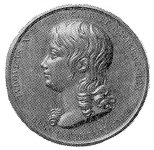
There is no episode in French history more painful than the ‘reign’ of Louis XVII. These two years, the last of his short life, were years of utter misery; the boy who had been born to the highest position in the world was systematically brutalized and degraded, and then deliberately neglected until he died. None the less, for a moment at least he knew that he was King of France when, after his father’s execution, his mother knelt before him in homage.
Louis XVII—Louis-Charles—was born at Versailles on Holy Saturday 1785, and at once created Duc de Normandie. Marie Antoinette first learnt his sex when the child was shown to her wearing the cordon bleu of the Saint-Esprit—the traditional way of informing a Queen that she had given birth to a Son of France. In contrast to his brother, the Dauphin Louis-Joseph, he began life as a healthy, lively boy, soon very talkative, with striking, somewhat girlish good looks, set off by his long fair hair, but marred (according to contemporaries) by excessively thick lips—though these are not apparent in the many beautiful portraits of him. Hézecques tells us that he was a noticeably sweet-natured child. He was only four when he succeeded his brother as Dauphin, too young to realize his new importance. In a letter, written in that sad summer of 1789, Marie Antoinette says that though healthy he is much too nervous—‘the slightest unusual noise has an extraordinary effect on him.’ He had to have as much fresh air as possible; fortunately he loved flowers and gardening. The Queen herself read him Perrault’s fairy tales and La Fontaine’s fables. She noticed with concern that her son was bad at his lessons, owing to lack of application rather than stupidity. However, she was satisfied that he had the best governess possible in Yolande de Polignac.
Louis-Charles could remember little of the early days of the Revolution. He was obviously upset by the dreadful leave-taking of Versailles in October 1789; when the harridans screamed threats at the Queen on the way to Paris, he put his head out of the coach window and begged ‘Forgive Mummy’ (Grace pour Maman). Although his first sight of the Tuileries, dusty and unfurnished, frightened him, he became happy enough there, and enjoyed playing in the palace gardens wearing the red, white and blue uniform of the National Guard. In July 1790 1,500 Bretons marched up to Paris to swear loyalty to the King. After Louis XVI had embraced their leader, the entire contingent was taken to see the Dauphin who was picking flowers on the terrace of the Tuileries. ‘The pretty boy gave a flower as long as they lasted to every Breton’, says an English eye-witness, ‘and then gathered lilac leaves, and for fear they should not last, tore them in two, and gave half a leaf apiece to the rest.’
Probably his first lasting moment of fear was the flight to Varennes; having fallen asleep after leaving the Tuileries, he said later that he woke up on the way out of Paris, terrified and convinced that ‘someone was coming to murder him’. Such a timid, sensitive child was horribly scared by the hostile demonstrations—the shouting and the stoning—and by his parents’ dejection on the miserable drive back.
Louis-Charles’s last year at the Tuileries must have been a time of constant terror, not only when the mob stormed into the palace on 20 June 1791, and made him wear the red cap of Liberty, but each day and every day. Though his mother and father did their best to conceal their own fear from him, he must have sensed the savage hostility of the mob outside the railings. According to Mme de Tourzel, one of his governesses, the Prince Royal (as he was called by the new Constitution) was obviously aware of his parents’ alarm, however much they tried to hide it. After the mob’s invasion of the Tuileries in June 1792, the royal family dared not set foot outside the palace, and Louis-Charles was even banished from his beloved gardens; when his mother attempted to take him for a walk there, there was nearly a riot by the red-capped sans-culottes, who screamed threats and insults at them through the railings and howled Ça Ira. During the flight from the palace to the Manège his parents kept the full horror of their situation from him, and mercifully he dozed throughout much of the ordeal in the minute writers’ box.
The months in the Temple with his father and mother were probably happy enough for Louis-Charles. Admittedly, the contrast between palatial luxury and the Tower’s rough furniture—some of which can still be seen at the Musée Carnavalet—must have come as a shock, but at least his parents were able to spend more time with him. They were invariably soothing and reassuring, despite the guards’ provocation. The King and Queen did not even show emotion when the commissioners came to tell them that the monarchy had been abolished, though the boy realized that secretly they were very distressed, and he learnt to fear the constant visits by committees from the Convention. Cléry, that heroic valet, was deeply impressed by the child’s sweet nature and attempts to comfort his parents. Naturally quick and intelligent, he learnt to live with the insolent guards, to recognize which of them was biddable or at any rate not a nuisance; on one occasion he reported to his father, as a good sign, that a guard was reading Tacitus.
When Louis XVI knew that he had been condemned to death, he told the Dauphin never to forget his Catholic faith and never to take vengeance upon regicides, raising the boy’s hand into the air to give more solemnity to the oath. Louis-Charles tried, unsuccessfully, to run out of the Temple, with a touching little plan of begging the soldiers to save his father. While the cannon roared to celebrate the execution and the royal prisoners were all in tears, Marie Antoinette (it is said) knelt solemnly before her son and acknowledged him as King. Almost certainly the majority of Frenchmen and Frenchwomen joined with her in spirit. Only extremists wanted the First Republic—everyone else was heartily sick of the bloodshed and anarchy, the soaring inflation, the revolutionary wars at home and abroad.
The prisoners were guarded with the utmost vigilance. One plan to escape—in which Louis was to have been hidden in a laundry-basket—was betrayed; another was foiled by sheer accident. For a time General Dumouriez who commanded the republican armies in the Low Countries, intended to march on Paris and enthrone Louis XVII, but he was defeated by the Austrians at Neerwinden in the spring, and deserted. In March 1793 the royalists rose in the Vendée where, led by the Marquis de Rochejacquelein, the pious peasants—the dreaded Chouans, so called from their hooting like owls when signalling—waged a bestial little war on the Godless government. Other risings were to follow—at Caen, Lyons, Bordeaux, Marseilles. The French would soon be at each other’s throats, White (royalist) against Blue (democrat). The newly-formed Committee of Public Safety (the ten extremists who terrorized the Convention and formed the country’s real government) regarded Louis as the greatest internal danger—he was the focal point of every counter-revolutionary conspiracy. Even the crazy Hébert, whose extremism had degenerated into mania, had to admit that, ‘For royalists and moderates the King never dies—he is in the Temple.’ It was also obvious that his mother and aunt had every intention of escaping and of taking him with them. The last straw came in June 1793 when it was discovered, just in time, that the Franco-Irish General Dillon had been plotting a coup d’état to dismiss the Convention at the point of the bayonet and proclaim Louis XVII.
Accordingly on the night of 3 July 1793 six commissioners—mostly Paris tradesmen—suddenly arrived at the Temple and burst in on the Queen who was quietly sewing by the side of her sleeping son. They announced brusquely that ‘Capet’s son is to be separated from his mother and family’. For an hour Marie Antoinette clutched Louis, who was weeping hysterically, imploring and beseeching the men to have mercy, but her prayers were in vain. At last she dressed the sobbing child, telling him to go with the men but never to forget how much she loved him. As they dragged him away, the King of France and Navarre screamed piteously.
In place of his mother Louis XVII now had a ‘tutor’, a Member of the Paris Commune, Antoine Simon. This successor to the grand seigneur Governors of the Bourbon child monarchs was a failed cobbler of nearly sixty, from the Paris back streets, who was living off the savings of his charwoman wife. Illiterate—he could neither read nor write—dirty, foul-mouthed and evil-tempered, Simon had been chosen deliberately as being best qualified ‘to turn an aristocrat into a democrat’. Though it has sometimes been questioned, there is no reason to doubt the traditional assessment of Simon. The child cried for two days and two nights, refusing to eat and begging to be taken back to his mother; eventually he grew too frightened to weep. The old cobbler quickly taught the boy, who was only eight and naturally trusting, to sing popular revolutionary songs like the Marseillaise and the Carmagnole, and to swear, and made him wear the red bonnet of a sans-culotte. Meanwhile his distraught mother, who could hear him crying in the room below, stayed at her window for hours on end in the hope of catching a glimpse of him when he went to play in the garden. Later, she said, ‘Nothing can hurt me any more.’
Simon was frequently drunk, and made Louis drink till he was tipsy too, although wine nauseated the boy. From her own room his horrified sister heard her brother’s shrill treble echoing the old man’s hoarse voice in bawdy catches. The cobbler made the King of France fetch and carry for him, cursing and shouting at him, and beating him especially when drunk. Hébert seems to have instructed Simon to degrade the boy physically—the old man taught him to masturbate, damaging one of his testicles in the process. Probably he was also instructed to bring prostitutes into his room, who, it was hoped—although he was too small to have intercourse with them—might infect him with the pox (this instruction does not seem to have been carried out). Every effort was made to terrify Louis, Simon bellowing that he would send him to the guillotine. Such treatment soon had an appalling effect on the sensitive little boy. Only a few weeks after being dragged from his mother, referring to his relatives in the room above him, he was heard to yell, ‘Foutre, haven’t those damned whores been guillotined yet?’
By the summer of 1793 the Austrians and Prussians were beginning to capture French frontier towns, while the English occupied Toulon and the Spaniards invaded Roussillon. Within France, royalist risings were going from strength to strength—even the Protestant mountaineers of the Cévennes rose for the lily banner of the Kings who had treated them so ill. Only the most savage measures sustained the tottering Republic, the guillotine crashing down monotonously. Robespierre and Carnot saved their Revolution in an orgy of French blood. Scapegoats were needed, the most sensational possible, and the Austrian bitch was the obvious candidate. The Committee of Public Safety wished to humiliate her as well as to destroy her.
On 6 October Hébert and a commission visited the Temple to obtain ‘evidence’ from ‘Capet’. Louis signed statements, obviously drafted by Hébert, accusing his mother of counter-revolutionary activities, and of deliberately teaching him to masturbate for her amusement. Madame Royale was brought down to confirm the statements, which her brother repeated—he even accused her of not telling the truth. Weeping with indignation, the girl was removed to make way for Mme Elisabeth, to whom poor Louis again repeated his ‘statements’. Her comment was ‘Oh! he monstre!’ But one of those present said that she was prompted by astonishment rather than revulsion, and that it was quite obvious that her nephew was repeating word for word a lesson which he did not understand.
His poor, proud, silly mother, prematurely aged—white-haired and half-blind—died magnificently on 16 October 1793. At her trial—she was indicted as ‘the scourge and bloodsucker of France’—Hébert’s disgusting allegations prompted the fine reply, ‘I appeal to all mothers here today.’ Shouts of feminine support from the gallery so alarmed Robespierre that he muttered, ‘The fool. He will save the woman yet!’ Unlike her husband, the ‘Widow Capet’ was taken to the guillotine in an open tumbril like a dung-cart. On the scaffold her courage was sublime; although nearly fainting, she showed not the slightest trace of fear—she even apologized to the headsman for treading on his foot. Napoleon described Marie Antoinette’s killing as ‘something even worse than regicide’, and the splendour of her bearing throughout her trial and execution, and the countless humiliations which accompanied them, disenchanted many of her former enemies with their new masters. For reasons of policy or from sheer indifference—one cannot believe from humanity—her death was kept a secret from her son, who for the rest of his short life always believed that she was somewhere in the Temple.
Thousands perished in the Terror, royalists like gallant old Malesherbes and his daughter and his grandchildren, together with republicans like André Chénier and Mme Roland—who had once proclaimed, ‘We can only be reborn through blood’—and even the maniac Hébert. Some of the worst excesses took place in the provinces—at Nantes 2,000 enemies of the state were systematically drowned. Other casualties were the regicide Philippe Egalité—characteristically, his speech from the scaffold was ‘one short, obscene word’—and Mme du Barry. On her way to the guillotine, jolting over the cobbles in her tumbril, la du Barry howled and shrieked, imploring a horrified crowd for mercy; observers thought that if the French aristocracy had behaved like her—instead of maintaining a silent, icy, dignity—the Terror could never have taken place. As it was, in May 1794 Louis’s aunt, Mme Elisabeth, was accused of ‘planning to massacre the people, to make away with freedom and restore tyranny’; after the execution her headless body was thrown naked into a common grave. Now only Louis’s sister remained in the Temple, though he never saw her again.
Everything associated with the monarchy had been demolished. Street names had been changed, statues pulled down. Saint-Denis, the most sacred shrine of French royalty, had been sacked in August 1793; the tombs of the Kings were broken open and their remains dragged out and thrown into a limepit—their embalmed hearts were sold as curiosities (years later the painter Saint-Martin returned those of Louis XIII and Louis XIV, practically undamaged, to Louis XVIII). The phial containing the coronation chrism was smashed—nobody noticed a monk in plain clothes stealing away with several drops on a shard of the shattered sainte ampoule. But for all the tearing down, the Convention could never forget that there was still a King of France in the Temple.
For the last months of 1793 Louis remained with the Simons, who seem to have grown quite fond of him; the old man had a pigeon loft built for him and even had a toy singing canary, which he had found, repaired and installed in the boy’s room. Some of the better-natured guards used to play draughts and bowls with him. When they were drunk, it was a different story; on one occasion they were found throwing ‘Capet’ round the room, and blowing smoke into his face, while Simon kept on pulling his long hair and threatening to kill him because he refused to sing yet another filthy song. Later, old Mme Simon too admitted that she had hit the child on a number of occasions. But in January 1794 the Simons decided that the job entailed too much responsibility and resigned their post.
In the months to come, Louis may even have missed the dirty old cobbler’s company. For the Committee of Public Safety decided that more extreme measures were necessary to guard against ‘Charles Capet’s’ escape—people among the Paris mob could be heard referring to ‘The King’ or to ‘Louis XVII’. Accordingly, a guard of four commissioners was appointed, to be relieved daily. There is no detailed account of what took place during the following months, but it seems that orders were given for the boy to be literally walled up on 19 January; apparently his door was nailed to the frame and further secured by great iron plates; his food was pushed in to him on a turn-box inserted in the door, while a small grating at the top of the door enabled the guards to peer in to see if he was still alive. No lamps or candles were allowed, a particularly cruel order as the one window was nailed and shuttered and the child was terrified of the dark—partly because of the rats which constantly scurried across the floor, and under, and sometimes over, his bed. Nobody entered that dark, airless room for six months, an eternity for an eight-year-old, and nobody spoke to him—except occasionally to shout at him through the grating.
In May 1794 Robespierre came to inspect Madame Royale, and it is more than likely that he peered through the grating at the dim form of his rightful King. The Princess, a spirited fifteen-year-old, had obviously learnt something of her brother’s condition from the guards, and remembered that when she had last seen him the previous October he had seemed unhealthily fat; the man who passed him his food through the turn-box said that he had to shout through the grill to make the boy realize that it was there. She handed a note to ‘the Sea-Green Incorruptible’, demanding that a doctor should see her brother. Naturally, the enemy of tyrants ignored her request.
On 27 July 1794 Robespierre was deposed, to be beheaded shortly afterwards in circumstances of great agony and humiliation. (He fell because practically the entire Convention went in fear of their lives.) Next day the ci-devant Vicomte de Barras, who had organized the coup, visited Louis at the Temple. We know what he found from a report by later visitors. The room was almost unimaginably filthy and foul-smelling; the King of France had had no means of washing and lay in his excrement on a urine-soaked invalid’s cradle, covered with bugs and lice, surrounded by the rotting remains of uneaten food which the rats gnawed at will. At first Barras thought that the nightmare apparition with matted hair and huge finger-nails was asleep, but then he saw that it had woken and was watching him. Attempts to make Louis get up from his bed of filth failed—if picked up he collapsed as soon as he was released. In response to questions, he said he had no complaints about his guards. The guards told Barras that the child ate nothing and did not even seem to sleep much.
Barras, horrified, gave orders that Louis should receive medical attention at once and that the revolting room should be washed down immediately. He also recommended that he should be allowed to play in the garden with his sister, and that two women should be appointed to look after him. The Convention ignored his recommendations. Admittedly a new guardian, a young Creole ‘democrat’ from Martinique called Christophe Laurent, was appointed. But for a further two months, during the heat of summer, the child remained immured with his filth and his misery.
At last, on 1 September 1794, Laurent and two assistants unbarred the door. Asked why he had not eaten—there was an untouched meal on the table—Louis replied simply that he wanted to die. He was carried out and brought into another room, where he was bathed and deloused, and then a doctor saw him. He realized at once that the child was seriously ill, covered in sores and tumours—a skin condition made it torment for him to remove his breeches.
Louis’s room was cleaned out and he was given toys, cards and writing materials, and taken each day to the top of the Tower for a breath of fresh air. One day he picked some flowers growing on the battlements and dropped them outside a door on the way down; it was the door of his mother’s old room and he may have remembered how he had once brought her flowers from his own garden at the Tuileries—obviously he thought she was still there.
But the improvement was very slight. He was still not allowed to play in the garden, not to see his sister and not to have a light at night (although the guards managed to kill the rats in his bedroom, with arsenic). However, in November Laurent acquired a more agreeable, if somewhat ineffectual assistant, one Gomin, who was timid but imaginative. He brought Louis flowers and even a lamp, and took him into another room. It was some weeks before the child trusted him sufficiently to speak. Suddenly Louis said, ‘You’re the man who gave me the flowers—I haven’t forgotten.’
Just before Christmas 1794 commissioners again came to inspect the prisoner, whom certain members of the Convention had recently been referring to as ‘a rallying point for aristocrats’—and also as ‘the Capet foetus’. The commissioners’ leader, Harmand, described the visit twenty years later (some months before he himself died of want and starvation). They found the King in a bare, scantily-furnished, but clean, set of rooms, playing with a pack of cards. Louis, dressed in a neat, slate-coloured sailor suit, looked extraordinary, with thin elongated limbs, a disproportionately small torso and chest, and curiously rounded shoulders, though ‘the head was very handsome, with long fine hair which was well kept and light brown in colour’. Harmand found livid swellings on his arms and legs, which he attributed to rickets. What struck him most, however, was the child’s refusal to speak or to answer questions, almost as though deaf and dumb; he did not even respond to offers of toys and sweets. Harmand was also shocked by the royal diet—a coarse bowl of blackish soup, some equally black beef, a platter of lentils, half a dozen burnt chestnuts, and no wine. He ordered grapes for the prisoner, who ate them without saying a word.
In January 1795 ‘Capet’ had the honour of being the subject of a debate by the Convention, who discussed whether he and his sister should be exiled or remain in prison. A lawyer called Cambacères argued that ‘the exile of a tyrant has always been the first step in his return to power’, and cited the case of Tarquin and the Romans. The Convention voted to keep the children in prison. The only power which tried to save them was Spain; to his eternal honour, Charles IV—otherwise a pitiful degenerate, and immortalized as such by Goya—insisted on the release of his young cousins as a pre-requisite condition for any peace between the two countries.
Gomin knew something of what the ‘tyrant’ suffered. When the guard told yet another commissioner that Louis was ill, the man replied, ‘There are many children worth just as much as he, who are far iller—and many of the ones who die are worth a good deal more.’ Gomin remembered that the prisoner repeated the words to himself. Another commissioner told Gomin in front of Louis, ‘In six weeks time that child will either be an idiot or dead.’
His health worsened—tumours appeared on his knees and elbows which made any movement an agony. Ironically he was suffering from the King’s Evil, a tuberculosis which sometimes attacks the bones as well as the lymph glands. Gomin did his best, bringing the child toys, playing draughts with him and fetching books from the Temple library for him to read. One evening he looked beseechingly at Gomin, whom he obviously thought understood him, and then looked at the door. ‘Let me see her once before I die,’ he begged. Gomin had not the heart to tell him that his mother was dead; he said awkwardly that it was impossible, whereupon the prisoner cried piteously.
Indeed by now there was no hope for King Louis XVII. On 16 March 1795 a royalist agent, M de Frotté, wrote to an adventurous Irishwoman, Lady Atkyns (who had wild dreams of rescuing ‘the King’) to tell her what he had heard from a member of the Convention: ‘Under Robespierre they so debased the unfortunate child, physically and morally, that he cannot live … you have no idea of the degeneration and brutishness of the little creature.’ If Louis was far from brutish, it was none the less true that his health was broken—he was increasingly attacked by fevers.
Laurent left the Temple that March, to be replaced by Etienne Lasne, a house-painter who had once been a soldier and had seen Louis at the Tuileries. A tough but kind-hearted character, the old soldier tried to make the boy as comfortable as possible, cleaning out his room meticulously. Accompanied by Gomin on the violin, he sang to him—sometimes marching songs of the royal guard, which they hoped the boy might remember—played cards with him and read to him. When Louis grew too weak to climb the stairs, Lasne would carry him to the top of the Tower where he could breathe fresher air.
At the beginning of May 1795, a tradesman managed to catch a glimpse of Louis XVII at the Temple, his face covered with ulcers and pimples, his body weirdly deformed—‘the most pitiable creature that ever was seen’—and barely able to sit up. It was plain that he was seriously ill and from 6 May doctors, supervised by commissioners, made regular visits, prescribing medicine and diet. Once, when the doctor was about to leave, Louis clung to him and—referring to the commissioners—begged, ‘Don’t leave me alone with those wicked men!’
He was growing weaker every day. Moved to a room which overlooked the Temple garden, he was barely able to look out of the window at the summer. Lasne and Gomin, who were really a very decent pair, did their best to cheer him, and Gomin brought him flowers assiduously. Then, on 6 June, Louis fainted and his guards suspected that he was failing. On the evening of 7 June, Gomin found him crying; asked if he was in pain, the prisoner sobbed, ‘Toujours seul—ma mère est restée dans l’autre tour.’ He died during the night of 7–8 June 1795, with his arms round Lasne’s neck. He was ten years old. He was buried secretly, by night, in a common grave at the cemetery of the church of Sainte-Marguerite; it is probable that the sexton later re-buried his remains nearer the church wall.
Many attempts were made to show that Louis XVII did not die in the Temple, and more than thirty claimants have tried to prove that they were Louis, or one of his descendants. Admittedly, the silent, rickety little wreck of 1795 bore small resemblance to the talkative, charming, intelligent child of 1793; and there may well have been a plot to rescue him, to substitute a deaf and dumb inmate of the Invalides hospital in his place. But all the evidence supports the traditional—and generally accepted—belief that the boy who died in the Temple was indeed Louis XVII.
Few will disagree with the Comte d’Hézecques’s opinion that the little King had been given ‘a course of poison more horrible and protracted than any dose of laudanum’. The Count adds, ‘The saddest thing for France is that every member of the Convention was responsible for the infamy of his long martyrdom.’