
‘Tartuffe’
_____________
‘Unite—and forget’
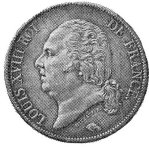
The Bourbons did not die with the Ancien Régime. One of the least known of French Kings, Louis XVIII was also one of the ablest. Had he succeeded to the throne before his elder brother, Louis XVI, this unpleasant but interesting man might well have saved the monarchy.
Louis-Stanislas was born at Versailles on 17 November 1755, the fourth son of the Dauphin Louis, and given the ancient title of Comte de Provence. Like his brothers, his education was entrusted to the pious Duc de Vauguyon, whose repressive regime may have been responsible for his lukewarm attitude towards religion. From a very early age he showed unusual intelligence, aided by a phenomenal memory. Delicate, with deformed hips which made it difficult for him to ride a horse, he was studious and developed a taste for history and literature which lasted throughout his life. He particularly enjoyed Voltaire, and the writings of the Encyclopédistes. Naturally malicious, he was apt to sneer at his clumsy brother, Berry (the future Louis XVI), who was only a year older, mocking his bad grammar—‘A Prince should at least know his own language.’
Berry gave him a revealing nickname—Tartuffe. This is the title-role of one of Molière’s greatest plays, a study of a sanctimonious hypocrite who covets both his benefactor’s wife and his benefactor’s goods. As a Voltairean, Louis-Stanislas was not exactly sanctimonious, while he was to be a very restrained adulterer (at any rate by the standards of his brother Artois, or of his grandfather). But in secret he always coveted his brother’s crown, and undoubtedly he resembled Tartuffe in his cynicism and cunning, in his cruel wit and in his icy selfishness. Probably the quality which most of all prompted his unenviable nickname was his false bonhommie.
When Berry ascended the throne in 1774, Louis-Stanislas was given the traditional style of Monsieur Frère du Roi. He was Heir Presumptive until the birth of the Dauphin Louis-Joseph in 1781, and no one was ever more conscious of the majesty of the French monarchy than Monsieur. Although only eighteen, he remonstrated angrily with his brother when he brought back the Parlements in 1774; ‘France will soon have republican senators like those in Genoa, Venice or Berne and the King will be nothing more than a Doge.’ But his brother told him that they were both too young to rely on their own judgement. Indeed, as a young man Monsieur was a thorough-going reactionary in every way. He voted against Turgot’s Six Edicts and, while delighting in them himself, urged the King to suppress any works of the Encyclopédistes which might encourage sedition. He regarded the American Revolution as ‘a punishable rebellion’.
Monsieur enjoyed pomp and circumstance. Despite his inability to ride, he kept one of the largest stables in France and his regiment of Carabineers was superbly mounted. As Grand Master of the Knights of St Lazarus, he restricted membership of that ancient hospitaller order to great noblemen. Everything about him was designed to enhance his pride and ostentation. Short, fat and swarthy, he overdressed in diamond-studded suits, and adopted a repellently haughty manner. Yet a gouache of Monsieur in his early twenties, by Moitte, shows a surprisingly attractive face, with the Bourbon nose but an amused grin.
The birth of Louis XVI’s first child in 1778, Madame Royale, was a bitter blow to Monsieur. At the christening, when Cardinal Rohan asked what names would be given to the child, he was heard to mutter, ‘But the first thing is to know who are the father and mother’; later, he seems to have tried to imply that the father was Artois. The birth of a Dauphin in 1781 must have been even more galling.
Monsieur had himself married in 1772, when he was only fifteen, but, despite boasting how he would outdo his brother, failed to beget children; it was rumoured that his impotency drove his wife to drink, though in fact he only became impotent much later in life. ‘Madame’ was Maria Giuseppina of Savoy, daughter of the King of Sardinia. She was small, dark, ugly, insignificant, and bad-tempered, coarse-natured, and dirty in her person—Louis XV begged her parents to persuade her to wash her neck and clean her teeth. Mme de Campan says that the only thing worth mentioning about her was a ‘pair of tolerably fine eyes’. Madame’s favourite occupation was catching thrushes in nets and having them made into soup. (Monsieur was fond of food too, but with more elegance—he created a dish which consisted of a partridge stuffed with an ortolan, which in turn was stuffed with foie gras.) Their flat was in the left wing at Versailles on the side near the Orangery, Monsieur and Madame occupying separate floors.
Monsieur became a patron of literature, supporting a whole host of writers at his palace of the Luxembourg. He earned himself a name for wit and bon mots—it was he who coined the aphorism ‘Punctuality is the politeness of Princes’. He wrote elegant light verse, ferocious political satire and libretti for two operas—La Caravane du Caire and Panurge dans l’Ile des Lanternes. Some of his verse he sent under assumed names to the Mercure and other newspapers. He read voraciously, his letters being filled with quotations ranging from Virgil to Voltaire.
When Emperor Joseph II paid his famous visit to Paris in 1778, he reported to his mother that Monsieur was ‘an inscrutable creature, better-looking than the King, but mortally cold’. None the less, Louis-Stanislas got on well enough with Marie Antoinette—his sly jokes made her laugh; Mme de Campan says that the fête which he gave for the Queen at his château of Brunoy was the most magnificent ever given to her, a combination of masque and tournament.
Monsieur constantly intrigued against the government, writing numerous and often savage pamphlets. One described Turgot as ‘a despot’ and Louis XVI as ‘the leading dummy in the kingdom’. He printed and circulated Necker’s secret memorandum, a ruse which led to the minister’s downfall (Necker had incurred his enmity by refusing to pay him a million livres which Louis-Stanislas claimed had been left to him by his parents). During the Assembly of Notables he presided over one of its committees and opposed most of Calonne’s reforms.
Somewhat surprisingly in view of his ugliness, timidity and ill-defined sexuality, Louis-Stanislas acquired a glittering young mistress, the high-spirited Mme de Balbi, who was one of Madame’s ladies. Anne-Jacobé Caumont La Force had been born in 1759, the daughter of a distinguished member of Monsieur’s household. Admired by all for her elegance and dashing appearance, she married the Comte de Balbi, grandson of a Genoese Doge, but he turned out to be insane; in 1780 violent behaviour culminated in his beating his wife with his cane after finding her en galanterie, and he was confined in a madhouse (some said with Monsieur’s connivance). What appealed to Louis-Stanislas about la Balbi was not so much her physical charms, and certainly not her promiscuity, as her literary tastes and mordant wit; though it is likely that they slept together, for at this date he was not yet impotent. He installed her in a flat above his own at Versailles, Madame continuing to live below. In Paris Anne-Jacobé held court at the Petit Luxembourg, where she entertained the literary men whose company her lover enjoyed so much. Her extravagance on clothes, jewellery and gambling reached such heights that Monsieur soon found himself in serious financial difficulty.
Hézecques, who obviously disliked him intensely, gives an unflattering portrait of Monsieur in the late 1780s and early 1790s. ‘Monsieur was very fat, but it was not the fatness which goes with strength and vigour, like Louis XVI. He had an unhealthy constitution and even as a boy took medicine to help his circulation and cure fits of giddiness, and this unhealthiness was made worse by lack of exercise…. No Prince was ever more ungainly than Monsieur; he had the waddle of the Bourbons in its most extreme form and all his fine clothes could not conceal his bad figure.’
Louis-Stanislas’s real calibre first appeared after the decision to summon the States General. He encouraged the King to agree to double the Third Estate; in his brother’s place he would have extracted the maximum popularity from such a concession. He saw no purpose in leaving Paris in 1789 and persuaded Louis XVI not to abandon his capital; only with hindsight does this advice appear disastrous; at the time, it seemed sound sense. Nor was he shaken by the storming of Versailles or by being dragged to the Tuileries in the King’s wake in October 1789.
By 1790, however, Louis-Stanislas was having second thoughts. The Marquis de Favras, a professional adventurer and mercenary soldier, proposed rescuing the King and taking him to Péronne on the frontier; it seems, though there is no proof, that Monsieur borrowed two million livres to finance the operation. But Favras was denounced by a fellow plotter; it was rumoured that he had meant to raise 30,000 men and assassinate Lafayette. He was hanged but luckily incriminated none of the Royal Family.
Monsieur far preferred the idea of being a constitutional monarch to having no throne at all. He would have had no qualms about taking Louis XVI’s place on the throne. However, after Favras, he was too cautious to intrigue during such dangerous times, but he hung on at the Luxembourg till the last possible moment, playing endless whist at the Tuileries with his dear brother (while grumbling about him behind his back; he told Mirabeau that the King’s weakness and indecision were beyond belief, comparing his character to ‘oiled ivory balls which one tries in vain to hold together’). Mirabeau contemplated forming a cabinet in which Monsieur would have been First Minister, but seems to have decided he was too nervous; probably Louis-Stanislas was hedging his bets.
With his usual astuteness he realized when the situation was finally out of control. During the Royal family’s flight to Varennes, while Louis XVI trundled towards disaster, Monsieur, Madame and Mme de Balbi, equipped with false passports, left Paris by the Pont Neuf and drove to Le Bourget, driving from thence to Soissons, Laon and La Capelle, and crossing the Belgian frontier without incident.
Monsieur now set up a government in exile at Coblenz, where Artois and the Prince de Condé had each gathered an army of émigrés. He assumed the title of Regent on the grounds that the King had lost his freedom of action. He kept impressive state, entertaining regally, sent ambassadors to the European sovereigns in the hope of persuading them to invade France, and issued threatening proclamations which gravely embarrassed his brother in Paris. Calonne came over from England to be his Prime Minister.
Mme de Balbi’s sway over Monsieur reached its zenith at Coblenz, where she was known as the ‘Queen of the Emigration’ and aspired to a political rôle. Her promiscuity made Louis-Stanislas a laughing-stock. When he moved to Hamm, she went to Brussels instead, though with every intention of rejoining him later. However, Monsieur then learnt that it was common gossip that she had had twins by a youthful lover, and was so furious that he never saw her again.
After la Balbi’s fall, the focus of Monsieur’s affections was the Captain of his Bodyguard. Antoine-Louis-François de Bestiade, Comte d’Avaray, was thirty-four and a career soldier whose skilful organization of his master’s escape to Coblenz had won him his master’s confidence; later the infatuated Louis-Stanislas gave him the right to bear the royal arms of France on his own with the motto Vicit iter durum pietas (loyalty finds a way over even the stoniest road). Henceforward, until his death, he only left Monsieur when sent on special missions. The two men had no secrets from each other, Avaray’s one fault in Monsieur’s eyes being that he had no Latin. Indeed it is probable, though there is no actual proof, that Monsieur was a repressed homosexual. Significantly, Hézecques compares his character with those of Henri III and Monsieur, brother of Louis XIV (though admittedly he does not speak of common sexual tastes). Undoubtedly, Louis-Stanislas found full emotional satisfaction in male friendships, even if these were platonic because of his low sexual drive. Like Louis XIII, he sought the perfect friend.
During the campaign before Valmy, Monsieur was irritated by the bragging of the Prussian commander, the Duke of Brunswick. ‘Be careful, Duke,’ he warned him, ‘I know that the French will defend their country—they are not always beaten.’ As a result of the ensuing débâcle, by the end of 1792 Monsieur was living in a small wooden house at Hamm in Westphalia, short of food and heating. The exploits of the Chouans raised his hopes, but by the end of 1793, even they had been crushed, only M de La Rochejacquelin holding out in his Breton woods. Monsieur moved to Verona. Here, as King Louis XVIII—he assumed the title on his nephew’s death—he issued what some émigrés termed the ‘criminal’ Proclamation of Verona; this promised that Absolutism would be restored and savage penalties inflicted when the King came home; it even listed those who would be quartered, those who would be broken on the wheel (Talleyrand was among these), those who would be hanged, and those who would be sent to the galleys.
In December 1795 his niece, Madame Royale, was rescued from the Temple. The Austrians exchanged a number of important French prisoners for her and sent her to Vienna, from whence she was brought to the King. She received the warmest welcome of which his cold nature was capable and betrothed to her cousin, Louis d’Angoulême, Artois’s son. Sadly, her experiences had ruined her nature and, ‘The orphan of the Temple’ was a sour bitter woman for the remainder of her long life (she did not die until 1851). Even so, a strong, sentimental attachment sprang up between her and the King; she was undoubtedly his favourite member of the royal family.
It must be remembered that a Bourbon restoration seemed almost inevitable until Napoleon was firmly established. The French people had more than a suspicion that égalité was killing liberté and fraternité, and the newspapers were full of royalist propaganda. Most Frenchmen longed for a return to the rule of law. Unfortunately, Louis, encouraged by reports from his agents in Paris, failed to realize that what France wanted was not the monarchy of 1789 but the constitutional monarchy of 1791. The bourgeoisie had no wish for the return of privilege; the peasants feared the re-introduction of feudal dues; and everyone who had bought émigré land dreaded confiscation. Nevertheless, by 1797 Royalist deputies had almost obtained control of the central government and Louis thought his restoration was imminent. But the army was still republican. On 4 September 1797—18 Fructidor, Year V, in the Revolutionary calendar—General Augereau staged a coup d’état and fifty-three Royalist deputies were condemned to deportation to Cayenne.
Meanwhile, the King was leading an odd, wandering life. He had left Verona for a brief spell with Condé’s army at Blanckenberg in Brunswick, before settling at Mittau in the Baltic Duchy of Courland—now part of Soviet Latvia, a coastal land famed for its beauty. From here he watched General Bonaparte’s rise to power with a mixture of hope and apprehension—was he Cromwell or was he General Monk? Before 18 Fructidor he offered him the Vice-royalty of Corsica and the title of Marshal of France if he would restore him. In 1800, when Bonaparte was First Consul, the King wrote to him: ‘You are taking a long time to give me back my throne; there is a danger that you may miss the opportunity. Without me you cannot make France happy, while without you I can do nothing for France. So be quick and let me know what positions and dignities will satisfy you and your friends.’ Bonaparte replied, ‘I have received Your Royal Highness’s letter. I have always taken a keen interest in your misfortunes and in those of your family. But you must not think of returning to France—you cannot do so without marching over a hundred thousand dead bodies.’ In 1803 Bonaparte sent an envoy to Mittau to propose that Louis and his family should surrender all claims to the French throne in return for independent principalities in Italy. The King wrote in reply, ‘I do not confuse M Bonaparte with those who preceded him. I respect his bravery and military genius…. But he is mistaken if he supposes my rights can be made the subject of bargain or compromise.’
However, Bonaparte gave the French everything which they had thought could only be supplied by a Bourbon restoration. Not only did he bring back the Church and build wonderful roads and schools, but he restored the rule of law (besides introducing theCode Napoléon, one of the world’s outstanding legal codes and one which could be understood by everybody, he even revived some of the courts of the old Parlement of Paris). When Napoleon assumed the title of Emperor in 1804, the King travelled to Sweden to join Artois—whom he had not seen for a decade—and issued a formal protest. But the Empire had a disquietingly permanent appearance.
Louis was forced to leave Mittau by the Tsar in 1807, whereupon he followed Artois’s example and settled in England. Although the British government gave him £ 7,000 a year, they would not let him stay in London, so he established his shabby court at Gosfield Hall in Essex, moving in 1809 to Hartwell House in Buckinghamshire. The diarist Charles Greville, accompanied by his father, visited Louis at Hartwell the following year. Greville says that there were so many people in the house—nearly 150—that the place resembled ‘a small rising colony’ and that he had never seen so many Dukes in his life. The King received them in his private closet, so small that it seemed like a ship’s cabin; the elder Greville said the way Louis heaved his huge bulk backwards and forwards made him feel seasick. He gave them a very modest dinner, carving himself; the only wines served were port and sherry. They spent the evening playing whist at threepence a point. The atmosphere was a compound of privation, hopelessness and ridiculously pompous etiquette. The diarist noted with amusement that the local yokels referred disrespectfully to their august neighbour as ‘old bungy Louis’.
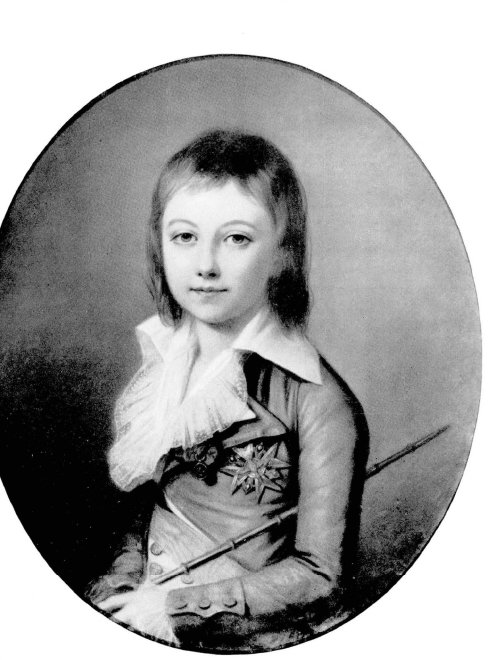
Louis XVII, by Kucharski
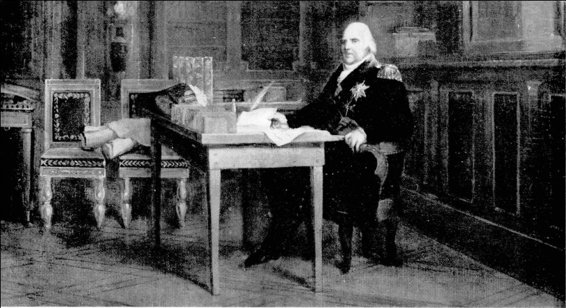
Louis XVIII, by Gerard
The King was in constant touch with the professional adventurers and spies who were the only people in France still to take an active interest in the Bourbon cause. Most were of dubious reliability—one double agent even tried to persuade Louis to make a secret trip to Paris. Savary, Napoleon’s Minister of Police, paid the Duc d’Aumont £ 1,000 a year to send him two letters a month reporting what went on at Hartwell. (At the Restoration the King told Savary with relish, ‘You see, Monsieur, how little one can trust people. He [Aumont] always told me he was only paid £ 500—no doubt he didn’t want to pay me my royalties, as I drafted the letters myself!) However, there was a genuine traitor at Hartwell who has never been identified, probably an émigré courtier; he or she was responsible for the capture and death of many royal agents.
For all his undoubted probity, Avaray, the King’s favourite companion, inspired jealousy and even hatred. He particularly irritated conservative émigrés by speaking English and dressing like an Englishman. In 1808 a Vendéen veteran, General de Puisaye, accused Avaray of trying to have him assassinated. The scandal reached such proportions that Louis issued a public defence of ‘the most feeling of friends’ and appointed a committee of twenty-four noblemen who quickly declared Avaray innocent. The favourite at once challenged Puisaye to a duel, but the King had him arrested by the English authorities to prevent him fighting. As a mark of his esteem he then made Avaray a Duke. However, the favourite’s health was collapsing—he seems to have been tubercular—and he had to leave England for a warmer climate at the end of 1810.
Louis’s Queen, Maria Giuseppina, who despite their incompatibility had stayed with him, died the same year. The British government gave her a state funeral in Westminster Abbey, after which her body was sent home to Turin. The King was by now in his late fifties, gout-ridden, cripplingly overweight and with a digestion which must have suffered dreadfully from his love of good food. He was prostrate when news came in 1811 that Avaray had died in Madeira.
Luckily, Louis quickly found a new dear friend, one who had been recommended by Avaray himself. Pierre-Louis-Jean-Casimir de Blacas, Comte d’Aulps, had been born in 1771 of an ancient family of Provence. Like his predecessor, he was a career soldier, a former dragoon captain. He had joined Louis’s household at Verona and had stayed with him ever since. A quixotic figure who modelled himself on the heroes of French chivalry, he insisted on regarding his gouty master as the reincarnation of Saint Louis and Henri IV. He knew Latin, and soon Louis was devoted to him. As Blacas said later, ‘You don’t know the King—he must have a favourite and he might as well have me as anyone else.’
After the débâcle of Napoleon’s Russian campaign, Louis was optimistic enough to send an envoy to Charles XIV of Sweden (the former Marshal Bernadotte) and the Tsar, but the envoy found little encouragement, the Tsar being positively hostile. Then in October 1813 Napoleon was defeated at Leipzig. The King refused to attend a triumphal banquet in London, commenting, ‘I don’t know if the disasters overtaking the French army are a means by which providence intends to restore legitimate authority, but neither I nor the Princes of my family can rejoice at events which are such a sorrow to our country.’ None the less, Leipzig had transformed his situation. On 13 March 1814 Bordeaux hoisted the white flag of the Bourbons. To his amusement, Louis was invited by the Prince Regent to attend a ball at Carlton House for the first time; the walls were hung with draperies covered in fleurs-de-lis and the rooms filled with émigrés in hired court dress.
Yet the allies were still thinking of a settlement with Napoleon and even after the Marshals deserted him in April discussed such alternatives as Bernadotte and the Duc d’Orléans. Finally a demonstration in the Paris streets in favour of King Louis—carefully organized by Talleyrand and M de Vitrolles, Artois’s agent—decided them in favour of the Bourbons.
Napoleon abdicated on 6 April 1814 and departed to Elba. Under the skilful management of Talleyrand (whom Louis had once promised to break on the wheel), the Imperial Senate deposed the two-year-old Napoleon II and proclaimed Louis XVIII. Artois, who had been on the frontier of northern France since February, entered Paris on 12 April 1814 in his capacity as Lieutenant-General (Regent). He delighted the French by quickly negotiating what France wanted most of all—the evacuation of the occupying allied armies in return for withdrawing the French troops who were cut off in Italy and Germany. France kept the frontiers of 1792, including that of the Rhine.
At Hartwell, King Louis’s carriage began its triumphal progress on 20 April, drawn by Englishmen instead of horses. The Prince Regent had come to fetch him, and in London the King was cheered by what seemed to be the entire capital and serenaded by brass bands outside his hotel in Albemarle Street. He dined at Carlton House with the Regent and the Archbishop of Canterbury; Louis bestowed the Cordon Bleu on his host, who reciprocated with the Garter (later the Regent said that buckling it on had been like putting a girdle round the waist of a stoutish woman). The King set sail for France on 24 April, on board the Royal Sovereign.
His Most Christian Majesty drove into ‘his good city of Paris’ through the Porte Saint-Denis on 3 May 1814—it was almost twenty-two years since he had seen his capital and he was in tears. With him in his carriage was the Duchesse d’Angoulême, whose last roof in Paris had been the Temple prison, and the aged Prince de Condé, the once redoubtable White general who was now blind and wandering in his wits. The ‘royal invalid’, as Chateaubriand lovingly called Louis XVIII, was received with all the martial splendour of the Grande Armée; Chateaubriand (in his somewhat unreliable, but always elegant, memoirs) noted that the Old Guard were shaking with rage when they presented arms. On the whole, however, most Frenchmen agreed with Talleyrand that without the ancient dynasty’s prestige, France would have been ‘either enslaved or partitioned’.
The King was certainly very different from the Emperor. His legs were swollen by gout and the great family nose now presided over a cascade of chins. He wore his hair in the fashion of 1789—powdered white, combed into ‘pigeons’ wings’ and a pigtail tied with a bow. His snuff-stained clothes were even more antiquated; he wore knee-breeches and red velvet gaiters and carried a three-cornered hat. Yet this fat, antediluvian little creature, with its preposterous dress, high shrill voice and pedantic jokes, somehow possessed a most regal dignity. Chateaubriand tells us that Louis XVIII never forgot for one moment that he was the King, and that Napoleon’s Marshals ‘were more intimidated when in the presence of this impotent old man than they had ever been in that of the terrible master who commanded them in a hundred battles.’
Even before entering Paris, Louis had granted a constitution, by the Declaration of Saint-Ouen on 2 May 1814. He had thus avoided having to accept that prepared by Talleyrand and the Imperial Senate and, by granting rather than accepting, safeguarded the monarchic principle. The Charter, as the constitution was known, consisted of a hereditary monarchy and two chambers on the model of the English Parliament—an upper house of Peers and a lower of Deputies who were elected by less than a hundred thousand voters. The King also promised freedom of worship and of the press, guaranteed property rights for those who had purchased émigré land, and undertook to maintain Napoleonic titles and the Légion d’Honneur.
The two Chambers constituted a system no less representative than the contemporary English Parliament. During his time at Hartwell Louis may well have taken an interest in English politics, but unfortunately he had no first-hand knowledge of how the system worked. His dear friend Blacas, who looked back to 1689 rather than to 1789 and who as Minister for the Household was the nearest thing to a Prime Minister, was disastrously ineffectual; as in 1790–92 ministers worked directly to the King without any proper co-ordination or cabinet.
The one area in which the regime of 1814–15 took positive action, the military, was especially unfortunate. Old émigré officers from the armies of Coblenz and the Vendée were given half pay and then promoted, while most of the Imperial Army was summarily retired; 14,000 veteran officers, many of them young men, were condemned to rot; Lady Morgan mentions a Captain reduced to working as a waggoner. At court, Marshals were snubbed and reminded of their humble origins. What angered the army above all was the revival of the Maison du Roi, 6,000 strong, complete with Bodyguards, Horse Grenadiers, Musketeers and even the Hundred Swiss, which only noblemen could join. (Among them were two young poets—Alphonse de Lamartine and Alfred de Vigny.) Soldiers began to refer to the King as ‘The Pig’.
When Napoleon landed near Fréjus on 1 March 1815 it was therefore hardly surprising that the army rallied to him. Some Marshals were canny enough to remain loyal to Louis XVIII, but most officers behaved like Ney, ‘Bravest of the Brave’, who first swore undying fidelity to the King, promising to bring the usurper back in a cage, and who then turned his coat.
The news reached the Tuileries on Sunday 5 March. Louis, his hands crippled by gout, had difficulty opening the envelope which contained the telegram. After reading it, he put his head in his hands and then said, ‘It is the Revolution all over again.’ Blacas protested that Napoleon was mad and that there was little danger. The King interrupted him impatiently: ‘Blacas, mon ami, you are a very pleasant fellow but that’s not quite enough. You have been wrong many times before and I am afraid that you are deluding yourself again.’ None the less Louis started to wear the Légion d’Honneur and solemnly asked the Chamber of Deputies, ‘How can I, at the age of sixty end my life better than by dying in defence of my country?’ But the army was going over to the Corsican en masse. On 19 March Louis XVIII left Paris—at midnight, in his carpet slippers. Napoleon re-entered the Tuileries the very next day.
Ghent was the new Coblenz, Louis installing his court at a house lent by the King of the Netherlands. Here Guizot first saw Louis XVIII who ‘gave me the impression of a rational, liberal-minded man, elegantly superficial, courteous to everyone, careful about appearances, not particularly interested in probing to the bottom of things, and as incapable of making the sort of mistakes which ruin a dynasty as he was of ensuring a dynasty’s survival.’ Fortunately, the allies, who had not demobilized their armies, at once announced their intention of crushing the Emperor. Significantly, Talleyrand remained loyal to the Bourbons, though he wrote from Vienna that the Congress blamed the King in large part for Bonaparte’s return. Meanwhile, the people of Ghent were astounded by the immense number of dishes and bottles consumed by their venerable guest, though he also impressed them by his calm during the panic caused by conflicting reports of the outcome of Waterloo.
Louis XVIII returned to the Tuileries on 8 July 1815, in a closed carriage. Parisians scowled at the fat old man forced on them by the enemy troops who swaggered through their city. The Emperors of Austria and Russia and the King of Prussia held parades on the Champs de Mars, treating the King of France with open contempt. The peace terms were an indemnity of £ 28 million; occupation for five years by an allied army of 150,000 troops; the surrender of French Savoy to Sardinia; and handing over the Saar to Prussia (which meant the final abandonment of the Rhine frontier). French pride was shattered. People muttered, ‘The allies gave us the Bourbons but it was Frenchmen who gave us the Bonapartes.’
In fact it was a Frenchman, Talleyrand, who had given France the Bourbons. He was made Prime Minister as well as Foreign Minister by the King, who sent Blacas off to Naples as ambassador. Louis XVIII knew very well that Talleyrand had twice set the crown of France on his head and keenly resented the fact that all Europe knew it too. Although personally he despised the man, in 1814 he had greeted him with the most honeyed flattery. ‘Our families date from the same epoch. But my ancestors were cleverer; if yours had been, it is you who would be inviting me to sit down now.’ (In fact the King insisted in private that the Talleyrands only dated from the twelfth century.) For a period after the Hundred Days Louis could not do without him. Nor could he do without Fouché, the regicide Minister of the Interior. Having seen the pair go in together to kiss hands, Chateaubriand wrote, ‘All at once the door opened and there entered, in total silence, Vice supported by Crime—that is to say M de Talleyrand on the arm of M Fouché.’ Fouché was soon thrown to the wolves, but the King needed Talleyrand’s genius to obtain a favourable peace settlement. However, Tsar Alexander then told Louis that Talleyrand was unacceptable; if the King would replace him by the Duc de Richelieu, whom the Russians knew and respected, the Tsar would see that France received good terms. Greatly to Louis’s relief, Talleyrand resigned at the end of September 1815.
The King has often been criticized for not making more use of Talleyrand, but he was totally unacceptable, not only to Ultras but to many moderates. Furthermore, he had betrayed Napoleon and might well betray the Bourbons. Louis would not willingly employ such a dangerous man, but he tried to mollify him with a shower of honours—Grand Chamberlain in 1815, a Duchy in 1817, the cordon bleu in 1820—and ignored his frequent attacks on royal ministers. Talleyrand once paid a grudging compliment—‘All Bourbons are idiots except Louis XVIII.’
Meanwhile, a White Terror raged throughout France, in which nearly 300 people died. Everyone dreaded the royalist bands, the Miquelets and the Verdets, who settled old scores and plundered and looted, murder gangs equipped with pocket pistols, knives and sword-sticks, often working in collusion with the local police. At Nîmes Protestants, including women, were publicly humiliated and beaten solely on account of their religion. Marshal Brune was lynched at Avignon, General Ramel assassinated at Toulouse, General Lagarde murdered at Nîmes. Nor was the government less restrained; Marshal Ney was shot for desertion, as were young General de la Bedoyère, and four other generals. The King dared not intervene, while the rest of the royal family cheered on the Whites; Artois’s son, M de Berry, joked, ‘We are going Marshal hunting.’ Great ladies, the tricoteuses des salons, raged against Imperialists and Liberals, as did many of the clergy. Special Provosts’ Courts sat for three years, executions continuing well into 1816. Both police and terrorists were deliberately encouraged by the new Chamber of Deputies elected in August 1815, so fiercely royalist that Louis called it the Chambre Introuvable—the ‘Nonesuch Chamber’. Its slogan was ‘Time for an end to clemency’; when the King resisted its more savage decrees, it openly called him a Revolutionary, a ‘crowned Jacobin’. Louis groaned, ‘They are relentless’, adding that if the Deputies could have their way ‘they would purge me too’. It was later popularly said, ‘If you have not lived through 1815, you do not know what hatred is.’
If 1815 was one of the most terrible years in French history, 1816 was scarcely better. Amid continuing anarchy, heavy rain caused a bad harvest and a cattle plague broke out; there was widespread famine. Already France was exhausted by years of warfare, years in which she had lost a million men, had been crushed by backbreaking taxes, and had had her trade crippled by the British blockade. Yet she had to find the money to pay for the indemnity and the army of occupation.
Furthermore, France was woefully disunited. Of 402 Deputies, the majority were Ultras who organized themselves into something like a political party; the Faubourg Saint-Germain formed its hard core, but its ranks were made up of small country squires and even of bourgeois and new men with landed interests. It included the Purs, the party’s extremists who were often Vendéens or returned émigrés, ghosts of the Ancien Régime, crying for vengeance on its murderers. On the left sat a motley collection of Liberals who, to begin with, were only united in their loathing of the new regime; most came from the haute bourgeoisie and the parvenu Napoleonic nobility, both deeply resentful of the old aristocracy. Among this opposition were indestructibles like the novelist Benjamin Constant and Lafayette—‘less a politician than a flag’.
However, when discussing Restoration parliaments, one should speak of groups of partisans rather than political parties. The groups which the King preferred were those of the Centre, sometimes known as Constitutionalists. They included Liberals who believed that France’s best hope lay in observing the Charter, and also a tiny band of intellectuals called the Doctrinaires—Royer-Collard, the historian Guizot, and a French Whig, the Duc de Broglie—whose basic principle was that the rights of crown and country were indistinguishable. But most Constitutionalists were simply moderate Royalists. Louis XVIII believed that the Restoration’s one chance of survival was to let such people govern France. Through them he intended to find a middle ground, adopting policies which would upset neither the old aristocracy nor the new rich of the Empire; ultimately he hoped to forge an alliance between both classes. As Balzac puts it, ‘After every revolution genius in government consists of effecting a fusion, which is what Napoleon and Louis XVIII did, both being men of true genius.’ The King’s motto, which he repeated over and over again, was ‘Unite—and forget’.
The fact that Artois was the Ultras’ acknowledged leader did not help Louis. The King was fond of his brother, or at least felt as sentimental about him as his cold nature allowed. Artois genuinely loved Louis but felt that his policies were misguided; he, Monsieur, knew what was best for France, and the Pavillon de Marsan (his wing of the Tuileries and one of the few parts which survived the fire of 1871) was the Ultras’ chief meeting-place.
Indeed, apart from the King, the entire royal family were Ultras. Artois’s eldest son, the ferret-eyed, long-nosed Louis, Duc d’Angoulême, was a gauche nonentity, as ill mannered as he was timid, without brains or character; he was said to be impotent. The childless Mme d’Angoulême, stiff, sour and red-faced, was the ‘Orphan of the Temple’ whose horrible experiences had so embittered her that she was dreaded by the entire court; she often reduced ladies-in-waiting to tears (though Fanny Burney found her charming). Artois’s younger son, Charles-Ferdinand, Duc de Berry, had an ungovernable temper—sometimes he struck officers on the parade ground—which was almost as embarrassing as his attempts to ape Napoleon. In Le Rouge et Le Noir Stendhal gives what may well be a portrait of the Duke—‘He was short and thick-set, with a florid complexion and gleaming eyes without any expression save the vicious ferocity of a wild boar.’ Yet Berry was not entirely unattractive. He could be extraordinarily generous, frequently giving money to tramps, and was democratic enough to treat the merchant banker Greffulhe as a personal friend. He played the flute, was a discerning collector of pictures, and genuinely loved the opera and the theatre—he was a keen admirer of Talma. In 1816 the Duke married a beautiful madcap Bourbon cousin from Naples to whom, though he loved her, he was frequently unfaithful. They lived in Mme de Pompadour’s old residence, the Elysée. Caroline de Berry was a small, lively blonde, with large blue eyes, and just a little too high-spirited. She joined her dour sister-in-law in constantly criticizing the weakness and foolishness of the King’s policies.
There was a Duc d’Orléans in the Palais Royal once more, although the King would not allow him to style himself ‘Royal Highness’. Louis Philippe was the son of the regicide Egalité. Before emigrating he had fought with the army of the Revolution at Valmy in 1792, and he was regarded with some suspicion by the court. A sly, watchful man, Orléans was avaricious to the point of rapacity, working ceaselessly to regain all his father’s vast estates.
The only other Prince of the Blood was the Prince de Condé, last of his line. His gallant old father had died in 1818 and the new master of Chantilly was a very different personality. He doted almost pathologically on his English mistress, Sophy Dawes, a fisherman’s daughter from the Isle of Wight and a former maid-servant, whom he had married to the Baron de Feuchères; the Baron, at first under the impression that Miss Dawes was the Prince’s illegitimate daughter, was enraged when he discovered the truth. Sophy returned to Condé and not only persuaded him to give her enormous presents but to bequeath Chantilly to the Orléans family, who had ingratiated themselves with her. The Prince does not seem to have derived much pleasure from his generosity—he hanged himself in 1830.
As Guizot puts it, ‘King Louis XVIII had a cold heart and a liberal mind. His family’s anger and irritation had little effect, once he decided not to let it bother him. It was his pride and joy to think himself clearer headed and shrewder, and to act according to his own judgement.’ Chateaubriand is even more plainly-spoken: ‘An egoist without principle, Louis XVIII wanted peace at any price. He supported his ministers for just as long as they could command a majority.’
As has been said, the Duc de Richelieu replaced Talleyrand as both Prime Minister and Foreign Minister at the end of 1815. This grand seigneur—‘the very personification of nobility’, Lady Morgan calls him—had made a career for himself in Russia during the emigration, becoming a Lieutenant-General and founding the town of Odessa. Hence Talleyrand’s gibe when he was appointed his successor—‘What a perfect choice, he knows the Crimea better than any man in France.’ But for all Talleyrand’s sneers, the Duke persuaded his friend the Tsar to reduce the indemnity and the allies to end their occupation in 1818, two years earlier than stipulated (some Ultras were horrified, and begged Wellington to stay). In addition, Richelieu rebuilt the country’s finances. Two former Napoleonic ministers worked a miracle for him—one an unfrocked priest, Baron Louis, and the other a Genoese, Count Corvetto. Their basic principle was that if a government wants credit, it must pay for it; accordingly they guaranteed all financial liabilities incurred by the Emperor. Stringent economies were made in the public service, civil servants being persuaded to draw only half their salaries for a six-year period. In 1817 a carefully calculated loan was negotiated from the English bankers, Messrs Baring. As a result of such measures, including an insistence that every minister must present annual accounts, the budget was balanced for the first time since 1739, while the indemnity was paid off by 1818. When Richelieu resigned that year, the Chambers voted him a pension of 50,000 francs in token of the country’s gratitude.
One reason for the survival of Richelieu’s ministry was the fact that its Minister of the Interior was M Elie Decazes. This dark-haired, fine-featured Gascon lawyer in his early thirties, the son of a little notary in the Gironde, had replaced Blacas as the King’s dear friend. Of his appearance Talleyrand said—knowing that his words would be reported to Louis—‘He resembles a moderately good-looking hairdresser’s assistant.’ Minister of Police during the First Restoration, Decazes had won his master’s confidence by following him to Ghent, and then endeared himself by retailing malicious gossip about the country’s leading figures, which he gleaned from police files. He never bored the King with tiresome detail but took care that he was informed of anything of genuine importance. In addition he was of a literary turn of mind, and an excellent listener who enjoyed Louis’s stories. Soon the King was infatuated, addressing him as ‘mon fils’ and writing to him three times a day—‘Come to receive the tenderest embraces of thy friend, thy father, thy Louis.’ He even gave his adorable minister English lessons, and was amazed by his progress; in fact Decazes was discreetly visiting the best tutor in Paris after each lesson. The King said of ‘his darling child’ that, ‘I will raise him so high that the greatest lords will envy him.’ Again, one’s mind goes back to Louis XIII.
The new favourite described his policy as ‘to nationalize royalism and to royalize nationalism’. It was Decazes who persuaded the King to dissolve the Chambre Introuvable in autumn 1816, obtaining a much more workable majority, and who was responsible for relaxing the press laws in 1817. The same year Louis approved a revision of the electoral laws, which gave the government more control of the Chambre des Députés. They were able to bring in the famous ‘law’ of Marshal Gouvion Saint-Cyr, which decided the structure of the French army until the Third Republic. Gouvion believed that while the monarchy could not trust the old Imperial army, it must none the less have reliable troops if France was to be a great power again. Henceforward the French army was recruited by a limited method of conscription which was infinitely less onerous than the universal conscription of Napoleon. Not only were many Imperial officers reinstated, but a third of all commissions were reserved for promotions from the ranks.
For all his moderate policies, there was almost excessive pomp and ceremony at the court of Louis XVIII. Balzac jokes that the King’s drawing-rooms were so full of powdered heads ‘that seen from above they gave the impression of a carpet of snow’. So conscious was Louis of protocol that when one day he fell over and lay helpless on the floor of the Tuileries and a junior officer named Nogent tried to help him to his feet, the King cried out, ‘Non, O non, M de Nogent!’ and insisted on remaining on the ground till the Captain of the Guard arrived. Duchesses still sat on tabourets(stools) while lesser ladies stood. There were still royal cup-bearers and the Hundred Swiss still mounted guard. Louis observed a monotonous routine, rising at seven o’clock, when he was wakened by the First Gentleman of the Bedchamber. The King’s daily council lasted from nine until he breakfasted at ten with his household—he retained the English hours of eating which he had known at Hartwell. From eleven till midday he gave audiences; the usual place for these in the Tuileries was a small study with an arched window, which had been Napoleon’s favourite room; here Louis worked at an English walnut table from Hartwell. At midday the old Voltairean attended Mass, despite certain suspicions as to his sincerity—Guizot speaks of ‘the freethinker’s imagination which his grandfather had bequeathed him’—after which he received his ministers or held a weekly Conseil du Roi. He was too unfit to hunt, so instead he was taken for carriage exercise every afternoon, always at full gallop as he loved speed; sometimes 300 horses were used in relays.
Another relaxation was conversation; Louis XVIII was a most amusing raconteur with a choice collection of anecdotes and dirty jokes; even Talleyrand admitted that, ‘His conversation never flags and is always interesting.’ The King sometimes gave delightful little dinner parties where he was the most convivial of hosts. He could disarm critics with his wit and seeming friendliness; one gambit, when communicating something known to the entire court, was to begin, ‘Let me tell you in the strictest confidence …’
Usually, however, Louis dined at six with the royal family, a meal which was probably the chief pleasure of his life, for he remained a gourmet until the very end (Lady Morgan was told that he ate enough for four, though, added her devoutly royalist informant,‘C’est un appétit charmant, charmant’). Finally, he received a few privileged friends before retiring to bed shortly after nine o’clock.
One long-forgotten pleasure was the French theatre. At the end of 1814 the King attended Racine’s Britannicus at the Comédie Française, and the great Talma’s performance reduced him to tears, bringing him to his feet in homage. He told the actor, ‘I have a right to consider myself a critic, M Talma, as I saw Lekain’ (the French Garrick, who had died in 1778). Soon Louis was going to the play once a week, either to the Comédie, or to his own theatre in the Tuileries. Although Talma was a protégé of Napoleon—royalists joked that the tyrant had taken lessons in deportment from the tragedian—and always remained a declared Bonapartist, the King none the less confirmed his pension. Nor did he blame him for performing before the Emperor during the Hundred Days, and later awarded him an additional pension of 30,000 francs (£ 1,200) from his own privy purse. He never lost his love of Talma’s acting, for all its innovations, and particularly enjoyed his interpretation of Corneille’s Cid. Talma was not the only actor whom Louis helped. He gave the equally great Mme Mars an annual pension of 20,000 francs, and when a priest refused to bury Mme Raucourt, an earlier ornament of the Comédie Française, sent one of his own chaplains to conduct the service.
Louis eventually acquired a certain popularity. His oddities amused the French. The arrival of his wheel-chair at the theatre caused a hilarity which verged on affection. Wits called him ‘Louis deux fois neuf’, referring to his two restorations, and joked that ‘The King is one part old woman, one part capon, one part Son of France and one part bookworm.’
Indeed, superficially Louis XVIII may seem a rather endearing figure. In reality he was the least likeable of his dynasty, cold, calculating and selfish, with little kindness or sympathy. Chateaubriand thought that, ‘Without being cruel, the King was hardly human, so insensitive was he to other people’s misfortunes.’ Talleyrand (of all people) once observed, ‘Egotistical, insensitive, epicurean and ungrateful, that is what I have always found Louis XVIII.’
Louis’s curious character intrigued contemporary novelists. Dumas has a peculiarly convincing portrait of him in The Count of Monte Cristo, hearing the news of Napoleon’s return ‘while making a note in a volume of Horace, Gryphius’s edition, which was much indebted to the sagacious philosophical observations of His Majesty.’ Balzac’s picture of Louis in Le Bal de Sceaux carries no less conviction. The ‘auguste littérateur’ relishes a polished turn of phrase or a bon mot; his own conversation—he has ‘a sharp, thin little voice’—is full of puns, epigrams and allusions to the classics, and he is invariably mocking and malicious. That vulgar but perceptive woman, Lady Morgan, wrote in her travel diary in 1816, ‘The King’s character and constitution, his tastes and his habits, all tend to repose. He is false, not ferocious, and having permitted Ultra vengeance to glut itself during the first period of his Restoration, he now resumes habitudes nourished in his long exile. A fine gentleman, an elegant scholar; graceful (if not grateful), as the Bourbons always are; gracious, as the French princes always have been, even when their courtesies meant nothing—he owes much to the privacy and privation of Hartwell…. Sensual and sentimental, he applies the bonhommie of the old court to the courtiers of the present. He has his petit mot galant for the ladies.’ However, the lady novelist is a little confused by his attitude towards Decazes. ‘He affiches his innocent passion for the sister of the Duc de Decazes, and his friendship for her brother (his Prime Minister), by throwing his arms around his neck en bon Papa.’ None the less, Lady Morgan knew enough to recognize Louis’s ‘inherent falseness’.
The Restoration is not a popular period with French historians. It seems tame compared to the Revolution and the Empire; even at the time Chateaubriand grumbled, ‘I have seen Louis XVI and Bonaparte die; after that it is a bad joke to live longer.’ Furthermore, feelings of social inferiority and resentment engendered during that Indian summer of the French aristocracy may well have bequeathed an atavistic distaste for the Restoration. Yet it was in many ways a French equivalent of the English Regency, with a noticeably full-blooded style. It was very much a young man’s world, the world of Balzac’s heroes, Eugène de Rastignac and Lucien de Rubempré, and of Stendhal’s Julien Sorel, trying to make their fortunes in a Paris which, although still without boulevards, had many of its modern landmarks, like the Bourse and the Madeleine, the Place Vendôme and the rue de Rivoli. It was gas-lit and by the end of the period it even had omnibuses. Nor was it merely the world of the rich dandies and adventurers who thronged the Opéra and the casinos, Tortoni’s restaurant, the hôtels of the Faubourg Saint-Germain and the bankers’ palaces in the Chaussée d’Antin. This was the time when Paris first became Bohemian and when the Latin Quarter became famous; the Left Bank was full of young writers, painters and law students of the sort depicted in Murger’s Scenes de la Vie de Bohème, with their weird clothes and hand-to-mouth existence.
Culturally, it was a wonderful time. Freed from the censorship of the Napoleonic police state, Paris became the literary, artistic and musical centre of the world, full of enthusiasm and new ideas. In 1819 Lamartine published his Méditations, and Vigny brought out his first poems in 1822. Prosper Merimée, Dumas, Balzac, Stendhal, Sainte-Beuve and Alfred de Musset all published their first works during the Restoration. Few regimes have enjoyed such gratifying support from contemporary writers. Victor Hugo produced his own first book of verse in 1822, and its inspiration was so profoundly royalist that Louis XVIII awarded him a pension of 1,000 francs. And if the classical tradition of French painting was majestically continued by Ingres, such Romantic giants emerged as Delacroix and Géricault. As for music, Berlioz performed his first Mass in 1825 and composed his Romeo et Juliette three years later; while everyone enjoyed Ahber’s cheerful operas. Even if French Romanticism did not reach its full bloom until the 1830s, its beginnings must unquestionably be sought under the Restoration.
The government took a laudably constructive part in the nation’s intellectual life. The Academie Française was given back the predominance of which it had been deprived by Napoleon. The Ecole des Chartes was founded in 1821, the Ecole des Arts et Manufactures in 1828 and the Ecole des Beaux Arts in 1830.
The Restoration tried hard to fill the vacuum left by the departure of Emperor-worship, with a cult of Henri IV, who was officially elevated to ‘best and favourite King’ (Nancy Mitford’s words). His statue was re-erected on the Pont Neuf—Victor Hugo wrote an ecstatic ode to celebrate the event—and other statues were set up all over France, while his bust or his portrait presided in every town hall. The Vert Galant’s head also replaced that of Napoleon on the cross of the Légion d’Honneur. Instead of the Imperialist Chant du Départ, the national anthem became Vive Henri Quatre; its cheerful tune was supported by other royalist airs associated with Henri, notably Charmante Gabrielle. There were even free performances for the poor of Collé’s La Partie de Chasse de Henri IV, a play which glorified the monarch. The official court painter, Baron Gérard, constantly produced ‘scenes’ from the great King’s life. Rather touchingly, Louis wore a little white heron’s feather in his hat in imitation of his ancestor’s famous white plume. Nothing could have shown more plainly how effete and worn out was the dynasty than these reminders of Henri IV.
A cult of the martyred Louis XVI and his Queen and of Louis XVII was also encouraged. Their remains were discovered and identified—Chateaubriand could still recognize Marie Antoinette’s features—and then reburied at Saint-Denis. All the other bones thrown out of the abbey in 1793 were dug up and re-interred in two vaults. One vault bore the inscription, ‘Here lie the mortal remains of eighteen Kings, from Dagobert to Henri III; ten Queens, from Nantilde, wife of Dagobert, to Marguerite de Valois, first wife of Henri IV; twenty-four Dauphins, Princes and Princesses, Children and Grandchildren of France.’ The inscription on the other vault read, ‘Here lie the mortal remains of seven Kings, from Charles V to Louis XV; seven Queens, from Jeanne de Bourbon, wife of Charles V, to Marie Leszczynska, wife of Louis XV; Dauphins and Dauphinesses, Princes and Princesses, Children and Grandchildren of France, to the number of forty-seven, from the second son of Henri IV to the Dauphin, eldest son of Louis XVI’. But the magic had gone for ever. As the twentieth-century Royalist Bernanos made his curé say, despairingly, ‘What force could have been capable of re-imposing the yoke?’
Despite a furious outcry from Artois and the Ultras, when Richelieu resigned in December 1818 after quarrelling with Decazes, Louis appointed a still more moderate Prime Minister, General Augustin Dessoles, though the new government’s real leader was Decazes. The King cried all day at not being able to keep Richelieu; even if he was not particularly attached to him as a man, he recognized his worth. Decazes introduced new and surprisingly tolerant press laws, which were blocked by the upper Chamber, so Louis created nearly seventy new Peers, enabling the government virtually to abolish censorship. Even Liberals began to applaud the King. The Charter had become a kind of Edict of Nantes, which both protected liberties and strengthened the monarchy. The bourgeoisie and the peasants began to accept the regime, soothed by its conciliatory attitude and by the return of peace and prosperity.
Unfortunately, in the elections of 1819 the Constitutionalists were beaten by both the Liberals and the Ultras, the Centre commanding only a handful of votes in the lower Chamber. Among 90 Liberals out of 430 Deputies was the Abbé Grégoire, a former member of the Convention who had actually voted for the abolition of the monarchy in 1792; he had once observed publicly that ‘Kings are in the moral order what monsters are in the physical’; special legislation was brought in to annul his election. But the Charter stipulated that one-fifth of the Chamber of Deputies had to be re-elected every year, and Dessoles and Decazes were increasingly worried by the signs of growing Liberal strength and the consequent drift of moderate Royalists into the Ultra camp. In November 1819, Dessoles resigned and Louis appointed his beloved Elie Prime Minister. Decazes offered concessions to the Ultras, a stick-and-carrot policy which had some chance of success.
But on the night of 13 February 1820, the Duc de Berry, leaving the Opera with his wife by a side door, was stabbed by a Bonapartist fanatic, a saddler from the royal stables called Louvel, who had tracked him for four years—‘a little weasel-faced mongrel, a snarling lone wolf’. The Duke did not die until six the next morning, but he did so with unexpected dignity, asking mercy for the assassin (who in the event was guillotined) and apologizing to the King for waking him. ‘Don’t worry,’ replied the cold old man, ‘I haven’t lost any sleep.’ The nobility of Berry’s end was somewhat marred by his insistence on seeing his two children by his English mistress, Amy Brown. None the less, the Vicomte Hugo’s inevitable ode hymned the Duke’s ‘Mort sublime’.
Berry had left the Duchess pregnant, and to the joy of the Ultras, who feared the eventual accession of M d’Orléans (on whose face Chateaubriand saw barely-concealed triumph as he left the deathbed), she gave birth to a boy on 29 September 1820. This was the Duc de Bordeaux, the future Henri V. The news was announced that evening, and quickly spread throughout Paris; in the theatres audiences rose to their feet and sang emotionally Vive Henri Quatre. Crowds flocked to the Tuileries and danced farandoles in the streets; there was a lavish distribution of free wine in the Champs-Elysées—a hundred barrels at the King’s expense. Victor Hugo was again inspired, writing not only an ode on the Duke’s birth but another on the baptism of ‘l’enfant sublime’. A public subscription was organized, and, partly by strong-arm methods, raised so much money that the château of Chambord was purchased and presented to the ‘Enfant de Miracle’. Louis carefully copied King Henri d’Albret’s behaviour at the birth of Henri IV, rubbing the baby’s lips with garlic and giving him a sip of Jurançon wine. He was so overjoyed that he gave Talleyrand the Cordon Bleu. M d’Orléans was so infuriated that when he visited Mme de Berry his remarks about the baby’s ugliness reduced the lady-in-waiting holding him to tears.
Berry’s assassination brought down Decazes. At the Duke’s deathbed his widow pointed at the Minister and screamed, ‘There is the man who is the real murderer,’ implying that his attacks on the Ultras had stirred up the Jacobins. Chateaubriand wrote, with a lack of taste unusual in him, ‘His feet have slipped in blood and he has fallen.’ In the Chamber of Deputies a motion was proposed which actually accused the Minister of being an accomplice. At first the King stood firm—‘The wolves ask nothing of the shepherd but to get rid of the dog,’ he sneered. The entire royal family begged Louis to dismiss him. When Mme d’Angoulême warned the King that Decazes’s weak government would endanger his life, Louis replied sarcastically, ‘I will risk the knives and daggers.’ He added, ‘I have never known a heart more open nor one endowed with more sensibility than that of Count Decazes.’ But eventually he yielded, and after giving Decazes a Dukedom sent him to London as ambassador, where Greville heard that he was being literally bombarded by the King with ‘verses and literary scraps’. It is difficult to imagine a more dismal and frustrating sexual condition than that of the impotent homosexual; the loss of yet another ‘dear friend’ was a dreadful prospect for poor Louis.
Richelieu returned as Prime Minister but had little hope of implementing moderate policies. In the summer of 1820 new electoral laws, to give the government more control over the voters, plunged the country into a really dangerous crisis. For a moment the Liberals seem to have thought that their only hope lay in a coup d’état. Riots broke out in Paris; there were cavalry charges by cuirassiers and gendarmes, the students fighting back with sticks and stones. The police discovered an army plot to restore Napoleon (who did not die until the following year). But the rioters were ridden down and the plotters were shot. So great was the alarm that the Ultras increased their majority—at the end of 1820 there were only fifteen Liberal Deputies.
As Blacas had said, Louis XVIII had to have a favourite. This time he chose, rather surprisingly, a woman. Zoe Talon, Comtesse du Cayla, was the daughter of an old Parlementaire family, now in her mid-thirties and an exceptionally beautiful and amusing lady. She produced a letter from her dead mother-in-law imploring the King to protect Mme du Cayla from her cruel husband who wanted to take her children away. Louis was so overcome that, referring to Decazes, he cried, ‘I too, Madame—they want to take away my child.’ The King had never known such a wonderful listener. In fact she had been put deliberately in Louis’s way by the royal family, as she had Ultra sympathies and would make him forget ‘darling Elie’. Soon the King was writing to her three times a day, and although there could be nothing sexual, they played chess together every Wednesday behind locked doors. Mme du Cayla became literally the last of the maîtresses en titre. He heaped gifts on ‘his dear daughter’, including substantial sums of money. He had built a magnificent château at Saint-Ouen (to commemorate his granting of the Charter) and gave it to her, being obsessed with the morbid fancy that from its windows she would one day look out and see Saint-Denis where he would lie buried. Paris was full of coarse jokes about la Cayla.
The liberal Duchesse de Broglie—Mme de Staël’s daughter—saw Louis at the Tuileries in September 1821. ‘The King was wheeled in, in his armchair. He is most unusual looking. In spite of his obesity he has considerable dignity and, for all his fat red face, a truly regal air. There is a perpetual smile on his lips, but his eyes are hard and unsmiling.’
Richelieu finally fell in December 1821, brought down by both Ultras and Liberals. Reluctantly the King sent for the Minister of Finance, M de Villèle, the leader of the Ultras. It was the end of Louis’s gallant attempt to govern with a moderate administration and to unite France. As he himself had said in 1818 (long before Disraeli borrowed the phrase for English consumption) he did not want to be ‘the King of two nations’, but in the face of a seemingly invincible Ultra majority in the Chambers, and exposed to the blandishments of Mme du Cayla and unceasing pressure from his family, he gave up. Confined to his wheel-chair, he was growing older and iller every day. He stopped fighting his brother—‘the two brothers have embraced,’ wrote Comte Molé, ‘and Louis XVIII has made way for Charles X.’
Joseph de Villèle was a crop-headed country gentleman from Languedoc, nearly fifty, who had had an unusually varied career. He had been a midshipman in Louis XVI’s navy, but after nearly losing his life in the Terror, had left France for the West Indies, where he had made his fortune; there were rumours that he had dabbled in the slave trade. He belonged not to the Faubourg Saint-Germain but to the provincial nobility—his town house was in Toulouse. Although a shy man, reserved to the point of dullness, he was a fine public speaker and the Ultras’s most formidable spokesman. He was also a natural administrator who soon succeeded in putting his country’s finances on so sound a footing that they remained stable for the rest of the century.
As an Ultra, Villèle was determined to improve the position of the Church, which had already made a remarkable recovery. Ultras and clergy joined in recognizing the ideas of the Enlightenment as a root cause of the Revolution, and the Church began a campaign to control education which culminated in 1824 with the appointment of Mgr de Frayssinous as Minister of Education. There were sinister rumours of the Congrégation (immortalized in Stendhal’s Le Rouge et Le Noir), in reality no more than a zealous missionary organization; the actual substance behind these rumours were the Chevaliers de la Foi, a secret society of Royalist fanatics dedicated to restoring the Church to its old dominance, whose existence remained unknown until 1949. Understandably anti-clericalism grew apace. The Church was suspected of hoping to regain the estates it had lost during the Revolution, while Liberals regarded its bid to take over education as a real threat to human progress; Stendhal told his readers, ‘Ever since the days of Voltaire the Church in France seems to have realized that its chief enemies are books.’
Villèle’s foreign policy was one of caution. But he was saddled with no less incongruous a Foreign Minister than the Vicomte René de Chateaubriand, who decided that France must intervene in Spain and save Ferdinand VII from his new Liberal masters; many Ultras saw the situation in Madrid as a Spanish 1789 which might well turn into a Spanish 1793. In 1823 100,000 French troops, nominally commanded by M d’Angoulême, marched into Spain under the White Flag. As they crossed the River Bidassoa, a band of French Liberals met them, waving the Tricolore—the troops fired on them without hesitation. Angoulême’s advisers, who had learnt from Napoleon’s mistakes, forbade looting and bribed the Spanish peasants handsomely, and the French army occupied Madrid almost without resistance. Only at the siege of the Trocadero fortress outside Cadiz, where the Liberal government had taken refuge, did the Spaniards show just enough fight for the French to claim a glorious victory. The monarchy’s prestige was enormously enhanced, both at home and abroad, though King Ferdinand refused to pay any of the alarmingly expensive costs of the expedition.
Villèle dismissed his Foreign Minister thankfully, on a pretext of not co-operating on financial matters. ‘Sacked like a servant’, wrote the outraged Chateaubriand. It was a sad mistake to make an enemy of the last of the Frondeurs. For the remainder of the Restoration Chateaubriand led the Ultra opposition to the government in the Chamber of Peers, delivering beautiful and wounding speeches.
On 12 October 1823 Te Deum was sung at Nôtre-Dame for the victory in Spain. During the service the King dropped his prayerbook repeatedly and looked round him with the air of not knowing where he was. His gout, his varicose veins and all his other maladies had gradually pulled him down. Now he grew dropsical; it was rumoured that poor Louis was in such a state of decay that when his valets removed his socks one day, they found a loose toe. The obese old man became a frightful skeleton. None the less, he tried bravely to live up to his maxim that ‘a King may die but he may never be ill’. Artois soon took over his duties of state; when consulted on ministerial appointments Louis would say, ‘I’m old and wouldn’t like to decide without knowing Monsieur’s views—show him the list.’
In August 1824 the King collapsed during dinner and was carried to his bed. Soon he was unable to sit up and could not even raise his head, though he remained perfectly alert; on 12 September he told his confessor that he was well enough not to need a priest. Mme du Cayla made what was to be her final visit; she coaxed Louis into signing an order buying her the Hôtel de Montmorency. But by the night of 15 September it was obvious that the King was dying. He revived a little and Artois stayed by his bed, kneeling in prayer. Typically, Louis had time for a last joke, a pun, ‘Allez-vous en, charlatans’—dismissal for the doctors whom he despised and a summons for Charles d’Artois to draw near. He died at four am on the morning of 16 September 1824.
It was no small feat to be the only sovereign to die in possession of the throne during the last century of monarchical government in France. Louis XVIII gave the French their first workable parliamentary system and was justified in seeing it as a truly great achievement. A character no less subtle than Talleyrand, he remained a pragmatist and an opportunist during an age of extremists. Quite unembittered by the Revolution, always able to judge what was possible and what was not, in his case it is palpably untrue to say that the Bourbons ‘learnt nothing and forgot nothing’. He was beyond question the shrewdest royal statesman of his day. Indeed, Gambetta considered Louis XVIII ‘the greatest King of France after Henri IV’.