
Leaving England on August 8, 1914, the Endurance headed south by way of Madeira, Montevideo, and Buenos Aires, where it spent nearly two weeks loading stores while adjustments were made to the crew. Shackleton himself did not join the expedition until it reached Buenos Aires in mid-October. All had not been easy on this first leg south. Short of fuel, the Endurance had burned the wood allocated for the magnetician's Antarctic hut, and under the command of the high-spirited Captain Frank Worsley, a New Zealander, discipline aboard ship had been markedly lax. Worsley himself mentions an altercation in Madeira, noting with some gusto, “Irving was cut with a sword on top of his head & Barr had had a large flower pot broken in his face.” Significantly, shortly after Shackleton met his ship, the names Irving and Barr, along with two others now forgotten, disappear from the ship's roll.
Also joining the Endurance in Buenos Aires, a few days before Shackleton, was James Francis Hurley, a gifted Australian photographer, and the man upon whom Shackleton's film syndicate had pinned its hopes. Hurley was born for this kind of venture. Independent and stubborn even as a boy, he ran away from home at the age of thirteen, finding work with the local ironworks, which in turn took him to the Sydney dockyards. While a teenager he bought his first camera, a 15-shilling Kodak box paid for with a shilling a week. Hurley's first professional work was taking pictures for postcards, but he had quickly moved on to more congenial assignments.
On October 26, the Endurance, painted black and loaded with fresh supplies as well as sixty-nine Canadian sledging dogs, set sail for the South Atlantic. The company had not been particularly reassured to learn that the unusually wet weather in Buenos Aires indicated that the ice had not broken in the Weddell Sea. Nor could the state of the funding, shaky as usual, have contributed to Shackleton's peace of mind. James Wordie, the expedition's geologist, had advanced personal monies to Shackleton for the purchase of fuel. And although the ship carried a wireless receiver, the expedition could not afford to purchase a transmitting plant. Nevertheless, the Endurance was bound at last for South Georgia, east of the Falklands, her final port of call.
Like most expeditions of this kind, the ship carried a mixed company of officers and scientists, as well as seamen. In Scott's expeditions, the two groups had been strictly segregated in naval fashion, but under Shackleton less attention was paid to niceties of class.
“So I find we have got to work!” wrote marine captain Thomas Orde-Lees in his diary. “The crew of the ship is insufficient for her needs as a sailing ship & so whenever she is under sail & a sail requires altering in any way we—the scientists, six of us—have to pull on the ropes.… Rope pulling makes the hands sore & the ropes are exceedingly dirty & tarry but it is good exercise.”
Lees was Shackleton's ski expert, and was also in charge of the aero-propellered motor sledges that were destined not to work. His diary, the most chatty and opinionated of those kept by expedition members, is also one of the most informative. Lees was a public-school man, educated at Marlborough. No one found the menial tasks more distasteful, and yet even he could discern their purpose.
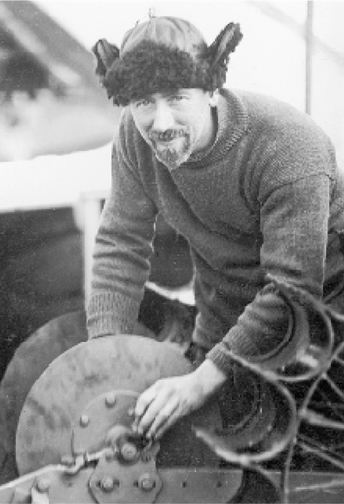
T. Orde-Lees
Seconded from the Royal Marines, where he was a physical training instructor, Captain Orde-Lees had served in China before joining the Endurance. He had narrowly missed being chosen to join Scott's second expedition.
“One can always have a bath afterwards, & I suppose it is good for one from a disciplinary point of view,” he conceded in his diary. Just how vital this discipline would prove to the well-being of the company as a whole not even Shackleton could have known.
The Endurance arrived at South Georgia on November 5, eleven days after leaving Buenos Aires, in a mist of snow squalls that obscured a jagged, precipitous coastline. The company were greeted warmly by the island's small population of Norwegian whalers, and were impressed by the level of amenity their hosts had managed to maintain at this most remote outpost of humanity. There were electric lights and hot water; and the home of the Grytviken station manager, Fridthjof Jacobsen, was not only heated but had geraniums blooming in its bow windows. These charms, however, could not conceal the noxious presence of the whaling industry: The island's natural harbors were full of greasy offal and the stench of decaying whale carcasses, and the waters of Grytviken were red.

Washing the floor
Left to right, Wordie, Cheetham, and Macklin. “I simply hate scrubbing. I am able to put aside pride of caste in most things but I must say that I think scrubbing floors is not fair work for people who have been brought up in refinement.” (Lees, diary)

Grytviken Whaling Station, seen from the Endurance
This was the ship's last port of call before heading south towards the Weddell Sea.
The whalers provided the expedition with coal and clothing, bought on credit, as well as valuable information. No men on earth knew better the seas Shackleton was poised to enter, and they confirmed the reports from Buenos Aires that ice conditions were unusually severe that year, with pack extending farther north than it had in anyone's recollection. Shackleton was advised to wait until later in the austral summer, and so the brief time he had planned to spend on South Georgia turned to a full month.
The month on South Georgia appears to have been passed agreeably with the men getting to know one another and each becoming familiar with his duties. Amid the magnificent subantarctic scenery and fauna—elephant seals, penguins, and other bird life—they could at last feel their adventure to the great white south was truly under way. The dog trainers took their charges to a nearby hillside and attempted to restrain them from gorging on whale offal and rooting through the old whalers' cemetery; the scientists wandered up into the hills looking at the abundant wildlife and “securing specimens.” Frank Hurley, aided by Captain Worsley and First Officer Lionel Greenstreet, lugged his forty pounds of camera equipment to the heights overlooking the Grytviken harbor and preserved the image of the Endurance riding at anchor, rendered insignificant by the stupendous encirclement of mountains. Lees, characteristically, sought to go off and climb challenging peaks on his own; Shackle-ton, characteristically, forbade him. The carpenter was busy constructing a covering for the extra deck space. The sailors remained with the ship.
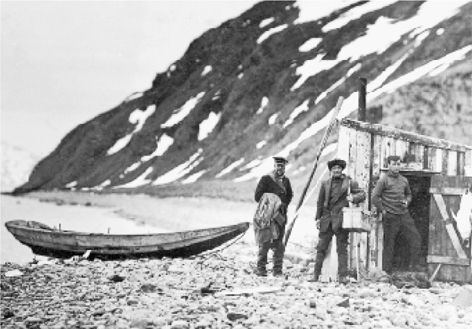
Veslegard Hut, South Georgia, 28 November, 1914
Reginald James took this picture of Wordie, Hurley ( holding camera bag ), and Clark while on a camping trip during the monthlong sojourn on the island.
Several members of the expedition could count themselves old Antarctic hands. Alfred Cheetham, the third officer, had been south more times than any other man on board the Endurance except Frank Wild: first in 1902, as boatswain on the Morning, the relief ship sent to search out and supply Scott's Discovery; as third officer with Shackleton on the Nimrod; and with Scott again on the Terra Nova. Born in Liverpool, Cheetham was small and wiry, known for his cheery, willing manner; he was the chanty-man on both the Nimrod and the Endurance, and an old salt to the marrow of his bones. When asked to join the Nimrod crew, so the story goes, Cheetham had immediately agreed, then hastened off to tell the wife of his mate “Chippy” Bilsby, carpenter on the Morning, that her husband was going to the Antarctic again. Having delivered this message, he continued to the house where Bilsby himself was working.
“Eh! Chippy lad, coom darn,” Cheetham called out, in broad Liverpudlian. “Tha's barn t'ert South Pole wi me.”
Bilsby: “I'se better see t'missus furst.”
Cheetham: “Ah've seen t'wife, Chippy. Coom on.”

Panorama of South Georgia Island, with Endurance in harbour
Worsley and Greenstreet, in foreground, helped Hurley lug his camera equipment up to Ducefell to take this picture.
Frank Hurley, of course, had been south as well. He was twenty-six in 1911, when South he first heard word that Dr. Douglas Mawson, Australia's noted polar explorer, was planning a journey to the Antarctic. Determined to get the job of expedition photographer, but with no contacts to recommend him, Hurley had waylaid Mawson in a private railway compartment, selling himself to the explorer for the duration of their journey. Three days later, Hurley received word of his acceptance—Mawson had admired Hurley's initiative. The success of Hurley's eventual film about the Mawson expedition, entitled Home of the Blizzard, had partly inspired Shackleton's Imperial Trans Antarctic Film Syndicate venture. Aboard the Endurance, Hurley was considered “hard as nails,” able to endure harsh conditions and willing to go to any length to obtain a desired shot. Professionally much admired, he was not universally liked. Having come up in the world by dint of talent and hard work, he was keenly conscious of his superior abilities. He was susceptible to flattery and was considered “rather bombastic.” His nickname was “the Prince.”
George Marston had been with Shackleton on the Nimrod. A graduate of a London art school, he was part of a young set that included Shackleton's two sisters, Helen and Kathleen, who encouraged him to apply for the position of expedition artist. On the Nimrod expedition, Marston took part in three sledging journeys, one of them with Shackleton, who had been impressed with Marston's physical abilities. The son of a coachmaker and grandson of a shipwright, Marston was, like Hurley, marvelously versatile—which would prove useful.
Little is known of Able Seaman Thomas McLeod, a superstitious Scotsman who had been with Scott on the Terra Nova and Shackleton on the Nimrod. Having run away to sea at the age of fourteen, he had twenty-seven years of sailing experience.
Tom Crean was a tall, raw-boned Irish seaman, one of ten children born to a farming family in a remote part of County Kerry. He had come up the ranks of the Royal Navy, having enlisted at sixteen—adding two years to his age—as a boy second class, in 1893. Fluent in Irish and English, Crean always regretted that his formal education had ceased at primary school. His own sensitivity to this fact, more than the fact itself, may have prevented him from rising higher than he did. On the Endurance, Crean was second officer.
But in worth, if not in actual rank, Crean was, to use Shackleton's own word, “trumps.” He had gone south with Scott on both the Discovery and the Terra Nova expeditions, receiving the Albert Medal for bravery on the latter; and he had been among the sixteen who set out with Scott for the South Pole in 1911. Scott's method was to avoid assigning roles in advance, so that no one in the crew knew whether he was destined to be in the polar party, or to be turned back short of the final push, after hauling supplies for many miles. On January 3, 1912, Scott told Crean and two companions, Lieutenant “Teddy” Evans and William Lashly, that they were to turn back the next day. Although all supplies and equipment had been rationed for two teams of four men each, at the last minute Scott chose a fifth man, “Birdie” Bowers, to join the polar party. This decision not only contributed to the demise of his own party by adding an unexpected mouth to feed, but seriously burdened the returning trio with a four-man sledging load. Evans, already suffering from scurvy, collapsed and was pulled by his companions until they could go no farther. Then, thirty-five miles from the nearest assistance, Crean set out alone with three biscuits and two sticks of chocolate.

Crean (standing) and Cheetham
The “Irish giant” and the diminutive “veteran of the Antarctic.” Crean had sailed on the Terra Nova and Discovery with Scott before joining Shackleton on the Endurance.
“Well Sir, I was very weak when I reached the hut,” Crean wrote in a letter to a friend. He was a hard man to rattle. Earlier in the same expedition, after an exhausting trek across fragmented sea ice with the ponies, Crean and his two companions had prepared their dinner. By mistake, a bag of curry powder was taken for cocoa. “Crean,” recalled his tent mate, “drank his right down before discovering anything wrong.” But tough though he was, Crean broke down and wept when, at 87° south, only 150 miles short of their goal, Scott informed him and his companions that they had not been selected for the honor of continuing with him to the pole.
A number of the sailors aboard the Endurance had formerly been trawlerhands in the North Sea, as brutal an occupation as could be imagined. Little suggests they were sympathetic characters, and one of them, John Vincent, previously a sailor in the navy and a trawlerhand off the coast of Iceland, would turn out to be a problematic bully. Of the two stokers, William Stephenson was a former Royal Marine and officer's servant, and Ernest Holness, the youngest of the sailors, was “a York-shire lad,” and considered—by Lees, at any rate—to be “the most loyal to the expedition.”
Four of the sailors were particularly liked. Timothy McCarthy was a young Irishman in the merchant service, known for his ebullient good humor and gift for repartee. Walter How, a Londoner, was only three weeks back home from a stint abroad when he applied for a position with the Imperial Trans-Antarctic Expedition. Shackleton was impressed with his recent experience aboard the Canadian Auxiliary Survey Ship, working only miles below the Arctic Circle off the coast of Labrador. He was also of a cheerful disposition and a good amateur artist. William Bakewell joined the expedition in Buenos Aires. He had been a farm laborer, logger, rail worker, and ranch hand in Montana before becoming a seaman at the age of twenty-seven. When his ship the Golden Gate ran aground in the River Plate, he and his mate Perce Blackborow wandered the docks of Buenos Aires looking for a way to England and came upon the Endurance.

George E. Marston
The expedition artist was described by a former shipmate as having “the frame and face of a prizefighter and the disposition of a fallen angel.”
“It was,” he said, “love at first sight.” On learning that she belonged to the famous polar explorer Sir Ernest Shackleton, and that he was seeking a replacement crew, the two young men presented themselves for consideration. Pleased with Bakewell's experience with sailing ships, as opposed to steam, Shackleton hired him (it may not have hurt his chances that Bakewell, the expedition's only American, posed as a Canadian, seeking a colonial's advantage). But Blackborow was turned away when Shackleton decided he had enough men. Aided by Bakewell and How, Blackborow stowed away in a clothing locker in the fo'c'sle. The day after the ship left Buenos Aires, he was discovered and dragged before Shackleton. Hungry, frightened, and seasick, the young man was subjected to an eloquent tirade from “the Boss” that impressed all onlooking seamen. In the end, Shackleton leaned close to Blackborow and said, “Do you know that on these expeditions we often get very hungry, and if there is a stowaway available he is the first to be eaten?” This was correctly interpreted as official acceptance of his presence, and Blackborow was signed on as steward to help in the galley, at £3 a month. In fact, Shackleton came to regard the quiet, conscientious Welshman as highly as any member of the crew.
One of the oldest men was Henry McNish, known by the traditional nickname for ship carpenters as “Chippy.” A blunt-spoken old salt from Cathcart, outside Port Glasgow, he stirred misgivings in Shackleton from the outset.
“The carpenter is the only man I am not dead certain of,” Shackleton had written to his friend and agent, Ernest Perris, shortly before leaving South Georgia. McNish was perhaps the most mysterious member of the expedition. He claimed, untruthfully, to have sailed south with William Bruce's Scottish expedition in 1902, but he was in any case much travelled. For reasons that remain obscure, Shackleton and his shipmates believed him to be in his fifties, although his actual age was forty. Though not particularly liked, he was universally respected, not only as a brilliant shipwright but also as an experienced sailor in the Royal Naval Reserve.

The deck of the Endurance on the outward journey
“Upon getting along side, I saw the name on her stern, Endurance, London. Upon closer view she did not look so neat and trim, as the deck was littered up with boxes and crates of all shapes and sizes and at least a thousand dogs.” (Bakewell, autobiography)
“Chips was neither sweet-tempered nor tolerant,” a shipmate from another expedition recalled. “And his Scots voice could rasp like frayed wire cable.” McNish had brought along his cat, the irrepressible Mrs. Chippy, a tabby described as “full of character” by several members of the expedition, and whose chief delight was taking teasing shortcuts across the kennel roofs of the half-wild sledging dogs, whom he (for Mrs. Chippy was belatedly discovered to be a male) cannily perceived to be securely chained to their kennels.
Twenty-seven in all, not including Shackle-ton, the men formed a relatively small team to wage the battle south through the thousand miles of ice-strewn ocean that lay between them and their planned destination. Each must have carefully scrutinized his fellows' experience and character. Nor was Shackleton himself exempt from such assessment.
“[A] queer bird, a man of moods, & I dont know whether I like him or not,” First Officer Greenstreet wrote to his father. Shackleton had arrived in Buenos Aires somewhat under the weather and does not seem to have been in top form while in South Georgia. Accompanying him on a short hike, Wordie observed that he “was troubled by a bad cough, and seemed pretty tired with the walk.” Shackleton still had much to worry about: The worst ice conditions in living memory showed no sign of improving and some of the whalers suggested that he should defer setting out until the next season. But for Shackleton postponement of the expedition would be tantamount to relinquishing it forever. Behind him lay the war and many financial loose ends.
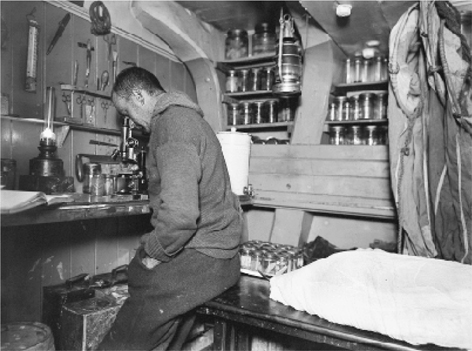
Clark in the biological lab
His shipmates played a practical joke on him by putting spaghetti in one of his specimen jars.
The Endurance steamed out of Grytviken's Cumberland Bay on the morning of December 5, 1914. She was freshly provisioned—her cargo now included two live pigs for food—and her crew was rested and eager for the next stage of the journey. The mountains of South Georgia remained in sight until the evening, as the Endurance headed south by southeast. As early as the next day the ship passed numerous icebergs, and by December 7 she had encountered the outskirts of pack ice.
The Weddell Sea is uniquely configured for maximum hazard to ships. It is contained within three belts of land—the string of South Sandwich Islands to the east, the Antarctic continent proper, and the long finger of the Palmer Peninsula to the west. A prevailing current drives the roughly circular sea in a slow clockwise motion. Sea ice, which can form here during any season, is thus never dispersed into the warmer northern waters, but churned in an interminable semicircle, eventually packed by the westward drift against the Palmer Peninsula.
For the next six weeks the Endurance worked its way cautiously south, dodging and weaving around loose floes and pack and sometimes smashing her way through them. Shackleton hoped that by keeping outside the pack's eastern edge, he could obliquely work his way down towards Vahsel Bay. The tactic only worked for so long, and soon he had to broach the pack.

Worsley directing helmsman through the ice
Shielded from the wind, Worsley semaphores directions to the ship's helmsman.
As the Endurance continued south, she entered fields of snowy ice, enormous floes up to 150 square miles. “All day we have been utilizing the ship as a battering ram,” Hurley wrote in his diary in mid-December. “We admire our sturdy little ship, which seems to take a delight herself in combating our common enemy, shattering the floes in grand style. When the ship comes in impact with the ice she stops, dead, shivering from truck to kelson; then almost immediately a long crack starts from our bows, into which we steam, and, like a wedge slowly force the crack sufficiently to enable a passage to be made.”
Days of thick mist opened onto clear days of radiant sunshine. During the long dusk of the austral summer night the broken pack appeared to float like so many giant white water lilies on an azure pond. The ship passed crabeater seals basking on the ice and crowds of always entertaining Adélie and emperor penguins, who would pop up unexpectedly on floes and clamor at her as she passed. Gradually the bodies of open water got smaller and smaller, until the whole sea looked like a vast snowfield, broken only here and there by lanes and channels.
Christmas Day was celebrated with mince pies and Christmas pudding, colorful flags and table settings, and a singsong in the evening. Magnificent sunsets were admired from the ship's rail, and on the last day of 1914, after a difficult morning spent ramming through a bad patch of ice, the Endurance crossed the Antarctic Circle in a dreamlike twilight reflected in calm waters. On the night of January 1, 1915, the Scottish contingent singing “Auld Lang Syne” woke the “respectable members” who had retired for the evening. Lees peevishly noted, “Scotchmen always are a nuisance at New Year and never have voices worth speaking of.” Meanwhile, on the bridge,

Endurance in pack ice
“Pack-ice might be described as a gigantic and interminable jigsaw puzzle devised by nature.” ( Shackleton, South)
Shackleton, Wild, Worsley, and Hudson shook hands all around and wished each other a happy New Year.
The weather by now was usually overcast, and the Endurance was encountering more icebergs, grand structures that rose like fantastic sculptures of blue-white marble above the waterline, and which appeared peacock blue below it. The expedition company whiled away the time in domestic pursuits. Lees darned his socks and washed and mended his clothes; Hurley took photographs in the midnight sun. Robert Clark, the biologist, studied the diatomaceous deposits of the Weddell Sea under a microscope. On January 6, the dogs were taken off onto a convenient floe for exercise, the first they'd had since leaving South Georgia a month before; they immediately initiated one of their infamous “scraps,” falling through rotten ice into the water.
Ice conditions on January 7 and 8 forced the ship to backtrack through the pack to seek a better opening, but on January 10, at 72° south, an important landmark was reached: The ship came in sight of Coats Land and began to work her way close to its great 100-foot-high wall of barrier ice. The Endurance was now, with fair going, as little as a week away from Vahsel Bay. With the expectation that she would still return to Buenos Aires or South Georgia for the winter, the expedition's wintering-over shore party were busy writing letters home to be carried with the returning ship.

Berg, observed 21 December, 1914
“[A]t 10:00 a.m. we entered long leads of ice free water, in which were drifting some fine bergs of magnificent forms. One a fine cuniform mass 200 feet high, I photographed.” ( Hurley, diary)
On January 11, the ship's company began the day with a breakfast of Quaker Oats, seal's liver, and bacon. Bad weather forced the Endurance to drift with a large floe. McNish, the carpenter, used this layover to make a small chest of drawers for “the Boss.” Shackleton himself was observed to be looking “dead tired”; he had not slept much over the past few days. The two pigs obtained in South Georgia (named Sir Patrick and Bridget Dennis) were fattening up, and one of the dogs, Sally, had given birth to three pups; tough Tom Crean was observed with amusement to be fussing over the pups “like a hospital orderly.” The day closed with a dinner of thick lentil soup, stewed clubbed seal, tinned peas, and custard.
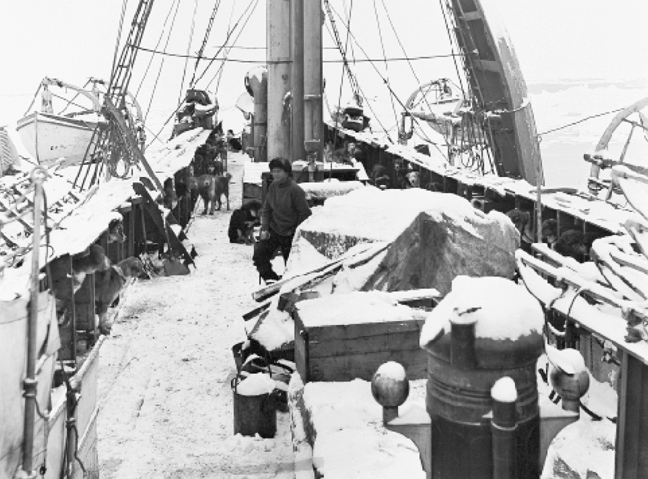
The upper deck after a light snow fall
“It is wonderful how the dogs prefer to sleep on the snow covered deck rather than in their kennels.” ( Lees, diary)
January 12 dawned with mist and snow, but was otherwise a good day. Clark bagged interesting specimens in his dredge nets and towards evening a flock of young emperor penguins was passed on a nearby floe. The Endurance, now under steam, broke from the pack ice into open water and reached the bay that marked the farthest south of William Bruce's Scotia expedition in 1903. Shallow soundings of about 150 fathoms indicated the proximity of land. Lees, busy amid the stores, triumphantly rooted out “a case of marmalade and one or two other things that Sir Ernest especially wanted.”
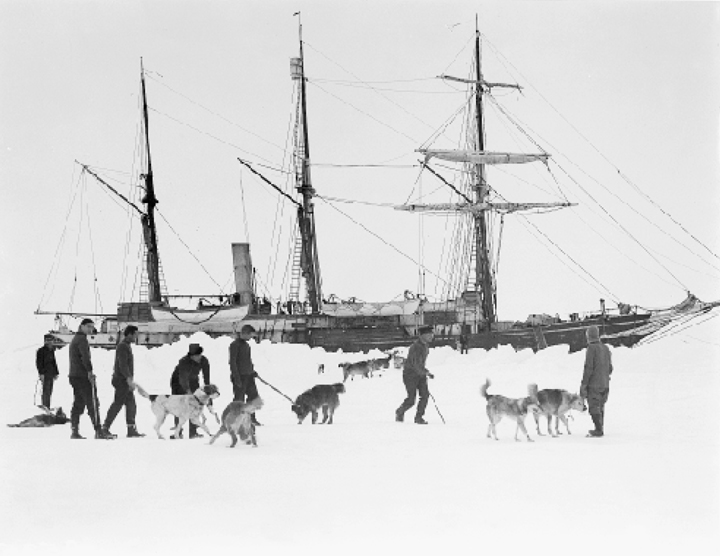
January 6, 1915; Exercising the dogs
“During the day the dogs were taken for a run on the large floe to which we were anchored. The exercise did them a great deal of good—it being the first they have had for nearly a month.” ( Hurley, diary)

Crean with pups
“Opposite the pigs are 5 puppies & their mother, the ‘interesting event' having taken place three days ago, but so far Tom Crean, who has cared for her like a hospital orderly is the only one who has seen the little creatures, though we all hear their shrill little squeaks. They will soon be fun.” ( Lees, diary)
On January 13, after skirting heavy pack around the barrier all night, the Endurance was again drifting within the floes, which showed no sign of opening up. For two hours she searched for an opening, then banked her fires and lay to. The following day, January 14, the ship was still held fast. The weather was magnificent, however, the best since leaving South Georgia, with the temperature at 25° Fahrenheit. Hurley, ever on the lookout for photogenic scenes, described the surroundings thus:
The bergs & floes were reflected in the deep blue water, while the heavy pres sure ice, gleaming in the sunshine with its deep blue shadows, was one of the finest sights I have seen in the South. The ice was more like serracs than pack ice, for it was so tossed, broken & crushed. Great pressure ridges thrown up 15 to 20 feet in height bear evidence of the terrific force & pressure of the ice in these latitudes.
From the crow's nest high above the ship, Lees noted that tremendous pressure pack could be seen in every direction.
Yet, in the evening, a rising breeze began to work upon the pack, and before
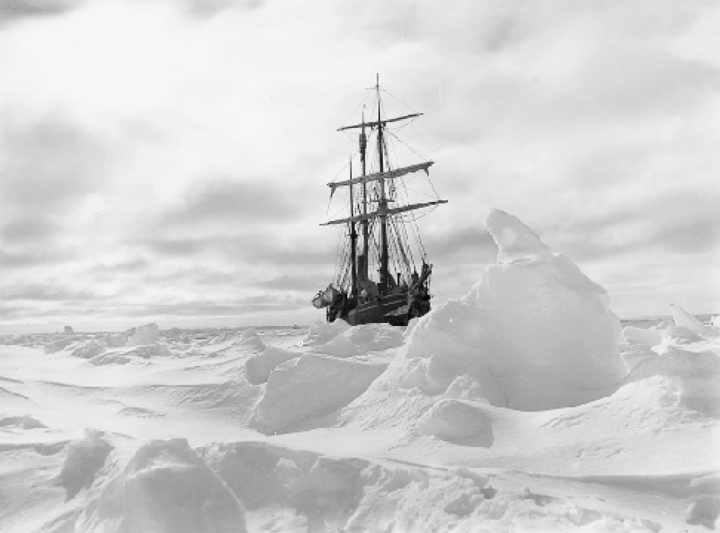
Laying to, 14 January, 1915
“Tied up all day to the floe ice.… The day was magnificent. The finest day since leaving South Georgia & in fact the second sunny one we have had.” (Hurley, diary)
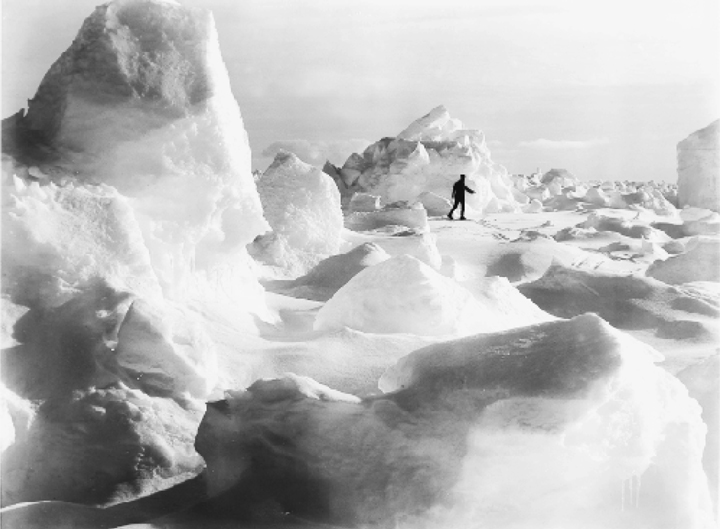
14 January, 1915
“This ice was more like serracs than pack ice for it was so tossed, broken & crushed. Great pressure ridges thrown up 15 to 20 feet in height bear evidence of the terrific force & pressure of the ice in these latitudes.” ( Hurley, diary)

14 January, 74° 10′S 27° 10′W
The lay-to in the floe ice allowed the crew to take excursions on the ice.
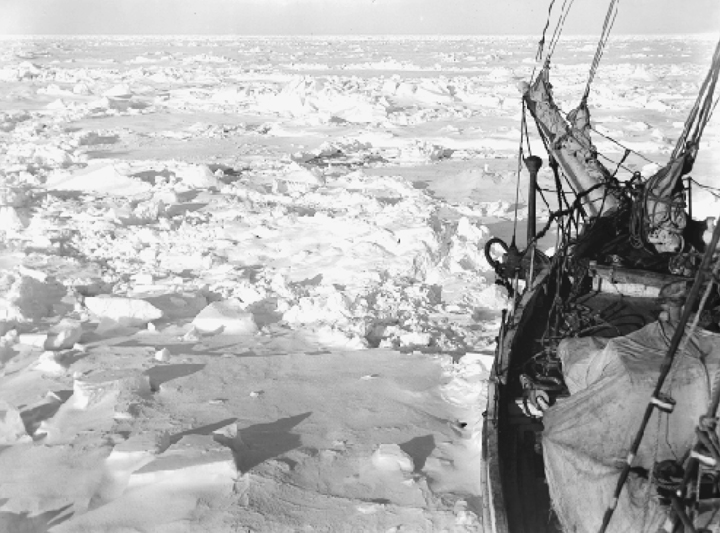
Pack ice, January 20, 1915
Taken the day the Endurance was finally held by the ice. “We have only 85 miles to go but the wind is still from NE & keeping the ice hard against the barrier.” (McNish, diary)

Endurance beset, full sail
On the night of January 24, a lead of open water appeared ahead of the ship. “Today at 9 a.m. we hoisted all sail & got up full steam and continued to drive the engines full speed ahead until noon in the hopes of reaching the open water but all to no avail.” ( Lees, diary) midnight a lane of open water had appeared at the foot of the barrier. In the early morning of January 15, the Endurance continued under hazy skies. An unusually large number of seals were seen throughout the day, and at three in the afternoon the ship passed a large group swimming out from the barrier to offshore pack. The whole company gathered at the rail to watch and exclaim as the seals dove and played around the ship like porpoises—it was an event that everyone remembered with affection. By evening, the skies were clear and a lane of water had opened to allow the Endurance to speed south under sail. Fine, clear water lay ahead. Just before midnight, in the strange perpetual summer twilight, the ship came upon a sheltered bay formed by the projecting end of a great glacier and the ice barrier.
“The bay…would have made an excellent landing-place,” Shackleton wrote, noting its “natural quay” of flat ice and its unusual configuration, which sheltered it from all but northerly winds. “I named the place Glacier Bay,” he continued, “and had reason later to remember it with regret.”
The Endurance steamed along the glacier front through the night, and by early morning had arrived at another glacial overflow, deeply crevassed, its frozen torrent spilling over a cliff face that rose as high as 350 feet. At 8:30 a.m., the ship's splendid run of 124 miles was brought to a halt by dense pack ice, partly held in place, as Shackleton surmised, by the strikingly large bergs in the vicinity. The ship drew up close to a small berg distinguished by well-defined bands of embedded matter, which expedition geologist James Wordie identified as “biotite granite.” Later in the day, an easterly wind blew up, eventually increasing to gale force. While the leeward pack began to break and disperse under its pressure, the Endurance lay to behind a convenient berg. It was tedious to be held up after such a satisfying run. Lees, for one, whiled away the time with a characteristic tidying up of stores in the hold.
The gale continued throughout the following day. The Endurance, unanchored, pitched about in the rough sea, steaming around and around in small circles all the while. A few seals rode the waves past her, their heads high above the water. From his bunk, Hurley looked up from his book to glance at the huge white bergs and lowering clouds through a porthole window.
On January 18, the gale had abated sufficiently to allow the Endurance to raise sail in the morning and take advantage of a long lead that had opened at the foot of the glacier front. Pack ice was encountered, however, in the afternoon. Cautiously, the Endurancewas nosed through the thick brash into open water, where she enjoyed a twenty-four-mile run before heading into more heavy brash and large, loose floes.
“The character of the pack has again changed,” Worsley noted. “The floes are very thick but are composed of a greater proportion of snow; tho' they are broken up slightly into large floes the brash between is so thick & heavy that we cannot South push thro' except with a very great expenditure of power.… We therefore prefer to lie to for a while to see if the pack opens up at all when this NE wind clears.”
Fighting seasickness brought on by the rough sea, Lees had endured his turn at the wheel, where it was “snowing and blowing and generally horrid.” In the afternoon he spent his spare time readying the stores for landing, sorting them into “ship” and “shore” piles. Less industrious members of the expedition were bored by the delay.
“It is gratifying to feel we are only 80 miles from our intended base, Vahsel Bucht,” Hurley wrote, referring to it by its German name. “We are all keen to reach it as the monotony is telling on some of us.”
The weather on the following morning was good, but the ice conditions had worsened, the pack having closed in around the ship during the night. The scientists dutifully took specimens, but everyone's attention was on the ice. The gale had packed it so tightly against the continental shelf that no water at all could now be sighted from the crow's nest. Still, the ship's company turned in that night hoping that a change in the wind would open the pack and allow them to continue on their way. The Endurance was now as little as one good day's sail away from Vahsel Bay.
The northeasterly gale that had been blowing intermittently since January 16 rose again in the course of the night. The day broke dull and snowy, revealing the pack pressed around the ship more densely than before. Still, the temperature was mild, 28° Fahrenheit, so as Lees noted “there is no fear, at present, our getting frozen in.” With nowhere to go, there was not much to do. The day's excitement came when Frank Wild shot a nine-foot crabeater seal, providing fresh meat for the men and dogs and Mrs. Chippy. The scientists held a singsong in Clark's cabin, a favorite gathering place as it was close to the boilers. Hurley continued writing letters to be taken with the ship when she returned to South Georgia Island, and Lees busied himself with washing and mending his wardrobe.
The gale was still blowing from the northeast on January 21, drifting snow from the continental ice shelf; consequently the air was full of moisture, and the wardroom and cabins became damp with condensation. Ice pressure against the rudder caused grave concern, and the crew went over the side to chip it clear. Although it represented a costly expenditure of fuel, Shackleton kept steam up in the boilers so that the ship could take advantage of the least opening in the pack. Held fast in the ice, the Endurance was being carried with the rest of the pack by the Weddell Sea's current; soon she would be moving away from land.
After six days of blowing on and off, the northeasterly gale subsided on January 22, and the following day dawned sunny and calm. Hurley immediately took advantage of the light to take some color photographs, and Lees continued his scrubbing and darning. An assessment of the ship's supply of fuel determined that only 75 tons of coal remained of the 160 the Endurance had carried from South Georgia.

Endurance in ice in full sail
Worsley called this photo “The Endurance in the Pride of Her Youth.”
At midnight on January 24, a rent in the surrounding ice opened a lead at right angles to the ship—but 100 yards distant. Full steam and sail were raised, but the Endurance could not ram through, and the ship's company took to the ice with chisels and crowbars to try to hack a path to the tantalizing lane to freedom. Although the ice could be seen breaking up some distance ahead, around the ship herself they could do nothing.
“Held up in the ice. Nothing of any movement takes place”; “still fast & no signs of any opening”; “the lead that promised so much has almost closed up again”; “still fast”— thus, in this anticlimactic way, do the diary entries over the next few days indicate the men's dawning awareness that the decision to lay to in the pack—made, it seems in retrospect, almost casually on the night of January 18—had proved fatal to their plans.
“It appears as though we have stuck fast for this season,” Hurley wrote at the close of January 27. “A noticeable drop in the temperature at midnight, +9 being recorded. This has had the effect of freezing up many of the small pools & cementing together the floes, an ominous happening.”

Playing football on the ice
A popular diversion while the ship was held up. Macklin and Clark, both Scots, were recognized as the most outstanding players. The teams were Port watch versus Starboard watch.
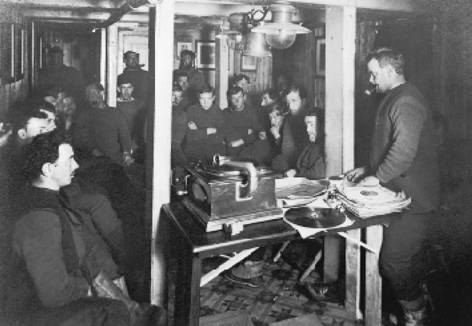
A weekly gramophone evening in the Ritz, Sunday evening
Some of the sailors developed the superstition that the gramophone incited the bouts of pressure.
Daily depth soundings indicated that the ship was drifting farther and farther away from land. With the regular routine winding down and less work for everyone to do, boredom inevitably set in. Games of football on the ice and attention to the dogs provided some diversion. In the wardroom, the scientists amused one another by reading aloud in the evening, and Sunday singsongs were a regular event. Saturday nights the traditional toast was drunk “to our sweethearts and wives” (followed unfailingly by the chorus, “may they never meet”), a ritual overdone by McNish one night, resulting in a quarrelsome disturbance in the fo'c'sle.
Although scientists and sailors had been prepared to travel south together, they had not counted on sharing one another's company for a polar winter. And while the possibility of the ship's wintering over had been discussed in Buenos Aires, the original plan had called for her to return to safe haven after depositing the shore party and their supplies.
“The idea of spending the winter in an ice bound ship is extremely unpleasant,” Hurley wrote in early February, “more so, owing to the necessarily cramping of the work and the forced association with the ships party—who, although being an amiable crowd are not altogether partial to the scientific staff.”
False hopes arose several times with the appearance of a lane, or a change in the ice, and more than once the men set out to cut or shake the ship free. On February 22, the drift of the Endurance carried her to the 77th parallel. It would be the farthest south attained by the Imperial Trans-Antarc-tic Expedition.

Cutting the ice around Endurance
On February 14 and 15, 1915, a lead of free water appeared 400 yards ahead of the stricken ship, and the crew made strenuous efforts to cut a path to this tantalizing lane.
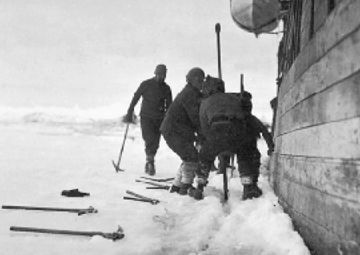
Trying to break up ice from around Endurance
“The summer had gone,” Shackleton wrote. “Indeed the summer had scarcely been with us at all. … [T]he seals were disappearing and the birds were leaving us. The land showed still in fair weather on the distant horizon, but it was beyond our reach now.” On February 24, Shackleton ordered the cessation of ship routine, and the Endurance officially became a winter station.
Having battled valiantly through 1,000 miles of pack ice in six weeks, the Endurance had come within a single day's journey of her landing base. Now exhausted by futile attempts to cut their ship free, Shackleton and his men could only watch helplessly as the Endurance's drift carried them out of sight of land. The fateful turn of events affected no one more than Shackleton. Not only was he burdened with the responsibility of keeping his diverse company in good health and spirits throughout a polar winter, but he had to swallow bitter personal disappointment. He was forty years old, and the Endurance expedition had taken formidable energy to assemble. With a war under way at home, it was unlikely that he would have another opportunity of returning to the south anytime soon; this was his last shot. Although for some while it remained theoretically possible that the expedition could proceed in the spring, when the breakup of the pack would release his ship, Shackleton was realistic enough to know that every passing day made this increasingly impossible.
“It was more than tantalizing, it was maddening,” wrote Alexander Macklin, one of the ship's two surgeons, in his diary. “Shackleton at this time showed one of his sparks of real greatness. He did not rage at all, or show outwardly the slightest sign of disappointment; he told us simply and calmly that we must winter in the Pack, explained its dangers and possibilities; never lost his optimism, and prepared for Winter.”
“The actual cutting out of the ice with picks & saws is difficult enough but lifting the blocks, some of which weigh as much as 3 and 4 hundred weight, out of the water, hauling them away, breaking them up…entails much hard work.” ( Lees, diary)
Meanwhile, Huberht Hudson, the navigator, repeatedly tried the ship's wireless to get signals from the Falklands, the nearest transmitting stations, but without success. The expedition was not only out of sight of land. No one in the world knew where it was.

“All hands again attack the ice and we work the ship a third of the way to the lead ahead.” ( Hurley, diary)

Trying to free the Endurance
“All hands hard at it till midnight when a survey is made of the remaining ⅔ some 400 yards. It is reluctantly determined to relinquish the task as the remainder of the ice is unworkable.” (Hurley, diary)

Endurance in the ice
Hurley noted that the pack frequently resembled a billowing sea.

A midsummer sunset, February 1915
“It was a charming evening. The atmosphere was charged with a redundancy of shimmering frost crystals.” ( Hurley, diary)

The ship caught in a pressure crack. 19 October 1915
“For the moment it seemed the ship would be thrown on her beam ends. Secured several fine photographs of our Gallant ship.” ( Hurley, diary)