
March opened with a blizzard and a temperature of –8° Fahrenheit. The floes around the ship had become so rough from the wind working upon them that crew members smashed two sledges trying to haul seal meat over the broken surface. Towards the end of this same day, Worsley gave orders for all hands to stay on board. The snow had become so heavy that it was dangerous to stray outside.
When the weather cleared, the creaking of ice and the sounds of the wind in all its moods filled the silence. At night, the men were kept awake by the light glinting upon the floes throughout the long austral twilight. Realistically, one could not expect the breakup of the ice until spring, sometime in October—some seven months away.
According to Shackleton's original plan, the shore party, composed of scientists and sledgers, would have been busy working at their various duties, preparing for the journeys they would undertake come spring. Those who were to have remained with the ship would have been working their passage back to a winter haven. But now the jobs the men had come to do could not be done, and the danger of a numbing tedium hung over them. From his own experience Shackleton well knew the peculiar psychological strain of the eerie silence and black emptiness of the impending Antarctic winter.
To guard against this, he set a strict winter routine. Instead of the usual rotation of sea watches, a single watchman was on duty from 8 p.m. to 8 a.m., allowing all other hands to enjoy uninterrupted sleep. To boost morale as much as stave off the cold, Shackleton issued to all hands the winter clothing originally designated for the shore parties (each article of which Lees had assiduously catalogued in his diary): two Jaeger wool shirts and combinations, or long underwear, Shetland wool mitts, minders, each of whom came to regard his charges with intense proprietary pride. Rivalries and races between the teams now provided further entertainment (“My team is one of the best,” Hurley characteristically confided to his diary). The dogs' health was a matter of constant concern. A number had already died, the victims of intestinal worms. April was also a tragic month for the pigs, whom the seamen converted into pork.

Hurley and Macklin at home one Shetland wool jersey, and, most important, Burberry tunics and trousers. These last were, in the words of one expedition member, roughly the weight of umbrella fabric, or calico, but supposedly so tightly woven as to be impervious to wind. A number of the sailors immediately stowed the new clothing safely away in their lockers, so as to have it “for swank” when they returned to civilization. Only clothing meant for the transcontinental party was kept apart, in the belief, or pretext, that the crossing might still happen.
“There are to be cubicles accommodating two members each and about 6 ft. 6 in. x 5 ft. each along the two sides of the hold. They will have curtains instead of doors.” ( Lees, diary) “The Billabong” held two cubicles, which were occupied by Macklin, Hussey, McIlroy, and Hurley.
Shackleton's immediate concern was to establish comfortable winter quarters for his men. March temperatures were running from +11° to –24°, and the deckhouse cabins where the afterguard of scientists and ship officers lived were bitterly cold. Shackleton ordered the storage area between decks cleared, and Chippy McNish began the work of constructing cubicles within this more insulated area. On March 11, the men moved down to their new quarters, which they had christened “the Ritz.” Each of the roughly six-by-five-foot cubicles housed two men, and each received a wry name from its occupants, such as “The Billabong,” “The Anchorage,” “The Sailors Rest.” In the middle of the space was a long table where all meals were taken, and a bogie stove stood at one end. The Ritz was not only warm; its close quarters seemed familial and cozy. Crean, Wild, Marston, and Worsley moved into the old wardroom, while the sailors remained in the fo'c'sle, which was situated between decks and so sufficiently insulated. Shackleton also stayed where he was, alone in the Captain's cabin, aft; it was the coldest part of the ship. Winter accommodations for the nonhuman members were also effected. The dogs were housed in ice block kennels dubbed “dogloos” in an extended circle around the ship. The pigs were disembarked to similar winter quarters, which the sailors called “pigloos”; Mrs. Chippy stayed on board the ship.
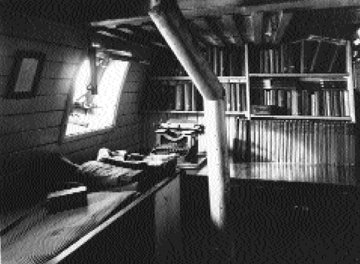
Ship's cabin, Endurance
Shackleton's cabin, the tidy repository of his ambitions.
The nights lengthened, and by the end of March there were equal hours of light and darkness. The fifty-odd dogs, big, energetic, wild, and playful, became the objects of intense interest and amusement. Their care occupied several hours a day, while their antics and different personalities kept the men on their toes. The animals took well to the ice, sleeping through blizzards with equanimity, curled in furry balls under the snow.
“When they think there is a danger of their being overlooked by their human pals,” wrote Worsley, “they sit up, shake themselves, do a song & dance & then coil down again for another snooze til GRUB— all our dogs spell it that way.”
In early April, Shackleton divided the dogs into six teams assigned to specific
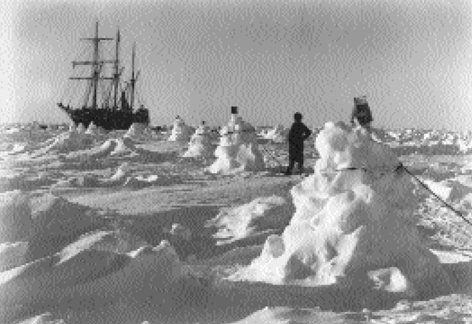
The way to the lead
A line of ice mounds were thrown up, linked with light rope to serve as guidance during blizzards.

Kennels around the ship
“Dogs all placed on shore much to their delight. All hands engaged building Igloos or Dogloos, from ice blocks & snow.… The dogs are secured by chain, one end of which is buried in the ice & frozen therein.” ( Hurley, diary)

Macklin and Greenstreet boiling blubber for dogs
A number of ice structures, including a quarantine and hospital for sick dogs, formed the dogloo complex.
In the dwindling light, the men exercised the dog teams, or scouted for now infrequent seals, or went off on exploratory hikes across the ice. Like the hapless Endurance, a number of icebergs had also become trapped in the pack, and so ship and landscape drifted in tandem, held together by the northwest current. As familiar objects in the men's erratically shifting world, many of these companion icebergs came to be regarded with affection. Notable among these was the aptly named Rampart Berg, which they had first encountered in early January, while still under sail.
Some 150 feet in height, it now reared majestically above the ice twenty miles from the ship.
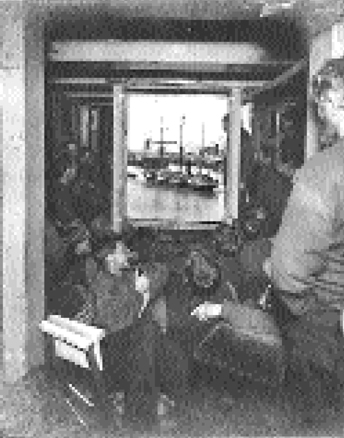
Self (Hurley) giving a “lantern chat”
“Hurley gives a lantern slide show of New Zealand. Having the honour of being the only New Zealander aboard, I do my best to give a lecture which consists mainly of ‘This is such & such a place.' Tap tap with a stick for the next picture. At the conclusion I give an imitation of a Maori haka or war dance with 3 or 4 excellent pupils.” ( Worsley, diary)
In the evenings, there were singsongs for entertainment, led by Leonard Hussey, the popular meteorologist who was also a proficient banjo player. Occasionally, Hurley presented lantern slide lectures, showing scenes of ice and snow from his Mawson expedition, or of sun and vegetation from his trip to Java. After most of the company turned in to bed, the lone night watchman was often joined by his pals, sharing such treats as cocoa and sardines on toast; these night visitors were called “ghosts.”
On the first of May, the sun disappeared entirely, not to be seen for the next four months. The men's activities were now curtailed even more. Exercise of the dogs continued, despite the difficulty in navigating the sledges over broken ice in the uncertain light, but excursions far from the ship were discouraged. Diversions of all kinds were sought: Hurley and Hussey became keen chess opponents, welcoming the mental stimulation of the game. In the fo'c'sle, the sailors played cards and draughts. Books were read and argumentatively analyzed, and for a time guessing games were all the rage in the Ritz. In late May, the men succumbed to winter madness, shaving their heads and posing amid great hilarity while Hurley immortalized the moment with a photograph.
Yet even in these winter months, there were days and nights of intense, magical beauty that raised morale and reminded some of the men why they had ventured into this harsh world. The strange mingling of faint daylight and a radiant moon on the frozen sea rendered the landscape mystically luminous. In the pure dark of a clear night, the stars glittered with unimagined brilliance, while faint aurorae tinged the horizon. Coming back from a sledging ride one night, Hurley described with elation the sensation of driving into the face of the moon.
The diaries of the men reflect, to varying degrees, a generally contented company. There are notes of peevishness and signs of the strain of living at close quarters with the same faces day after day, but no friction of real consequence.
“We all manage to live very happily here on board in spite of conflicting interests and the fact that most members are what one might term rather definite personalities and of somewhat different stations in life,” wrote Lees, ever mindful of class distinctions. Yet, he continues, “[T]here is no real need to have quarrels of any kind with one's comrades. Amongst gentlemen quarrels should be and can be avoided and there is no reason therefore why that should not be the case down here.” This was a particularly generous statement, written as it was only a short time after Hussey and Hurley had emptied a handful of lentils into his open mouth while he slept, to stop his snoring.
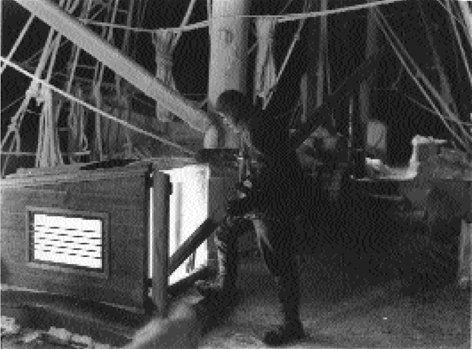
Clark returning from winter exercise
Carrying his skis, he prepares to enter the main hatch.
The general peace that prevailed on the Endurance had not come about by accident and owed something to the manner in which Shackleton had selected the men in the first place. When James presented himself for his interview, the great explorer had bewildered him by asking not about his suitability for a major polar expedition, or details of his scientific work—but whether he could sing.
“Oh, I don't mean any Caruso stuff,” Shackleton had continued, “but I suppose you can shout a bit with the boys?” The question proved to be uncannily appropriate. What he was looking for was an “attitude,” not paper qualifications.
Shackleton's presence informed every event that occurred on his ship. On the one hand, he was always ready to be one of the boys: He shaved his head along with everyone else, and he joined, enthusiastically and tunelessly, in the singsongs. He was anxious, with much to ponder and plan, but he did not require a brooding solitude in which to do this. He was always among his men, perceived to be in good spirits, and this fact alone was in great part responsible for the atmosphere of security that pervaded their stricken circumstances.
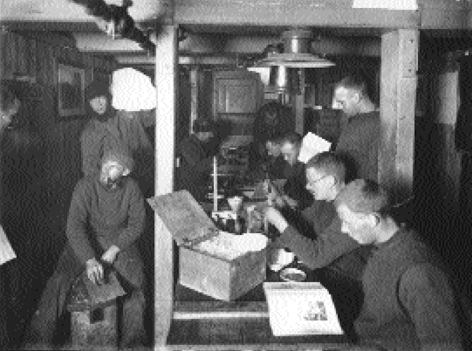
A morning in the Ritz, midwinter 1915
At left rear, Blackborow carries a lump of ice to be melted for water. Right, the scientists work.

Hussey and Hurley (Nightwatch) indulge in a friendly game
“Hussey & I are night watchmen. During the night we indulge in a game of chess. We are both keen enthusiasts & it exercises one's otherwise stagnant intellect.” ( Hurley, diary)
Shackleton did not believe in unnecessary discipline, and yet ultimately nothing happened without his consent. He was known to be above all fair, and so commands were obeyed not only because they were commands, but because they were generally perceived as being reasonable. His attention to the crew in the fo'c'sle was scrupulous. This was illustrated very clearly when the winter clothing was distributed. The fo'c'sle hands were supplied first, before officers and the shore party: “Whoever goes short it is not the crew,” Worsley wrote.
Walter How and William Bakewell, both lowly able seamen but avid readers, could look forward to discussing the books they had read in the excellent ship's library one-on-one with Sir Ernest Shackleton. Blackborow, the stowaway, was made to attend to his schooling, Sir Ernest having taken a personal interest in the bright, conscientious young man. Yet when occasion required, Shackleton's commanding personality could also confront the most difficult individuals head on. John Vincent, the bosun, a swaggering trawlerhand who was physically bigger and stronger than any of the rest of the crew, was a bully. When a delegation from the fo'c'sle complained to Shackleton of ill treatment at his hands, the Boss summoned Vincent to his cabin. Vincent left shaken and demoted, and caused no more specific trouble. Shackleton had not felt the need for backup in this encounter, which in the hands of lesser men could have turned into an unpleasantly jittery affair.
“He could put on a look, a disdainful look that made you shrivel up,” according to First Officer Lionel Greenstreet. “He could be very cutting when he wanted to, but I think it was more the look.”
Above all else, Shackleton judged a man by the degree of optimism he projected. “Optimism,” Shackleton once said, “is true moral courage.” Those not blessed with this gift he regarded with transparent contempt. This was the case with poor Lees, who was probably the most universally unpopular member of the expedition on account of his snobbishness and his inclination to be absent when hard work was demanded. For Shackleton, however, these flaws mattered less than Lees's naked anxiety about supplies and provisions. Lees had been appointed storekeeper and was in charge of rationing and keeping tally of what was consumed; but his able fulfillment of these duties was marred by his tendency to hoard and secret away trivial odds and ends for his own personal use. This, to Shackleton, suggested morbid pessimism, a lack of faith in availability of future stores. And so, despite Lees's own reverence for Shackleton as a leader, he was despised.
Characteristically, however, Shackleton was not vindictive. When, later in the winter, Lees was laid up with a bad back after shovelling snow (“the first work he has done since we left London,” McNish sourly observed), Shackleton placed him in his own cabin, checking in on him from time to time and bringing him cups of tea.
“At first,” wrote Lees plaintively, “I was in my own bunk lying in indifference & almost complete darkness all day. …” These are the words of a lonely man. One has the distinct feeling that Shackleton sensed some less observable malaise behind Lees's symptoms, and that he whisked Lees away from self-pity and the needling of his skeptical shipmates for a little ego boosting—all for a man he actively disliked.

R. W. James
“James was physicist, and was engaged in working magnetic observations, occultations of stars. … He had some wonderful electrical machines which none of us understood, and a joke of ours that annoyed him very much, was that he did not either.” (Macklin, diary)
Another pillar of the high morale on board Endurance was Frank Wild, Shackleton's second-in-command. No man had a bad word to say about him. “He has,” wrote Lees, “rare tact and the happy knack of saying nothing and yet getting people to do things just as he requires them.… [I]f he has any orders to give us he gives them in the nicest way.” Wild was forty, the same age as Shackleton. He was born in Yorkshire, the son of a schoolteacher, and claimed, untruly, that he was a direct descendant of the great Captain Cook. Before his first journey south on the Discovery, Wild had served in both the merchant service and the navy. He later declined Scott's invitation to join the Terra Nova expedition, casting his lot instead with Mawson's Australasian Antarctic Expedition. Wild had a laid-back competence, an unassuming manner, and it was to him that most petty complaints were made—that Clark, the biologist, wasn't polite enough, that Marston was a bully. To each grievance Wild appeared to give complete attention and understanding, with the result that the petitioner left feeling vindicated, even if no action was actually taken. Wild's loyalty to Shackleton was bone-marrow deep, and together the two men made a formidably efficient team.
Despite the efforts to generate amusements, time hung very heavy for the scientists. James “Jock” Wordie, the geologist, and Reginald “Jimmy” James, the magnetician and physicist, had been friends at Cambridge. Jimmy James, earnest and reserved, was the stereotypical academic, brilliant and engaged in his field, somewhat baffled and inept in everything outside of it. The son of a London umbrella maker, James had led a sheltered academic life. He had given up a desirable university appointment to come south (his ice-block physics lab was called a “physloo” by the sailors). James was a good conversationalist, talking excitedly about such issues as vaporization, pressure of gases, and atmospheric phe-nomena—often baited by Greenstreet and Hudson, whose facetious questions would eventually silence him. Unexpectedly, he proved to be one of the best actors in the farcical skits that were a mainstay of ship entertainment.
Wordie was from Glasgow, and a popular member of the expedition. His dry humor and unmalicious leg pulling were much appreciated. He had determined to join the expedition while at Cambridge, despite having attended a dinner there with Lady Scott, Captain Robert Scott's colorful widow, who “tried to dissuade all would be candidates from the thought of going” with Shackleton. But Wordie suspected that this would be the “last big expedition which would go South.” Unable to do much in the way of geology, he had turned his attention to glaciology.

Worsley, James take observations during the winter
“Worsley and James had a large telescope which they set up, and by getting the exact moment of occultation of certain stars, were able to work out the exact time.” (Macklin, diary)
Robert Clark, the biologist, was a dour man of very few words; even in Hurley's photographs, his reserve and self-containment are unmistakable. He won respect from all hands, being hardworking and strong, and could be counted on to volunteer for disagreeable jobs such as shovelling coal; he was also an excellent football player. Almost from the moment he left England, he was at work with his dredging nets, and grimly continued with his scientific duties while in the ice. He was forever skinning and dissecting penguins, a practice that gave rise to the rumor among the sailors that the scientists were looking for gold in the animals' stomachs.
Leonard Hussey, the meteorologist, was a Londoner by birth, and his shipmates amused themselves by teasing him for being a “cockney.” Having taken his degree from London University, he worked in the Sudan as an archaeologist before joining the Endurance; Shackleton claimed to have chosen him because the improbability of a man travelling from the heart of Africa to Antarctica amused him. Hussey's dedication to science was perhaps not as strong as that of his companions.
“The vagaries of the climate quite bewilder Hussey,” Lees observed. “For just when he thinks it is going to do one thing the precise opposite happens.”
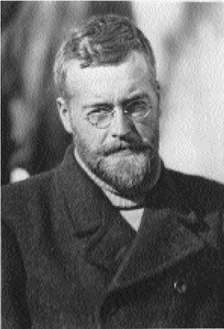
J. H. Wordie
“ ‘Jock' … is another Scotsman from Glasgow. … Taking him all round he is at once the most inoffensive & one of the most popular of our members. He has no use for cliques.” ( Lees, diary)
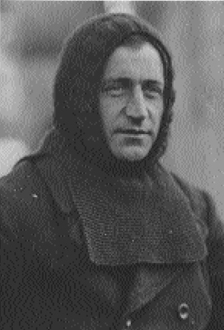
Robert S. Clark
“One day we saw a bunch of curious-looking penguins. … Clark went into ecstasies, or as near it as was possible for a dour Aberdonian to go.” (Macklin, diary)

Leonard D.A. Hussey
“I could never see that Hussey had much to do, for all his night observations were taken by the night watchman, but if we wanted him to come out and he did not want to come, he always pleaded great pressure of meteorological work.” (Macklin, diary)
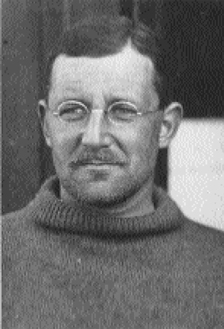
A. H. Macklin
Reliable and loyal, Macklin was the only Antarctic “novice” selected for the transcontinental crossing.
The two surgeons on board, Alexander Macklin and James McIlroy, were kept busy with the dogs: Both had been appointed as sledging team drivers, and it was their lot to attend to the parasite-ridden animals. Macklin was a Scot, the son of a physician from the Scilly Isles: Much of his boyhood had been spent around the islands in small boats. Although he could be quick-tempered, he was generally soft-spoken and very hardworking. He was also considered one of the group's best rugby players. McIlroy was about thirty-five years old, handsome and sardonic, already a man of the world who had practiced for years in Egypt, Malaya, and Japan and as ship's doctor on East Indian passenger steamers. He was from Northern Ireland (a third of the expedition were Scotch and Irish), and his humor could be wicked. One of his most successful perfor-mances—as reported by Lees himself—was an imitation of Lees's excessive deference to Shackleton:
[McIlroy:] (Dancing about in a most effusive way) “Yes sir, oh yes certainly sir, sardines sir, yes sir here they are (dashes to pantry and back) and bread sir, oh yes sir, bread sir, you shall have the night watch-man's bread sir.” (Another dash to the pantry and much groveling effusion and so on) “And may I black your boots sir,”…
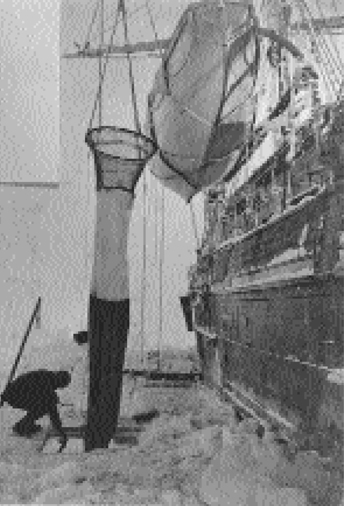
A man checking an ice hole outside the ship Shackleton sent word back that he himself had been brought up to eat what was put in front of him.
Probably Clark, who persisted with dredging for specimens throughout the period on the ice.
In the fo'c'sle, the sailors spent a great deal of their time in their beds.
“They just sleep the time away as best they can and never seem to look for any occupation,” Lees wrote, disapprovingly. The sailors were exempt from night watch duties, and although they had to tend to their own quarters, they were not called upon to help out in the Ritz. Again, Shackleton's care was to ensure that no one in the lower deck had cause to feel aggrieved. There had been hints that they could be troublesome, principally on the issue of meals. Though seal and penguin meat were routinely served in the wardroom, grumbling resistance to this had arisen in the fo'c'sle on the grounds that serving seal, as opposed to costly tinned meat, was “a ——— cheap way of running the expedition.” But their prejudices were catered to only so far. The word came down from the fo'c'sle one afternoon that one of the sailors had not found the day's menu of Heinz Spaghetti in Tomato to his taste.
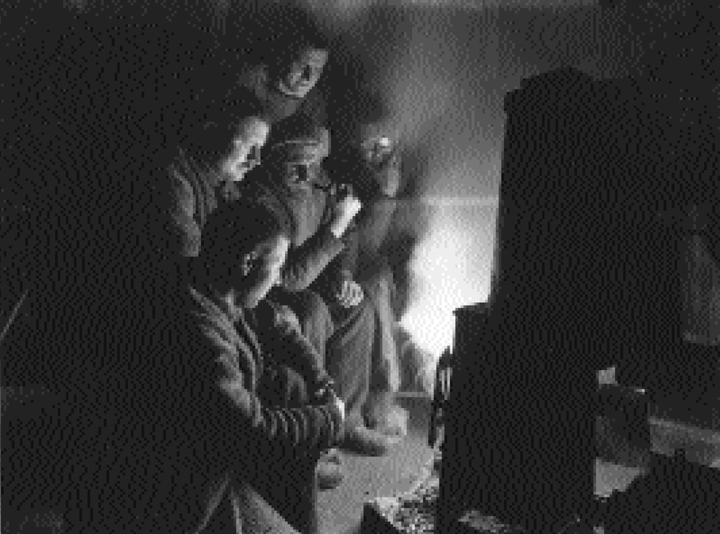
The night watchman's visitors
The night watchman's duties consisted of keeping alight the fires in the Ritz, upper-deck wardroom, fo'c'sle, and Shackleton's cabins, and keeping an eye on the dogs in the event that they “came adrift.” Above all, he was expected to watch for signs of change in the ice.

A glimpse in the fo'c'sle
Conjectured in background, How with ukulele, Stephenson beside him; around table (left to right), Holness, Vincent, Blackborow, McLeod.
Louis Rickinson and Alfred Kerr, the two engineers, were both so quiet and unassuming that their shipmates knew little about either of them, although both were admired for their efficiency and tidiness. Rickinson, who was in his thirties, was distinguished for his experience with internal combustion engines—and for being particularly sensitive to the cold. Kerr, who was a little over twenty, had worked on large oil tank steamers.
Possibly no one had less to do than the three men responsible for moving the Endurance forward. Frank Worsley, the captain, was now for all intents and purposes a man without a ship. Worsley was from an educated family of settlers who had come to New Zealand from England (his father had attended Rugby). He had grown up living the rugged, outdoor life of a pioneer, and at sixteen had followed his brother to sea, as an apprentice on a wool clipper. After coming up through the ranks of the merchant service, he eventually moved to England and joined the Royal Naval Reserve. Rambunctious and erratic, he was much like some of the high-spirited sledging dogs. One of the reasons Shackleton had reconsidered his plan to return the Endurance to safe haven over the winter was that he did not completely trust Worsley to deliver her safely the following season without supervision. Few men so thoroughly enjoyed all aspects of the expedition in all its extremes as Frank Worsley.
He was fond of claiming that his cabin was too stuffy, and slept instead in the 0° passageway; he relished shocking his shipmates by taking snow baths on the ice. His diaries are anecdotal, with a keen eye for situational comedy and for the beauty of the landscape around him. Like Shackleton, he was a romantic, dreamily in search of buried treasure, of improbable journeys. Yet for all Worsley's impracticalities, he was an expertly skilled sailor. Before moving to England, he served for several years in the New Zealand Government Steamer Service, a time spent mostly in the Pacific, where he learned to sail small boats in heavy surf.
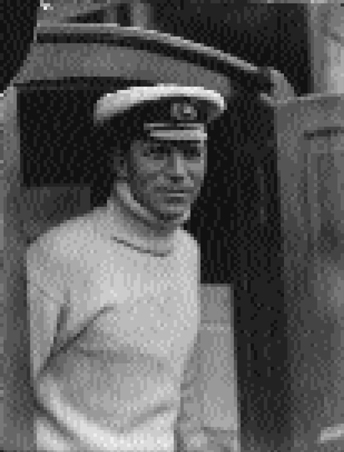
Captain Frank Worsley
“The skipper's principle whims were his eagerness to announce at every port at which we touched on the way out that this was, ‘Sir Ernest Shackleton's flag ship Endurance bound for the Antarctic on a voyage of discovery,' and his persistence in declaring that the cabins etc. on board are so stuffy that he had to sleep outside in the passages, which is what he actually does; but he is very much ‘all there' in spite of these quaint little peculiarities.…” ( Lees, diary)
Lionel Greenstreet, a young officer in the merchant service, between commissions, had signed on to the Endurance at short notice— twenty-four hours before the ship sailed from Plymouth—when the original first officer withdrew to join the war effort. His father was a respected captain in the New Zealand Shipping Company. Perceptive, critical, and a hard worker, he chose as companions the taciturn Clark and the rather superior Frank Hurley.
Huberht Hudson, the navigator, was the son of a minister and had grown up in an educated family, but in a tough East End neighborhood. He had left a school sponsored by the Worshipful Company of Carpenters at age fourteen, to be apprenticed at Trinity House. He was a “mate” in the merchant service, but was studying hard for his “master” rank while on the Endurance. He was regarded by his shipmates as extraordinarily good-hearted and unselfish, although at times a bit “touched.”
“One never quite knows,” wrote Lees, “whether he is on the brink of a mental breakdown or bubbling over with suppressed intellectuality.” He earned the nickname “Buddha” after appearing in a bedsheet with a kettle lid tied to his head at a small costume party held early in the expedition on board the ship. He was also the most proficient catcher of penguins for the ship larder.
A handful of men kept busy despite the expedition's setback. Charles Green, the cook, and Blackborow, the steward, worked hard in the galley from early morning until night, preparing meals for twenty-eight men. Green was the son of a master baker, and had run away to sea at the age of twenty-one, becoming a cook in the Merchant Navy. When war broke out, he joined a Royal Mail Line passenger liner, which docked in Buenos Aires around the time Shackleton was cleaning house. Hearing that the Endurancecook had been sacked, Green applied for the job; he had in fact met Worsley once before, in Sardinia. Blackborow, the eldest of nine children, grew up in Newport, Wales, near the town's active docks in a seafaring family. A hint of temper, the capability of plainly speaking his mind, was perceived to lurk beneath his pleasant, easygoing manner. At only twenty, he was the youngest member of the crew.
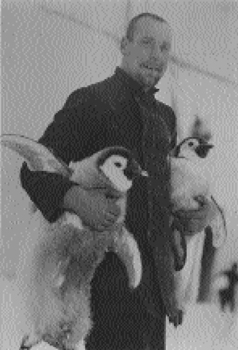
Hudson with young Emperor Penguin chicks, 12 January 1915; Lat. 74° 45S, 22.33W
The navigator became renowned for his penguin-catching skills.

Cook skinning a penguin in the galley
On the Endurance, Green's day began at dawn and ended only after dinner. The son of a pastry chef, he baked twelve loaves of bread a day, in addition to skinning and preparing game captured on the ice.
Chippy McNish was also rarely idle. He was not merely a carpenter, but a master craftsman and shipwright, and was constantly building or adapting things—card tables, chests of drawers, dog kennels, decking.
“All the work he did was first class,” according to his shipmate Macklin. He was never seen to take measurements: He simply looked at his job, then went away and cut the pieces, which always fit perfectly. Even Lees, who loathed him, recognized that McNish was “an expert wooden ship's man.” Although neither an officer nor a scientist, McNish was officially one of the afterguard, and his quarters were therefore not in the fo'c'sle, but in the wardroom, now relocated to the Ritz. For the fastidious Lees, eating at the same table with so unrefined a person was a kind of penance (“at scooping up peas with a knife he is a perfect juggler”). Lees would have been taken aback to learn McNish's views of the propriety of the shore party, of which he, Lees, was a member: “I have been shipmates with all sorts of men,” McNish confided to his diary, “both in sail & steam but never nothing like some of our shore party as the most filthy langue is used as terms of endearment & worse than all is tolerated.” This from an old salt whose blunt-spoken manner intimidated nearly everyone else.
Between McNish and Worsley there was likewise little love lost, McNish holding a very low and undisguised opinion of Worsley's high jinks and erratic ways. Not one of the expedition company could have guessed, in these early months of the winter of 1915, that the lives of the company would eventually depend upon the skills of these two men—the rambunctious captain and the gruff, uncouth Chippy McNish.
Finally, Frank Hurley's work remained unaffected by the change in plans. An able handyman, he kept continually busy with self-imposed tasks, such as creating an efficient “thaw box” for frozen seal meat, or carving signs for the various Ritz cubicles; his stint as an electrician in a Sydney post office enabled him to run the Endurance's little electric plant. But above all, he was occupied with his photography. Hurley's images from the earliest days of the expedition, when the Endurance first entered the pack ice, are marvelous, bold, abstract patterns shaped by the play of ship's mast against ice, or the cross formed by mast and yard arm against a lead of open water. They reflect what must have been the heady sensation of having the whole of Antarctica as a bare, white canvas to be etched by the stark, clean lines of the Endurance and her shadow.
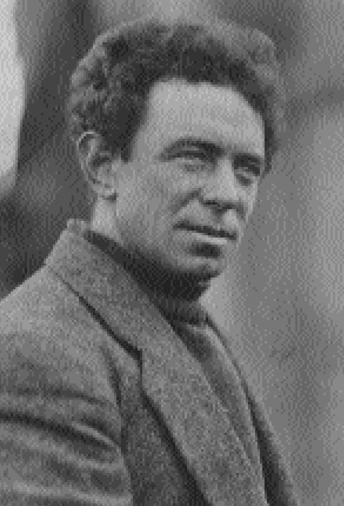
“Frank Hurley”
“Hurley, our photographer, is an interesting character. He is Australian—very Australian & was photographer on Sir Douglas Mawson's recent Australasian Antarctic expedition to Adelie Land. As a photographer he excels & I doubt if his work could be equalled even by Ponting.…” ( Lees, diary)
“H is a marvel,” Worsley wrote towards the end of January. “[W]ith cheerful Australian profanity he perambulates alone aloft & everywhere, in the most dangerous & slippery places he can find, content & happy at all times but cursing so if he can get a good or novel picture. Stands bare & hair waving in the wind, where we are gloved & helmeted, he snaps his snaps or winds his handle turning out curses of delight & pictures of Life by the fathom.”
Once the Endurance became trapped, Hurley turned his camera to both the domestic life of the ship, and to the vision of it improbably suspended in the protean world of the ice. On duty at all hours of the day or night, sometimes arising at midnight to take photographs, he was keenly sensitive to the variegated and ever-changing play of light, continually elated at this spectacle of sky and ice and shadows.
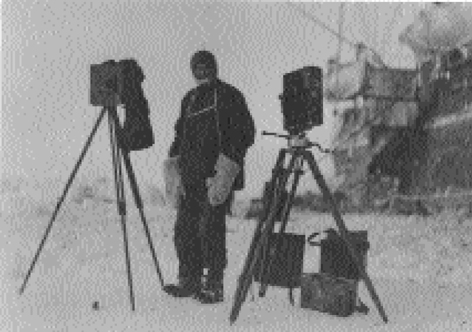
Hurley
This photograph shows Hurley with both his still and his movie film cameras.
The cold temperatures increased the difficulties of every aspect of his work. To guard against the condensation that developed on his cameras when they were carried from the outside into the ship's warmer interior, Hurley made a storage cupboard on deck, where they could be kept at a fairly constant temperature.
“Nevertheless,” he wrote, “my apparatus needs attention every occasion it is taken out. Lubricating with petroleum etc., especially the cine. The film becoming extremely brittle.”
The processing, too, was conducted under less than ideal conditions.
“Darkroom work rendered extremely difficult by the low temperatures it being –13 outside,” he wrote towards the end of the winter. “The darkroom situated abaft the engine room is raised to above freezing point by a primus stove.…Washing [plates] is troublesome as the tank must be kept warm or the plates become an enclosure in an ice block. After several changes [of water] I place them in a rack in Sir E's Cabin—which is generally at an equable temperature. The Dry plates are all spotted & carefully indexed. Development is a source of annoyance to the fingers which split & crack around the nails in a painful manner.”
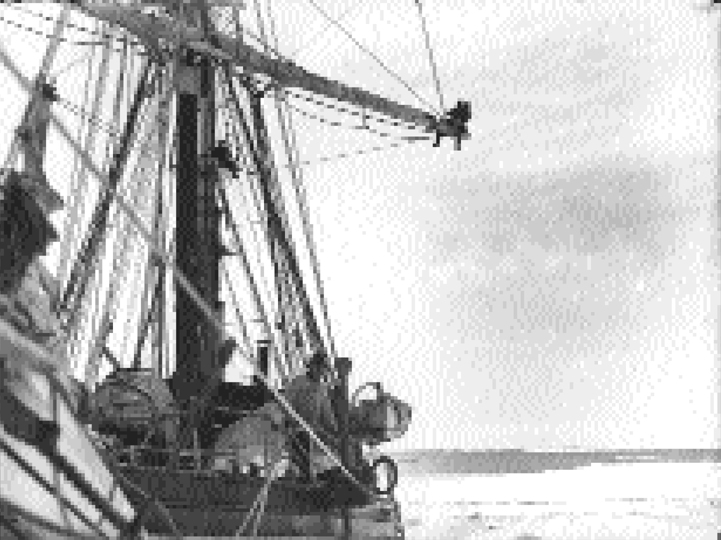
Hurley aloft, Shackleton on deck
“Hurley was very busy with his camera and cinematograph machine, getting photos. He … fixed his machine on the extreme end of the top-gallant yard, to get panoramic views of the Pack.” (Macklin, diary)
Elsewhere he dryly notes “difficulty in obtaining sufficient water for washing operations.” All water, of course, had to be melted from blocks of ice.
April, in Shackleton's words, “was not uneventful.” Twice that month, the ice groaned around the ship, nipping her sides and causing the Endurance to vibrate slightly; it was the first palpable hint of the pack's deadly potential.
On the last day of the month, the ship's company were entertained by a rare spectacle. Shackleton and Worsley took a break from inspecting Lees's motor sledge and, inspired by some private whimsy, danced together in a stately waltz on the ice, while a member of the crew whistled “The Policeman's Holiday.” Lees's record of this improbable event was perceptive.
“That is Sir Ernest all over,” he wrote of the famous polar explorer's courtly gyrations. “He is always able to keep his troubles under and show a bold front. His unfailing cheeriness means a lot to a band of disappointed explorers like ourselves. In spite of his own great disappointment and we all know that is disasterous enough, he never appears to be anything but the acme of good humour and hopefulness. He is one of the greatest optimists living.… [H]e enters the lists every time with the spirit that every prize fighter enters the ring with.”

Hurley with camera
In June began the darkest part of the year. Save for the moon and a couple of hours of dim twilight at noon, there was no light. The temperature had dropped to the minus twenties and leads of water that had been clear only the day before became encrusted with six inches of ice overnight.
During this darkening period of dead calm, on June 9, heavy pressure broke. Some 500 yards from the ship, colossal plates of ice screamed and groaned against each other, exploding now and then with the muffled boom of distant artillery. Guided by hand lanterns, several men went out to observe the pressure as it piled huge blocks of ice, each many tons in weight, one atop the other, to a height of fifteen feet. The roaring continued through June 12, but the weather thickened, making more excursions impossible.
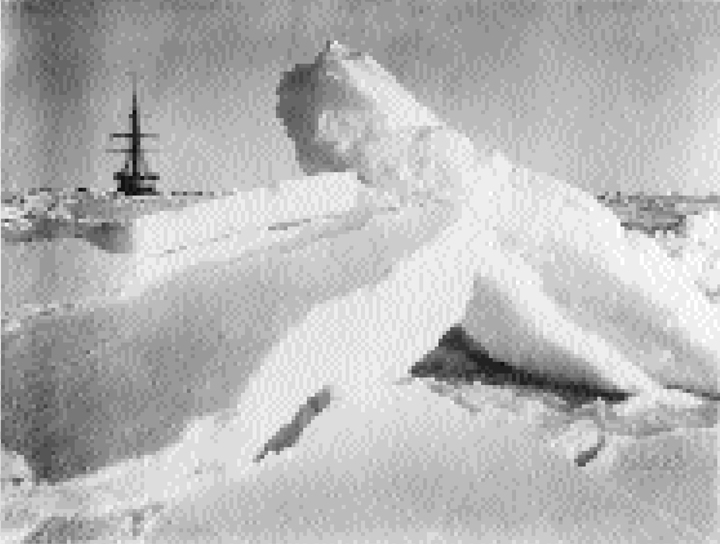
Endurance in the Ice, 4 April 1915
“During the night of the 3rd we heard the ice grinding to the eastward, and in the morning we saw that young ice was rafted 8 to 10 ft. high in places. This was the first murmur of the danger that was to reach menacing proportions in later months.” ( Shackleton, South)
By June 15, all was calm again, and a race between dog teams was planned for the following day. The rollicking Dog Derby was a much welcome diversion after the ominous bout of pressure. In the twilight, the track was lit with hurricane lamps, and Shackleton himself acted as starter. He had given all hands the day off, and several of the able seamen entered into the spirit of the day by appearing dressed as bookies, although, as Hurley remarked, “as they look a trifle ‘disreputable,' their odds are not accepted.” With a flutter of handkerchiefs and cheers of encouragement, the dogs were off. Wild's team won, having covered the 700 yards in two minutes and sixteen seconds.
Only days later, yet another holiday was festively observed. June 22, Midwinter's Day, was commemorated with a feast and after-dinner entertainment. Hurley erected a stage decorated with bunting and set up acetylene footlights. An overture, “Discord Fantasia in four flats,” was performed by the Billabong Band, while James offered the most successful sketch of the evening, appearing as Herr Professor von Schopenbaum to give a Dissertation on The Calorie.
“Very witty & truly unintelligible,” Worsley wrote appreciatively. After midnight, the company sang “God Save the King” and wished one another well for the days ahead.
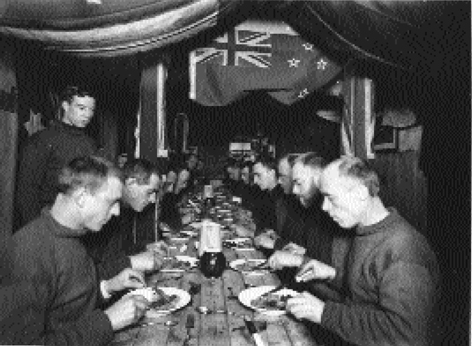
Midwinter Dinner, 22 June 1915
“Dinner at 6-0 Roast Pork stewed apples & preserves peas with plum pudding.” (McNish, diary)
“From within the cosiness of the Ritz, it is hard to imagine we are drifting, frozen and solid in a sea of pack ice in the heart of the Weddell Sea,” Hurley wrote. Yet, he added, “I often wonder what is to become of it all.” His words imply that certain possibilities were not discussed, even as the creaking, booming sounds of distant pressure were carried through the crisp air to the stricken ship.
By the end of June, the Endurance had drifted more than 670 miles since her entrapment, and each mile brought her closer to the open water beyond the pack, and to the prospect of freedom. The hours of daylight were now increasing appreciably, and the men could look forward to seeing the sun again. Dog exercising became easier with the returning light, and concerts and lantern slide lectures continued as entertainment.
After several days of clear calm, a strong gale arose on July 12 and grew into a full-blown blizzard on July 13. The ship quivered as the pressure ground around her. Wild and Worsley were visiting with Shackleton in his cabin.
“The wind howled in the rigging,” Worsley recalled, “and I couldn't help thinking that it was making just the sort of sound that you would expect a human being to utter if he were in fear of being murdered.” In the lulls of the wind, the three men listened to the grinding of ice against the ship's sides. It was now that Shackleton shared what he had known for many months.
“The ship can't live in this, Skipper,” he said, pausing in his restless march up and down the small cabin. “You had better make up your mind that it is only a matter of time. It may be a few months, and it may be only a question of weeks, or even days … but what the ice gets, the ice keeps.”
Worsley reports that he received this news with despair and incredulity, and it is difficult to tell whether, in the few remaining months ahead, he regarded the loss of his ship as truly inevitable. He was, in his way, a more incurable optimist than Shackleton.
But Shackleton knew, and what Shackleton knew Wild took on faith. The men left their meeting and went back to the old routine, betraying nothing.
“It is bitterly cold and no one is allowed away from the ship,” Hurley wrote the following day. “We are not anxious however. The alluring cosiness of the Ritz being too enticing.” On the opposite side of the Ritz, however, McNish was writing in his diary from a very different perspective.
“We had a slight shock last night or this morning early,” the old seaman wrote. “At least there was a noise under the bottom aft the same as if the ice had broken up
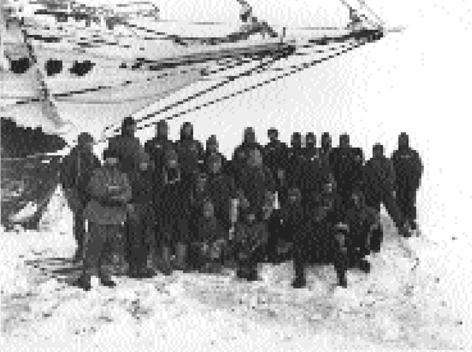
Crew of the Endurance
“The keel is jamed & there is no way in clearing it but at present everything is quiet & we are freezing in again but there is a lot of craks around the floe Hurley took a groupe of all hands on Wednesday.” (McNish, diary)
I jumped on deck but we could not find out what it was the Boss thinks it was a whale but I think different.”
On July 21, amid heavy pressure, Shackleton ordered the decks cleared in the event the dogs had to be evacuated from the breaking ice; hourly watches were set throughout the night. The following day, Worsley rushed into the Ritz to announce that the ice had cracked some thirty yards ahead of them. All hands donned Burberrys and head gear and hurried outside. Some 300 yards off the port bow, colossal pressure was piling up massive blocks of ice as if they were sugar cubes. The sledges were brought off the floe, and Shackleton, Wild, and Worsley each took a four-hour watch during the night; Shackleton's daily sleep was now down to about three hours in the afternoon.
Over the ensuing days, emergency rations were stored with the sledges, ready for use, and on August 1, the dogs were hastily brought on board shortly before a wave of pressure caused blocks of ice to flatten the kennels and grind them to powder between the jaws of opening and closing floes. A large lump of ice that had become jammed under the rudder was maneuvered away, but damage had already been done.
As the gale raged, the Endurance was shaken like a toy by the pressure, knocked to her port side and nipped forward, backward, and side to side. Soundlessly she resisted, but when this onslaught ceased, a massive new pressure compressed her sides, causing her to strain and groan until her beams actually buckled.

At close of Winter. August 1, 1915
“Our position became extremely perilous, as huge blocks were rafting and tumbling over themselves in their apparent eagerness to hurl their force against our walls.” ( Hurley, diary)
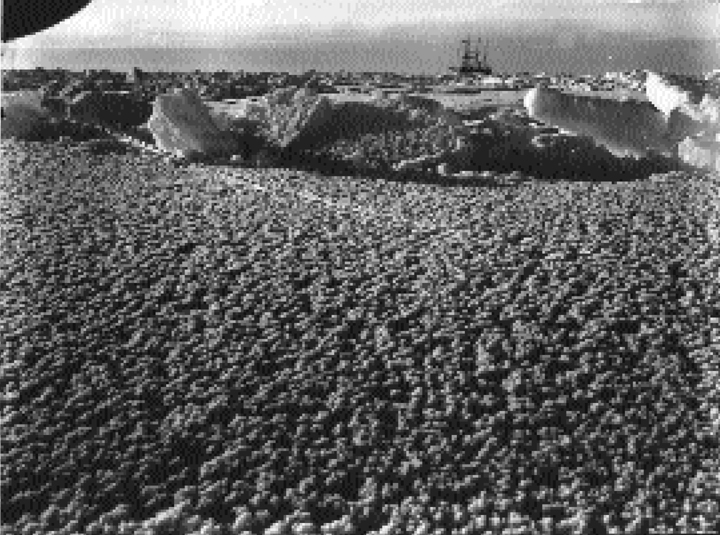
New leads covered with ice flowers—early spring
“Took color camera to lead this morning amidst similar gorgeous conditions of yesterday & more glorified perhaps for a fine crop of ice flowers springing up on the lead & they, illumined by the morning sun, resembled a field of pink carnations.” ( Hurley, diary)
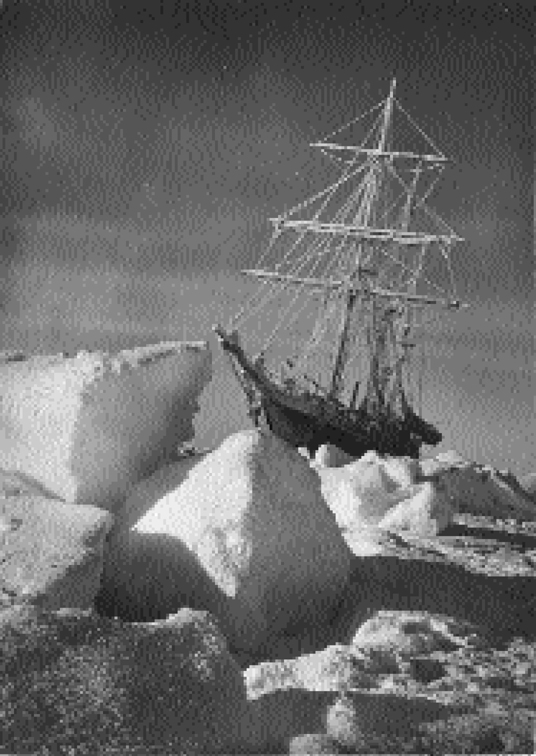
The Return of the Sun
“Extremely heavy precipitation of rime crystals during the night, our rigging being heavily encrusted, some of the ropes being over 3? in diameter, but the effect is beautiful.” ( Hurley, diary)
“Everyone got our warm clothes put up in as small a bundle as possible,” wrote McNish that night. “I have placed my Loved ones fotos inside Bible we got presented with from Queen Alexandra & put them in my bag.”
Around the ship, blocks of ice caught between moving floes jumped like cherrystones squeezed between a gigantic thumb and finger. The wind blew hard all night, then dropped the following day, when all became quiet, save for an occasional distant rumbling. Shackleton calculated that the gale had caused the ship to drift as much as thirty-seven miles north in the three days it had raged.
Throughout this ordeal, Lees, recovering from sciatica, had lain alone in Marston's bunk, to which he had been moved at his own request. From this deck cabin, he had listened to the rumbling and upheaval of the ice and the tramping of the watchman's feet overhead. While the ship rocked and trembled, he held his breath, waiting to see how she would settle. On August 9, he ventured outside for the first time in three weeks, thinner and greatly weakened.
Outside, an amazing sight awaited him: The Endurance lay in an entirely new landscape. All the old, familiar landmarks were gone or dislocated, and the ship appeared to have been forced forward a hundred yards through ice six feet thick.
“How this little ship survived amidst such a mighty upheaval is almost inconceivable,” he wrote. “As it is she lies very much on her side with her rudder cracked & surrounded by great piles of ice blocks rising as high as her decks. We used to step out onto a comparatively level floe, now, on stepping outside, one finds oneself immediately in a labyrinth of ice blocks & gullies.”

The pups (by Sally and Samson)
Left to right, Nell, Toby, Roger, and Nelson. “In addition to their foster-father, Crean, the pups adopted Amundsen. They tyrannized over him most unmercifully. It was a common sight to see him, the biggest dog in the pack, sitting out in the cold with an air of philosophic resignation while a corpulent pup occupied the entrance to his dogloo.” ( Shackleton, South)
Yet the Endurance had survived, and the pressure had vanished. Gradually, the weather cleared, and as the winter drew to a close the sun tentatively returned, shining for several hours each day. Spirits rose as old routines were resumed. The greatest amusement was provided by Crean, who was undertaking to train the puppies he had nursed so tenderly. On their first day in harness his fat charges (now weighing some seventy pounds each) lay on their backs, waved their legs in the air, and squealed.
“Their howls and roars of terror resound for miles around,” wrote Worsley, one of the many bystanders entertained by the spectacle. “They pursue a devious and uncertain course.… [T]hough each pup possesses the voice of Jeremiah, his paunch is the paunch of Falstaff, and they flounder puff and pant along through the snow until to their joy they are headed for the ship and for a few minutes drag the hated sledge almost as fast as a dog team. Crean expects in two more lessons to teach them to drag a sledge unaided by an old leader. They will then be formally promoted from ‘Purps' to ‘Dags.'”
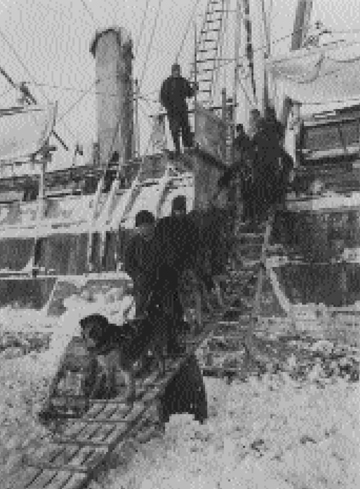
Taking the dogs out for exercise
After severe ice pressure forced the evacuation of the dogs from the dogloos to the ship, they were disembarked every other day for exercise.
The rest of August passed without incident. Glorious sunrises tinted the ice pink, and delicate ice formations that formed on new leads of water resembled fields of carnations. On the night of August 27, with the temperature at –24°, Hurley set up twenty flashes behind hummocks of ice around the stricken Endurance.
“Half blinded after the successive flashes,” he recorded, “I lost my bearings amidst hummocks, bumping shins against projecting ice points & stumbling into deep snow drifts.” But the image he secured was haunting: the rime-crusted Endurance breasting the ice, a spectral ship, both gallant and vulnerable.
Spring was on the way. The men began to speculate whether on breaking out they would immediately return to Vahsel Bay and embark upon the transcontinental crossing or would return to civilization first for provisions. Bets were placed on
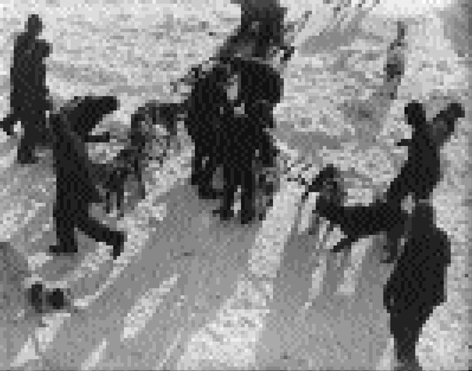
Harnessing the dogs
“The harness is similar to that used by Amundsen, consisting of a padded collar attached to traces, which fit over the dog & is secured by a belly band.” ( Hurley, diary)

Dog team being exercised over pressure ice. “A good leader will ferret out the best track through rough or broken country, will not allow fights in the team, or indulge in any capricious antics.…A team of nine dogs can haul about 1,000 lbs.” ( Hurley, diary)
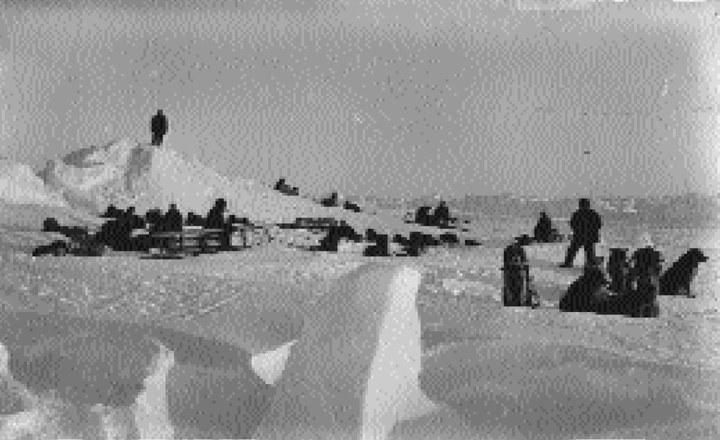
The dog teams
“One team appears to suffer from heart disease, their owner evidently expecting the whole creation to hold their breath as they pass by. A vulgar person…had the indescribable effrontery to let go his horrid war cry whilst riding on the imposing conveyance drawn by these dignified but nervous creatures, and was reproved by their indignant owner pointing out to the Vulgar Person into what terror his voice had thrown the beautiful but highly strung and delicate doggies.” ( Worsley, diary)
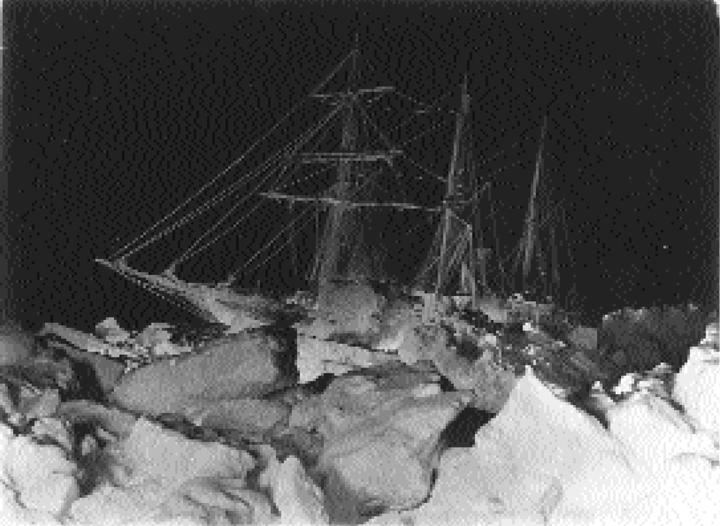
The Endurance at Night
August 27, 1915: “During night take flashlight of ship beset by pressure. This necessitated some 20 flashes, one behind each salient pressure hummock, no less than 10 of the flashes being required to satisfactorily illuminate the ship herself. Half blinded after the successive flashes, I lost my bearings amidst hummocks, bumping shins against projecting ice points & stumbling into deep snow drifts.” ( Hurley, diary) the “breakout” date: McIlroy hazarded November 3; Lees, ever pessimistic, thought it unlikely to occur before mid-February; Shackleton said he believed it would be October 2.

The pressure returned on the night of August 26. For several days it presented no immediate danger, but in the early hours of September 2, it took hold of the Endurance with a vengeance.
“On the night of 2nd September, I had one of the most startling moments of my life,” Bakewell recalled. “I was lying in my bunk, when… the ship literally jumped into the air and settled on its beam.” The iron plates in the engine room buckled, door frames were distorted, beams bulged as if they would splinter. The Endurance struggled and groaned as if in mortal pain.
“There were times when we thought it was not possible the ship would stand it,” wrote McNish. He had watched the three-foot-square iron plates bulge up one and a half inches. But the pressure passed, and a week later McNish was busy building a wheelhouse that would protect the steersman from the elements, once they were under way again. Meanwhile, Shackleton had privately calculated that they were 250 miles away from the nearest known land, and more than 500 from the nearest outpost of civilization.

The floe cracking up, 29
“My Birthday & I sincerely hope to spend my next one at Home there is a fine breeze a Southerly wind at present & there is a crack in the floe about 10 yards ahead of the ship if the wind holds in this direction for a while it will open the ice up.” (McNish, diary)
September unfolded without further crises, although the roar of distant pressure was seldom absent, and the floes around the ship were in constant movement. The men played football on the shifting floes, exercised the dogs, and hunted for seals, which were returning with the promise of spring. A light snowfall one night left the ship shimmering as if tinselled, and the ice sparkling as though covered with diamonds.
On the afternoon of September 20, the most severe bout of pressure encountered so far shook the Endurance from mast to keel, so that it seemed her sides would have to collapse. But an hour later, the pressure subsided.
It was October 1915. On the third day of the month, heavy pressure broke ten yards from the ship. The Endurance was by now as frozen onto the blocks of ice beneath her, in Lees's words, “as any rock in a glacier.” During a brief opening of the ice around the ship, the men had gazed down into the open water by her side and seen, spotlit by the penetrating sun, great azure-blue conglomerates of ice lying as much as forty feet below the surface. Frost smoke rose from out of the open leads, red tinged at sunrise so that the ice seemed at times to be aflame.
High temperatures—up to 29°— on the 10th produced a general, mushy thaw. The men started packing up the Ritz, and on the 13th returned to their original quarters. The following night, the floe on which the Endurance was lodged suddenly split; the ice slithered out from under the ship, and she floated on an even keel, in clear water for the first time in nine months. Impelled by the gale that had arisen, she swung in the narrow lead, and actually drove 100 yards ahead. Then the ice closed on her, and she was fast again.

An hour later
Over the following days, while the pack was still loose, Shackleton had the sails set, and an effort was made to force the ship ahead, but with no success. Shortly after tea on the 16th, after several loud bumps against her sides, the Endurance began to rise above the ice, squeezed up between the floes—then was abruptly thrown on her port side, listing some 30 degrees. Kennels, dogs, sledges, stores were all thrown across the deck into a tangled, howling heap. Then, around nine in the evening, the pressure subsided, and the ship returned to an even keel.
On the 19th, Shackleton had the boilers filled and fires banked in readiness, and ice debris was cleared from around the rudder and the ship. McNish was commissioned to build a small punt, with a view to navigating the leads and channels. Light snow fell off and on throughout the day, and in the evening a killer whale appeared in the tiny pool around the ship, his huge body seen plainly through the calm, clear water as he cruised, leisurely, up and down beside the stricken ship.
In the following days, the roar of pressure was continually in the men's ears, likened, by James, to the sound of London traffic when one is sitting quietly in a park. Sea watches were resumed, while the ice floes ground around the ship. The Endurance was now shaken and beaten constantly, but the men had become so accustomed to the disruptions that they were indifferent to all but the most violent upheavals.
“Personally,” wrote Worsley, “I've got tired of alarm against which we can do absolutely nothing.” The dogs, restless from lack of exercise, howled and whimpered as the ominous sounds arose from the ice.
“The ice is opening up a bit, thank goodness,” Lees wrote on the 23rd. “Things look a little more hopeful.” After a dinner of salt beef, carrots, mashed potatoes, and Banbury tarts, the traditional Saturday night toast was drunk to “Sweethearts and Wives.” There was now as much as twenty-two hours of daylight each day.
On Sunday, October 24, the men watched the pressure move across the ice throughout the otherwise uneventful day. In the evening after dinner, Lees had just put “The Wearing of the Green” on the gramophone when a terrific crash shook the ship like an earthquake, causing her to shiver and list over about 8 degrees to starboard. The men finished listening to the tune, then went up on deck, according to Lees, “to see if anything unusual had occurred.” They found Shackleton on the ice with a grave face, examining the ship's sternpost. Caught between three separate pressure ridges across her bow and both sides, the Endurance had been twisted and bent by their onslaught. The sternpost had been almost wrenched out and was leaking dangerously.
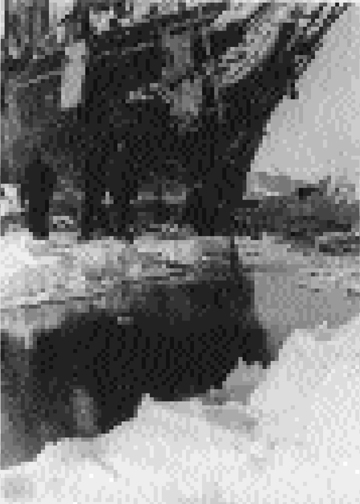
“Early yesterday afternoon a crack formed along the snow filled trench, 2ft. broad, whose formation first started on Aug. 27th… This new crack was 8 ins. wide at 6.0 p.m.: at 9.0 it suddenly broadened another 2 ft…A big change however took place in the afternoon. Between half past two and half past three the innocent crack became a lead 10yds. broad.” ( Wordie, diary)
Immediately, Shackleton gave the order to raise steam for the engine room pumps. With water rising rapidly, the engineers, Rickinson and Kerr, desperately piled on fuel—coal, blubber, wood—racing to raise steam before the rising water could put the fires out. Within two hours they had the pump working, but they soon saw that it could not cope with the inrush of water. Hudson, Greenstreet, and Worsley disappeared into the bunkers, where the coal was stored, to clear the bilge pump, which had been jammed with ice all winter. Digging through the coal in the darkness, now underneath icy black water, they succeeded by early morning in clearing the pump with a blowtorch, and it was worked in shifts throughout the night.

The Endurance keeling over
“Suddenly the floe on the port side cracked and huge pieces of ice shot up from under the port bilge. Within a few seconds the ship heeled over until she had a list of thirty degrees to port.” ( Shackleton, South)
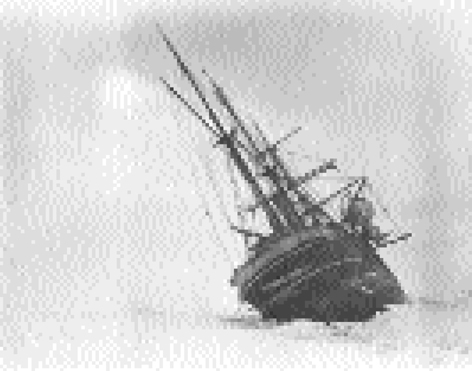
Port list
“At 4.45 p.m. slowly but surely the ship heeled right over to port: all sorts of weird noises came up from the engine room, and then with a rush all the unsecured dog kennels slid down to leeward.… She took a list of fully 30° in 5 seconds. It's an ill wind that blows nobody good—Hurley was immediately out on the floe photographing the ship from every possible position.” ( Wordie, diary)
On the floes, the men took turns away from the pumps to dig desperate, ineffectual trenches around their dying ship. Inside, the sound of running water and the clickety-clack of the pumps rose above the creaking of the ship's tortured timbers. Down in the engine room, Chippy McNish was working with fierce concentration, building a cofferdam across the stern to contain the leak. Crouched in the water that rose at times to his waist, he toiled unremittingly through the night. Meanwhile, all other hands were feverishly gathering together stores, clothing, sledging gear, and dog food in preparation for disembarking onto the ice. Worsley went through the ship's library, tearing maps, charts, even photographs of possible landfalls out of the books they would have to leave behind. Marston, Lees, and James worked in the after hold removing supplies while the sound of rushing water resounded beneath them and the ship's beams cracked and exploded like pistol shots overhead. On the following morning, Hurley visited McNish, who had labored without rest on the cofferdam, and found that the leak had been checked.
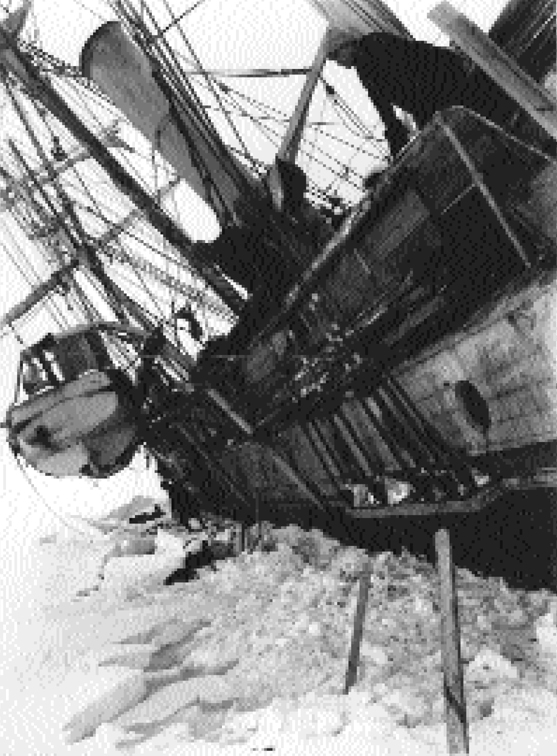
The port side of the ship. 19 October 1915
Shackleton, shown leaning over the side, called this photograph “The Beginning of the End.”
“The water is level with the engine room floor but it is being easily kept under,” he wrote. “We still hope to bring our staunch little craft through.”
It was a cloudy, misty day. Pressure could be seen and heard all around, raising the ice to unimagined heights, but the ship herself was quiet. McNish still toiled on in the engine room, filling with concrete the space between the two bulkheads he had built and caulking them with strips of torn blankets.
“Things look a bit more promising now,” wrote Wordie later in the day. “The sun is shining for one thing, and we are hoping the cofferdam is a success.” From four in the afternoon until midnight, the pumps were worked continuously, until the incoming water was under control. All stores were shifted from the stern, so as to raise it above the water when the ice opened and allowed the ship to float again. Only the bilge pump was worked throughout the night, and the exhausted men snatched minutes of sleep despite the faint whispers of distress that arose from the ship. Chippy McNish was still below working on the cofferdam.
The 26th dawned clear, save for gentle, fleecy clouds, and full of sunshine that glinted with sparkling beauty off the ice. With the roar of pressure in his ears, Shackleton was struck by the surreal incongruity between the serene beauty of the day and the death throes of his ship; from the bridge, he had seen how the pressure was actually bending her like a bow, and it had seemed to Worsley that she was gasping to draw breath. She was leaking badly again, and the exhausted men worked the pumps in shifts—fifteen minutes on, fifteen minutes off—half asleep on their feet. At nine in the evening, Shackleton ordered the lifeboats and sledges lowered to a stable floe. The leak slowed, stanched to some degree by movement of the ice.
“All hope is not given up yet for saving the ship,” wrote Hurley. Nevertheless, he took the precaution of packing his photo album in waterproof cloth —”it being the only record of my work I shall be able to take, should we be compelled to take to the floe.” The Endurance had quieted, but that evening an unsettling incident occurred while several sailors were on deck. A band of eight emperor penguins solemnly approached, an unusually large number to be travelling together. Intently regarding the ship for some moments, they threw back their heads and emitted an eerie, soulful cry.
“I myself must confess that I have never, either before or since, heard them make any sound similar to the sinister wailings they moaned that day,” wrote Worsley. “I cannot explain the incident.” It was as if the emperors had sung the ship's dirge. McLeod, the most superstitious of the seamen, turned to Macklin and said, “Do you hear that? We'll none of us get back to our homes again.”
They continued to work the pumps throughout the night and morning. October 27 dawned clear and bright, but with a temperature of –8.5°. The ice had not ceased to roar, but the men were now too tired to notice. The pumps were being worked faster and faster, and someone was actually singing a chanty to their beat. The pressure increased throughout the day and at 4 p.m., reached its height. With a blow, the ship was knocked stern up, while a moving floe ripped away her rudder and sternpost; then the floe relaxed, and the beaten Endurance sank a little in the water. The decks began to break upward, and as the keel was ripped out, the water poured in.
It was all up. At 5 p.m., Shackleton gave the order to abandon ship. The dogs were evacuated down canvas chutes, and the supplies that had been readied were lowered to the ice. Shackleton, standing on the quivering deck, looked down the engine-room skylight to see the engines dropping sideways as the stays and plates gave way.
“Everything has come too quickly to make us pause to regret,” wrote Wordie. “That will come in the future.” The men were numbed by fatigue and the suddenness with which the end had come. None of the diaries evinces much concern for personal safety; all emotion was expended on the death of the ship. From her first entrance into the pack, they had cheered her fighting spirit; “noble,” “gallant,” “brave,” “our stout little ship”— these had been the proud words with which they had characterized her. It was her maiden journey—she was, in Hurley's words, “a bride of the sea.”
“It is hard to write what I feel,” wrote Shackleton. “To a sailor his ship is more than a floating home. … Now, straining and groaning, her timbers cracking and her wounds gaping, she is slowly giving up her sentient life at the very outset of her career.”
Before departing for good, Hurley had taken one last look around their old quarters in the Ritz, already a foot deep in water. The sound of beams splintering in the darkness was alarming, and he abruptly left. But of all sights and sounds, it was the clock still ticking comfortably in the cozy wardroom as the water rose that perhaps most unnerved him.
Shackleton was the last to leave. He hoisted the blue ensign, and the men on the ice gave three hearty cheers. By a cruel accident, the ship's emergency light had switched on, and as its circuit was intermittently broken, the Endurance seemed to all hands to bid them a final, sad, flickering farewell.
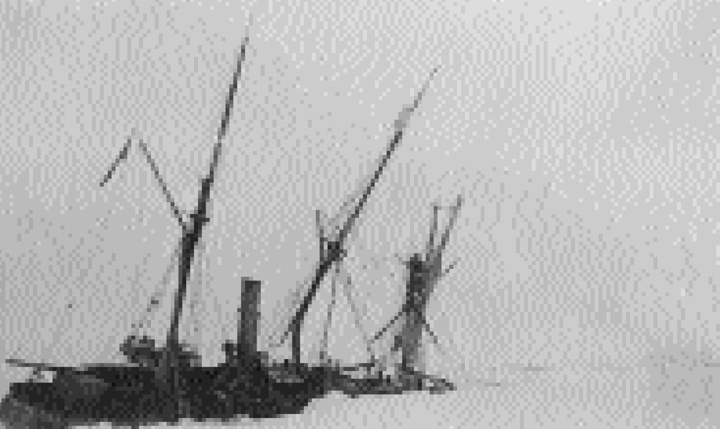
The wreck of the Endurance
“The floes are in a state of agitation throughout the day, and in consequence, I had the cinema trained on the ship the whole time. I secured the unique film of the mast collapsing. Toward evening, as though conscious of having achieved its purpose, the floes were quiescent again.” ( Hurley, diary)
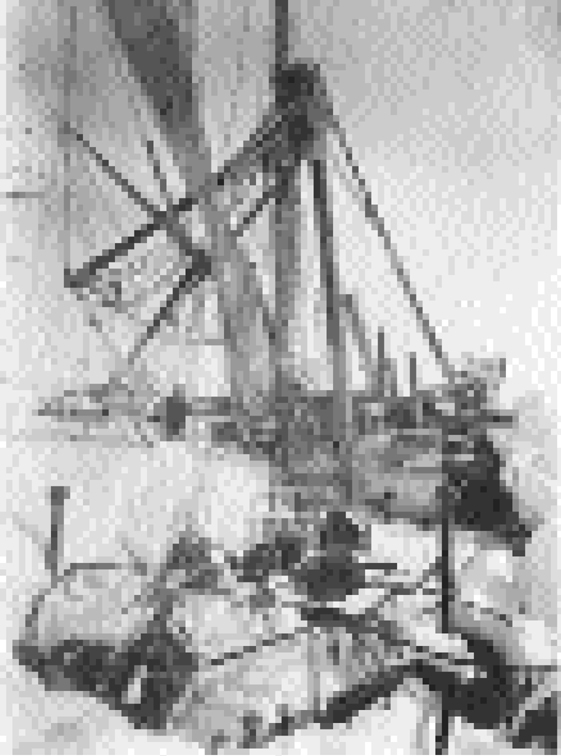
The wreck of the Endurance
“Awful calamity that has overtaken the ship that has been our home for over 12 months.…We are homeless & adrift on the sea ice.” ( Hurley, diary)

Shackleton's caption for this photograph in South was “The End.”